Our dock sits a good 200 feet from the nearest outlet, and for years that meant walking down in the dark with a flashlight clamped between my teeth. Then I discovered how good solar dock lighting ideas have gotten, and honestly? I wish I had done it sooner. Modern solar fixtures charge all day on the pilings and deck, then give you a full evening of warm, steady light with zero trenching, zero conduit, and zero electrician bills. In this post I am sharing the 15 setups that actually work on the water: the edge lights that keep everyone on the boards, the task lights that make tying up and cleaning fish less fumbly, and the pretty glows that turn the dock into our favorite seat at dusk. Everything here runs on the sun, shrugs off splashes, and layers together the way I layer light everywhere else — a safe base first, useful task light second, and a little sparkle on top.

1. Flush-Mount Solar Dock Lighting Ideas for Safe Edges
If you only do one thing on this list, make it this one. Flush-mount solar deck lights sit down inside the deck boards, so nothing sticks up to catch a bare toe or a dock line, and they trace both edges of the walkway like a quiet runway. I drill a snug hole with a hole saw at each spot, drop the fixture in, and let the little solar panel on top do the rest. Space them every 6 to 8 feet and stagger the two sides slightly so the path reads clearly without looking like an airport. In my experience, warm white at around 2700 to 3000K is the sweet spot on the water — bright enough to see the board edges and any coiled rope, soft enough that it never blinds you when you step off a dark boat. Look for housings rated for foot traffic and full weather exposure, because these take spray, rain, and the occasional dropped tackle box. Once they are in, you will wonder how anyone walked the dock without them.
Suggested budget range: $40 – $90.

2. Solar Post Cap Lights on Every Piling
Pilings are the tallest thing on most docks, which makes them perfect little lighthouses. Solar post cap lights slide over the top of each piling or screw onto a flat cap, and they mark the footprint of the dock so clearly that guests arriving by boat after dark can read the whole outline from the water. I fit them on every piling along the outer edge and the slip, and the effect from shore looks like the dock is floating on a string of lanterns. Measure your posts before ordering — caps come sized for standard 4×4 and 6×6 posts, plus round-piling adapters — and choose a snug fit so wind and bumps never work them loose. Because the panels face straight up, these charge better than almost anything else on the dock. If you want more style ideas for post-top lighting around the yard too, my roundup of solar post light ideas covers fences and decks as well. Keep the caps in the same warm color family as your edge lights so the whole dock reads as one plan.
Suggested budget range: $35 – $80.

3. Solar Piling Lights Mounted at Knee Height
Caps light the silhouette, but piling lights mounted lower do the close-up work. I screw compact solar fixtures to the inside face of the pilings, about 18 to 24 inches above the deck, where their light pools on the boards right where people step on and off the boat. That knee-height placement is the trick: high enough to spread a useful circle of light, low enough to stay out of your eyes. These are wonderful at the boarding spot and beside the swim ladder, where wet feet and dark water meet. Pick models with a replaceable battery if you can, because a fixture that lets you swap the cell in year three will outlast sealed throwaway versions by seasons. Stainless or heavy-duty marine plastic hardware matters here — cheap screws rust-stain the wood within one summer. Aim the light slightly downward rather than straight out, and the glare off the water disappears while the deck stays bright. Two per boarding zone is plenty; more than that starts to feel like a parking lot.
Suggested budget range: $30 – $70.

4. Underwater Solar Lights for a Glowing Waterline
This is the one that makes neighbors slow their boats down to look. Submersible solar lights sit just below the surface on weighted bases or clamped to the pilings, and at night the water around the dock glows a soft green-gold that draws in minnows, then bigger fish, then everyone with a fishing rod. Most kits run a cable from the underwater light up to a solar panel that mounts on the deck or piling top, so the panel stays in full sun while the light does its work below. Keep the glow subtle — one light per slip or swimming corner is plenty, and aim for the gentler tones rather than bright white, which can look harsh and spook the fish you are trying to attract. If you love this effect, my guide to pond lighting ideas uses the same tricks in garden water. Rinse the lenses every few weeks in summer; a film of algae dims them faster than anything, and a quick wipe brings the magic right back.
Suggested budget range: $45 – $110.

5. Solar Step Lights for Dock Stairs and Ramps
Every dock has one awkward level change — the step down to the floating section, the ramp to the swim platform, the two stairs up to the boathouse deck — and that is exactly where someone eventually trips in the dark. Little solar step lights fix it for good. I mount one on the riser or the side stringer of every step, so each tread edge catches its own line of light. They are small, cheap, and sip so little power that even the shadier side of our ramp stays lit until midnight. For ramps, angle matters: point the light across the walking surface rather than down it, and the texture of the boards shows up, which helps wet feet grip. Choose housings you can step near without crushing — recessed or heavy cast styles survive dock life best. This is the least glamorous idea on the list and the one I would never give up. Falls on wet stairs are how dock seasons get ruined, and twenty minutes with a screwdriver makes them a non-issue.
Suggested budget range: $20 – $50.

6. Motion-Sensor Solar Lights at the Dock Entrance
The start of our dock is where the yard goes dark and the boards begin, and it is also where raccoons hold their nightly meetings. A motion-sensor solar light mounted on the first piling or the boathouse post covers both problems. It stays off or glows at a low idle until someone walks up, then brightens for 30 seconds or so — enough to find the cleats, the cooler, and the light switches of life without flooding the whole shoreline in light all night. That on-demand brightness also stretches the battery through cloudy stretches, because the fixture is not burning full power for eight straight hours. Mount it 6 to 7 feet high and aim the sensor along the approach path, not across the water, or every passing wake and jumping fish will set it off. Honestly, the gentle brighten as you arrive feels like the dock is saying hello. It is also a quiet bit of security: an unexpected full-bright light tends to move along both the four-legged and two-legged visitors.
Suggested budget range: $25 – $60.
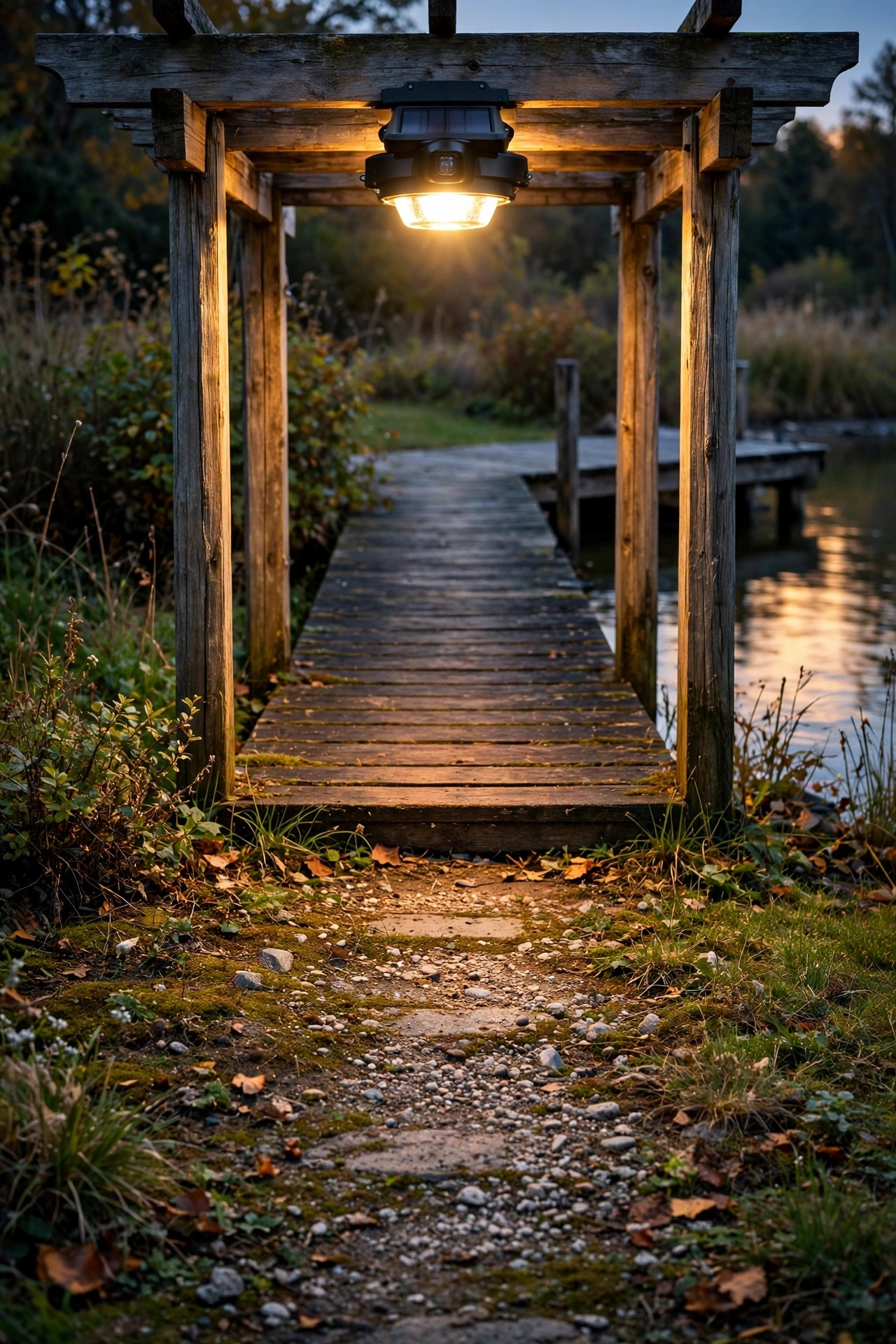
7. Solar Rope Light Along the Dock Edge
For pure pretty, nothing beats a rope of warm light tracing the dock outline. Solar rope lights come on a reel with a small panel, and I run them under the lip of the deck edge or along the rub rail, clipped every couple of feet so the line stays smooth and never sags into the water. From across the cove, the whole dock draws itself in one golden stroke, and from on board it gives you a constant, gentle reference for where the edge is without any glare at all. It is more atmosphere than work light, so pair it with the flush-mount edge lights from idea one rather than asking it to do the safety job alone. Keep the solar panel and the control box up on a piling where they get real sun and stay out of the splash zone, and coil any extra length neatly instead of letting it dangle. On holiday weekends I will admit I love this one most — the reflection doubles it, and the dock looks dressed up for free.
Suggested budget range: $20 – $45.

8. Solar Lanterns for the Dock Table and Seating Corner
Every dock deserves one spot that feels like a room, and ours is the little seating corner at the end with two chairs and a side table. Solar lanterns are what make it work: they charge on the table all day, then glow through the evening like candlelight that never blows out. I mix two or three styles — a couple of hanging lanterns from the piling tops and one sturdier table lantern with a handle — all in the same warm tone so it looks collected rather than cluttered. Flameless is non-negotiable on a wooden dock over dry summer boards, and solar lanterns give you that safety with a better glow than battery candles. When storms roll in, I gather them into the dock box in thirty seconds, which is another quiet advantage of keeping this layer portable. Guests always end up in this corner after dinner, life jackets off, feet up, watching the underwater light do its thing. That is the whole point of a dock, as far as I am concerned.
Suggested budget range: $25 – $65.
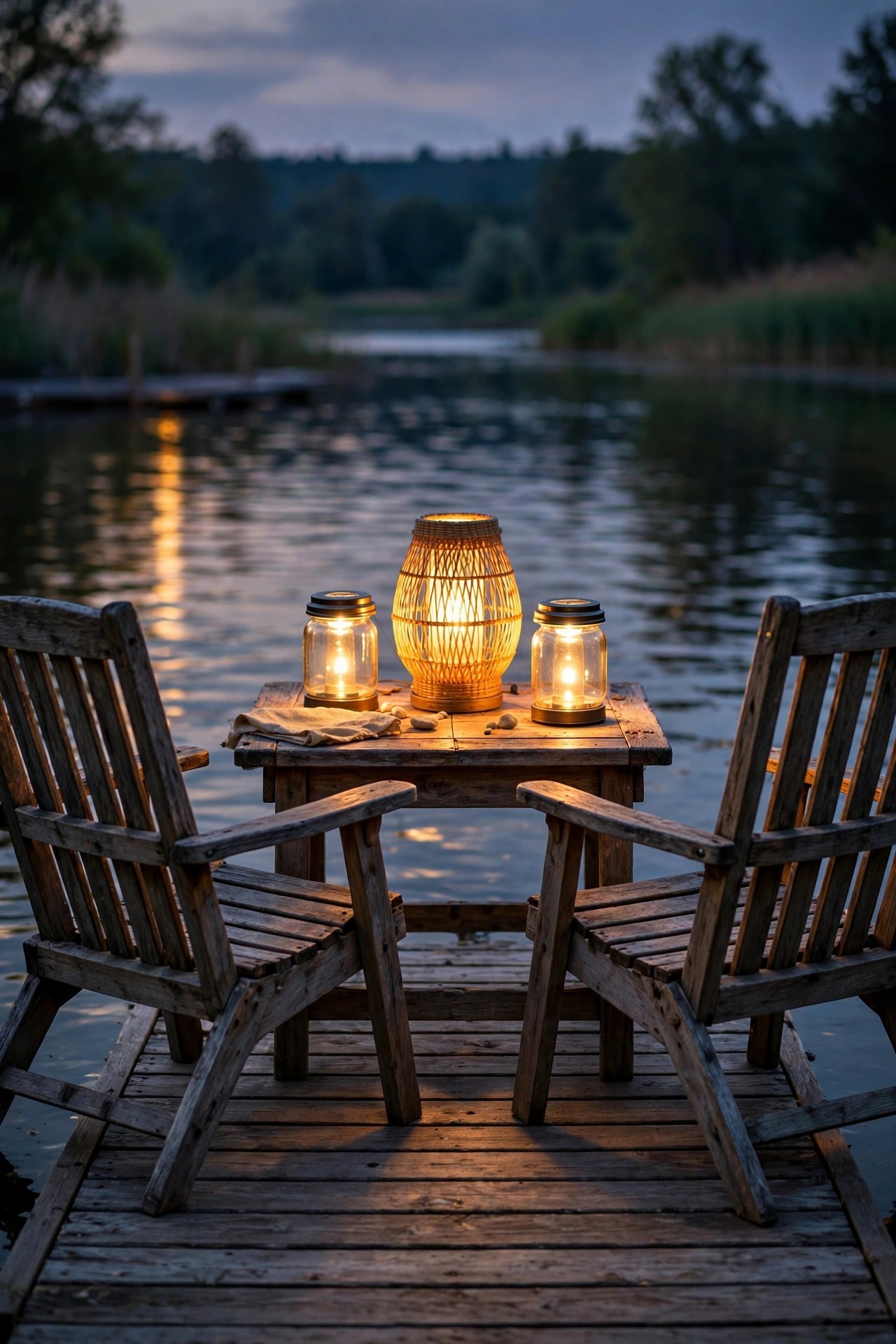
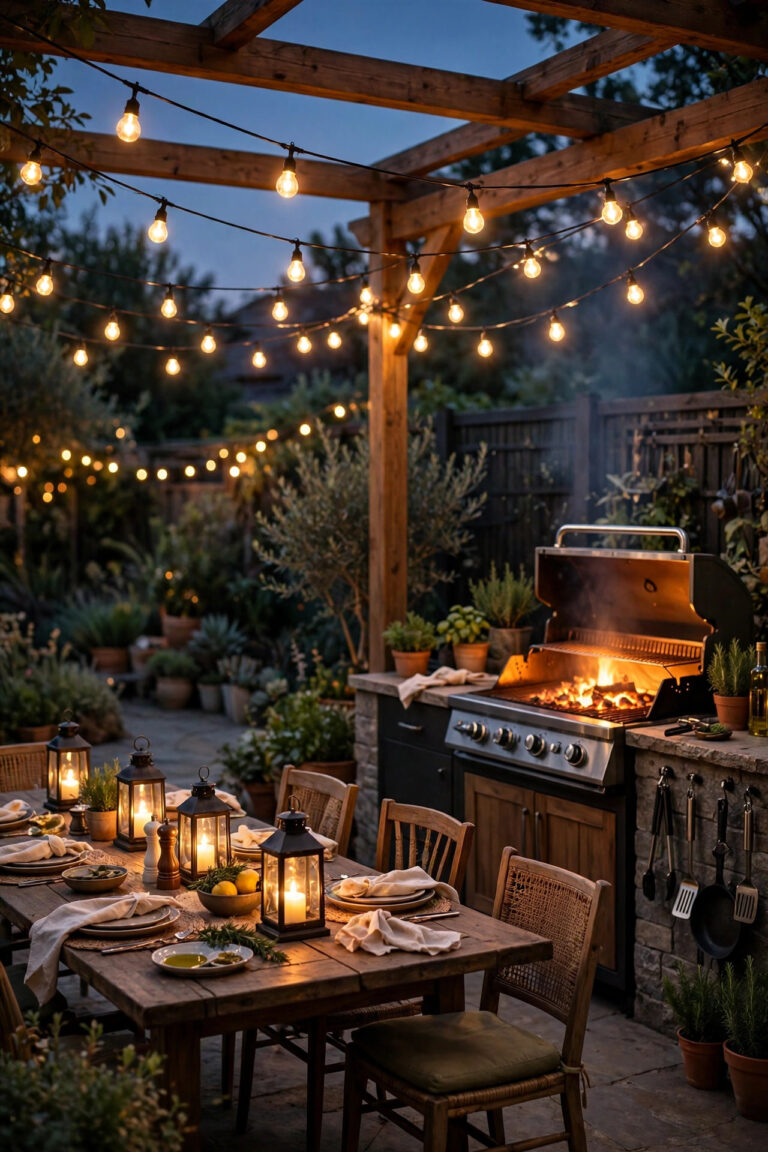
9. Solar String Lights Over the Dock Seating Area
String lights over a dock sound like a Pinterest fantasy until you give them proper support. Run a simple cable or rope between two tall pilings or poles over the seating end, then hang solar festoon strings with shatterproof bulbs from it. The solar panel mounts at the top of one pole, and the whole canopy of warm bulbs turns dinner on the dock into an event. Keep the strings over the hangout zone only, never over the boat slip, and leave honest headroom — seven feet at the lowest sag keeps tall guests and raised fishing rods comfortable. Wind is the real enemy out here, so clip every bulb socket to the cable rather than letting the strand swing free, and take the strings down before winter storms if your dock stays in. In my experience the solar versions with a remote panel charge far better than the tiny panel-on-the-strand kind, because you can aim the panel at real sun while the bulbs hang in the shade of the canopy. Pure summer magic, zero wiring.
Suggested budget range: $30 – $75.
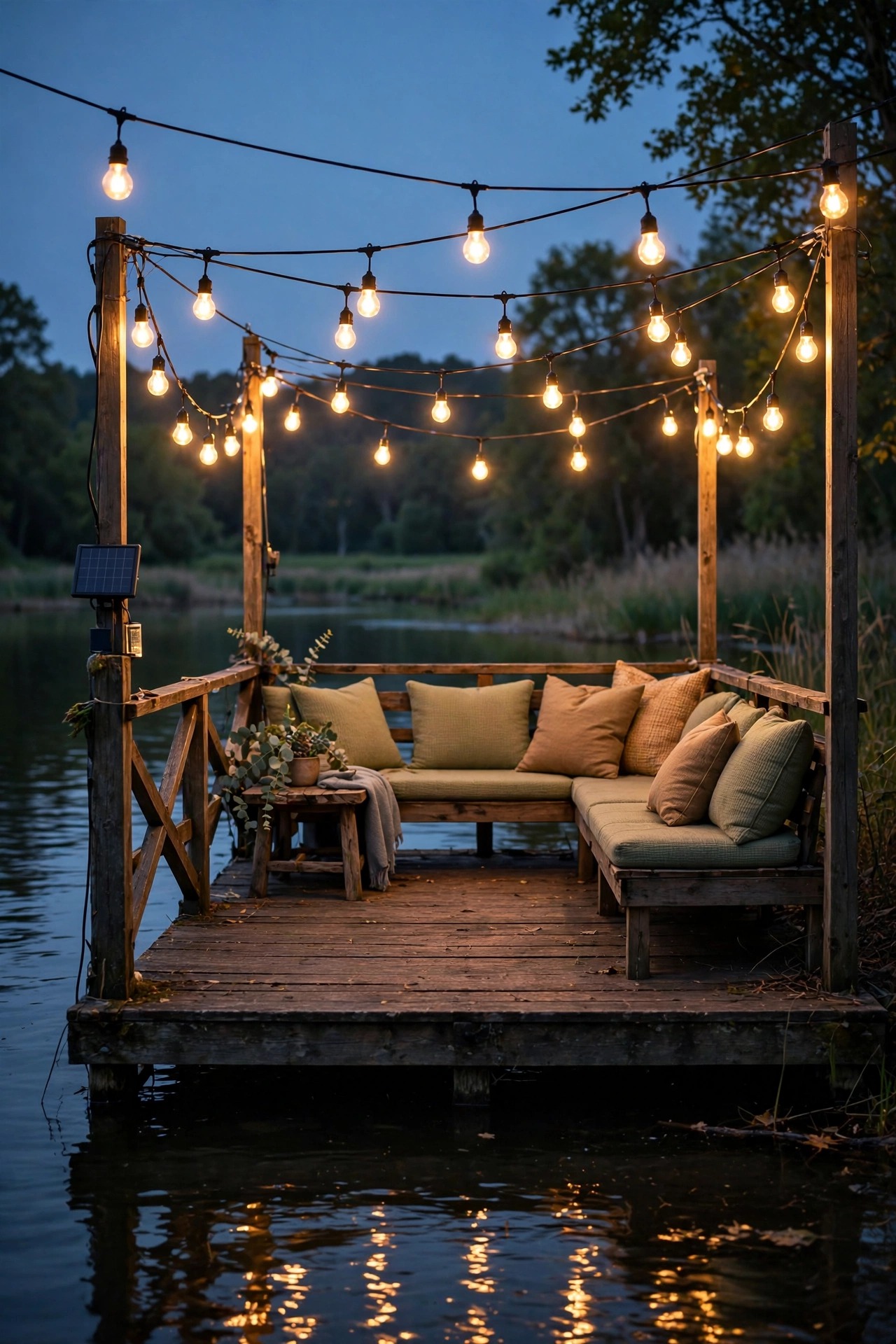
10. A Solar Flood Light for the Boat Slip
Tying up after dark, finding the right cleat, plugging in the charger, grabbing the cooler — the slip is a work zone, and it deserves one honest task light. A solar flood light with a motion setting, mounted high on a piling or the boathouse wall and aimed down into the slip, handles all of it. I aim ours carefully so the beam covers the boat deck and the walkway finger but stops short of the water and the neighbors — a downward angle and the included shield keep the light where it belongs. Because it only runs at full brightness when it senses movement, a single day of charging covers a whole weekend of comings and goings. Choose a model with adjustable sensitivity and duration; the factory settings are usually too eager and too long. This is also the light I want on the rare night something goes bump — one bright, well-aimed flood beats a shoreline of glare every time. Working light, on demand, no shore power required.
Suggested budget range: $35 – $85.

11. Amber Solar Marker Lights for the Swim Area
Our grandkids swim off the dock all summer, and these little amber markers are how everyone knows the boundary after dusk. I set low solar marker lights — the kind that sit almost flush or on short pucks — along the swim platform edge and the ladder, in amber rather than white. Amber reads as a boundary color, it does not wreck anyone night vision, and it is far less attractive to the clouds of bugs that white light pulls in over the water. Swimmers in the water can always find the ladder by the glow, and boats approaching after dark see a clear, calm outline of where the dock activity is. Keep these dim and low on purpose; they are signposts, not work lights. If your lake has evening boat traffic, this small courtesy also tells skippers exactly where the swimmers might be. Safety that looks like ambience is my favorite kind, and this layer costs less than a pizza night.
Suggested budget range: $18 – $40.

12. Remote-Panel Solar Lights for Shaded Docks
Not every dock basks in full sun. Ours sits under big oaks on the north shore, and the first solar lights I bought there failed miserably — not because they were bad lights, but because their little built-in panels never saw direct sun. The fix is remote-panel fixtures: the light mounts where you need it, and a separate solar panel on a few feet of cable mounts up high on a piling top or back on the sunny shore. That one change turned our shadiest corners into the most reliable lights we own. It works for the underwater lights, the flood, and the step lights alike. When a fixture underperforms anywhere, my troubleshooting guide to make solar lights brighter walks through panel angle, cleaning, and battery swaps. Angle the remote panel toward the midday sun, wipe it when you wipe the underwater lenses, and even a tree-covered dock can run a full lighting plan on sunlight alone.
Suggested budget range: $40 – $95.

13. One Warm Color Temperature Across the Whole Dock
Here is the unglamorous idea that makes all the others look intentional: pick one color temperature, around 2700 to 3000K warm white, and buy everything in it. Docks collect fixtures the way kitchens collect mugs — a cap light here, a flood there, a string light someone brought as a gift — and when each one glows a different shade, the whole place looks patched together no matter how good the layout is. Warm white also flatters everything on the water: wood grain, skin tones at dinner, the green of the shoreline trees at dusk. Cool daylight-blue fixtures make a dock feel like a marina parking lot, and they glare harder off the water. When I replace a fixture now, the color temperature is the first spec I check, before brightness, before style. The one exception I allow is the underwater glow and the amber swim markers, which read as deliberate accents precisely because everything else is consistent. Discipline everywhere else makes the accents look like art.
Suggested budget range: $15 – $60.

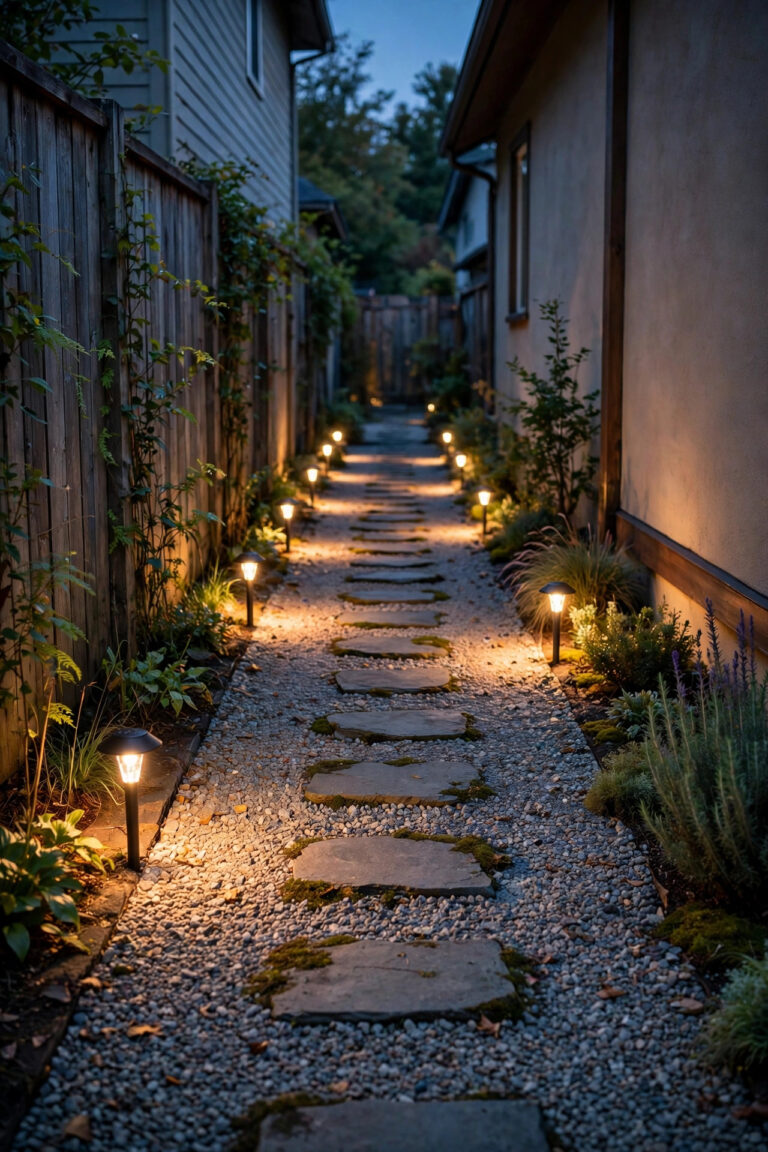
14. Solar Lights for the Gangway and Shore Path
The prettiest dock in the world still fails if guests trip walking down to it. I treat the gangway and the shore path as the first scene of the dock lighting plan: solar path lights staked along the trail from the yard, a step light on the ramp, and the motion light from idea six waiting at the entrance. Solar stakes are perfect here because the path usually gets the best sun on the property, and there is no wire to run under the lawn. Space them closer than you would in a garden — every 5 to 6 feet — because dock paths tend to be uneven, with roots and stones that a garden path would never tolerate. Where the path meets the ramp, one brighter fixture marks the transition so nobody misjudges the slope in the dark. Walking down after dinner, the light builds in layers: path, ramp, entrance, then the full dock glowing at the end. It feels like arriving somewhere. That little bit of theater is worth every stake.
Suggested budget range: $30 – $70.

15. Put It Together: Layered Solar Dock Lighting Ideas That Work as One Plan
Here is how all fifteen ideas stack into one plan, and it is the same layering I use in every yard I light. Start with the safety base: flush-mount edge lights, step lights, amber swim markers, and the gangway path, all running dusk to dawn on their own. Add the task layer next: piling lights at the boarding spot, the motion light at the entrance, and the flood over the slip, working only when you do. Finish with the sparkle: cap lights tracing the silhouette, the rope light along the edge, lanterns and string lights in the seating corner, and that underwater glow underneath it all. Hold one warm temperature across the plan, put remote panels anywhere the trees win, and walk the whole dock at dusk once a season to adjust angles and wipe lenses. These solar dock lighting ideas ask for no trench, no conduit, and no shore power at all — just a sunny day and an evening you will want to stay out for. The dock becomes the best seat at the lake, and it runs on sunshine.
Suggested budget range: $150 – $400.

Frequently Asked Questions
How long do solar dock lights stay on at night?
Most quality solar dock fixtures run 8 to 10 hours on a full day of charging, which covers dusk to well past midnight in summer. Motion-sensor models last even longer because they idle at low brightness. In winter, with shorter days, expect 5 to 6 hours — still enough for evening use, especially if the panels get a clear southern exposure.
Are solar lights bright enough for a dock?
Yes, for the jobs a dock actually needs. Edge, step, and path lighting is about guidance, not stadium brightness, and modern solar fixtures handle it easily. For the one true task zone, the boat slip, choose a solar flood with a motion setting and a larger panel. The trick is layering several modest lights rather than asking one fixture to do everything.
Will solar dock lights survive splashes, rain, and freezing winters?
Look for fixtures rated for wet locations and full outdoor exposure, with sealed housings and corrosion-resistant hardware — docks are a harsher environment than gardens. In freezing climates, many owners lift portable pieces like lanterns into storage and leave mounted fixtures in place; check that the battery type tolerates cold, and bring underwater lights up before the ice forms.
How much does it cost to light a whole dock with solar?
A basic safety setup — edge lights, step lights, and a motion light — runs about $100 to $200. The full layered plan in this post, with cap lights, string lights, an underwater light, and a slip flood, lands around $300 to $600 total, with no electrician, no trenching, and no ongoing electricity cost. That is a fraction of a wired installation.
Conclusion
A dock without power used to mean a dock without light, and that trade is simply over. With the right solar dock lighting ideas layered in the order I use — safety first, task light second, sparkle on top — you get a dock that is safer for grandkids, kinder to arriving boats, and prettier than half the wired setups on our lake. Start with the flush-mount edge lights and one motion light this weekend; the rest has a way of following. And if your waterfront projects wander back toward shore, browse the rest of the lighting ideas here on the site — the same layering rules work beautifully in gardens, patios, and porches too.