There is a moment just after sunset when a pond either disappears into the dark or becomes the whole reason you stay outside a little longer. In my experience, the difference is always light. These are the pond lighting ideas I reach for again and again, because water does something no lawn or flower bed can do: it doubles every lumen you give it, throwing soft reflections back at you and turning a still surface into a slow, shimmering mirror. My whole approach is layering, the same philosophy I use everywhere in the yard. A little glow under the water, a wash of light at the rim, and one warm highlight overhead will beat a single bright floodlight every single time. Whether your water garden is a grand koi pond with a waterfall or a humble half-barrel on the patio, the seventeen ideas below scale up or down beautifully, and most of them are weekend-friendly, low-voltage projects.
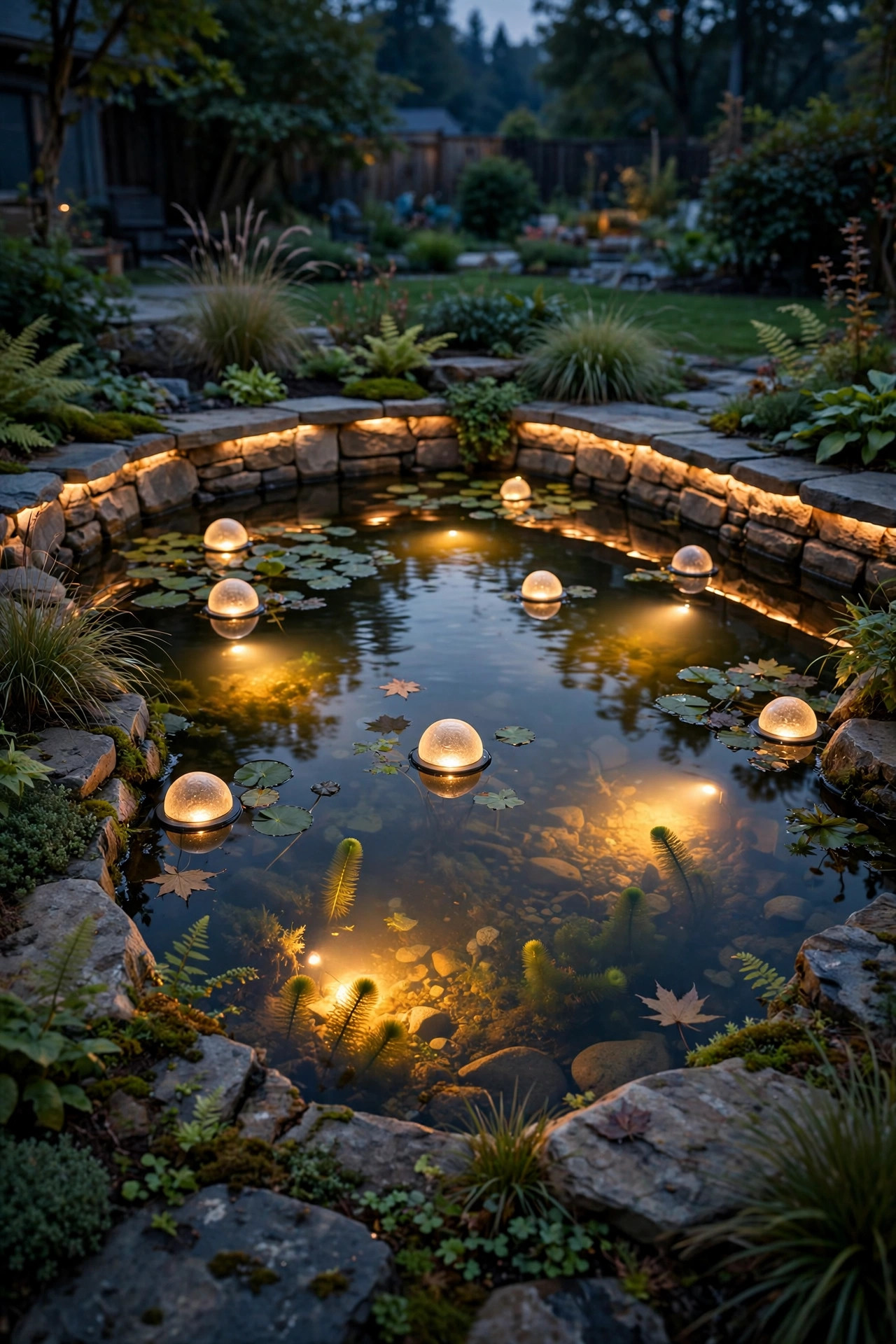
1. Submersible Pond Lighting Ideas for a Deep Underwater Glow
If you only try one thing on this list, make it submersible lights, because an underwater glow is what turns a dark hole in the ground into a jewel box. I use low-voltage LED spotlights rated IP68, which means they are built to live fully submerged, and I weight them down with their weighted bases or tuck them between rocks so they stay put. Aim two or three fixtures upward at a slight angle from the bottom and you get that lovely rising shimmer on the surface, plus a clear view of your fish drifting through the light like they are on stage. For a pond up to about 8 feet across, three 3-watt fixtures are honestly plenty. Keep the cable runs tidy along the bottom and bring them up behind a rock or plant where they exit the water. Warm white, around 2700 to 3000K, keeps goldfish and koi looking rich and natural instead of washed out. If you are curious how the same trick works at pool scale, my notes on pool underwater lighting ideas cover the bigger cousins of these fixtures.
Suggested budget range: $40 – $110.
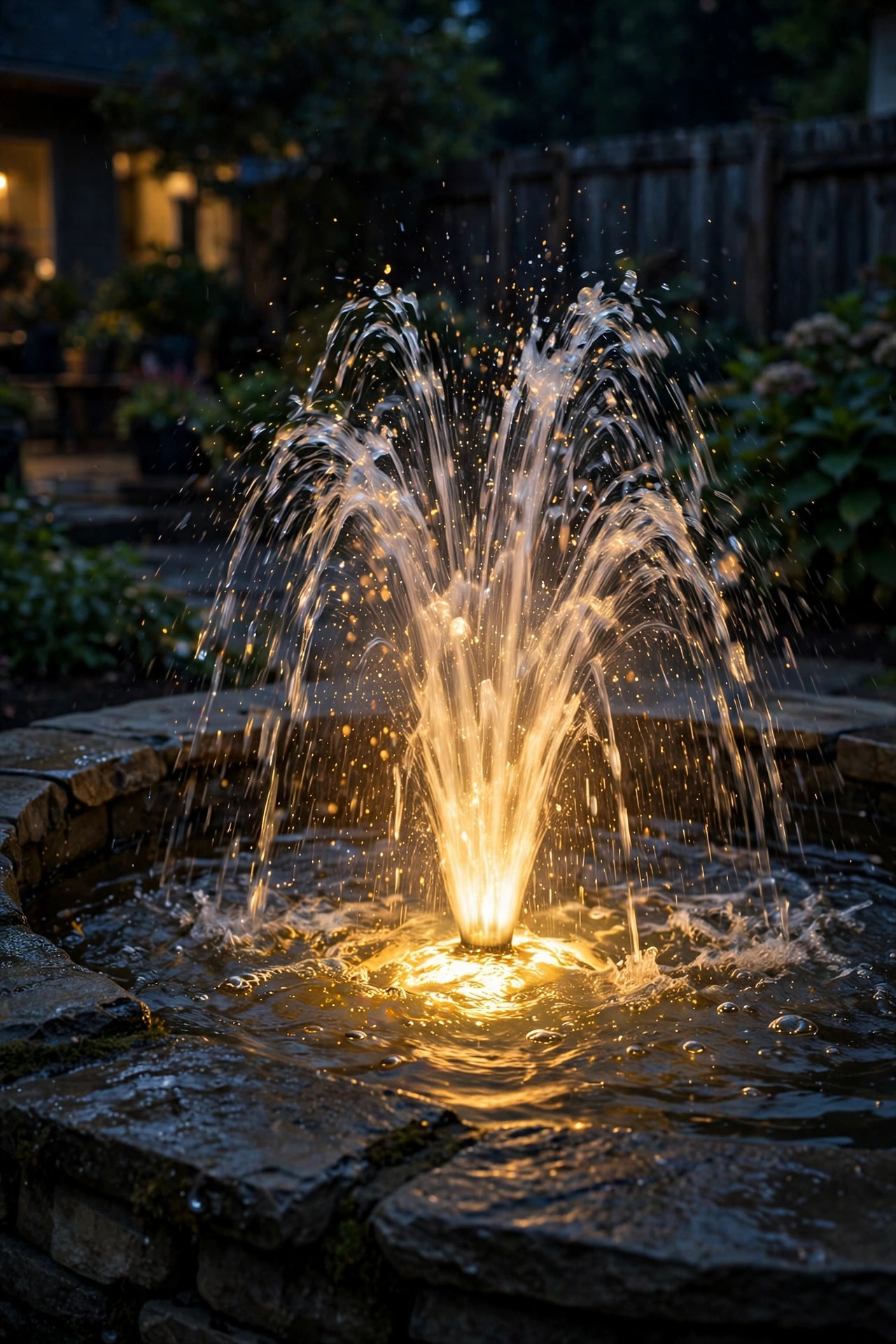
2. Floating Solar Orbs That Drift and Glow
Floating solar orbs are the easiest win in all of pond lighting: no wiring, no transformer, no timer to program. You charge them in the sun, drop them in, and they drift around the surface all evening like little moons. I like grouping three or five of them in odd numbers, because a cluster reads as intentional while a single orb can look a bit lost. Each one has a small solar panel on top and a soft LED inside a frosted globe, usually 6 to 10 inches across. They are gentle lights, more mood than illumination, so think of them as jewelry rather than the main event. One honest warning from my own pond: in a heavily shaded water garden they may only glow for three or four hours, so place the pond where the orbs catch afternoon sun, or choose models with a removable panel you can charge on a sunny step. They also make a sweet highlight in a birdbath or stock tank if your pond is small.
Suggested budget range: $25 – $65.
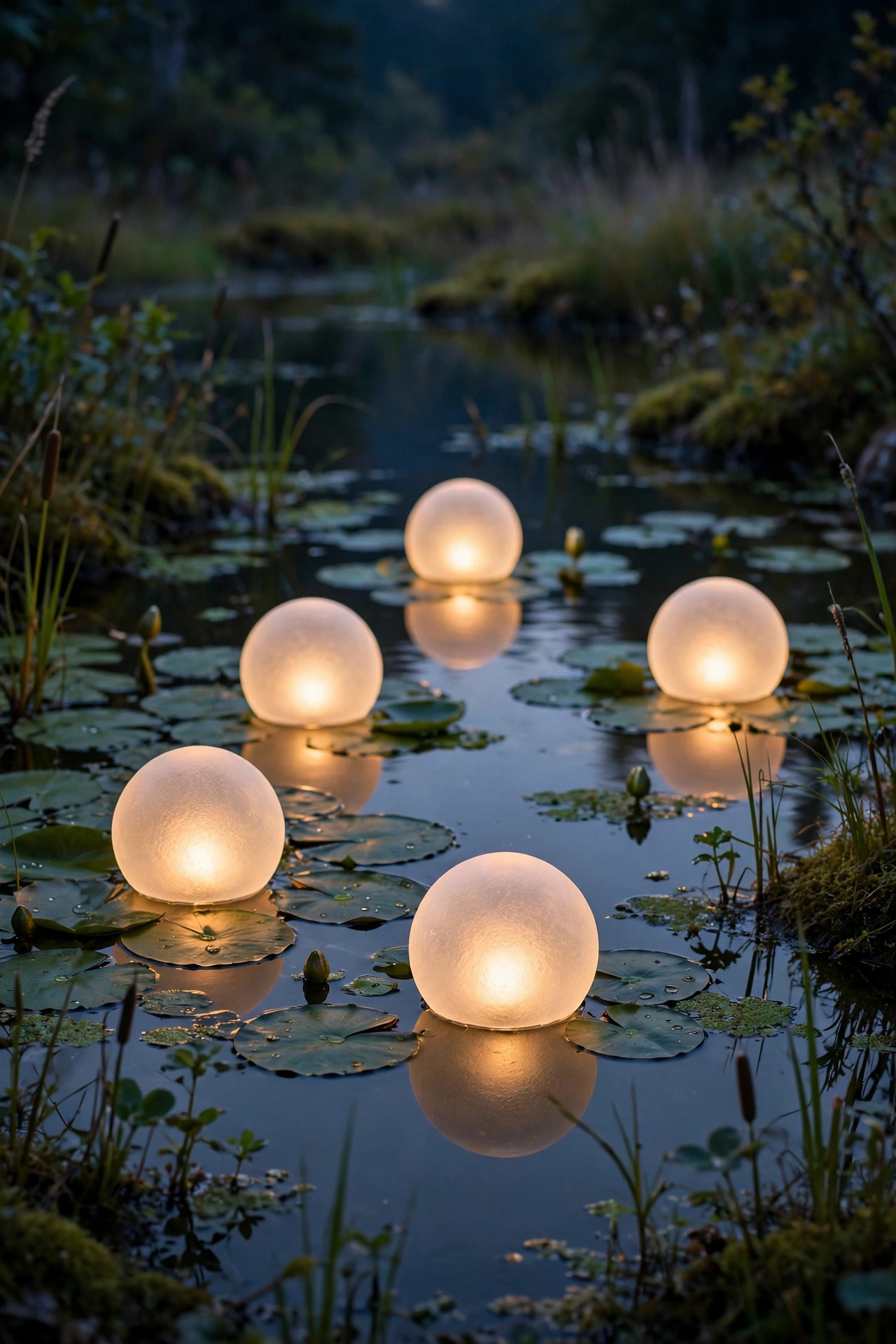
3. Waterfall Wash Lights That Catch Every Cascade
A waterfall in the dark is just noise until you light it, and then it becomes the star of the whole yard. My favorite approach is a small submersible spotlight tucked into the rocks at the base of the falls, aimed up into the falling sheet of water so the cascade itself glows and sparkles. A second fixture hidden behind the top lip, washing down, adds depth and keeps the top stone from going black. Keep the fixtures a few inches to the side of the main flow rather than dead center, because angled light shows texture better than a head-on beam. If your falls are part of a separate feature, the placement tricks in my fountain lighting ideas translate almost one-to-one. Watch the splash zone when you position things: constant splashing grows algae on lenses fast, so give yourself easy access for a monthly wipe-down. Warm white light makes falling water look golden and inviting, while cool white reads more like a mountain stream.
Suggested budget range: $35 – $95.
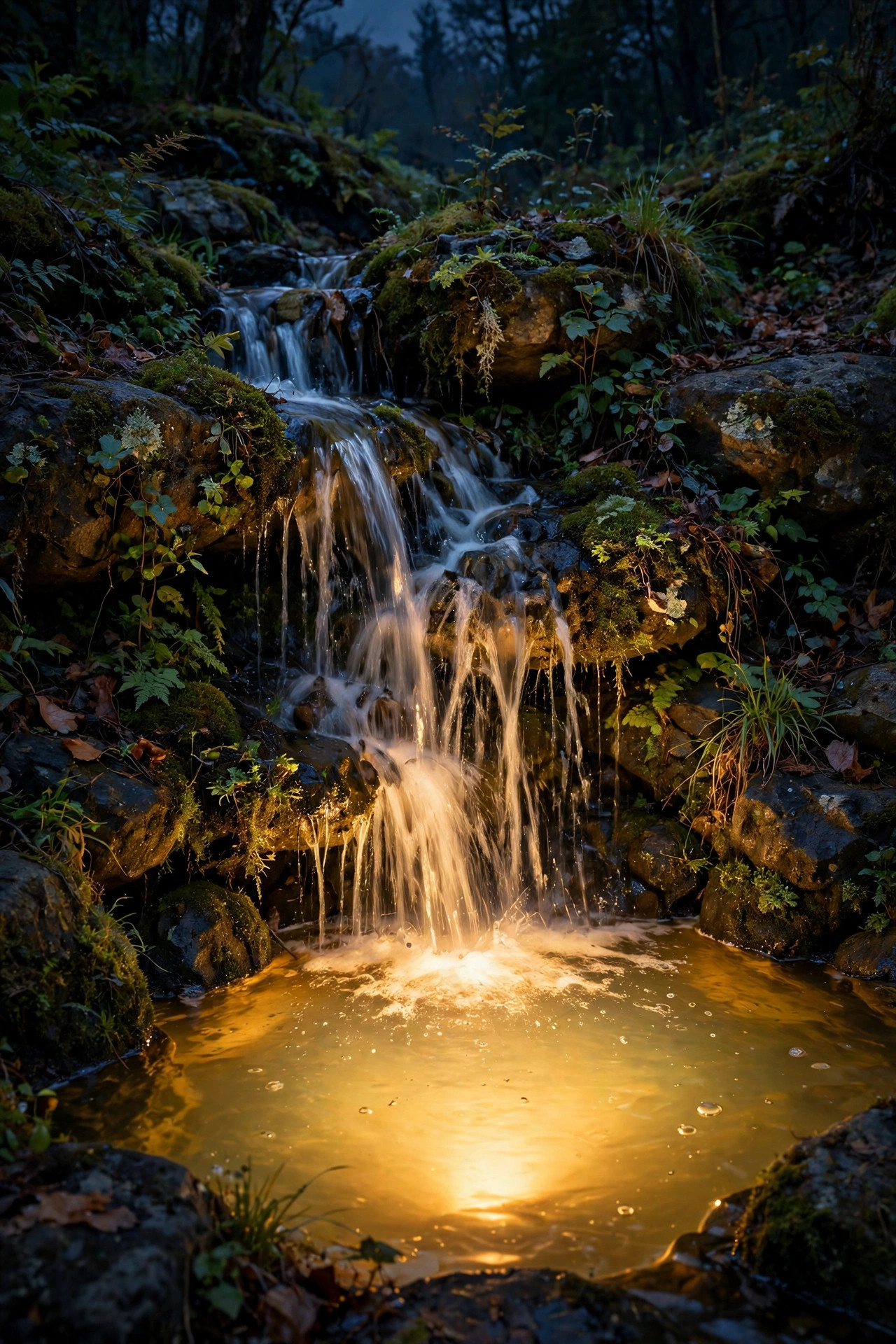
4. Low Rim Lights That Trace the Edge
Tracing the rim is how you keep guests from backing into the pond at a party, and it also gives the water a beautiful defined shape after dark. I run a loose ring of low fixtures just outside the edge: small solar stakes, short bollards, or low-voltage path lights spaced about 4 to 6 feet apart, angled slightly inward so their pools of light kiss the waterline without glaring across it. Keep them low, under 12 inches tall, so the fixtures disappear and only the light reads. On a naturalistic pond, tuck them behind tufts of iris or stone so the source stays hidden. On a formal raised pond, a neat even rhythm looks best, almost like runway lights. Avoid placing a fixture directly opposite your favorite bench, because you will stare into it all night. This is also the layer that makes the pond read from inside the house, which matters more than people think on weeknights when you mostly enjoy it through the window.
Suggested budget range: $45 – $130.
5. Moonlighting From a Tree Overhead
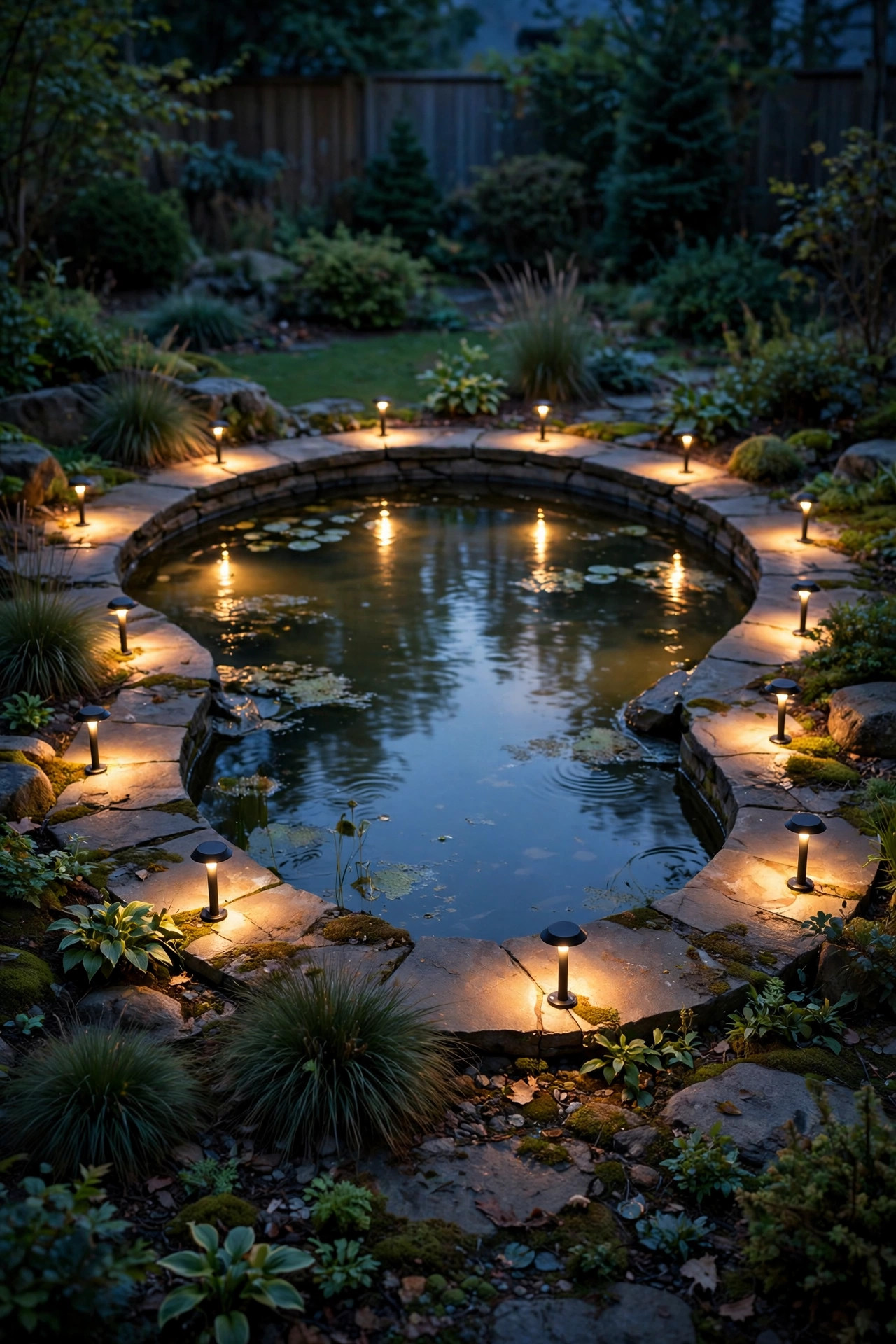
Moonlighting is the most natural-looking light of all, because it copies what the moon actually does: a soft, cool-ish wash sifting down through leaves. I mount one or two downlights 15 to 20 feet up in a tree near the pond, fitted with a soft spread lens, and let the branches break the beam into dappled patterns on the water. Every breeze moves the pattern, and the pond surface picks up the motion beautifully. Use a fixture with a glare shield and keep the output modest, around 200 to 300 lumens per head, because the goal is a whisper, not a spotlight. Honestly, this is the one idea on the list where I recommend hiring a pro if the tree work makes you nervous, since climbing with a drill is nobody's idea of fun. No tree nearby? A tall shepherd's hook or a pergola post at 8 to 10 feet gives you a gentler version of the same effect.
Suggested budget range: $60 – $180.
6. Uplighting the Marginal Plants
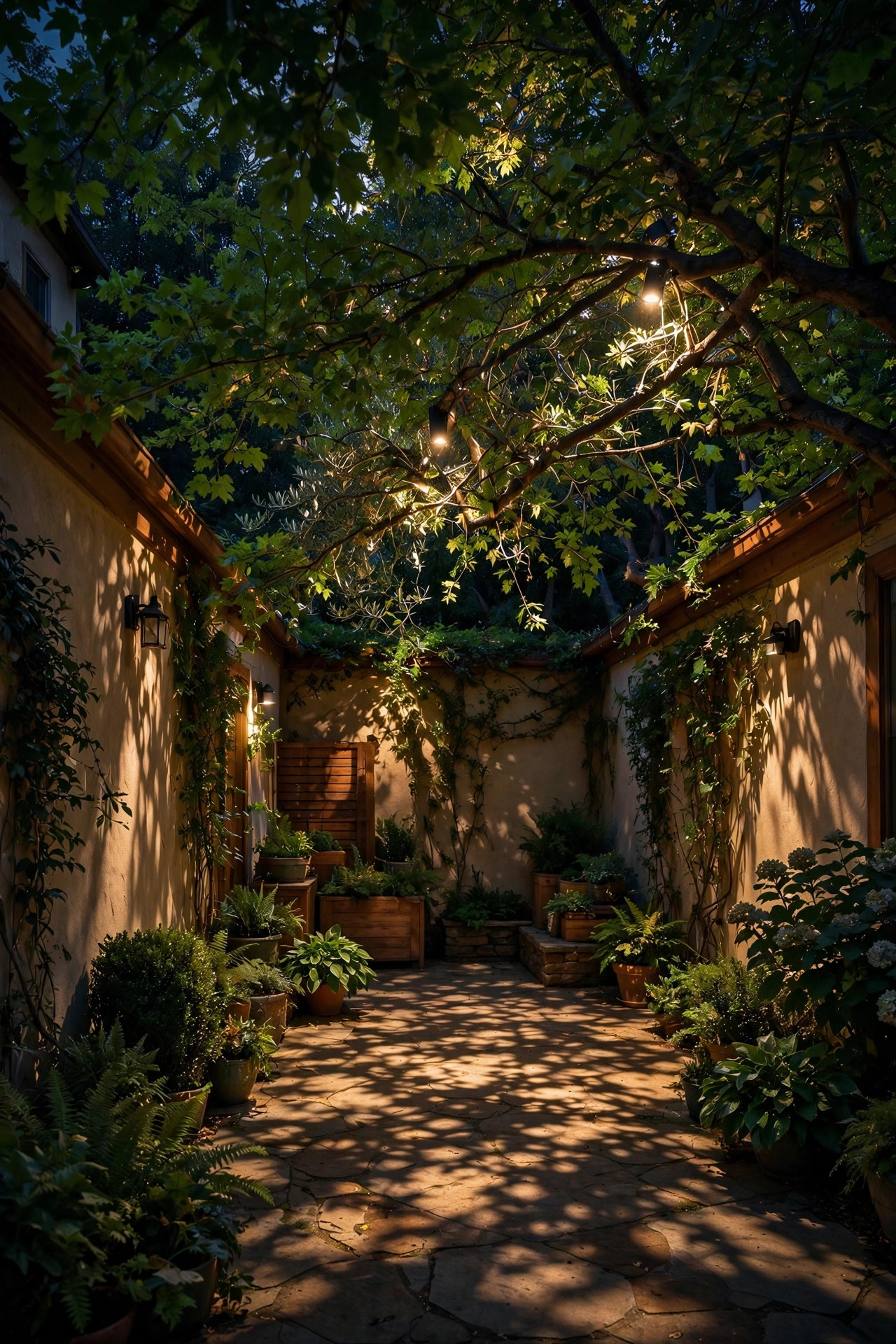
The plants at the pond edge, the irises, rushes, and ornamental grasses standing in the shallow margin, are sculptural after dark if you give them a little uplight. I place a small adjustable spotlight at the base of a clump, just outside the water or on a submerged shelf, and aim it up through the stems so the foliage glows like a green lantern. One fixture per major planting group is enough; overdoing this layer turns the pond edge into a stage set. This trick is especially gorgeous in fall, when grass plumes catch the light and move. Choose fixtures with a narrow to medium beam, around 30 to 45 degrees, and keep them warm white so greens stay lush rather than neon. Because these lights sit close to damp soil and splash, I always spec IP65 or better, and I check the seals each spring when I divide the irises anyway.
Suggested budget range: $30 – $85.
7. String Lights Swagged Over the Water
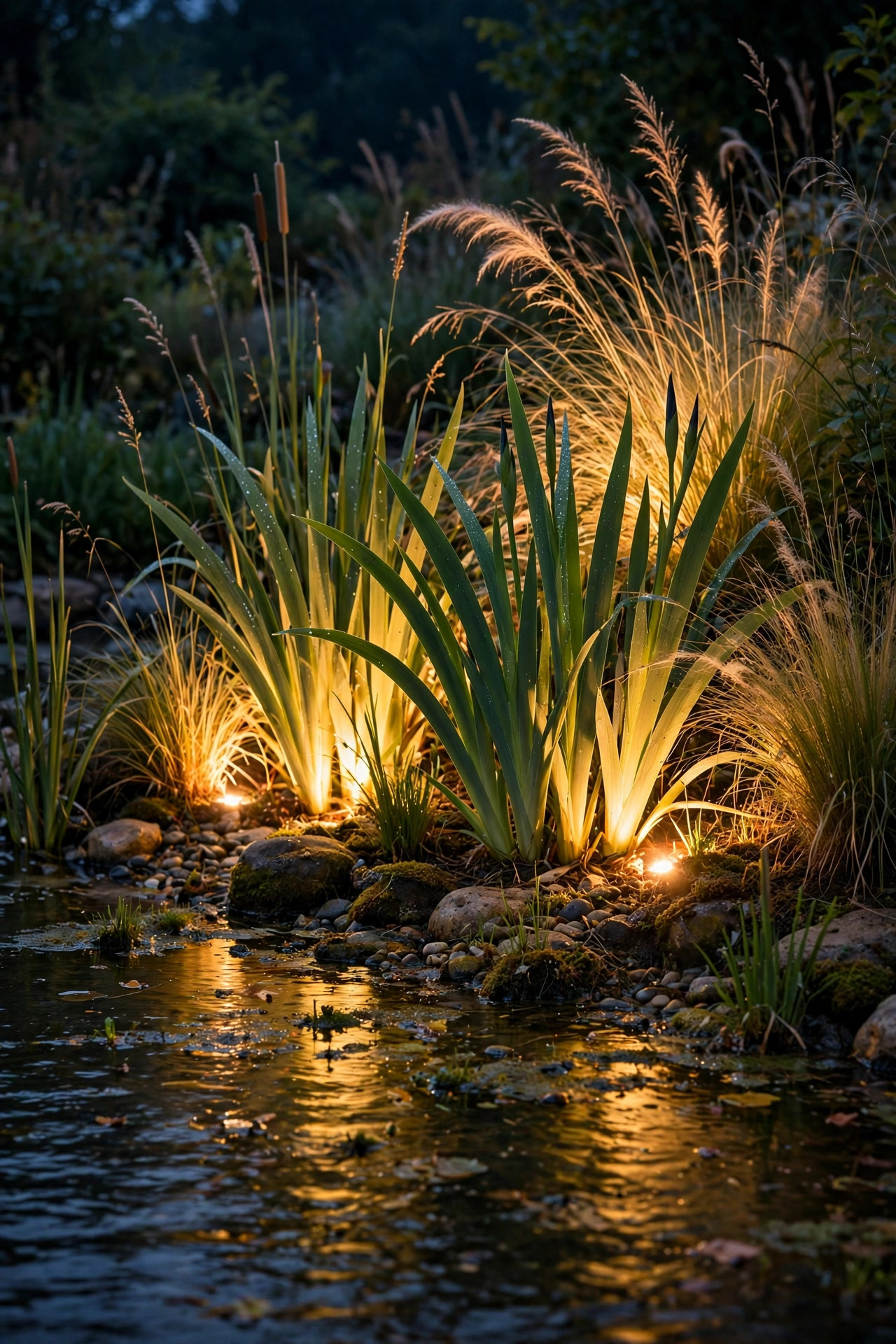
Nothing says evening garden party like café string lights, and a pond underneath them doubles the show because every bulb reflects in the surface. I swag two strands in gentle catenary curves from a fence or pergola post to a sturdy tree or a pole set in a planter, crossing somewhere near the middle of the pond so the reflection forms a soft X of light. Use commercial-grade outdoor string lights with shatterproof LED bulbs, and keep the strands at least 7 feet above the water so nobody's paddle, net, or raised arm finds them. A GFCI-protected outlet is non-negotiable anywhere near water, and the connection point should stay on dry land under a weatherproof cover. Honestly, this is the layer my guests photograph the most. In winter I sometimes leave one strand up just for the reflection on the ice, which sounds odd but looks like a snow globe in the best way.
Suggested budget range: $35 – $90.
8. Lanterns Resting on the Stone Edge
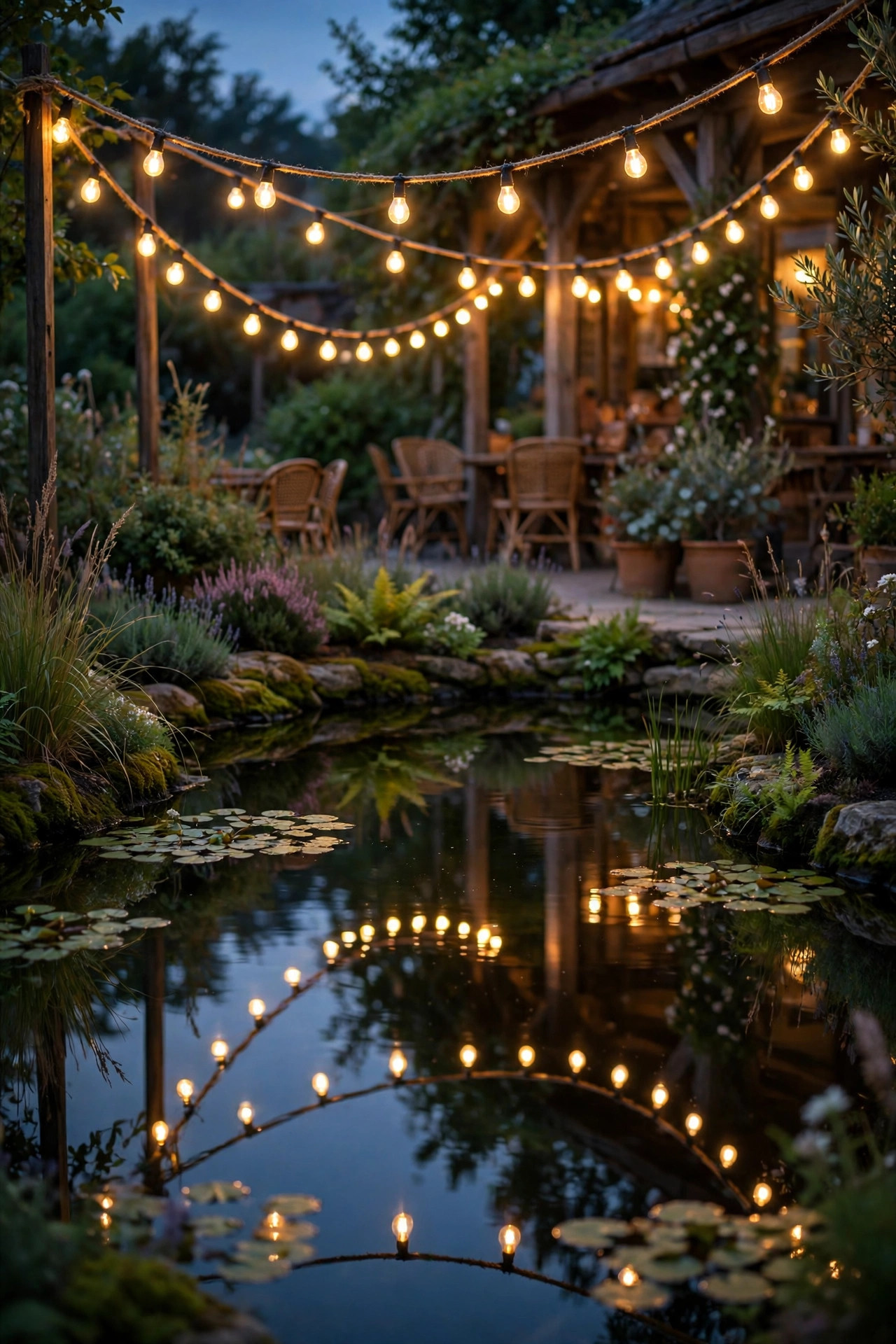
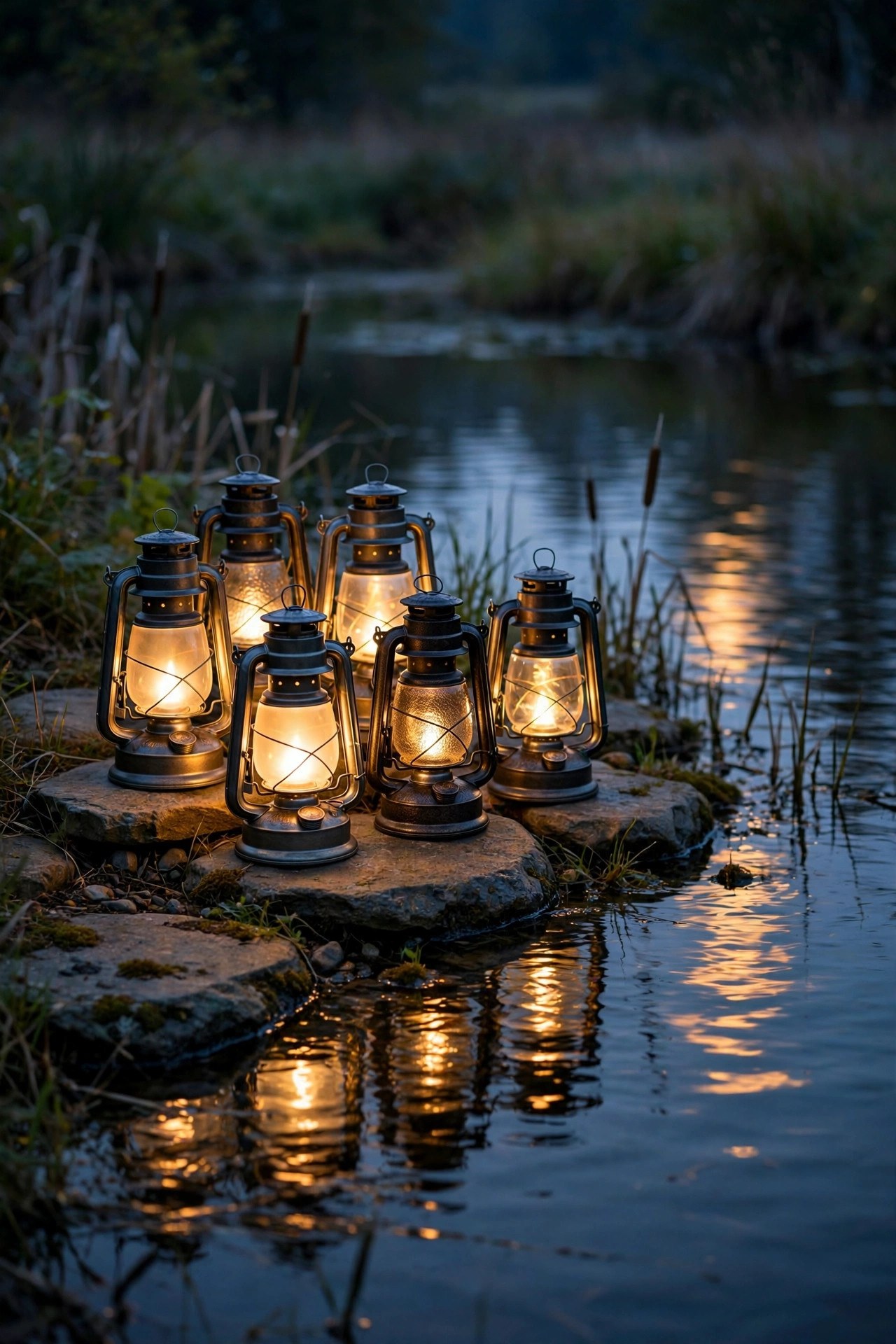
For the nights when you want atmosphere without touching a switch, lanterns on the stone edge are my standby. I group flameless LED lanterns in twos and threes on flat rocks around the rim, varying the heights so the arrangement feels collected rather than matched. Flameless is the key word here: real candles near dry mulch, wooden decking, and curious pets are a risk I am not willing to take, and the modern LED versions flicker convincingly enough that nobody has ever once asked. Look for outdoor-rated lanterns with a timer function, so they click on at dusk and off at bedtime without you remembering a thing. A couple of lanterns also make a lovely bridge between the pond layer and your seating area, visually walking the eye from the water to the patio. Brass-look and matte black finishes both weather well; just bring the inexpensive ones in before a hard freeze.
Suggested budget range: $30 – $80.
9. Color-Changing Smart Lights for a Little Drama
Most nights I am a warm-white purist, but a color-changing submersible light earns its place for parties and for grandkids, who consider a teal pond the height of luxury. Modern smart fixtures let you dial the color and brightness from your phone, set scenes, and drop right back to a tasteful 2700K white for everyday evenings. My advice is to use color as an accent, not a base layer: one color fixture underwater plus your usual warm rim and plant lights gives you the option without committing the whole garden to disco mode. Deep blues and teals read best in water because they feel natural; reds and pinks can look murky in a pond with any tannin tint. Check that the controller and connections stay on dry land, since the smart brains of these systems are rarely submersible even when the light heads are. Start with a single two-pack and see how often you actually reach for the rainbow before buying more.
Suggested budget range: $50 – $140.

10. A Spotlight for the Statue or Fountain Figure
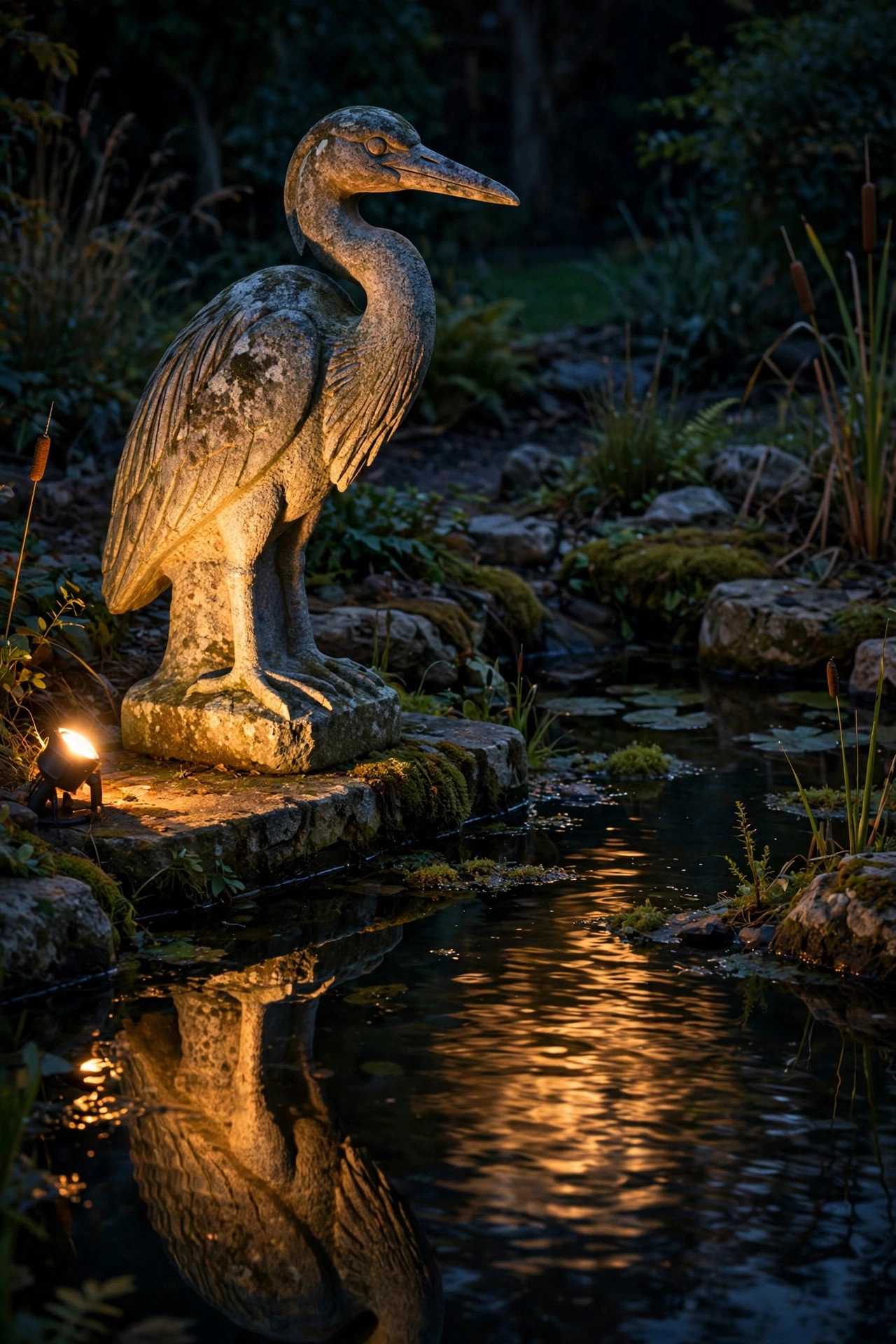
Many ponds have a hero piece, a heron statue, a stacked-stone cairn, or a spouting figure, and it deserves its own moment after dark. I light mine with a single narrow-beam spotlight from low and off to one side, about 30 degrees off axis, which models the shape with shadow instead of flattening it the way a head-on beam does. If the piece sits in the water, a submersible fixture at its base aimed upward gives a magical rising glow, and moving water over the light adds shimmer to the stone. Keep the rest of that corner dim so the hero piece holds the eye; contrast is what makes it read as art instead of clutter. This is also a forgiving place to experiment, because one fixture is cheap to reposition until the angle feels right. Try it from three spots over three evenings before you bury any cable, and trust the view from your actual chair, not from standing over it.
Suggested budget range: $25 – $70.
11. Path Lights That Lead the Way to the Water
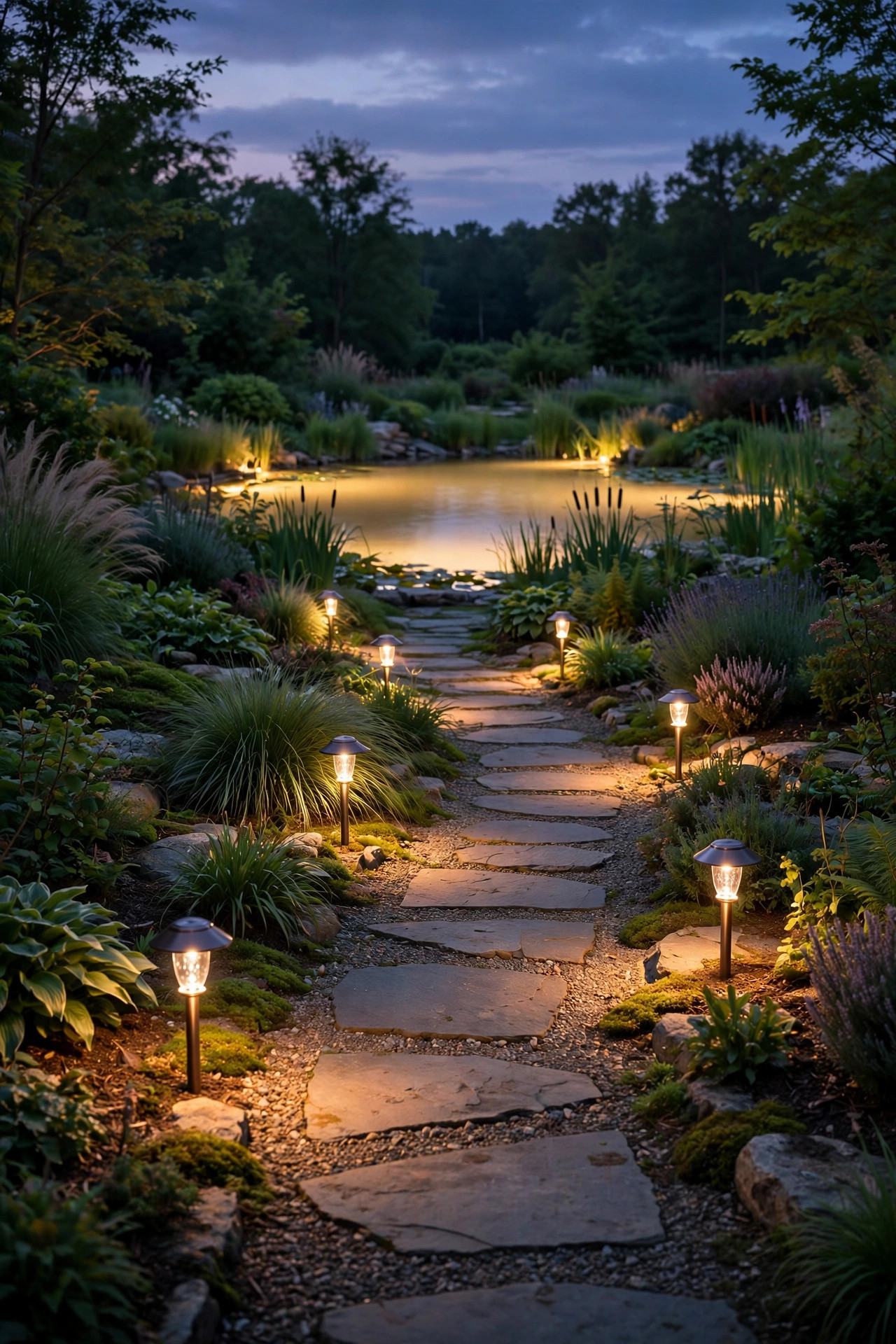
A pond you cannot find in the dark is a pond you stop visiting, so I always light the journey as well as the destination. A simple run of low-voltage path lights, spaced 5 to 6 feet apart along the garden path, warms up the walk and builds a little anticipation before the water even comes into view. Match the color temperature to your pond lights, 2700K throughout, so the whole scene feels like one composition instead of competing zones. Keep fixtures out of the mower's path and slightly back from the path edge, nestled into the planting where possible. Where the path meets the pond, one slightly brighter fixture or a pair flanking the viewing spot acts like a full stop at the end of a sentence. If your route crosses lawn that gets soggy, solar path lights save you the trenching and perform fine for this gentle job, as long as they get decent daytime sun.
Suggested budget range: $55 – $150.
12. Underwater Light Rings in the Falls Basin
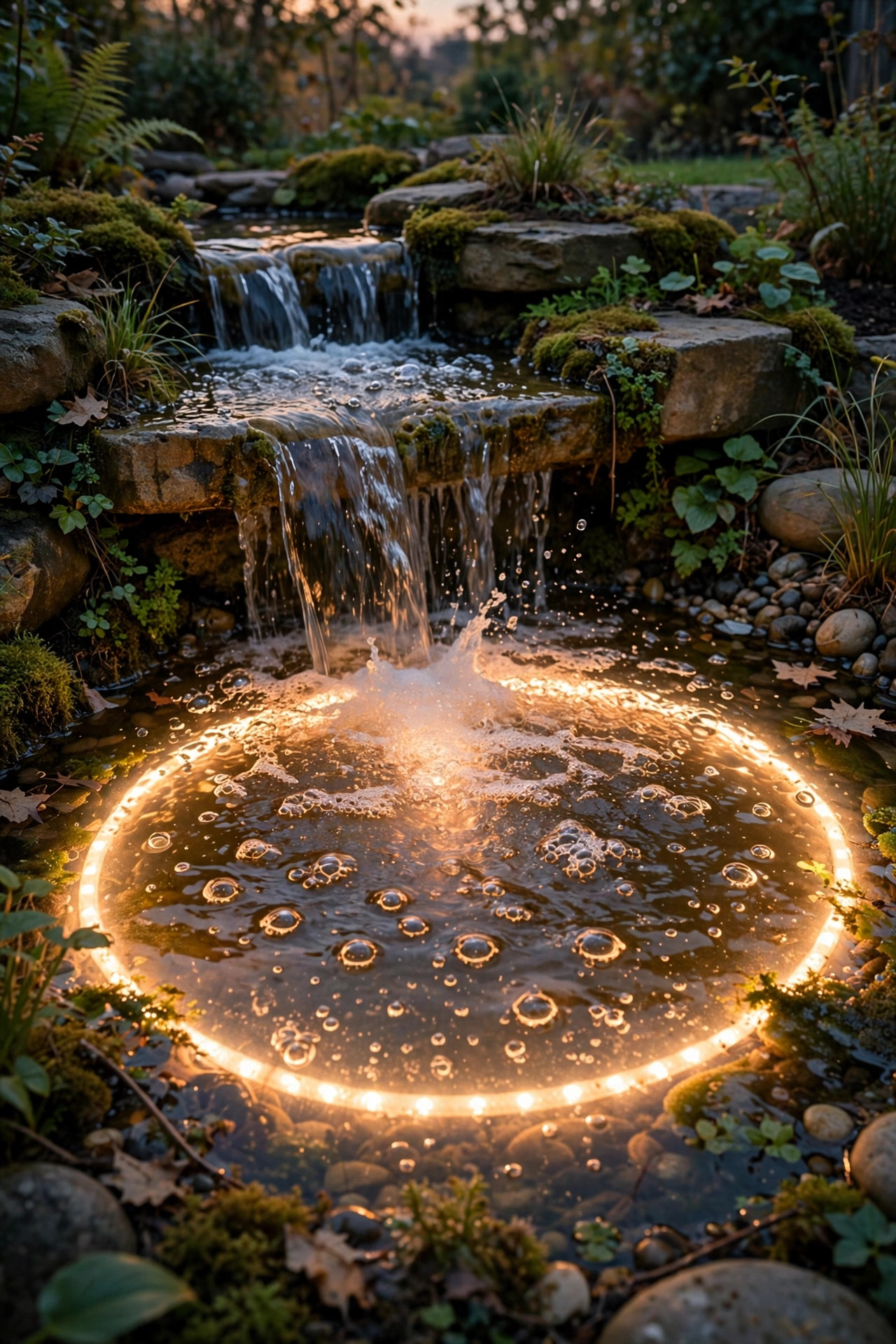
If your pond has a shallow basin where the waterfall lands, a ring of small lights hidden in that basin makes the splash zone itself glow, and the effect is pure theater. I use a flexible submersible LED strip or a set of mini puck lights rated IP68, pressed into the gravel or tucked behind the basin rocks, aimed up through the churned, bubbly water. All that agitation scatters the light beautifully, like a lantern under rapids. Keep the strip connections above the waterline whenever the manufacturer allows it, because connectors are the weak point of any underwater system. This is a detail light, so it works best when the surrounding area is fairly dark; a bright rim light nearby will wash it out. Clean the lenses when you clean the filter, since the basin collects the most debris. Honestly, of everything on this list, this is the one visitors ask about most, because it looks far more complicated than it is.
Suggested budget range: $30 – $75.
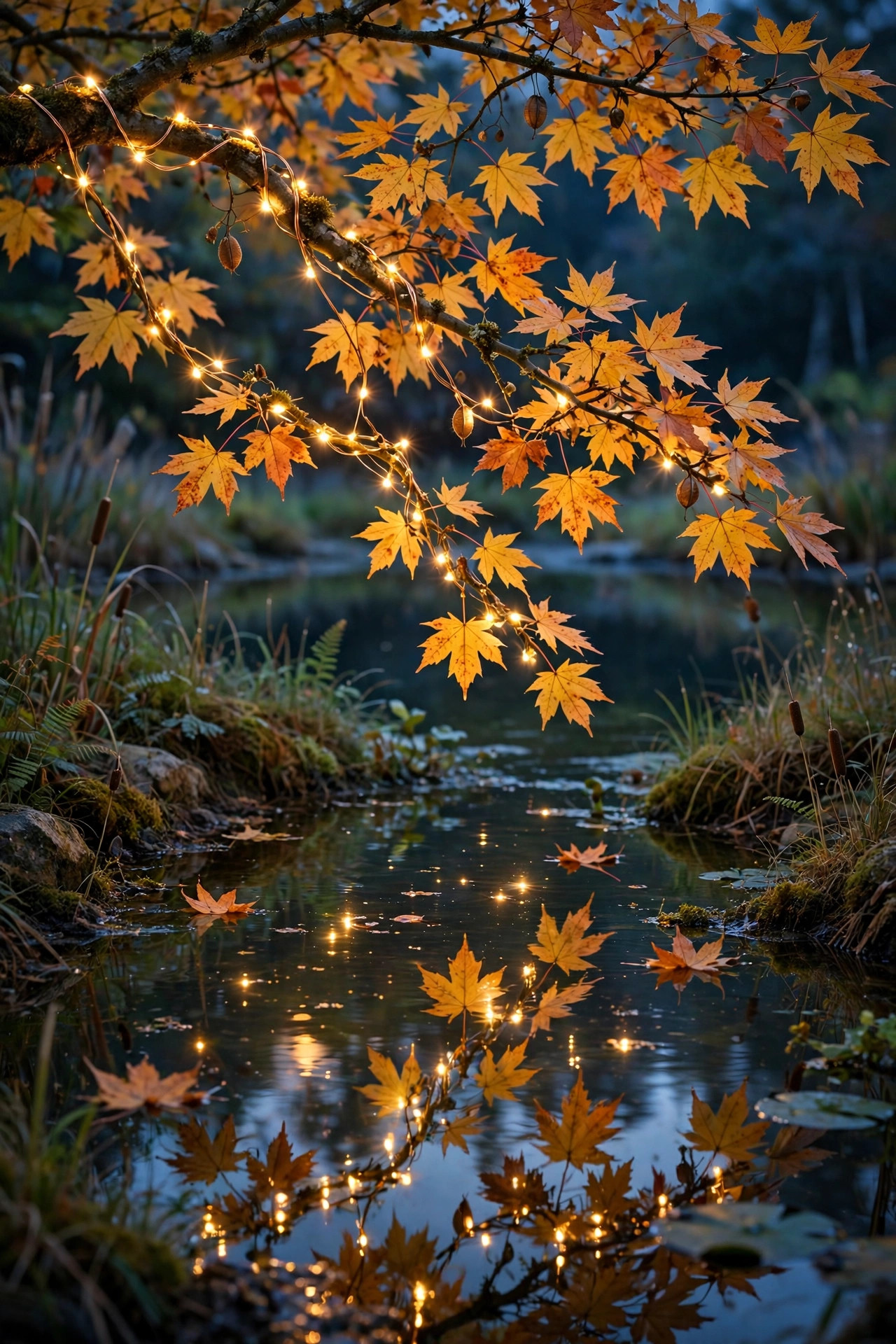
13. Fairy Lights Woven Into Overhanging Branches
A branch that reaches over the water is an invitation. I weave a strand or two of copper-wire fairy lights along an overhanging limb, a small Japanese maple or a willow whip, so the tiny points of light hang above the pond and double in the reflection. Copper-wire strands are nearly invisible by day, waterproof along their length, and easy to shape exactly where you want them. Battery packs with built-in timers are the practical choice here; tuck the pack into a weatherproof pouch at the trunk. Keep the effect sparse and starry rather than dense, because a reflection doubles every bulb and busy quickly becomes cluttered on water. Solar fairy strands work too if the panel can sit in a sunny spot at the base of the tree. This is a seasonal pleasure at my house: up in spring when the maple leafs out, down before the worst of winter, and it takes me all of twenty minutes.
Suggested budget range: $15 – $45.
14. Sleek Bollard Lights for a Modern Rim
Not every water garden is a naturalistic tumble of rocks. If your pond is a clean rectangle, a raised rill, or part of a contemporary courtyard, short bollard lights give you a rim layer with real architectural presence. I like 12- to 18-inch bollards in matte black or brushed metal, spaced evenly along one or two sides rather than marching all the way around, which can start to feel like a parking lot. Choose fixtures that throw light downward and outward in a controlled fan, so the water catches a bright sheen but nobody across the pond gets glare in the eyes. Bollards are typically hardwired or low-voltage wired, and they anchor into soil or a small concrete footing, so plan their positions before the hardscape goes in if you can. Paired with a single underwater light, they make even a small formal pond feel like it belongs at a boutique hotel.
Suggested budget range: $70 – $200.

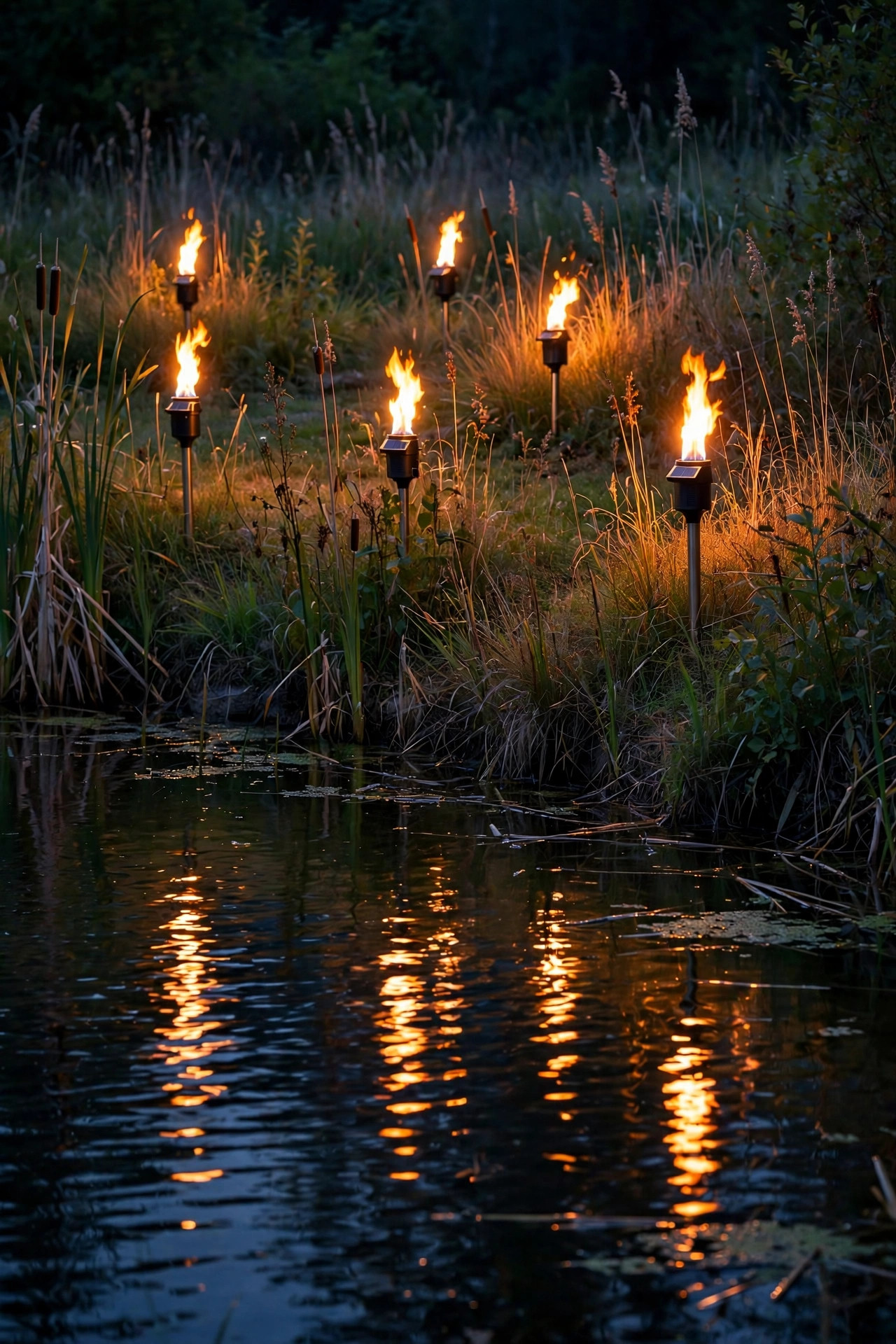
15. Flame-Effect Lights for Fire Beside Water
Fire and water together is the oldest garden magic there is, and flame-effect solar torches give you that flicker safely at the pond edge. I plant three or five of them in the planting beds behind the pond, never right at the rim, so the dancing orange glow reflects off the surface without competing with your calmer white layers. The LED flame panels in modern versions are surprisingly convincing from a few feet away, especially behind grasses that sway in front of them. Because they are solar and staked, you can test positions for a week before committing, which I strongly recommend, since one torch too close to the water can dominate the whole reflection. Keep real open flame, tiki torches included, well away from the pond if you have fish, because dripped oil and soot are bad news for water quality. With the LED versions you get the romance and none of the worry.
Suggested budget range: $30 – $70.
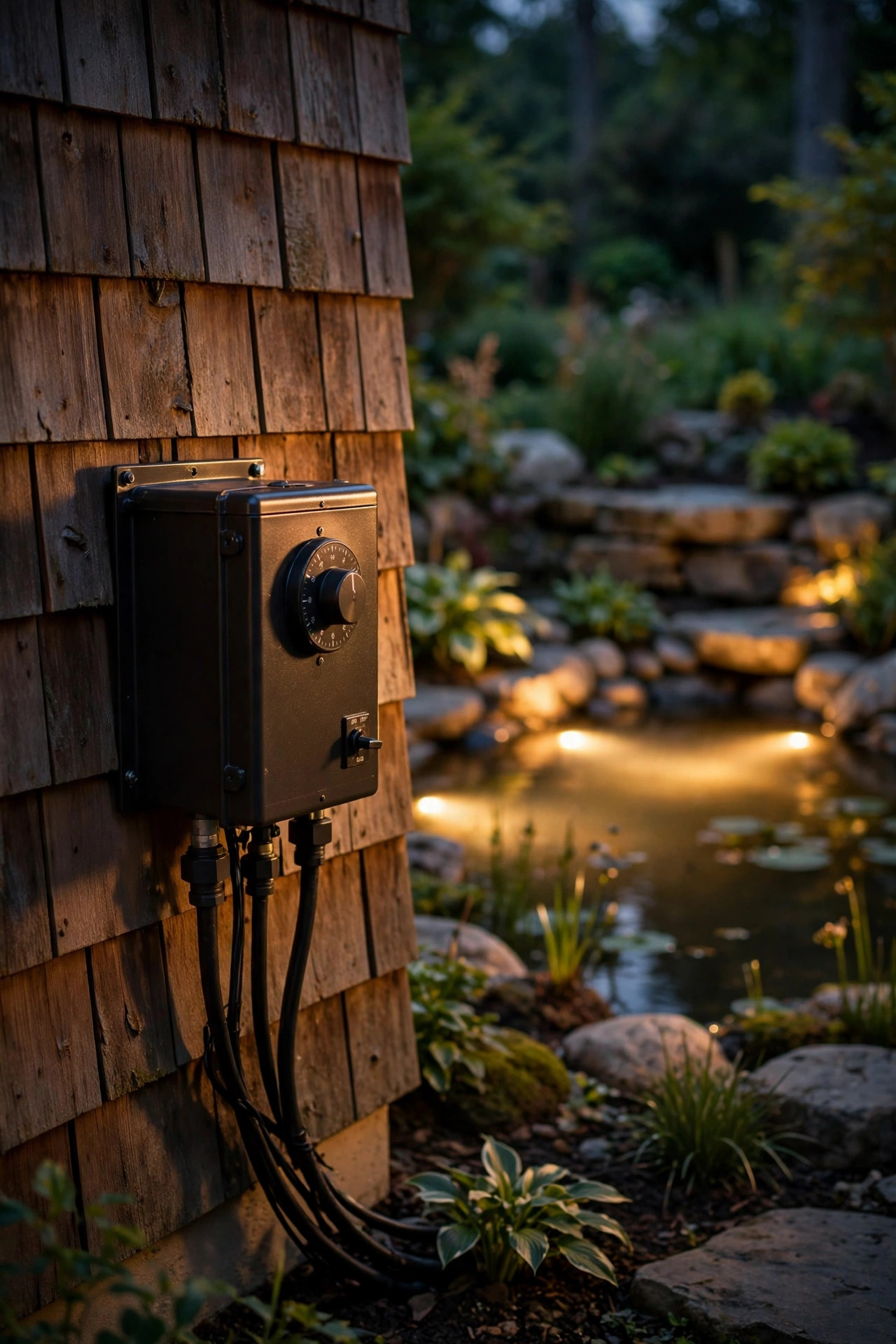
16. Timers, Photocells, and a Transformer That Does the Thinking
The best lighting plan is the one that turns itself on, because a pond you have to remember is a pond that sits dark half the summer. I run all my wired pond lights from a single low-voltage transformer with a built-in photocell and timer, set to switch on at dusk and off around 11 p.m., which covers the evening without lighting an empty garden at 3 a.m. Size the transformer with headroom: add up your fixture wattages and choose a unit rated at least 20 percent higher, so future additions do not force a replacement. A plug-in astronomical timer works beautifully for solar-free indoor-outlet setups too. Put the transformer somewhere you can reach it in the rain without regret, mine is on the house wall under the eave, and label the runs with small tags; future you, troubleshooting a dark fixture in October, will be grateful. Automation is also kinder to your electric bill and your neighbors than all-night lighting.
Suggested budget range: $45 – $120.
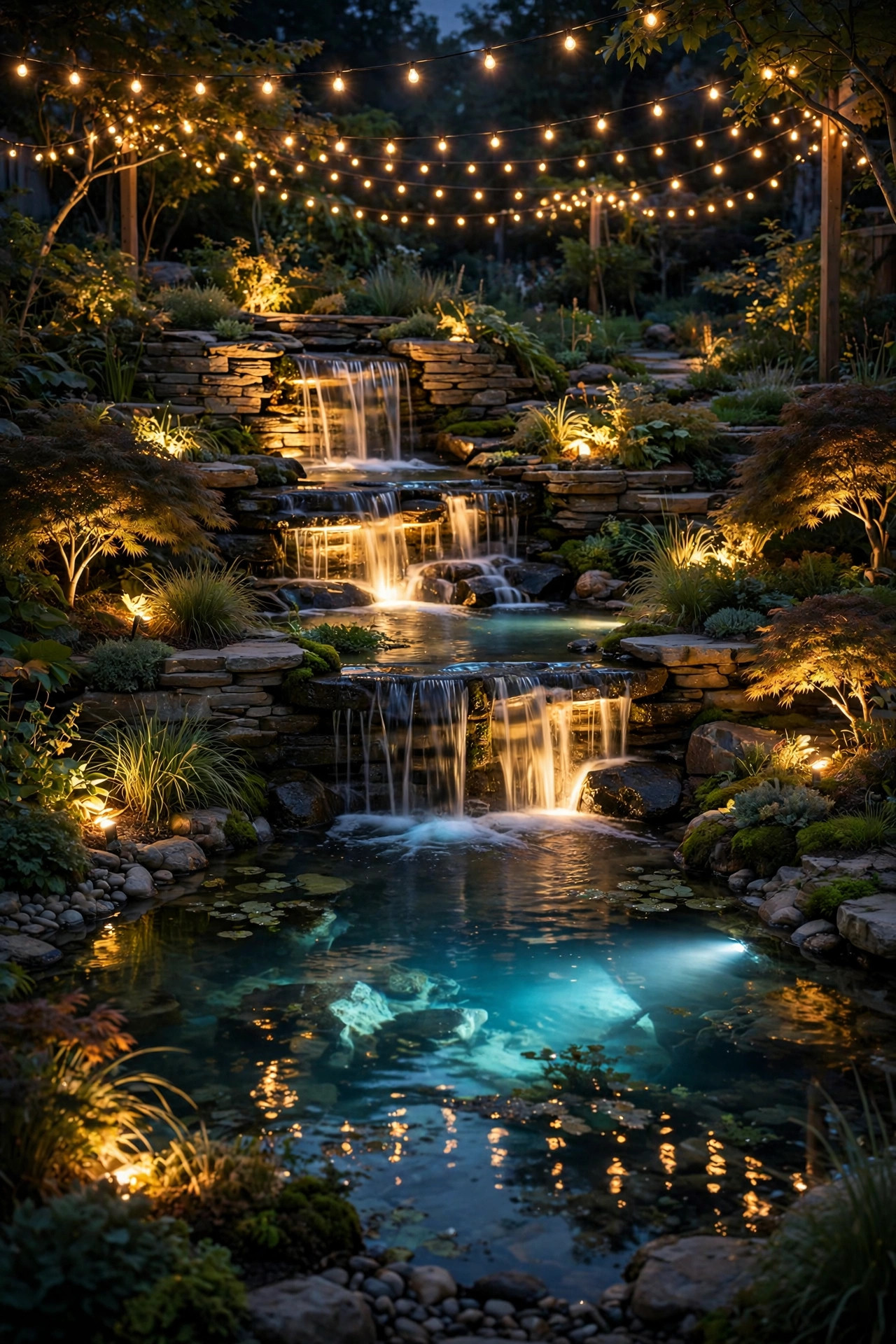
17. Layered Pond Lighting Ideas That Tie the Whole Scene Together
Here is the finale I build toward: layers, each doing one job, all in the same warm color family. Start underwater with two or three submersible spotlights for the core glow. Add the rim layer, low lights tracing the edge every 4 to 6 feet, so the shape reads from the house. Give the plants their uplights, one per major clump, and let any waterfall or statue have its own dedicated fixture. Finish with one overhead note, moonlighting from a tree or string lights overhead, and put everything wired on a single timer so the scene arrives all at once at dusk. Stand back with a drink and edit like a painter: if a layer competes, dim it, move it, or remove it, because restraint is what separates a designed pond from a lit pond. Done this way, these pond lighting ideas stop being seventeen separate tricks and become one place you never want to leave. For the wider framework I use across the whole garden, my garden lighting ideas pull the same layers together beyond the water.
Suggested budget range: $200 – $600.
Frequently Asked Questions
What color light looks best in a pond?
Warm white, between 2700K and 3000K, is the most flattering choice for almost every pond. It makes stone look golden, keeps fish colors true, and blends gracefully with the rest of your garden lighting. Cooler white can suit a very modern, formal water feature, but in a naturalistic pond it tends to look stark and a little clinical, so I always suggest buying one fixture first and judging it after dark before committing to a full set.
Are pond lights safe for fish and plants?
Yes, when you choose correctly. Low-voltage LED fixtures rated IP68 are designed for continuous submersion and produce very little heat, so fish and aquatic plants are perfectly comfortable around them. Keep light levels moderate and give fish a shadowed corner to retreat to, since constant bright light all night can stress them; a timer that switches off late in the evening is both fish-friendly and budget-friendly. Avoid copper-based fixtures inside the water, and never use line-voltage lighting in a pond without a licensed electrician and full GFCI protection.
Can solar lights really work in and around a pond?
Solar works wonderfully for the gentle layers: floating orbs, rim stakes, flame-effect torches, and fairy lights all perform well because they ask for modest light over many hours. Where solar struggles is underwater brightness and shaded ponds, since a panel under trees may only store enough charge for a few evening hours. My honest rule is solar for accents, wired low-voltage for the core underwater glow, and you will rarely be disappointed by either.
How many lights does a small backyard pond need?
For a typical pond of 6 to 10 feet across, five to seven fixtures cover it beautifully: two or three submersible lights for the underwater glow, two or three rim or path lights to define the edge, and one accent for a waterfall, statue, or plant grouping. Start there, live with it for a week, and add only where you see a genuinely dark gap. More fixtures than that usually creates glare and competition rather than beauty.
Conclusion
A pond after dark should feel like the reward at the end of the garden, and the honest truth is that it takes very little to get there: a glow under the water, a gentle line of light at the rim, and one or two accents with the confidence to stay quiet. Work through these pond lighting ideas in layers, test each one from the chair where you actually sit, and let the reflections do the heavy lifting. When you are ready to carry the same layered thinking to the rest of the yard, browse the wider collection of lighting ideas here on the site and keep building your evening garden one warm layer at a time.