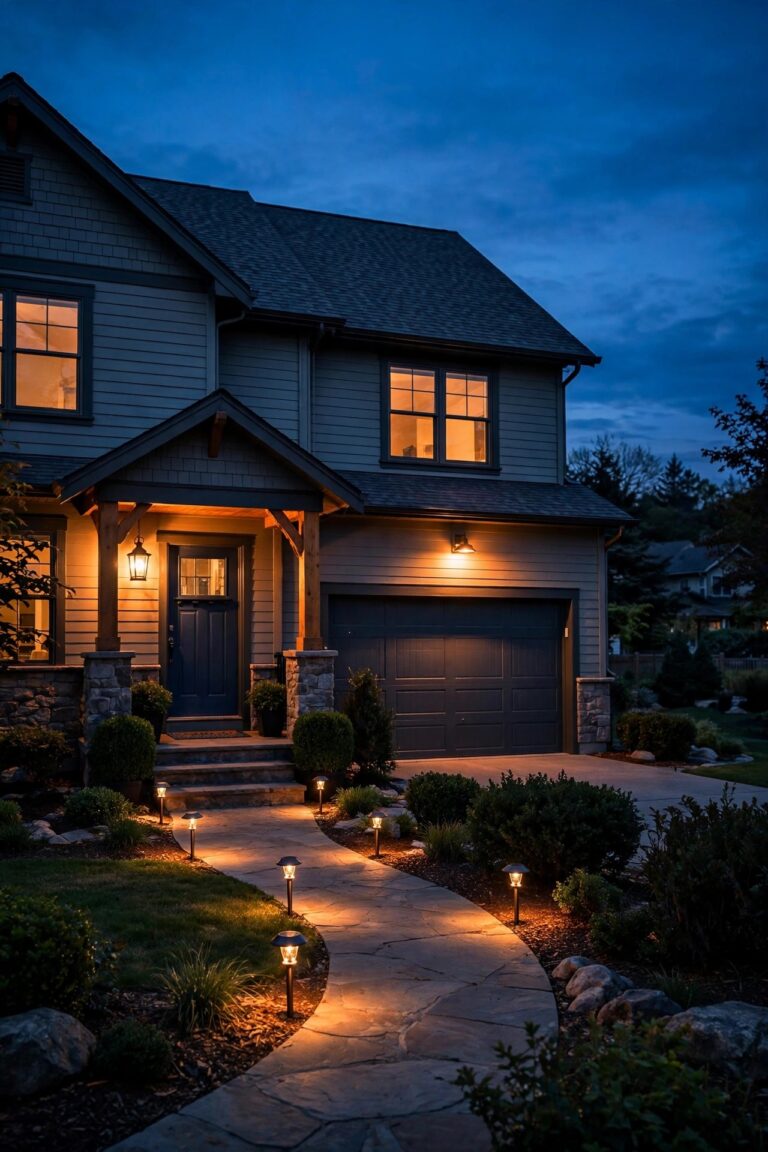
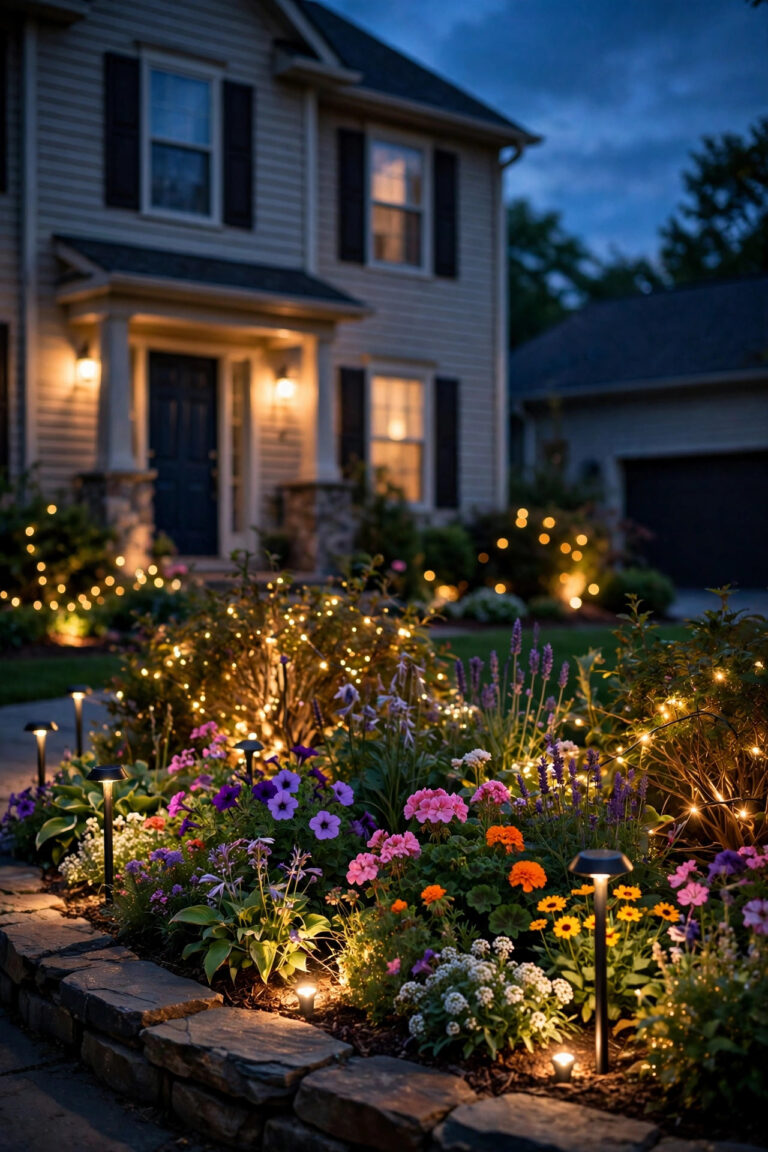
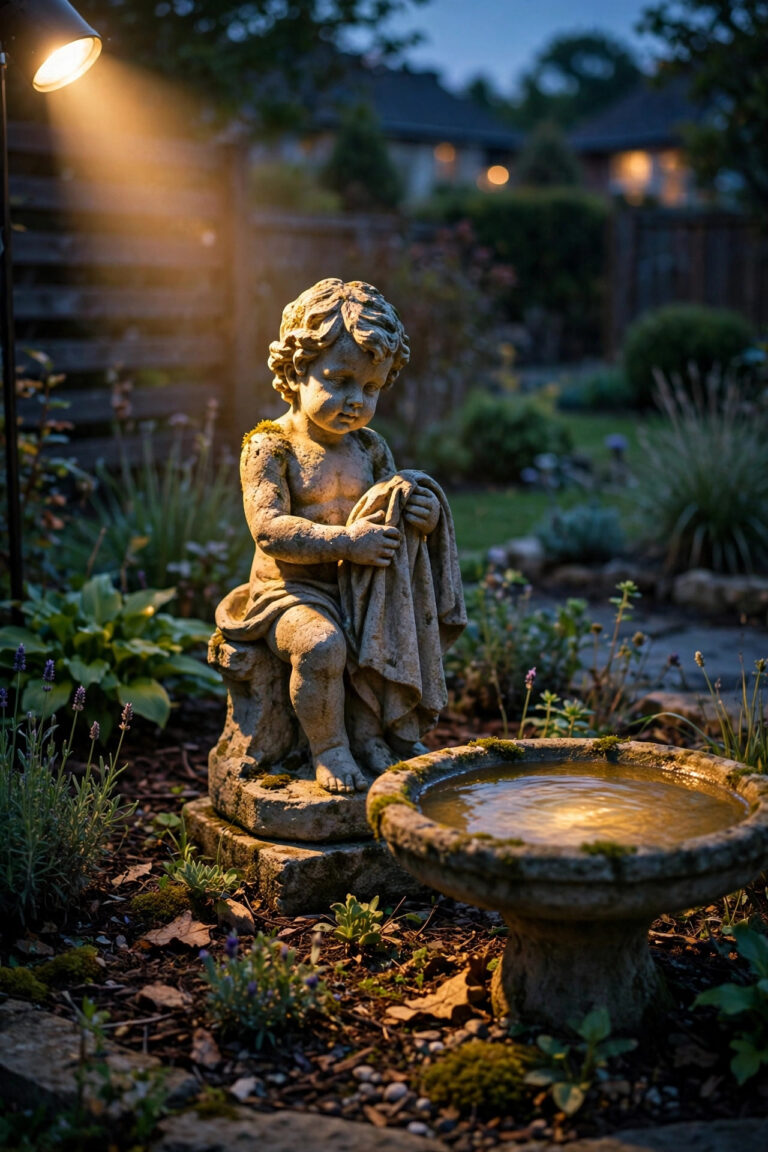
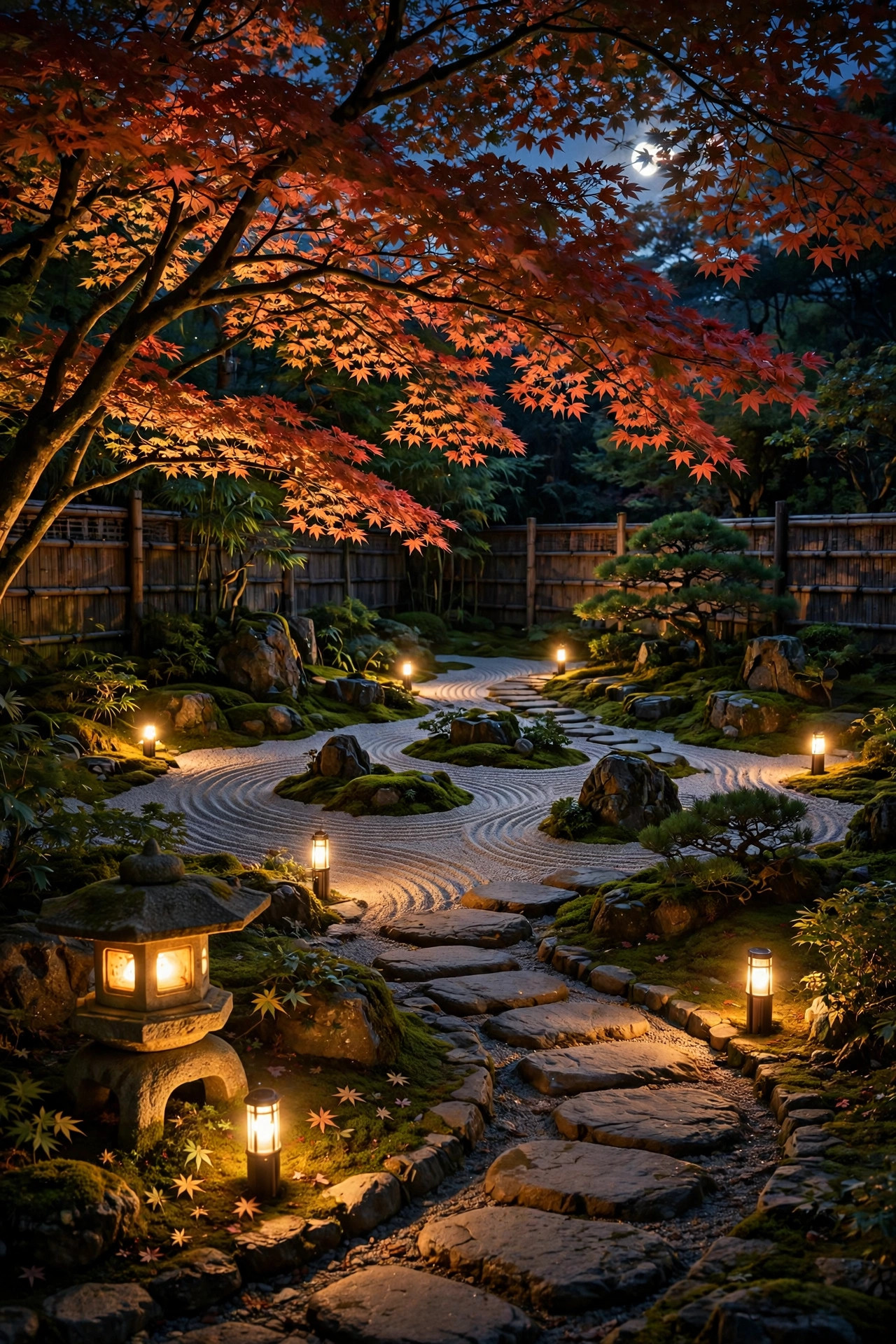
The first time I lit my little Japanese-style corner, I made the classic mistake: too many lights, all of them too bright, and the whole space felt like a parking lot instead of a retreat. These japanese garden lighting ideas come from scaling way back. In a zen garden, light should feel discovered, not installed — a glow inside a stone lantern, a soft pool of light on gravel, one tree washed in moonlight. My approach is layering at low levels: ground light for safe footing on stepping stones, a mid layer of lanterns for warmth, and a single high accent, usually moonlighting through a maple. Dim and warm beats bright every time, so I stick to 2700K bulbs and hide fixtures wherever I can. Below are the 19 ideas I actually use, from five-minute solar touches to a full low-voltage plan, each with an honest budget range. If you want the broader picture first, my garden lighting ideas guide covers the whole yard, and this post zooms into the quiet corners.

1. Start With Stone Lanterns, the Heart of Japanese Garden Lighting Ideas
If a zen garden gets only one light, make it a stone lantern. These carved granite or cast-stone lanterns, called toro, have sheltered a small flame for centuries, and that soft boxed glow is still the most calming light I know. Place one where paths turn, beside a water basin, or at the foot of your best tree — odd numbers and asymmetric spots always look more natural than pairs. A real flame is lovely but risky near mulch and dry leaves, so I use warm LED candle bulbs or solar inserts rated for outdoor use; the flicker setting on a quality LED honestly fools everyone at dusk. Keep the light low inside the lantern chamber so it spills onto the gravel rather than shining into eyes. Cast-stone versions weather beautifully and cost far less than true granite. In my experience, one lantern lit well does more for the mood than six path lights, so buy the lantern first, live with it a week, and let it anchor every japanese garden lighting decision after that.
Suggested budget range: $45 – $180.

2. Line the Stepping Stones With Bamboo Path Lights
Stepping stones set the slow, mindful pace of a Japanese garden, and each one deserves a small pool of light so evening walks feel safe without feeling staged. Short bamboo or bamboo-look bollards, about 12 to 15 inches tall, blend into the planting by day and throw a gentle downward wash at night. I space them every second or third stone, roughly 4 to 6 feet apart, and stagger them left and right instead of marching them in pairs — symmetry is the enemy of the natural look. Choose 2700K warm white and modest output, around 100 to 200 lumens; you are lighting the stone, not the whole path. Low-voltage wired fixtures give the steadiest glow, while solar versions with a remote panel work where the stones sit in sun. Keep fixtures tucked against a stone edge or a fern so the source stays hidden. If this style speaks to you, my pagoda path light ideas post covers more Asian-inspired shapes that sit beautifully along a stone path.
Suggested budget range: $25 – $90.

3. Moonlight From a Favorite Tree
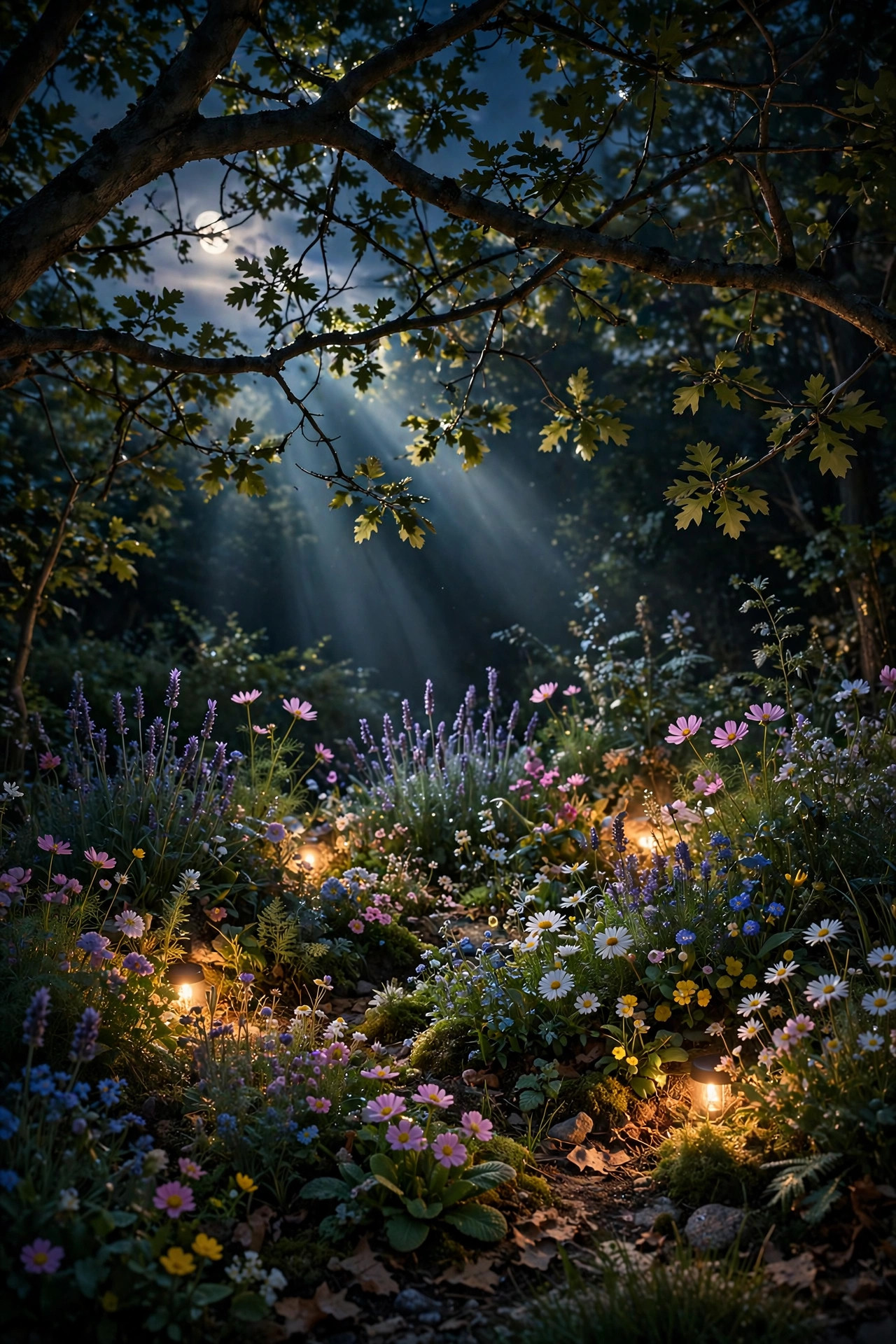
Moonlighting is the single most peaceful trick in this whole list. Mount one or two shielded downlights 12 to 20 feet up in a Japanese maple, pine, or even a sturdy oak at the garden edge, and aim them straight down through the branches. The light filters through the leaves and lands on the gravel in soft, dappled patterns that shift when the breeze moves — it genuinely looks like a full moon lives in your tree. Use a cool-neutral bulb around 3000K here, slightly cooler than your lanterns, because real moonlight reads cooler and the contrast feels natural. Fixtures need a glare shield and a proper tree strap or stainless screws, never nails hammered carelessly into bark. This is the one job where I hired an arborist with a ladder once and now just maintain the bulbs myself. My moonlighting trees guide walks through fixture placement and aiming if you want the full method before climbing anything.
Suggested budget range: $60 – $220.
4. Add Submersible Lights to the Koi Pond
Water and warm light together are pure meditation, and a small pond or water bowl is where a zen garden comes alive after dark. Submersible LED pond lights sit on the pond floor or clip to the edge, angled up at a waterfall, a cluster of iris, or the slow swirl of koi. Always choose fixtures rated IP68 for full submersion and run them on low voltage, 12 volts, with the transformer plugged into a GFCI outlet — electricity and water demand that respect, no exceptions. Two or three small lights beat one bright one; I aim for a glow you notice second, after the sound of the water. Warm white keeps koi colors rich and reds glowing, while a single soft blue-green accent can deepen the water color in a modern garden. Rinse lenses monthly in summer, because algae film dims output fast. On still evenings, the reflections double every lantern nearby, and honestly, that mirrored shimmer is the prettiest light in my whole yard.
Suggested budget range: $35 – $140.

5. Uplight One Sculptural Tree
Every Japanese garden has a hero: a twisted pine, a red maple, a cloud-pruned juniper. Give that one tree a dedicated uplight and let the rest of the garden stay quiet around it. I use a single well light or a stake spotlight buried at the base, angled up at about 30 degrees so the beam rakes across the bark texture and into the lowest branches. Raking light is what reveals the sculpture — straight-on front lighting flattens it. A narrow 15 to 30 degree beam keeps the glow on the tree instead of spilling into the sky or a neighbor window. Warm 2700K flatters red and burgundy foliage beautifully in fall. Resist adding a second light for symmetry; one dramatic tree against soft darkness is exactly the wabi-sabi mood we are after. In my experience this is the idea guests photograph most, and it costs less than almost anything else on the list because it is literally one fixture, one cable run, one timer click at dusk.
Suggested budget range: $20 – $75.

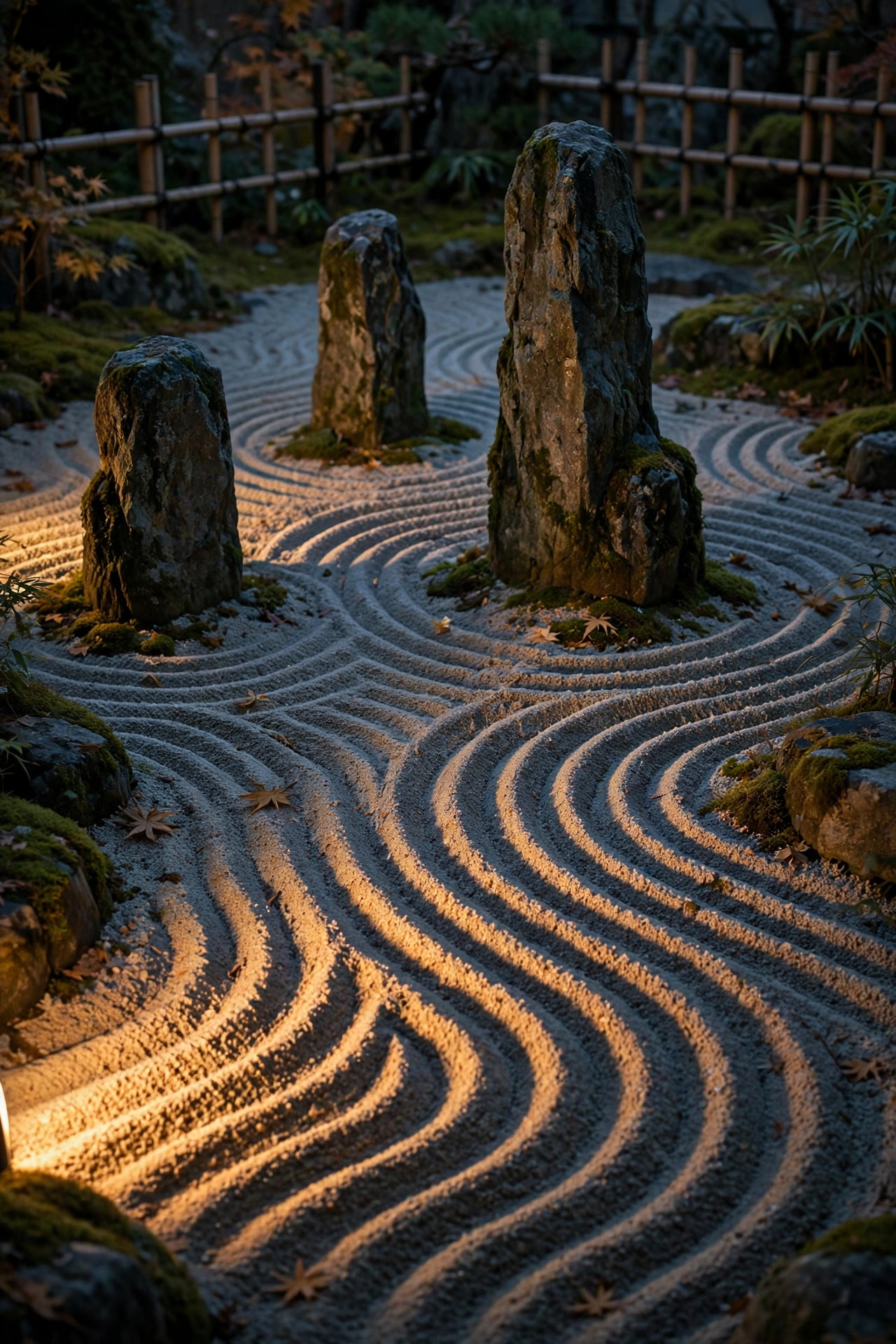
6. Wash the Raked Gravel With Hidden Light
A dry gravel garden, the karesansui, is all about pattern: raked waves and rings around standing stones. Light it wrong and the rake lines vanish; light it low and across, and every groove casts a tiny shadow that makes the pattern glow with texture. The secret is grazing light from a hidden source at gravel level. I tuck small in-ground well lights or a low shielded fixture behind a border stone at each short end of the gravel bed, so light skims horizontally across the surface. Never shine down from above — flat overhead light erases the very shadows you raked in. Keep output low, 100 lumens or less per fixture, and warm. Solar in-ground lights work here if the bed sits in full sun, though wired low-voltage is steadier through winter. After storms, re-rake and check that no fixture has drifted above the gravel line. Done right, the gravel becomes a lit artwork you can read from the deck like a quiet painting.
Suggested budget range: $30 – $110.
7. Hang Paper-Style Lanterns From the Arbor
Real paper lanterns dissolve in the first rainstorm, but modern outdoor versions in weatherproof nylon or resin keep that soft floating-orb look all season. I hang three, always an odd number, at slightly different heights from the arbor or pergola beam over my sitting corner, using LED bulbs inside — LED only, because anything hot near fabric shades and dry bamboo is a fire risk I will not take. Choose warm 2700K filament-style LED bulbs at low wattage so the lantern itself glows rather than the bulb glaring through. Solar lanterns with the panel on top are the zero-effort route for a sunny arbor; wired stringer sockets give steadier light in shade. Space them unevenly, a cluster of two and one apart, like lanterns hung for a small tea gathering. Bring cheaper styles indoors for winter storms and they will last years. On a still night, three glowing orbs over a bench turn an ordinary corner into the seat everyone quietly hopes to get.
Suggested budget range: $25 – $85.

8. Spotlight the Water Basin
A stone water basin, the tsukubai, is meant to catch your eye and slow you down before tea, and a whisper of light makes it the garden focal point after dark. I hide one small spotlight in the planting behind the basin, aimed so the beam catches the water surface and the wet stone rim without blinding anyone approaching. Moving water sparkles; still water mirrors, and either way a low 50 to 100 lumen beam is plenty. Position the light so visitors see the glow, never the fixture — tuck it behind a fern or a low stone. If your basin has a bamboo spout, aim slightly across the drip point so each falling drop flashes as it lands, which is honestly mesmerizing. Keep all wiring low-voltage and connections in waterproof gel-filled nuts, since this spot stays damp. Rinse the lens when you top up the basin. It is a tiny installation, twenty minutes of work, that gives the whole garden a sense of ceremony.
Suggested budget range: $15 – $60.

9. String a Few Lights Over the Tea Corner
Yes, string lights belong in a zen garden too — but with restraint, which is honestly my rule for them everywhere. One single swag, not three, sagging gently over the tea or meditation corner gives just enough overhead warmth to read by or pour by. I pick small globe or copper-wire styles in warm white and skip anything oversized or carnival-bright. Anchor the strand between the arbor post and a bamboo pole set into the planting, with a natural drape of about 12 inches in the middle. LED bulbs only, and outdoor-rated sockets with the connections kept off the ground. On a timer for three evening hours, this one strand does the job of a porch light for the whole corner at a fraction of the harshness. If your garden has a moonlighting tree nearby, keep the strand dimmer than the moonlight so the layers do not compete. Simple, cheap, and the corner instantly becomes where evening conversations stretch an hour longer than planned.
Suggested budget range: $15 – $50.

10. Scatter Stone-Look Solar Lights
From a distance, the most invisible daytime fixtures are solar lights molded to look like river stones and small boulders. By day they read as part of the rock grouping; by night each one glows softly from within the planting. I scatter four or five through the groundcover, near a stone grouping, and beside the pond edge, always clustered casually instead of spaced like soldiers. Quality varies a lot, so check for a real IP65 weather rating and replaceable batteries, and give the hidden solar panel a wipe every few weeks — dust quietly steals half the charge. Output is gentle, more glow than beam, which suits a zen garden perfectly. They are my first suggestion for renters or anyone avoiding wiring entirely, since there is no cable, no transformer, and no commitment: if a spot looks wrong, pick the stone up and move it. In deep shade they will fade by midnight, so save them for beds that catch at least five hours of sun.
Suggested budget range: $20 – $60.

11. Recess Lights Into the Viewing Deck
Many Japanese gardens are designed to be viewed from one special seat — a deck edge, an engawa-style platform, or a simple bench step. Small recessed deck lights set into that platform edge mark the step down into the garden and wash the first stones with light, all without a single visible fixture breaking the view. I install them every 4 to 5 feet along the deck rim, choosing frosted-lens models that spread light downward rather than out into your eyes while seated. Low-voltage wired sets are the reliable choice here since the fixtures live underfoot and take weather; look for walk-over rated housings and stainless or composite trim that will not rust-stain the boards. Keep the color at 2700K to match your lanterns. This is a slightly bigger weekend job — drilling clean holes and running cable under the deck — but the result is pure calm: you sit in soft shadow, the garden glows below you, and the boundary between house and garden disappears. In my experience, this is the idea that makes a small garden feel twice its size.
Suggested budget range: $55 – $160.

12. Weave Fairy Lights Through the Bamboo Grove
A bamboo grove at night is mostly sound — that soft rustle — until you weave one strand of copper-wire fairy lights through the culms and it becomes a wall of tiny warm stars. I thread the wire in a loose spiral up three or four canes at the grove edge, keeping the lights inside the foliage line so from the path you see glow, not wire. Solar copper-wire strands are perfect here because bamboo groves usually sit in the sun all day anyway, and there is no outlet anywhere near mine. Warm white only; colored lights undo the zen in about four seconds. Push the battery pack or panel into a spot that still catches sun but hides from the main view. The copper wire disappears against the canes by day, which I love. One honest caution: fairy lights are decoration, not pathway lighting, so pair them with your bamboo bollards for safe footing. Together the two layers make the grove look deep and mysterious instead of like a dark fence line.
Suggested budget range: $10 – $35.

13. Use Japanese Garden Lighting Ideas to Honor a Statue or Pagoda
A stone pagoda, a small Buddha, or a carved guardian figure earns its place in the garden, and japanese garden lighting ideas should treat it like the artwork it is. I light statues the way museums do: one soft spotlight from low and to the side, never straight on, so shadows model the carving instead of flattening it. Start with a dim fixture, around 100 to 200 lumens, and step back ten feet to judge — stone glows fast and over-lighting looks theatrical in the worst way. A ground-level well light hidden behind a small rock gives an uplight that makes a five-tier pagoda look seven feet tall. Keep the beam on the statue only; light spilling onto the fence behind it breaks the spell. For a Buddha figure, some gardeners prefer a lantern beside it instead of a spotlight, letting the statue sit in reflected glow — honestly, that softer route is the one I chose, and it feels more respectful and more peaceful.
Suggested budget range: $18 – $70.

14. Mark the Garden Gate With a Lantern Pair
The gate is the threshold between the everyday yard and the calm corner, and light is how you tell visitors, and yourself, that the mood changes here. I flank my simple wooden gate with one wall-mounted lantern-style sconce on the post — just one if the gate is narrow — in a dark bronze or bamboo finish that suits the garden. Motion-sensor models are practical on the approach path, but inside the garden I prefer a steady dusk-to-dawn photocell lantern so the welcome glow is simply always there. Warm 2700K, frosted glass, nothing that glares at eye level. Hang a small wind chime nearby if you like; sound plus soft light is a very Japanese welcome. Wiring a post lantern usually means a short low-voltage run from the nearest path-light cable, an easy Saturday task. Every single evening when I walk out with tea, that lit gate makes the garden feel like a destination instead of just the far end of the yard.
Suggested budget range: $30 – $120.

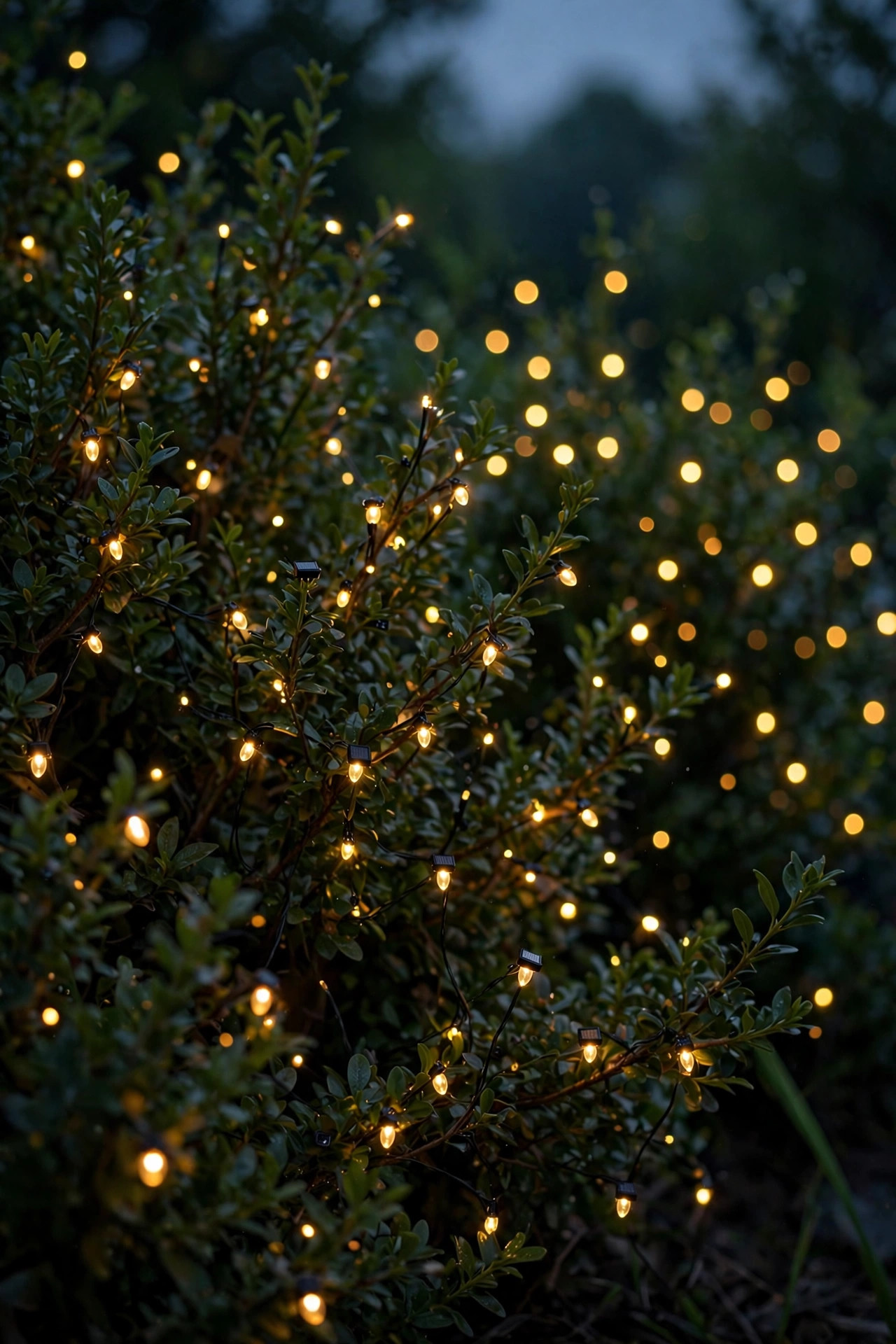
15. Float Firefly Lights in the Shrubbery
Firefly lights are thin solar strands topped with tiny bulbs on flexible stems, and once tucked into a shrub they sway and bob in the evening breeze exactly like real fireflies drifting over the planting. A zen garden is the perfect home for them because the effect is pure suggestion — six or eight gentle points of light moving in the dark over the azaleas. I push two clusters into the shrubs flanking my sitting bench and let the flexible stems spread at different heights, about knee to waist high. Warm white reads most natural; the cool white versions look like electronics, honestly. Each cluster needs its small solar panel angled into real sun, so check the shrub does not shade it out as summer growth fills in. They cost almost nothing, ask for no wiring, and children and adults both stop mid-sentence the first time they notice them. Pair with your lanterns and moonlight and the whole corner feels quietly alive after dark.
Suggested budget range: $12 – $30.
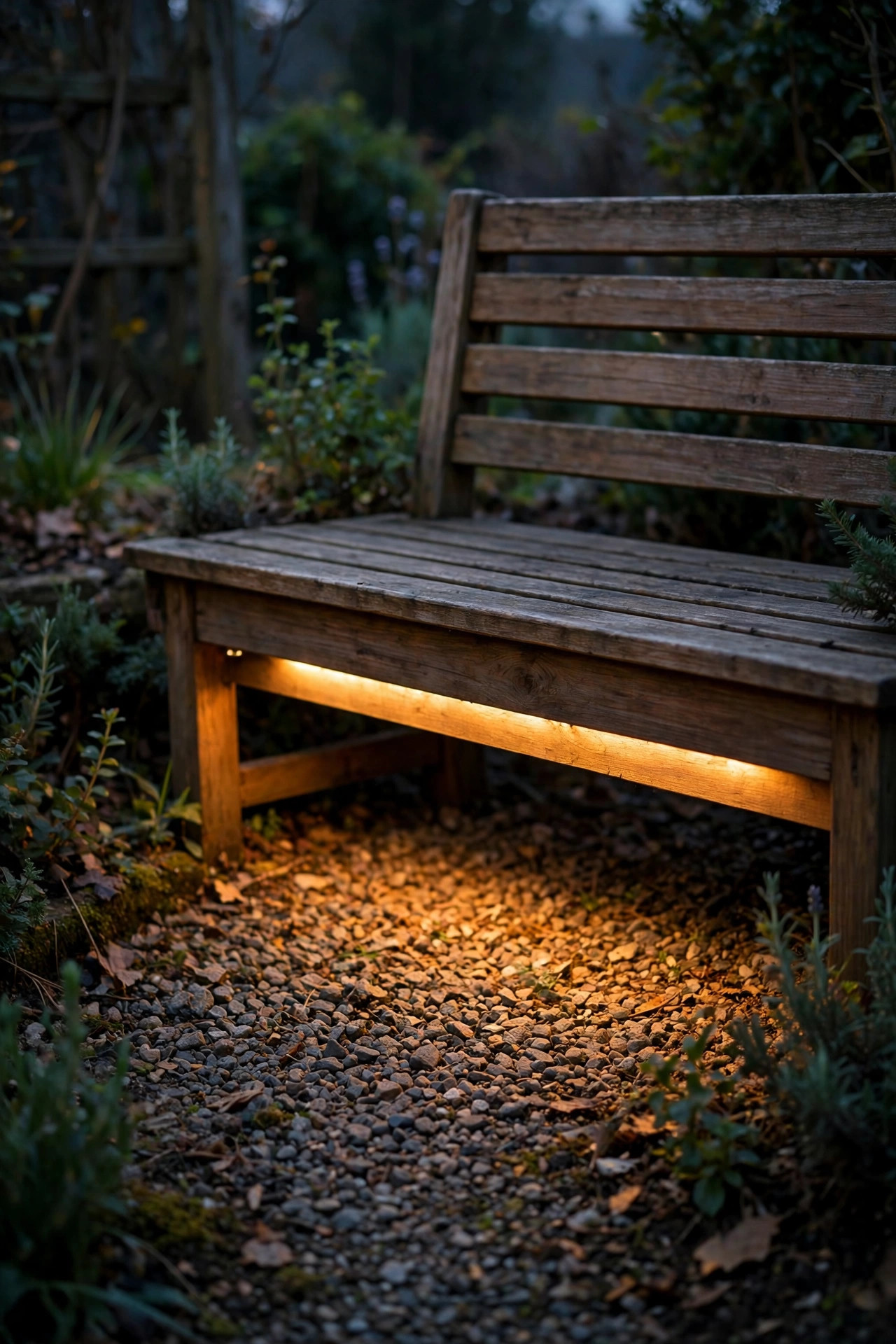
16. Hide a Strip Light Under the Bench
The viewing bench is where I sit longest, so I stole this trick from modern landscape designers: a waterproof LED strip hidden under the bench seat or under a low stone ledge, washing the gravel or deck boards below with a floating glow. The fixture is completely invisible, your feet rest in soft light, and the bench itself seems to hover. Use an outdoor-rated strip, IP65 or better, in 2700K warm white on a dimmer, because full brightness under a seat feels like a fridge light — I keep mine at about half. Low-voltage strips with a small transformer in a weatherproof box are the dependable route, and the box tucks under the bench too. Stick the strip with its adhesive plus a few clips, since summer heat loosens adhesive over a season or two. This is also stealthily practical: dropped tea cups and book pages get found fast. Layered under moonlight and one stone lantern, an under-bench glow is the final touch that makes the corner feel designed rather than decorated.
Suggested budget range: $20 – $65.
17. Keep Every Bulb at One Warm Color Temperature
This is the least glamorous idea on the list and the one that protects all the others. A Japanese garden lit in three different color temperatures looks like three different gardens arguing. Pick 2700K warm white for lanterns, path lights, and accents, and hold that line with every replacement bulb and every new fixture, forever. The only exception I allow is the moonlighting fixture at 3000K, a touch cooler, high in the tree where the difference reads as moonlight rather than mismatch. When you shop, the Kelvin number is on every box and product listing — check it the way you would check a fixture size. Mixed bargain multipacks are the usual trap; one cool-blue solar stake can cheapen a whole corner. If a beloved older fixture runs cool, move it to the driveway and let the garden stay warm. In my experience, color consistency is the invisible detail that separates gardens that feel serene from gardens that merely have lights in them, and it costs nothing but attention.
Suggested budget range: $0 – $40.

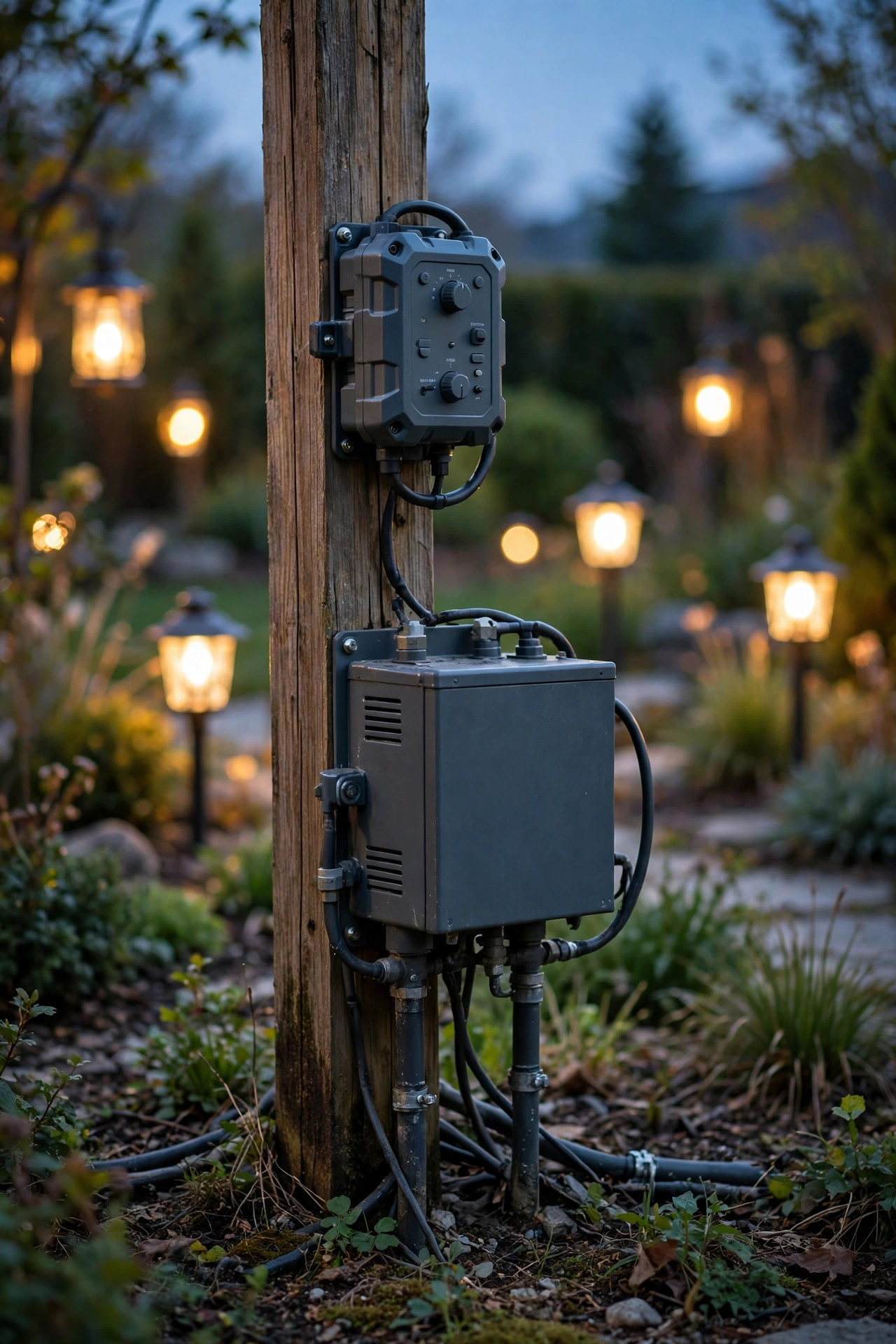
18. Put the Whole Garden on a Timer
A calm garden should simply be lit when you step out, not after ten minutes of hunting switches. I run every wired fixture through one low-voltage transformer with a built-in photocell and timer: lights breathe on at dusk, soften the garden for three or four hours, and click off before midnight so the garden, the neighbors, and the moths all get their darkness back. Solar pieces handle themselves. Set the timer seasonally — my winter evenings start at five, my summer ones at nine — and use the manual override for nights when guests linger. A smart plug on the transformer works too and lets me light the garden from the kitchen while the tea brews, which never stops feeling like a small luxury. Timers also save the bulbs and the electric bill, and dark-sky-friendly hours mean the stars stay visible overhead. Honestly, automation is what turned my lighting from a project into a habit: the garden glows every evening whether I remember it or not.
Suggested budget range: $25 – $80.
19. Layer Your Japanese Garden Lighting Ideas Into One Quiet Scene
Here is the whole philosophy in one idea: a finished zen garden at night is three soft layers, never one bright one. Layer one is ground light — bamboo bollards and stone-look solar glows marking the stepping stones. Layer two is the warm heart — a stone lantern, the basin sparkle, paper lanterns over the bench. Layer three is a single high note — moonlight through the maple or one sculptural tree uplit against the dark. Walk your garden at dusk with a drink in hand and adjust like a sound engineer: anything that glares gets shaded, anything invisible gets a nudge brighter, and any fixture you can see gets hidden behind a stone or fern. Count your total fixtures; most calm corners need only eight to twelve, which surprises everyone. These japanese garden lighting ideas work as a system, and the system is restraint. Add one layer per season, live with it, and stop the moment the garden feels complete — that quiet restraint is exactly what makes it feel like Japan instead of a lighting showroom.
Suggested budget range: $150 – $600.
Frequently Asked Questions
What color temperature is best for a Japanese garden?
Warm white, around 2700K, suits almost every fixture in a Japanese garden because it echoes candlelight inside stone lanterns and flatters wood, stone, and foliage. The one exception is moonlighting, where 3000K high in a tree reads as natural moonlight. Whatever you choose, keep it consistent, since mixed color temperatures are the fastest way to make a calm corner feel disjointed.
Can I light a zen garden with solar lights only?
Yes, if the garden gets at least five to six hours of direct sun on the panels. Solar stone lanterns, stone-look rocks, firefly strands, and fairy lights all work beautifully without any wiring. In shaded gardens, put solar panels on remote leads in the sun, or mix in a small low-voltage wired system for the key pieces like path lights and pond lights so the core glow never fails on cloudy weeks.
How do I light a koi pond safely?
Use only submersible fixtures rated IP68, run them on 12-volt low voltage, and plug the transformer into a GFCI-protected outlet. Keep all cable connections out of the water in waterproof gel-filled connectors, and never run household 120-volt power to anything in or near the pond. Angle lights at a waterfall or planting rather than straight at viewing seats, and clean algae off the lenses monthly for full brightness.
How many lights does a small Japanese garden actually need?
Fewer than you think — most small corners feel complete with eight to twelve fixtures total. Start with one stone lantern, two or three path lights for the stepping stones, and one tree light, then live with that for a few evenings before adding anything. A zen garden depends on darkness and shadow for its calm, so every light you skip is part of the design too.
Conclusion
A Japanese garden after dark should feel like an exhale, and the right light is always the quiet kind: a lantern glowing through stone, moonlight sifted through maple leaves, water catching one small sparkle. Start with a single stone lantern, keep every bulb warm and consistent, hide every fixture you can, and add layers one season at a time. These japanese garden lighting ideas are less about brightness than about restraint, and that restraint is what turns an ordinary corner into the calmest seat in the yard. When you are ready to plan the rest of the yard in the same spirit, browse the wider lighting projects here on the site and carry the same soft, layered approach to every corner you own.