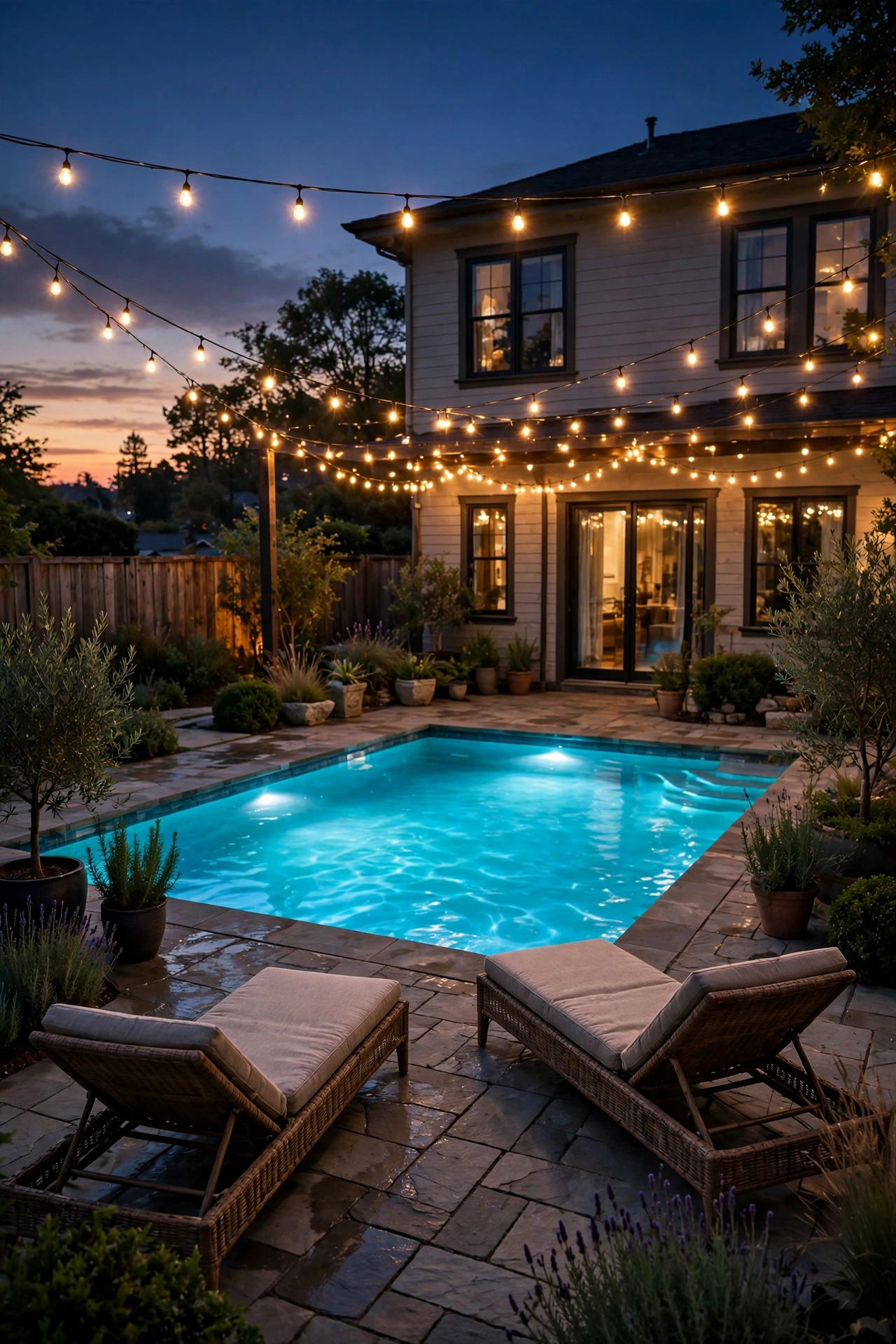
There is something almost magical about slipping into a pool after dark. The whole backyard goes quiet, the sky turns indigo, and if your lighting is right, the water itself seems to glow from within. I have spent years helping friends and clients figure out their pool underwater lighting ideas, and honestly? The difference between one dim old pool bulb and a thoughtfully layered setup is the difference between "just swimming" and a full-blown evening experience. My philosophy is always the same: layer it. A little underwater color, a little warm glow around the deck, and a few safety lights so nobody trips on the way to the towel basket. In this post I am walking you through 21 ideas — from simple LED retrofits you can handle on a Saturday afternoon to color-changing systems and moonlight effects that will make your neighbors stop and stare. Grab a lemonade, and let's turn your pool into the best seat in the house after dark.
1. Swap Your Old Pool Bulb for an LED Retrofit
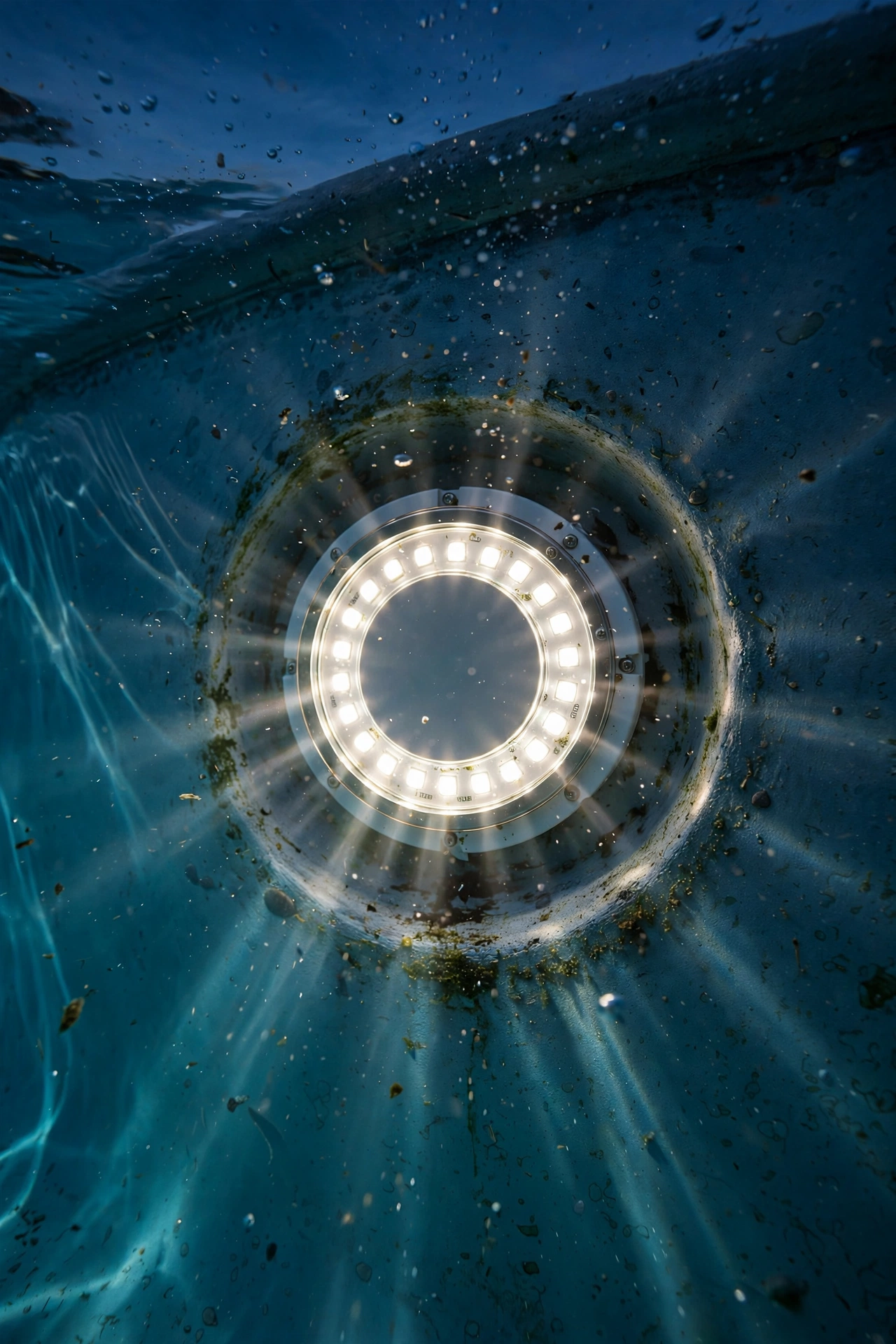
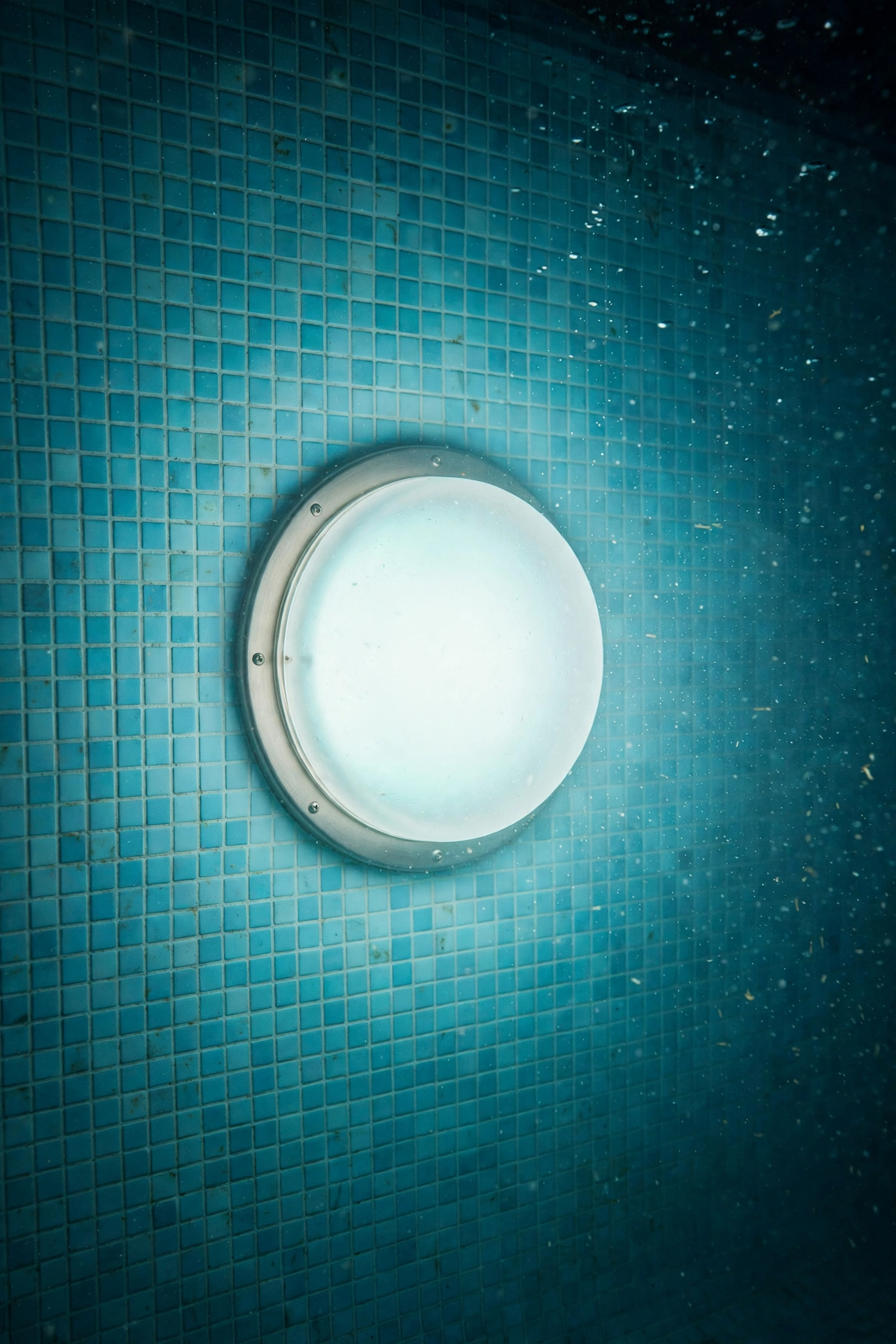
If you take on exactly one project from this list, make it this one. Most pools built before 2015 still run old incandescent or halogen pool bulbs that eat 300 to 500 watts and burn out every season or two. A modern LED retrofit screws or clips into the existing niche — no new wiring, no drain-down — and sips just 15 to 45 watts while throwing far more light. In my experience, a single good LED retrofit can light a whole average-size pool so evenly you will wonder why you waited so long. Turn the power off at the breaker first (never trust just the switch), pop the fixture from its niche, and swap the bulb or the whole sealed LED unit according to the manufacturer's instructions. Most retrofits are 120-volt, so the existing wiring stays put, and you keep the GFCI protection you should already have on that circuit. Look for a sealed, submersible-rated unit — IP68 — and pick your color temperature: warm white around 3000K feels like a resort lagoon, while cool white around 5000K gives that crisp, sparkling aqua look. Many retrofits now include color-changing modes you cycle through with the wall switch. If your fixture niche is cracked or the cord seal looks brittle, call in a pool electrician rather than forcing it — water and electricity are not a place to improvise.
Suggested budget range: $60 – $180.
2. Go Full Color With Changing Pool Underwater Lights
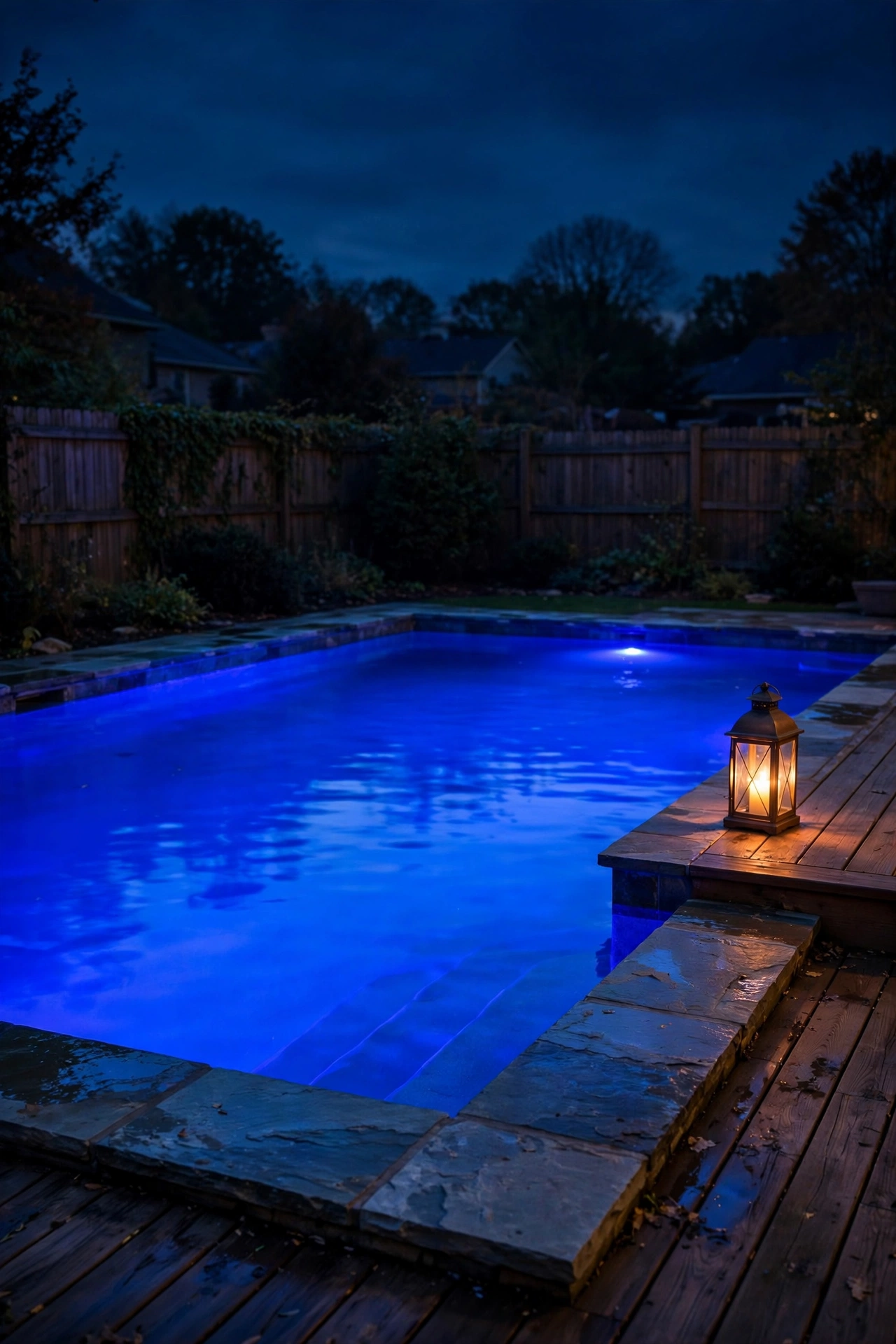
Once you have reliable white light, color is where the fun starts. Color-changing pool lights — usually RGB or RGBW LEDs — let you shift the whole mood of the water with a tap or a flip of the switch. Slow-cycling rainbow modes are pure magic for kids' swim nights, deep blue reads elegant and calm for an adults-only evening, and red or purple turns an ordinary Saturday into a party. I always recommend choosing a fixture with a "hold" mode so you can freeze on your favorite color instead of cycling forever, and a dimming option, because full-blast color at 2 a.m. can look more nightclub than backyard. Most color units are 12-volt low-voltage, which is the safest route for pool electrical — the transformer sits well away from the water and steps the voltage down before it ever reaches the fixture. Sync multiple lights so they change together; nothing ruins the effect like two lights stuck on different colors. A lot of models now include a small remote or phone app, which beats running inside to flip the switch. Plan on one color light per 200 to 300 square feet of surface area for even coverage in a typical residential pool.
Suggested budget range: $150 – $450 per fixture.
3. Add Nicheless Underwater Spotlights
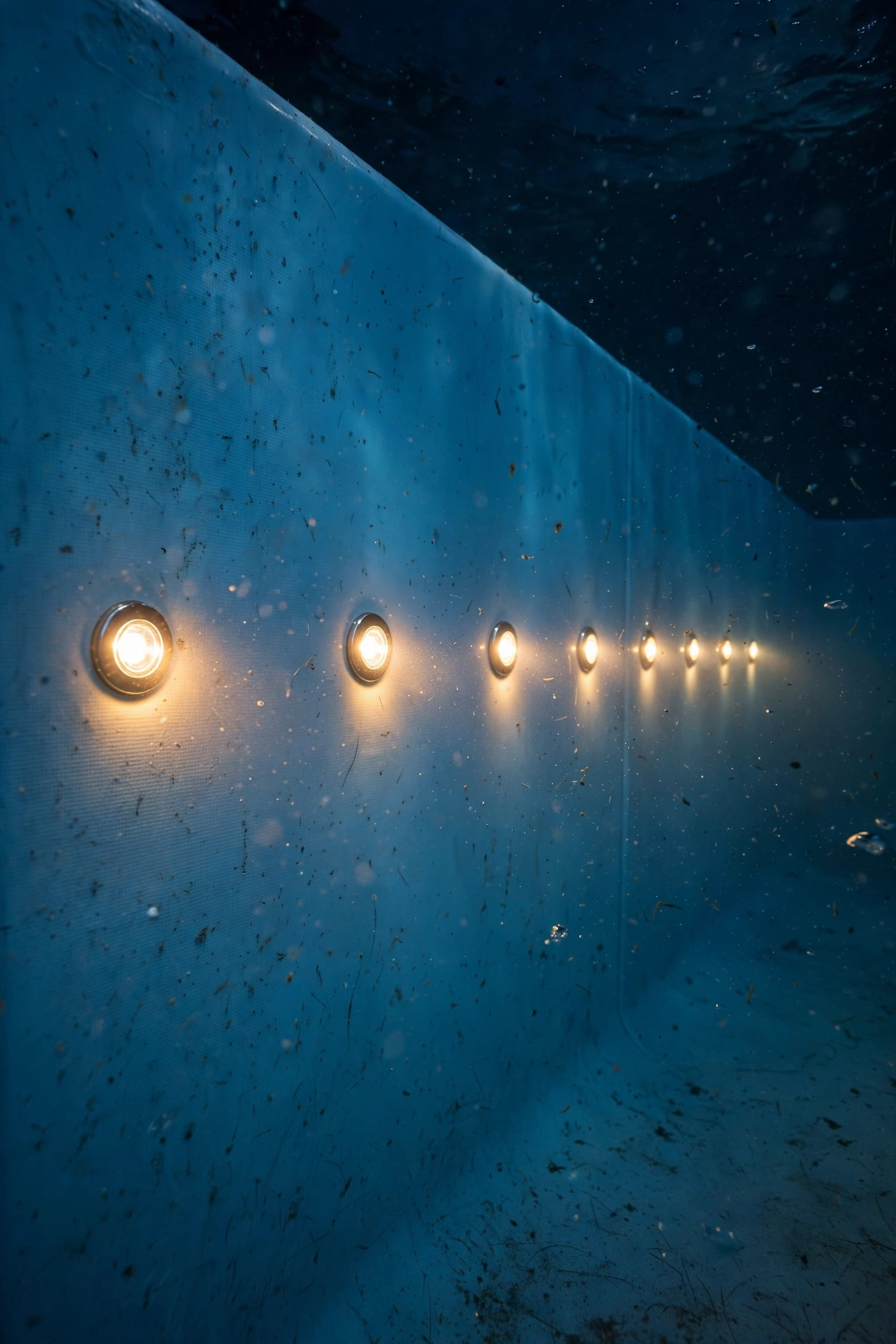
Not every pool has a classic light niche, and many smaller plunge pools, cocktail pools, and above-ground setups were built with zero underwater lighting at all. Nicheless LED spotlights solve that beautifully. These compact fixtures — often just 3 to 4 inches across — mount flat against the pool wall with a simple bracket or clamp, and the cord runs up and out of the water to a low-voltage transformer. I love them for fiberglass shells and vinyl liners where cutting a niche is not an option. Most are 12-volt, fully sealed to IP68, and available in warm white or color-changing versions. Placement matters: aim for lights on the long wall opposite your main viewing spot — usually the patio or kitchen window — so you see the glow, not the glare of the fixture itself. Space them 6 to 8 feet apart for even wash, and set them 18 to 24 inches below the waterline so they light the water column rather than just the surface.
Suggested budget range: $80 – $220 per light.
4. Soften the Glow With a Frosted Lens Cover
Sometimes the problem is not brightness — it is harshness. A bare LED pool light can create that sharp, stadium-like hotspot right in front of the fixture, with the rest of the pool falling off into shadow. A frosted or diffused lens cover is a tiny upgrade with an outsized payoff: it scatters the beam into a soft, even wash that makes the whole water column glow like a lantern. You can buy replacement diffused lenses sized for common fixtures, or choose a fixture with a frosted faceplate from the start. In my experience, this is the fix people need when they say their new LED is "too bright" — they do not need less light, they need better-distributed light. While you are at it, check the gasket and pilot screw; a fresh seal keeps water where it belongs. This trick pairs beautifully with warm white LEDs if you are after that dreamy, golden-lagoon feel rather than a clinical aqua. It is the cheapest glow-up on this entire list, and honestly one of my favorites to recommend.
Suggested budget range: $15 – $60.
5. Try Fiber Optic Pool Lighting for Maximum Safety
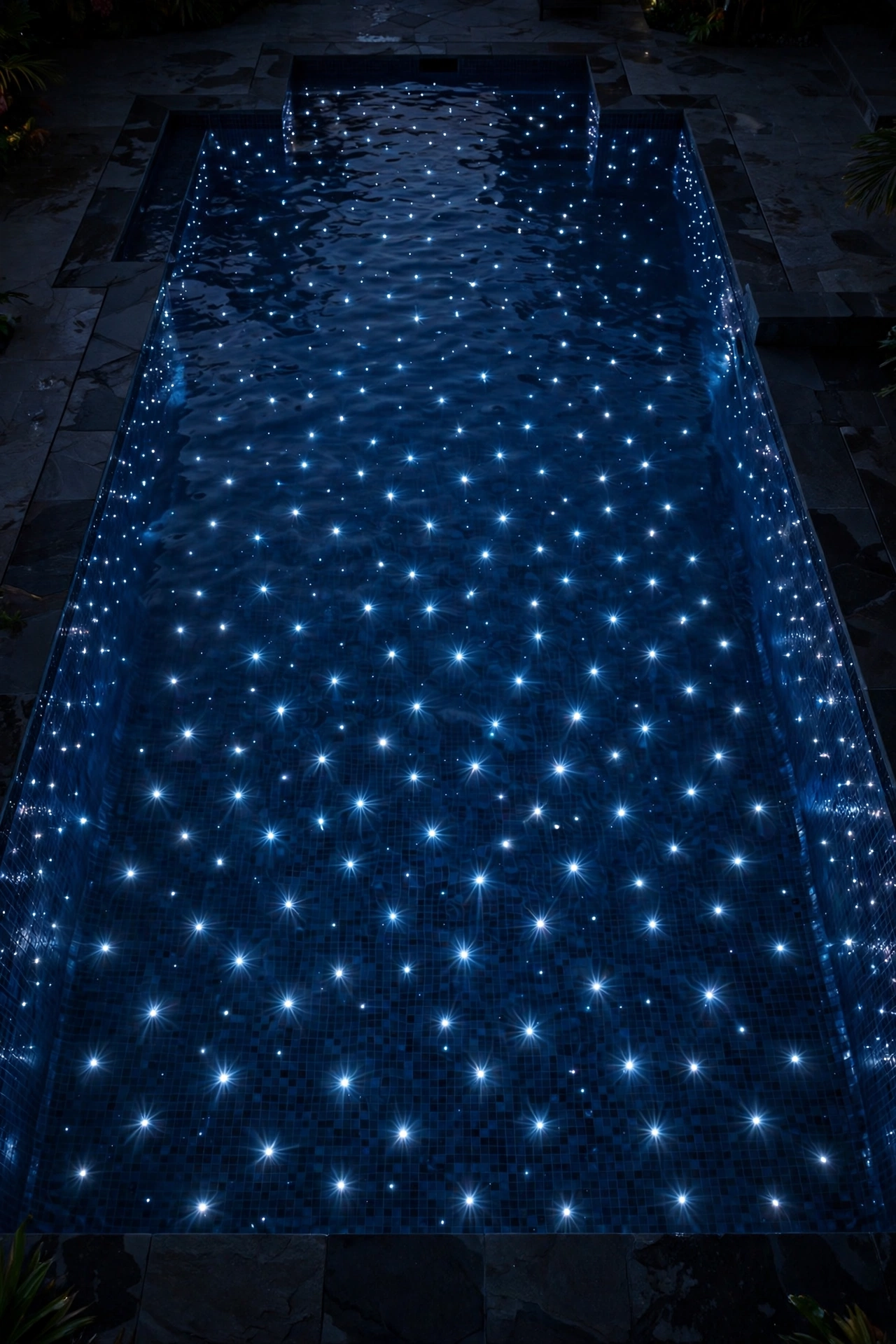
If the idea of any electricity near the water makes you nervous, fiber optics are your answer. In a fiber optic system, the actual light source — a metal-halide or LED illuminator box — sits far away from the pool, often in a dry equipment shed, and the light travels through fiber strands to small points in the pool wall. That means zero electricity anywhere near the swimmers, which is about as safe as pool lighting gets. The effect is gorgeous too: hundreds of tiny star-like points of light, and you can get twinkling or color-wheel effects that look straight out of a luxury resort. These systems are most practical in new builds or major renovations, since the fibers need to be roughed in before the pool interior finish goes on — retrofitting into an existing pool is usually not worth the cost. If you are building or replastering, though, ask your builder about it. You can run fibers to the pool floor, the walls, and even into attached spas for a night-sky effect under the water. The illuminator box needs a dry, ventilated spot within about 30 to 60 feet of the pool, and one illuminator can feed dozens of fiber points.
Suggested budget range: $1,500 – $5,000 installed.
6. Float LED Orbs on the Surface
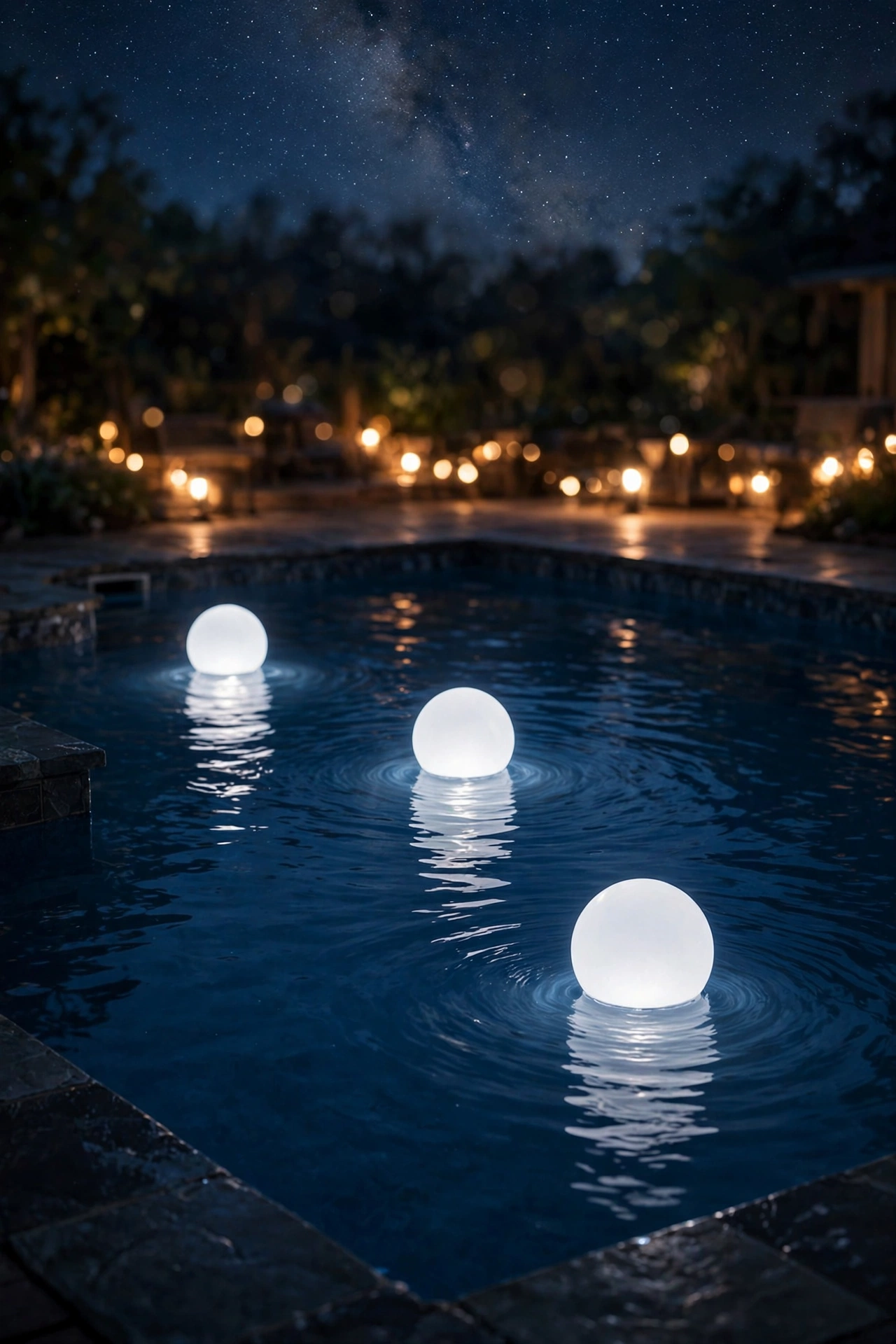
Floating LED orbs are the easiest instant upgrade in this whole post — no wiring, no electrician, no permits. Just charge or switch them on and toss them in. These waterproof spheres, usually 6 to 16 inches across, drift with the breeze and cast a soft glow across the water's surface that photographs beautifully. I keep a set of three large orbs and scatter them loosely; odd numbers always look better than even. Most run on rechargeable batteries or solar panels built into the top, giving you 6 to 10 hours per charge, and the better ones are color-changing with a remote so you can dial the mood from the deck chair. A few practical notes: tether them loosely with clear fishing line to a corner of the pool if you have a skimmer, because they will otherwise park themselves right over the skimmer basket all night. Take them out during heavy storms — they are tough, but hail and 40-mile-an-hour gusts are not their friend. And if you have curious kids or dogs, get the shatterproof plastic kind rather than glass globes. They are also brilliant for above-ground pools that have no underwater wiring at all.
Suggested budget range: $25 – $120 for a set of three.
7. Scatter Solar Floating Lights
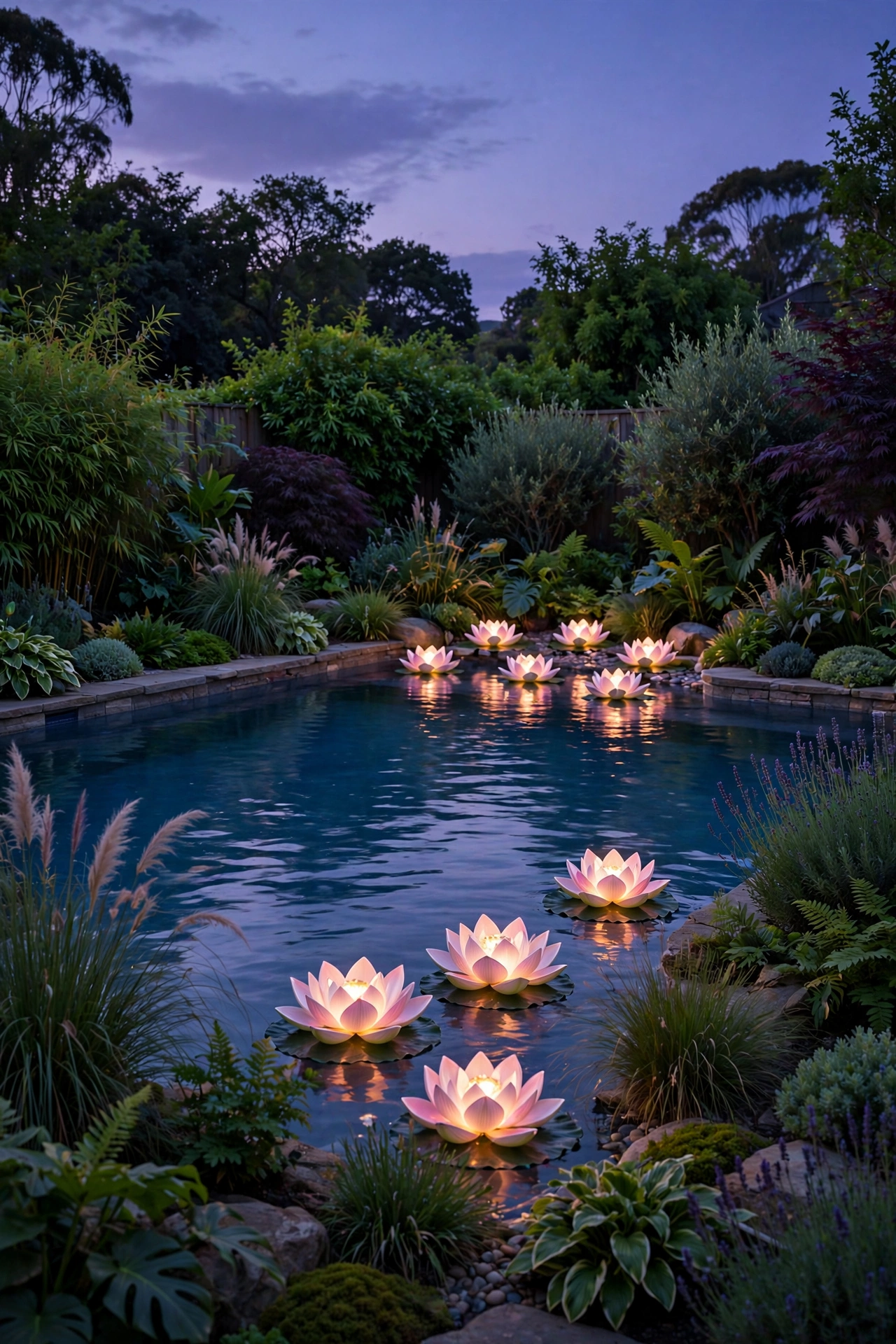
For a softer, more natural look than techy orbs, solar floating lights shaped like lily pads, lotus flowers, or simple discs are lovely. They charge all day on the water's surface and switch on automatically at dusk, glowing a gentle warm or cool white for 6 to 8 hours. I adore these in pools with adjacent landscaping — a few glowing lotus shapes drifting near the planted end of the pool make the whole scene feel like a secret garden. They are fully sealed and solar-powered, so there is literally nothing to install and no electricity to worry about. The catch is honest: they are mood lighting, not task lighting — do not expect them to illuminate the deep end. Cluster five to seven together for a real visual impact rather than dotting one lonely flower in a 20-foot pool.
Suggested budget range: $30 – $90 for a set of six.
8. Light Up Your Waterfall or Sheer Descent
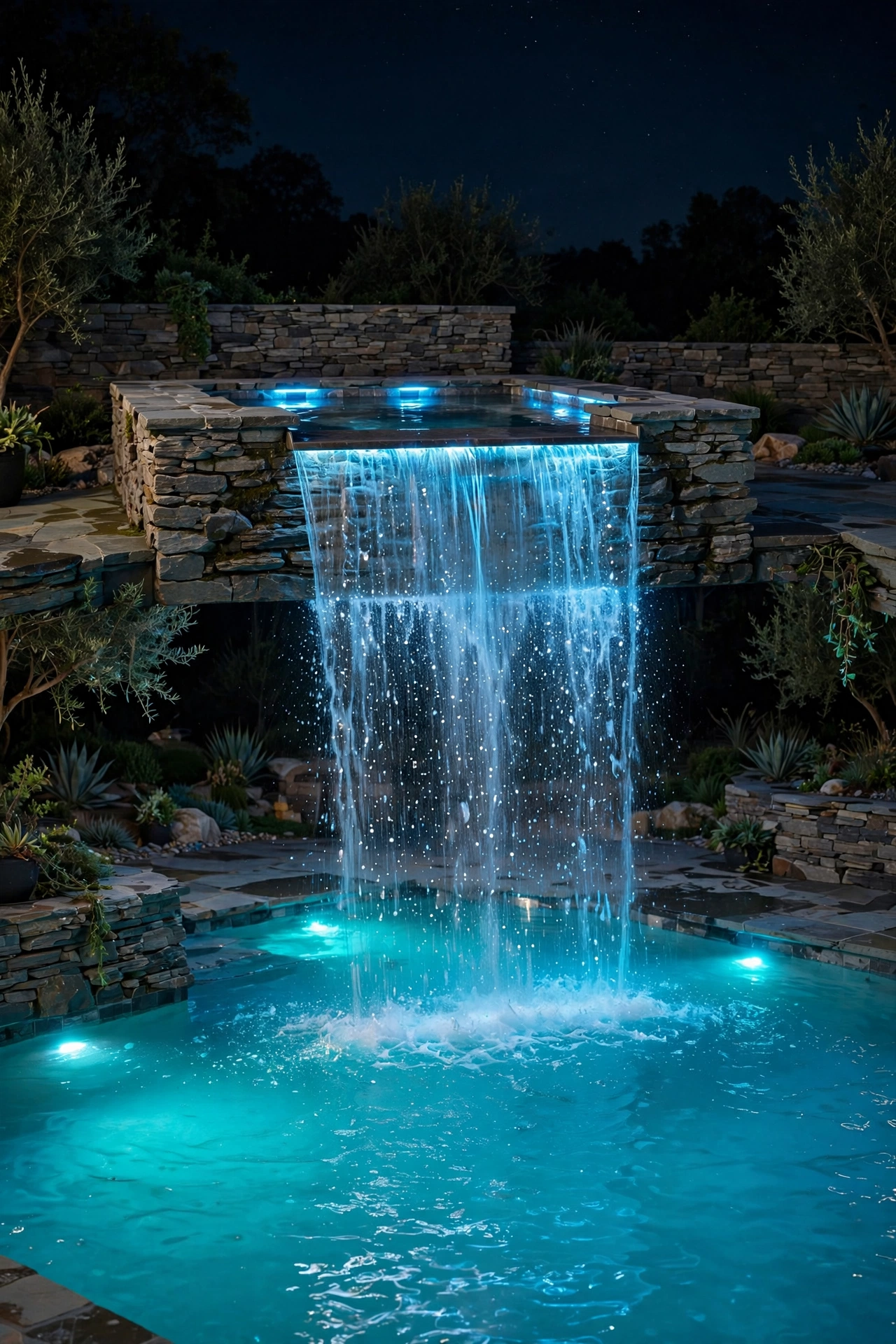
A waterfall or sheer-descent scupper is one of the most beautiful features a pool can have — and at night, unlit, it is just a dark shape. Adding light to moving water creates a shimmering curtain effect that is honestly the single most dramatic thing you can do after dark. The most common approach is a small LED strip or dedicated waterfall light bar mounted under the lip of the spillway, aimed down through the falling water. Most are 12-volt, fully sealed, and sized to the width of the feature — measure your scupper in inches before ordering. The light catches every ripple and droplet, turning the sheet of water into liquid glass. If you have a raised spa spilling into the pool, light that spillway too; the glow connecting the two bodies of water looks incredible. Choose a color temperature that matches your underwater lights so the scene feels cohesive — mixing warm waterfall light with cool pool light can look disjointed. Run the waterfall lights on the same timer as your pool pump schedule so they only run when the water is actually flowing, which saves energy and wear.
Suggested budget range: $70 – $300 per feature.
9. Accent the Spa, Steps, and Baja Shelf
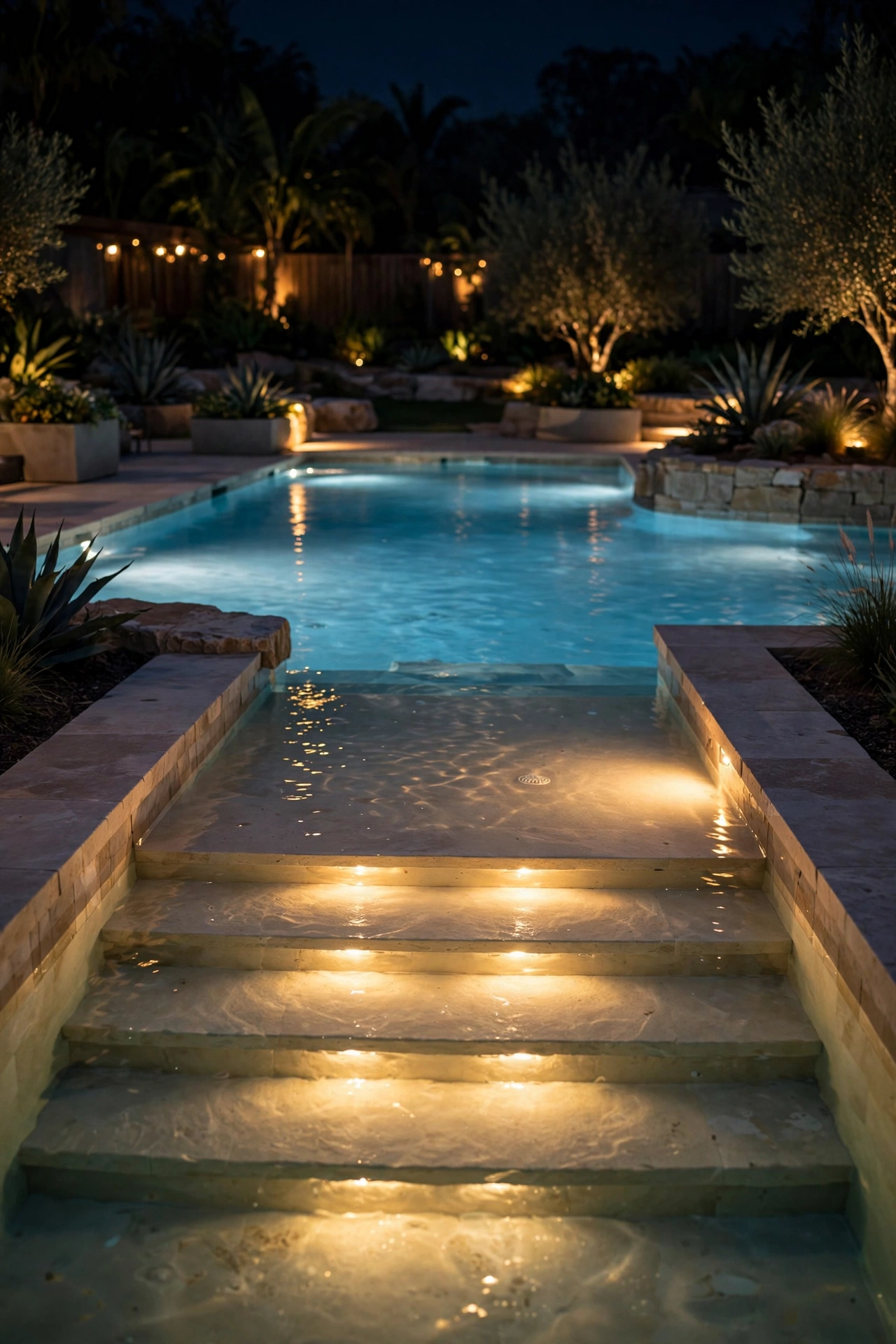
The shallow zones — your spa, entry steps, and any baja or tanning shelf — deserve their own accent lighting. These are the spots where people actually sit and linger after dark, so a little dedicated glow goes a long way for both ambiance and safety. Small 12-volt LED step lights or mini underwater spots work beautifully: one on each pool step riser, one or two washing across the baja shelf, and a soft fixture in the spa itself. I always recommend keeping spa lighting warmer and dimmer than the main pool — a soft 2700K glow in 102-degree water feels like a private hot spring, while harsh bright light kills the mood instantly. On steps, aim the light down the tread rather than straight out, so you illuminate the footing without blinding swimmers. If your baja shelf has an umbrella sleeve, a tiny uplight at its base creates a lovely halo around the umbrella pole. These small fixtures draw so little power — often 3 to 6 watts each — that you can run a whole set off one modest transformer, and they make the pool feel finished and intentional instead of half-lit.
Suggested budget range: $40 – $150 per fixture.
10. Line the Coping With LED Strip Lighting
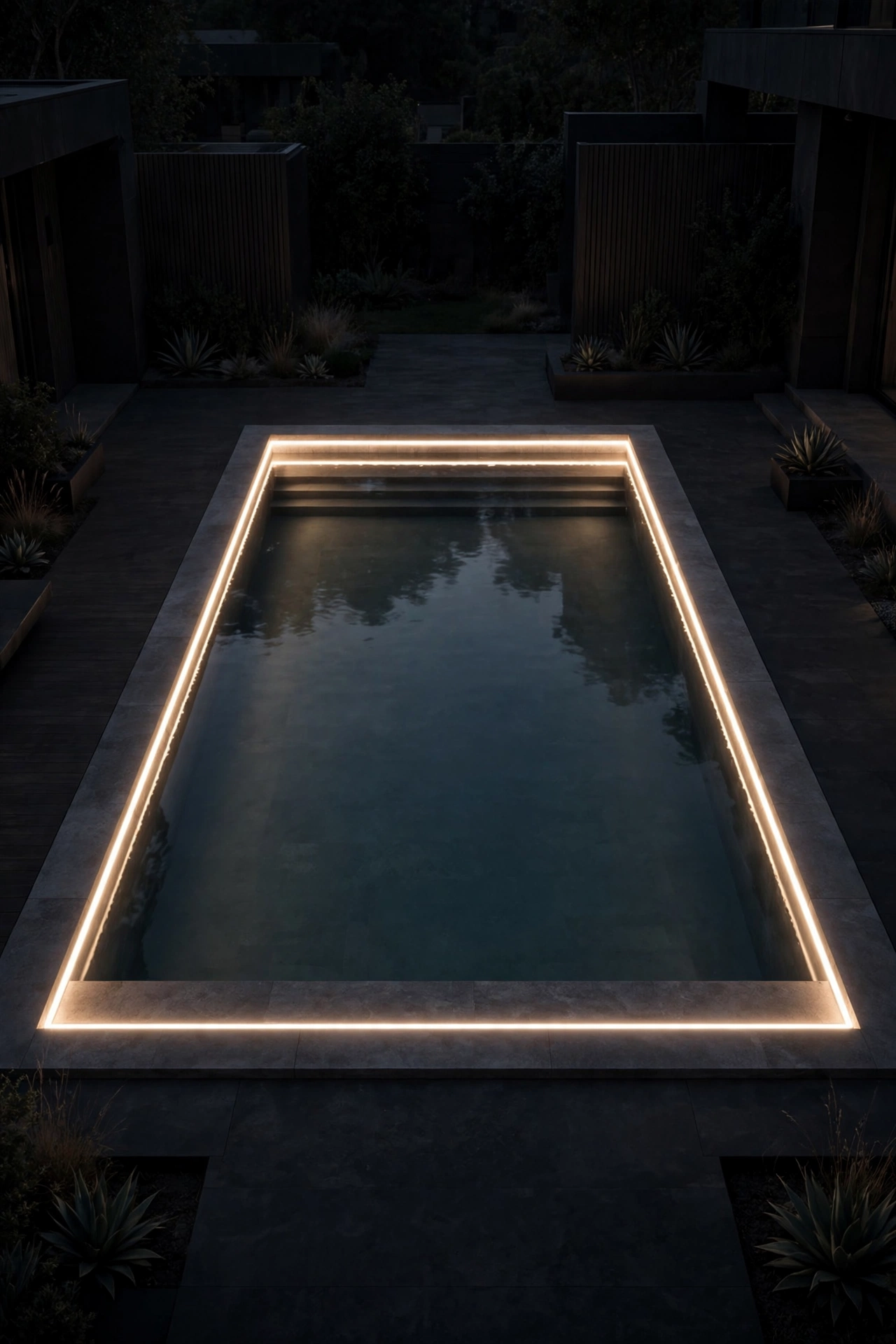
LED strip lighting tucked under the coping — the cap edge around the pool perimeter — creates a continuous ribbon of light that outlines the water like a neon drawing. It is a modern, architectural look that works especially well on geometric pools with clean lines. Use an outdoor-rated, waterproof strip (IP67 or IP68) in a low-profile aluminum channel with a diffuser cover; the channel protects the strip from feet and pool chemicals and gives the light a clean, professional line instead of a dotted look. I recommend 12-volt or 24-volt strips, never line-voltage, and mount the driver and connections in a weatherproof box well away from splash zones. Run the strip in the recessed joint under the coping overhang so the source stays hidden and you see only the glow — visible LED dots are the fastest way to make this look cheap. Warm white (2700–3000K) reads elegant; RGB strips give you party colors. One caution: pool chemicals and constant moisture are brutal on cheap strips, so buy marine-grade or pool-rated products and expect to replace budget strips every couple of seasons. A quality install with proper channels can last five-plus years.
Suggested budget range: $150 – $600 for an average pool perimeter.
11. Set Lanterns Around the Deck
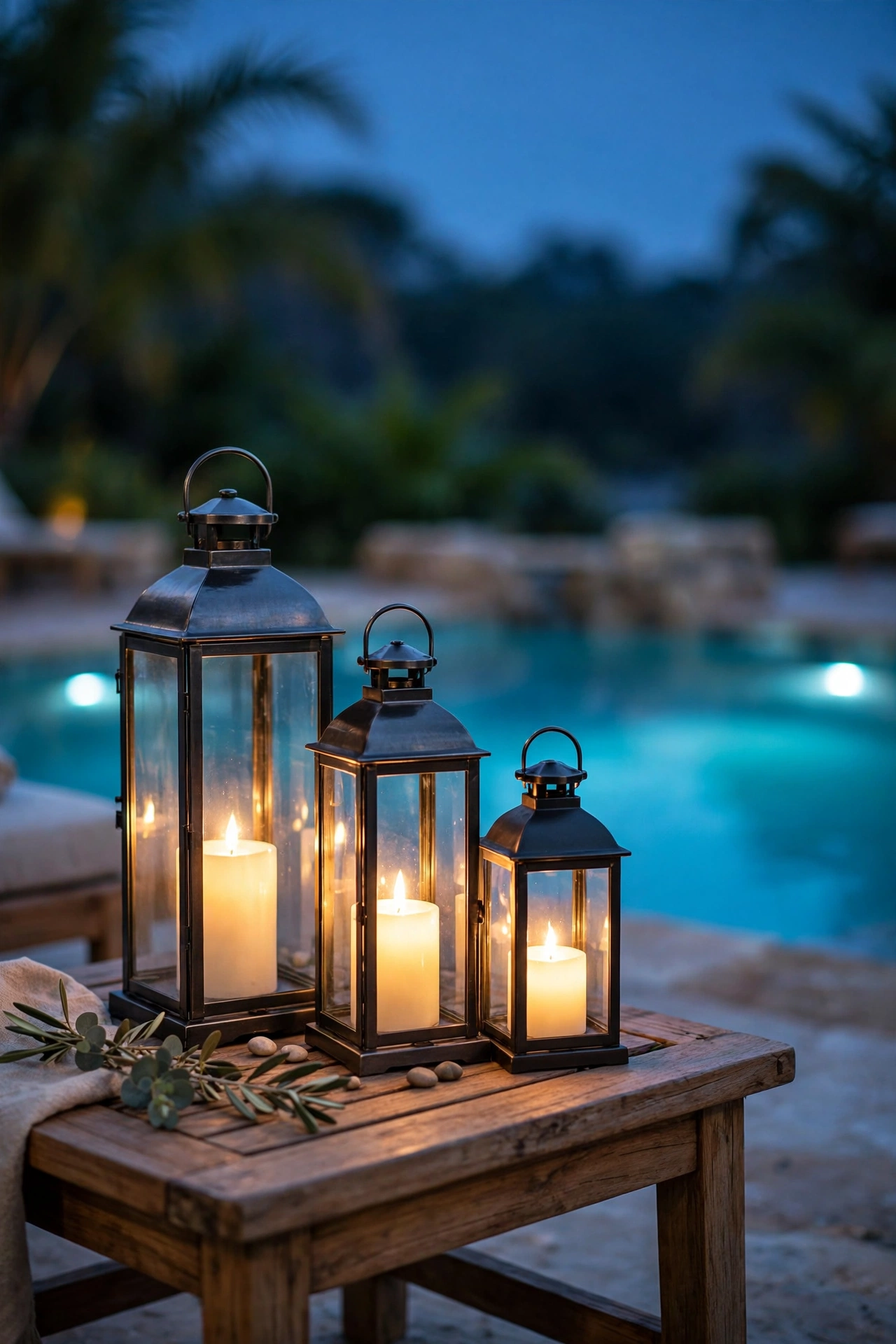
Not every light needs to touch the water. A cluster of lanterns on the pool deck — on side tables, along the retaining wall, flanking the outdoor shower — adds the warm, human-scale layer that makes a pool area feel like a room instead of a facility. I always recommend LED candles or solar inserts inside real glass-and-metal lanterns; you get the flicker and charm of candlelight with zero open flame near splashing kids and zero wax to scrub off the pavers. Group them in threes at different heights — the classic designer trick — and repeat the grouping two or three times around the deck so the eye travels. Place at least a few feet back from the water's edge so a cannonball does not send one swimming. Storm-rated, weighted lanterns are worth the extra money in windy areas; lightweight ones become projectiles. For a cohesive look, match your lantern finish to your other fixtures — matte black, aged bronze, and brushed nickel all weather well outdoors. On party nights, swap the standard LED candles for amber or color-changing ones to echo whatever color the pool is running.
Suggested budget range: $20 – $80 per lantern.
12. String Lights Over the Pool Deck
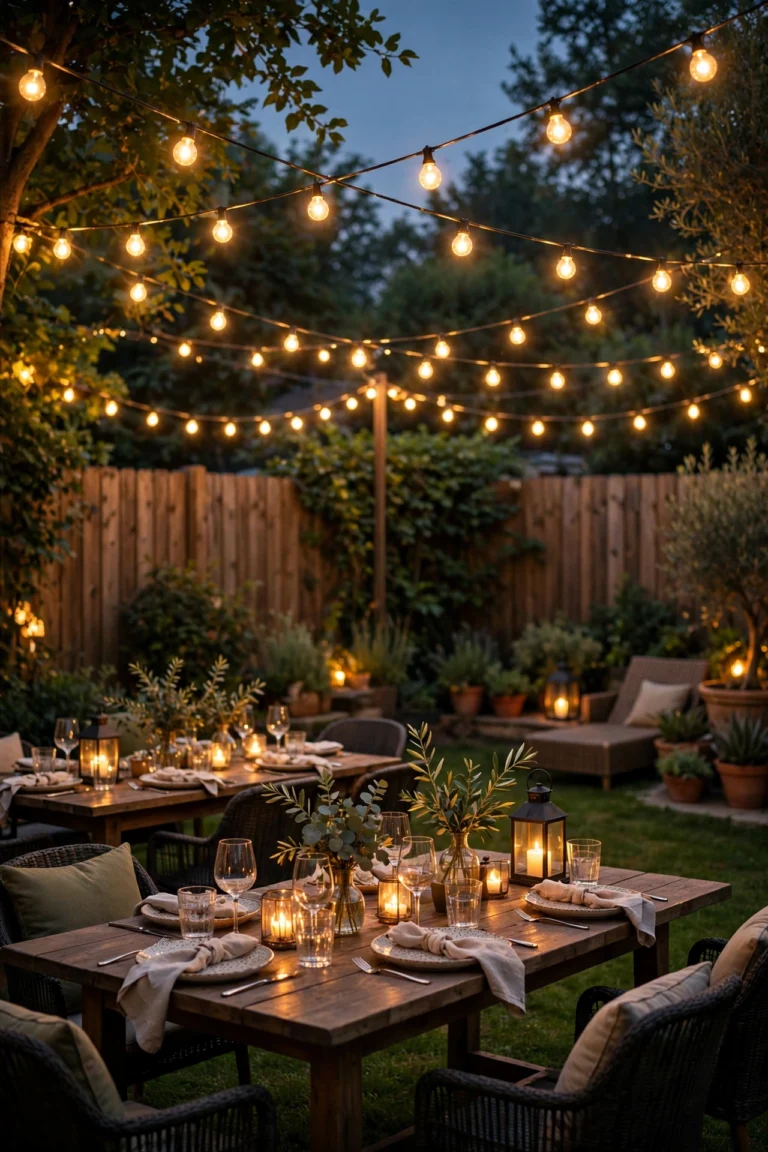
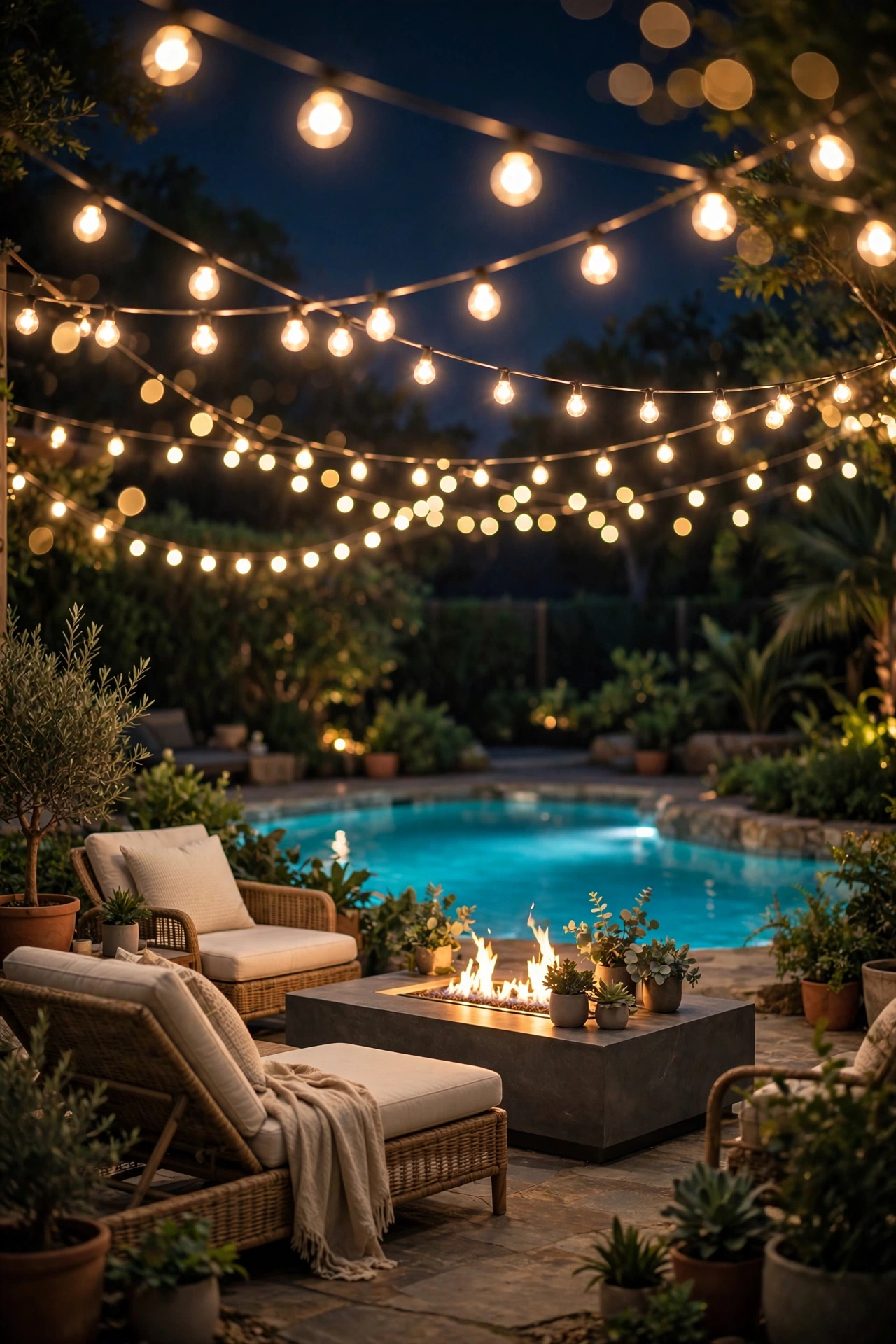
Few things say "summer night" like string lights overhead. Draped across the pool deck — from the house to a pergola, between posts, or in a zigzag over the seating area — they cast a warm canopy of light that makes even a weeknight swim feel like a vacation. I am a firm believer in the backyard lighting layering approach: keep the strings for the social zone and let the underwater lights own the water, and the two layers play beautifully together. Use commercial-grade, outdoor-rated strands with shatterproof LED bulbs; glass incandescents over a pool deck are a broken-bulb-in-the-water accident waiting to happen. Hang them 9 to 10 feet up so tall swimmers and pool toys clear them easily, and use a proper catenary wire — not just the strand itself — for spans over 15 feet so wind does not stress the sockets. Warm white 2700K is the sweet spot; cool white strings over a pool can read harsh and commercial. Put them on a dusk-to-dawn timer or smart plug so they are glowing when you wander out with a towel at 9 p.m. without a second thought.
Suggested budget range: $40 – $150 per 50-foot strand.
13. Stake Flame-Look LED Torches Around the Perimeter
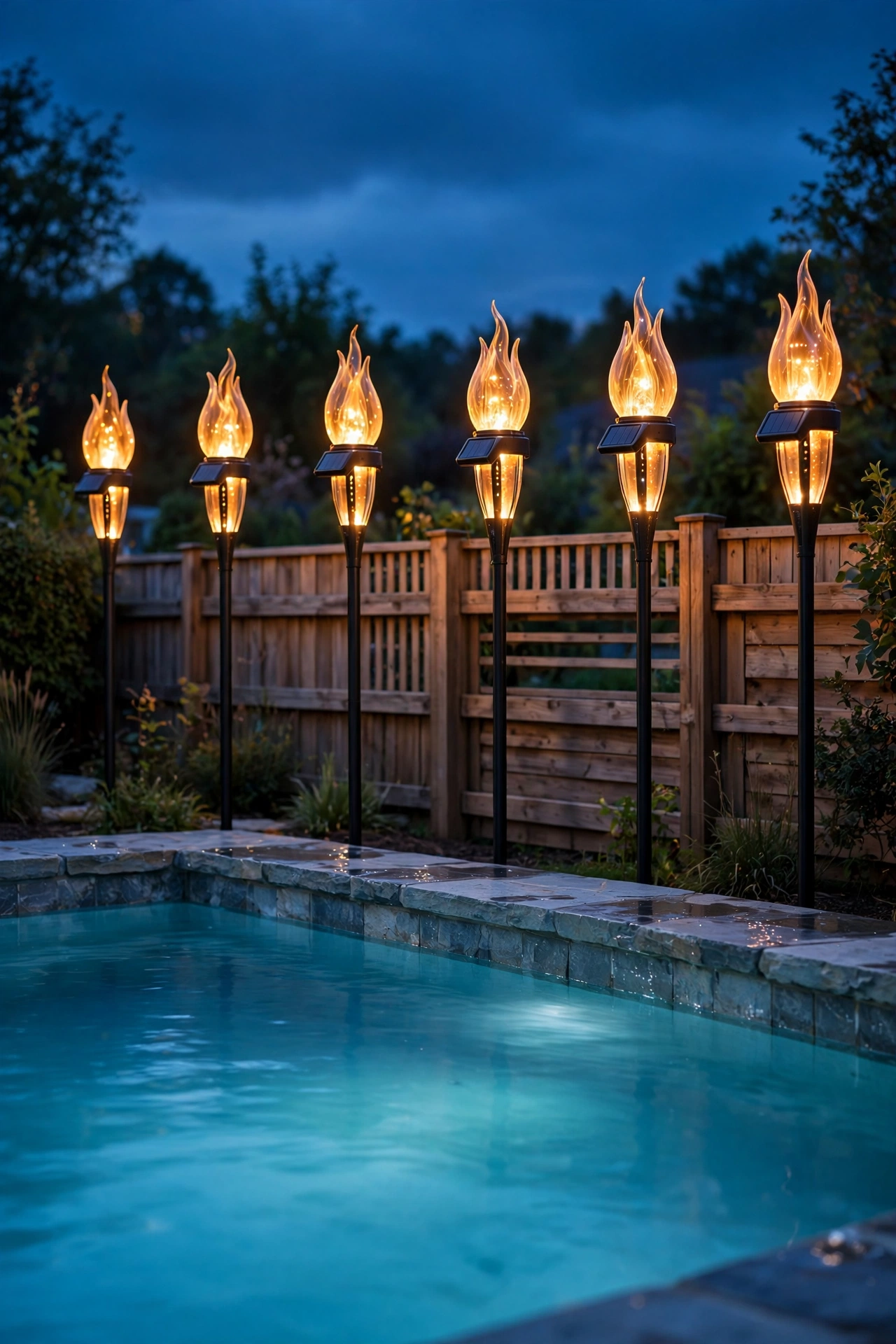
Real tiki torches have undeniable tropical charm — and undeniable open flames, fuel, and smoke around a pool full of kids. Flame-look LED torches give you the flicker without the fire. These solar or battery stakes stand 4 to 6 feet tall and mimic a dancing flame with warm amber LEDs; from ten feet away at dusk, the effect is surprisingly convincing. I like to line them along the back fence or the far side of the pool, spaced 6 to 8 feet apart, so they form a glowing boundary that makes the whole yard feel enclosed and intimate. Solar versions need a full day of sun on their little panels, so do not bury them under the eaves — and honestly, the rechargeable battery models that you plug in once a week tend to glow brighter and longer on party nights. Keep any torch — real or LED — at least 4 to 5 feet from the pool edge and away from overhanging branches. If you go with real flame torches for a special occasion, use citronella-free fuel near the pool (nobody wants oily residue on the water) and never leave them burning unattended. For everyday use, the LED versions win on safety and simplicity.
Suggested budget range: $30 – $100 for a set of four.
14. Uplight the Palms and Plantings Around the Pool
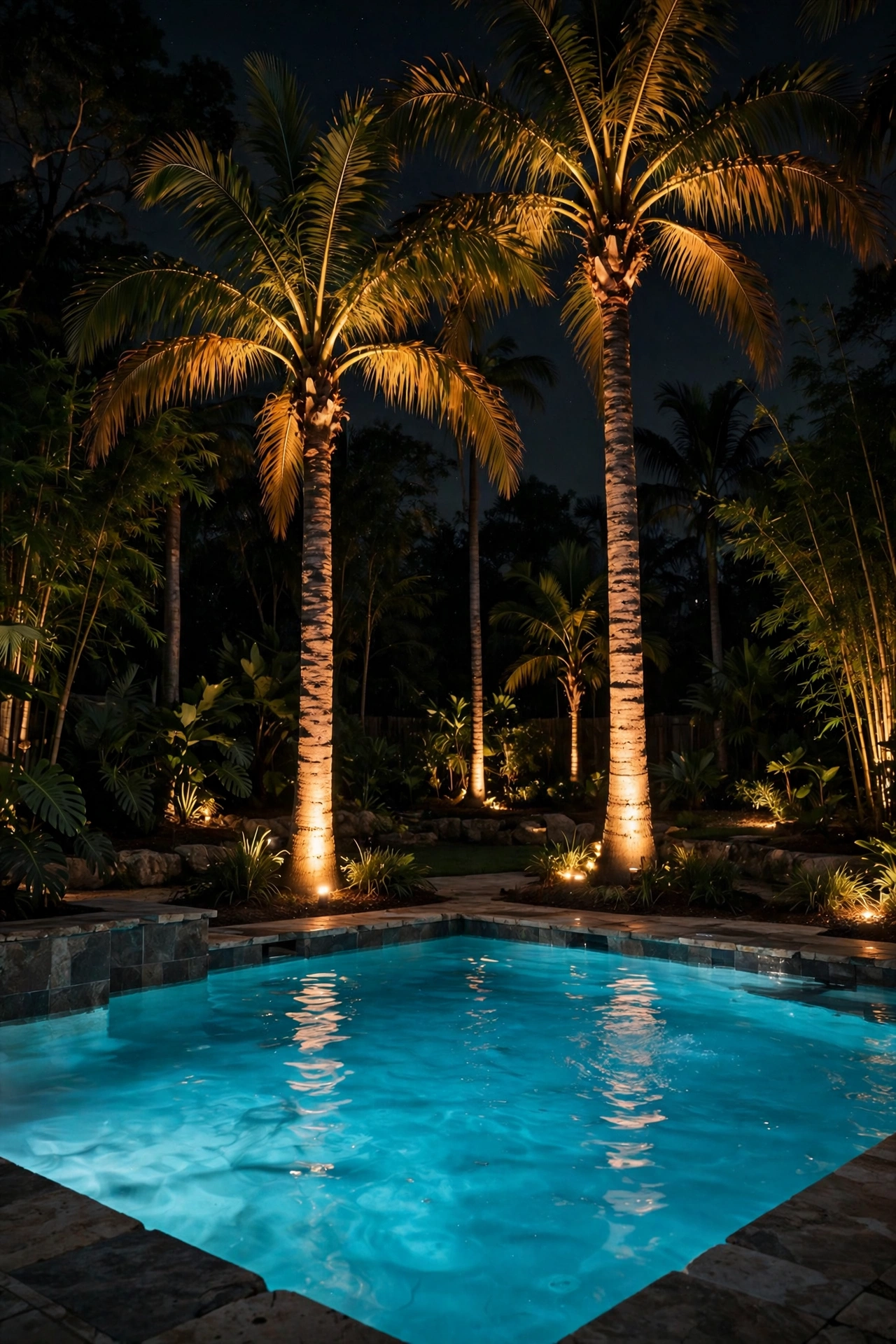
The pool does not exist in a vacuum — the landscaping around it is half the nighttime show. A few well-placed uplights at the base of palms, ornamental grasses, or sculptural shrubs turn the backdrop into a living mural. I always recommend low-voltage LED bullet or well lights for this: bury or stake them 1 to 2 feet from the trunk, aim up into the canopy, and the fronds throw dramatic shadows across the fence or house wall. For palms, one light per tree is usually plenty; for a wide traveler palm or a big clump of pampas grass, use two from opposite sides to fill it out. Choose warm white 2700–3000K to echo the deck lighting, and keep the fixtures at least 5 to 6 feet from the water's edge so irrigation and splash do not constantly soak them. Well lights that sit flush with the ground are great along lawn edges where mowers roam — no more decapitated path lights every spring. This layer is what separates a lit pool from a lit backyard, and it is the layer guests always comment on without quite knowing why the yard feels so finished.
Suggested budget range: $40 – $120 per fixture.
15. Light the Path to the Pool for Safe Night Access
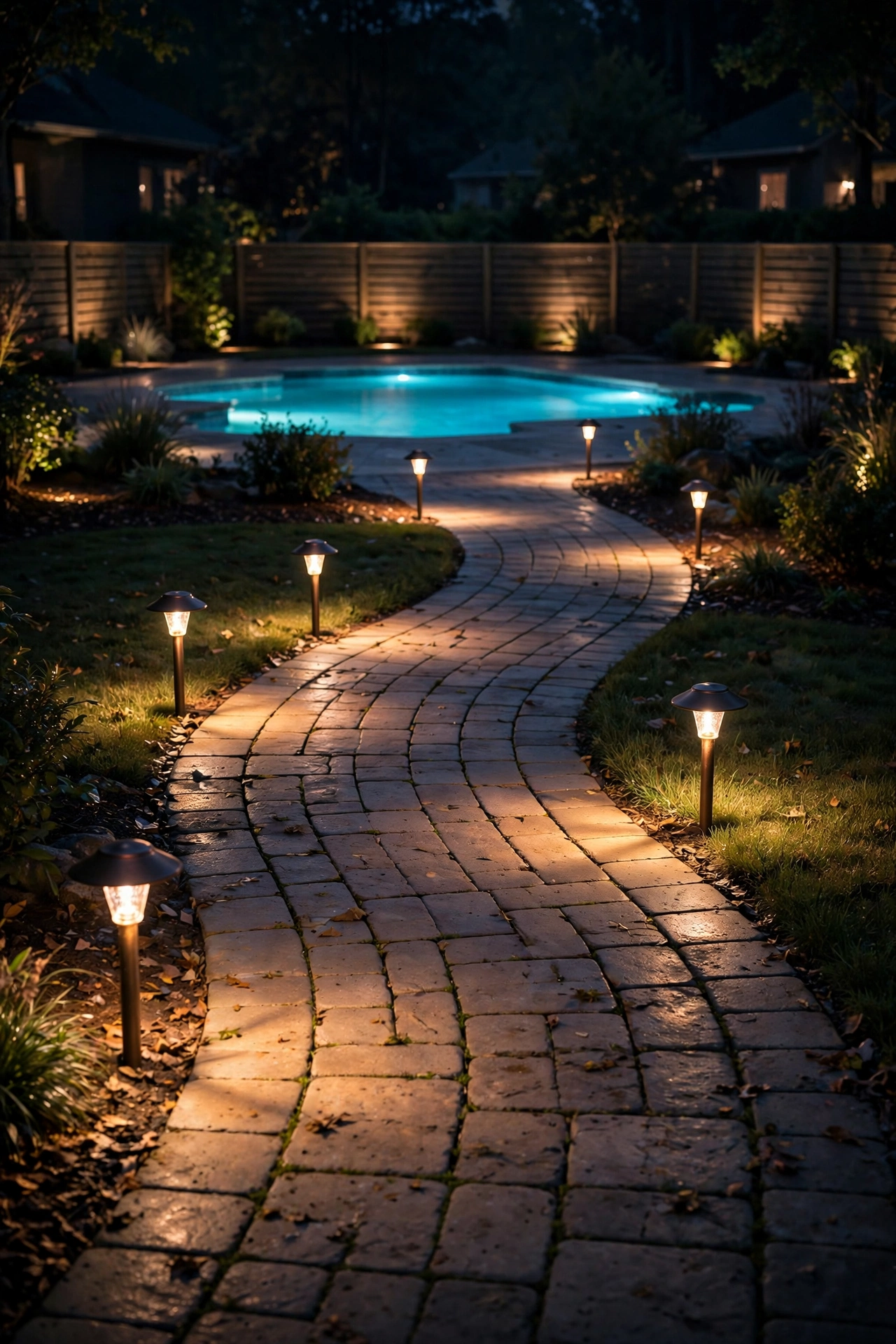
Beautiful lighting means nothing if someone twists an ankle walking to the pool in the dark. Path and marker lights along the route from the house, the gate, and the driveway to the pool deck are a safety essential I never skip. Low-voltage LED path lights — the classic hat-top style — spaced 6 to 8 feet apart along walkways give you a clear, glare-free route; aim the light down at the pavement, not up at faces. For a sleeker look, recessed paver lights or small deck dots set flush into the walkway mark the route with zero trip hazard and nothing for the mower to hit. I always recommend solar path lights only as a supplement, not the primary safety lighting — on cloudy stretches they fade by midnight, exactly when you need them. Wire the important ones on a low-voltage transformer with a dusk-to-dawn sensor so the route is lit every single night without thinking about it. Pay special attention to any stairs, gates, or changes in grade along the way; one well-placed step light at a tricky transition prevents more accidents than a dozen decorative fixtures. Safety first, beauty follows.
Suggested budget range: $25 – $70 per path light.
16. Mark the Pool's Edges With Step and Coping Lights
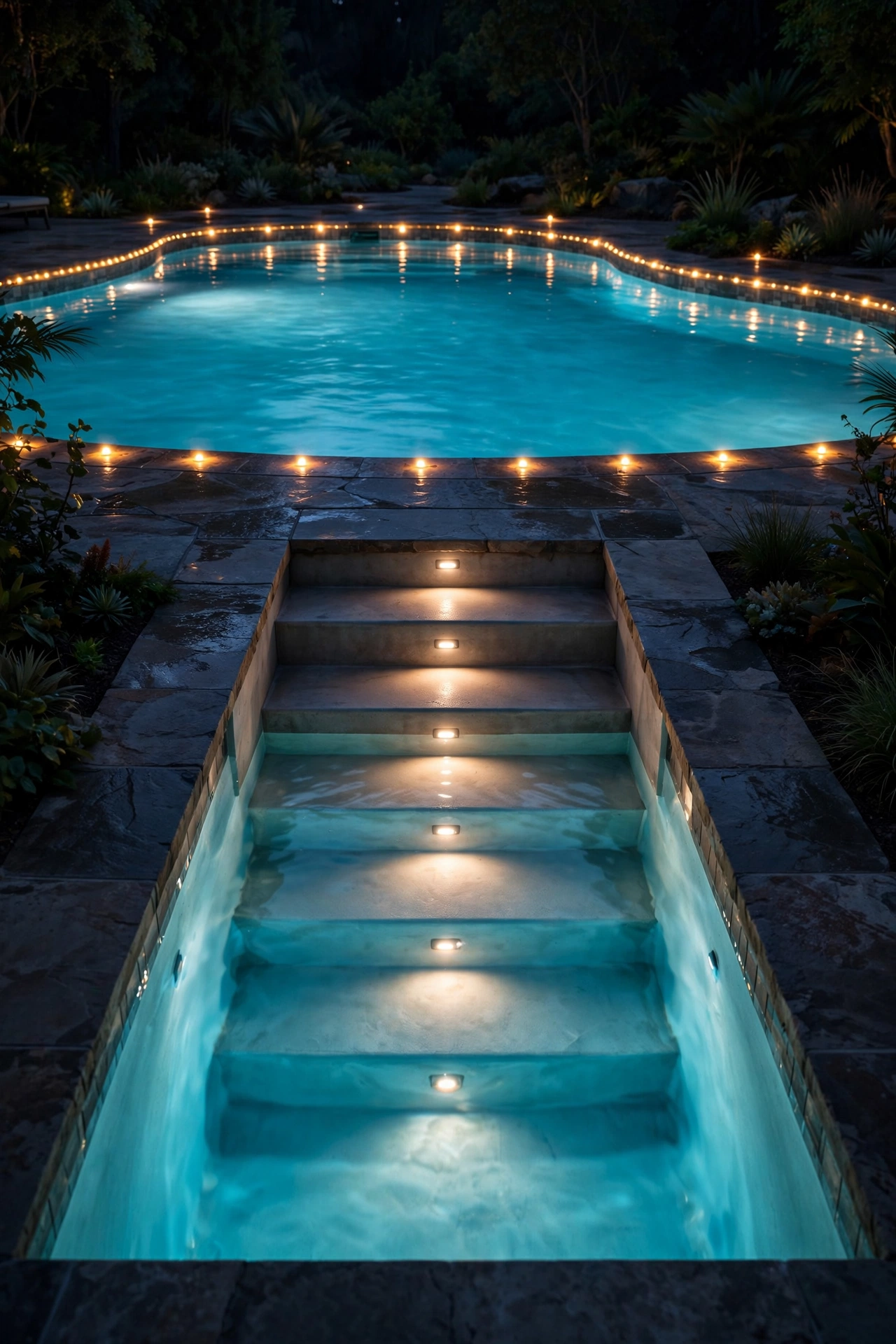
Inside the pool zone itself, the most important lights are the ones that keep people safe: step lights, edge markers, and anything that defines where the water ends and the deck begins. Recessed LED step lights set into the riser of each pool stair, small marker lights along a raised bond beam, or slim strip lighting under a bench or Baja shelf edge all serve the same purpose — you can see the drop-offs. Building codes in many areas now require specific illumination levels for pool steps and entries, so check your local rules before a renovation; your pool builder or inspector can confirm. I recommend a soft, non-glaring output here — these are wayfinding lights, not floodlights — and matching their color temperature to the rest of the system so the safety layer disappears into the design. Low-voltage fixtures are standard, and everything should land on the same GFCI-protected circuit as the rest of the pool lighting. This is also where a dusk-to-dawn photocell earns its keep: edge lights that switch on automatically every evening protect the kids, the grandparents, and the neighbor who wanders over after dark, with zero effort from you.
Suggested budget range: $30 – $90 per fixture.
17. Wash the Pool Walls From Deck-Mounted Spotlights
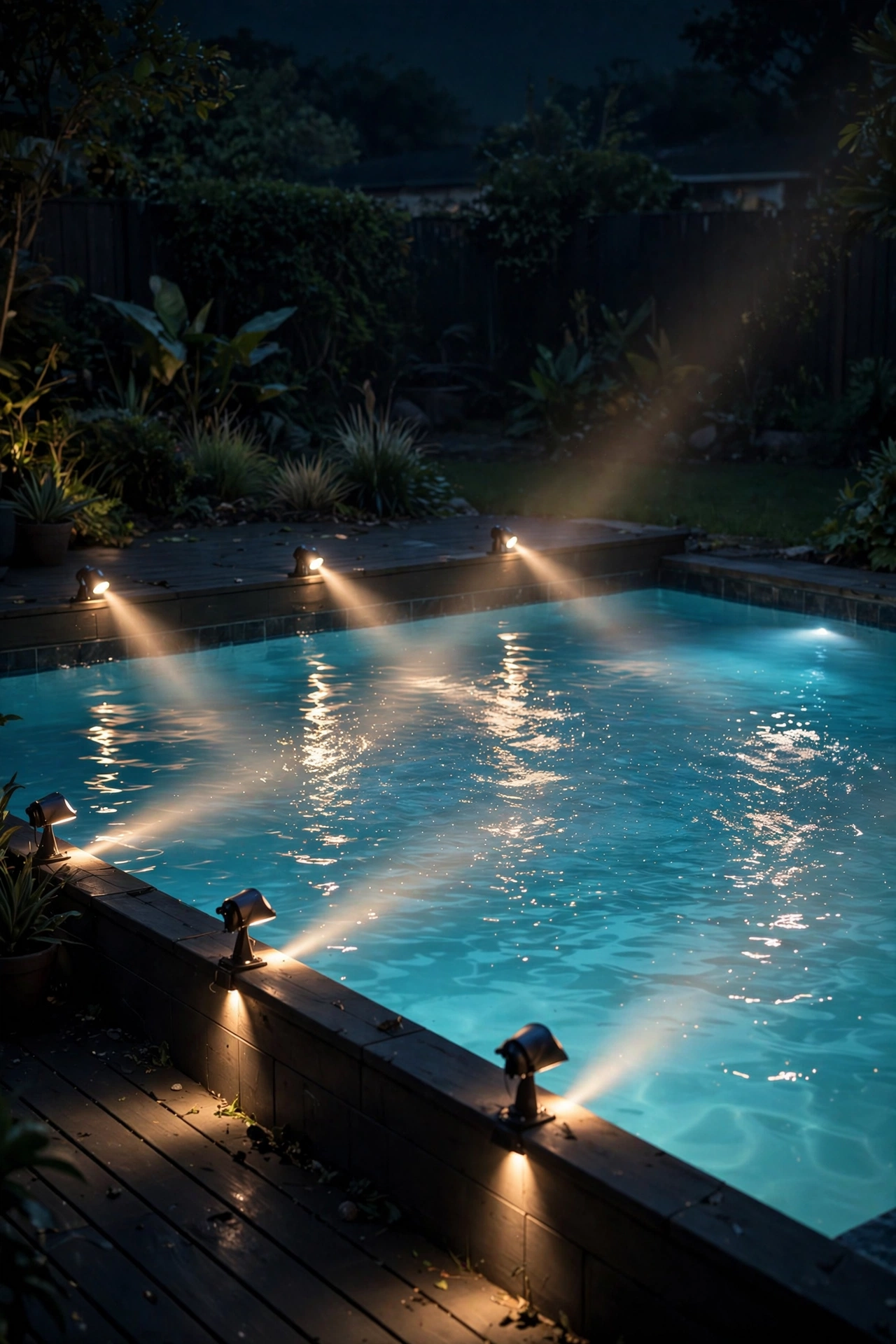
If your pool has no underwater fixtures and you cannot add them, you can still light the water from above. Deck-mounted spotlights aimed down at the water create a shimmering surface glow and light up the pool interior by reflection — not as even as true underwater lighting, but genuinely beautiful and far easier to install. Use adjustable low-voltage LED spotlights staked or mounted on the deck 3 to 6 feet back from the edge, aimed at a shallow angle across the water so the beam skims rather than punches through. I always recommend mounting them on the same side as your main seating so the light rakes across the water toward you — backlit water sparkles, front-lit water glares. Two to four spots around a typical residential pool give good coverage; more than that starts to look like a parking lot. Choose fixtures with glare shields or hoods so the source stays hidden from swimmers' eyes, and keep all wiring in conduit run under the deck or along the fence line, well away from foot traffic. This approach also works wonderfully for above-ground pools where underwater wiring is off the table entirely.
Suggested budget range: $50 – $140 per spotlight.
18. Put It All on an App-Controlled Smart System
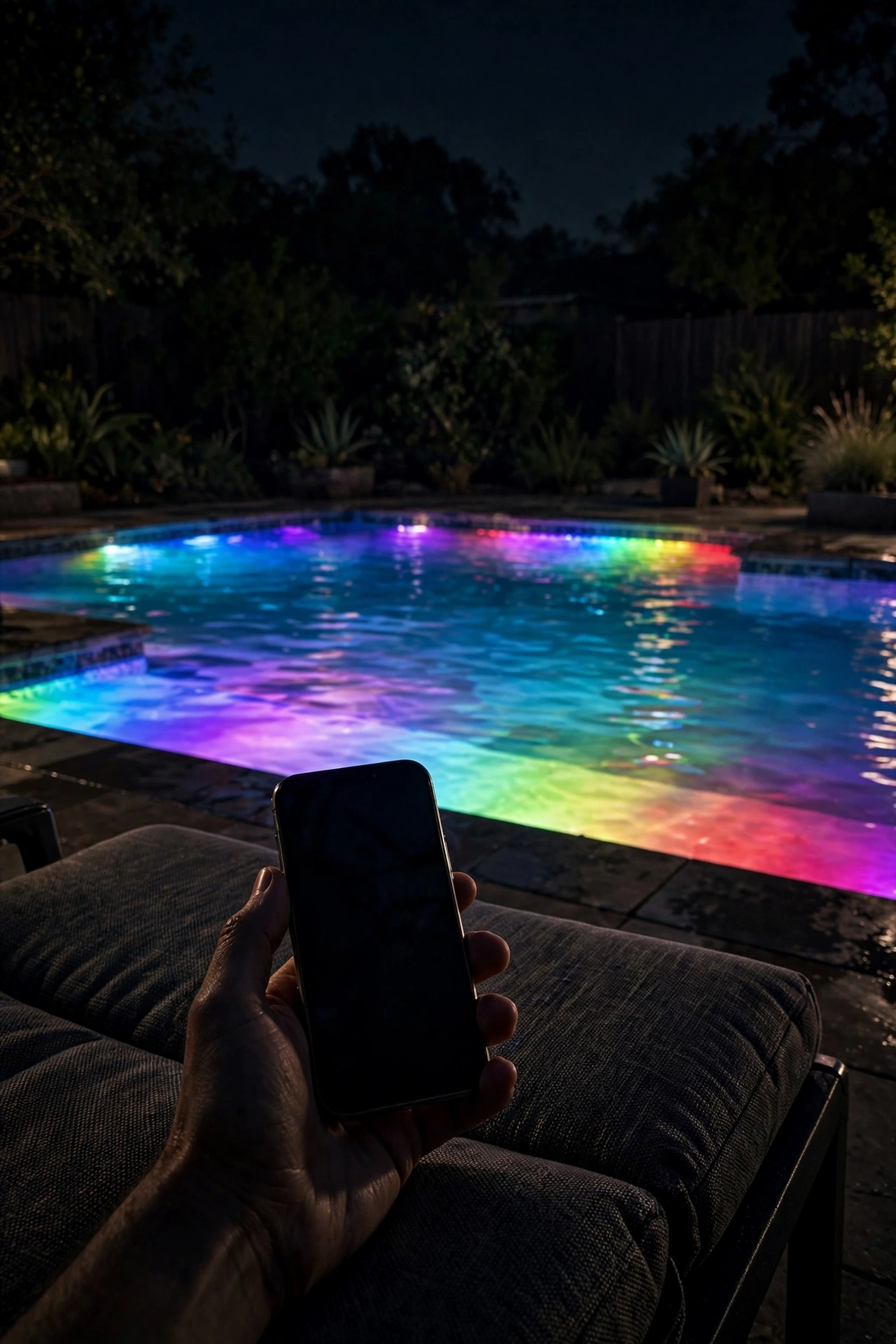
Once you have more than a couple of lighting layers, juggling separate switches, timers, and remotes gets old fast. A smart pool lighting controller ties your underwater lights, deck lighting, waterfall lights, and landscape lights into one app — or one voice command — with scenes you can trigger in a second. "Swim night" brings everything up warm and bright; "late soak" dims the spa to amber and kills the deck floods; "party" cycles the pool through colors. Honestly, scenes are the feature you will actually use every day, way more than the novelty of picking individual colors. Most modern color LED pool lights already speak common smart protocols, and a dedicated pool automation panel or a set of smart switches on a smart exterior lighting setup can coordinate the rest. A few practical notes: keep the controller and any hubs on a weatherproof, GFCI-protected circuit, make sure your Wi-Fi reaches the equipment pad (an outdoor access point is often needed), and set up a simple physical switch or button as a backup — when the app glitches at 10 p.m., you do not want to be fumbling in the dark. Start with one zone smart and expand; you do not have to automate everything on day one.
Suggested budget range: $200 – $800 for controller and setup.
19. Fake Moonlight With Downlights in the Trees
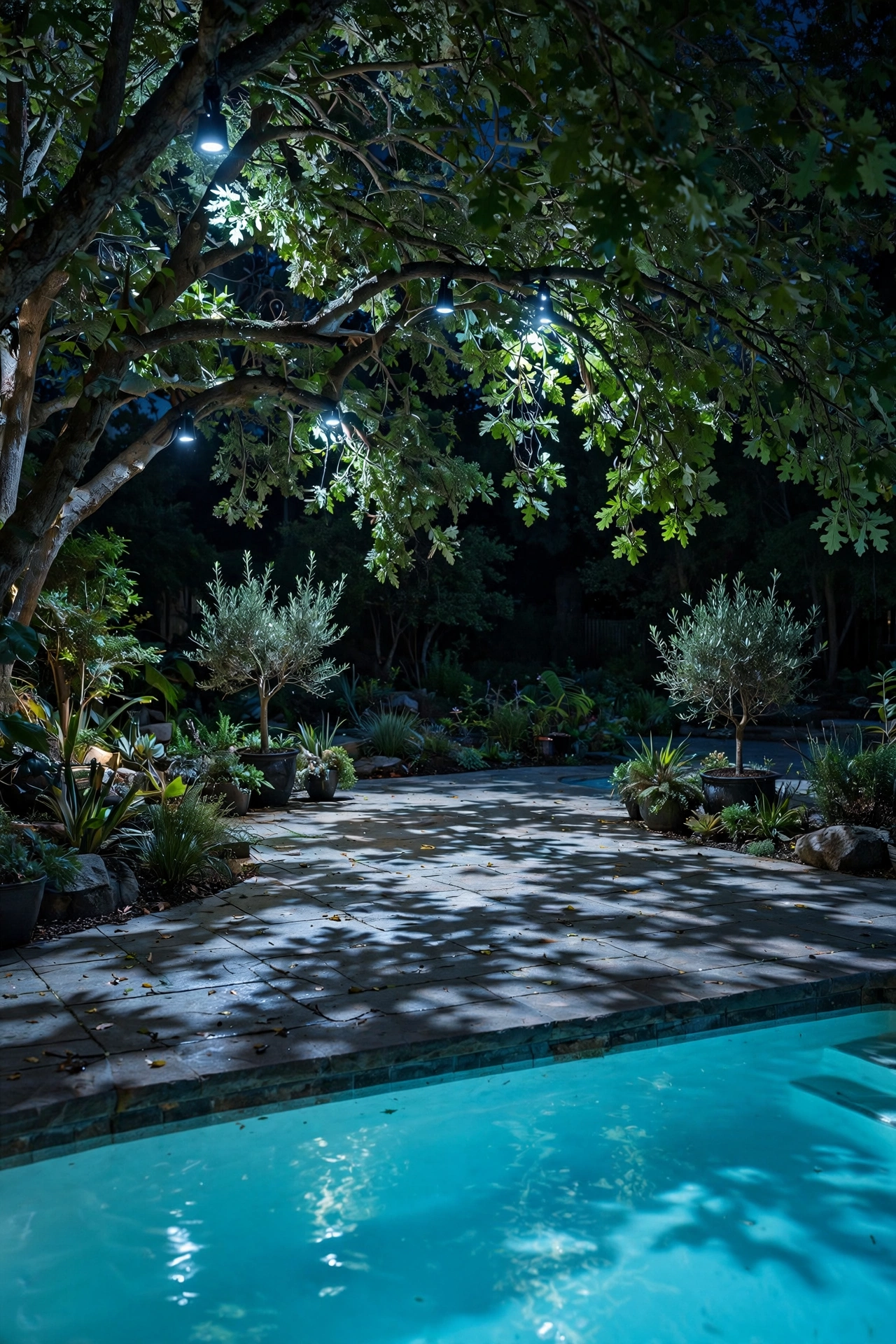
Moonlighting — mounting soft downlights high in trees or on a pergola so the light filters down through leaves — is my favorite high-end trick, and it works beautifully over a pool deck. Unlike harsh floodlights, moonlighting creates dappled, natural-looking pools of light with gentle leaf shadows dancing on the pavers. Mount low-voltage LED downlights 15 to 25 feet up in sturdy branches (an arborist can help with placement and tree-safe mounting hardware), aimed down at the deck and the near edge of the pool — never straight down into the water, which creates glare. I always recommend a cool-ish 4000K or a dim warm 3000K for this; true moonlight is cool, but a slightly warm tone feels more inviting and matches the rest of the deck. Keep the fixtures subtle — one or two per tree, max — because restraint is the whole point. Wire them on the same low-voltage transformer as your landscape lights, and put the tree lights on a separate dimmer or zone so you can dial them down when the underwater color show is the star. The effect on a breezy night, with shadows swaying across the water's edge, is pure magic.
Suggested budget range: $100 – $250 per downlight installed.
20. Program Pool Underwater Lighting Scenes for Parties and Holidays
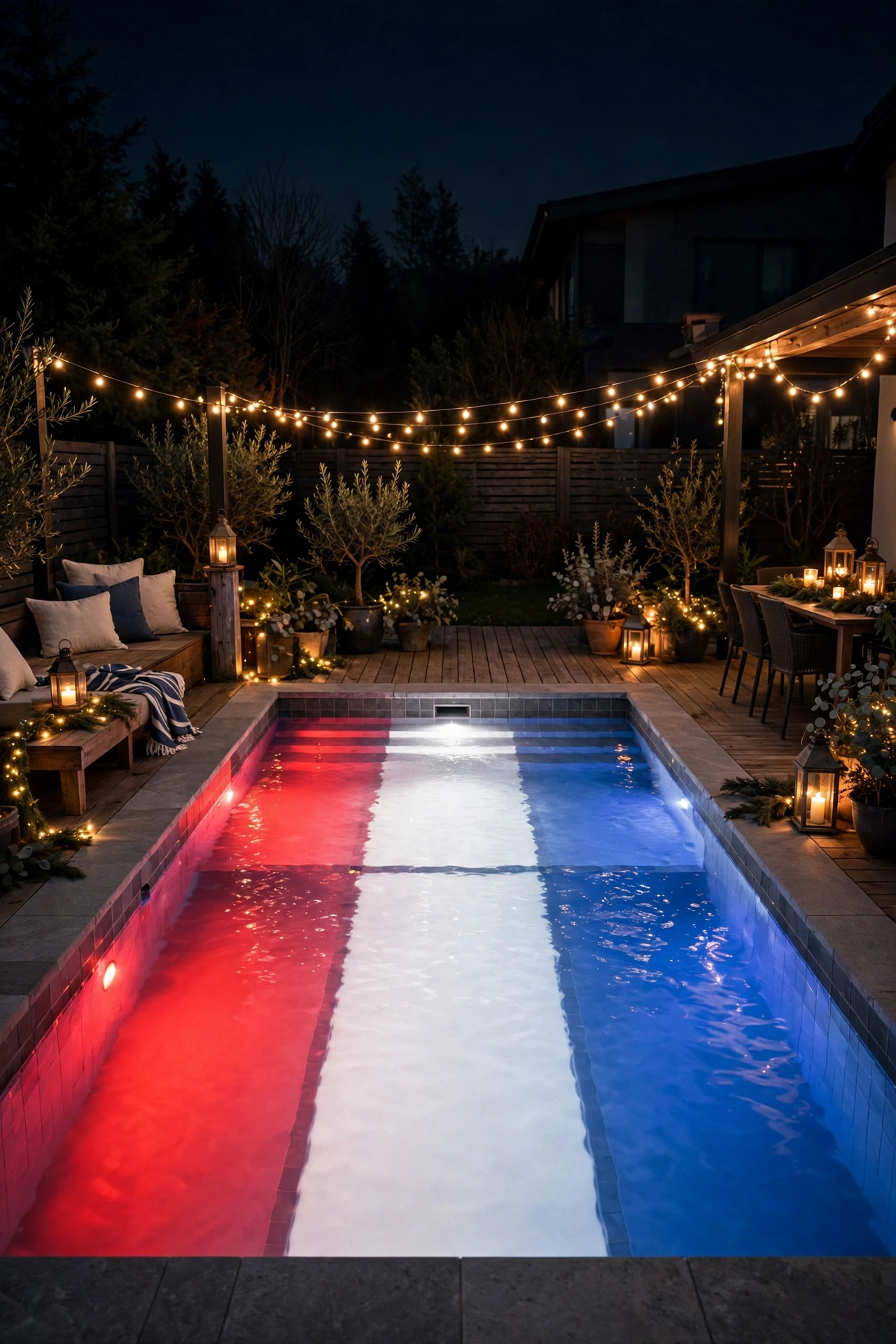
If you invested in color-changing underwater lights, do not let them sit on "slow rainbow" forever — programmed scenes are where the money pays off. Most color systems let you save favorite combinations: deep red, white, and blue for the Fourth of July; orange and purple for Halloween; icy blue and white for a winter pool party; your team's colors for game night. I always recommend spending one evening dialing in four or five scenes and saving them, because in the moment — with guests arriving and the grill going — nobody wants to cycle through sixteen modes to find the right one. Some systems sync to music, pulsing the colors with the beat; it is gloriously over-the-top for a teen birthday or a big cookout, and you can always switch back to calm blue when the party winds down. A few etiquette notes from experience: run the brightest color shows before 10 p.m. out of respect for neighbors, keep at least one scene that is plain warm white for everyday swimming (color fatigue is real), and photograph your favorites — guests will ask "how did you do that?" and you will want to show them. This is the feature that turns a pool into the neighborhood legend.
Suggested budget range: $0 – $150 (uses existing color lights; remotes or apps may add cost).
21. Set Dusk-to-Dawn Timers So It Runs Itself
The best pool lighting system is the one you never have to think about. Dusk-to-dawn photocells and smart timers make sure your underwater lights, path lights, and deck accents switch on every evening and off every morning — whether you are home, at work, or on vacation. I always recommend a photocell over a fixed clock for outdoor lighting, because sunset drifts by two hours between June and December and a clock you set in July will be wrong by September. Put the whole lighting system — or at least the safety layers like steps, paths, and edges — on automatic, and keep the fun stuff (color scenes, waterfall lights) on manual or app control so you choose when the show runs. For anything touching pool water, the timer or photocell goes on the supply side of the GFCI-protected circuit, installed in a weatherproof box by an electrician — this is not a plug-in-timer situation. Review the schedule once a season: check that the photocell lens is clean, that timers survived any power outages, and that the lights actually come on at dusk. A system that runs itself is a system that gets used, and used lighting is what keeps a pool beautiful and safe all season long.
Suggested budget range: $20 – $120 for timers and photocells.
Frequently Asked Questions
Are pool underwater lights safe? What about electricity in the water?
Yes, when they are installed correctly. Modern pool lights run on 12-volt low-voltage power or are fully sealed 120-volt fixtures on a GFCI-protected circuit, and pool electrical work falls under strict national electrical code rules (NEC Article 680) covering grounding, bonding, and GFCI protection. For complete peace of mind, brush up on the basics in our electrical safety tips guide, and always have a licensed electrician handle anything involving the pool's niche, wiring, or breaker panel. Never swim with a flickering or cracked fixture — get it serviced first.
How many underwater lights does a typical residential pool need?
A good rule of thumb is one light per 200 to 300 square feet of surface area, with a minimum of one for small pools and two to three for average 16-by-32-foot pools. Place them on the wall facing away from your main viewing area — usually opposite the patio — so you see glowing water instead of glaring fixtures. Shallow shelves, spas, and steps each benefit from their own small accent light, which is separate from the main count.
LED vs. halogen pool lights — is the upgrade worth it?
Absolutely. An LED retrofit uses roughly one-tenth the electricity of an old 300-to-500-watt halogen (15 to 45 watts), lasts 30,000 to 50,000 hours instead of one or two seasons, and runs cool, which is gentler on seals and gaskets. Most pay for themselves in energy savings within two to three swim seasons, and you gain color-changing options halogen never had. If your pool still runs halogen, this is the highest-return upgrade on the list.
Can I install pool underwater lighting myself?
It depends on the type. Floating lights, solar fixtures, LED retrofits that use your existing niche, and plug-in low-voltage deck lighting are all reasonable DIY projects — just kill the breaker first and follow the instructions exactly. Anything involving new wiring in or near the water, a new niche, the transformer connection, or the breaker panel should be done by a licensed electrician or pool professional. When in doubt, call the pro; water and electricity are unforgiving.
Conclusion
Great pool underwater lighting ideas all come back to one principle: layering. A little color beneath the surface, warm glow around the deck, safe footing on every step, and a timer so it all happens without you lifting a finger. You do not need all 21 ideas — start with one underwater upgrade and one deck layer, live with it for a few swim nights, and add from there. If this got you dreaming about your backyard after dark, browse our other outdoor lighting guides for more ways to make every corner of your yard glow.