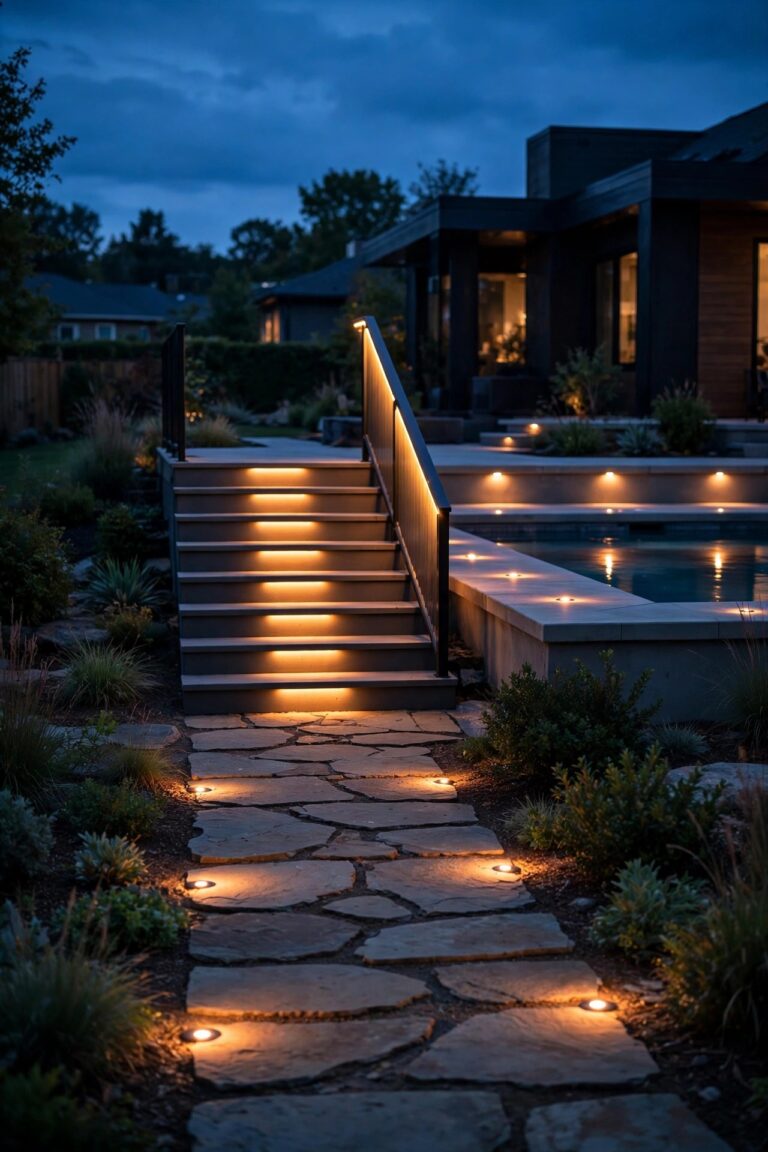
There is a moment just after a desert sunset — the sky still burnt orange above the rooftops, the adobe walls holding the last of the day's heat — when a Southwestern front yard either falls flat and dark or starts to glow like an ember. I chase that ember feeling, and these southwestern front yard lighting ideas are how I get it. Adobe, stucco, gravel, and sculptural cactus do not take the same lighting as a lawn-and-maple suburb; the light out here has to be warmer, lower, and more deliberate. My approach, as always, is layering: low lights to guide your feet across gravel and tile, lantern light at eye level to welcome guests through the courtyard gate, and gentle accents that show off agave rosettes and hand-troweled walls. Below are 15 ideas I have worked through in desert yards from Tucson to Santa Fe, each with placement measurements, honest budgets, and the heat-and-monsoon safety notes that honestly matter more here than anywhere else I have lit.

1. Start With a Three-Layer Plan for Southwestern Front Yard Lighting Ideas
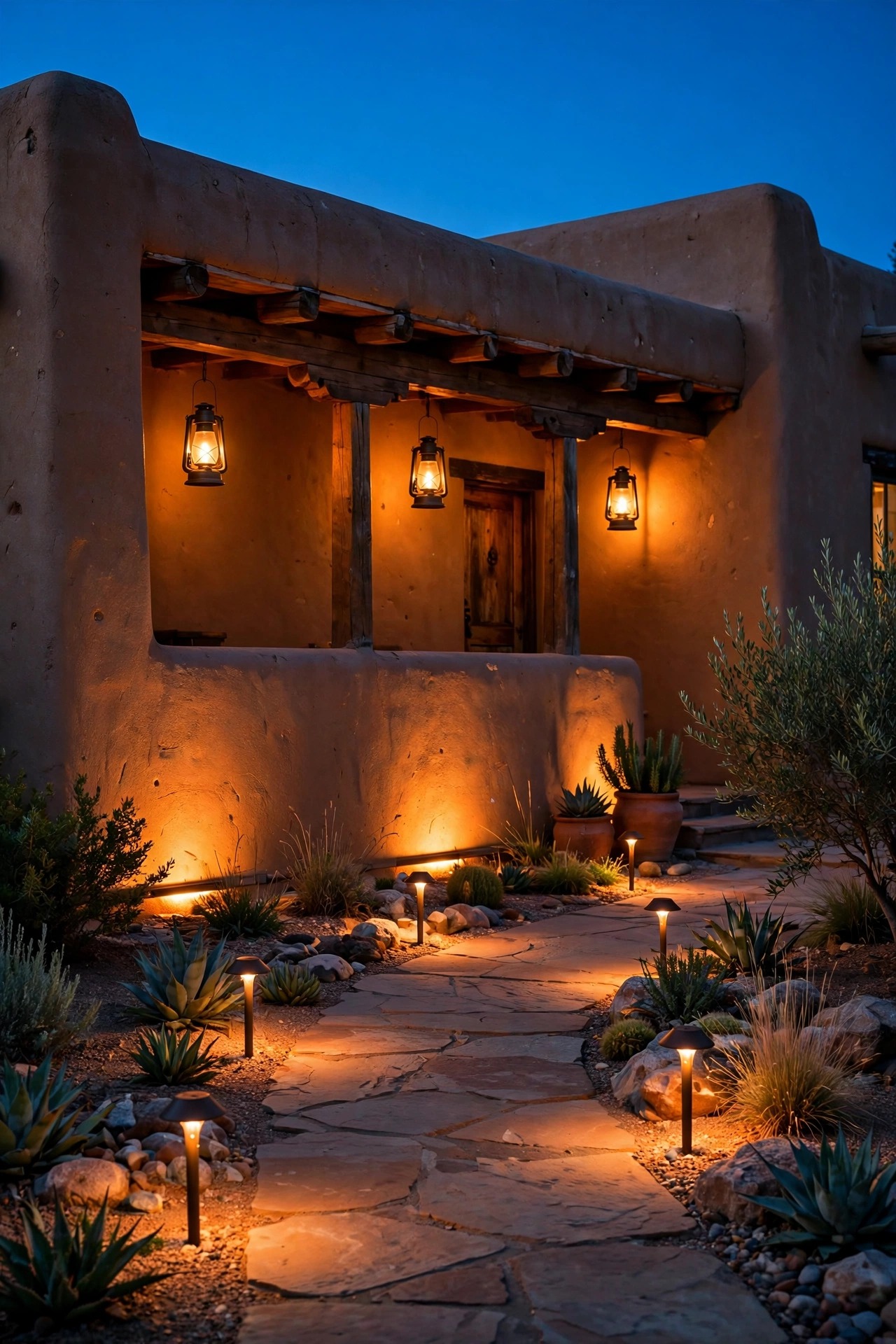
Every desert yard I have lit well started on paper, because gravel and courtyard walls punish guesswork — you cannot just push a stake somewhere else later without it showing. Sketch the driveway, the walk, the gate, and your specimen plants, then mark three layers. The low layer is guidance: path lights 12 to 14 inches tall, spaced 5 to 7 feet apart so the pools of light just touch on the gravel. The middle layer is welcome: lanterns at the gate and door, bulb centers about 5-1/2 to 6 feet up, where they light faces instead of scalps. The high layer is atmosphere: one uplit saguaro or agave, a soft wall wash, maybe moonlight from a mesquite. Keep the fixture family tight — dark bronze or rusted iron, seeded glass, terra cotta tones — so the yard reads as one idea. For a typical 50-by-40-foot front yard, 10 to 14 fixtures across all three layers is plenty. If you want the broader framework first, my front yard landscape lighting walkthrough covers layering in depth; this post adapts it to adobe and xeriscape.
Suggested budget range: $40 – $130.
2. Flank the Front Door With Mission-Style Iron Lanterns
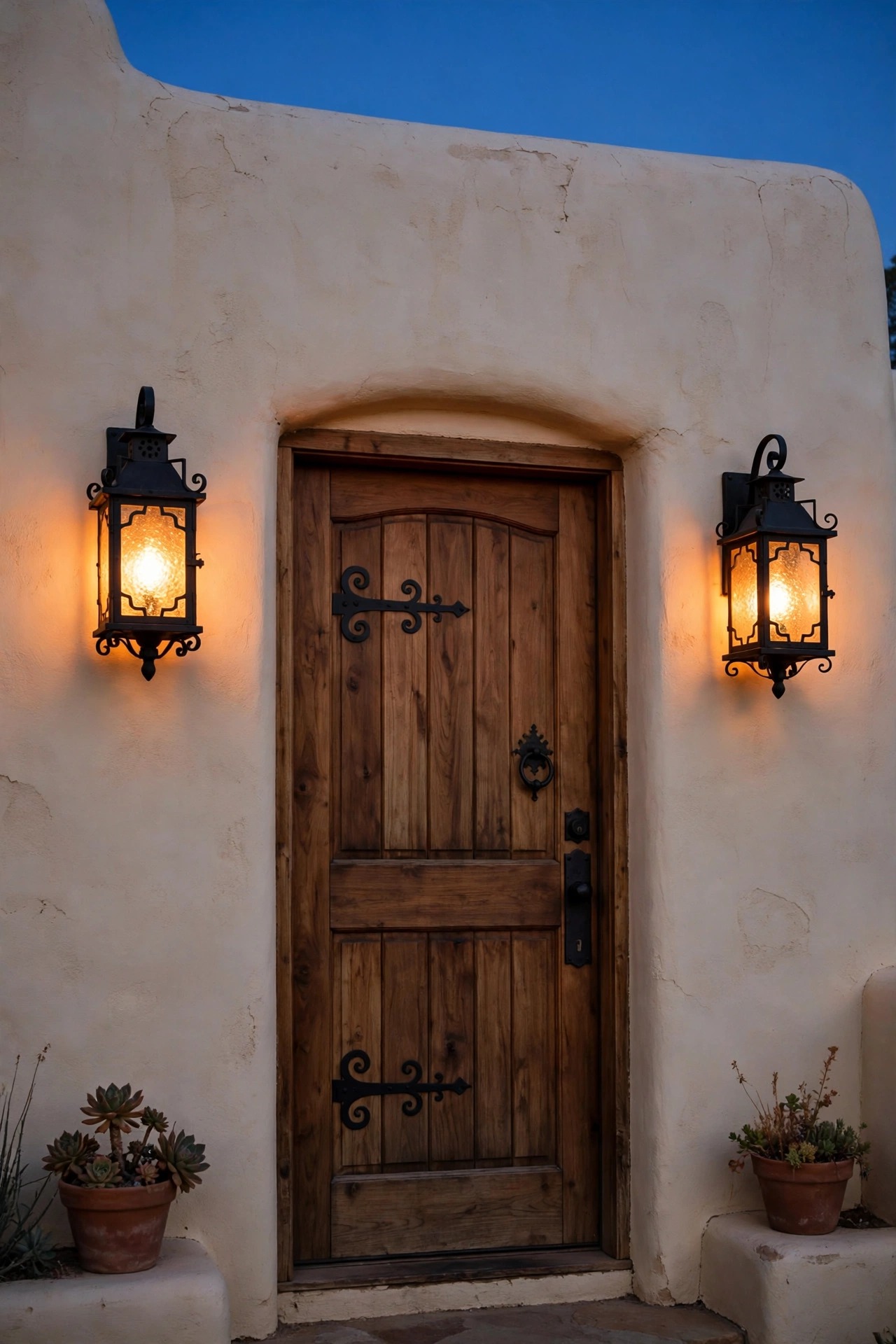
The door lantern is the handshake of a Southwestern home, and the mission style was practically invented for adobe walls: heavy iron-look frames, seeded or amber glass, and a silhouette that echoes old Spanish lanterns. I mount a matched pair with the bulb center about 66 inches above the step, 12 to 18 inches out from the door trim, so the warm light washes the stucco instead of blinding guests. Choose LED filament bulbs at 2700K, around 800 lumens each — brighter reads harsh against pale adobe, and in my experience two softer sources always beat one glaring one. Pick fixtures rated for wet locations, because monsoon rain blows sideways out here and finds every unsealed seam. On a single-door entry, one oversized lantern at 18 to 24 inches tall holds its own better than a timid pair. Let the finish weather a little; a hint of rust patina against cream stucco is not a flaw in this style, it is the whole point.
Suggested budget range: $110 – $320.
3. Line the Walk With Punched-Tin Farolitos
Farolitos — the little punched-tin lanterns of New Mexico — throw the prettiest patterned light I know, all stars and dots scattered across the gravel. Traditional ones hold candles, but along a front walk I use LED candles or low-voltage puck inserts: same flickering pattern, zero open flame near dry plantings. Set them 12 to 15 inches tall, spaced 4 to 6 feet apart on alternating sides of the walk rather than in stiff pairs, and nudge each one about 6 inches back from the edge so feet and hose reels pass cleanly. In gravel, press the base into a small leveled pad of sand so it sits plumb; a leaning farolito looks drunk by the second night. Tin is light, and desert wind is not, so add a handful of sand or a flat stone inside each base. I bring mine under the porch roof during the worst monsoon storms — five minutes of fuss that doubles their life.
Suggested budget range: $60 – $180.

4. Uplight One Sculptural Saguaro, Agave, or Ocotillo
A desert yard already owns sculpture; lighting just frames it after dark. Pick ONE hero plant — a multi-arm saguaro, a wide blue agave, an ocotillo in leaf — and give it a single in-ground well light set 12 to 18 inches from the base, aimed up with a narrow 15- to 25-degree beam. That tight beam is the secret: it models the ribs and arms instead of flooding the whole plant flat. Use 2700K and keep the wattage modest, around 300 to 500 lumens; desert plants read beautifully in low light, and your neighbors will thank you for the restraint. Never attach anything to a saguaro — they are protected, slow-growing, and easily wounded — and keep the fixture clear of the drip line so monsoon runoff does not pool in the housing. A second, dimmer light from the side at 45 degrees adds depth if the plant is large, but honestly? One well-aimed light usually does the job with more drama.
Suggested budget range: $70 – $210.

5. Choose Solar Path Stakes That Can Take Desert Sun
If solar lighting works anywhere, it works in the desert — six-plus hours of hard sun charges even budget panels fully. That is exactly why I reach for solar stakes along secondary paths and bed edges where trenching low-voltage cable through gravel and caliche is miserable. Look for replaceable batteries, a monocrystalline panel, and — this is the part most people skip — a stated color temperature of 2700K, because the default on many stakes is a blue-white 5000K that murders adobe warmth on contact. My full solar path lights guide walks through panel and battery quality in detail. Space stakes 5 to 6 feet apart, pushed into a pre-dampened hole so the gravel locks around the shaft. Dust is the desert tax: wipe the panels with a dry cloth every month or two, and expect batteries to need swapping every 18 to 24 months in serious heat. Keep a few spares in the garage and the swap takes five minutes.
Suggested budget range: $50 – $160.

6. Wash the Adobe Wall With a Low, Warm Graze
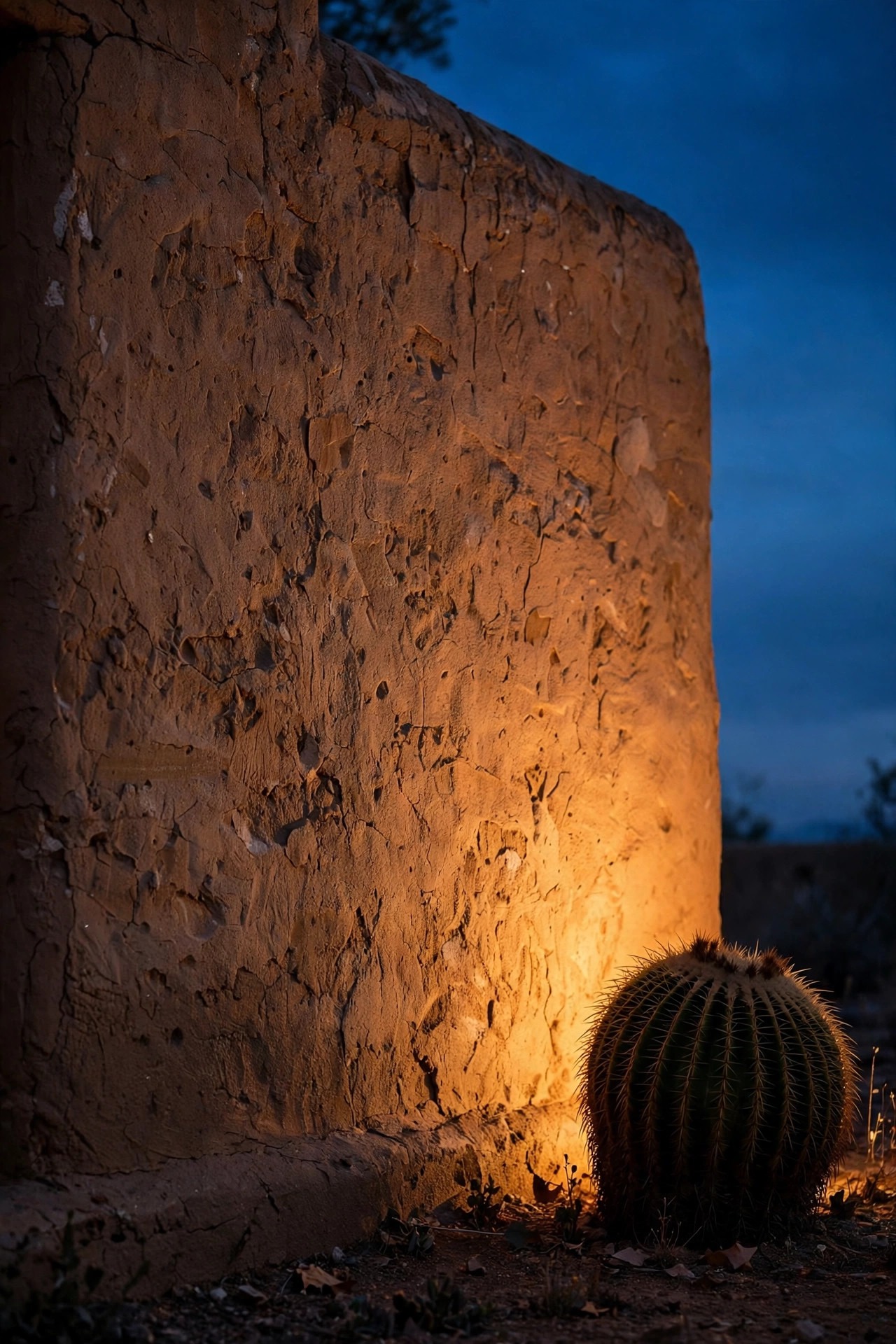
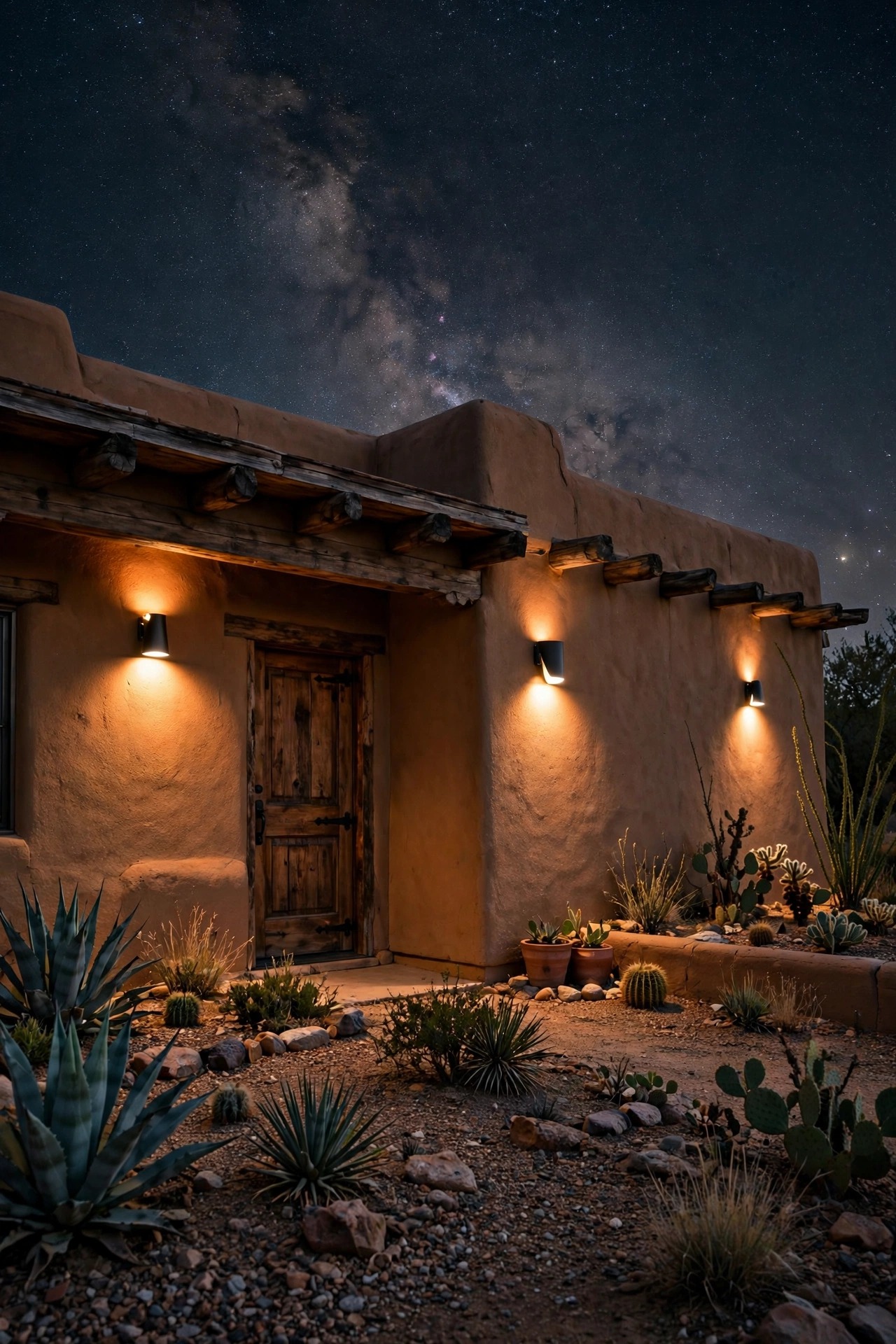
Adobe and stucco are texture, and texture only appears when light rakes across it at a shallow angle. Place compact wash lights 6 to 12 inches out from the wall base, tilted up, and the hand-troweled bumps and soft corners suddenly look like they were sculpted on purpose. I light the wall in sections — one fixture every 8 to 10 feet, aimed at the stretches between windows — rather than a continuous flood, because the rhythm of lit and shadowed wall is what reads as warm instead of commercial. Keep it 2700K and dim; on pale stucco, 200 to 400 lumens per fixture is plenty, since the wall itself bounces light back into the yard like a reflector. Shield every fixture with a glare guard or honeycomb louver so nobody driving past stares into the source. This is also the kindest light for older adobe with patched, uneven surfaces: a soft graze flatters what a harsh spotlight would expose.
Suggested budget range: $90 – $260.
7. Hang a Ristra-Style Strand Under the Porch Beam
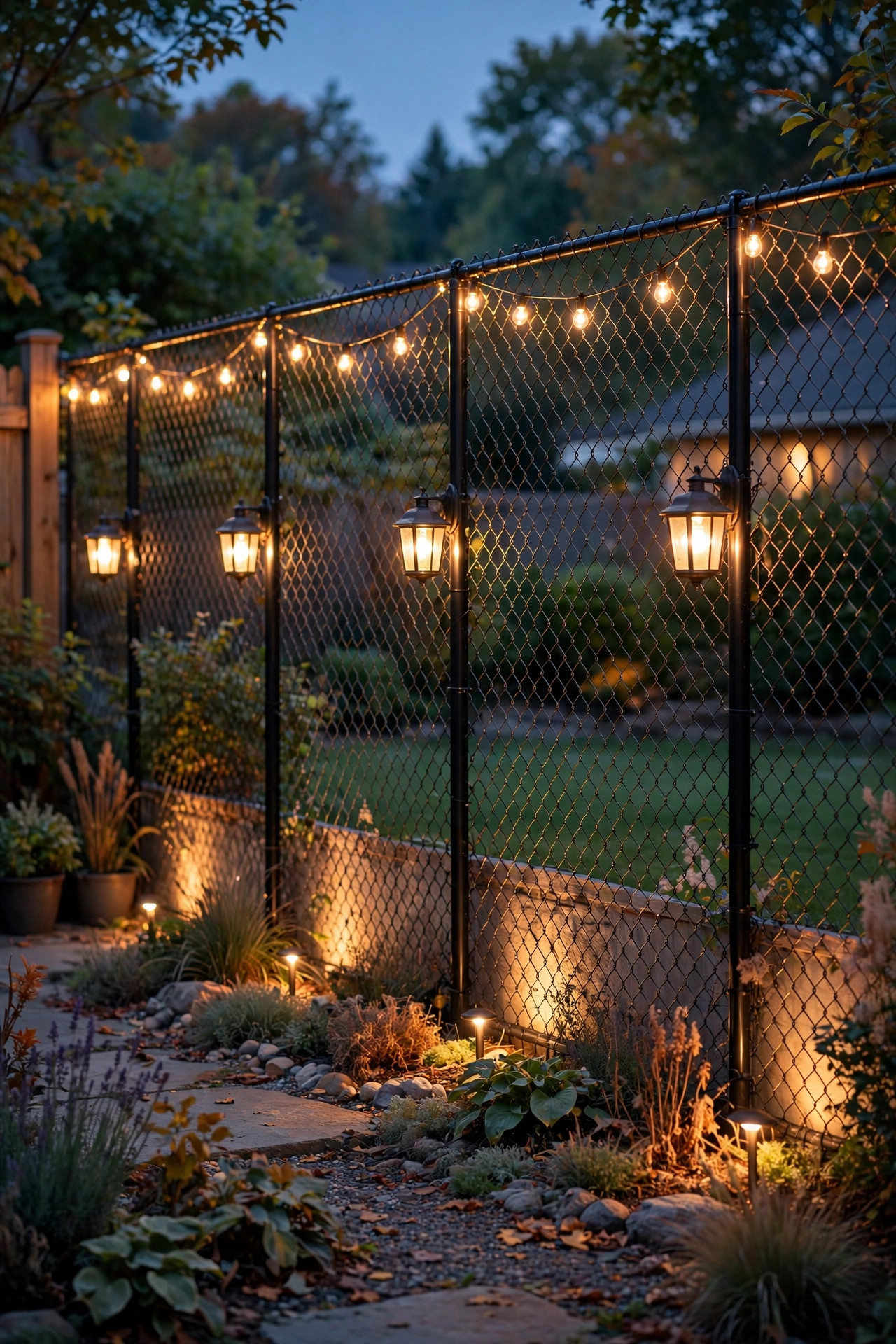
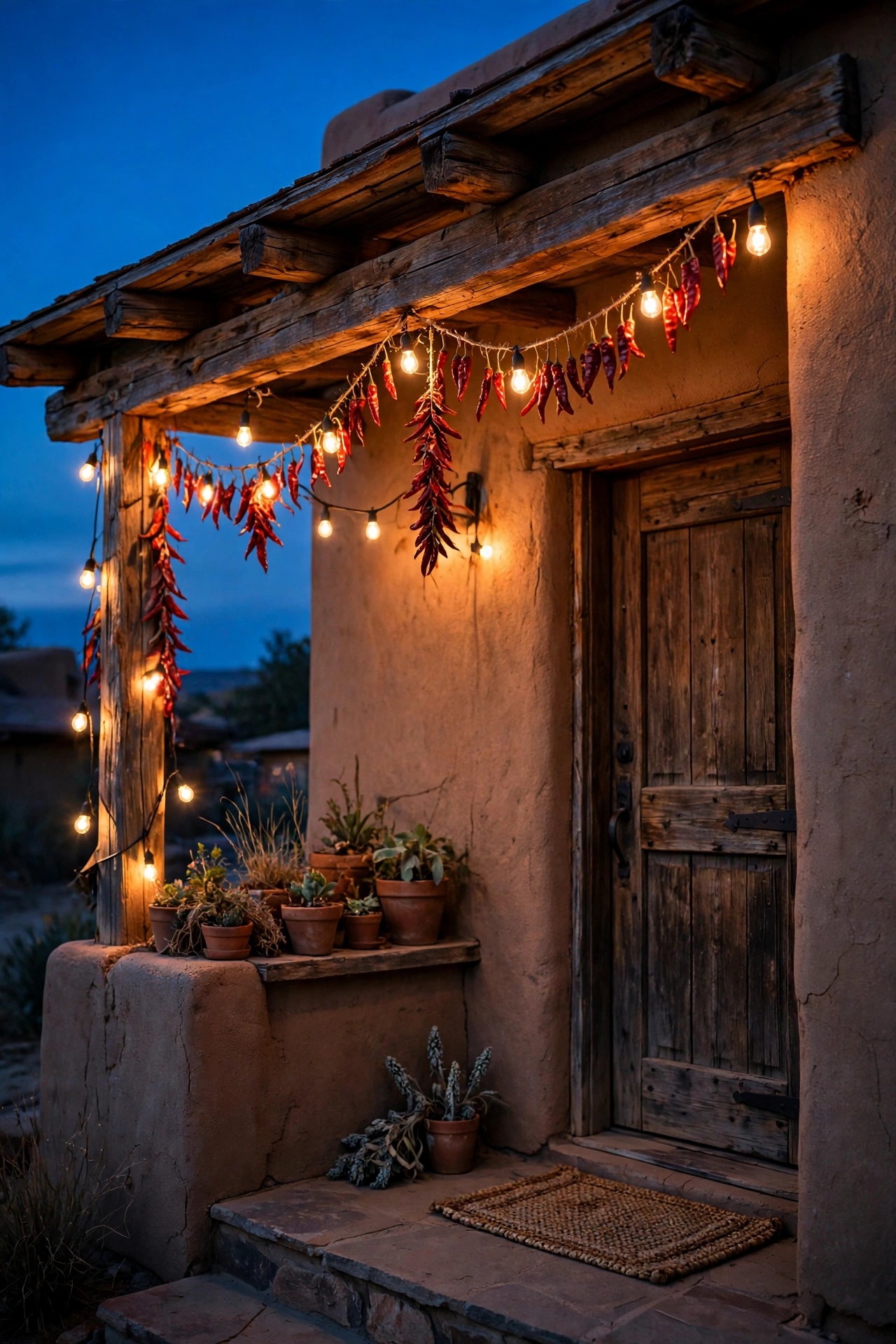
A ristra — the hanging bunch of red chiles by every Santa Fe door — is the Southwest's good-luck charm, and the light-up versions make a joyful porch accent. I hang one LED ristra-style strand beside the front door or loop warm-white string bulbs along the porch beam between the viga ends, treating it strictly as decoration rather than task light. Plug into a GFCI outlet, run the cord on clips rated for outdoor use, and put the strand on a plug-in timer set for dusk to 11 p.m. so it never glows forgotten at 3 a.m. LEDs matter here for a practical reason: they stay cool against wooden vigas and the dried chile neighbors on the real ristra hanging beside them. If a full strand feels like a lot, a single illuminated ristra by the door plus the mission lanterns from idea 2 gives you the whole festive note in a quieter key. Store the strand loosely coiled after the holidays and the wire will not kink or crack in the heat.
Suggested budget range: $35 – $110.
8. Set Luminarias Along the Driveway for Gatherings
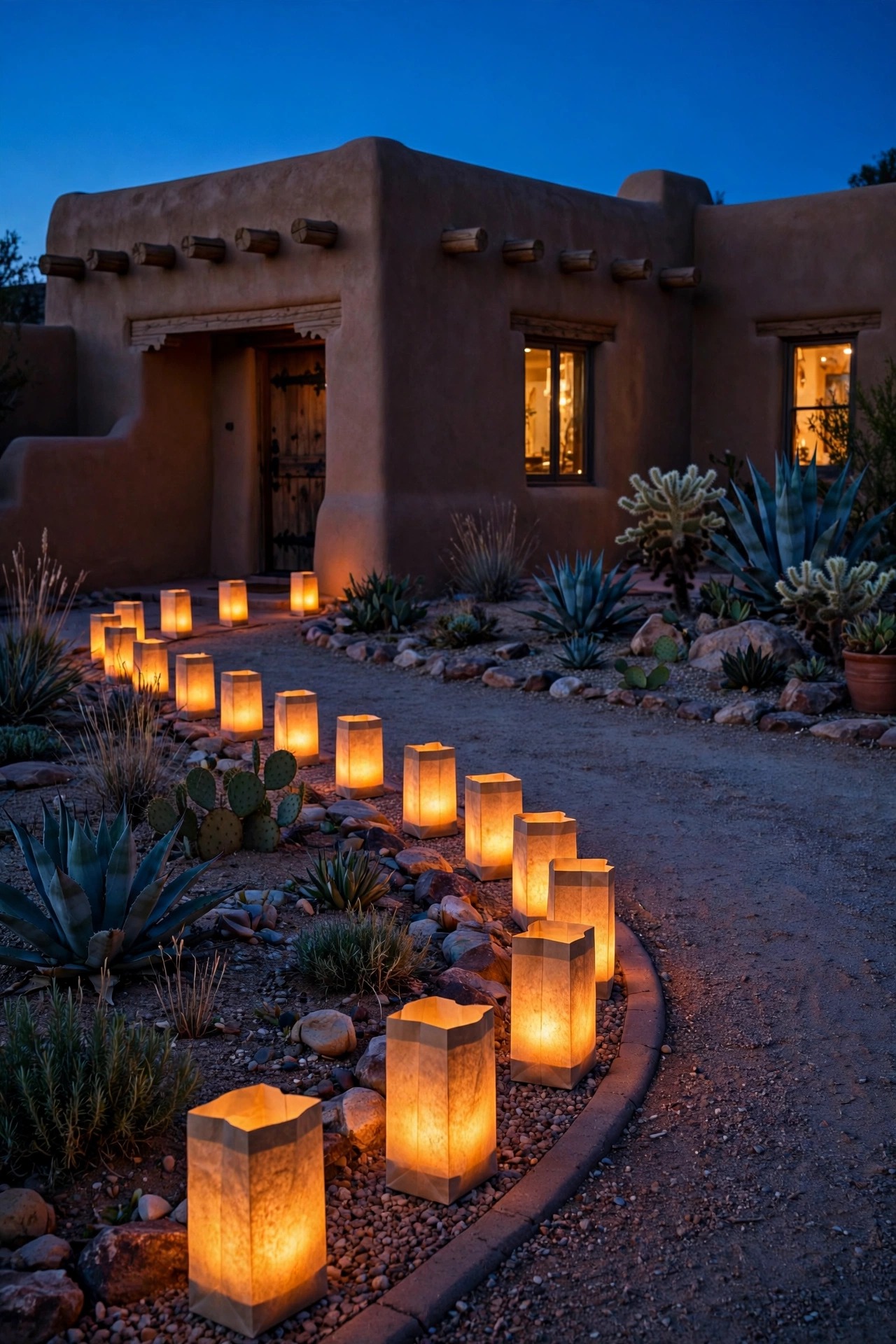
Luminarias — sand-weighted paper bags with a glow inside — are pure New Mexico Christmas, but I use the reusable versions all year for parties, when the driveway and walk need to read as an arrival. The non-negotiable rule: flameless LED tea lights only. Paper bags, dry desert air, and real candles are a combination I will not put near gravel mulch and ornamental grasses, full stop. Weighted with 2 inches of sand, spaced 2 to 3 feet apart along the drive edge and up the walk, they make the plainest entry feel ceremonial. Fabric or punched-metal luminarias cost more up front but survive seasons instead of a single night, and they fold flat in a storage tote. For everyday weeks I keep just four metal ones flanking the courtyard gate — enough to say welcome without saying festival. If wind picks up past a gentle breeze, bring paper ones in; the LED versions forgive a gust, but a tipped bag still looks sad by morning.
Suggested budget range: $30 – $120.
9. Spotlight a Cluster of Terra Cotta Pots
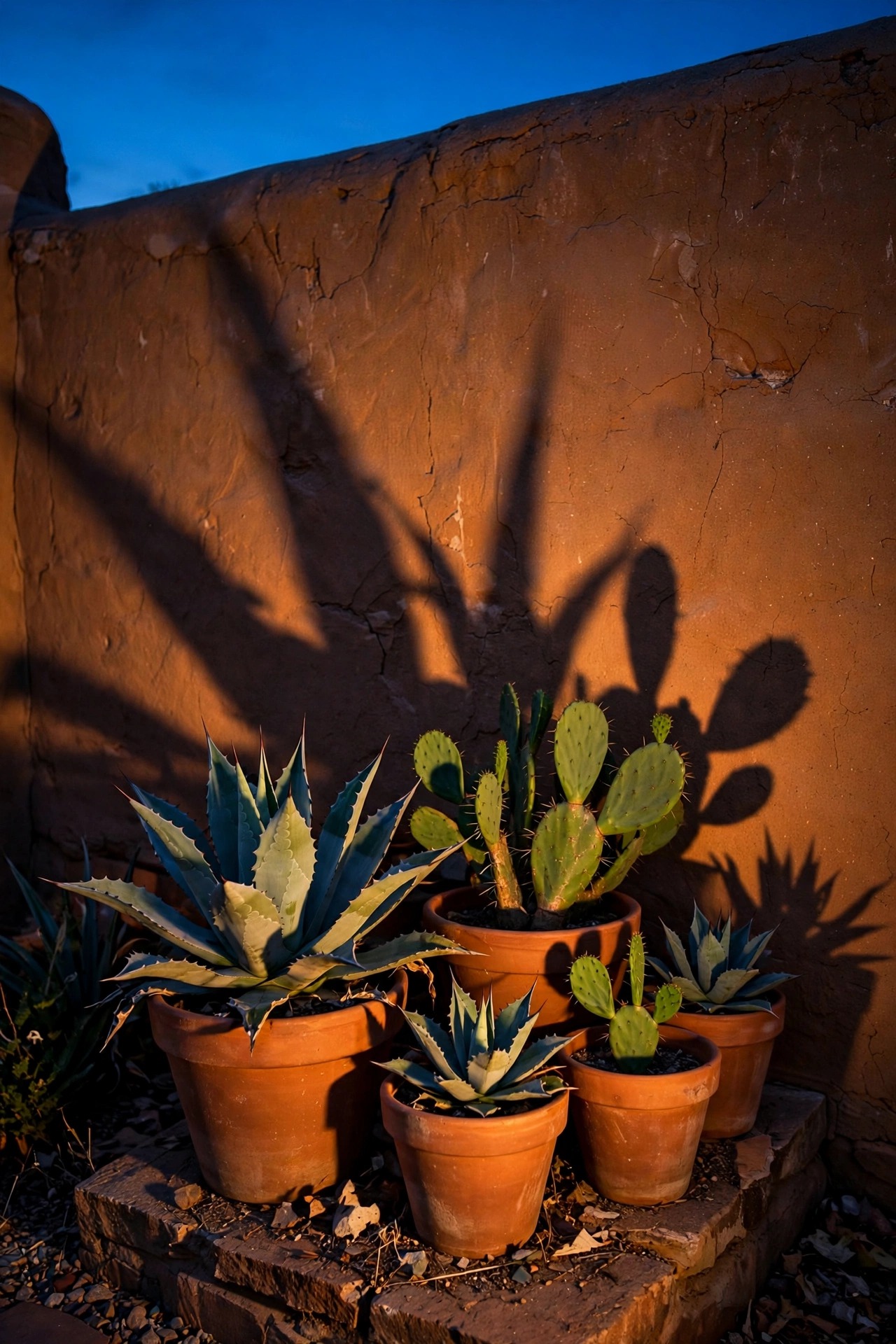
A grouping of terra cotta pots — one tall with an agave, two lower with trailing rosemary or a small prickly pear — becomes a front-yard vignette with a single adjustable spotlight. Place the fixture 12 to 24 inches in front of the cluster, half-buried in the gravel so it disappears, and aim it across the pots at a low angle so the light rakes the clay ribs and throws long plant shadows onto the wall behind. That shadow play is the real prize; the pots are just the excuse. One 2700K spot at 300 to 450 lumens handles a cluster up to about 4 feet wide. Use a fixture with a stake mount and a lockable tilt, because monsoon downpours shift gravel and a drooping spotlight lights nothing but dirt. Terra cotta breathes and ages beautifully beside warm light, and if a pot cracks in a rare freeze, its replacement costs less than the fixture lighting it — the easiest refresh in this whole list.
Suggested budget range: $45 – $140.
10. Welcome Guests With a Photocell Lantern at the Courtyard Gate
Many Southwestern homes hide the front door behind a courtyard wall, which makes the gate the true front door — and it deserves the yard's best lantern. I hang a carriage-style lantern above or beside the gate, bulb center roughly 6 feet up, on a photocell so it wakes at dusk by itself. Pair the photocell with a timer or a smart bulb that cuts off around midnight; dusk-to-dawn all night wastes energy and washes out the stars your guests came to the desert to see. At 2700K and about 800 lumens, the lantern lights faces under the gate arch, shows the latch and the step, and pools just enough light on the courtyard tile beyond to promise what is coming. If the gate sits far from the house wiring, a hardwired post lantern on the gate pillar is worth the one-time trench — this is the single most-used light in the yard, and it should never depend on a battery. Match its finish to the door lanterns so the welcome feels like one gesture.
Suggested budget range: $120 – $340.

11. Moonlight From a Mesquite or Palo Verde Canopy
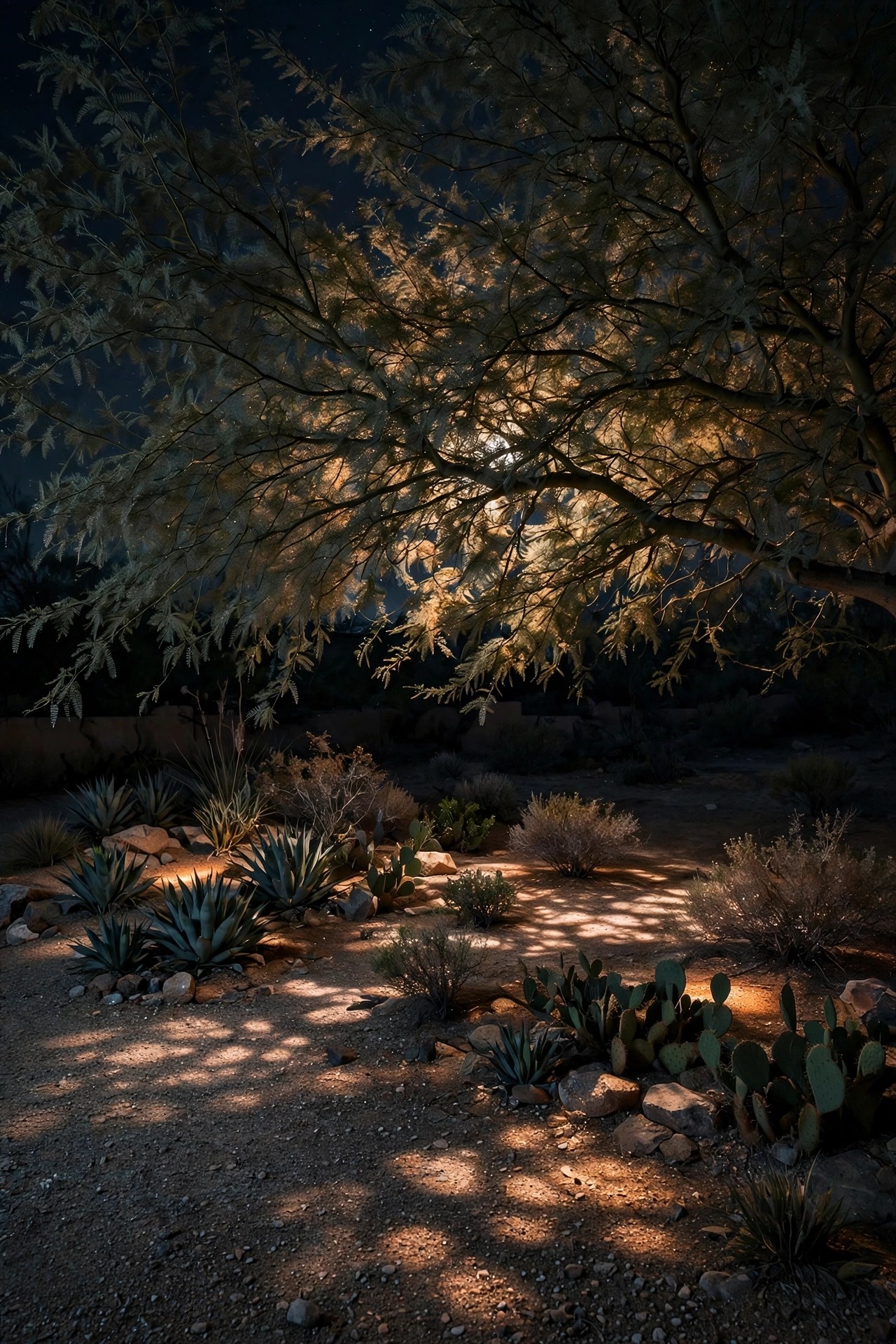
Moonlighting — a fixture mounted high in a tree, shining down through the branches — gives a desert yard the dappled, silvery pools you see under a real full moon, and mesquites and palo verdes have the open, sculptural canopies that do it best. Mount the fixture 12 to 15 feet up with a strap or bracket system, never screws or nails into the trunk, and use a soft 2700K to 3000K source; the slight lift in temperature reads as moonlight while staying warm against the adobe. The light should be dim enough that guests notice the pattern on the gravel before they notice the fixture. This is the one job in this list I routinely hand to a pro or a very confident ladder person: desert trees are brittle, the canopy is thorny, and a bad mount girdles a slow-growing tree. My front yard tree lighting ideas covers mounts and beam angles in more depth. Done right, one moonlight fixture replaces three path lights and looks a hundred times more natural.
Suggested budget range: $180 – $450.
12. Tuck Louvered Step Lights Into Courtyard Steps and Risers
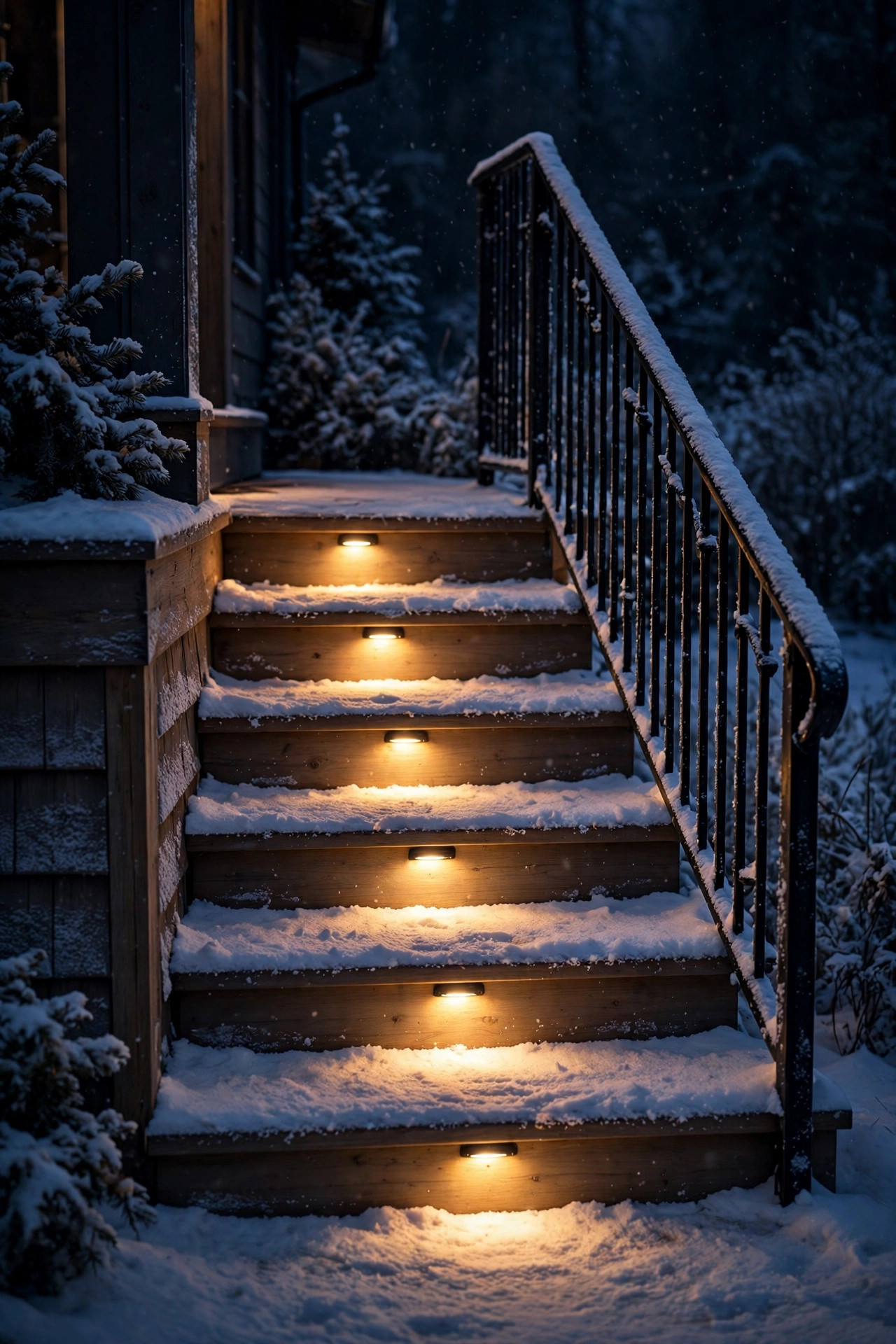
Courtyard entries love a level change — two steps up through the gate, a raised porch on Saltillo tile — and desert steps are gloriously uneven in exactly the way ankles hate at night. Recessed LED step lights with louvered faces solve it without glare: the louvers throw light down onto the tread and keep it out of eyes. I put one light in the riser of every step on runs of three or fewer, or every other step on longer runs, positioned about a third of the way in from the handrail side. Choose IP65 or better, since monsoon rain sheets straight across courtyard tile, and wire them on the same circuit as the gate lantern so one switch or timer runs the whole welcome sequence. At 2700K and a modest 50 to 100 lumens each, they read as a warm seam of light rather than a runway. On existing steps where cutting tile is not an option, surface-mount versions in a dark bronze finish disappear against the risers by day.
Suggested budget range: $80 – $240.
13. Automate It All — and Respect the Dark Desert Sky
Out here, automation is not a luxury; nobody wants to cross a gravel yard in July heat to flip switches, and half the desert towns I visit have dark-sky ordinances besides. My standard recipe: path and gate lights on an astronomical timer that tracks sunset on its own, accents on a photocell-plus-timer so they die at 11 p.m., and the hero uplight on the same schedule. Shield everything — fixtures should hide their bulbs and aim down or at a wall, never out toward the street or up into open sky. Where the yard borders open desert, I drop feature lights to a mellower 2200K amber, which scatters less, bothers wildlife less, and honestly suits adobe even better. Set the whole system once, then check it at the season changes: monsoon storms trip GFCIs, and a timer that survived a power flicker may be running two hours proud of the real dusk. Ten minutes with a flashlight twice a year keeps the magic on schedule.
Suggested budget range: $40 – $150.
14. Hold Every Bulb to One Warm Temperature
The fastest way to make a Southwestern yard look cheap is mixed color temperature — one icy blue solar stake will undo six good decisions. My rule: everything lives at 2700K, with 2200K amber allowed only as a deliberate accent in flame-effect and gate lanterns. Adobe, stucco, and terra cotta are warm materials; 2700K sits inside their color story, while 4000K and above turns cream walls gray-green and makes gravel look like a parking lot. When you buy, read the Kelvin number on the box, not the words warm white, which manufacturers stretch shamelessly — and buy spares from the same batch, because two brands of 2700K can still disagree by a visible shade. Walk the yard after any bulb swap and compare against the door lanterns; your eye catches a mismatch instantly even if you cannot name it. In my experience this one discipline, more than any single fixture, is what makes visitors say the yard feels expensive.
Suggested budget range: $25 – $90.
15. Finish With a Dusk Walk-Through of Your Southwestern Front Yard Lighting Ideas
Whatever you install, judge it the way your guests will: from the street, at dusk, on foot. Walk the curb line first and squint — any fixture you can see the bare bulb of needs a shield, a tilt, or a dimmer bulb. Then walk the route a visitor takes, gate to door, and check that your feet always land in or near a pool of light, that the step lights catch the risers, and that no shadow hides the latch. Stand in the yard and look back at your hero plant: the uplight should model it, not flatten it against the sky. I take phone photos from three spots — curb, gate, door — because the camera finds hot spots and dead corners my eyes forgive. Finish by checking the timer against the real sunset and noting the date you last cleaned the solar panels. These southwestern front yard lighting ideas only stay this pretty with that ten-minute ritual each season, and honestly, a dusk walk around a glowing desert yard is the best chore on my list.
Suggested budget range: $0 – $50.
Frequently Asked Questions
What color temperature looks best on adobe and stucco homes?
Aim for 2700K across the whole yard, with 2200K amber reserved for flame-effect accents. Warm light lives inside the color story of adobe, terra cotta, and wood vigas, while anything at 4000K or above turns cream stucco gray and makes gravel look commercial. Consistency matters more than the exact number, so buy every bulb and fixture to the same Kelvin rating.
Can outdoor lights actually survive desert heat and monsoon rain?
Yes, if you buy for it: metal fixtures with powder-coat or sealed finishes, wet-location ratings, and IP65 or better on anything low to the ground. Heat is hardest on solar batteries, which may need replacing every 18 to 24 months, and monsoon wind-driven rain finds unsealed seams, so check gaskets each spring. Avoid cheap plastic housings — desert UV makes them brittle within a couple of summers.
Do solar lights work well in a desert front yard?
They work better here than almost anywhere, because six or more hours of direct sun charges panels fully even in winter. The desert taxes are dust and heat: wipe panels monthly so output stays bright, and expect battery life to run shorter than the box promises. Keep solar for paths and accents, and wire the gate lantern and hero uplight where reliability matters most.
How much does it cost to light a Southwestern front yard?
A realistic DIY total runs about $700 to $2,200 spread over a season or two: $150 to $400 for the path layer, $230 to $660 for door and gate lanterns, a few hundred for uplights and wall wash, and under $150 for timers and controls. Professional moonlighting in a mesquite is the biggest single line item. Most readers I hear from start with the walk and the gate, then add one accent each season.
Conclusion
If you take one principle from this list, let it be the ember rule: warm light, low and layered, placed with restraint against materials that are already beautiful. These southwestern front yard lighting ideas are not about flooding a desert yard with brightness — they are about guidance at your feet, a lantern's welcome at the gate, and one sculptural plant lifted out of the dark. Start with the path and the gate lantern, hold every bulb to 2700K, automate the whole thing, and let the dark sky keep its share of the night. When you are ready to plan the beds and borders beyond the front walk, browse the rest of my outdoor lighting ideas here on the site for more desert-friendly inspiration.