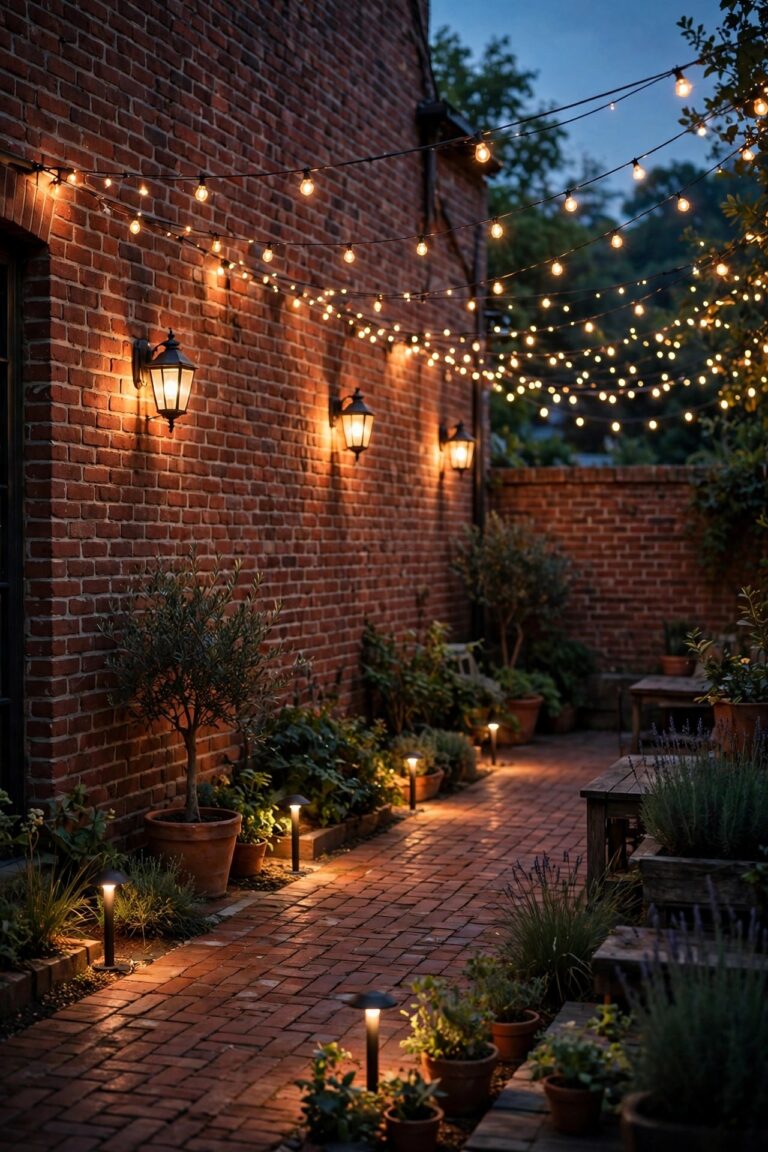
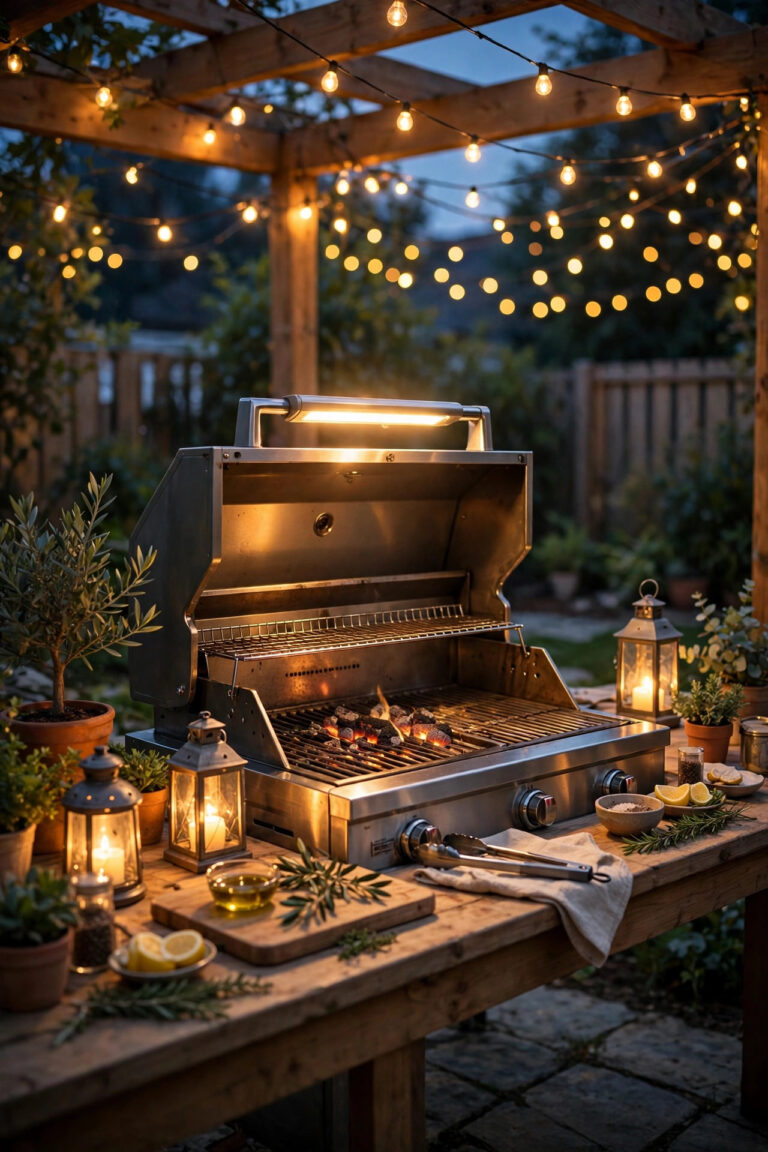
The best hour in a desert garden starts right after the sun drops. The heat finally breaks, the sky turns that deep indigo you only get over open desert, and your xeriscape shifts from glare to drama — if the lighting is right. These desert landscape lighting ideas are built for exactly that moment. Saguaros, agaves, boulders, and gravel mulch are sculptural by day, and with layered light they become sculpture by night too. My approach is always the same three layers: a low layer to guide your feet along gravel paths, a middle layer of accents that model the plants and rock, and a whisper of light from above, like moonlight. If you want the full framework before you start, my guide to layered landscape lighting walks through all three layers step by step. Below are 17 ideas I have installed and lived with in real desert yards, each with honest budgets, spacing numbers, and the dark-sky habits that keep the stars visible and the neighbors happy.
1. Start With a Layered Desert Landscape Lighting Ideas Plan
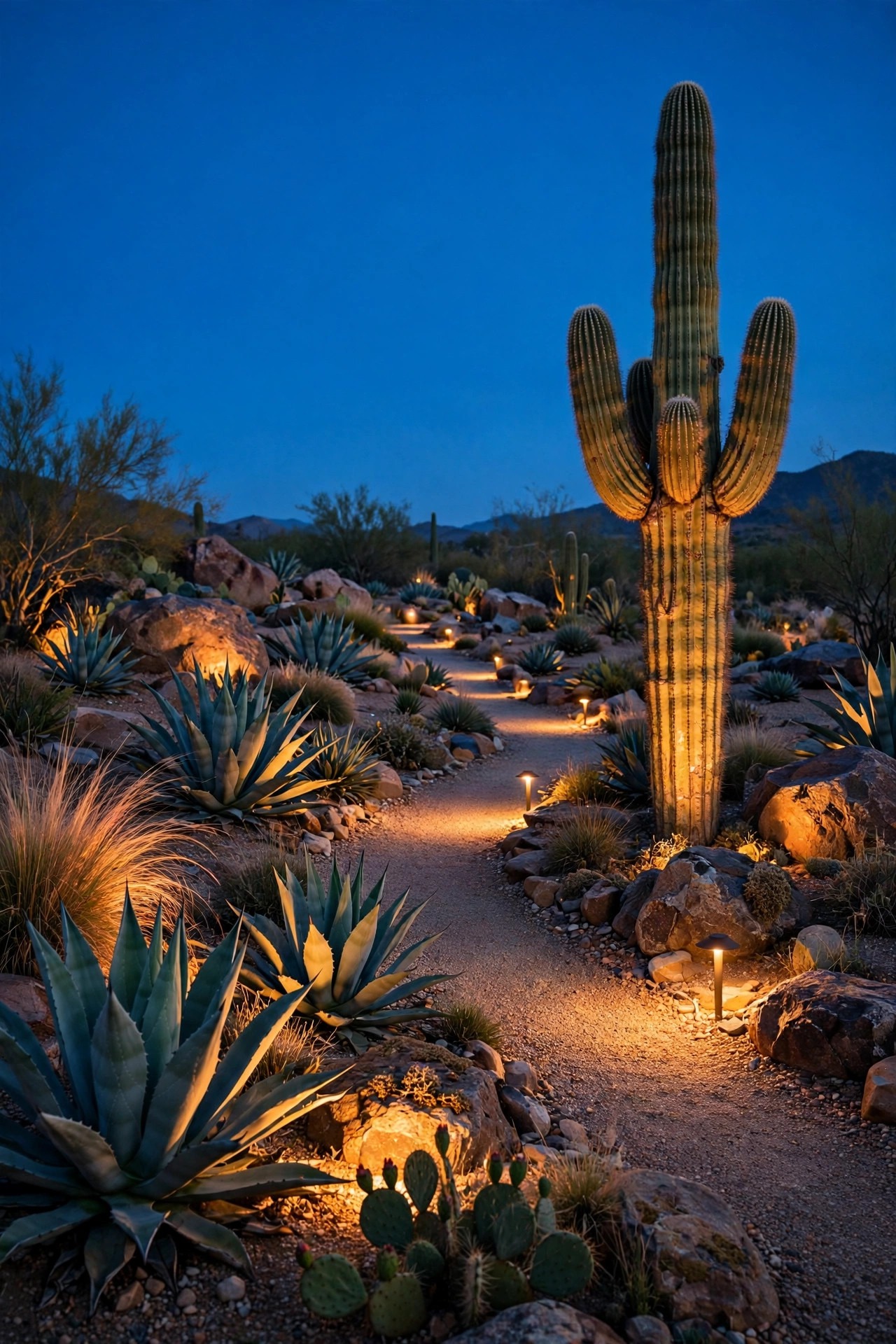
Every desert yard I have lit successfully started with a sketch, not a shopping cart. Draw your beds, gravel paths, driveway, and seating on paper, then mark three layers. The low layer is guidance: path and step lights under 14 inches tall that pool light on the ground where you walk. The middle layer is the art: narrow-beam accents aimed at saguaros, agaves, boulders, and walls. The high layer is atmosphere: one or two fixtures mounted 12 feet or higher that wash light down through a tree canopy like moonlight. Desert yards need restraint more than lush gardens do, because there is less foliage to absorb mistakes — for a typical front xeriscape, 10 to 14 fixtures across all three layers is plenty. Plan your dark-sky habits in the sketch too: every beam should land on a plant, a rock, or the ground, never the sky. Size your transformer with 20 percent headroom for the fixtures you will inevitably add, and run the main cable loop down the center of the yard so no single run starves the far end. Walk the sketch at dusk with a flashlight before you buy a single fixture.
Suggested budget range: $40 – $120.
2. Uplight a Saguaro or Agave Like a Sculpture
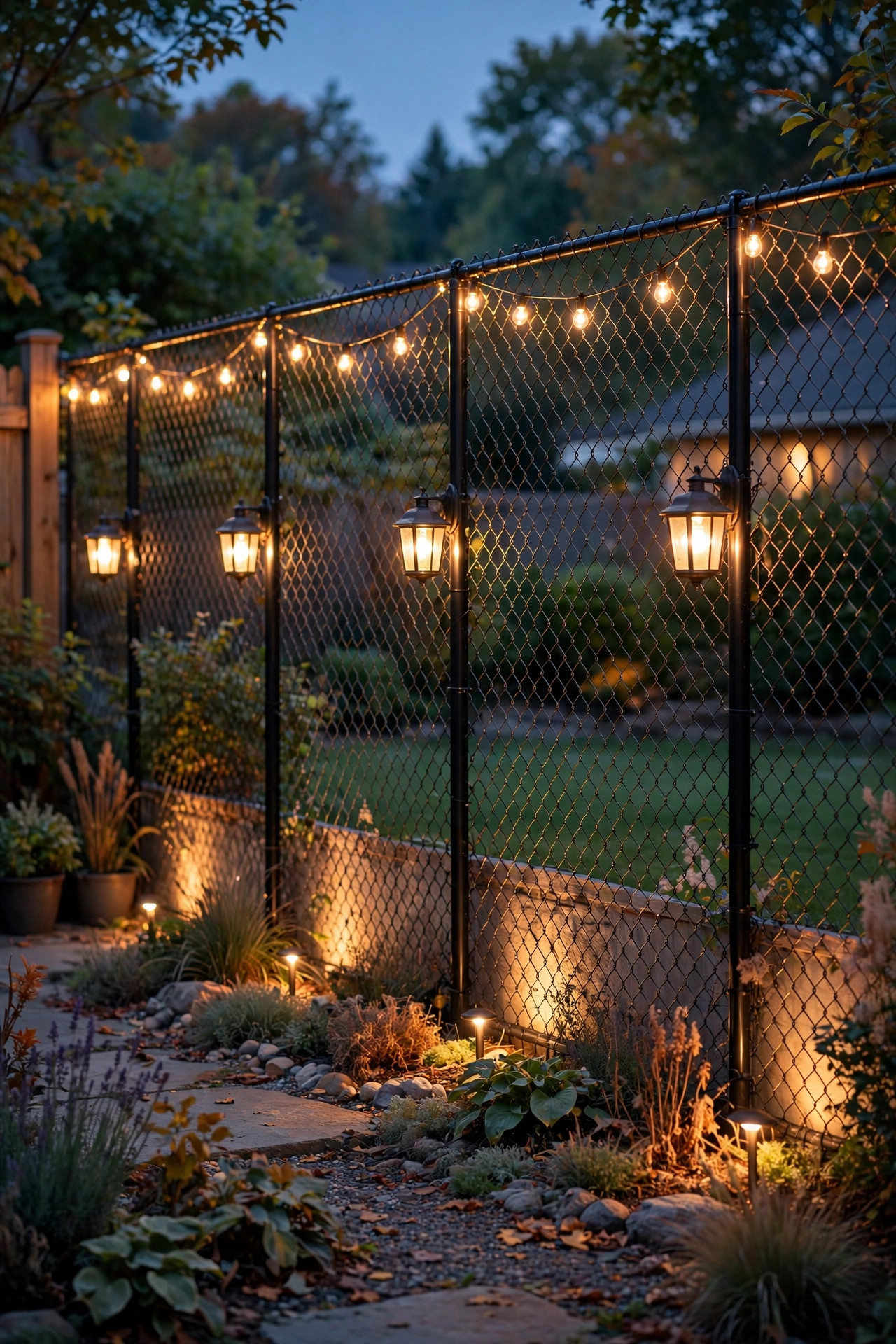
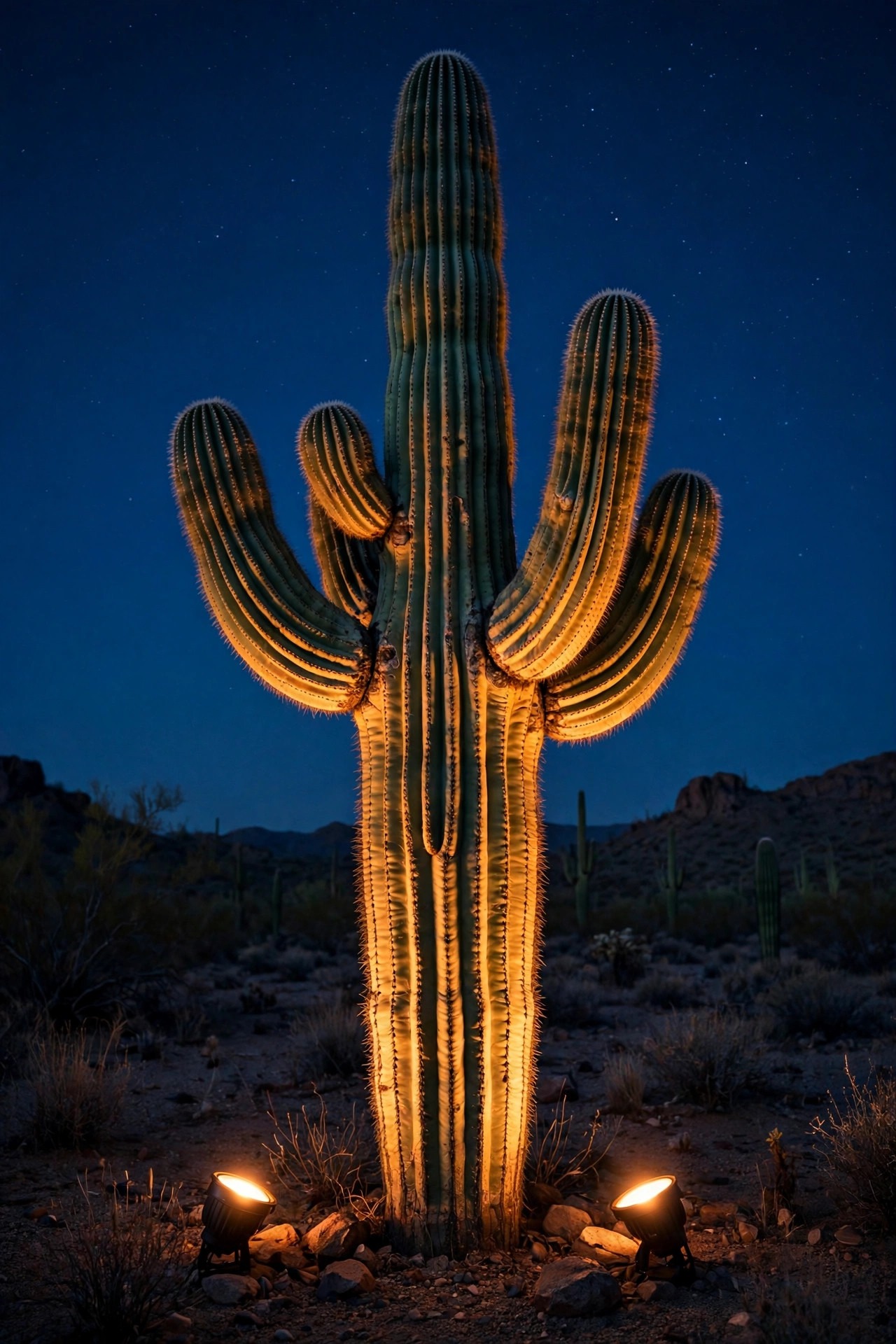
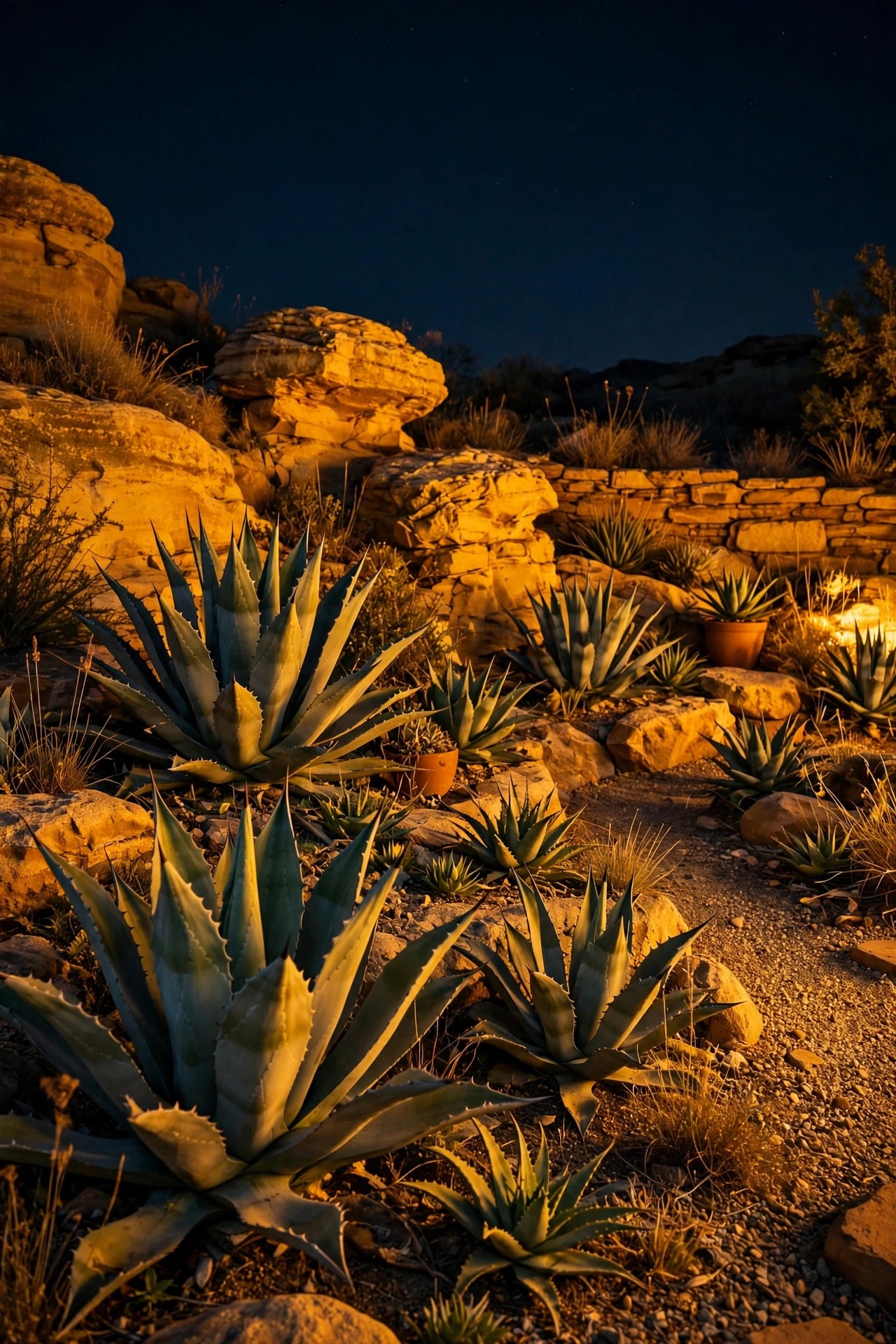
A healthy saguaro or a big blue agave is already a sculpture; lighting just frames it after dark. My formula is two shielded spotlights with narrow 15- to 25-degree beams, staked 12 to 18 inches from the base and tilted up the ribs or rosette so the light models the form instead of flattening it. Two beams from slightly different angles give you shadow and depth; a single head-on beam looks like a mug shot. Keep the fixture shields doing their job — the goal is a glowing plant, not a visible light source, and tight beams keep spill out of the night sky. Wear thick gloves and use tongs to clear debris around cactus bases, and never strap or screw anything into a cactus itself; desert plants heal slowly, and a wound invites rot. In many Arizona communities, saguaros are protected, so treat them as look-but-do-not-touch. A 2700K LED in the 300- to 500-lumen range is plenty for a mid-size specimen — desert eyes adjust fast, and restraint reads as elegance out here.
Suggested budget range: $60 – $180.
3. Moonlight Down From a Mesquite or Palo Verde
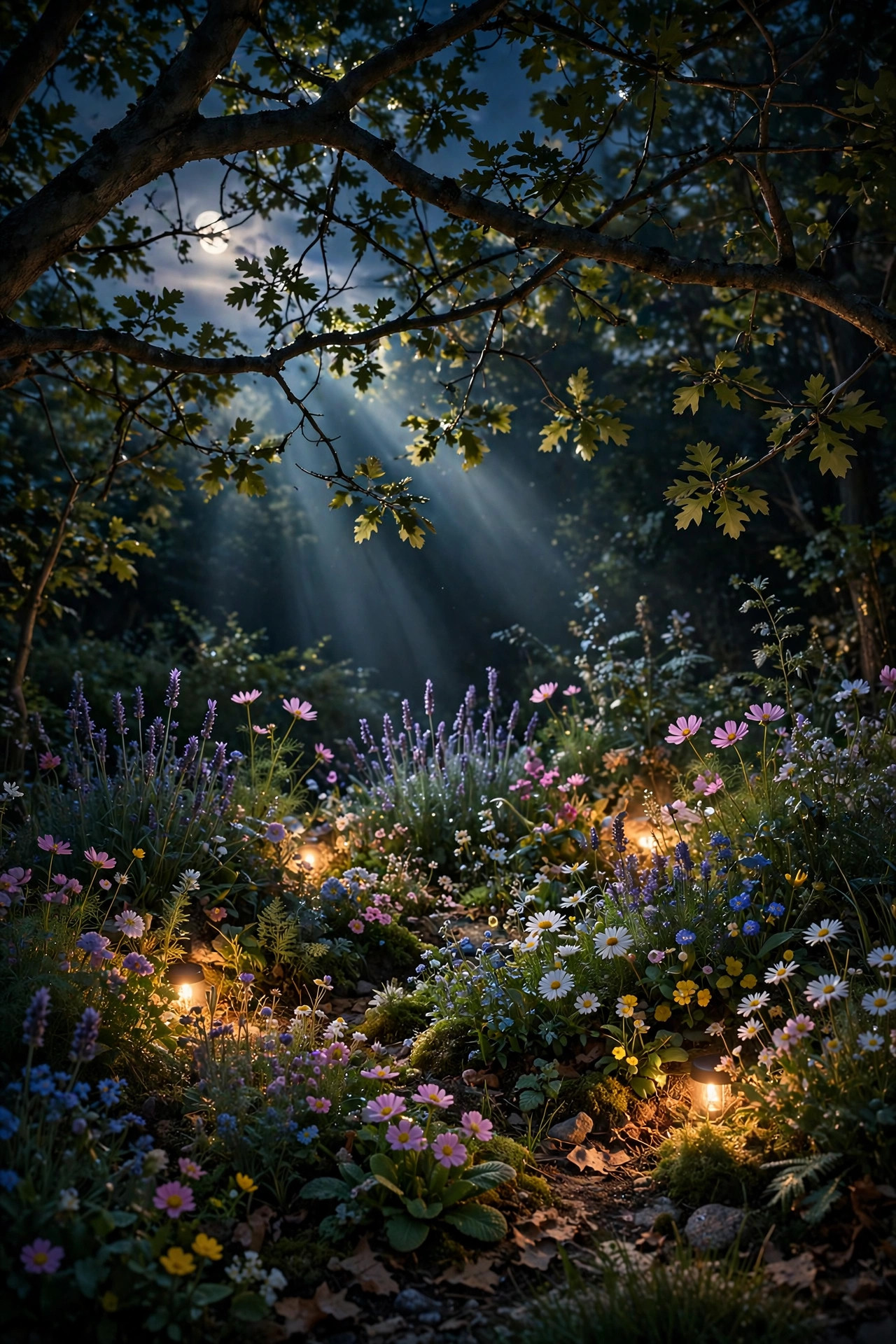
Moonlighting is my favorite trick in mesquite and palo verde country, and it is the most dark-sky friendly technique on this list because every lumen points down. A small shielded fixture mounts 12 to 15 feet up in the canopy and shines a wide, soft beam down through the branches, so the gravel below gets dappled, moving shadows that look exactly like a full moon. Use a stainless strap or a tree-friendly mounting bracket, never nails or screws straight through bark, and leave slack in the cable for growth. The green bark of a palo verde glows beautifully under a 2700K bulb, and the filtered light is gentle enough for seating underneath. This is the one job where I suggest hiring a pro for the ladder work if heights make you nervous — an hour of professional help beats a fall every time. Keep the glare shield angled so no bare bulb is visible from the street or a neighbor's window. In my experience, guests always assume it is actual moonlight and ask why the moon looks so good tonight. One tree done well can carry the whole backyard; two is a luxury.
Suggested budget range: $120 – $350.
4. Guide Gravel Paths With Low Shielded Path Lights
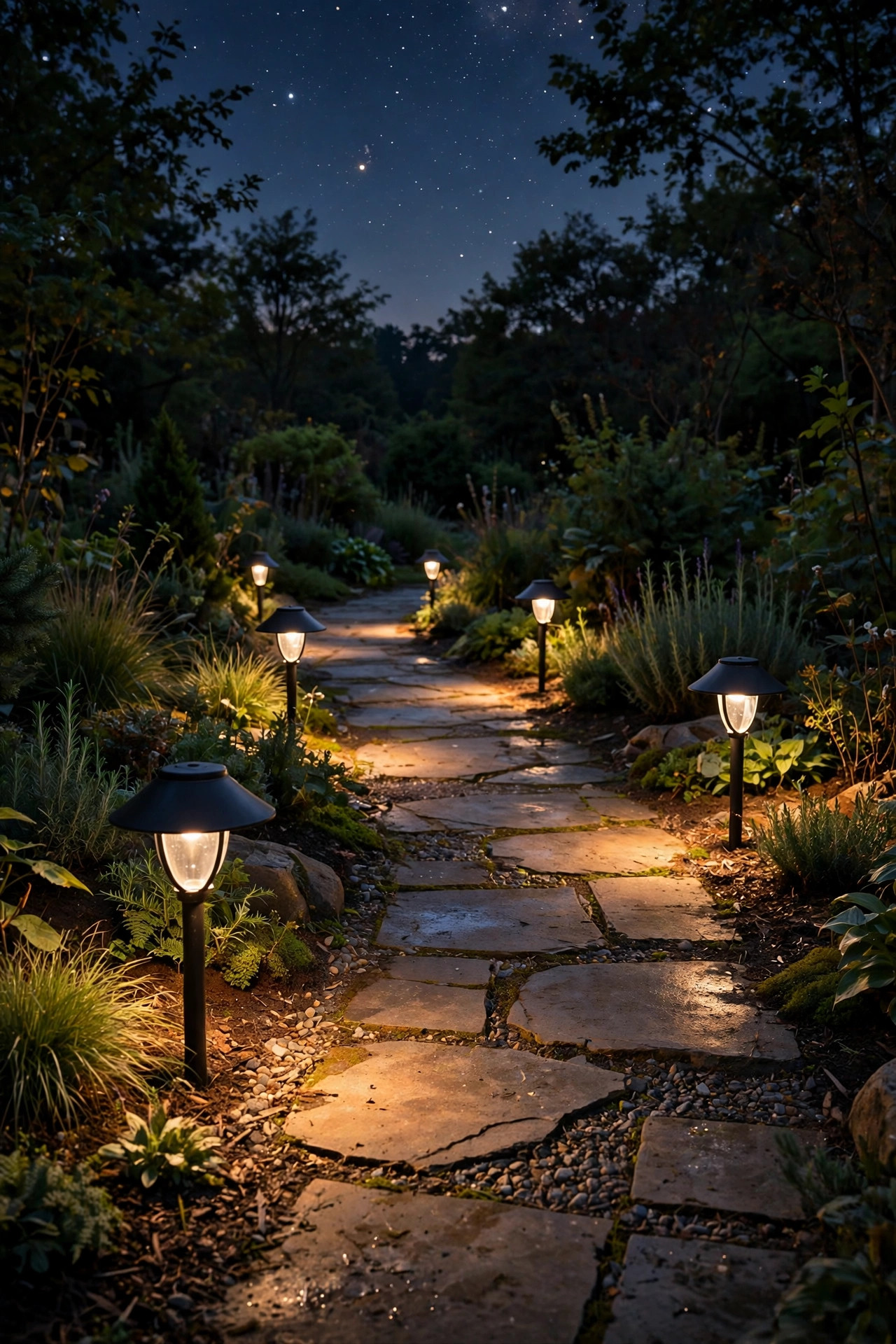
Gravel paths are the circulatory system of a xeriscape, and they want low, shielded light that lands on the stones and nowhere else. Choose hooded path lights or fixtures with louvered shields that throw light straight down in a soft circle — unshielded mushroom caps are the number one source of glare and sky glow in desert neighborhoods. Mine stand 12 to 14 inches tall, sit about 6 inches back from the path edge, and space 6 to 8 feet apart on alternating sides so the pools of light just touch. That rhythm guides your eye without building a runway. Choose powder-coated metal or solid brass; desert sun and dust storms eat cheap plastic stakes within a couple of seasons. Because the light stays low and downward, shielded path lights are the easiest fixture to defend to an HOA or a dark-sky ordinance — many desert cities cap outdoor color temperature at 3000K and require exactly this kind of shielding. Trench the cable 6 inches deep beside the path, and slip a spare conduit sleeve under the path itself for the future repair you will thank yourself for later.
Suggested budget range: $90 – $280.
5. Graze Boulder Clusters With Recessed Well Lights
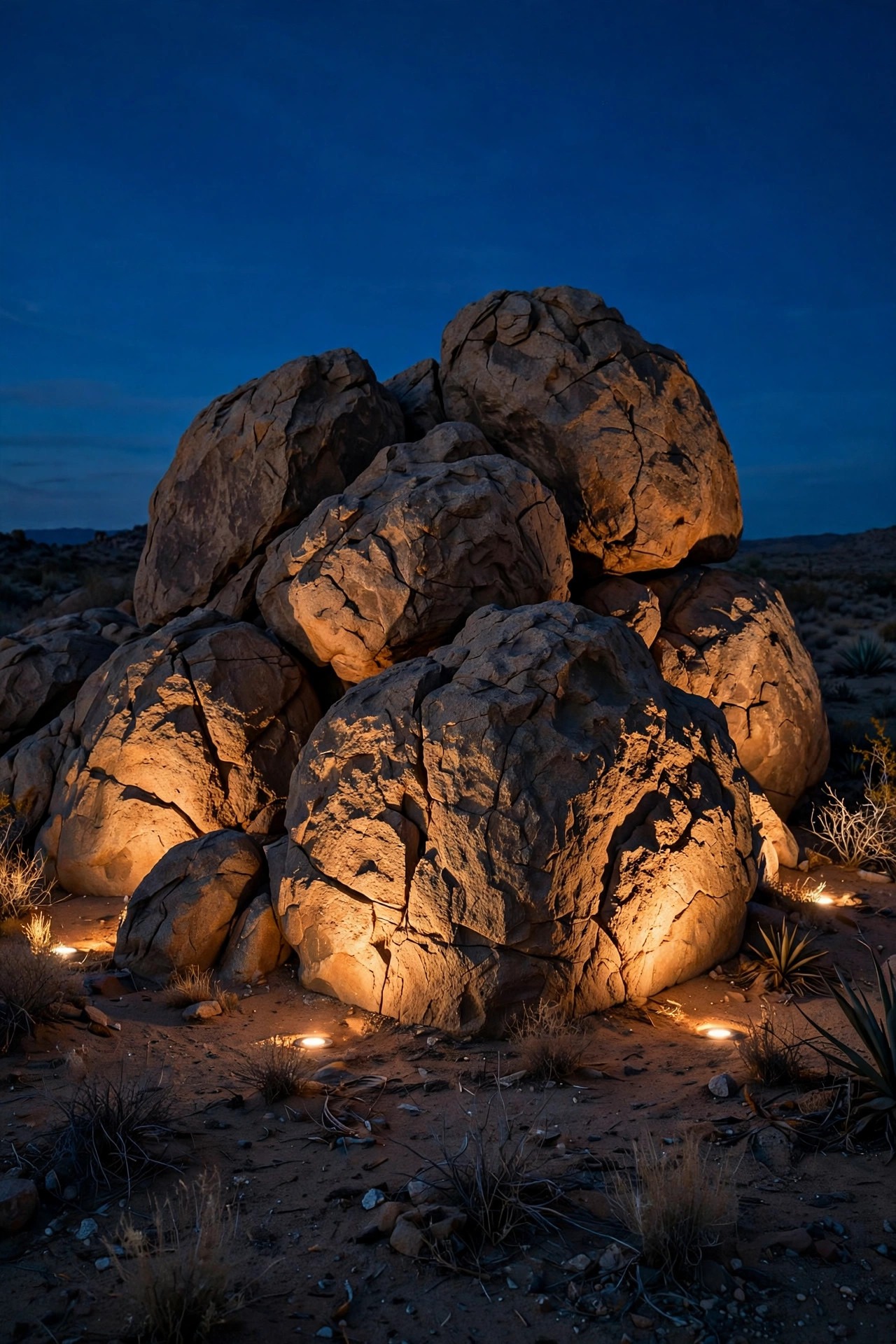
Boulders are the bones of a rock garden, and grazing light makes them look twice their size. Set recessed well lights in the gravel at the base of a cluster, aimed almost straight up the rock face so the beam skims across cracks and mineral veins instead of blasting over the top. One well light per major boulder is enough; for a cluster of three rocks, use two lights angled from slightly different sides. Choose fixtures with rock guards or grates if the cluster sits anywhere near a driveway, and pick sealed, gasketed housings — monsoon season will test every seal you own, and fine desert dust finds its way into everything. Keep the beam tight to the stone. The moment a well light overshoots the boulder, it becomes an uplight spraying the sky, which is exactly what dark-sky rules and your stargazing neighbors object to. I like 2700K here because warm light makes granite and sandstone read golden, while cool white turns beautiful rock into gray rubble. Wipe the lenses twice a year; a dusty lens can steal half your light before you notice.
Suggested budget range: $80 – $240.
6. Wash Adobe and Stucco Walls in Warm Light
Adobe and stucco walls are a desert gift: broad, warm surfaces that hold light like a sunset. Position wash fixtures 12 to 18 inches out from the wall with a wide 60-degree beam, and tilt them so the wash fades before it reaches the roofline — a clean cutoff keeps the glow on your wall and out of the sky. The texture is the point. Rough stucco, stacked stone veneer, and adobe brick all throw tiny shadows under a grazing angle, so experiment at dusk by moving the fixture a few inches closer or farther until the relief pops. Light a wall behind seating and you get a backdrop that makes the whole patio feel enclosed and calm. Stop the wash below window height so you are not backlighting your own curtains or flooding a bedroom. On long walls, two smaller fixtures spaced 8 to 10 feet apart read better than one bright one. Warm 2700K — or even 2200K amber — suits earth-tone walls best; cool temperatures make adobe look like a parking garage, honestly.
Suggested budget range: $70 – $200.
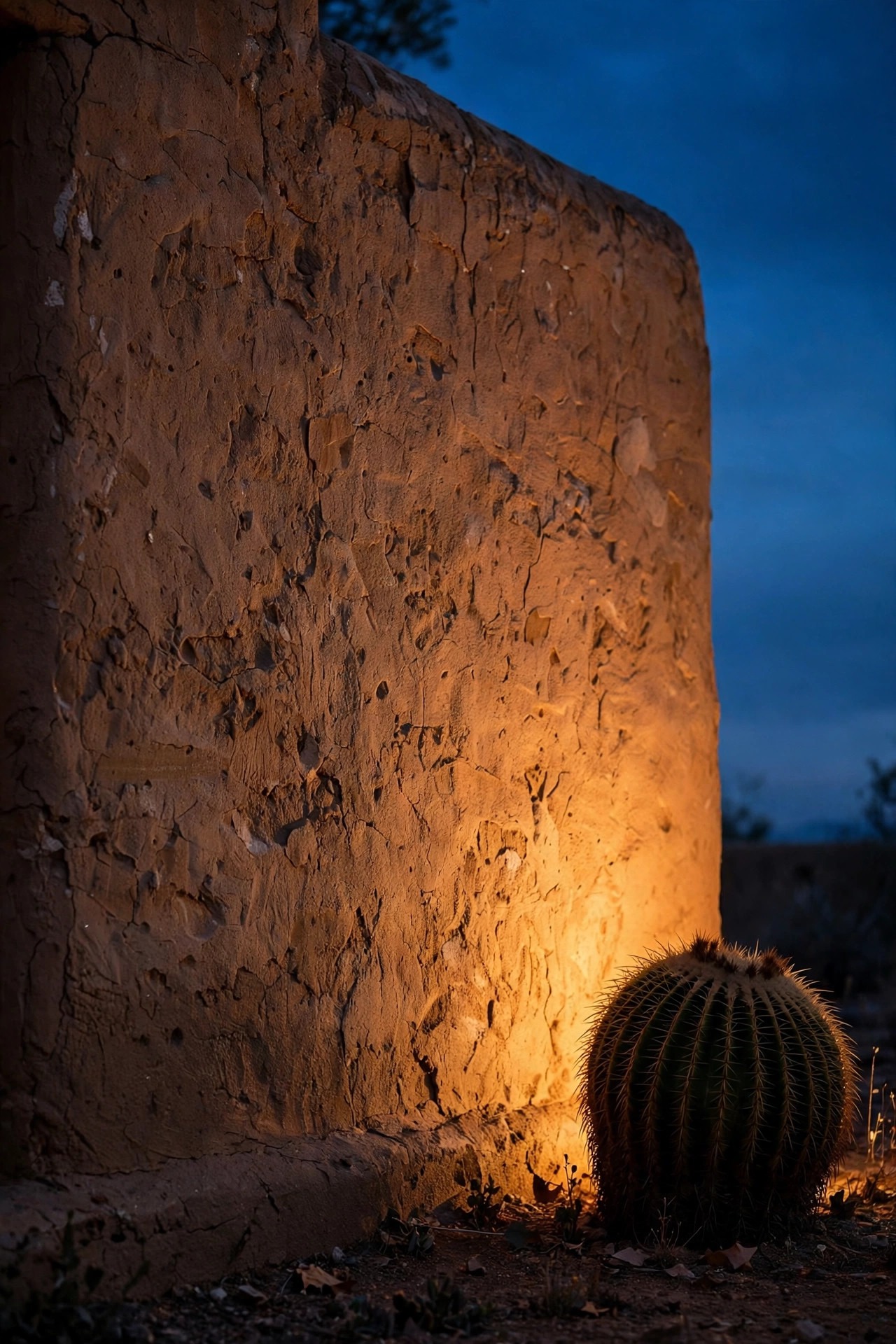
7. Take Solar Stakes Where Wiring Cannot Go
Solar lighting and desert sun were made for each other, and the far corners of a big xeriscape — the ocotillo by the back fence, the boulder at the end of the drive — are where trenching cable stops being fun. This is where I happily go solar. Modern solar spotlights and stake lights with separate, tiltable panels charge fully even in winter at desert latitudes, as long as the panel gets six honest hours of sun and you wipe the dust off it monthly. Look for replaceable batteries and metal housings; sealed throwaway units are landfill on a timer. Set honest expectations, though: solar accents give you glow and guidance, not the punch of a wired uplight on a 20-foot saguaro. If you are weighing a full system, my comparison of solar vs. wired landscape lighting breaks down cost, brightness, and lifespan for both. My usual desert recipe is hybrid: wired low-voltage for the heroes near the house, solar for the outposts. It keeps the budget sane and the trench lines short.
Suggested budget range: $35 – $110.
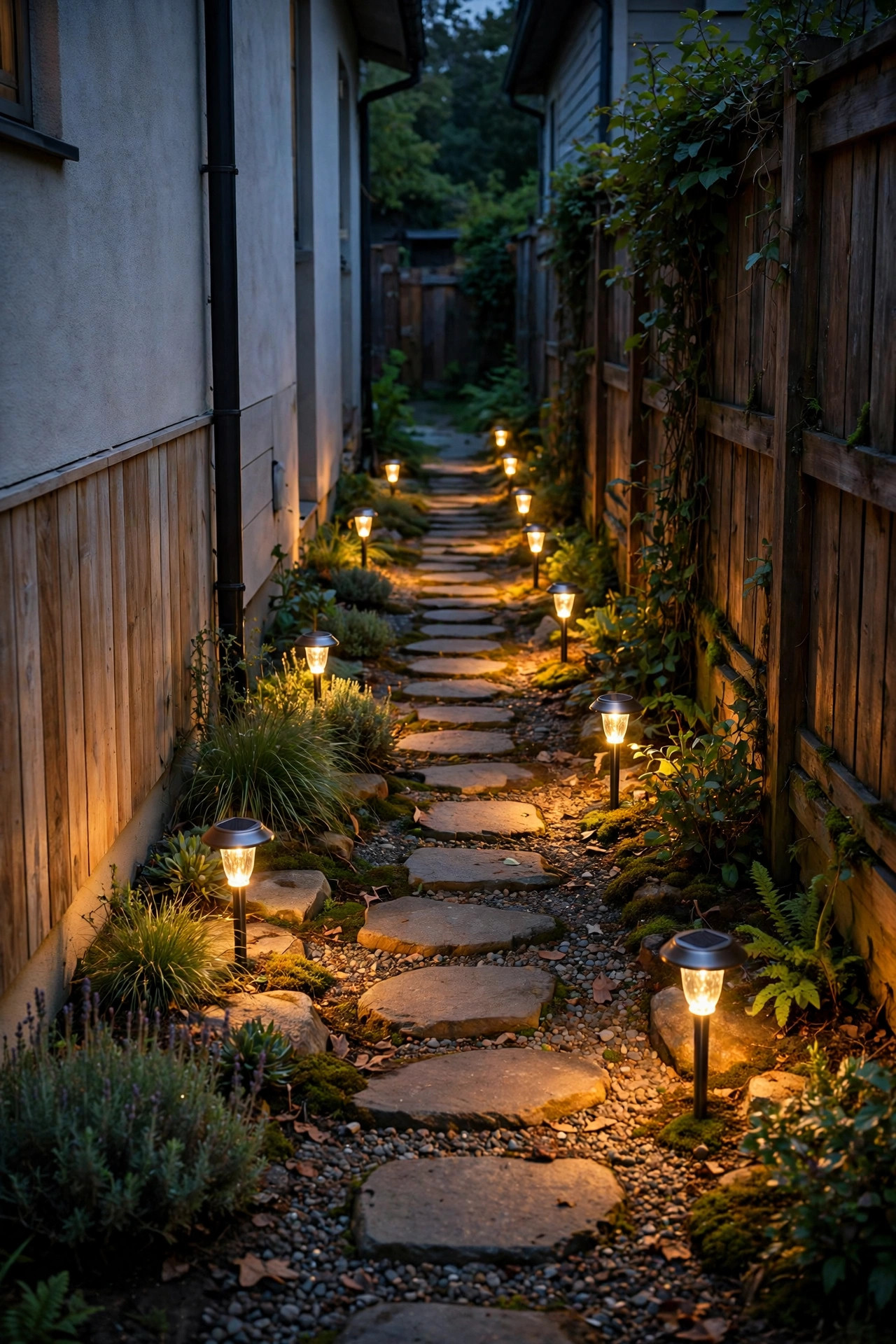
8. Nestle Well Lights Into Rock Garden Beds
Rock garden beds deserve their own moment because the fixtures nearly disappear here. Small in-ground well lights and mini spotlights tuck between stones, so all you see at night is light pooling on rock and the occasional barrel cactus glowing from inside the bed. Angle each beam to rake across stone, never straight up — in a bed, the rocks are the artwork, and grazing shows off their edges. Gravel mulch is your friend twice over: it hides cable runs completely, and a quick rake smooths over any trench. Choose fixtures with brass or heavy composite housings rated for ground contact, because bed fixtures live in dust, irrigation overspray, and the occasional monsoon puddle. If your rock garden sits out front, I have a whole companion piece on front yard rock garden lighting with layouts for slopes and dry creek beds. Keep bed lighting dimmer than you think — 100 to 200 lumens per fixture is plenty among pale stones, which bounce light generously. Pale gravel plus bright light equals glare, and glare is the enemy of every desert night.
Suggested budget range: $60 – $190.
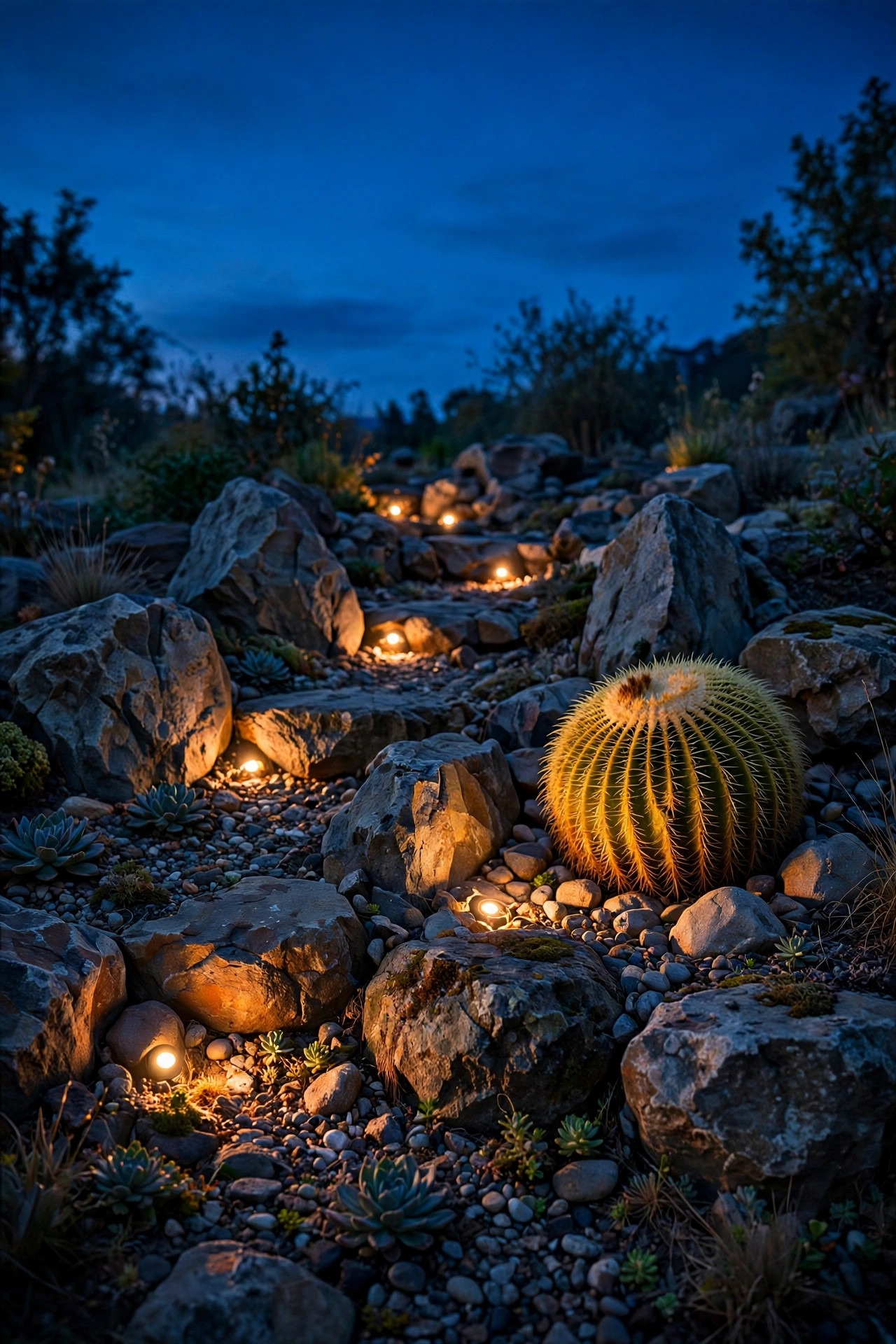
9. Mark the Driveway and Courtyard With Shielded Bollards
Where a driveway meets a courtyard gate, desert homes often go dark in exactly the spot where guests arrive. Shielded bollards fix it, with manners. A good bollard stands 18 to 24 inches tall and hides its bulb behind louvers or a solid cap, throwing a clean fan of light down and out at ground level — you see the driveway, never the source. Space them 8 to 10 feet apart along the drive edge or flanking the courtyard entry, set back at least a foot from the pavement so bumpers and mirrors pass cleanly. In adobe and Santa Fe styles, a simple dark-bronze bollard with clean lines disappears by day and behaves beautifully at night. Bollards also solve a dark-sky headache: unlike a bright coach light over the garage, their light stays in a low band around the base, so nothing leaks upward or across the street. Match the metal finish to your gate hardware, and keep the color temperature at 2700K to match the rest of the system. Go wired here — this is a safety light that must perform every single night, not a fair-weather accent.
Suggested budget range: $150 – $420.
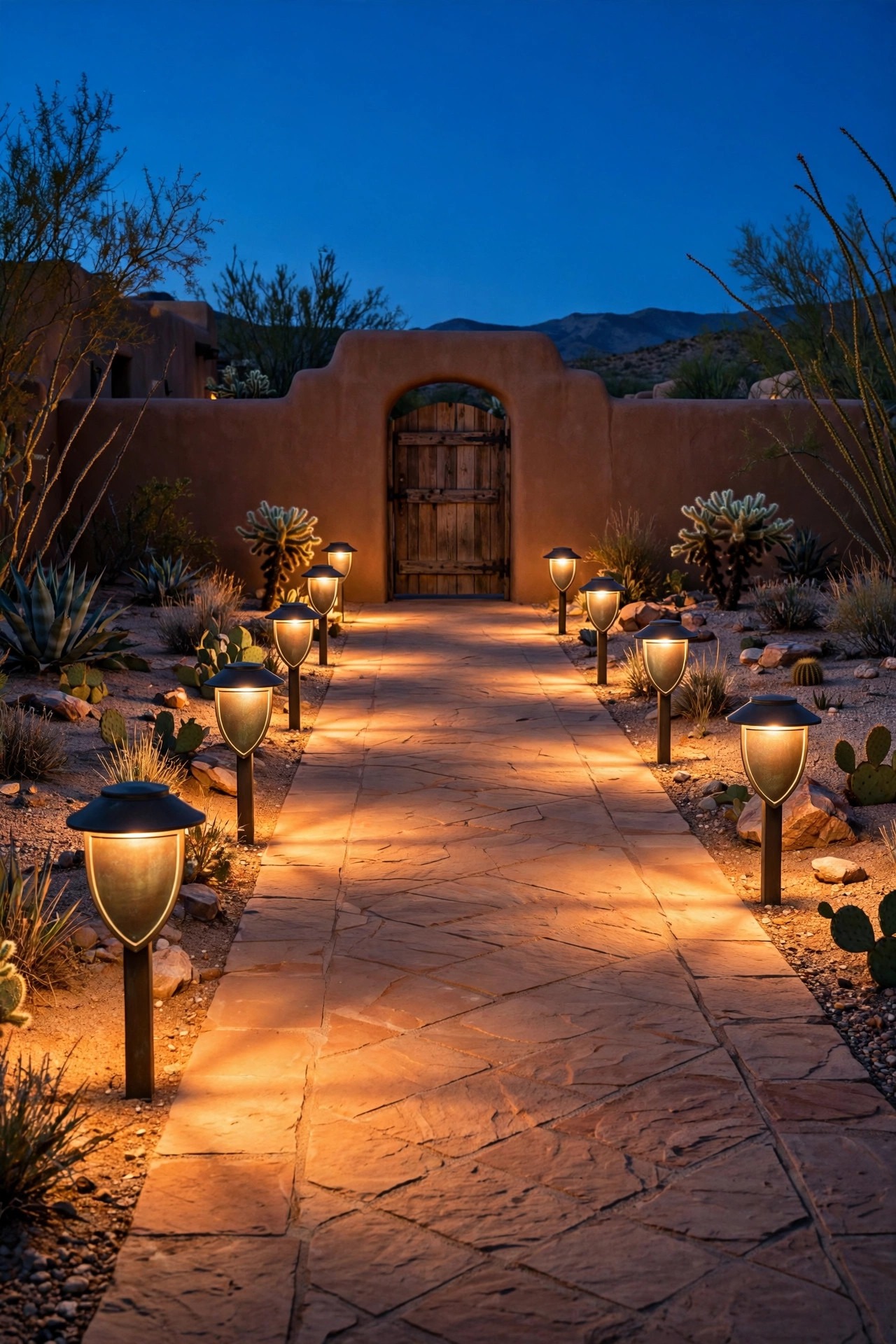
10. Silhouette Specimen Plants Against a Lit Wall
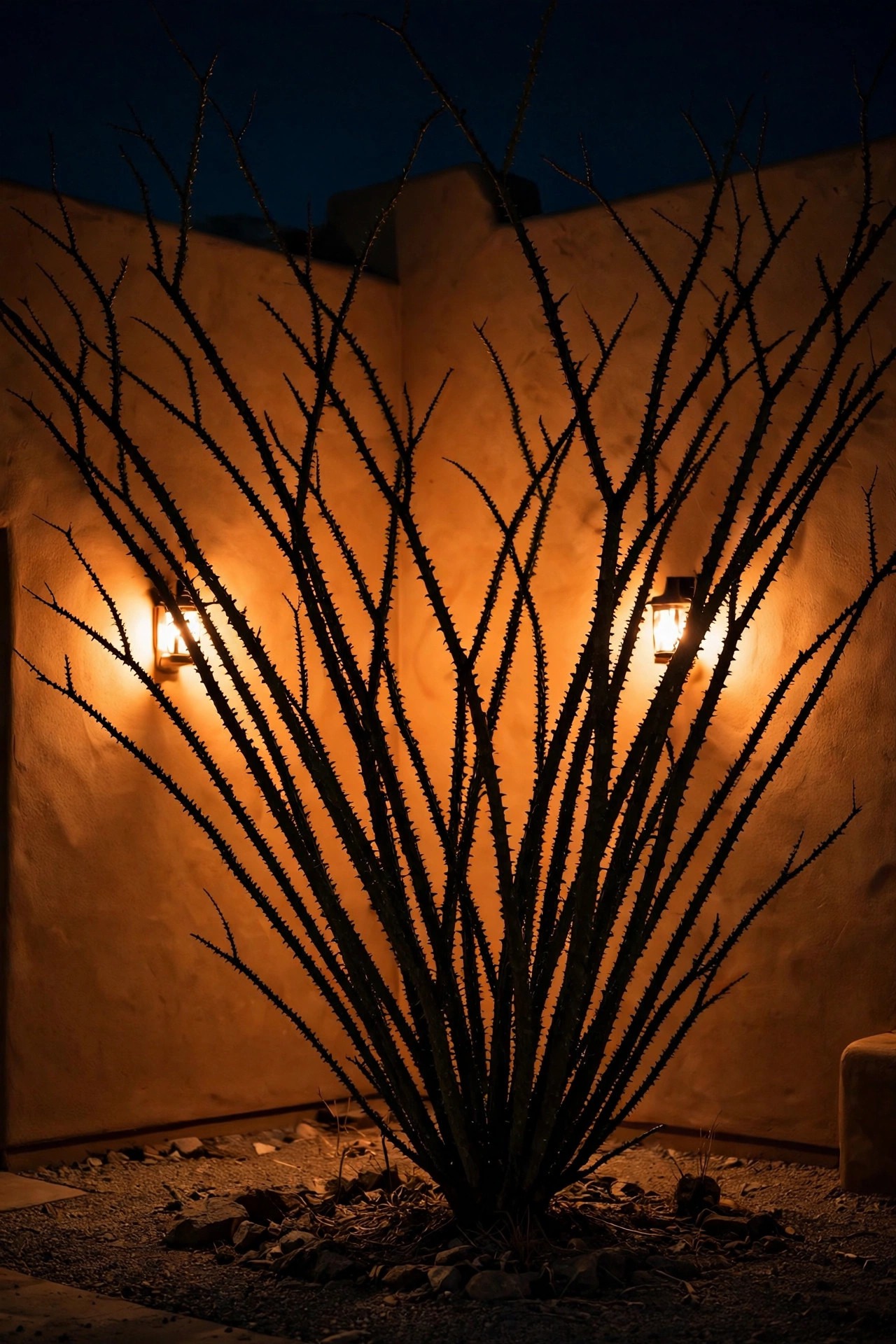
Silhouette lighting is the cheapest drama in the desert. Put one wide-beam fixture on the ground a few feet in front of a plain wall, aim it at the stucco, and stand an ocotillo, a totem cactus, or a sculptural agave between the light and the wall. The plant goes black and graphic against the glowing surface, and its shadow stretches to three times its real size. The trick is restraint: the wall should be lit evenly and modestly, about the brightness of candlelight written large, so the silhouette stays ink-dark by contrast. It never works with a dim plant and a blazing wall, so dim the wash down and let your eyes adjust. This is also a kind way to light near a bedroom window, since the glow is indirect and soft. Ocotillo canes in spring leaf are my favorite silhouette subject, with a cluster of golden barrels a close second. One fixture, one plant, one wall: it is the most complimented corner of every desert yard I have done, and it costs less than dinner out.
Suggested budget range: $45 – $130.
11. Build Light Into Steps and Retaining Walls
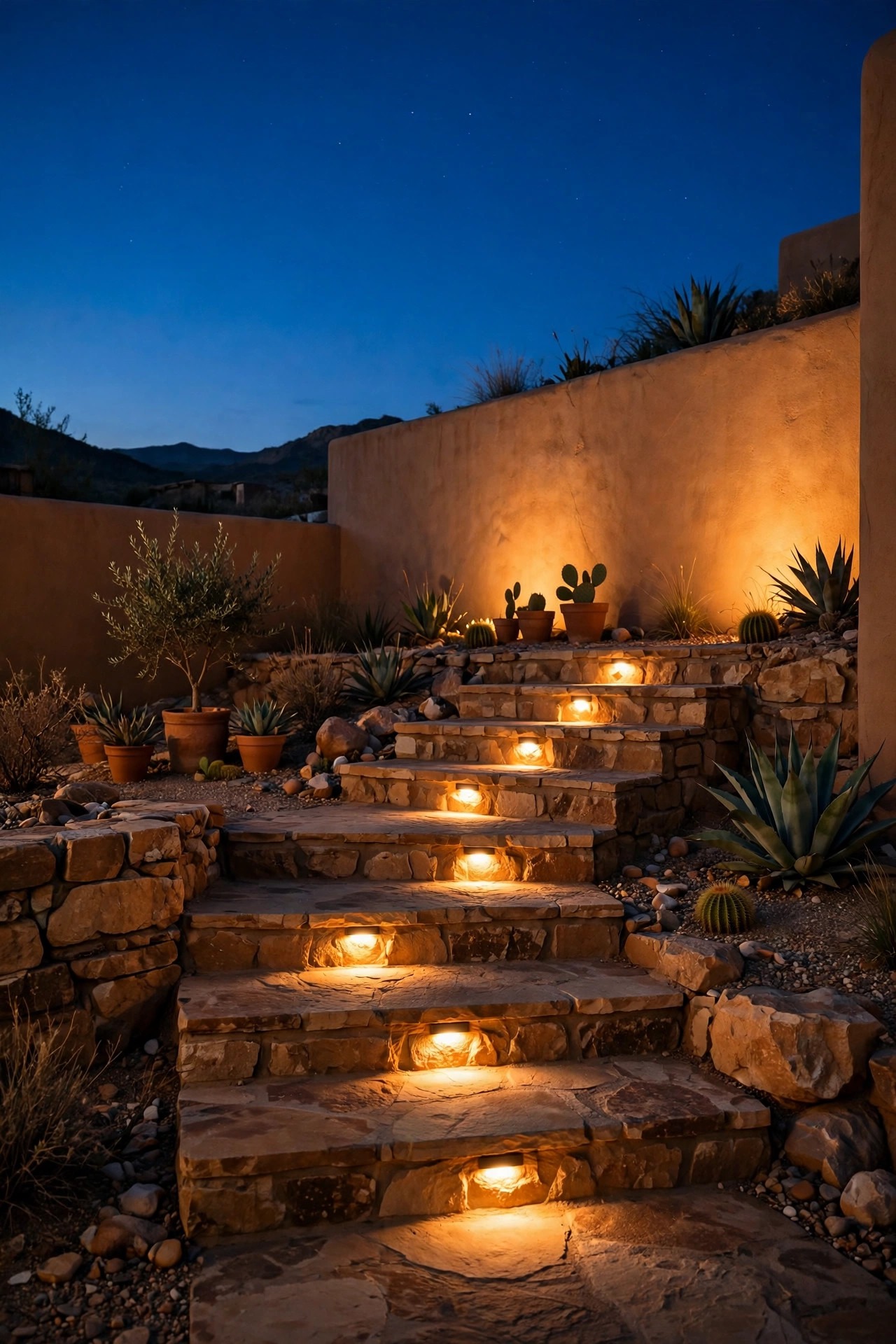
Desert yards are full of level changes people forget at night: courtyard steps, terraced retaining walls, the two sneaky stairs down to the fire pit. Build the light into the architecture and nobody ever trips. Recessed step lights mount in the riser or the wall beside each tread, and under-cap lights hide beneath the top course of a retaining wall, washing the face below and pooling light on the landing. Both styles are inherently shielded — the structure itself blocks any upward spill — which puts safety lighting and dark-sky rules on the same side for once. Space step lights on every other tread for residential stairs, and aim for even pools rather than brightness. Masonry work is the real cost here, so plan these fixtures while a wall or staircase is being built whenever you can; retrofitting into finished stucco is doable but slower. Use fixtures rated for masonry contact as the manufacturer specifies, and keep every wire connection in a waterproof junction box above the irrigation line. Low-voltage LED modules sip power, so an entire staircase can run on less electricity than one old porch bulb.
Suggested budget range: $110 – $320.
12. Downlight the Ramada or Pergola From Above
For the ramada, pergola, or covered patio where desert evenings actually happen, mount small downlights in the beams instead of relying on portable lamps. A row of compact, shielded downlights over the dining table or seating gives you honest task light for dinners and board games, all of it pointing down at the tabletop where it belongs. Because nothing shines up or out, downlighting is the technique dark-sky ordinances love most, and your neighbors will never see a bare bulb. Put the row on a dimmer and the same fixtures go from full dinner brightness to a low ember for stargazing after dessert. Space the lights 3 to 4 feet apart over a table, and choose 2700K bulbs with a high color-rendering rating so food looks appetizing, not gray. Outdoor-rated fixtures matter even under a roof — desert dust and monsoon humidity get everywhere. If the structure is freestanding, run low-voltage cable up one post inside slim conduit painted to match; done neatly, the wiring vanishes. This is the layer guests feel most and notice least, which is exactly the point.
Suggested budget range: $130 – $360.

13. Give the Pool or Water Bowl a Soft Underwater Glow
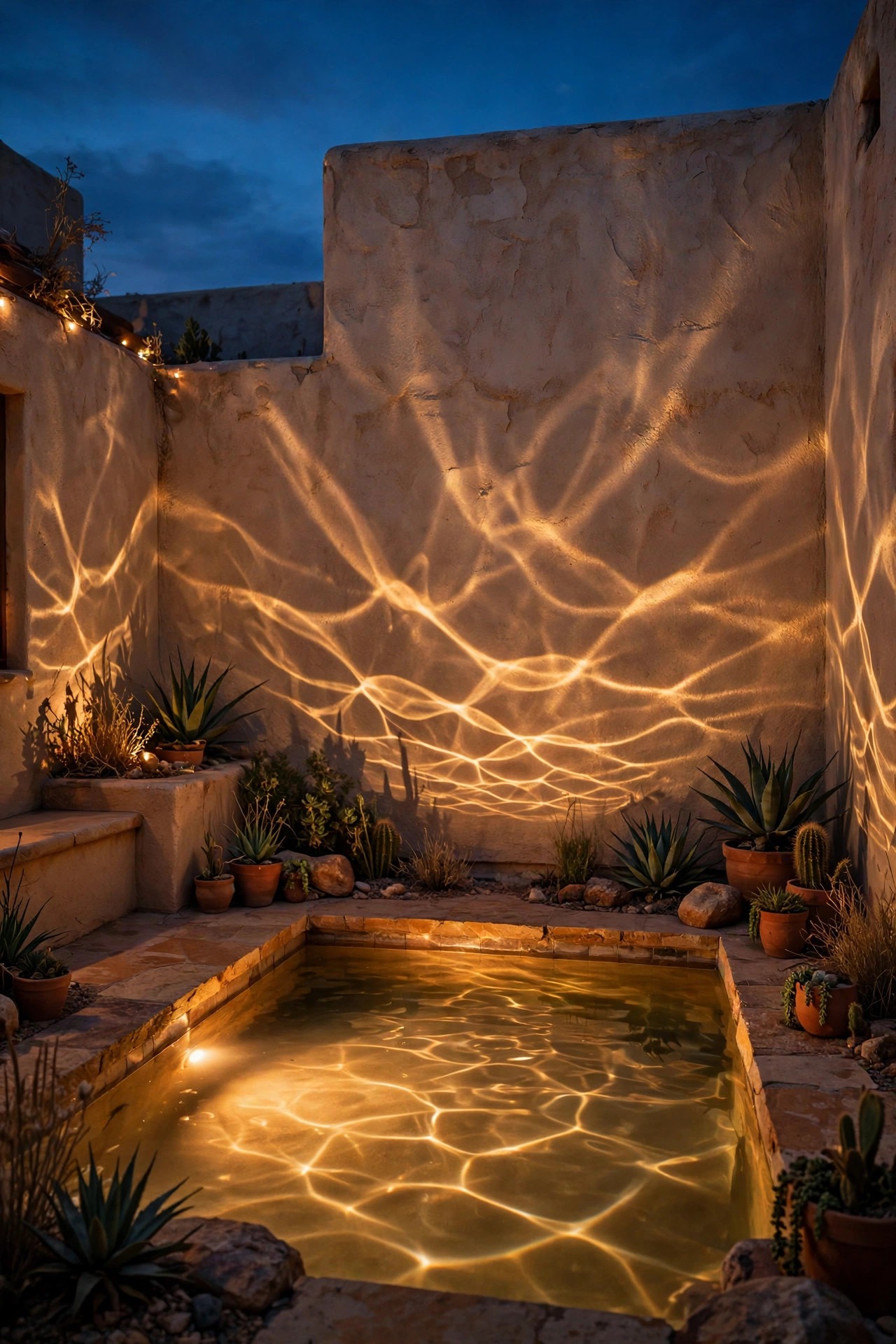
Even a small desert water feature — a reflecting bowl, a stock-tank plunge pool, a fountain against the courtyard wall — doubles its beauty with one submerged light. Moving water over a warm beam throws rippling reflections onto the wall behind it, and the whole corner feels cooler just looking at it. The rules here are strict and non-negotiable: only fixtures rated for underwater use, only low-voltage power, and the transformer and any plug connection on a GFCI-protected circuit, full stop. Never improvise a regular spotlight into a pool edge. Position the fixture to graze across the water from below rather than blasting straight up, both for the shimmer effect and to keep light out of swimmers' eyes. Warm light reads as lantern glow; cool blue turns a desert courtyard into an aquarium. Desert water evaporates fast, so check the level weekly — a submersible fixture run dry can overheat. A timer that shuts the water light off late in the evening saves the pump, the power bill, and the night sky in one move.
Suggested budget range: $90 – $260.
14. Put Everything on Timers and Photocells
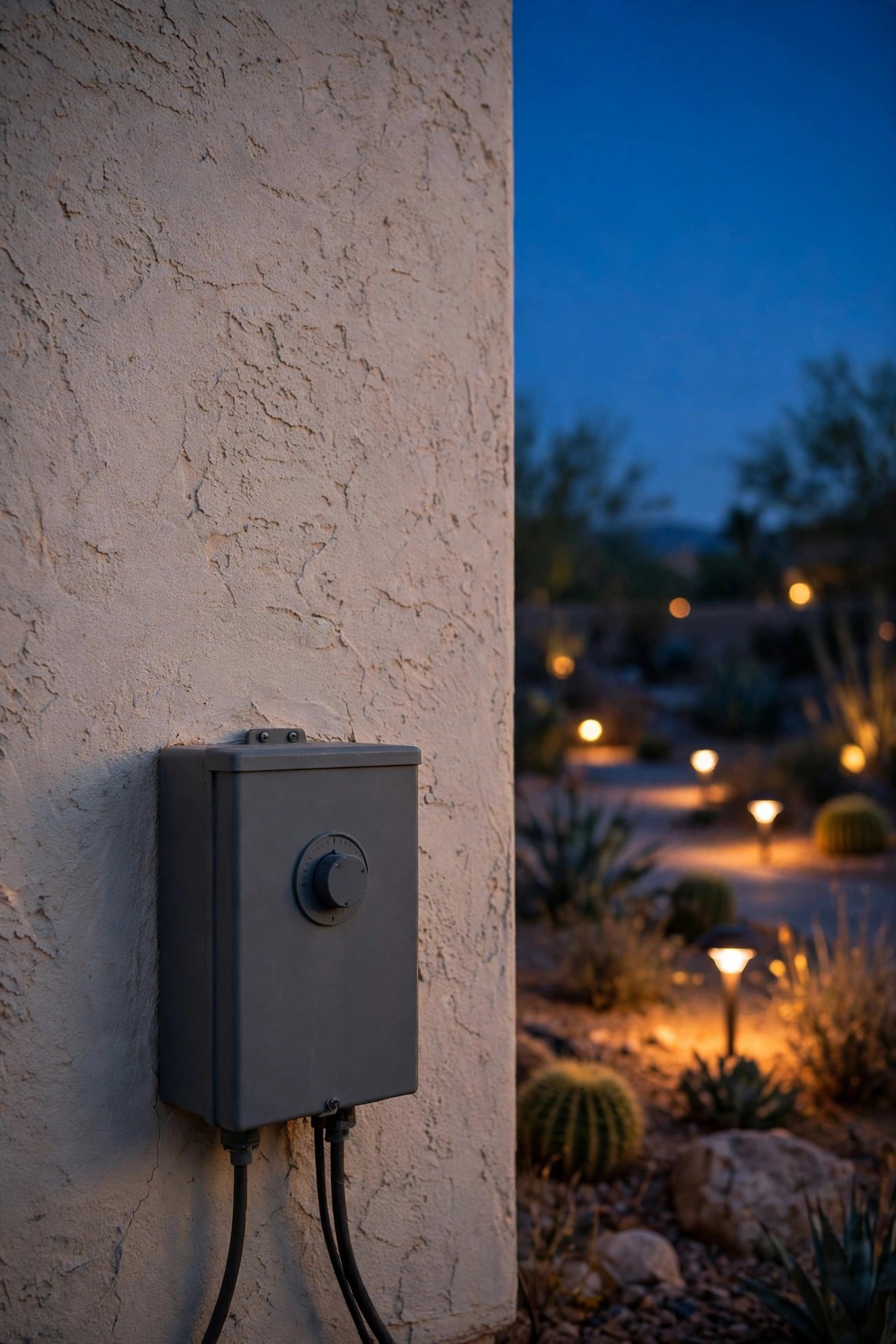
Automation is what turns desert lighting from a chore into a habit. A photocell wakes the system at dusk without you touching a thing, and a timer — ideally an astronomical one that tracks sunset through the seasons — shuts it down at a civilized hour. Many desert cities and HOAs ask that outdoor lighting go off by 10 or 11 p.m. unless it is motion-activated, and honestly the yard looks better for the discipline; the stars are the late show. Modern low-voltage transformers often build the photocell and timer right in, and smart plugs add simple zoning: paths every night, party accents only on weekends. Motion sensors belong at gates, side yards, and the trash-can alley, where light should visit briefly and leave. Whatever you choose, test the off-time from the street once. If your yard still glows at midnight like a gas station, the timer has failed or a shrub is shading the photocell so it thinks night never ends. Fifteen minutes of checking saves you the neighborhood reputation, and it keeps your beautiful yard on the right side of the local lighting ordinance.
Suggested budget range: $25 – $90.
15. String Warm Café Lights Over the Patio Edge
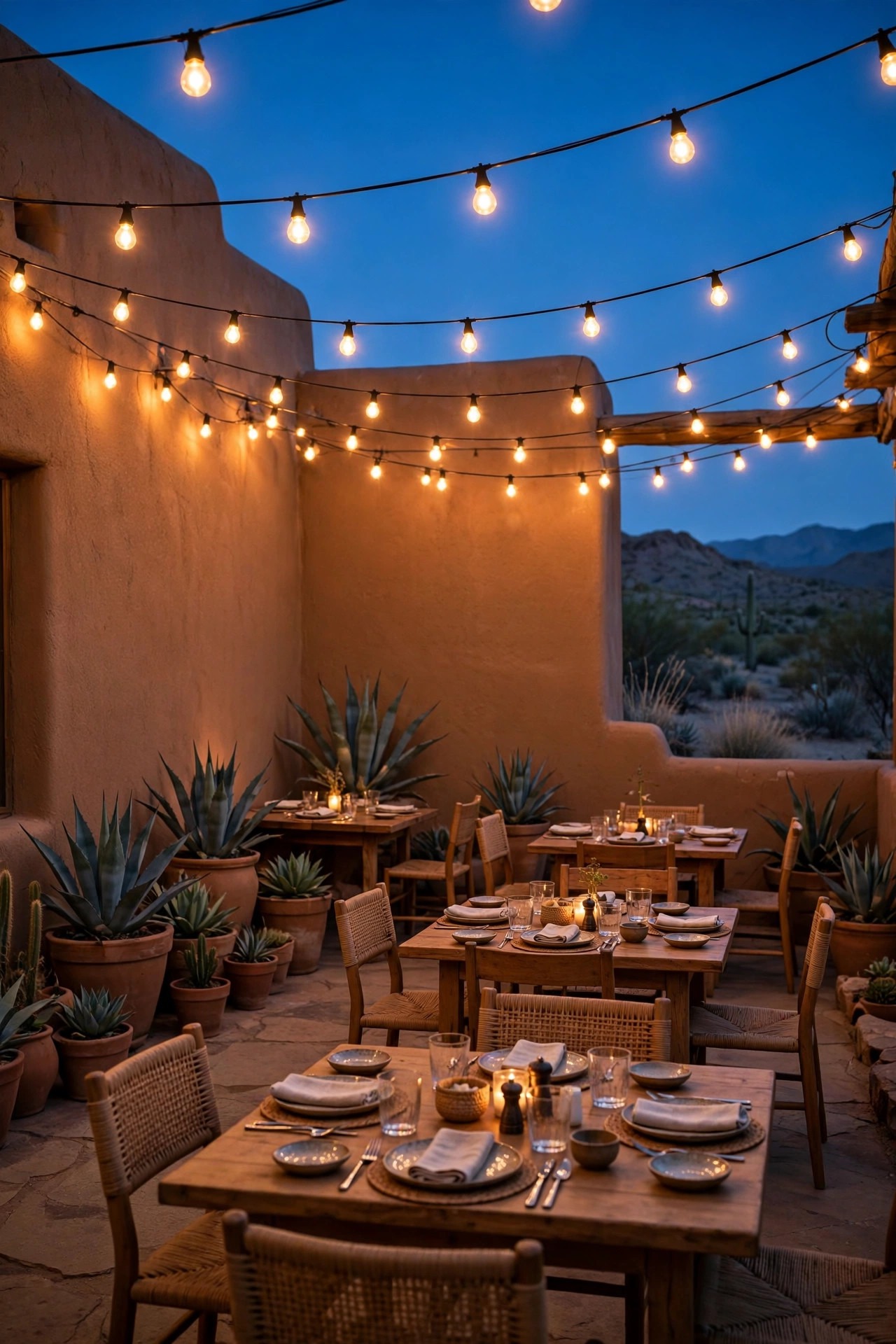
Yes, café string lights belong in the desert too — over hardscape, in moderation, and always warm. Strung over a patio table or along a ramada edge, dimmable 2700K filament-style LED strings give that cantina glow desert evenings were invented for. The dark-sky courtesy rules are simple: hang them over the patio, not over open yard; keep them on the same timer as everything else so they retire by 10 or 11; and choose dimmable bulbs so they read as candlelight, not carnival. LED-only is also a fire rule out here — dry grasses, palm skirts, and patio cushions should never sit near a hot incandescent bulb. Support long runs on a proper steel guide wire so monsoon gusts do not swing bulbs against stucco or, worse, cactus spines. I count string lights as the welcome layer, not the lighting plan; the paths, steps, and specimen plants still need their own fixtures. But for that last layer of mood over a dinner table, nothing in this list earns its keep faster per dollar.
Suggested budget range: $40 – $140.
16. Hold Every Bulb to 2700K or Warmer
Walk into a desert yard lit in mixed color temperatures and it feels broken, even if you cannot say why. Pick one warm temperature for the whole property — 2700K is my default, with 2200K amber reserved for properties near wildland edges, observatories, or strict dark-sky ordinances, many of which cap outdoor lighting at 3000K. Amber light also bothers roosting birds and nocturnal desert wildlife less, which matters when your fence line is open desert. Swapping mismatched bulbs is the cheapest upgrade in this entire list: audit every fixture on one evening walk, note the offenders — usually a cool-white solar stake or a daylight bulb someone screwed into the porch light — and replace them in one pass. Good LEDs hold their color for years, so this is a one-time discipline. Warm light flatters everything the desert grows: agave blue turns silvery instead of sickly, sandstone goes golden, and stucco glows like late afternoon. Cool white does the opposite, draining color and flattening sculpture into scenery. Consistency is what makes a yard look designed rather than accumulated, honestly.
Suggested budget range: $30 – $100.
17. Finish With a Dusk Walk-Through of Your Desert Landscape Lighting Ideas
The last step is an edit, and it is the one that separates good yards from great ones. Wait until full dark, then walk your property slowly with fresh eyes — ideally after a week of living with the new system. Start at the street: any fixture whose bare bulb you can see from the road needs a shield, a lower aim, or a dimmer setting. Stand in each seating area and look outward; you should see lit plants, rock, and walls, never light sources. Check the heroes: is the saguaro modeled or flattened? Is the moonlighting tree casting shadows or just glowing? Note where light escapes upward — a beam missing its boulder, a wash climbing past the roofline — and fix the aim, not the bulb. Then check compliance while you are at it: timers set, temperature consistent, nothing shining into a neighbor's window. My rule is subtract before you add; most yards need one fixture removed or dimmed, not one more bought. Finish the walk at your favorite chair, sit down, and enjoy the yard you actually designed.
Suggested budget range: $0 – $60.
Frequently Asked Questions
What color temperature is best for desert landscape lighting?
Warm, always. I recommend 2700K as the default for xeriscapes — it flatters adobe, sandstone, and agave — and 2200K amber where a dark-sky ordinance, an observatory buffer, or open wildland calls for extra care. Many desert cities cap outdoor lighting at 3000K, so anything cooler risks both a violation and an ugly yard. Avoid daylight bulbs entirely; they flatten desert plants and look institutional. Whatever you choose, use one temperature everywhere so the yard reads as a single design.
Are solar lights enough for a xeriscape, or do I need wired?
For paths, bed accents, and remote corners, yes — desert sun is the best solar charging station in the country, as long as panels get about six hours of direct light and a monthly dust wipe. Solar falls short for tall specimen uplighting, moonlighting, and any fixture that must run reliably past midnight in December. Most yards I design are hybrid: a wired low-voltage backbone for the heroes and safety lights, solar for the outposts. That mix keeps trenching, cost, and frustration all low.
How do I keep my landscape lighting dark-sky friendly?
Follow five habits: choose shielded fixtures that hide the bulb and aim light down; keep color temperature at 3000K or warmer; light only what needs light, at the lowest brightness that does the job; put everything on timers that switch off by 10 or 11 p.m.; and use motion sensors instead of all-night floods for security areas. Then check your own property line and HOA rules, since many desert communities add fixture and curfew requirements on top of the basics.
How much does desert landscape lighting cost to run?
Very little once it is in. A typical 12-fixture low-voltage LED system draws roughly 60 to 100 watts total; on a dusk-to-11 p.m. timer that works out to a few dollars a month in most desert utility districts. The bigger costs are up front: a do-it-yourself starter system runs about $400 to $900 in fixtures, transformer, and cable, while a professionally designed and installed scheme usually lands between $2,500 and $6,000. Solar accents cost nothing to run, just a battery swap every year or two.
Conclusion
If you take one principle from all of this, let it be restraint with layers: guide the feet, model the sculpture, borrow the moonlight, and let the dark stay dark. The desert gives you drama for free — bones of rock, silhouettes of cactus, the biggest sky on the continent — and good light simply points at it. Start with a sketch, wire the heroes, take solar to the far corners, automate everything, and hold the whole yard to one warm temperature. These desert landscape lighting ideas will carry a xeriscape from glare to glow in a single weekend of work. Browse the rest of my outdoor lighting collection here on the site for more styles and budgets, then go stand in your yard at dusk and start planning.