There is a short window on a desert evening when the sky goes coral and violet and the adobe walls still hold the warmth of the day, and honestly, that is exactly when a patio should come alive. The best southwestern patio lighting ideas do not fight that sunset; they catch its colors and carry them gently into the night. I think about patio lighting in three layers: low guidance light for paths and steps, warm welcome light where people actually gather, and accent light that shows off the textures that make this style so beautiful, from rough stucco to weathered wood vigas to one sculptural agave. In this post I will walk you through 19 ideas that layer those three jobs together, most of them weekend friendly, many solar or low voltage, and every one leaning into the warm amber tones that flatter terracotta, turquoise, and sun-baked stucco. Pour something cold, and let us plan your sunset patio.

1. Layer Your Southwestern Patio Lighting Ideas in Three Heights
Every patio I have ever loved follows the same quiet rule: light lives at three heights. Down low, path and step lights guide feet safely across flagstone and decomposed granite. At eye level, sconces, lanterns, and string lights create the warm welcome layer where faces glow and conversation happens. Up high, a moonlight fixture in a mesquite tree or a wash of light across a tall adobe wall adds the drama. Before you buy a single fixture, sketch your patio on paper and mark where each layer already exists and where the dark holes are. Most patios I visit are missing the low layer entirely, which is why they feel harsh. I lay out the full layering method in my complete guide to patio lighting ideas, and it works for any style, but it sings out here, where sunset gives you a head start every single evening. Buy sample bulbs first, test them at dusk, and only then commit to full sets.
Suggested budget range: $30 – $90.
2. Line the Courtyard Wall With Farolitos
Farolitos, the little paper bag lanterns of New Mexico tradition, are the soul of this style, and a row of them along a courtyard wall or down a set of steps is pure magic at sunset. The modern, practical version uses weatherproof luminaria sleeves or sturdy bags weighted with two inches of sand, each holding a flameless LED candle on a timer. Please hear me on this: never put a real flame in a paper bag near dried plants or a breezy corner. The LED versions flicker so convincingly that guests lean in to check. Space them about two to three feet apart along a wall base, cluster three on each wide step, and let them be your low guidance layer with genuine regional soul. Warm white candles in the 2200K range read closest to candlelight against adobe. Set the timers to switch on just before sunset so the patio greets you already glowing when you step outside with your drink.
Suggested budget range: $20 – $60.

3. Hang a Ristra by the Door for a Warm Welcome
In Santa Fe, a hanging ristra of dried red chiles means welcome and good luck, and a lighted ristra by the patio door might be the most charming welcome light I know. Outdoor rated LED ristra strands drape chile shaped covers over warm bulbs, and they look wonderful clustered beside a door, along a gate, or swagged at the corner of a ramada. Choose strands rated for outdoor use with sealed sockets, because desert monsoon rain arrives sideways. One ristra is a sweet accent; two flanking the door feel intentional. Hang them from a sturdy hook screwed into a beam or stucco anchor, never from a nail that can work loose in wind, and leave a little slack so the strand can sway without stressing the wire. The red glow is surprisingly soft, more ember than neon, and it sets the whole color story of terracotta and warmth that the rest of your lighting can echo.
Suggested budget range: $35 – $90.

4. Cluster Punched Tin Lanterns for Star-Pattern Shadows
Punched tin lanterns are classic Southwestern tinwork, and when light spills through those tiny pierced patterns, the walls and floor bloom with little stars and crescents. Hang three lanterns at staggered heights in a quiet corner, or run a row of them along a beam over the dining table. Odd numbers almost always look better, and mixed sizes, one large with two smaller, feel collected rather than matched. Use LED filament style bulbs inside; they give you that warm candle style point of light that makes the punched pattern project crisply, and they stay cool against the tin. A light patina of rust is part of the charm here, so do not fight it, but do bring lanterns under cover during the hardest monsoon downpours if you want the finish to last. On a still evening, the moving shadow patterns do more decorating than any accessory I could buy. They are the first thing guests photograph on our patio, every single time.
Suggested budget range: $45 – $130.

5. String Café Lights Between the Viga Ends of a Ramada
A ramada or pergola with exposed viga beams is the backbone of so many Southwestern patios, and swagging café string lights between those beam ends is the fastest way to make it feel finished. Run commercial grade strands with suspended sockets, and support any span over about fifteen feet with a guide wire so the weight never hangs on the cord alone. Dim them. Honestly, dimming is the difference between a romantic sunset canopy and a used car lot; at sixty percent, the light turns to honey. I cover beam spacing, swag depth, and support hardware in depth in my guide to pergola lighting ideas, and every tip applies directly to a viga ramada. Keep bulbs at 2700K or warmer, leave about a foot of gentle swag between beams, and put the whole run on a timer so the canopy appears like clockwork as the sky fades. One strand per bay is plenty; the beams themselves do most of the decorating.
Suggested budget range: $80 – $250.

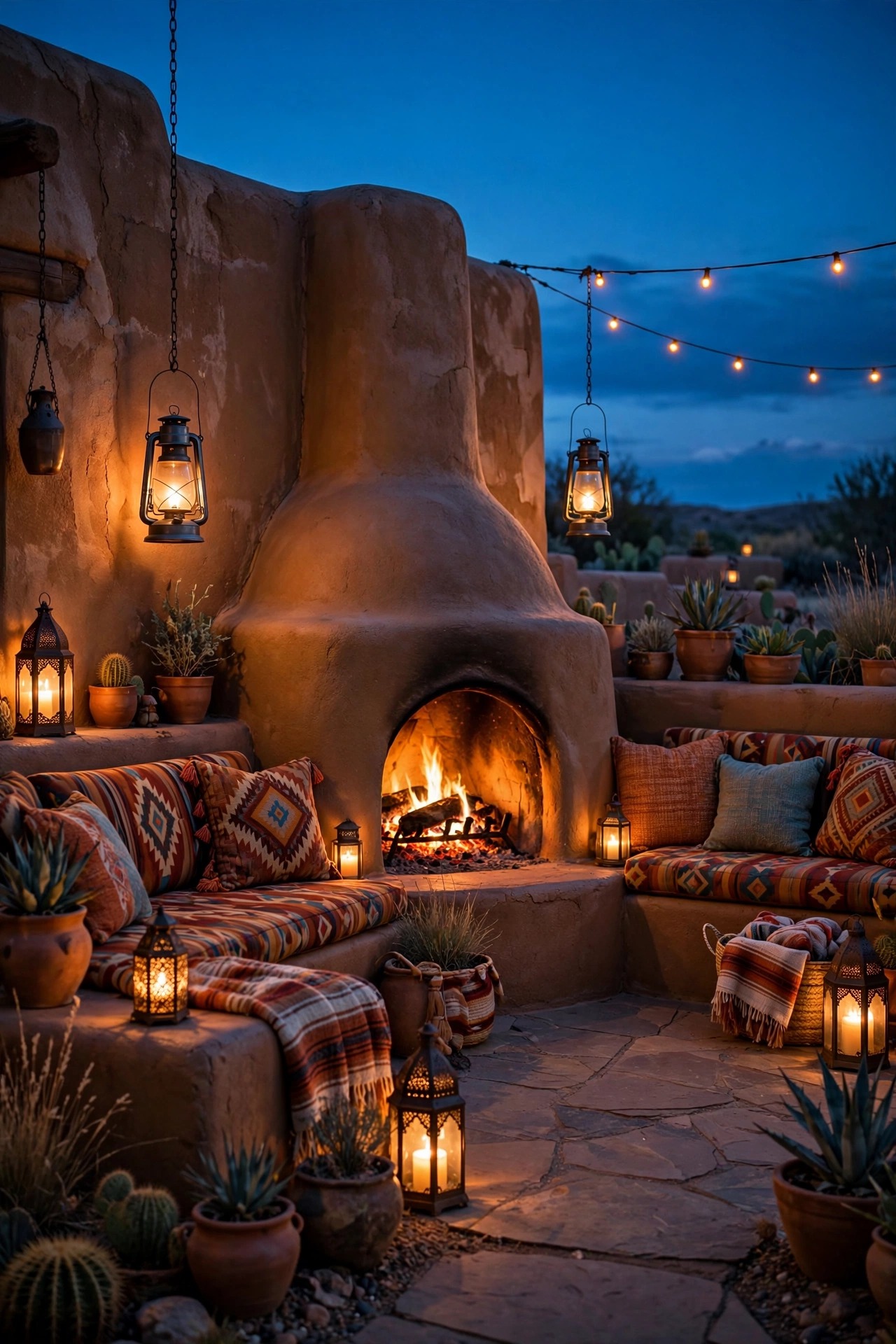
6. Let a Kiva Fireplace Be Your Anchor Light
A beehive shaped kiva fireplace is the natural anchor of a Southwestern patio, and on the nights you light it, it does the heavy lifting for your whole welcome layer. On the nights you do not, it still deserves light: a small lantern on the hearth, a flameless candle cluster inside the firebox, or a soft downlight tucked under the chimney hood keeps the corner from going dead. I arrange two low benches or chairs angled toward our kiva, add a punched tin lantern on a side table, and that corner hosts every long conversation of the summer. Keep any fixture at least three feet from the flue opening, use only outdoor rated equipment near the heat, and never store cushions against a warm firebox. For placement, seating angles, and mantel styling, my patio fireplace lighting ideas walk through the whole setup. Firelight flickers at roughly 1800K, so every electric light nearby should stay warm to blend.
Suggested budget range: $60 – $300.
7. Flank the Door With Wrought Iron Sconces
The front door of the patio, whether it opens to the yard or the house, deserves a proper pair of wrought iron sconces. Matte black iron against pale stucco is the most classic contrast in this style, and seeded or amber glass softens the bulb glare beautifully. Mount the pair so the center of the fixture sits about 66 to 72 inches from the floor, roughly at eye level, and match their height to any lanterns nearby so the eye reads one calm rhythm. Choose wet location rated fixtures with enclosed or shielded bulbs, because patio doors catch wind driven rain even under a portal. In my experience, a sconce with a slightly oversized backplate suits chunky adobe walls better than a dainty fixture, which can look lost against all that texture. Put them on a photocell or smart switch and the doorway lights itself every evening, which matters on the nights you come home after dark.
Suggested budget range: $70 – $220.

8. Uplight Agaves and Desert Plants Like Sculpture
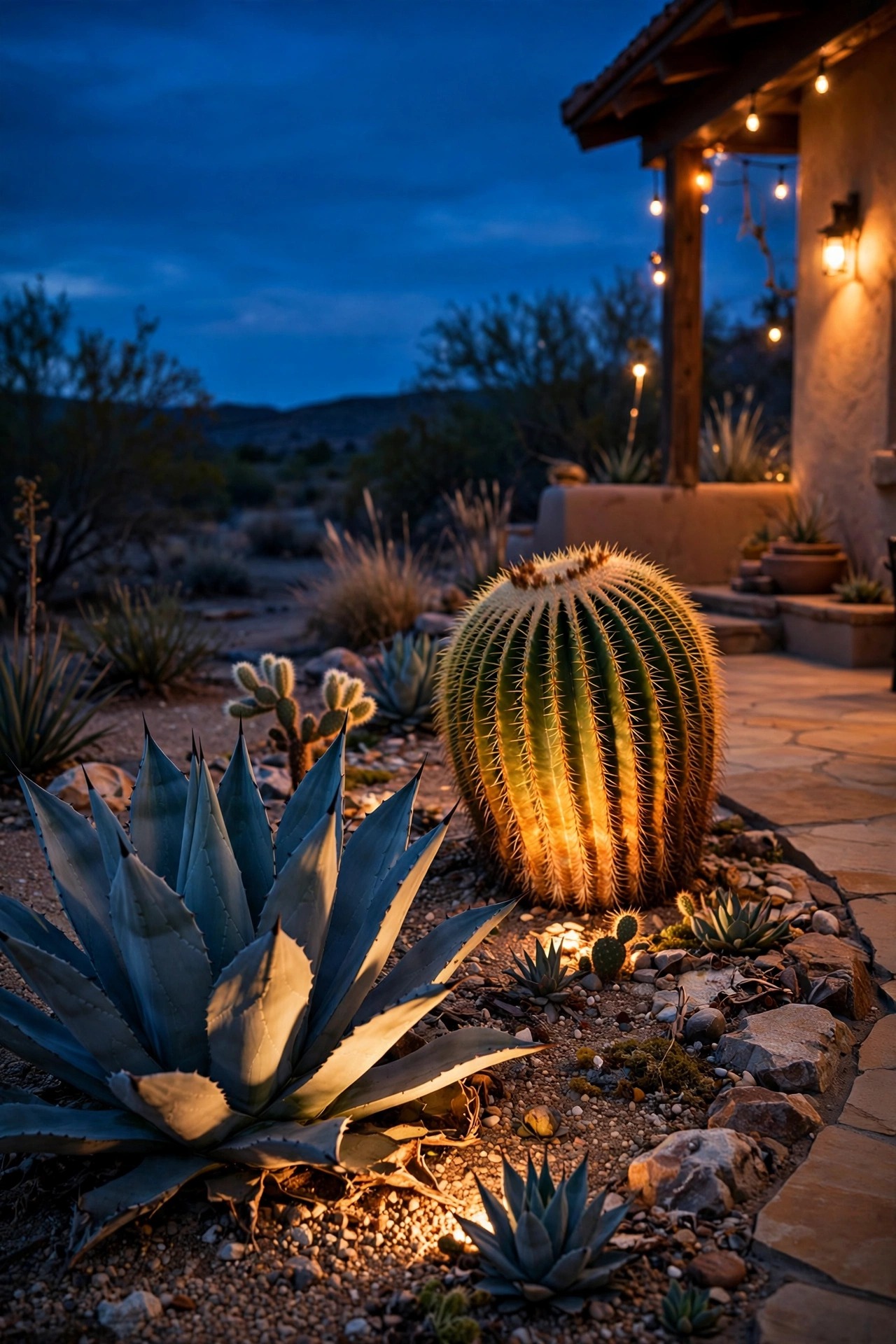
Desert plants are architecture. A blue agave, a sculptural prickly pear, or a small ocotillo lit from below becomes the artwork of the patio after dark. Use a low voltage bullet spotlight or well light placed six to twelve inches from the plant base, aimed up into the form, and keep the beam narrow enough that light stays on the plant instead of spilling into the sky. One hero plant lit well beats five lit poorly, so start with your single best specimen near the seating area. Graze light across a barrel cactus cluster and the spines catch a halo that honestly stops guests mid sentence. Keep fixtures out of the drip line of irrigation emitters, bury cable a few inches under gravel so it never trips anyone, and wipe lenses twice a year, because desert dust dims output faster than people expect. This is your accent layer, and it is the one that makes the patio feel designed.
Suggested budget range: $50 – $160.
9. Moonlight From a Mesquite Tree
Moonlighting might be my favorite trick in the whole desert playbook. A shielded fixture mounted fifteen to twenty feet up in a mesquite or palo verde casts soft, dappled light through the lacy canopy, exactly like a full moon, and the moving leaf shadows make the whole patio feel alive. Aim for a warm 2700K source, not blue, and use a glare shield so nobody sees the bulb itself from a chair. This is the one job on the list where I recommend hiring a pro: climbing, mounting to a living tree with the right hardware, and running cable safely are worth paying for once. Ask the installer to mount on a strap or through bolt that can grow with the tree, and to leave a service loop of cable. Moonlight works beautifully as the high layer over a dining area, because it lights the table gently without a single fixture hanging over anyone's head.
Suggested budget range: $150 – $400.

10. Turn Terracotta Pots Into Lanterns
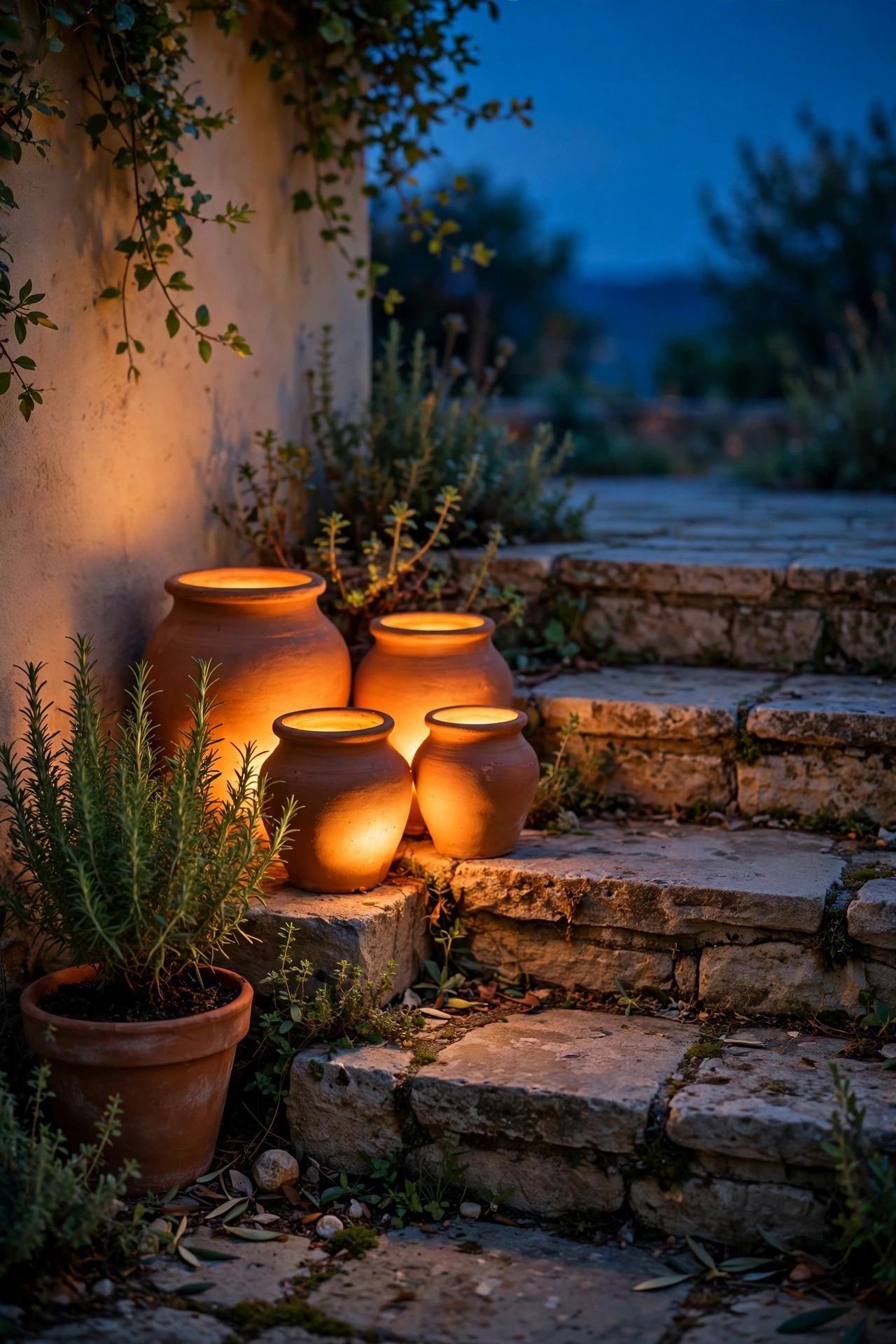
Terracotta belongs everywhere in this style, and with a little help it glows, too. My favorite low effort trick is grouping three large pots near a step or doorway, each with a solar puck light or flameless candle tucked inside a frosted glass insert, so the whole cluster reads as a lantern. Unglazed clay will halo softly if you place a candle style LED inside an empty pot turned on its side toward a wall; the bounce is gentle and gorgeous. Keep one pot planted for height, maybe with a trailing rosemary, and light the two beside it. Solar pucks in the desert charge brilliantly, a full day of sun buys you a long evening of glow, but bring the candles inside during hail season. This is renter friendly, wiring free, and easy to rearrange when you change the furniture layout, which around here happens every time the seasons turn.
Suggested budget range: $30 – $85.
11. Light the Steps With Talavera Style Risers
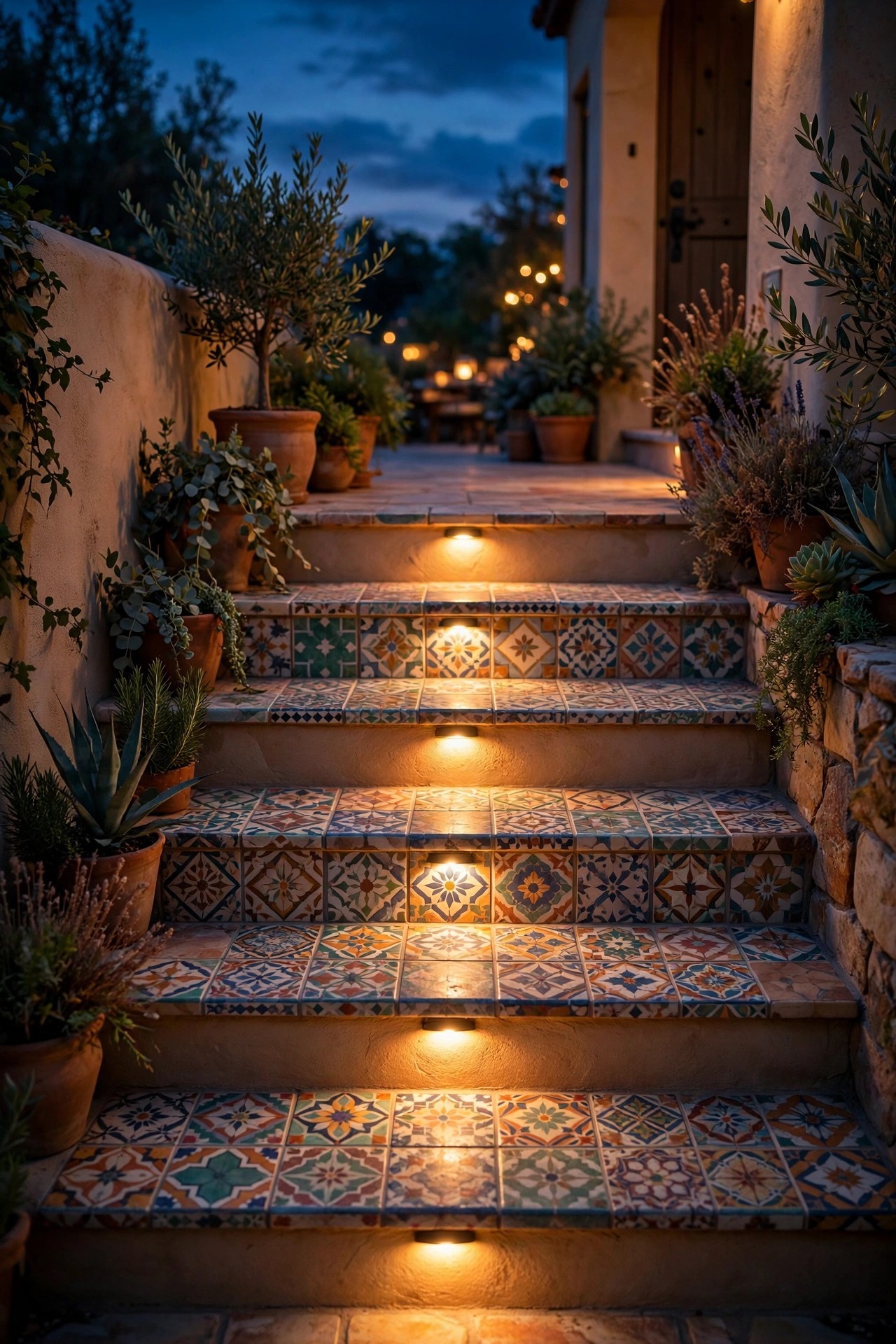
Steps between patio levels are the most common trip hazard in Southwestern courtyards, where one level of flagstone often drops to gravel or a sunken seating pit. Recessed louvered step lights set into the riser every two to three steps throw a soft wash across each tread without blinding anyone climbing up. If your steps are tile trimmed, lean into it: choose small fixtures with patterned or Talavera inspired faces and let the safety light double as decoration. Hardwired step lights belong on a GFCI protected circuit, full stop, and low voltage versions make the DIY route far more forgiving. Keep the light aimed down at the tread, never out at eye level, and test the pattern at night before you grout or set anything permanently. A single unlit step in an otherwise glowing patio is exactly the one a guest will find, so this humble idea earns its place high on my list.
Suggested budget range: $60 – $180.
12. Swag One Long String Light Run Across the Courtyard
If your patio is an enclosed courtyard, one long commercial grade string light run zigzagged overhead can be the entire welcome layer, and it is gloriously simple. Anchor into the courtyard walls with proper eye bolts into studs or masonry anchors, never into stucco alone, and use a steel guide cable for spans past twenty feet so the strand stays taut through wind season. Zigzag in two or three passes about six feet apart rather than one dense grid; the negative space keeps it airy. Bulbs should be shatterproof LED, warm 2700K, on a dimmer. In my experience the courtyard shape traps this light in the best way, bouncing it off warm walls until the whole space feels like a private plaza in an old desert town. Add one lantern cluster at the far corner as a destination point and the eye travels the whole room. Nothing else on this list changes a patio faster for the money.
Suggested budget range: $55 – $170.

13. Stake Solar Path Lights Along the Gravel Walk
The path from gate to patio usually crosses gravel or decomposed granite, and a staggered line of solar stake lights turns that walk into part of the evening instead of a dark errand. Desert sun is your friend here; panels that would sulk in Seattle charge fully by noon. The catch is color: most bargain solar stakes glow a chilly blue white that murders the sunset mood. Hunt specifically for warm white models listed at 2700K to 3000K, and buy one to test before you commit to a dozen. Stagger stakes on alternating sides every four to six feet rather than lining them up like a runway, and push them into the gravel edge where they will not catch a rake or a heel. Expect two to three seasons from budget stakes and keep one spare in the garage. Wipe the little panels monthly, because a film of desert dust can cut the evening runtime in half.
Suggested budget range: $25 – $70.

14. Set the Table With Hurricane Lanterns and Flameless Candles
Dinner on the patio deserves light at table height, where faces actually are, and a trio of glass hurricane lanterns with flameless candles down the middle of the table is the easiest centerpiece I own. The glass chimneys shield the flicker from evening breezes, the flameless part means no wax on the tablecloth and no open flame near the paper napkins or the dried chile centerpiece, and timer candles switch themselves on at six and off at eleven without me thinking about it. Vary the heights, tall in the middle, shorter at the ends, and mix in a small punched tin lantern or two for pattern. Keep real candles out of the mix outdoors entirely; between wind, wax, and dry desert air, they are more worry than glow. On nights with no dinner planned, the same hurricanes migrate to the mantel of the kiva or the steps, which is why I call them the hardest working lights I own.
Suggested budget range: $35 – $95.

15. Build a Fire Bowl Corner for Cool Desert Nights
Desert evenings cool off fast once the sun drops, and a metal fire bowl or chiminea in one corner gives the patio a second hearth and a reason to stay out past nine. Edge the corner with low lantern light rather than bright fixtures: two farolitos, one low lantern on a stump table, and the fire does the rest. Keep ten feet of clearance from anything that can burn, which includes the ramada posts, cushion storage, and that beautiful dry ocotillo fence, and always use the spark screen when the wind picks up. Check your local burn rules before the first fire, since many desert towns restrict open burning on windy or high fire danger days. Position the bowl so the prevailing breeze carries smoke away from the seating, a small thing I got wrong for one whole season. The light from a fire bowl is pure warmth, and every other fixture nearby should defer to it.
Suggested budget range: $90 – $280.

16. Commit to One Warm Color Temperature
If you take one discipline from this whole list, make it this: every bulb on the patio lives between 2200K and 2700K. Sunset light is amber, firelight is amber, adobe and terracotta are warm, so a single cool bulb anywhere in the mix reads like a mistake the eye cannot unsee. The Kelvin number is printed on every bulb box; check it before you buy, because packaging that just says daylight usually means 5000K and a patio that feels like a parking garage. LED filament style bulbs in the 2200K range are my pick for lanterns and sconces where the bulb shows, while standard 2700K A19s hide fine inside shaded fixtures. When I replaced the two stray cool bulbs in our own string lights with warm ones, neighbors asked what we had renovated. We had changed two bulbs. Consistency is the cheapest design upgrade there is, and it makes every other idea on this list look twice as expensive.
Suggested budget range: $20 – $60.

17. Put It All on Timers, Photocells, and Dimmers
Sunset moves by more than two hours across the year, so a fixed seven o'clock timer wastes light all summer and misses the show all winter. An astronomical timer solves this elegantly; you set your location once and it tracks sunset itself, bringing the patio up as the sky fades. Outdoor rated smart plugs do the same job for string lights and farolito candles, and they let you group zones, low layer first, welcome layer a few minutes later, for a little nightly choreography. Dimmers matter just as much: full brightness for cooking and games, half for dinner, a quarter for stargazing with the fire bowl. Motion sensing has its place at the gate and side path, but keep it off the seating patio, where a sensor blast every time someone reaches for a drink ruins the mood fast. Good controls disappear, and the patio simply seems to breathe with the evening.
Suggested budget range: $30 – $110.

18. Graze the Adobe Walls With a Soft Wash
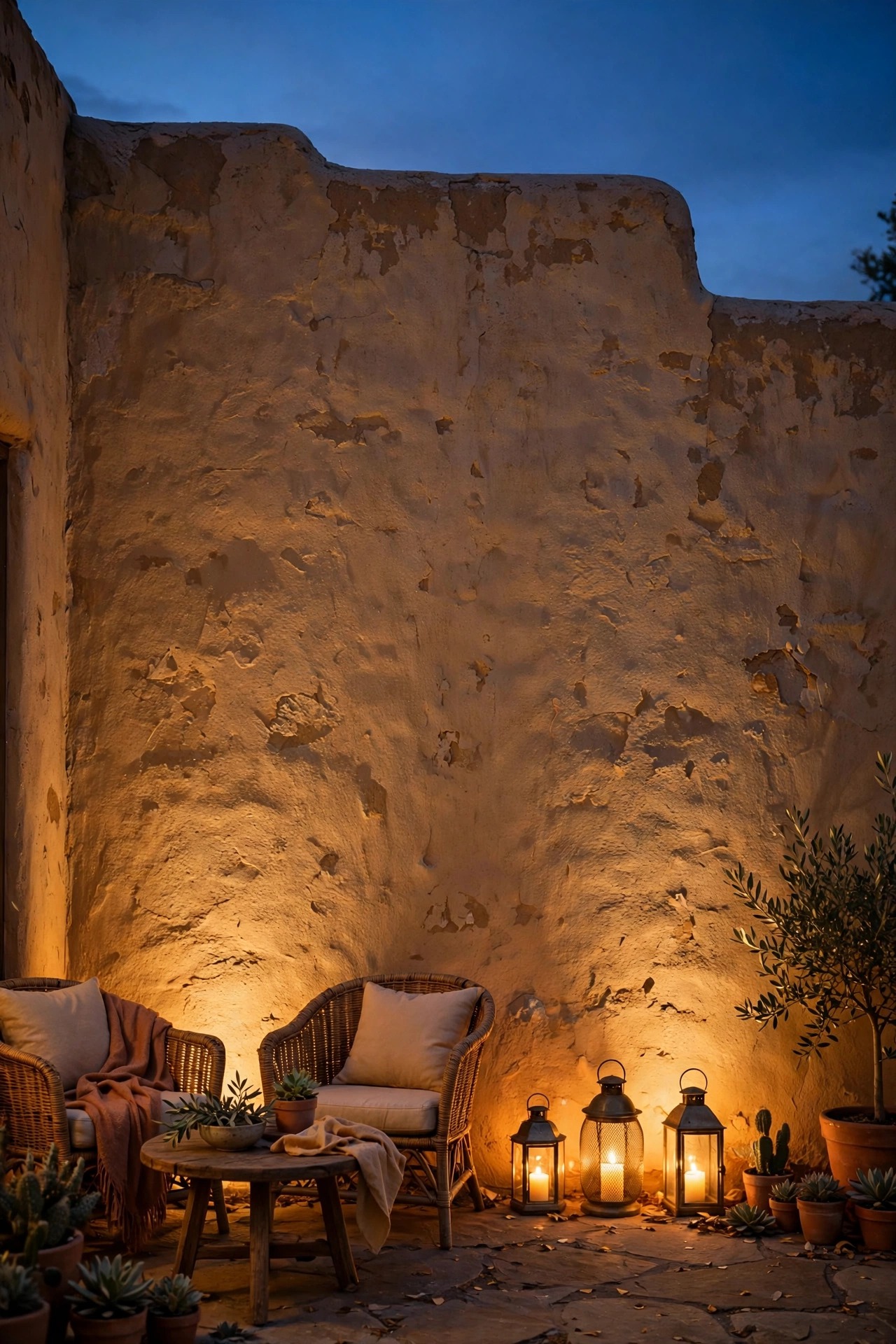
Adobe and stucco walls have deep, hand troweled texture, and light skimmed across that texture at a shallow angle makes the whole patio feel richer. Place a narrow beam spotlight six to twelve inches out from the wall base and aim it steeply upward; the raking light throws every ripple and curve into soft relief, and the wall itself becomes the largest lamp on the patio. One wash on the wall behind the seating area is usually enough, and it pairs beautifully with the farolitos at its base. Keep the source warm, 2700K or lower, and modest in output, because a blasted bright wall will bounce glare into every seat facing it. This is also the kindest possible light for an older wall with a few honest cracks; raking light reads them as character. If your walls are smooth painted stucco instead, widen the beam and pull the fixture back two feet for a gentler, even glow.
Suggested budget range: $55 – $150.
19. Do a Final Walk-Through of Your Southwestern Patio Lighting Ideas at Sunset
The last step is the one most people skip, and it is the one that ties the whole patio together. On the first evening everything is installed, walk the space slowly at sunset with fresh eyes. Sit in every chair. Check for a bare bulb glaring from the dining seats, a dark step your low layer missed, a spotlight that lands in a neighbor's window instead of on your agave. Photograph the patio from the gate and from the table; a phone picture shows hot spots and dead zones your eyes politely ignore. Then adjust one fixture at a time, a few degrees here, a dimmer notch there, and live with it for a week before changing anything else. Your southwestern patio lighting ideas will keep evolving with the seasons anyway, brighter for summer dinners, moodier for winter fire bowl nights, and that slow tuning is honestly half the pleasure of a desert patio.
Suggested budget range: $0 – $40.
Frequently Asked Questions
What color temperature looks best on a Southwestern patio?
Warm, always. Bulbs between 2200K and 2700K echo firelight and the last light of a desert sunset, and they flatter adobe, terracotta, and wood instead of washing them gray. Anything labeled daylight, usually 5000K or higher, will fight the whole palette. When a bulb shows through glass, I reach for 2200K filament styles; hidden bulbs can sit at 2700K.
Can solar lights handle a whole patio in the desert?
For accent and path layers, honestly yes, because desert sun charges panels fully even in winter. Solar farolitos, stake lights, and pot lanterns are reliable out here in a way they simply are not in cloudy climates. I still hardwire or plug in the welcome layer, string lights and sconces, where you want brightness on demand and dimmer control every single night.
Are farolitos safe to leave outside all season?
The traditional paper version is a one evening decoration and should never hold a real flame unattended. Weatherproof luminaria sleeves with flameless LED candles are the leave them out version: no flame, timer controlled, and unfazed by wind. Bring any paper bags in before rain, keep real candles out of bags entirely, and your farolitos will glow safely for seasons.
How much does it cost to light a Southwestern patio?
A starter layer of solar stakes, farolitos, and one string light run lands between $150 and $350. A full three layer build with sconces, uplighting, and controls typically runs $600 to $1,500 in fixtures if you install the low voltage parts yourself. Moonlighting and fireplace work are the pro level splurges at $150 to $400 each.
Conclusion
Great desert patio lighting is not about brightness; it is about timing, warmth, and layers that rise as the sky fades. Pick your low, welcome, and accent layers, hold every bulb in that amber range, and let these southwestern patio lighting ideas unfold one sunset at a time. Start with the farolitos and one string of lights this weekend, then browse the rest of the lighting ideas here whenever you are ready for the next layer.