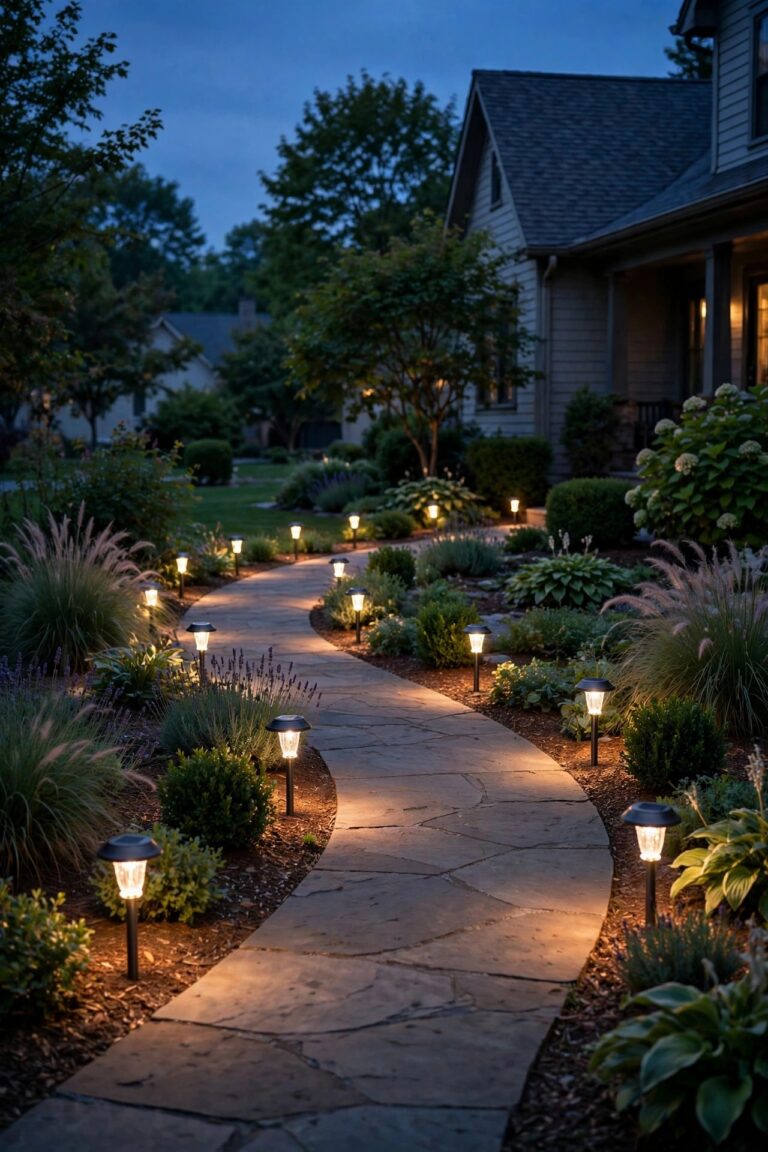
Ten winters ago, I lined our front walk with a cheerful mix of fixtures: a few solid brass path lights I splurged on, a row of black aluminum ones from a big end-of-season sale, and a handful of plastic solar stakes I grabbed "just for now." A decade of freeze-thaw cycles, road salt, sprinkler spray, and July sun has turned my yard into an accidental science experiment on brass vs aluminum light fixtures — and honestly? The results surprised me. Two of the three materials still look nearly new. One group cracked, faded, and quietly fell apart by year four. So if you're standing in the lighting aisle wondering whether the heavy, pricey fixture is actually worth it, or whether plastic can survive a real winter, this guide is my ten years of notes: what cold, salt, and sun do to each material, where each one belongs in the yard, what it all costs in 2026, and the simple care habits that add years to any fixture you bring home.

The Short Answer
Short on time? Here's my verdict after ten winters. Solid brass is the last-fixture-you-buy option: it never rusts, shrugs off freeze-thaw cycles and road salt, and ages into a rich patina instead of peeling — expect 15 to 25 years or more. Powder-coated cast aluminum is the smart middle path: 8 to 12 good years at roughly half the price, as long as the coating stays intact. Plastic and composite fixtures are fine for solar accents and testing a layout, but UV and deep cold make them brittle, so plan on 2 to 5 years. Match the material to the spot, not the sale price, and you'll stop re-buying the same path light every spring.
What Winter Actually Does to a Fixture
Before we blame any material, it helps to know what it's up against. The biggest villain is the freeze-thaw cycle. Meltwater seeps into seams, lens edges, and screw holes during a mild afternoon, then temperatures drop overnight and that water freezes — expanding about 9 percent as it turns to ice. Repeat that forty or fifty times in one winter and it works lenses loose, pops gaskets out of their seats, and wedges hairline cracks wider. The second villain is road salt, which gets splashed and sprayed onto anything near the street or driveway and quietly accelerates corrosion on coated metals. Third is plain old sun: UV radiation breaks down plastic polymers all summer, so by the time the first hard freeze arrives, a plastic housing that flexed in July may snap like a cracker in January. Add snow-load, the occasional snowplow spray of gravel and slush, and lawn-mower bumps, and you see why a fixture's material matters far more than its showroom shine. Even the humble screw and stake take a beating: threads corrode, soil heaves and shifts, and every cycle loosens something by a fraction. Nothing dramatic happens in a single storm — winter damage is a slow accumulation, which is exactly why the ten-year view matters more than the ten-day forecast.

Brass: The Buy-It-for-Life Metal
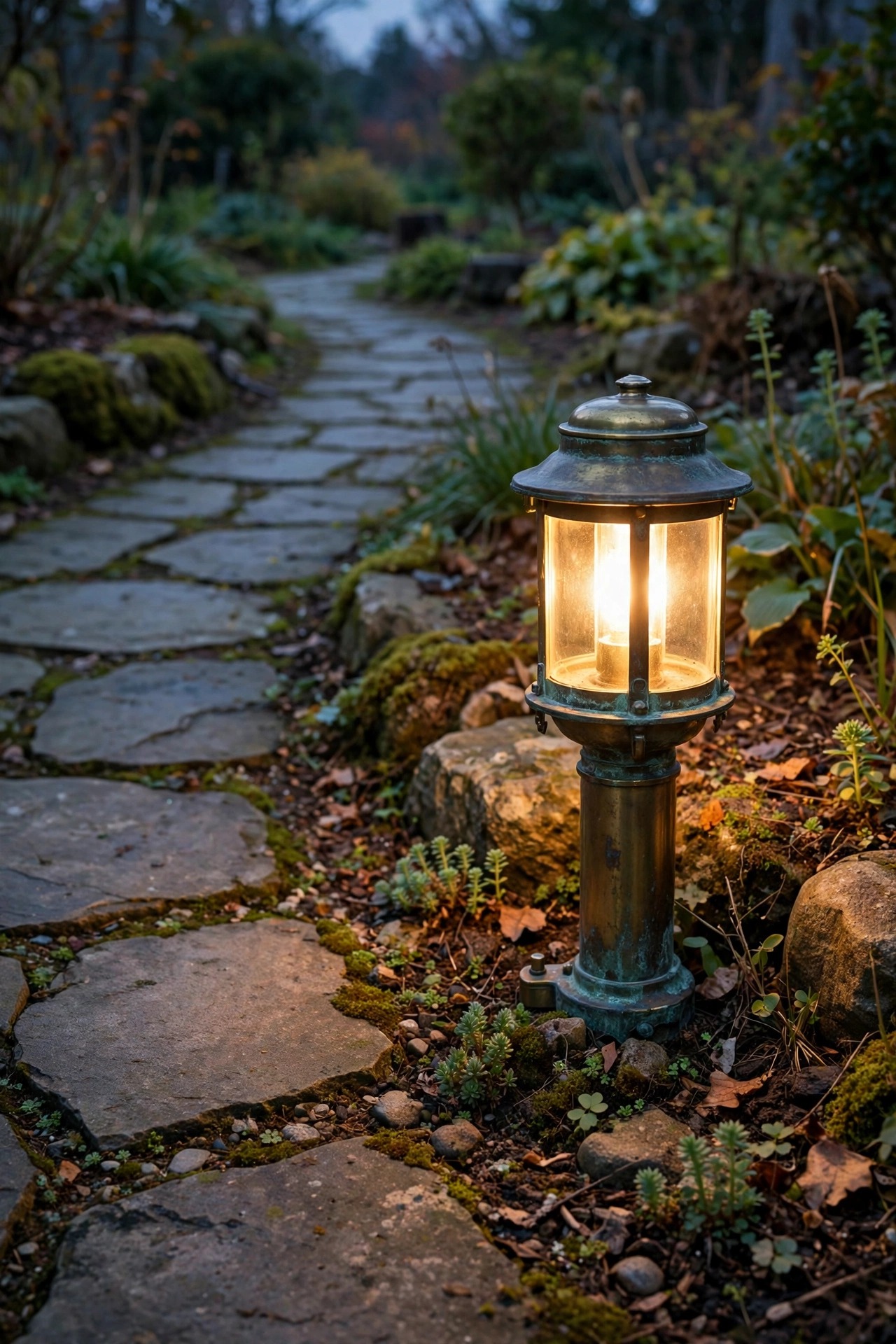
My ten-year-old brass path lights are the ones that still stop me on the walk at night. Brass is a copper alloy, and copper alloys simply do not rust — there is no iron in them to turn orange and flake away. Instead, the surface oxidizes into a deep, mottled patina that actually protects the metal underneath. Scratches don't matter, chips don't spread, and salt spray that would eat a coating just rinses off. Brass is also satisfyingly heavy: a solid brass path light can weigh two or three pounds, so it stays upright through frost heave, doesn't wobble when the dog brushes past, and survives the occasional mower kiss without cracking. The honest downsides are price (we'll get to the numbers) and the fact that shiny new brass shows fingerprints and water spots until the patina settles in — I learned to either polish twice a year or, my preference, let it go gracefully antique. If you love the material, my roundup of copper and brass lantern ideas is full of that warm, old-soul look. One more quiet advantage: brass is repairable. Threads can be cleaned up, a bent stem can be straightened, and a tired socket can be swapped without replacing the whole fixture — because the body itself is never the part that fails. With cheaper materials, the housing is usually what dies first, and there's nothing left worth saving.
Aluminum: The Smart Middle Path
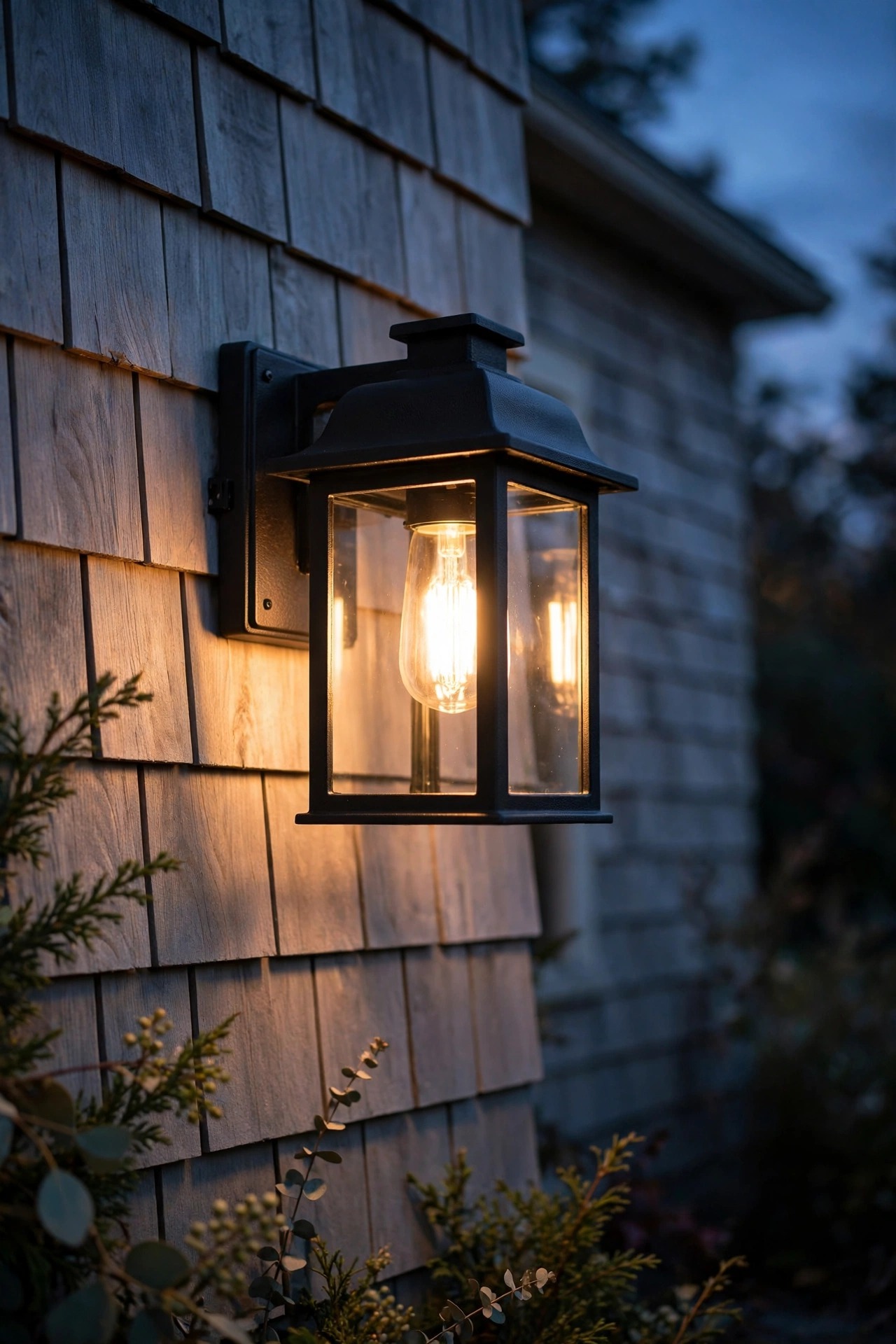
Here's where I have to be fair, because my aluminum fixtures mostly did fine — with one asterisk. Aluminum itself doesn't rust red the way steel does; instead, quality fixtures are cast aluminum with a powder-coat finish, and that coating is the whole ballgame. Where my coating stayed intact, the fixtures still look sharp after a decade. But on two lights near the driveway, plow spray and kicked-up gravel chipped the finish, moisture crept underneath, and I got the classic aluminum failure: white, powdery oxidation bubbling up under the paint, then flaking. The lesson isn't "avoid aluminum" — it's "buy cast, not stamped." Thick cast aluminum with a heavy powder coat feels substantial in your hand and shrugs off bumps; thin stamped fixtures dent, their coatings crack at the bends, and they age fast. A chip repaired promptly with touch-up paint genuinely stops the creep, which is why my surviving aluminum lights get a five-minute inspection every spring. Where does aluminum shine brightest? Anywhere it's sheltered or elevated: porch sconces, garage coach lights, and eave-mounted fixtures can look nearly new after a decade, because the coating never faces gravel spray or standing slush down at ground level. When you shop, look for a finish that's baked on thick and even — if you can see thin, orange-peel coverage around the edges in the store, imagine it after five winters of expanding and contracting in the cold.
Plastic and Composite: The Honest Truth
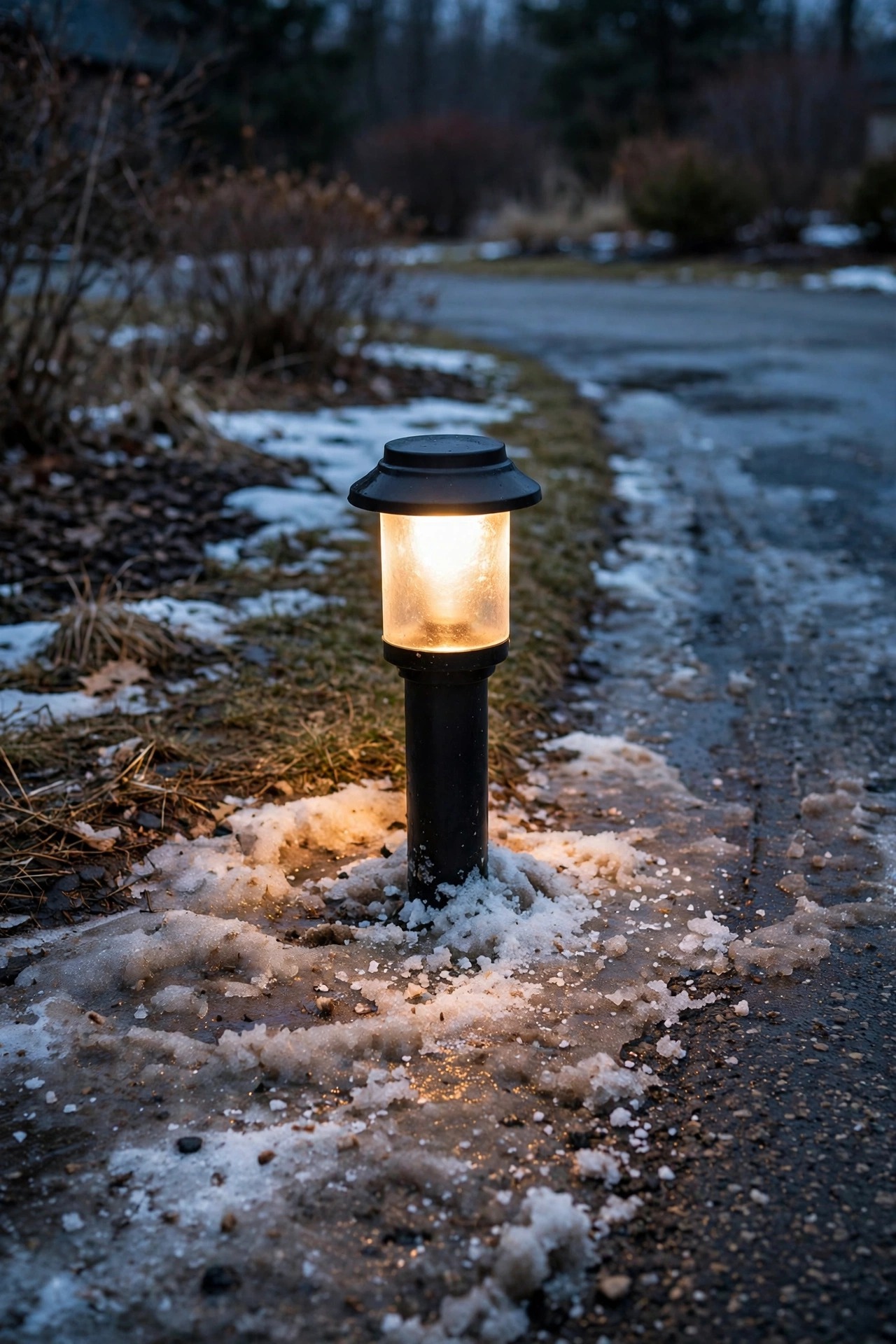
Now for the group that didn't make it. My plastic solar stakes were adorable for two summers. By winter three, the stakes had gone brittle and snapped at ground level — that's where cold, UV-weakened plastic meets the side-load of frozen soil. Housings yellowed and turned chalky, lenses clouded, and one cold snap took out three fixtures in a single week. To be fair, "plastic" covers a wide range: cheap thin ABS is the worst offender, while thicker polycarbonate and glass-filled resin composites hold up noticeably better and are what most decent solar fixtures use now. I still buy plastic — deliberately. It's perfect for testing a layout before committing to wired fixtures, for seasonal accents I expect to refresh, and for spots where kids and soccer balls rule. The mistake is paying for plastic while expecting a decade from it. Buy it as the consumable it is, keep it out of the plow-spray zone, and it earns its keep. One cold-weather trick if you do run plastic fixtures: bring solar stakes in for the deepest winter months, or at least before the first hard freeze settles in. Cold-soaked batteries charge poorly and short days starve them anyway, and a fixture resting in the garage can't snap off in frozen soil. It's the single easiest way I know to stretch a two-year fixture into a four-year one.

Brass vs Aluminum Light Fixtures, Head to Head
If you're weighing brass vs aluminum light fixtures specifically — the two "real" long-term options — here's the comparison that ten winters taught me, in one place:
| Solid brass | Powder-coated cast aluminum | Plastic / composite | |
|---|---|---|---|
| Typical lifespan | 15–25+ years | 8–12 years | 2–5 years |
| Corrosion | Patina only, never rusts | White oxidation where coating chips | No corrosion, but UV brittleness |
| Freeze-thaw tolerance | Excellent | Very good | Poor to fair |
| Weight & stability | Heavy, stays put | Medium | Light, leans after frost heave |
| Finish over time | Ages to antique patina | Looks new until coating fails | Fades, yellows, chalks |
| Best for | Forever spots, coasts, plow zones | Covered porches, most yards | Solar accents, test layouts |
Notice the pattern: brass fails almost never, aluminum fails at the coating, and plastic fails at the material itself. That single insight — where does this fixture's weakness live? — will guide every buying decision below better than any star rating. Reading the table another way, you're really choosing what you'd rather manage. With brass, you manage almost nothing: a rinse, a gasket check, done. With aluminum, you manage a finish — inspect it, touch it up, and it rewards you for years. With plastic, you manage a replacement schedule, swapping out casualties as they yellow and snap. None of those is inherently wrong. What's wrong is paying brass money for plastic behavior, or expecting plastic to behave like brass.

What Road Salt and Sprinklers Do
Location can matter as much as material. Fixtures within about six feet of a street or driveway apron live in the salt-spray zone, and that changes the math completely: my aluminum light at the end of the driveway aged faster than the identical one by the porch, purely from brine splash. Brass doesn't care. Plastic doesn't corrode, but salt crust on a solar panel quietly strangles charging all winter. Sprinklers are the summer version of the same problem — a fixture that gets blasted daily grows mineral crust on the lens, stays damp for hours, and corrodes at every screw and seam. There's also one sneaky failure to know: galvanic corrosion. When two different metals touch and stay wet — say, a brass fixture threaded onto a cheap steel stake — the less noble metal corrodes faster. Keep metals matched, or use the plastic isolator washers many fixtures include. If your home is near the ocean, salt air does all of this year-round, which is why my guide to coastal outdoor lighting treats brass as the default, not the upgrade. The fix for sprinkler abuse is mostly aim, not money: adjust heads so streams fall short of your fixtures, or swap a full-circle head near the beds for one with a narrower arc. I also wipe mineral crust off lenses each spring — left alone, it bakes on in the summer sun and permanently hazes whatever it coats.
Weight, Wobble and the Mower Test
Pick up a fixture before you buy it — your hand is a decent durability instrument. A solid, heavy housing almost always means thick walls, real metal threads, and a lens that seats into a proper gasket. A featherweight fixture usually means thin walls and press-fit parts that loosen as seasons cycle them hot and cold. In the ground, weight becomes stability: every spring, frost heave tilts fixtures a few degrees, and heavy brass lights settle back nearly plumb while light plastic ones lean a little further each year until they're lighting the mulch instead of the path. Stakes matter as much as fixtures, too. Even a brass light wobbles on a short, flimsy stake; in freeze country I use 8- to 10-inch stakes and push them below the frost-disturbed top layer. And the mower test is real: a cast fixture survives the string trimmer's attention, while brittle plastic stakes are the number-one casualty in my yard — trimmer line at ankle height is exactly where old plastic snaps. There's a security footnote to weight, too. A yard of heavy, solidly staked fixtures is simply harder to walk away with than featherweight stakes that pull out of soft spring soil with one hand. Nothing outdoors is truly theft-proof, but brass path lights have a way of staying where you planted them — in every sense.
Brass vs Aluminum Light Fixtures by Spot in the Yard
Since brass vs aluminum light fixtures each win in different places, here's how I'd allocate a budget across a real yard. Front path and entry — the highest-visibility, highest-abuse zone: brass if you can, cast aluminum happily if you can't. Tree uplights and focal spots: brass, because they're aimed, adjusted, and occasionally stepped on during garden work. In-ground well lights: brass or heavy composite housings only; they're the wettest spot in the yard. Porch and garage sconces: powder-coated aluminum is genuinely fine here — they're sheltered from direct rain and all salt, so the coating lives an easy life and can last well past a decade. Driveway edge and anywhere in plow range: brass, or cheap plastic you've emotionally accepted replacing. Shady garden beds for solar accents: composite plastic, no guilt. This mixed strategy — splurge where abuse is high, save where it's sheltered — is exactly how my yard ended up, just ten years and several mistakes later than it should have. What about the backyard patio and deck? Step lights and rail lights live sheltered lives there, so aluminum or even quality composite earns a pass — they see feet, not freeze-spray. And for a mailbox or address light out by the curb, treat it like the plow zone it is: brass, or a sacrificial budget fixture you've already made peace with replacing.

What It Costs in 2026
Let's talk real numbers, because the per-fixture gap is smaller than the decade math suggests. A plastic solar path light runs about $4 to $12; a decent composite solar fixture, $15 to $30. Powder-coated cast aluminum path lights run $25 to $60 each, and quality aluminum spots and sconces $40 to $90. Solid brass path lights are $60 to $150, with brass uplights and sconces at $80 to $200. Now the ten-year math for ten path lights: plastic at $8 each, replaced three times over a decade, is roughly $240 plus your Saturdays. Aluminum at $45 each is $450 once, with maybe one casualty — call it $500. Brass at $100 each is $1,000 once, full stop. So brass costs about double the ten-year plastic bill, not ten times — and you get better light every single night of that decade. Running costs are identical across materials since they all use the same LED bulbs: roughly $1 to $2 per fixture per year on a dusk-to-midnight schedule. Installation is the same trenching and wiring either way, which is exactly why it pays to put a long-life fixture on the end of that labor. And don't forget the hidden line item: your time. Every failed fixture is a trip to the store, a swap in the cold, a disposal run. Over a decade, the plastic route quietly bills you five or six of those errands; the aluminum and brass routes, one or two. I don't know about you, but my Saturdays are worth more than the difference.

5 Mistakes That Ruin Good Fixtures
Every one of these I learned firsthand, usually while holding a fixture that should have had years of life left in it. The material isn't always the problem — sometimes the owner is, and I say that as the owner in question.
1. Mixing metals on one mount. A brass fixture on a galvanized steel stake is a galvanic corrosion kit. Match metals or isolate them.
2. Pressure-washing your fixtures. It blasts water past gaskets and strips powder coat at the edges — the two fastest routes to an early death I know.
3. Polishing brass with harsh abrasives every month. You'll scrub through lacquer and create blotchy, high-maintenance metal. Either commit to the patina or use a gentle brass polish a couple of times a year.
4. Ignoring the gasket. A $2 dried-out gasket admits the meltwater that freeze-thaw turns into a cracked lens. Check them every fall; it's a two-minute job per fixture.
5. Buying bargain fixtures for the plow zone. The cheapest light in the hardest spot is the most expensive strategy there is. Put your toughest material where the slush lands.
Notice what's not on this list: buying the "wrong" material. Most early fixture deaths I see trace back to one of these five habits, not to the metal itself.
Care Routines That Add Years
None of this requires a weekend — just a few seasonal habits. In spring, rinse salt and grit off every fixture with a garden hose (not the pressure washer), inspect aluminum coatings for chips and touch them up, and straighten anything frost heave tilted. In fall, clean lenses for maximum winter brightness, check gaskets, and clear mulch and leaves away from fixture bases so they don't sit in a damp nest all winter. For brass, decide once — polish or patina — and stop fighting the other outcome. After heavy snow, a soft broom across the tops of path lights keeps them visible and charging if they're solar. My full seasonal walk-through lives in the outdoor lighting maintenance checklist, and following it is honestly the difference between my fixtures that aged gracefully and the ones I replaced. Fifteen minutes, twice a year, per material — that's the whole secret. Brass owners get one extra, oddly satisfying chore: if you chose the polished look, a spring polish with a soft cloth and a gentle brass cleaner takes about ten minutes for a whole path — and that first evening afterward, when they gleam at dusk, is one of my favorite moments of the season. Patina people, you may smugly skip this paragraph.

Frequently Asked Questions
Do brass landscape lights really last longer than aluminum?
In my yard, yes — meaningfully. Solid brass has no coating to fail and cannot rust, so its realistic lifespan is 15 to 25 years or more. Good cast aluminum lasts 8 to 12 years, and its clock starts ticking faster once the powder coat gets chipped by gravel, trimmers, or plow spray.
Will aluminum outdoor fixtures rust?
Aluminum doesn't rust in the red, flaky way steel does. What it does is oxidize: where the finish is damaged, you'll see white or gray powdery corrosion that bubbles under the surrounding paint. Catch chips early with touch-up paint and the fixture underneath stays sound for years.
Are plastic solar lights worth it in snowy climates?
As accents and layout tests, yes; as your main lighting, no. Cold makes plastic brittle, snow cover starves the solar panel, and short winter days mean dim, brief light. If you love the convenience, choose thicker polycarbonate models, bring them in for the worst months, or accept a 2- to 5-year replacement rhythm.
Can I mix brass and aluminum fixtures in the same yard?
Absolutely — mine are mixed, and it's the smartest budget strategy. Use brass where abuse is high (paths, driveway edges, uplights) and aluminum in sheltered spots like porch sconces. Just don't mount two different metals in direct contact on the same fixture or stake, where galvanic corrosion can start.
Conclusion
Ten winters reduced my experiment to one sentence: buy the material for the decade, not the season. Brass is the forever choice for exposed, high-abuse spots; cast aluminum is the honest workhorse everywhere sheltered; plastic is a useful consumable as long as you treat it as one. Whichever way your own comparison of brass vs aluminum light fixtures lands, matching material to location — and giving the winners fifteen minutes of care twice a year — means the lights you install this fall can still be glowing beautifully a decade from now. Browse the rest of my outdoor lighting guides and ideas here on the site, and may your walkway be the warm, welcoming one on the block.