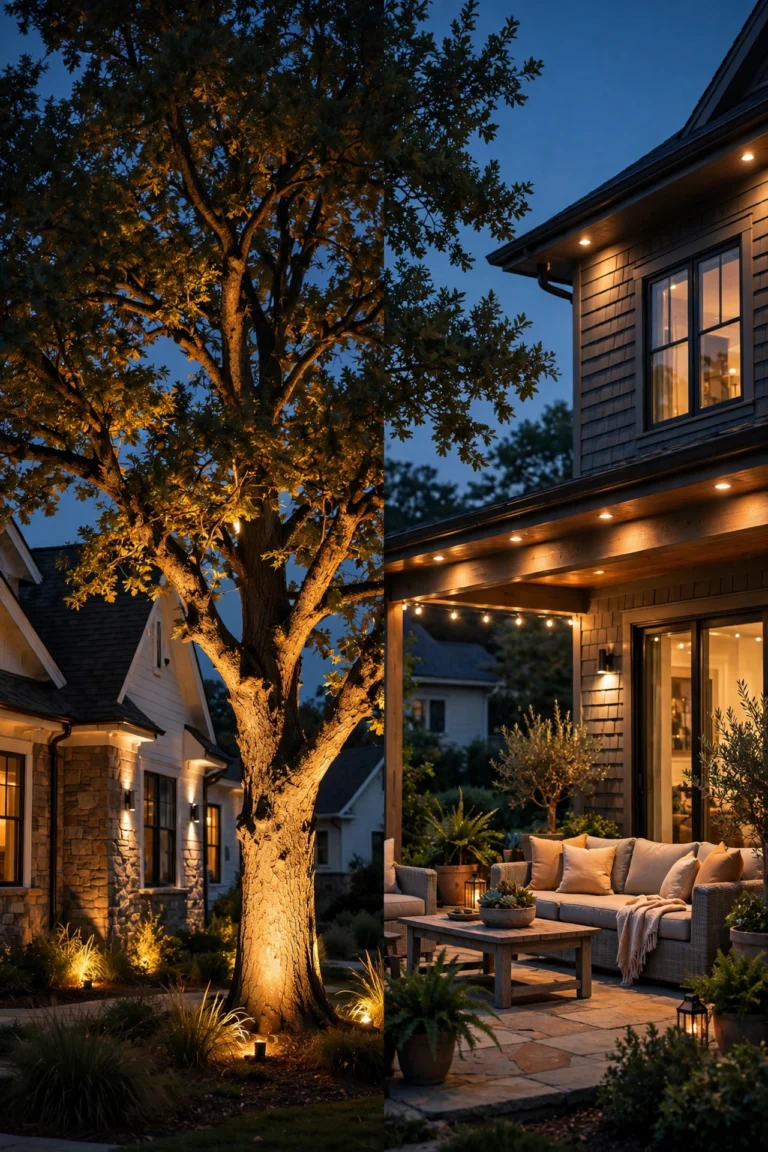
There is exactly one finish in my yard that looks better today than the day I installed it, and it's the copper. Everything else fades, chips, or quietly begs to be replaced — but copper outdoor lanterns just settle in. They start out bright as a new penny, mellow into a warm toasted brown, and if you let them, eventually bloom into that soft blue-green verdigris that makes old garden walls look like they've been loved for a century. Brass does the same trick in its own way, deepening from polished gold to a rich, honeyed bronze. In this post I'm sharing 19 copper and brass lantern ideas for porches, paths, garages, and garden corners, with honest notes on solid metal versus plated finishes, how the patina actually develops, and what each one really costs. As always, think in layers: a statement pair at the door, something lower along the walk, and one warm accent where you actually sit outside.

1. A Pair of Copper Outdoor Lanterns Flanking the Front Door
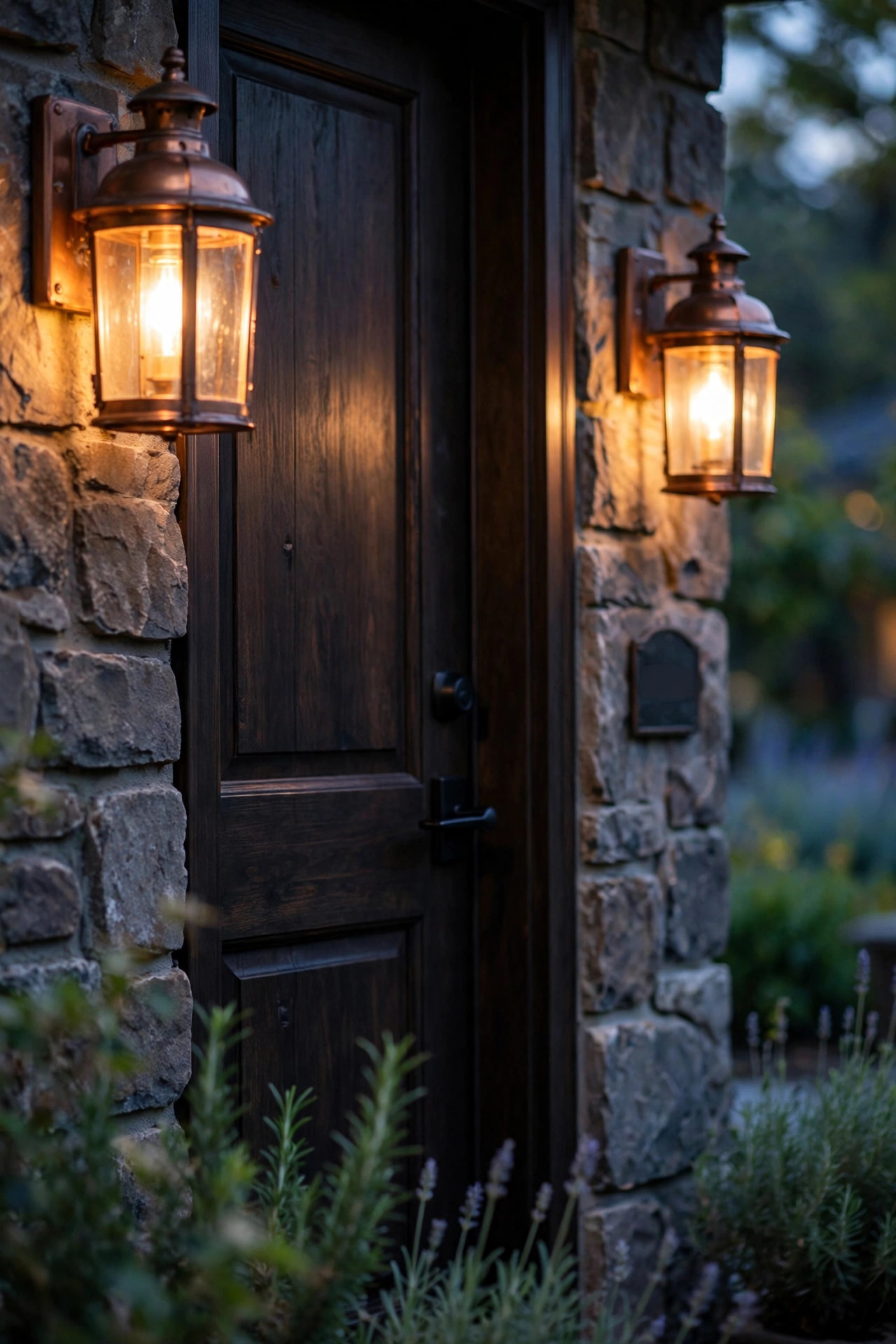
If you only buy one thing from this list, make it this pair. A matched set of copper wall lanterns flanking the front door is the single most timeless entry look I know, and it works on everything from a colonial to a cottage. Size them generously: each lantern should be roughly one-quarter to one-third the height of your door, so 18 to 24 inches tall for a standard 7-foot door with sidelights. Mount them with the center of the fixture about 66 to 72 inches off the ground, at eye level for most guests. Solid copper with clear glass shows off the flame-like flicker of an LED filament bulb best — choose 2700K and 400 to 600 lumens per side so the entry feels candlelit, not interrogated. Decide now whether you want a lacquered finish that stays rosy or a living finish that browns and eventually turns verdigris; both are beautiful, but they're different commitments. My own pair is unlacquered, and the toasted-brown stage is honestly my favorite so far. For more shapes and sizes, my roundup of outdoor wall lantern ideas is a good browse before you order.
Suggested budget range: $240 – $650.

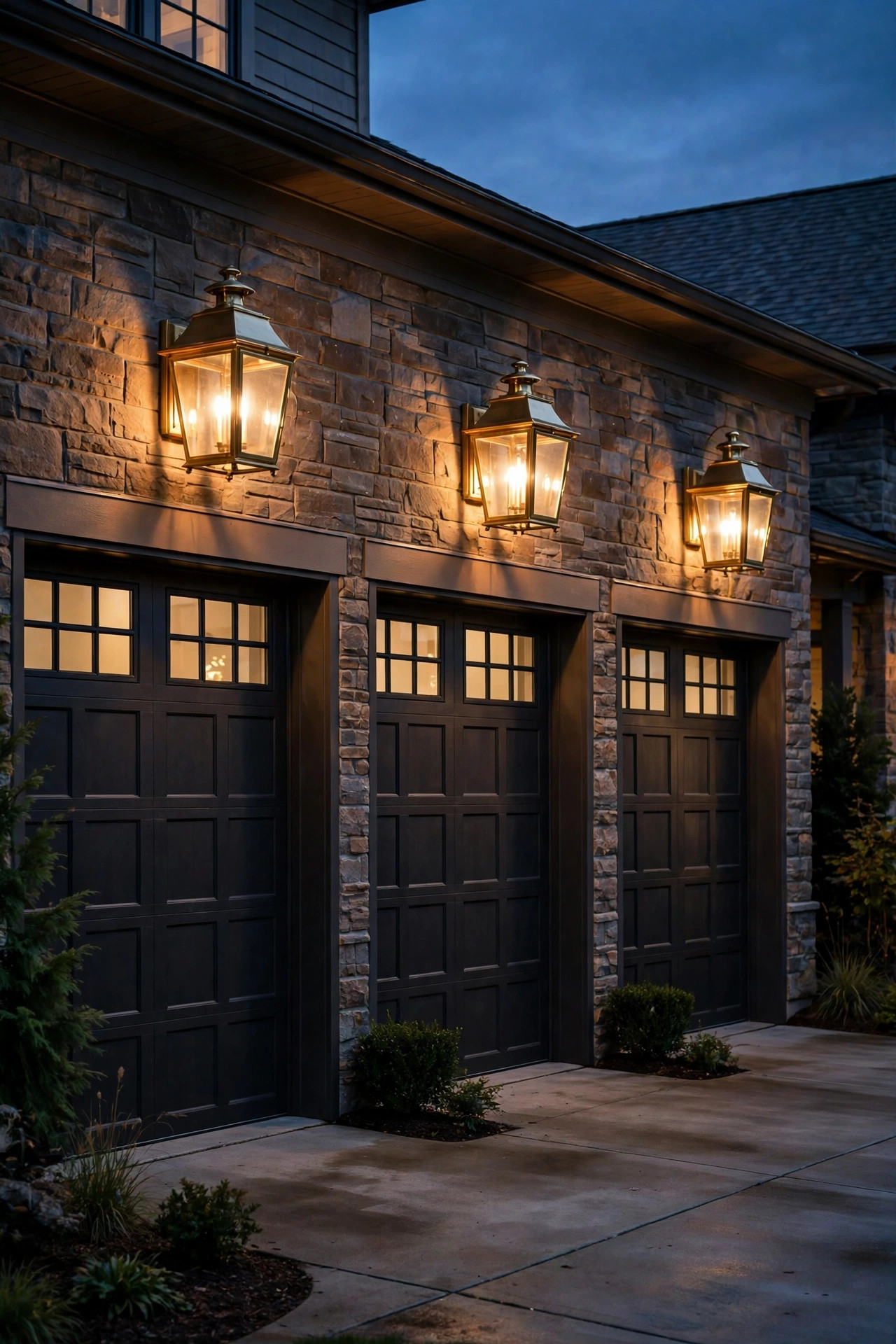
2. Solid Brass Carriage Lanterns Over the Garage
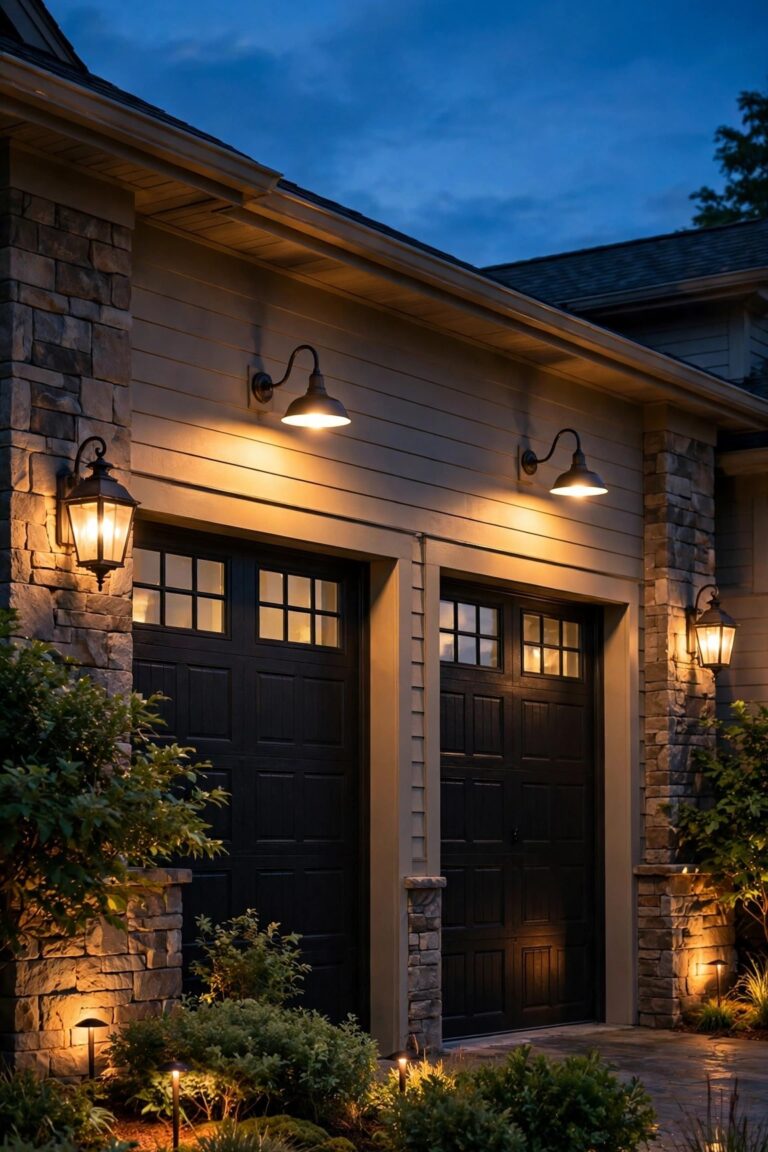
The garage is where most homes lose curb appeal after dark, and a row of brass carriage lanterns brings it right back. Brass suits the carriage style perfectly — that rounded top, the four glass panels, the little ring finial — and its golden tone reads classic against brick, stone, and painted siding alike. For a two-car garage, mount one lantern centered over each door or one on each outside column plus one in the middle; three across is the proportion that looks intentional. Lanterns 15 to 18 inches tall suit standard 8-foot-wide doors; go 20 inches or more for oversized doors. Insist on solid brass rather than brass-plated aluminum if these will face weather directly — plated finishes can blister at the edges within a few seasons, while solid brass just darkens gracefully and can be polished back if you ever want the shine. Wire them to the same switch or timer as your porch pair so the whole facade lights as one scene at dusk. Put them on a photocell or an astronomical timer and you'll never think about them again.
Suggested budget range: $270 – $750.
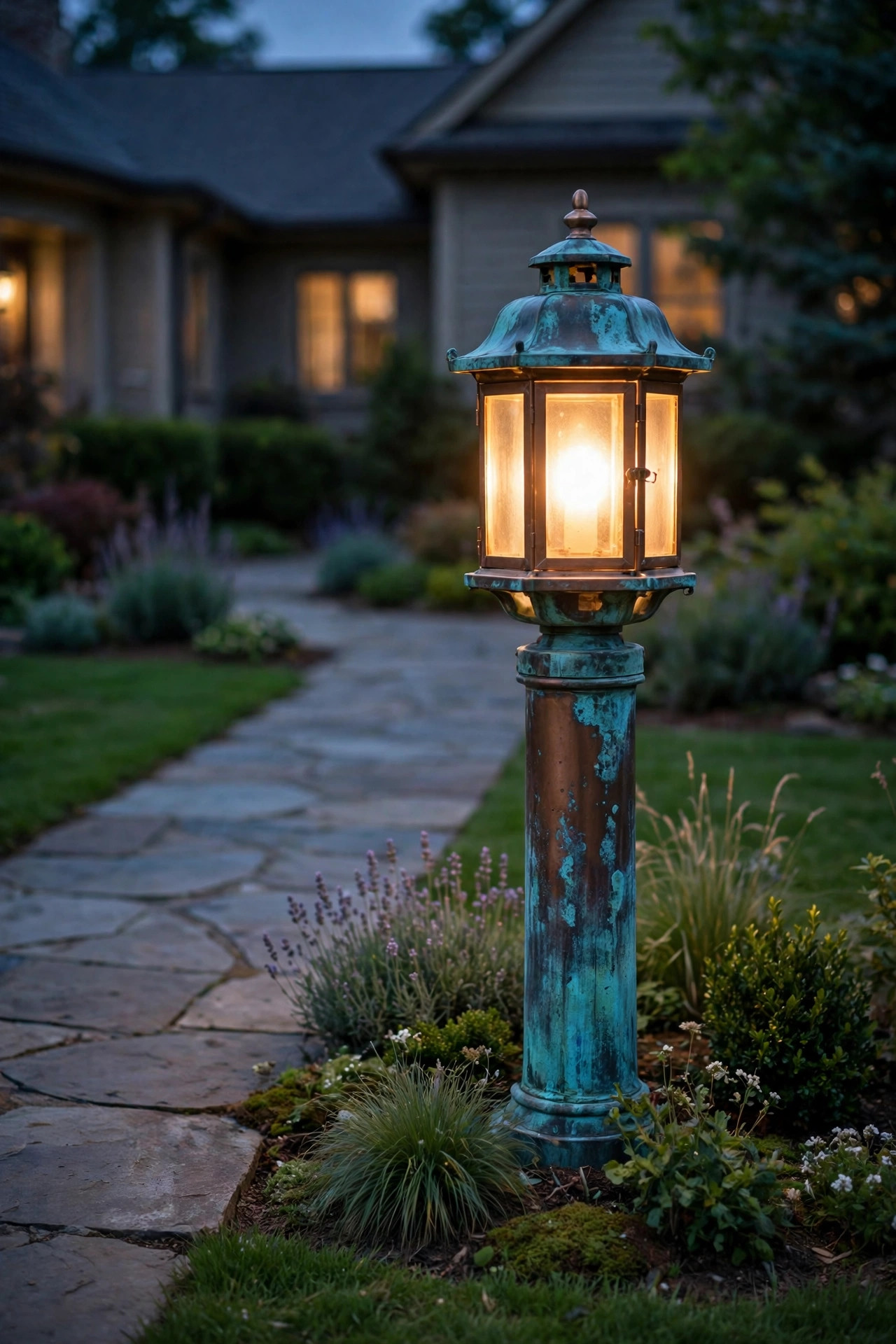
3. A Verdigris Copper Post Lantern at the End of the Walkway
Every front yard needs one exclamation point, and a copper lantern on a post where the walkway meets the sidewalk is mine. This is the one fixture where I actively encourage you to buy the living, unlacquered finish and let it go fully verdigris — that blue-green against green lawn and gray concrete is pure garden-magazine. A post lantern head 16 to 20 inches tall on a 6- to 7-foot post gives you presence without glare, and the light pools low across the walk where feet actually need it. Hardwired is best here since it runs nightly; trench the cable 18 inches deep in conduit, or shallower per local code for low-voltage. If trenching isn't in the cards this year, a solar post lantern gets you the look while you save up, just expect softer output. Keep the bulb modest, around 500 to 800 lumens at 2700K, because a post light sits right at pedestrian eye level. Plant something soft at the base — ornamental grass or a low boxwood — and the post stops looking like infrastructure and starts looking like landscaping.
Suggested budget range: $180 – $520.
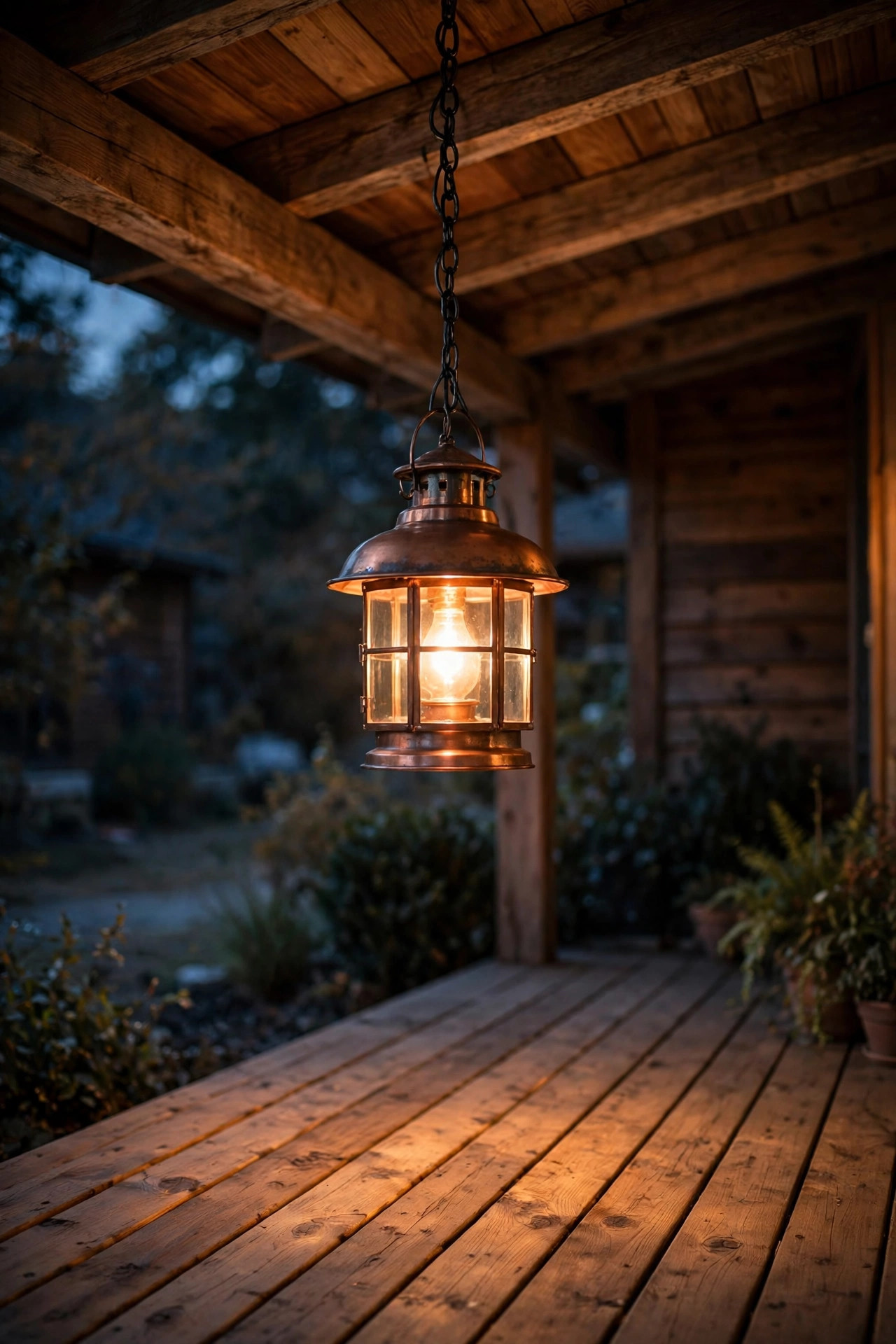
4. Hanging Copper Pendant Lanterns Under the Porch Roof
A porch with a ceiling deserves a hanging lantern, full stop. A copper pendant lantern on a chain becomes the chandelier of the entry — the thing guests look up at, the glow you see from the street through the porch opening. Hang it so the bottom sits about 7 feet above the porch floor, high enough to clear a tall guest's head and the swing of the door. If your porch is long, two smaller pendants hung in line look more tailored than one giant one. Chain length is adjustable on most models, which means you can fine-tune the height after living with it for a week; I always hang mine slightly lower than feels safe, because the pool of light on the porch boards is half the effect. Copper plays well with a dark porch ceiling — the warm metal pops against deep green, navy, or haint blue paint. Look for a damp- or wet-location rating depending on how exposed your porch roof edge is, and use a dimmable 2700K LED filament bulb so you can drop it to a murmur during summer evenings on the swing.
Suggested budget range: $120 – $380.
5. Oversized Brass Lanterns for Tall, Two-Story Entries
Standard lanterns disappear on a tall entry. If your front door sits under a two-story foyer window or a grand portico, you need lanterns in the 24- to 30-inch range for the scale to read from the street — anything smaller looks like a postage stamp on a barn door. Solid brass earns its price here because oversized fixtures catch more wind and weather, and you do not want to re-hang 20 pounds of lantern in five years because a plated finish failed. Mounting height scales up too: center them around 78 to 84 inches, roughly in line with the top third of the door surround. Because these are big glass boxes, choose seeded or lightly textured glass to soften the bulb view, and keep output around 800 lumens per lantern — two bright lanterns plus a bright interior foyer behind glass can tip into glare fast. An antique or living brass finish forgives the scale a little, aging into the architecture instead of shouting. These are buy-once pieces, so order the best construction you can: real brass, real glass, replaceable sockets.
Suggested budget range: $450 – $1,100.

6. Copper Outdoor Lanterns on Path Stakes
Path lighting is where copper quietly outshines every other finish, because the metal sits down in the garden where you actually see it up close. Low copper lantern stakes — the kind with a little roofed lantern head instead of a mushroom cap — throw a warm window of light onto the walk and look like tiny houses for garden fairies, which is exactly the charm. Space them 6 to 8 feet apart, alternating sides of the path, and keep output low: 100 to 200 lumens each is plenty for wayfinding and preserves the lantern look. Low-voltage wired stakes tied into one transformer will outlast and out-glow solar versions, and the copper heads will patina in step with your door pair if both are living finishes. Here is my favorite detail: let the plantings brush them slightly. A lantern half-tucked into lamb's ear or liriope, glowing through the leaves, is the layered look designers charge for. Just keep foliage a few inches off the fixture itself, and use LED only — never an incandescent bulb that could scorch a dry leaf.
Suggested budget range: $45 – $130.

7. Antique Brass Coach Lights Against Red Brick
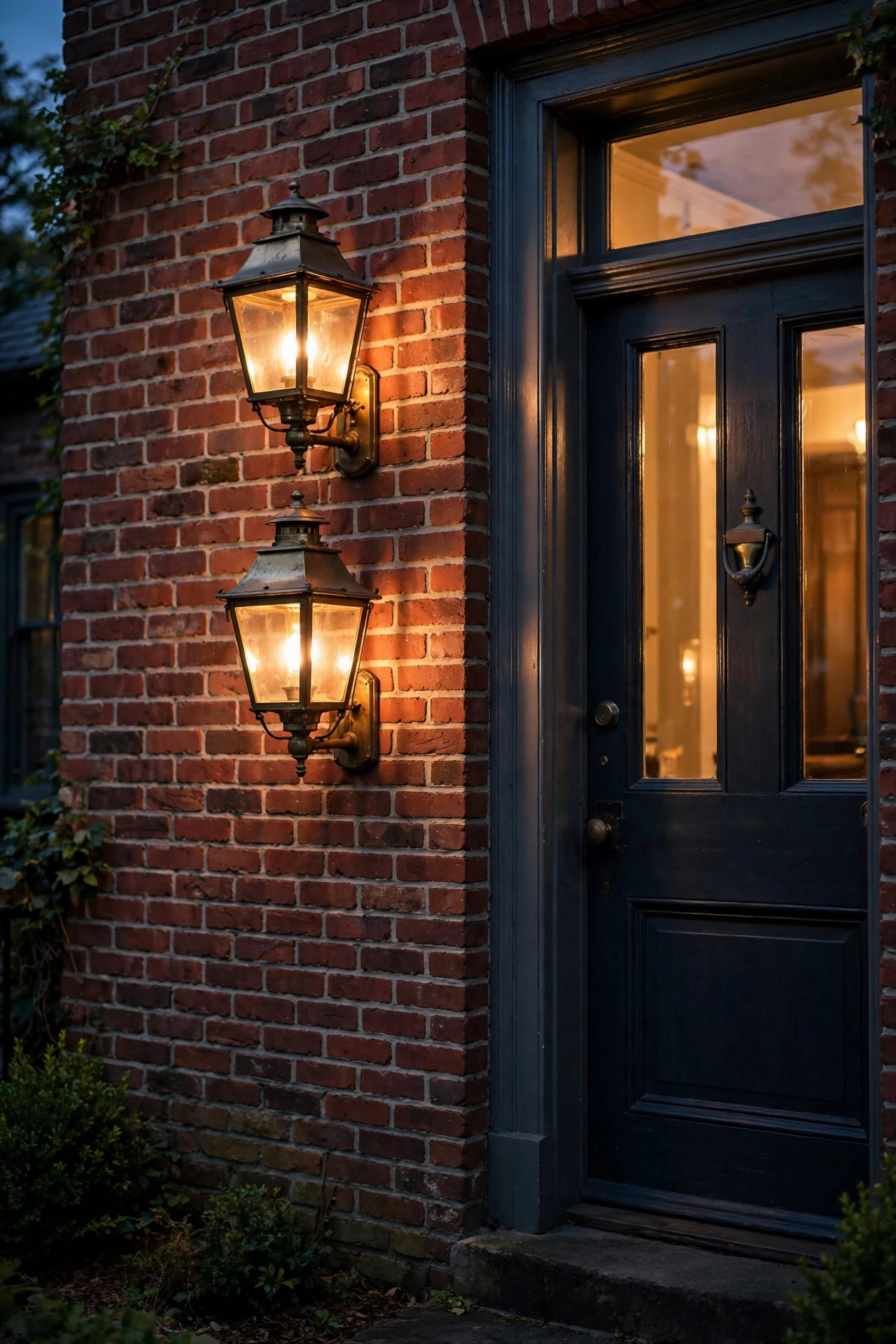
Some combinations are classics because they never miss, and antique brass against red brick is one of them. The warm gold undertones in aged brass pull the orange and rust tones out of brickwork, and brick returns the favor by making brass look richer than it does against pale siding. Coach-light silhouettes — the tapered lantern with a scrolled arm — suit brick colonials, Georgians, and traditional two-stories especially well. Choose an antique or aged brass finish rather than polished; a mirror finish against brick can read a little costume-y, while the muted version looks inherited. Mount pairs flanking the door and consider a third over the house numbers or beside the garage for rhythm. One practical note from experience: brick dust and masonry anchors are no joke. Use a masonry bit, proper wall anchors, and seal the top edge of the backplate with a bead of exterior silicone so wind-driven rain can't sneak behind the fixture. Your future self, swapping a bulb in November, will appreciate that the fixture stayed dry and the screws stayed clean.
Suggested budget range: $160 – $420.
8. Copper Lantern String Lights Across the Patio
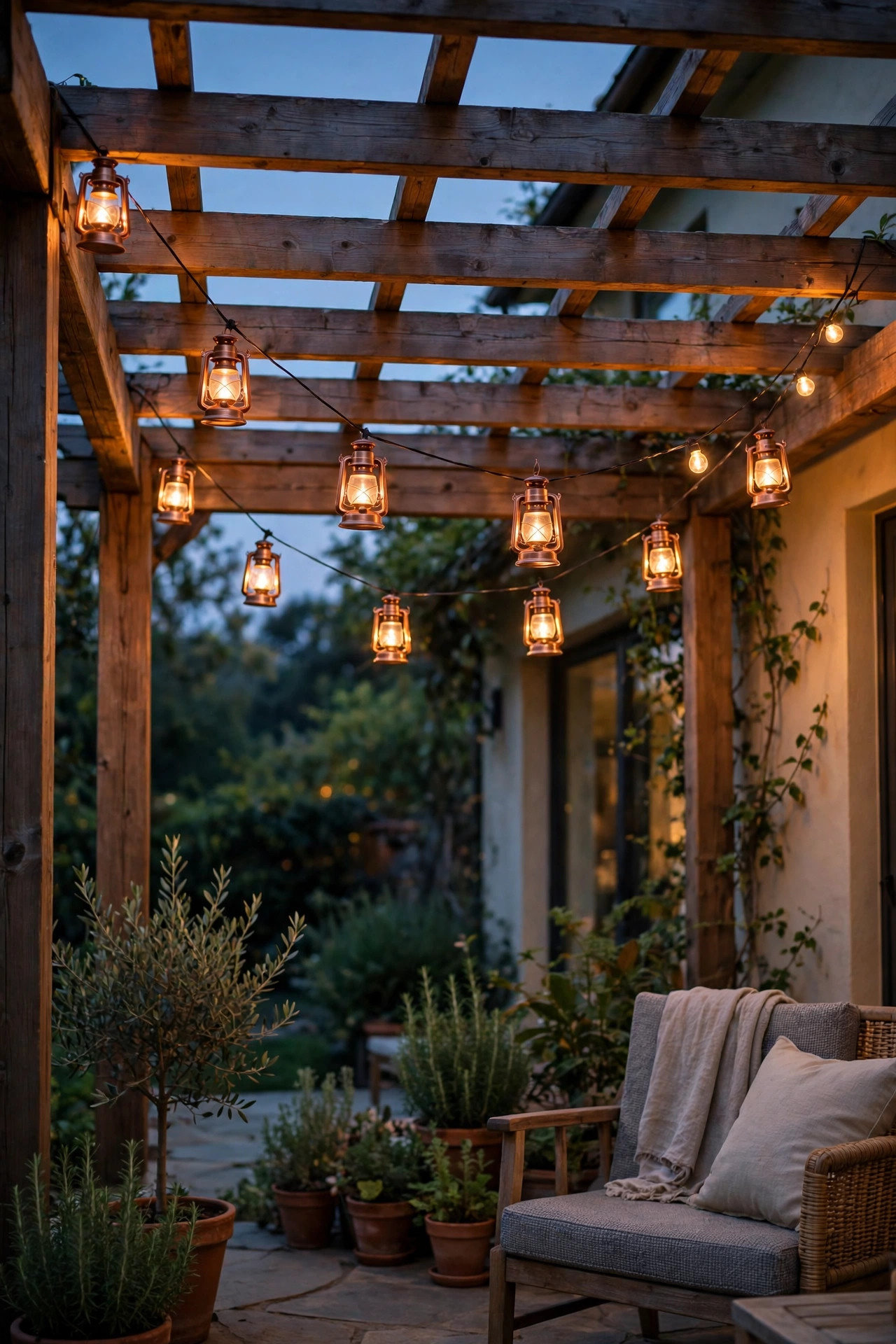
Festoon lighting gets all the attention, but strings of small copper lanterns do something the bare-bulb strands can't: they look finished at noon, too. Each little lantern shade throws the light downward in a defined pool, so a patio strung with them feels like an outdoor room with a ceiling of light rather than a party supply. Run two or three swags from the house to a pergola post or a sturdy tree, keeping the lowest point of each swag at least 7 feet overhead. Copper shades pair beautifully with warm 2200K to 2700K bulbs — the metal itself adds amber to the light. These are almost always plug-in, so plan your outlet: a GFCI-protected receptacle and a simple plug-in timer or smart plug handles dusk-to-bedtime scheduling. Because the shades are real metal, weigh a strand before you hang it; copper strings are heavier than they look, and you'll want screw hooks into real framing, not just siding. In winter I leave mine up — the patina keeps developing and the patio never looks stripped.
Suggested budget range: $45 – $120.
9. Flameless-Candle Copper Lanterns on the Porch Steps
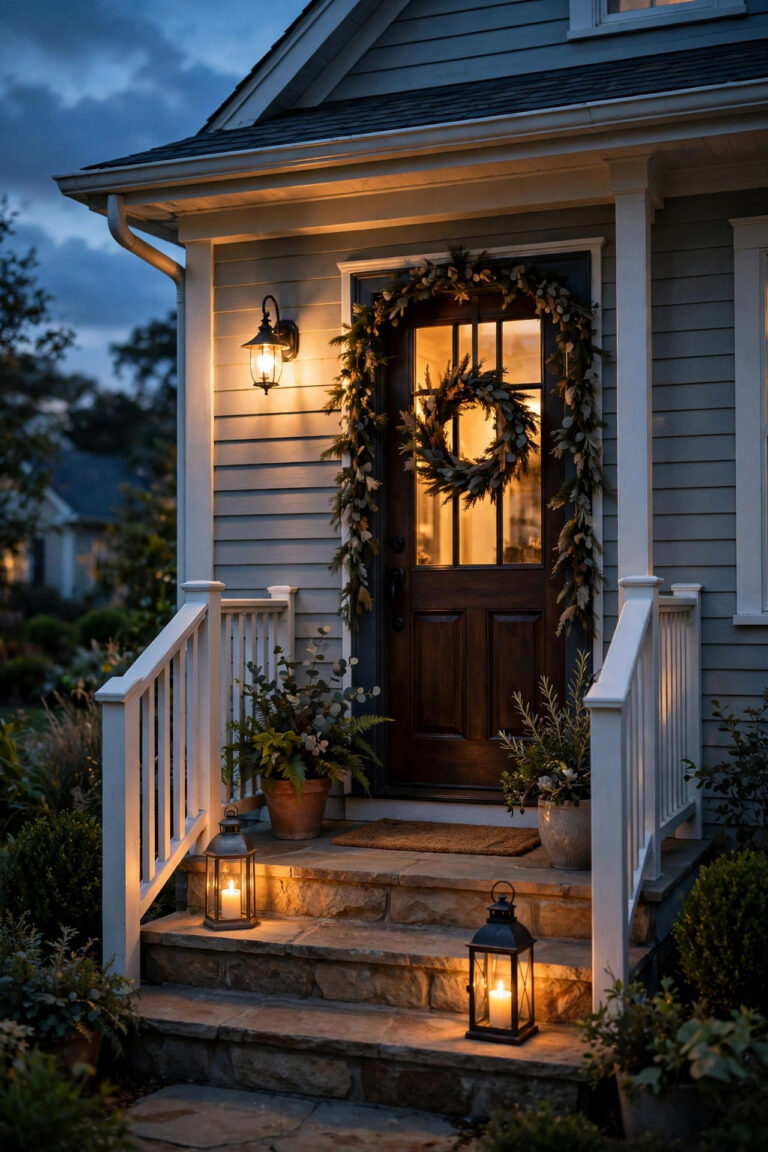
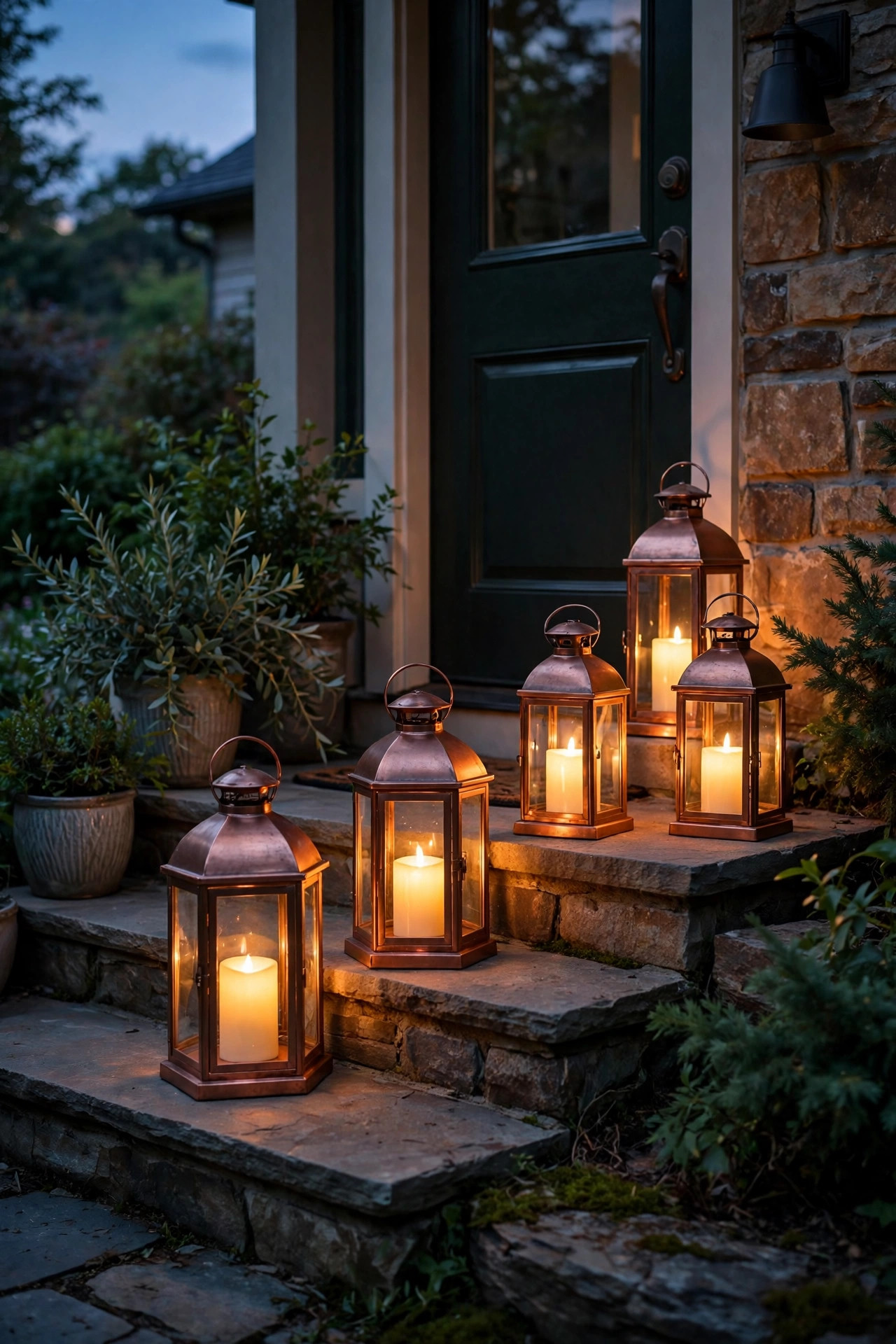
This is my favorite renter-friendly, wiring-free trick: a cluster of copper lanterns holding flameless LED candles, arranged on the porch steps and beside the door. Because there's no real flame, you can tuck them anywhere — against the siding, inside a wreath's shadow, on a wooden step — with zero fire worry, and most flameless candles have timers that click them on at the same time every evening for five hours. Buy lanterns in graduated sizes, say 8, 12, and 16 inches, and group in odd numbers. The copper catches daylight nicely too, so the steps look styled around the clock. Real solid copper costs more, but for decorative lanterns that live under a porch roof, copper-tone metal is a reasonable budget call and nobody can tell at arm's length. Do bring them in during the worst winter weather if they're the plated kind, and store the candles' batteries out. Come fall, I weave a few mini pumpkins and a plaid throw around mine and the whole entry photographs like a magazine cover — for very little money and no electrician at all.
Suggested budget range: $90 – $330.
10. A Brass Nautical Lantern Beside the Back Door
Every house has a hardworking door — the back door to the trash bins, the dog run, the grill — and it deserves better than a bare bulb in a jelly jar. A brass nautical lantern, the bulkhead style with its caged glass and rounded hood, was literally designed for salt spray and ship decks, which makes it nearly indestructible on a house. Solid brass versions shrug off coastal air that eats painted fixtures alive, and the cage protects the bulb from basketballs, broom handles, and life in general. Mount it beside the door at about 66 inches and let it be the one slightly cooler light in your scheme if you like — a 3000K bulb reads practical here — though 2700K keeps the whole property cohesive, and cohesion is what makes a home look designed. The nautical look suits cottages, coastal homes, and any place with a little shingle or board-and-batten going on. If your home is inland and traditional, file this under the mudroom door or the garage side door instead, where its utility personality fits right in.
Suggested budget range: $75 – $230.

11. Solar Copper Lanterns Tucked Into Garden Beds
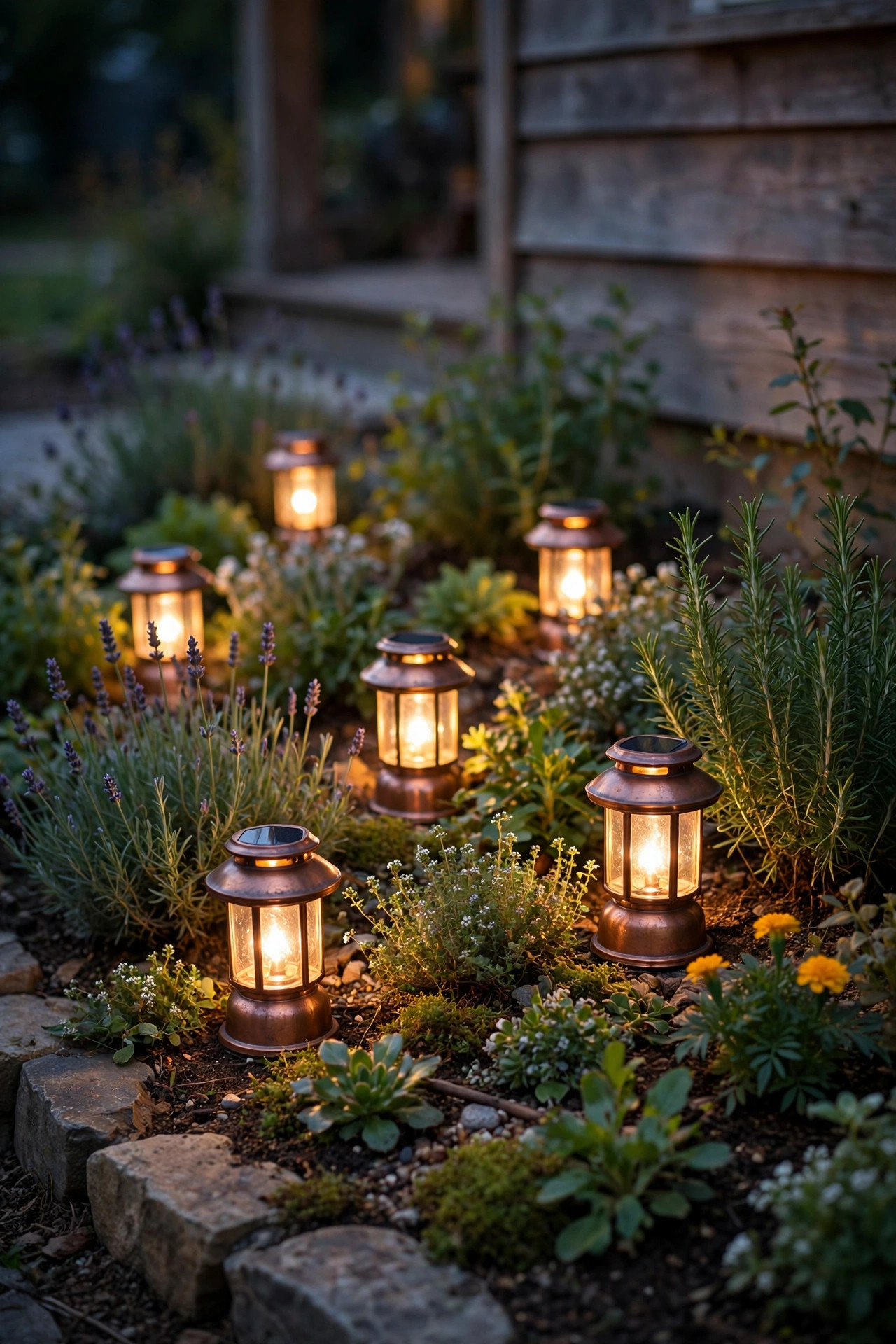
Not every lantern needs a wire. Solar copper lanterns — little roofed houses on short stakes, or hanging shepherd's-hook styles — are made for the middle of a garden bed where trenching cable feels like overkill. Set them where shrubs thin out or beside a stepping stone, and let them mark the garden's edges after dark. The copper finish matters here more than you'd think, because a garden lantern sits at eye level when you're seated on the patio; cheap plastic reads cheap at that distance, while real copper tones look like garden ornament by day. Be honest about output: a good solar lantern gives you a gentle glow, maybe 20 to 50 lumens, and needs 6 hours of reasonably direct sun on its panel to charge. That means south or west beds, panels wiped clean monthly, and no deep shade from the maple. I mix three or four solar copper lanterns into the beds as accents and let the wired path lights do the actual wayfinding — that division of labor is the difference between charming and disappointing. Replace the rechargeable batteries every couple of years and they'll keep going.
Suggested budget range: $25 – $70.
12. Hammered Copper Lanterns for Handmade Texture
If smooth copper feels too formal, hammered copper will loosen you right up. The hand-dented surface scatters light in dozens of tiny directions, so a hammered lantern doesn't just glow — it sparkles a little, and the walls around it pick up a dappled pattern that's impossibly cozy. This texture suits craftsman, cottage, mountain, and Spanish-influenced homes especially well, and it hides the patina's uneven early stages better than a polished finish, which makes it a smart first copper purchase if the blotchy brown phase worries you. Because each piece is worked by hand (or convincingly tooled to look it), no two are identical — lean into that and don't stress about perfect matching across a pair. Hammered lanterns look wonderful as porch pendants and as wall lanterns on stone or stucco, where the rough surface echoes the wall's own texture. Pair them with a warm 2700K bulb; cool light flattens the dents into gray, and warm light turns every facet amber. Keep the glass simple and clear so the metal stays the story, and expect the crevices to darken first — that's not dirt, that's depth developing.
Suggested budget range: $110 – $360.
13. Brass Lantern Sconces Flanking a Garden Gate or Arbor
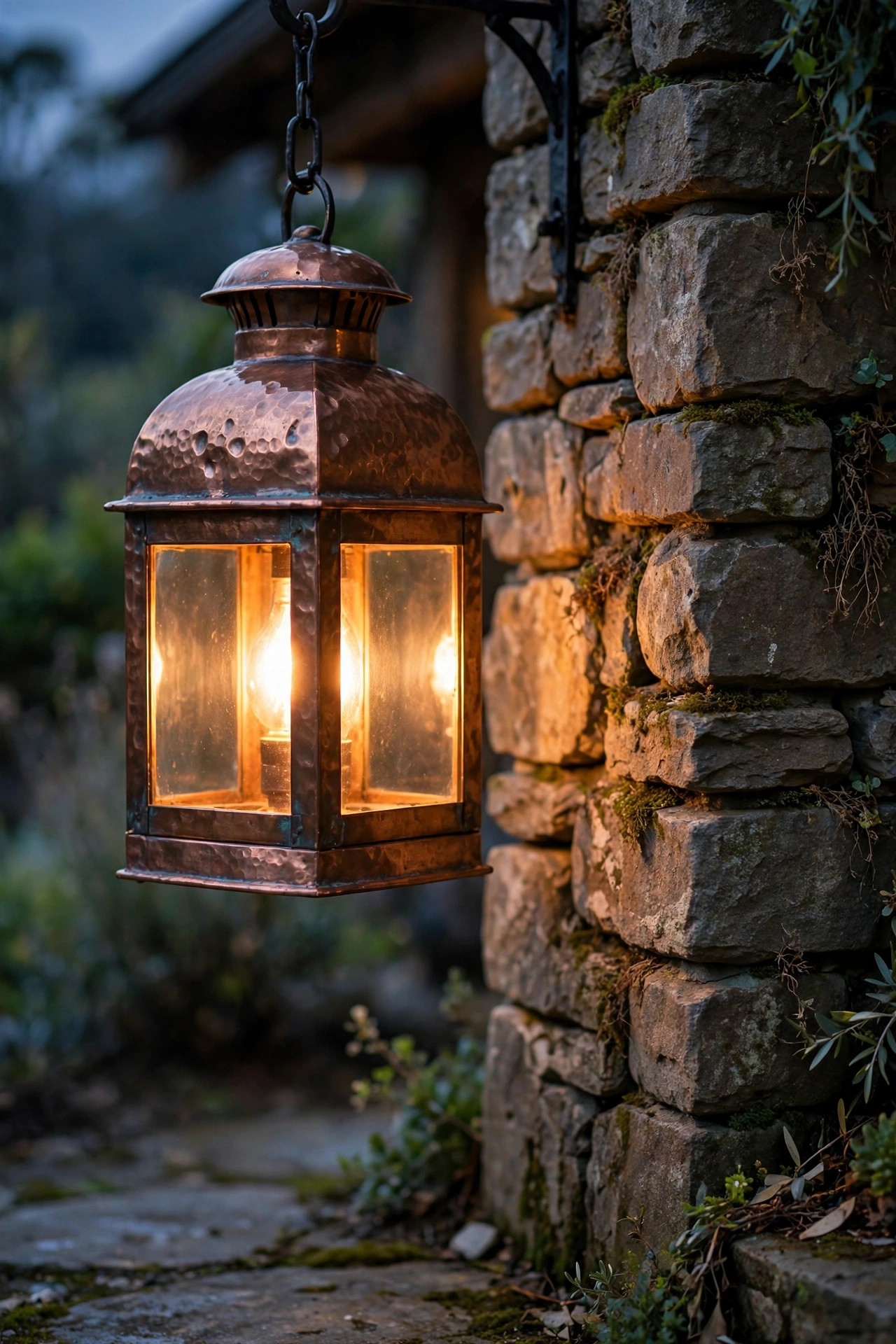
A garden gate without light is just a dark gap in the fence. Two small brass lanterns on the gate posts or the arbor uprights turn it into a destination — the threshold between the front yard's public face and the back garden's private one. Brass is the right call outdoors in the garden because it tolerates sprinkler overspray and fertilizer splash without complaint, and its gold tone against green foliage and weathered wood is a combination pulled straight from English garden tradition. Keep these small, 10 to 14 inches, since they're close to faces passing through; 200 to 300 lumens each is plenty and keeps moths from hosting a nightly convention. If running wire out to the gate is a project too far, low-voltage cable along the fence line is an easy weekend run, and solar versions with separate panels exist for truly remote corners. I light my side gate this way, and honestly the trip to take out the recycling now goes past a glowing little archway that makes the whole yard feel twice as deep.
Suggested budget range: $95 – $280.

14. Gas-Style Copper Lanterns With an Electric Flame Look
You know the look: the dancing, open-flame lanterns on historic homes in Charleston and New Orleans, copper hoods burnished by years of real fire. True gas lanterns are gorgeous but come with gas lines, professional installation, and a fuel bill that never sleeps. The happy middle ground is a copper lantern built in the gas style but fitted with an electric flame-effect LED module — from the sidewalk, the flicker is nearly indistinguishable, and you get a timer and an off switch. These suit historic, colonial, and French-influenced homes best, mounted as a front-door pair or a row along a gallery porch. Because the lantern body is oversized and open at the bottom in the traditional style, confirm the electric version carries a proper wet-location rating — the classic gas silhouette wasn't designed with sockets in mind, and the good manufacturers engineer around that. Real copper is worth it here: this is a heritage fixture you'll hand down with the house. Expect the flame module to use a specialized bulb; buy a spare when you order the lanterns.
Suggested budget range: $220 – $620.

15. Mixed Metals: Copper Lanterns With Matte Black Accents
Pure copper everywhere can feel like a theme; a little contrast makes it feel like design. My favorite current pairing is copper lanterns with matte black hardware — black house numbers, black door hardware, maybe black path lights — because black sharpens copper's warmth and stops the scheme from sliding into matchy-matchy. The easiest version: your copper front-door pair stays the star, while a simple black gooseneck or black carriage lights handle the garage. Or reverse it, with black lanterns at the door and one copper post lantern down the walk as the single warm note. The rule that keeps mixed metals looking intentional is repetition: each metal should appear at least twice, and the undertones should agree — warm copper with warm brass accents, never copper beside a cold chrome. Keep bulb color identical across every fixture at 2700K, because mismatched light color undoes mixed-metal harmony faster than anything. If you've been collecting fixtures over years and nothing matches, this is your permission slip: group by zone, repeat each finish once more somewhere, and suddenly it looks curated.
Suggested budget range: $180 – $480.
16. Copper Table Lanterns for Outdoor Dining
The most complimented light at my outdoor dinners isn't overhead — it's the copper lanterns sitting right on the table. A pair of medium copper lanterns with flameless candles (or real candles in glass hurricanes, if the table is stone or metal and well away from linens) drops the light to face level, where it's flattering to everyone and makes the food look like a magazine shoot. Copper earns its keep here because it reflects candlelight with a rosy warmth no other metal matches; brass works too, in a more golden key. Keep lanterns 10 to 14 inches tall so sightlines across the table stay open, and cluster them with something green — a small potted herb does double duty. For safety, LED flameless candles are the only sane choice around table linens, paper napkins, and reaching arms, and the good ones flicker convincingly at this distance. Because table lanterns live outdoors only part-time, store them inside between uses and the finish stays in that golden-brown sweet spot for years. Honestly, this is the lowest-cost, highest-drama idea on the whole list.
Suggested budget range: $35 – $120.

17. A Trio of Floor Lanterns at Three Heights by the Front Door
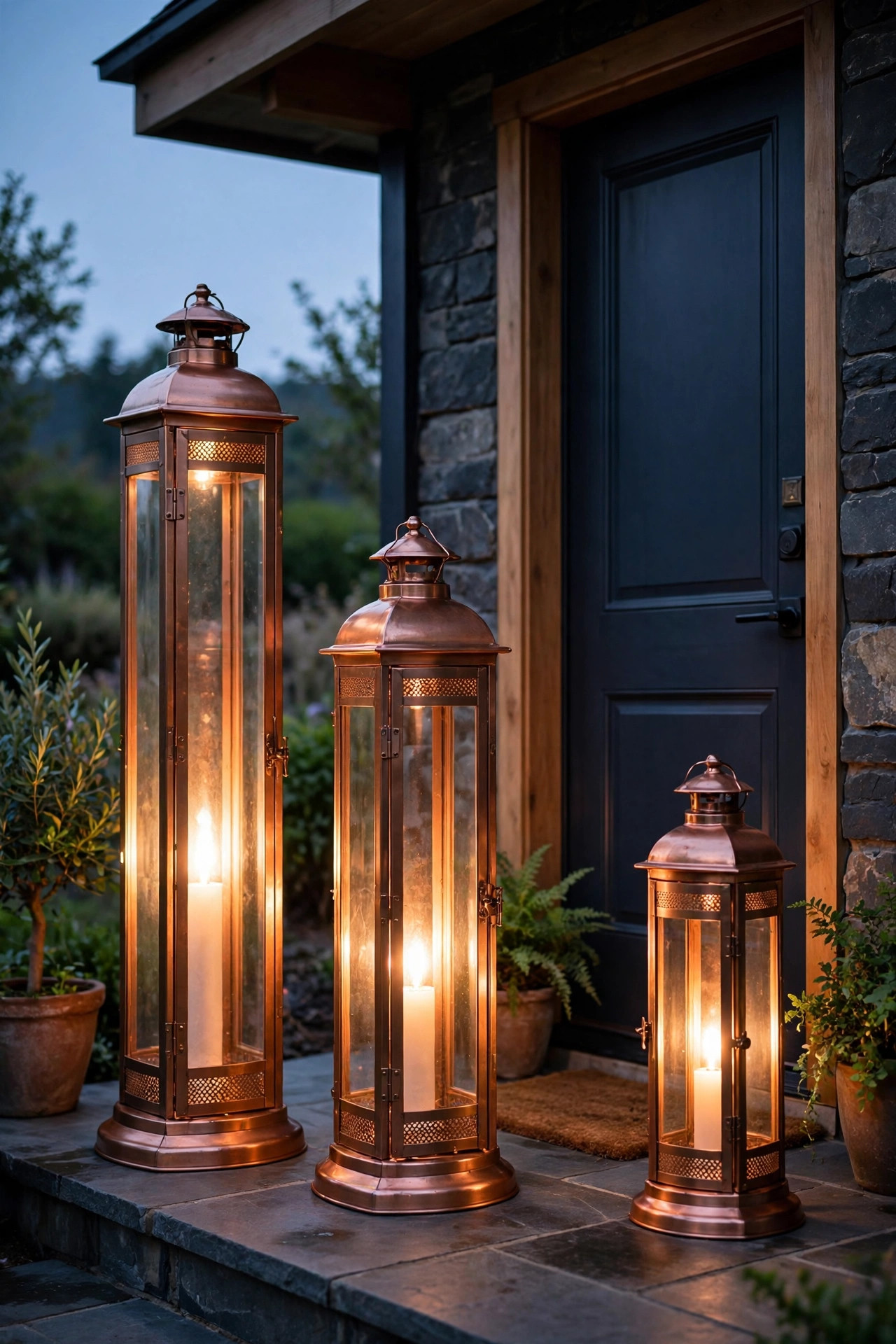
When wall mounting isn't possible — stone veneer you don't want to drill, a rental, an HOA with opinions — a trio of large copper floor lanterns beside the door delivers nearly the same welcome. Buy or collect three in graduated heights, roughly 14, 20, and 26 inches, and arrange them in a loose triangle on the porch corner or the landing, tallest at the back. Fill them with chunky flameless candles on timers, and at dusk the whole cluster wakes up in layered sizes of glow. The copper bodies do the daytime styling work, looking like sculpture against the door even unlit. This grouping also solves the awkward deep-porch problem, where wall lanterns sit so far from the door that the entry still reads dark; floor lanterns bring the light right down to the threshold where guests stand. Anchor the arrangement with a heavy stone or a sandbag insert in the tallest lantern if your porch catches wind, and choose lanterns with simple, squared silhouettes so the trio reads as a set rather than a yard sale. It's maximal effect, zero wiring, ten minutes to arrange.
Suggested budget range: $85 – $260.
18. Copper Lanterns With Seeded Glass for a Softer Glow
Clear glass shows the bulb; seeded glass shows the light. If your taste runs soft and romantic, seeded glass — the kind peppered with tiny bubbles, like old hand-blown panes — is the upgrade that changes a copper lantern's whole personality, diffusing the bulb into a gentle halo and hiding the LED filament's hard lines. It's also forgiving: seeded glass conceals dust, water spots, and the occasional moth casualty far better than crystal-clear panes, which matters on fixtures you'll clean twice a year at most. The lantern silhouette can stay classic while the glass does the mood work, so this is an easy way to make a traditional pair feel custom. Light output drops slightly compared with clear glass, so step up a touch — around 600 to 800 lumens per lantern at the front door — and stay at 2700K, since warmer light through seeded glass reads like candlelight through old windows. I specified seeded glass on the lanterns by our side door, and that little entry now feels like the doorway of a storybook cottage, which was precisely the goal.
Suggested budget range: $130 – $380.

19. The Living Finish: Letting Your Copper Outdoor Lanterns Age on Purpose
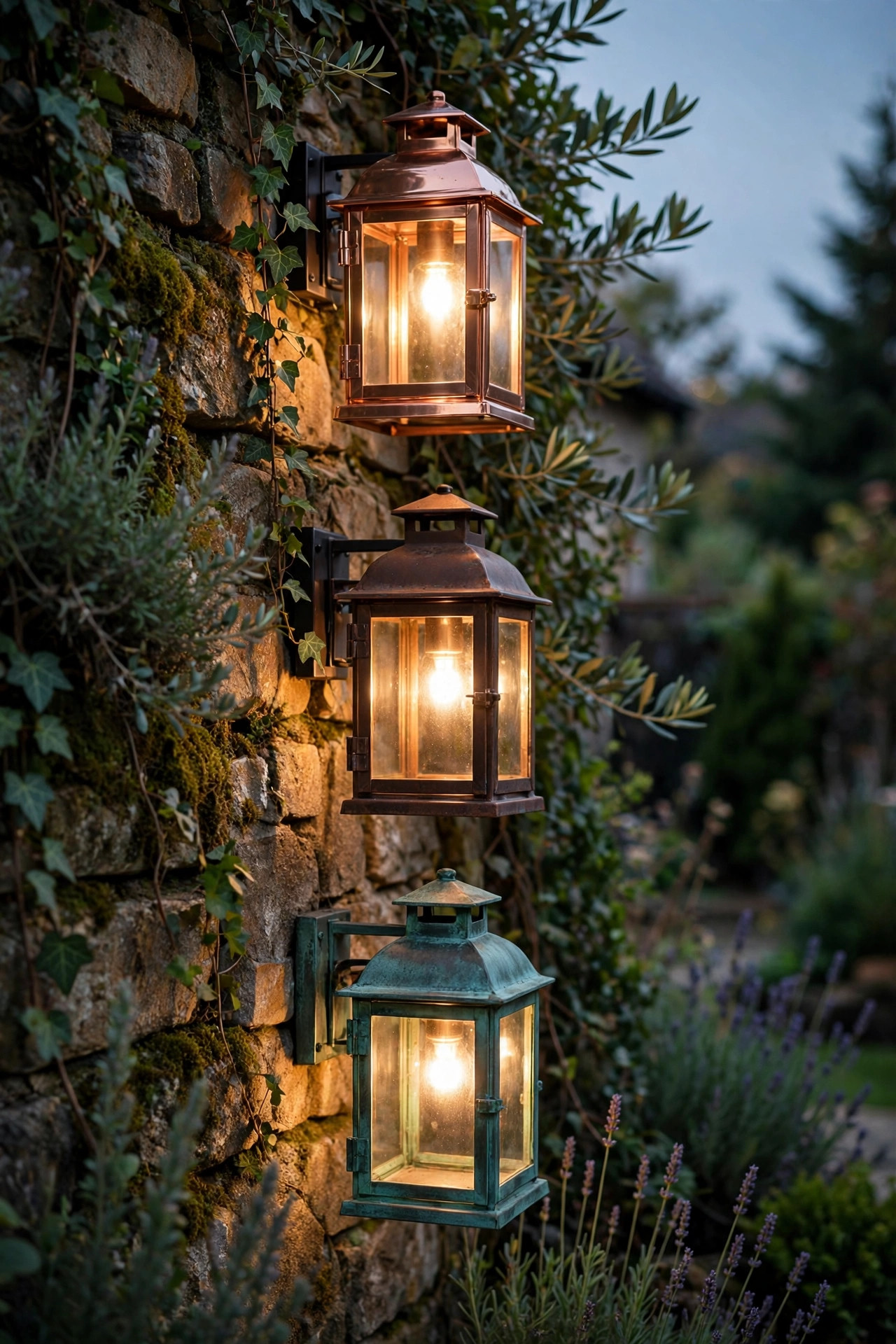
This last idea isn't a fixture — it's a decision, and it might be the most valuable one here. A living finish means your copper outdoor lanterns arrive unlacquered and you let chemistry do its slow art: bright copper for the first months, then a freckled brown, then deep chocolate bronze, and in humid or coastal air, the first minty hints of verdigris within two to five years, starting under the roof edges where moisture lingers. You can speed or slow it — a coat of paste wax once or twice a year holds the brown stage almost indefinitely, while salt air and garden sprinklers hurry the green along. What I love is that the lanterns become a record of your house's life, aging alongside the garden instead of against it. Practical care is minimal: rinse dust off with a hose a few times a year, never use abrasive pads, and check the socket and seals each fall when you swap toward winter — my outdoor lighting maintenance checklist covers the full seasonal routine. If you're torn between shiny and aged, split the difference: lacquered pair at the formal front door, living finish everywhere the garden softens things. Either way, you're buying the last lanterns that door will ever need.
Suggested budget range: $15 – $60.
Frequently Asked Questions
Do copper outdoor lanterns really turn green?
Yes — that's the famous verdigris patina, and it's a protective layer, not damage. Unlacquered (living-finish) copper first darkens from bright penny to brown over several months, then, in humid or coastal climates, develops blue-green tones over roughly two to five years. Inland and dry climates may stay in the handsome brown stage for a decade or more. Lacquered copper won't patina until the lacquer wears, so choose your finish based on the look you want long-term.
How do I keep copper lanterns shiny instead of letting them age?
Start with a lacquered finish, which seals the bright copper for several years. Maintain it with a gentle wash — mild soap, water, a soft cloth — and a coat of high-quality paste wax once or twice a year. If an older lantern has already darkened and you want the shine back, a paste of lemon juice and salt (or a commercial copper polish) will strip the patina; just know you're signing up to repeat it, because unprotected copper starts re-aging immediately.
Is brass or copper better for homes near the ocean?
Solid brass has the slight edge in salt air — it's exceptionally corrosion-resistant and was the traditional choice for ship fittings for a reason. Solid copper also performs beautifully at the coast and is the pick if you love the verdigris look, since salt air speeds it up. What matters most is avoiding plated steel or thin plated aluminum near the ocean; once the plating chips, the base metal rusts fast. Rinse salt spray off fixtures with fresh water a few times a year either way.
What kind of bulb looks best in a copper or brass lantern?
An LED filament-style bulb at 2700K is the sweet spot — it mimics a candle or gas flame, flatters the warm metal, and uses a fraction of the energy of incandescent. For front-door lanterns, 400 to 800 lumens per fixture is the useful range; path and garden lanterns need far less, around 100 to 200 lumens. Make sure the bulb is rated for enclosed fixtures and outdoor use, and if you're mixing fixtures across the yard, match every bulb to the same 2700K so the scheme reads as one design.
Conclusion
The thread running through all 19 of these ideas is patience rewarded: copper outdoor lanterns and their brass cousins are the rare home purchase that appreciates in beauty every single year you own them. Start with the layer you need most — a front-door pair for welcome, path stakes for safety, a post lantern for curb appeal — buy solid metal with a finish you've chosen on purpose, and let time do the decorating. If you're planning your entry around a pair, my front door sconce pair guide walks through sizing and spacing in detail. Browse the rest of my outdoor lighting ideas here on the site, pour something warm, and go enjoy your porch at dusk — that's what all this glow is for.