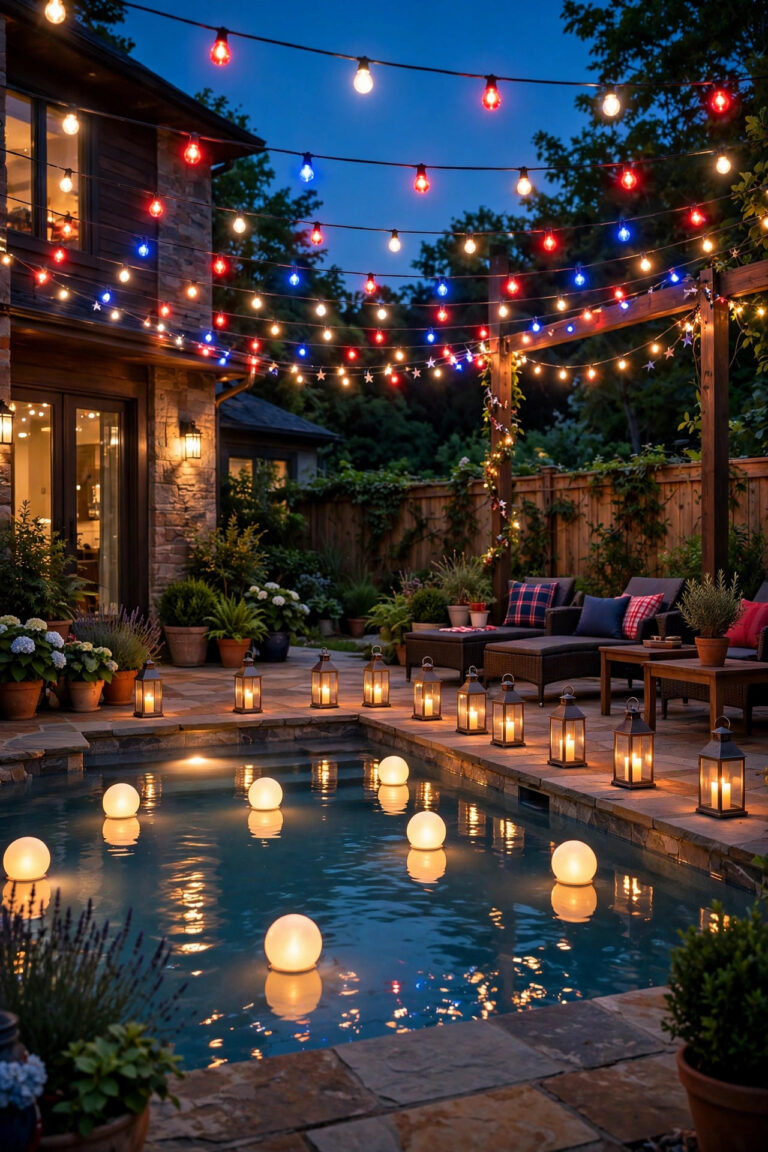
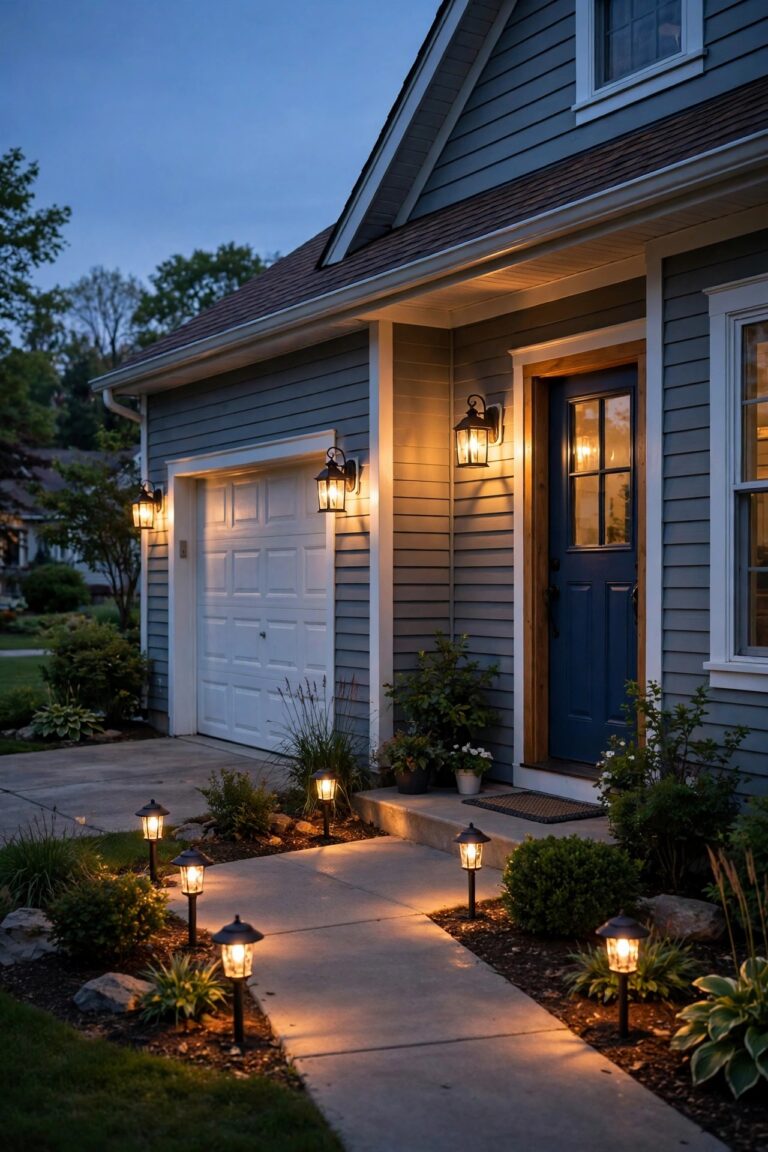
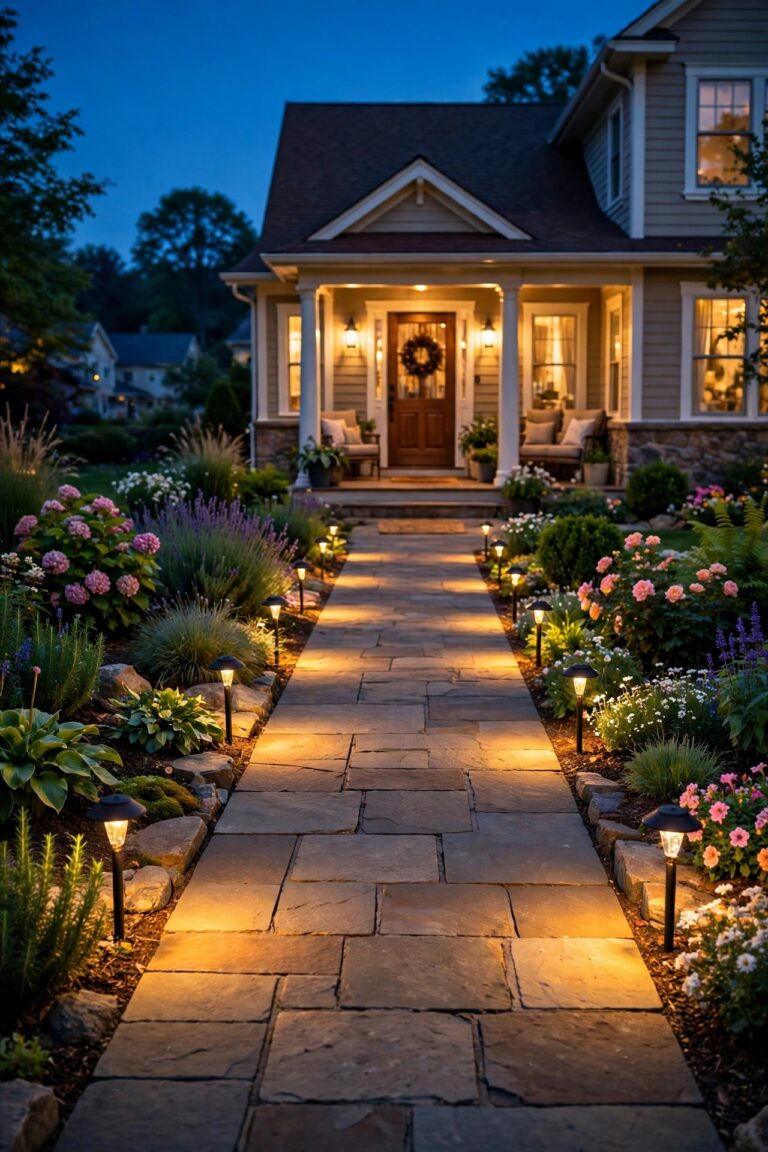
There is a moment on a summer evening in the Southwest when the heat finally breaks, the sky turns the color of apricot jam, and your backyard becomes the best room in the house. That is exactly when good lighting matters most. The best desert backyard lighting ideas work with this landscape instead of fighting it: they shrug off 110-degree afternoons, dusty winds, and monsoon downpours, then glow warm and low once the sun drops. In my experience, the secret is layering. I build every desert yard in three layers — a soft ambient wash so nobody trips on the gravel, task light where we cook and gather, and accent light aimed at the shapes that make this region magic: a sculptural agave, a weathered mesquite, a boulder that has sat there longer than the house. Add timers so it all runs itself, keep every beam pointed down for those famous starry skies, and the yard feels like a boutique resort outside Santa Fe. Here are the 19 ideas I reach for again and again.
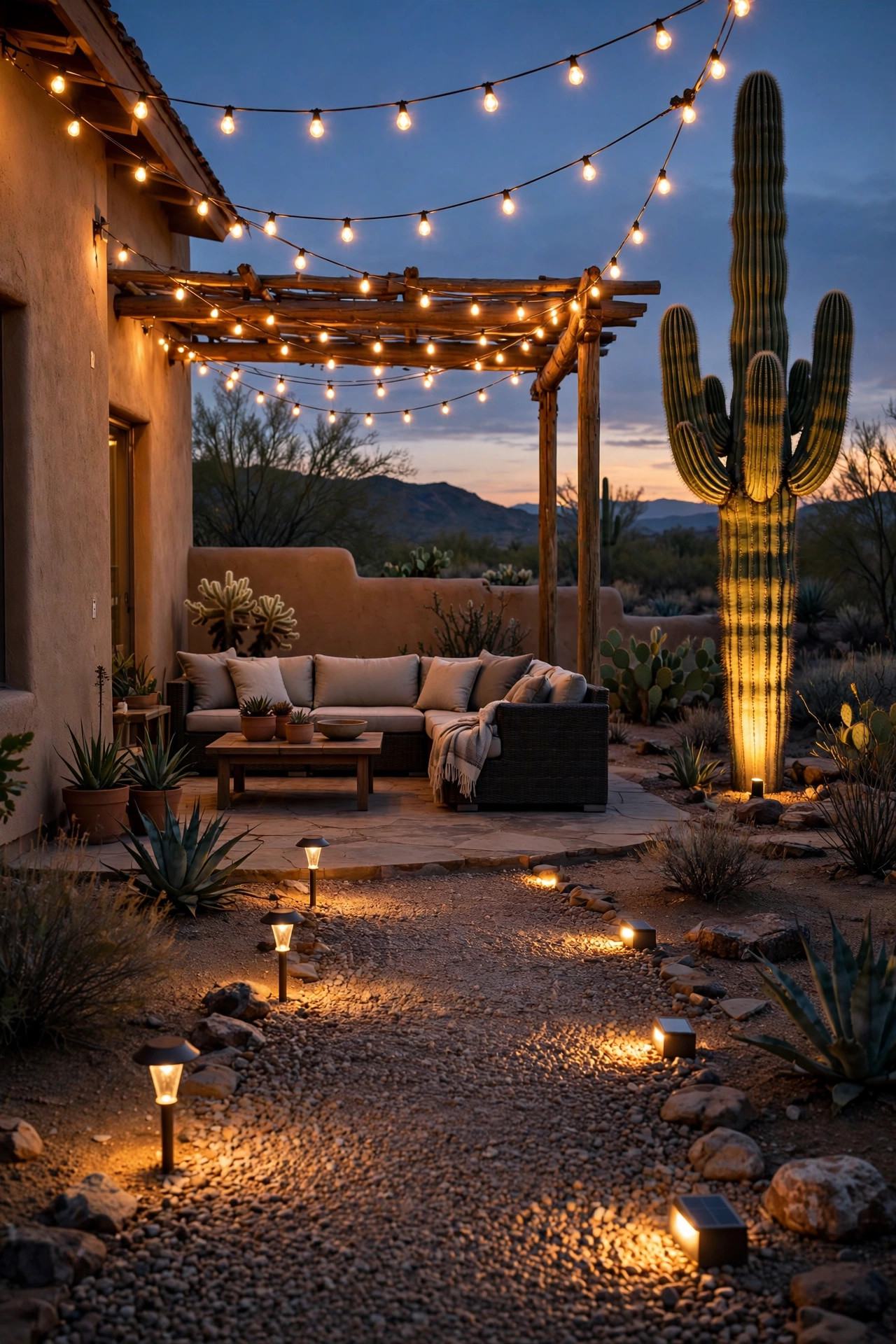
1. Layer Your Desert Backyard Lighting Ideas From the Ground Up
Every desert yard I have ever lit successfully started with a plan on paper, not a shopping cart. Sketch your space in three layers. Layer one is ambient: a gentle overall wash from sconces and string lights so the yard never feels pitch black. Layer two is task: real brightness at the grill, the dining table, and every step or grade change, because decomposed granite hides tripping hazards beautifully until someone finds one. Layer three is accent: narrow beams aimed at the sculpture the desert gave you for free — a saguaro, a boulder, a gnarled mesquite. Wire the layers on separate switches or smart plugs so you can run accents alone on a weeknight and everything at once for a party. Low-voltage LED is my default here; a single 150-watt transformer handles most backyards, sips electricity, and stays cool around dry plantings. Keep the color temperature consistent at 2700K so the yard reads as one place. This layered system is the backbone of every desert yard I have lit, and it lets you build yours over several weekends instead of one exhausting, expensive marathon.
Suggested budget range: $150 – $600.

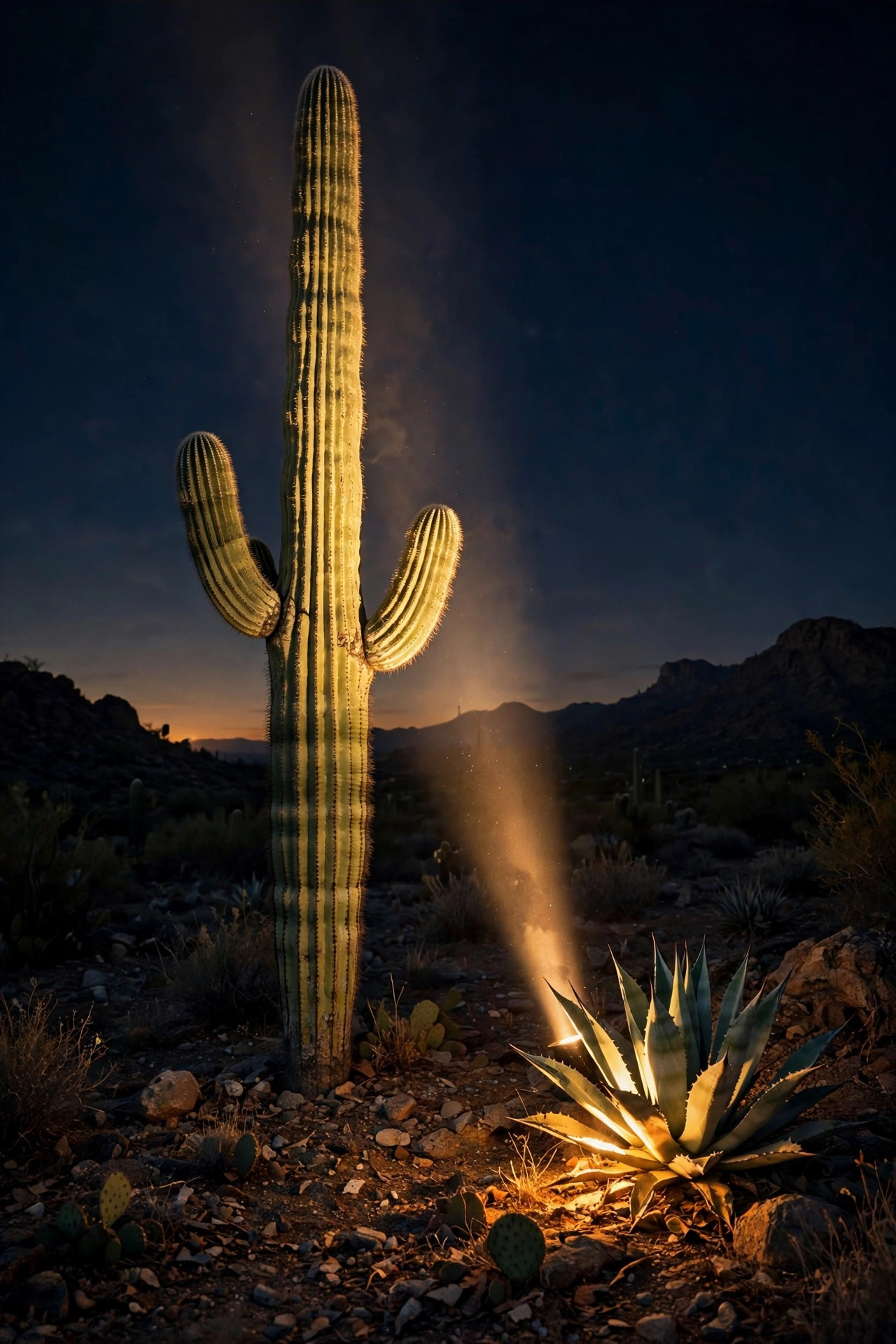
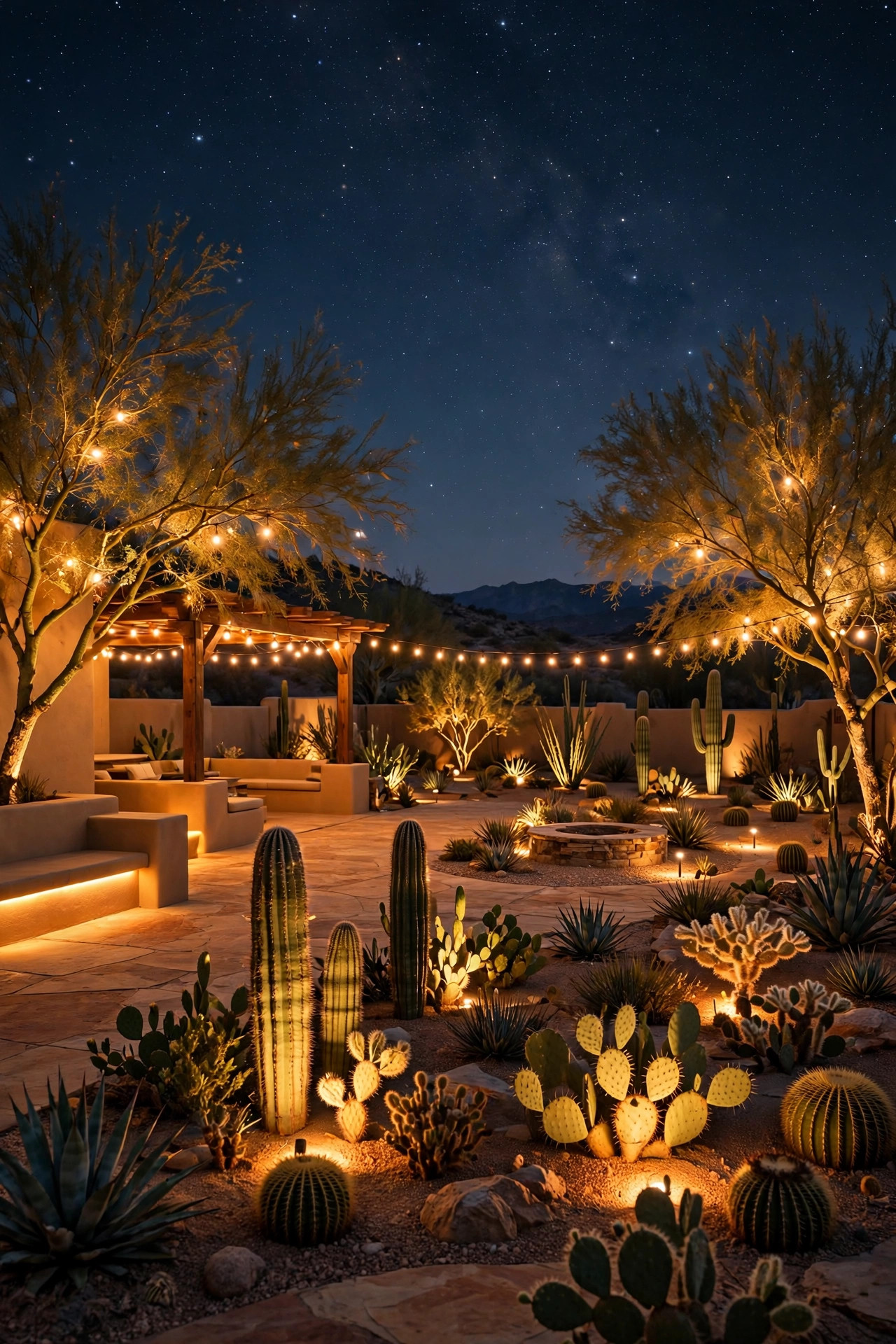
2. Uplight a Saguaro or Sculptural Cactus Like a Monument
A saguaro at midnight, lit from below, might be the most dramatic sight in American landscaping — and it takes one fixture. Use a narrow-beam LED spotlight, 10 to 15 degrees, staked 12 to 18 inches from the base and tilted up so the beam hugs the ribs and throws those accordion shadows skyward. For a barrel cactus or agave rosette, move the fixture a little farther out and widen the beam; you want the whole rosette glowing like a green lantern, not one hot stripe. LEDs matter here for a desert-specific reason: they run cool. A hot halogen a few inches from a plant that stores water in its tissue can scorch it, and a scorched saguaro wears the scar for decades. Keep the fixture itself low and dark-finished so it disappears into the gravel by day. If your cactus is young and small, start with a solar spotlight and upgrade when it grows — the plant is on a fifty-year plan, and honestly, your lighting can evolve right along with it.
Suggested budget range: $60 – $240.
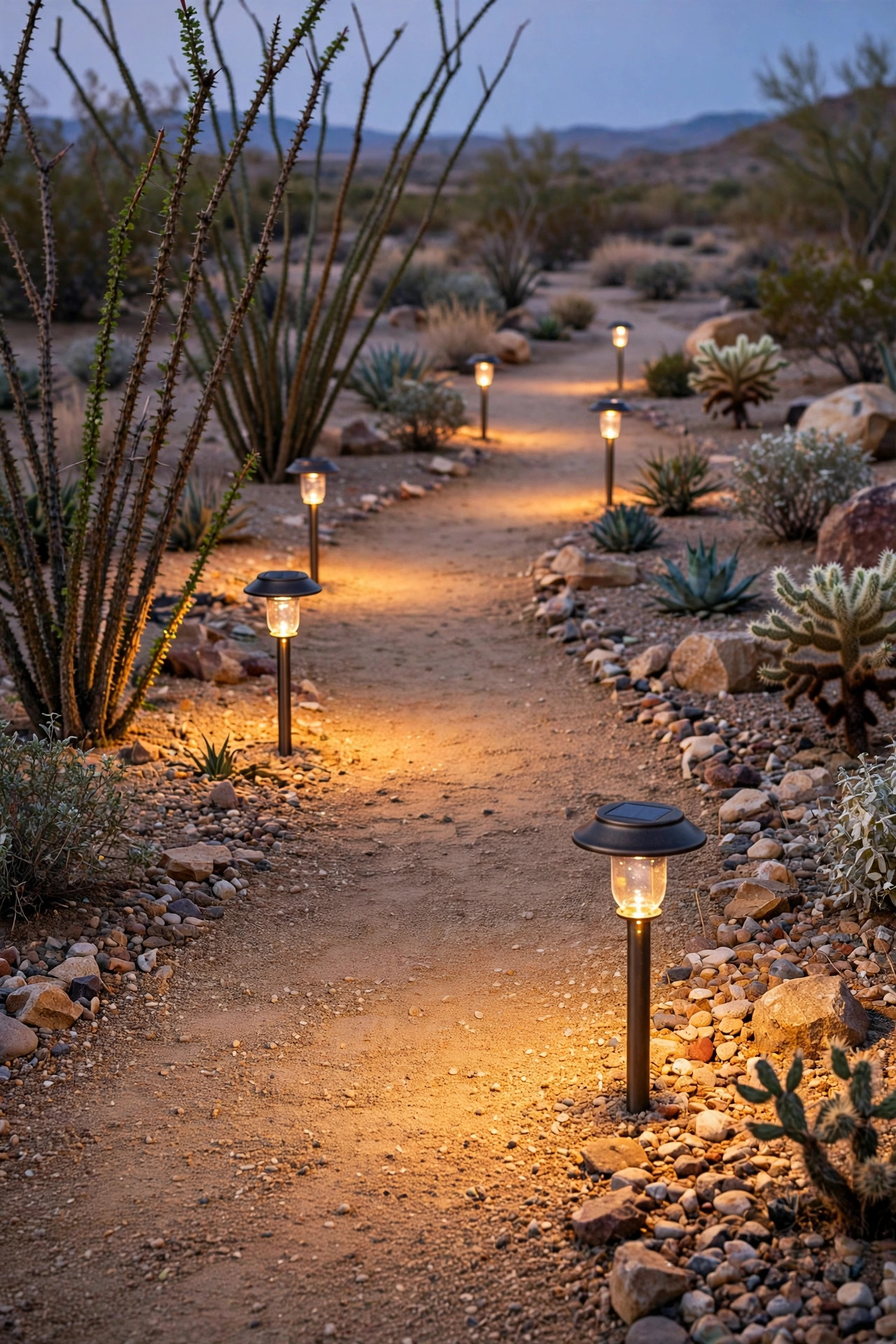
3. Line Gravel Paths With Solar Stakes That Can Take the Heat
Gravel and decomposed-granite paths are the Southwest standard, and they eat cheap solar lights for breakfast — the midday sun turns plastic housings brittle and cloudy within two summers. Spend a little more on solar stakes with powder-coated metal bodies and real glass or high-grade panels, and they will shrug off the heat. I space mine 4 to 6 feet apart, staggered on alternating sides of the path so the light reads as a dotted rhythm instead of a runway. Dust is the other quiet enemy: a thirty-second wipe of each panel once a month keeps output noticeably brighter, and I do it while the coffee brews. For shaded stretches under a mesquite canopy, choose models with a remote panel you can stake in full sun a few feet away. Our full solar path lights guide walks through panel sizes and battery types if you want the deep dive before you buy. One desert bonus: solar stakes need no trenching, which your back will thank you for — digging a wire run through caliche is a workout nobody asked for.
Suggested budget range: $40 – $150.
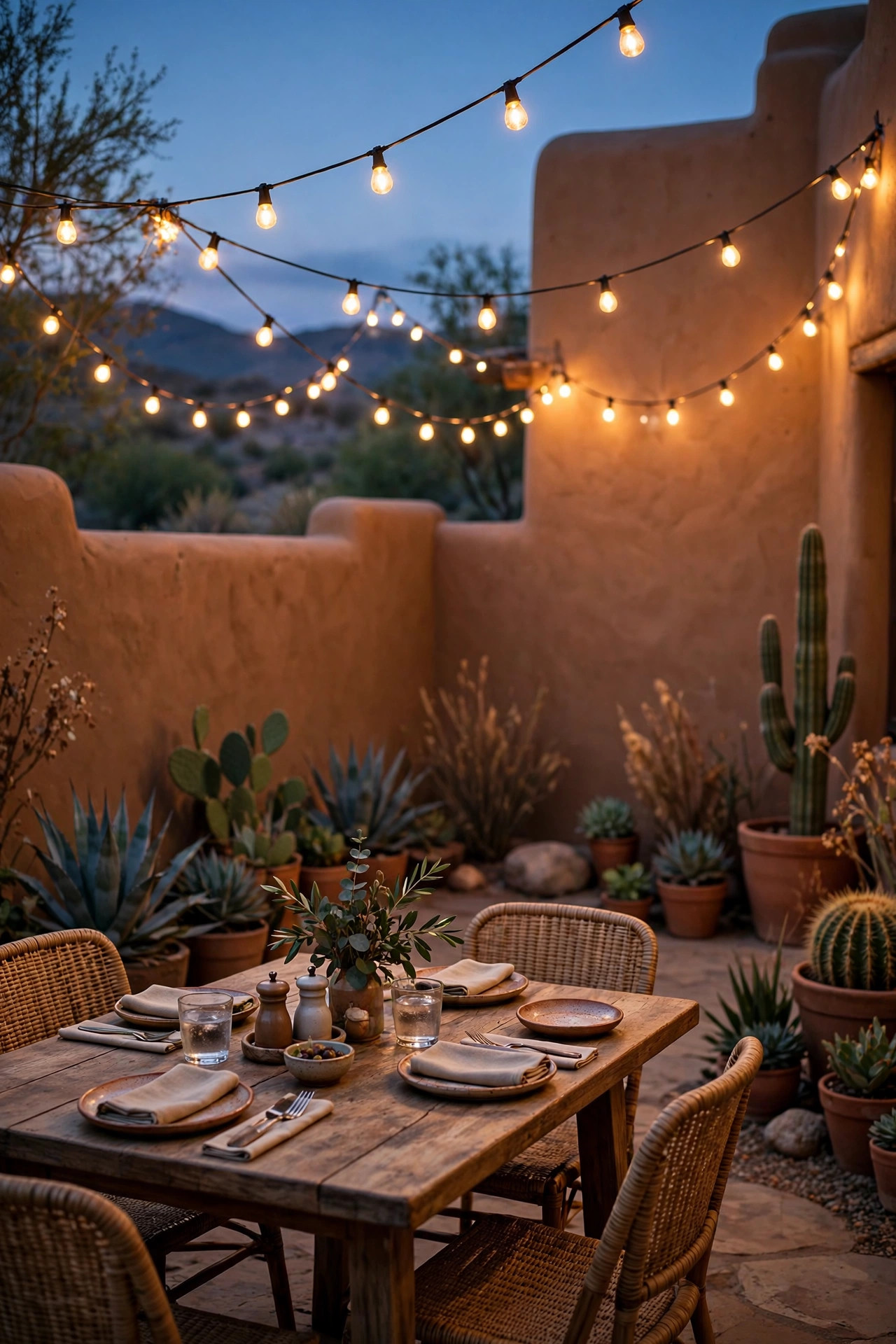
4. Swag Bistro String Lights Over the Patio
Nothing says patio season like a canopy of warm bulbs, and in the desert the season is basically October through May, so these lights earn their keep. Commercial-grade string lights are non-negotiable here: the cords are thicker, the sockets are sealed, and the whole strand tolerates heat that would sag a bargain set. Hang them from a ramada beam, a shade-sail pole, or two steel poles set in gravel, and always run a steel guide wire so the weight hangs on the wire, not the cord. Shatterproof LED filament bulbs are my pick — they give that 2200K candlelight warmth, sip power, and will not rain glass onto the patio if a monsoon gust gets frisky. Swag the strands in gentle scallops about 7 to 8 feet above the seating so heads clear and the glow feels like a ceiling. On a dimmer, they go from dinner-party bright to star-watching low, and that dimmer is honestly the hardest-working ten dollars in this whole list.
Suggested budget range: $60 – $220.
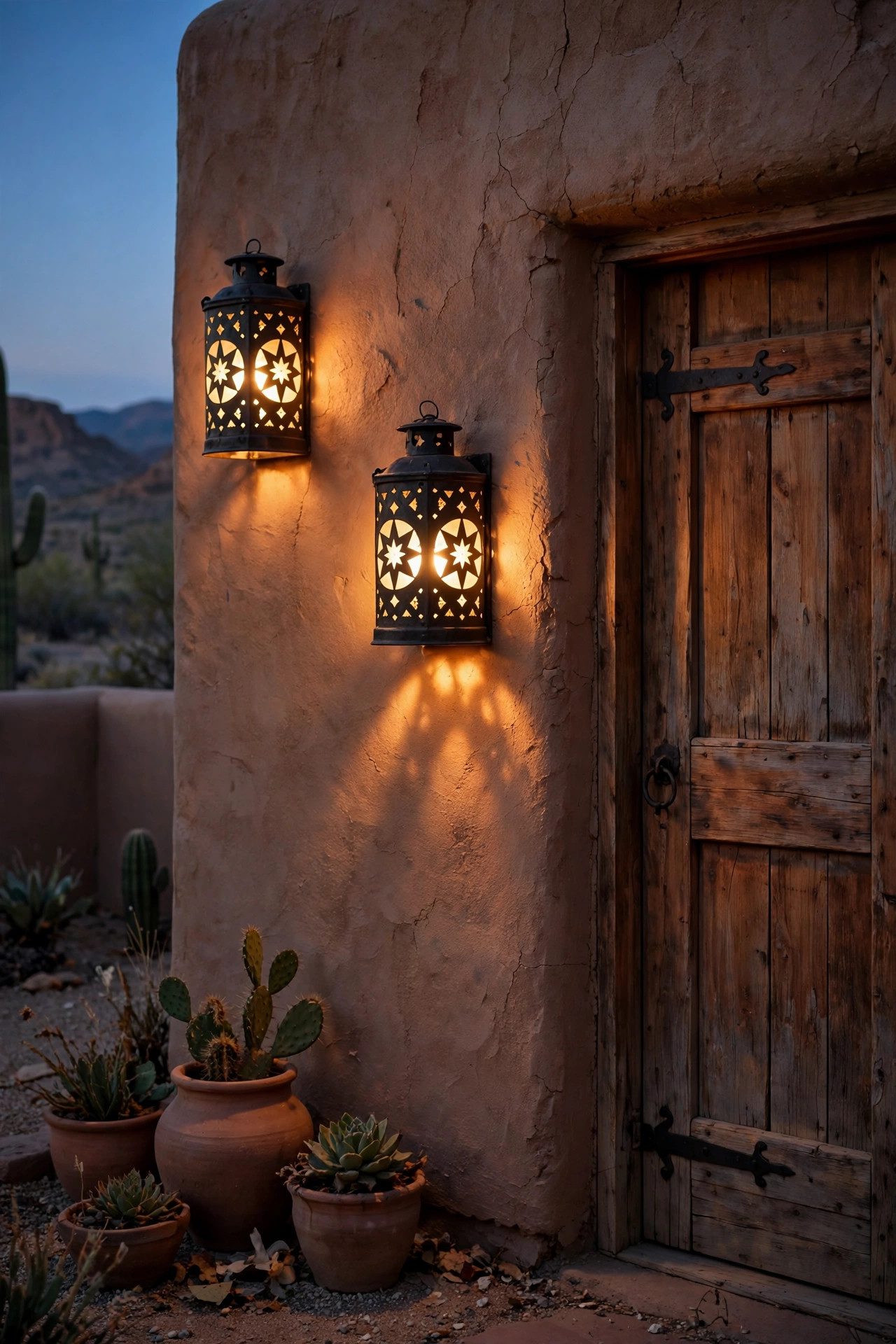
5. Mount Santa Fe–Style Sconces Beside Adobe Doors
Adobe and territorial-style homes deserve sconces that look like they grew there. I reach for punched-metal lantern silhouettes, seeded-glass panels, and rust-brown or matte-black finishes that echo window trim and vigas. Mount a pair flanking the back door or along a courtyard wall at about 66 inches to the center of the fixture, and choose designs that throw light downward or carry frosted glass — bare bulbs against pale stucco create a glare bomb you will regret every single evening. A 2700K LED inside warms the mud-plaster tones beautifully; stucco practically drinks warm light. If your walls are thick adobe, surface-mount fixtures with a shallow profile sit flatter and look more intentional than deep gooseneck arms. Wire them to the same switch as your patio strings and the whole courtyard wakes up as one scene. These are the fixtures guests photograph, so buy the pair you love rather than the pair on clearance — you will look at them from the dinner table roughly forever.
Suggested budget range: $45 – $180.
6. Cluster Punched-Tin Lanterns for Instant Southwest Character
Punched-tin lanterns are pure Southwest folk art — stars, suns, and swirling cutouts that throw patterned light across stucco and stone. Cluster three at staggered heights beside a seating nook or hang a row along a portal beam, and the wall behind them does half the decorating for you. Here is my firm desert rule, though: fill them with flameless LED candles, never real flame. Dry grass, brittle creosote, and one tipped lantern are a combination I do not gamble with, and modern flameless candles flicker convincingly enough that nobody has ever once asked. Solar versions with the panel tucked on top work nicely for clusters far from an outlet. The tin itself handles heat and sun beautifully, developing a soft patina over the years. Mix sizes — one tall floor lantern anchoring a corner, two smaller ones on a side table — and keep the color temperature matched so the cluster reads as a set. It is the easiest twenty-minute upgrade on this entire list.
Suggested budget range: $30 – $120.

7. Line Walkways and Rooflines With Modern LED Luminarias
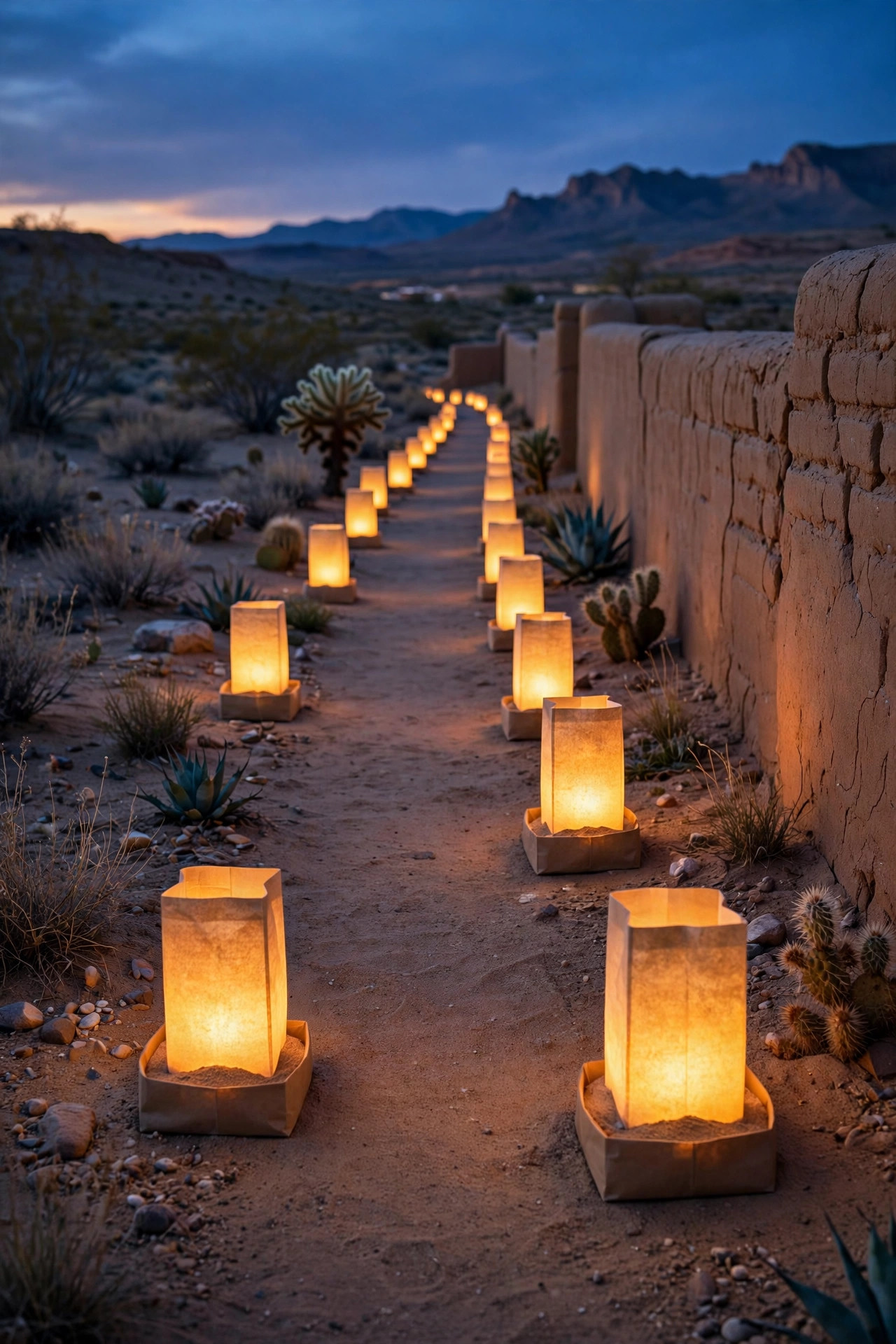
Luminarias — farolitos, if you ask a Santa Fe local — are the region's signature glow, traditionally paper bags weighted with sand and lit by a real candle. The look is unbeatable: a soft dotted line of amber light tracing a path, a wall top, or a roofline. The traditional materials, though, meet two modern problems: open flame in a dry, windy climate, and paper that disintegrates in the first monsoon shower. The fix is the new generation of molded luminarias in sand-toned plastic or metal, fitted with warm flicker LEDs. They read as the real thing from six feet away, they stay lit through a dust storm, and you can store them in the garage for eleven months and line the whole courtyard in an hour come December. I use them year-round along the garden path, honestly — the shape is so tied to this landscape that they never look like leftover holiday decor. Battery sets with timers are the most flexible; solar versions exist but dim noticeably on short winter days.
Suggested budget range: $35 – $140.
8. Surround a Sunken Fire Pit With Recessed Light
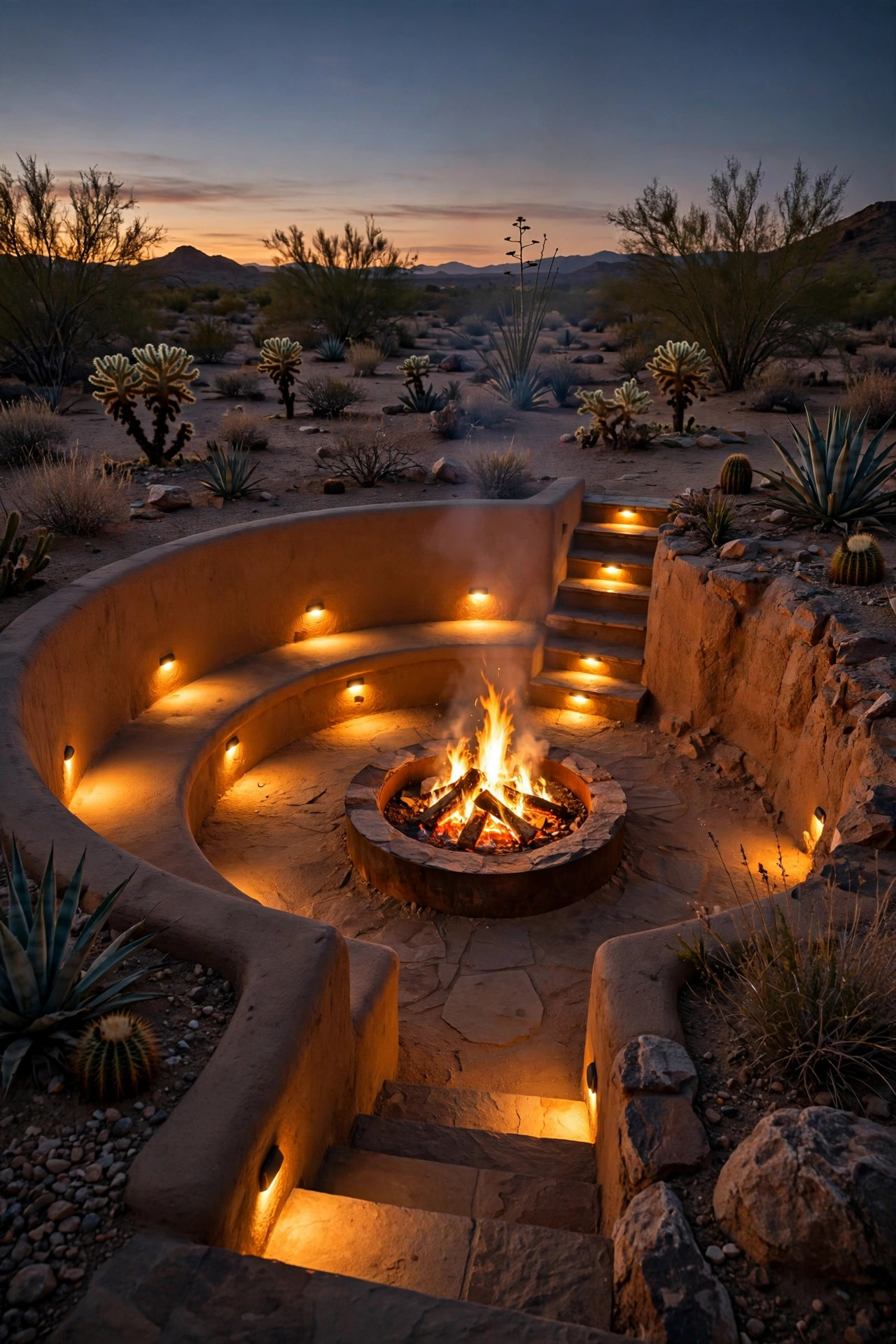
A sunken fire pit is the social center of a desert backyard from October onward, but the fire itself lights faces, not footing — the steps down and the seat wall behind you stay treacherously dark. I tuck small recessed LED step lights into the seat wall or the pit's outer edge, aimed down at the ground, so people can find their seat and their drink without a single beam competing with the flames. Put them on their own switch or dimmer, separate from the rest of the yard; once the fire is going, you will often want only these and the firelight itself. Choose fixtures rated for the heat zone — anything within a few feet of the firebox should be metal, not plastic, and wired lights should follow the same clearances a pro would use for a gas line installation. Keep the color warm, 2700K, so the electric light blends with firelight instead of fighting it blue. Done right, guests just perceive that the circle feels safe and golden, which is exactly the point.
Suggested budget range: $80 – $300.
9. Wash a Palo Verde or Mesquite With a Soft Uplight
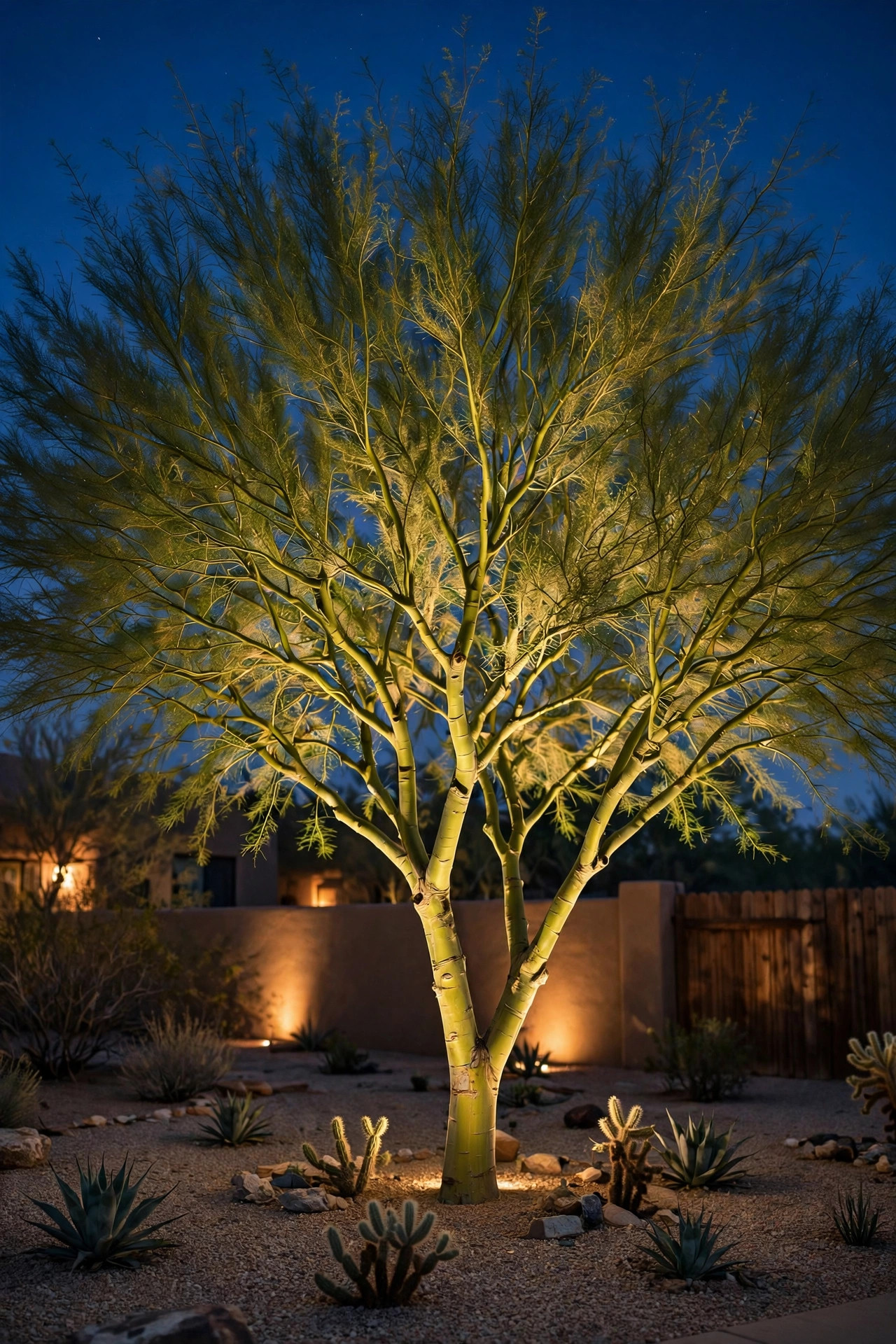
If a cactus is the desert's sculpture, the palo verde is its stained glass. That green bark photosynthesizes year-round, and a soft uplight turns the whole branching canopy into a glowing green lantern against the night sky. Use a wider flood here — 36 to 60 degrees — staked 2 to 3 feet from the trunk in the gravel, and aim for wash, not spotlight: you want the architecture of the branches lit, with light leaking prettily through the tiny leaves. Mesquites take the same treatment with a slightly tighter beam to trace their twisting trunks. One fixture per tree is plenty; two trees lit in a medium yard feels lush, five feels like a dealership. Keep the light off the trunk flare itself to avoid a hot spot at the base, and check the aim after monsoon season — a summer storm can nudge a stake just enough to send your beam into the neighbor's bedroom window, and nobody makes friends that way.
Suggested budget range: $40 – $160.
10. Accent Boulders and Rock Gardens With Grazing Light
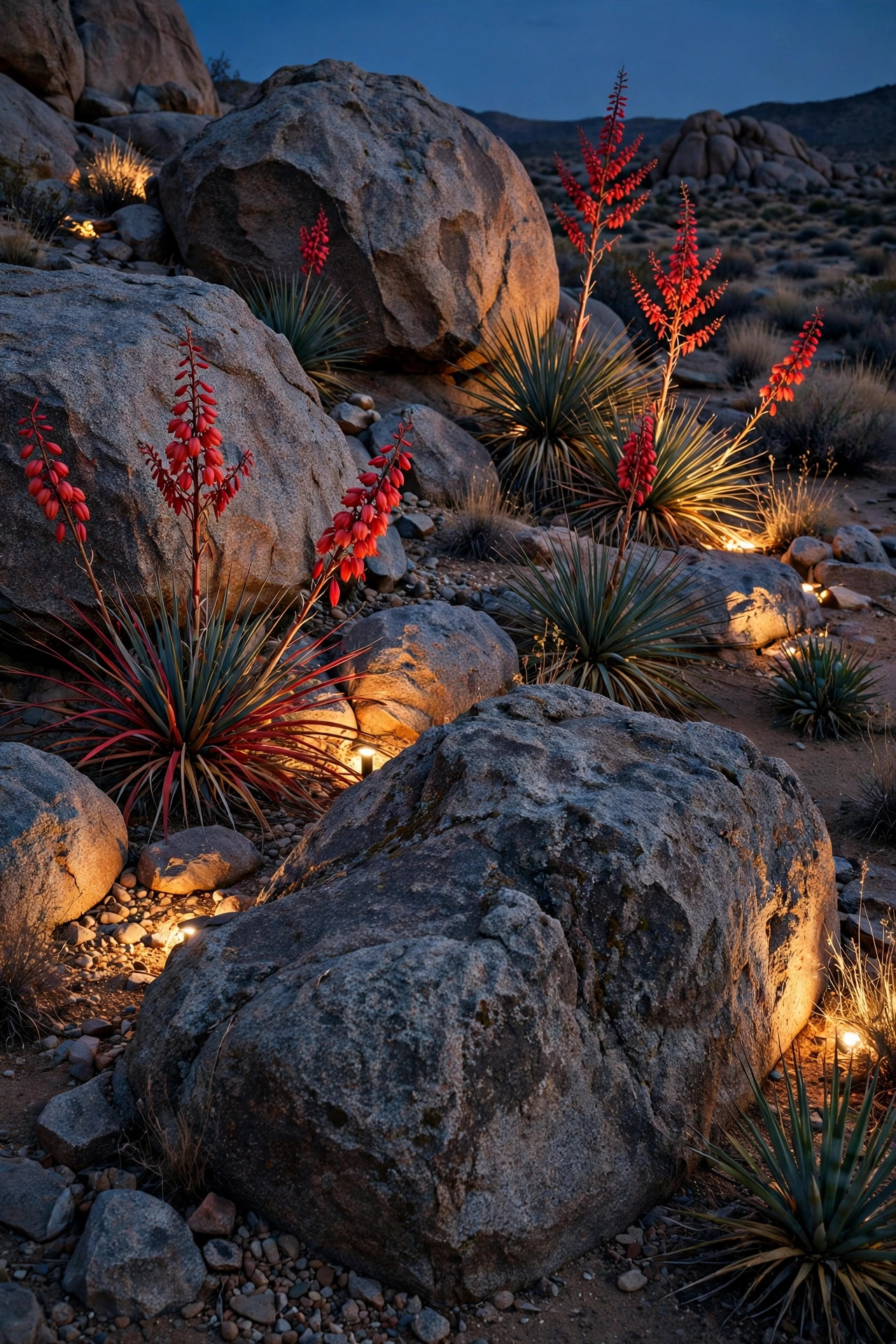
Desert landscaping trades lawn for drama: granite boulders, river rock, and gravel in three shades of rust. Grazing light is how you show it off after dark. Set a low, shielded fixture a few inches from a boulder's face and let the beam rake across it — every ridge and mineral seam throws a shadow, and a rock that looked flat at noon becomes a landscape painting at nine. Cluster plantings of red yucca or desert spoon around the boulders and one accent light can graze rock and plant in a single pass. I borrowed half of this technique from rock garden lighting ideas, where the same graze-and-shadow trick works at garden scale; in a desert yard, just scale the fixtures up and spread them wider. Restraint is everything: light two or three rock groupings, not every stone, or the yard turns into a geology museum gift shop. Warm light flatters the red and copper tones in the stone, and a matte bronze fixture disappears against the gravel by day.
Suggested budget range: $50 – $200.
11. Turn the Pool Into a Glowing Desert Oasis
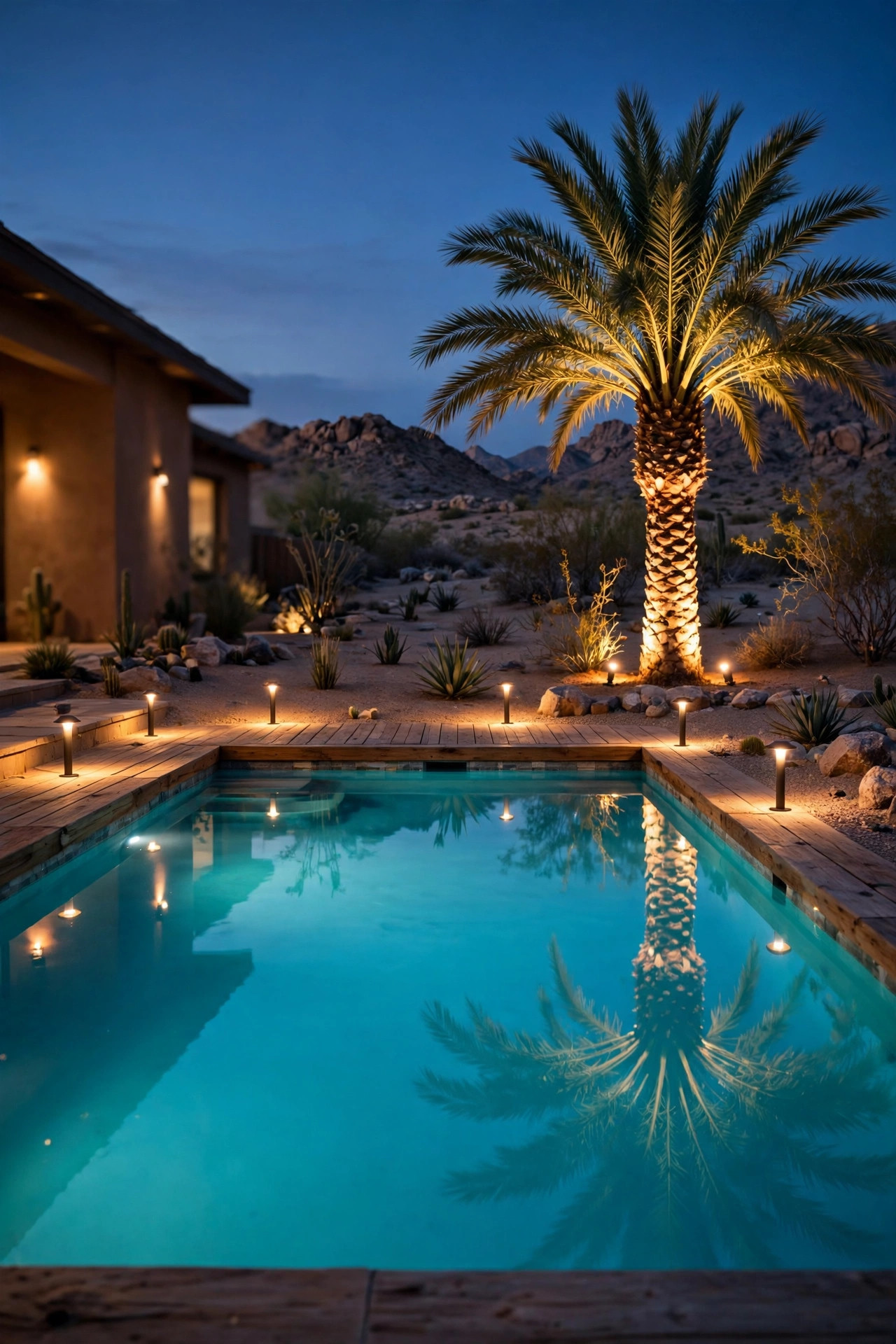
In Phoenix and Tucson, the pool is not a luxury, it is a survival strategy — and at night it becomes the yard's mirror. Modern LED pool lights in warm white (skip the color-show disco modes, or save them for the grandkids) turn the water into a glowing turquoise sheet that doubles every other light in the yard by reflection. Underwater fixtures are a pro job, full stop: water, electricity, and code requirements are not a DIY cocktail. What you can do yourself is the frame around it — low path lights along the pool deck's walking edge, one uplight on a palm or mesquite at the far end, and sconces on the pool house or wall so the whole scene layers. Everything near water goes on a GFCI circuit, no exceptions, and any fixture within reach of the deck should be rated for wet locations. The effect I am after is resort-quiet: you should see the glow and the water, never the hardware.
Suggested budget range: $150 – $800.
12. Moonlight From a Tall Mesquite or Shade Sail
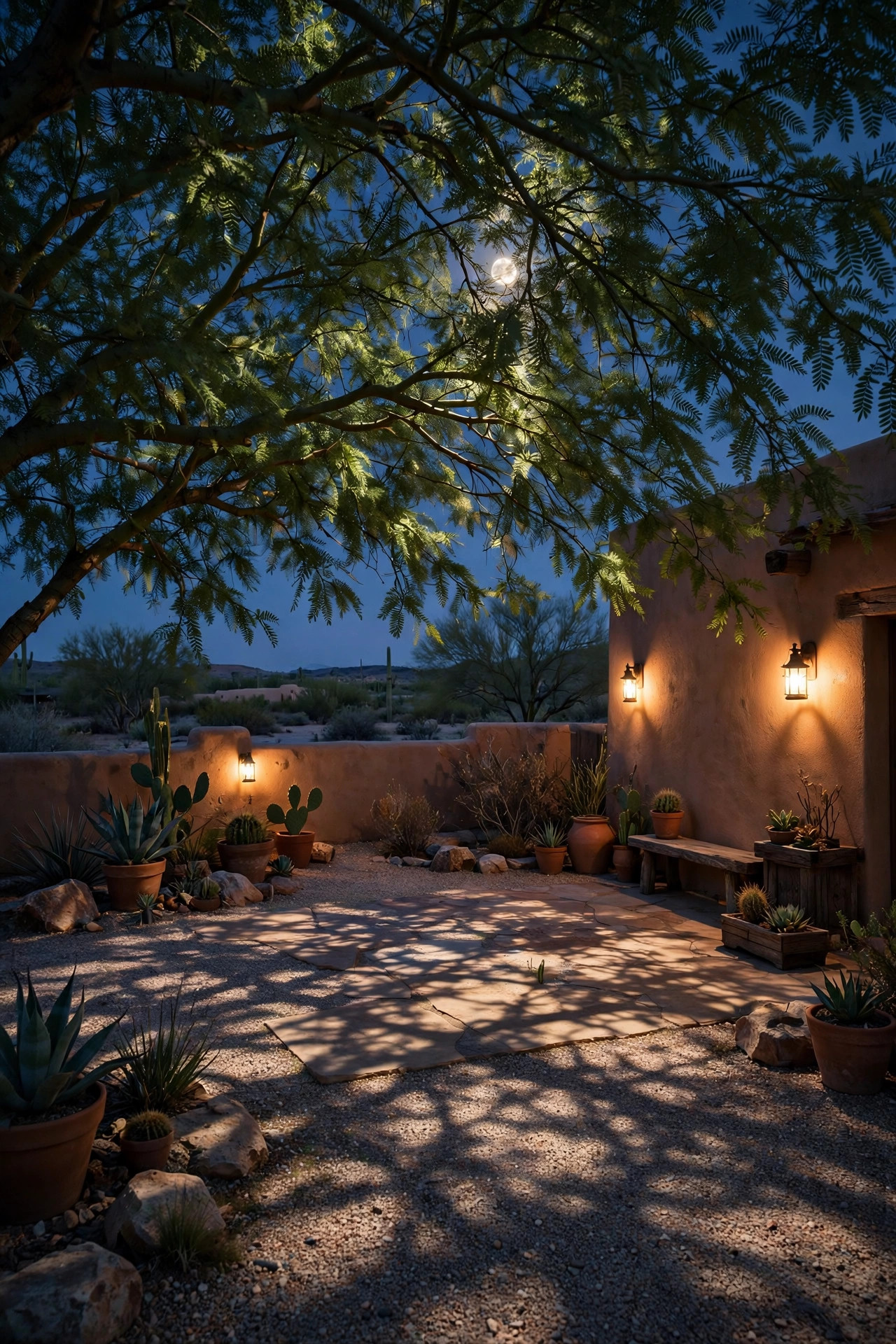
Moonlighting is the most natural-looking trick in lighting: a fixture mounted high — 15 to 20 feet up in a mature mesquite, or on a tall shade structure — shining down through branches so the ground gets the dappled, shifting pattern of real moonlight. In the desert it solves a specific problem: our yards are mostly hard surfaces and gravel that bounce harsh light around, but dappled light through a canopy softens everything it touches, including the dining patio below. Use a 2700K LED in a shielded, downward fixture with a long glare guard; from below, you should see lit leaves, never the bulb. The mounting height makes this the one job I happily hand to a pro with the right ladder and tree-friendly straps — never screws or nails in a living tree, which invite disease into a slow-growing desert native. The payoff is a patio that feels lit by weather rather than hardware, and on windy evenings the shadows actually move. It is pure magic, and it is the idea neighbors ask about most.
Suggested budget range: $120 – $450.
13. Choose Fully Shielded Fixtures and Keep the Night Sky Dark
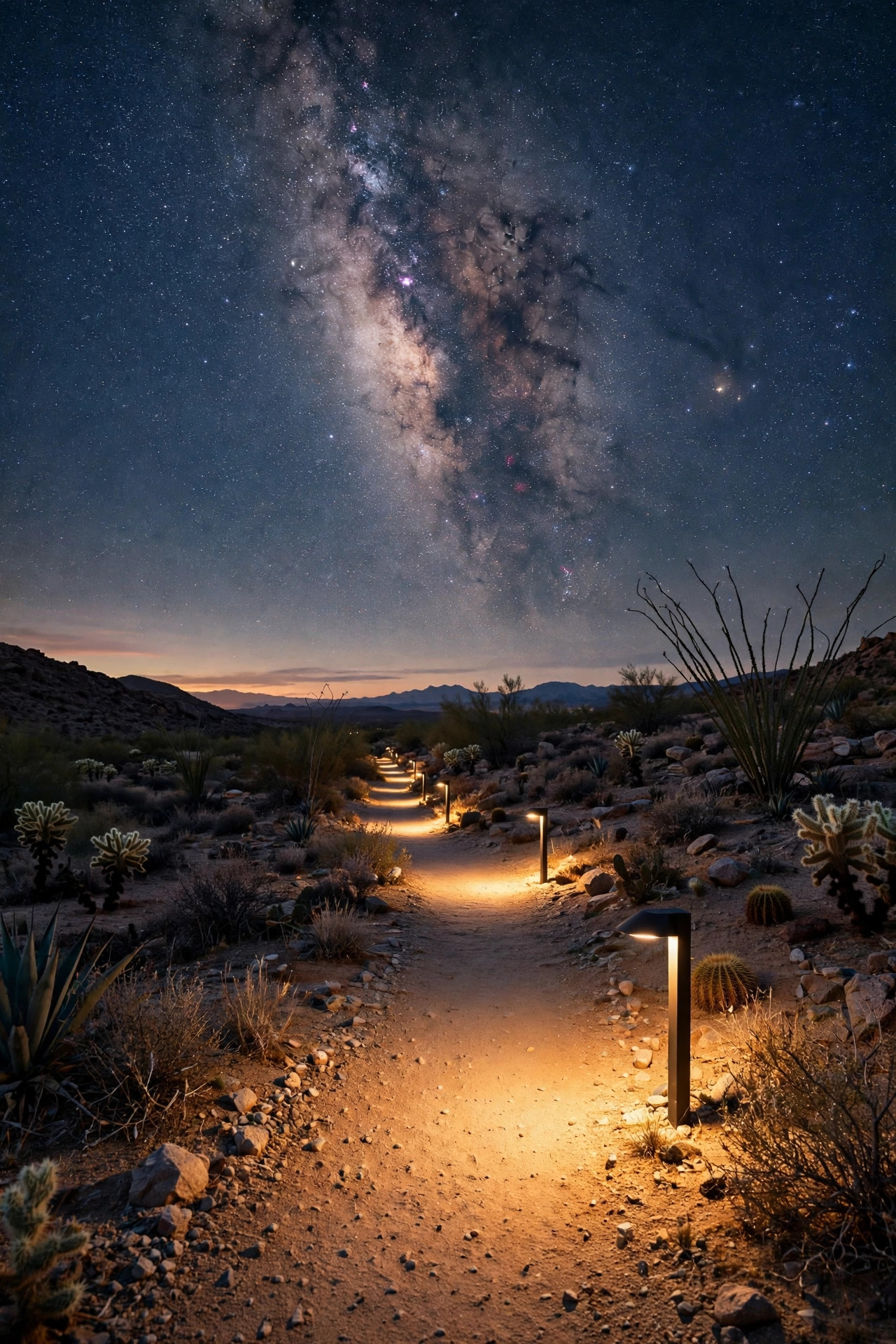
Flagstaff was the world's first International Dark Sky City, and towns across Arizona and New Mexico have followed with lighting ordinances — because out here, the Milky Way is a feature of the property, not a metaphor. Even where no ordinance applies, shielded lighting is simply better manners and better design. A fully shielded fixture caps the bulb so all light travels down where you need it; nothing spills up into the sky or sideways into a neighbor's window. Pair that with warm color temperatures — 2700K or lower reads amber and calm, while blue-white light is what scatters and glares — and put accent lights on timers that click off by 10 or 11 p.m. Our dark-sky outdoor lighting guide covers fixture ratings and the shielding labels to look for on the box. You will be surprised how little light you actually need once every lumen is aimed at the ground instead of the cosmos: paths get clearer, faces get softer, and the stars come back like somebody turned them up.
Suggested budget range: $70 – $300.
14. Light the Ramada With Downlights and a String-Light Border
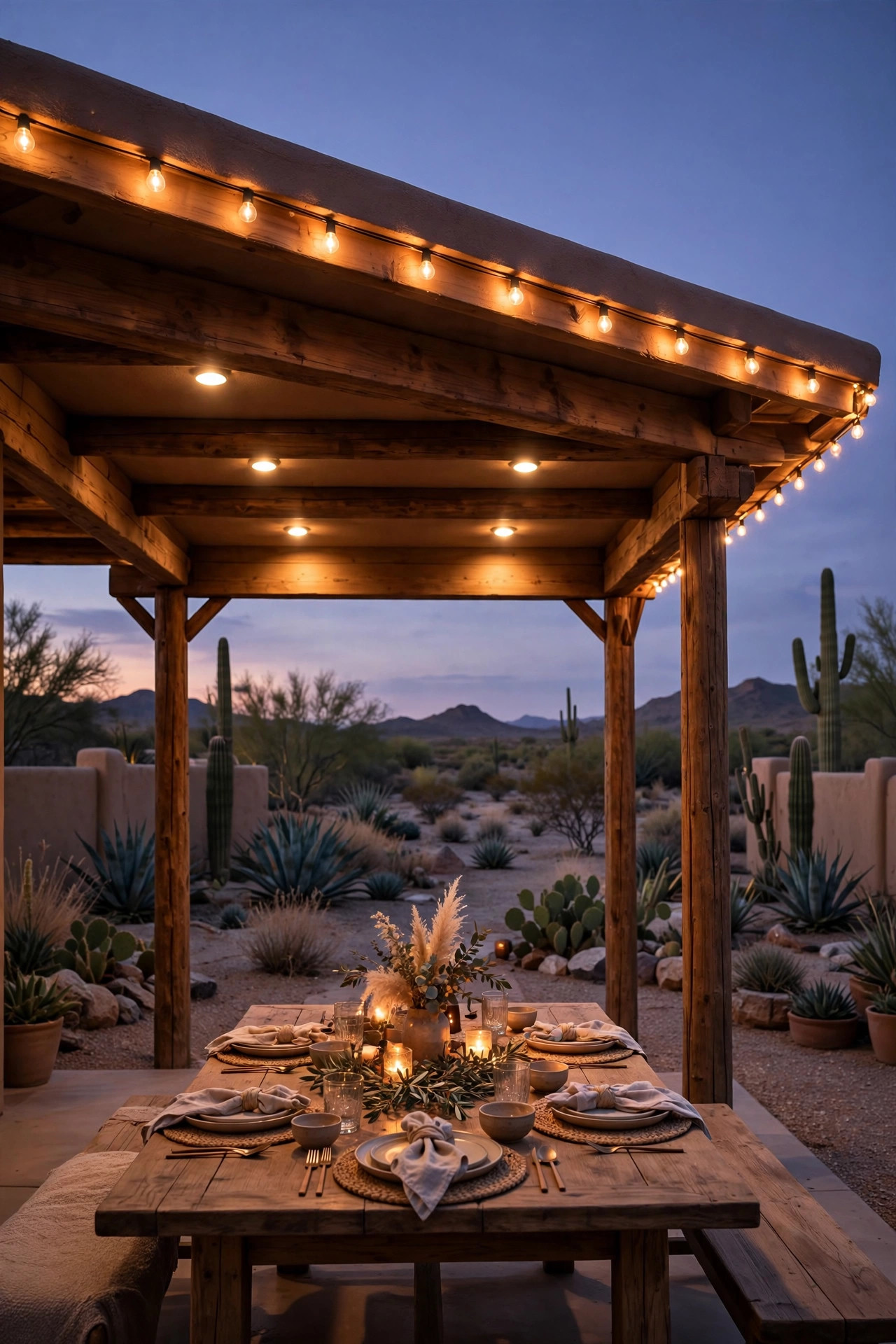
The ramada — our open-air, roofed patio — is where desert life actually happens, so it deserves real lighting design, not one bare bulb. I run two systems. First, soft downlights: recessed cans or short pendants over the dining table, on a dimmer, aimed at the tabletop so faces glow and the ceiling stays moody. Second, a border of string lights around the ramada's edge, which defines the room without a wall and gives that festive outline you can see from the far end of the yard. Keep both at 2700K so they blend into one warm scene. Heat note: fixtures under a solid roof sit in trapped hot air all summer afternoon, so choose LEDs with metal heat sinks and honest temperature ratings; the cheap ones cook themselves dim by August. A ceiling fan with an integrated dimmable light kit is a fine two-for-one in this climate, as long as the light is on its own dimmer, separate from the fan speed. Dinner at nine, stars at ten, all from the same chairs.
Suggested budget range: $100 – $400.
15. Set Low Bollards Into Decomposed Granite Beds
Bollards — short, sturdy posts of light — are built for desert beds. Their sealed, louvered heads throw a wide, low pool of light across decomposed granite without glare, and the metal bodies laugh at heat that melts lesser fixtures. Set them into the beds flanking a path or driveway rather than in the walkway itself, spaced 5 to 7 feet apart, and drive the stakes deep: compacted DG holds a stake like concrete once it settles, but a shallow stake in loose gravel will lean by July. Choose IP65 or better so monsoon dust and driven rain stay out of the optics, and wipe the louvers when you wipe your solar panels — desert dust films everything, and a filmed lens can lose a third of its light without looking dirty. Low-voltage wired bollards are the reliable choice for a main route; solar bollards work on secondary paths where a dimmer night or two is no hardship. Their clean vertical line suits territorial and modern desert architecture especially well.
Suggested budget range: $60 – $250.

16. Give the Outdoor Kitchen Real Task Light
Desert evenings revolve around the grill more than the dining room does, and nobody can judge a steak's doneness under mood lighting. Give the cooking zone honest task light: a heat-rated fixture on the wall or ramada post washing the grill surface, plus an LED strip under a nearby counter lip or rail so prep space and tongs are visible. This is the one spot where I allow 3000K — a touch crisper than the rest of the yard — because color accuracy matters when chicken is involved, and the small temperature difference disappears once you step back to the table. Keep switches separate so the work light dies the moment dinner is served and the yard returns to candlelight mode. Watch clearances: strips and fixtures near the grill need metal housings and distance from the firebox, following the grill maker's own heat clearances. It is unglamorous lighting, right up until the first perfectly timed ribeye changes your mind about that.
Suggested budget range: $50 – $280.
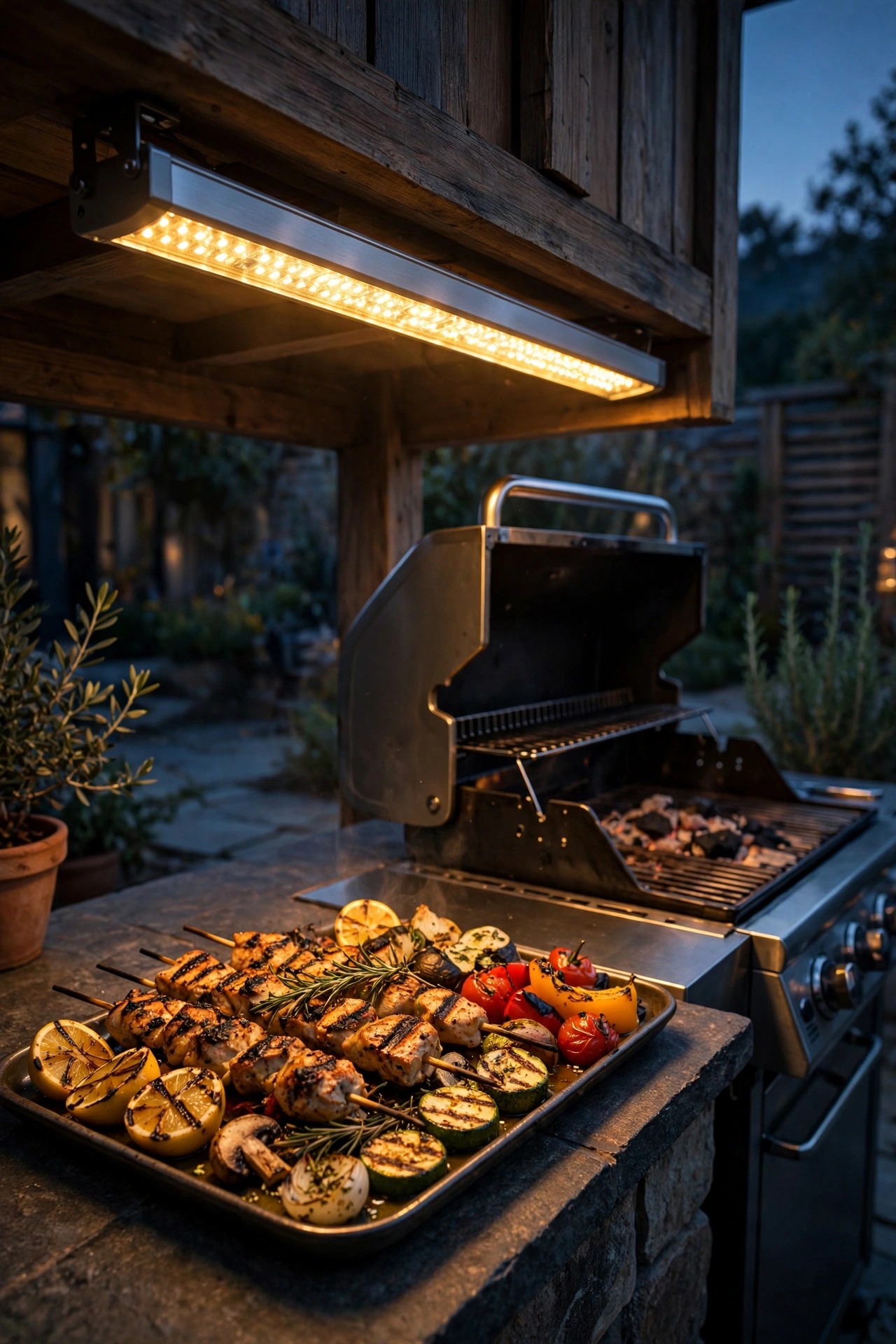
17. Make Terraced Steps Safe With Recessed Step Lights
Terraced yards are the desert norm — lots slope, patios step down to pools, and adobe or flagstone steps connect it all. Those steps are beautiful at noon and ankle-breakers at nine without light. Recessed step lights, set into the riser or the wall beside each tread, are the cleanest fix: a small shielded slot of light that washes the tread below and nothing else. One per step is ideal; every other step works on wide, shallow runs. If your steps are finished adobe or stone you would rather not cut into, surface-mount versions in a matching rust or bronze finish sit nearly as flush and install in an afternoon. Solar step lights exist, but on a shaded north-facing stair they will fade by midnight, so wire the main staircase and save solar for a garden step or two. This is safety lighting, and I never put it on the party dimmer — it stays on its own photocell, dusk to dawn, every night of the year.
Suggested budget range: $90 – $350.

18. Go Amber After Dark for Wildlife (and Fewer Bugs)
Here is a trick from desert resorts: after ten, switch the yard to amber. Light at 2200K or in a true amber LED reads like firelight, flatters skin and stucco, and — the practical magic — attracts a fraction of the insects that white light summons, which in moth and beetle season is reason enough. It is also gentler on the desert's night shift: bats, moths, and the owls that hunt them all do better under dim amber than under blue-white glare. I put amber bulbs in the late-night fixtures — the path lights and porch sconce on the timer that runs past bedtime — while dinner-hour fixtures stay 2700K. And because this is the desert, one honest footnote: amber light will not spot a scorpion for you. Keep a cheap UV flashlight by the back door; scorpions fluoresce bright green under it, and a ten-second scan of the patio before barefoot o'clock is a habit every desert household should have.
Suggested budget range: $30 – $130.
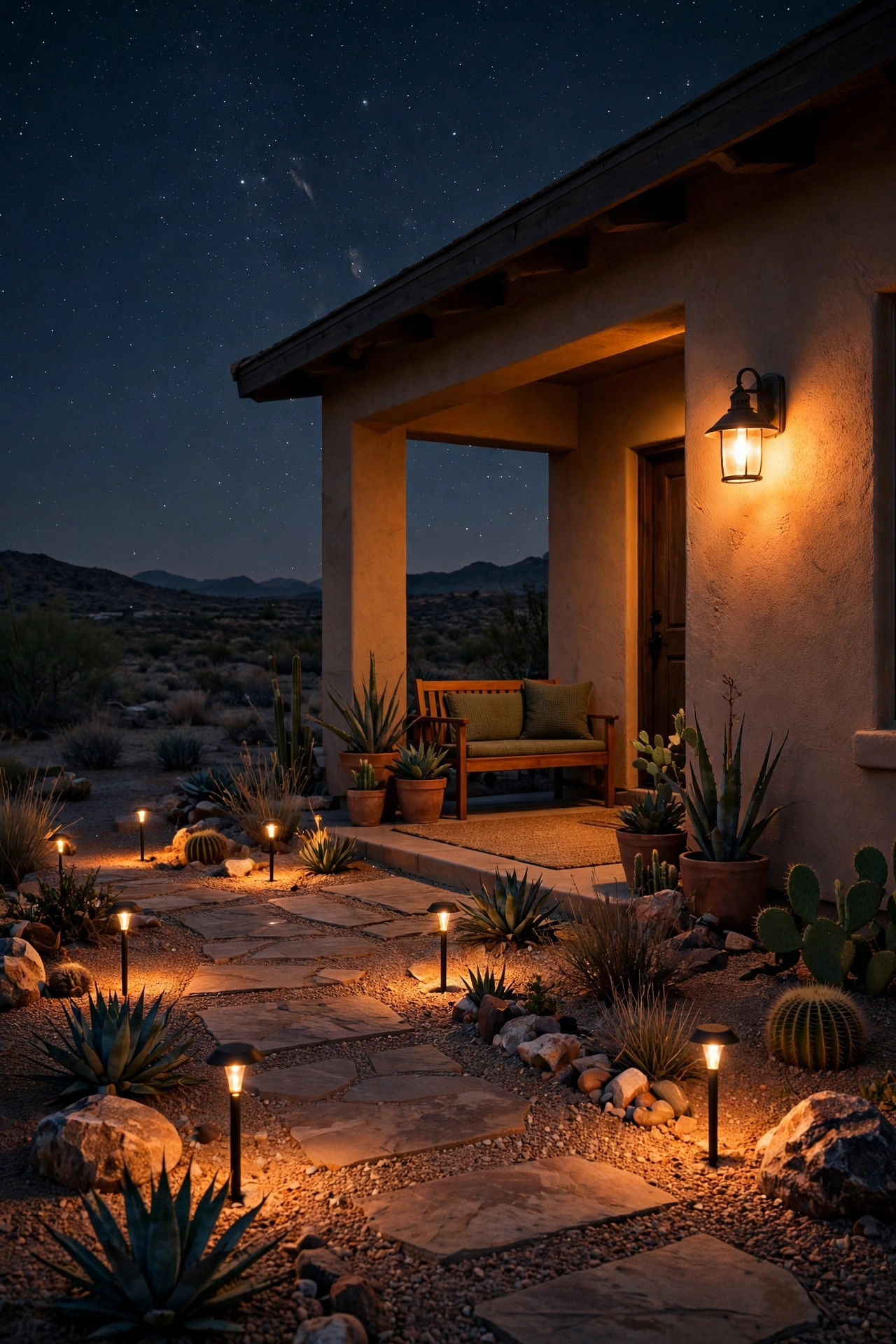
19. Tie It All Together: Desert Backyard Lighting Ideas That Respect the Dark
However you build your system, finish with this ritual: wait for full dark, pour something cold, and walk the whole yard slowly with a notebook. Sit in every chair. Stand where guests will stand. You will spot the fixture glaring into the dining seats, the corner that went cave-dark, the uplight that drifted two degrees into the street — things no daylight install ever reveals. Adjust angles, swap one bulb warmer, nudge a timer an hour later. Then walk to the sidewalk and look back: the goal is a yard that glows like embers, with the mountains and sky still black behind it. That walk-through is where good desert backyard lighting ideas become your yard's actual personality, and it costs nothing but an evening. Repeat it after the first monsoon, when stakes shift and dust films the lenses, and once in December when the luminarias come out. Ten minutes of tuning twice a year keeps a desert system looking designed instead of merely installed — and keeps you outside, under those stars, which was the point all along.
Suggested budget range: $0 – $75.
Frequently Asked Questions
What color temperature is best for a desert backyard?
Warm, always. I stay between 2200K and 2700K: it flatters adobe, terracotta, and weathered wood, matches firelight, and keeps light pollution low because warm light scatters less in the sky. Reserve 3000K for the grill station only, and avoid daylight-white bulbs entirely — they make a desert yard look like a parking lot and flatten every texture you paid to showcase.
Can solar lights survive desert summers and dust storms?
The good ones can, but choose like you mean it: metal housings instead of plastic, replaceable batteries, and panels you can reach. Heat shortens battery life, so expect two to three years per battery rather than the five promised on the box. Wipe dust off the panels monthly — a filmed panel is the number one reason desert solar lights mysteriously go dim — and pick remote-panel models for spots shaded by trees or the house.
How do I keep my lighting dark-sky friendly?
Three habits do it: shield everything so light only travels down, keep brightness modest (you need pools of light, not a stadium), and put accents on timers that end the show by 10 or 11 p.m. Warm color temperatures help too. Many Arizona and New Mexico towns now require exactly this, so building dark-sky habits into your design keeps you legal, neighborly, and swimming in stars.
What fixtures hold up best in desert sun and monsoon rain?
Powder-coated aluminum, copper, and heavy composite fixtures with an IP65 rating or better. Cheap plastic turns brittle and chalky within a couple of summers, and unsealed fixtures fill with the fine dust that rides every haboob. Run anything wired through a GFCI outlet, bury low-voltage cable a few inches under the gravel, and re-check fixture aim after big storms — wind and washouts shift stakes more than you would expect.
Conclusion
The yards that stop me on evening walks out here are never the brightest ones. They are the ones where a palo verde glows like green glass, the path is a quiet dotted line of warm pools, and the stars still run the show overhead. Start with the layer that solves your biggest problem — safe footing, a dinner table you can actually see across, or one beloved cactus in the spotlight — and let the rest follow over a season or two. These desert backyard lighting ideas are forgiving that way: add a layer, live with it, adjust. Then pour something cold, step out onto the warm stone, and browse the rest of my outdoor lighting ideas here whenever you are ready for the next project.