There is nothing quite like a beach house patio at golden hour: the breeze off the water, sand still warm underfoot, and that soft light settling over the dunes. But if you have ever watched a pretty fixture turn orange with rust after one season, you already know the hard truth. Salt air is relentless, and ordinary outdoor lighting simply is not built for it. The good news? The right beach house patio lighting ideas are designed for exactly this environment, so you can have that warm, layered glow without replacing corroded fixtures every spring. In my experience, coastal lighting works best in layers: a dependable base of marine-grade fixtures, softer accent light at sitting height, and a little sparkle overhead. Below I am sharing 17 ideas that have survived real salt spray, humid nights, and sandy feet at my own shore place, plus the materials and ratings that actually matter. Every pick favors sealed housings, rustproof metals, and LED sources that sip power. Whether your patio is a small deck over the dunes or a big wraparound porch, you will find a mix here that looks beautiful on night one and still looks beautiful three summers later.
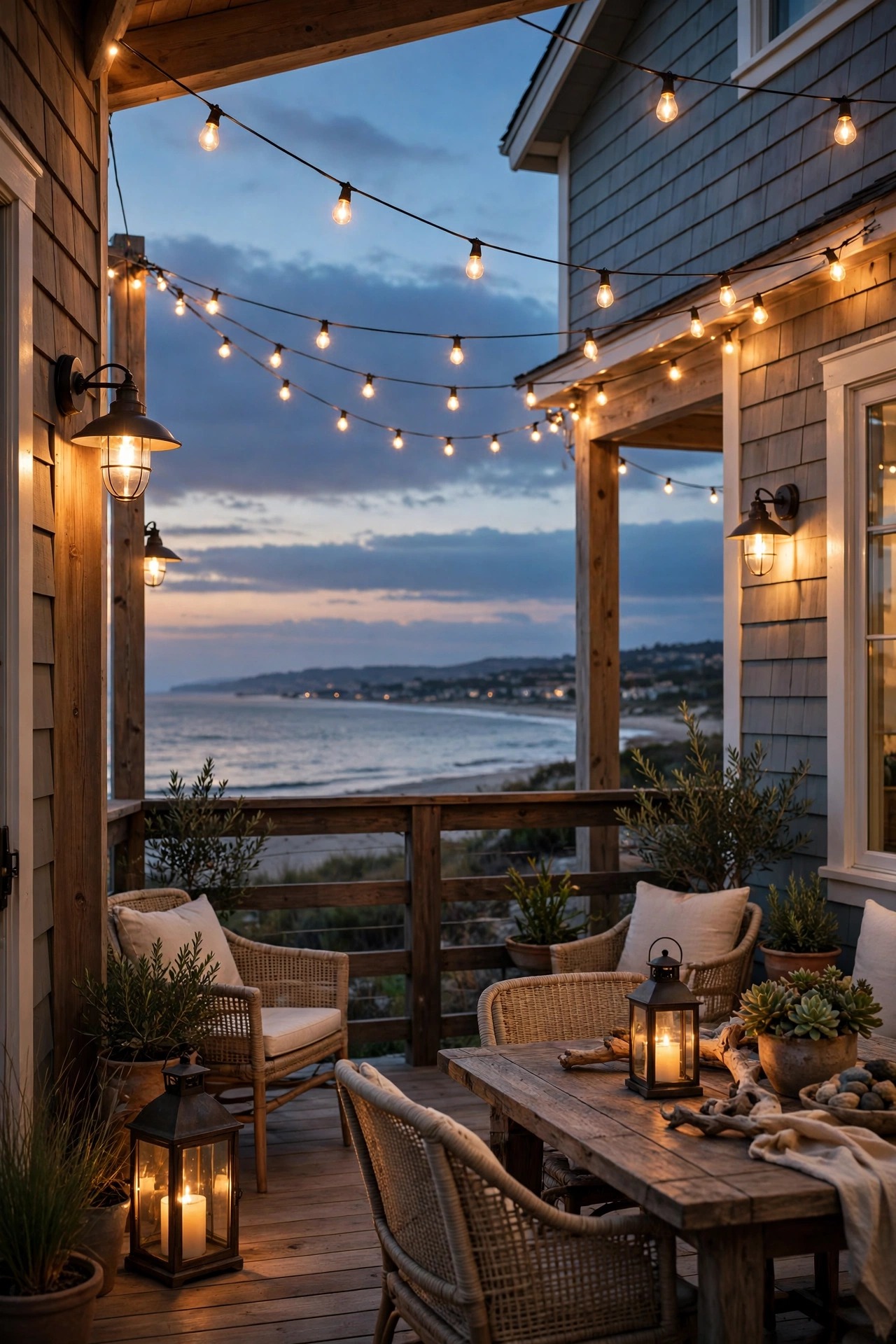
1. Start With Marine-Grade Stainless Sconces by the Door
If you buy one serious fixture for a coastal patio, make it the door sconce, and make it marine grade. Look for 316 stainless steel, the grade used on boats, because it contains molybdenum that resists the pitting and tea-staining salt air causes on cheaper 304 stainless. Solid brass and copper are also wonderful choices; both develop a soft patina instead of rusting through. Mount a pair flanking the patio door at about 66 inches from the floor to the center of the fixture, which keeps the glow at eye level without glare. Choose enclosed or louvered designs so wind-driven rain and spray cannot reach the bulb, and check for a wet-location rating rather than just damp. I always recommend warm 2700K LED bulbs here, around 800 lumens each, so the entry feels welcoming instead of like a dock floodlight. Every spring, wipe the fixtures down with fresh water and a soft cloth; that two-minute habit rinses off salt crystals before they can bite into the finish. It sounds fussy, but honestly, it is the single easiest way to double the life of coastal fixtures.
Suggested budget range: $90 – $260.
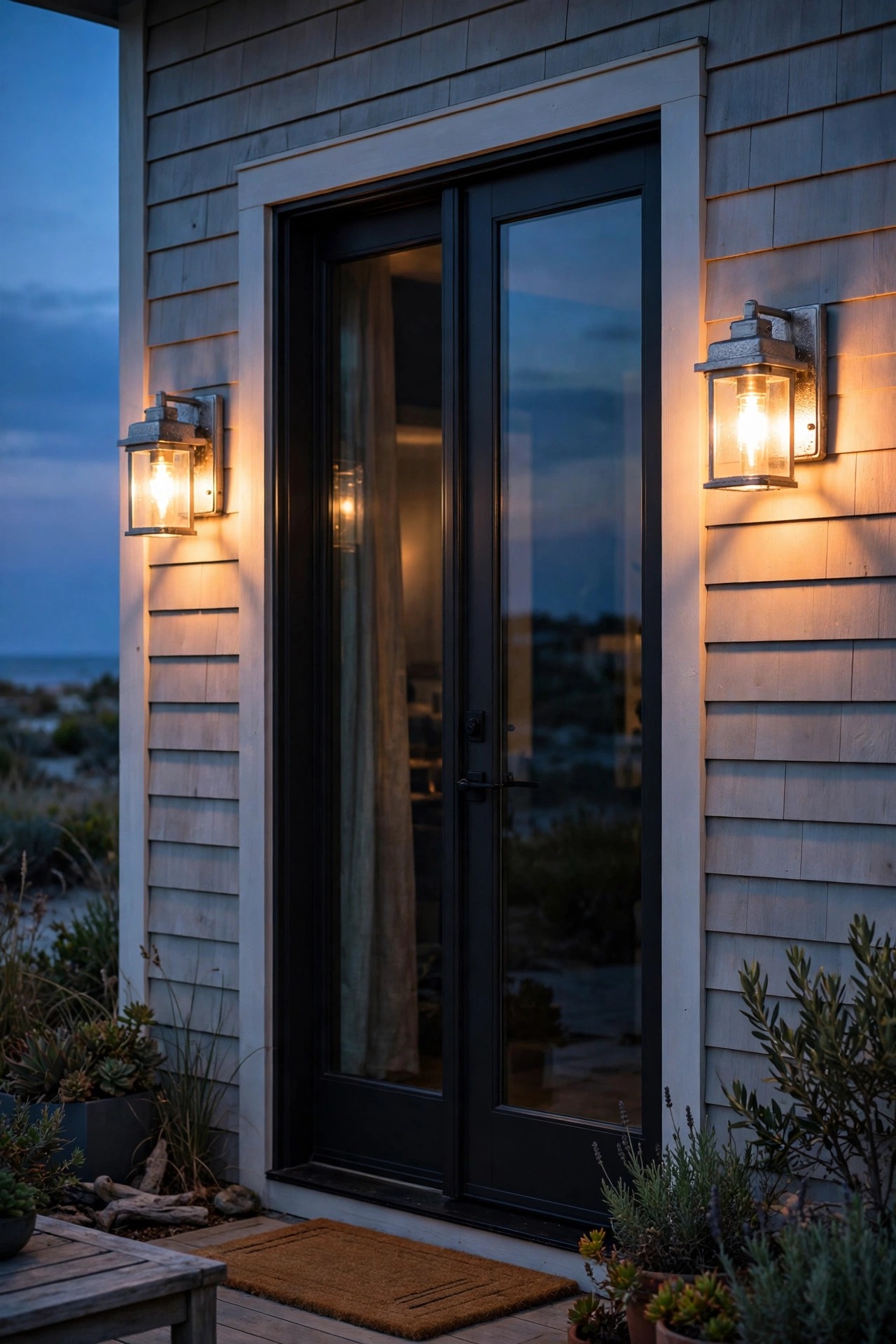
2. Solar String Lights: The Easiest of All Beach House Patio Lighting Ideas
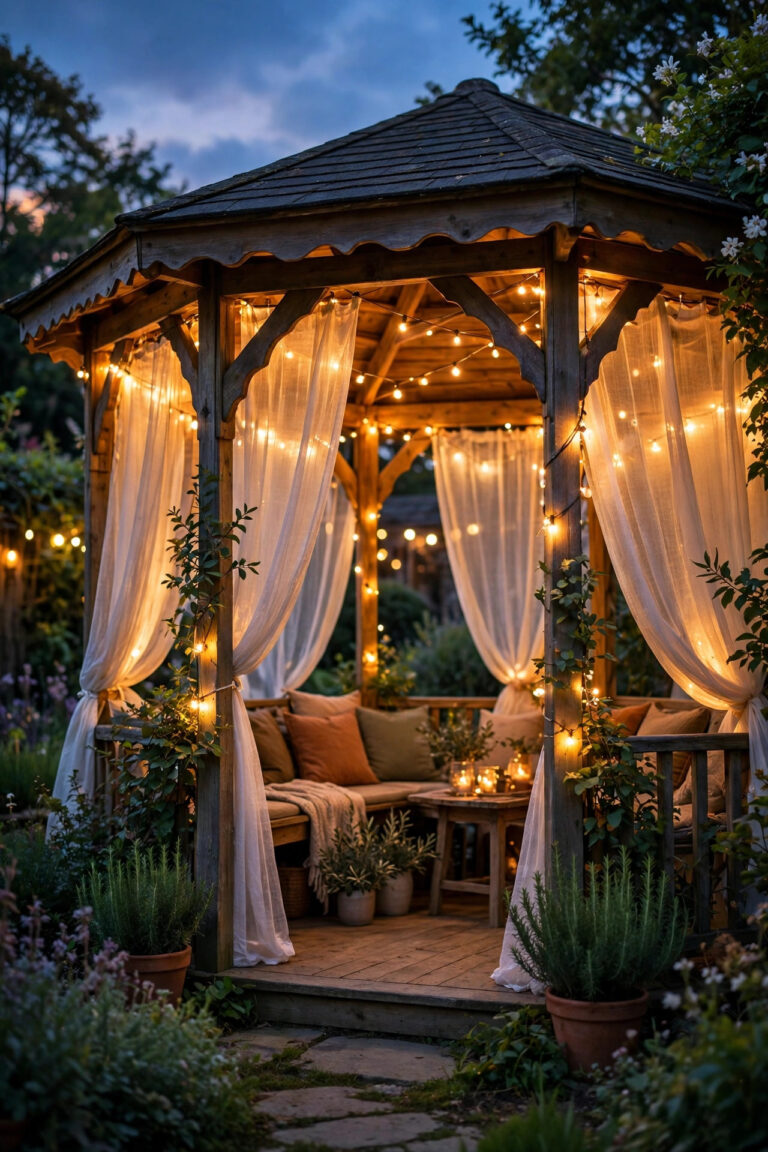
String lights are the fastest way to make a beach patio feel magical, and solar versions are my top pick near the coast because there is no outlet, no cord to trip over in the sand, and no metal socket strip quietly corroding in the sea breeze. Look for strands with shatterproof plastic bulbs and fully sealed sockets rated IP65 or higher; those sealed sockets are what keep salt fog out. Hang them in gentle swags between the house and a pergola post, keeping the solar panel in full sun, ideally on a south-facing rail or roof edge where it gets six to eight hours of light. Bulbs spaced about 12 inches apart give that classic cafe look, and warm white is far more flattering than cool blue tones against weathered wood. If your patio is shaded, choose a strand with a detachable panel on a ground stake so you can park the panel in a sunny spot a few feet away. For more strand styles that hold up outdoors, I keep coming back to the tricks in our guide to solar string light ideas. On breezy nights, add a few small clips along the run so the strand does not slap against the siding.
Suggested budget range: $25 – $70.
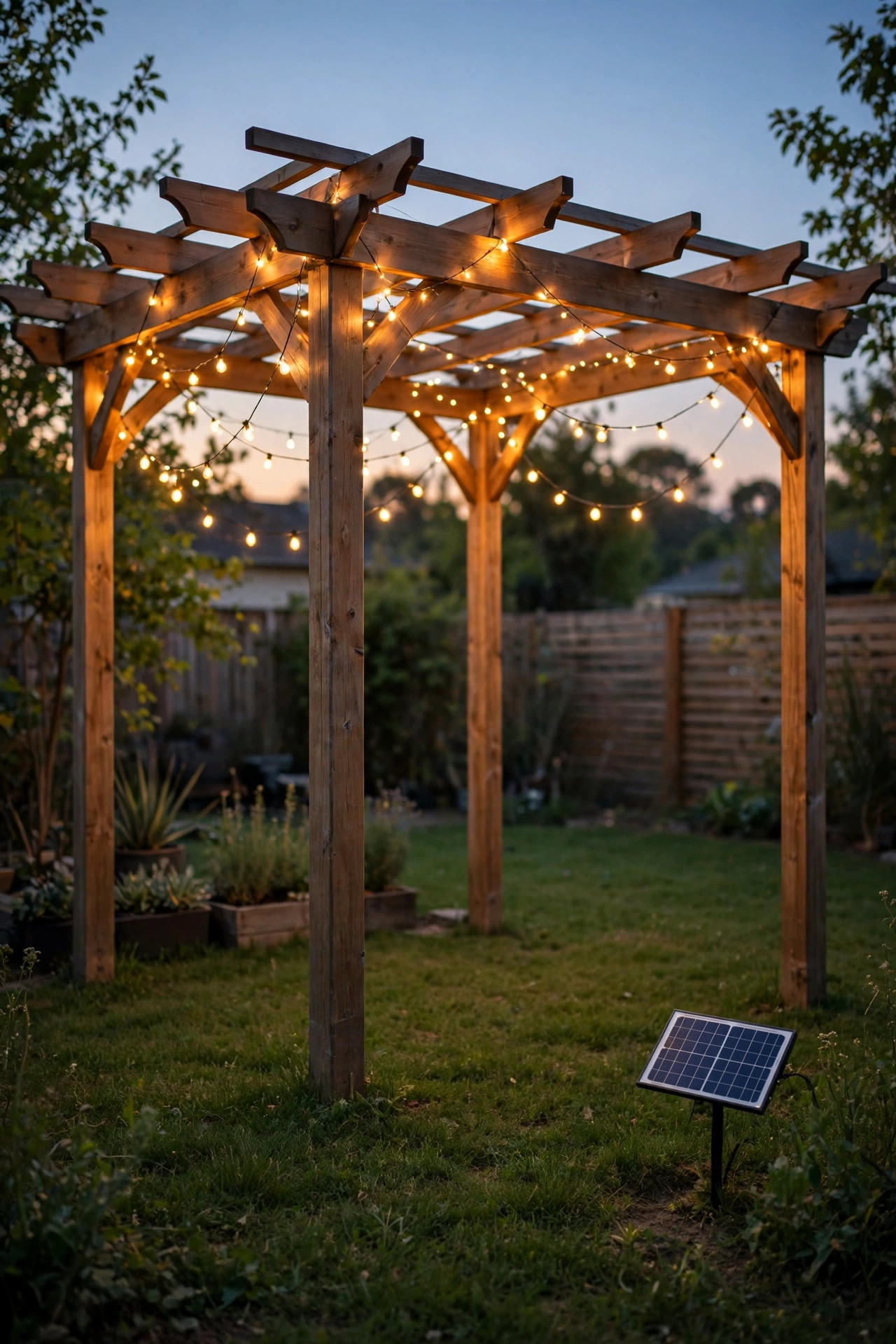
3. Rope-Wrapped Lanterns With Flameless Candles
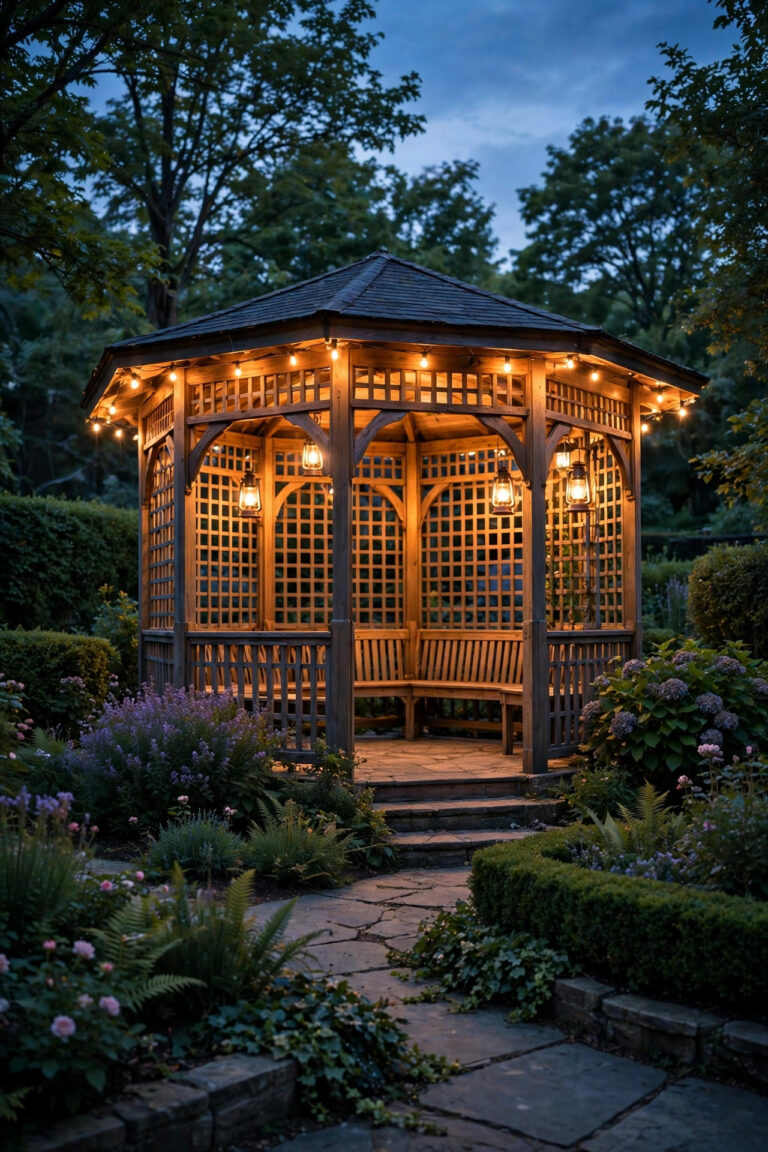
Nothing says beach house like rope, glass, and a flickering candle, but real flames and coastal wind are a miserable match. My solution is lanterns wrapped in natural manila or sisal rope with flameless LED candles inside. The candles run on timers, usually five hours on and nineteen off, so they glow to life every evening without you hunting for a lighter in the wind. Group them in odd numbers: a trio on the coffee table, a pair flanking the steps, one big statement lantern beside the lounge chair. Because these move around so easily, they are perfect for renters and for storm season, since you can carry the whole set inside in two minutes flat. Choose lanterns with powder-coated or galvanized frames rather than bare steel, and glass panels you can rinse, because salt film dulls glass faster than you would expect. A quick freshwater rinse every few weeks keeps the candlelight looking crisp. The flicker setting on most LED candles is surprisingly convincing, and honestly, guests never guess they are not real until they lean in close on a windy night and notice the flame is not even trembling.
Suggested budget range: $30 – $90.
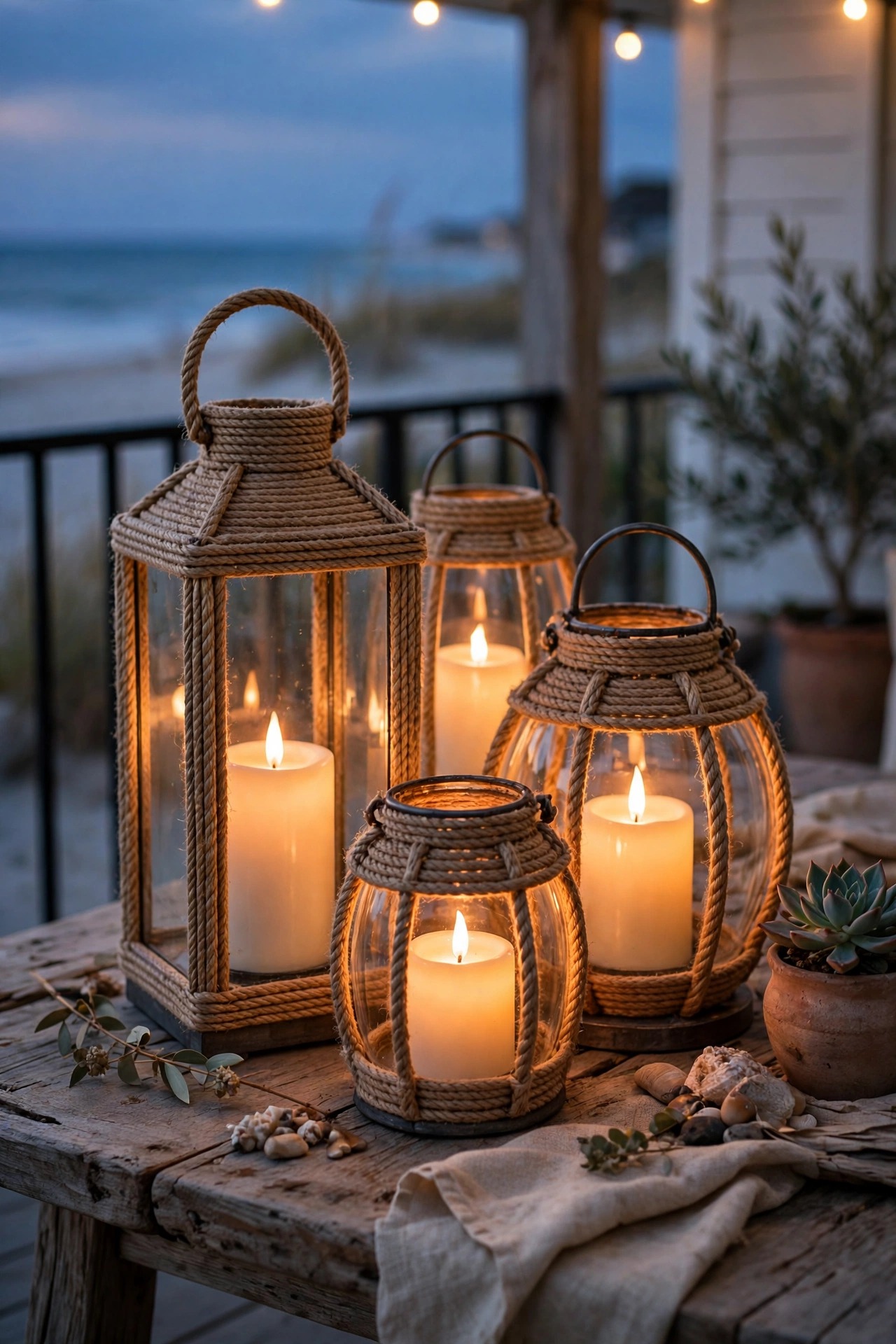
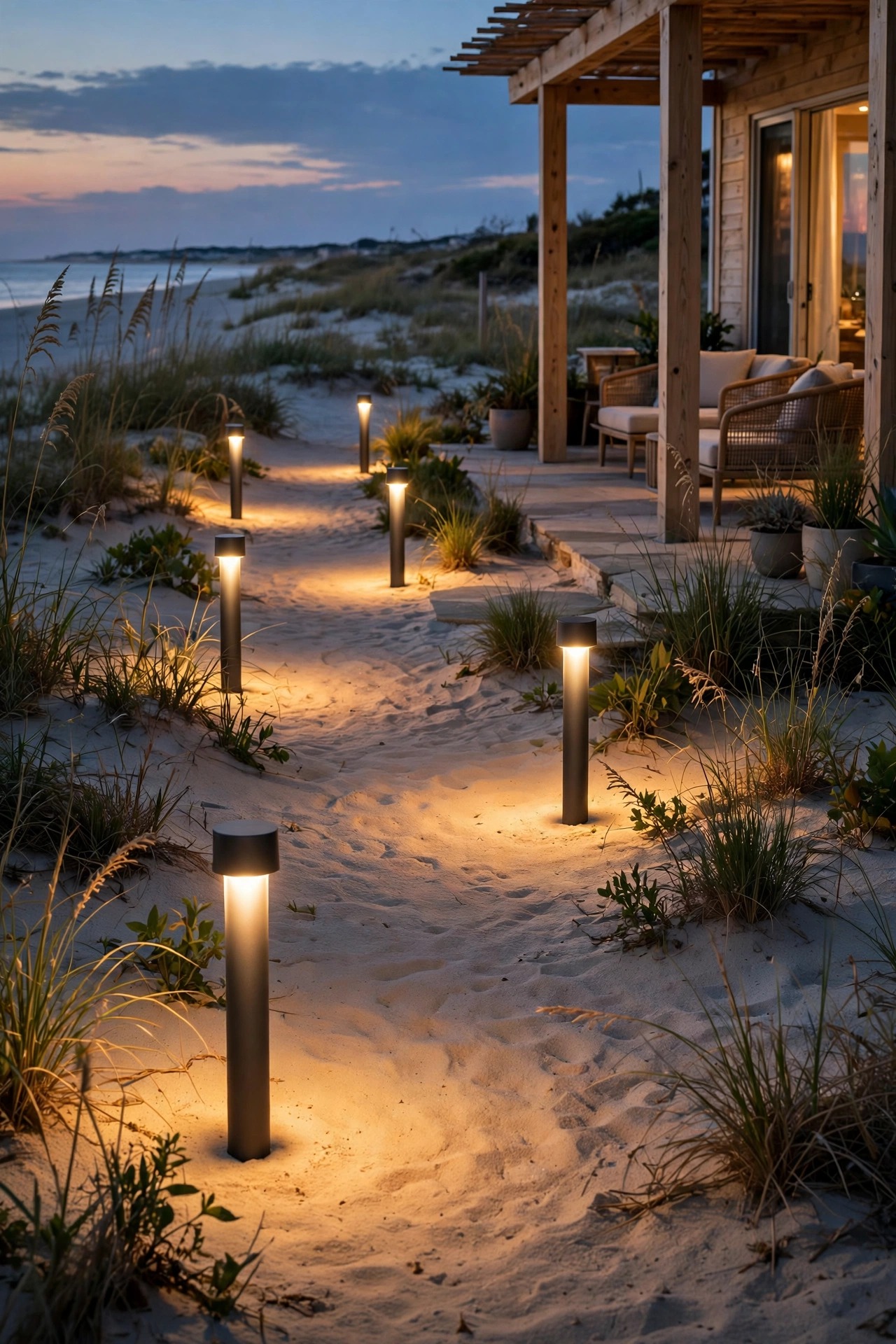
4. Powder-Coated Aluminum Path Lights Along the Walkway
The walk from the patio to the outdoor shower or the beach path needs light, but it needs the right fixtures even more. Standard steel path lights rust at the stake first, then wobble, then snap. Powder-coated cast aluminum is the coastal upgrade: it cannot rust, the baked-on finish shrugs off salt spray, and the fixtures stay handsome for years. Space them 6 to 8 feet apart along one side of the path, staggered rather than in a runway line, and aim for low output around 100 to 200 lumens each so you get guidance without glare bouncing off pale sand. A 12 to 18 inch stem keeps the head above beach grass and plantings. Low-voltage wired systems are worth the small effort here because the transformer sits safely near the house and the fixtures themselves run cool and cheap. Push the stakes a few inches deeper than the instructions say; sandy soil lets go of shallow stakes during storms. Every fall, I pull mine up, rinse the salt off, check the wire connections for green corrosion, and dab on a little dielectric grease before winter. That ten-minute ritual has kept the same set glowing for five seasons.
Suggested budget range: $120 – $320.
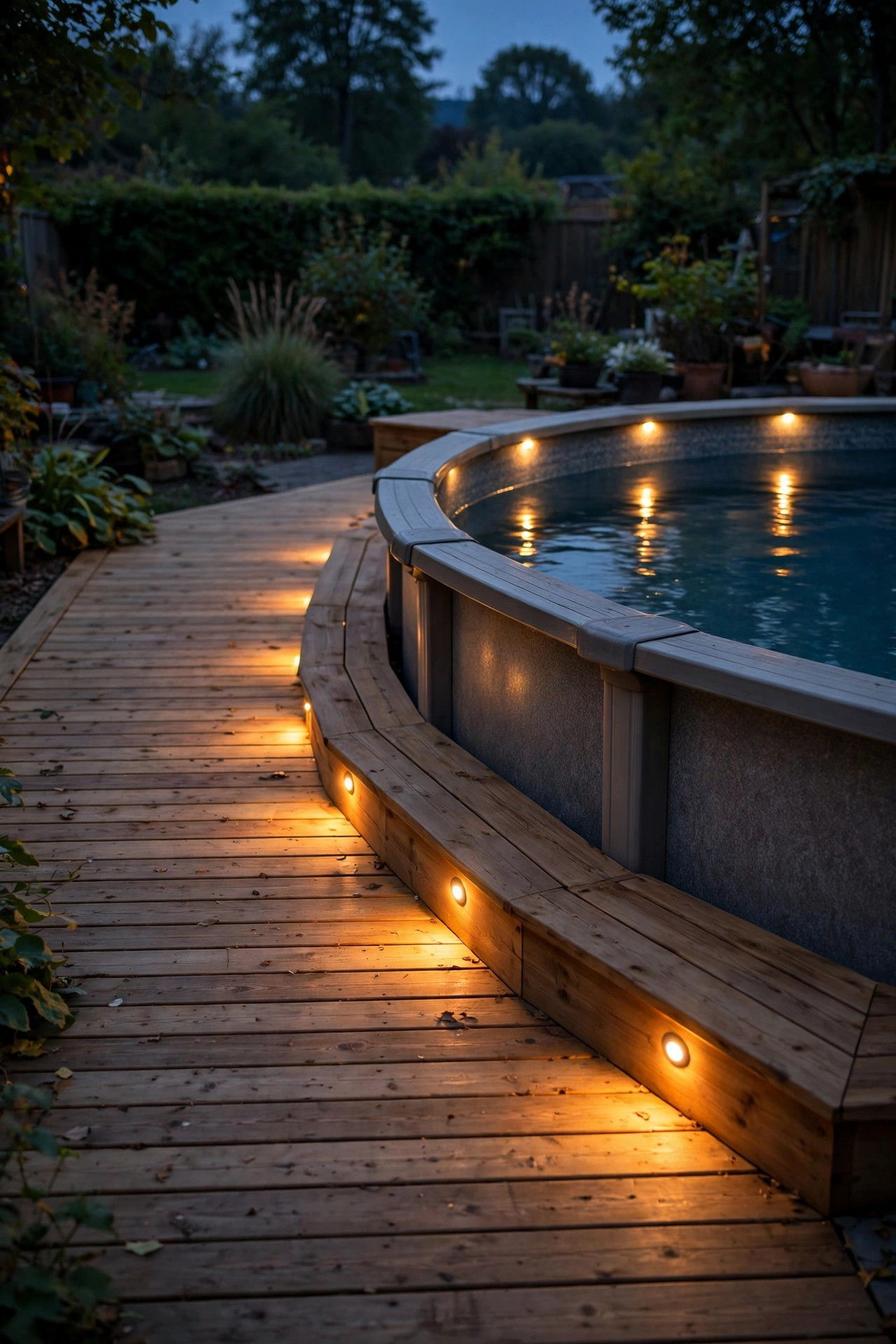
5. Recessed Deck Lights With Sealed Housings
If your beach house patio is really a deck, recessed lights are the cleanest way to add a safety layer without cluttering the space. These little pucks sit flush in the deck boards, marking edges, steps, and the route to the hot tub or grill. The coastal detail that matters is the housing: choose fixtures with sealed, gasketed housings rated IP67 and stainless or composite trim rings, because the underside of a seaside deck is a salty, humid cave that eats unsealed electronics. A warm 2700K output of about 50 to 100 lumens per light is plenty; you are painting soft pools of light, not landing planes. Space them roughly every 4 to 6 feet along edges and one on each step riser. Most kits connect ten or more lights to one low-voltage transformer with simple snap connectors, and a photocell timer handles the rest. Drill pilot holes slightly snug so the fittings stay put when boards expand in the summer heat. I installed ours in an afternoon with a hole saw and a cordless drill, and the flush profile means chairs slide right over them and sandy feet never catch an edge.
Suggested budget range: $80 – $240.
6. Solar Post Cap Lights on the Railing
Railing post caps are the most underused lighting real estate on a beach patio, and solar caps make the upgrade almost effortless. You pop off the plain cap, set the lighted one in place, and the built-in panel handles charging. For salt air, pick caps with ABS or powder-coated aluminum housings rather than thin painted metal, and a stated IP44 rating at minimum so wind-blown spray stays out. Measure your posts carefully; 4×4 and 6×6 are the common sizes, and a snug fit matters because loose caps rattle and blow off in coastal gusts. I add a small bead of clear silicone under the rim on the windward side for insurance. Expect gentle accent light, roughly 10 to 30 lumens per cap, which reads as a pretty dotted line of glow along the rail rather than true task lighting, and that is exactly the charm. They pair beautifully with brighter layers elsewhere. Through winter, swap the rechargeable batteries every year or two; there is good advice in the broader patio lighting ideas roundup on our site about mixing solar accents with wired workhorses so no single layer has to do every job.
Suggested budget range: $40 – $110.

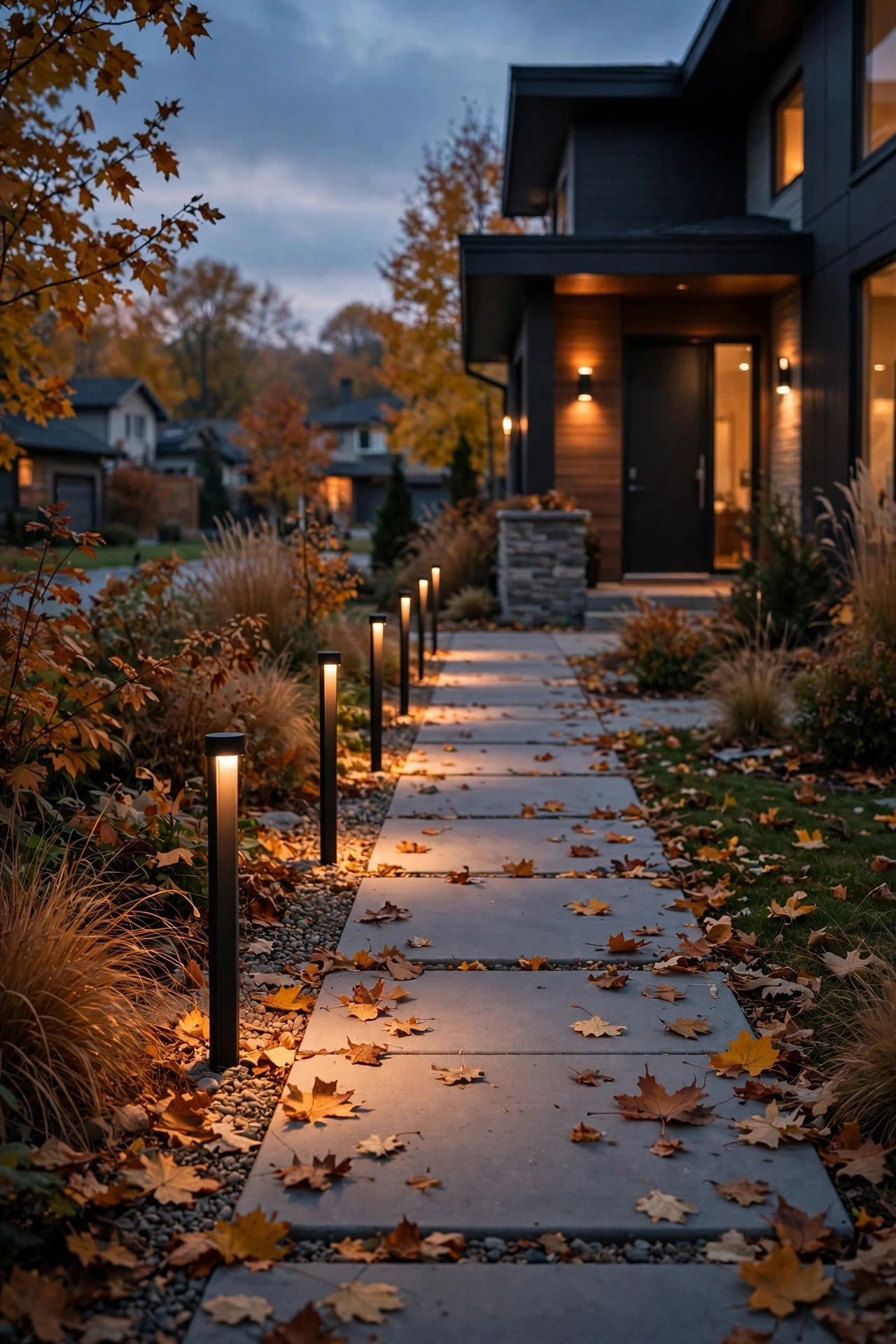
7. Short Bollard Lights in Coastal Finishes
Bollards bring a resort polish to a beach patio, and their low, wide spread of light is perfect for defining seating zones and the edge where decking meets sand or lawn. Keep them short, around 12 to 22 inches, so the light stays below seated eye level and feels intimate. For the coast, look for marine-grade aluminum or fiberglass bodies with a textured powder-coat finish in driftwood gray, matte black, or weathered bronze; those finishes hide salt film far better than glossy ones. The lens should be frosted polycarbonate, not glass, because polycarbonate will not shatter when a beach chair or a wind-blown umbrella stand bumps it. Most bollards wash light in a 3 to 5 foot radius, so spacing them 8 to 10 feet apart around the patio perimeter gives even, overlapping pools. Wire them on the same low-voltage run as your path lights to keep the project simple. I like one bollard anchoring each corner of the seating area, like punctuation marks. Rinse them when you wash the patio furniture, and check that sand has not drifted up over the lens after stormy weeks, since buried lenses dim the whole effect.
Suggested budget range: $140 – $380.
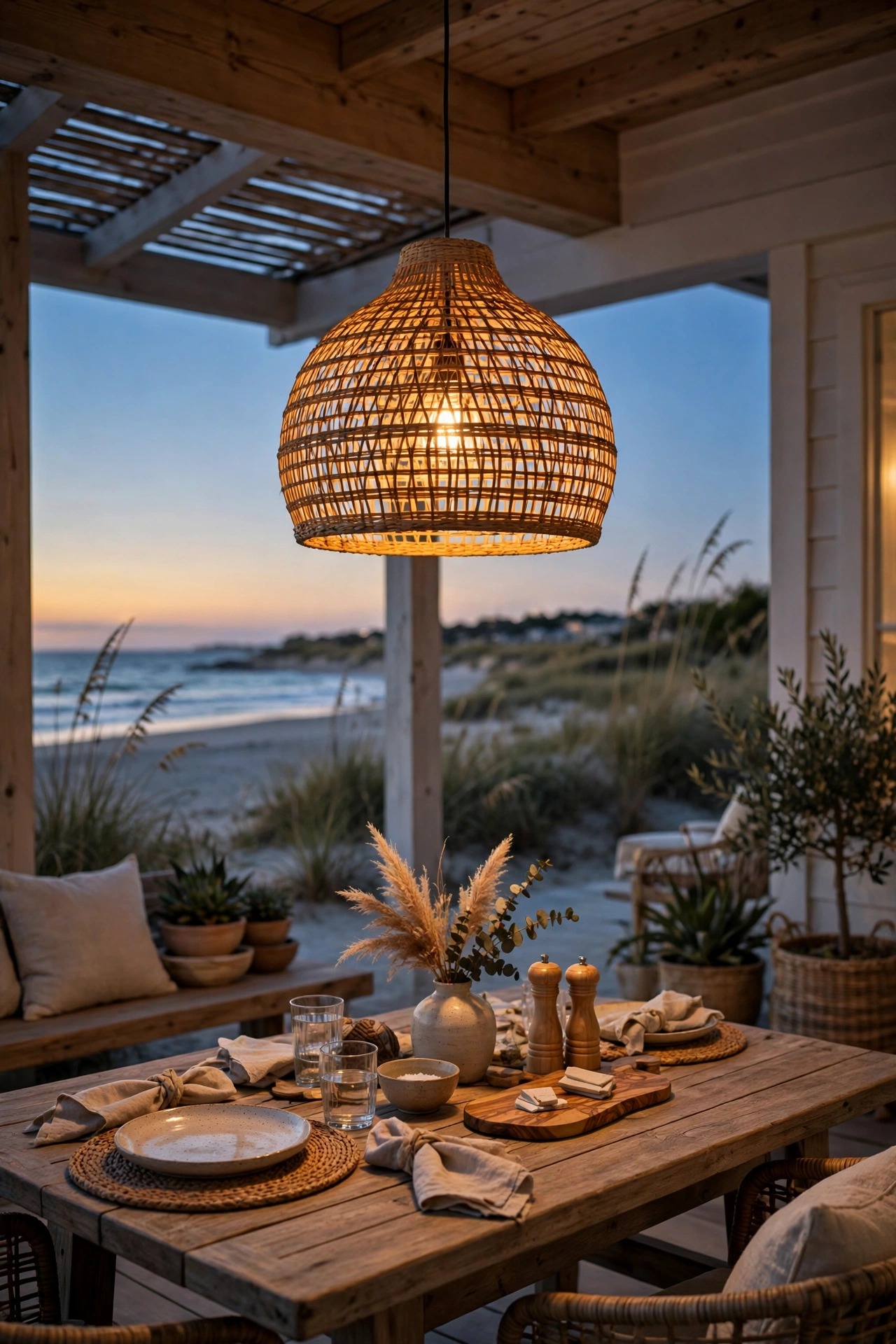
8. A Damp-Rated Pendant Over the Outdoor Dining Table
Dinner outside tastes better under a real pool of light, and a pendant centered over the dining table gives your beach patio a proper room-without-walls feeling. The fixture must be rated for damp or, better, wet locations, and on the coast I insist on resin wicker, powder-coated aluminum, or sealed rattan-look shades rather than natural fibers, which drink in humid salt air and mildew by August. Hang the shade so its bottom sits 30 to 36 inches above the tabletop, low enough to feel cozy and keep light on faces and food, high enough that nobody bonks a head standing up. Use a dimmable warm LED bulb around 800 to 1,100 lumens and put it on a dimmer; full brightness for serving, then dial it down for lingering over dessert. If your patio roof or pergola is open framing, a plug-in pendant with a weatherproof cord and a heavy-duty hook works fine and avoids new wiring. Just route the cord through a GFCI outlet and add a drip loop so rain runs off instead of into the socket. It is a small detail that electricians swear by for a reason.
Suggested budget range: $110 – $300.
9. Fairy Lights Tucked Into Glass Floats and Jars
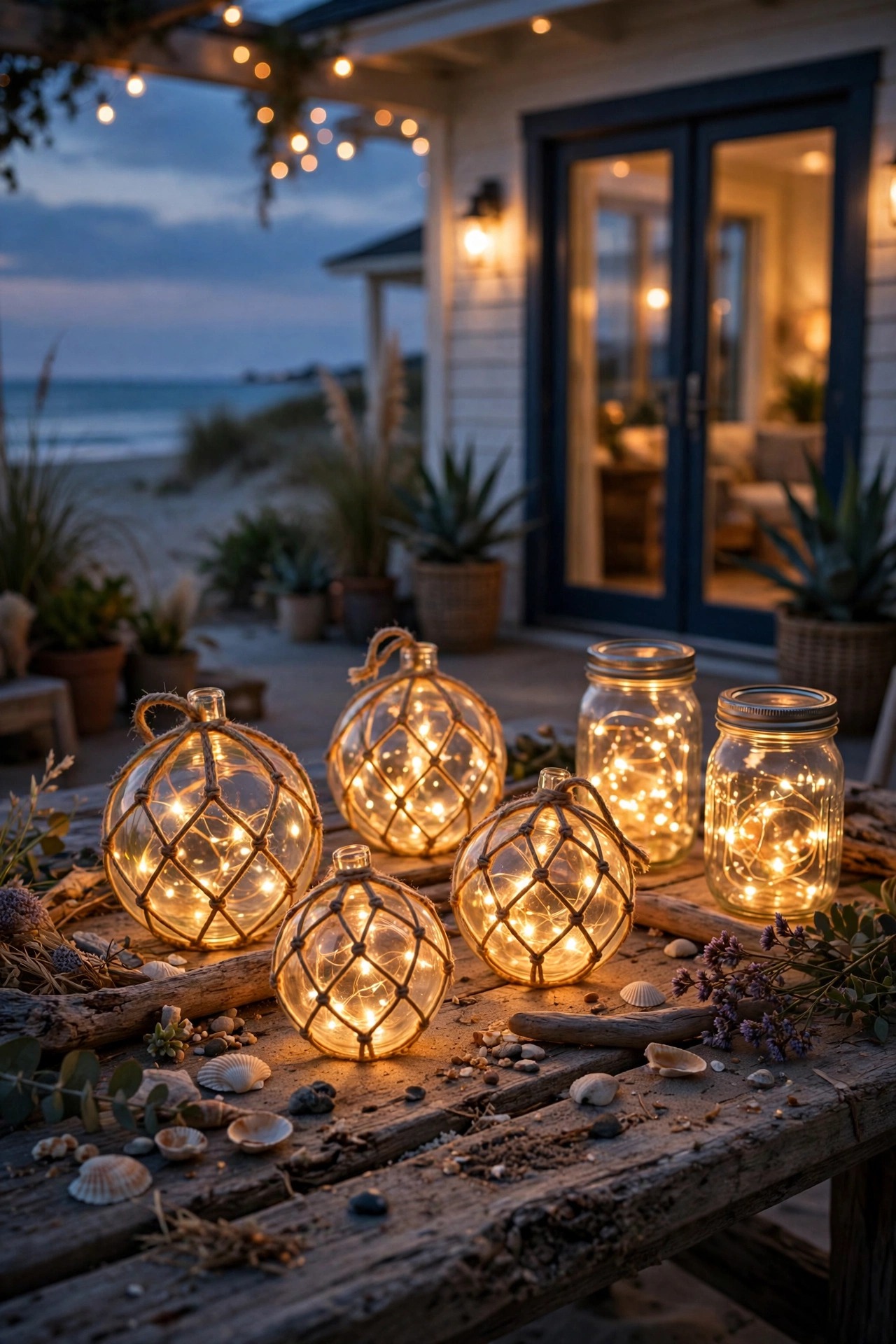
For pure charm, nothing beats copper-wire fairy lights woven through glass fishing floats, mason jars, or big hurricane vases on the patio table. The wire is thin enough to disappear, and the tiny LEDs read as fireflies caught in glass, which is exactly the mood a beach evening wants. The coastal advantage is real: copper wire tolerates salty air far better than cheap steel wire, and because the whole strand lives inside glass, the spray never reaches it. Choose battery packs with a timer function and tuck the pack under the jar or inside a shell so it stays dry; a six-hour nightly timer stretches a set of batteries through most of the summer. You can also buy solar-lid jar kits that charge by day. Cluster three jars of different heights as a centerpiece, or line a whole row of floats down the center of the dining table instead of flowers that the wind would shred anyway. Keep spare batteries in the junk drawer, and bring the jars in during named storms. Year after year, this is the detail my guests photograph most, and it costs less than a pizza night.
Suggested budget range: $15 – $45.
10. LED Strip Lights Hidden Under the Railing
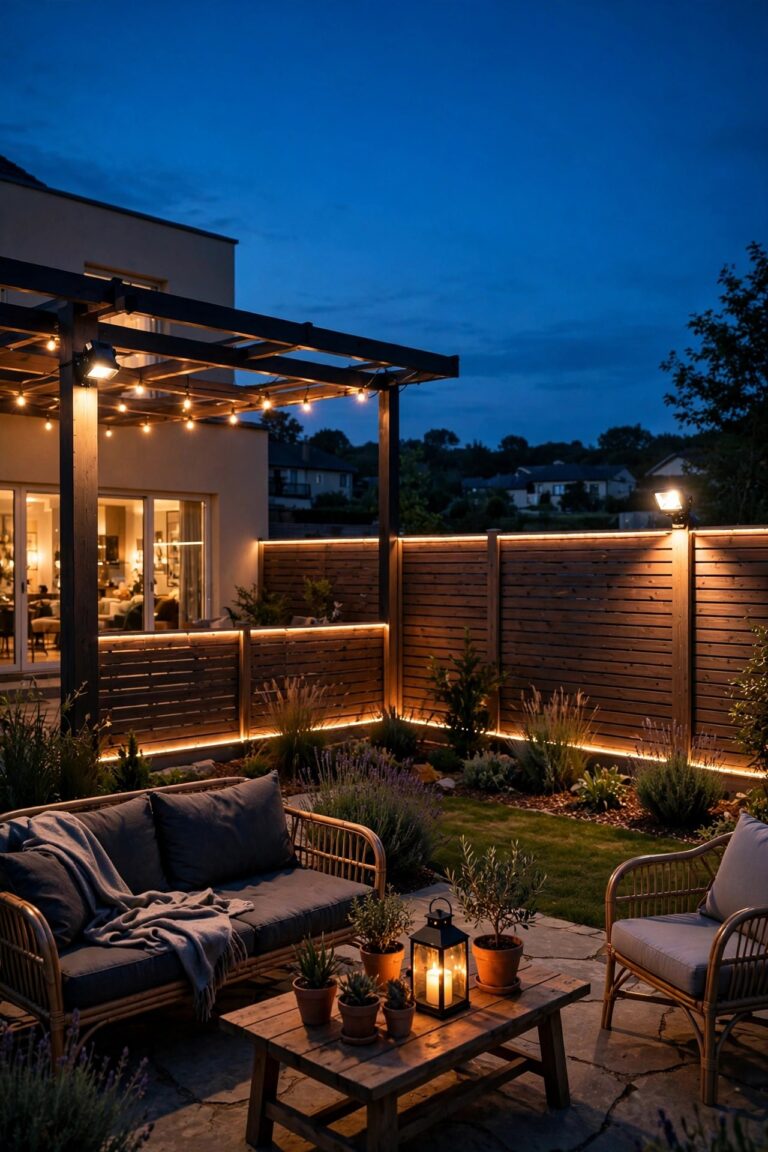
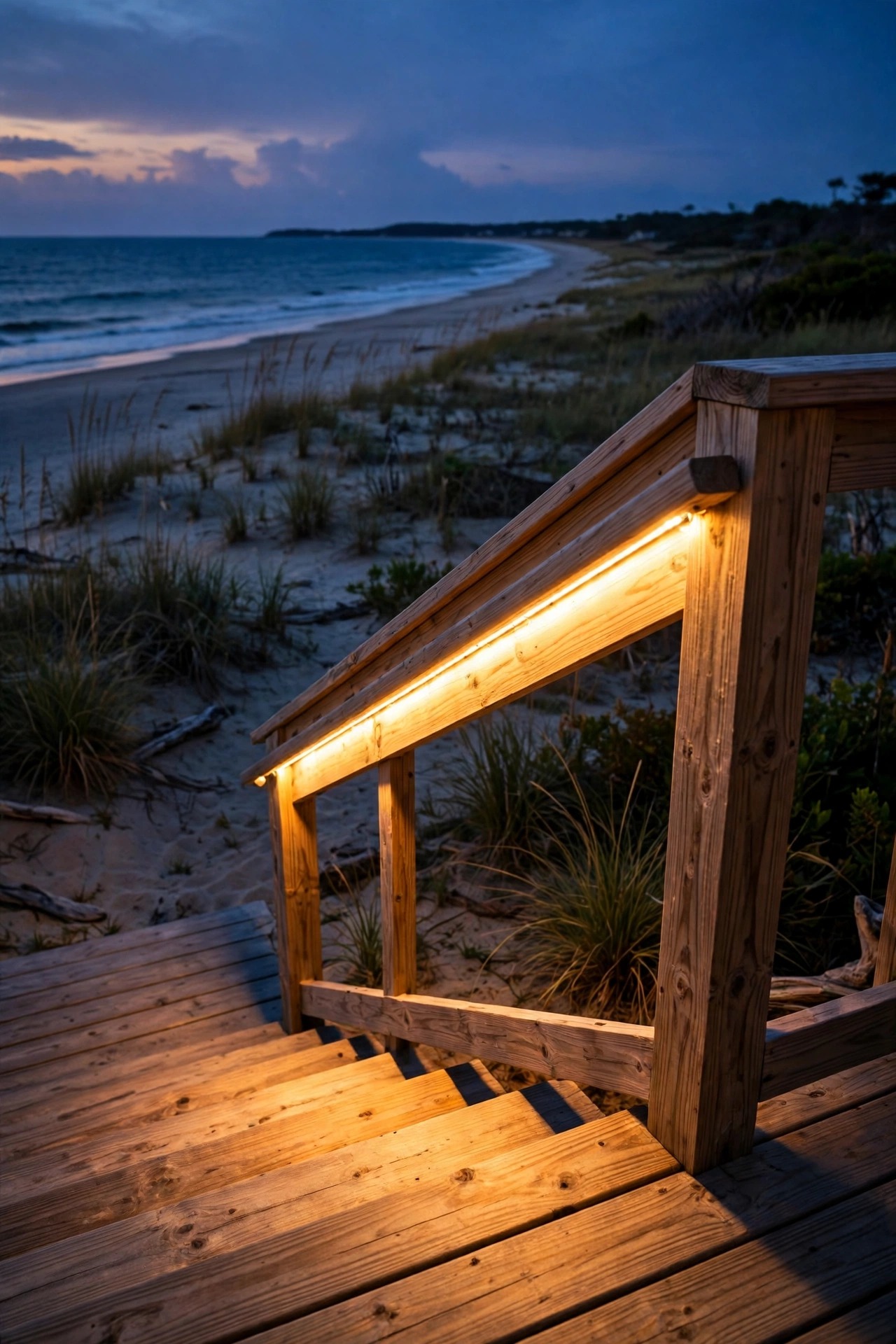
A hidden ribbon of light under the handrail is the most modern trick in my coastal playbook, and it makes steps, level changes, and the whole deck edge read clearly without a single visible fixture. Use outdoor LED strip rated IP67 or IP68 with a silicone sleeve; the sleeved versions survive salt fog that kills bare strips in a single season. Mount it in an aluminum channel with a frosted diffuser under the rail, which protects the strip, spreads the light evenly, and gives you something sturdy to wipe down. Warm white at 2700K keeps it in step with the rest of your layers. The strip sips electricity, often under 5 watts for a whole railing run, and a simple dusk-to-dawn timer or smart plug handles the schedule. Seal every cut end with the manufacturer caps and silicone, because cut ends are where moisture sneaks in first. If you want color for holiday weekends, RGBW strips let you switch back to warm white for everyday evenings. Our deeper look at coastal outdoor lighting covers more of these corrosion-proof materials if you are planning a full patio overhaul rather than a weekend refresh.
Suggested budget range: $45 – $130.
11. A Marine-Grade Motion Sensor Light for the Side Path
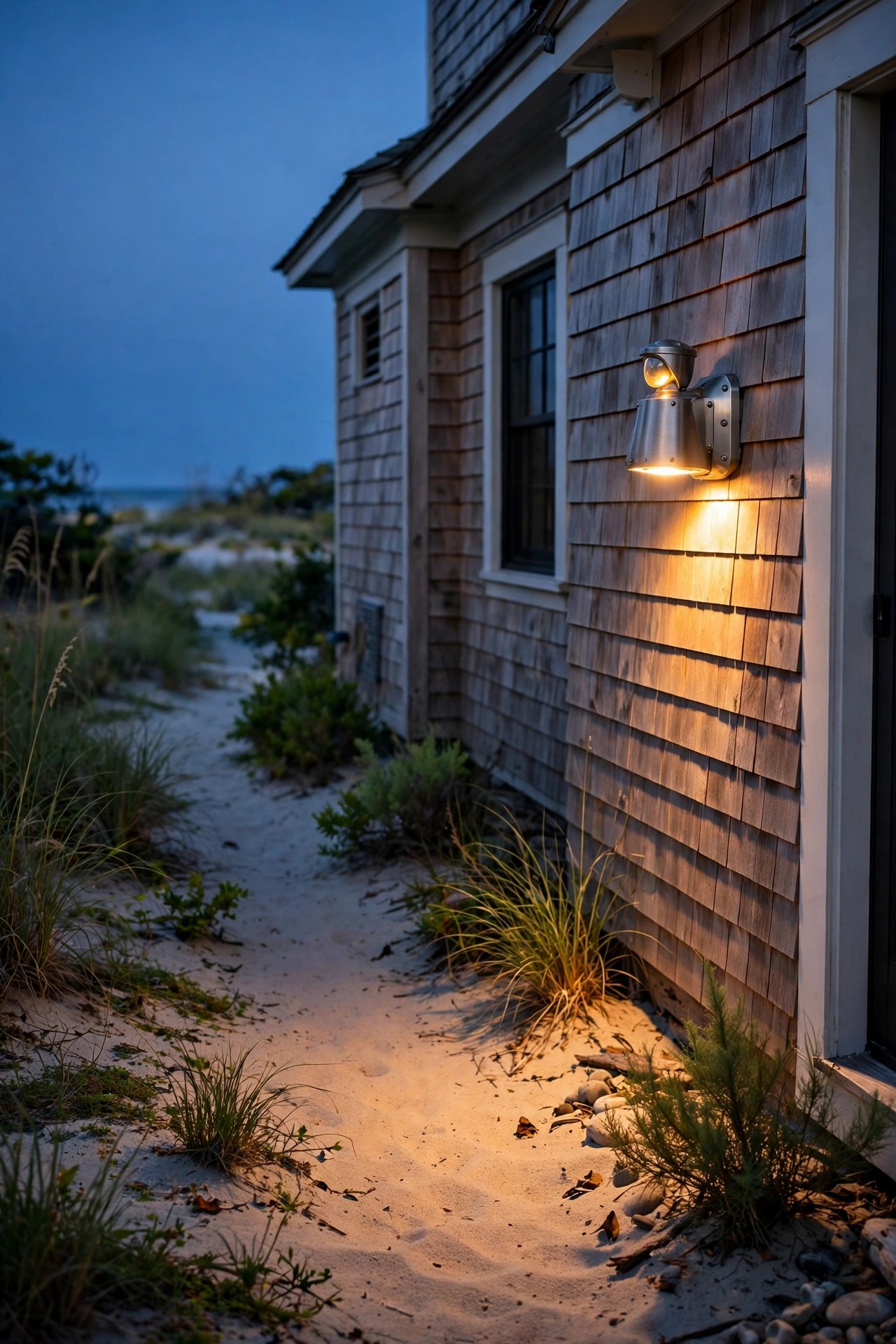
Every beach house has a dark side path: the route to the outdoor shower, the kayak rack, or the trash bins nobody wants to walk in flip-flops at night. A motion sensor fixture solves it without burning light all evening, and on the coast it must be built like boat hardware. Pick a fixture with a polycarbonate or powder-coated aluminum body, stainless fasteners, and sealed optics; bargain steel units rust-streak the siding within a season. Set the sensor to a range of about 20 to 30 feet and a timeout of one to three minutes, and angle the head slightly downward so it lights feet and path rather than blinding neighbors. Around 1,200 to 1,600 lumens is plenty for a path. Salt film builds up on sensor lenses too, so wipe the dome when you rinse your sconces, or you will wonder why the range has shrunk. Position the fixture under an eave if you can; a little shelter from direct spray stretches its life by years. Ours has survived four hurricane seasons of sideways rain, which tells you everything about buying the marine-grade version once instead of the cheap one twice.
Suggested budget range: $60 – $170.
12. Flameless Solar Tiki Torches Around the Seating Area
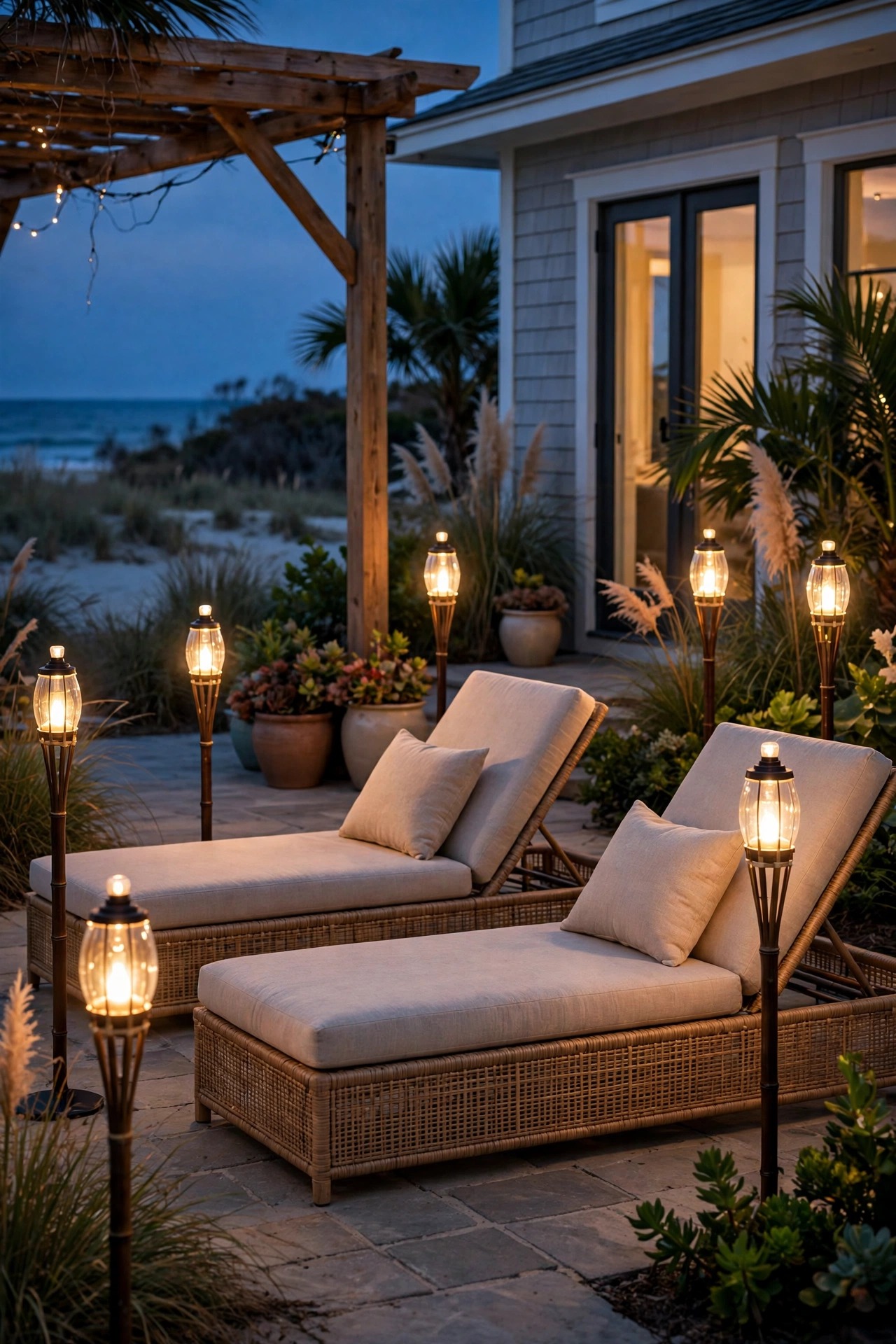
Tiki torches promise island atmosphere, but open flame plus sea breeze plus a fuel canister is a trio I no longer entertain. Solar tiki torches with flickering LED flames deliver the same dancing glow with zero fire risk, and that matters when the wind picks up mid-evening. The better models have a realistic flame effect with dozens of tiny LEDs, a solar panel in the cap, and a stake or mounting bracket that puts the flame about 3 to 4 feet off the ground. For salt air, choose torches with sealed ABS housings and avoid the flimsiest thin-stake versions, which lean after one storm in sandy soil; driving the stake through a small buried block of wood or into a weighted planter keeps them upright. Flank the lounge chairs with a pair, then add two more marking the patio corners, so the flicker frames the space. Expect eight to ten hours of flame on a full day of sun. Bring them into the garage for winter if your beach house closes up, because months of salt spray on an idle panel dulls the charge. Guests always reach out to warm their hands. Every time.
Suggested budget range: $35 – $95.
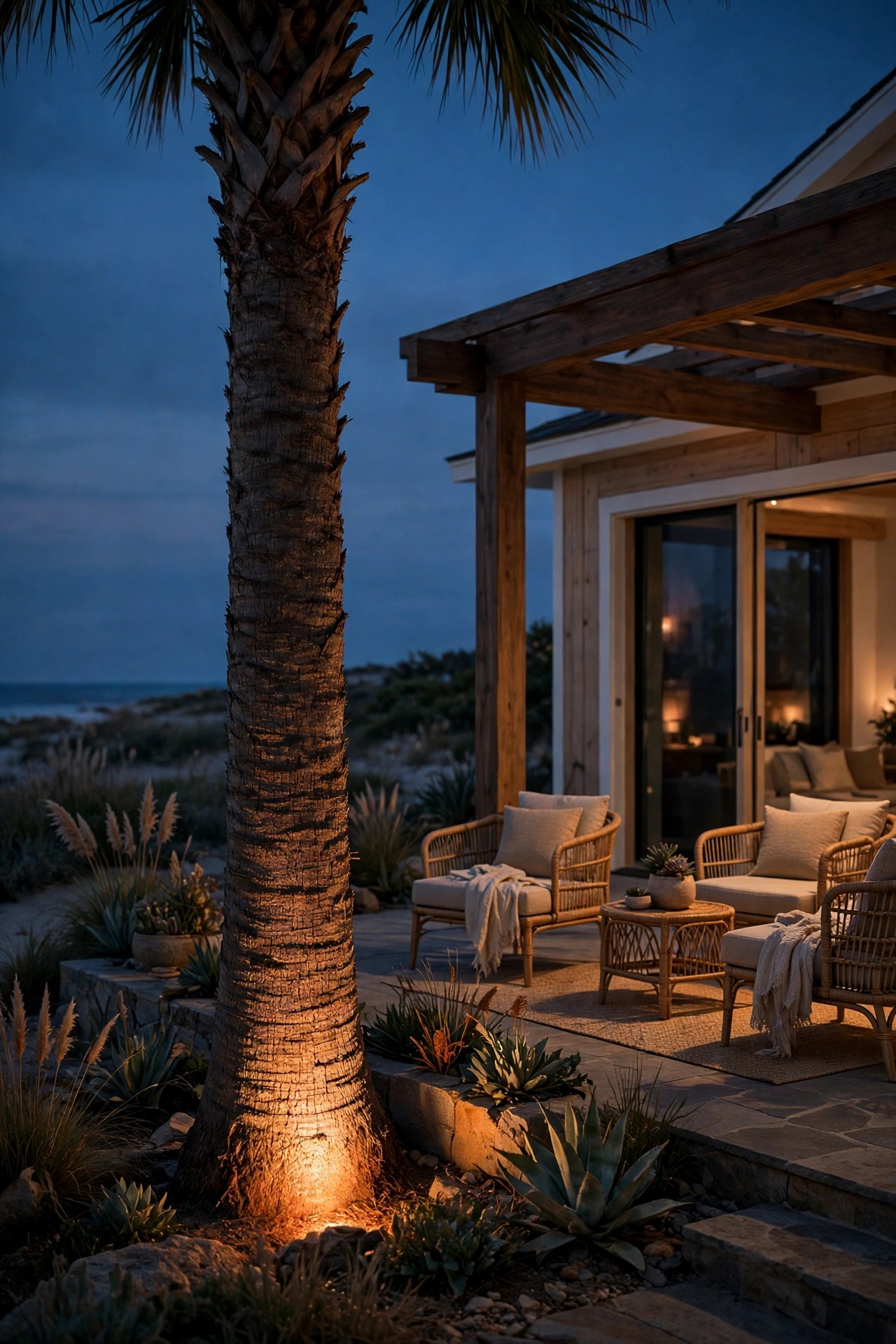
13. Gentle Uplighting for Palms and Dune Grass
Beach landscaping does half your decorating for you, and a little uplight makes it perform after dark. A low-voltage spotlight at the base of a palm, angled up the trunk at about 30 degrees, throws dramatic frond shadows across the patio ceiling and walls. Keep the fixture itself corrosion-proof: solid brass or powder-coated aluminum with a sealed lens, staked into a small gravel bed so sand and mulch do not bury it. One light per specimen tree is enough; overlighting the garden turns a beach patio into a parking lot. For dune grass and low plantings, a softer wash from a wide-beam fixture placed 12 to 18 inches back gives that moonlit shimmer when the breeze moves the blades. Stay with warm 2700K and modest output, 200 to 400 lumens per spot, and aim carefully so no beam spills into a bedroom window, yours or the neighbors. Shielded fixtures with a glare guard are worth the small upcharge near the shore, where dark-sky courtesy matters to the turtle patrols, too. Many coastal towns ask residents to keep lights low and amber during nesting season, and warm, shielded uplights fit those rules happily.
Suggested budget range: $70 – $210.
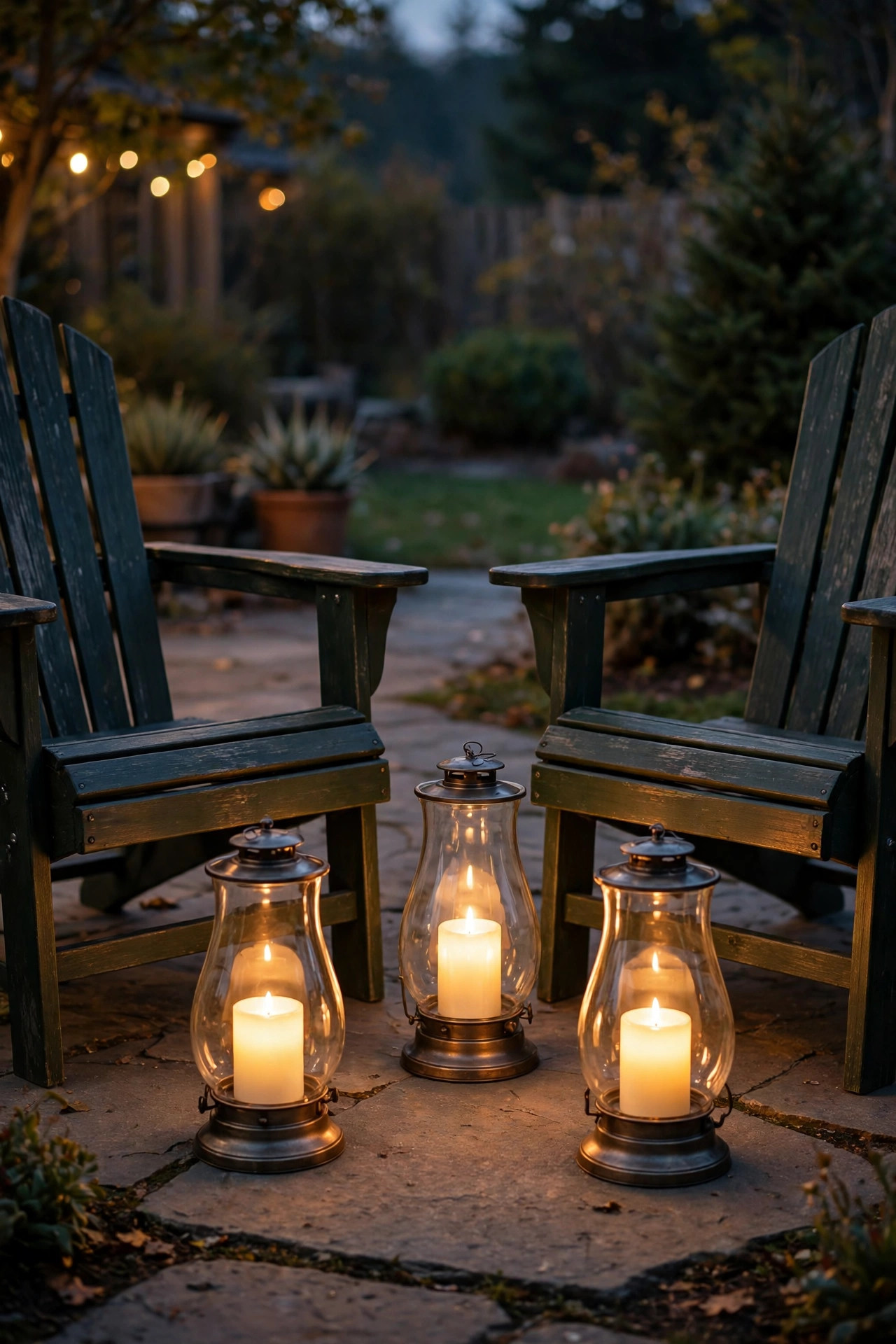
14. Hurricane Lanterns as Table Anchors
There is a reason the classic hurricane lantern never left the coast: the glass chimney was literally designed to keep a flame alive in sea wind. The modern version keeps the silhouette and swaps in a flameless candle or a small LED pillar, which means the glow stays steady through every gust off the water. I use two substantial lanterns as anchors on the dining table and one on each side table, filled at the base with an inch of sand and a few small shells; the sand adds ballast so they never skitter in a breeze, and it could not look more beach house if it tried. Buy lanterns in galvanized metal, powder-coated aluminum, or resin rather than raw tin, and rinse the glass chimneys when salt film starts to haze them. A mix of heights, say 12 and 18 inches, looks collected rather than matched. Timer candles are the move here again, so the whole table lights itself at dusk while you are still rinsing sandy feet at the spigot. When a storm is actually named and heading your way, these are the first things I carry inside, and the last I carry back out.
Suggested budget range: $40 – $120.
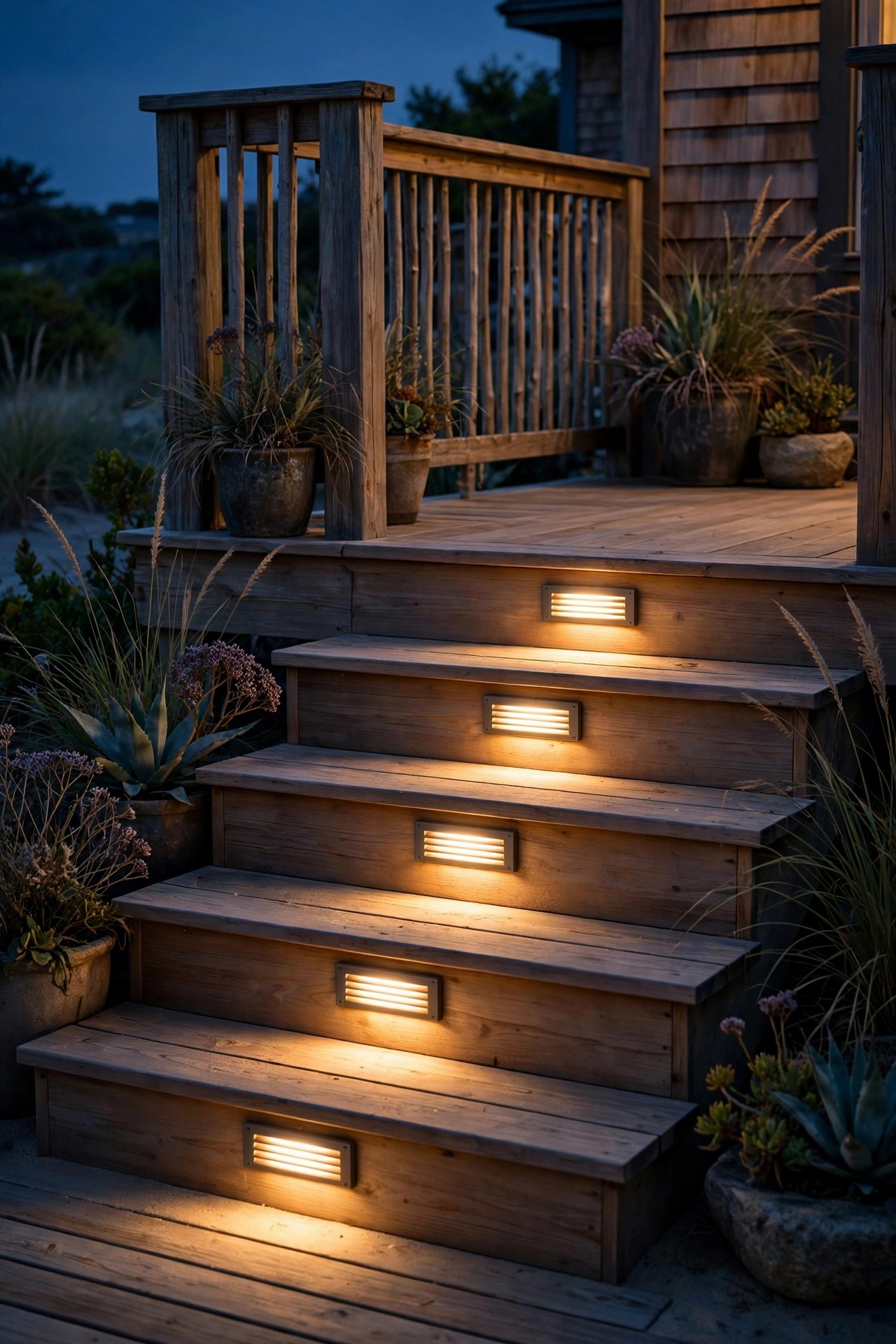
15. Step Lights Where the Patio Meets the Sand
The most useful beach house patio lighting ideas are the unglamorous ones, and step lights top that list. Decks and patios near the shore love level changes: two steps down to the lawn, a raised platform for the grill, the boardwalk over the dune. Each one is a stubbed toe or worse waiting for a dark evening. Small louvered step lights recessed into the riser, or surface-mounted on the side wall of the step, wash each tread with light while shielding the source from your eyes. Choose fixtures with stainless or composite faces and IP65 sealing, because the bottom of a patio is where salt spray concentrates and lingers. Plan one light for every step, or one every other step on wide stairs, wired to the same low-voltage transformer as your deck lights so everything comes on together. Warm light around 30 to 80 lumens per step is the sweet spot; brighter starts to feel like a marina dock at midnight. If wiring is not in the cards this season, solar step lights with adhesive or screw mounts are a fair stand-in, just expect to replace batteries yearly. Safety lighting is never the prettiest layer, but it is the one everyone silently thanks you for.
Suggested budget range: $55 – $160.
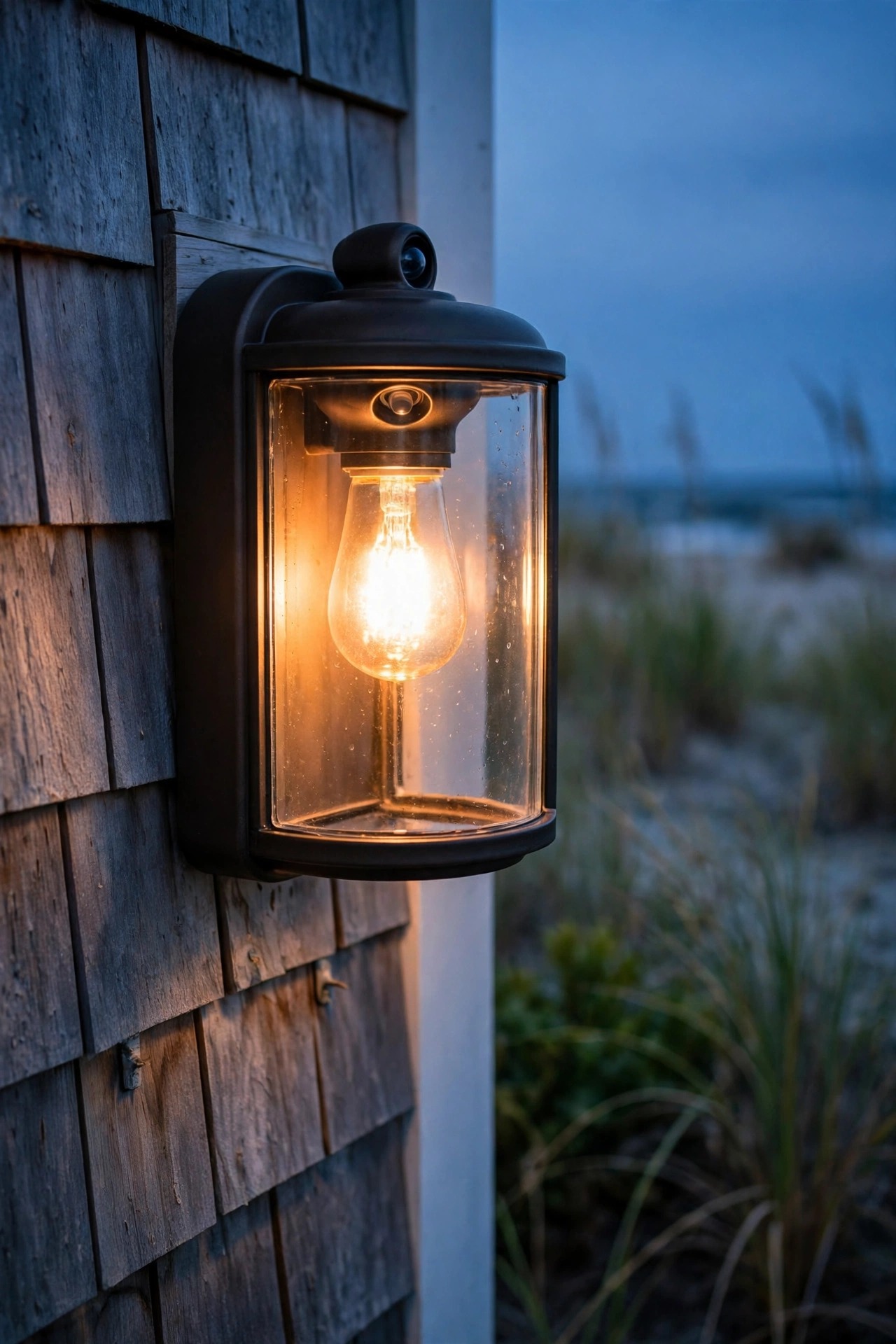
16. Dusk-to-Dawn Photocell Bulbs in the Porch Fixture
Sometimes the smartest upgrade is a smarter bulb in the fixture you already own. A dusk-to-dawn LED bulb has a tiny photocell in its base, so it switches itself on at sunset and off at sunrise with no timer to program and no smart home hub to argue with. For a beach rental or a house you visit on weekends, that reliability is gold: the patio and porch look lived-in and welcoming every single night. Make sure your existing fixture is up to the environment first; if the socket is corroded or the housing is rusting, replace the fixture with a sealed marine-grade one and then add the smart bulb. Use a warm 2700K bulb around 800 lumens, and pick a bulb rated for enclosed fixtures if your sconce has a closed globe, since heat shortens LED life in sealed housings. The little photocell eye needs a reasonably clear view of the sky, so bulbs in deeply shaded, louvered fixtures can behave oddly at twilight; a quick test night tells you if yours is happy. Cost-wise this is the cheapest idea on the whole list per evening of light, and renters love it because the bulb unscrews and travels home with you.
Suggested budget range: $12 – $30.
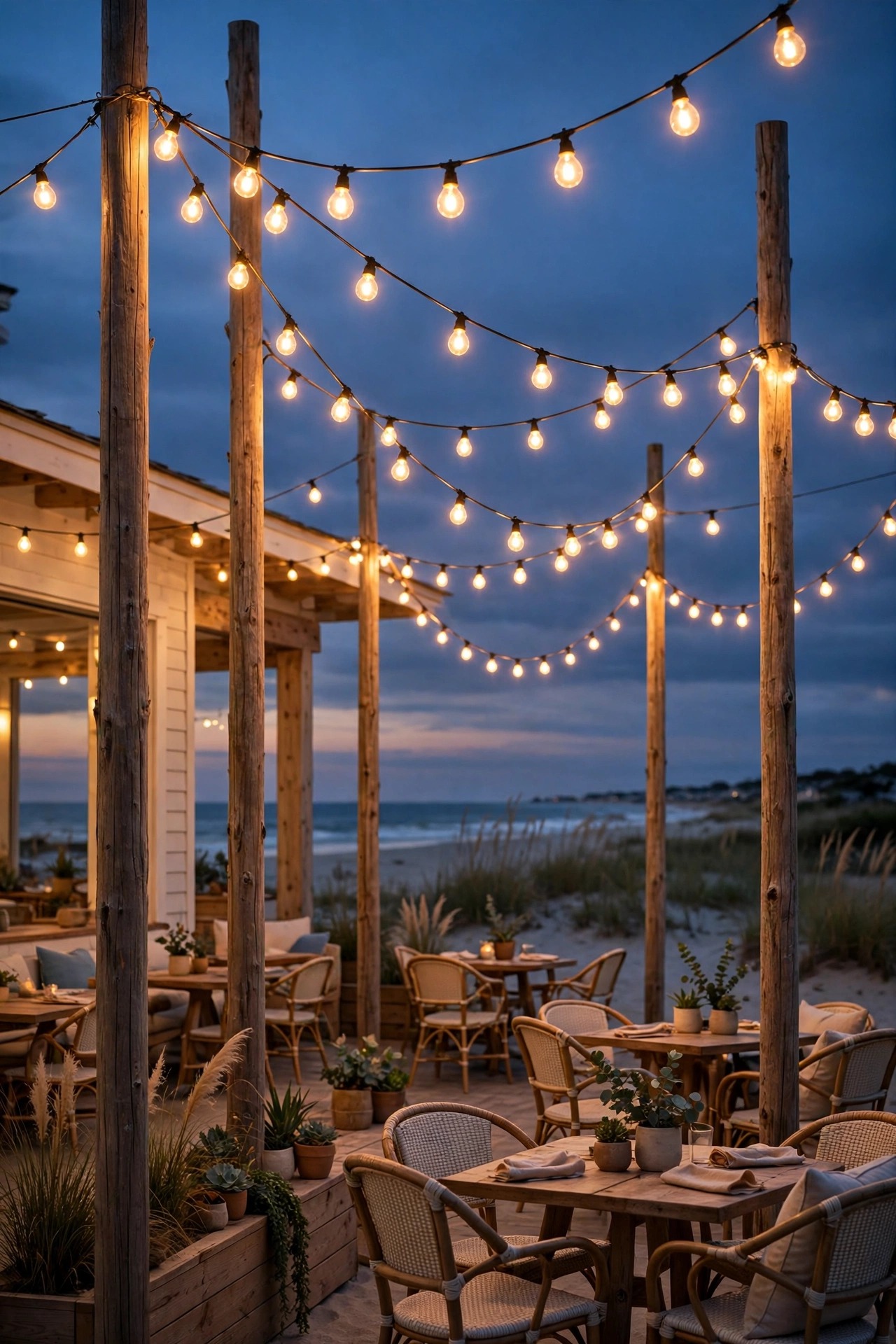
17. Cafe String Light Poles: The Finishing Layer of Beach House Patio Lighting Ideas
Plenty of beach patios are wide open slabs or decks with no pergola, no trees, and nothing overhead but sky, which leaves people assuming string lights are off the table. Sturdy string light poles fix that in an afternoon. Use poles in powder-coated steel or aluminum, about 9 to 10 feet tall, anchored in weighted planters filled with sand or concrete, or sleeved into the ground beside the patio; at the shore, planters are my favorite because you can roll the whole arrangement inside before a big storm. Run two or three swags of sealed-socket cafe lights between the poles and the house, keeping the lowest point of each swag at least 7 feet above the patio so tall guests and raised glasses clear it easily. Commercial-grade strands with heavier wire handle their own weight over longer spans and laugh at humidity. Add a dimmer plug and the mood goes from dinner party to boardwalk fair with one slide. It pulls together every other layer in this list of beach house patio lighting ideas, giving the patio a ceiling of light that makes the whole space feel like a room. String the last swag, pour something cold, and watch the patio you used to abandon at dark become the best seat at the shore.
Suggested budget range: $130 – $340.
Frequently Asked Questions
What materials survive salt air the longest?
Marine-grade 316 stainless steel, solid brass, copper, and powder-coated cast aluminum are the proven survivors. They resist the pitting and rust that destroy ordinary steel fixtures. Sealed housings with wet-location or IP65-plus ratings matter just as much as the metal, since salt fog creeps in through every unsealed seam.
How often should I clean coastal outdoor lights?
Rinse fixtures with fresh water every few weeks during the season, and more often after storms. Salt crystals left on a finish act like tiny sponges that hold moisture against the metal, which speeds corrosion. A soft cloth, plain water, and five minutes is all it takes, and glass lenses stay noticeably brighter for it.
Are solar lights bright enough for a beach house patio?
Modern solar fixtures are plenty bright for accents, paths, and ambiance, and the sunny coastal climate charges them well. For dining, grilling, and security, wired low-voltage or line-voltage fixtures still give stronger, more reliable light. Most beach patios look best with both: solar for sparkle and convenience, wired for the workhorse layers.
What color temperature looks best at the beach?
Warm white between 2200K and 2700K flatters weathered wood, sand tones, and skin, and it keeps the patio feeling like a sunset instead of a stadium. Many coastal communities also prefer warm or amber light during sea turtle nesting season, so warm bulbs keep you neighborly and compliant at the same time.
Conclusion
Great coastal lighting is really about respecting the ocean air while refusing to let it win. Choose corrosion-proof materials, seal out the salt fog, layer your light from the path to the tabletop to the string lights overhead, and give everything a freshwater rinse now and then. Do that, and these beach house patio lighting ideas will keep glowing season after season instead of rusting into regrets. If you are ready to keep planning, browse more of our lighting ideas here on the site and sketch your own layers before the next beach weekend arrives.