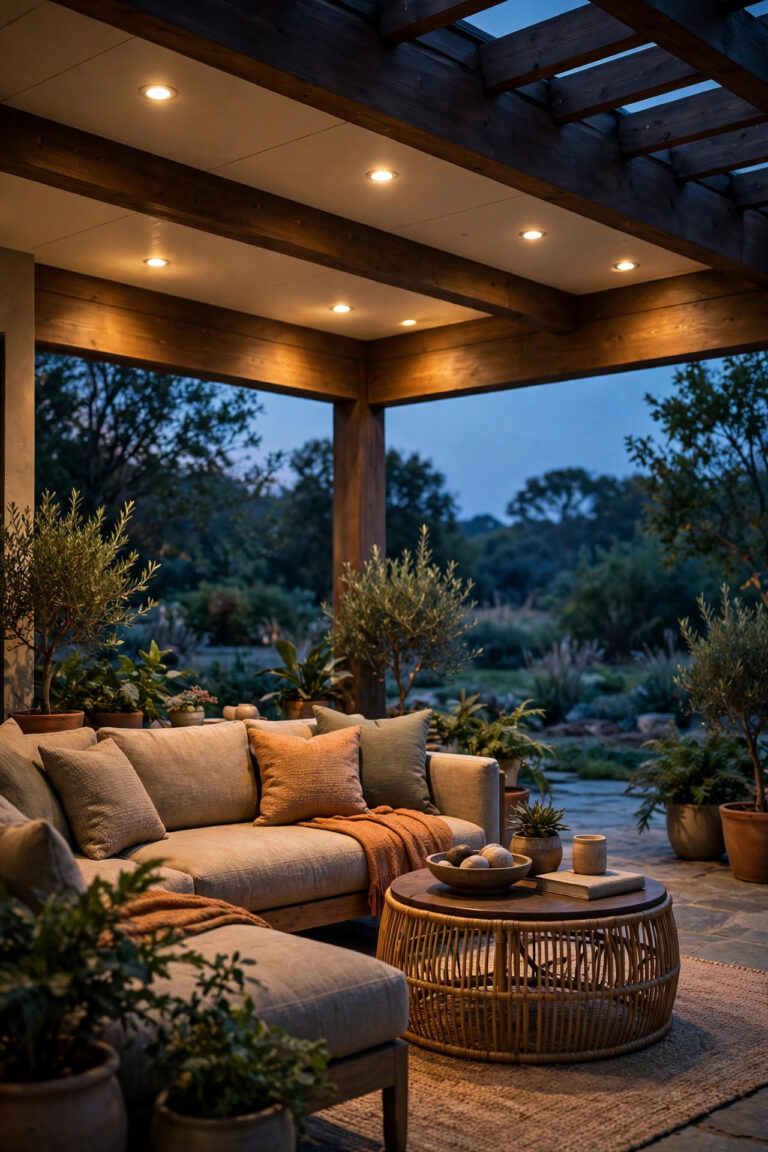
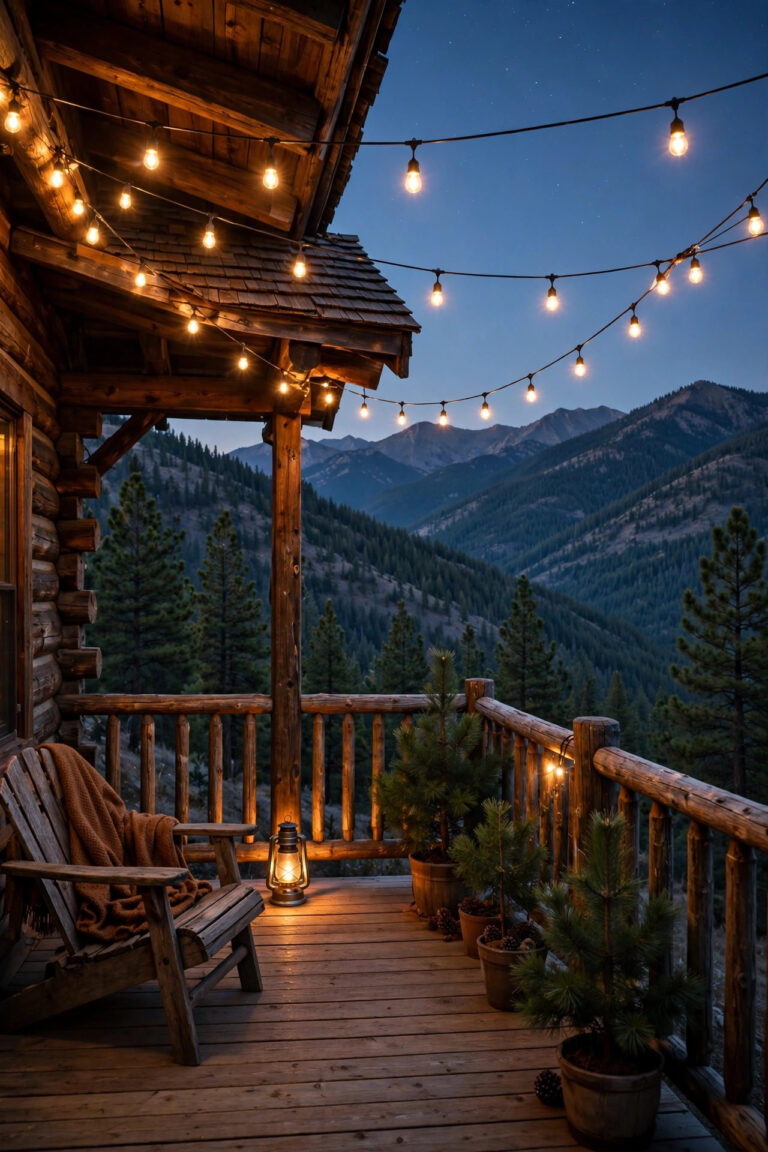
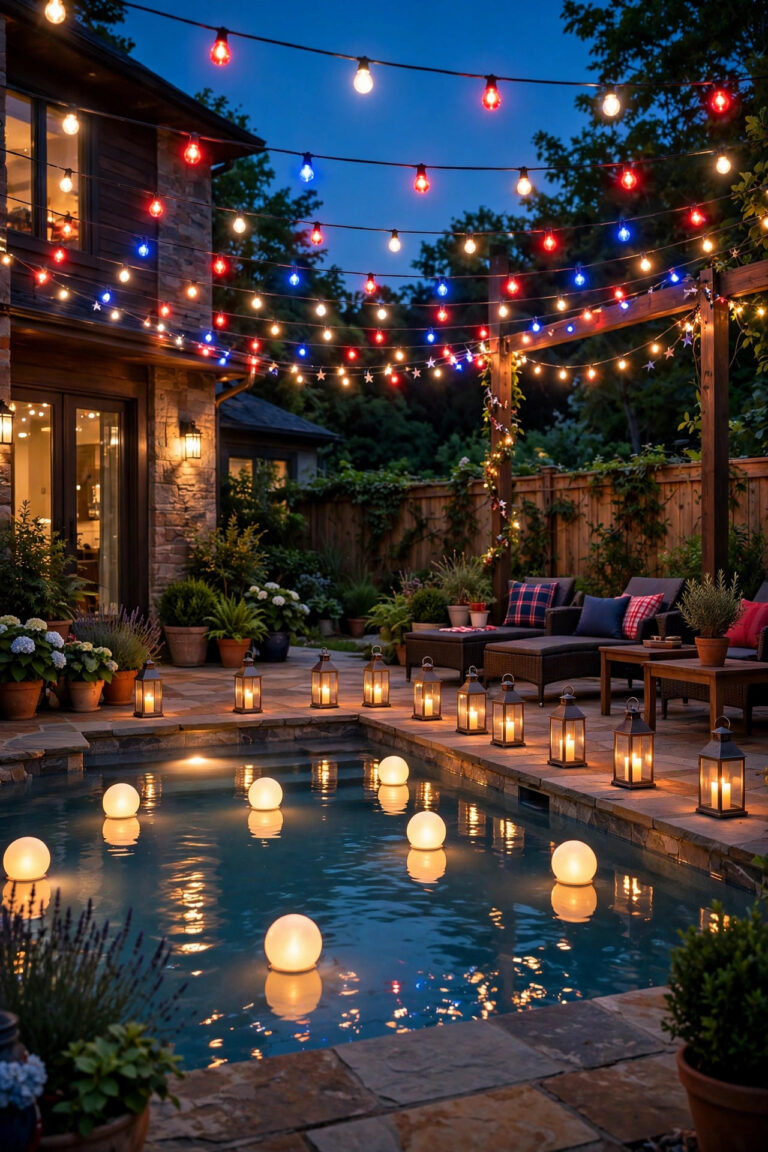
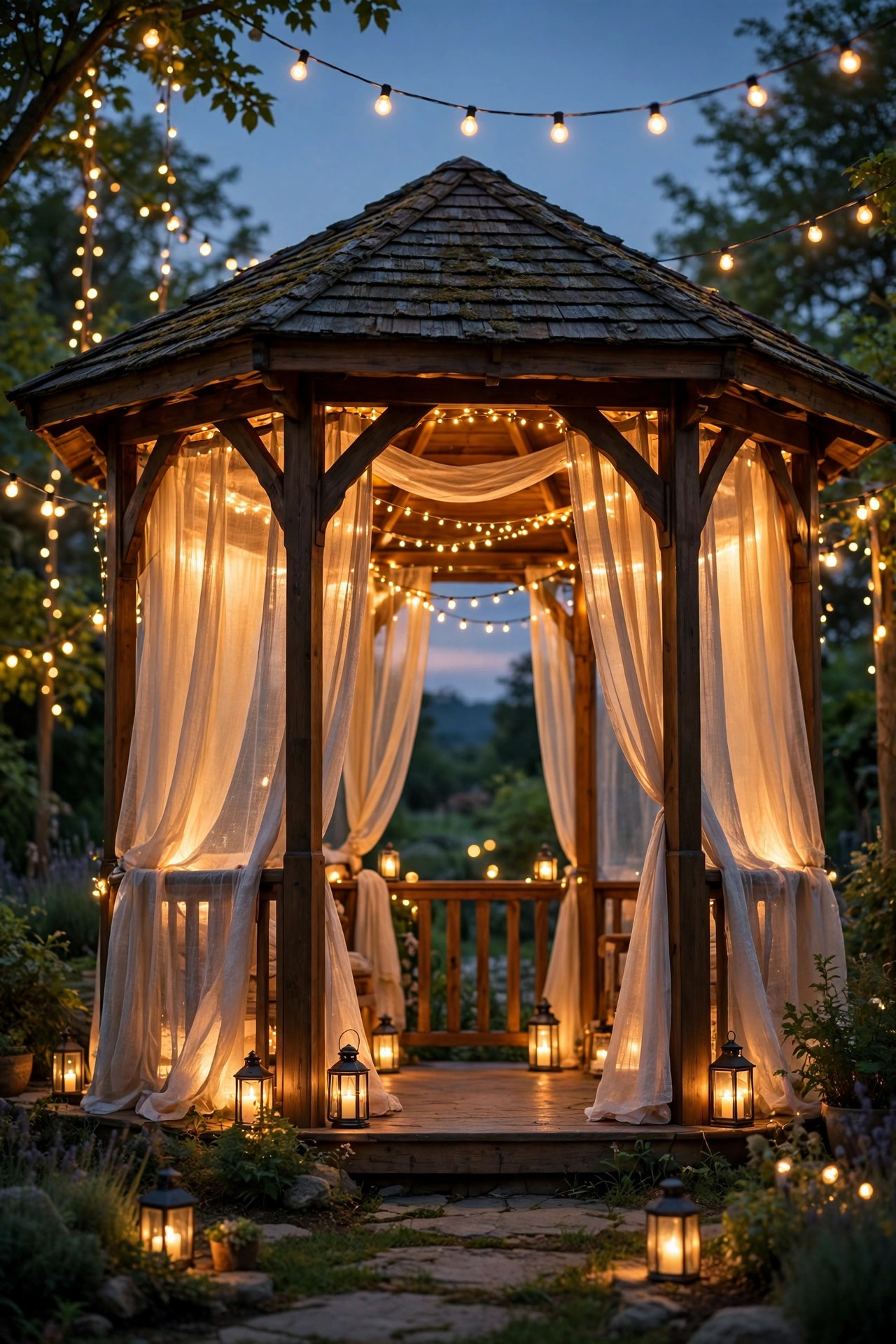
Our gazebo sits close enough to the neighbors' deck that for the first summer, we barely used it after dark. Then the curtains went up, and the lighting plan changed everything. If you have been hunting for gazebo privacy lighting ideas that make a curtained or screened gazebo feel like a private little hideaway instead of a fishbowl, this is the playbook I worked out over two seasons of trial and error. The secret is not brighter light; it is light in the right layer. Put the glow on the fabric itself, keep the seating area low and warm, and the curtains turn into soft, luminous walls nobody can see through — while the breeze still drifts in. Below are 15 combinations, from five-minute battery fairy lights to a fully layered scene, each with placement notes and costs. One safety rule runs through all of them: LED and flameless only anywhere near curtain fabric or screens, never anything that runs warm. Pick one layer tonight, or stack a few for the full effect.
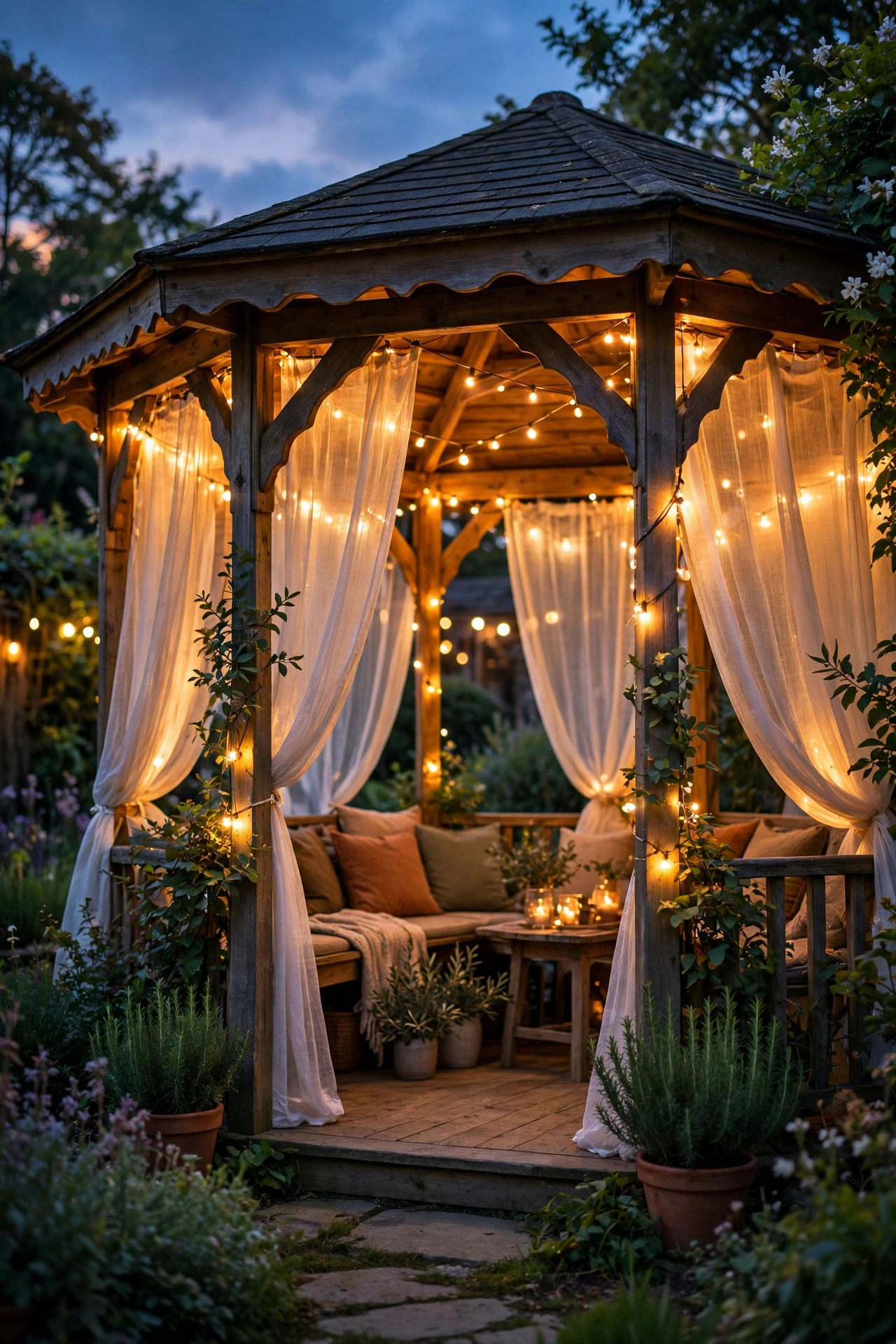
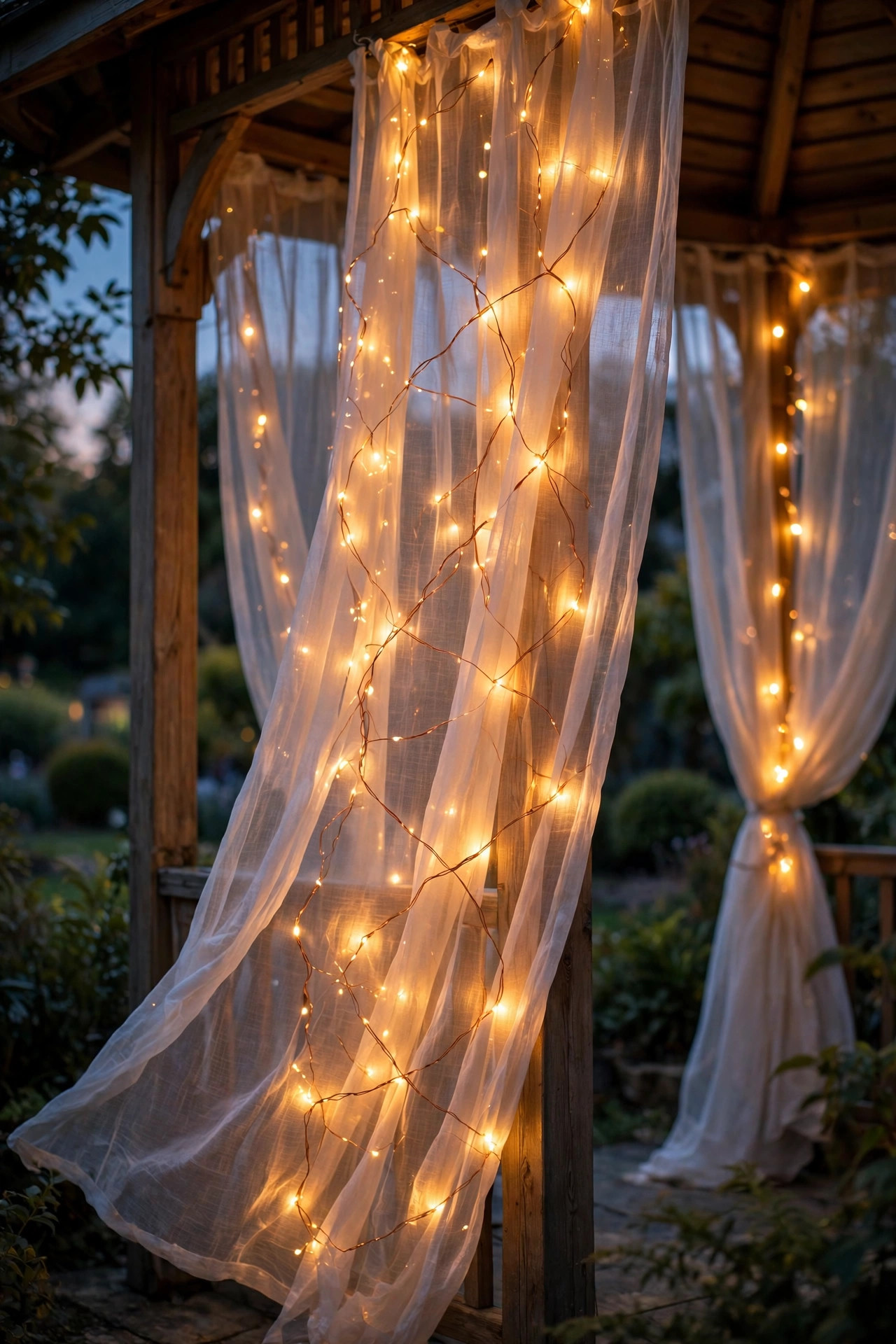
1. Weave Copper-Wire Fairy Lights Through Sheer Curtain Panels
This is the idea that made our gazebo feel private overnight, and it costs less than a pizza night. Copper-wire fairy lights are nearly invisible in daylight, and because the LEDs stay cool to the touch, you can thread a strand right through the top hem of a sheer panel or zigzag it down the fabric in loose vertical runs. I use battery-powered strands on a timer — six hours on, eighteen off — so there is no cord crossing the floor. Space the zigzags about 8 inches apart; tighter looks like holiday decor, looser and the effect disappears. Through one layer of linen, the dots read as fireflies caught in the fabric, and from the yard all anyone sees is a glowing curtain, not you. Only ever weave LED strands into fabric — never anything incandescent — and pick warm white, not blue-white, which turns sheers an icy gray. When the panels come down for washing, the strands slip out in seconds and coil into a mason jar for storage.
Suggested budget range: $15 – $40.
2. Hang Curtain String Lights Behind Solid Drapes
If your gazebo wears heavier drapes instead of sheers, a curtain-style string light panel is your best friend. These hang like a net of tiny vertical drops, and I mount ours on the outside face of the posts, between the post and the closed drape, using small adhesive hooks rated for outdoor use. When the drapes close, the whole panel glows through the fabric like light behind a lampshade — even, soft, and completely silhouette-proof. Look for a panel around 10 feet wide with 8 twinkle or steady modes and an IP44 or better weather rating, and give the drops about 4 inches of spacing so the light reads as a wash rather than dots. I keep the strand at least 2 inches off the fabric on its hooks, and only LED versions ever go near drapes in my yard. My year-round guide to icicle curtain lights covers panel sizes and hanging hardware in detail if you want the full how-to. On a timer, the drapes light themselves at dusk.
Suggested budget range: $25 – $60.

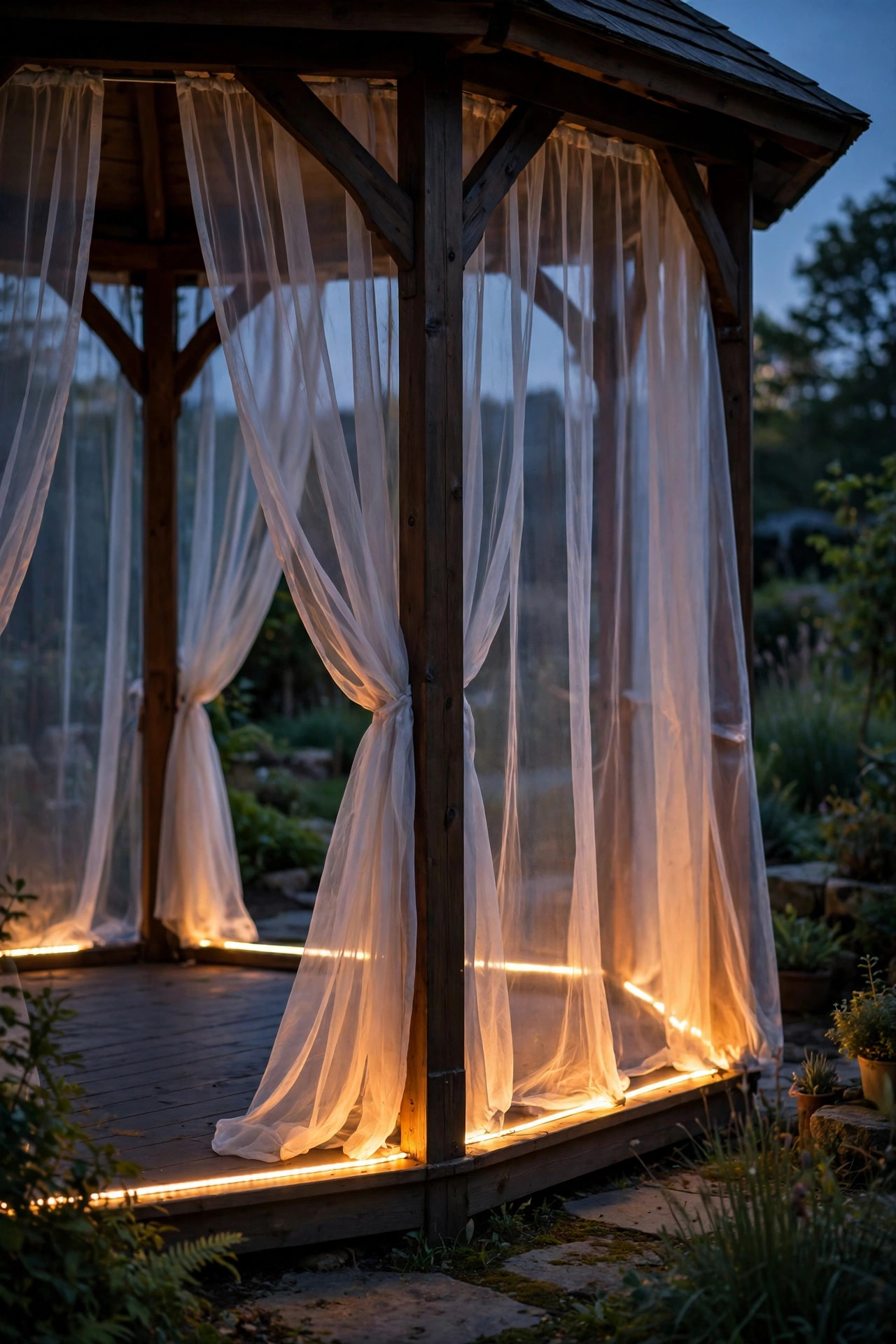
3. Gazebo Privacy Lighting Ideas That Start With Backlit Sheers
Backlighting is the single most effective privacy trick I know, and it is the foundation of most gazebo privacy lighting ideas that actually work. The principle is simple: if the curtain itself is the brightest thing in view, eyes outside cannot adjust past it to see you. I hide a low-voltage LED strip in a slim aluminum channel along the floor rail, aimed straight up the inside face of our sheer panels. The fabric catches the light and turns into a glowing wall, while the seating behind it stays in soft shadow. Keep the strip 2 to 3 inches away from the fabric, and choose a 2700K strip with a diffuser channel so you get a wash instead of hot spots. A plug-in dimmer lets me drop the wash to a whisper on movie nights. Because the strip is LED, it stays cool against the hem — but I still never let fabric rest directly on it, and the whole run plugs into a GFCI outlet. It takes maybe an hour to install and changes the entire feel of the space.
Suggested budget range: $30 – $75.
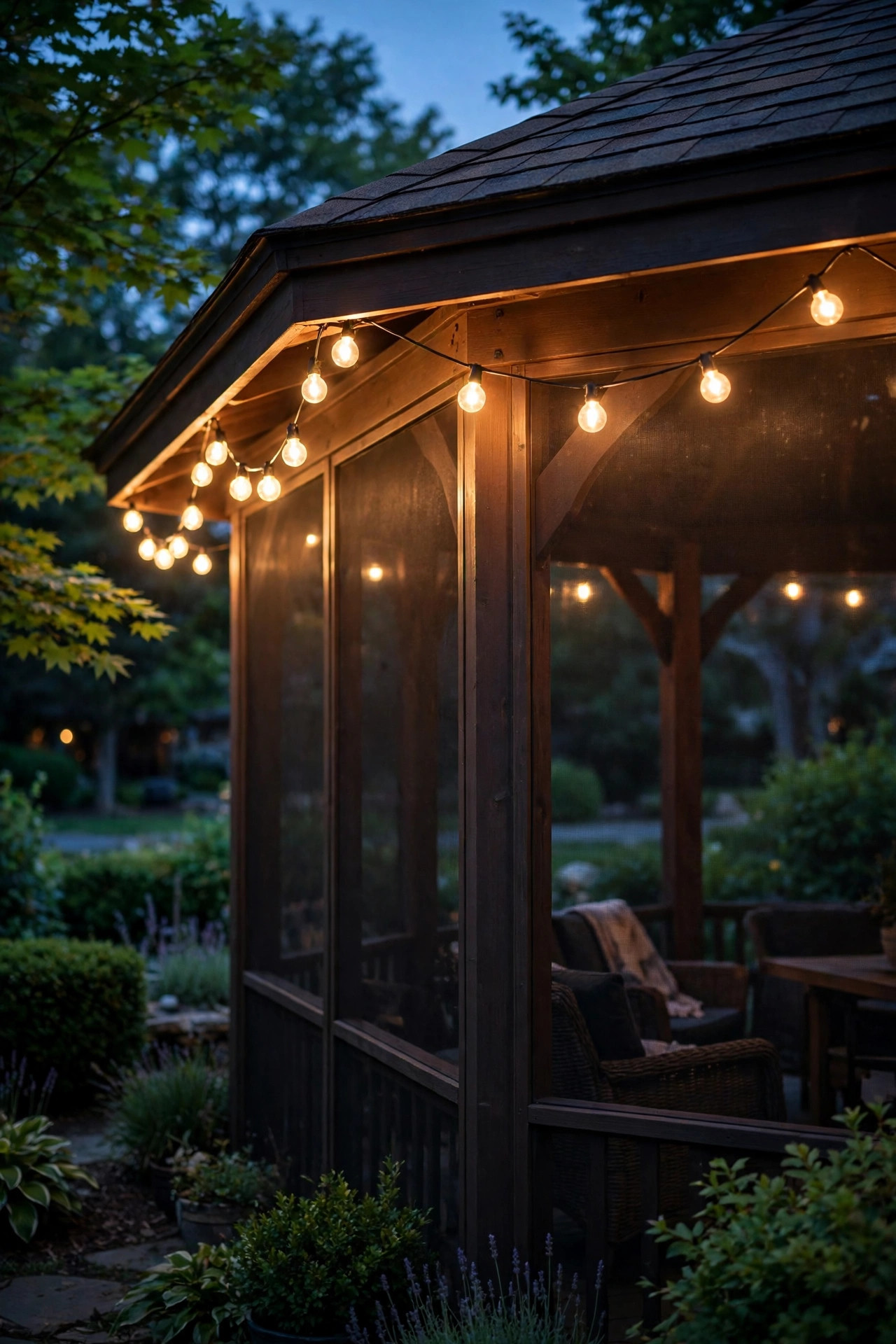
4. Swag Globe String Lights Outside the Screens
Here is the counterintuitive one: to hide the inside of a screened gazebo, light the outside. When globe string lights swag along the exterior eaves, the bright line of bulbs sits between your neighbors and your screens, and their eyes stop there. I run two strands around the outside of the roof edge, bulbs about 12 inches apart, hanging them from gutter-style clips so nothing drills into the posts. Shatterproof LED globes in warm white are the move — glass and real filament heat do not belong near mesh screens, and LED globes stay cool even after hours. Keep the interior lights dimmer than the exterior swag and the screen mesh goes nearly opaque from the yard, especially once the sun is fully down. It also looks gorgeous from the house, like the gazebo is outlined in lanterns. Plug the strands into a dusk-to-dawn timer outlet so the privacy wall switches itself on, and overlap the ends at the corners so there are no dark gaps for sightlines to sneak through.
Suggested budget range: $40 – $110.
5. Cluster Flameless Candle Lanterns Low Inside
Privacy lighting is as much about what you keep dim as what you brighten, and the inside of our gazebo stays deliberately low-lit. Instead of an overhead fixture glaring down — which turns everyone inside into a silhouette display — I cluster flameless candle lanterns on the table and in two floor corners. The flicker is warm and flattering, and because the light sits below eye level, it barely registers from outside the curtains. Honestly? This is also the layer guests compliment most; it feels like a campfire glow without any fire. And near curtains and screens, flameless is not a style choice, it is the rule: real candle flames and billowing fabric should never share a breezy structure. Look for lanterns with a timer function and a warm 2200K to 2700K flicker tone, and group them in odd numbers — three on the table, two by the door opening. Battery sets last us most of a season, and a few rechargeable pillars rotate through the mix so we are never caught dark.
Suggested budget range: $20 – $55.

6. Aim Solar Uplights at the Outside of the Curtains
Think of this as backlighting in reverse. A row of solar stake spotlights planted about 2 feet out from the gazebo, aimed up at the closed curtains, turns each panel into a softly glowing sail. From the street or the neighbors' yard, all that registers is warm fabric — the interior disappears completely. I use four to six stake lights with adjustable heads, angled so the beam washes the lower two-thirds of each panel where sightlines matter most. Solar makes this a zero-wiring install: push them in, angle them, done, though I do wipe the little panels monthly so they charge fully. Position them where they catch at least six hours of sun, and nudge them inward if mower or foot traffic keeps clipping them. Only the fabric gets lit here, so heat near the curtains is a non-issue, and the glow doubles as pretty landscape lighting for the yard. On cloudy weeks I rotate in a couple of brighter low-voltage spots, but most nights solar carries it easily.
Suggested budget range: $25 – $70.

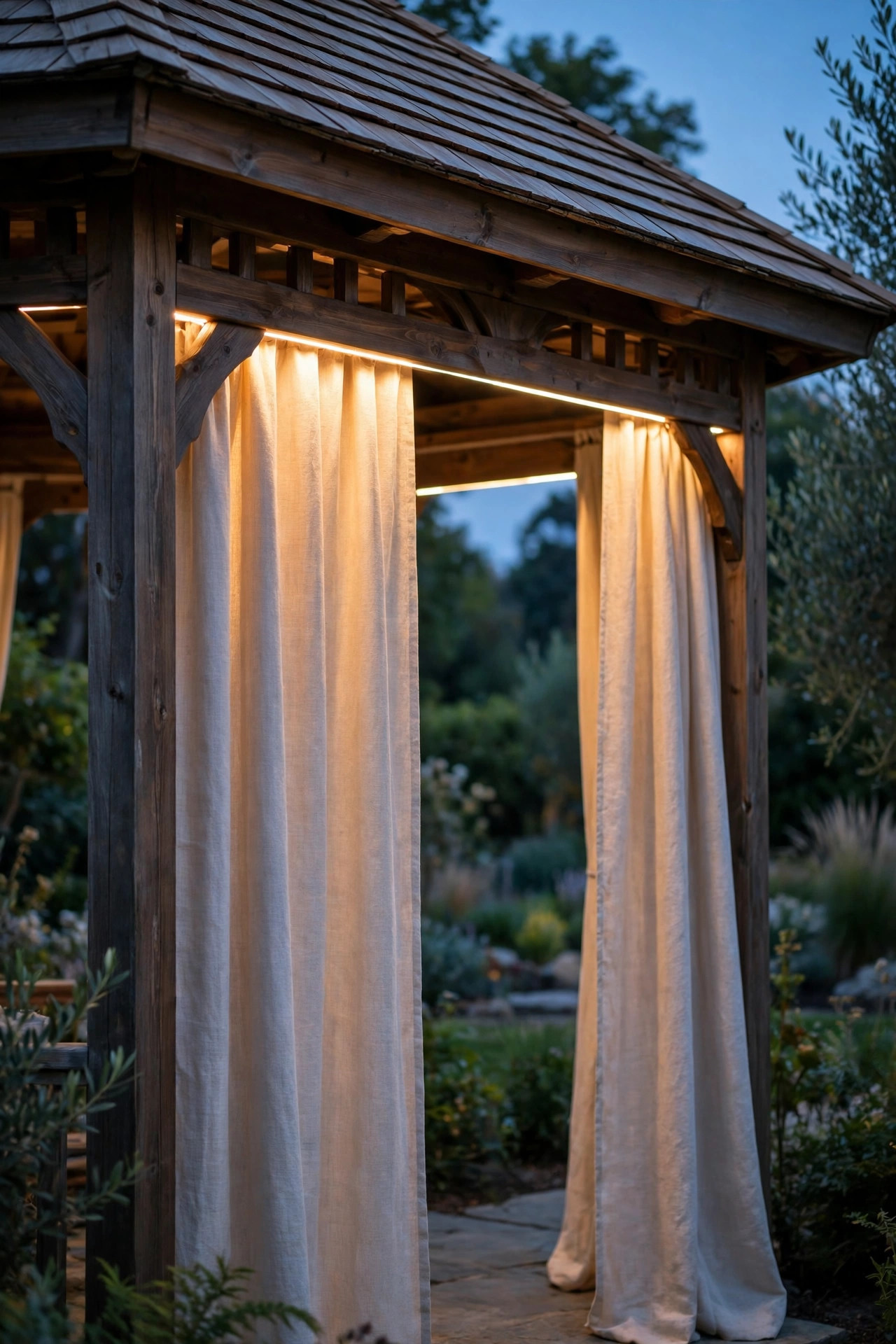
7. Run an LED Strip Along the Top Valance
The top-down cousin of backlighting: hide an LED strip inside the valance or along the curtain rod housing, aimed down the face of the panels. The wash pours over the fabric from above, erasing shadows and making the curtain read as one solid glowing surface from outside. I mount the strip in a shallow aluminum channel screwed to the inside of the top rail, which keeps the diodes invisible and the light even — bare strips show every dot mirrored in the sheers. Aim for 2700K, high color rendering if you can find it, and put it on a dimmer; full brightness is for parties, half is our nightly privacy setting. The strip should sit at least 2 inches from where the curtain hangs, and because it is LED it stays cool — still, fabric should never rest against it. This one takes a ladder, a free hour, and a GFCI-protected outlet. Paired with backlit sheers on the busiest side, it gives you a full glowing wrap with no gaps at the top where people forget to check.
Suggested budget range: $35 – $85.
8. Hang Paper Lantern Pendants Low Over the Seating
A small cluster of paper lanterns hung low over the seating area does privacy work in a sneaky way: it pools warm light in the center of the gazebo, so the perimeter — curtains, screens, and the people nearest them — falls into gentle shadow. I hang three lanterns at staggered heights, the lowest about 5 feet off the floor, on a battery pendant cord with a remote. Only ever put LED bulbs inside paper shades; the cool-running rule matters most here because shade and bulb sit inches apart. Warm white, low lumens — around 200 to 400 per lantern — is plenty; you are after a lantern-festival glow, not task light. From outside, the effect is lovely and mysterious: soft orbs floating behind gauzy curtains, zero detail. Paper lanterns are not weatherproof forever, so mine come down ahead of storms and live in a tote through winter, which honestly takes five minutes. Cordless pendant kits make the whole thing a no-electrician project, and the remote dimmer lives in the same basket as the citronella.
Suggested budget range: $30 – $80.

9. Drape Net Lights Over the Neighbor-Facing Screen Wall
Every gazebo has one exposed side — ours faces the neighbors' patio door — and that is where net lights earn their keep. A net light is a grid of LEDs on a mesh you simply drape, and clipped to the outside of the screen wall it becomes a sparkling privacy skin: bright points of light that break up every sightline. I use small binder-style outdoor clips along the top rail every 12 inches so the net hangs flat and never sags into the screen. Choose a warm-white net sized to your panel — 6 by 4 feet covers most — with an end-to-end connector so two nets can wrap a corner. The LEDs stay cool against the mesh, but I still keep the net on the exterior face so fabric curtains inside never touch it. From the yard it looks intentional, like a light wall at a garden party, and from inside it reads as a soft starfield behind the sheers. On a smart plug timer it runs itself from dusk to bedtime.
Suggested budget range: $20 – $50.

10. Set Smart Bulbs to a Low Privacy Scene
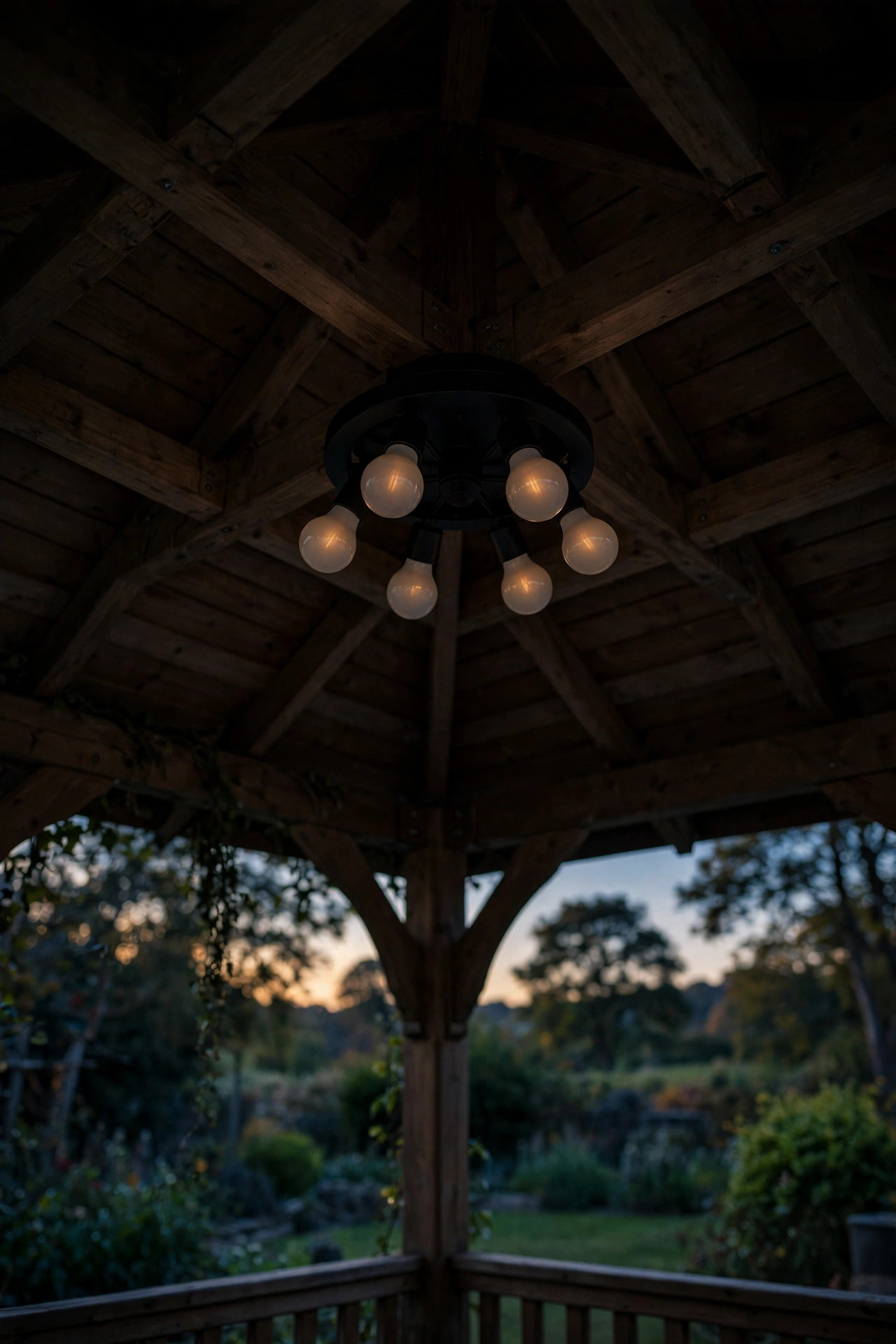
If your gazebo has a ceiling fixture or fan light, smart LED bulbs plus one saved scene might be the laziest privacy upgrade on this list. I replaced the fixture bulbs with dimmable smart LEDs and built a scene called, plainly, Privacy: 30 percent brightness, warmest color setting, on at dusk, off at 11. At that level the interior is comfortable for conversation but far too dim to broadcast silhouettes through the curtains — the fabric layers do the rest. A second brighter scene handles game nights when we draw the drapes fully closed anyway. The bulbs are LED, so heat near the fixture shade is minimal, and I keep the fixture's own diffuser between bulb and fabric regardless. Voice control from the hammock is a genuine treat, and schedules mean the gazebo glows welcomingly whether or not I remember. Start with two bulbs in the main fixture before committing to the whole structure; in my experience, that one dim warm pool of light changes how private the space feels more than any single curtain upgrade.
Suggested budget range: $45 – $100.
11. Trace the Eave With Rope Light Above Blackout Curtains
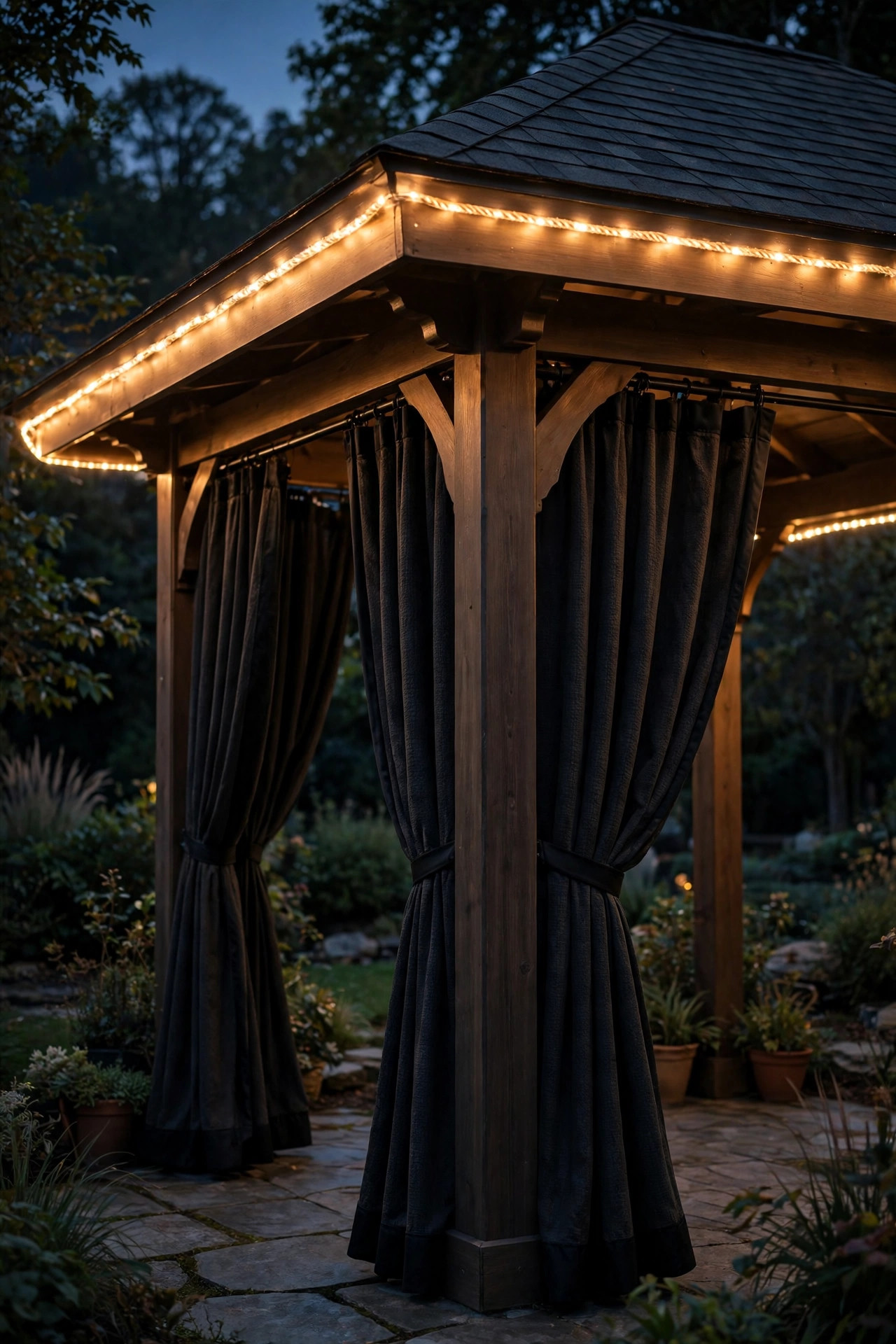
Some evenings call for the full blackout treatment — movie night with a projector, or guests staying late. For that, hang heavier blackout-lined curtains on the street and neighbor sides, then trace the eave above them with a rope light tucked into the top trim. The rope light washes the header and the top foot of the drapes, sealing the gap where light usually leaks and where eyes naturally check first. Blackout fabric handles the rest: not a flicker of interior movement shows through. Rope light is forgiving to install — clips every 16 inches along the trim — and LED rope stays cool along the wood, though I keep it off direct contact with the curtain header itself. Choose 2700K and put it on the same timer as your other layers so the whole system wakes together. In my experience, this combination is also the best wind buffer; the heavy drapes stop the billowing that makes lighter panels flutter against lights. It reads surprisingly elegant from outside, like a stage valance lit for a show.
Suggested budget range: $25 – $65.
12. Clip Battery Fairy Lights Along Screen Frames
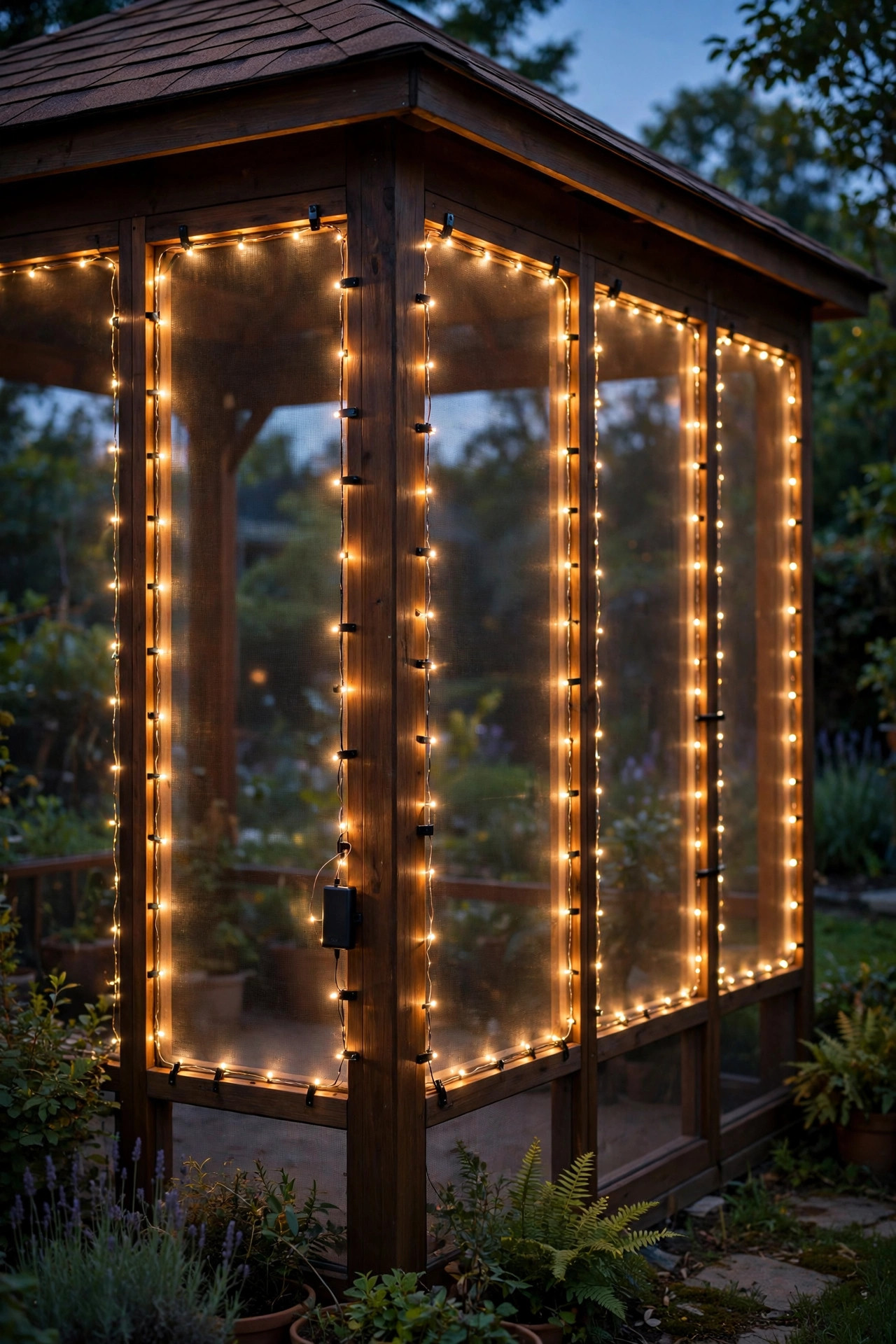
Renters and commitment-phobes, this one is yours. Short battery fairy light strands with mini clips snap directly onto screen frames and curtain hems, outlining each panel in tiny warm points. The outline does the privacy work: a defined border of light around every opening makes the dark interior behind it unreadable from outside, the same way a lit doorway hides a dim room. I run strands around the door panel and the two side screens we keep closed most, spacing clips about 10 inches apart so the line stays taut. Battery packs tuck into the frame corners, and the eight-hour timer setting means they switch on at dusk without a thought. Copper-wire LED strands are the right tool here — light, cool-running, and safe clipped an inch from mesh screens or fabric hems. Full disclosure: this is a softer privacy layer than backlighting, more sparkle than wall, so pair it with dim interior lanterns for the real effect. It is also the first layer I add for parties, because it takes ten minutes and photographs beautifully.
Suggested budget range: $12 – $35.
13. Mount Post Sconces Aimed Out at the Curtains
Most gazebo sconces point inward, lighting faces and furniture — exactly what you do not want when privacy is the goal. Flip the logic: mount compact sconces on the posts and aim them outward at the curtain panels. Each drape becomes a glowing backdrop, and the seating sits in the soft bounce-back, which is flattering and dim. I use low-voltage fixtures with frosted lenses, angled so the beam center lands mid-panel about 4 feet up, and I wire them to the same transformer as our path lights. Frosted lenses matter — a bare bright bulb against fabric creates a hot spot that reads as a lamp silhouette from outside, which defeats the purpose. Keep fixtures and fabric a few inches apart per the rating on the box, and LED lamps only, as always near textiles. For broader layout inspiration, I pulled a lot of my early fixture ideas from the site's main gazebo lighting ideas collection before I started aiming everything outward. Two sconces per exposed side is plenty.
Suggested budget range: $60 – $140.

14. Suspend a Solar Chandelier With a Frosted Shade
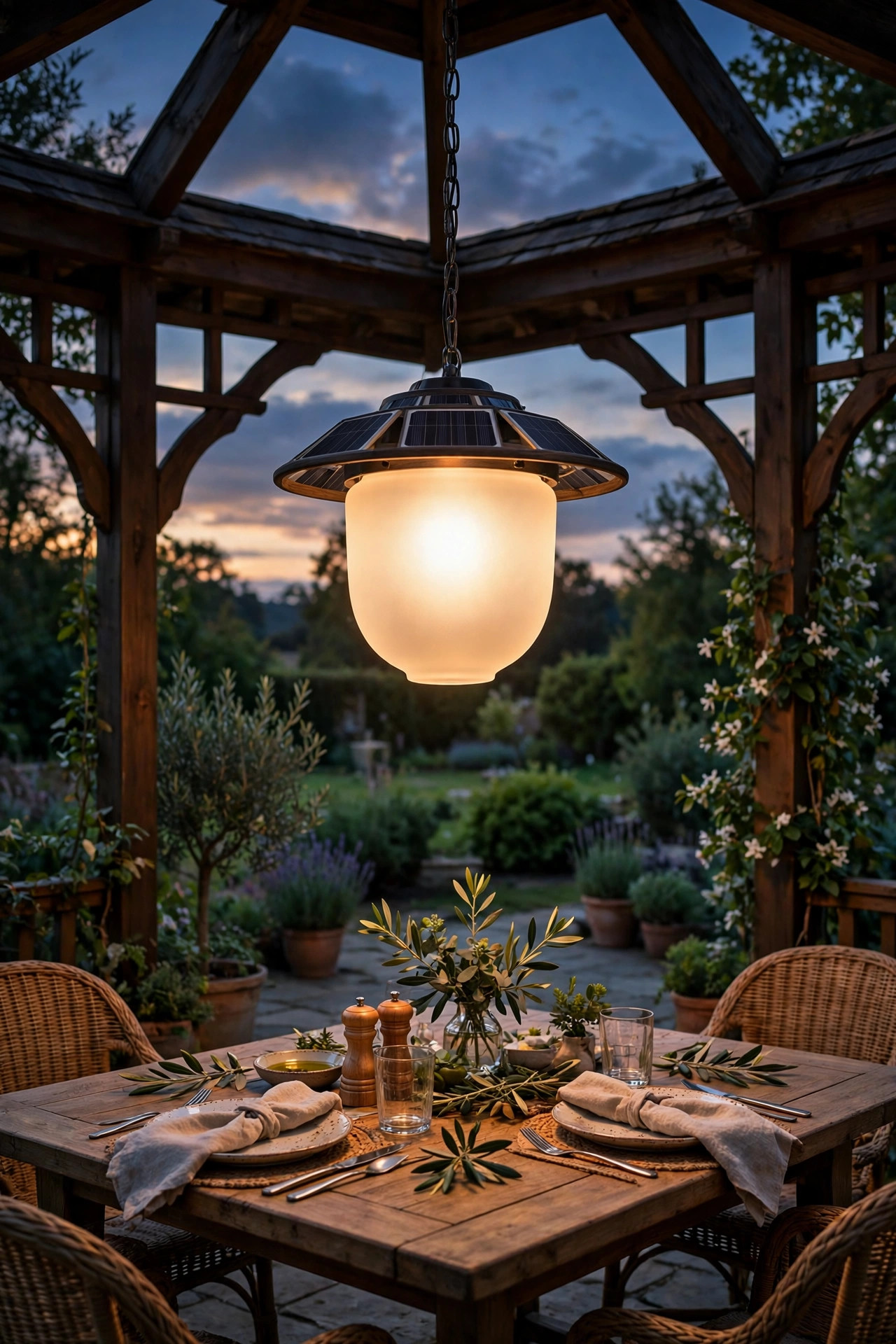
A chandelier sounds grand, but the solar versions are simple: a hanging fixture with a small panel that charges by day and glows all evening, no wiring at all. Hang it dead center, low enough that its light pool lands on the table — the bottom of the shade around 30 inches above the tabletop works for us. The privacy magic is the frosted shade: it diffuses the LEDs into a soft dome of light that illuminates dinner without throwing anyone's shadow onto the curtains. A bare-bulb fixture, by contrast, projects crisp silhouettes straight onto the fabric, which is the opposite of privacy. Look for a remote solar panel you can perch on the roof edge if your gazebo sits in shade, since a shaded panel means a dim chandelier by nine. The LEDs inside run cool, and the shade keeps them a safe distance from any swaying curtain edge. We take ours down in deep winter; the hook stays, rehanging takes a minute, and guests always assume it is hardwired.
Suggested budget range: $50 – $120.
15. Layered Gazebo Privacy Lighting Ideas for the Full Hideaway
Every idea above works alone, but the full hideaway comes from layering three of them together — this is the recipe I land on whenever someone asks for my best gazebo privacy lighting ideas in one setup. Layer one: glow on the fabric, via backlit sheers or a valance strip, so the curtains become the brightest surface in view. Layer two: a dim, warm interior — flameless lanterns low on the table and smart bulbs parked at 30 percent — enough to see faces and plates, never enough to project silhouettes. Layer three: a bright perimeter, globe strings or solar uplights outside, which stops outside eyes from adjusting to your dim interior at all. The same three-layer thinking runs through my favorite pergola lighting ideas, because the structures share the same sightline problem. Put all three layers on timers so the whole scene builds itself at dusk. Start with whichever layer your gazebo lacks most; in my experience the fabric glow alone fixes 80 percent of the fishbowl feeling.
Suggested budget range: $120 – $300.
Frequently Asked Questions
What color temperature looks best through gazebo curtains?
Warm white, 2700K or lower, wins every time in my yard. It reads like candlelight through linen, flatters skin tones, and makes white or cream sheers glow amber instead of gray. Cooler 4000K and 5000K bulbs turn the same fabric a chilly blue-white that feels more parking lot than hideaway. Whatever you choose, keep every layer in the same color family — mixed temperatures are the fastest way to make a careful setup look accidental.
Are string lights and LED strips safe against curtains and screens?
LED versions, yes, with basic care. LEDs run cool, which is why every idea in this post uses them, but I still keep strands and strips an inch or two off the fabric, never pinch cords in door frames, and choose products with an IP44 or better outdoor rating. Incandescent and halogen bulbs are the ones to banish — they run genuinely hot and have no business near billowing curtains or mesh screens. Plug everything into GFCI-protected outlets, and bring battery and solar layers in if a storm is going to whip the drapes around.
How does lighting actually make a gazebo more private?
It works the same way a lit shop window does at night, in reverse. Your eyes adjust to the brightest surface they see, so if the curtain is glowing and the interior behind it is dim, an outside viewer physically cannot pick out details inside — you become a soft shape at most. That is why glowing fabric plus low interior light beats heavy drapes alone: plain dark curtains still show silhouettes the moment someone turns on a bright ceiling light. Light the fabric, dim the middle, and the privacy mostly takes care of itself.
Can I run all of this on solar and batteries with no outlet?
Almost all of it, yes. Fairy lights, lanterns, solar uplights, curtain panels with solar leads, and solar chandeliers cover layers one and two for most gazebos, as long as the panels see roughly six hours of sun — a remote panel on a short lead solves shady roofs. The trade-off is winter: short, gray days mean dimmer, shorter evenings of light, and batteries fade faster in the cold. If you entertain year-round, one GFCI outlet run by an electrician is worth the splurge for the valance strip alone.
Conclusion
Privacy in a gazebo is not really about thicker curtains; it is about putting the light where it works for you — glowing on the fabric, low and warm in the middle, bright at the perimeter. Start with one layer from these gazebo privacy lighting ideas, live with it for a weekend, and add the next when you are ready. If you want more inspiration for the structure itself, browse the rest of the outdoor lighting ideas here on the site — your hideaway is closer than you think.