Every January, my whole street goes dark in the same week — and honestly, my house used to be the worst offender, with bare eaves and a porch that looked abandoned by New Year's Day. A few winters ago I decided to keep my icicle lights year round instead of dragging out the ladder, and it completely changed how our home feels after dark. The secret is treating icicle and curtain lights as a year-round lighting layer, not a holiday costume: warm white instead of rainbow colors, tidy permanent mounting instead of sagging clips, and timers so everything glows on schedule like the rest of your landscape lighting. In this post I'm sharing 17 ways I use icicle strands and curtain panels from spring garden parties straight through to fall evenings — porch walls, pergolas, fences, trees, and a few party tricks — with the sizes, ratings, and honest costs for each.
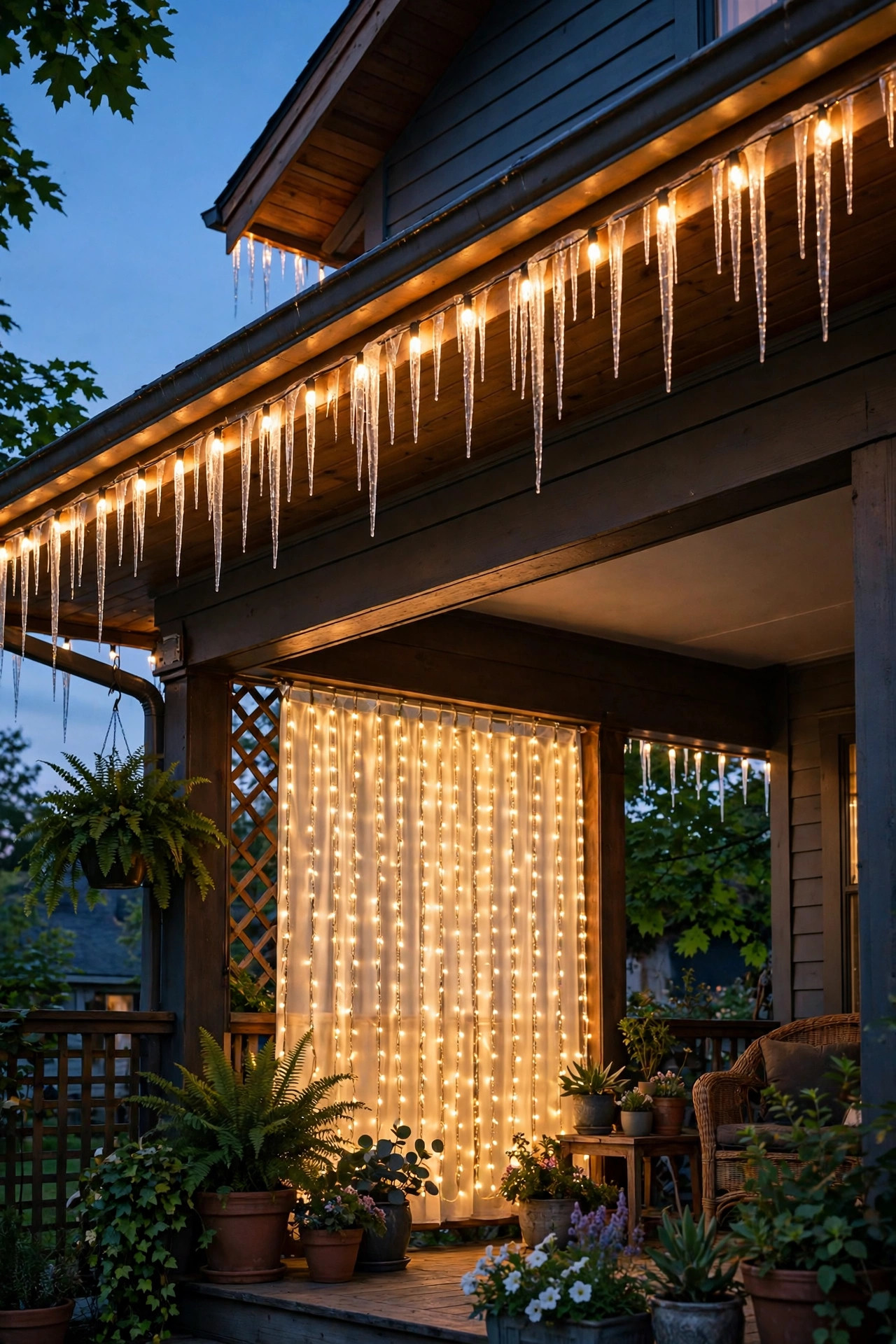
1. Keep Icicle Lights Year Round Along the Front Eave
This is the move that started it all for me: a single, tidy run of warm white icicle lights along the front eave that simply never comes down. Choose commercial-style LED icicle strands rated for outdoor use with shatterproof bulbs, and pick a drop pattern you genuinely like seeing in July — I prefer shorter, even drops of 12 to 18 inches spaced about 6 inches apart, which reads as a soft sparkling trim rather than a winter scene. Mount them on all-in-one gutter or shingle clips that can stay in place permanently, keep every connection off the roof surface, and plug the run into a GFCI outlet on an astronomical timer set from dusk to 11 p.m. Warm white in the 2700–3000K range is non-negotiable; cool blue-white is what screams "forgot to take the Christmas lights down." Because LEDs sip power and shrug off rain, a quality set handles years of this duty happily.
Suggested budget range: $25 – $70.

2. A Curtain-Light Wall on the Covered Porch
A curtain panel turns a plain porch wall into the prettiest backdrop on the house. The standard panel is about 10 feet wide by 10 feet tall with 300 or so LEDs on vertical drops, and it hangs beautifully from a slim tension rod, a row of cup hooks under the porch beam, or a length of galvanized wire. I hang mine behind our porch seating, where the wall of tiny warm lights makes every evening conversation feel like a café. Measure your wall first — for a wall wider than 10 feet, most panels are connectable end-to-end, usually up to three panels per outlet run. Two rules from experience: keep the controller box and plug under cover where rain can't reach them, and let the drops hang free rather than gathered, because the even waterfall effect is the whole point. If your porch is open on the sides, choose a panel rated IP65 so wind-driven rain won't hurt it.
Suggested budget range: $20 – $50.

3. A Pergola Curtain Backdrop That Doubles as Privacy
On a pergola, one curtain panel on the back or west-facing side does three jobs at once: it blocks the low evening sun, gives you a layer of privacy from the neighbors, and turns dinner outside into an occasion. Run a stainless cable or a straight conduit pipe between the two rear posts at the top beam, hang the panel from it with small rings or zip ties every 12 inches, and let the bottom hem float just above the floor so it moves a little in the breeze — that movement is gorgeous. I pair mine with the string lights overhead rather than choosing between them, because the layered look is what makes a pergola feel designed; my notes on layering in the pergola lighting ideas post walk through how I combine the two. Pick a panel with a twinkle or slow-fade mode for dinners, and steady-on for reading nights.
Suggested budget range: $25 – $60.
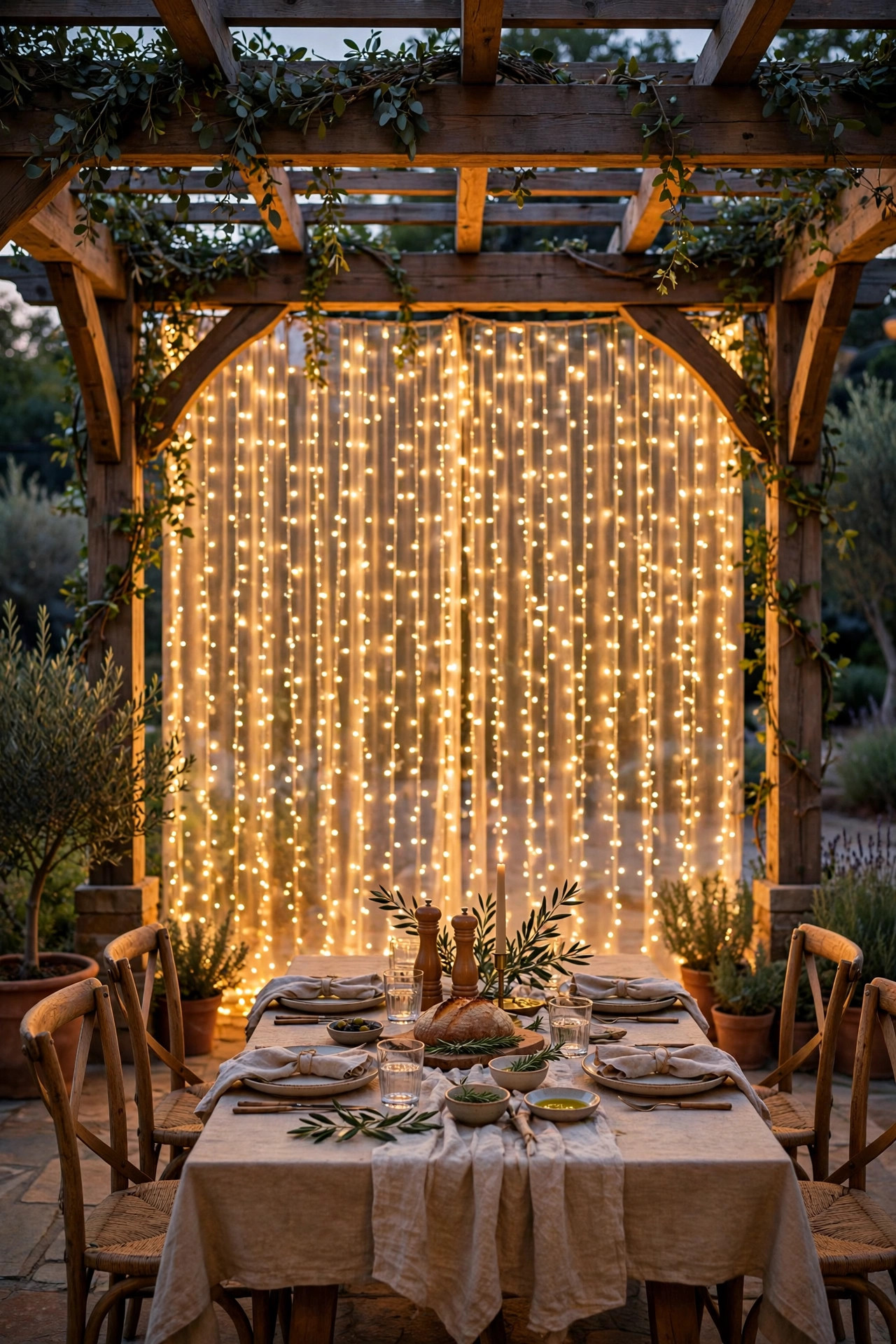
4. Wedding and Party Backdrop Curtains
If you host anything outdoors — a backyard wedding, an anniversary, a milestone birthday — a curtain-light backdrop is the single highest-impact decoration I know. Copper-wire fairy curtain strands are my favorite for this because the wire nearly disappears and the lights look like they're floating behind the head table or cake table. Go bigger than you think: two 10-by-10 panels overlapped slightly looks lush, while one panel stretched thin looks like an apology. Hang them from a simple pipe-and-drape frame, a clothesline between two posts, or the pergola cable from idea three. Battery and USB-powered versions exist for spots far from an outlet, and they'll run a full evening event on one charge. Keep flames far away — LED-only near fabric drapes, always, and never use real candles under the panel. After the party, the same panels move to the porch, which is exactly why I count this as a year-round purchase.
Suggested budget range: $30 – $90.

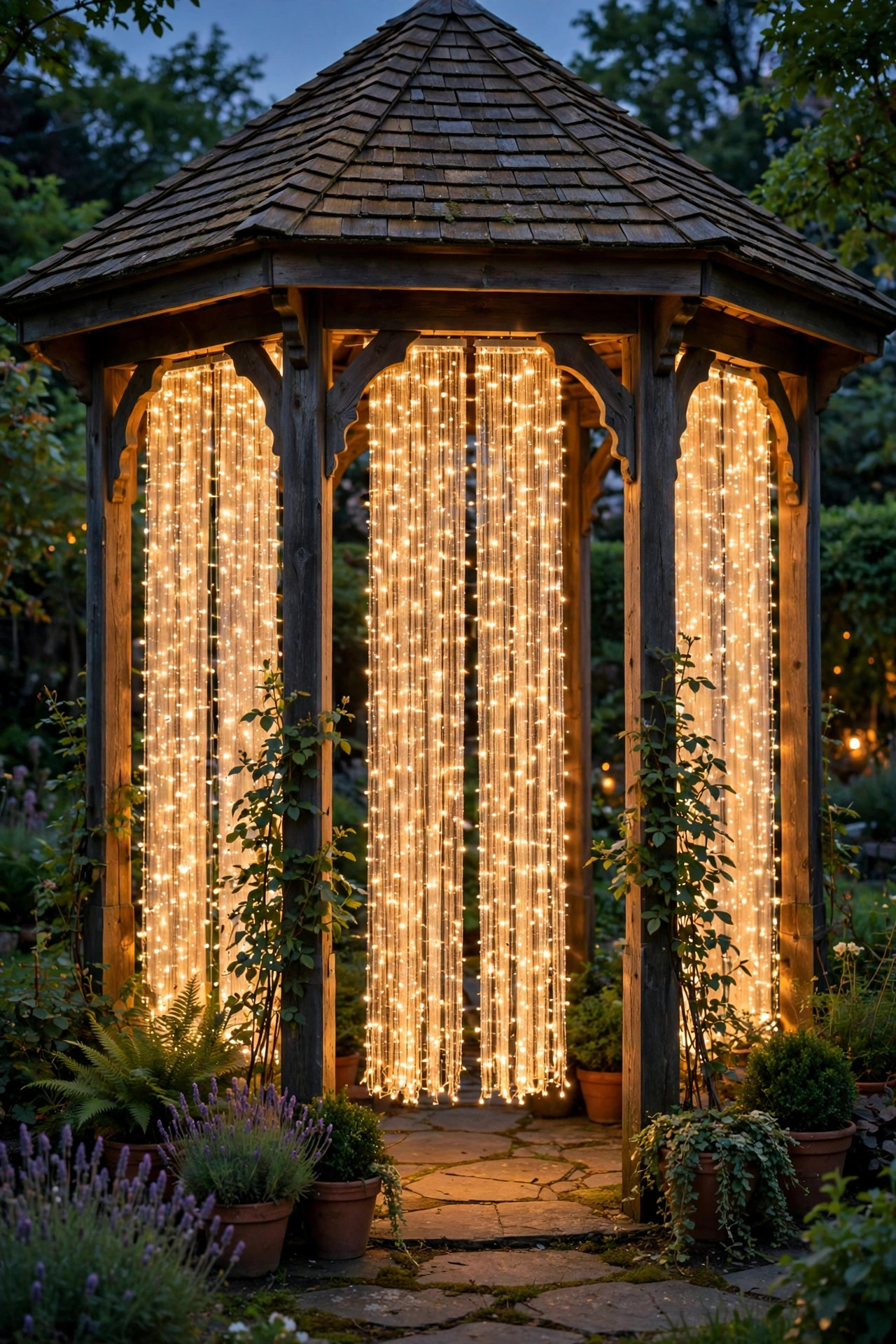
5. Gazebo Curtain Lights Between the Posts
A gazebo is basically a frame built for curtain lights. Hang one panel between each pair of posts around the back half of the structure, leaving the front open as your entrance, and the whole gazebo glows like a lantern from across the yard. I attach the top wire of each panel to screw hooks under the gazebo's top rail, and I add a loose tie-back at each post — a short length of ribbon or a hook — so I can gather the drops to the sides on windy afternoons and let them down again at dusk. Choose panels with removable drops if you can find them; when one strand gets damaged, you replace a strand instead of the whole curtain. Because gazebos catch weather from every direction, IP65-rated lights are worth the small premium here, and a timer means the gazebo lights itself every evening whether or not you remember.
Suggested budget range: $35 – $80.
6. Balcony Railing Curtains for Apartment Dwellers
Renters, this one is yours. A curtain panel zip-tied along a balcony railing turns the smallest outdoor space into a private glowing nook, and it comes down in five minutes with a pair of scissors when you move. Use a shorter panel — 6 feet wide by about 3 to 4 feet of drop suits most railings — or fold a standard panel's extra length behind itself, since the drops are usually spaced evenly enough to hide a fold. Solar-powered curtain lights are perfect here because balcony outlets are rare; just mount the small solar panel where it catches direct afternoon sun on the railing's outer face. Check your lease and building rules first, keep everything inside the railing line so nothing drips or dangles over the edge, and choose warm white so your balcony reads as cozy rather than carnival from the street below.
Suggested budget range: $18 – $45.

7. Curtain Lights Across the Porch Windows
Here's a trick I borrowed from cafés: hang a curtain panel inside the porch windows — or across a big picture window that faces the street — and let the glass do the styling. From outside, the drops read as a soft wall of light behind the glass; from inside, they're the prettiest night-light a room ever had. This works beautifully on a screened or glassed-in porch where the panel stays completely dry, which means you can use an indoor-rated panel that costs less and often has finer, more delicate wire. Hang it from a slim rod or adhesive hooks rated for the panel's light weight, keep the bottom hem a few inches above the sill so it sways slightly, and put it on a smart plug so it joins your evening lighting scene. It also solves a real problem: a big dark window at night is a black mirror, and the curtain of light makes the room feel warm instead of exposed.
Suggested budget range: $15 – $40.

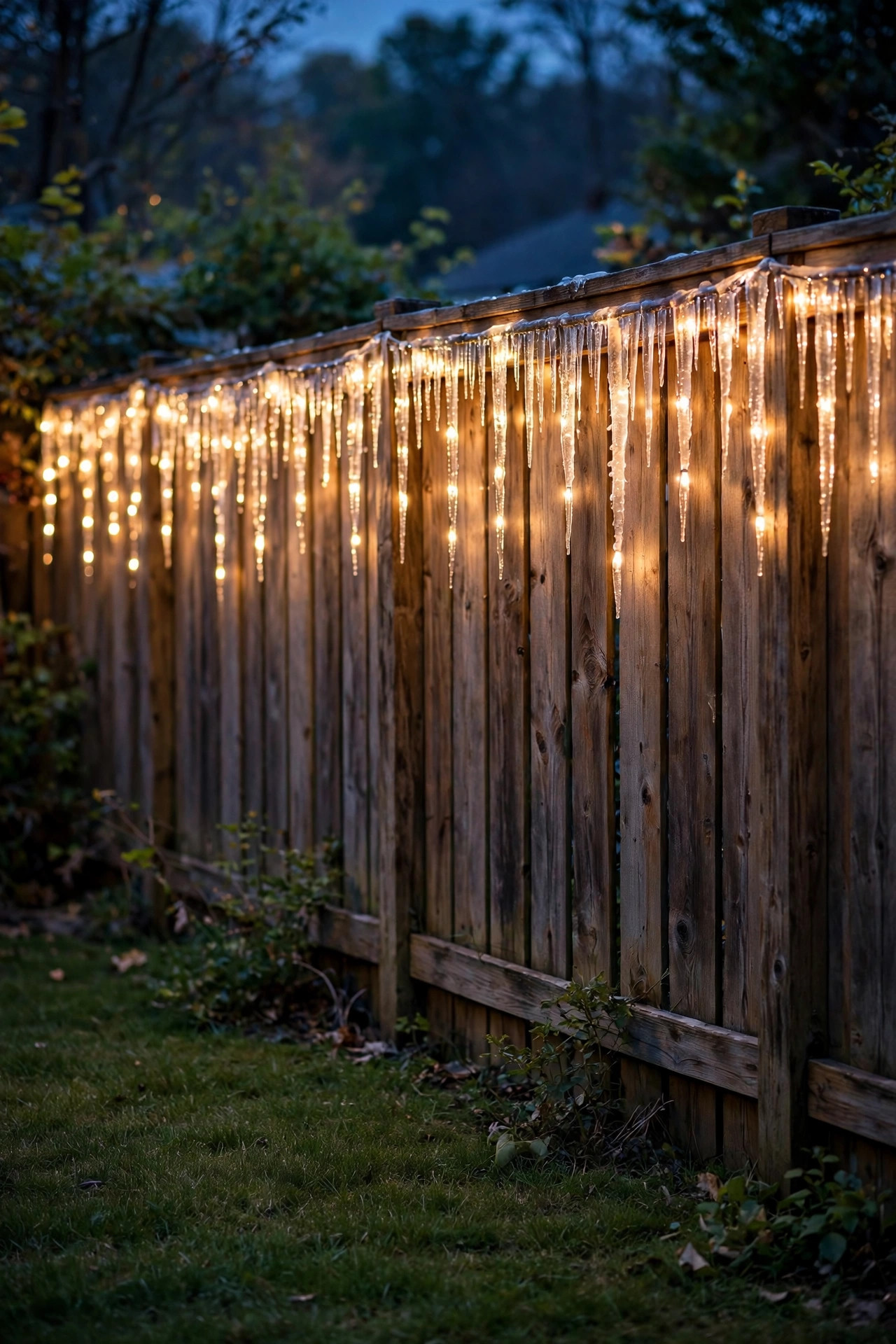
8. Fence-Line Icicles for a Backyard Border
Running icicle lights along the top rail of a backyard fence gives the whole yard a finished edge after dark, the way a string of café lights does — but with a softer, drippier sparkle that I honestly prefer. On a standard 6-foot privacy fence, staple-free mounting matters: use screw-in cup hooks or fence-rail clips every 4 to 5 feet so you're not chewing up the wood, and let each strand swag very slightly between hooks for a relaxed line. Stick to one color temperature across the whole run and match whatever your patio lights are doing, because a mismatched fence line looks accidental. In my experience this is the best-value idea on the whole list for big yards — one or two 20-foot strands outline an entire fence side. Just keep the run on your side of the fence, and check that the plug end lands somewhere dry, ideally inside a weatherproof outlet cover box.
Suggested budget range: $20 – $55.
9. Weeping-Willow Curtains in a Favorite Tree
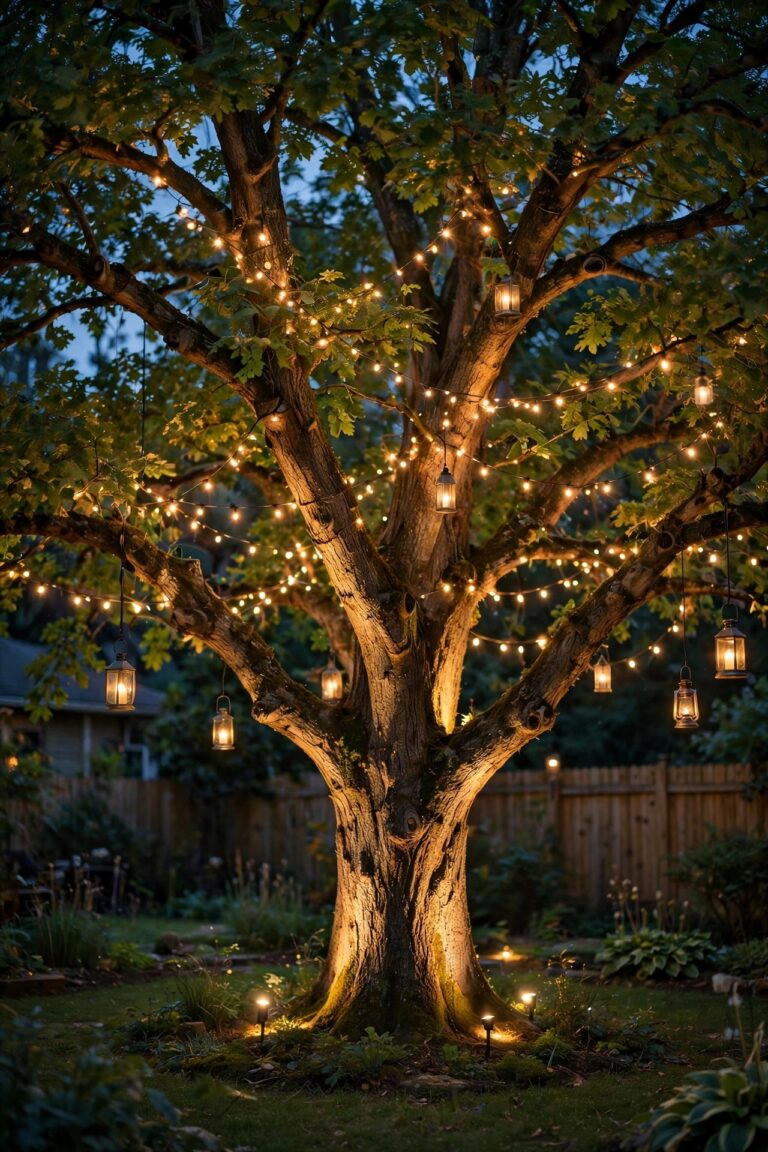
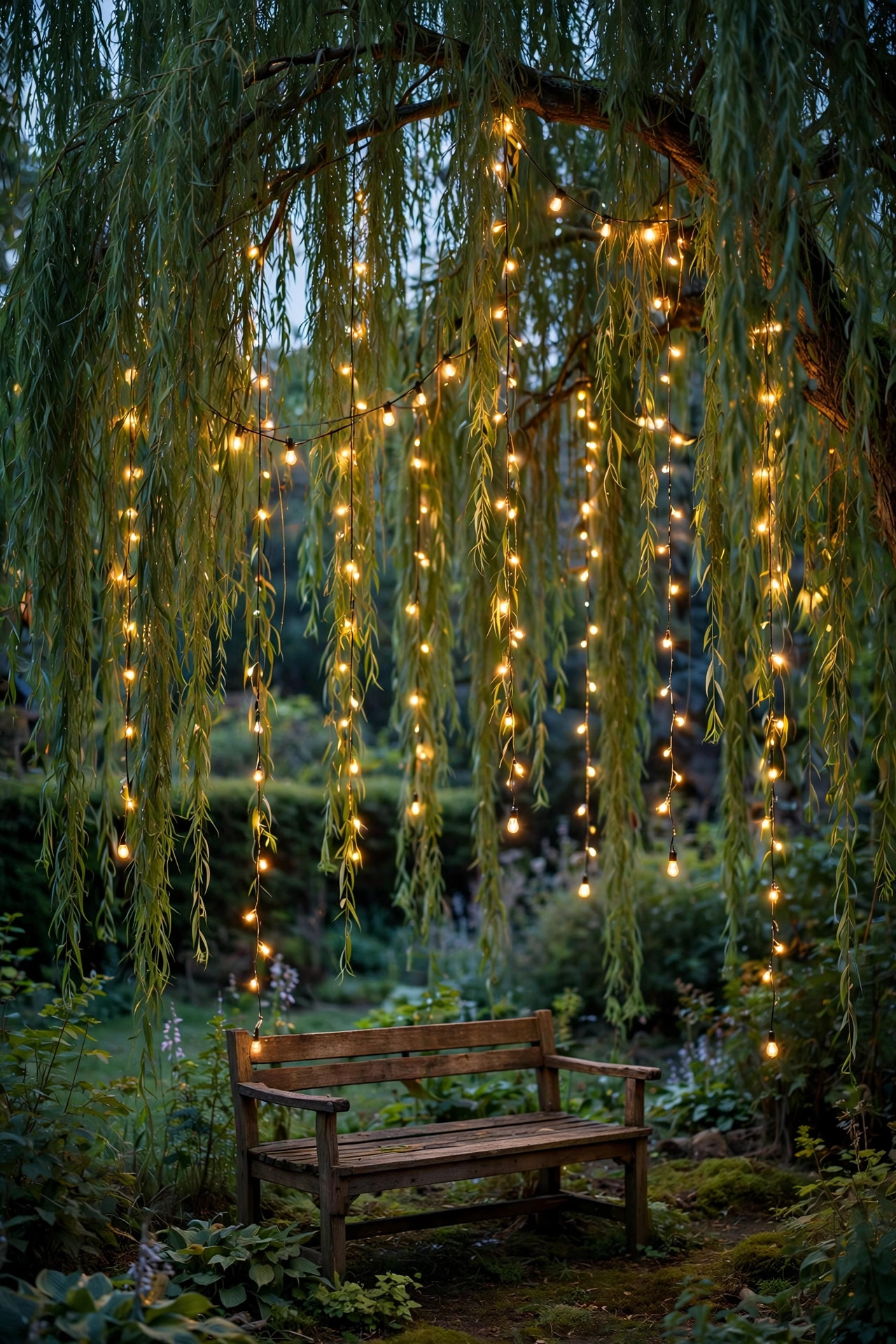
Individual curtain strands hung from the branches of a wide tree create a weeping-willow effect that stops guests in their tracks. You can buy strands individually or unhook the drops from an inexpensive curtain panel — many panels use loop-top drops that slide right off the horizontal wire. Hang 10 to 20 strands from the lower canopy of a tree overhanging your seating area, at varied lengths between 3 and 6 feet, so the light seems to drip out of the leaves. Solar strands are the practical choice here since tree canopies and extension cords are a poor mix; each strand runs from its own small panel clipped to a sunny branch. Keep strands clear of any branch you'll need trimmed this year, and bring the solar units in for winter if your winters are harsh — the LEDs don't mind the cold, but the batteries live longer for it.
Suggested budget range: $25 – $60.
10. Icicles Along the Covered Deck's Roof Edge
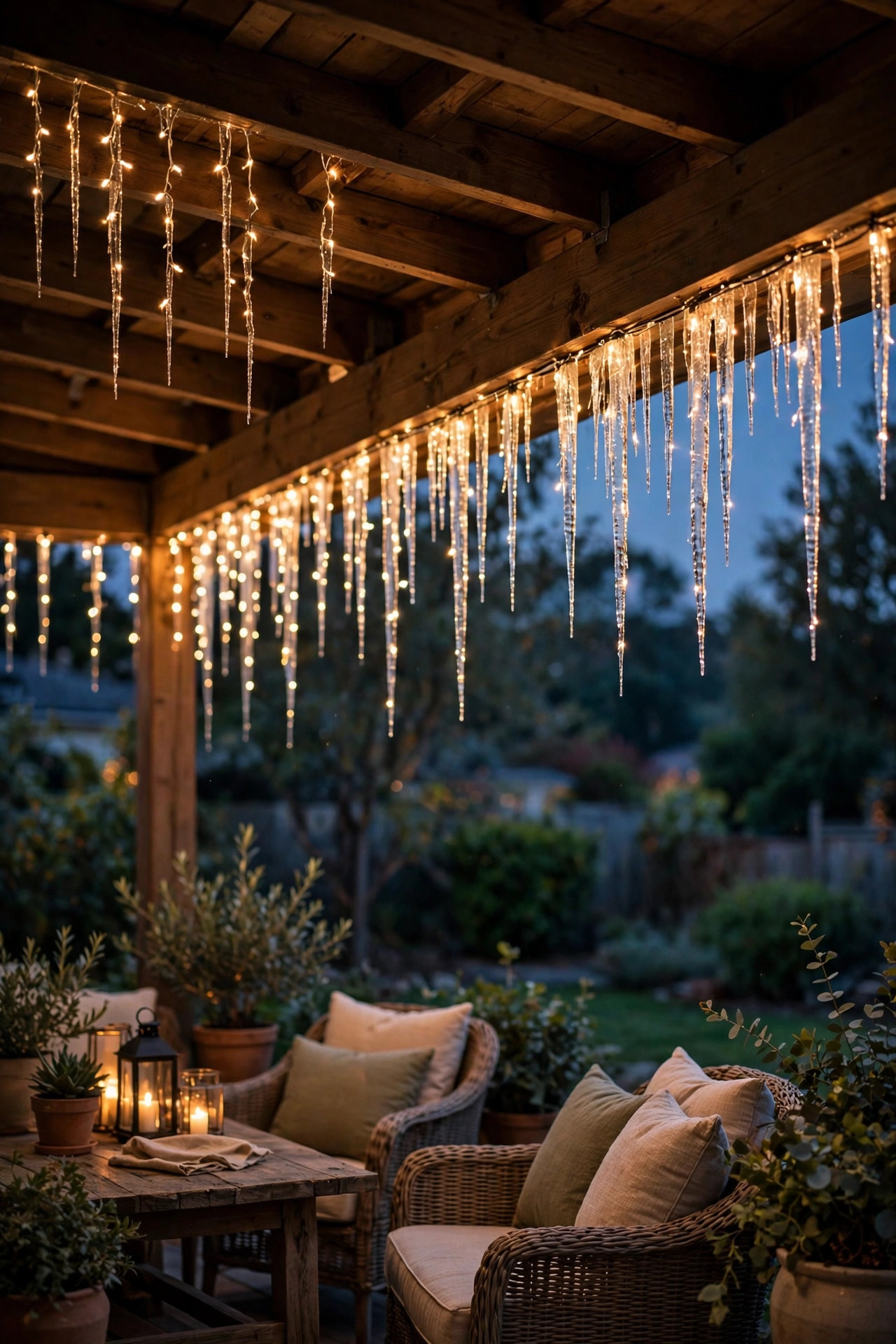
A covered deck or patio roof has a fascia edge that's practically begging for icicle lights, and because the roof keeps the worst weather off, this is one of the longest-lived installs you can do. I mount mine on the inside face of the fascia so the drops hang just inside the roofline — you get the full sparkle from the yard, but the strands stay dry and the daytime look is tidy. This is also the one place I'd suggest hardwiring-adjacent thinking: a switched outlet in the deck ceiling or a smart plug on a schedule turns the icicles into true architecture, on at dusk with your sconces, off at bedtime. Match the drop length to your roof height; on a low 8-foot deck roof, choose icicles with drops under 12 inches so nobody brushes them with a raised drink. From the street, a glowing deck edge gives the whole back of the house a resort feel.
Suggested budget range: $25 – $65.
11. A Photo-Booth Backdrop for Every Backyard Party
Designate one wall, fence section, or pergola bay as your party photo spot and dress it with a curtain panel permanently — your guests will find it on their own, I promise. Layer the lights with something dimensional in front: a garland, a row of lanterns, or a simple bench with cushions, because photos love depth and the curtain provides the glow behind it. Hung at full height behind where people stand or sit, a 10-by-10 panel fills a phone camera's frame perfectly. If the panel lives outside full-time, pick one with a memory function so it returns to your chosen twinkle setting after every power cycle instead of flashing through all eight modes. For party nights, I switch it to slow fade; for everyday evenings, steady warm glow. It's a small thing, but having one reliably photogenic corner has genuinely changed how much our backyard gets used — people linger where the light is flattering.
Suggested budget range: $20 – $50.

12. Icicles Over the Garden Arch and Trellis
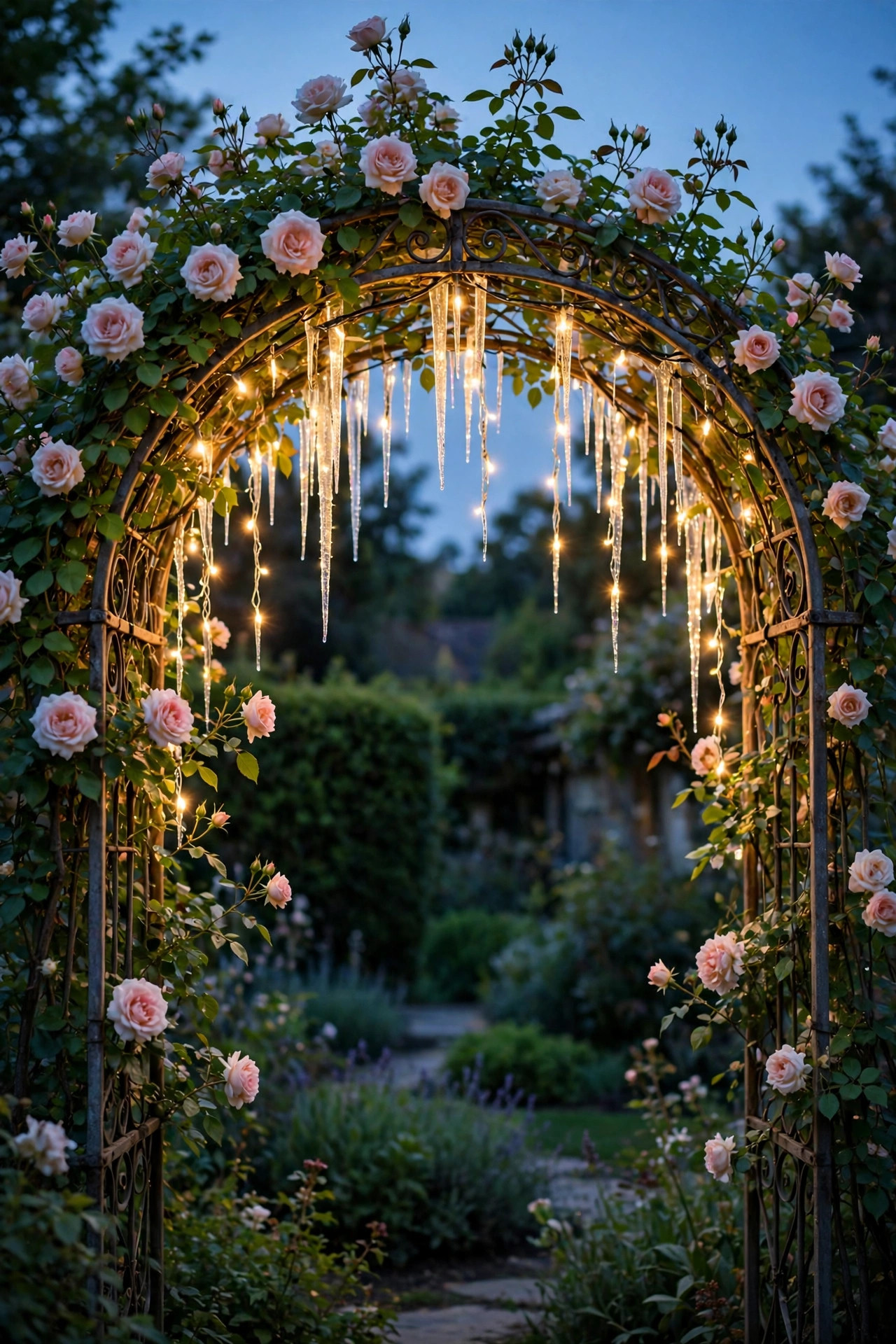
Draping icicle strands across a garden arch or a flat trellis gives you a tunnel of light to walk through, and it's my favorite way to mark the entrance to a garden room. Run the strand along the top of the arch following its curve, securing it with soft plant ties or reusable hook-and-loop straps every 12 inches — never tight wire, which cuts into both the strand and the wood as things move in the wind. Let the drops hang on the inside of the arch so you pass under the sparkle. Keep every bulb LED (cool to the touch, safe near leaves and vines), keep the plug connection elevated and sheltered where the arch meets the ground, and don't let a climbing vine swallow the strand entirely by midsummer; a monthly two-minute untangling keeps it looking intentional. Solar icicle strands exist and work nicely on a sunny arch where a cord would have to cross a path.
Suggested budget range: $18 – $45.
13. A Curtain Behind the Outdoor Bar or Kitchen Counter
If you have an outdoor bar, a serving counter, or even just a potting bench that moonlights as a drink station, hang a curtain panel on the wall or fence directly behind it. The wall of light turns bottles and glassware into silhouettes and makes the whole station look like a little cocktail bar — guests instinctively gather there, which any host will tell you is half the battle. Because this spot involves splashes, choose an IP65 panel and mount the controller and plug well away from the wet zone, ideally inside a covered outlet box on a dry wall. A dimmer matters here more than anywhere: full brightness for prep and mixing, then down to a low glow once drinks are poured. Keep the panel's bottom edge at least a few inches above the counter backsplash so drips can't run down the drops onto the work surface.
Suggested budget range: $22 – $55.

14. Solar Curtain Lights Where There's No Outlet
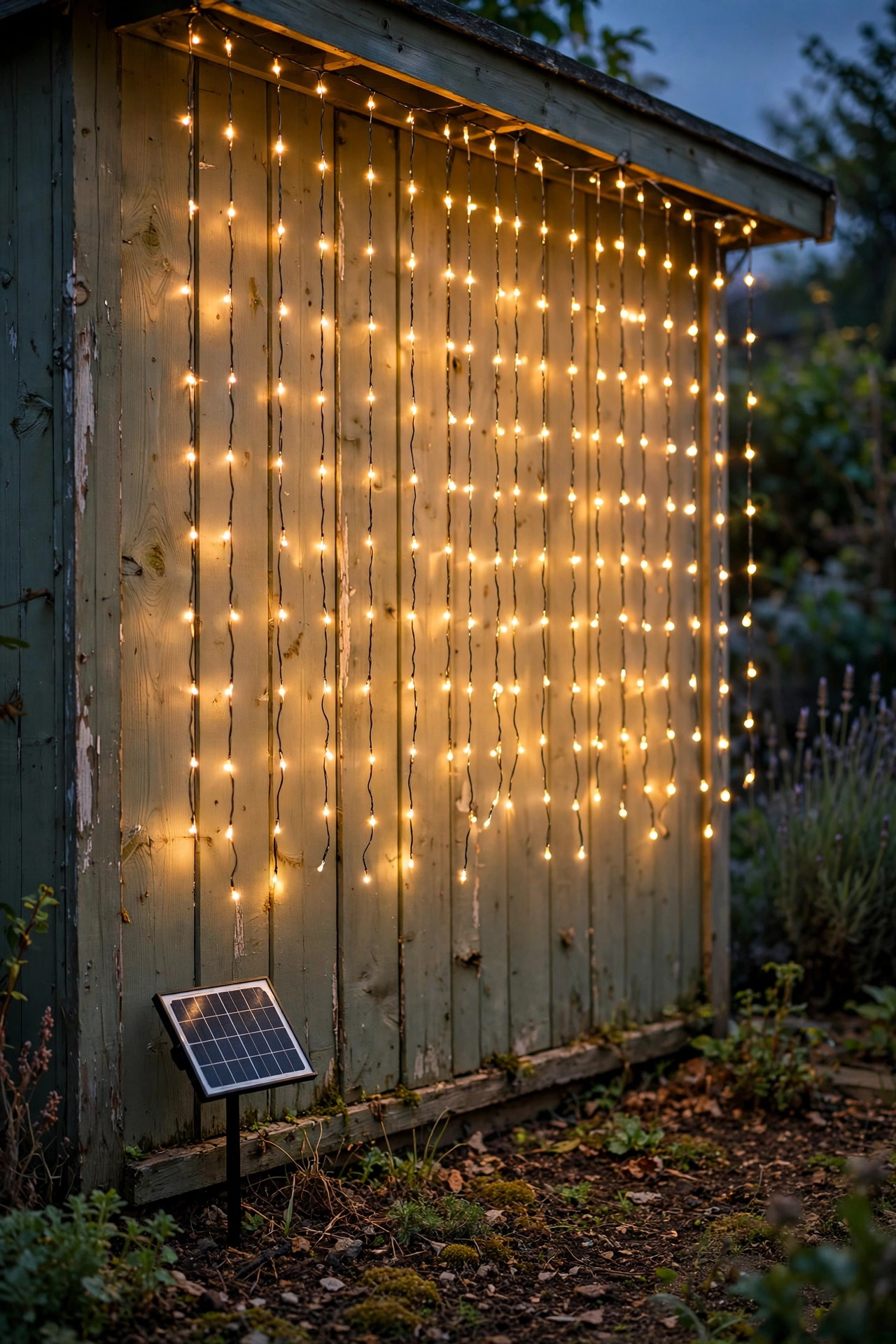
The far side of the yard, the garden shed, the gate arch — the prettiest spots are always the ones without power, which is exactly where solar curtain lights earn their keep. Modern solar panels come as a full 10-by-10 curtain fed by a separate ground-stake panel, and the setup rules are simple: the panel needs six or more hours of direct sun, angled toward the midday sky, and the first charge should be a full sunny day with the switch off. Expect a softer glow than a plug-in panel and a runtime that follows the season — long summer evenings are its glory, and by midwinter you'll get a few early hours rather than all night. That's fine for an accent. I use solar curtains on the shed and the back fence corner, and I genuinely love that they cost nothing to run and needed no trench, no cord, and no electrician.
Suggested budget range: $25 – $50.
15. Color-Changing Curtain Lights That Earn Their Keep Every Holiday
Here's how icicle and curtain lights pay for themselves across the whole calendar: one smart, color-changing curtain that restyles itself for every season. Warm white for everyday evenings, red and blue for the Fourth of July, amber and orange for Halloween, pastels for a spring baby shower, school colors for graduation parties. App-controlled curtain panels let you set colors drop-by-drop or pick from preset scenes, and the better ones include a music-sync mode that parties love and I personally ration to twice a year. The trick to keeping it tasteful is restraint — one accent curtain in color, everything else on the house staying warm white. When you shop, prioritize the warm white quality and the waterproof rating over the number of effects; you'll live in warm white mode 300 days a year. Put it on your lighting timer like everything else, and changing the "theme" of your yard becomes a thirty-second phone tap instead of a ladder day.
Suggested budget range: $35 – $80.

16. Layer Icicle Lights Year Round With Timers and Rope Lights
Icicles look their best as one layer in a bigger scheme, and the layer that pairs with them most naturally is a soft line of rope light tucked under a deck rail, along a step edge, or behind a fence cap. The rope light gives a continuous glow while the icicles sparkle above it, and the contrast between steady and twinkling is what makes both look expensive. I keep every strand on the same astronomical timer schedule — my outdoor string lights guide covers the hanging hardware and connectable-strand math I use to plan these runs. Two practical notes: buy icicles and rope lights in the same color temperature from the start, because a 2700K rope under 4000K icicles looks like a mistake, and count your total strands against the manufacturer's connectable limit before you fall in love with a longer design. Layered and synchronized, the whole yard clicks on at dusk like a resort.
Suggested budget range: $30 – $75.
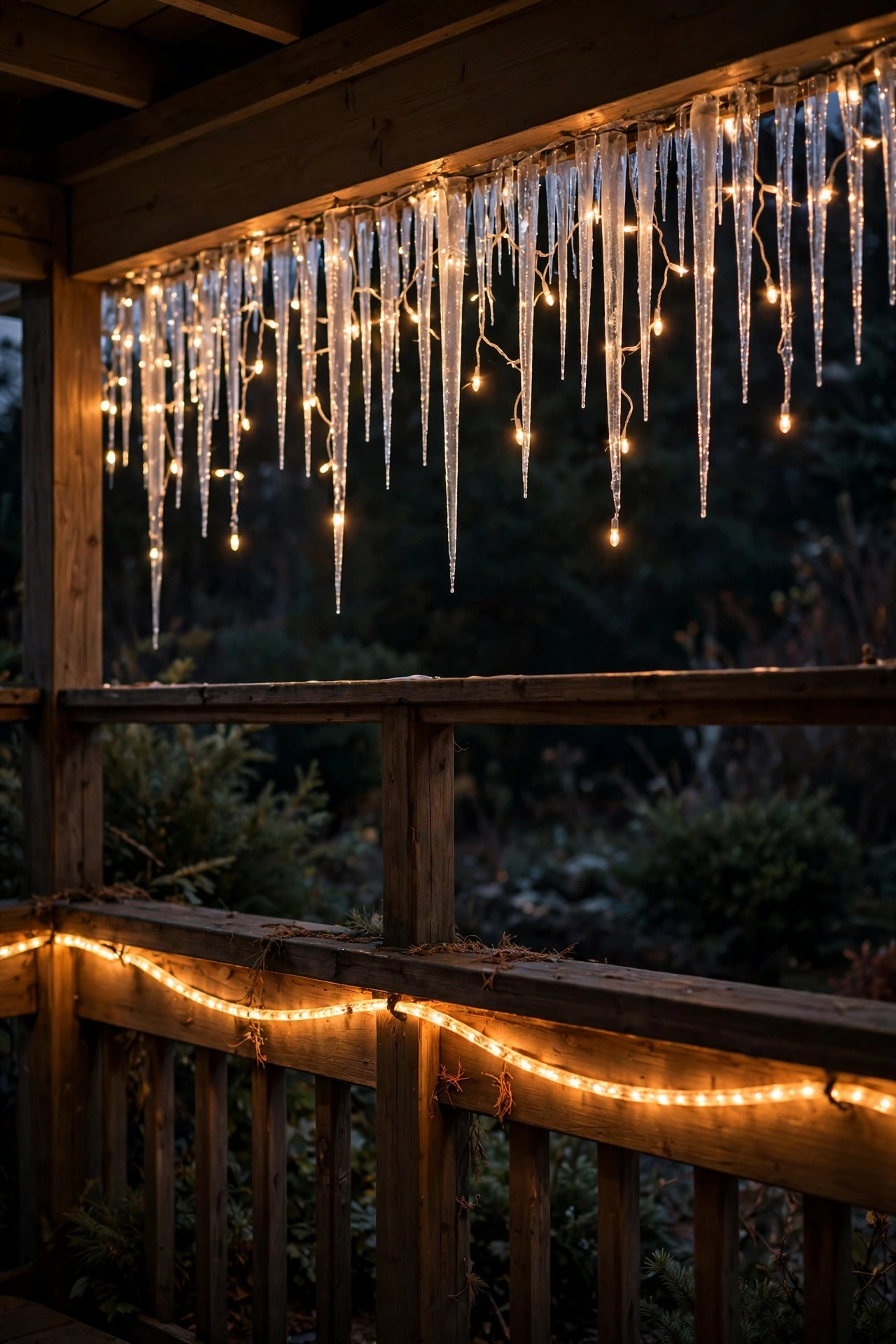
17. An Overhead Icicle Canopy Between Two Posts
For a patio with nothing overhead, swag icicle strands in gentle catenary curves between two posts — or between the house wall and one sturdy pole — and you get a sparkling canopy that feels like a street festival in the best way. This install needs a proper guide wire: run galvanized cable or heavy-duty coated wire first, tension it snug, and hang the light strands from the cable with clips so the wire, not the light cord, carries the weight and wind load. Spans of 10 to 15 feet per swag work well; longer spans sag into the headroom, so aim to keep the lowest point of every drape at least 7 feet above the floor. Because this is the most exposed install on the list, buy genuinely outdoor-rated strands and bring them down before any forecast storm with serious wind. On a calm summer night, though, nothing on this page beats eating dinner under a canopy of dripping light.
Suggested budget range: $35 – $85.

Frequently Asked Questions
Can you really leave icicle lights up all year?
Yes — LED icicle strands rated for outdoor use handle rain, sun, and temperature swings for years, and that's exactly what I do. The honest trade-offs are these: clear wire insulation slowly yellows in strong sun, and connections are the weak point, so seat every plug fully and use weatherproof covers on outdoor connections. When a strand finally does wear out, my guide to storing outdoor Christmas lights doubles as my system for testing, coiling, and labeling spares so a swap takes ten minutes instead of an afternoon.
Are curtain lights waterproof?
Most outdoor curtain panels are rated IP44 or IP65, which covers splashing rain and, at IP65, direct jets of water — plenty for a fence, gazebo, or pergola. What usually isn't waterproof is the controller box and the plug, so always tuck those under an eave, inside a covered outlet box, or at minimum facing downward under shelter. Solar versions put the vulnerable battery pack in the panel unit, so mount that where it gets sun but not the full blast of a downspout.
How much electricity do curtain and icicle lights use?
Very little. A typical 300-LED curtain panel draws roughly 5 to 10 watts — about what one old night-light bulb used — and a long icicle run is similar. Running a panel six hours a night for a month costs well under a dollar in most of the US. That's why I never feel guilty leaving mine on a timer every evening; the entire sparkle layer of my yard costs less to run than a single porch bulb did a decade ago.
How do I keep year-round icicle lights from looking like leftover Christmas?
Three choices do all the work. First, warm white only, in the 2700–3000K range — color and cool blue-white are what read as "holiday." Second, tidy mounting: straight lines, even spacing, cords hidden, nothing sagging. Third, context: when icicles glow alongside your path lights, sconces, and string lights on one timer schedule, they read as architecture instead of decoration. Styled that way, mine get compliments in June and nobody mentions Christmas at all.
Conclusion
Keeping icicle lights year round isn't about skipping a chore — it's about giving your home a sparkle layer that works as hard in July as it does in December. Start with one install that fits your space, whether that's a curtain panel on the porch, a solar curtain on the shed, or the classic eave run, keep it warm white and tidy, and put it on a timer so the magic happens without you. From there, layer in a fence run, a tree canopy, or a party backdrop as the seasons invite. If you're ready to build out the rest of the picture, browse my other outdoor lighting ideas here on the site — paths, porches, pergolas, and everything in between — and let's make your whole yard glow.