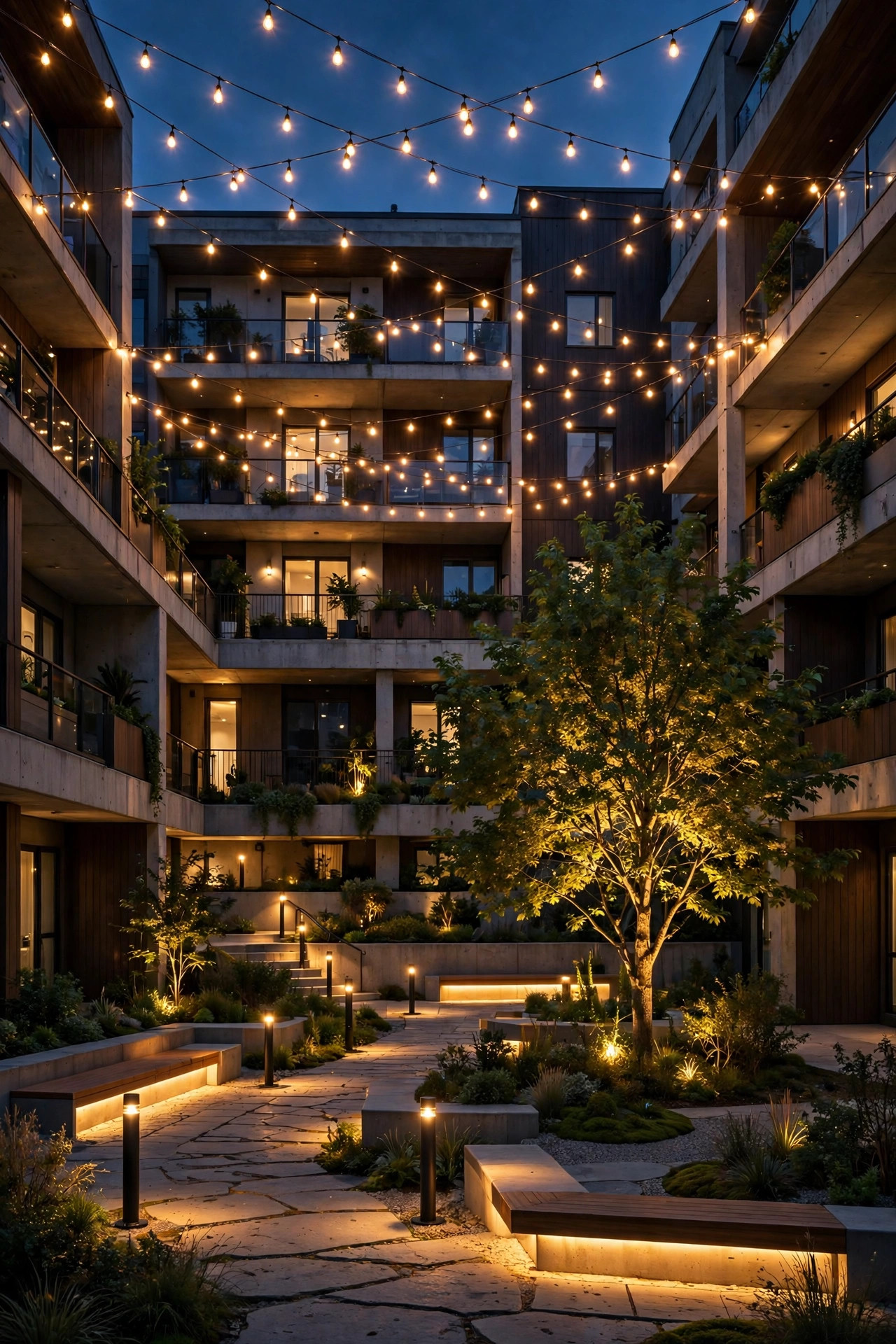
When we bought our condo, the courtyard was honestly the deciding factor: a green square of calm in the middle of the city, ringed by balconies and exactly one sad floodlight that made everyone look like they were being interrogated. Sound familiar? A shared space has to please dozens of households at once, which is why good shared courtyard lighting ideas are less about one dramatic fixture and more about layers everyone can live with. My formula never changes: a soft canopy overhead, a friendly glow at sitting height, and low light tracing the ground so nobody trips carrying groceries in the dark. In a courtyard, every layer also has to respect the windows looking down on it, because your ceiling is someone else's bedroom view. Below are the 19 setups I have helped our building committee, two sister complexes, and a lot of neighbors land on, each one durable, timer-friendly, and gentle enough that the only comments you will get are compliments.
1. Start With a Layered Plan for Your Shared Courtyard Lighting Ideas
Before anyone orders a single fixture, walk the courtyard at dusk with a notebook and, ideally, one person from the building committee. In my experience, shared spaces fail when each corner gets lit by whoever complained loudest, so map the whole square first: mark where people sit, where they walk, where strollers and wheelchairs roll, and which windows sit closest to the ground. Then assign every zone one job per layer: canopy light for the gathering areas, eye-level glow for the benches and mailboxes, and ground light for routes and steps. Count your outlets and note which ones the building controls, because that decides what can run on timers. A sketch with rough measurements saves real money later; most courtyards need far fewer fixtures than the first enthusiastic estimate. This planning hour is also when you agree on one color temperature and one lights-out time, and getting those two decisions in writing prevents 90 percent of future courtyard drama, honestly.
Suggested budget range: $0 – $25.

2. Stretch a Festoon String Light Canopy Over the Gathering Area
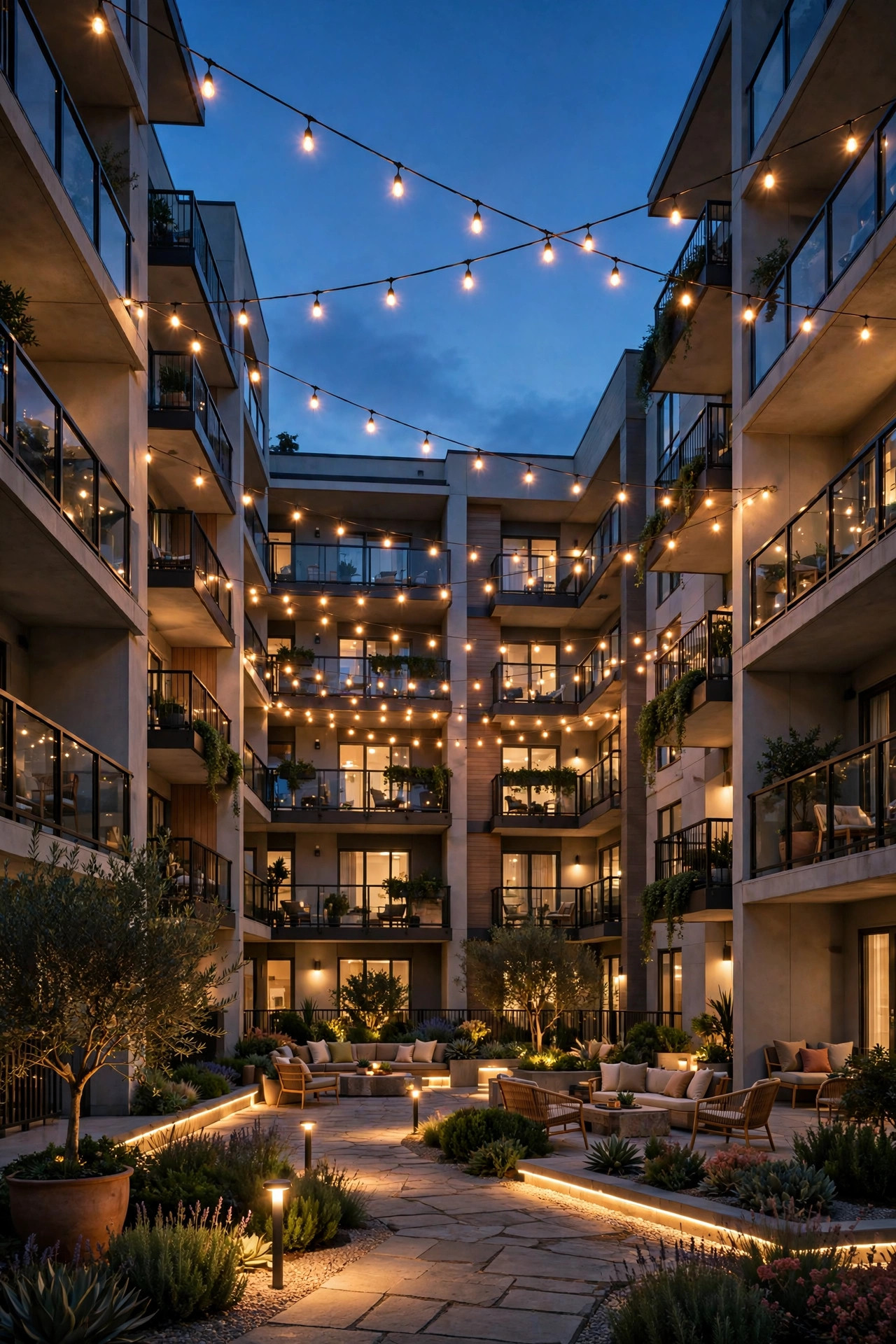
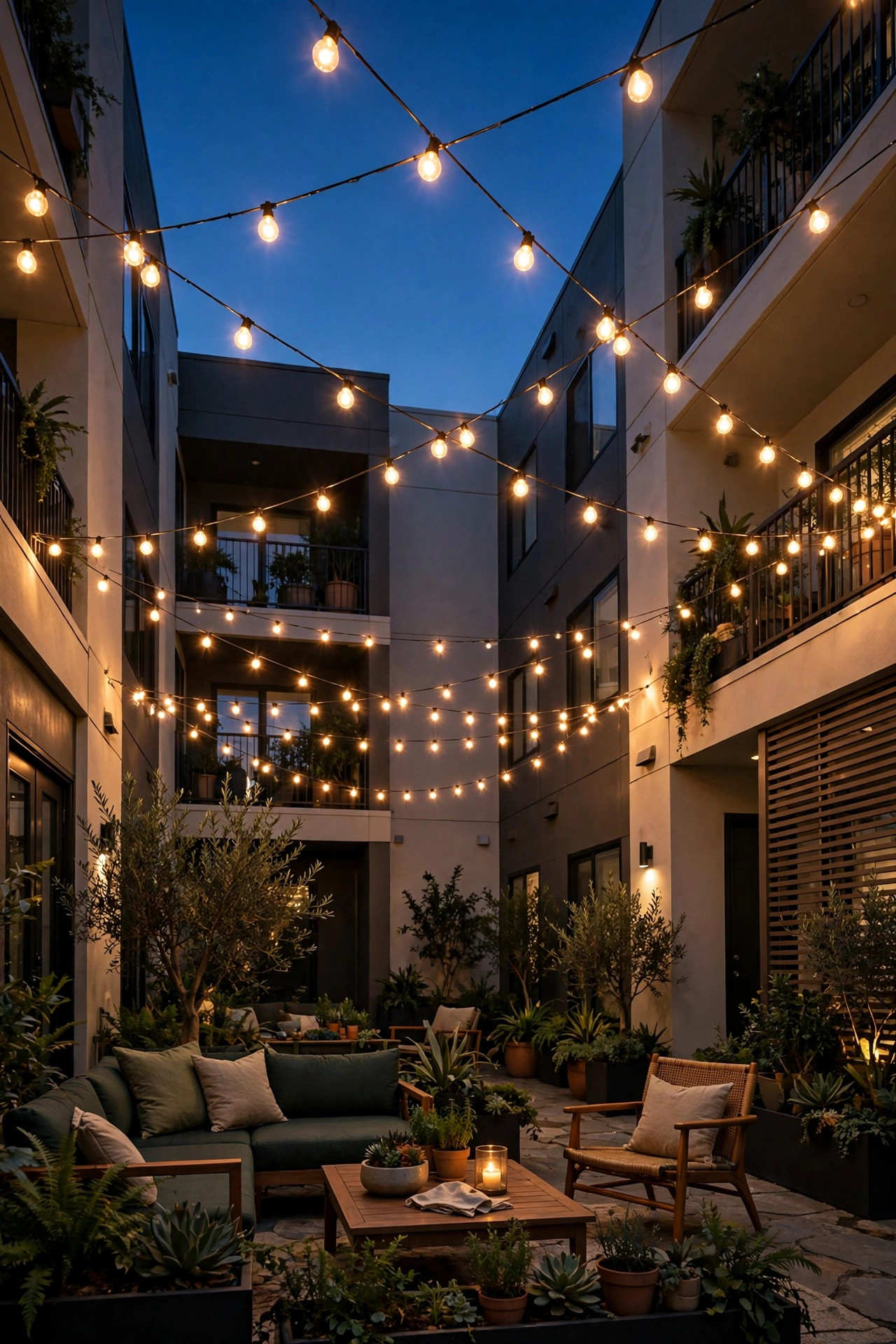
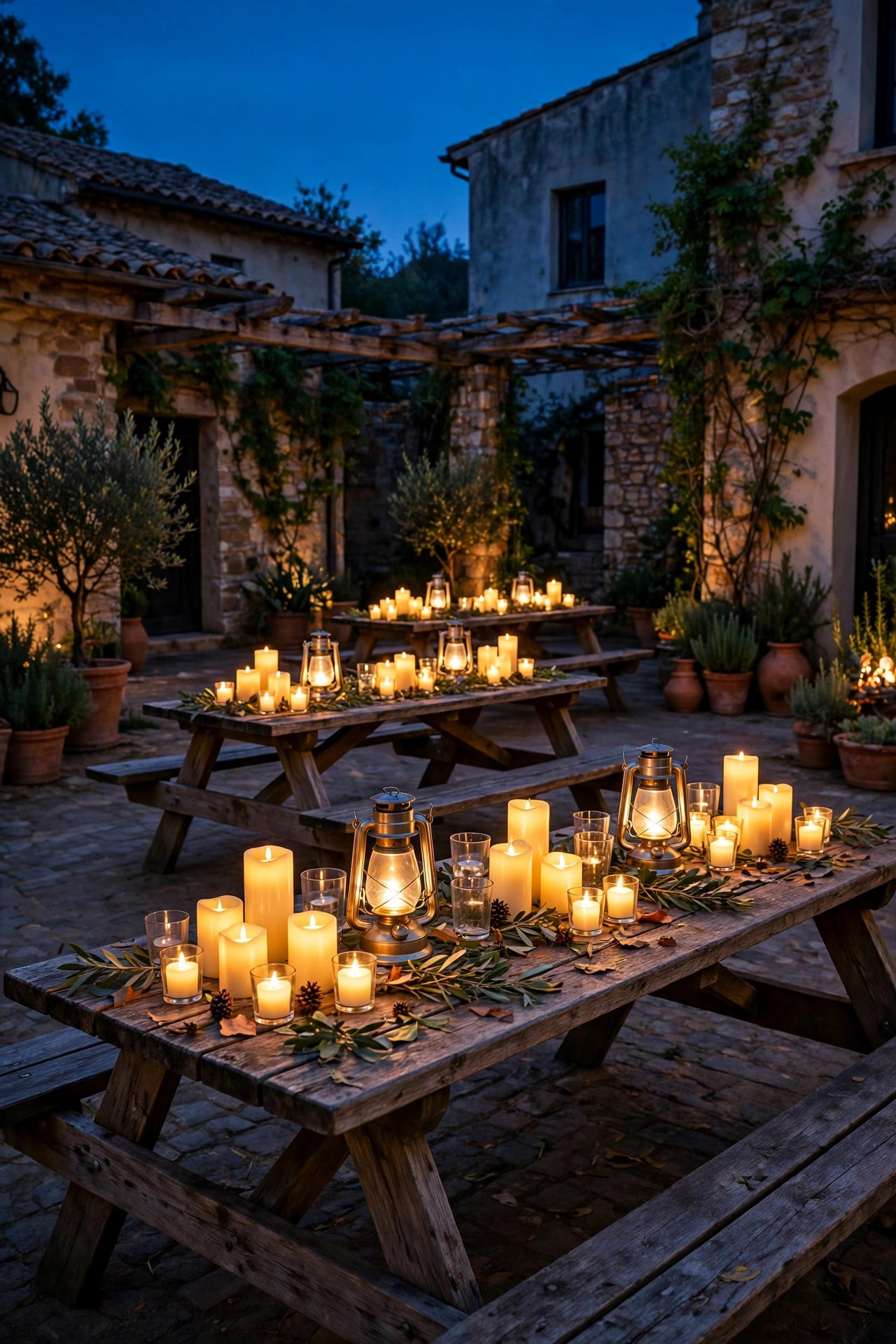
Nothing transforms a courtyard faster than a canopy of festoon string lights over the main seating area. Run commercial-grade strands in gentle swags between the building walls or on poles set in the planting beds, keeping the lowest dip at least 8 feet above the ground so tall residents and moving ladders pass safely underneath. Shatterproof LED bulbs are non-negotiable in a shared space; if one ever drops over a walkway, it bounces instead of scattering glass. Space the swags 4 to 6 feet apart for even light, and use guide wire so wind does not tangle the runs. If you want layout patterns and spacing tricks, my roundup of courtyard string light ideas covers zigzags, perimeters, and center-mast designs. Keep the canopy over seating rather than paths, so the ground routes can stay a touch dimmer and calmer for the ground-floor windows nearby.
Suggested budget range: $60 – $180.
3. Line the Shared Walkways With Solar Path Lights
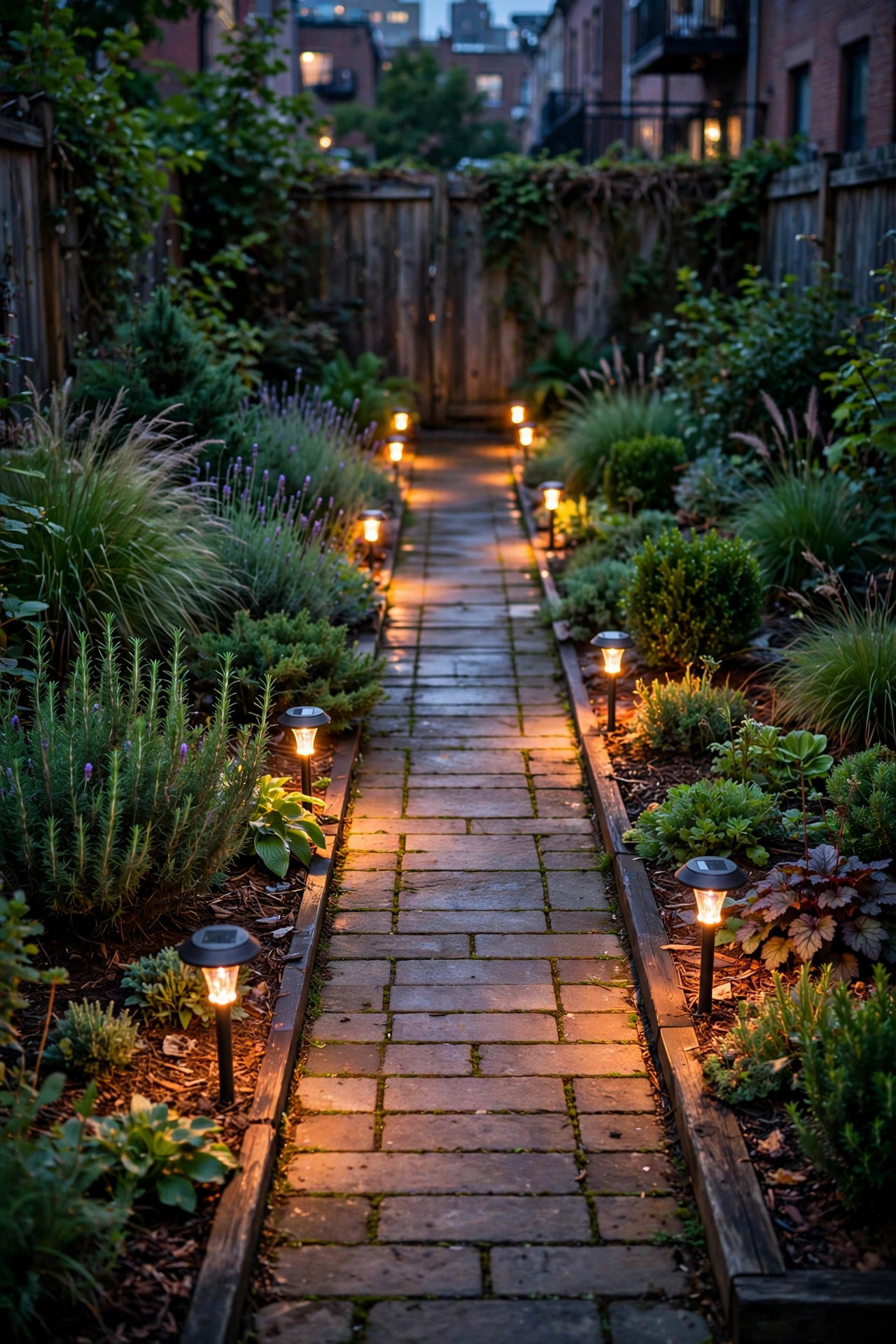
The paths between the gate, the mailboxes, and the building doors are the highest-traffic routes in any complex, so they get reliable ground light first. Solar path lights are the easiest win here: no wiring across shared ground, no electrician, and no arguments about who pays for the power. Push stakes in every 6 to 8 feet along both sides of the main walks, staggering them so the pools of light overlap with no dark gaps. Choose sturdy metal or thick resin stakes rated 50 to 100 lumens; the flimsy dollar-store kind will not survive one season of foot traffic and lawn crews. Warm white in the 2700K to 3000K range keeps the courtyard feeling residential instead of institutional. Twice a year, wipe the solar panels clean with a damp cloth, because dusty panels are the number one reason these lights fade early in the evening.
Suggested budget range: $40 – $120.
4. Add Bollard Lights Where Solar Cannot Keep Up
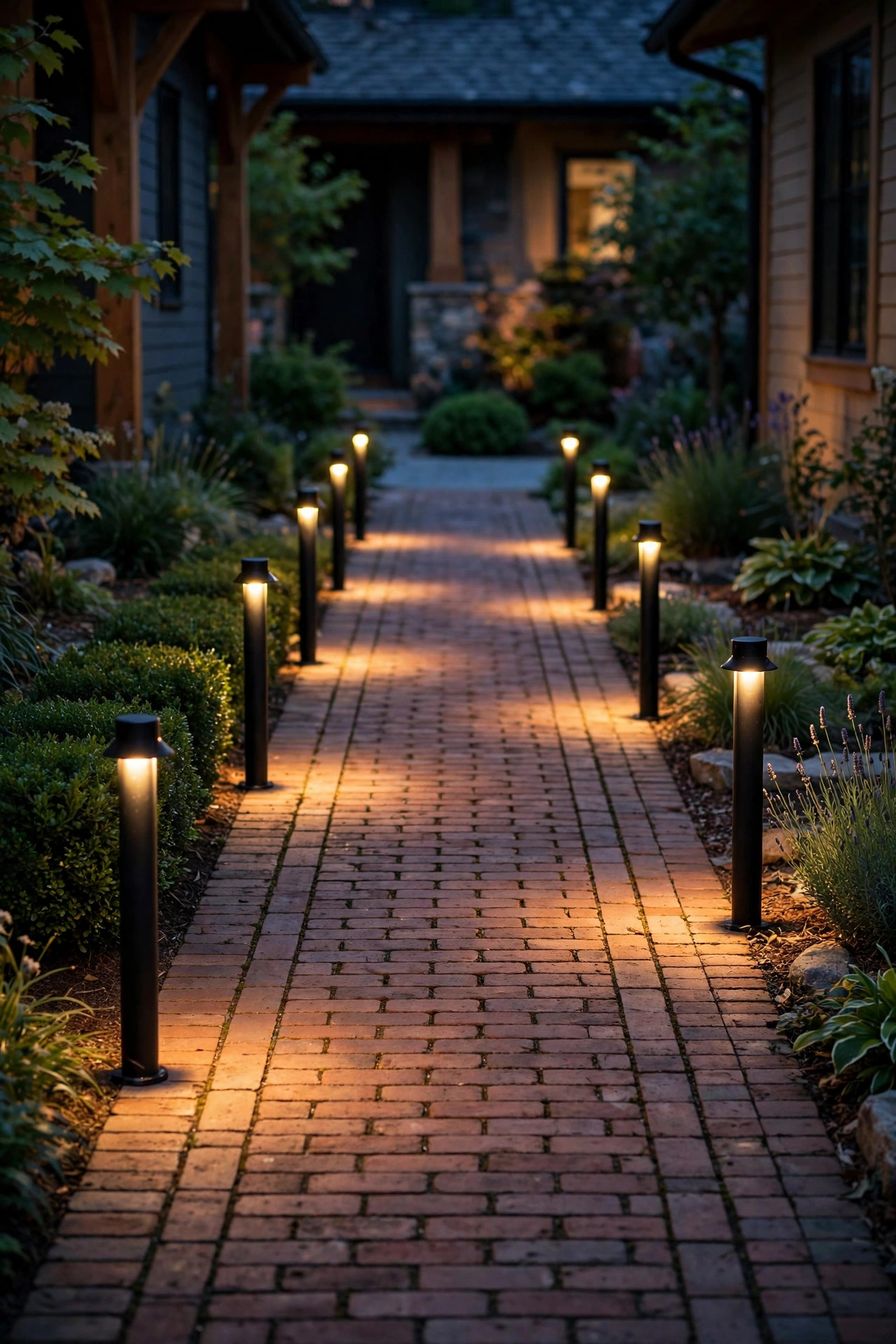
On the busiest routes, like the run from the parking gate to the main entrance, solar stakes sometimes cannot keep pace with winter evenings and heavy shade. That is bollard territory. Low-voltage bollards, 24 to 36 inches tall, throw a wide, even wash across pavement without glaring into eyes, and they shrug off bumps from carts and bikes far better than stakes. Space them 8 to 10 feet apart on alternating sides and pick fixtures with louvered or shielded optics that push light down, not out. This is usually a committee-budget item installed once and forgotten for a decade, which is exactly what shared infrastructure should be. Run the cable a few inches under mulch or along bed edges, never loose across a walkway, and put the transformer on a timer from day one. In complexes where wiring is impossible, solar bollards with replaceable batteries are a decent second choice for all but the darkest corners.
Suggested budget range: $150 – $450.
5. Uplight the One Big Tree Everyone Loves
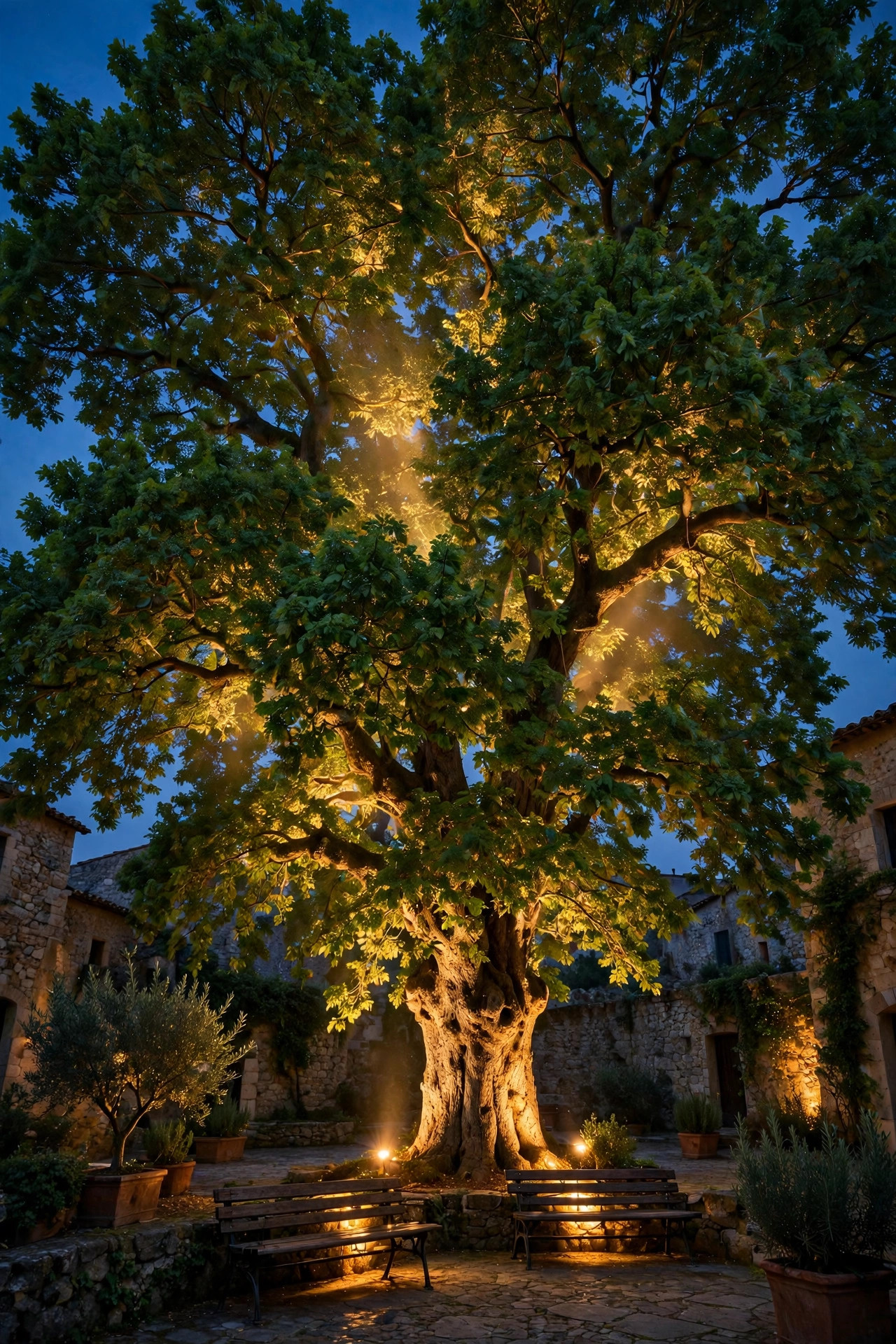
Most courtyards have a hero: a mature tree, a sculptural pine, the magnolia everyone photographs in spring. Give it two or three low-voltage uplights and it becomes the courtyard's evening landmark. Place the fixtures 12 to 18 inches out from the trunk, angled up into the canopy so the light filters through the leaves and dapples the ground the way moonlight does. Keep each fixture modest, around 200 to 300 lumens, because in an enclosed courtyard a little uplight goes a long way and the canopy itself does the spreading. This is the one spot where I recommend a quick chat with the building's landscaper: fixture placement should leave room for the trunk to grow, and wires should be stapled with slack, never tight. The effect is pure storybook from every balcony, and it costs less than almost anything else on this list for the drama it delivers.
Suggested budget range: $30 – $90.
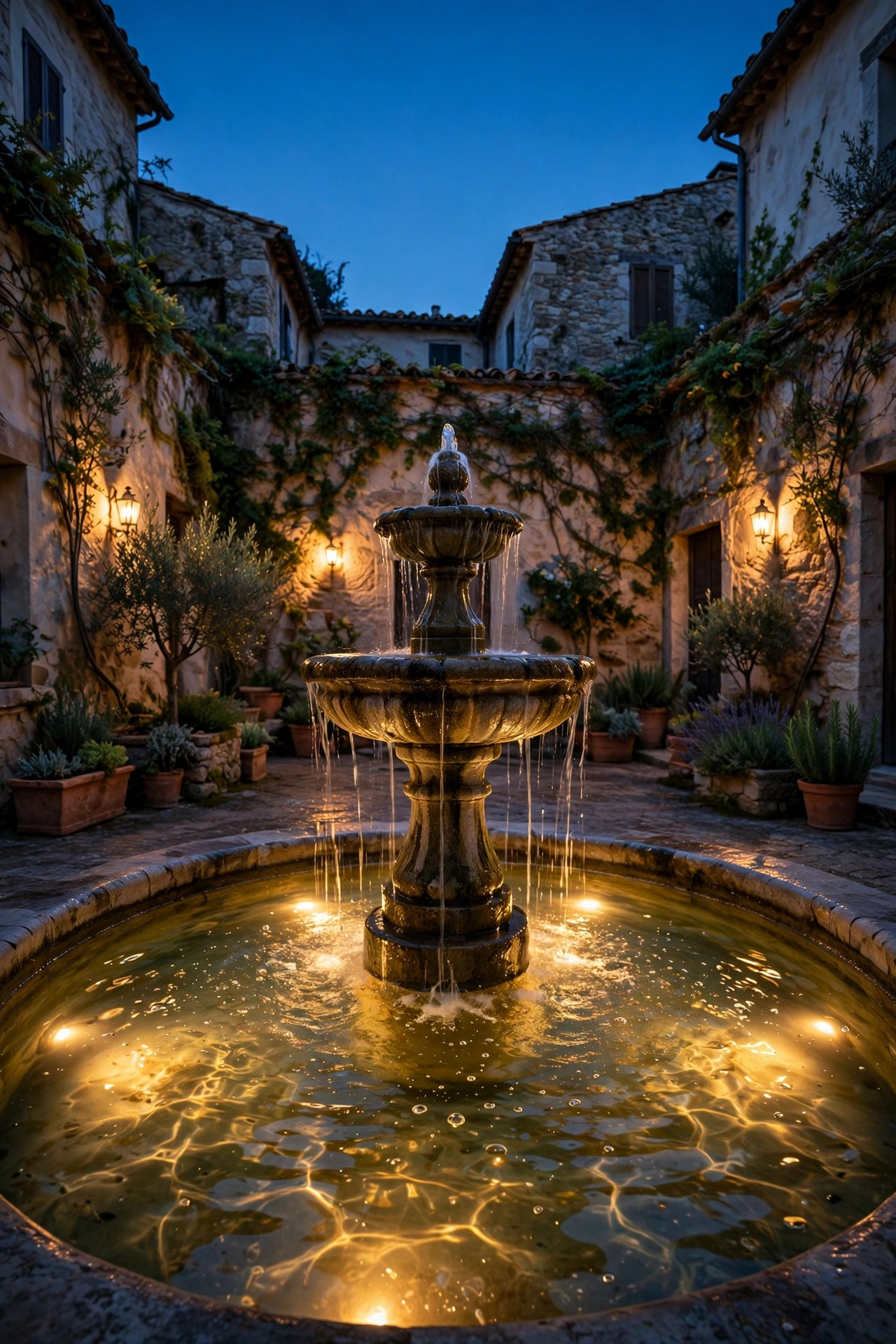
6. Give the Fountain a Soft Underwater Glow
If your complex is lucky enough to have a fountain, lighting it from inside the water turns it into the courtyard's evening centerpiece. Submersible LED pucks or a small underwater spotlight in warm white make the moving water shimmer without lighting up the whole square. Only use fixtures rated for full submersion, IP68, and keep the transformer and every connection well outside the splash zone. Angle the light across the water flow rather than straight up; moving water does the decorating for you. For more placement patterns and fixture styles, my notes on courtyard fountain lighting ideas walk through tiered, wall, and basin fountains separately. One caution from experience: skip the color-cycling modes for nightly use. A shared space reads calmer and classier in steady warm white, and the residents on the second floor will thank you. Clean the fixture lens whenever the fountain gets its routine service, because a film of algae dims even the best underwater light surprisingly fast.
Suggested budget range: $25 – $80.
7. Cluster Flameless Lanterns Around the Benches
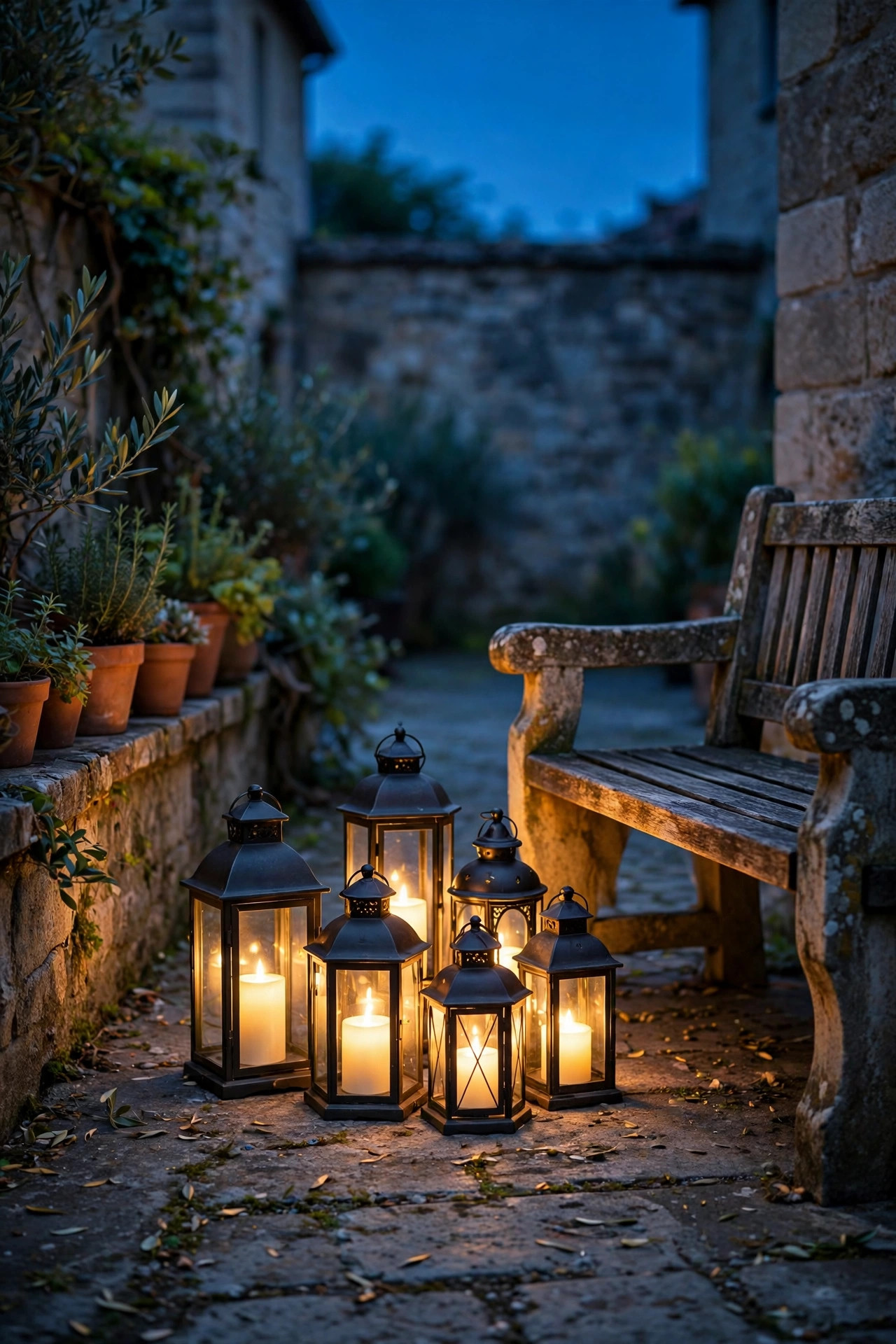
Bench nooks are where courtyard social life actually happens, and they want glow at sitting height, not more overhead light. My favorite trick is clusters of flameless LED lanterns: two or three grouped on the ground beside a bench, or on a low side table if your complex has them. Real candles are a hard no in shared spaces; fire codes, wind, and wax on pavers all argue against them, and honestly the flameless versions with a realistic flicker read just as cozy at conversational distance. Battery lanterns do wander off in communal areas, so choose a style the committee buys in bulk and neighbors can adopt, or anchor the look with heavier solar lanterns that recharge where they sit. Warm flicker at knee-to-table height flatters faces, keeps the light out of the windows above, and makes a plain bench feel like a destination.
Suggested budget range: $20 – $60.
8. Wash the Surrounding Walls With Soft Sconces
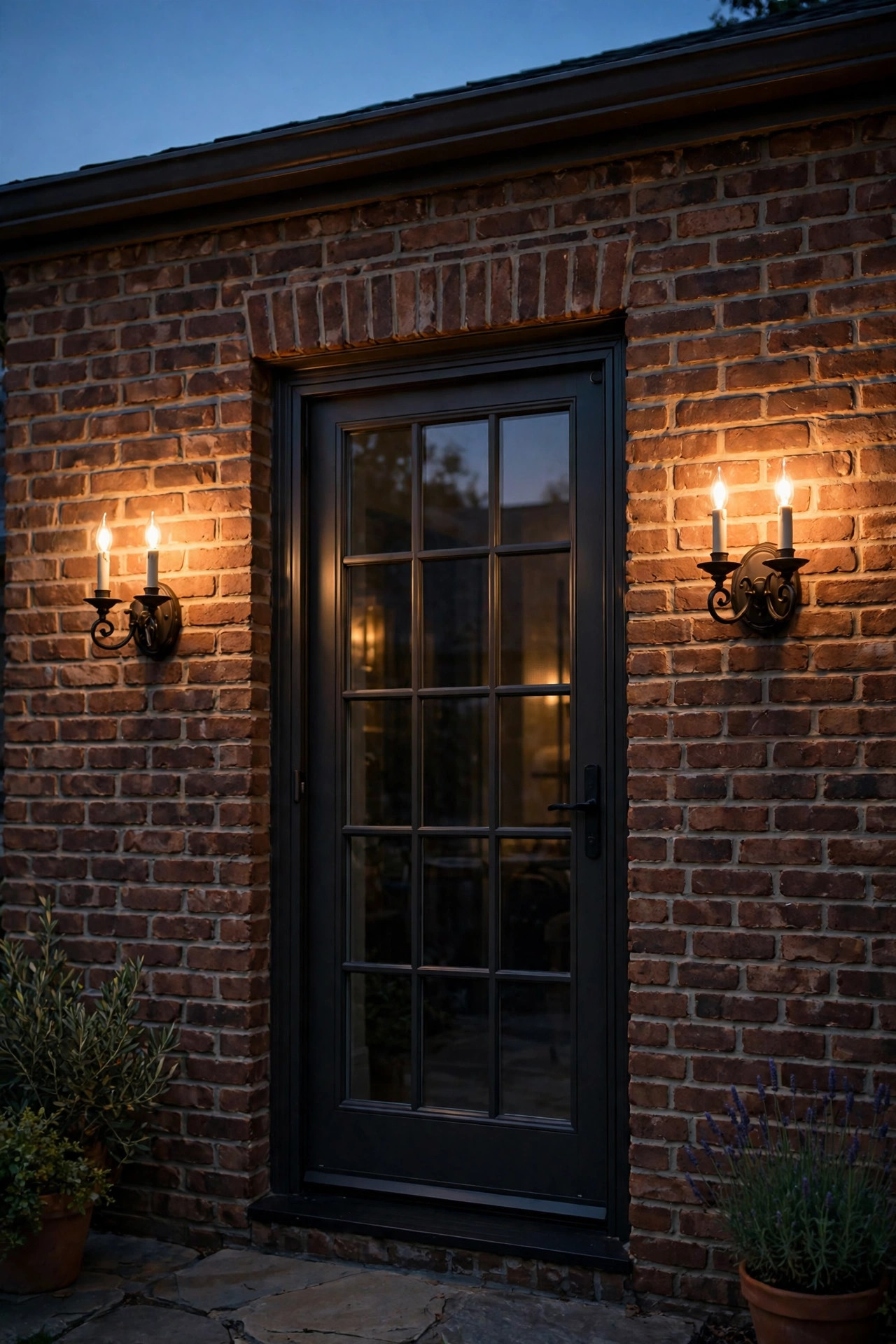
A courtyard is an outdoor room, and rooms need their walls lit or the space feels unfinished at the edges. Building-mounted sconces and small wall washers on the surrounding facades bounce a gentle wash that makes the whole square feel intentional. Downward-aimed fixtures are the neighbor-friendly choice here: they light the planting beds and the pavement edge without throwing beams across the courtyard into facing windows. Space them evenly, roughly every 15 to 20 feet, and match the finish to the building trim so they disappear during the day. Because these tie into building power, they belong on the building's timer circuit, which means the committee controls them once and nobody's balcony outlet becomes the courtyard's power station. If your complex cannot add hardwired fixtures, solar wall sconces with a few hours of storage still give a respectable evening wash on the sunniest walls.
Suggested budget range: $80 – $300.
9. Mark Every Step, Ramp, and Level Change
Courtyards collect level changes: two steps down to the garden tier, a ramp by the side gate, the raised edge of a planting bed that catches shins in the dark. In a shared space these are liability spots, not just annoyances, so they deserve deliberate light. Small step lights on each riser, or a short run of solar edge lights along a ramp, throw a pool of light exactly where feet land. Choose diffused lenses so the light spreads instead of glaring, and mark both the top and bottom of any run of steps, the two transitions people misjudge most. At my complex we added glow markers along the bed borders too, and the nighttime trip reports dropped to zero. Walk the whole courtyard thinking like someone carrying a laundry basket at 9 p.m.; every surprise underfoot deserves a marker, and in shared space that walk-through is worth doing with the property manager once a year.
Suggested budget range: $30 – $90.

10. Thread Fairy Lights Through the Shared Planters
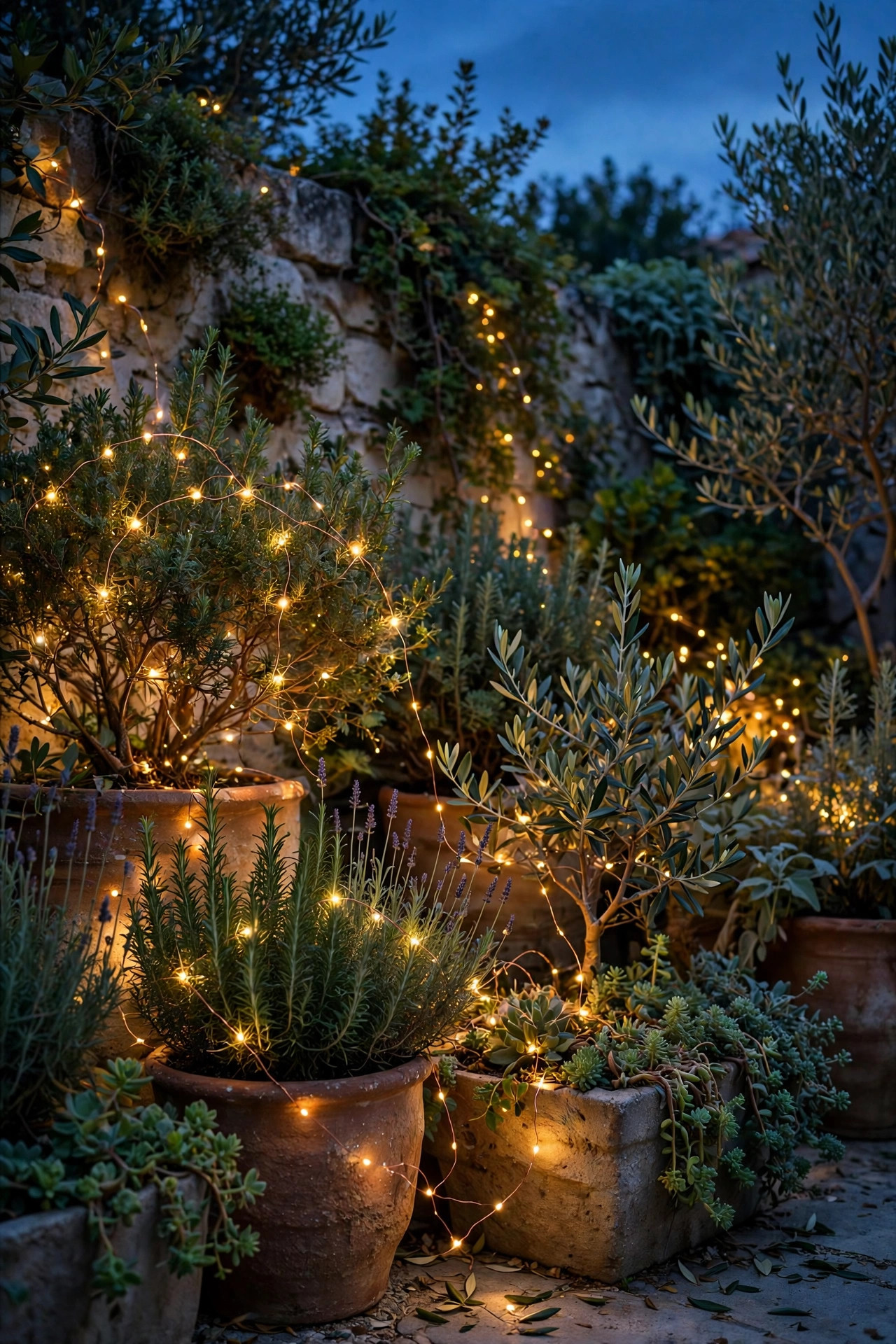
Every courtyard has planters, hedges, or a row of shrubs that look wonderful by day and turn into dark blobs by night. Copper-wire fairy lights fix that for pocket change. Weave a strand loosely through each shrub or along the planter edge, keeping the battery pack or solar panel tucked where it gets sun but stays out of sight. The tiny points of light outline the greenery so the beds read as soft shapes rather than holes in the courtyard, and because the output is so gentle, it never bothers the windows above. Solar strands are the set-and-forget choice for shared plantings; they charge on the planter rim all day and glow by dinner. Replace strands as they age rather than untangling them, life is short, and keep a couple of spare sets in the building's storage closet so a dead strand gets swapped the same week it fails.
Suggested budget range: $15 – $45.
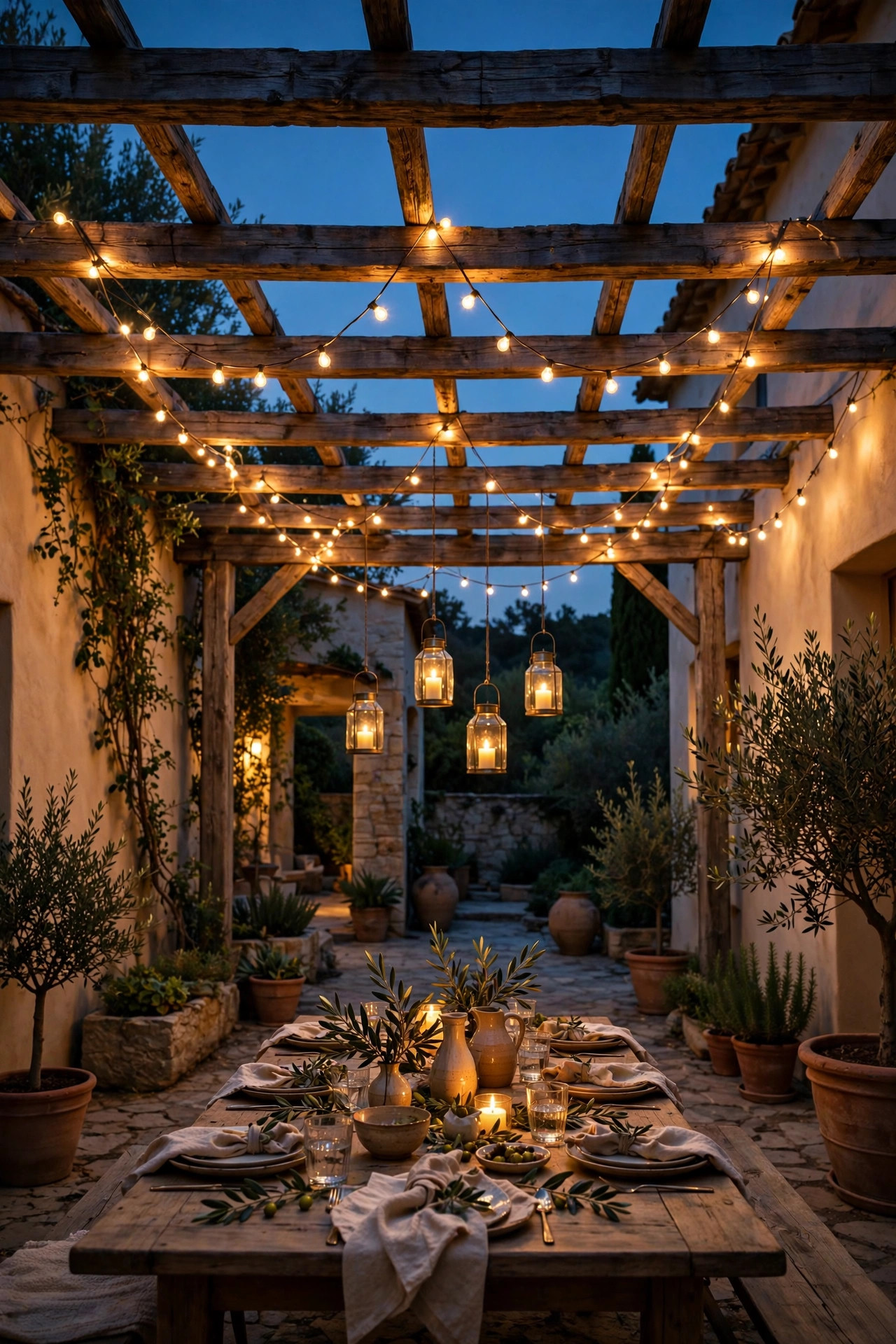
11. Build a Pergola or Pavilion Canopy Corner
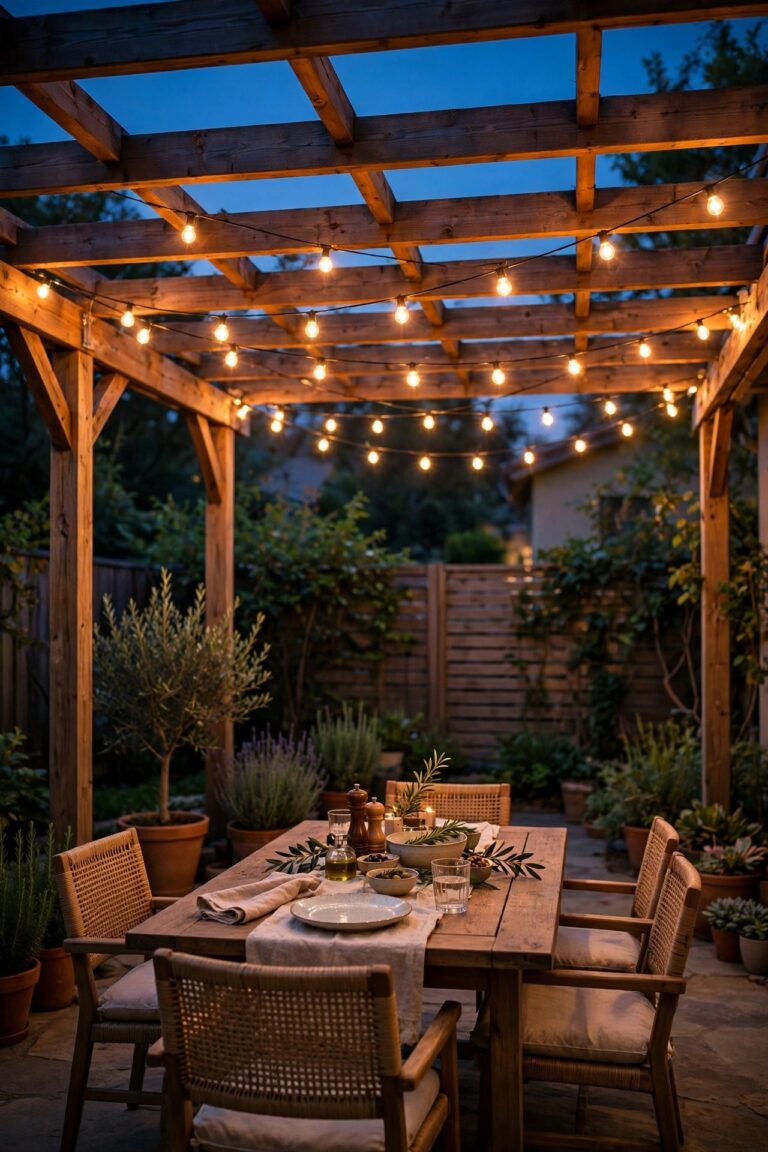
Many complexes have a pergola, gazebo, or covered pavilion that hosts birthday parties and book clubs, and it deserves its own lighting moment. Wrap the beams with string lights in a flat grid, or hang two or three swags wall to wall, and the structure turns into a glowing room inside the courtyard. Add one dimmable pendant or a cluster of hanging solar lanterns over the table if the structure has a center point. Because this corner hosts events, put its lights on a separate switch or smart plug so the pavilion can glow for a gathering while the rest of the courtyard runs its normal timer. Keep the bulbs warm and the brightness moderate; event photos look better, and the neighbors whose windows face the pavilion stay friendly. A lit pavilion also quietly extends how late the space gets used, which is the whole point of having one.
Suggested budget range: $70 – $220.
12. Put Motion-Sensor Lights at Gates and Entries
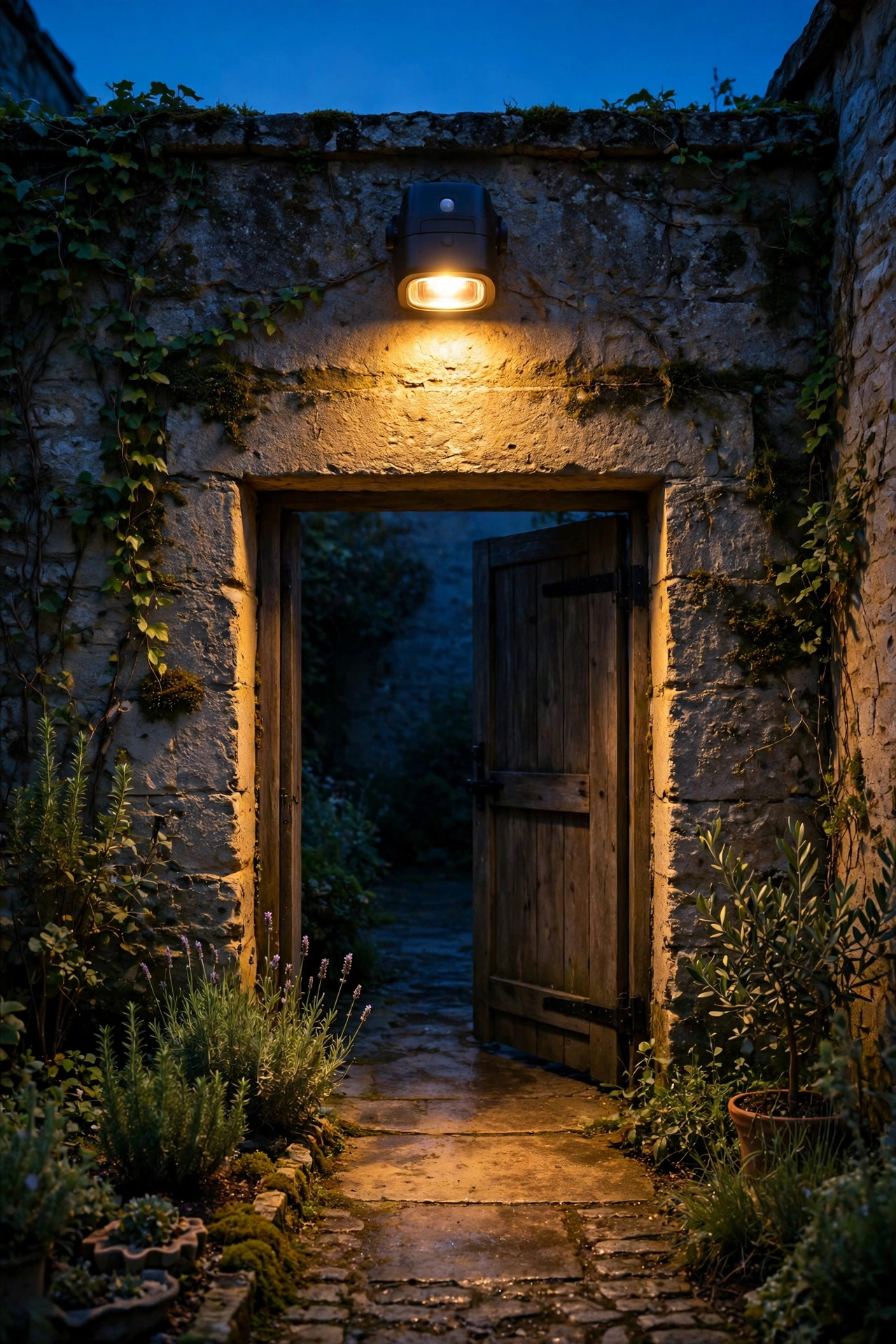
Some spots should not glow all evening; they should answer when someone arrives. The side gates, the trash enclosure path, and the building entries all belong in that category. A motion-sensor light mounted 7 to 8 feet up catches movement within about 15 feet and stays on for a minute or two, lighting the way for a resident with full hands and quietly signaling that someone is at the gate. Choose warm white and moderate brightness, around 300 to 500 lumens; a harsh white blast feels like a security yard, not a home. Aim sensors slightly downward and shield them from the street so passing cars do not trigger them all night. For more placement ideas around doors and gates, my guide to courtyard entry lighting ideas covers entries in detail. In shared space, these fixtures earn their keep on safety alone, and residents consistently rank the gate lights among the most appreciated upgrades in the whole courtyard.
Suggested budget range: $25 – $75.
13. Stake Solar Lights Through the Garden Beds
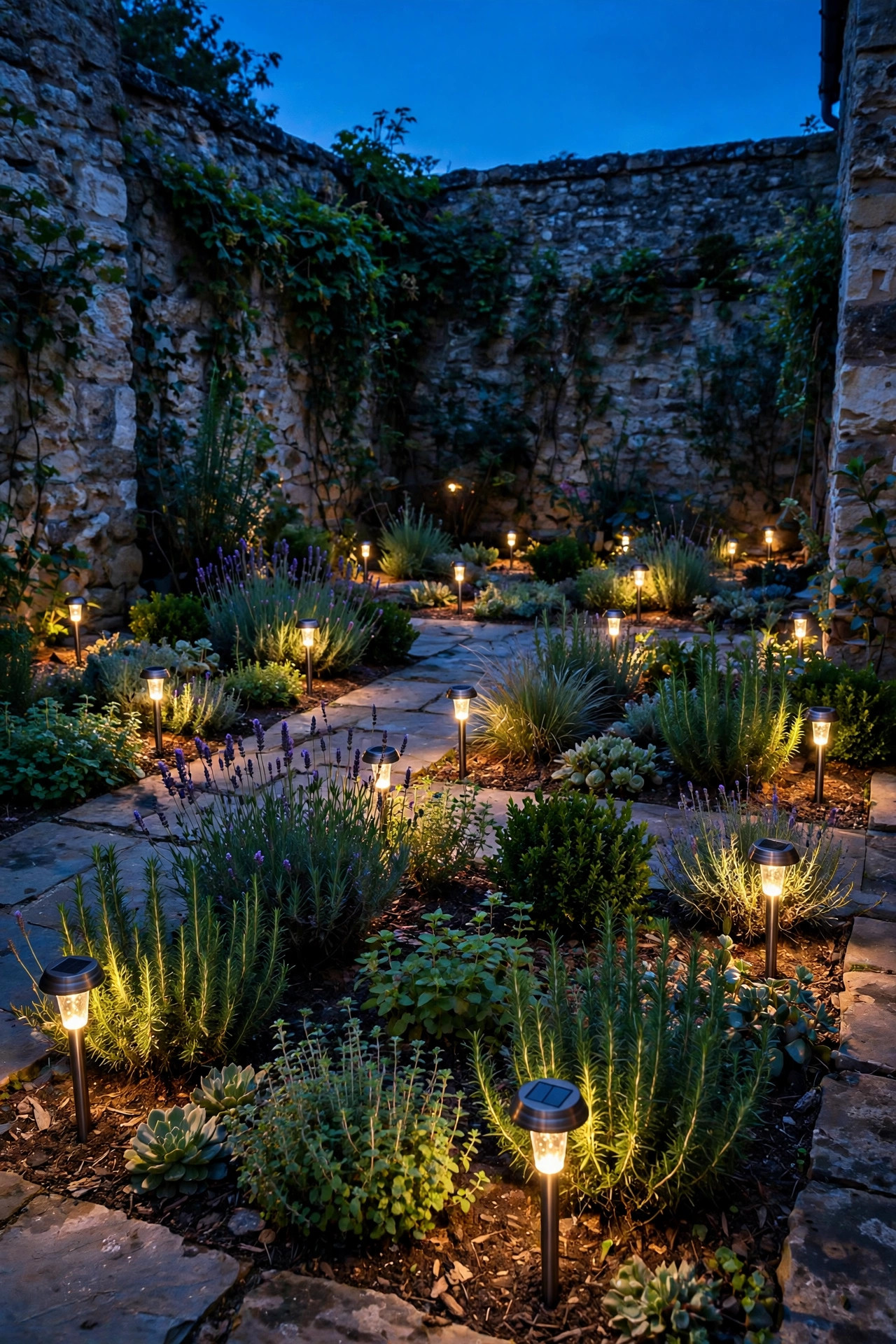
Beyond the walkways, the planting beds themselves deserve a little definition, both for looks and so nobody shortcuts through the flowers after dark. Short solar stake lights, 12 to 18 inches tall, dotted through the beds every 4 to 6 feet make the plantings read as soft islands of glow. Keep them dimmer than the path lights; beds are scenery, not routes. Mixed plantings hide the stakes by day, and at night the light catches leaf texture and makes even plain shrubs look sculpted. Solar is the only sane choice deep in shared beds, since nobody wants cords snaking through mulch that a gardening crew will slice by June. When the committee refreshes mulch each spring, pull the stakes, wipe the panels, and reset them in an hour. It is the cheapest landscaping upgrade I know: the same beds, suddenly deliberate, and the nighttime view from the surrounding balconies improves more than the tiny price tag would ever suggest.
Suggested budget range: $20 – $60.
14. Pick One Warm Color Temperature and Hold the Line
The fastest way to make a courtyard look like a parking lot is five households' worth of mismatched bulbs: blue-white here, amber there, one mysterious green porch light. Pick one color temperature for the whole complex, ideally 2700K warm white, with 3000K as the absolute ceiling, and write it into the courtyard guidelines. Warm light flatters faces and brick and plantings, and it reads as residential from the street. When a fixture dies, replace it with the same temperature, not whatever was on sale; a single 5000K bulb in a sea of warm light glares like a typo. This rule costs almost nothing and does more for the courtyard's feel than any single fixture on this list. Post the standard wherever the committee keeps its vendor notes, and if residents add their own balcony lights, a friendly note suggesting warm white keeps the whole building glowing in the same key.
Suggested budget range: $10 – $40.
15. Run It All on Timers So Nobody Has to Remember
Shared lighting that depends on someone remembering a switch will be dark half the time and blazing at 3 a.m. the other half. Timers fix the politics and the practicality at once. Put the canopy, sconces, and bollards on astronomical timers that track sunset, set to turn off at a civilized hour your community agrees on, usually 10 or 11 p.m., with motion sensors covering the late-night routes afterward. Smart plugs work for the string lights and pavilion if the building has outdoor Wi-Fi near the courtyard. Solar fixtures handle themselves. The goal is a courtyard that lights itself every evening, dims down politely at night, and never needs a group text about whose turn it is. Test the whole system at the start of each season, because timers drift after power outages and daylight saving changes, and a five-minute reset in spring saves a summer of complaints.
Suggested budget range: $20 – $70.
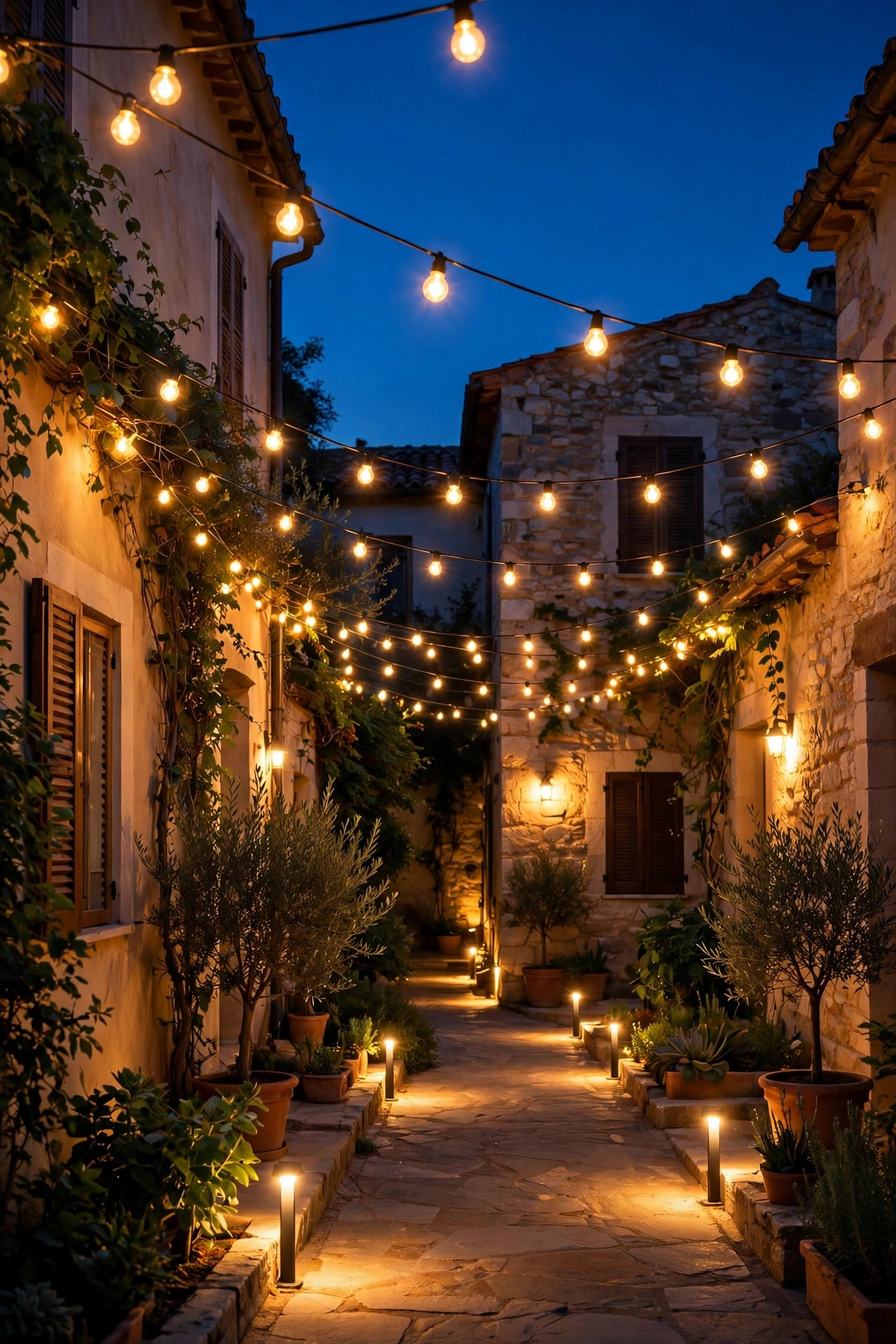
16. Dress the Community Tables for Evening Events
Courtyards earn their keep on event nights: the summer picnic, the holiday market, the building's birthday barbecue. A small kit of flameless table candles and battery lanterns, kept in the storage closet and brought out for gatherings, makes folding tables look like a celebration in ten minutes. Group three flameless candles of different heights down the center of each table, or set one lantern per table with a sprig of whatever the planters are growing. All LED, all cool to the touch, nothing that can tip a flame onto a paper tablecloth when the wind picks up. Because the kit is shared property, buy sturdy pieces in one consistent style and keep spare batteries in the same bin. After the event, everything goes back in the box, and the everyday courtyard lighting does not have to work overtime to feel festive the rest of the year.
Suggested budget range: $15 – $50.
17. Shield Everything That Faces a Window
In a courtyard, light trespass is not an abstract idea; it is Mrs. Alvarez on the second floor trying to sleep. So make shielding a design rule, not an apology. Choose fixtures with hoods, louvers, or downward optics for anything mounted above ground level, and aim uplights so their beams land in tree canopies or on walls, never across open air toward windows. Keep the brightest fixtures, bollards and entry lights, on the routes farthest from ground-floor bedrooms, and let the gentlest light, fairy strands and lanterns, live near the windows. After installation, do the courtesy check: stand in the courtyard, look up, and count how many bare bulbs you can see directly. Every one you can spot is a bulb someone upstairs can spot too. A $5 shield or a five-degree tilt usually fixes it, and the goodwill is worth far more than the hardware.
Suggested budget range: $40 – $150.

18. Swap Small Accents With the Seasons
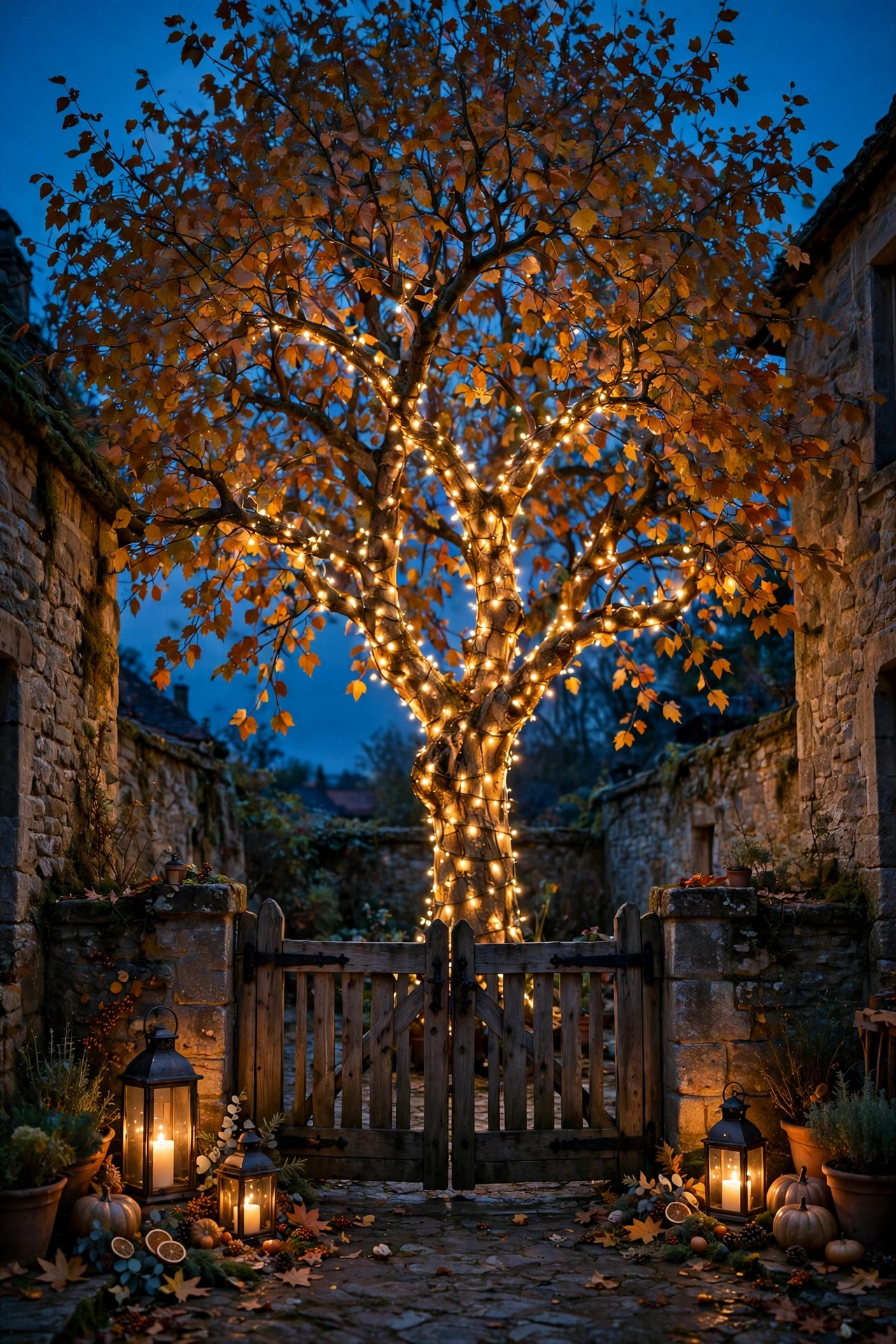
A shared courtyard stays loved when it changes a little with the calendar, and lighting is the easiest seasonal swap there is. In spring, add fairy lights to the flowering shrubs; in summer, lean on lanterns for the long evenings; in fall, warm amber bulbs in the pavilion and a few pumpkin-safe flameless luminaries by the gate; in winter, a tasteful string of warm white lights on the courtyard tree inside whatever window the community rules allow. Keep the permanent layers exactly the same so the space never feels chaotic, and store the seasonal pieces in one labeled bin so the tradition survives committee turnover. Modest and consistent beats spectacular and random: residents should feel the season shift, not wonder what happened to their courtyard. One volunteer's hour, four times a year, is honestly all this takes, and the compliments at the mailbox will recruit next year's volunteer for you.
Suggested budget range: $25 – $80.
19. Finish With a Dusk Walk-Through of Your Shared Courtyard Lighting Ideas
Once everything is in, gather two or three residents and walk the courtyard the way it is actually used: in the gate with imaginary groceries, across to the mailboxes, down the steps to the garden tier, and onto a bench with a cup of coffee. You will spot what no plan catches. A path light that glares at sitting height, a dark gap behind the pavilion, a motion sensor that fires when the gate swings. Bring painter's tape, mark anything that needs angling, shielding, or moving, and fix it within the week while the notes are fresh. Then repeat the walk from above: borrow a second-floor balcony and check that nothing beams into windows. That two-direction audit is the difference between shared courtyard lighting ideas that look good on paper and a courtyard the whole building genuinely loves. Do it once a year, ideally in spring, and put the date on the committee calendar.
Suggested budget range: $0 – $30.
Frequently Asked Questions
What color temperature is best for a shared courtyard?
Warm white, 2700K to 3000K, is my recommendation for the whole complex. It flatters faces, brick, and plantings, reads as residential from the street, and bothers sleeping neighbors far less than blue-rich daylight bulbs. The key is consistency: every fixture, from path stakes to sconces, should share the same temperature so the courtyard glows in one warm key.
Who should install and pay for shared courtyard lighting?
Anything wired into building power or mounted on the facade belongs to the association or property manager, so bring the plan to the committee with costs and timer settings spelled out. Solar stakes, fairy lights, and flameless lanterns are usually resident-friendly projects, but get written approval anyway. A one-page plan with a sketch and a lights-out time gets approved far faster than a fixture list alone.
Are solar lights bright enough for a shared courtyard?
For paths, beds, and accents, yes: modern solar stakes and bollards in the 50 to 100 lumen range handle wayfinding well after a sunny day. For the main entrance, gates, and steps, layer in at least one wired or bollard fixture as an anchor, because a string of cloudy winter days can leave solar-only areas dimmer than a shared space should be.
How do we keep courtyard lights from bothering the units above?
Aim everything down, shield anything above eye level, and set timers so the bright layers turn off at a set evening hour, leaving only motion sensors and the dimmest path lights overnight. Warm color temperatures help too. Finally, do the balcony check after installing: if you can see a bare bulb from the courtyard floor, someone upstairs can see it from bed.
Conclusion
Great shared courtyard lighting ideas all come back to the same layers I use everywhere: a canopy that gathers people, a glow at sitting height that makes them stay, and ground light that gets everyone home safely. Add one warm color temperature, timers that respect the whole building, and fixtures aimed away from windows, and a plain square of grass and pavers turns into the room every resident shares. Start with the routes and the steps, add the canopy when the committee is ready, and do one dusk walk-through, from the ground and from a balcony, before you call it done. If you are ready for the next project, browse the rest of the outdoor lighting ideas here on the site; there is always one more corner of the complex waiting to glow.