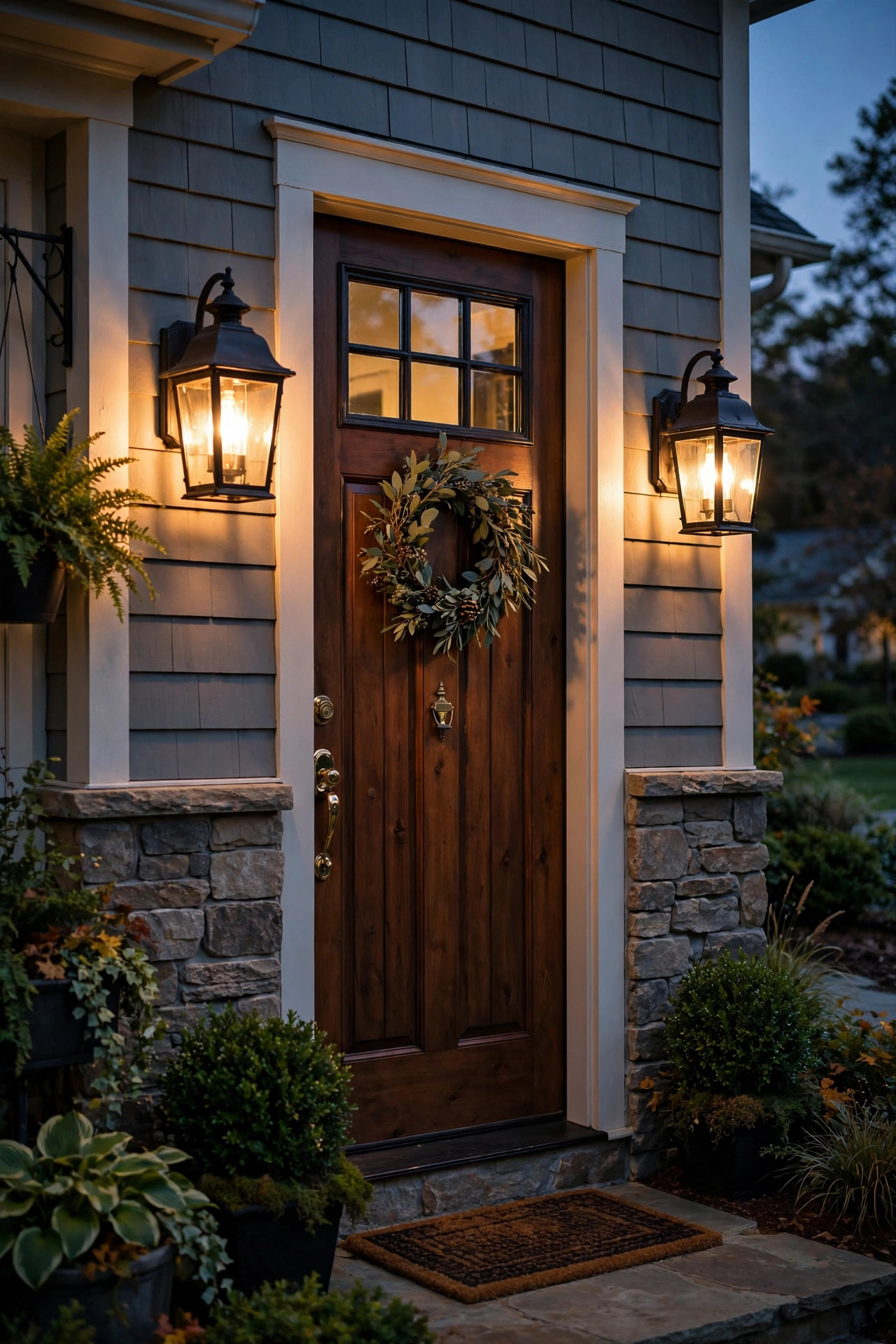
There is no single fixture that changes how your home feels after dark quite like a pair of well-chosen front door sconces. In my experience, it's one of those upgrades that guests notice without being able to name — the entry just feels warmer, more intentional, more "someone who loves this house lives here." I learned this the hard way after years of a single harsh floodlight that turned my porch into a gas station canopy.
If you're weighing front door sconce lighting ideas, the good news is that you don't need an electrician's vocabulary or a designer's eye to get it right. A pair of sconces flanking the door is the classic move because it balances your entryway and gives usable light from both sides — no lopsided shadows when you're fumbling for keys.
By the end of this guide, you'll know which sconce styles suit your home's architecture, how to size them so they look proportionate, not dinky or overpowering, where to mount them for the best light, which bulbs create that welcoming glow, what a pair will cost you in 2026, and the mistakes homeowners make most. Let's make yours the best-looking entry on the block.
The Short Answer
Pick a matching pair of wet-rated LED sconces, mount them 6 to 10 inches from each side of your door frame with the center of each fixture about 60 to 66 inches off the ground, and choose fixtures roughly one-quarter to one-third the height of your door. Warm white bulbs (2700–3000K) flatter every exterior, and hardwired fixtures with a dusk-to-dawn sensor beat solar for reliability at the entry. Budget $120 to $600 for the pair of fixtures, plus $150 to $400 if an electrician is doing the install.
How Front Door Sconces Actually Work
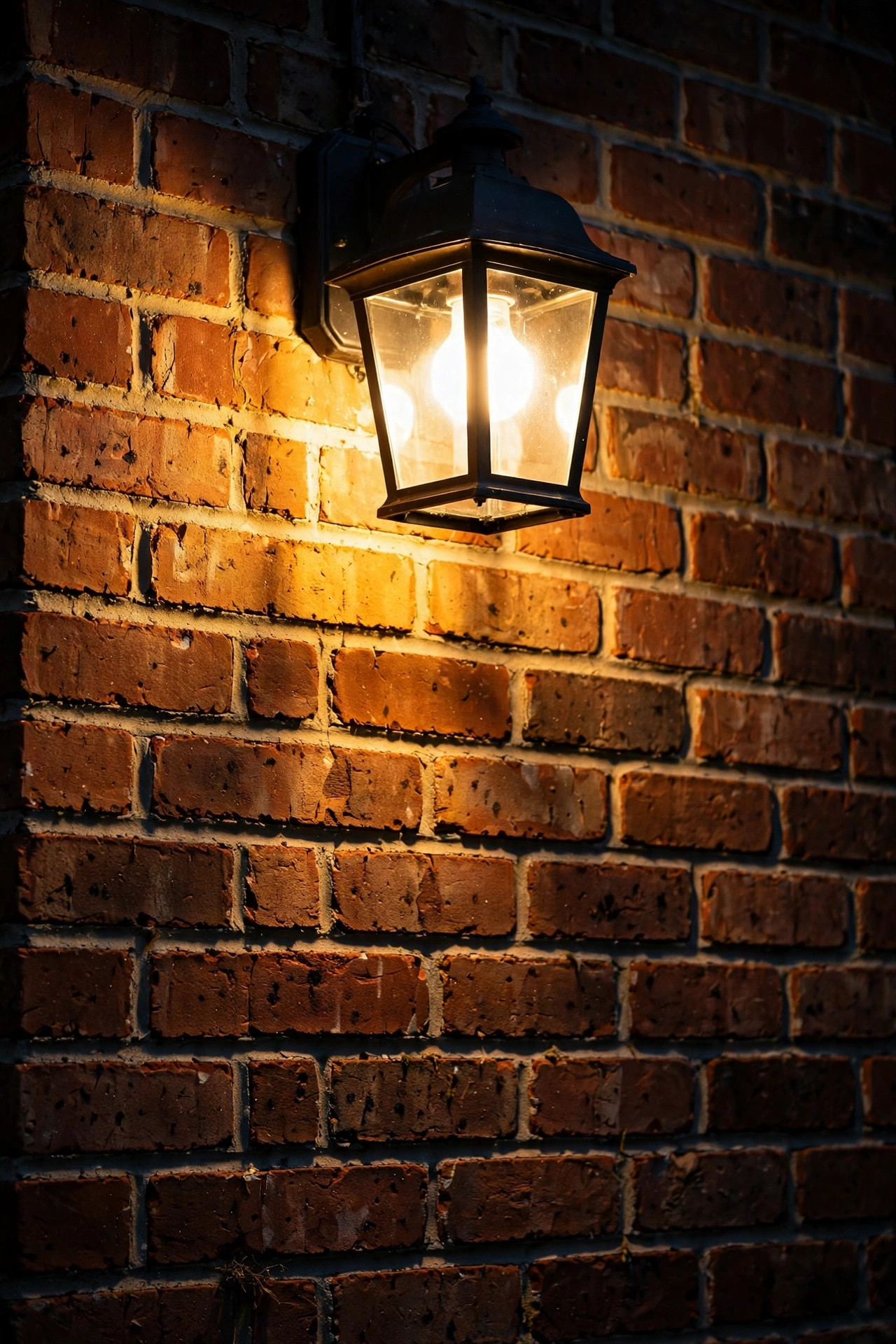
A sconce is simply a wall-mounted light fixture, and the "pair" tradition comes from symmetry: one fixture on each side of the door frames your entry and throws balanced light across the threshold. Unlike a single overhead light, which blasts straight down and puts your face in shadow while you stand under it, flanking sconces wash light sideways and across the entry area, which is far more flattering and far more useful when you're trying to see the doorbell camera or greet someone at night.
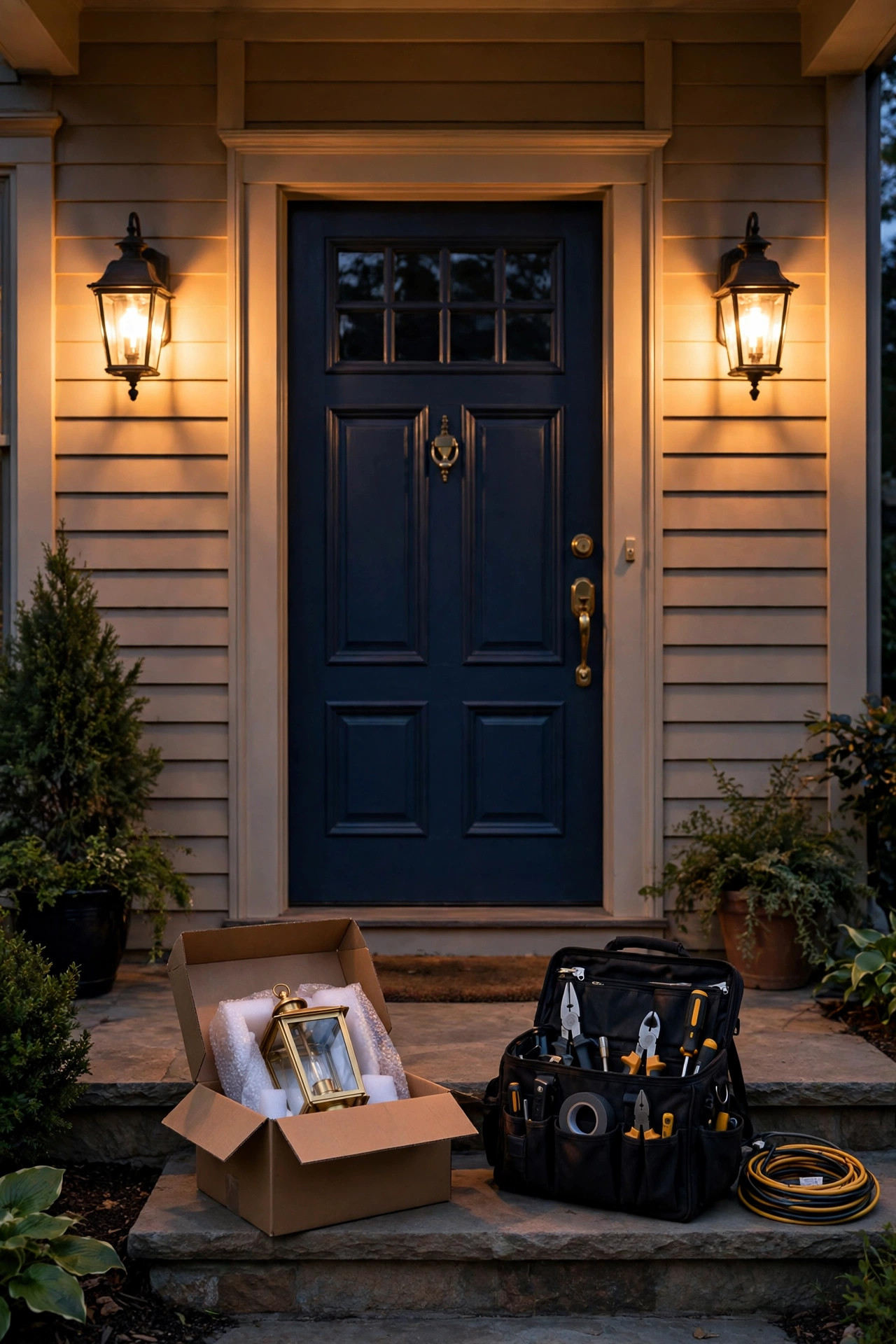
Most hardwired exterior sconces run on standard 120-volt wiring and connect to a junction box mounted in the wall. If your home already has fixtures by the door, you're usually swapping them onto existing boxes — an easy afternoon project. If the boxes aren't there, that's when an electrician earns their fee, because running new wiring through exterior walls involves drilling, fishing cable, and keeping everything weatherproof.
Light direction matters more than most people realize. Down-lighting sconces push light onto the steps and welcome mat, which is great for safety. Up-and-down fixtures throw light in both directions, creating that gorgeous glow against siding and soffits. Glass panels that let light through the sides scatter a softer, more ambient wash. For a front entry, I always recommend fixtures that put at least some light downward — your steps will thank you in the winter when the sun sets at 4:30.
The other thing to know: exterior sconces live a hard life. Rain, snow, temperature swings, bugs building condos behind the backplate. A fixture rated for wet locations (more on that in the safety section) with a sealed or gasketed housing will outlast a pretty-but-cheap fixture by years. Honestly, build quality matters more at the front door than almost anywhere else on the house.
The Main Sconce Types, Compared Honestly
Here's the lineup you'll actually see at lighting stores, stripped of marketing speak. Every one of these works as a matching pair — the question is which suits your house and how much fuss you want.
| Type | Typical cost each | Light direction | Best for | Watch out for |
|—|—|—|—|—|
| Classic lantern | $80–$250 | All around / down | Colonial, craftsman, farmhouse entries | Cheap versions rust within two seasons |
| Up-and-down (modern) | $90–$300 | Up + down only | Modern, contemporary, ranch facades | Puts no light outward; needs a second source for the steps |
| Coach / carriage light | $70–$200 | Down through open bottom | Traditional, brick colonials, cottages | Undersized ones look lost on grand entries |
| Mission / craftsman | $100–$280 | Down, soft side glow | Craftsman bungalows, stone facades | Style is very specific — clashes with modern homes |
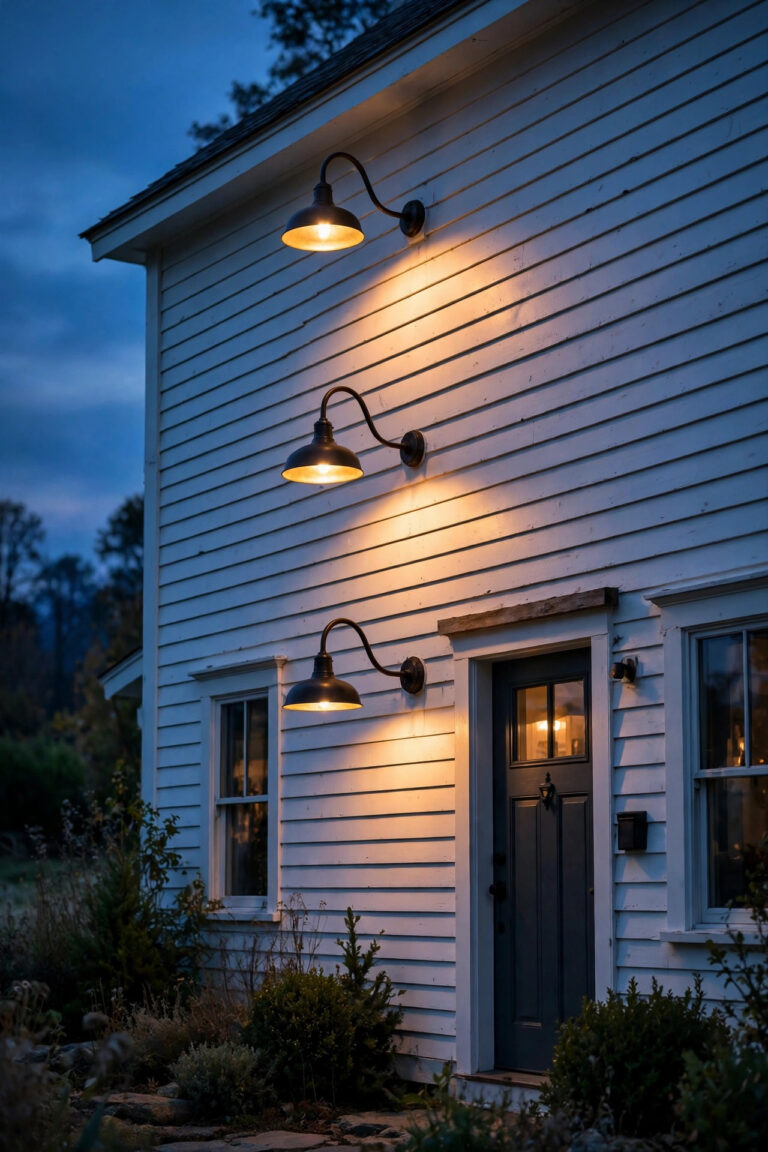
| Farmhouse cage / wire | $60–$150 | All around | Farmhouse, cottage, shabby-chic porches | Open cages collect spiderwebs and invite bugs to the bulb |
| Sealed bulkhead | $50–$120 | Down / forward | Coastal, minimalist, side-entry doors | Can look institutional if too plain |
| Solar decorative lantern | $30–$120 | Soft ambient | Rentals, no wiring, low-stakes upgrades | Dimmer, inconsistent, and panels need direct sun |
My honest take: for a primary front entry, hardwired lantern or coach styles are the safest bet for most American homes because they suit the widest range of architecture and throw light in the directions you actually need. Modern up-and-down fixtures are gorgeous on the right house, but they're an accent light disguised as a main light — they look stunning against a dark siding at dusk while your steps sit in relative darkness. If you go that route, pair them with a well-lit pathway.
Front Door Sconce Lighting Ideas for Every Home Style
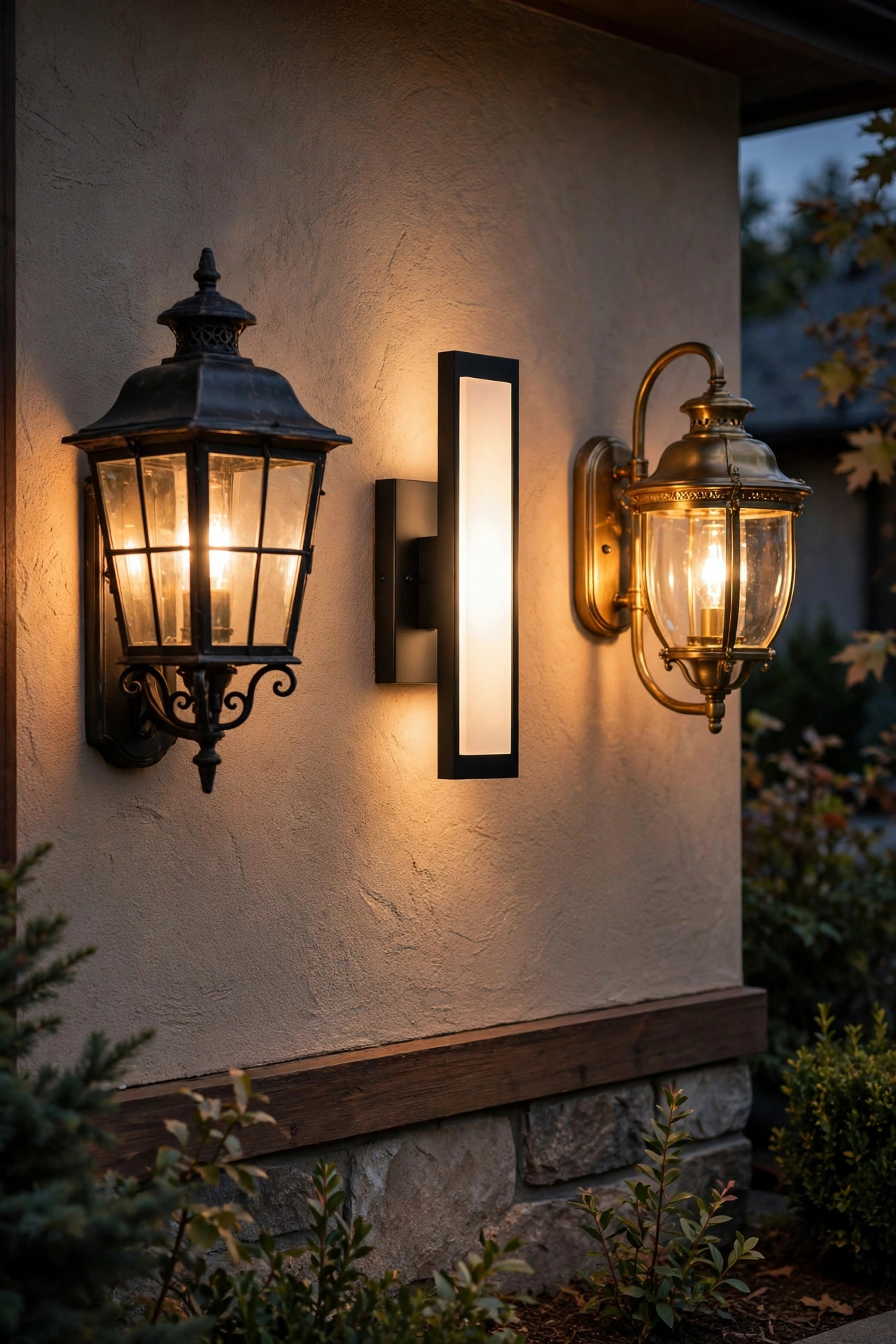
This is where front door sconce lighting ideas get fun, because the right fixture should look like it grew with the house. A colonial with black lantern sconces is a timeless pairing; put those same lanterns on a mid-century ranch and something feels off. Start with your home's architecture, not with what you saw in a neighbor's yard.
For colonials and traditional brick homes, classic lantern sconces in black or aged bronze are the go-to — they echo the era's symmetry and look natural against brick. Craftsman bungalows pair beautifully with mission-style fixtures in oil-rubbed bronze or dark copper, especially with seeded glass that softens the glow. Farmhouses can handle cage sconces, galvanized finishes, or simple barn-style lights, and honestly, farmhouse is the most forgiving style — hard to get it wrong.
Modern and contemporary homes are where people overthink it. Simple geometric shapes — cylinders, rectangular up-down lights, minimal backplate sconces — in matte black or brushed nickel keep the entry crisp. Just remember the light-direction caveat from above: add pathway lighting so the walk isn't a black hole. For coastal homes, sealed fixtures in white, brushed nickel, or a weathered bronze hold up against salt air better than anything with ornate detailing that traps moisture.
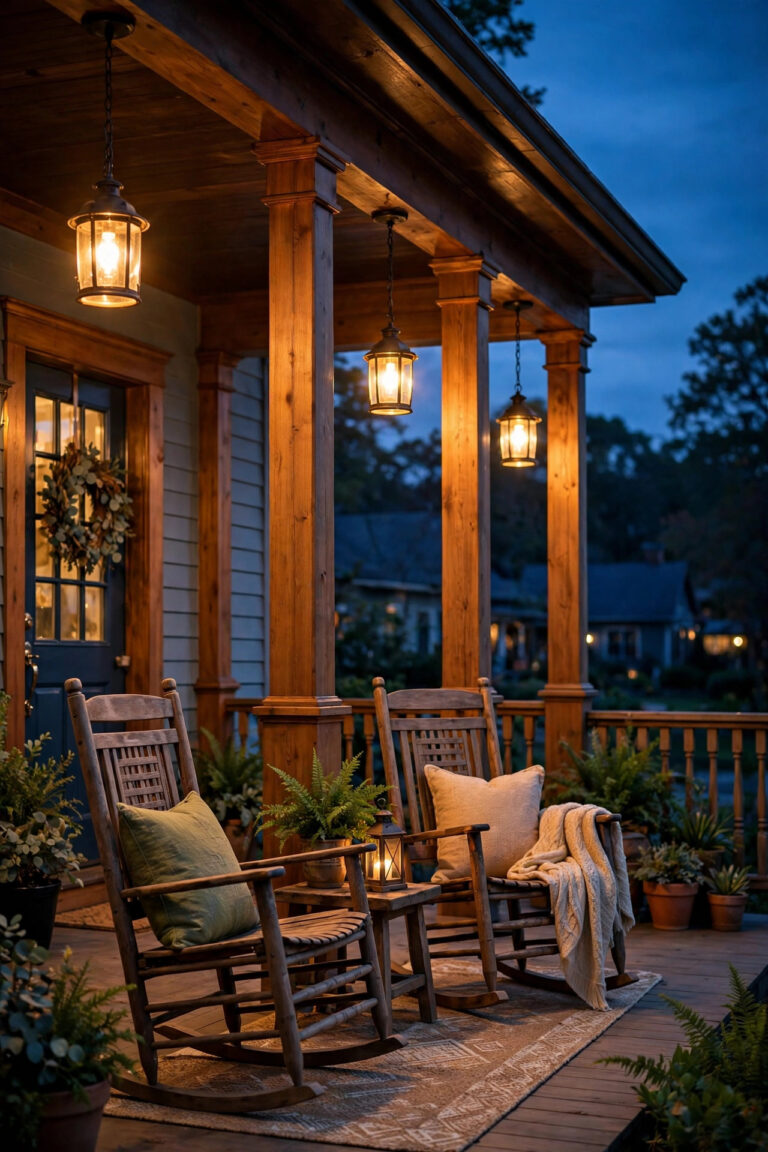
One of my favorite styling tricks is to carry your sconce finish through the rest of the entry: match it to your door hardware, house numbers, and mailbox for a pulled-together look. And if you decorate seasonally, pick a finish that plays well with wreaths and garlands — black and bronze work with literally everything, which is why you see them everywhere (I used this same approach in my fall porch lighting ideas, where the lanterns got a cedar-and-berry garland draped around them and looked like a magazine cover).
Sizing Rules for the Perfect Front Door Sconce Pair
Sizing is where most people go wrong, and it's almost always the same mistake: too small. Tiny sconces on a standard entry look apologetic, like earrings on a giraffe. Here's the rule of thumb I always recommend: each sconce should be roughly one-quarter to one-third the height of your front door. A standard 80-inch door wants fixtures in the 20 to 27-inch range — though in practice, most residential sconces top out around 18 to 20 inches, which lands you right in the sweet spot.
Width matters too. A good guideline is that each fixture should be about one-quarter the width of the door itself. On a 36-inch door, look for sconces around 9 inches wide — the typical 6 to 10-inch range you'll find in stores. And watch the projection, the distance the fixture sticks out from the wall: 4 to 8 inches is standard. If your walkway or porch is narrow, keep projection on the slimmer end so nobody shoulders the fixture carrying in groceries.
For double doors, scale everything up. A 72-inch-wide double-door entry can handle bigger, bolder fixtures — 22 to 28 inches tall looks proportional rather than excessive. With a wide entry, you also gain the option of a center-mounted lantern above the transom window in addition to the flanking pair, which adds a lovely layered effect.
Small or narrow porches with only one good wall get a pass from the pair rule. One generously sized sconce plus a porch pendant or recessed light above can carry the whole entry. The goal is balanced, useful light and good proportions — not forcing a pair where the architecture fights it. When in doubt between two sizes, size up. Almost every entry I've ever restyled looked better with the larger option.
Placement and Mounting Height: The Measurements That Matter
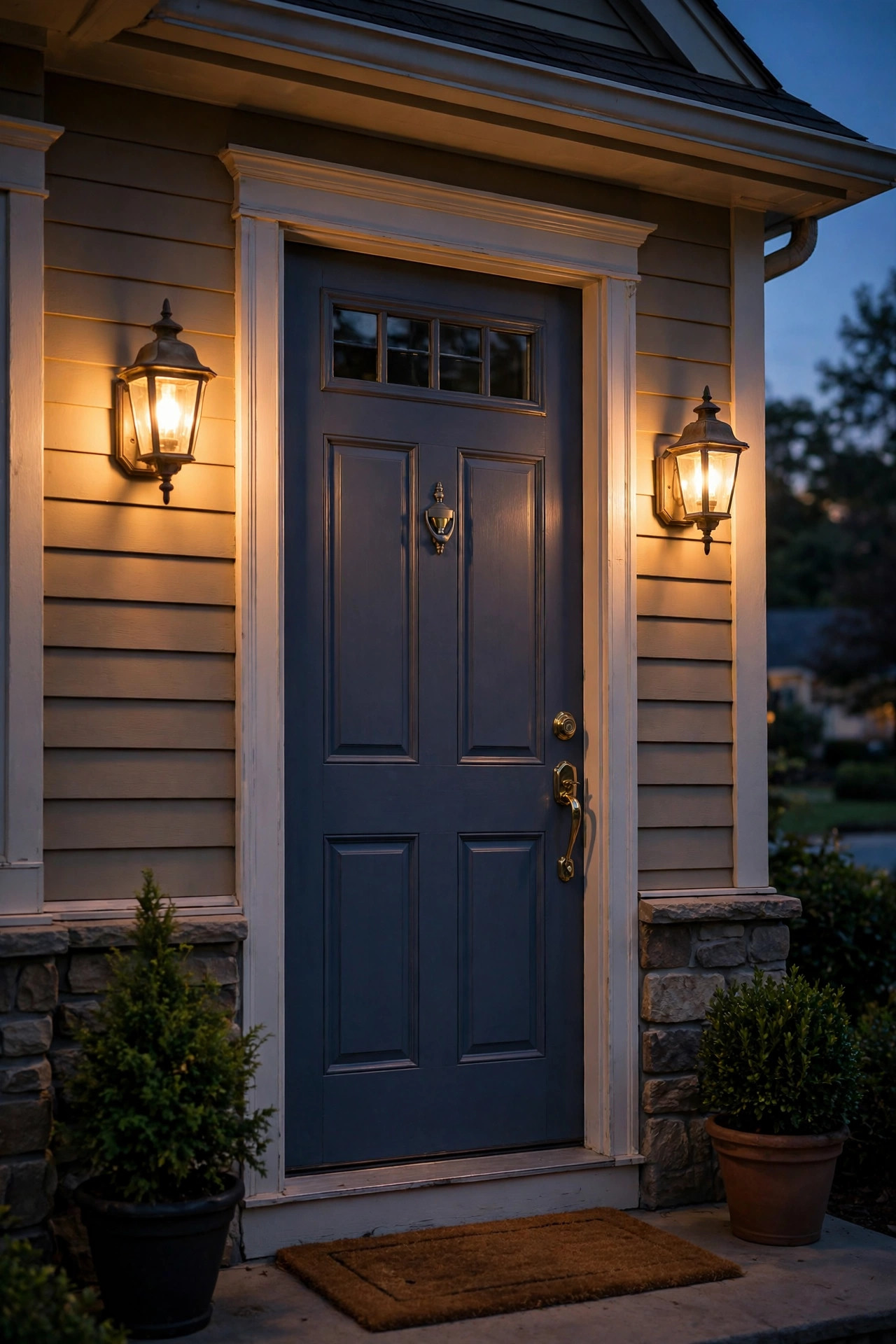
Once you've sized your sconces, placement is mostly a tape-measure exercise. The golden rule: center each fixture 60 to 66 inches from the ground (or porch floor) — right around average eye level. This puts the glow where faces and doorbells live, and it keeps the light out of your sightline when you approach. If your porch floor sits a step or two above grade, measure from the porch floor, not the yard.
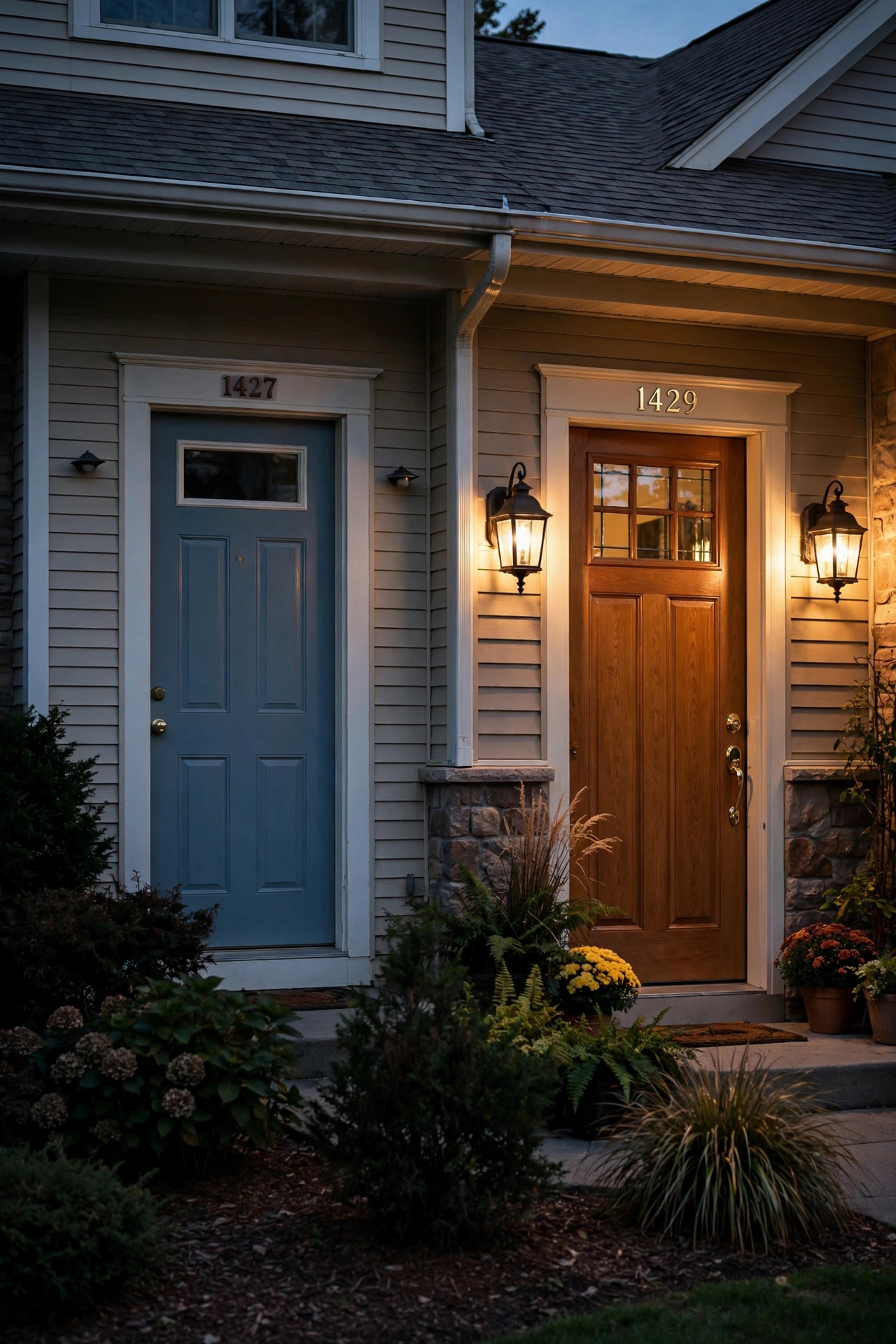
Horizontally, position each sconce 6 to 10 inches from the edge of the door frame or trim. You want a clear visual relationship with the door — too far away and the fixtures feel disconnected, like they're guarding the windows instead. If you have shutters, molding, or wide trim, account for it: leave at least 3 to 4 inches of breathing room so the fixture doesn't crowd the architecture.
A couple of real-world wrinkles worth mentioning. If your entry has a deep overhang, make sure the sconces aren't mounted so far back under it that they read as dim from the street. And if your door has sidelights, the sconce-to-glass distance matters more — you want light reflecting warmly in the glass, not a hot spot glaring through it at night. Stand on your sidewalk at dusk and look at the entry the way a visitor would; that two-minute test catches problems no diagram will.
For garages and secondary entries, the same rules apply — 60 to 66 inches, 6 to 10 inches from the frame. Consistency across every exterior fixture on the house is one of those quiet details that makes a home look professionally designed.

Matching Finishes and Styles to Your Home
Finish is the detail that ties everything together, and it's also the detail people change their minds about first. Black is the workhorse — it disappears against most siding, looks crisp against brick and stone, and pairs with any door color. Oil-rubbed bronze (a dark, warm brown-black) is the coziest option and hides dust and water spots better than pure black. Brushed nickel and stainless read modern and clean but show water spots, so they're higher-maintenance near sprinklers or in rainy climates.
Copper and brass deserve a mention because they age beautifully. A solid copper lantern develops a rich patina over a few years, and even the brown "aged" finishes look intentional. Just know what you're buying: real copper and solid brass cost more, but powder-coated lookalikes will eventually chip and reveal metal underneath. In my experience, spending a little more on a genuinely good finish is one of the highest-value upgrades in exterior lighting — it's what separates fixtures that look great in year one from fixtures that still look great in year eight.
Match your sconce finish to your door hardware if you can — lockset, handle, kick plate, and house numbers all in the same family. Then extend the look inside: your entryway lighting ideas inside the foyer should echo the exterior finish so the transition feels seamless when the door opens at night. Nothing jars quite like a gorgeous warm entry outside and clashing cool nickel inside.
One caution: resist the urge to mix finishes across the front of the house. Two finishes maximum — sconces, porch light, and garage lights should all speak the same language. Three or more finishes reads as accidental, and it's one of the fastest ways to make even expensive fixtures look scattered.
Bulbs and Brightness: Getting the Glow Right
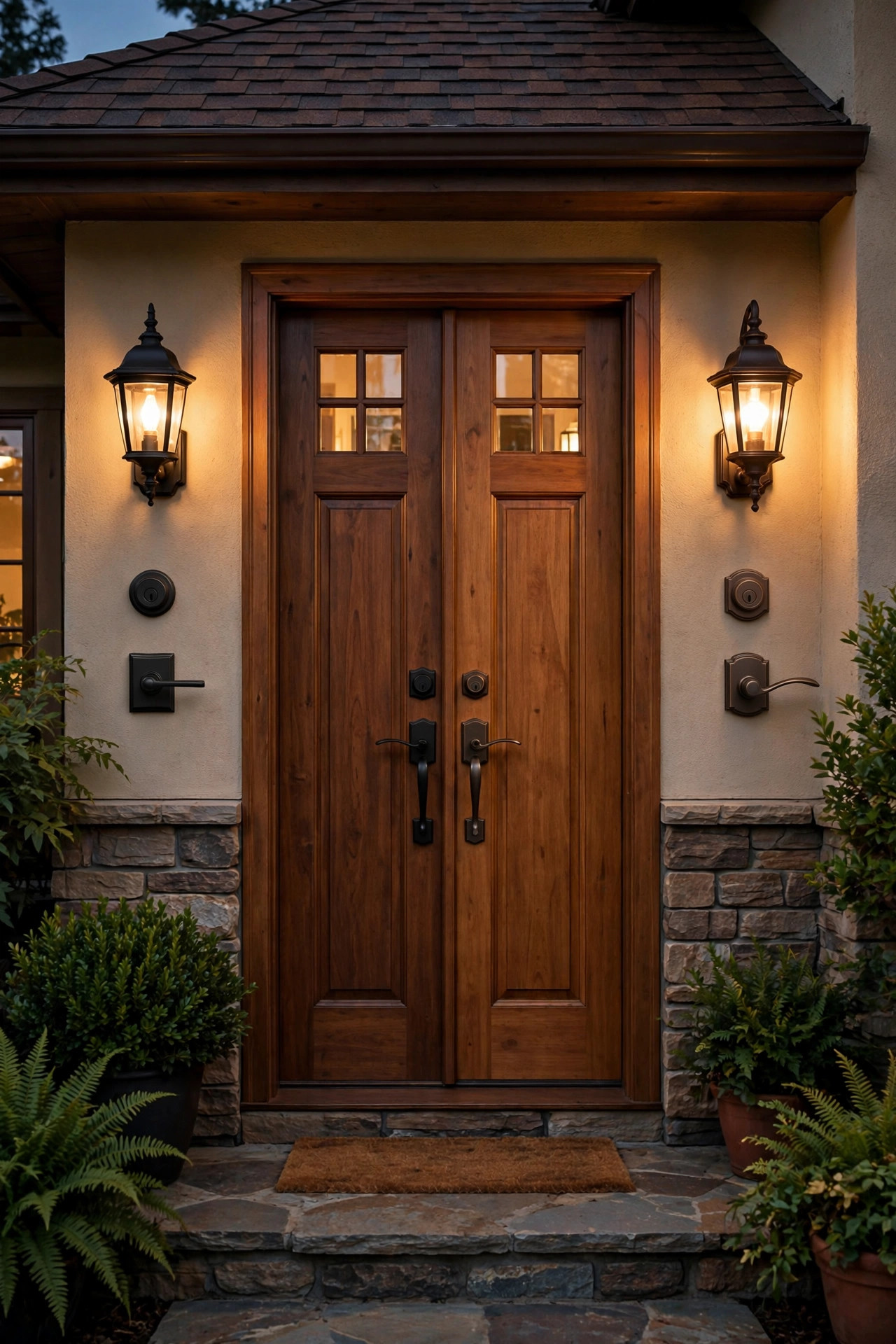
The bulb is where the magic happens, and honestly it's the cheapest part of the whole project to get right. For front entries, warm white is the answer — 2700K to 3000K on the Kelvin scale. Anything cooler (4000K and up) reads clinical and blue against siding, and it makes your warm-colored brick or wood look washed out. If you remember one number from this whole guide, make it 2700.
Brightness-wise, each sconce wants roughly 200 to 800 lumens depending on the job. If the sconces are your only light source, lean toward 400 to 800 lumens each (about a 40 to 60-watt incandescent equivalent in LED terms). If you also have a porch pendant or overhead light, 200 to 400 lumens per sconce gives you that layered accent glow without overpowering everything. Total light pollution matters too — there's no reason to flood your entry with 3,000 lumens and blind the neighbors.
LED bulbs are the obvious choice: they sip power (most sconce bulbs are 5 to 12 watts), last 15,000 to 25,000 hours, and handle cold weather without dimming. LED filament bulbs — the ones with the visible vintage-looking filaments — are my favorite in lantern and cage sconces because the bulb itself becomes part of the look. Check the base type before buying: most exterior sconces use a standard E26 medium base, but smaller fixtures may take E12 candelabra bulbs.
Smart features are worth considering. Dusk-to-dawn sensors turn your sconces on automatically at sunset and off at sunrise, so you never come home to a dark entry. Photocell sensors cost a few dollars more per bulb or fixture but pay for themselves in convenience. And if your sconces sit on a switch you always forget, a simple timer plug or smart switch solves it. Aim your bulbs so light hits the steps and the lock area — the two spots where you actually need to see.
Hardwired vs. Solar: What Actually Works at the Front Door
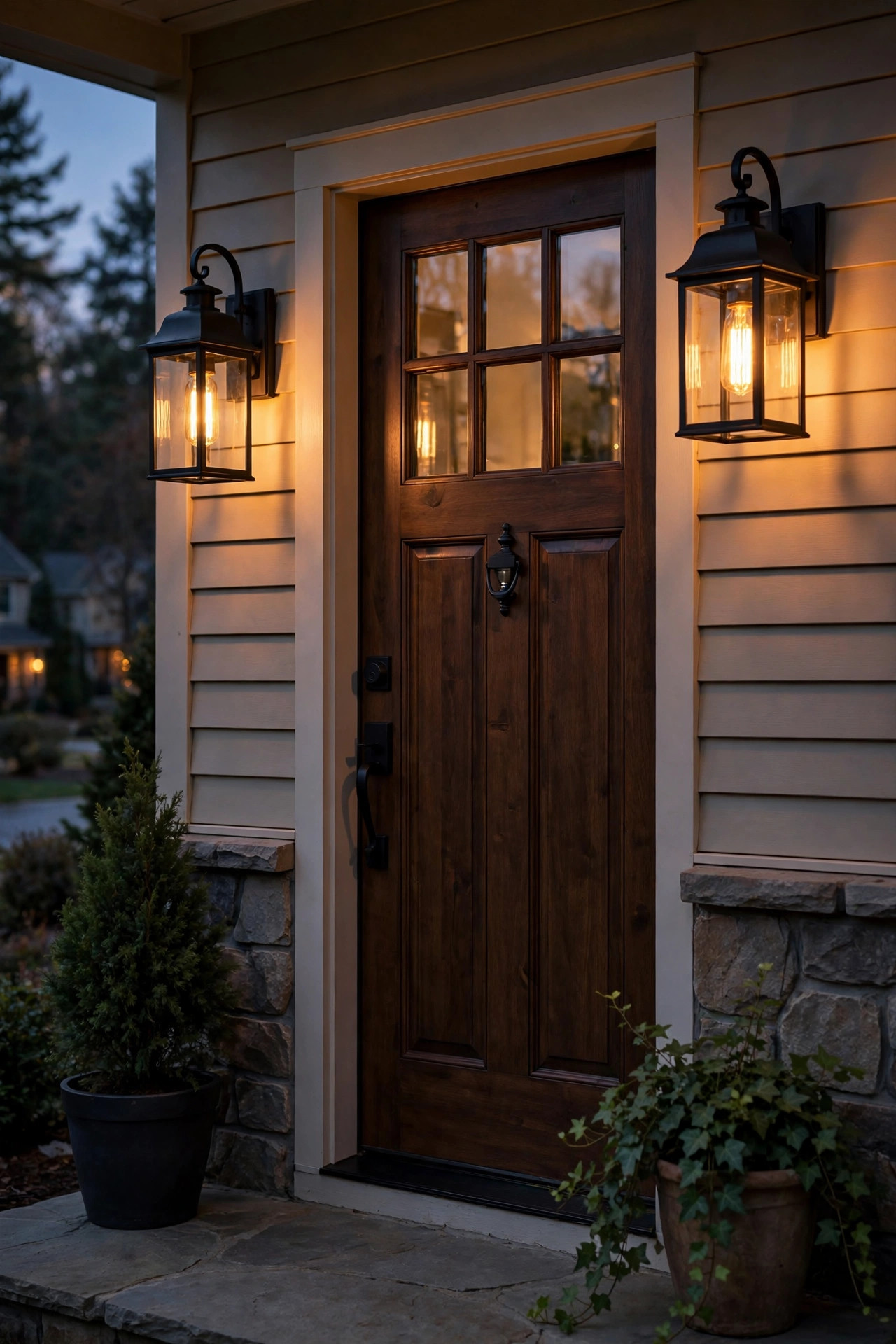
Here's my honest position: for the primary front entry, hardwired wins. Solar sconces have come a long way, and they're genuinely good for fence posts, garden beds, and secondary spots — but the front door is where you need light to work every single night, at full brightness, the moment you pull in the driveway. Solar depends on the panel getting direct sun during the day, and a north-facing entry or a shaded porch can leave you with dim, half-charged fixtures by 9 p.m.
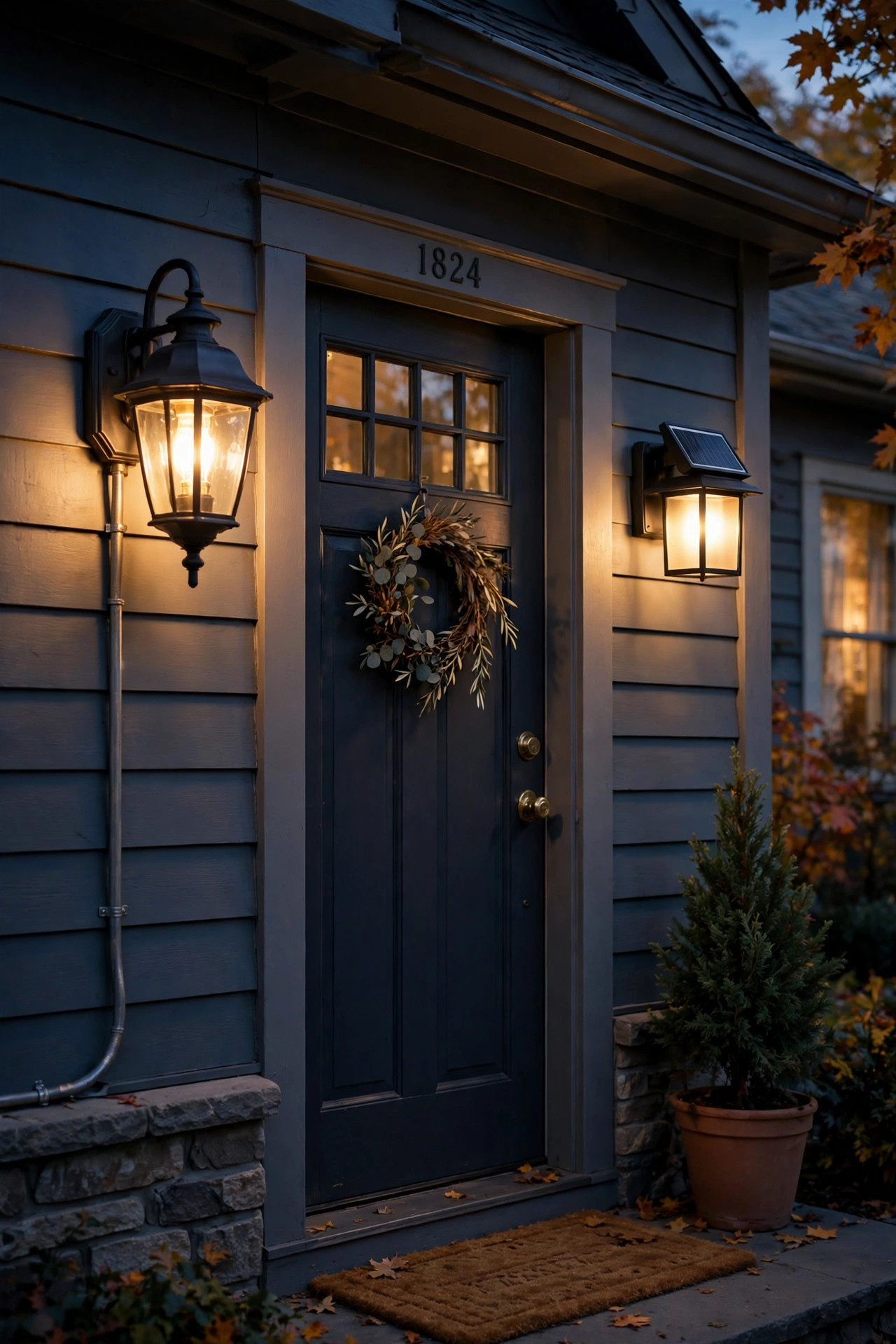
That said, solar has its place. If you're renting, if your entry has no existing wiring and an electrician's visit isn't in the budget, or if you want temporary accent lighting for a season, solar lanterns are a perfectly fine stopgap. Look for ones with separate solar panels you can mount in the sunniest spot, and lithium batteries rather than Ni-Cd — they hold a charge much better through winter.
Battery-operated sconces (the remote-control kind with LED pucks inside) are another workaround for wiring-less entries. They look decent in photos but the brightness rarely satisfies in person, and you're swapping batteries every few weeks. Fine for a party, not for a permanent entry.
If you have existing wiring, upgrading to hardwired is almost always worth it. The fixtures stay bright all night, you can use any bulb you want, and dusk-to-dawn sensors just work. For a deeper comparison of the two approaches across your whole yard, my LED vs solar breakdown covers running costs and longevity in detail. Bottom line for the front door specifically: wire it once, enjoy it for a decade.
What a Sconce Pair Costs in 2026
Let's talk real numbers. A decent pair of hardwired exterior sconces runs $120 to $600 for the fixtures alone — $60 to $150 each for solid big-box-store options, $150 to $300 each for premium finishes and heavier construction. Solar pairs are cheaper upfront, $60 to $240 for the pair, but factor in replacing them every 2 to 4 years.
Installation is the variable. If you're swapping onto existing junction boxes and you're comfortable with basic wiring, it's a DIY project that costs you nothing but an afternoon and maybe $15 in wire nuts and caulk. Hiring an electrician to swap two fixtures on existing boxes typically runs $150 to $400 depending on your market. Running brand-new wiring where none exists is the big-ticket item: expect $300 to $600 for a pair, sometimes more if the electrician has to open up finished walls or run conduit through brick.
Running costs are refreshingly tiny. Two LED sconces at 9 watts each, running 6 hours a night, use about 40 kilowatt-hours a year — roughly $6 to $8 at average US electricity rates. That's less than a dollar a month. A dusk-to-dawn sensor doesn't change the math much since LEDs are so efficient.
My recommended budget tiers: around $150 total for a DIY solar or swap-in refresh; $300 to $600 for quality hardwired fixtures with a pro install on existing wiring; $800 to $1,200 for premium fixtures with new wiring. Honestly, the middle tier is where the value lives — good fixtures, installed right, that you won't think about for a decade.
7 Mistakes That Ruin Your Front Door Sconce Lighting
I've seen every one of these in real neighborhoods, including on my own house before I knew better. Run through this list before you buy.
1. Going too small. The number-one mistake, full stop. A pair of 8-inch sconces on a standard 80-inch door looks like dollhouse furniture. When in doubt, size up — use the one-quarter-to-one-third rule from the sizing section.
2. Mounting them at the wrong height. Sconces centered at 72 inches or higher wash light over everyone's head and leave the lock area dark. Stick to 60 to 66 inches and measure from the porch floor.
3. Mismatching with the rest of the house. Bronze sconces with nickel house numbers and a brass mailbox is three finishes fighting. Pick one finish family and commit.
4. Choosing cool-white bulbs. 5000K "daylight" bulbs at the front door make your home look like a dentist's office. Stay at 2700K to 3000K, always.
5. Ignoring what's behind the wall. Buying gorgeous fixtures only to discover there's no junction box — or that the existing box is a rusted mess — turns a weekend project into a scramble. Check the wiring situation before you shop.
6. Forgetting clearance. Fixtures that collide with shutters, screen doors, or storm-door swings get damaged or block the door. Hold the fixture up (or tape an outline on the wall) and swing everything before drilling.
7. Skipping the wet rating. A fixture rated only for damp locations will corrode when driving rain hits it directly — and most front doors get driving rain. Wet-rated or nothing for exposed entries.
Safety and Electrical Basics
Exterior electrical work isn't scary, but it deserves respect. First rule: always kill the power at the breaker before touching anything, and test the wires with a non-contact voltage tester. It takes thirty seconds and it's the difference between a project and a story.
Outdoor ratings are non-negotiable. Look for fixtures labeled "suitable for wet locations" — these are sealed against direct rain and snow. "Damp location" fixtures handle humidity and covered porches but will fail under direct weather. If your entry is fully covered and never sees rain, damp-rated is fine; otherwise go wet-rated. The label is on the fixture box and in the specs — check before you buy, not after you mount.
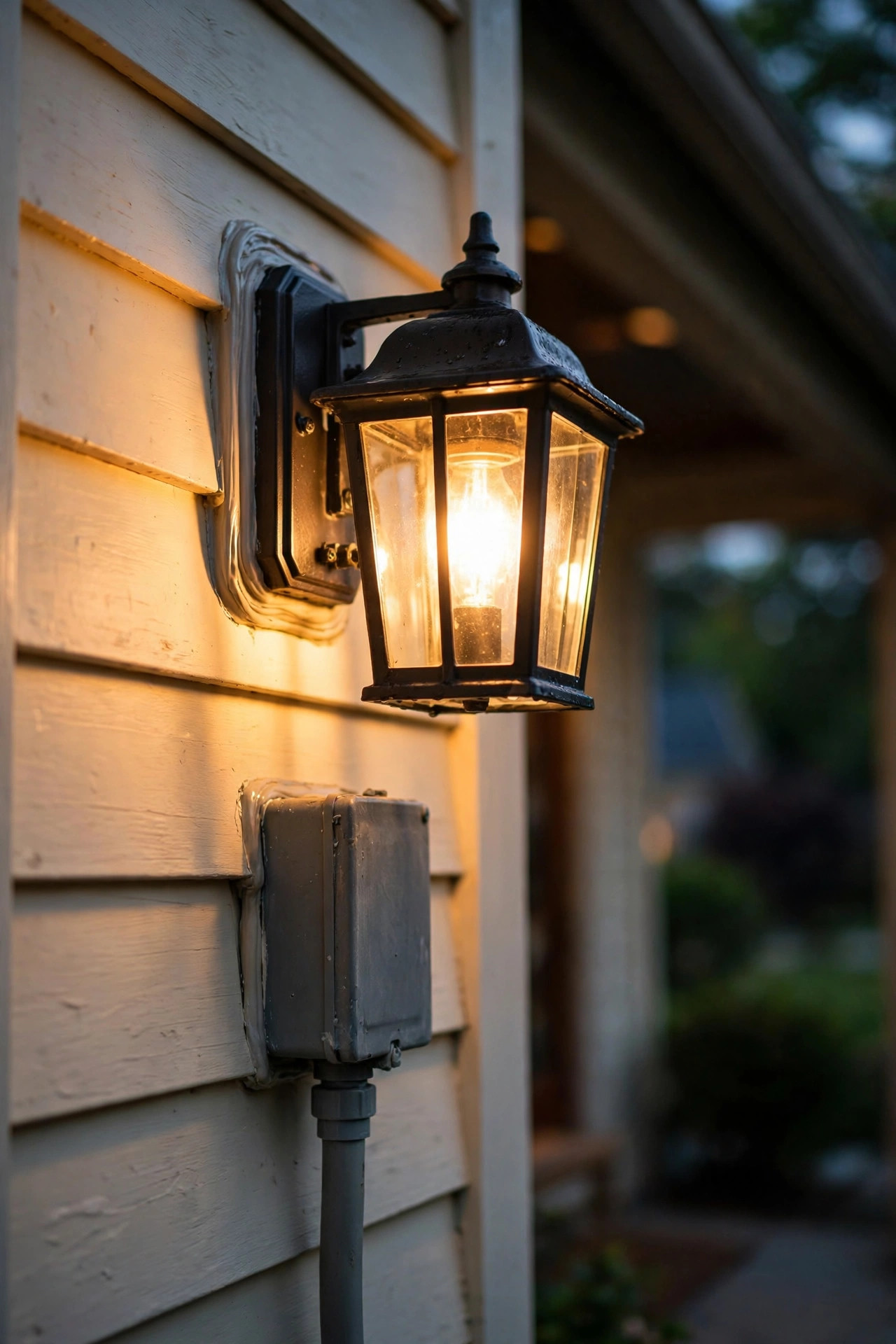
All exterior fixtures should be on a GFCI-protected circuit, and junction boxes need weatherproof covers with proper gaskets. Where the fixture meets the wall, run a bead of exterior silicone caulk around the top and sides (leave the bottom open so any moisture can drain out — this is a detail pros swear by). If you're mounting on vinyl or wood siding, use a mounting block to give the fixture a flat, sealed surface.
LED-only near anything flammable is a standing rule — LEDs run cool, which is why they're ideal around dried wreaths, garlands, and corn-stalk bundles. And if your home is older and the wiring looks questionable (cloth insulation, no ground wire), that's a job for a licensed electrician, full stop. A $200 service call is cheap insurance against a fire.
Maintenance: Keeping Them Beautiful for Years
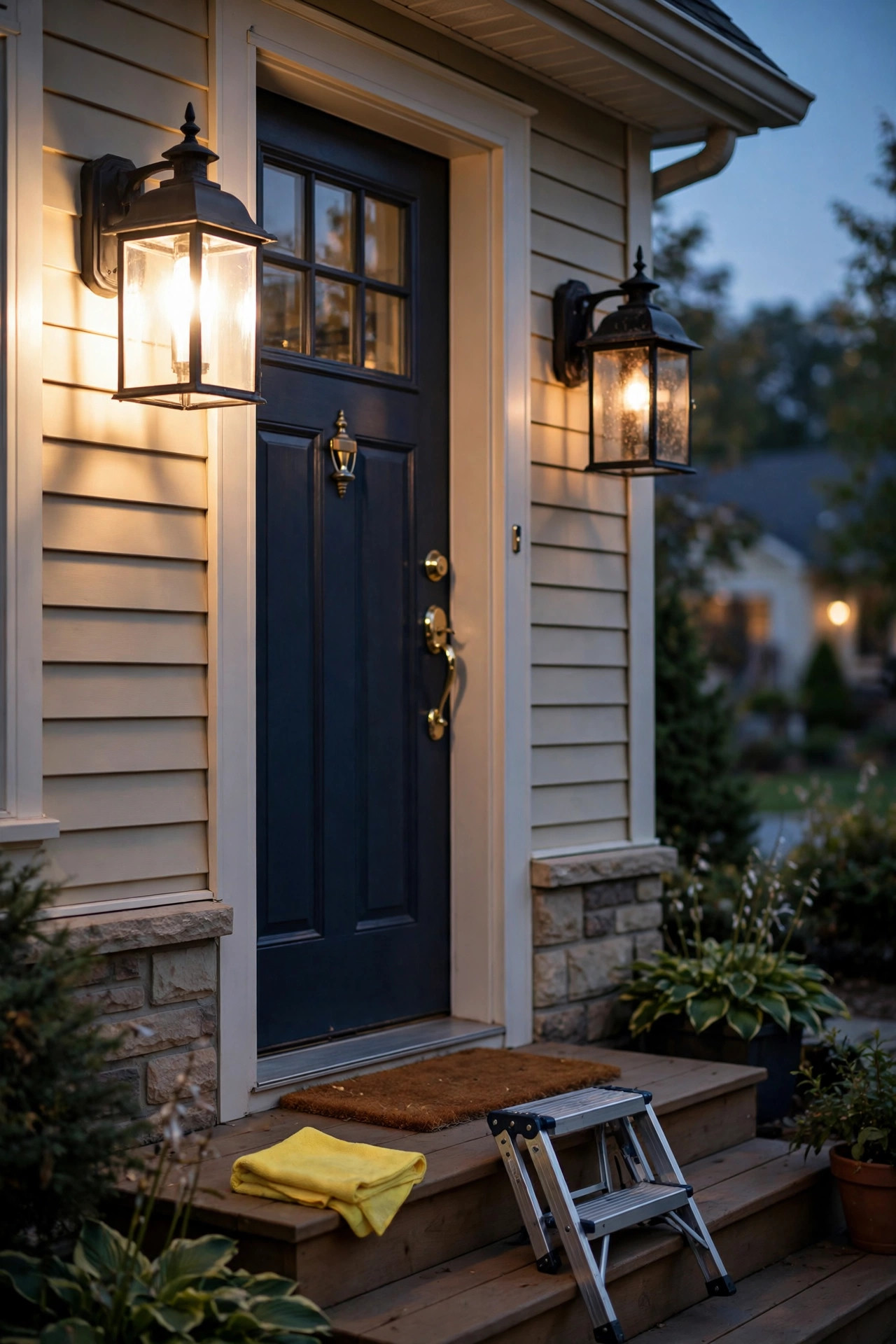
Good sconces are low-maintenance, not no-maintenance. Twice a year — I do mine when I change the smoke-detector batteries — give each fixture a quick once-over. Wipe down the glass and the fixture body with a damp cloth; you'd be surprised how much pollen, dust, and bug residue dulls the light output over a season. A filmy lens can cut brightness noticeably without you realizing it's happened gradually.
Check the caulk seal around each fixture annually and touch it up if it's cracked or pulling away. Tighten any mounting screws that have worked loose — temperature cycling does that. If you see corrosion starting on a finish, address it early with a rust-inhibiting touch-up rather than waiting for it to spread. And clear out any insect nests behind the backplate or inside open-cage fixtures before they become a permanent residence.
LED bulbs last years, but when one does fade or flicker, replace both bulbs in the pair at the same time so the brightness and color match. Keep a spare bulb or two on hand — there's nothing more annoying than one dead sconce making your entry look lopsided for a week while you remember to buy a replacement. With this little bit of attention, a quality pair of sconces will look as good in year ten as the day you hung them.
Frequently Asked Questions
How much does it cost to install a pair of front door sconces in 2026?
For a DIY swap onto existing wiring, just the fixtures: $120 to $600 for the pair. With an electrician doing a straightforward swap on existing junction boxes, add $150 to $400. If new wiring needs to be run, total project cost typically lands between $450 and $1,200 depending on the fixtures and your market. Running costs are negligible — two LED sconces cost roughly $6 to $8 a year in electricity.
Can I install front door sconces myself, or do I need an electrician?
If you're swapping fixtures onto existing, properly wired junction boxes and you're comfortable turning off the breaker and matching wire colors, it's a very doable DIY project. You need an electrician when there's no existing wiring, when you need new junction boxes cut into the wall, when the existing wiring is old or ungrounded, or when anything about the setup looks questionable. When in doubt, call the pro — exterior electrical mistakes cause fires.
What size sconces do I need for a standard 36-inch front door?
Aim for fixtures roughly 14 to 20 inches tall and 6 to 9 inches wide — about one-quarter to one-third of the door's 80-inch height. Mount them 6 to 10 inches from each side of the door frame with the center of each fixture 60 to 66 inches off the porch floor. For double doors, scale up to 20 to 28 inches tall.
Why does one of my sconces keep flickering or going out?
The most common causes are a loose bulb, a dying LED driver or bulb, a loose wire connection in the junction box, or moisture getting into a fixture that isn't properly sealed. Start simple: tighten or replace the bulb, then check for corrosion on the socket. If both sconces flicker, the issue may be the switch or the circuit — and if the fixture fills with condensation regularly, it's probably not wet-rated for its exposure and needs replacing or resealing.
When is the best time of year to install exterior sconces?
Any dry, mild-weather weekend works, but fall is ideal: you'll finish before the early winter sunsets, so you immediately get the full benefit of that warm entry glow during the darkest months. It's also the perfect moment to coordinate the new fixtures with your seasonal porch decor. Avoid installing in freezing temperatures if you need to caulk, since most exterior sealants don't cure properly below about 40°F.
Conclusion
The best front door sconce lighting ideas aren't about following a trend — they're about getting the fundamentals right: a well-proportioned pair, mounted at the right height, in a finish that suits your home, glowing with warm 2700K light every single night. Get those four things right and your entry will look intentional, welcoming, and honestly kind of expensive, whether you spent $150 or $1,000.
If your entry is still lit by a single tired fixture (or nothing at all), make this the weekend you fix it. And once the sconces are up, keep going — browse more exterior lighting ideas on the site and give your porch, pathway, and patio the same warm treatment your front door just got.