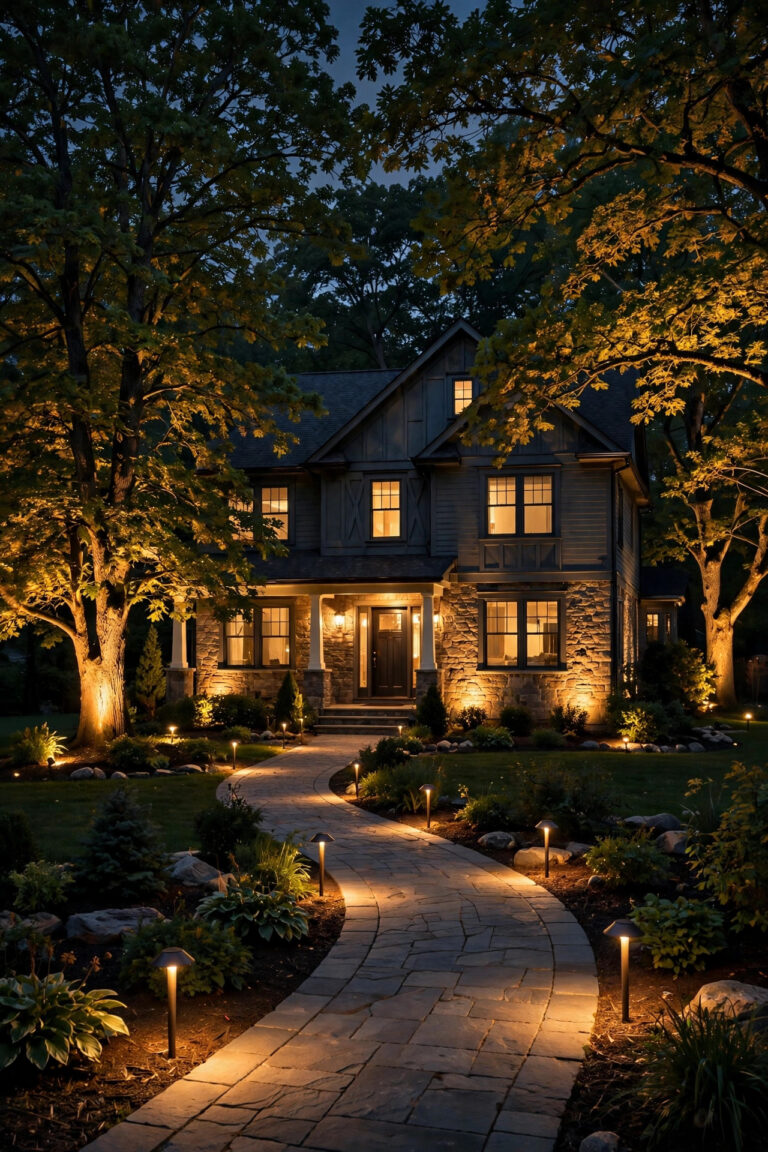
There is a moment, right after the sun drops behind the far shore, when our little pier turns into my favorite place on earth — if the lights are right. For years they were not: one glaring floodlight, a lot of squinting, and more than one stubbed toe on the wet boards. These days I layer my pier lighting ideas the same way I layer light everywhere else, with a calm base that shows you the edges, a little task light where hands need it, and a soft top layer that makes the water itself glow. That layering is the whole secret. Below I am sharing the 17 setups that turned our pier, and the boardwalk down at the marina, into places where people linger after dark: solar caps on the pilings, light tucked under the handrail, a gentle shimmer under the waterline, and seating corners that feel like a tiny café on the lake. Every one of them is weather-tough, kind to the neighbors across the water, and sized for real budgets, so pick the three or four that fit your stretch of boards and build from there.

1. Start With a Layered Plan for Pier Lighting Ideas That Work
Every pier I have ever loved at night follows the same three-layer recipe, and every disappointing one skipped straight to a single bright fixture. Layer one is your safety base: low, steady light that outlines the walking surface, the edges, and the steps, so nobody has to guess where the boards end. Layer two is task light, a little brighter and aimed, for the jobs hands actually do out there — tying up a boat, fumbling with a cooler latch, reading the depth finder. Layer three is pure mood: a shimmer on the water, a warm pool of light around the bench, the sparkle that makes people say yes to one more evening stroll. Before you buy a single fixture, walk your pier at dusk with a notepad and mark where each layer belongs. In my experience, most piers need far less light than people think — a 100-foot pier usually glows beautifully on 12 to 20 well-placed low-lumen fixtures — but it needs that light in the right three places. Plan the layers first, and every idea below slots neatly into one of them.
Suggested budget range: $150 – $600.

2. Solar Post Cap Lights on Every Piling
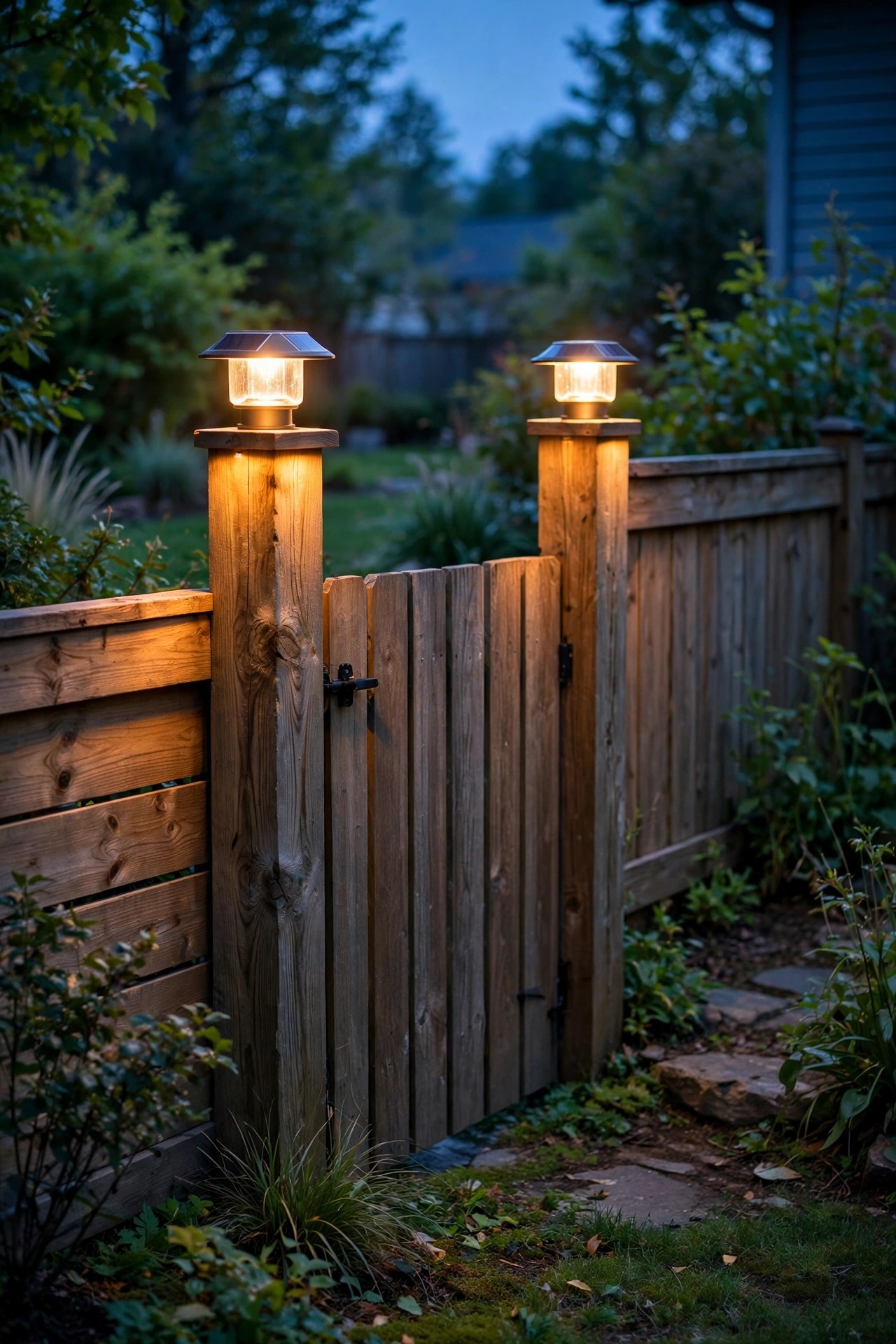
If a pier has pilings, it is practically begging for post cap lights. These little solar caps sit right on top of each piling or deck post, charge all day in full sun — and out on the water, sun is the one thing you have plenty of — then switch on at dusk and trace the whole outline of the pier in warm points of light. I run them down both sides, and the rhythm of those glowing caps is what boaters use to line up their approach after dark. Measure your posts before ordering: 4×4 and 6×6 are the common sizes, and round piling caps exist too if your pier stands on true pilings. Look for caps with replaceable batteries, because the panel will outlive the first battery by years, and choose warm white around 2700K so the glow reads golden instead of blue. A bead of exterior silicone under the rim keeps wind-driven rain from sneaking in. Twice a season I wipe the panels with a damp cloth — pollen and gull contributions add up — and they reward me by burning until well past midnight.
Suggested budget range: $60 – $180.
3. Recessed Deck Lights Flush With the Boards
Bare feet and raised fixtures are enemies, which is why recessed deck lights are the hardest-working pier lighting ideas on this whole list. These small round or square pucks drop into a hole drilled right in the deck boards and sit perfectly flush, so toes, dock lines, and rolling coolers pass over them without a catch. I space mine every 6 to 8 feet along both edges of the walkway, staggered slightly, and that double dotted line reads like a runway guiding you home. Low-voltage wired sets are my first choice for a permanent pier because they stay consistent on cloudy weeks; solar versions work well on short docks in full sun. Aim for modest output — around 30 to 60 lumens per puck is plenty on dark water — and frosted lenses so you never see a harsh dot of diode. Use a hole saw for clean cuts, seal the cut edges with wood preservative on a timber pier, and leave a little slack loop of cable underneath each fixture. When one eventually fails, and one will, that slack lets you swap it in five minutes standing on the dry side.
Suggested budget range: $80 – $250.

4. Low Bollards Along the Boardwalk Edge
Boardwalks are wider and busier than private piers, and they call for a fixture with a little more presence: the low bollard. A good bollard stands 18 to 24 inches tall, throws its light down and out in a soft pool, and keeps the beam below knee height so strollers are never looking into a bulb. I like them spaced 10 to 14 feet apart along one edge — alternating sides looks charming on a curve — where each pool of light just touches the next. That gentle overlap is what makes a boardwalk feel safe without feeling lit like a parking lot. Choose fixtures with louvered or shielded tops, heavy bases that shrug off a bumped wagon or bicycle, and powder-coated aluminum or marine-grade finishes if your boardwalk sits anywhere near salt air. Wired low-voltage bollards on a single transformer run are the reliable choice for a long stretch; solar bollards have improved enormously and suit short neighborhood boardwalks. Keep plantings and benches just outside the light pools so the path stays readable, and the whole walk takes on that resort-boardwalk rhythm that makes an evening stroll feel like a small vacation.
Suggested budget range: $200 – $700.

5. Rope Light Tucked Under the Handrail
Here is the trick I steal compliments for most often: a warm LED rope light hidden under the handrail, washing the deck boards in one continuous ribbon of glow. Because the source is concealed, all you see is the light itself — no glare, no visible fixtures, just a handrail that seems to float above a lit path. Mount the rope in a plastic channel screwed to the underside of the rail so it stays straight and protected, and choose a fully sealed, outdoor-rated rope; on a pier, I insist on IP65 or better, since spray and storm rain find everything eventually. The effect is pure safety disguised as atmosphere: the whole walking line is visible, steps and thresholds announce themselves, and hands on the rail get a pretty backlight. It is also wonderfully kind to night vision, which matters when you are stepping from the boards onto a dark boat. Run it on a low-voltage system with the transformer tucked under the pier head platform or in a dock box, and put it on the same timer as your base layer so the ribbon of light appears like magic every single evening.
Suggested budget range: $50 – $160.

6. Underwater Lights for a Glow Beneath the Pier
Nothing stops a stroll like light coming up through the water. Submersible fixtures mounted just below the waterline on the pilings turn the whole underside of the pier into a soft, moving lantern — the surface ripples do the animation for free. I keep mine in warm white or a gentle aqua, aimed slightly downward so the glow pools under the pier instead of shooting into the eyes of anyone on the boards. On still nights you will see minnows, the occasional curious turtle, and once, memorably, a very confused heron. These must be fixtures genuinely rated for continuous submersion, IP68, on a GFCI-protected low-voltage circuit — water and electricity is the one combination where I never, ever cut corners, and if wiring makes you nervous, a licensed electrician for this one job is money well spent. The technique is the same one I use for the shallows in my pond lighting ideas roundup: light the water, not the surface, and keep brightness low. Two to four fixtures light a family pier beautifully; more turns magic into a fish tank.
Suggested budget range: $120 – $400.

7. String Lights Swagged Between the Posts
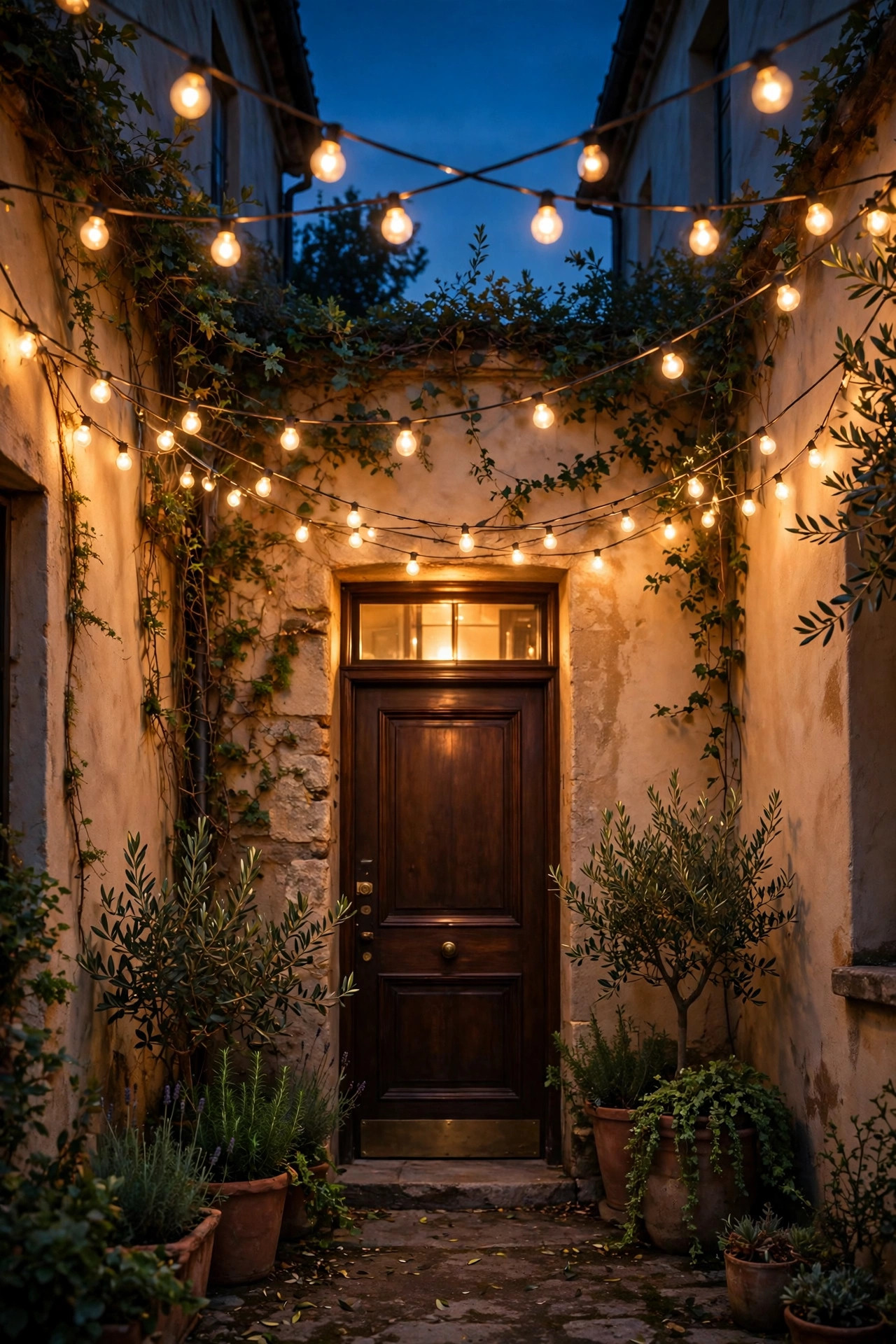
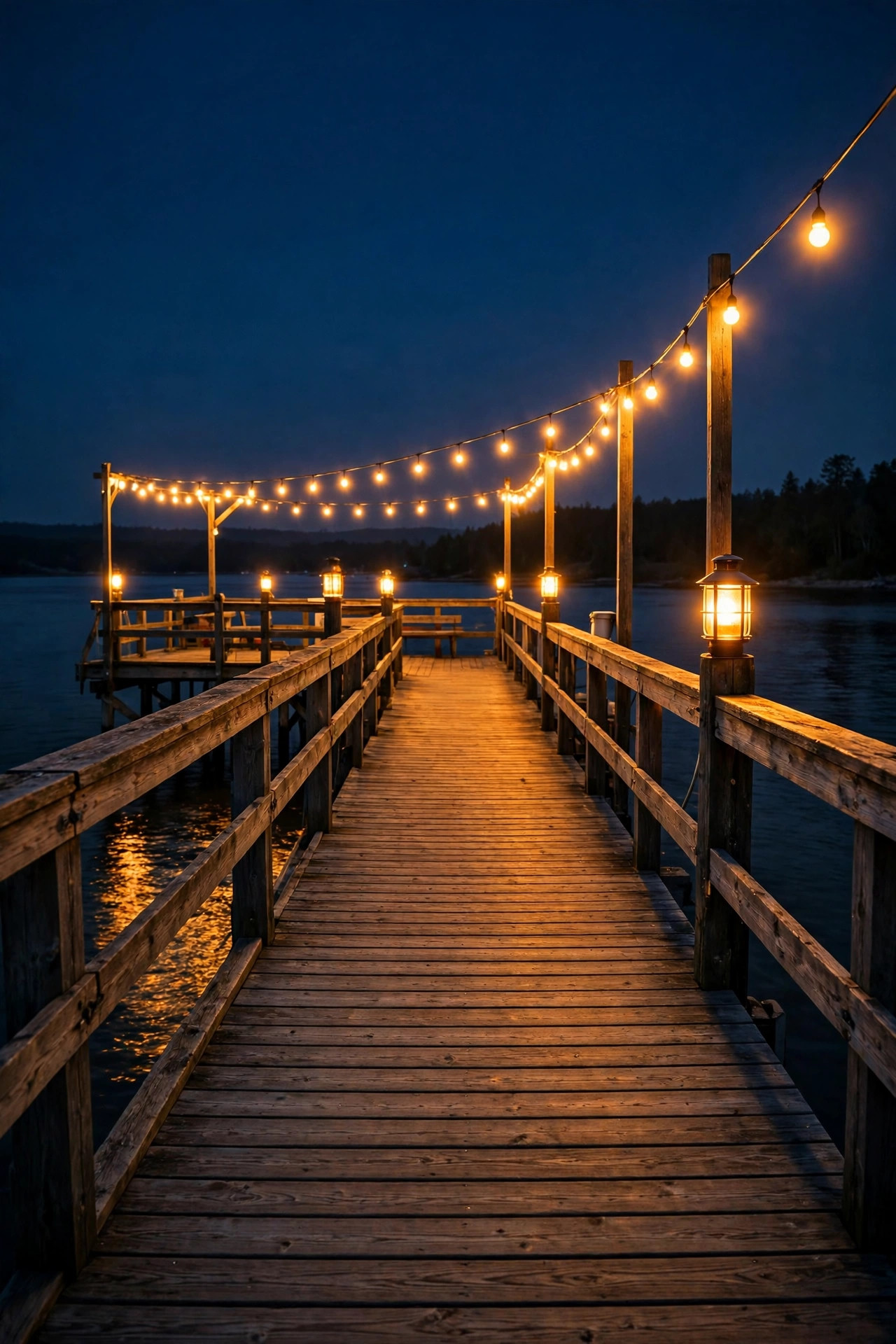
Over the seating platform at the end of the pier, nothing beats café string lights. I swag two or three strands between the corner posts and a central pole, letting them dip in easy catenary curves about 7 to 8 feet above the boards — high enough to walk under, low enough to feel like a ceiling of stars. Out on the water, durability is everything: choose commercial-grade strands with heavy sockets and replaceable LED filament bulbs, because a bargain strand will not survive its second storm season. Each post gets a proper cup hook or eye bolt, never a staple, and I add a simple guide wire on the longest spans so the wind works against steel instead of the cord. Warm 2200 to 2700K bulbs give that candlelit amber that flatters faces, food, and forty-year-old deck boards alike. One honest caution: keep string lights over the pier platform only, never draped along the walking route where a raised fishing rod or a tall guest could snag them. On their own timer zone, they become the official signal at our house that the evening has shifted from chores to cocktails.
Suggested budget range: $70 – $220.
8. Lantern-Style Post Lights at the Pier Head
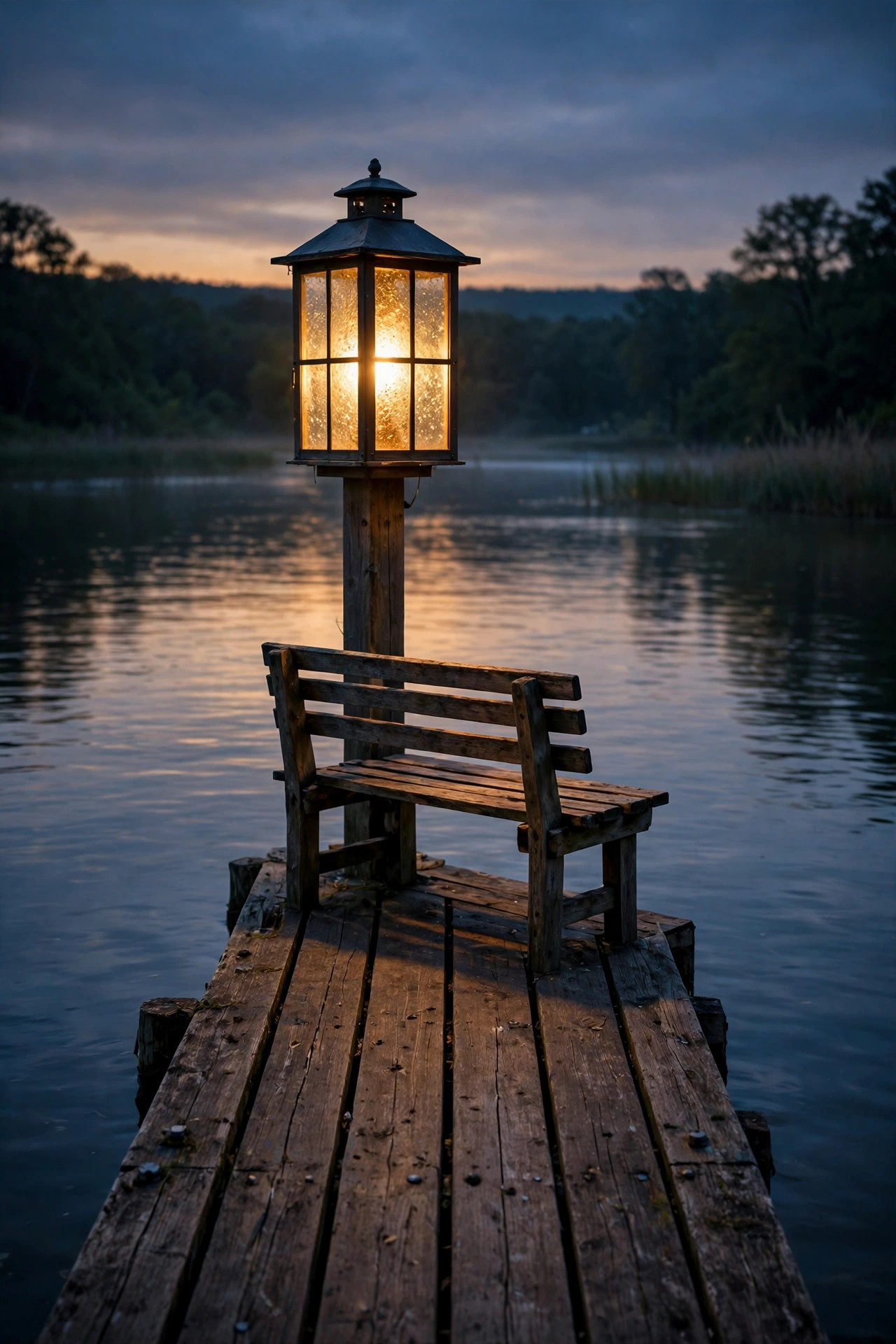
Every pier deserves one handsome fixture at its end, the full stop at the finish of the walk, and mine is a lantern-style post light on the final piling platform. This is the one place I spend real money on looks: a seeded-glass lantern with a warm LED filament bulb reads nautical without tipping into theme-park, and its gentle pool of light anchors the bench, the cooler, and the conversations that happen out there. If you are choosing fixtures, browse my favorite pier mount post light ideas for shapes that suit everything from a rustic fishing pier to a sleek modern dock. Keep the bulb modest — 40 to 60 watts equivalent is plenty, since this light is a landmark, not a work lamp — and put it on a dimmer if your system allows, because some nights call for full glow and some for barely-there. A photocell socket is the simplest automation of all: screw it in, and the lantern wakes at dusk and sleeps at dawn without being asked. In salt air, solid brass or marine-coated finishes earn their price by still looking handsome in year five.
Suggested budget range: $90 – $300.
9. A Motion-Sensor Light at the Entrance, and Only There
Motion lights have exactly one job on a pier: to welcome you at the entrance and then leave you alone. A single sensor fixture where the shore path meets the boards means you never fumble the first step in the dark, and late arrivals get a friendly pool of light instead of a shout across the yard. Everywhere else, I ban them. A sensor that fires every time a wave rocks the dock or a raccoon takes the night shift will drive you mad and teach your guests to ignore the light entirely. Set the sensitivity low, aim the head down the path rather than across the water, and keep the on-time short — one to two minutes is enough to get everyone aboard and settled. Solar all-in-one units are perfect here since the entrance is usually the sunniest spot on the whole structure. Angle the panel toward open sky, not toward the tree canopy, and test the trigger zone on a calm evening by walking the path at a natural pace. When this one light does its one job well, the rest of the pier gets to stay soft, steady, and gloriously unbothered.
Suggested budget range: $30 – $110.
10. Step and Ramp Lights for Safe Landings
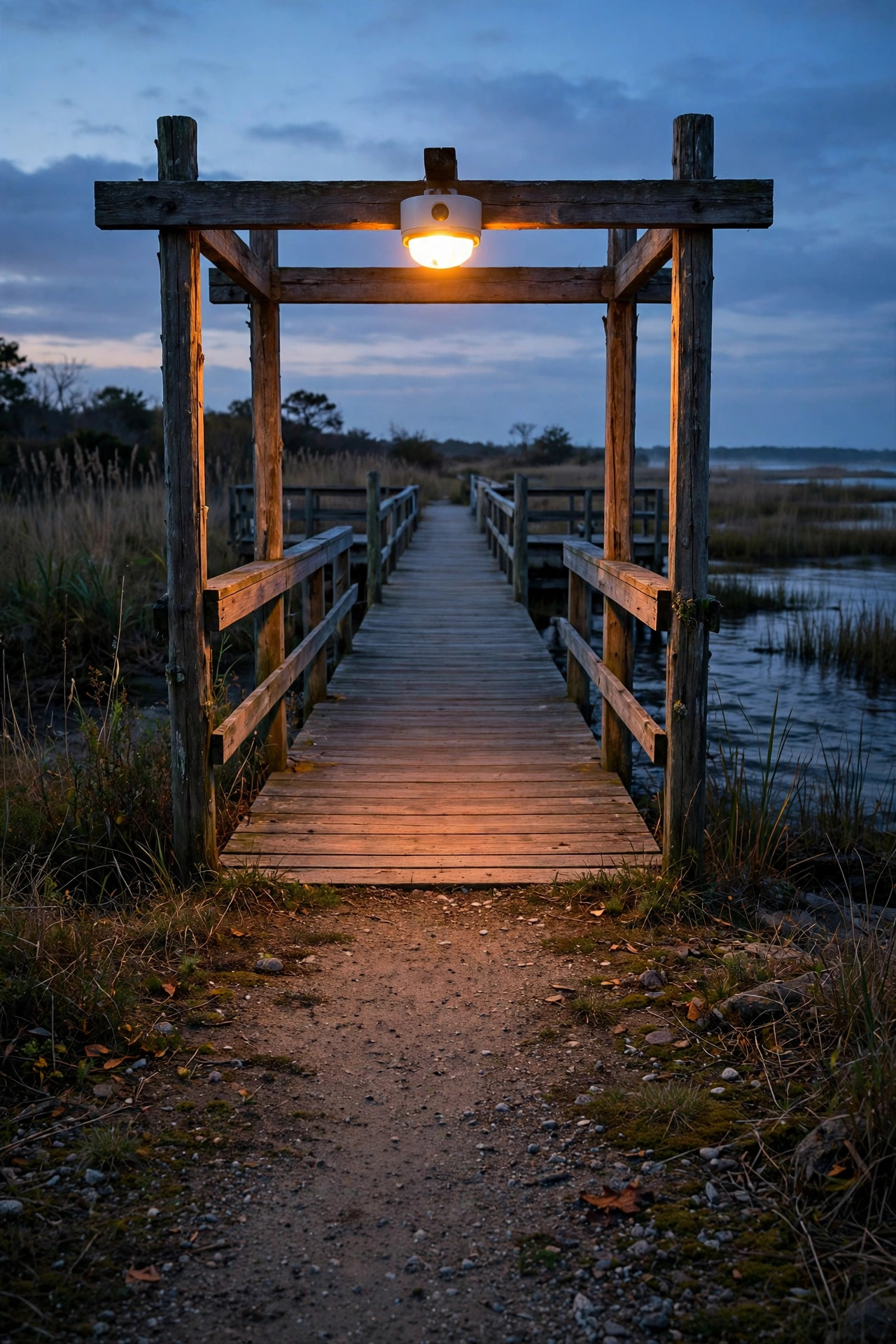
Piers rarely sit at one level: there is the step down from the shore, the ramp to the floating dock, maybe two stairs up to the seating platform. Every one of those level changes deserves its own small light, because in the dark, feet believe the floor is wherever it was a second ago. I use compact step lights recessed into the riser or mounted low on the stringer, washing each tread from above at ankle height. For ramps and gangways, a pair of small fixtures at the top and bottom plus the handrail rope light from idea five covers the slope completely. Keep these fixtures on the safety layer circuit so they are never accidentally dimmed with the party lights, and choose hooded designs that throw light down onto the tread, never out into eyes. On a floating section, remember the whole geometry moves with the water, so leave cable slack and mount nothing where a rising tide or a dropping ramp can pinch it. It is the least glamorous idea on this list, and the one your ankles will thank you for every single night.
Suggested budget range: $60 – $200.

11. Floating Solar Lights Bobbing on the Water
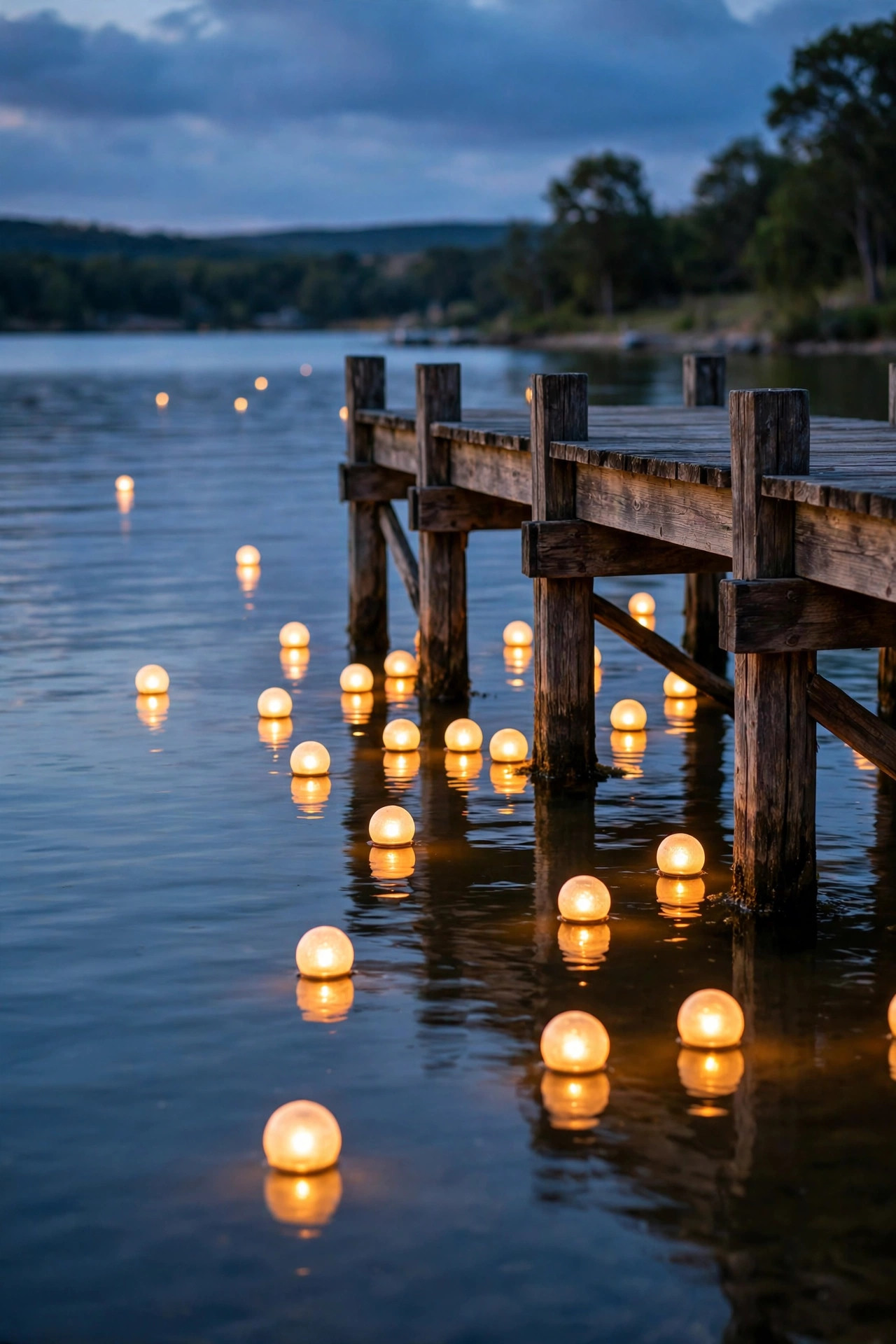
For pure magic at almost no cost, I keep a handful of floating solar lights in the quiet water beside the pier. They are sealed little orbs or lily-pad discs that charge on the surface all day and glow all evening, drifting gently against the pilings. The effect is somewhere between fireflies and lanterns on a river festival, and children lose their minds over it in the best way. A few practical notes from hard experience: tether each one with a short length of fishing line to a piling, or the whole fleet will emigrate to the far shore by morning. Choose warm white if the rest of your scheme is warm — the rainbow color-changing versions are fun for the Fourth of July and a little much for a Tuesday. They are also the easiest maintenance on this list: haul them out monthly, wipe off the algae film, and let the panels see the sun again. In northern winters, they come in with the dock furniture before the ice. Six to ten floats light the waterline of a family pier with real enchantment for less than a single wired fixture.
Suggested budget range: $35 – $90.
12. One Warm Temperature on the Whole Pier
Here is the quiet discipline behind every beautiful pier you have ever admired: every bulb sings the same note. Warm white, 2700K or a touch warmer, everywhere — caps, pucks, lanterns, rope — so the pier reads as one golden place instead of a hardware store sampler. The moment one cool-blue fixture sneaks in, the whole scene cheapens, and out on dark water the contrast is ten times harsher than it is in a yard. When you shop, buy all your fixtures in one session, read the Kelvin number on every box, and order a spare or two of the exact same bulbs for the day one dies. Solar products make this trickier because their color descriptions wander, so I test one unit for a week before committing to a dozen. Your phone camera is a surprisingly honest judge: photograph the pier at night, and any fixture that renders blue-white against the golden rest is your offender. Warm light also treats people kindly, makes weathered wood look rich instead of gray, and — a real bonus on the water — draws noticeably fewer bugs than cool white. One temperature, held faithfully, is the cheapest elegance there is.
Suggested budget range: $20 – $80.
13. Path Lights Guiding the Boardwalk Approach
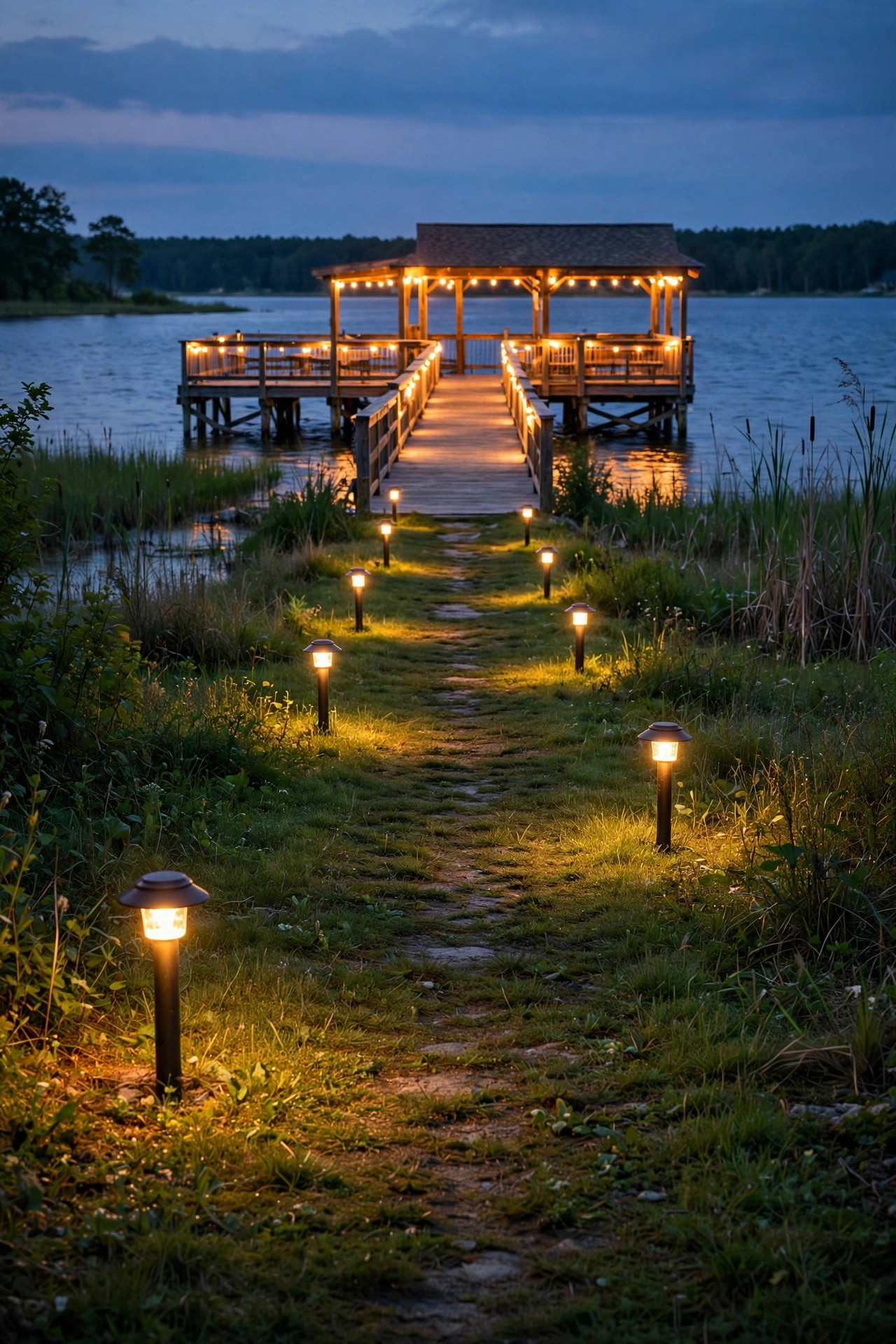
The evening stroll starts before the first board: it starts where the grass path leaves the yard, the parking area, or the marina gate. A short run of path lights along that approach sets the whole tone and keeps guests oriented from car to cooler. I use the same rules out here that govern my favorite walkway lighting ideas: lights every 6 to 10 feet, alternating sides, close enough that each pool nearly touches the next, and always aimed down so the path glows rather than the fixtures. Match the style family to the pier itself — black mushroom caps for a classic boardwalk feel, sleek stakes for a modern marina — and keep the color temperature identical to the fixtures waiting at the water. Solar stakes are the honest budget pick for a short approach; a wired low-voltage run earns its keep on anything longer than about 40 feet or anywhere shade sits heavy. At the transition to the boards, one slightly taller fixture acts as a gatekeeper, and from there the pier lighting takes over. Guests should be able to follow the light like a story, with no dark chapter in the middle.
Suggested budget range: $70 – $260.
14. Timers and Photocells That Run the Show
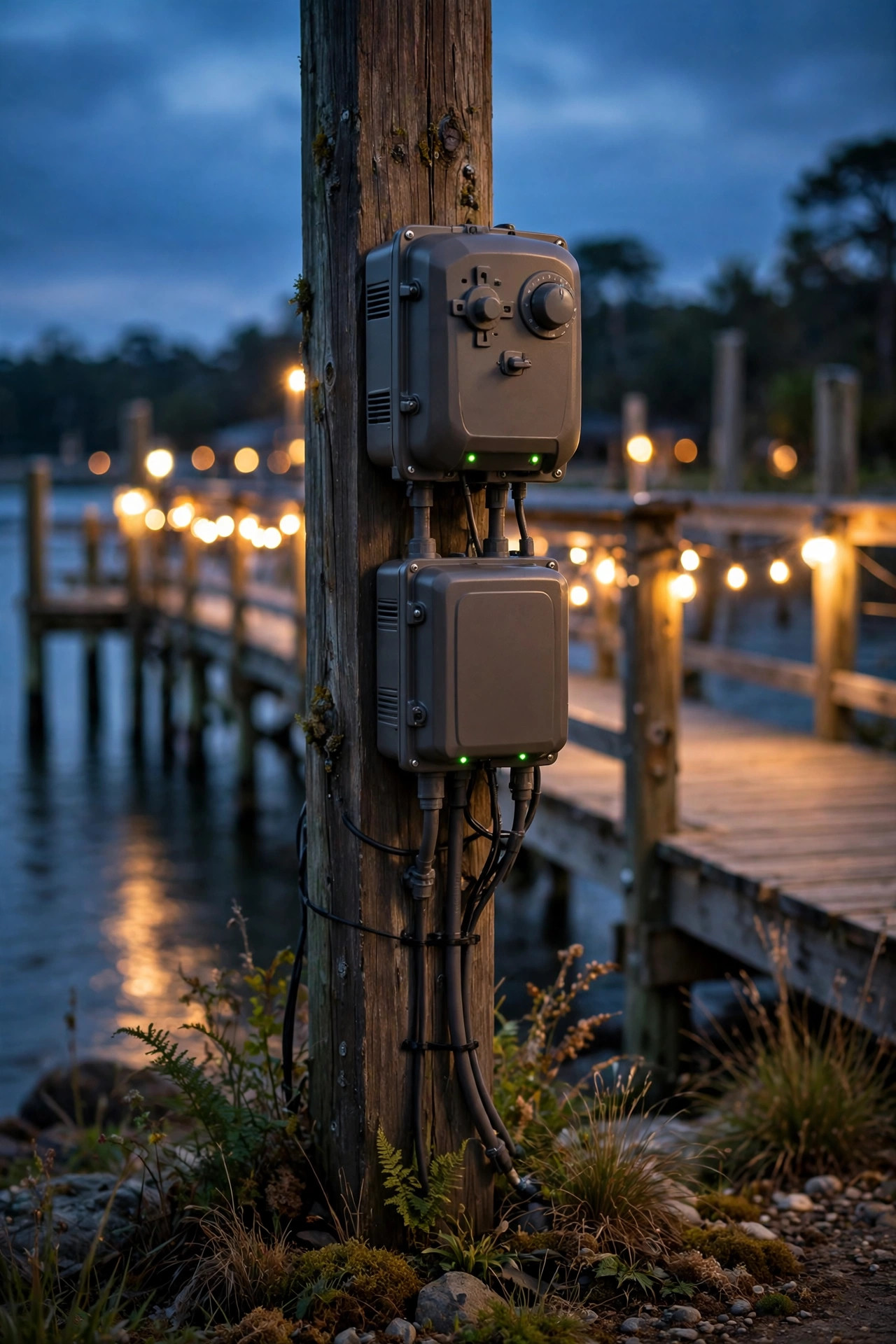
The best pier lighting is the kind you never think about, and that means automation. My whole base layer — deck pucks, handrail rope, bollards, path lights — lives on one low-voltage transformer with an astronomical timer, which knows sunset better than I do and adjusts itself all year. The lantern and string lights ride a smart plug with its own schedule, coming on a little later and going off at a civilized 11 p.m. on weeknights. Photocell sockets cover the odd fixture that does not fit either system. Solar lights, bless them, automate themselves. The real gift here is consistency: the pier glows every single evening whether you are home or away, which is good for security, good for the neighbors who borrow the view, and pure joy when you come home after dark and see your own shoreline lit to welcome you. Set timers to dusk-to-11 rather than dusk-to-dawn unless you truly need all-night light — the water, the wildlife, and your electric bill all prefer a curfew. Review the schedule twice a year, at the clock changes, and the system will quietly run itself for seasons.
Suggested budget range: $40 – $150.
15. Shielded Fixtures That Spare the Neighbors and the Sky
On open water, light travels forever, and a careless fixture on your pier becomes a spotlight in somebody's bedroom window across the cove. The fix is simple and makes your own pier prettier too: shield everything. Choose fixtures that hide the bulb from any horizontal sightline — hooded step lights, louvered bollards, caps that throw down, lanterns with the bulb tucked up inside. Aim every beam at boards, water, or foliage, never at the horizon. Full-cutoff is the technical term, and once your eyes adjust, you will notice the magic: with no glare competing, the warm pools of light look richer, the stars come back, and the water reflections double because the surface stays dark around them. This matters beyond courtesy. Many lake associations and coastal towns now have dark-sky or turtle-friendly ordinances, and shielded warm lighting is usually exactly what they ask for. Sea turtles and migrating birds navigate by darkness we barely notice, so keeping light low, warm, and downward is genuinely kind. Walk the water side of your pier at night, or better, paddle out twenty feet: if you can see a bare bulb anywhere, that fixture needs a shield, a tilt, or a dimmer bulb.
Suggested budget range: $30 – $120.

16. Battery Lanterns for Benches and Quiet Corners
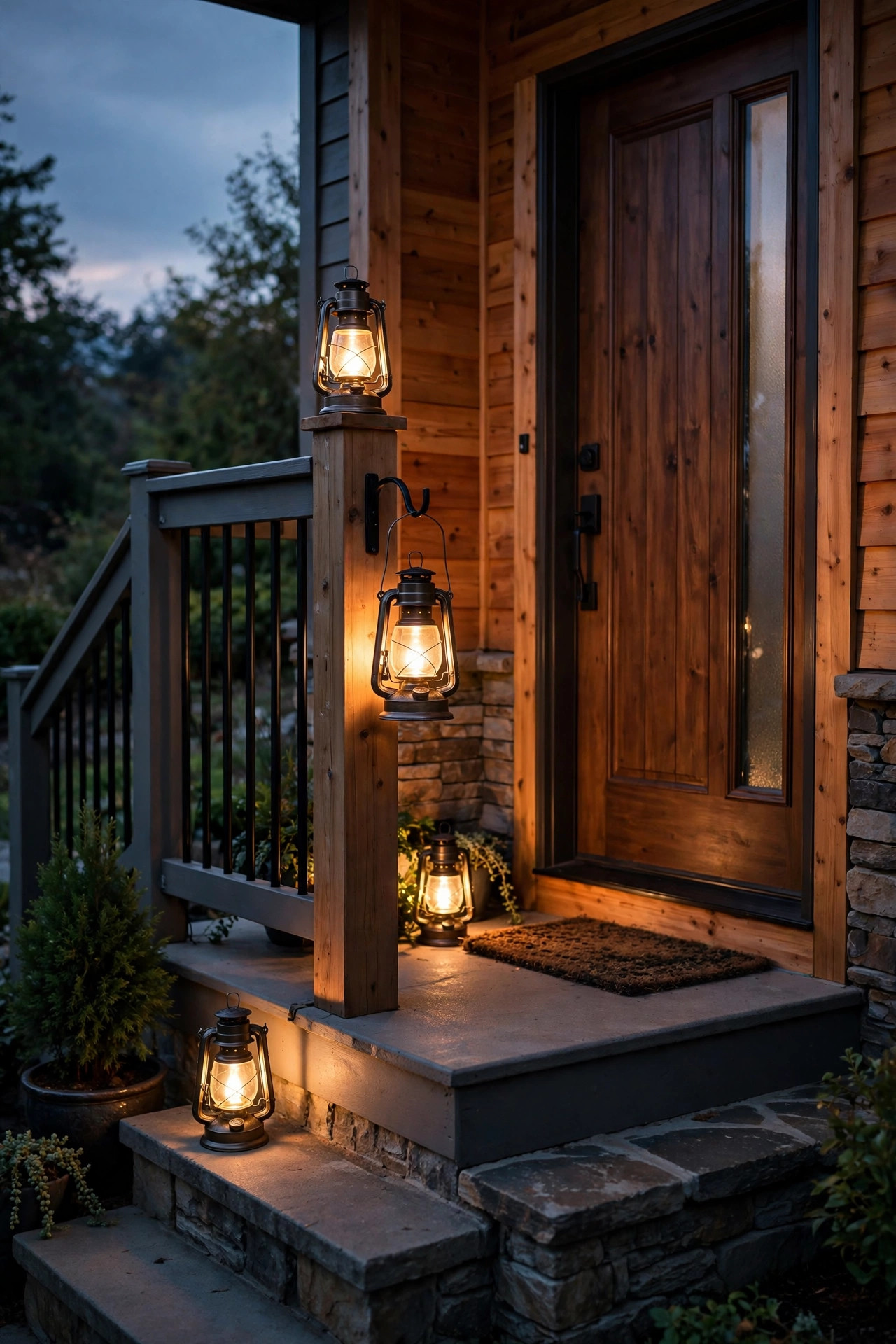
Not every pool of light needs a wire, a panel, or a plan. A pair of rechargeable battery lanterns on the pier bench, the bait table, or the little reading corner at the end turns dead space into the seat everyone fights for. I choose lanterns with a warm dim setting, a handle for carrying, and a USB port, and I keep three in rotation so one is always charged. They are the flexible layer of the whole scheme: carry one down to the boat for a sunset putter, set two on the picnic table when the pier hosts dinner, line three along the railing when teenagers colonize the platform with card games. Flameless is non-negotiable out here in my book — between wind, wooden boards, and boat fuel nearby, a real candle on a pier is a story I do not want to tell — and modern LED lanterns fake a flame so well that nobody misses it. At season's end they come inside and spend winter as the world's prettiest power-outage insurance. Start with two; you will own four by July, and you will not regret a single one.
Suggested budget range: $40 – $120.
17. The Dusk Walk-Through: Testing Your Pier Lighting Ideas End to End
The last step is the one everybody skips, and it is the difference between a pier that looks lit and a pier that feels lit. On the first calm evening after an install, walk the whole route the way a guest would: down the shore path, through the entrance, along the boards, out to the lantern at the end, then turn around and walk it all back. Bring a notepad and be picky. Where did you squint? That fixture needs a shield or a softer bulb. Where did your foot hesitate? That shadow wants a puck or a step light. Sit on the bench for five full minutes and let your eyes settle — the string lights that seemed perfect at arm's length might hum with glare from the sitting angle. Then paddle or walk out on the water side and judge the reflection, because half the beauty of pier lighting ideas lives in the mirror they make on a still night. Adjust angles with the lights on, in the dark, one fixture at a time, and write down your final timer settings. Do this walk twice a year and your pier will stay the one everyone drifts toward after dinner.
Suggested budget range: $0 – $50.
Frequently Asked Questions
What color temperature is best for pier and boardwalk lights?
Warm white, between 2200K and 2700K, is the sweet spot on the water. It reads golden and welcoming, flatters faces and weathered wood, draws fewer insects than cool white, and stays gentle on night vision when you step between the lit boards and a dark boat. Whatever temperature you choose, use the same one on every fixture — a single cool-blue light will undo the whole mood.
Are solar lights bright enough for a pier or boardwalk?
For caps, path markers, floating accents, and entrance sensors, absolutely — modern solar fixtures handle accent and guidance lighting beautifully, especially out on open water where panels get full sun. For the walking surface itself, a wired low-voltage system stays more consistent through cloudy weeks and short winter days. My honest recommendation is a hybrid: wired for the safety layer, solar everywhere else.
What waterproof rating do pier lights need?
Look for IP65 at minimum for anything mounted above the deck, since spray and wind-driven rain reach everywhere on a pier. Fixtures that sit in splash zones, on ramps, or near the waterline should be IP67, and anything actually submerged must be IP68 and made for continuous underwater use. Run every wired circuit through GFCI protection, and when in doubt, let a licensed electrician handle the wettest work.
How much does it cost to light a whole pier or boardwalk?
A private pier can glow beautifully for $300 to $900 in fixtures if you lean on solar caps, rechargeable lanterns, and one modest low-voltage run for the deck. A long public-style boardwalk with wired bollards is more like $1,500 to $4,000 depending on length. Running costs are tiny: a full low-voltage pier system typically uses less electricity in a month than one porch bulb left burning.
Conclusion
If you take one thing from this list, let it be the layering: a calm base that keeps every footstep safe, a little task light where hands work, and a soft finishing glow that makes people slow down and stay. Start with the edges and the entrance, add the lantern at the end, and let the water do the rest. These pier lighting ideas are forgiving — build them in a weekend, adjust them over a season, and your stretch of boards will quietly become the best seat in the neighborhood after dark. Browse the rest of the site for more ways to bring that same warm glow to your paths, decks, and shoreline, and I will see you out on the pier at dusk.