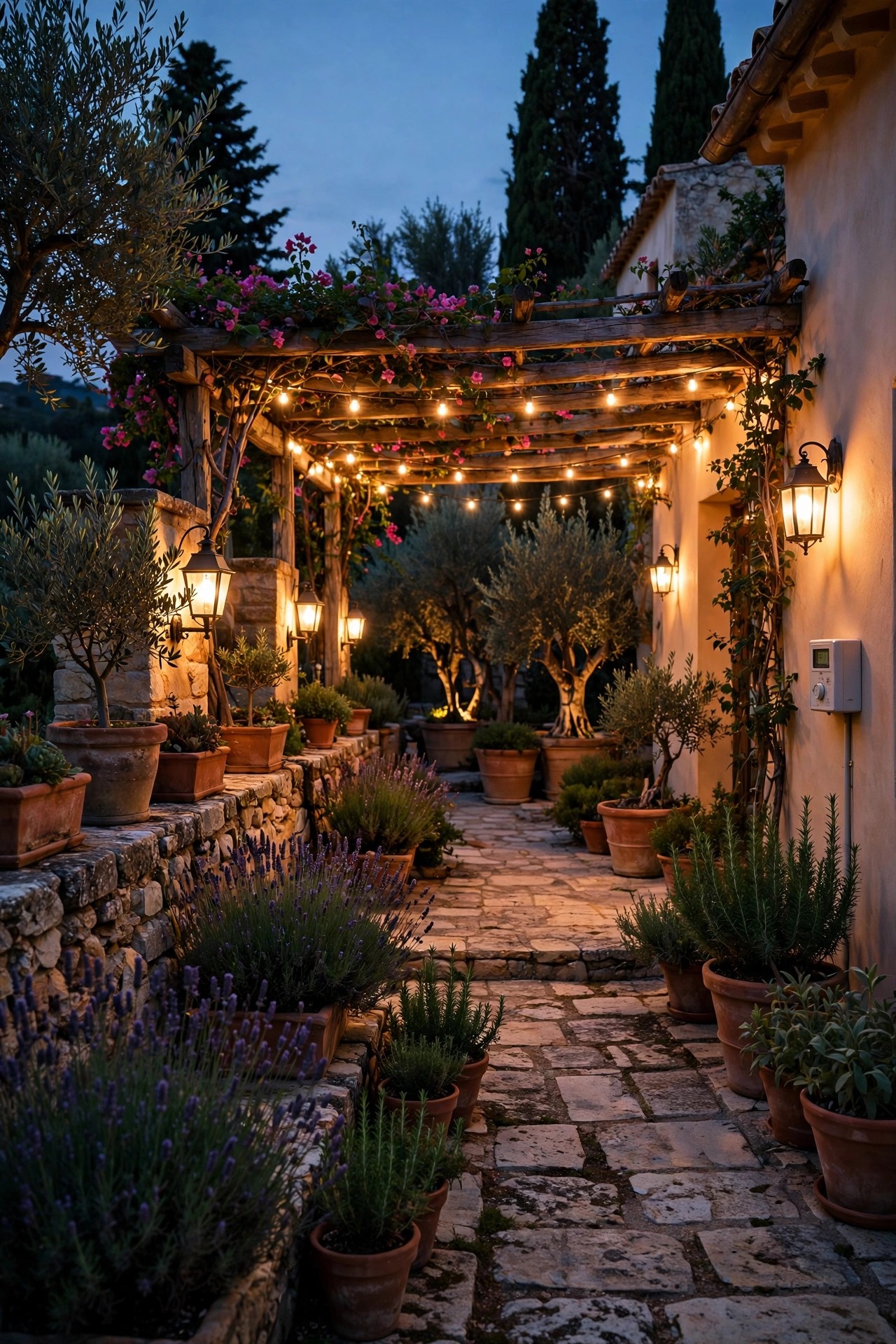
There is a moment, just after sunset, when a Mediterranean garden turns to pure gold — the gravel goes pale honey, the stucco holds the last of the heat, and the olive leaves flash silver-green. Honestly? The right lighting lets you keep that moment going until bedtime. My favorite mediterranean garden lighting ideas all start with one philosophy I use in every yard: layering. One bright fixture flattens terracotta, stone and stucco into a dull wash, but lots of small, warm pools of light at different heights make a garden feel like a little village in the hills. In this post I will walk you through 21 ideas, from uplighting a cypress spire to tucking solar lanterns between the lavender, with real spacing numbers, bulb temperatures and budget ranges for each one. Everything here runs warm — 2700K, like candlelight — because that golden temperature is what makes sun-baked materials glow instead of glare. Pour something cold, and let us plan your garden after dark.
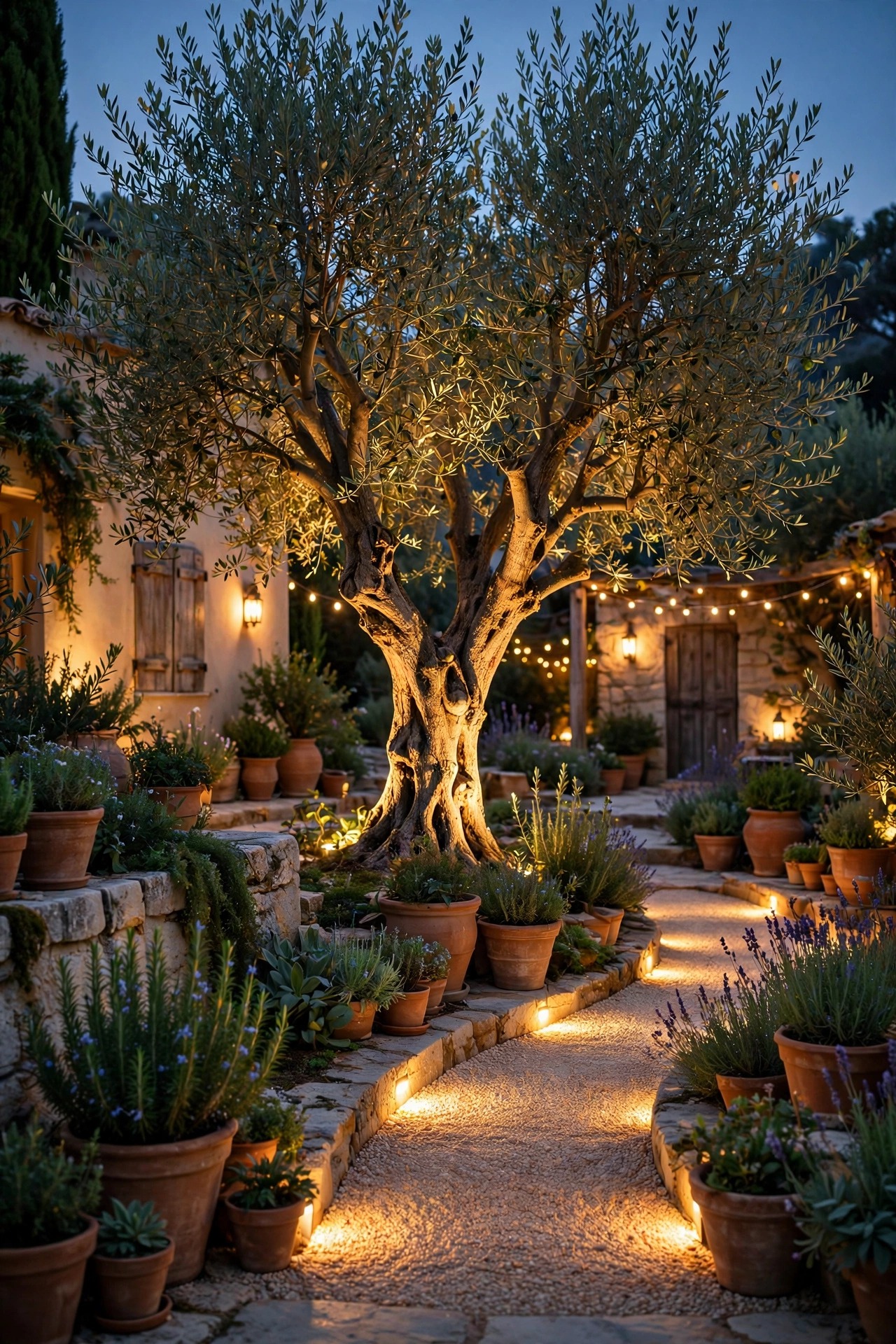
1. Layer Your Mediterranean Garden Lighting Ideas in Three Zones
Every garden I light, Mediterranean or not, gets the same three layers, and this style takes to the formula beautifully. Layer one is guide light: low path fixtures, 12 to 18 inches tall, spaced 6 to 8 feet apart along gravel walks so feet always know where they are going. Layer two is welcome light: lanterns at sitting height — wall lanterns by the gate, a pair of table lanterns on the terrace — glowing around 2700K so faces look warm and relaxed. Layer three is accent light: discreet uplights tucked at the base of an olive tree, a cypress or a stone wall, doing the drama. In my experience, most gardens fail because they buy layer three first and skip the paths entirely, so the yard looks pretty from the street and stays unusable after dark. Work in the opposite order: make it walkable, then make it welcoming, then make it theatrical. Keep every bulb in the garden at the same warm temperature so the layers melt together instead of fighting. This plan is the backbone of everything below, and once you see your garden in zones, you will never shop for fixtures randomly again.
Suggested budget range: $150 – $400.
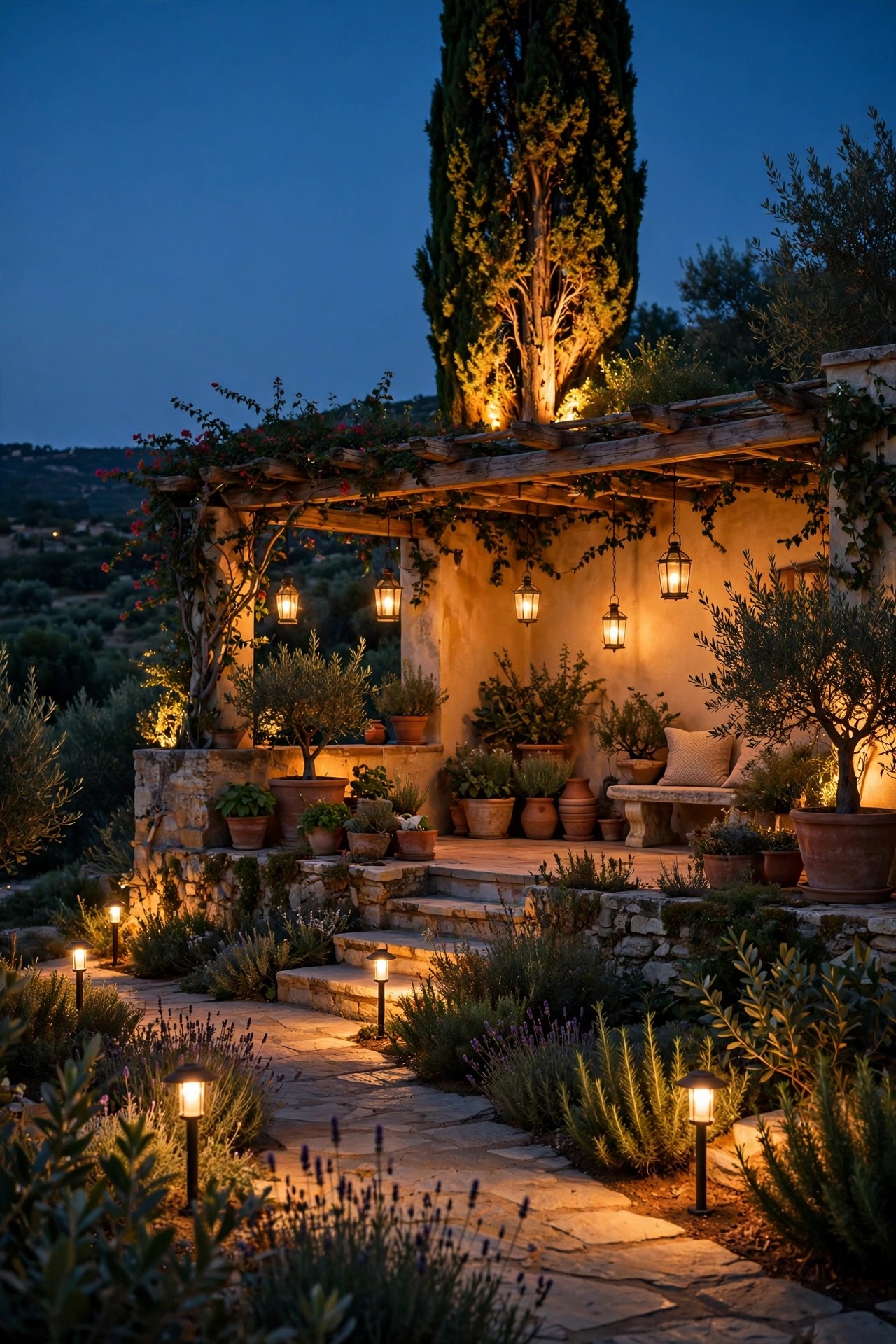
2. Uplight Olive Trees and Cypress Spires
If a Mediterranean garden has a signature silhouette, it is an olive tree next to a pencil-thin cypress, and both were born to be uplighted. For the olive, I set one or two low-voltage spotlights 12 to 18 inches out from the trunk, aimed up at a 30 to 45 degree angle so the light rakes through the gnarled bark and catches the silvery undersides of the leaves. A wide 60-degree beam suits the olive's spreading canopy. The cypress wants the opposite treatment: a narrow 15 to 30 degree beam placed close to the base, shooting straight up the column so the whole spire reads like a green exclamation point against the night sky. Use 2700K LED lamps — cool white turns olive foliage a sickly blue-green and ruins the entire sun-baked mood. In-ground well lights sit flush in gravel and disappear by day, while above-ground spots on stakes are easier to adjust as trees grow. Keep fixtures a few inches clear of mulch and dry leaf litter, and choose LED only, since LED lamps run cool against bark and foliage. Two or three well-aimed uplights will do more for your garden's drama than a dozen path lights.
Suggested budget range: $80 – $240.
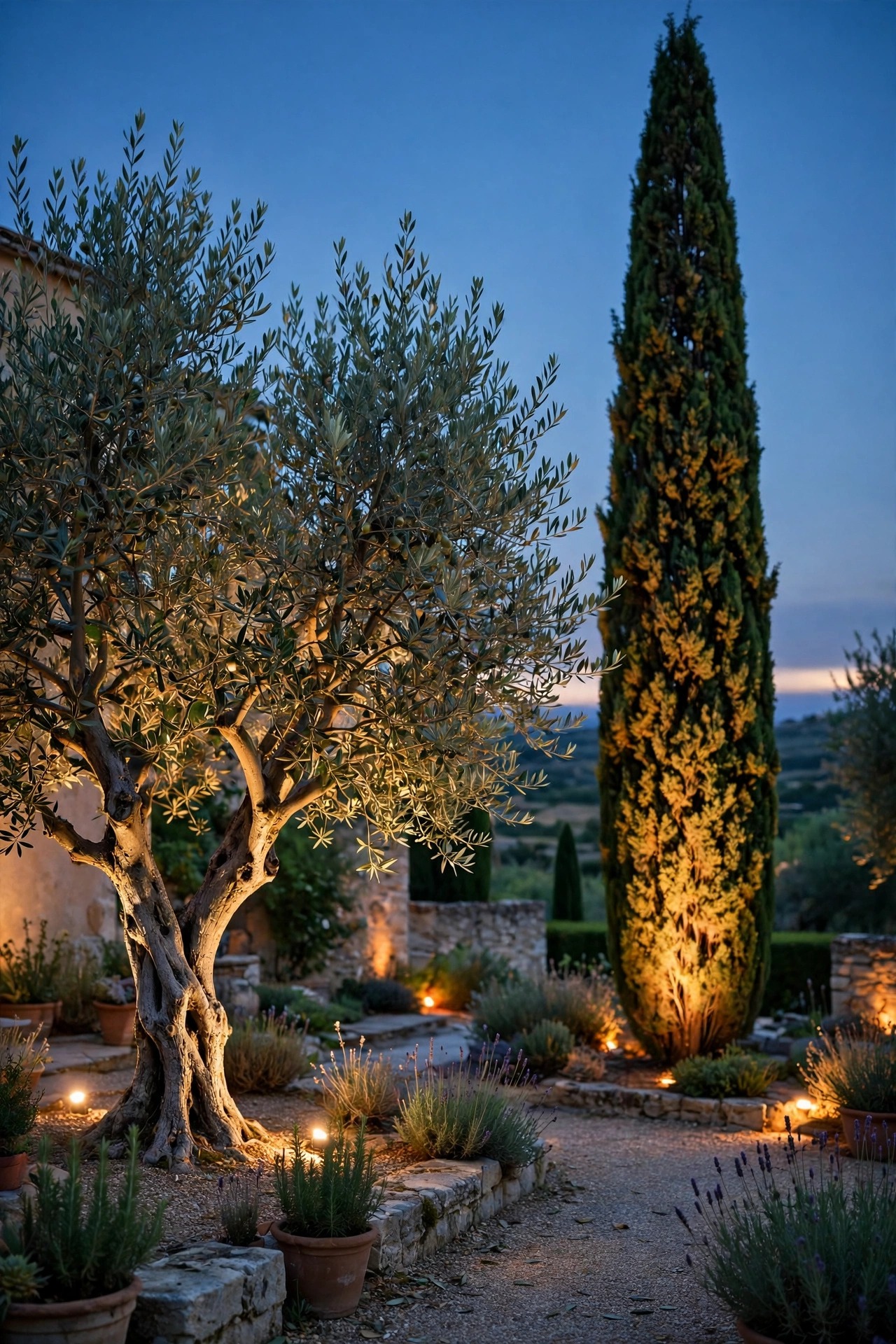
3. Tuck Lanterns Between Terracotta Pots
Terracotta and warm light were made for each other — the clay literally glows when a lantern sits beside it. I cluster my biggest terracotta pots in odd-numbered groups of three or five at path corners, terrace edges and the foot of steps, then nestle a solar lantern or a flameless LED candle lantern on the gravel between them. The light pools low, washes the pots in amber, and marks the edge of the walk without a single wire. Solar lanterns with warm-white LEDs and a dusk-to-dawn sensor are the easiest version: charge them in full sun all day, then set them out at ankle height where you want the glow. For a more permanent setup, low-voltage lantern-style path fixtures echo the same look with steadier brightness. One safety note I never skip: keep every light source LED and cool-running near dry leaves, mulch and terracotta groupings in summer, because Mediterranean plantings get tinder dry by August. Groupings look best when the pots vary in height — a tall olive pot, a mid-size citrus and a low bowl of trailing rosemary — with the lantern sitting just in front of the tallest pot so its silhouette joins the show.
Suggested budget range: $40 – $120.
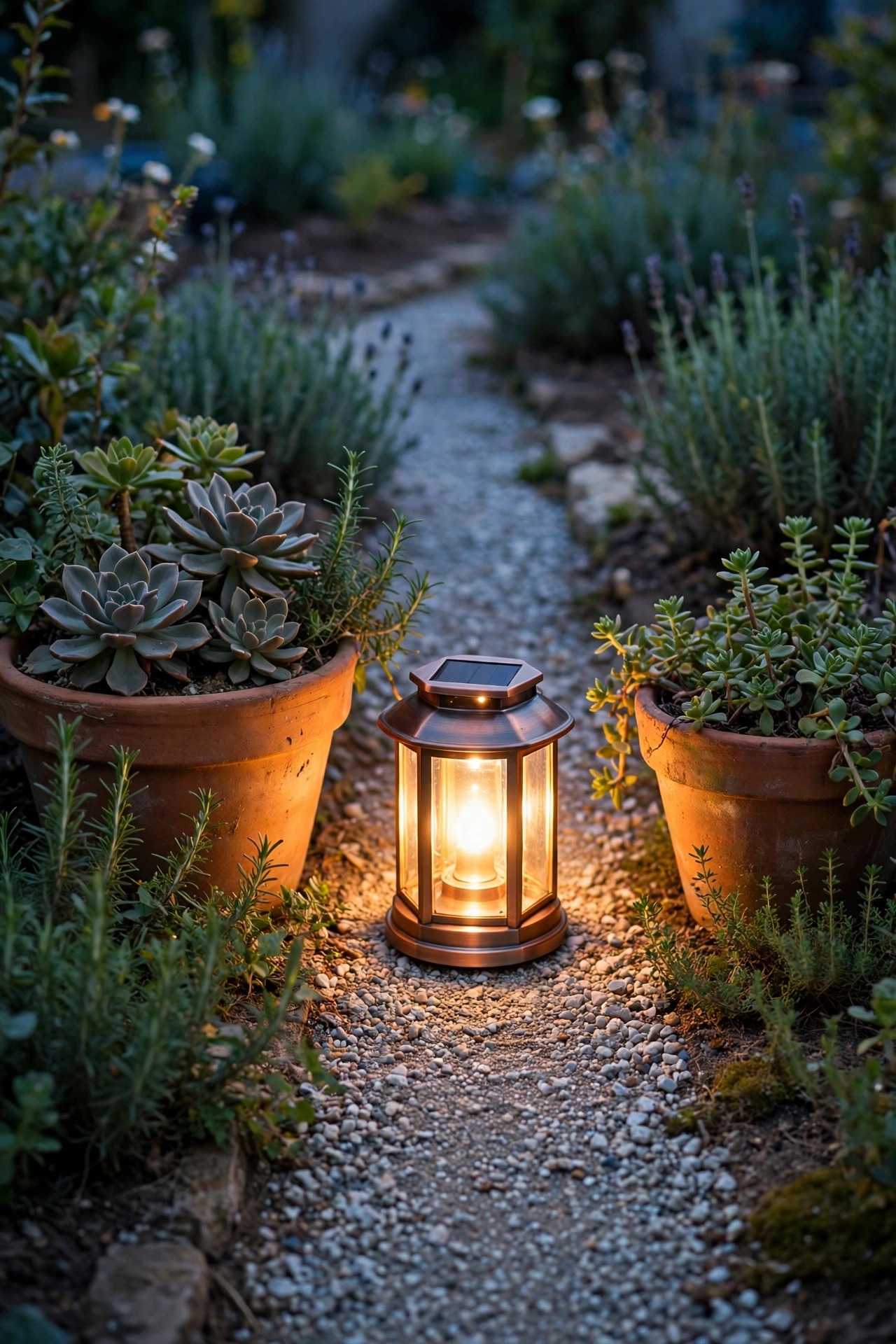
4. Hang Wrought-Iron Wall Lanterns on Stucco
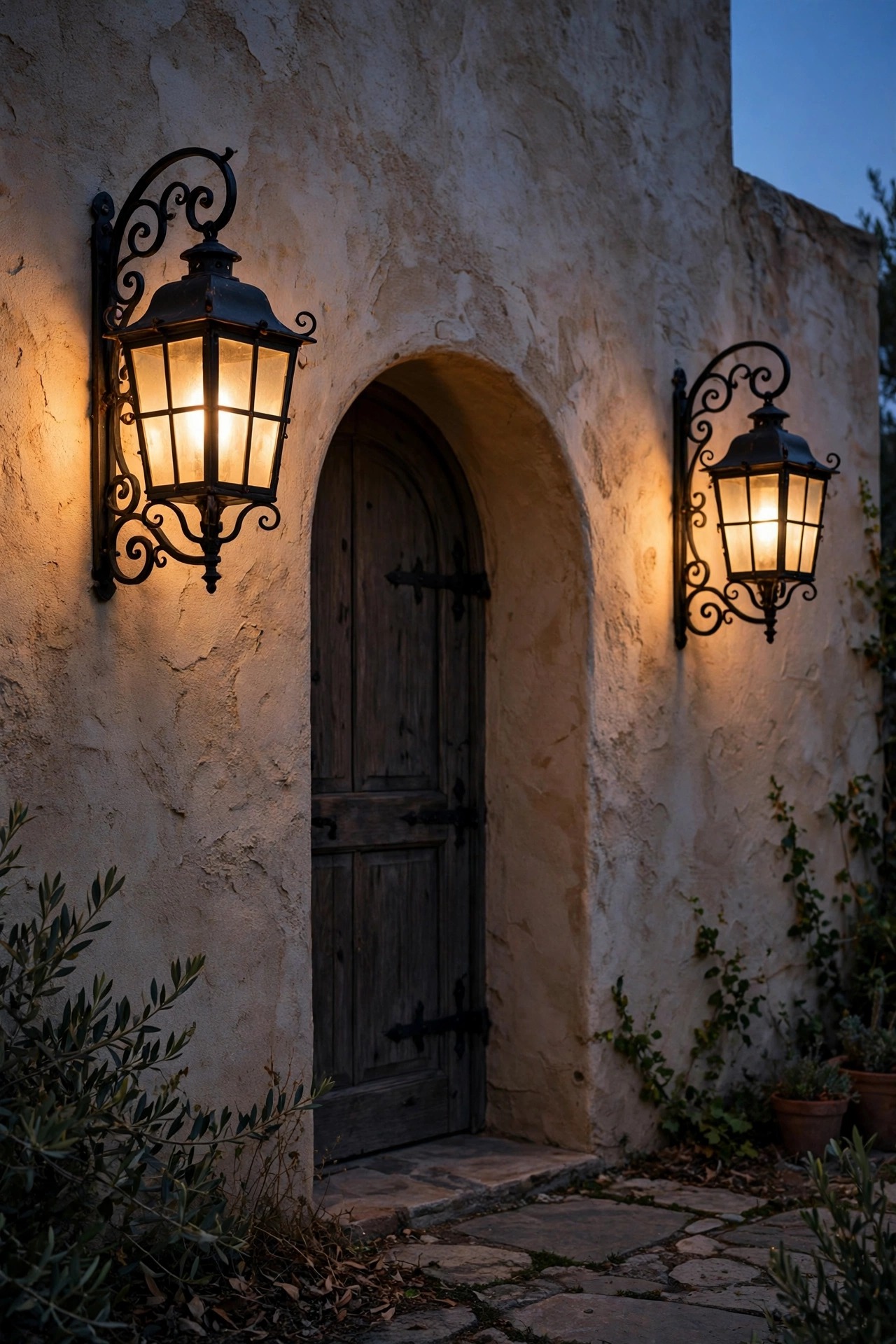
A stucco wall at dusk is a blank canvas, and a pair of black wrought-iron lanterns turns it into architecture. I flank arched doorways, garden gates and outdoor fireplace walls with matching lanterns mounted 60 to 66 inches from the ground to the center of the fixture — roughly eye level, so the glow welcomes instead of blinding. The classic Mediterranean profile is a tapered cage lantern with seeded or amber glass and an LED filament-style bulb inside; the visible filament is doing real decorative work in this style, so skip frosted bulbs here. Choose fixtures rated for wet locations, and if your garden sits anywhere near coastal air, powder-coated aluminum with an iron look will outlast real iron by years without the rust streaks down your stucco. Wire them to a photocell or an astronomical timer so they come on at dusk without you thinking about it. Between the pair, the wall itself becomes the third light source as the warm wash grazes across the stucco texture — honestly, that grazing light on rough plaster is one of the prettiest effects in this whole list, and it costs nothing extra once the lanterns are up.
Suggested budget range: $60 – $180.
5. Drape String Lights Over the Pergola
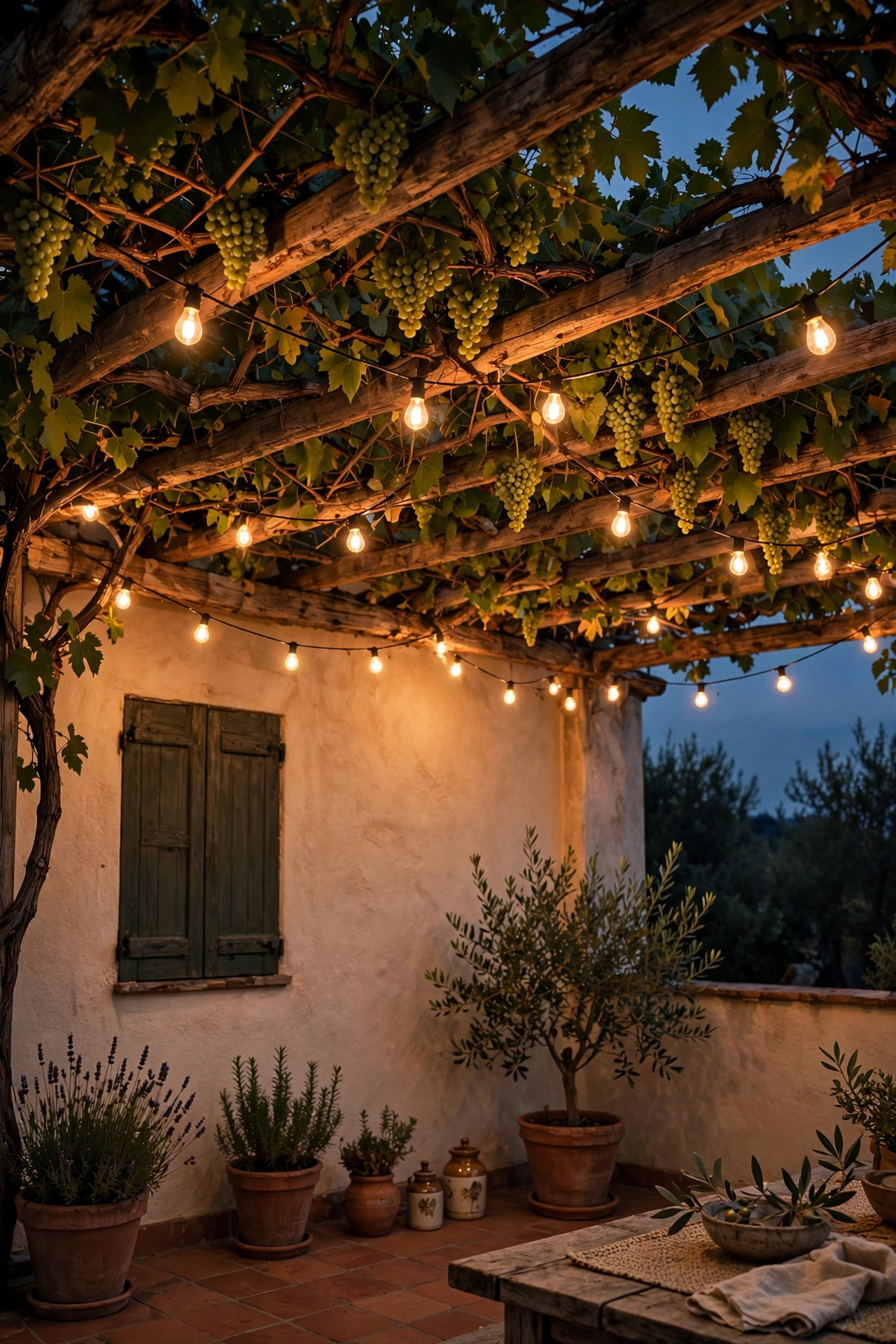
A pergola over a dining terrace is the social heart of a Mediterranean garden, and string lights are its ceiling. I run commercial-grade outdoor string lights in a gentle zigzag or a soft V between the pergola beams and the house wall, keeping the lowest swag at least 7 feet above the table so tall guests and raised glasses stay clear. Use shatterproof LED filament bulbs in warm white, spaced 12 to 24 inches apart, and put the whole run on a plug-in dimmer — full brightness for serving dinner, half brightness for lingering over dessert, low glow for stargazing afterward. Anchor into wood or masonry with proper screw hooks and a guide wire if your span runs longer than about 15 feet, because sagging, sloppy catenary curves look tired fast. Every plug and connection should land in a GFCI-protected outdoor outlet with an in-use weather cover. If your pergola stands alone in the garden, buried-cable low-voltage festoon systems give the same look without an extension cord crossing the gravel. Two parallel runs about 4 feet apart read more "outdoor room" than one lonely strand, and the doubled reflection on wine glasses and tile tabletops is pure holiday-evening magic.
Suggested budget range: $50 – $150.
6. Line Lavender and Rosemary Beds With Solar Stakes
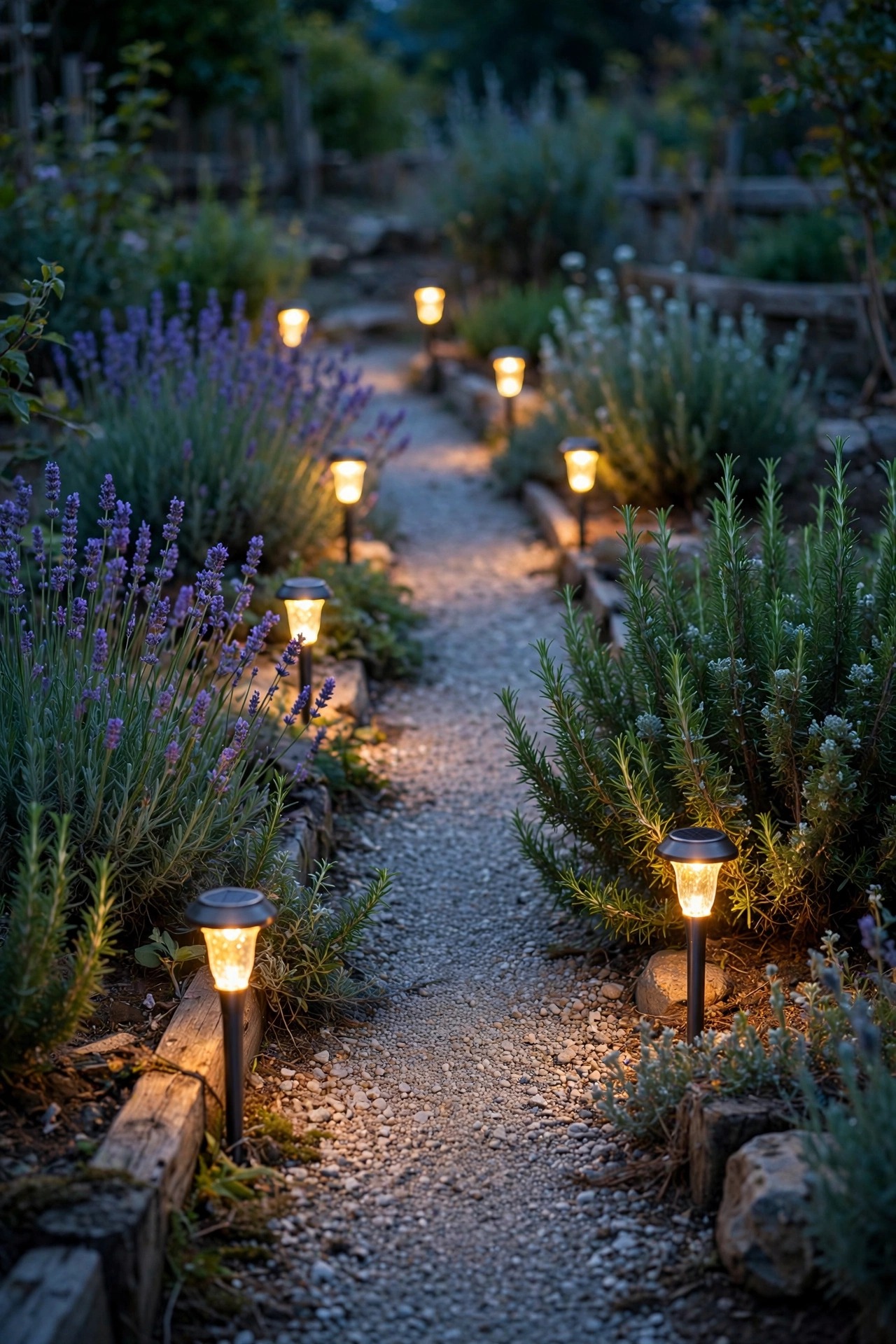
Lavender and rosemary borders are where Mediterranean gardens earn their fragrance, and a row of low solar stakes gives those beds a soft outline after dark. I push warm-white solar stake lights, 10 to 14 inches tall, every 3 to 4 feet along the front edge of the bed, alternating sides of the path so the light pools overlap in a scalloped rhythm instead of a runway stripe. The fixtures should be short enough that the lavender haze still towers over them in bloom. Solar works genuinely well here because herb beds need full sun anyway — the panels charge all day in exactly the spot where the lights stand all night. Choose stakes with replaceable rechargeable batteries and an IP65 rating so sprinkler overspray and summer storms do not kill them by July. The glow through rosemary needles and lavender spikes throws lacy shadows across the gravel, which is half the charm. Keep brightness modest: these are outline lights, not task lights, and a bed edged too brightly looks like a parking lot. In my experience a dozen mid-quality stakes, replaced one or two at a time as they age, beats a bargain box of twenty dim ones every single time.
Suggested budget range: $30 – $90.
7. Make the Fountain Glow From Within
A tiered fountain is the sound of a Mediterranean garden, and with one or two submersible lights it becomes the sight of it too. I use low-voltage LED puck lights rated IP68 for full submersion, set on the basin floor and aimed up through the falling water so every droplet catches the light, or a ring light around the central column for an even halo. Warm white is gorgeous; a soft amber lamp makes the water look like it is lit by candlelight. The transformer stays on dry land, outside the splash zone, plugged into a GFCI outlet — water and electricity only ever meet through properly rated low-voltage gear, never a line-voltage lamp anywhere near the basin. Run the cable out through the fountain's overflow or discreetly over the back rim and bury it in the gravel. If your fountain is a wall spout instead of a freestanding tier, a single small spotlight grazing down the wet stone gives that same liquid shimmer. For wiring diagrams, fixture comparisons and more ways to light courtyard water, my guide to courtyard fountain lighting ideas goes deeper. Clean the lens monthly in hard-water areas, because mineral film dims the glow faster than you would expect.
Suggested budget range: $45 – $160.

8. Edge Gravel Paths With Low Bollards
Gravel paths are pure Mediterranean, but loose stone and darkness are a trip hazard, so the path layer has to be both pretty and honest. Short bollards, 14 to 22 inches tall, suit this style better than dainty mushroom lights — look for simple cylinders or squared posts in bronze, copper or matte black with a shielded top that throws light down and out, never into eyes. Space them 6 to 8 feet apart, staggered on alternating sides of the path, and set them 6 inches back from the gravel edge so the rake and the mower never clip them. Stake-mounted fixtures push straight into the soil beside gravel and hold fine; for a path that curves, drop to 5-foot spacing on the bend so the pools of light still overlap. Low-voltage wired bollards give the most reliable brightness, and a 12-volt system is a safe DIY install for most homeowners. Keep the beam wide and low — the goal is a readable ribbon of light along the stones, not a row of glowing exclamation marks. At junctions where paths meet the terrace, one slightly taller bollard acts as a quiet landmark, and honestly that small hierarchy is what makes a path system feel designed rather than scattered.
Suggested budget range: $90 – $260.

9. Moonlight a Citrus Tree From Its Own Canopy
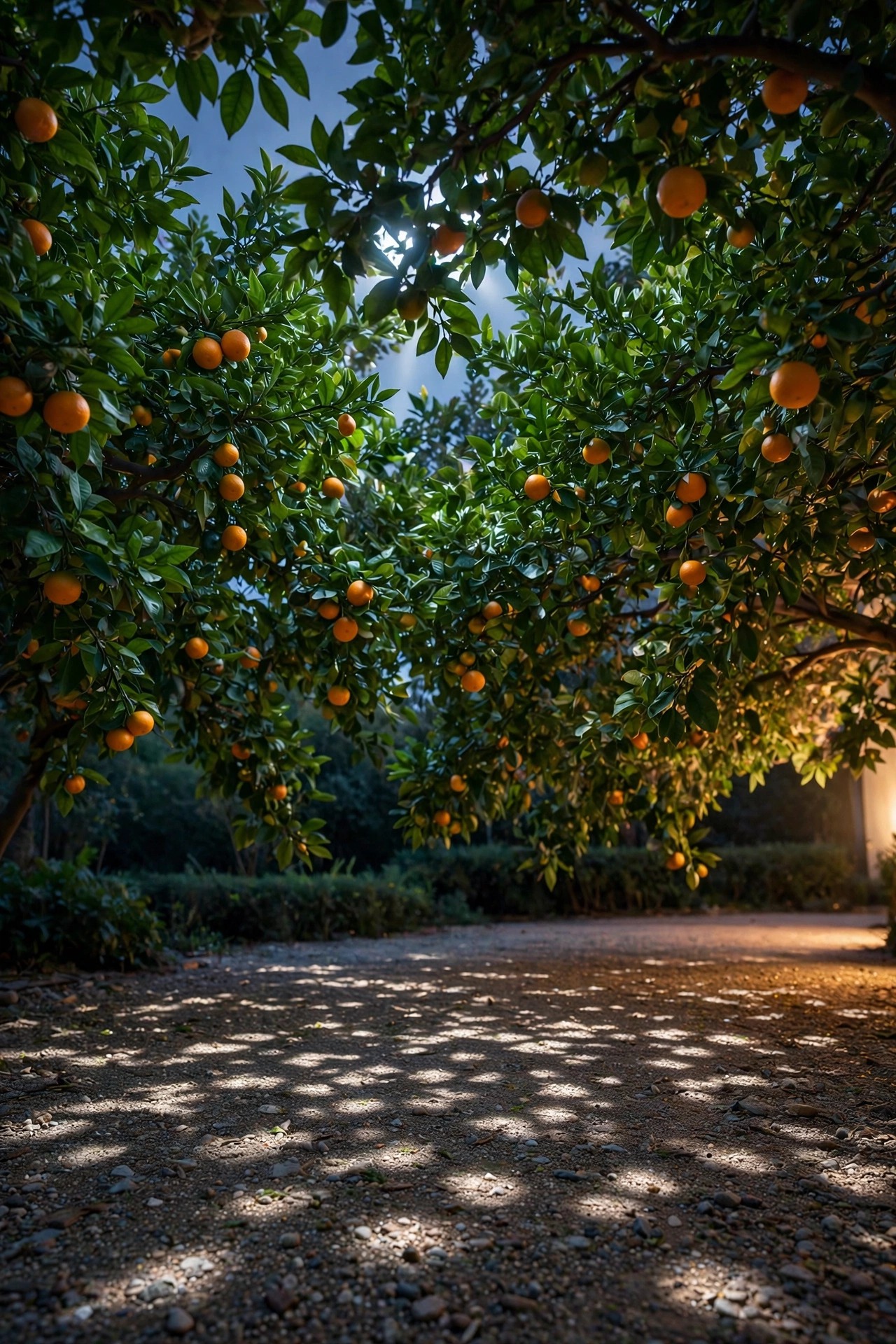
Moonlighting is the most romantic trick in landscape lighting: a soft downlight hidden high in a tree, filtering through the branches so the ground wears a pattern of dappled light and shadow, just like a full moon. A citrus tree is the perfect Mediterranean host — glossy evergreen leaves, fragrant blossom in spring, and fruit that glows like little lanterns when the light passes through the canopy. Mount a shielded downlight 12 to 15 feet up, aimed straight down with a wide beam, and use a warm 2700K lamp rather than the blue-white people expect from moonlight; in a warm garden palette the golden version looks far more natural. High mounting inside a tree is the one job in this post I happily hand to a pro with the right ladder and insurance, because a fall onto gravel or stone is no joke. The effect underneath is worth every penny: dinner guests sit in shifting leaf-shadow, the gravel sparkles between pools of shade, and no visible fixture breaks the spell from ground level. Keep the lamp modest in output — moonlight should whisper. One fixture per tree is plenty, and a second tree lit the same way across the garden balances the composition beautifully.
Suggested budget range: $70 – $220.
10. Set Candle Lanterns on Stone Steps
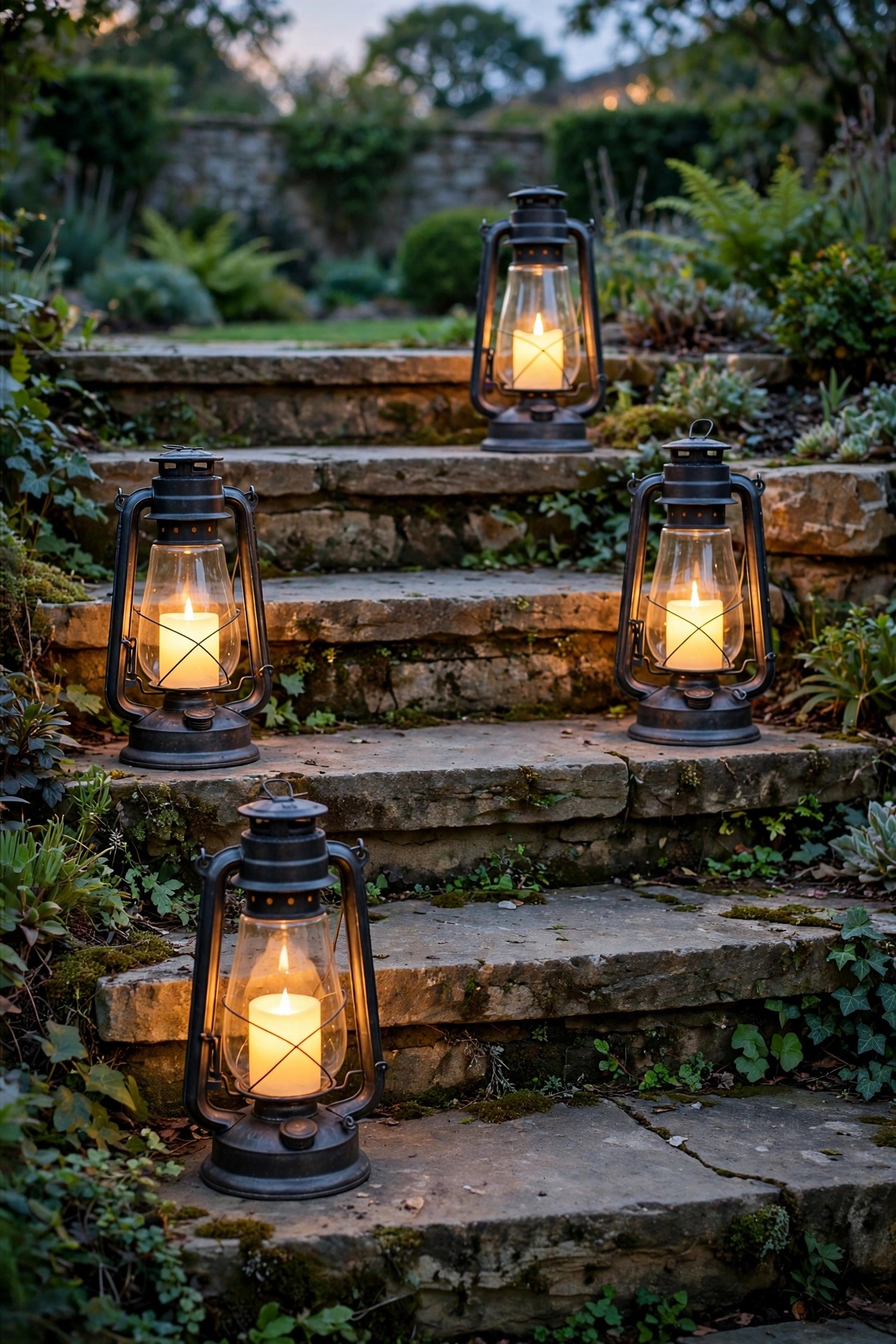
Stone steps between garden levels deserve light that respects both safety and theater, and candle lanterns deliver both. I set hurricane-style lanterns with flameless LED candles on alternating treads — one on the left of step two, one on the right of step four — so the staircase reads as a gentle zigzag of glow. Real candles and stone steps in a dry summer garden are a combination I will never recommend; the flameless versions flicker convincingly, run on timers, and cannot tip a flame into dry leaves. For a permanent solution, recessed LED step lights in the risers or a solar step light on each tread edge give the same guidance every night without rearranging anything. Either way, every tread edge needs to be readable: accidents on garden steps happen in that flat gray minute between daylight and full dark, which is exactly when your lights should already be on — another reason timers earn their keep. Size the lanterns to the steps, roughly a third of the tread width, and keep them tight to the riser so toes and hems pass cleanly. The look, honestly, is ancient and perfect: lamplight on worn stone.
Suggested budget range: $35 – $110.
11. Spotlight Statues, Urns and Garden Art
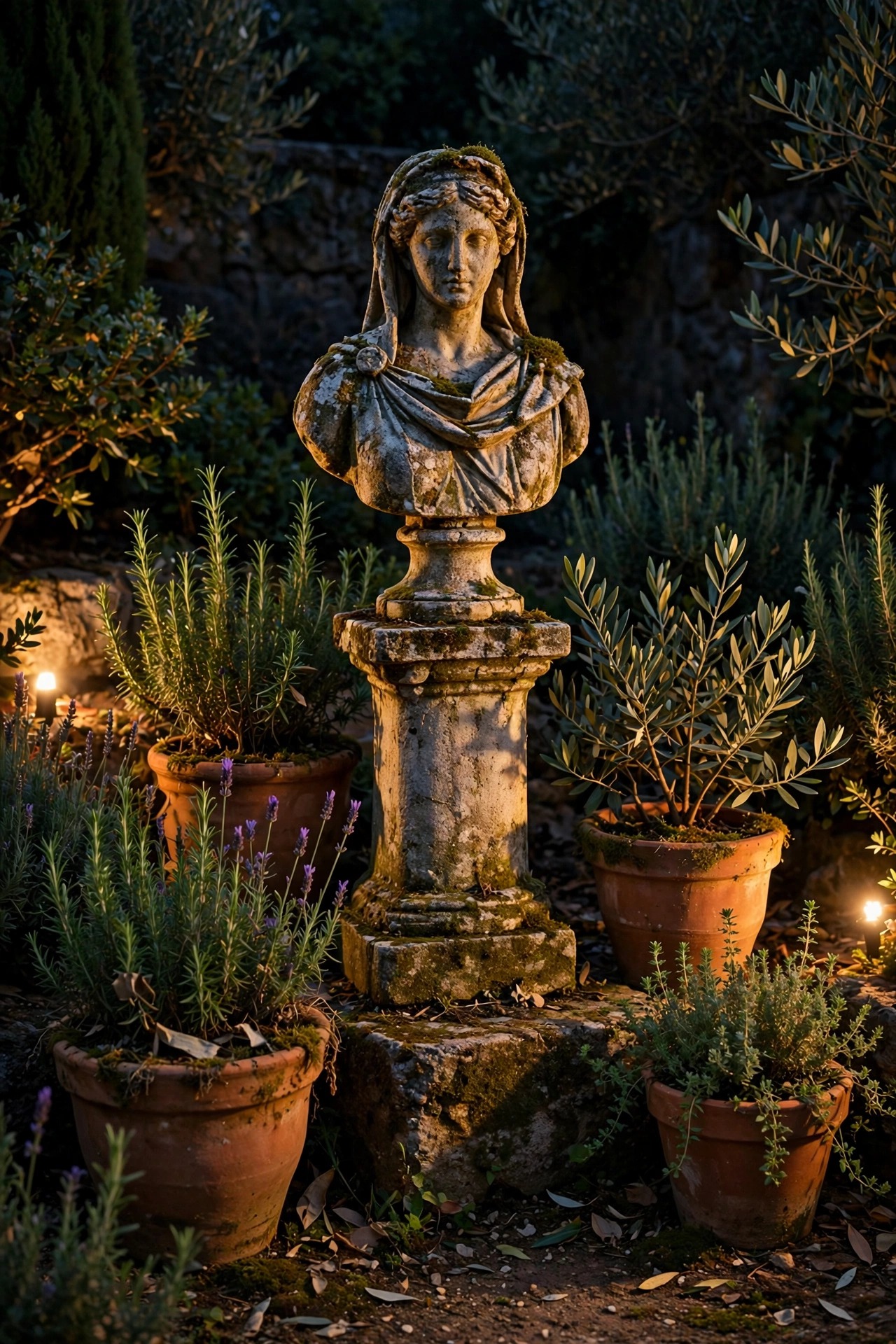
Every Mediterranean garden hides a focal point — a weathered statue, a pair of oversized urns, a sundial, an old olive jar — and accent lighting is how you crown it after dark. The secret is angle: light a statue from the side at roughly 30 degrees off center and slightly below face height, so the beam rakes across the surface and every carve and curve throws a small shadow. Straight-on light from the front flattens sculpture into a white cutout, the single most common mistake I see. A narrow to medium beam, 15 to 30 degrees, on a low-voltage spotlight set 3 to 6 feet away usually does it. Urns look best lit as a pair flanking a door or stair, each with its own gentle uplight, the symmetry doing the formal work. Keep the brightness in conversation with the rest of the garden — a focal point should be maybe twice as bright as its surroundings, not ten times. My post on garden statue lighting ideas covers beam angles and placement diagrams in more depth if you are lighting a collection. Shield every accent light so guests see the glow on the art, never the bare bulb.
Suggested budget range: $40 – $130.
12. Choose Copper and Brass Lanterns That Age Gracefully
Plastic fixtures die young in a sun-baked garden; copper and brass just get better looking. Unlacquered brass lanterns start bright, mellow to bronze, and eventually wear that blue-green patina that looks like it was always meant to stand beside olive trees and limestone. Copper does the same journey in warmer tones. I use solid-metal lanterns where they will be touched and seen up close — flanking the garden gate, hanging over the outdoor table, standing on the terrace steps — because that is where cheap finishes peel and shame you. Metal also shrugs off the heat cycles that crack plastic housings by the second summer. The one place to think twice is within sprinkler range or beside a pool, where constant wetting speeds patina unevenly; there, a quality powder-coated fixture may age more evenly. Pair metal lanterns with LED filament bulbs so the hardware and the light source share the same old-world character. If you love the look as much as I do, my roundup of copper and brass outdoor lantern ideas shows finishes at every stage of patina. Real metal costs more up front, but spread over fifteen summers it is the cheapest lantern you will ever buy.
Suggested budget range: $55 – $190.

13. Graze Stone Walls With a Wash of Light
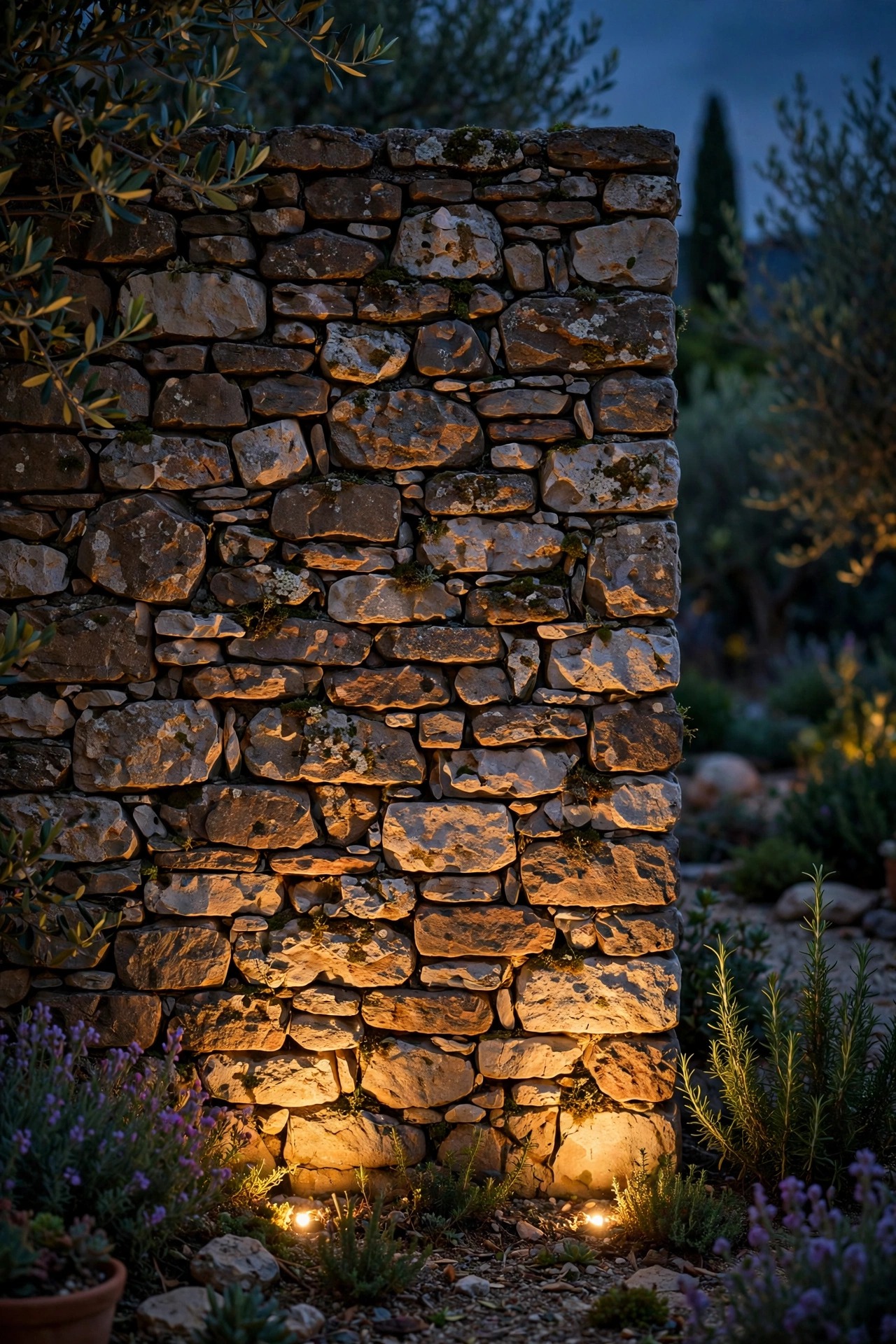
Dry-stacked stone walls, raised limestone planters and old brick retaining walls carry half the texture of a Mediterranean garden, and grazing light shows off every inch of it. Place a low-voltage fixture just 6 to 12 inches from the wall base, aimed straight up, and the beam skims the surface so each stone's shadow line deepens — flat daylight stone turns into rugged relief. That tight placement is the whole trick: pull the fixture 3 feet out and you get a smooth, boring wash instead. Linear LED strip fixtures tucked along the base of a long wall give an even graze without hot spots, while individual well lights every 4 to 6 feet suit shorter runs and corners. Warm 2700K light flatters limestone, sandstone and brick alike. On a wall with a cap, a second subtle effect is worth stealing: mount small fixtures under the capstones so a ribbon of light spills down the face and pools on the gravel below — gorgeous behind a bench or along a raised herb bed. Keep grazing fixtures clear of mulch and irrigation spray, and wipe the lenses each spring, because a dusty lens turns that crisp texture back into mud.
Suggested budget range: $85 – $240.
14. Ring the Fire Bowl With Low Accent Light
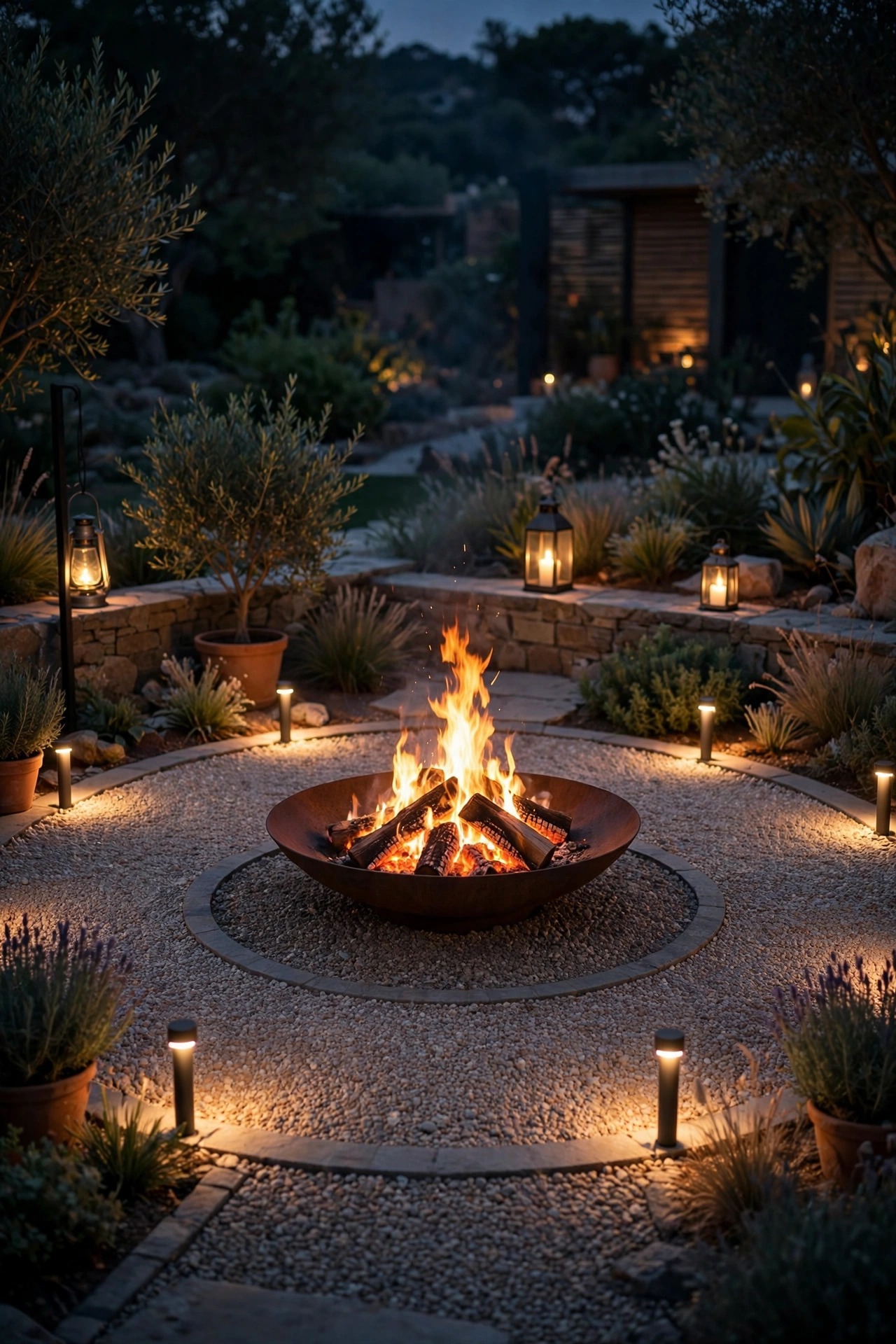
A fire bowl or small fire pit extends the Mediterranean evening well past dinner, but the fire itself should not be the only light in its circle — faces go orange, edges vanish, and the walk back to the house turns into guesswork. I ring the seating area with low, quiet accent light: two or three shielded path fixtures behind the chairs throwing soft pools onto the gravel, or a string of lantern light from a nearby pergola post, so people and pathways stay readable while the fire stays king. Keep every fixture and cable at least 3 feet from the bowl, more if your fire throws sparks, and keep anything solar or plastic well outside the heat zone. LED bulbs only, everywhere near flame, and never drape string lights directly over an open fire bowl — the romance is not worth the risk. A single uplight on a tree or wall behind the seating gives the circle a backdrop, so the space feels enclosed instead of lost in blackness. Done right, the fire provides the flicker, the accents provide the safety, and guests settle in for hours. This is the corner of my own garden nobody ever wants to leave.
Suggested budget range: $60 – $175.
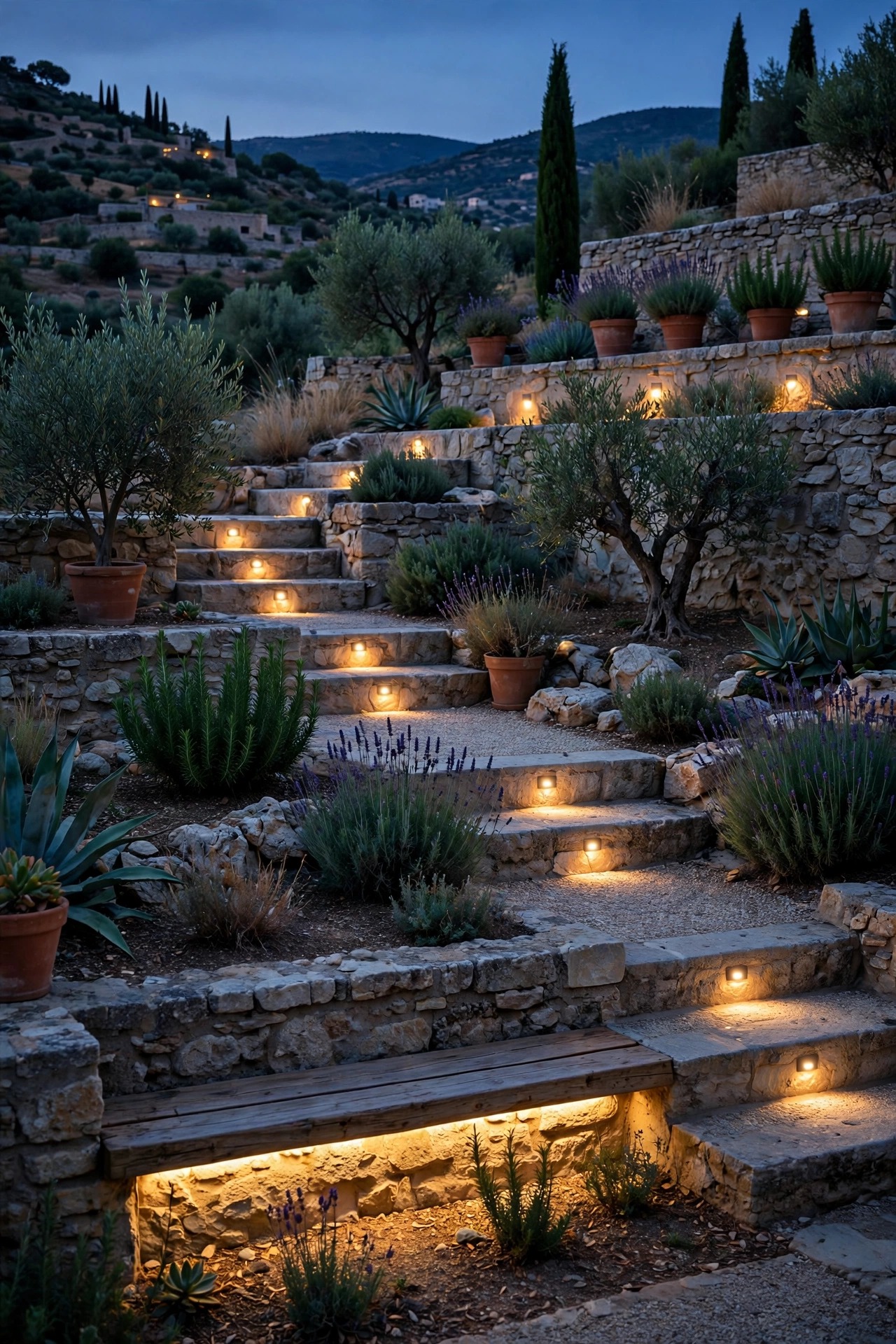
15. Light Terrace Steps and Benches From Underneath
Terraced gardens are the Mediterranean answer to a sloped yard, and the lighting that makes terraces feel luxurious is the lighting you barely see. Recessed LED step lights set into each riser wash the tread below with a clean fan of light — no glare, no fixture to trip over, just a staircase that glows like it was built that way. Under-bench lighting is the companion trick: a waterproof LED strip mounted beneath a stone bench or under the coping of a low wall throws a floating ribbon of light onto the gravel, and the bench appears to hover at night. Use IP65 or better strip, warm 2700K, on a low-voltage driver tucked in a weatherproof box. These hidden installations are the fiddliest in this post — drilling stone and chasing cable is patient work — but they read as pure architecture, and guests always ask how you did it. If recessed work is beyond the weekend plan, surface-mount step lights on the riser face get you 90 percent of the effect in an afternoon. Whichever route you choose, light every level change in the garden, even a single 6-inch step between lawn and terrace, because that is precisely the step nobody sees coming.
Suggested budget range: $75 – $230.
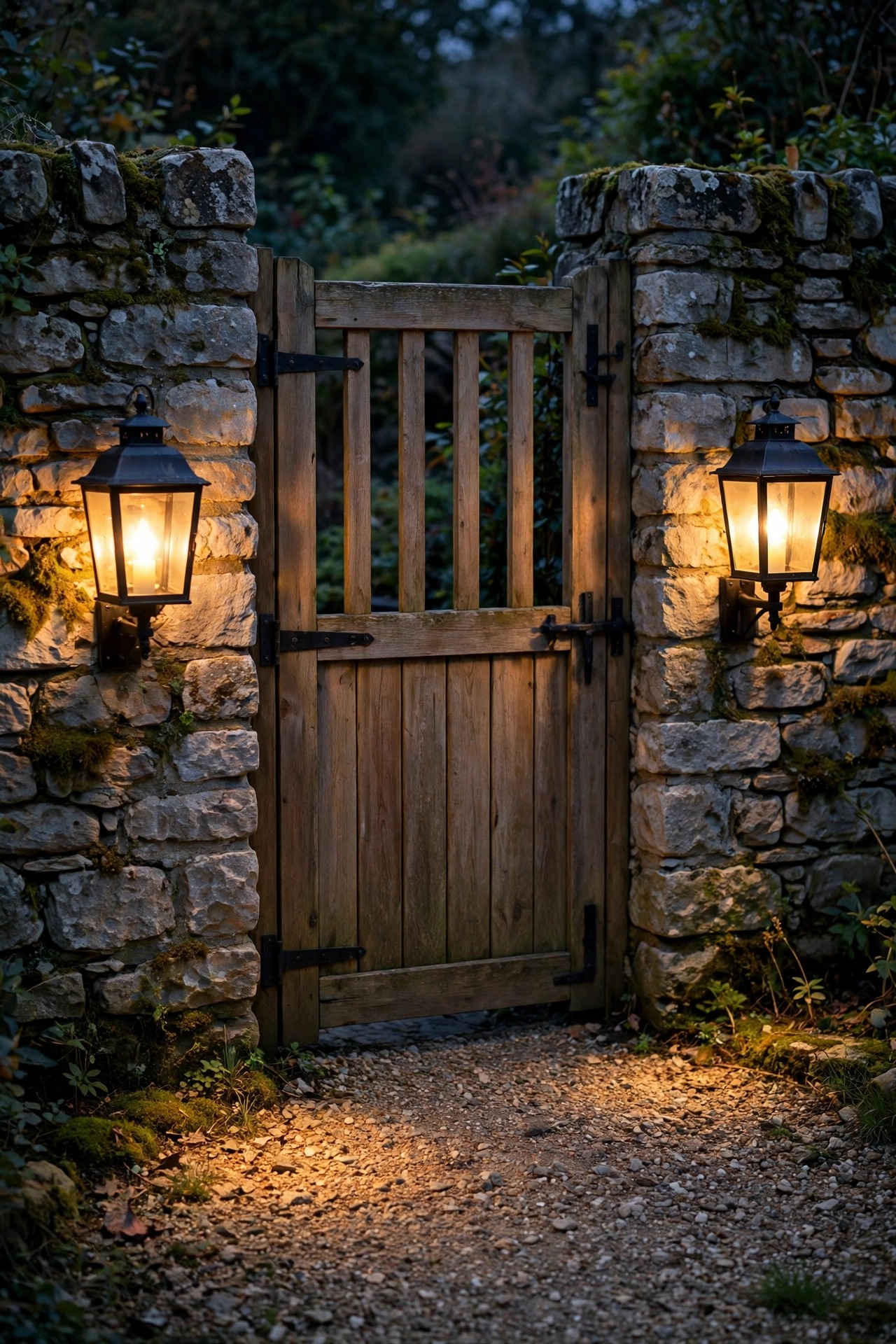
16. Flank the Garden Gate With a Matched Pair
A garden gate is a threshold, and thresholds deserve a ceremony of light. I hang or mount a matched pair of lanterns on the gate posts or the wall beside them — matching the wrought-iron or aged-brass language of the rest of the garden — so arriving guests read the entrance from halfway down the path. Symmetry is the Mediterranean love language, and nowhere does it pay off more than at an entry. Post-top lanterns work beautifully on timber or stone gate piers; wall-mount versions suit gates set into a stucco or stone wall. Add a lit house number or a small lantern-lit niche beside the gate if your garden opens to the street, and the welcome starts before anyone touches the latch. Put gate lanterns on the same timer circuit as the path lights so the whole arrival sequence switches on together at dusk. Motion sensors make sense on a working side gate, but for the main garden gate I prefer steady light — a gate that blinks on as you approach feels like security lighting, while a gate that simply glows feels like hospitality. Size matters too: lanterns roughly a quarter the height of the gate read as intentional, while undersized fixtures look like an apology.
Suggested budget range: $65 – $200.
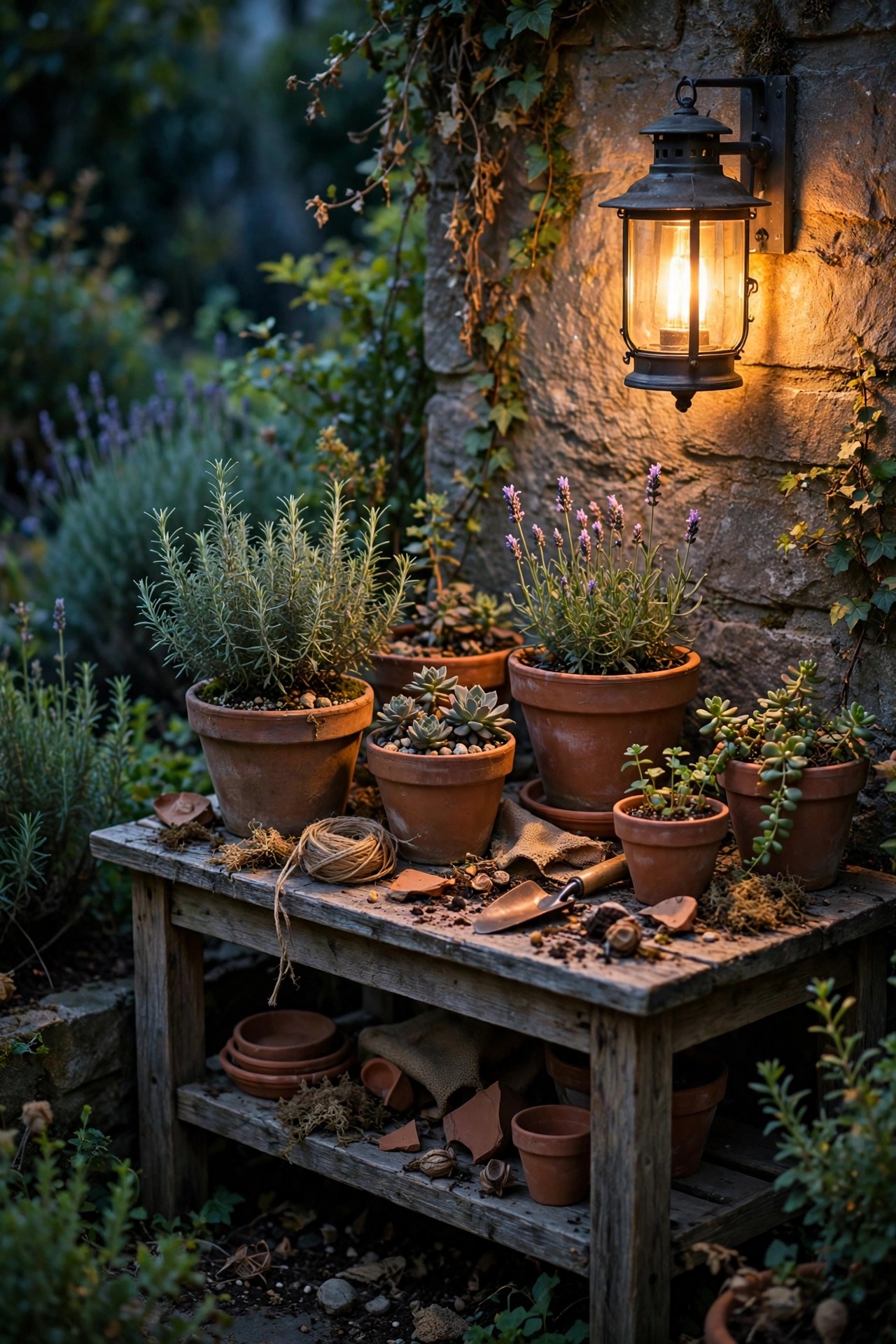
17. Add a Task Light at the Potting Bench
Every Mediterranean garden I know hides a working corner — a potting bench, a sink for washing vegetables, a stack of terracotta waiting for spring — and working corners need honest light, not mood light. I mount one brighter fixture over the bench: a caged utility lantern or a gooseneck-style lamp on the wall above, on its own switch, so it only burns when hands are busy. This is the one place I relax my 2700K rule slightly and accept up to 3000K for a touch more clarity while dividing perennials or reading a seed packet, though honestly 2700K at higher brightness does the job fine. A plug-in lantern on a GFCI outlet keeps the install simple, and a solar motion light works if the bench sits in full sun. Keep the task light shielded downward so it never becomes a glare bomb for the rest of the garden, and switch it off when the work is done so the evening layers take over again. Herbs drying on the bench, pots stacked by size, the day's tomatoes in a bowl — under a good work light, even the chore corner becomes part of the garden's charm instead of the part you hide from guests.
Suggested budget range: $30 – $85.
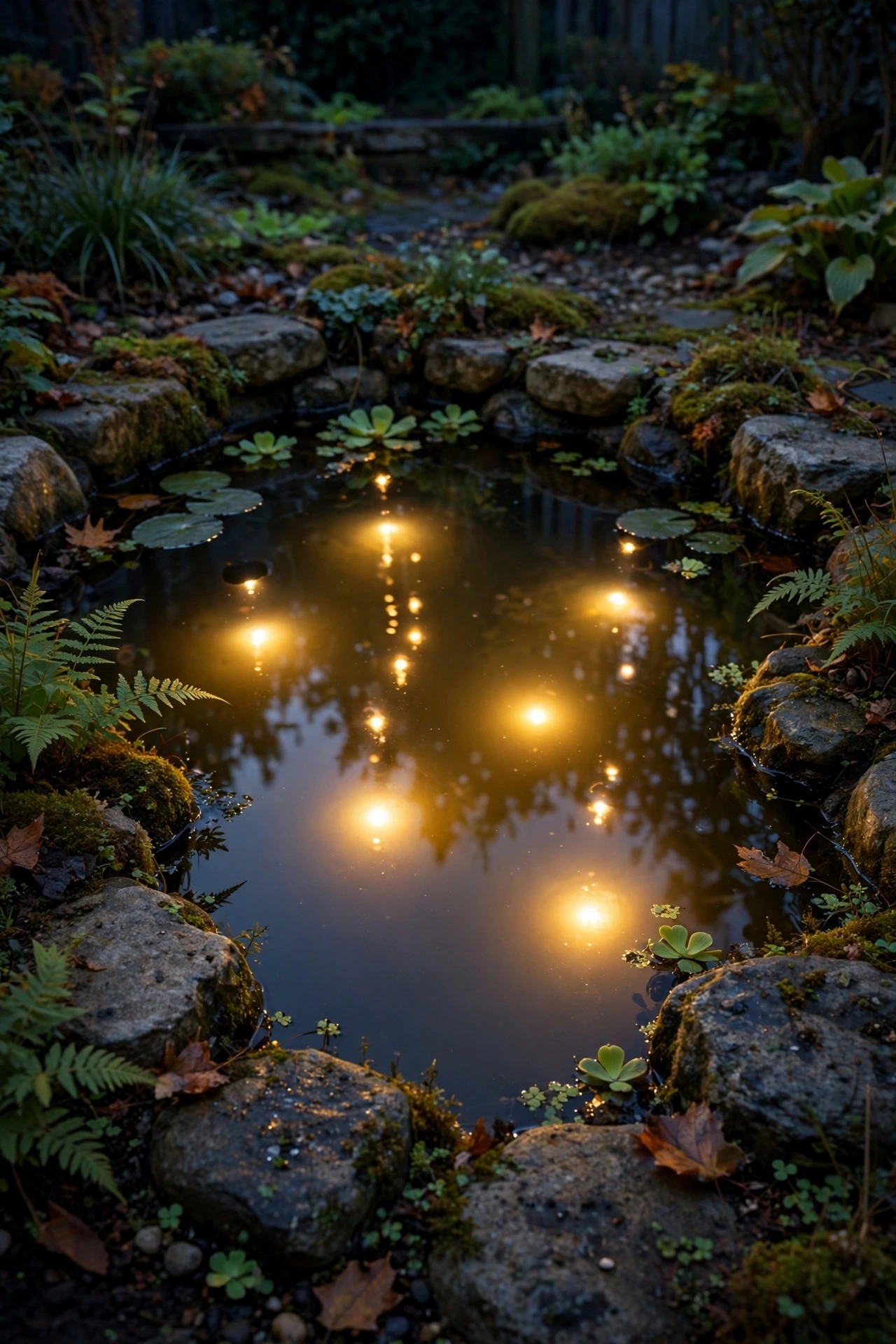
18. Edge a Pond or Rill With Tiny Points of Light
A still pond or a narrow stone rill is a mirror at night, and mirrors double every light you give them. I edge small water features with tiny points of light rather than big washes: two or three submersible LED spotlights resting on the pond floor, aimed at a feature stone, a water lily cluster or the far wall, plus one soft uplight in the planting behind so the water has something beautiful to reflect. The reflections do half the lighting work for free. Everything in or near the water must be genuinely rated for it — IP68 for submerged fixtures, low voltage throughout, GFCI protection on the circuit, and cable connections made on dry land, never underwater. Floating solar orbs are the zero-effort version and look surprisingly elegant drifting on a still pond, though they will gather at one end by morning. Keep light levels low around water: too much brightness kills the mirror effect and bothers frogs and fish. A rill only needs one light at its source and one at its end to read as a ribbon of moving sparkle. This is the quietest idea on the list, and on a still night it might be the loveliest.
Suggested budget range: $50 – $170.
19. Put It All on Timers and Hold One Warm Temperature
Twenty ideas will not save a garden whose lights come on at random times in three different colors. The discipline that makes mediterranean garden lighting ideas work as a system is boring and absolute: every lamp at 2700K, every circuit on a timer. An astronomical timer knows sunset all year and adjusts itself, so paths, gate and terrace switch on together in that flat gray minute when steps disappear. Set solar lights aside — they self-manage — and put everything wired on the timer, with the fire-circle accents and potting bench on manual switches since those are occasion lights. Then audit your temperatures ruthlessly: that one bargain bulb at 4000K will stick out like a fluorescent tube in a candlelit taverna. Buy spare bulbs in the same warm temperature when you install, because color consistency five years later is hard to match from memory. Photocell sockets on individual lanterns are a fine budget alternative to a central timer. In my experience this unglamorous step — timers plus one temperature — is the difference between a garden that looks designed and a garden that looks accumulated, and it is the cheapest transformation on the entire list. Do it before you buy one more fixture.
Suggested budget range: $25 – $95.
20. Swap Accents With the Seasons
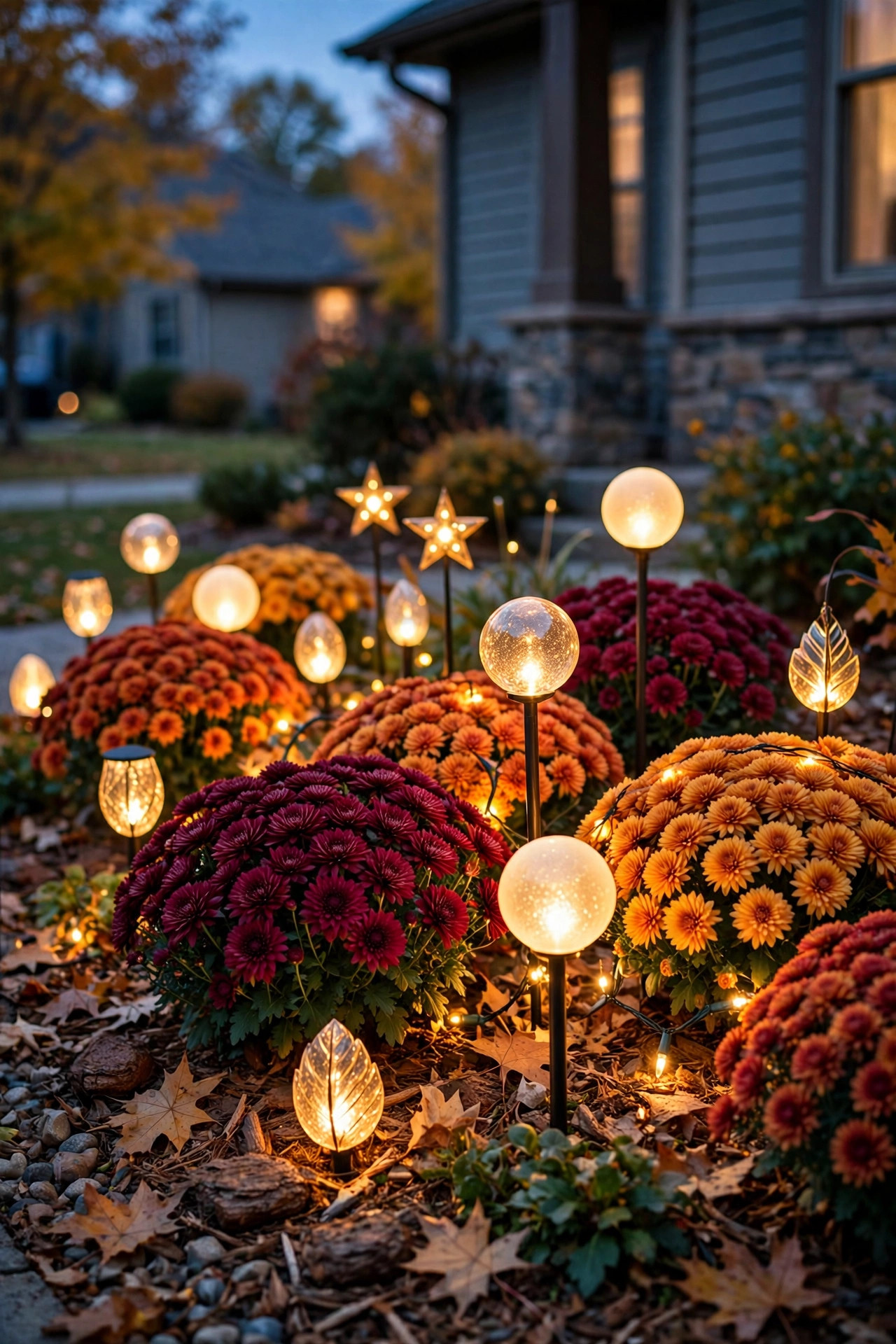
A Mediterranean garden changes its personality across the year, and small lighting swaps keep the scheme feeling alive instead of frozen. In summer, the garden is a dining room: bring the candle lanterns to the table, add a second string-light run over the terrace, and let the fountain and fire bowl carry the evenings. In autumn, I move solar lanterns to flank the olive harvest and shift accent lights onto the grapevine and the pomegranate, whose fruit and turning leaves deserve a spotlight month. Winter is structure season — the crowds of pots go into shelter, and I re-aim uplights onto bare branches, the cypress pair and the stone walls, so the garden's bones glow through the quiet months. Spring calls the fairy lights back into the citrus blossom and fresh stakes into the herb beds as they wake. None of this needs new purchases after the first year; it is a rhythm of moving, re-aiming and storing, maybe an hour each season with a glass of something in hand. Keep a small labeled tote for the rotating pieces, and write the winter positions on a card inside the lid — future you, standing in the cold, will be grateful.
Suggested budget range: $40 – $140.
21. Finish With a Dusk Walk-Through of Your Mediterranean Garden Lighting Ideas
The last step costs almost nothing and teaches the most: once everything is installed, walk the garden at dusk with a notebook and look at it the way a guest would. Start from the street or the back door. Can you read every step? Does any bare bulb glare into your eyes from a chair — if so, shield it, lower it or re-aim it into a plant instead of a face. Stand at the dining table and check that faces are lit warmly, not from directly overhead like an interrogation. Walk the gravel path and look for dark gaps between pools of light; a gap usually means one fixture nudged 2 feet, not one more purchase. Then stand back and take in the whole composition of your mediterranean garden lighting ideas: layers balanced, focal points crowned, nothing screaming for attention. Take phone photos from three spots — they reveal hot spots and dead zones your eyes forgive in person. Adjust, tighten, dim. I repeat this walk every spring, because plants grow, fixtures tilt in storms, and gardens are alive. Thirty minutes of honest looking will improve your lighting more than another hundred dollars of fixtures, every single time.
Suggested budget range: $0 – $60.

Frequently Asked Questions
What color temperature looks best in a Mediterranean garden?
Warm white at 2700K, every time. It echoes candlelight, firelight and the last of the sunset, which is exactly the palette terracotta, limestone and stucco want. Cooler temperatures, 4000K and up, turn olive foliage blue-gray and make warm stone look like a parking garage. Consistency matters as much as the number itself: hold every bulb, stake and lantern in the garden to the same 2700K so the layers blend, and buy a few spares when you install so replacements match years later.
Are solar lights bright enough for Mediterranean garden paths and steps?
For marking edges and outlining beds, yes — modern warm-white solar stakes and step lights give a clear, gentle pool of light, and they thrive in the same full sun a Mediterranean garden already gets. For true safety lighting on steep steps or a main entrance path, wired low-voltage fixtures are brighter and far more consistent, especially in winter when solar charging hours shrink. My usual recipe is a wired backbone for paths and steps, with solar filling in beds, pots and accents where running cable is a nuisance.
How do I stop outdoor fixtures corroding in a sunny, salty or poolside garden?
Start with materials that expect a hard life: solid brass, copper, marine-grade stainless, or quality powder-coated aluminum, all rated at least IP65 for weather exposure. Avoid painted bargain metals, which blister within a couple of summers. Rinse fixtures near pools or coastal air with fresh water a few times a season to clear salt film, keep lenses clean, and check cable connections each spring. A fixture that costs twice as much but lasts ten summers is the cheaper lantern in the end.
How much does it cost to light a whole Mediterranean garden?
A satisfying starter scheme — path lights down the main gravel walk, a pair of gate lanterns, two tree uplights and string lights over the terrace — typically lands between $400 and $900 in fixtures if you install the low-voltage work yourself. Lighting every zone in this post, with recessed step lights and a fountain install, can run $1,500 to $3,500. Running costs stay tiny: a whole garden of LEDs on a timer usually draws less electricity than one old porch bulb burning all night.
Conclusion
A Mediterranean garden after dark does not need more light — it needs the right light, in the right layers, at one warm golden temperature. Guide the gravel paths, welcome people with lanterns at sitting height, and crown the olive, the cypress and the fountain with quiet accents, and those mediterranean garden lighting ideas will turn every warm evening into a small holiday at home. Start with the paths, add the layers a weekend at a time, and do the dusk walk-through before you buy anything extra. If you are planning the water features next, browse my fountain and pond lighting posts here on the site — and I would love to hear which idea glows first in your garden.