There is a moment, just after sunset in the warm months, when a Mediterranean-style front yard turns into pure theater. The stucco goes honey-gold, the terracotta roof tiles hold the last of the light, and the cypress trees stand like dark exclamation points against a violet sky. Honestly? That drama does not happen by accident — it is lighting. The best mediterranean front yard lighting ideas borrow from old-world villas: wrought iron, aged bronze, terracotta, and warm amber light pooled exactly where the eye should land. In this post I am sharing the 15 ideas I reach for when I want that villa drama out front, all built on the layering approach I use in every yard — a soft ambient base, clear task light on the path and steps, and bold accents on the trees, fountain, and architecture that make the house look expensive after dark. You will get spacing numbers, bulb temperatures, and a budget range for every single idea. Whether your home is true Spanish revival or you are simply borrowing the look, these layers will make your front yard feel like a holiday in the hills above the sea.
1. Start With a Layered Plan for Mediterranean Front Yard Lighting Ideas
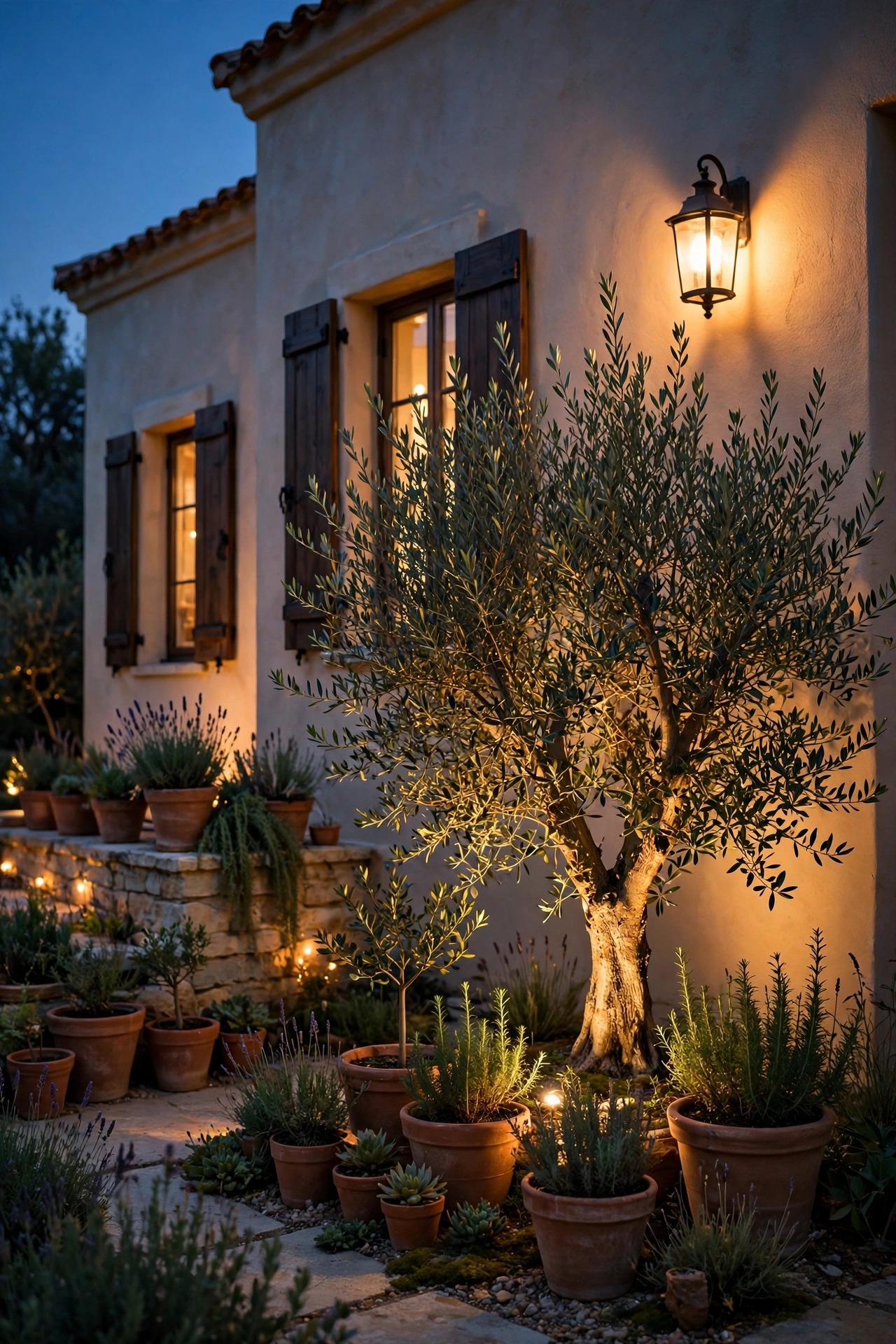
Every villa-worthy yard I have lit starts on paper, not at the hardware store. I sketch the front yard and mark three layers: ambient light for a soft general glow, task light where feet land on the path, steps, and driveway edge, and accent light for the drama — the olive tree, the fountain, the arched entry. Mediterranean yards have strong bones to work with: stucco walls that love a wash of light, gravel or stone paths, and sculptural plants like cypress, agave, and citrus. Plan your transformer location near an outdoor GFCI outlet, and sketch cable runs along bed edges where gravel or mulch hides them. I also note fixture finishes now — aged bronze, oil-rubbed black, and weathered copper sit naturally with terracotta and stucco, while shiny chrome reads modern and breaks the spell. If you want to see this layering on a full estate layout, my guide to Mediterranean villa lighting shows the whole scheme. Twenty minutes with a tape measure and a sketch saves you from the most common mistake in front yards: buying beautiful fixtures in the wrong order and ending up with bright spots and dark holes.
Suggested budget range: $0 – $40.
2. Flank the Front Gate With Wrought Iron Lantern Posts
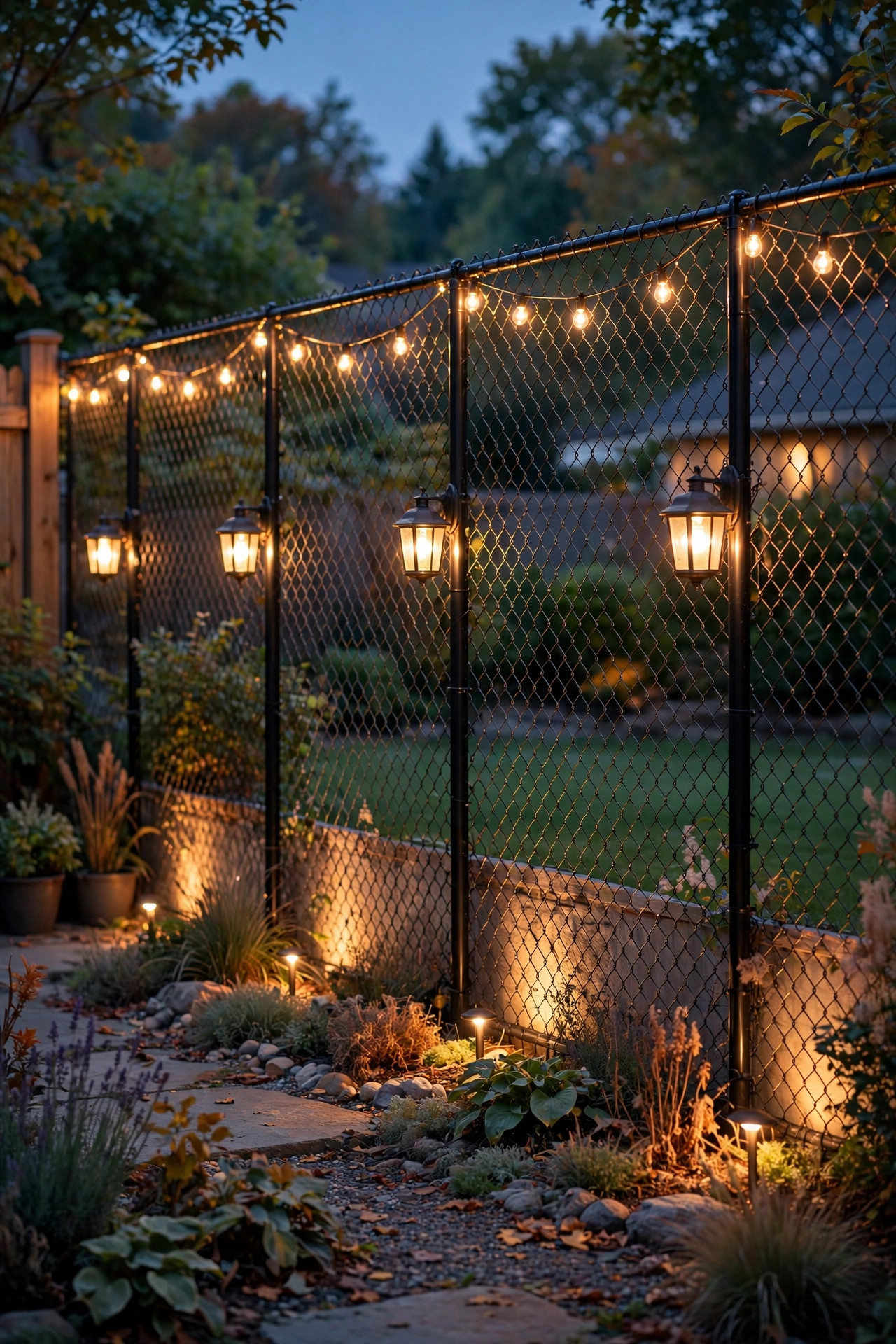
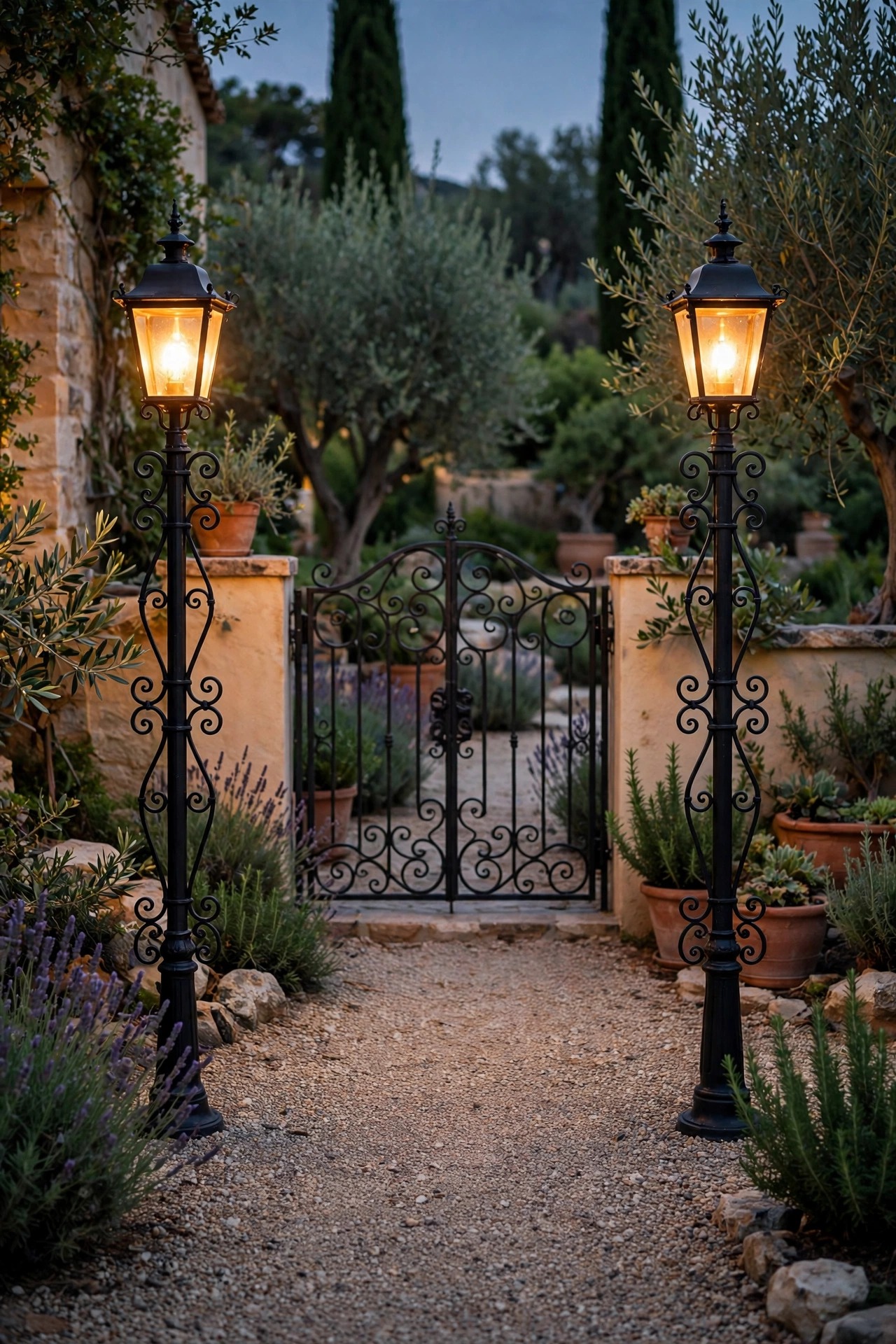
If a Mediterranean front yard has one signature move, it is a pair of wrought iron lanterns standing guard at the gate or where the path meets the sidewalk. I choose black iron post lanterns with seeded or amber-tinted glass and warm LED filament-style bulbs around 2700K, mounted 5 to 6 feet high so the glow pools on the path instead of glaring into eyes. Set each post the same distance from the path edge — 18 to 24 inches is my usual mark — and put the pair on the same circuit and timer so they always switch on together. A single lit lantern reads as a mistake; a matched pair reads as an entrance. Low-voltage posts are the easiest DIY route, and I bury the cable at least 6 inches deep along the path edge where a gravel border hides the trench line. In windy or coastal areas, I anchor posts in a small concrete footing so they stay perfectly plumb through storm season. In my experience, no other fixture buys you this much old-world presence per dollar, because guests feel the welcome before they ever reach the front door.
Suggested budget range: $180 – $480.
3. Uplight Olive Trees and Italian Cypress for Instant Drama
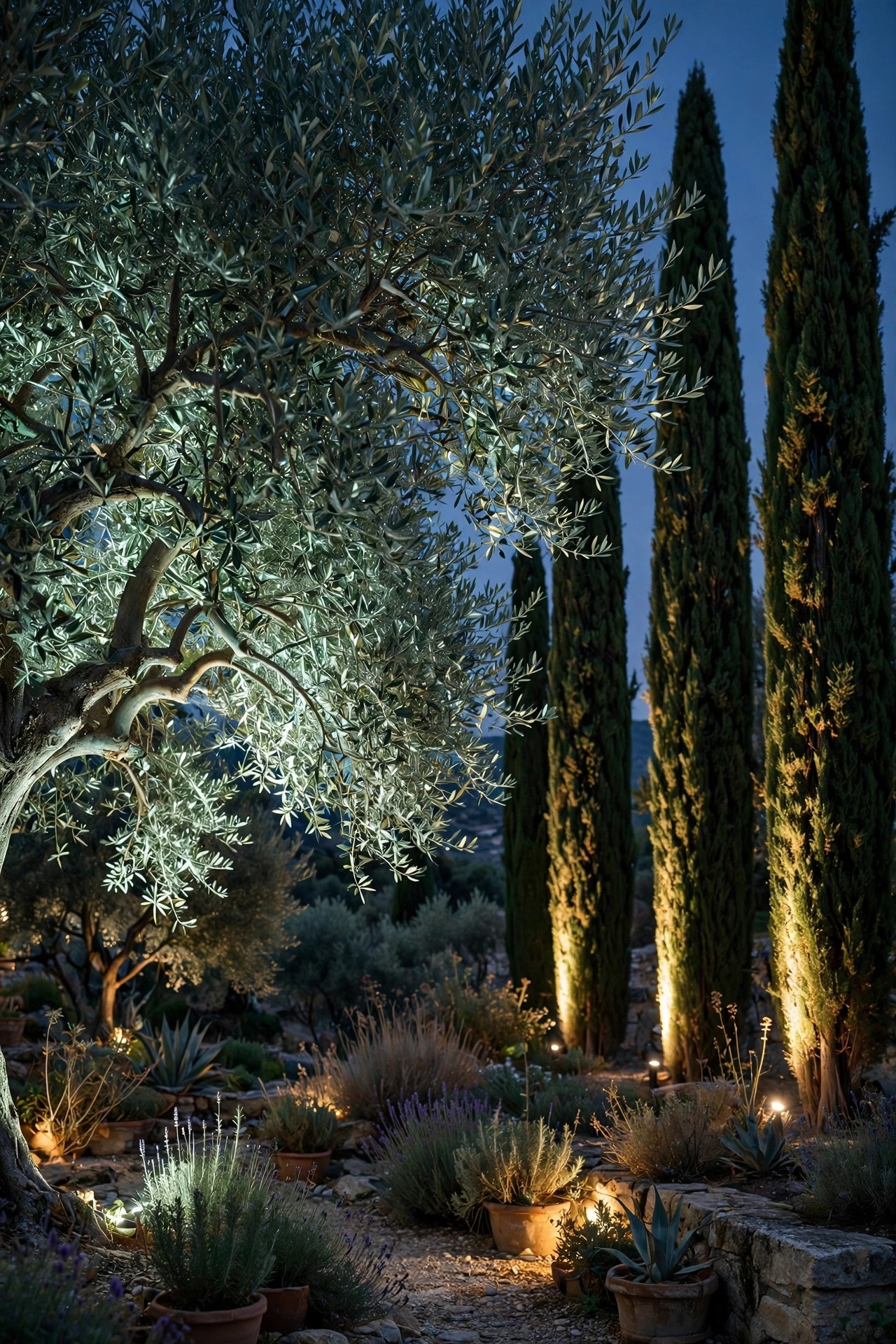
Mediterranean planting is already theatrical — lighting just turns the volume up. For an olive tree, I set one or two well lights or spotlights 12 to 18 inches out from the trunk, aimed up through the silvery canopy so the leaves shimmer against the night sky. Around 400 to 600 lumens per fixture is plenty for a medium tree. Cypress trees want the opposite treatment: a narrow-beam spotlight, around 10 to 15 degrees, placed close to the base so a single column of light races up the full height and makes the tree look twice as tall. Keep every bulb at 2700K so the foliage reads rich green rather than ghostly blue. Well lights that sit flush in the ground are my pick near paths and lawn edges, since there is nothing for the mower to clip or guests to trip over. Check your aim after the first week, because soil settles and fixtures tilt. This is the layer neighbors ask about, honestly — two or three dramatically lit trees can carry an entire front yard, with everything else playing a supporting role.
Suggested budget range: $90 – $240.
4. Line the Gravel Path With Terracotta Lanterns
Gravel paths are pure Mediterranean, and they deserve lighting with the same handmade character. My favorite trick is a row of terracotta lanterns — pierced clay shades or simple clay pots fitted with flameless LED candles — spaced 4 to 6 feet apart along both edges of the path. The pierced patterns throw dappled stars of light across the gravel, and the clay glows a deep ember orange from within that no metal fixture quite matches. Because these are decorative accents rather than true task lighting, pair them with a few low path lights from idea 8 so the route stays safely visible. Keep flames out of it entirely: LED candles with a flicker setting give the same dance of light with zero fire risk near dry grasses and mulch. Terracotta is porous, so in freeze-prone climates I bring the lanterns under cover for the hardest winter weeks to stop cracking. Set them on small flat stones so they sit level and shed rainwater. The whole row costs less than one designer fixture and delivers more atmosphere than almost anything else in this post.
Suggested budget range: $60 – $180.

5. Wash Stucco and Stone Walls With Warm Grazing Light
Blank stucco is the Mediterranean yard secret weapon, because textured plaster and stone look incredible when light rakes across them at a shallow angle. I place small uplights or wall-wash fixtures 6 to 12 inches out from the wall base, aimed nearly straight up, so every bump and trowel mark throws a tiny shadow and the surface comes alive. Space washes 6 to 10 feet apart along a long facade, and keep them a touch dimmer than your accent lights — the wall is the backdrop, not the star. Around 200 to 300 lumens each at 2700K gives that late-evening glow you see on hillside villages. Mind your windows: angle fixtures so beams skim the wall between them rather than blasting into glass, and shield any fixture a driver on the street can see directly. This technique also rescues a plain garden wall or fence line, turning a flat boundary into a glowing backdrop for silhouetted planting. Of all the mediterranean front yard lighting ideas in this post, this is the one that makes people say the house looks like a boutique hotel.
Suggested budget range: $120 – $320.

6. Hang an Oversized Lantern at the Arched Entry
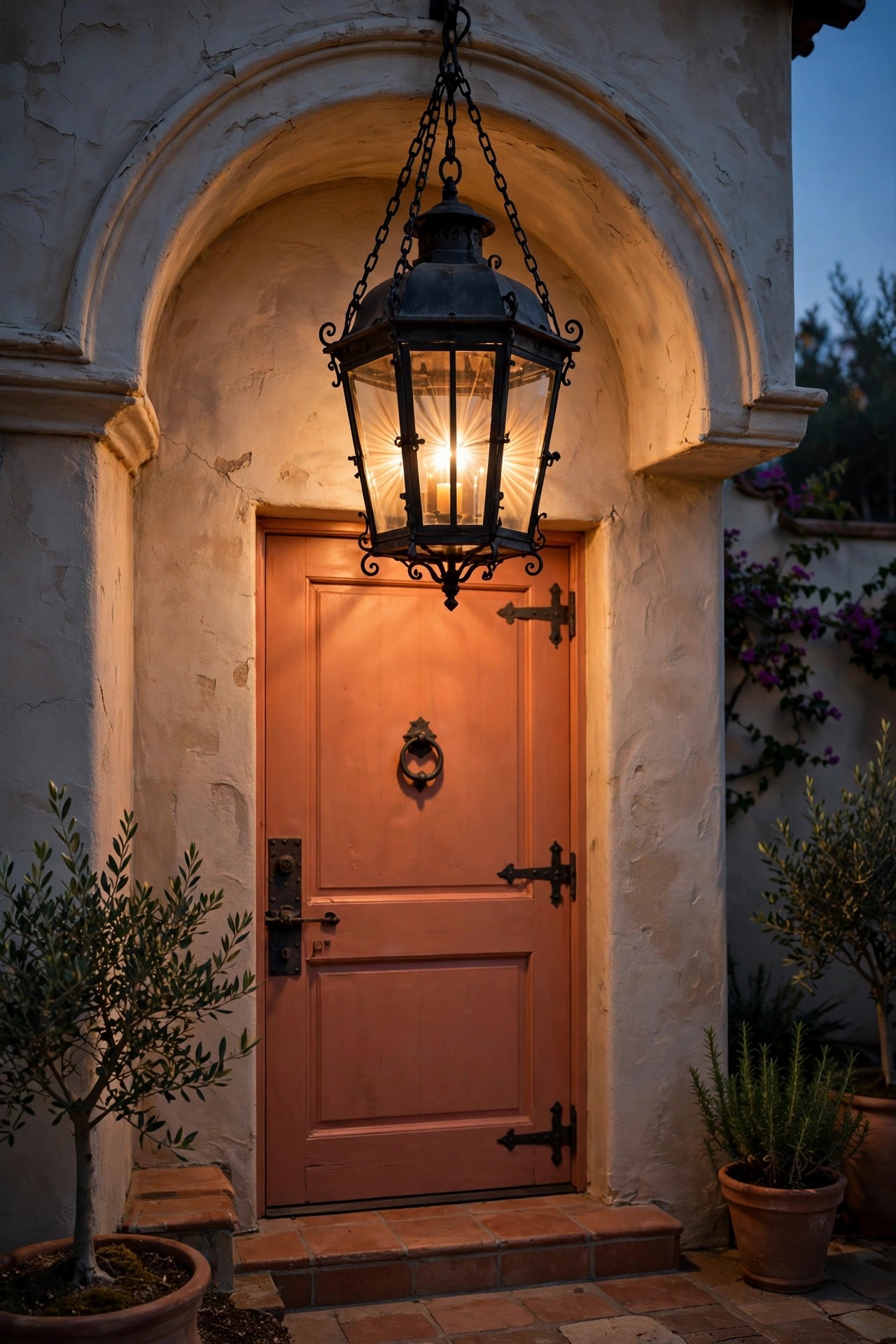
Mediterranean entries love a little grandeur, and one oversized lantern under the arch or porch ceiling delivers it in a single fixture. I scale up more than feels safe — a lantern 18 to 24 inches tall suits a standard door, and bigger homes can carry 30 inches without blushing. Hang it so the bottom of the fixture sits at least 6 and a half feet above the step, and center it on the door from the street view, not just on the ceiling. Black iron with clear or seeded glass is the classic pairing with stucco and a terracotta or deep blue door. Use a warm LED filament-style bulb around 2700K, and put it on a dimmer if you can — full brightness for arrivals, a low ember glow for the rest of the evening. If your entry has no ceiling or arch, a large wall-mounted lantern at the same visual weight does the same job. This is the fixture your whole scheme gets judged by from the curb, so it is the one place I happily spend a bigger share of the budget.
Suggested budget range: $140 – $400.
7. Make the Fountain Your Glowing Focal Point
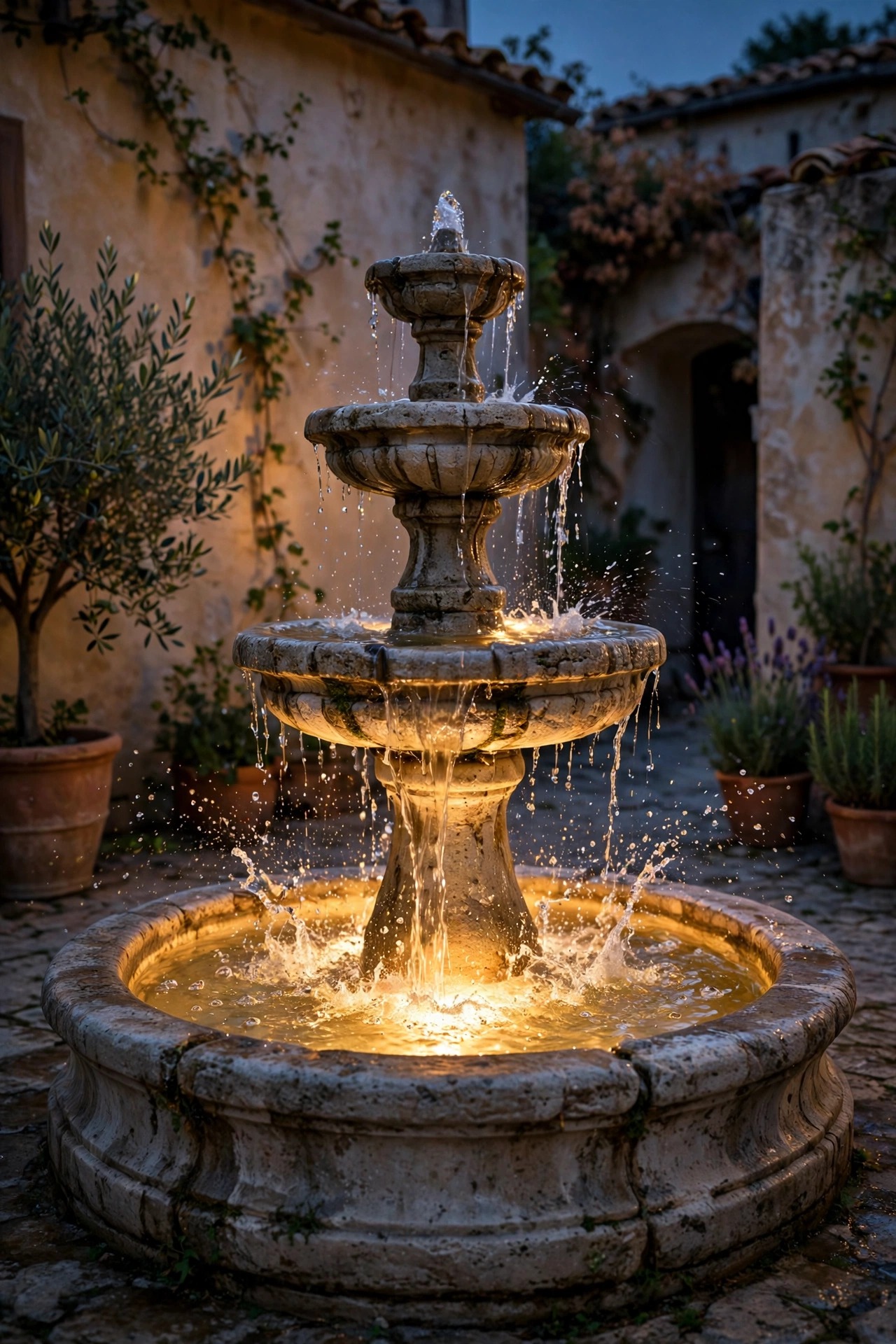
A front yard fountain is already the star of a Mediterranean scheme — at night it should absolutely sparkle. I light mine two ways: a submersible LED puck or ring inside the basin, rated IP68 for full underwater use, and one soft spotlight from the planting bed aimed at the falling water so the droplets catch the light. Warm white around 2700K keeps the water golden; colored filters read theme park, so I skip them. Run any fountain lighting on its own GFCI-protected circuit and keep connections in waterproof junction boxes above the waterline, never spliced inside the basin. If your fountain is a wall fountain against stucco, combine this with the grazing light from idea 5 and the whole composition glows like a plaza in a hill town. Solar fountain lights exist, but in my experience they fade by mid-evening; wired low-voltage fixtures keep the show running until the timer says stop. Clean the lens monthly in hard-water areas, because mineral film dims the effect faster than you would expect.
Suggested budget range: $80 – $260.
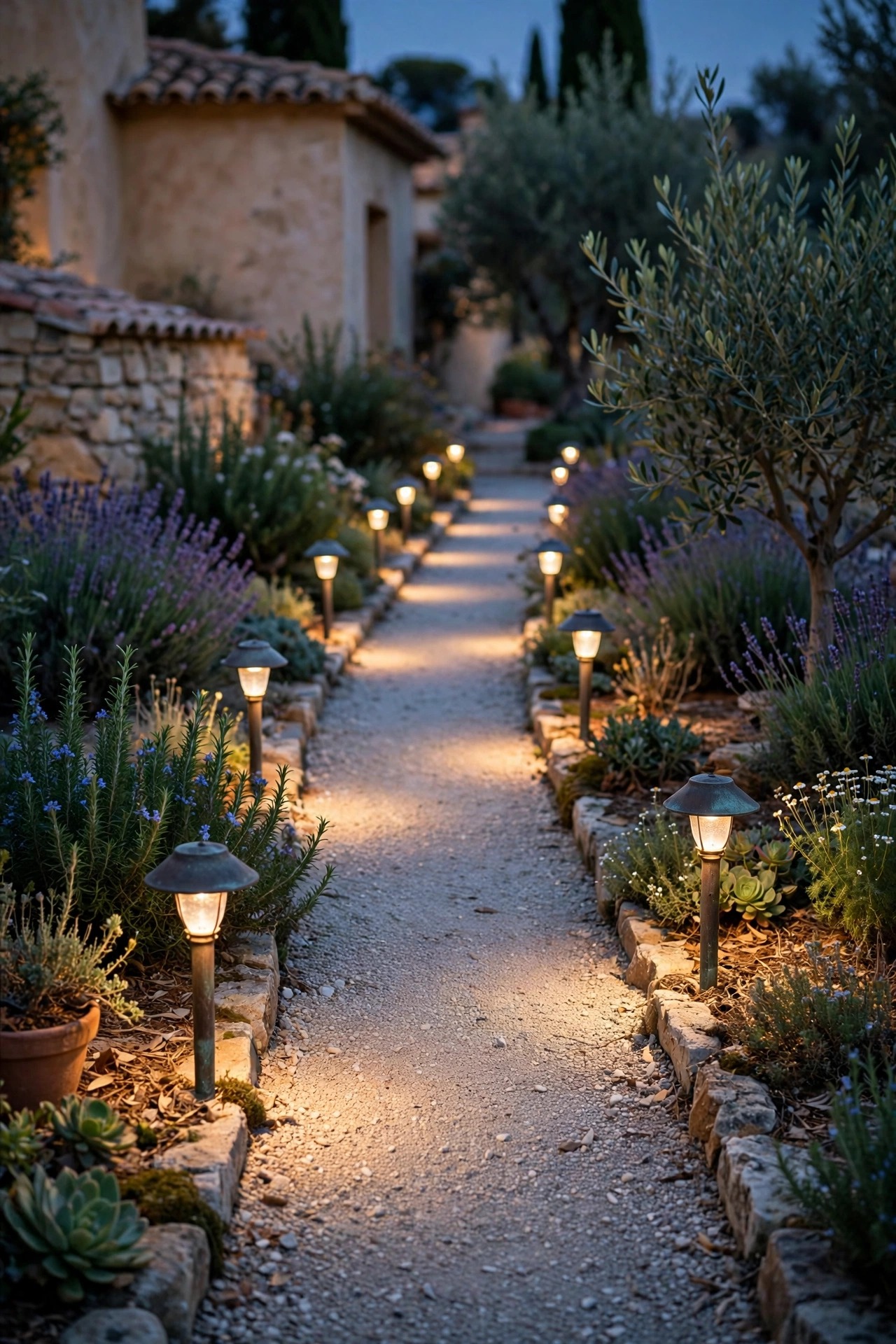
8. Edge Beds and Borders With Low Bronze Path Lights
Between the drama pieces, a front yard needs steady, practical light, and low path lights in aged bronze are my workhorses. I use hooded fixtures 12 to 18 inches tall that throw light downward onto gravel and stone, spaced 6 to 8 feet apart along paths and bed edges so the pools of light just touch. Aim for 100 to 150 lumens each — enough to read every step, never enough to look like a runway. The bronze finish earns its keep outdoors too: it resists corrosion far better than painted steel and develops a patina that suits terracotta and stucco beautifully. My full walkthrough of front yard landscape lighting covers layout patterns if you are planning a bigger scheme. One honest tip: buy two or three spares from the same batch. Finishes vary between production runs, and a path of matching lights with one odd fixture in the middle will bother you every single evening. Keep a small brush in the garage and knock dust and sprinkler spots off the lenses every few weeks.
Suggested budget range: $150 – $420.
9. Drape String Lights Over a Front Pergola or Loggia
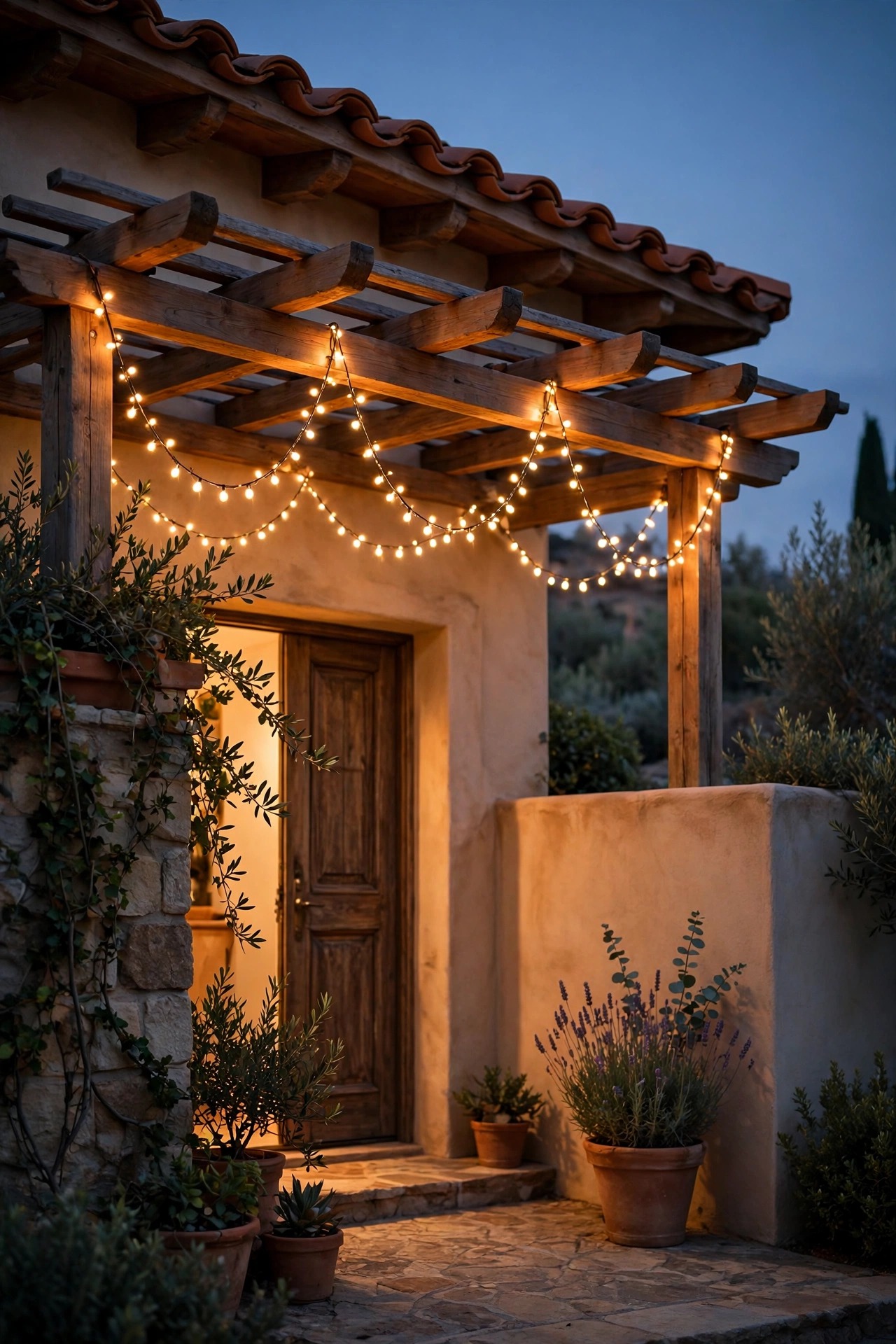
Many Mediterranean homes have a small pergola, loggia, or tiled porch roof over the front sitting area, and string lights were born for exactly that spot. I run commercial-grade outdoor string lights in gentle swags between the beams, spacing the drops evenly — measure the span and divide, because lopsided swags look accidental. Warm LED filament-style bulbs around 2700K keep the mood old-world; I avoid the bluish daylight bulbs that make stucco look chalky. Anchor cables to eye bolts in the beams rather than wrapping cords around wood, and keep every connection point under the roof edge so rain runs off instead of in. Use only string lights rated for outdoor wet locations, and plug into a GFCI outlet. A front pergola lit this way becomes an evening room the whole street envies, and it gives your entry lantern from idea 6 some friendly company. On a timer set for dusk to around 11 pm, the whole front of the house settles into that golden hour glow long after the real golden hour ends.
Suggested budget range: $70 – $220.
10. Border the Driveway With Solar Stakes and Bollards
A long driveway can swallow a lighting budget in cable alone, so this is the one place I happily go solar. I alternate solar stake lights with a few taller solar bollards along the driveway edge, spaced 8 to 10 feet apart, keeping the line set back at least a foot from where tires actually track. Choose fixtures with warm 2700K output and the largest solar panels you can find in the style — panel size, more than anything, decides whether a solar light still glows at midnight. Bronze or black finishes keep the Mediterranean thread running. Be honest with yourself about shade: a driveway under dense canopy will starve solar fixtures, and wired low-voltage lights from a transformer near the garage are the better spend there. In sunny driveways, though, this border costs nothing to run and installs in an afternoon with no trenching. I also add two slightly brighter bollards at the driveway entrance itself, flanking it like a quiet announcement that the villa begins here.
Suggested budget range: $100 – $350.

11. Spotlight Potted Citrus, Agave, and Topiary
Big terracotta pots are half the Mediterranean look, and a small spotlight turns each one into a sculpture after dark. I tuck a single low-voltage spike spot into the planting bed or gravel in front of each statement pot, aimed up into the canopy of a potted lemon or olive, or across the face of an agave so its rosette throws long shadows. Around 200 to 300 lumens is plenty for a container plant; more just blows out the leaves. Keep the beam tight, roughly 25 to 35 degrees, so light stays on the plant instead of spilling onto the path. Groupings work best in odd numbers — three lit pots marching toward the entry look deliberate, while a single pot alone can look lost. Terracotta soaks up warmth beautifully under this treatment, and glazed pots in deep blue or green pick up a jewel-like shine. This is also my favorite renters trick, because pots and spike lights move with you and leave nothing behind but a small hole in the mulch.
Suggested budget range: $60 – $190.

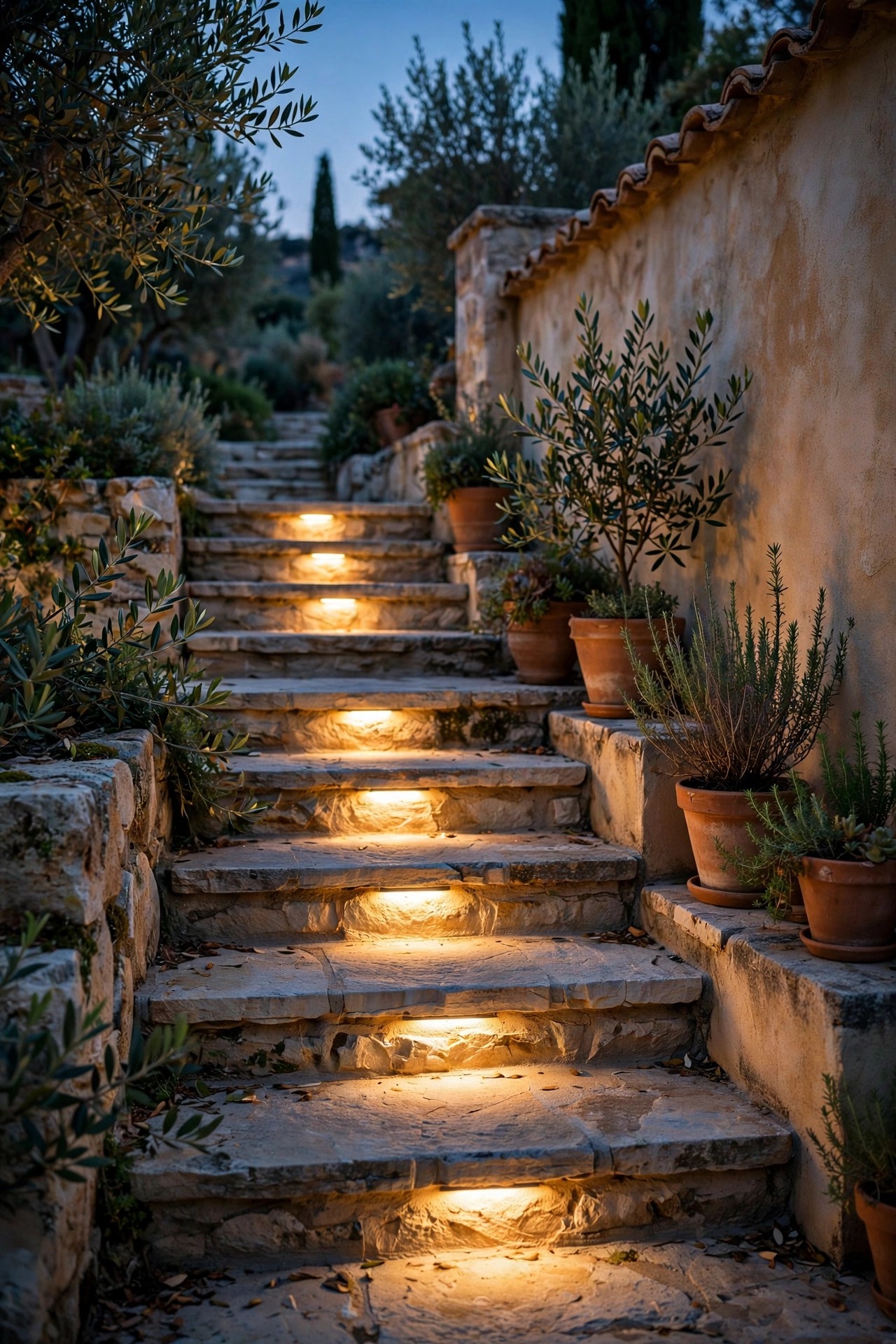
12. Add Step Lights to Terraces and Stone Stairs
Sloped Mediterranean lots love terraces, and terraces mean steps — which means the most practical lighting in this whole post. I recess small step lights into the riser of each stone or tile step, or mount low-profile fixtures on the side wall so the tread itself glows. Every step gets light, evenly; skipping alternate steps to save money creates a shadow rhythm that trips people, honestly. Around 50 to 100 lumens per step at 2700K is the sweet spot — visible underfoot, gentle on the eyes. Choose fixtures rated for wet locations and, on masonry, hire out the drilling if you are not confident, because cracked tile costs more than the electrician. Solar step lights can work on a sunny south-facing run, but wired fixtures win on shaded stairs where reliability matters most. Pair the steps with a lit handrail line or the path lights from idea 8 and guests float up your terraces like they are entering a resort. Safety that looks this good is the easiest yes in the yard.
Suggested budget range: $110 – $380.
13. Cluster Flameless Candles in Hurricane Lanterns by the Door
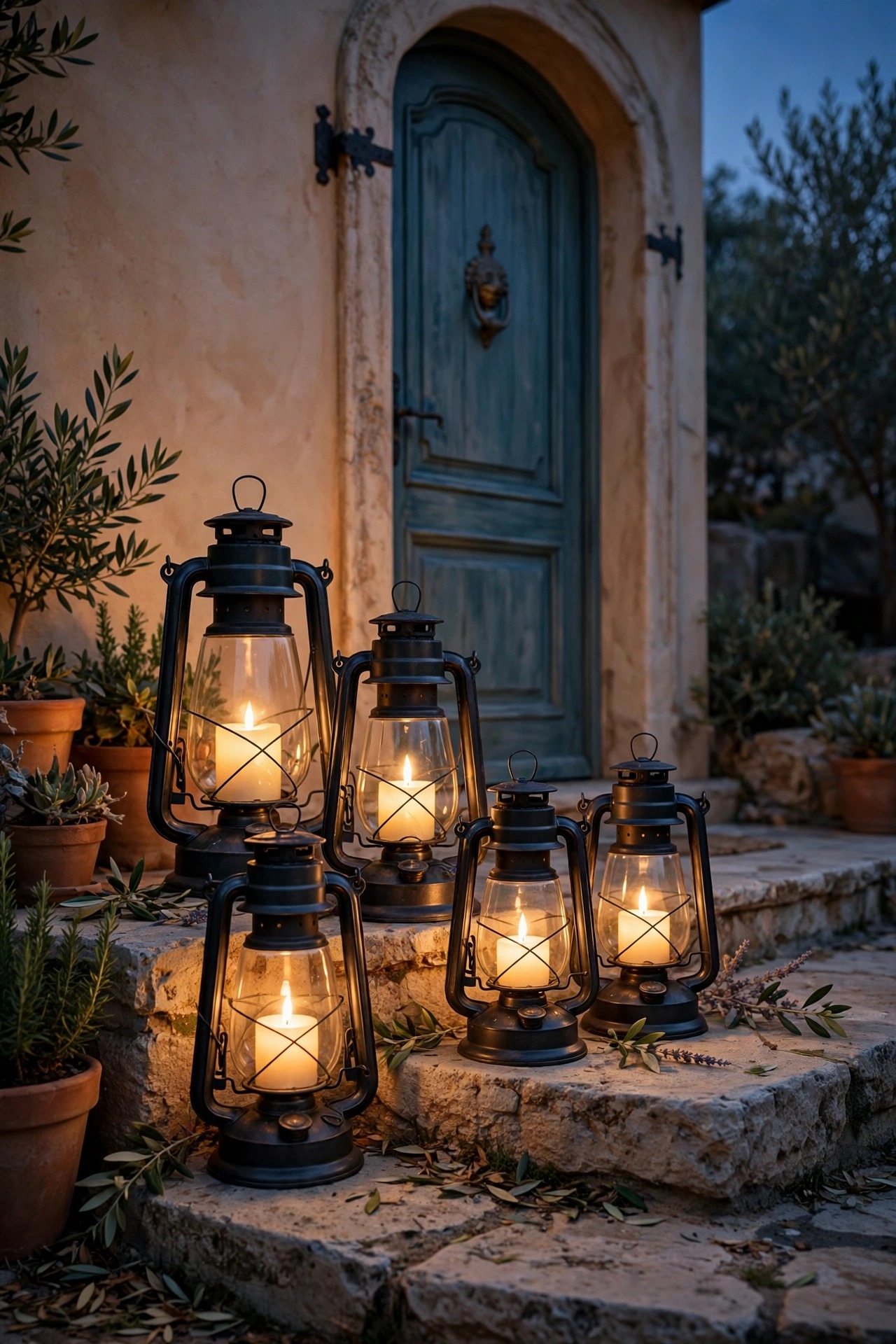
Some nights the fixed lighting is not enough, and that is where my favorite five-minute trick comes in: clusters of hurricane lanterns filled with flameless LED candles on the entry steps, the gate piers, and the porch floor. I group them in threes at different heights — tall, medium, small — because a cluster reads as a design choice while a single lantern reads as an afterthought. The flicker setting on modern flameless candles is convincing enough that guests lean in to check, and there is zero fire risk near door wreaths, dry grasses, or the welcome mat. Look for candles with built-in timers, the kind that light themselves for five hours each evening once you set them the first time. Black iron or aged brass lanterns keep the old-world thread, and the glass hurricanes keep breezes from exposing the trick. I keep a spare set charged for parties and holidays, and honestly the entry cluster is the background of half the photos my family takes at this house.
Suggested budget range: $40 – $130.
14. Lock In One Warm 2700K Temperature and Set Timers
Here is the unglamorous rule that holds every villa scheme together: one color temperature, everywhere. I use 2700K warm white for every bulb, fixture, and candle in the front yard, because Mediterranean light is candlelight and firelight — amber, golden, never blue. One stray 4000K bulb in a path light will stick out like a fluorescent tube in a cathedral, so check the Kelvin rating on every box before it goes in the cart, including replacements years later. Once the palette is locked, put the whole system on timers or a smart transformer schedule: on at dusk, off around 11 pm or midnight, with entry and step lights welcome to run longer for safety. Photocell sensors that simply react to darkness are my budget pick for lantern posts and driveway bollards. Automation also protects the drama — a scene that lights itself every single evening looks intentional, while a yard that depends on someone remembering a switch looks lit only on weekends. Consistency is what separates a villa from a house with some lights.
Suggested budget range: $30 – $150.

15. Walk the Yard at Dusk and Fine-Tune Your Mediterranean Front Yard Lighting Ideas
The last step is my favorite ritual: once everything is installed, wait for full dusk and walk the yard slowly, from the street to the door and back again. This is where mediterranean front yard lighting ideas stop being a shopping list and become a scene. Look for the failures your plan could not predict — a spotlight glaring into a bedroom window, a path pool that ends one step too early, an olive tree lit beautifully from the porch but flat from the street. Adjust angles by hand, nudge a stake two inches, swap one bulb that reads cooler than its neighbors. Then drive past your own house slowly, the way guests and buyers actually see it, and check that the brightest thing in view is the entry, not a bare bulb. I repeat this audit twice a year, after spring planting and before the holidays, because shrubs grow into beams and fixtures sink in soft soil. Take phone photos each time; comparing them season to season shows you exactly what drifted. Twenty unhurried minutes twice a year keeps the whole composition at villa standard.
Suggested budget range: $0 – $60.
Frequently Asked Questions
What color temperature looks best for Mediterranean outdoor lighting?
Warm white at 2700K is the answer I give every time. It mimics candlelight and firelight, flatters stucco, terracotta, and stone, and keeps foliage a rich green instead of a ghostly blue. Whatever temperature you choose, use that single rating for every fixture and replacement bulb, because one cool bulb in a warm scheme is the first thing every eye finds.
Are solar lights bright enough for a Mediterranean front yard?
For borders, driveway edges, and soft accents, good modern solar lights are plenty bright, especially on sunny lots. For the drama layers — tree uplighting, wall grazing, and fountain light — wired low-voltage fixtures are brighter and far more consistent through the evening. My usual split is solar for the perimeter and wired for the stars of the show.
How do I keep wrought iron and bronze fixtures from rusting outdoors?
Start with fixtures rated for wet locations, and in coastal air choose powder-coated iron, solid brass, or bronze, which handle salt far better than painted steel. Rinse fixtures with fresh water every month or two in salty climates, and touch up any paint chips on iron before rust gets a foothold. A coat of clear outdoor sealant once a year keeps the finish looking aged rather than neglected.
How much does a full Mediterranean front yard lighting setup cost?
A starter scheme with gate lanterns, a path of bronze lights, and two tree uplights typically runs $700 to $1,800 in fixtures as a DIY project. Adding a lit fountain, wall grazing, step lights, and a pergola can bring a full front yard to $2,500 to $5,000. Professional installation usually adds 40 to 60 percent, and the phased approach works well — entry and path first, drama layers season by season.
Conclusion
Great mediterranean front yard lighting ideas are really just three habits repeated with beautiful materials: layer the light, keep every bulb at one warm temperature, and give the eye a star — a tree, a fountain, an arch — to travel toward. Start with the gate lanterns and path, add your drama layers one season at a time, and audit the whole scene from the street twice a year. If your front yard opens into a patio or entry court, my courtyard lighting ideas carry the same warm palette through the gate. Then browse the rest of the lighting ideas here on the site — I add new schemes every season, and I would love to hear which layer turns your front yard into the villa on the block.