There is a moment on every good lake evening when the sky goes violet, the water turns to glass, and nobody wants to head back inside. That is exactly when a dark dock becomes a problem: coolers to carry, cleats to trip over, and a gangway you suddenly cannot see. The best dock lighting ideas solve both halves of that moment at once, because down by the water, safety and beauty are honestly the same project. My approach never changes: layer the light. Start with a soft ambient glow so the dock reads as a place, add honest task light where hands and feet actually work, then trace every edge, step, and corner with low marker light so nobody guesses where the boards end. Keep everything warm white, marine-rated, and aimed down at the deck instead of out across the water, and the whole setup stays kind to neighbors, fish, and your electric bill. Below are the 21 setups I recommend most, from five-minute solar fixes to a full low-voltage system, each with the measurements and little hard-won tricks that make them actually work.

1. Start With a Layered Plan for Your Dock Lighting Ideas
Before you buy a single fixture, walk your dock at dusk with a flashlight and a notepad, and do it again after full dark. In my experience, dock lighting ideas fail when they start with products instead of a plan, so map the space first: measure the dock length and width, note the piling spacing, and mark every step, cleat, ladder, and level change. Then assign each zone one job per layer. Ambient light comes from post caps, lanterns, or strings so the dock glows as a destination. Task light belongs at the boat lift, the cleaning station, and the shore-end work area where you actually handle gear. Safety light traces edges and steps at ankle height. Sketch rough measurements and count your power options honestly: one GFCI outlet at the shore end usually decides whether your system is wired, solar, or a blend. Decide on one color temperature now, too, and write it on the plan. This planning hour feels slow, but it prevents the classic mistake of a bright dock in the middle and pitch-black corners where people actually step off the boat.
Suggested budget range: $0 – $25.
2. Cap Every Post With Solar Post Cap Lights
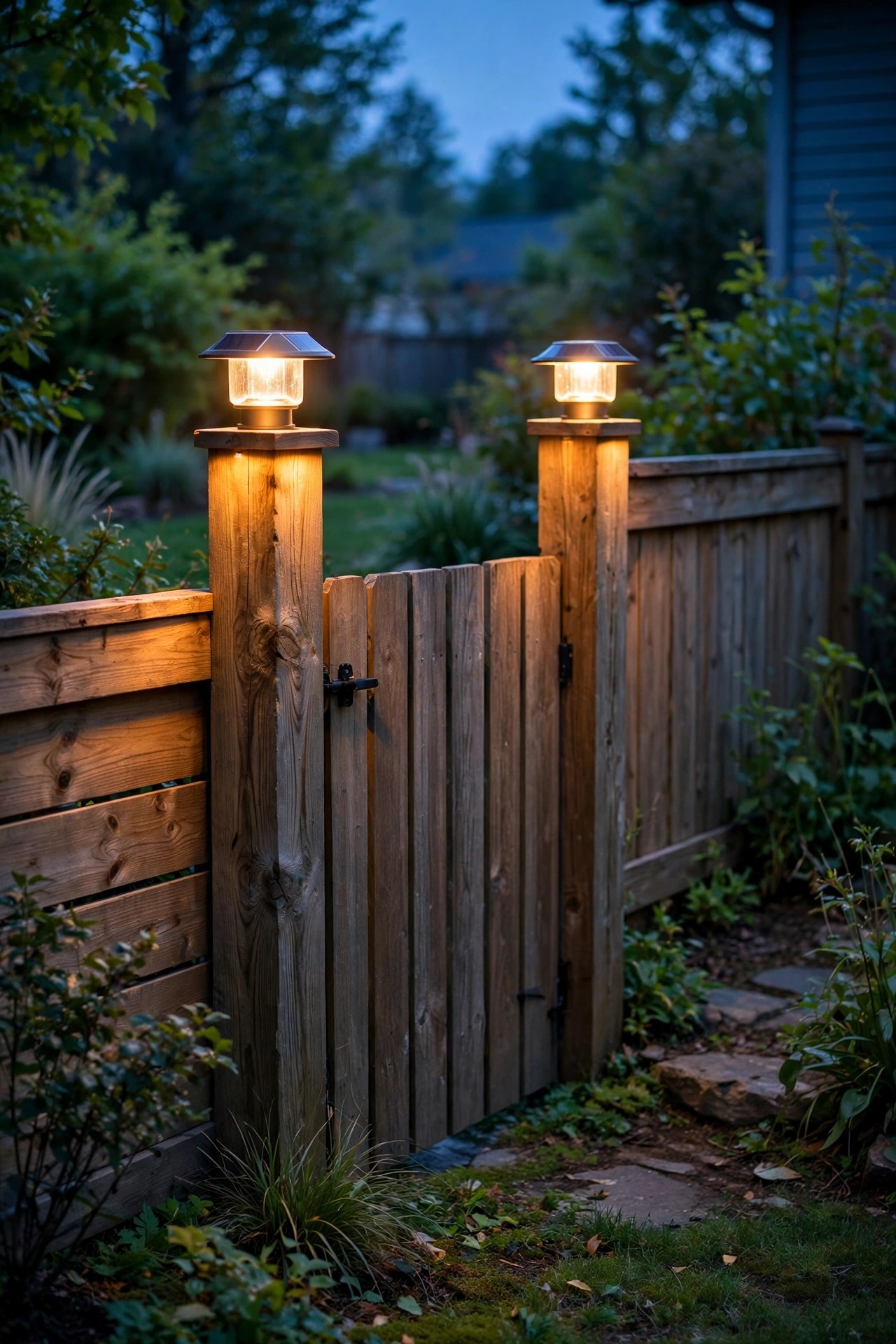
If your dock has posts or pilings within reach, solar post cap lights are the fastest transformation I know. Measure your posts first: caps come sized for standard 4×4 and 6×6 lumber, plus round-piling adapters, and a snug fit matters because wind works loose caps free by August. Look for warm white output around 2700K, a replaceable battery, and a housing rated for constant spray and sun. Set one cap on every post along both sides, spacing them with your pilings, usually every 6 to 8 feet, and the dock instantly reads as a lit runway from shore. Light output is modest, honestly, so treat caps as your ambient and marking layer rather than your only light. If you want a closer look at sizes and mounting styles, my roundup of deck post cap lights covers the same fixtures that work beautifully on dock posts. Once a month, wipe the little solar panels with a damp cloth; a film of pollen and lake grime quietly steals half their charge by midsummer.
Suggested budget range: $40 – $120.
3. Recess Deck Lights Into the Boards for a Built-In Glow
Recessed deck lights are the fixtures guests never notice until they realize they can see every board. These puck-sized lights sit flush in the decking, so coolers, bare feet, and fishing gear glide right over them. I space them every 4 to 6 feet, alternating sides of the walkway so the light pools overlap gently instead of striping. Installation is a Saturday job: mark your pattern, cut with the hole saw size the kit specifies, drop the lights in, and daisy-chain the low-voltage cable under the deck where it stays dry and hidden. Choose IP67-rated fixtures with replaceable LED modules, because a sealed unit that dies means cutting a new hole. Keep the faces warm white and dimmable if your transformer allows it; recessed lights run surprisingly bright at night over dark water, and half power usually looks best. Pay special attention to the last 3 feet before the boat slip and the corner where the dock turns, since those are the spots where a flush marker quietly prevents a very wet evening.
Suggested budget range: $60 – $180.

4. Add Underwater Lights for a Glow That Comes From Below
Underwater lights are the one indulgence I talk almost every dock owner into, because the effect is pure magic: a soft halo under the dock that turns the water itself into the light fixture. Submersible LED lights mount to a piling or the underside of a floating dock section, aimed down or slightly outward, 1 to 3 feet below the surface. Warm white reads elegant and candlelit; the fish, honestly, do not care either way and will gather regardless, which delights every kid with a net. Non-negotiables here: a true IP68 submersible rating, low-voltage power only, and cable protected in conduit where it enters the water so muskrats and ice cannot chew or crush it. Keep the glow contained under and around your own dock rather than beaming into a channel. If you have a garden pond too, the submersible know-how in my pond lighting ideas transfers directly, just scaled up. One or two fixtures usually do it; more than that and your dock starts looking like an aquarium exhibit.
Suggested budget range: $50 – $200.

5. Make Steps and Gangways Impossible to Miss With Step Lights
Every dock has a danger spot, and it is almost always the transition: the shore steps, the sloped gangway, or the two boards between dock sections. Step lights fix it for very little money. Recess small fixtures into stair risers or mount low-profile surface lights on the side stringers, one per step, aimed down at the tread. On a gangway, place a light at the top, the bottom, and any point where the slope changes, because a ramp that is friendly at noon becomes a ski jump after dew settles. Solar step lights work fine on sunny shore stairs, but for the gangway itself I prefer wired low-voltage, since that spot must work on cloudy weeks too. The placement math in my guide to deck stair light ideas works exactly the same on dock stairs: light every tread, keep the source shielded from eyes, and test from the bottom looking up. Guests carrying a sleeping toddler and a bag of towels will thank you silently every single night.
Suggested budget range: $35 – $110.

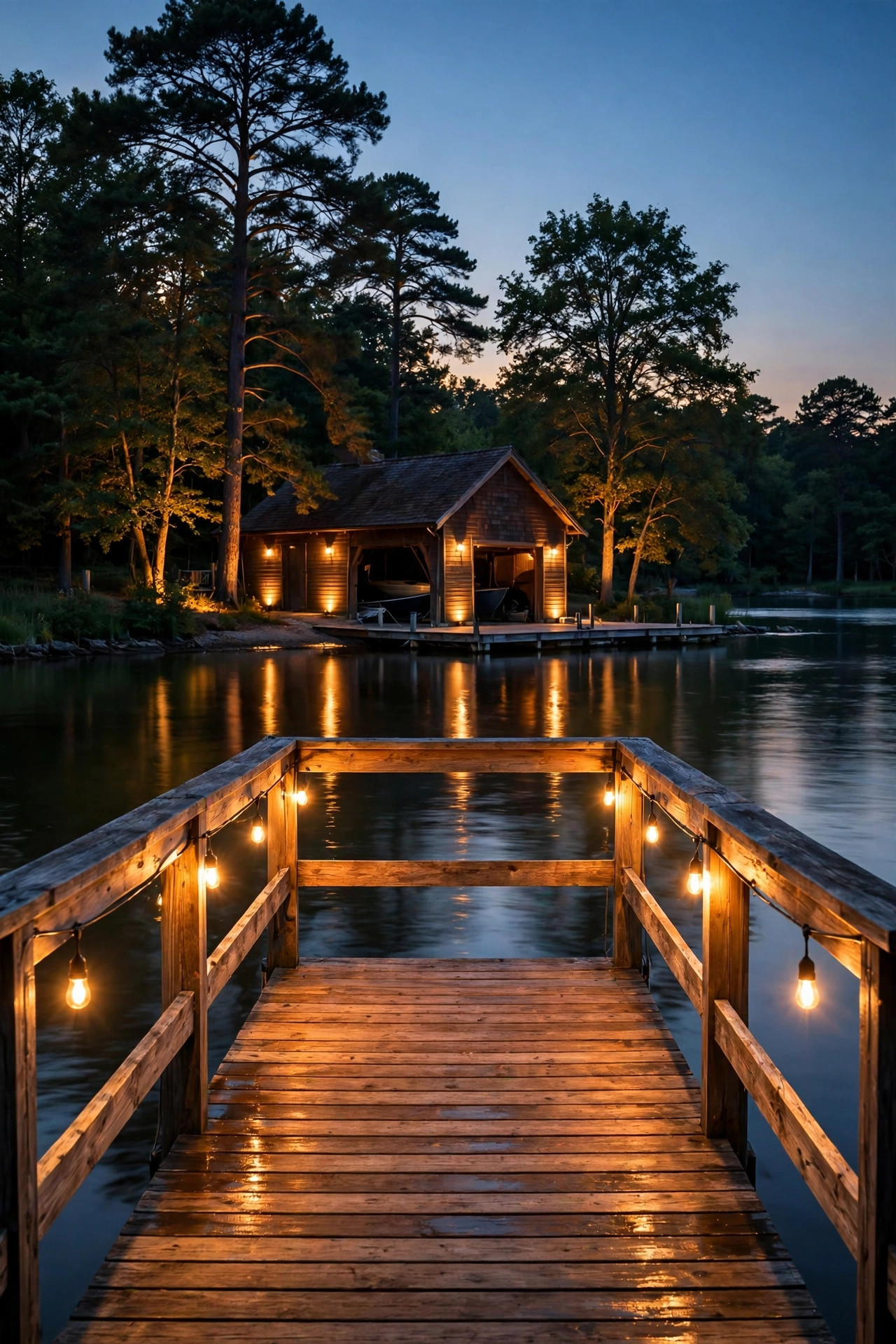
6. Swag String Lights Between the Dock Posts for Instant Party Mood
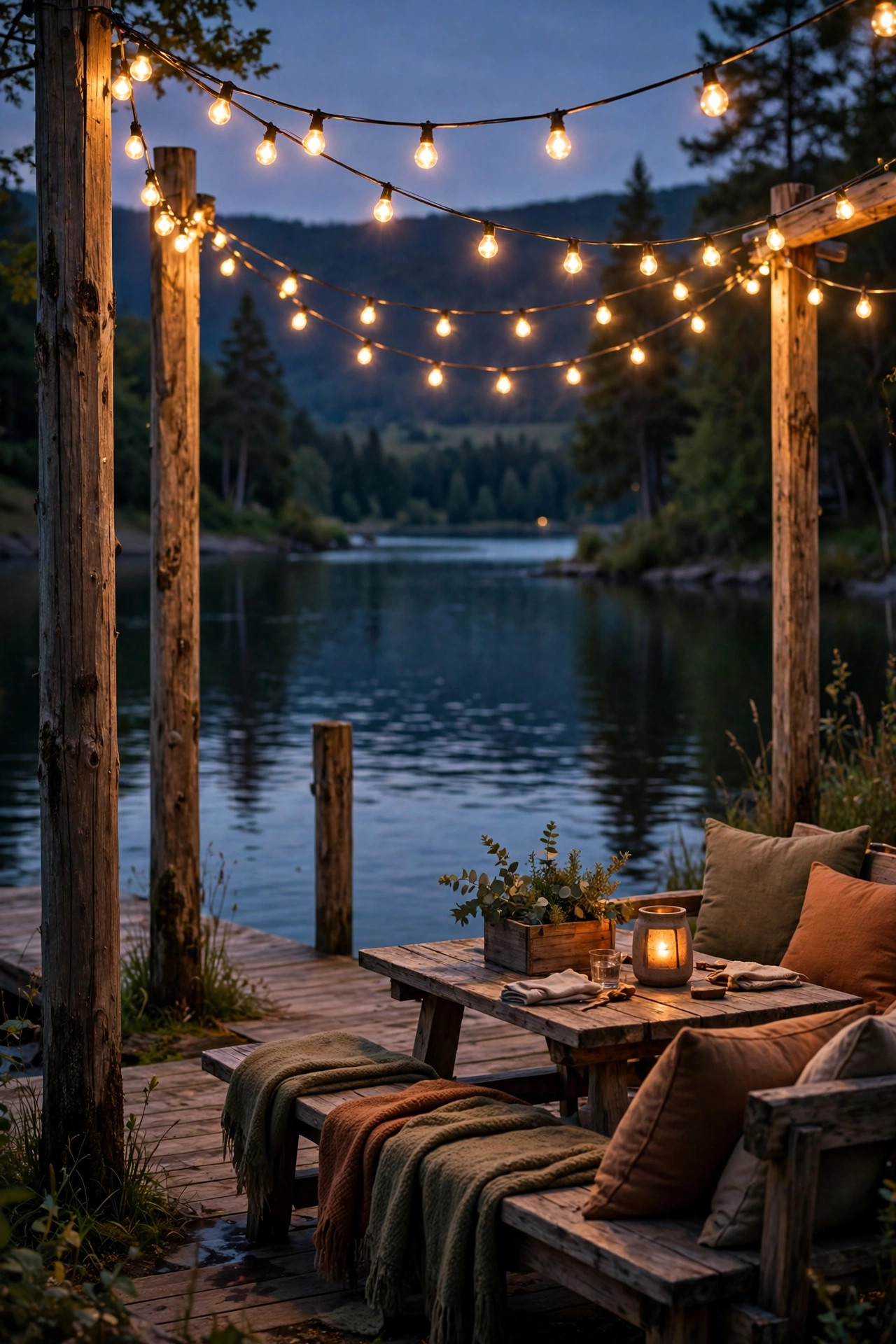
When the dock doubles as your evening living room, nothing beats string lights overhead. Run commercial-grade strands between the end posts, or from a taller center pole down to the corners in a gentle tent shape, and keep the lowest swag at least 7 feet above the deck so nobody clotheslines themselves carrying a paddleboard. Shatterproof LED bulbs are the only sensible choice over water; if one ever works loose, it floats and blinks instead of shattering across the boards. Support every run on a guide wire with clips, because bare cords sag, stretch, and chafe where they rub a post in the wind. Two 20-foot strands cross-lit over a seating area give you that restaurant-patio canopy, and on a dimmer they settle into a glow you can read by without killing the stars. Power them from the shore-end GFCI outlet on a timer, and store the strands indoors over winter if your lake freezes; UV and ice are the two things even good string lights quietly hate.
Suggested budget range: $45 – $130.
7. Put a Motion-Sensor Light at the Dock Entrance, Not the Middle
Motion lights are wonderful servants and terrible hosts, so put them where arrival happens and nowhere anyone lingers. Mine watches the shore-end entrance: step onto the dock after dark and a soft pool of light wakes up to greet you, then fades while you fish, talk, or watch herons in peace. Solar models with a separate panel suit most docks, since the panel can sit in full sun on shore while the fixture waits in shade under the first boards. Aim the sensor along the walkway, not across the water, or every passing wave and duck will trigger it all night. Set the run time to 30 to 60 seconds and the sensitivity a notch below enthusiastic. Choose warm white output to match the rest of your layers, and look for a fixture with a manual override for the evenings you want steady light while unloading the boat. Positioned this way, a motion light is also your quiet security system, announcing midnight raccoons and dock-wandering neighbors with equal fairness.
Suggested budget range: $25 – $80.

8. Run LED Strip Lights Under the Dock Edge for a Floating Effect
This is the trick that makes neighbors slow their boats down: a waterproof LED strip hidden under the dock edge, washing the waterline with light. Mount the strip in an aluminum channel under the rub rail or along the inside face of the outer boards, facing down, so you see the glow and never the source. The dock appears to float on a cushion of light, and the edge, the most important safety line on the whole structure, becomes unmistakable from the water and the deck alike. Only use strips rated IP65 or better with fully sealed end caps, and keep every connection above the waterline inside a waterproof junction box. Low-voltage strips on a dimmer give you range: bright for docking the boat on a dark return, low for ambiance. One honest caution: run the strip along the sides guests board from, not across a swimming area, because swimmers should always have one completely dark, unlit side to climb out on without gear or cables nearby.
Suggested budget range: $40 – $120.

9. Anchor the End of the Pier With Lantern-Style Post Lights
Every dock deserves one exclamation point, and mine is a pair of lantern-style post lights at the far end. They mark the dock like a lighthouse in miniature, giving boaters a reference point and giving the seating area a warm focal glow to gather around. Mount them on the two end posts or on short dedicated posts, 36 to 48 inches above the deck, which puts the light at seated eye level where it flatters faces instead of glaring down scalps. Filament-style LED bulbs inside clear glass give you that gaslight flicker feel with none of the heat or mantles, and a seeded or lightly frosted shade softens the filament for anyone looking back from the water. Wired low-voltage lanterns stay consistent through a cloudy week, which matters for your signature fixture; solar versions trade a little reliability for a zero-wire install. Keep the pair matched and slightly dimmer than you first think. From shore at midnight, two warm lanterns at the end of a dark pier is the prettiest sight on the lake, and it is entirely yours.
Suggested budget range: $60 – $220.

10. Float Solar Globe Lights Near the Dock for Pure Whimsy
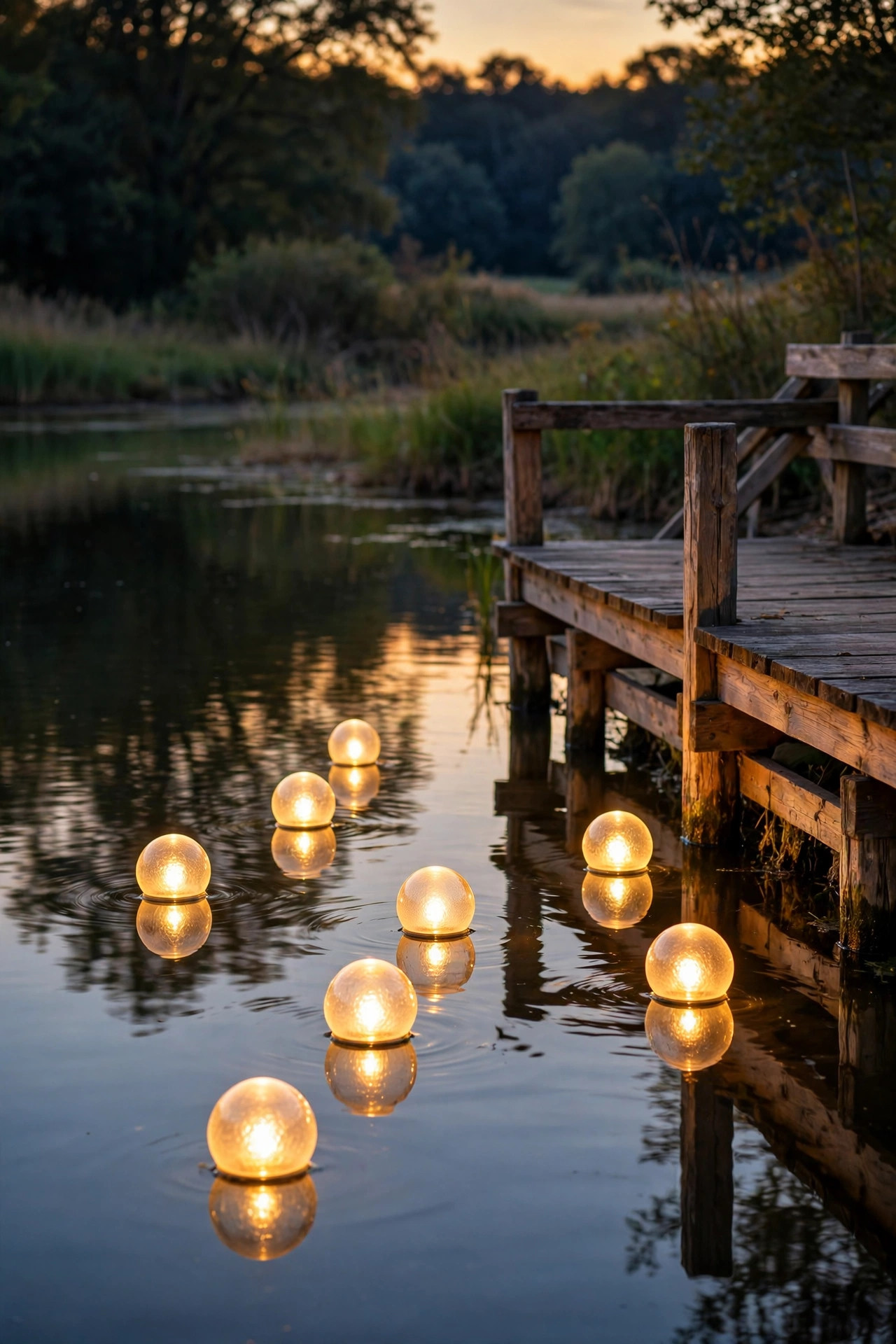
Not every light has to be serious. Solar floating globes, soft orbs that charge all day and glow on the water all evening, are the fastest smile I know how to install: charge them, switch them on, and set them afloat. Cluster three to five in the calm water alongside the dock, tethered loosely to a piling with fishing line so the cluster stays put without looking restrained. They read as moonlight that came down to visit, and on a still night the reflections double the effect for free. Respect two rules and these stay charming instead of chaotic: keep them out of swim areas and any route a boat actually travels, and bring them in ahead of storms, because a globe that escapes becomes lake litter with a battery inside. Battery life runs 6 to 8 hours on a full charge, so they fade politely around the same time the party does. For a holiday weekend, swap two globes to a soft red and green at the dock corners and you have decorated the whole lakefront in four minutes.
Suggested budget range: $30 – $90.
11. Keep Color-Changing Lights in Your Dock Lighting Ideas for Celebration Nights
Everyday dock light should be warm and calm, but a few color-changing fixtures turn the Fourth of July and birthday weekends into events. The tasteful way to do it: choose fixtures that live at warm white nearly all year and only go carnival when you ask, usually an underwater light or a pair of deck lights with remote-controlled color. Red, white, and blue under the dock on Independence Day is genuinely stirring reflected on black water, and kids consider a purple dock the height of civilization. Control them from one remote or app so changing the mood takes seconds, and set a household rule that colors stay inside your own shoreline, never flashing or strobing, which confuses boaters and annoys every neighbor within sight. This is also the one place I break my warm-white discipline on purpose for Halloween, when a deep green underwater glow under the dock turns the whole end of the pier deliciously haunted. Buy color as a feature of good fixtures, never as the fixture itself, and you will use the warm setting 95 percent of the time, happily.
Suggested budget range: $50 – $160.

12. Set Flush Solar Disk Lights at Corners and Cleats
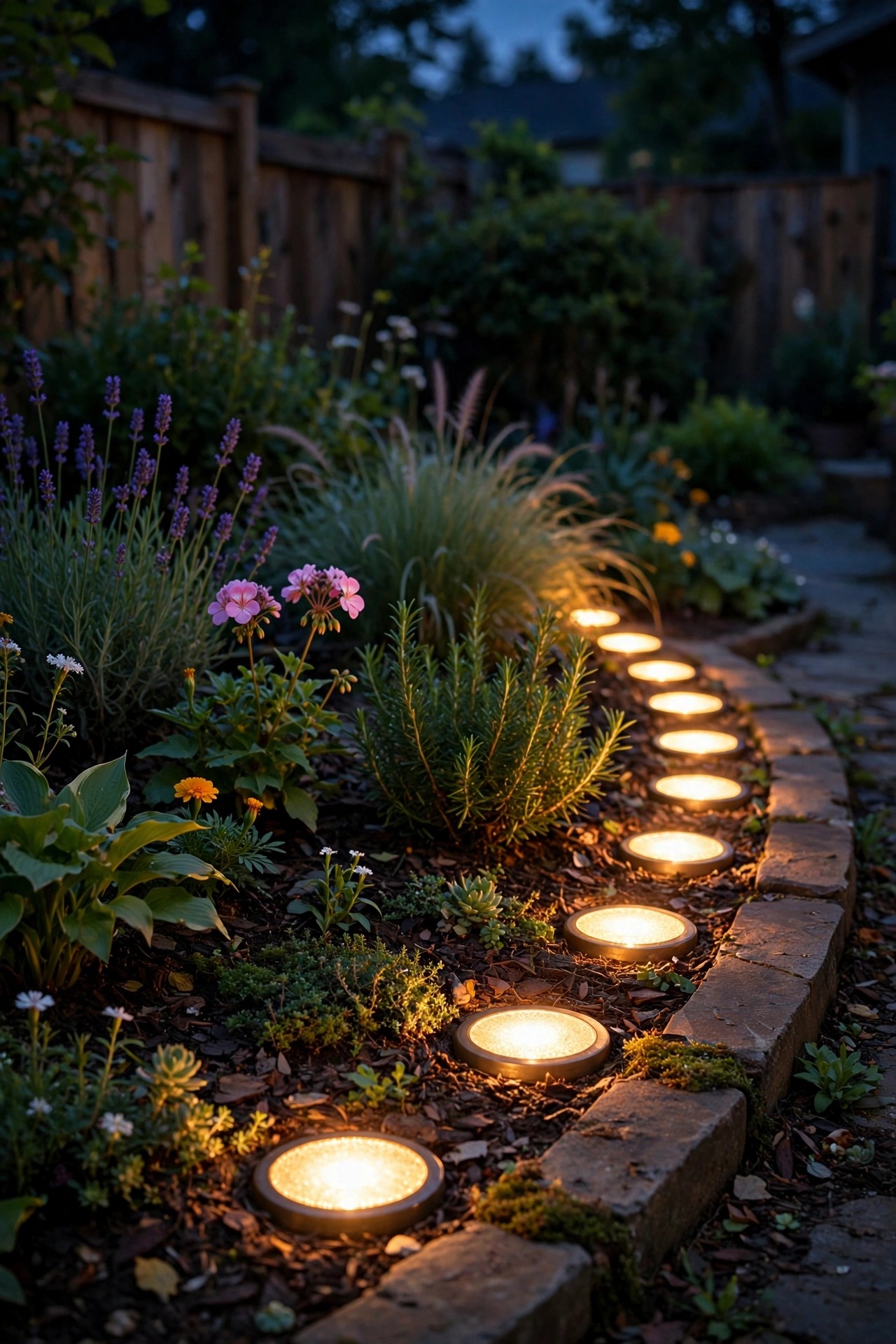
Solar disk lights sit nearly flush with the deck, glowing up from underfoot like runway markers, and they solve the stubbed-toe geography of a dock beautifully. Press or screw them into the boards at the four corners of every dock section, beside each cleat, and at the base of the swim ladder, all the invisible furniture your shins know by heart. Because they charge from the top, they need real sun, so place them on open boards rather than under benches or the shadow of a moored boat. Expect a modest glow rather than true illumination; that is the point. They define edges and obstacles in the dark without adding glare over the water. The better models carry a stainless or heavy composite ring and a replaceable battery, and survive being stepped on, which cheaper plastic disks, in my experience, do exactly once. Sweep sand off the little panels when you sweep the dock. Paired with post caps above, disks give your dock a two-height marking system that makes midnight dock-walking feel as obvious as strolling a lit garden path.
Suggested budget range: $30 – $85.
13. Choose Flickering Solar Flame Torches Over Real Tiki Flames
Real tiki torches near boats, fuel, and dry boards are a hard no from me, but the look, that dancing flame glow along the water, is half the romance of a dock evening. Solar flame torches deliver the look with an LED that flickers like fire and zero actual combustion. Mount them in torch holders clamped to the end posts, or stake the solar versions along the shore path where the dock begins, spaced 6 to 8 feet apart for a processional feel. The flicker effect works because the light moves, so give them sight lines: against dark water or trees they read as genuine flame from 20 feet away. Keep the count modest, four to six along a typical dock, or the effect tips from campfire to theme park. Almost all are solar with dusk sensors, so they light themselves as the evening starts and need nothing from you but an occasional panel wipe. On breezy nights when a real flame would blow out or worse, blow sideways toward the boat cover, these just keep dancing, safely and a little smugly.
Suggested budget range: $35 – $100.

14. Outline Railings With Rope Light for One Continuous Line
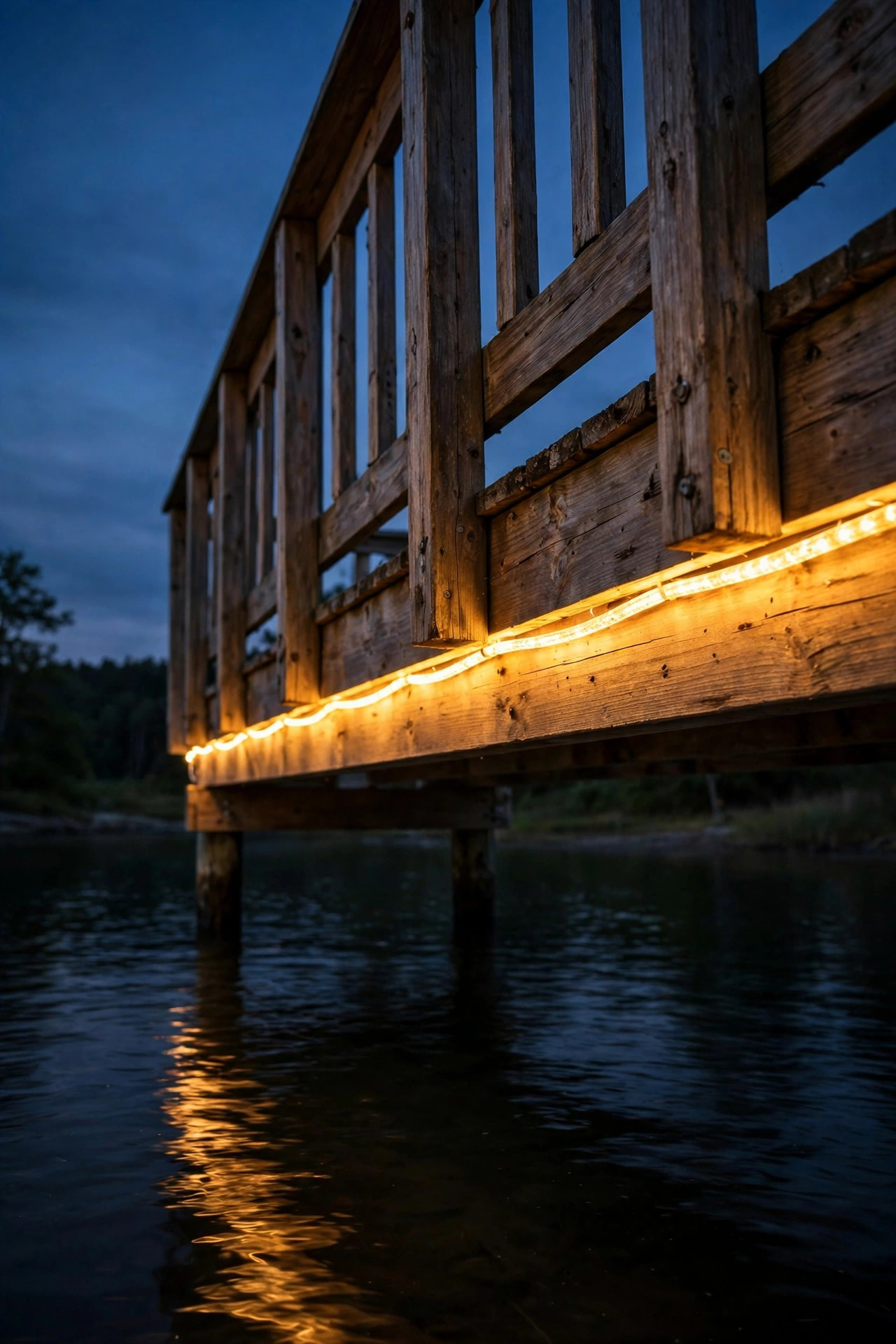
Where a dock has railings, along a gangway, around a swimming platform, or beside a roofed slip, rope light draws the whole shape in one unbroken warm line. That continuity is the safety value: in the dark, a railing you can see entirely is a railing nobody falls over or backs a boat trailer into. Clip the rope under the top rail on the inside face, every 12 to 18 inches, so the rail itself shields the source and the light washes down the balusters and deck edge. Use only rope rated for outdoor wet locations, keep every plug and splice well above splash height, and power it from the GFCI circuit like everything else on the dock. LED rope sips power, so a 30-foot run costs pennies a night on a timer. I keep rope light to railings and the underside of a dock roof edge, where its line reads architectural rather than festive. Combined with the low disks at your feet and caps at the posts, a roped railing completes a dock you can read at a glance from anywhere on shore.
Suggested budget range: $25 – $75.
15. Uplight the Shoreline So the Dock Sits in a Picture
Sometimes the prettiest dock light is not on the dock at all. A few well-aimed uplights on shore, washing a specimen tree, a stone retaining wall, or the boathouse gable, give the dock a backdrop and double the scene in the water reflection. Use narrow-beam spotlights staked 12 to 18 inches from the trunk or wall base, aimed steeply up so the beam dies in the branches instead of crossing the lake. Keep every shoreline light aimed at your own property and shielded from the water side; a spotlight sweeping a channel is rude and, for boaters, genuinely blinding. This is also where wired low-voltage earns its keep, since shore fixtures near the house can join your existing landscape system and share its timer. Two or three accents are plenty. The dock stays low and warm, the shoreline glows behind it, and the composition reads finished from every angle, including the one that matters most: sitting at the end of the pier with your feet in the water, looking back at home.
Suggested budget range: $45 – $150.
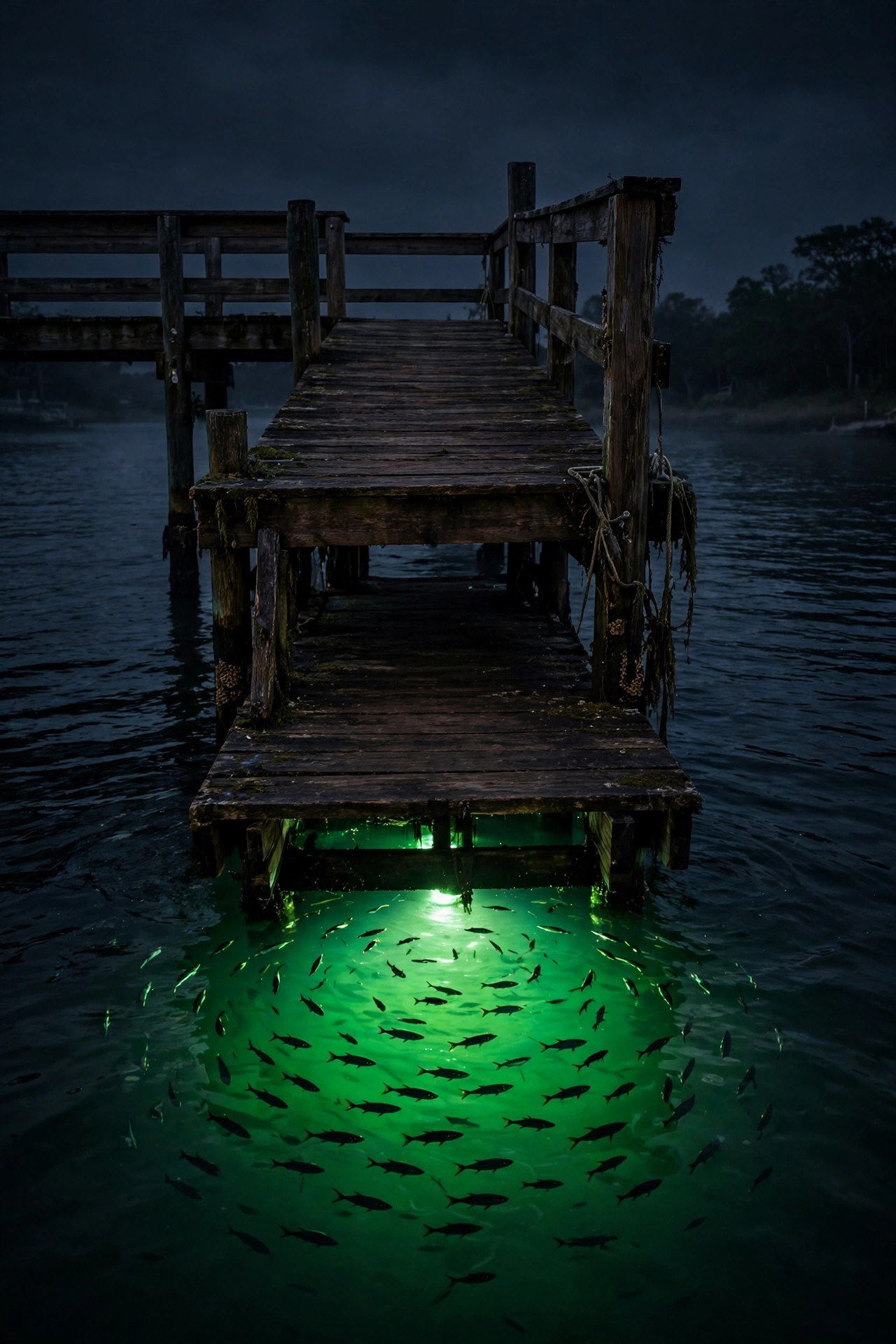
16. Hang a Green Underwater Fishing Light Off the End
Ask any night fisherman on our lake and you will hear about the green light. A submersible green LED hung 3 to 5 feet below the surface off the dock end starts a whole food chain: plankton gather in the glow, minnows follow, and the bigger fish cruise the edges of the light like it is a buffet with a dress code. Mount it from the last piling on a weighted cord, keep the transformer and connections dry on deck, and only ever use fixtures sold for continuous submersion with a proper IP68 rating. Evenings, it doubles as entertainment, since watching baitfish swirl in green light beats most television. Two courtesies: check your local rules first, because a few waters restrict artificial fishing lights, and switch it off when you head in rather than running a green beacon all night for the whole lake to see. Paired with warm white above deck, you get the best contrast on the dock: amber where people are, emerald where the fish are, and a very good reason for one more cast.
Suggested budget range: $60 – $180.
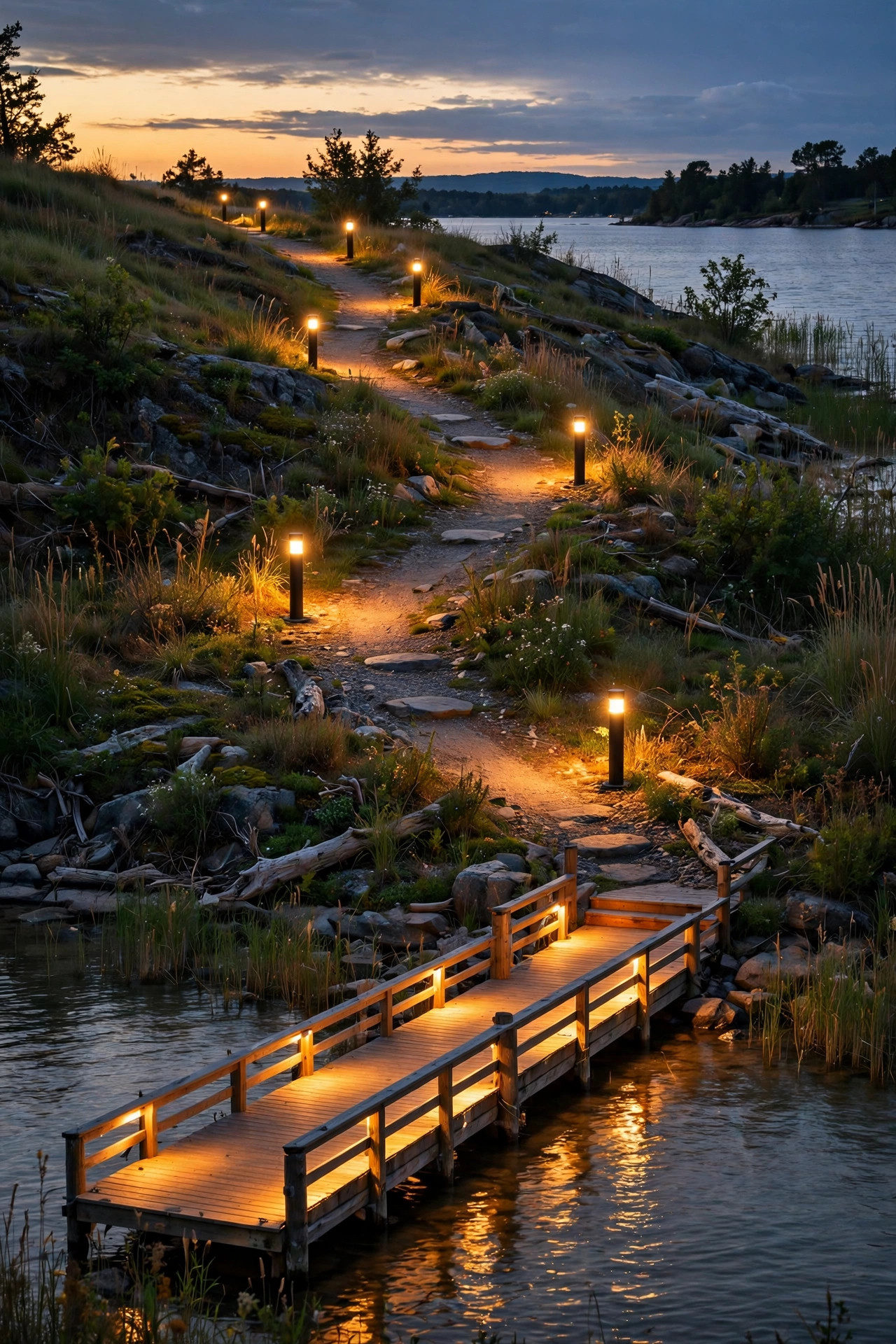
17. Light the Shore Path With Low Bollards So the Journey Matches the Dock
A beautifully lit dock at the end of a blackout yard path is a punchline waiting to happen. Low bollard lights along the walk from house to shore complete the trip, standing 18 to 24 inches tall and spacing every 8 to 10 feet, staggered side to side so the pools of light overlap without a runway feel. Choose louvered or downward-shielded bollards that throw light onto the path surface instead of into eyes, and keep the same warm temperature as the dock so the whole route reads as one system. Solar bollards handle sunny paths fine; shaded, tree-covered routes do better wired, and since this run usually starts at the house, borrowing the porch circuit is often simple. Watch your step edges here too: any grade change, root, or stone step on the path deserves its bollard placed right at it. When guests arrive after dark for a dock dinner, this path does quiet hosting work, guiding them down lit and dry-shod, with the glowing pier ahead doing the inviting. First impressions start at the back door, not the waterline.
Suggested budget range: $70 – $240.
18. Put Everything on Timers and Photocells, With a Lights-Out Hour
The best dock lighting system is the one nobody has to remember. A photocell or astronomical timer at the transformer brings your wired layers on at dusk without any seasonal fiddling, and solar fixtures mostly handle themselves. What I insist on, and what separates considerate docks from light pollution, is a lights-out hour: set the main layers to rest from about 11 p.m. to dawn, leaving only the low disks and a cap or two burning as night markers. Waterfront dark matters. It protects the night sky everyone came for, gives fish and wildlife a true dark period, and keeps faith with neighbors whose bedrooms face your dock. An astronomical timer that tracks sunset through the year is a small upgrade that pays for itself in never hearing a complaint. Keep one manual override switch at the shore end for late arrivals and early fishing departures. Automate the routine, keep the exceptions easy, and your dock will be the one on the lake that glows warmly at nine and sleeps politely by eleven.
Suggested budget range: $15 – $60.

19. Tuck Strip Light Under Dock Benches and Storage Boxes
Built-in benches and dock boxes are standard furniture on a working dock, and the shadow underneath them is where dropped hooks, sunglasses, and toes go to be lost. A short run of waterproof LED strip under the bench lip or the lid edge of a storage box turns that dead shadow into a soft pool of useful light, aimed straight down at the deck where your feet and gear actually are. Because the strip hides under an overhang, it stays out of weather and splash, which stretches its life well past exposed fixtures. Wire it with the recessed deck circuit if you have one, on the same dimmer, so the whole ground layer rises and falls together. This is also lovely task light for the unglamorous jobs: coiling lines, sorting tackle, finding the sunscreen that rolled away. Keep the strip warm white to match, and mount it a few inches back from the edge so the source never shows. It is a small, cheap detail, and it is the one every guest eventually comments on, usually while easily finding something they dropped.
Suggested budget range: $30 – $95.

20. Hold One Warm Color Temperature Across the Whole Dock
Here is the discipline that separates a designed dock from a collection of fixtures: every light, from post cap to underwater halo, lives between 2700K and 3000K. Mixed temperatures are what make docks look accidental: a blue-white solar cap beside a golden lantern beside a greenish deck light, each fighting the others and all of them glaring off the water. Warm white also wins practically on the water. It draws noticeably fewer insects than cool white, flatters skin and wood, and reads as firelight, which is the feeling every dock evening is chasing. When you buy replacements or add a layer, check the Kelvin number on the box the way you would check a paint swatch, and keep spares of your chosen temperature in the dock box. The one exception I allow is the dedicated green fishing light, which is a tool, not decor. Everything else holds the line. Stand on shore on the first finished night and squint: if the dock reads as one warm chord instead of several competing notes, you did it right.
Suggested budget range: $0 – $40.

21. Finish With a Full-System Night Walk, Your Favorite Dock Lighting Ideas Working Together
The last step of every dock project at our place is the same: a slow walk at full dark, coffee or something stronger in hand, looking at the whole system the way a guest and a boater would. Start from the water side if you can, floating out and approaching your own dock; you will spot glare, dark gaps, and any fixture beaming somewhere it should not within one pass. Then walk the boards slowly, checking that edges, steps, the gangway, and the swim ladder all read clearly at ankle height, and that no light shines straight into your eyes anywhere along the route. Adjust angles, swap the one bulb that came out cooler than its siblings, and dim the ambient layer until the underwater glow just balances it. This is where dock lighting ideas stop being a shopping list and become a place: post caps above, disks at your feet, lanterns at the end, and the water itself holding the reflection. Take the photo. Then sit down at the end of the pier, because honestly, you have earned the best seat on the lake.
Suggested budget range: $0 – $50.

Frequently Asked Questions
What color light is best for dock lighting?
Warm white, between 2700K and 3000K, wins on every count for a dock. It looks like firelight against wood and water, flatters people, and attracts noticeably fewer insects than cool blue-white light, which matters enormously over water on a summer night. Warm light also glares less off a wet deck. The one purposeful exception is a green underwater fishing light, which draws baitfish. On saltwater coasts with nesting sea turtles, switch to long-wavelength amber fixtures during nesting season and follow local ordinances, which many beach communities now require.
Are solar dock lights bright enough, or do I need wired?
Solar is genuinely enough for the marking and ambient layers: post caps, disks, flame torches, and step lights on a sunny dock perform beautifully and cost nothing to run. Where solar falls short is consistency, after two or three cloudy days, and in true task lighting at a boat lift or cleaning station. My usual recipe is a hybrid: solar for caps and accents, one low-voltage wired run for recessed deck lights, steps, and anything safety-critical. That blend keeps the must-work lights working in any weather while solar handles the easy wins.
Will dock lights bother fish, wildlife, or my neighbors?
They can, which is why aim and timing matter as much as the fixtures. Keep light warm, shielded, and pointed down at your deck or under your own dock rather than out across open water, and most wildlife simply ignores it; fish actually gather under a gentle glow. Neighbors are bothered by glare and by lights burning all night, so a dusk-to-11 p.m. timer schedule solves nearly every complaint before it happens. If your lake has dark-sky or shoreline lighting rules, a quick check with the association keeps your project welcome.
Do dock lights need GFCI protection and special ratings?
Yes, anything wired near water plays by stricter rules, and this is the one area I never improvise. Line-voltage anything belongs on a GFCI-protected circuit, full stop, and many of us choose low-voltage systems for the dock itself precisely because 12-volt power is far more forgiving around water. Fixtures should carry wet-location ratings: IP65 or better above deck, IP68 for anything submerged, with marine-grade, corrosion-resistant hardware near salt water. If running a new circuit to the shore feels beyond your comfort, that part is a fair and wise place to hire an electrician.
Conclusion
A great dock at night is never about one hero fixture; it is about layers that agree with each other, warm light traced along every edge, honest brightness where hands and feet work, and a system polite enough to rest when the evening ends. Start with your plan, add the caps and markers this weekend, and let the underwater glow and lanterns arrive when they may. However far you take these dock lighting ideas, the measure of success is simple: nobody thinks about the lighting at all, they just keep saying yes to one more hour on the water. When you are ready to carry the same layered thinking up the hill, browse the rest of our outdoor lighting ideas here on the site and light the whole shoreline like it belongs together, because it does.