Some porches are just a place to shake off your boots, and some make you want to pull up a chair and stay until the fireflies finish their shift. The difference is almost always the light. The rustic porch lighting ideas I reach for again and again are not about buying a matched set from one catalog page. They are about layering warm, weathered-looking light at a few heights: a pendant over the door, lanterns at eye level, a soft glow down by the steps where feet actually land. Rustic style forgives a mix of galvanized metal, seeded glass, rope, and worn wood, as long as every bulb glows the same warm amber. In this post I will walk you through 21 ways I build that welcome, from barn pendants and gooseneck lights to mason jars and hurricane lanterns, with the practical details that matter: mounting heights, lumen counts, weather ratings, and what each layer really costs. Start with two or three, live with them a week, and add the next layer when the porch asks for it.
1. Start With Layers: Rustic Porch Lighting Ideas That Feel Collected
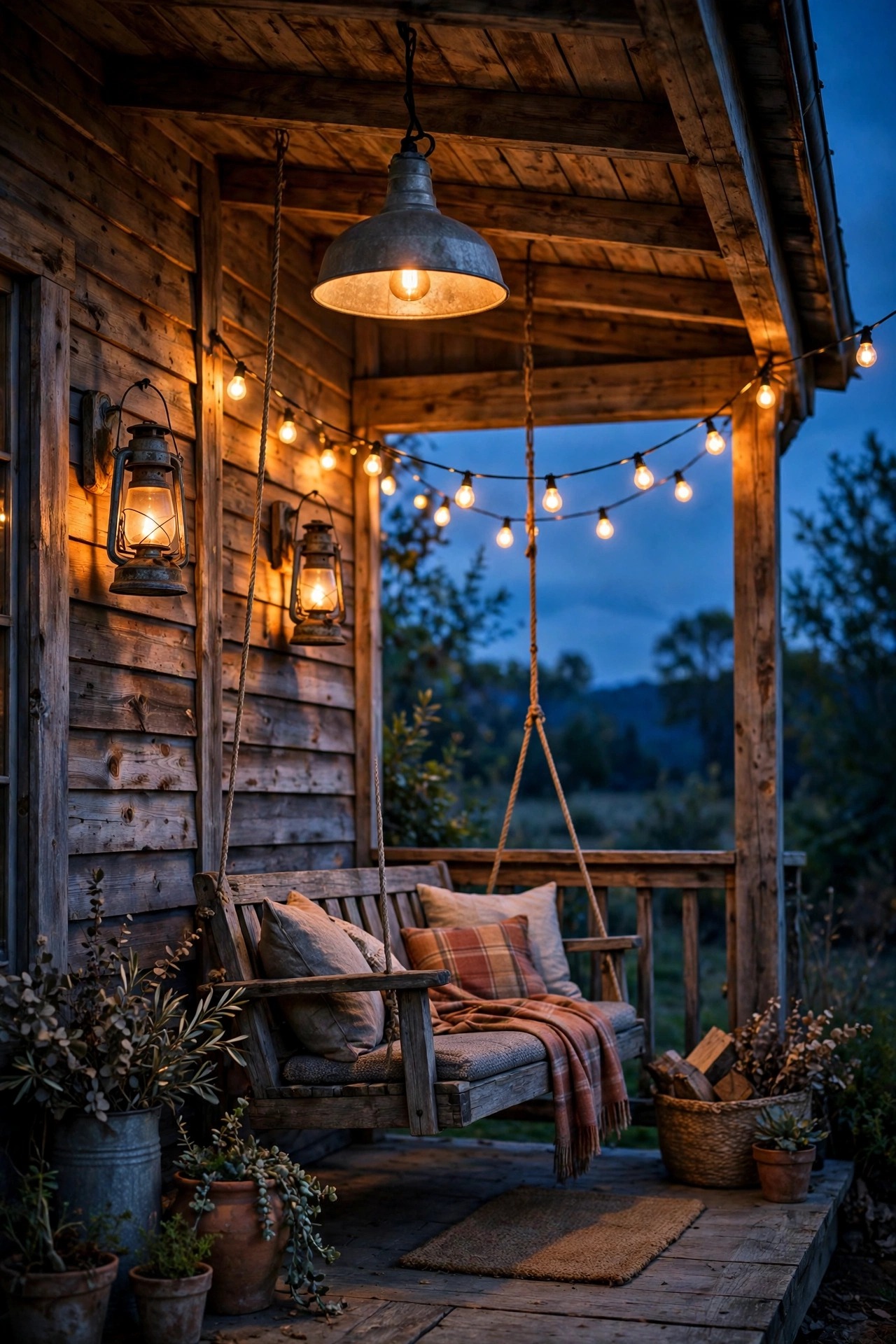
Every porch I love after dark is built on the same three layers at three heights. The low layer is guidance: gentle light at the steps, the walk edge, and the porch floor so guests see where their feet land. The middle layer is the welcome: sconces and pendants at eye level, right where faces are, because that is the light people read as friendly. The top layer is accent: a wash up a column, a glow along the beam, something that gives the eye a place to rest. Rustic style loosens the rules inside that formula. Your low layer can be solar lanterns instead of wired path lights. Your middle layer can mix a barn pendant with lantern sconces that clearly came from different decades. What keeps the mix from looking accidental is repetition and temperature. Repeat each material at least twice somewhere on the porch, and hold every single bulb to warm 2700K so galvanized metal, wood, and glass all read as one family. I sketch the three layers on paper first, marking the door swing, the steps, and where chairs actually sit. Build the middle layer first, since the door is where a porch does its hardest work.
Suggested budget range: $75 – $300.

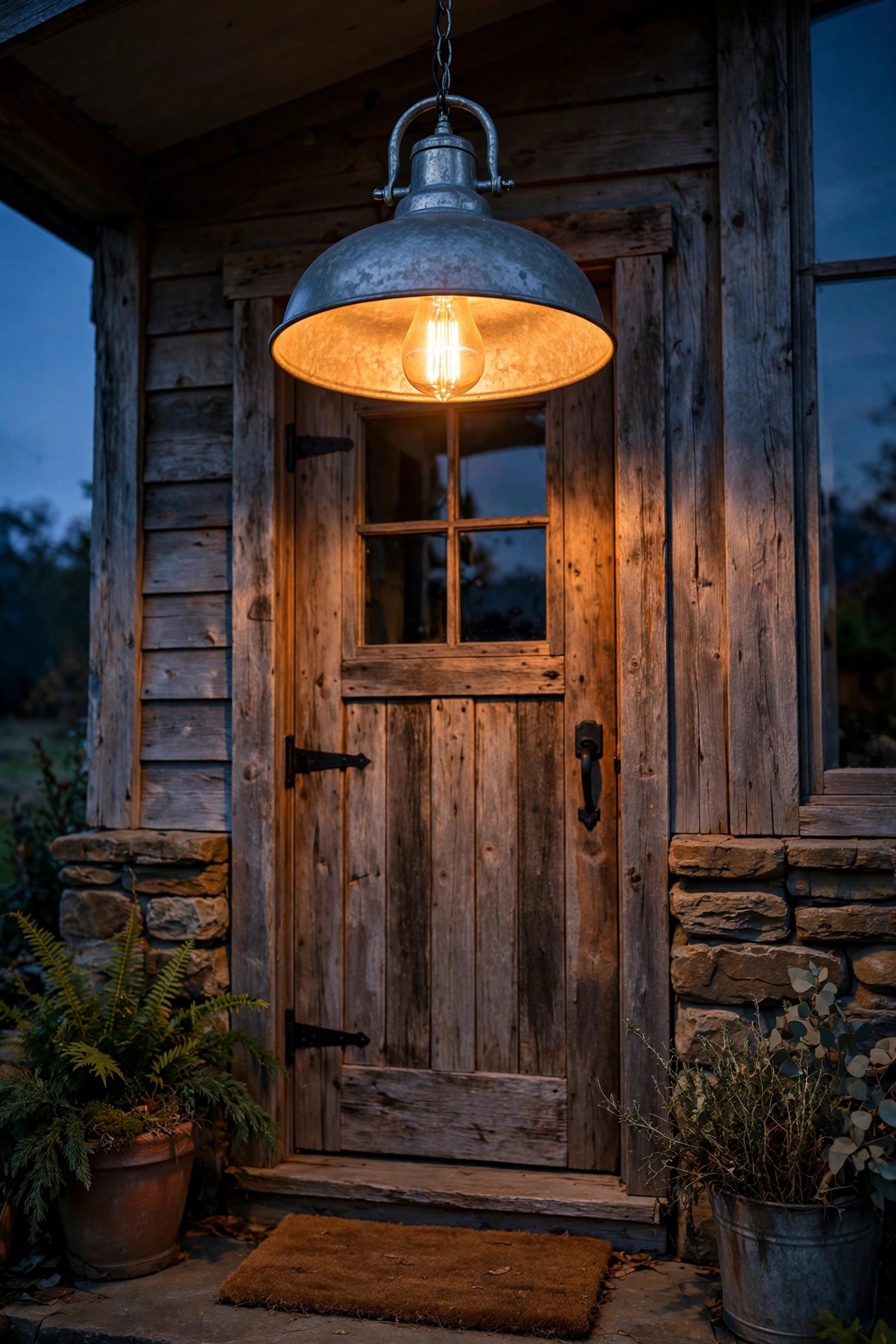
2. Hang a Galvanized Barn Pendant Over the Door
If a rustic porch gets only one hardwired fixture, I make it a barn pendant centered over the front door. Galvanized steel or oil-rubbed bronze with a wide 12 to 16 inch shade throws a generous pool of light exactly where keys, packages, and greetings happen. Hang it so the bottom of the shade sits about 6 feet 8 inches above the porch floor, high enough that a tall guest in a hat never feels crowded, and shorten the chain or rod rather than letting it droop into the door swing. Inside, I use a dimmable LED filament bulb around 800 lumens at 2700K, bright enough to find the keyhole and soft enough on a dimmer for evening sitting. On an open porch with no ceiling protection, choose a fixture rated for wet locations, not just damp, because wind-driven rain finds everything eventually. The look sits right between farm and lodge, and it pairs beautifully with the broader farmhouse porch lighting ideas I use when a porch wants a slightly cleaner finish. One pendant, centered and warm, does more for curb appeal than four mismatched fixtures ever will.
Suggested budget range: $45 – $160.
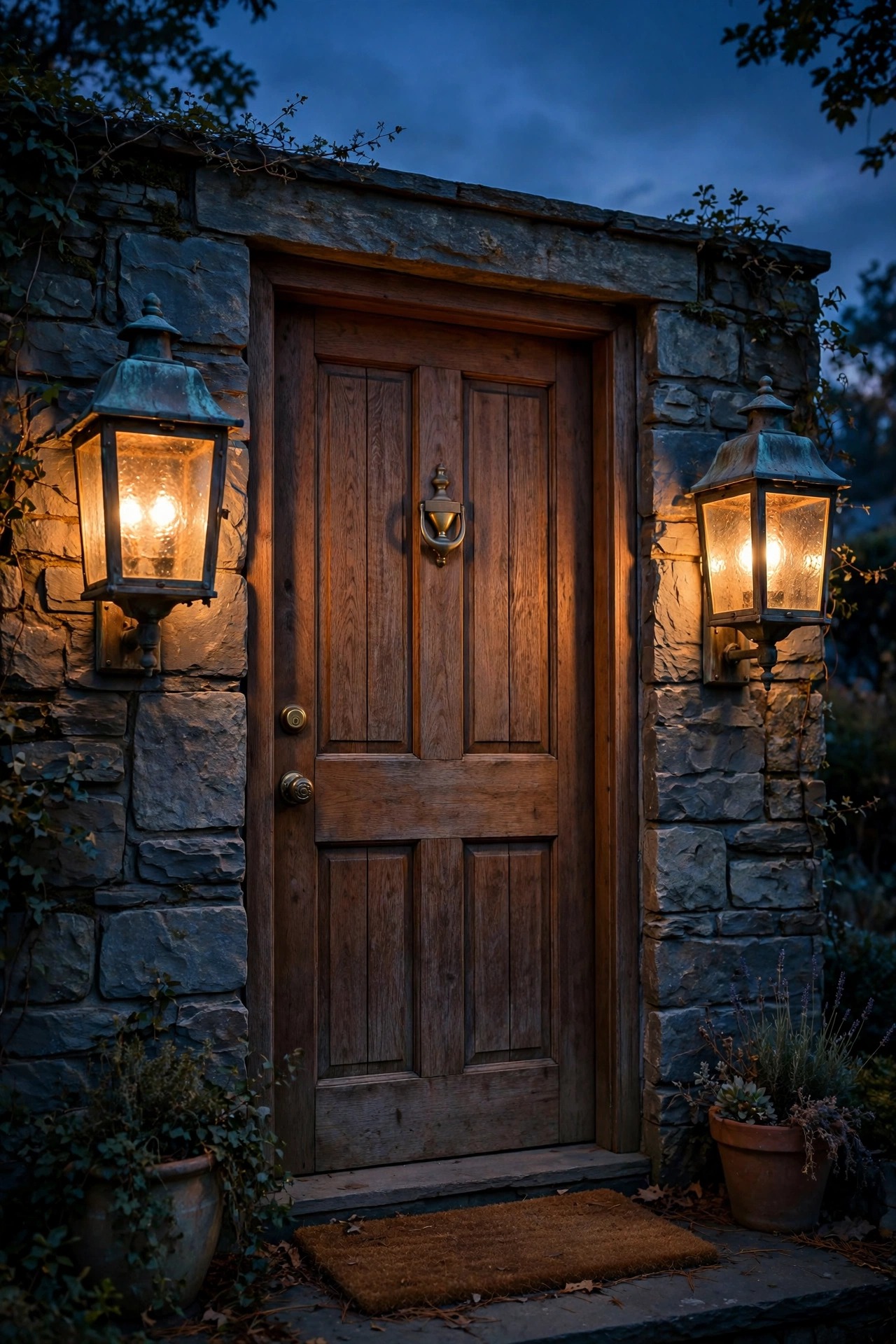
3. Flank the Door With Weathered Lantern Sconces
A matched pair of lantern sconces framing the door is the oldest trick in the porch book, and it still works because symmetry reads as intention. I mount mine so the center of each fixture lands about 66 inches above the porch floor, roughly eye level, and 6 to 9 inches out from the door casing so the light washes the trim instead of hiding behind it. Seeded glass is my favorite rustic choice here: the tiny bubbles scatter the light softly and, honestly, they hide dust and water spots far better than clear glass ever will. Use LED filament candelabra bulbs at 2700K, around 400 to 600 lumens each, so faces glow instead of glare. Finishes that weather gracefully, like oil-rubbed bronze, aged zinc, or matte black, will patina instead of peeling. If your porch only has one wired box beside the door, do not fake a pair with a lopsided twin. Hang the real sconce on the wired side and balance it with a battery lantern on a small wall hook opposite; at dusk, nobody can tell which one is hardwired.
Suggested budget range: $60 – $220.
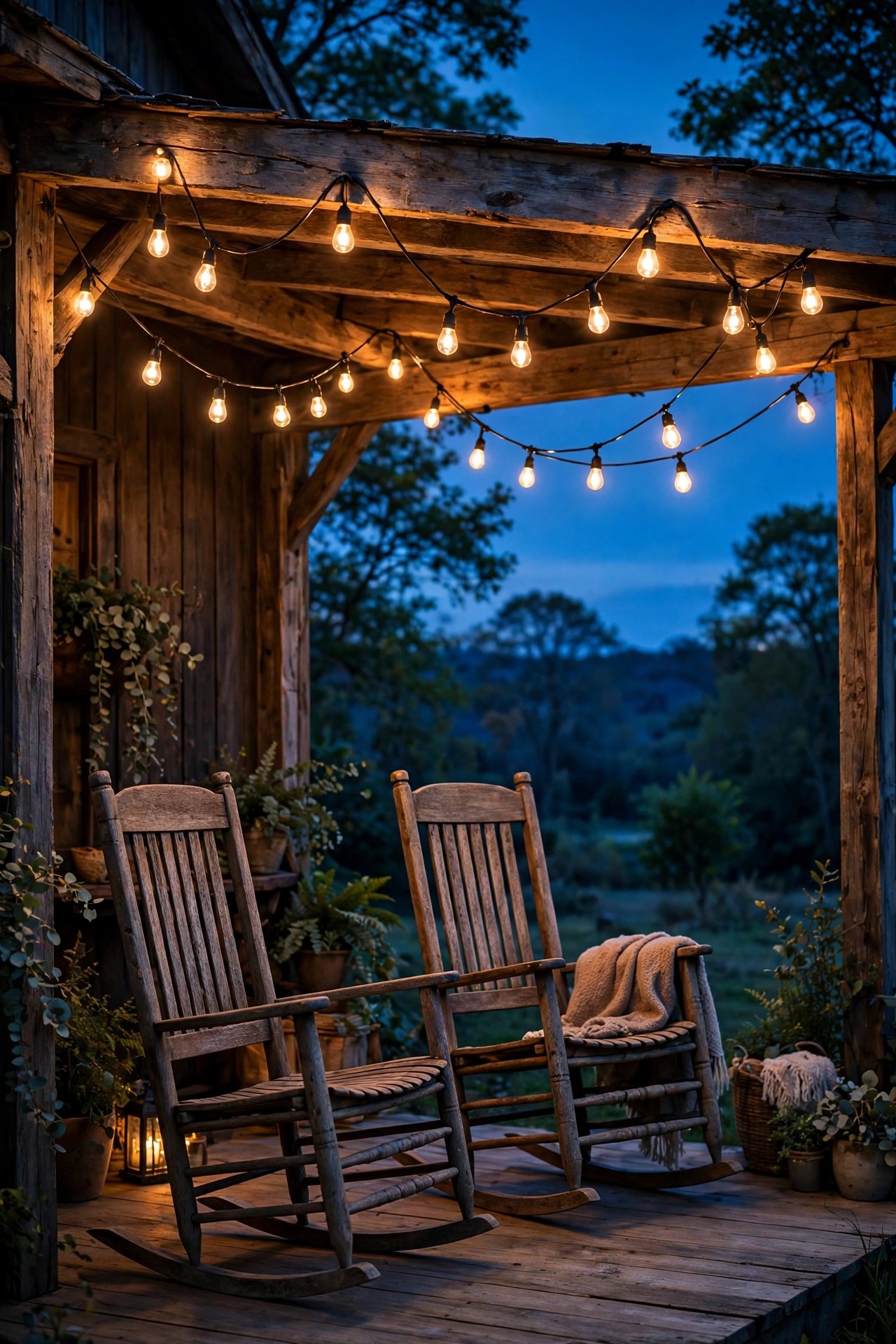
4. Drape Edison-Style String Lights Along the Beam
String lights turn a plain covered porch into the room everyone drifts toward after dinner. For a porch I choose commercial-grade strands with sockets every 12 to 18 inches and shatterproof LED filament bulbs, because the cheap residential sets yellow and crack within a season or two. Screw cup hooks into the front beam and ceiling joists, never staples through the cord, and let the strand sag just 3 to 6 inches between hooks. A porch wants a gentler swag than a backyard; too much dip reads saggy instead of relaxed at this smaller scale. Run one line along the front beam, then a return line along the joists so the glow spreads over seating instead of stopping at the edge. Keep the plug on a GFCI-protected outlet and put the whole run on a timer that clicks off at 11 p.m. Warm 2700K bulbs, or 2200K amber if you want full campfire mood, flatter wood tones beautifully. Leave a little slack at each socket in summer; cords contract on cold nights, and that small kindness keeps sockets from stress-cracking in January.
Suggested budget range: $35 – $110.
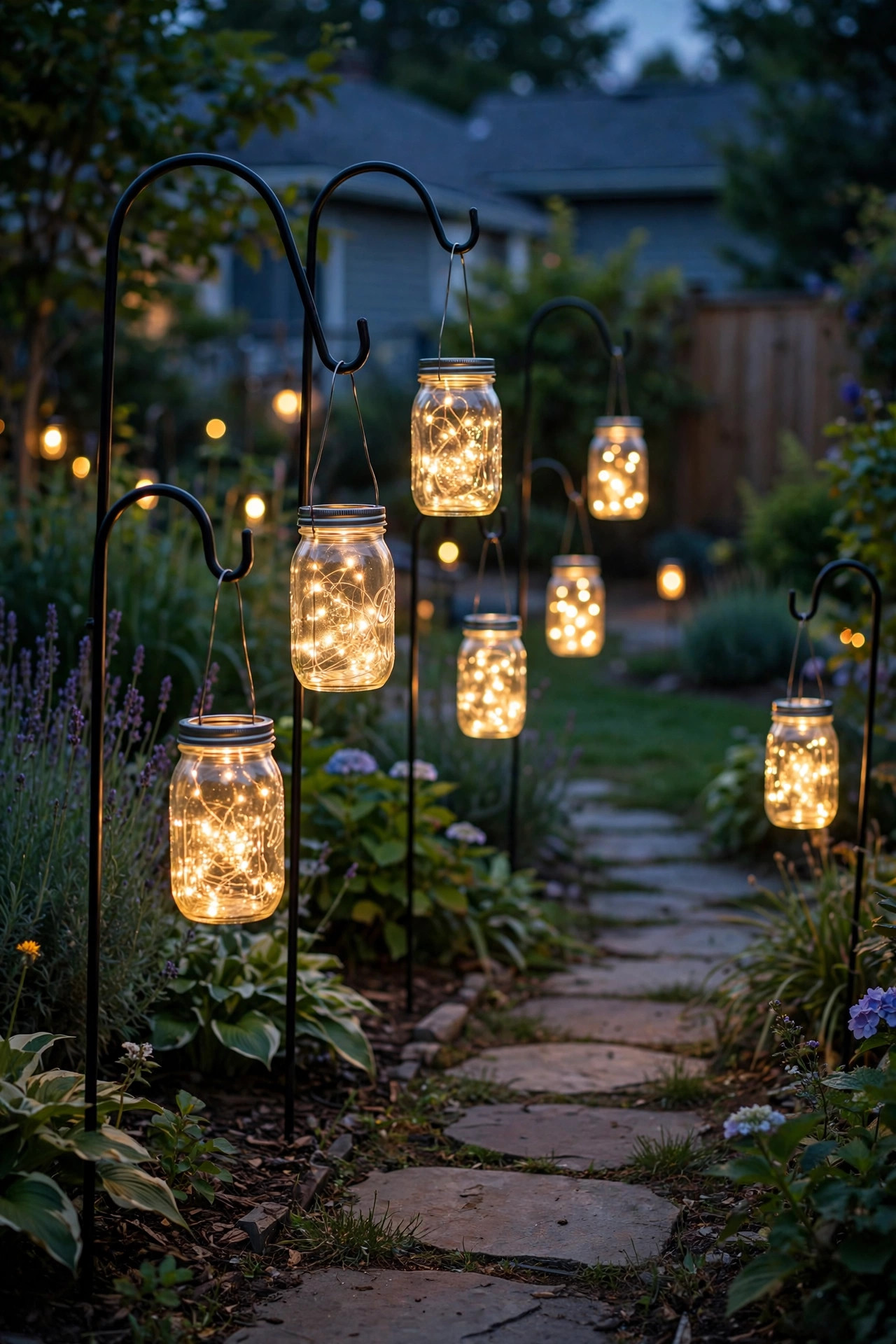
5. Cluster Mason Jar Lanterns on a Weathered Bench
Mason jars are the hardest-working rustic light I own. Fitted with wire handles and flameless LED candles, or with solar lids that charge on the railing all day, they cluster beautifully on a weathered bench, an old crate, or the wide corner of the steps. I group them in odd numbers, three or five, and vary the heights by setting jars on wood blocks or a slice of log so the cluster feels gathered rather than lined up. The flickering flameless candles are my default because real flame near porch cushions and dry wreaths makes me nervous, and the good LED versions are honestly hard to spot from the sidewalk. Jars also forgive weather that would kill fancier lanterns; a sudden shower just means dumping the water out in the morning. For parties, I fill a few jars halfway with dried beans or pebbles to anchor the candle and add texture. Keep spare solar lids in a drawer, since one lid always gives up mid-season. This is the cheapest layer on my porch, and it is the one neighbors ask about most.
Suggested budget range: $20 – $75.
6. Wrap It in Rope: Pendants and Lanterns With Texture
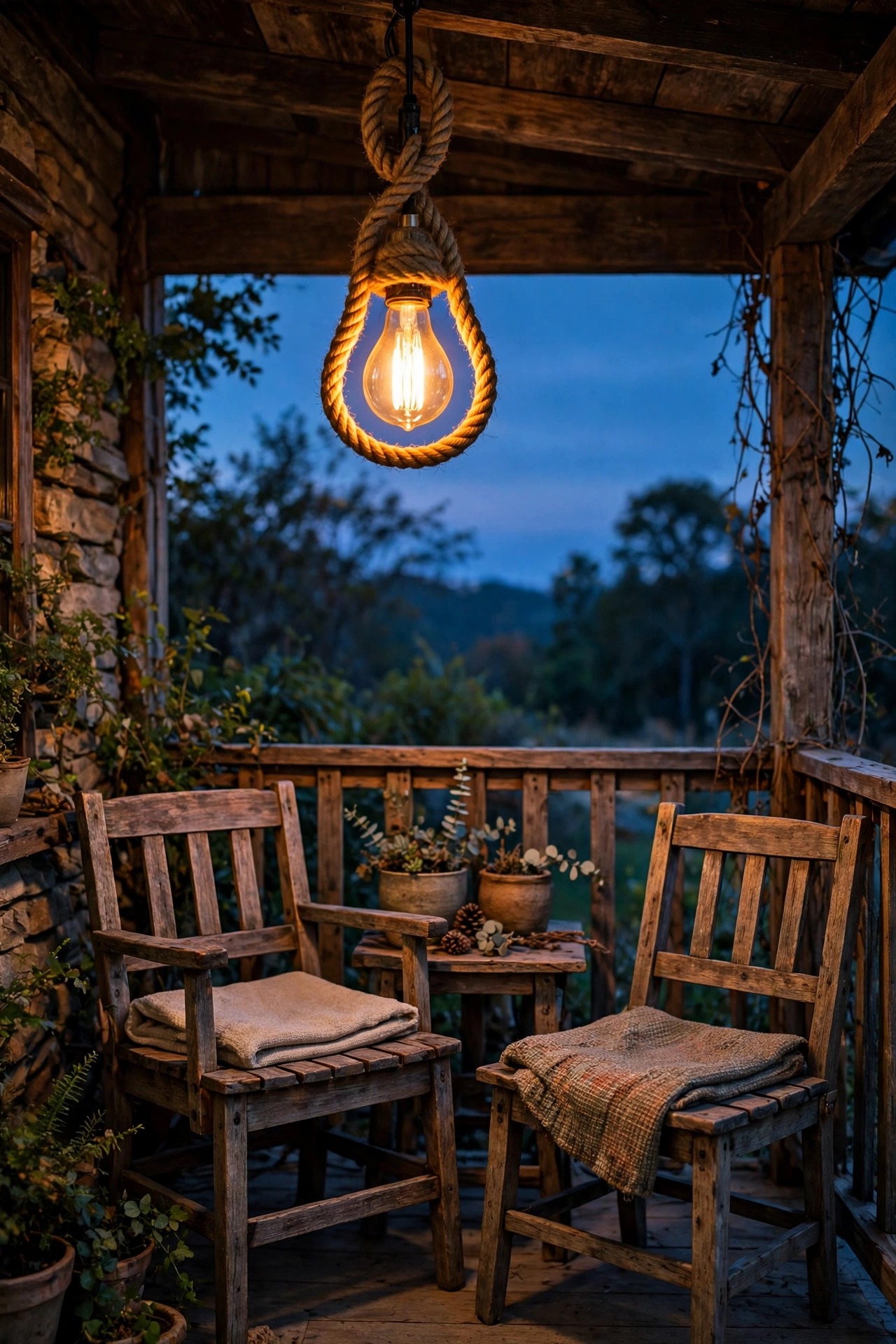
Rustic light is as much about texture as brightness, and rope is the fastest way to add it. A rope-wrapped pendant over a side table or porch seating corner softens metal and glass with that hand-worked, nautical-meets-barn feel, and the wrapped shade throws gentle patterned shadows at night. Manila or jute rope also covers a multitude of sins on thrifted fixtures; I have rescued more than one dated porch light with a hot glue gun and twenty feet of rope. Two rules keep this layer safe and pretty. First, LED bulbs only, and modest wattage equivalents at that, because rope and heat are not friends even through a shade. Second, choose fixtures rated for damp locations at minimum, since natural rope drinks humidity and can mildew on an open porch through a wet spring. If your porch is fully exposed to rain, look for rope-look shades molded from resin instead; they read as fiber from three feet away and shrug off weather for years. Pair one rope piece with your barn pendant and the whole porch suddenly looks collected on purpose.
Suggested budget range: $40 – $140.
7. Set Solar Lanterns on the Steps for Safe Footing
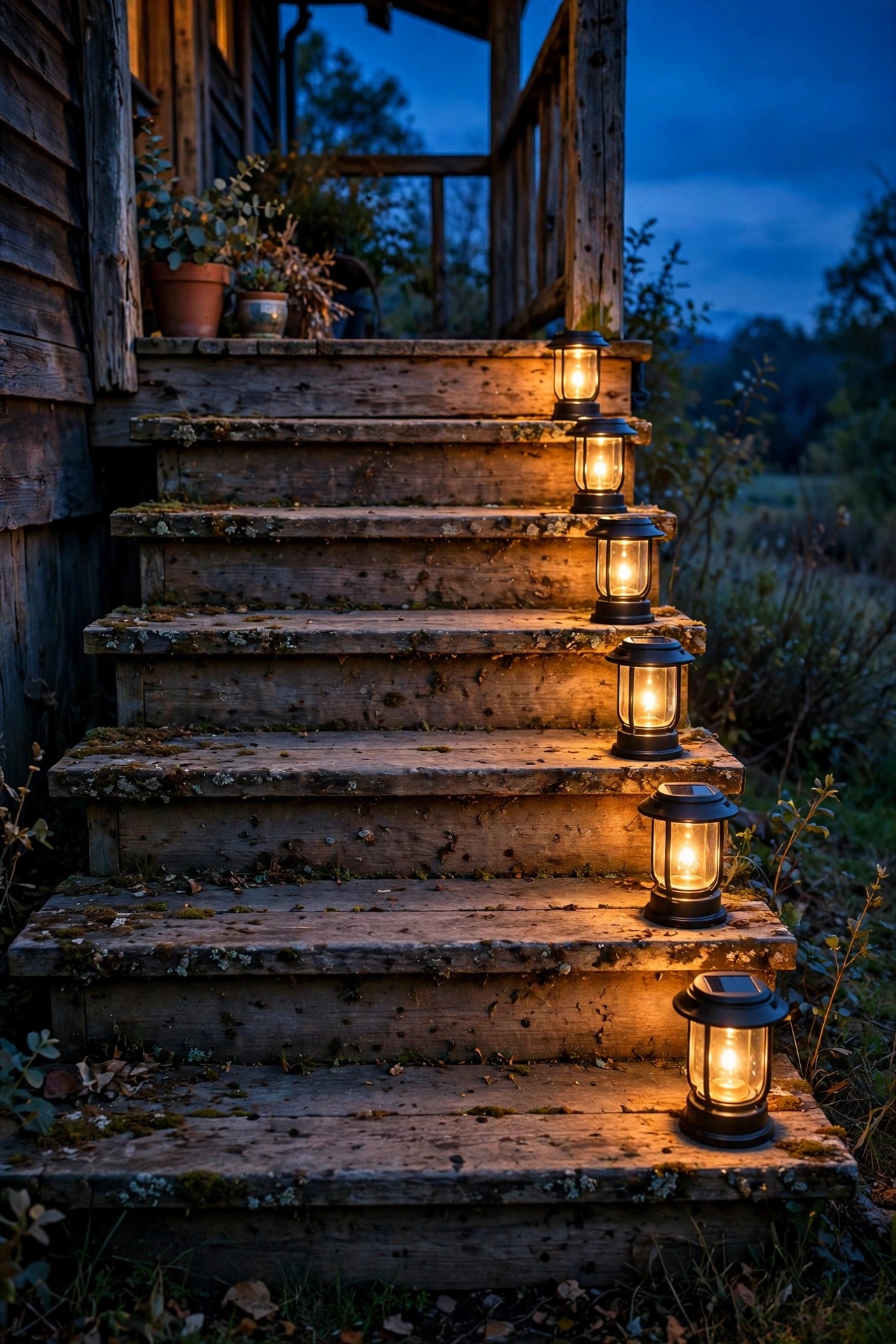
Porch steps are where guests trip, drop packages, and miss the edge in the dark, so I treat step lighting as safety first and decor second. Solar lanterns sized for a step corner, set on alternating sides or flanking the top and bottom treads, pool just enough light to read each edge. Shop carefully here: many bargain solar lights glow blue-white and feeble. I look for warm 2700K in the listing, at least 30 lumens, and a panel that can catch real sun. That last part matters, because a deep covered porch starves solar panels. My workaround is lanterns with a separate panel on a short cord, so the panel sits in a sunny bed while the lantern lives on the shaded step, or USB-rechargeable lanterns I top up monthly indoors. Mark the top and bottom steps even if you skip the middle ones; those two transitions are where ankles get lost. In my experience a $12 lantern that actually charges beats a $40 beauty that spends its life dim and disappointed.
Suggested budget range: $25 – $90.
8. Mount a Gooseneck Barn Light by the Side Door
Most porches have a second door that does the daily work: the side entry, the garage pass-through, the door the dog uses forty times a day. A gooseneck barn light is the perfect rustic fixture there. The curved arm reaches 12 to 18 inches out from the wall and throws light down and out, so you get a wide, useful pool instead of a bright dot on the siding. Mount it 7 to 8 feet up, centered over the door or just above the casing, and choose a shade wide enough to shield the bulb from view at ground level; bare-bulb glare is the fastest way to make a hardworking light feel harsh. I put mine on a photocell so it wakes at dusk and sleeps at dawn without me thinking about it. Match the finish to your front pendant, galvanized with galvanized or bronze with bronze, and the two doors suddenly belong to the same house. Wet-location rating is non-negotiable on this one, since side entries rarely enjoy a deep protective overhang.
Suggested budget range: $55 – $170.

9. Fill Galvanized Buckets With Flameless Candles
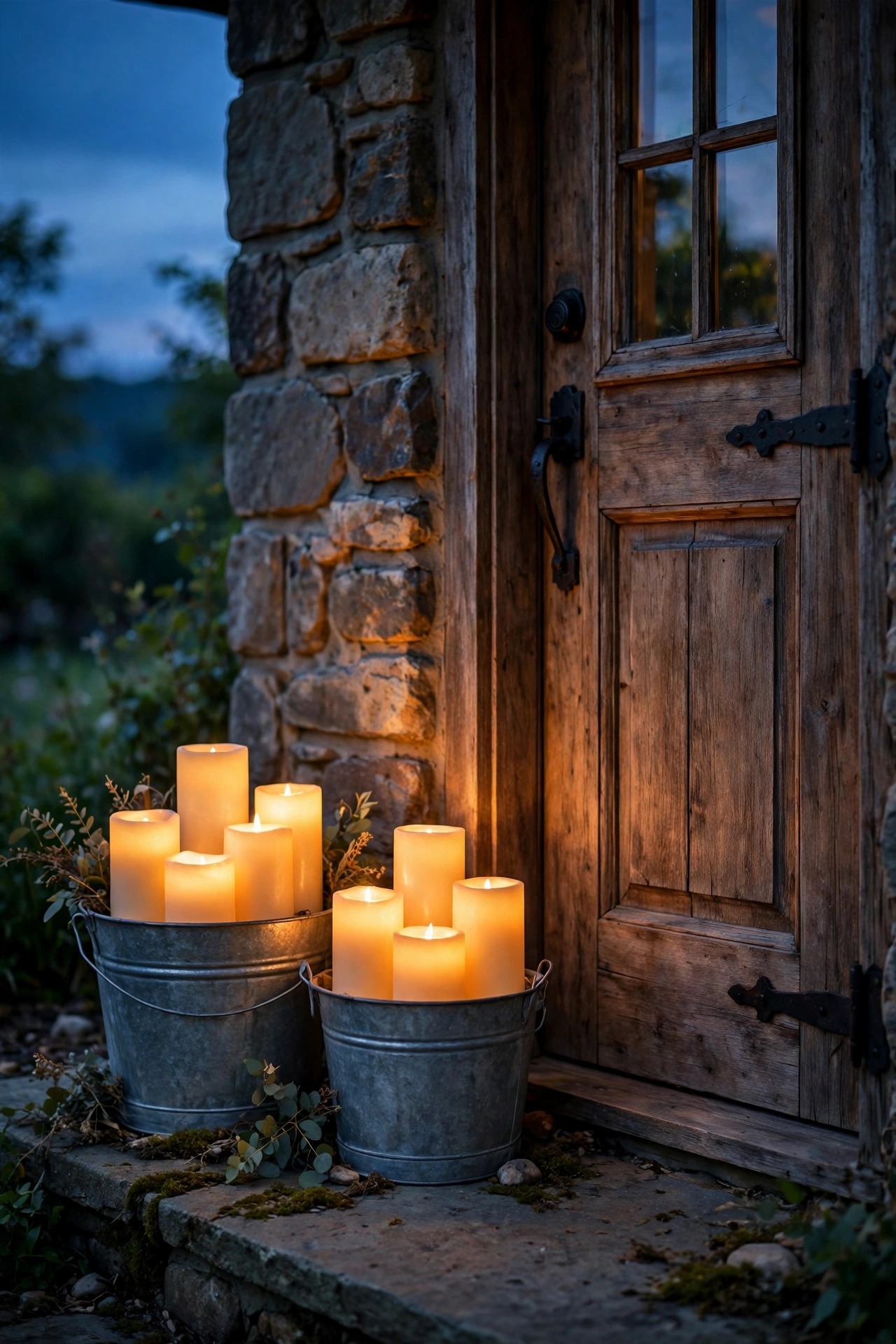
This is my favorite five-minute porch upgrade: a galvanized bucket or small tub, a few handfuls of gravel or sand for weight, and two or three flameless pillar candles nestled inside at different heights. Set one bucket beside the door and another at the foot of the steps, and the porch gains that low, firelight shimmer that makes everyone look good. The metal reflects the candle glow and doubles it, while the bucket walls block wind that would murder a real flame. Choose flameless pillars with a built-in timer, the kind that light themselves for five hours each evening, and mix 4, 6, and 8 inch heights for a gathered look. Because there is no flame and no cord, buckets are safe around kids, dogs, and the stack of delivery boxes that lives by every door in America. Refresh the fill seasonally: pinecones in winter, river stones in summer, dried corn in fall. It costs almost nothing, stores in a closet corner, and has survived three porch remodels at my house.
Suggested budget range: $25 – $80.
10. Give the Porch Swing Its Own Soft Glow
A porch swing in shadow is a porch swing nobody uses after dinner. The trick is to light the people, not the swing: a gentle glow behind and above the sitters, never a bare bulb in their eyes. I run a warm LED rope light along the underside of the top rail or beam behind the swing, so the light bounces softly and faces stay flattering. Copper-wire fairy lights woven loosely along the swing chains add a little sparkle for almost no money, and a battery lantern on the side table finishes the corner for readers. My full set of porch swing lighting ideas goes deeper on placement if your swing sits in an awkward corner like mine does. Keep cords off the floor entirely, tuck battery packs into a small weatherproof box behind a cushion, and test the glow from the street: if you can see the light source itself, it is too exposed. Done right, the swing corner becomes the most fought-over seat on the porch from May through October.
Suggested budget range: $30 – $120.

11. Hang a Wagon-Wheel Style Chandelier From the Beam
Big porches with real ceiling beams deserve one statement piece, and nothing says rustic welcome like a wagon-wheel style chandelier. Look for a wheel 24 to 36 inches across, scaled so it spans roughly half the width of your seating area, with candle-style sockets pointing up around the rim. Loaded with LED filament candelabra bulbs on a dimmer, it glows like a circle of low lanterns and photographs beautifully through the front windows. Hanging is the part to respect. The bottom of the wheel should clear 7 feet above the floor, and the chain must land on a proper ceiling box rated for the fixture weight; heavy wheels need a fan-rated brace box between joists, which is a one-hour job for an electrician if your porch ceiling is finished. Keep the finish honest: blackened iron or weathered wood tones, never shiny chrome pretending to be old. On a smaller porch, a half-scale wheel or a simple wood-beam fixture with three lantern pendants gives the same gathered-overhead feeling without overwhelming the space.
Suggested budget range: $150 – $450.

12. Carry the Glow Down the Walk With Rustic Path Lights
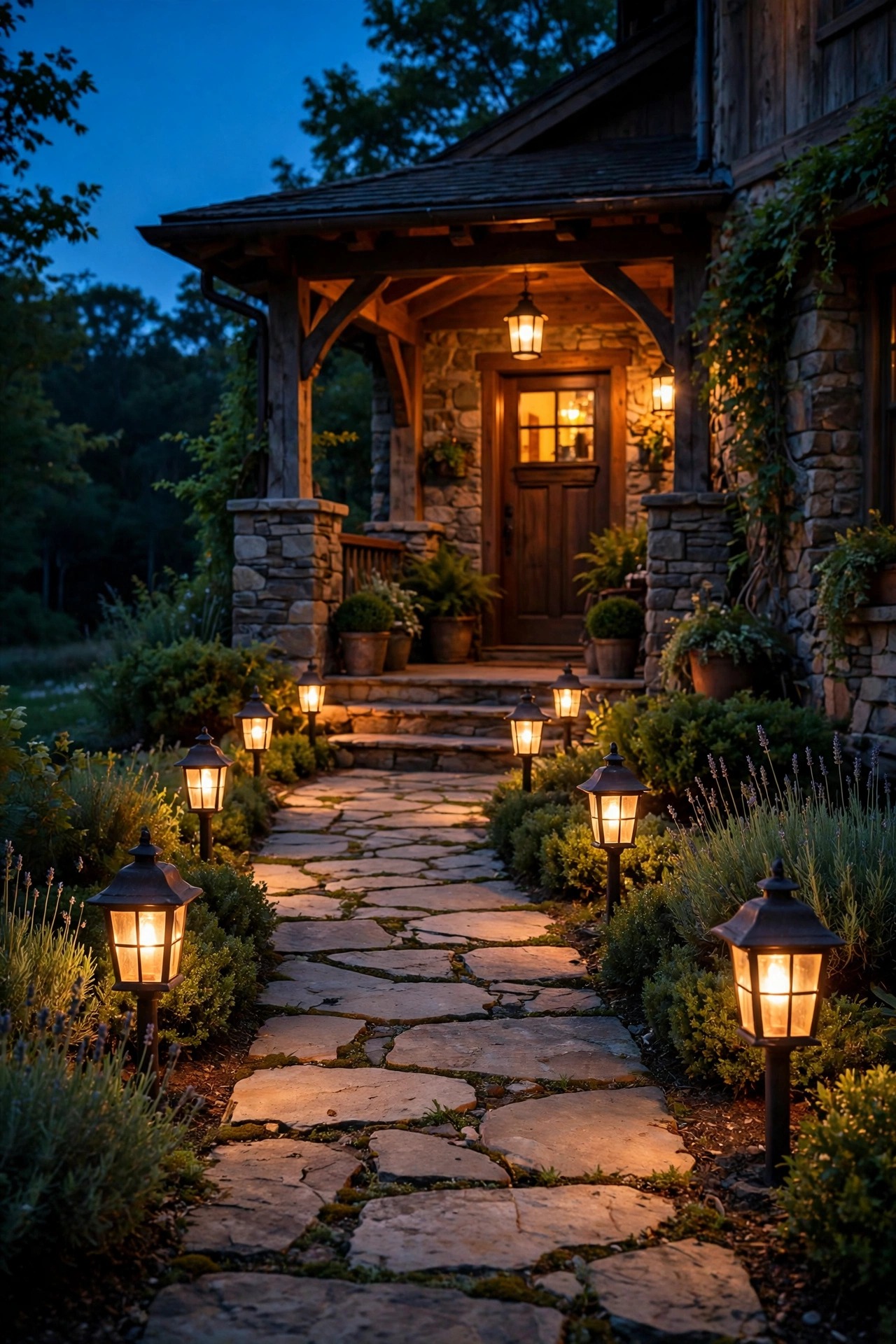
A beautifully lit porch floating at the end of a black walkway feels unfinished, so I always extend one low layer out to the street or driveway. Lantern-style or mushroom-cap path lights in aged bronze or copper that patinas over time keep the rustic story going. Space them 6 to 8 feet apart, staggered rather than mirrored, and set them about a foot back from the walk edge so light pools on the path instead of blinding from the grass. Each fixture only needs 100 to 200 lumens; path lighting is guidance, not stadium work, and restraint is what makes it look expensive. If your porch lights already run on a low-voltage transformer with spare capacity, tap into it so everything shares one timer and one warm temperature. For a short walk, good warm-toned solar stakes can do the job, but test one for a week before buying eight, because brightness and color vary wildly. Guests should feel guided from car door to porch swing without ever noticing a single fixture.
Suggested budget range: $80 – $300.
13. Choose Seeded Glass and Amber Filament Bulbs
If your rustic porch lighting feels almost right but slightly off, the glass and bulbs are usually the culprits. Seeded glass, the kind full of tiny bubbles, is the rustic workhorse: it softens glare, throws a gentle sparkle, and hides the dust and pollen that settle on every porch fixture by June. Clear glass shows every speck and every harsh diode. Pair it with LED filament bulbs, which mimic the warm loops of old carbon filaments without the heat or the electric bill. For lanterns and jars, 2200K amber filament bulbs give that oil-lamp glow that makes wood look richer. For the pendant and sconces where people actually need to see, 2700K keeps faces natural. One caution from experience: buy bulbs labeled with an actual Kelvin number, not just the words warm white, which can mean anything from candlelight to office beige. Check the color rendering too if you read on the porch; a CRI of 90 or better keeps book pages and faces true. This single refresh, new bulbs in old fixtures, is the highest-impact twenty dollars in this whole post.
Suggested budget range: $15 – $60.
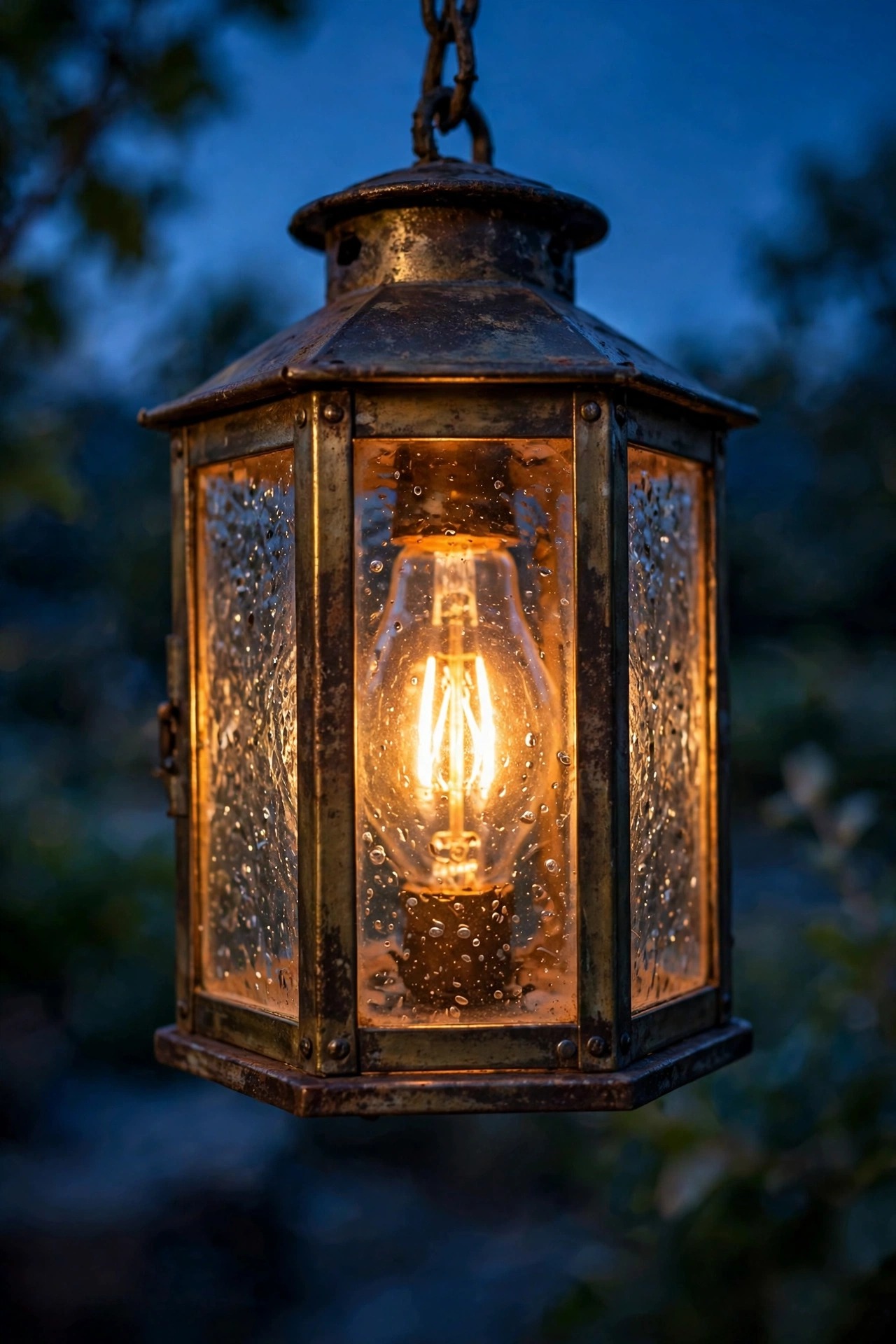
14. Add a Motion-Sensor Lantern Where Guests Arrive
There is a corner of every porch, usually by the steps or the driveway side, where a light is only needed when someone is actually there. A rustic lantern with a built-in motion sensor fills that gap without burning all night. Look for one styled like your other fixtures, with the sensor tucked discreetly under the cap, and set the range to about 15 to 25 feet so it catches the walk but ignores the street. Aim the sensor slightly downward, set the timer for one to five minutes, and test it from a guest's path, not your own, since you walk it differently. My favorite versions offer dual brightness: a low dusk-to-dawn glow that brightens when motion trips, which feels welcoming instead of alarming. Keep the lens clean; a cobweb across a sensor is the number one reason these lights seem to quit working. This is also the polite choice for light-sensitive neighbors, and in my experience it stops the porch feeling like a stage set at 2 a.m.
Suggested budget range: $45 – $130.
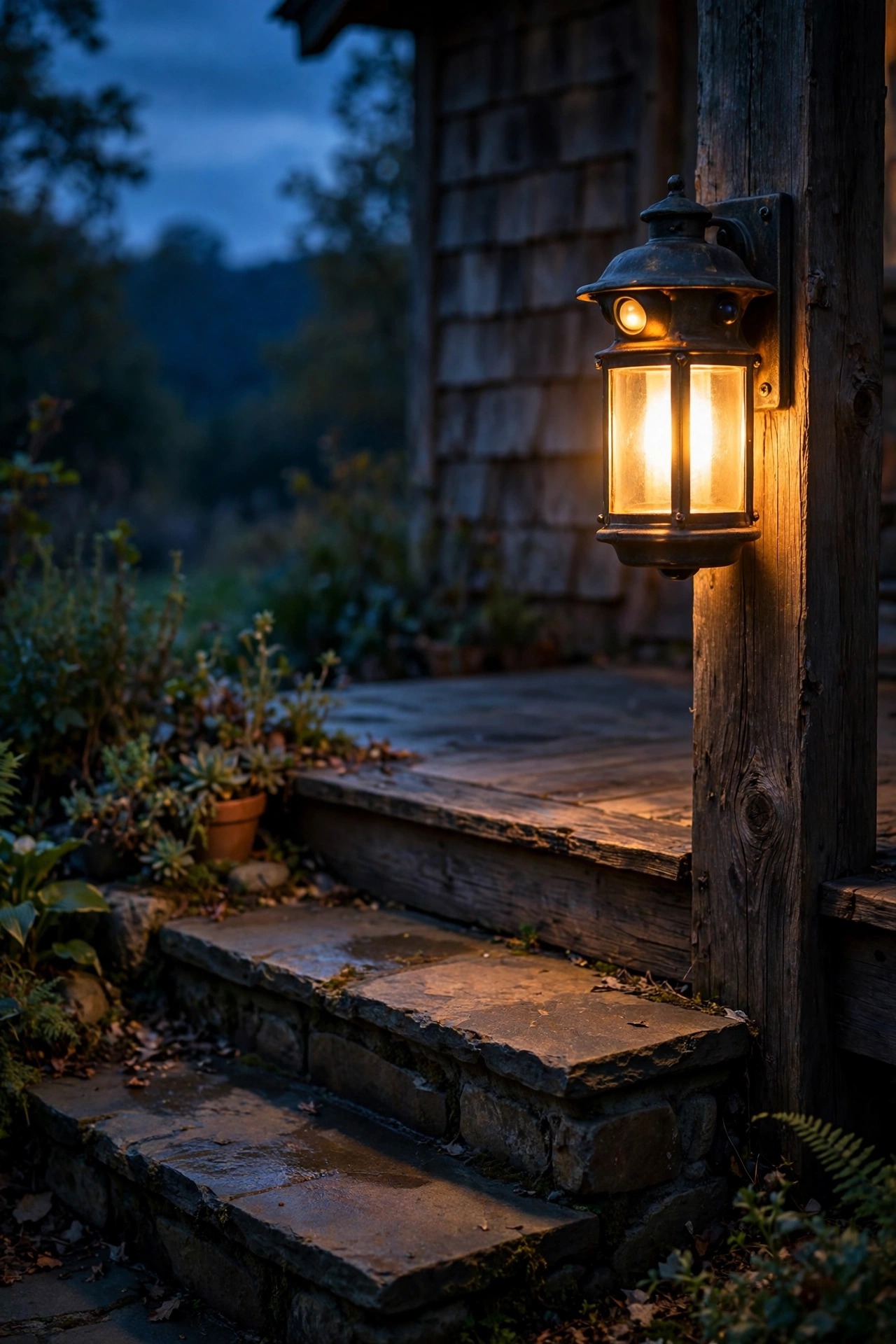
15. Hang a Lantern From a Shepherd Hook Beside the Steps
No wiring, no problem. A shepherd hook staked beside the porch steps, or set into a heavy planter at the porch corner, holds a hanging lantern exactly where a sconce cannot go. I push the hook 10 to 12 inches into the ground so it stands straight under a lantern's weight, and I hang the light so its glow lands around 4 to 5 feet up, high enough to light treads and faces without shining into eyes. Solar lanterns with a warm bulb and a real on-off switch are ideal here, since you can kill them for stargazing nights. Battery lanterns with timers work too and never care about cloudy weeks. A pair of hooks flanking the steps looks intentional and costs less than one electrician visit, which makes this the renter-friendliest idea in the whole list. In windy country, choose a hook with a stabilizer prong and a lantern with a locking bail handle. Come winter, the whole arrangement lifts out and stores in the garage in about ninety seconds.
Suggested budget range: $30 – $95.
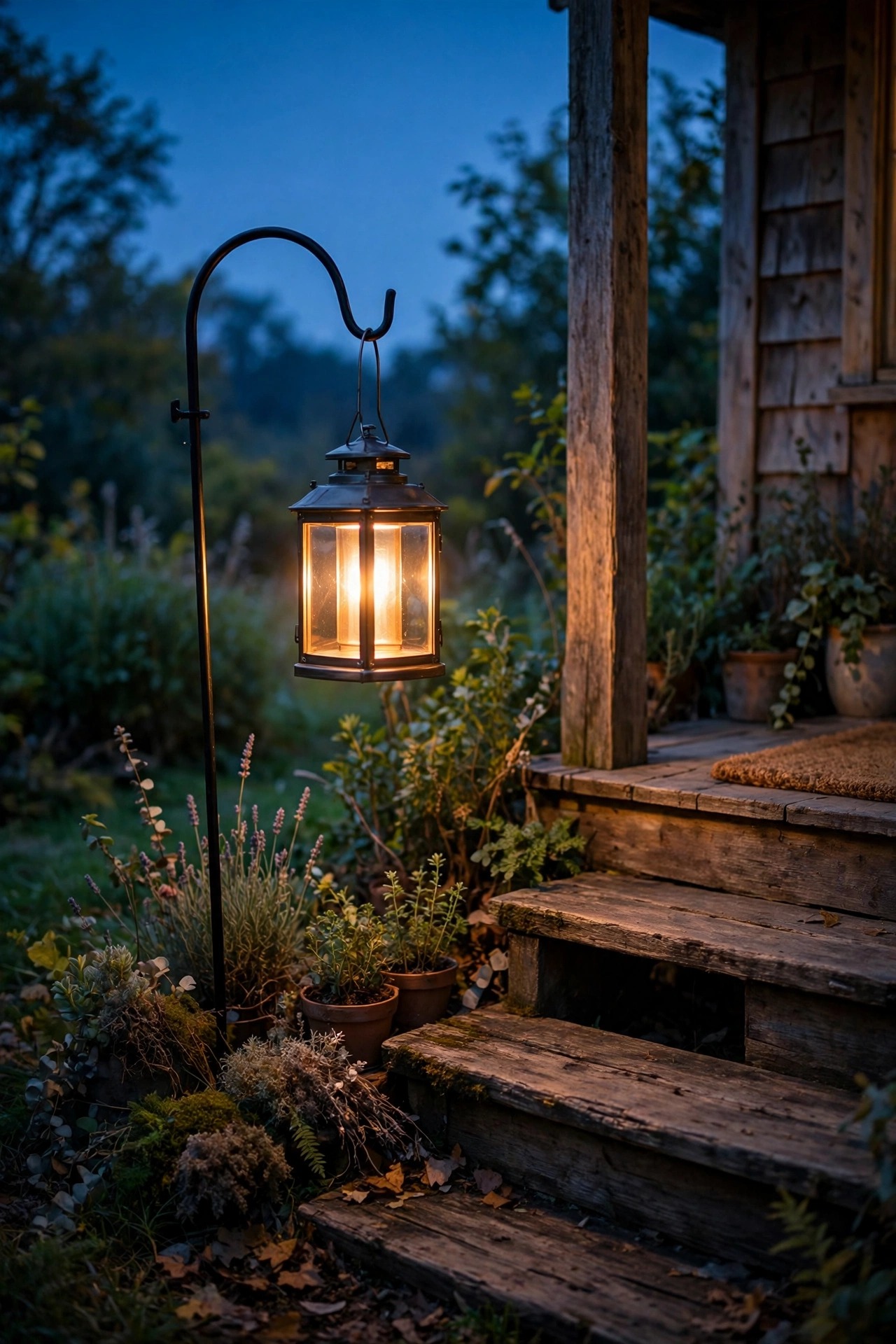
16. Line the Porch Edge With Hurricane Lanterns
Hurricane lanterns, with their tall glass chimneys, were designed for exactly the life a porch gives them: breezes, long evenings, and being carried from table to railing and back. Lined in a loose row of three or five along the porch edge or on a low shelf, they make the whole front of the house look lived-in and loved. For daily use I fit mine with LED inserts or flameless candles, and I save real oil lamps for attended evenings only, set well away from railings, curtains, and the cushion pile, with the fuel stored in the garage and never in the house. Vary the heights slightly and let the finishes mismatch a little; galvanized next to black next to rusty red is the whole point. The chimneys do need a wash every month or so, since porch dust dulls the glow faster than you would think. Five minutes with soapy water and they shine like new. Guests always end up carrying one to wherever the conversation migrates, and honestly, so do I.
Suggested budget range: $35 – $120.
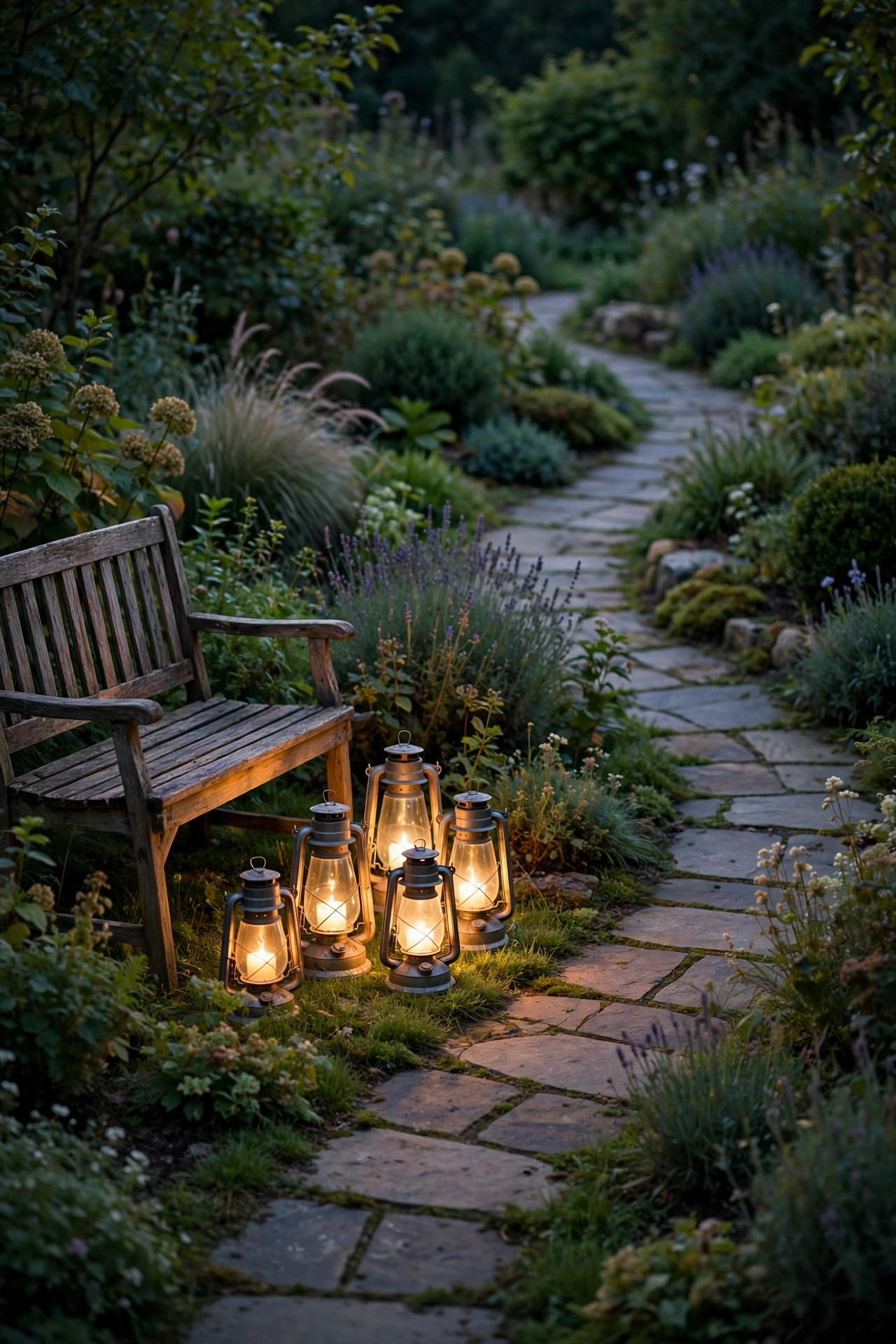
17. Put It All on Timers and Photocells
Rustic charm should never depend on me remembering a switch. The pendant and sconces get dusk-to-dawn photocell adapters, little screw-in or plug-in sensors that wake the lights at sunset and put them to bed at sunrise. String lights go on a plug-in timer or smart plug set to shut off at 11 p.m., because nobody is admiring them at 3 a.m. and bulb life is real money. I keep one low layer, usually the step lanterns, on the longest schedule for pure safety. A basic vacation setting that varies the on-off times makes an empty house look occupied, which pairs nicely with a porch that already glows like somebody is home. When you shop, match the control to the load: timers and smart plugs must be rated for outdoor use and for LED loads, and photocell adapters need enough clearance inside smaller lantern cages. Set everything once in spring, glance at it when the time changes, and the porch simply takes care of itself from then on.
Suggested budget range: $15 – $70.
18. Hold Every Bulb to One Warm Temperature
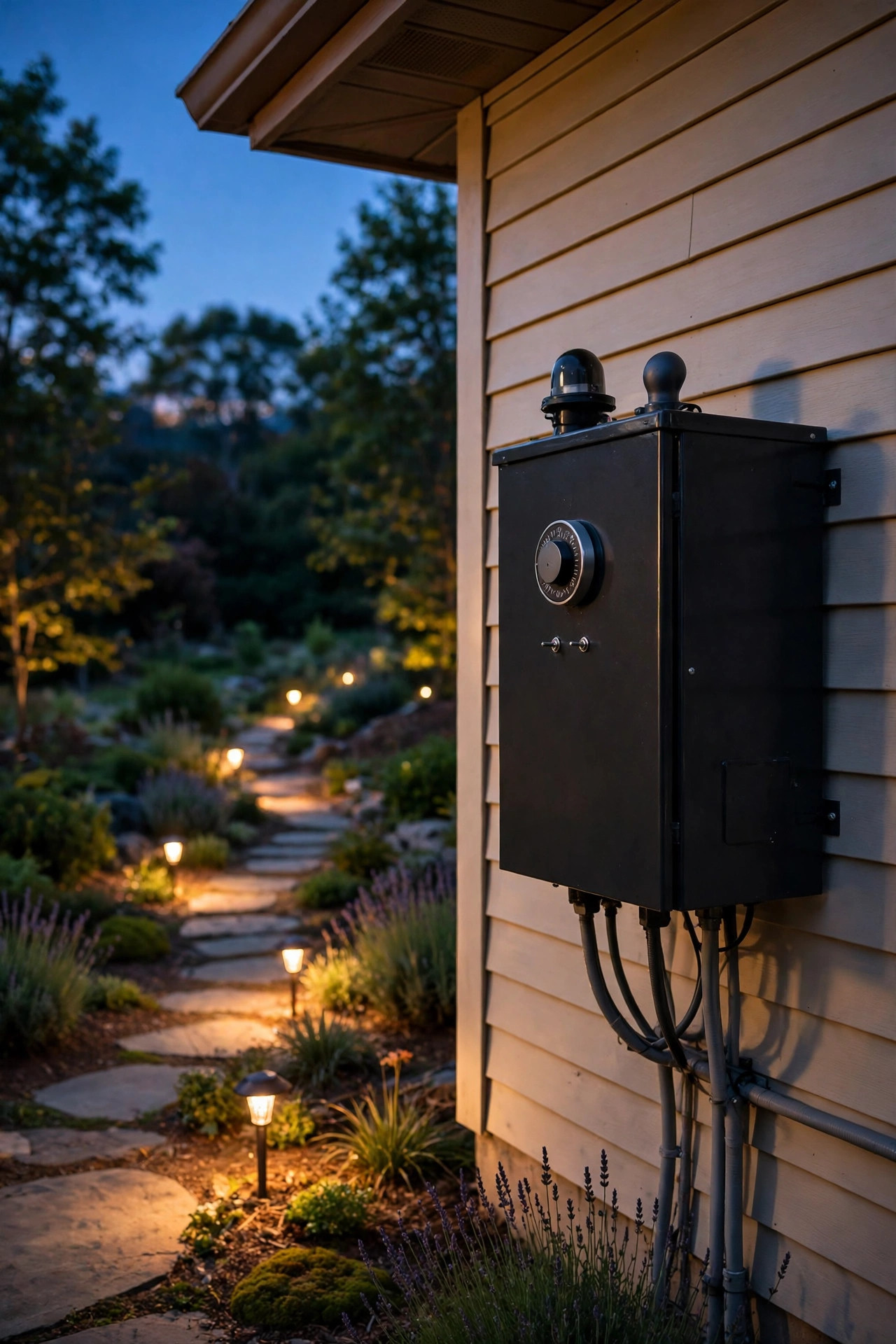
Here is the rule that quietly makes or breaks a rustic porch: every bulb, in every fixture, at one warm temperature. The night I replaced a single burnt-out bulb with a spare 4000K daylight bulb, my porch looked like a gas station had moved in. Mixed temperatures read as mistakes, even when nobody can name why the porch feels wrong. I standardize on 2700K for anything hardwired or plug-in, and allow 2200K amber only inside lanterns and jars where the oil-lamp mood belongs. When a bulb dies, its replacement comes from a labeled spare box in the hall closet, bought in the same batch, so the color never drifts between production runs. Solar lights are the sneaky offenders; check the Kelvin rating before buying, because many still ship with blue-white diodes that clash with everything. Hold a lit bulb beside your sconce at dusk before installing a full set. Five minutes of testing on the steps saves a season of squinting at a porch that feels subtly, stubbornly off.
Suggested budget range: $10 – $50.
19. Light the House Number and Mailbox to Match
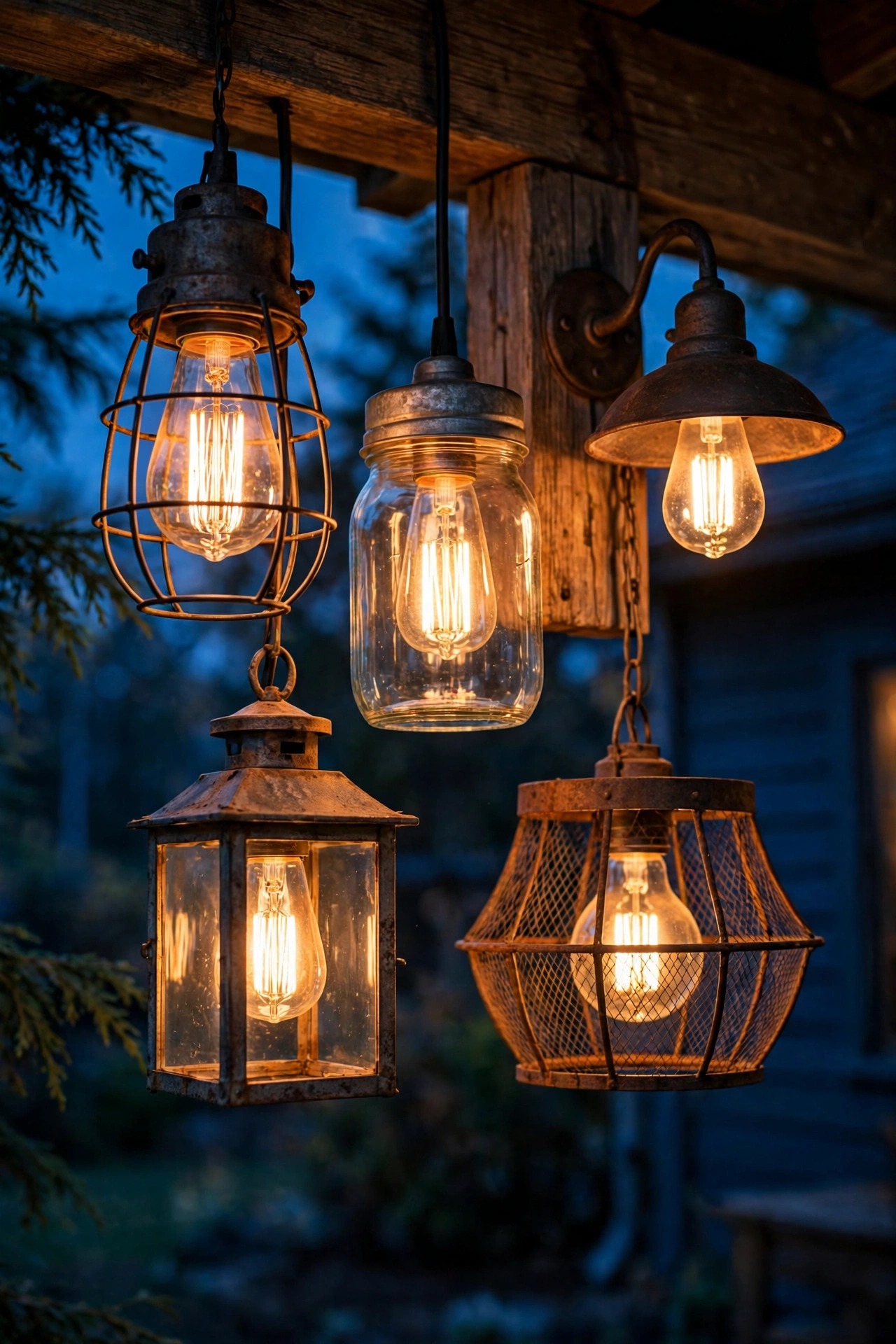
Delivery drivers and first-time guests judge your porch before they reach it, and a lit house number is the handshake. A small barn light or compact lantern mounted above or beside the numbers throws enough light to read them from a passing car, which means packages land on your porch instead of the neighbor's. Numbers themselves should be at least 4 inches tall, in a finish that contrasts with the siding, and lit from above so shadows fall away from the digits. Down at the street, a solar lantern on the mailbox post carries the same warm welcome to the curb and ties the whole front yard together. Match the finish family to your door sconces, bronze with bronze or black with black, and this tiny layer looks designed rather than added. Keep the mailbox light modest; the goal is a readable address, not a runway. In my experience this is the idea visitors mention least and use most, usually while saying the house was so easy to find.
Suggested budget range: $30 – $110.
20. Swap the Details With the Seasons
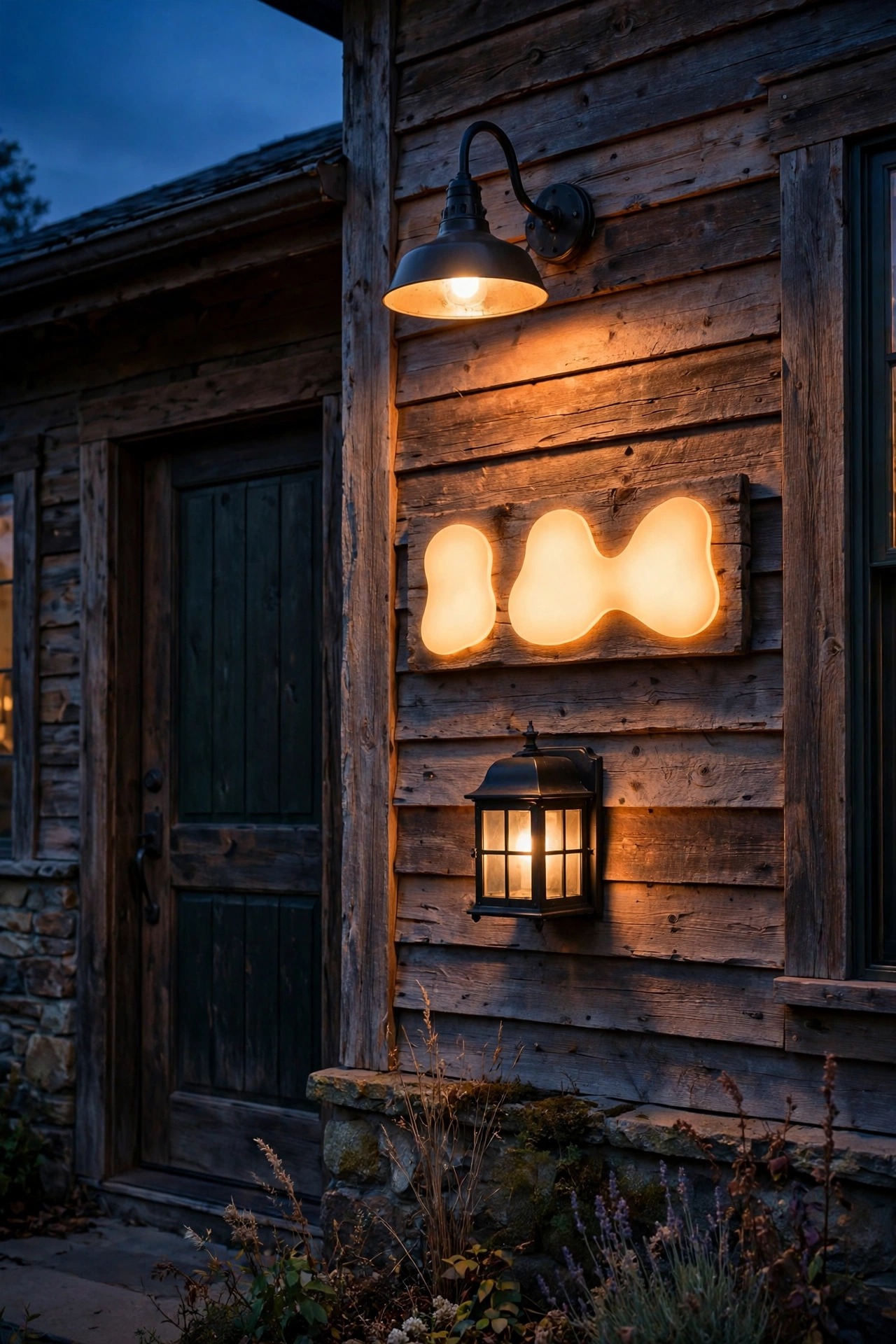
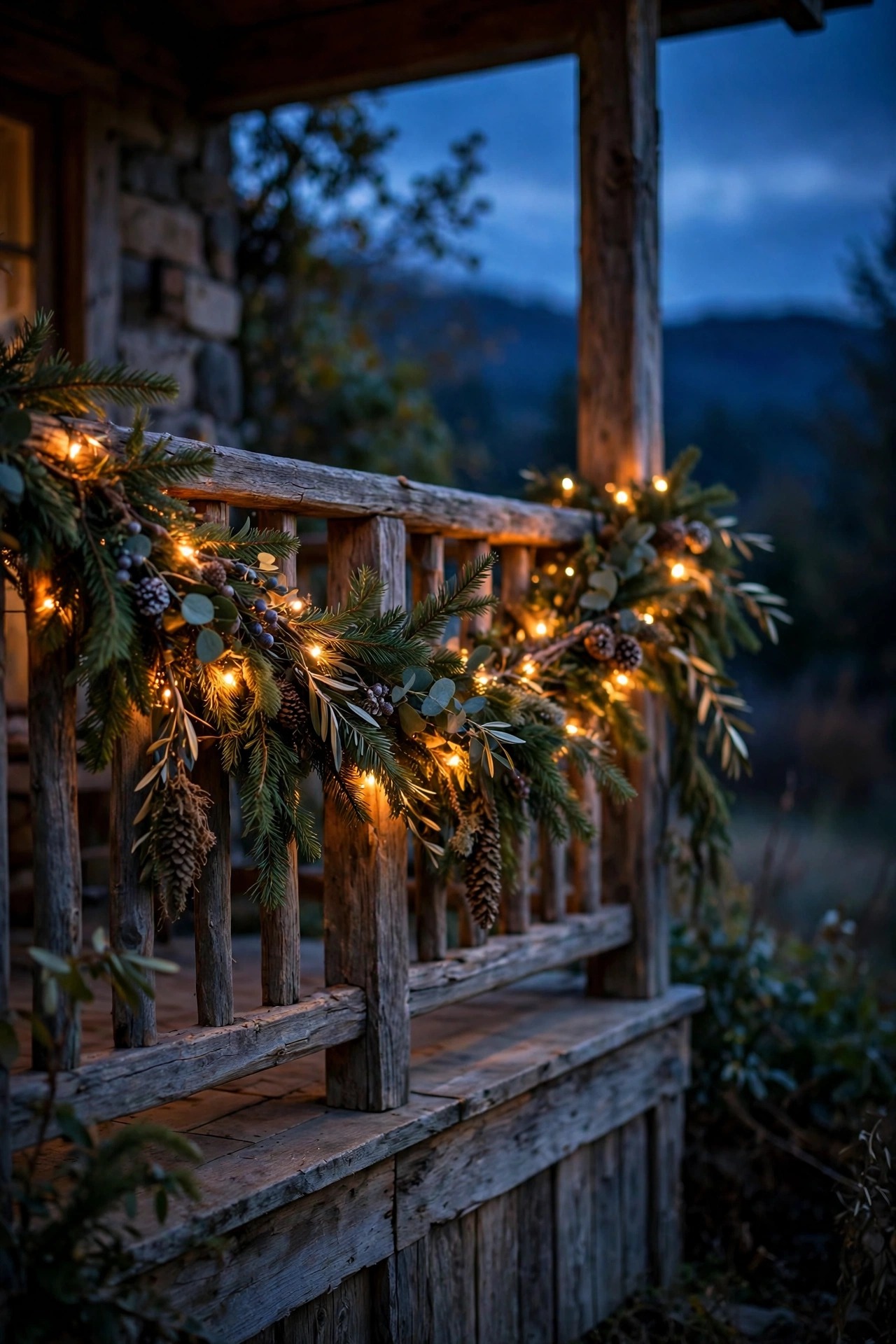
A rustic porch earns its keep all year when the lighting flexes with the seasons instead of fighting them. In fall, I thread warm micro fairy lights through a grapevine wreath on the door and set flameless candles inside hollowed luminaria along the steps. Winter brings an evergreen garland along the railing, woven with the same warm micro lights on a six-hour timer, plus the candle buckets filled with pinecones. Spring and summer swap in the mason jars and hurricane lanterns full-time, with citronella flameless candles near the seating. Two safety habits keep the fun safe. LED and flameless only, anywhere near dried greens, wreaths, or hay bales, because rustic decor and real flame are a genuinely bad combination. And battery packs for wreath lights belong in small weatherproof boxes tucked behind the greenery, not dangling in the rain. Each swap takes me under an hour, costs little beyond batteries, and makes the porch feel newly loved four times a year instead of decorated once and forgotten.
Suggested budget range: $25 – $100.
21. Finish With a Dusk Walk-Through to Tune Your Rustic Porch Lighting Ideas
The last step is the one most people skip, and it is the one that makes rustic porch lighting ideas actually work in real life. Wait for full dusk, then walk the exact path a guest walks: from the street or driveway, up the walk, onto the steps, to the door, and finally to the swing with a drink in hand. Squint as you go. Anywhere you can see a bare bulb, the fixture needs an aim adjustment, a seeded glass swap, or a dimmer. Anywhere you hesitate, a step edge or a dark corner, the low layer needs one more lantern. Take a phone photo from the street; porches photograph harsher than they look, and the picture will show you the one cold bulb or dead zone your eyes kept forgiving. Then sit down and look at the porch from inside the house, because a great porch glows for the people in the living room too. I repeat this walk every couple of months and after every bulb change. Ten honest minutes of tuning beats another hundred dollars of fixtures, every single time.
Suggested budget range: $0 – $60.

Frequently Asked Questions
What color temperature looks best for rustic porch lighting?
Warm wins, every time. I keep hardwired and plug-in fixtures at 2700K, which reads like late-afternoon sun and flatters wood, brick, and skin. Inside lanterns and mason jars, 2200K amber filament bulbs give that oil-lamp glow rustic style loves. Avoid anything 3500K and above on a porch; cooler light fights the warm materials and makes even expensive fixtures look like hardware-store specials. Whatever you choose, choose it once and buy spares from the same batch, because consistency matters more than the exact number.
Are solar lights bright enough for porch steps?
For marking edges, yes; for reading a book, no. A decent warm-toned solar lantern at 30 to 50 lumens clearly shows a tread edge, which is all steps honestly need. The catch is charging: panels need several hours of real sun, and deep covered porches starve them. Use lanterns with a remote panel you can place in a sunny bed, USB-rechargeable models you top up indoors, or low-voltage wired lights for the steps and save solar for accents. Test one lantern for a week before committing to a full set.
How do I keep rustic fixtures from rusting out too fast?
A little patina is the point, but structural rust is not. Choose fixtures rated for wet locations with powder-coated, galvanized, or solid brass and copper bodies, which weather gracefully instead of flaking. Once a season, wipe fixtures down, clear the drain holes most lantern bottoms have, and check that mounting screws and canopy gaskets still seal against the wall. Raw iron and untreated steel will rust through in a few wet years, so save those for covered porches. In coastal air, rinse salt off monthly with plain water.
How much does a rustic porch lighting update cost?
A meaningful refresh, meaning new bulbs everywhere, step lanterns, and one decor layer like jars or candle buckets, runs about $150 to $400 in do-it-yourself territory. A full layered redo with a new pendant, sconce pair, and path lights usually lands between $600 and $1,500 in fixtures. Adding a brand-new hardwired location is the budget wildcard: an electrician typically charges $150 to $350 per new fixture point, depending on how far the run is from existing wiring. Timers and photocells, at under $70 total, stretch every dollar by doubling bulb life.
Conclusion: A Porch That Feels Like a Welcome
If you remember one thing from this whole list, make it this: warm layers, honest materials, and one temperature, repeated with intention. The best rustic porch lighting ideas are rarely the priciest ones. They are the pendant hung at the right height, the lanterns that make the steps feel safe, the jars that come out every single evening because a timer remembers them. Start with the door layer, tune it at dusk, and add pieces the way porches actually gather them, one good find at a time. And if your heart leans further into the woods, my rustic cabin lighting ideas carry the same warm, weathered recipe to cabins and mountain entries. Browse around, steal the layers that fit your porch, and leave the rest. I will save you a seat on the swing.