
Intro
There's something about a farmhouse porch at dusk that just wraps around you — the creak of the swing, the smell of cut grass, and that warm amber glow spilling out of lanterns and barn lights. If you're hunting for farmhouse porch lighting ideas that nail the rustic-charm look without turning your entry into a theme park, you're in exactly the right place.
In my experience, the farmhouse porches that make people slow their cars down all follow the same recipe: a few honest materials — galvanized metal, weathered wood, glass mason jars — paired with warm 2700K light at three heights. High, middle, low. That's the whole secret. Honestly? You don't need a big budget or an electrician on speed dial for most of these ideas.
Below are 21 ideas I've tried in my own home and on friends' porches over the years, from classic gooseneck barn lights to mason-jar lanterns and Edison bulb string lights. Each one includes real placement measurements, bulb picks, and weatherproofing tips, so you can shop and hang with confidence. Grab a sweet tea and let's light up that porch.
1. Gooseneck Barn Lights: The Farmhouse Porch Lighting Signature
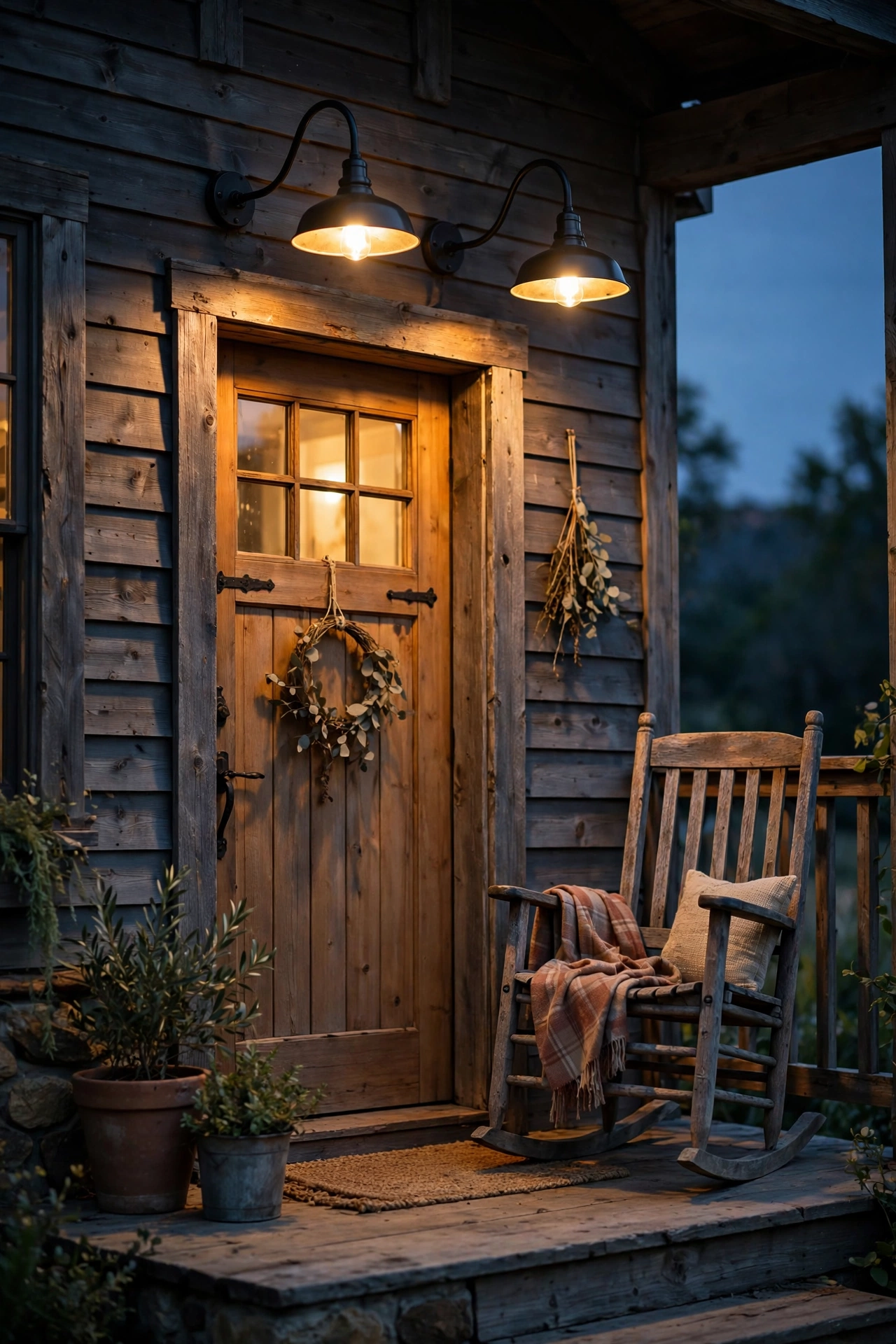
If farmhouse style has one defining light fixture, it's the gooseneck barn light — that curved-arm shade that throws a warm pool of light straight down. In my experience, mounting height matters more than anything else here. Center the fixture 66 to 72 inches from the porch floor to the middle of the shade, or about 6 to 12 inches above your door frame. Too high and the light floats uselessly; too low and guests bump their heads or get glare in their eyes.
For shade size, match the door: a 12- to 14-inch shade suits a standard 36-inch door, while double doors or a wide entry can carry a 16-inch shade. Angle the shade so the light washes down the door and steps rather than shooting out into the yard — that's what gives you that welcoming doorway glow instead of a floodlight effect. Choose a wet-rated fixture if your porch is exposed to rain, and stick with LED bulbs around 800 lumens (60-watt equivalent) at 2700K. Galvanized or matte black finishes age beautifully. If you want the full breakdown on shade sizes, arm lengths, and mounting heights, my gooseneck barn lights guide walks through every option.
Suggested budget range: $60 – $160 per fixture.
2. Mason-Jar Lanterns Glowing on the Steps
Nothing says farmhouse charm faster than a row of mason jars flickering on the porch steps, and this might be the easiest idea on the whole list. Use quart-size jars and fit each one with a wire hanger or a simple twisted-wire handle so they can hang or sit. Drop a battery-operated tea light or a short strand of copper-wire fairy lights into each jar, then add an inch of sand or pea gravel in the bottom — it keeps the jar stable in a breeze and hides the battery pack.
Line three to five jars up the steps, spacing them about 18 inches apart so the light stair-steps down toward the walkway. Frosted or lightly distressed jars diffuse the light more softly than crystal-clear ones. One safety note I never skip: LED only inside sealed jars, never a real flame — glass traps heat, and a wooden porch is the wrong place to gamble. Solar mason-jar lids are a nice upgrade if your steps get at least six hours of daytime sun. At dusk, these little jars make the whole staircase look like it's breathing.
Suggested budget range: $15 – $45 for a set of five.

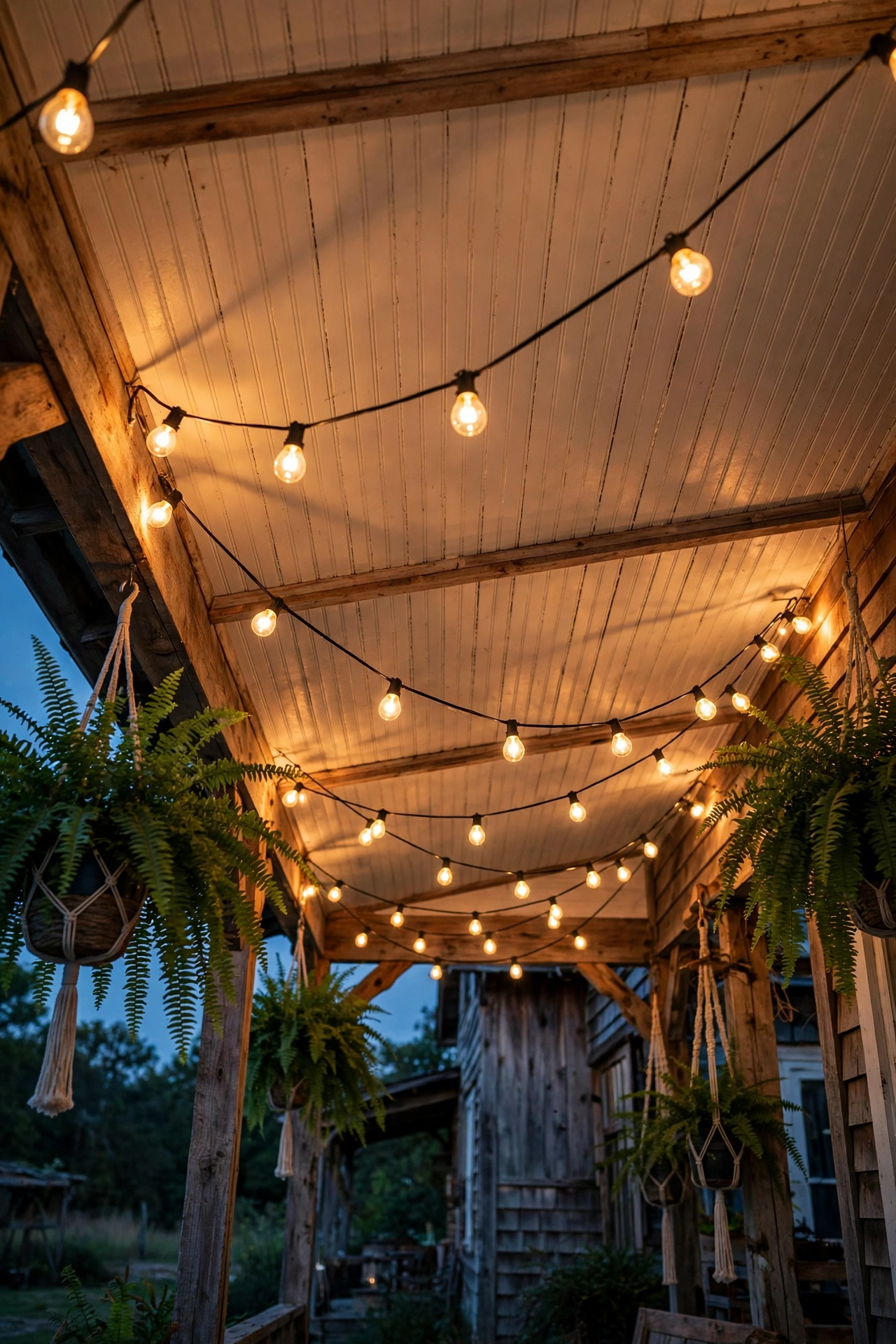
3. Edison Bulb String Lights Across the Porch Ceiling
Edison-style string lights are the fastest way to make a plain porch ceiling feel like a cozy farmhouse cafe. Buy heavy-duty outdoor strands with shatterproof LED filament bulbs — the plastic ones that look like vintage glass but survive a ladder bump and a hailstorm. I like the classic ST58 bulb shape in warm 2700K; each bulb sips just 1 to 2 watts, so a whole strand costs pennies a night to run.
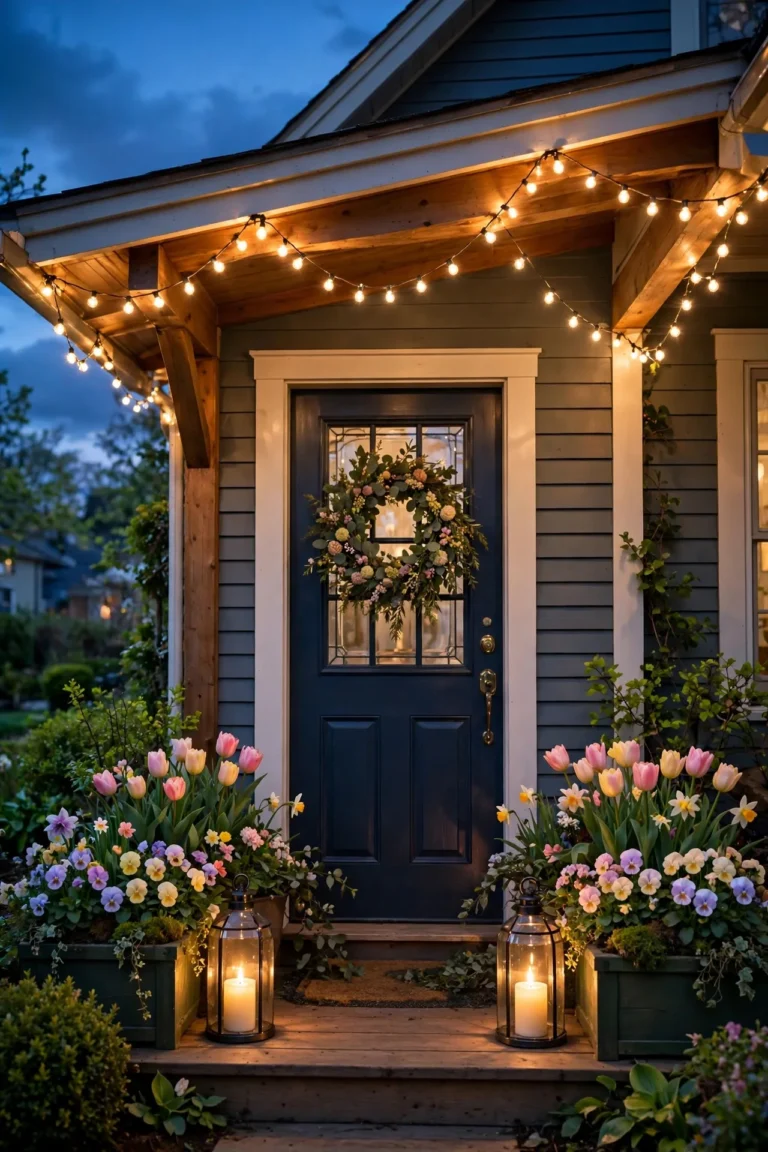
Hang them in gentle swags across the ceiling or zigzag between posts. Screw cup hooks into the ceiling or beams every 3 to 4 feet and let each span sag 4 to 6 inches in the middle — that relaxed drape is the whole look. Keep the lowest point of every swag at least 7 feet above the floor so tall guests don't graze bulbs. Most strands let you connect up to three 48-foot lengths end to end; plug the run into an outdoor timer or smart plug set for dusk to 11 p.m. Buy strands rated for wet locations and plug into a GFCI-protected outlet. Honestly, one evening of hanging these changes the entire feel of the porch.
Suggested budget range: $30 – $90 per 48-foot strand.
4. Wood-and-Metal Lanterns Flanking the Front Door
A matched pair of lanterns on either side of the door is pure farmhouse symmetry, and the wood-and-metal styles — think distressed wood frames with glass panels and dark metal roofs — nail the rustic look without feeling kitschy. Sizing is the make-or-break detail: pick lanterns roughly one-quarter to one-third the height of your door, so a standard 80-inch door wants lanterns in the 18- to 24-inch range.
Mount them so the center of each lantern sits 60 to 66 inches off the porch floor, which puts the glow right at eye level for arriving guests. If your door is flanked by sidelights, center each lantern on the sidelight's outer trim for a balanced look. Fill them with flameless LED pillars on built-in timers — the 6-hours-on, 18-off setting means they light themselves every evening. Keep both lanterns at the same finish as your other fixtures for a pulled-together look. If you're weighing sizes and spacing for a pair, my guide on pairing sconces by the front door covers the measurements that matter most.
Suggested budget range: $50 – $140 for the pair.

5. Galvanized Bucket Pendants Over the Porch Swing
This is my favorite budget showpiece: turn simple galvanized buckets into pendant lights over the porch swing. Grab a pendant cord kit — the kind with a socket, canopy, and a generous length of braided cord — drill a hole in the bottom of each bucket for the cord, and hang them from the porch ceiling. Two buckets spaced about 24 inches apart over a swing or loveseat looks intentional; one lonely bucket just looks like you lost the other one.
Hang them so the bottom rim of each bucket sits 30 to 36 inches above the swing seat, with at least 7 feet of clearance from the porch floor to the lowest point. Use LED bulbs around 400 to 800 lumens at 2700K — bright enough to read by, soft enough to keep the mood. Make sure the cord kit is rated for outdoor or at least damp locations, and seal the drilled hole with a rubber grommet so rain can't track down the cord into the socket. The galvanized finish throws a lovely textured light and only gets better looking as it weathers.
Suggested budget range: $40 – $110 for two pendants.

6. Wire-Cage Wall Sconces Beside the Windows
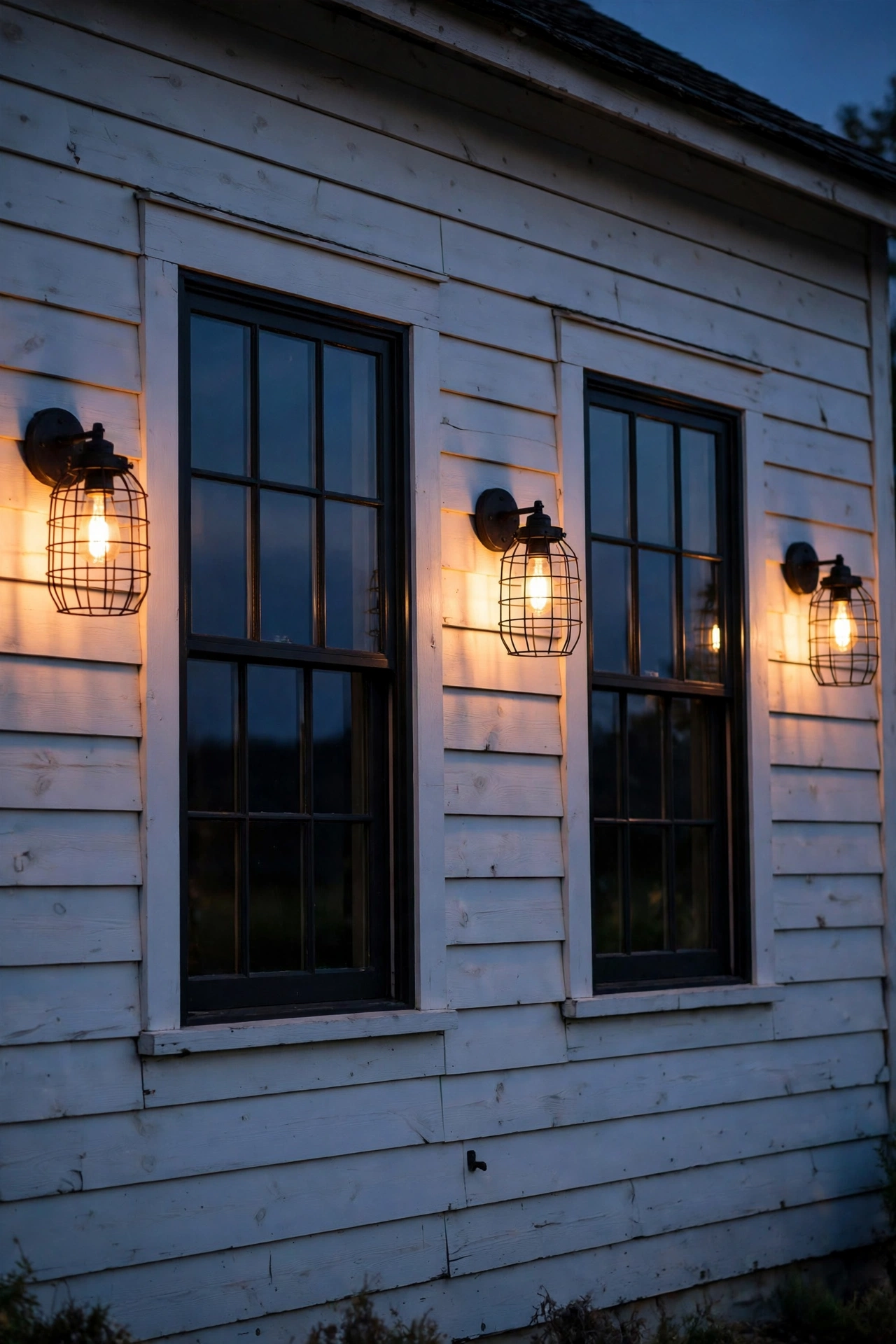
If you've already got lanterns by the door, wire-cage sconces beside the front windows extend that farmhouse rhythm across the whole facade. The open cage design — thin metal ribs around an exposed bulb — gives you that industrial-farmhouse edge, and it has a practical bonus: the cage protects the bulb from bumps, basketballs, and curious hands.
Mount each sconce centered on the window's outer trim at the same 60- to 66-inch height as your door fixtures, so every light on the porch shares one clean sightline. For narrow windows, a compact 6- to 8-inch-tall cage works; wider picture windows can handle 10- to 12-inch sconces. Use LED filament bulbs at 2700K — the visible filament inside the cage is half the charm, so skip frosted bulbs here. Match the cage finish to your other hardware: galvanized for a silvery patina, matte black for contrast against light siding. Check the wet-location rating if the windows sit outside the porch roofline, and always kill the breaker before swapping any hardwired fixture.
Suggested budget range: $45 – $130 per sconce.
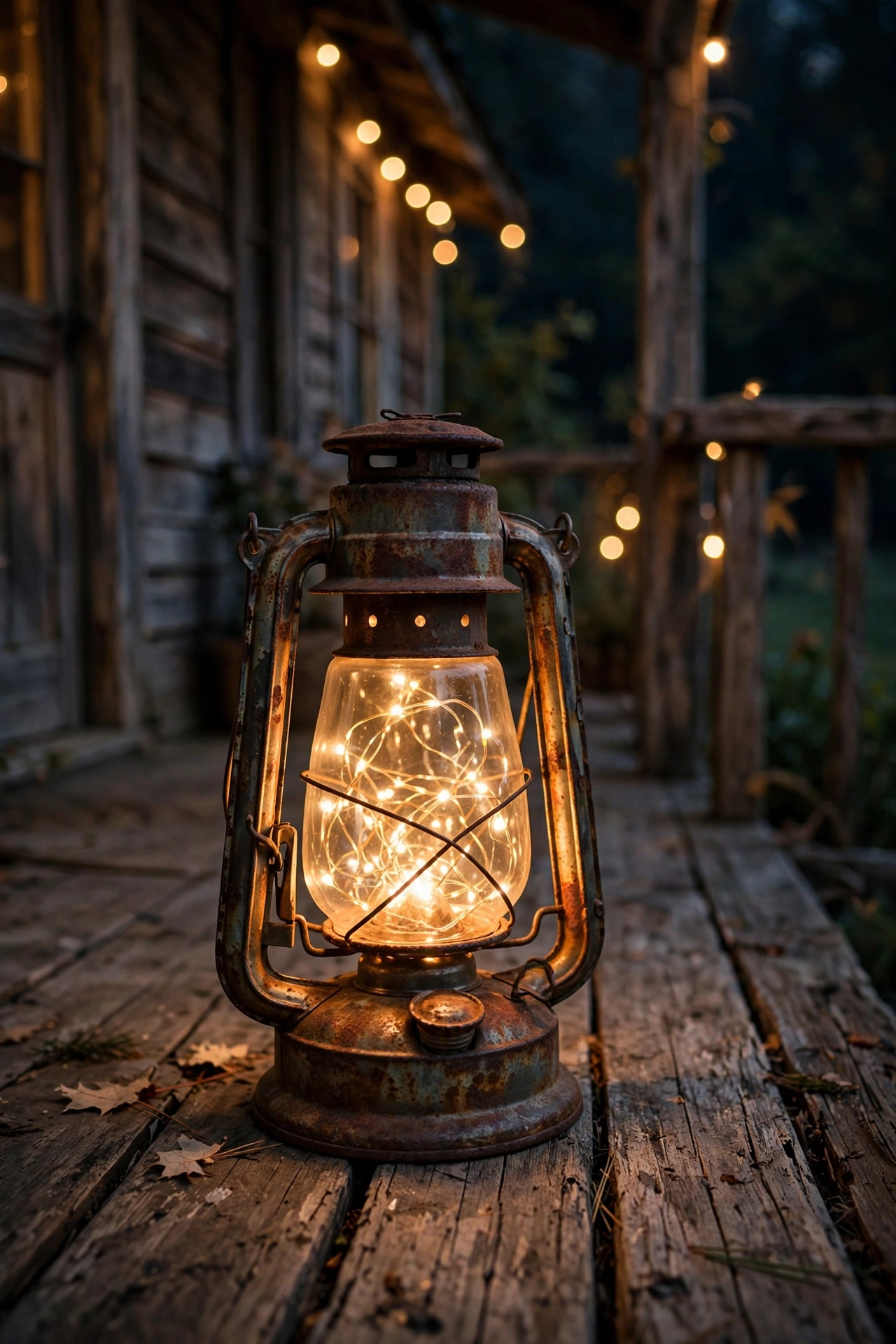
7. A Vintage Lantern Stuffed With Fairy Lights
Flea-market hurricane lanterns are practically made for this trick. Find an old metal-and-glass lantern — the rustier and more characterful, the better — and coil a 20- to 33-foot strand of copper-wire fairy lights inside the glass chimney. Tuck the little battery pack into the base or behind the lantern's fuel tank, and you've got a glowing relic that looks like it costs ten times what you paid.
Set it on a side table, a wooden crate, or the top step where it'll catch eyes but not feet. Choose fairy lights with a built-in timer — the 6-on, 18-off cycle is standard — so you never have to remember to switch it on. Because the wire is hair-thin and the LEDs run cool, this is completely safe to nestle among dried florals, pinecones, or a plaid throw. One caution: keep the battery pack dry by placing the lantern under the porch roof or bringing it inside during driving rain. Wipe the glass with a dry cloth now and then; dusty glass dulls the sparkle fast.
Suggested budget range: $20 – $60 including the lantern.
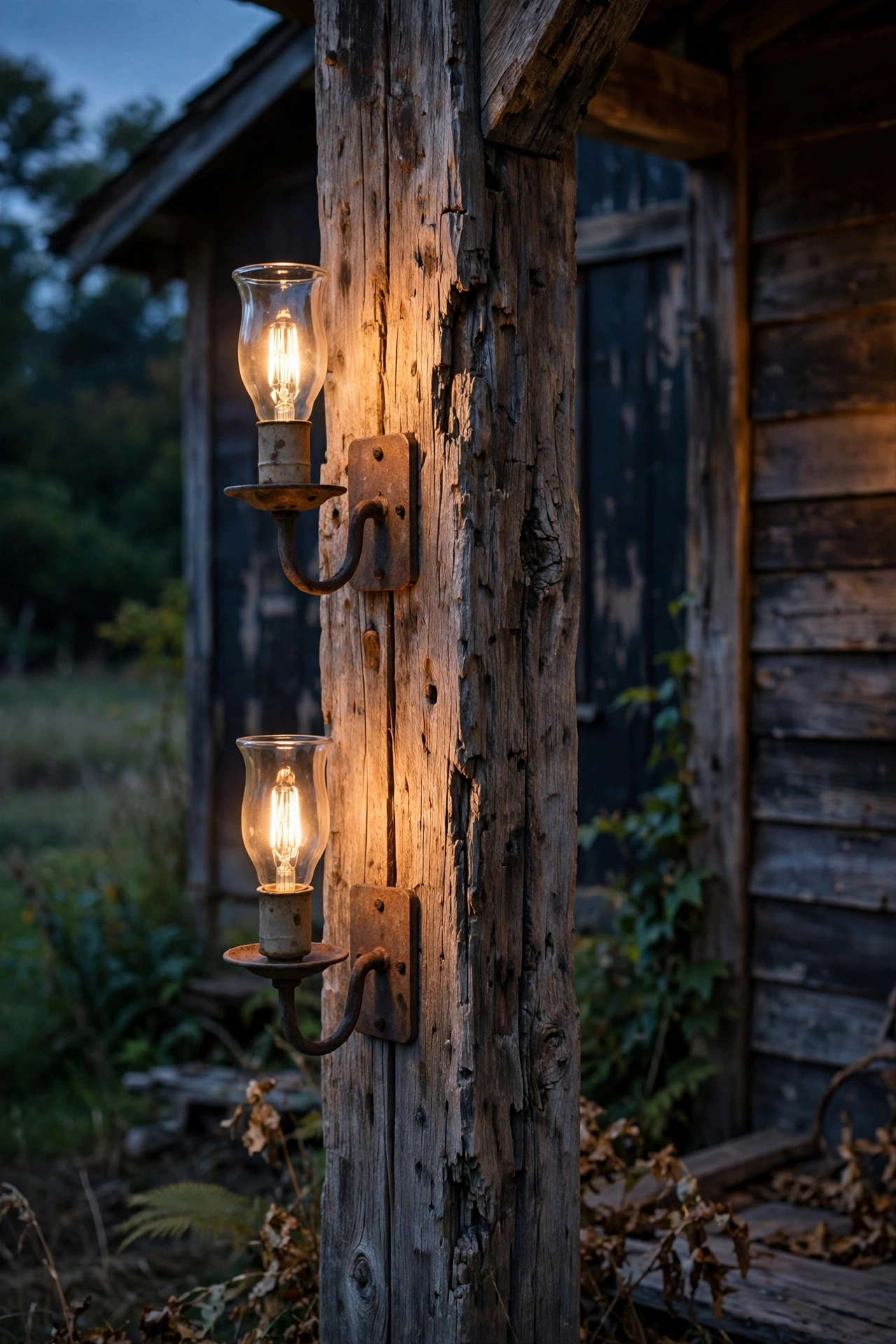
8. Candle-Style Sconces With Warm Filament Bulbs
There's something deeply nostalgic about sconces that look like wall-mounted candles — little cups cradling flame-tip bulbs that glow like real candlelight. They read instantly as farmhouse, especially in weathered bronze or distressed white finishes. Mount them at the familiar 60- to 66-inch height beside the door or on porch posts, keeping at least 12 inches of clearance from the ceiling and any trim.
The magic is in the bulb: choose flame-tip LED filament bulbs in the 2200K to 2700K range for that true candle warmth. Standard flame-tip bulbs run about 350 to 450 lumens, which is perfect accent light — these are mood-makers, not work lights. Go dimmable if your sconces are on a dimmer switch, and confirm the bulbs are marked dimmable too, or you'll get an annoying flicker. Most candle-style sconces are rated for covered porches (damp locations), so skip them on fully exposed walls unless the listing specifically says wet-rated. They pair beautifully with a real lantern or two for a layered, old-fashioned glow.
Suggested budget range: $55 – $150 per sconce.
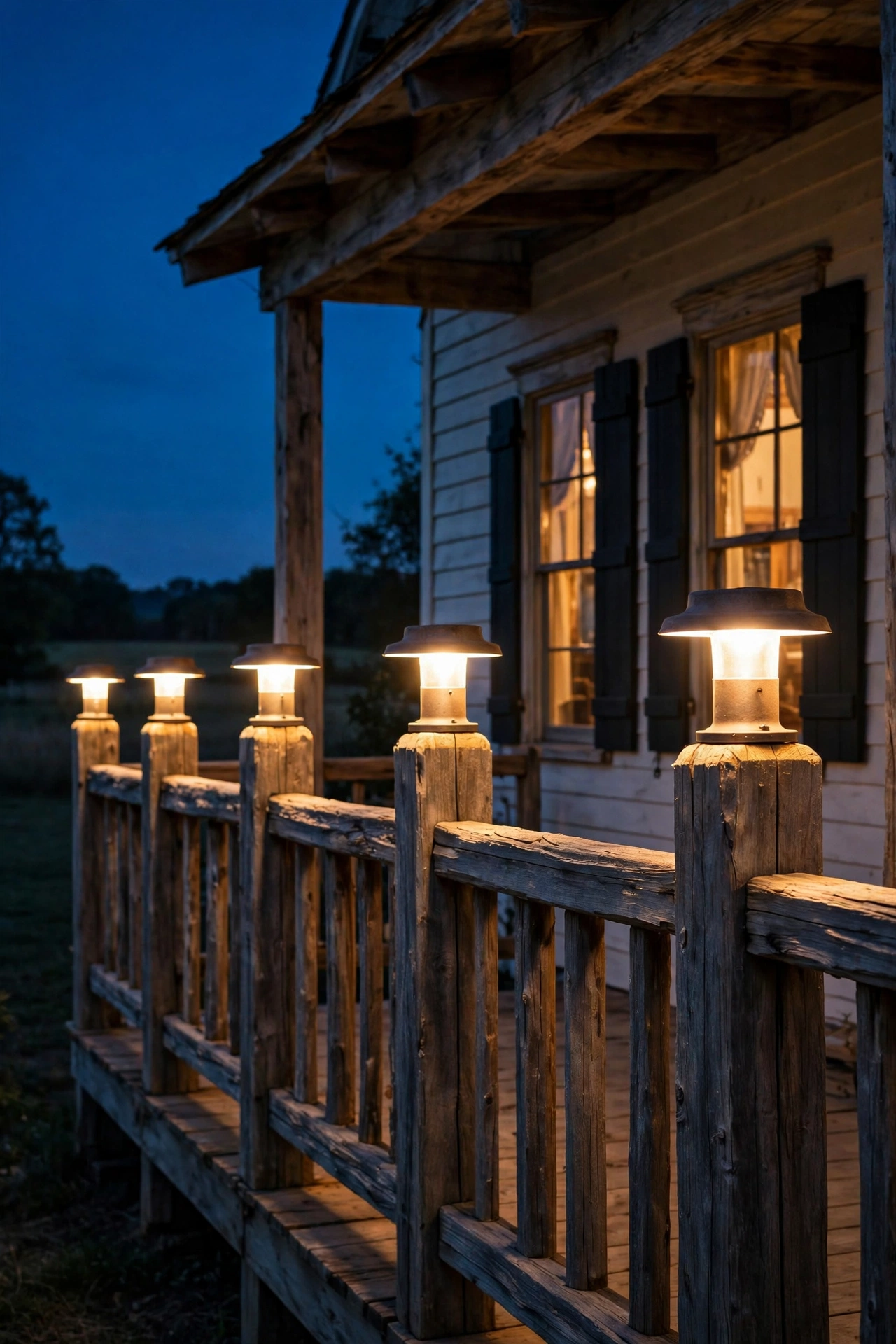
9. Rustic Post Cap Lights on the Railing
Your railing posts are free real estate for light — and post cap lights turn them into a runway of warm dots that outline the whole porch. Measure your posts first: most are nominal 4×4 (actually 3.5 inches square) or 6×6, and caps are sized to fit snugly over the top. Rustic styles in hammered metal, aged copper tones, or matte black blend right into farmhouse railings.
You've got two power choices. Solar caps are dead simple — press on, done — but they need six-plus hours of direct sun and their glow is modest, best for outlining rather than illuminating. Low-voltage caps wire into a 12-volt transformer system and shine brighter and more consistently, though you'll run thin cable along the railing. Either way, stick with warm-white LEDs and place a cap on every post; on long railings, every other post still gives a lovely rhythm. LED-only is the rule here — incandescent caps would cook the fixture. Tighten the fit with a dab of exterior construction adhesive if wind is an issue in your area.
Suggested budget range: $8 – $25 per cap, solar; $150 – $350 for a low-voltage set.
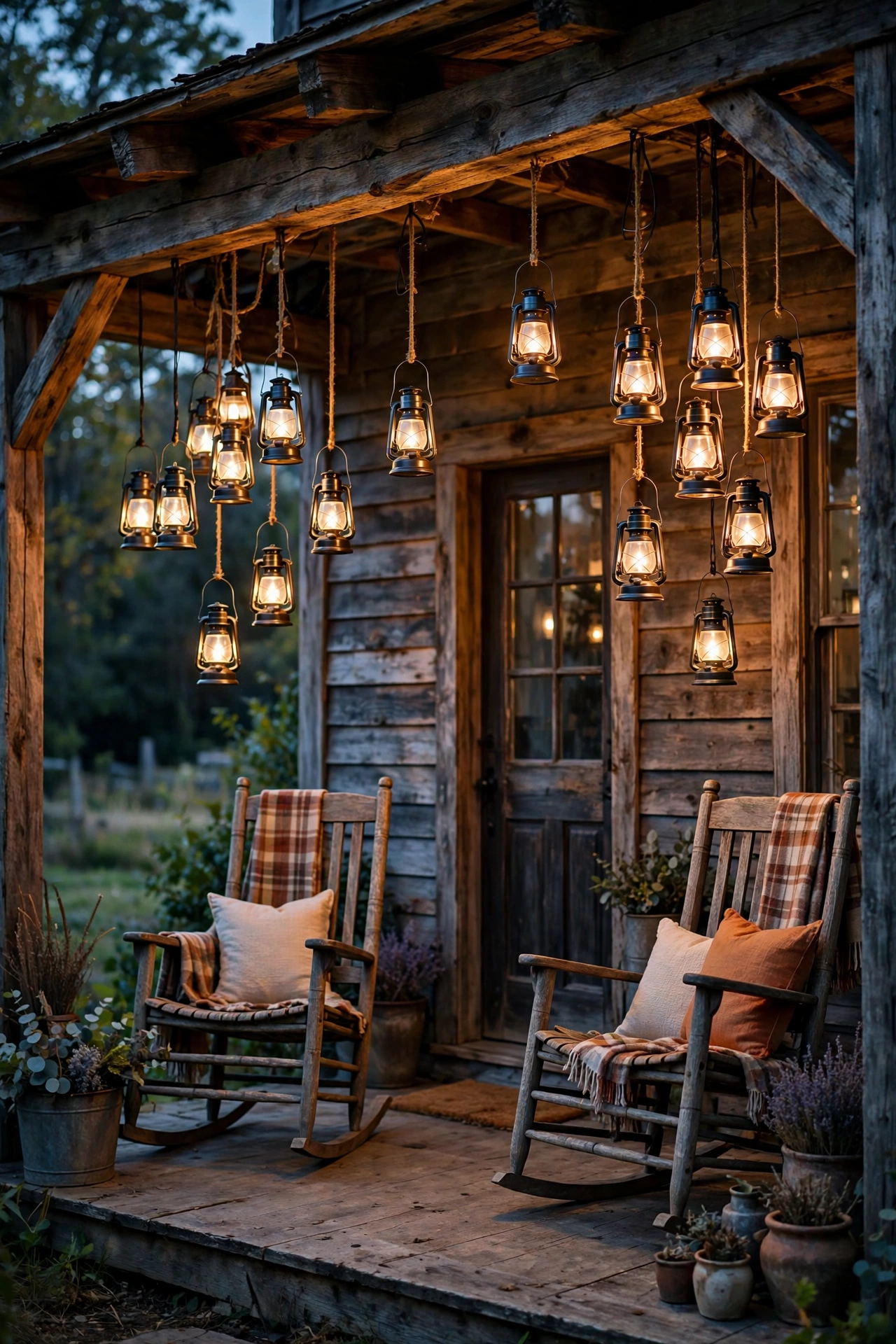
10. Hanging Lantern Clusters at Different Heights
A single hanging lantern is nice; a cluster of three at staggered heights is a statement. Hang them from the porch ceiling over a corner seating area or beside the door, dropping them at roughly 24, 30, and 36 inches so they cascade like a chandelier that wandered in from a barn. Use chains, black metal rods, or even thick jute rope for the drops — rope leans extra rustic, just make sure it's rated for the weight and kept dry.
Keep the bottom of the lowest lantern at least 7 feet above the porch floor, and space the lanterns 12 to 18 inches apart so they read as a group without clanking together in a breeze. Fill each with a flameless LED pillar or a coil of fairy lights on staggered timers so they don't all blink on at the exact same second — that tiny offset feels more organic. Choose outdoor-rated hanging hardware and confirm your ceiling junction boxes are fan-rated if the lanterns are heavy. Honestly, this is the look guests photograph.
Suggested budget range: $75 – $200 for a cluster of three.
11. Wire-Cage Table Lanterns With Flameless Pillars
Tabletop lanterns are the jewelry of the porch — small, close-up, and impossible not to notice. Set wire-cage or wood-frame lanterns on your porch side tables, plant stands, or the top of a storage bench, and fill each with a flameless LED pillar candle. I like the 3-by-4-inch and 3-by-6-inch pillar sizes; group them in odd numbers — three lanterns of varying heights beats two matched ones every time.
Modern flameless pillars have come a long way: look for ones with a realistic flicker mode and a built-in daily timer, usually 5 hours on and 19 off. The warm 2700K glow through the cage wires throws gorgeous little shadows across the tabletop. Because they're LED, you can tuck them next to fabric cushions, dried wreaths, or a stack of old books without a second thought — no heat, no wax, no worry. The one job: bring them indoors during heavy storms or freezing weather, since most tabletop lanterns and their electronics are only splash-resistant, not stormproof. Wipe the glass monthly so the glow stays crisp.
Suggested budget range: $25 – $80 for a grouping of three.

12. A Dusk-to-Dawn Barn Light on the Garage Gable
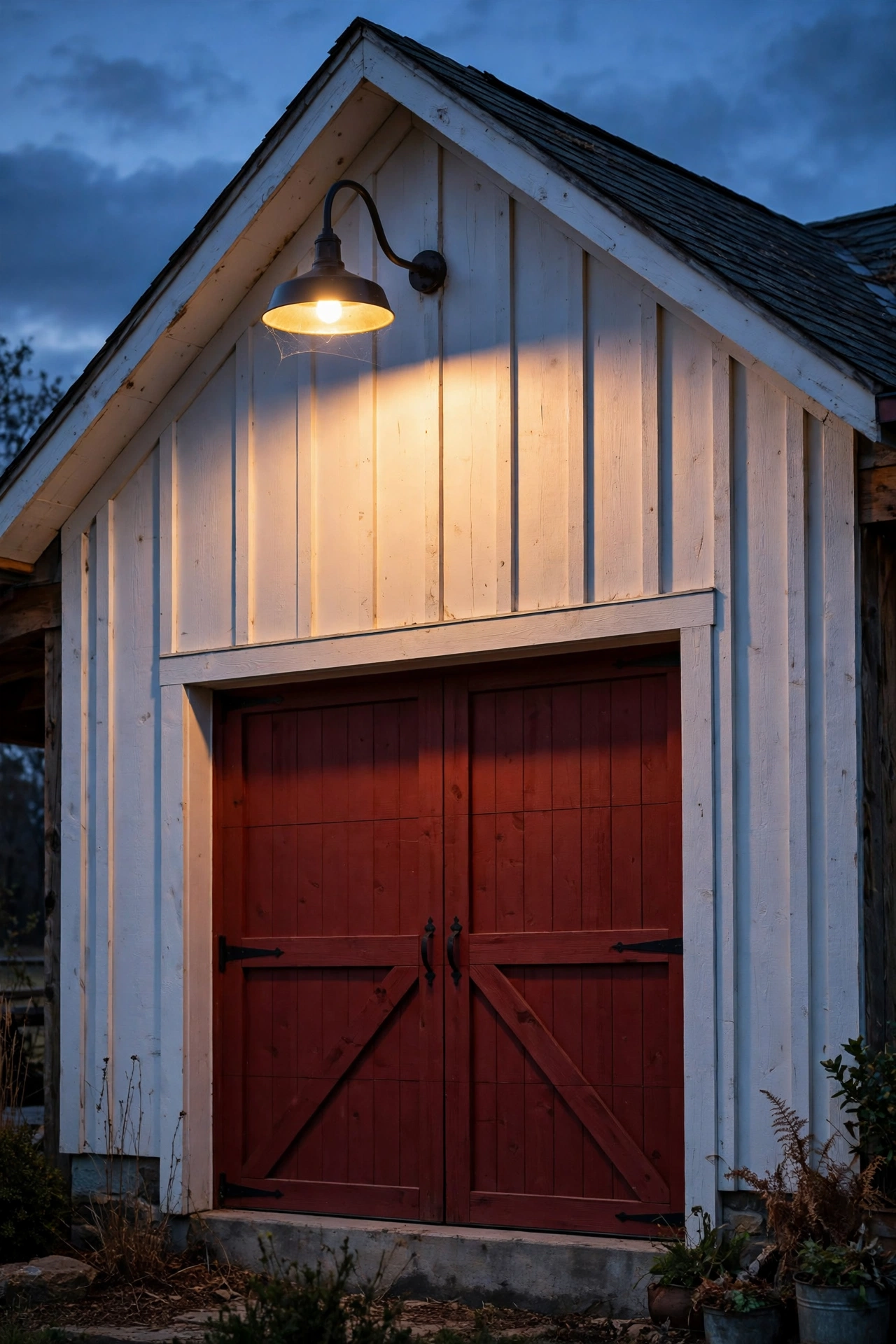
Farmhouse charm shouldn't stop at the porch — a classic barn light mounted high on the garage gable extends the look across the whole front of the house and earns its keep as security lighting. Mount it 8 to 10 feet up, centered on the gable, with a gooseneck shade angled to wash light down the driveway and walkway.
Choose a fixture with a built-in photocell so it switches itself on at dusk and off at dawn — set it and forget it for years. For a driveway, 1200 to 2000 lumens gives you real visibility without turning the yard into a stadium; the downward shade keeps the light where it belongs and keeps neighbors happy. A warm 2700K to 3000K bulb keeps the farmhouse feel instead of that harsh blue security-light look. Fair warning: if there's no existing junction box on the gable, this one usually needs an electrician — budget for a couple of hours of labor. The result, though, is the single most transformative exterior light most homes can add.
Suggested budget range: $70 – $180 for the fixture, plus $150 – $300 for electrician install if needed.
13. Solar Mason Jars for the Walkway: Farmhouse Porch Lighting That Lines the Path
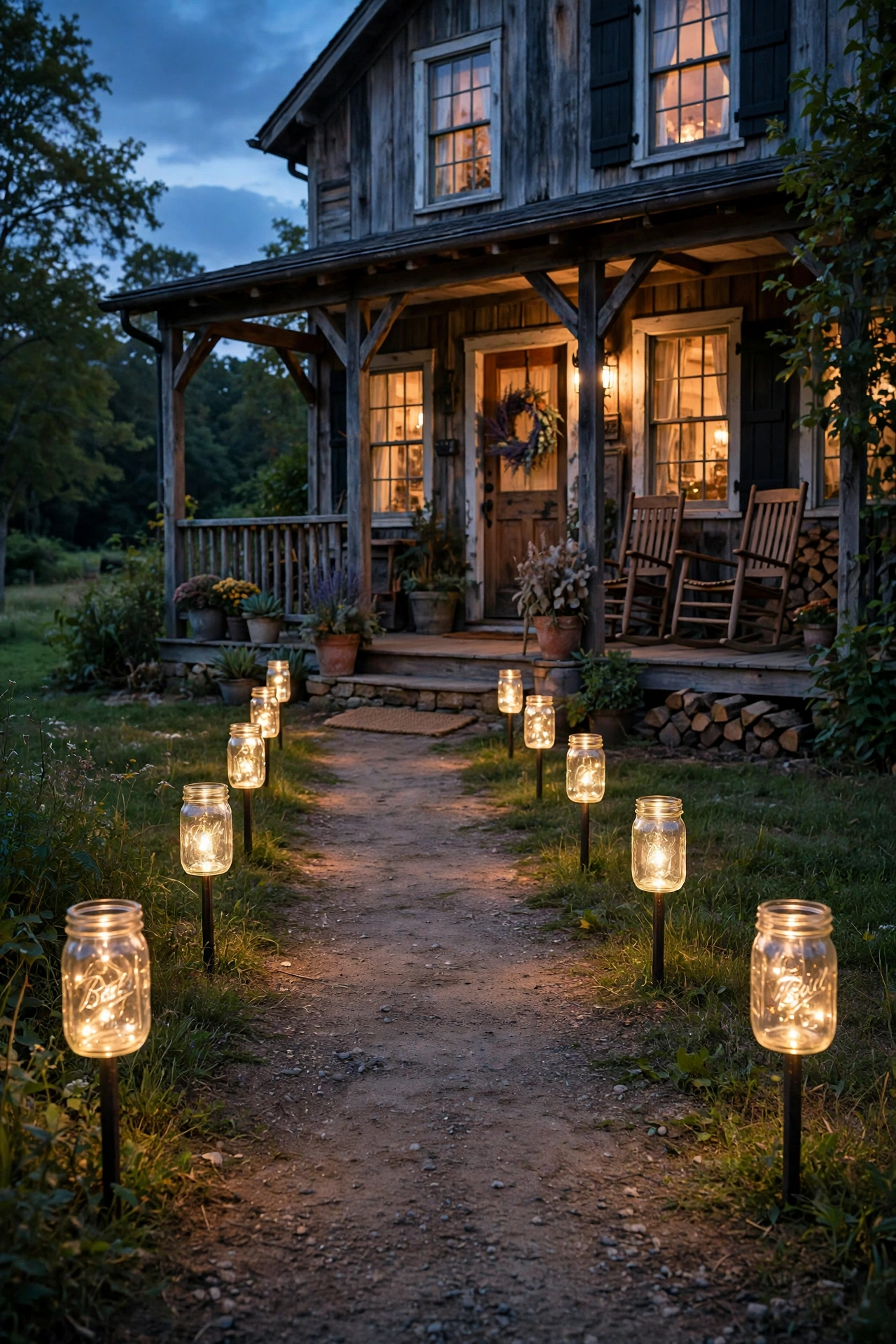
Carry the mason-jar magic off the porch and down the walkway. Solar mason-jar lids — little screw-on caps with a small panel and a warm-white LED — turn ordinary jars into self-charging path lights. Hang each jar from a 24- to 36-inch shepherd's hook, or set jars on short wooden stakes, spacing them 6 to 8 feet apart and alternating sides of the path for a natural, wandering feel.
They need honest sun to perform: six-plus hours of direct daylight for a full evening of glow. On cloudy stretches they'll be dimmer, so think of these as charming guides rather than primary lighting — and keep one wired light at the porch itself so the entry never goes dark. The glass jars handle weather fine, but the solar lids are the weak point; bring just the lids indoors for deep winter and they'll last years longer. Frosted jars or a light coat of frosted-glass spray softens the LED points into a gentle glow. Line the walk, and your whole approach to the house feels like a storybook farm lane.
Suggested budget range: $30 – $75 for a set of six.
14. Punched-Tin Star Lanterns Casting Patterned Light
Punched-tin lanterns are folk art you can light up — sheets of tin pierced with stars, hearts, or simple dot patterns that throw constellations across your porch walls. Hang one from a ceiling hook or set a pair on the steps, and the perforations scatter dozens of tiny light points around it. They look best 2 to 4 feet from a light-colored wall or siding, where the pattern has room to bloom.
Use a small LED bulb or a cluster of fairy lights inside — never an incandescent, because tin traps heat and the punched edges get surprisingly hot. Battery-operated tea lights work for tabletop sizes; a low-watt LED Edison bulb suits the larger hanging ones. The aged-tin and rusty finishes are the whole point, so don't polish them — the patina is the style. Keep them under the porch roof if possible; punched tin will rust through faster in direct rain. One large star lantern by the door, glowing with its pattern dancing on the siding, is worth a dozen generic fixtures.
Suggested budget range: $25 – $70 per lantern.

15. Soft Rope Lighting Tucked Under the Porch Roof Edge
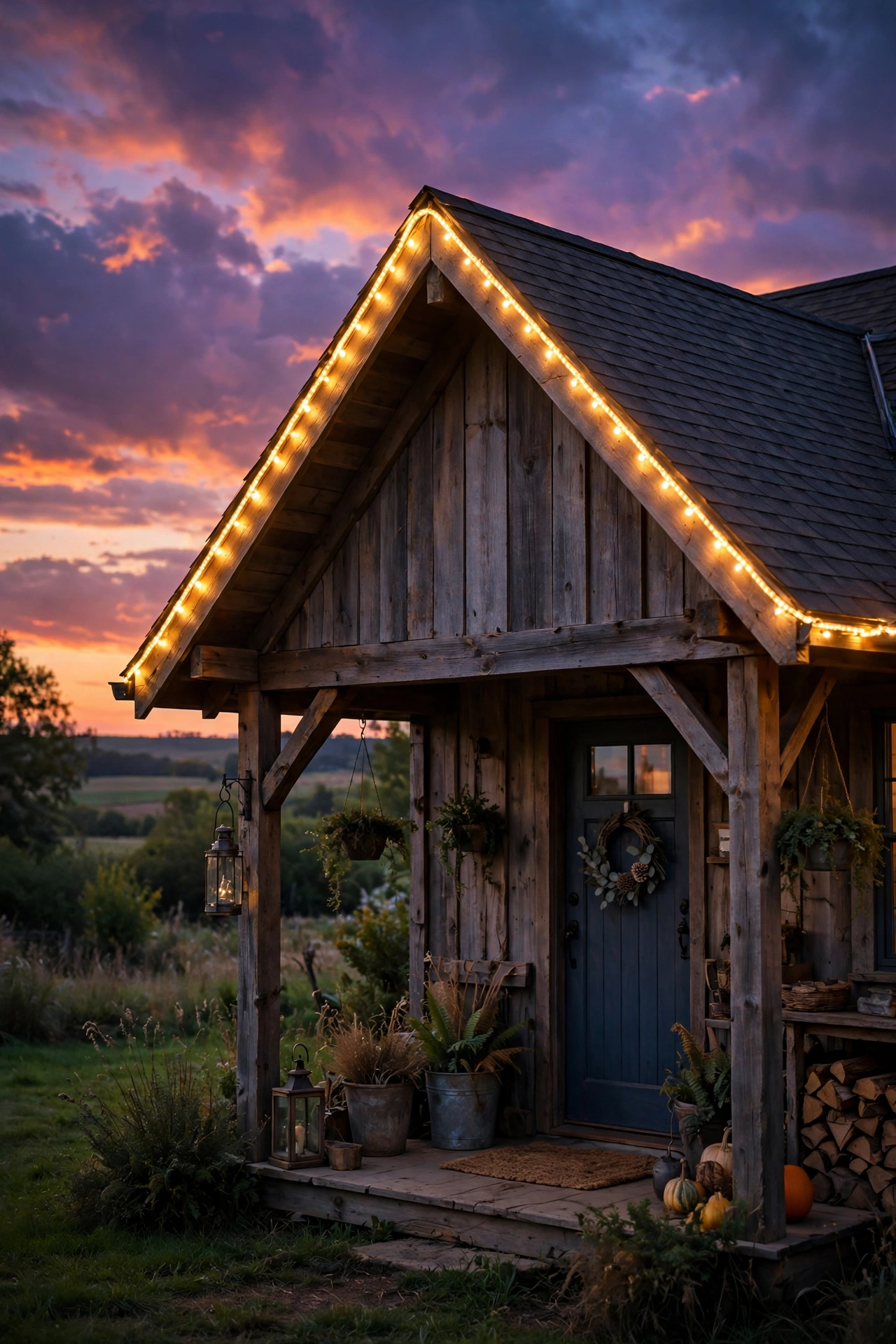
Here's the quiet workhorse idea: run warm-white LED rope light tucked just under the porch roof's edge or along the fascia board, where it grazes the ceiling with a soft wash of light. You barely see the source — you just see the porch ceiling glowing like it's lit from within. It makes the whole porch feel taller and more expensive, and it photographs beautifully.
Mount it with plastic clips every 12 to 18 inches, keeping the rope hidden behind the fascia so only the glow shows. Choose 2700K rope rated for outdoor use, and plug it into a timer or smart plug for dusk-to-11-p.m. operation. This is accent light, not task light — pair it with one real fixture like a gooseneck or lanterns for actual visibility. Measure your run before buying; rope lights come in fixed lengths like 16, 33, and 66 feet, and cutting them to fit only works on marked cut points. Keep connections off the ground and wrapped with outdoor-rated tape. Subtle, simple, and it runs for pennies.
Suggested budget range: $25 – $70 depending on length.
16. A Seeded-Glass Flush Mount on the Porch Ceiling
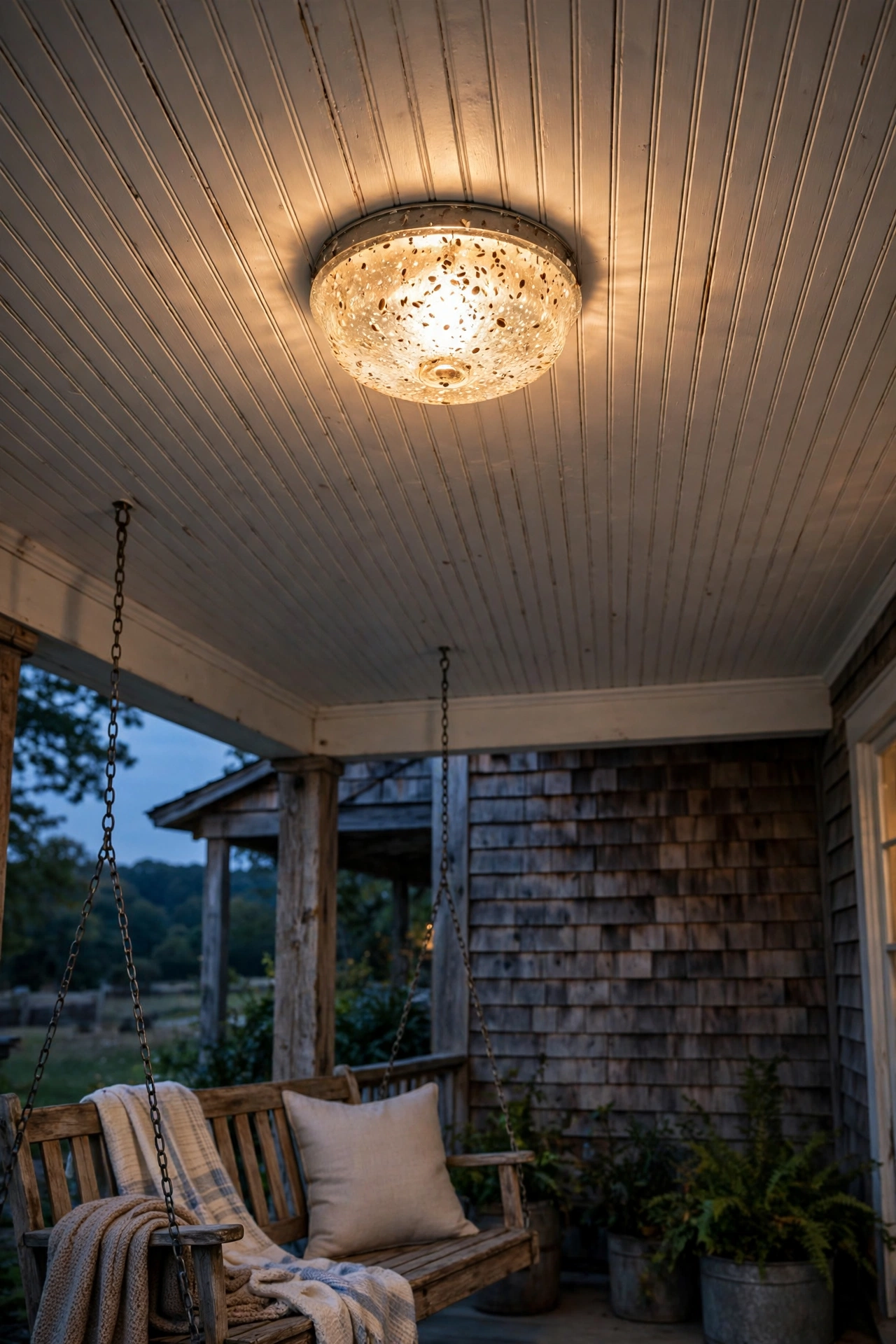
Low porch ceiling? A flush-mount fixture with seeded glass is your answer. Seeded glass — the kind with tiny bubbles trapped inside — scatters light into a soft, old-timey sparkle that flat glass just can't match. Center one over the front door or over the main seating area, choosing a fixture 10 to 14 inches across for a standard porch.
Use an LED A19 bulb at 2700K, around 800 lumens, and check that the bulb is rated for enclosed fixtures — trapped heat shortens the life of cheap LEDs. Galvanized, oil-rubbed bronze, or matte black finishes all suit the farmhouse look; seeded glass pairs especially well with a galvanized base for that collected-over-time feel. Make sure the fixture carries at least a damp-location rating, and a wet rating if your porch has no roof overhang protection. It's a ten-minute swap if a ceiling box already exists — just flip the breaker first. Small fixture, big farmhouse payoff.
Suggested budget range: $45 – $120.
17. A Rustic Bead Chandelier Over the Seating Area
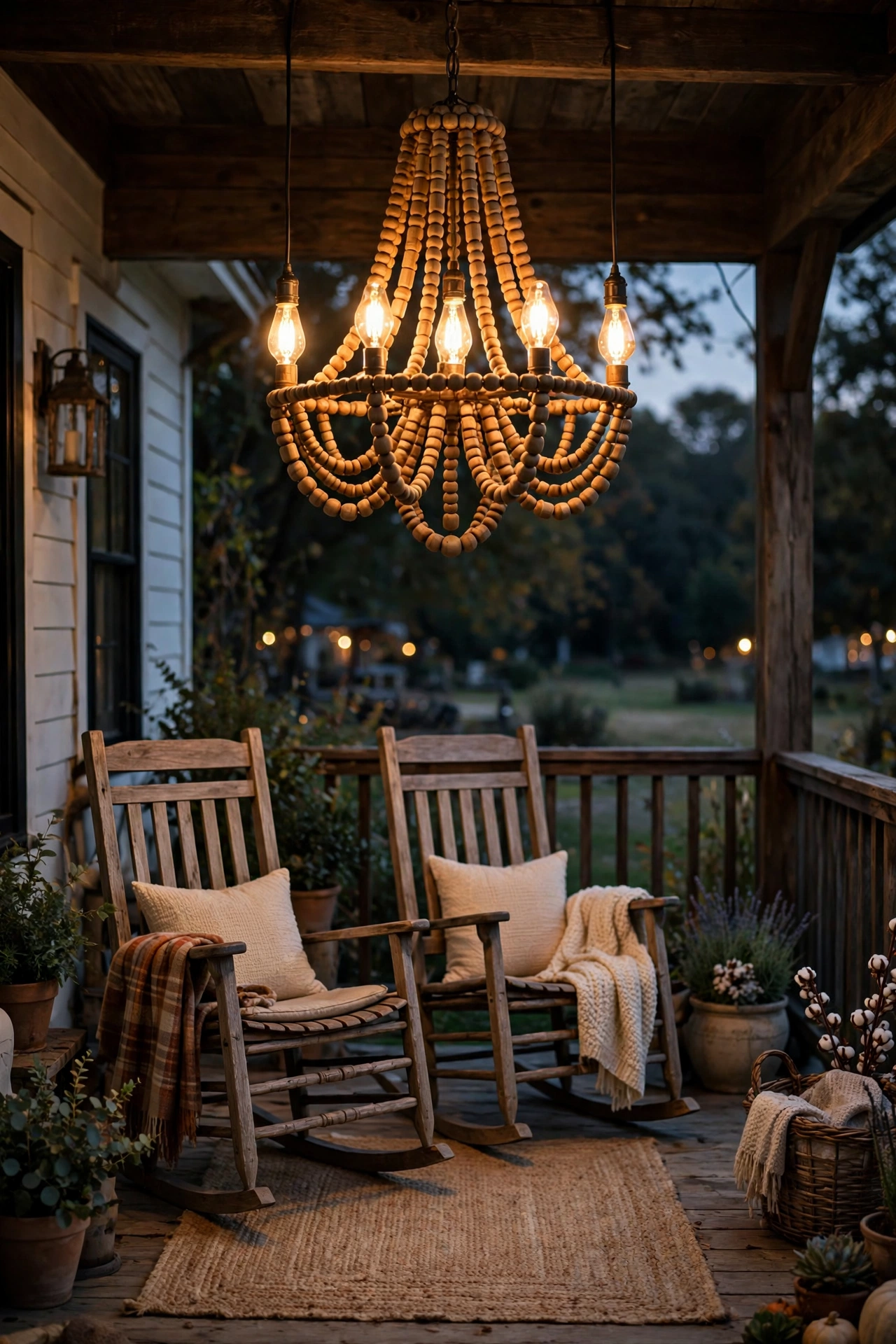
If your porch has a real seating area — a loveseat, a couple of rockers, a coffee table — it deserves a chandelier moment. A wooden-bead chandelier, with five or six small lights strung among turned-wood beads, brings farmhouse texture overhead without any of the fussiness of a traditional chandelier. Natural wood, whitewashed, or gray-washed finishes all work; pick the tone that echoes your porch furniture.
Hang it 30 to 36 inches above the coffee table surface, or keep a full 7 feet of clearance above the floor if it's over open space. Use small LED filament bulbs — G25 globes at 2700K are my pick — around 400 lumens each so the total glow stays cozy rather than glaring. This is a covered-porch fixture; check for a damp-location rating and keep it out of direct rain. Put it on a dimmer if you can — full brightness for cleaning up after a cookout, low and golden for late-evening conversation. It's the piece that makes a porch feel like a room.
Suggested budget range: $90 – $250.
18. The "Poured Light" Watering Can
This is the whimsical one, and it's pure farmhouse magic: tip a galvanized watering can on its side — on a crate, a step, or the porch floor — and let a strand of copper-wire fairy lights "pour" from the spout onto the ground below. From the street, it reads as glowing water spilling out of the can, and kids absolutely lose their minds over it.
Use a 33- to 66-foot strand of warm-white fairy lights, tucking the battery pack inside the can where it's hidden and sheltered. Stake or wedge the can so wind can't roll it — a brick inside the base works wonders — and let the light strand puddle naturally on the step or into a wooden crate below. Everything here is low-voltage LED, so it's safe to leave running all evening on a timer. Keep the battery pack dry by positioning the can under the porch roof. In my experience, this $30 trick gets more compliments than fixtures costing ten times as much.
Suggested budget range: $25 – $55.

19. Swing-Arm Barn Sconces You Can Aim Where You Need
Sometimes you need light exactly somewhere — on the wreath, the house numbers, the steps where the railing ends. Swing-arm barn sconces solve that: a classic barn shade on an adjustable arm that pivots and tilts, mounted beside the door or on porch posts. Mount them at 66 to 72 inches, the same sightline as your other fixtures, and aim the shade down at a 30- to 45-degree angle for the prettiest wash.
The adjustability is the point, so re-aim seasonally — at the wreath in December, at the steps in summer. Use an 800-lumen LED at 2700K, wet-rated if exposed. The arm hardware should be exterior-grade metal with stainless fasteners so it still swings smoothly after a few rainy seasons; a drop of silicone lubricant on the joint once a year keeps it moving. Wire them to the same timer or smart switch as your other porch lights so everything rises and sets together. Practical, handsome, and quietly the most useful fixture on this list.
Suggested budget range: $70 – $170 per sconce.

20. The $25 Bulb Swap That Changes Everything
Before you buy a single new fixture, do this: walk your porch with a notepad and write down every bulb — sconces, ceiling fixture, lanterns, post caps — then replace them all with 2700K LEDs in one go. Mismatched color temperatures are the number-one reason porches look "off," and a single 5000K daylight bulb hiding among warm ones will ruin the whole farmhouse mood. This one afternoon project delivers more transformation per dollar than anything else on this list.
Match brightness to the job: 800 lumens (60-watt equivalent) for sconces and ceiling fixtures, 450 lumens (40-watt equivalent) for lanterns and tabletop pieces. Check that each bulb suits its fixture — enclosed fixtures need enclosed-rated LEDs, dimmers need dimmable bulbs. Buy a few spares while you're at it; keeping one box of matching bulbs means replacements never break the color harmony. Honestly, I've seen $25 worth of bulbs make a $2,000 fixture setup look twice as good. Start here, then layer the fun stuff on top of a perfect warm foundation.
Suggested budget range: $20 – $40 for a whole porch.

21. My Whole-Porch Farmhouse Porch Lighting Plan
If you want the full recipe in one place, here's the farmhouse porch lighting plan I'd build from scratch. Start high: one gooseneck barn light centered over the door. Add the middle layer: a matched pair of wood-and-metal lanterns flanking the door at 60 to 66 inches, plus Edison string lights swagged across the ceiling. Finish low: three to five mason-jar lanterns stair-stepping down the steps, and solar mason jars on shepherd's hooks lining the walkway every 6 to 8 feet.
Keep every single bulb at 2700K — that unbroken warmth is what makes it all hang together. Put the wired pieces on one outdoor timer set for dusk to 11 p.m., use the built-in timers on the battery pieces, and let the solar jars fend for themselves. Total it up and you're looking at a complete, layered porch for roughly the cost of one nice dinner out per month saved over a season — most of these pieces last for years. Layer high, middle, and low; keep it warm; automate it. That's the whole philosophy, and it works on every porch I've ever dressed.
Suggested budget range: $250 – $600 for the complete layered plan.

Frequently Asked Questions
What's the best color temperature for farmhouse porch lighting?
Warm white at 2700K is the sweet spot — it's the color of old incandescent bulbs and candlelight, and it flatters wood, galvanized metal, and brick beautifully. For lantern accents and fairy lights, you can dip to 2200K for an even cozier, candle-like feel. The golden rule: keep every light on the porch at the same temperature. One cool-white bulb in the mix will clash with everything else and instantly break the rustic mood.
Can I leave farmhouse lanterns outside all year?
The fixtures themselves — metal, wood frames, glass — handle year-round weather fine if they're rated for outdoor use. It's the electronics that need care: bring battery packs, solar lids, and flameless candles indoors during deep freezes and driving storms, since cold kills batteries and moisture corrodes contacts. In snowy climates, I bring tabletop lanterns inside for January and February and leave the hardwired sconces and barn lights to do the heavy lifting.
Are mason-jar lights safe on a wooden porch?
Yes, as long as you use LED lights only — never a real flame in a sealed jar on a wooden surface. Battery tea lights, copper-wire fairy lights, and solar lids all run cool to the touch, so there's no heat risk to wood, dried florals, or fabric. Keep jars stable with sand or gravel in the bottom so they can't tip, and set them back from the main footpath so nobody kicks one over in the dark.
How much does it cost to run farmhouse porch lighting?
Less than you'd think, because almost everything here is LED. A typical 10-watt LED bulb running 6 hours a night uses about 1.8 kilowatt-hours a month — at average US electric rates, that's roughly 25 to 30 cents per bulb per month. A whole layered porch with a dozen LED light points usually adds $3 to $5 a month to your electric bill. Solar and battery pieces cost nothing to run beyond occasional replacement batteries.
Conclusion
There you have it — 21 ideas to wrap your entry in the kind of warm, honest glow that makes a house feel like a home. In my experience, the perfect farmhouse porch lighting setup isn't about buying the most fixtures; it's about layering a few honest materials — galvanized metal, weathered wood, glowing glass — in warm 2700K light at three heights, then putting it all on a timer so the magic happens on its own.
Start with the $25 bulb swap tonight, add one statement piece like a gooseneck barn light this weekend, and layer in mason jars and string lights as the mood strikes. Your porch is the first thing guests see and the last thing the neighborhood sees — make it glow.
If this got your wheels turning, browse our other lighting ideas for more inspiration — including cozy fall porch lighting ideas for the autumn season — because there's always another corner of your home waiting for the right light. Happy decorating, and enjoy every golden evening on that porch.