There is a particular kind of magic in the first warm evening of spring, when you can finally sit outside without a blanket and the whole neighborhood seems to exhale at once. If your porch has been sitting dark and a little sad since the holidays, these spring porch lighting ideas are exactly the refresh it needs. I always tell friends that spring is the easiest season to light beautifully, because the blooming plants, fresh wreaths, and longer evenings do half the work for you — you just need the right glow to show it all off.
My whole philosophy here is layering: one light source flattens everything, but two or three layers — an overhead or string glow, something at eye level like lanterns or sconces, and a low accent along the walkway or in planters — turn a plain concrete slab into a room you actually want to linger in. In my experience, three small, warm sources beat one big bright floodlight every single time. The guide below walks you through 19 of my favorite ways to build those layers, from ten-dollar solar stakes to a full string-light canopy, with real budgets and the practical details I wish someone had told me before I bought my first set of lights. Let's wake up that entryway.
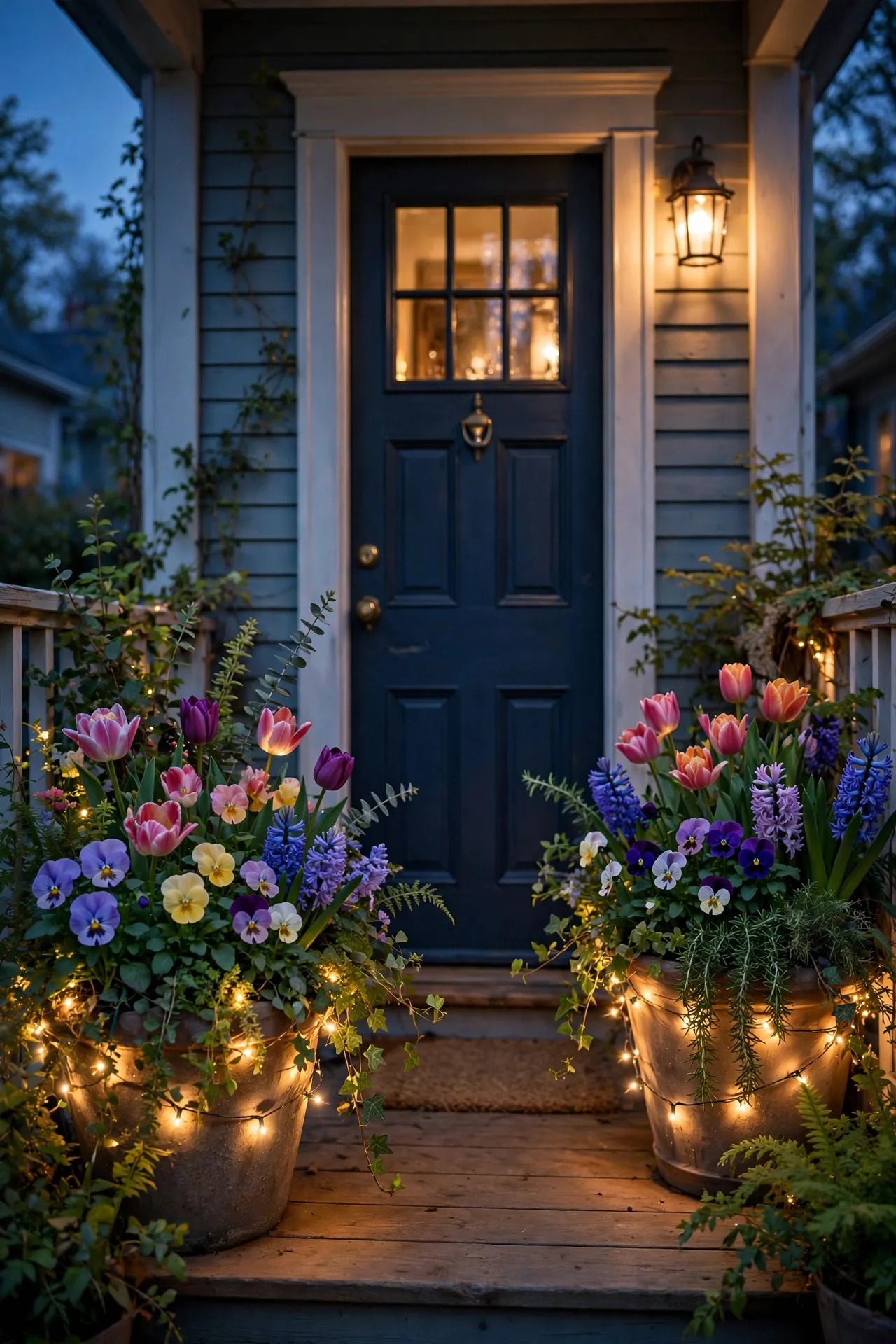
1. Fairy-Light-Wrapped Blooming Planters (My Favorite Spring Porch Lighting Idea)
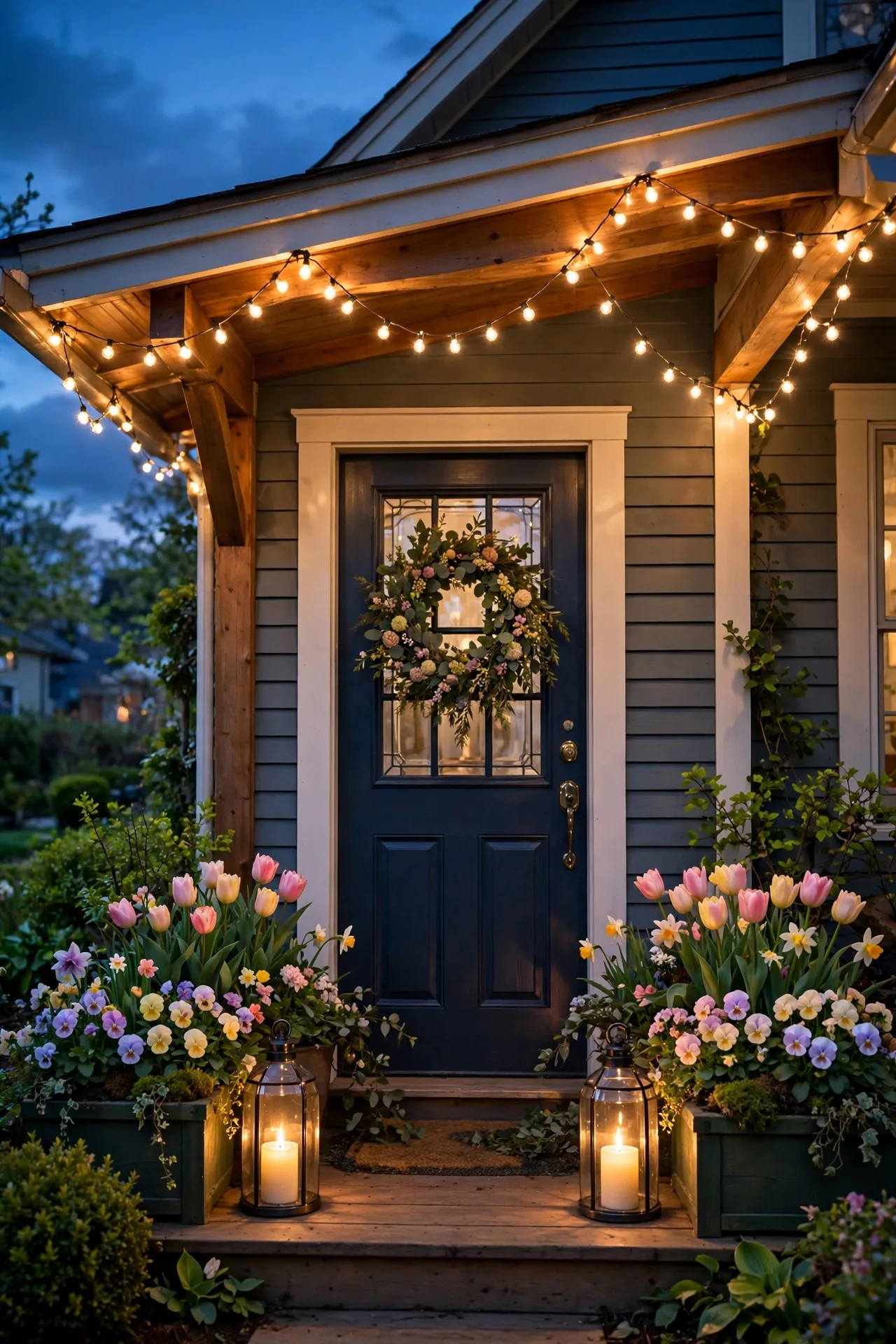
Spring planters are already the stars of the show — pansies, tulips, hyacinths spilling over the edge of a big terracotta pot — so wrapping them with lights is the easiest glow-up on this whole list. I take a 33-foot strand of copper-wire fairy lights (the warm white, battery-powered kind with a built-in timer) and weave it loosely through the foliage, tucking the battery box behind the pot where nobody can see it. The key word is loosely: burying the wire deep in the soil kills the effect, but draping it through the leaves makes the whole planter sparkle from within. Set the timer so the lights click on at dusk and run six hours — you'll get the full evening without remembering to switch anything. Honestly, two flanking planters done this way look so good that guests assume you hired someone. One caution: use LED-only strands near live plants and mulch, never old incandescent minis, and look for an outdoor rating on the battery box if the pots sit in the rain.
Suggested budget range: $15 – $40.
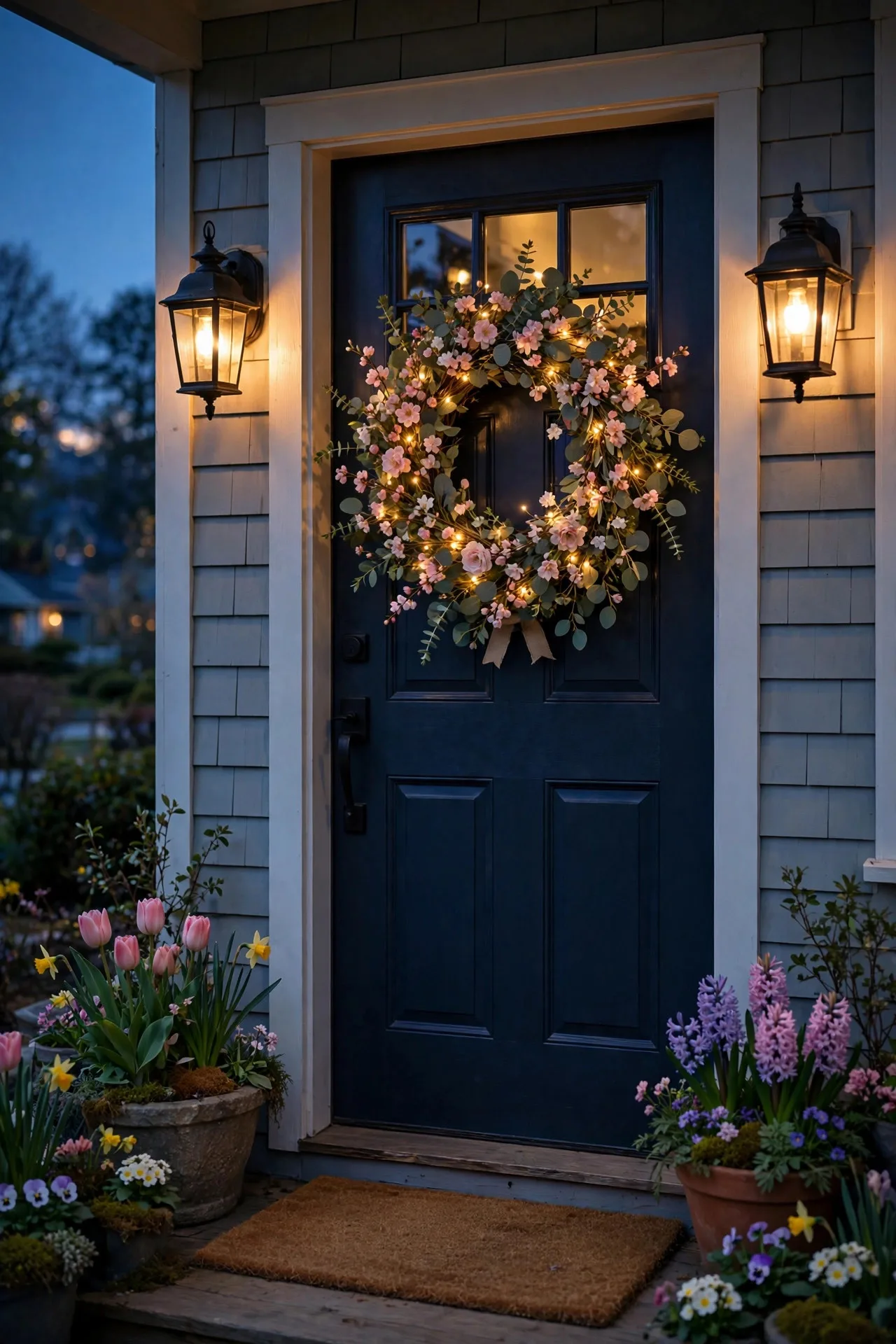
2. A Lighted Spring Wreath on the Front Door
A spring wreath studded with tiny lights is the porch equivalent of a good first impression. I love a grapevine or eucalyptus-style wreath with a 20-bulb micro LED strand woven through it — choose one where the wire is thin enough to disappear into the greenery. The trick is hanging it where it catches people: on the door itself at about eye level, centered. If your door gets direct afternoon sun, swap delicate dried florals for faux eucalyptus and silk blossoms, because real dried flowers bleach out by June. I always recommend the battery-powered strands with a daylight sensor or timer so the wreath glows from dusk until you turn in without any visible cord snaking across the porch. And here's a styling tip that costs nothing: pair the lit wreath with an unlit matching garland on the railing or around the door frame, and the whole entry suddenly feels coordinated. If you love wreath lighting year-round, my roundup of prelit wreath and garland looks has more inspiration you can adapt for any season.
Suggested budget range: $25 – $75.
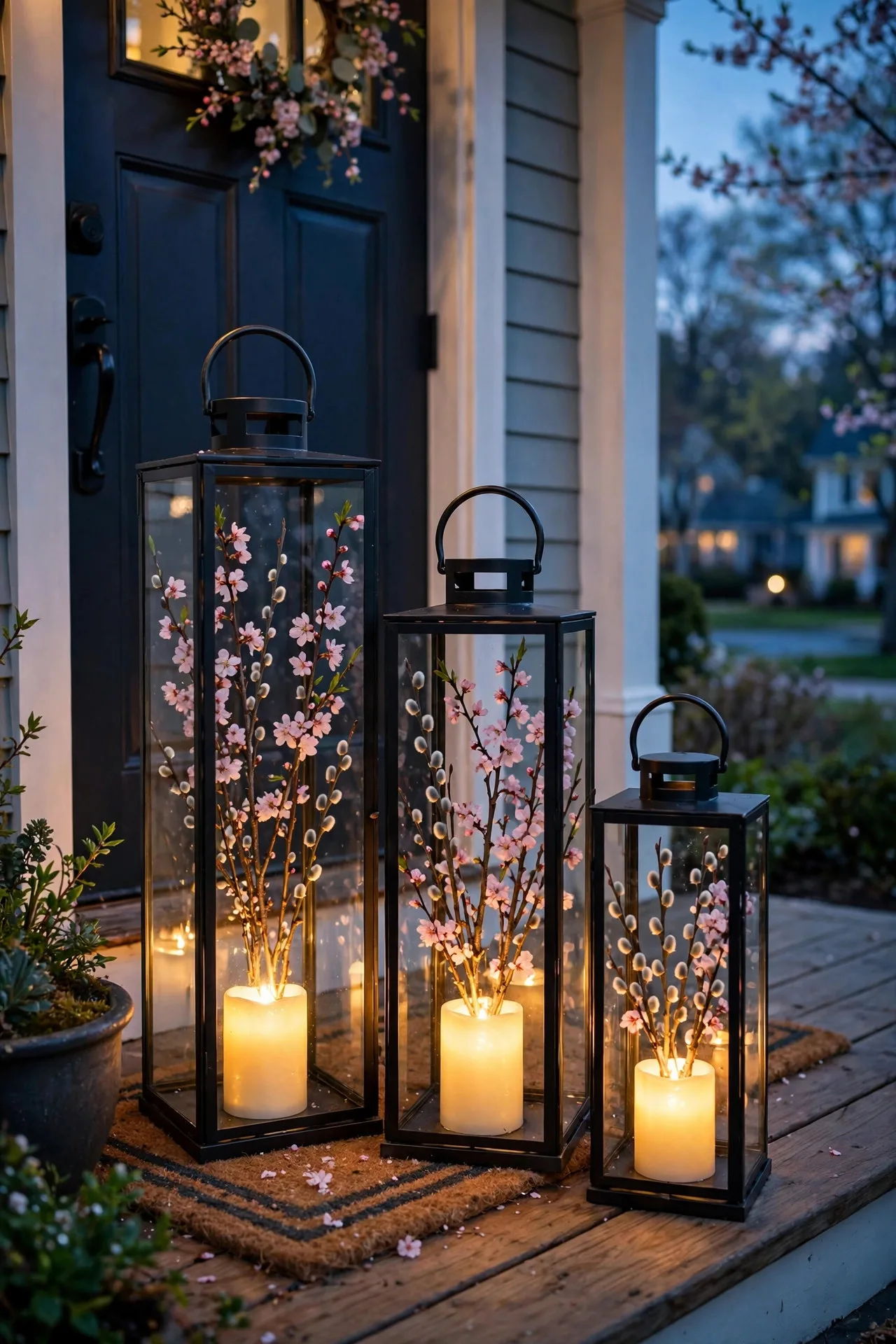
3. A Trio of Lanterns with Spring Stems
Nothing says "sit a while" like lanterns clustered at different heights, and spring gives you the prettiest filler — a few stems of cherry blossom, forsythia, or pussy willow inside glass lanterns turns basic porch decor into something editorial. I group three lanterns together (tall, medium, short) on one side of the door or at the foot of the steps, and inside each one I drop a flameless LED candle or a short strand of fairy lights coiled around the stems. Go flameless, always — real candles and dry spring branches are a combination I never mess with, plus LED pillars last hundreds of hours and many come with remotes. Metal or wood lantern frames read coziest; just make sure anything sitting out in the weather is rated for outdoor use, and bring fabric-shaded lanterns inside when a real downpour rolls through. When the stems fade in a few weeks, swap in summer greenery and the lanterns keep working all season.
Suggested budget range: $40 – $120.
4. Refresh Your Door Sconces for Spring
Before you buy a single new light, look at the two fixtures you already own — the sconces flanking your front door. I refresh mine every spring in about twenty minutes: a quick wipe-down of the glass (winter grime dims more light than you'd believe), then fresh warm-white LED bulbs in the 2700K range. That warm 2700–3000K color temperature is my non-negotiable for porches — anything cooler than 3000K reads blue and sterile against spring greenery. If your sconces are dated, swapping them for a clean lantern-style pair is one of the highest-impact porch upgrades there is; mount them so the bulb sits roughly 60 to 66 inches off the porch floor, which puts the glow right at eye level for visitors. One safety note: this is low-voltage, routine work, but always flip the breaker off before touching the fixture, and if your wiring looks brittle or the box isn't weather-rated, that's a job for an electrician. A $60 pair of sconces and two good bulbs can make a tired entry feel brand new.
Suggested budget range: $10 – $150.

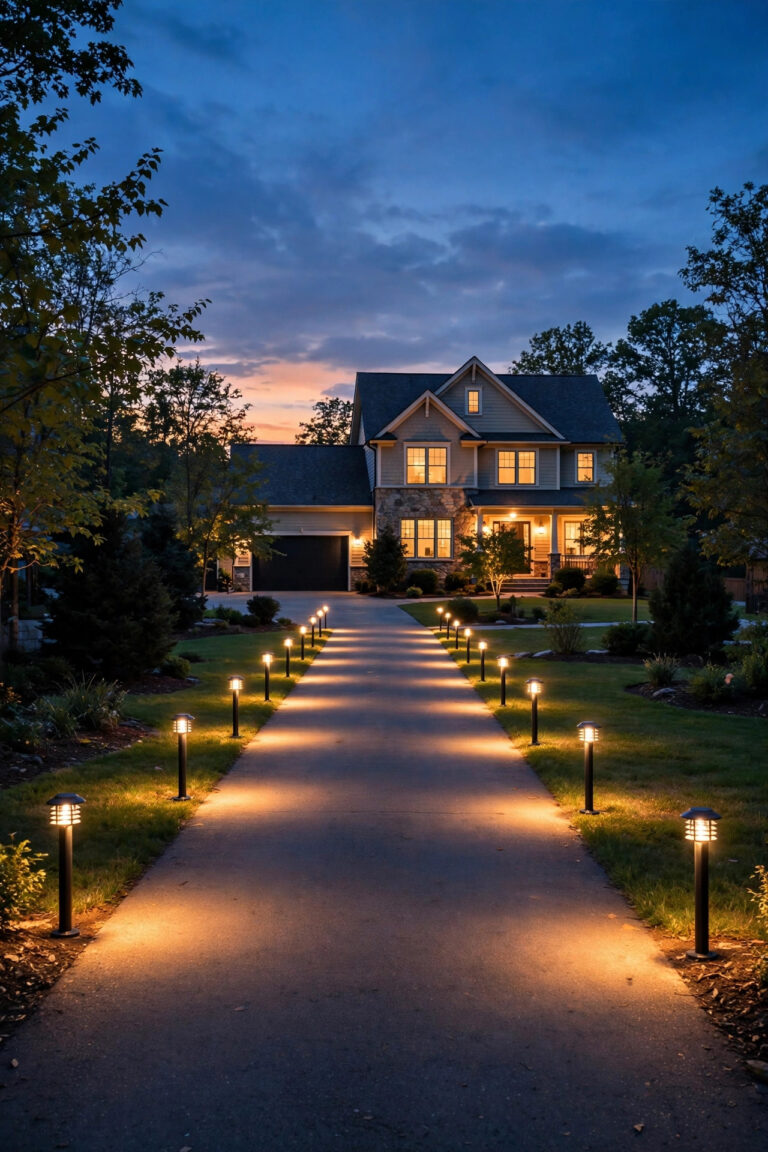
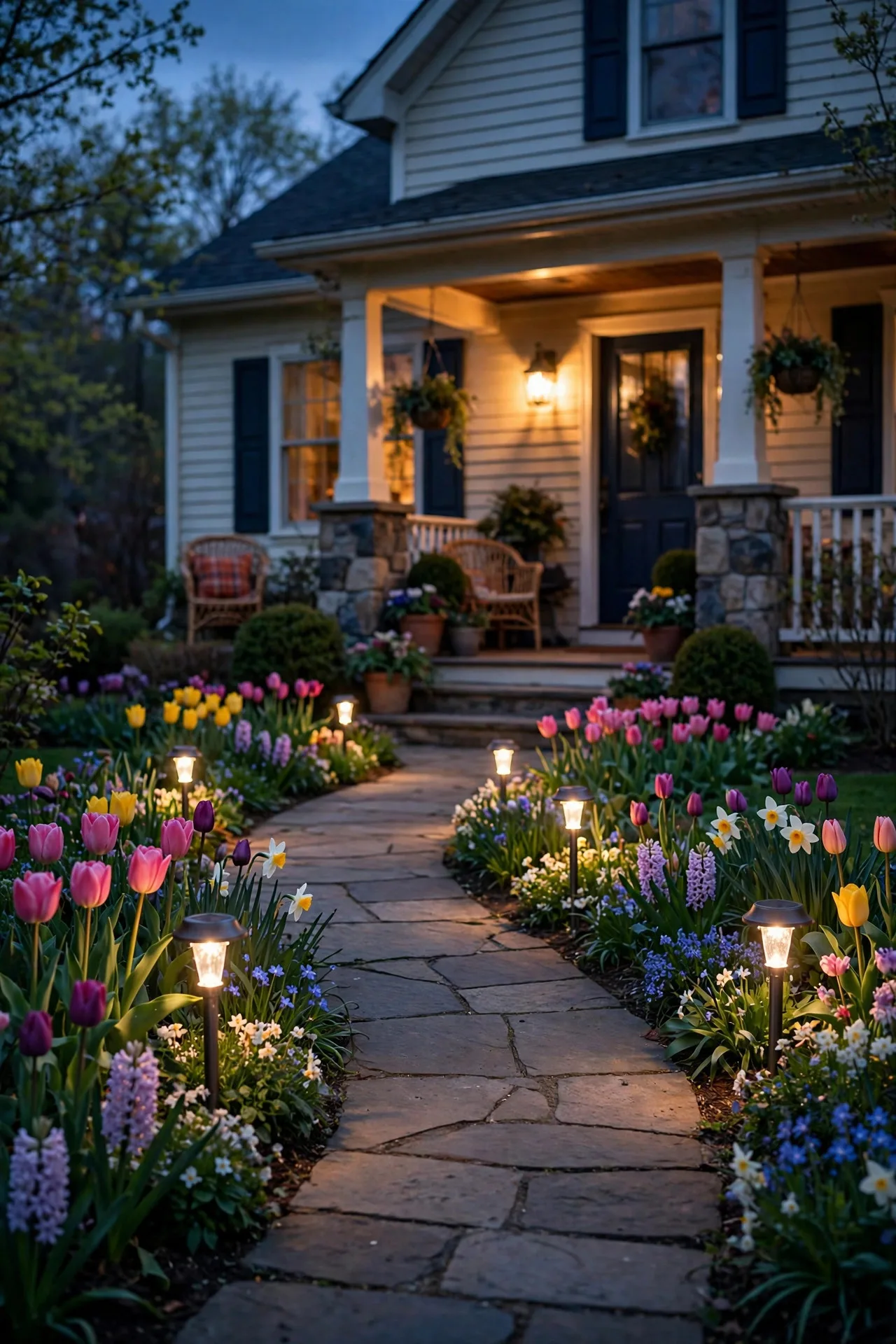
5. Solar Path Lights Among the Spring Blooms
Spring is when solar lights finally earn their keep — the longer days charge them up and the flower beds give them something gorgeous to highlight. I place solar stake lights about 6 to 8 feet apart along the walkway, offset slightly so they wash the tulip beds and fresh mulch rather than standing in a straight military line. Warm white is the move here; cool blue-white solar stakes make even the prettiest border look like an airport runway. In my experience, the biggest mistake people make is buying the cheapest multipack and wondering why they fade by midnight — mid-range stakes with a decent battery (look for 600mAh and up) will comfortably run from dusk past bedtime on a full spring charge. Push them in where the solar panel gets at least six hours of direct sun, clear of overhanging shrubs, and wipe the panels monthly since spring pollen films over them fast. For a walkway around 30 feet long, five to six lights give you a lovely, welcoming runway.
Suggested budget range: $25 – $90.
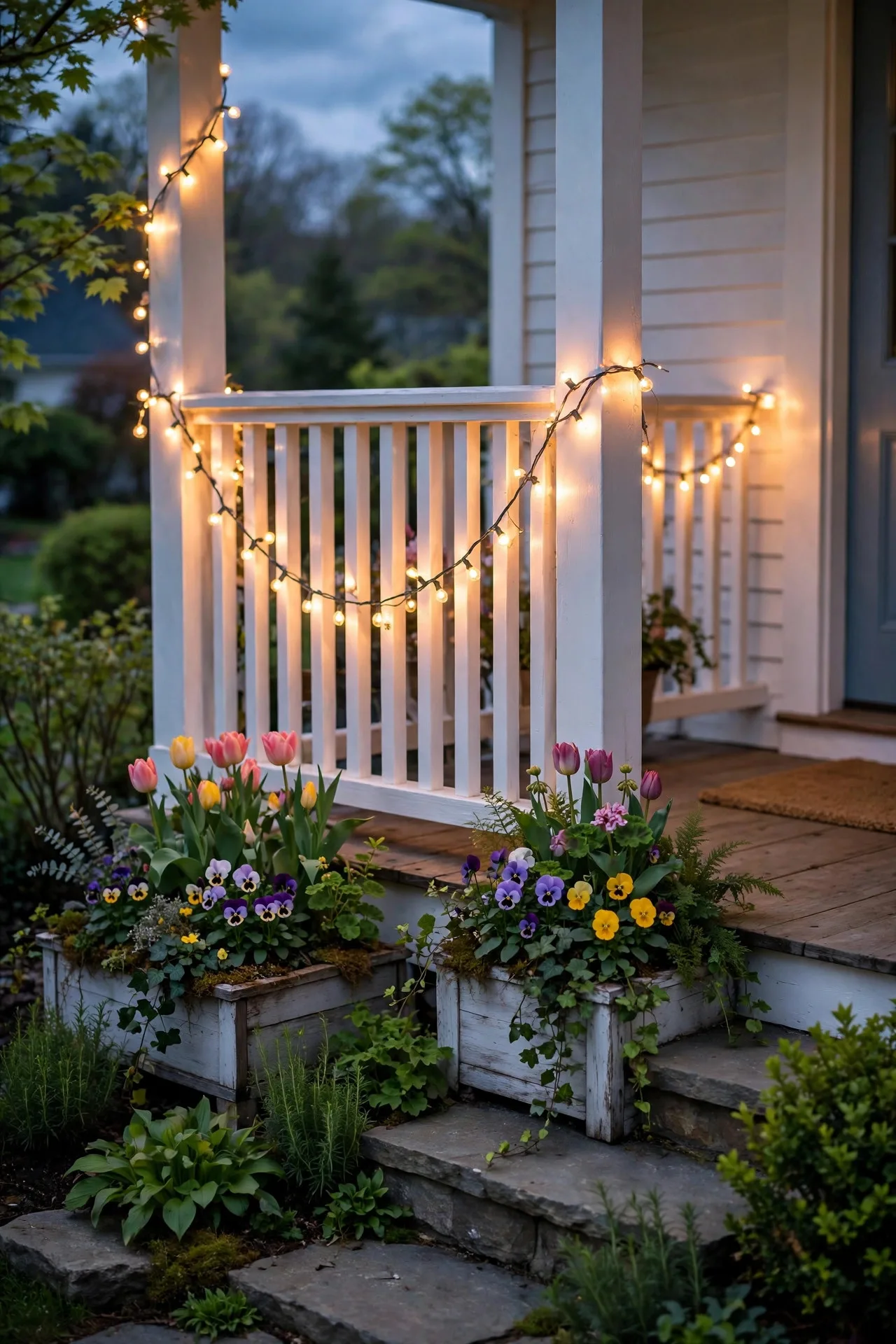
6. String Lights Draped Along the Porch Railing
String lights on a railing are the porch equivalent of a string of pearls — simple, classic, and flattering on everyone. I drape a warm-white outdoor strand along the top rail, letting it swag gently between posts (about 4 to 6 inches of dip per span looks relaxed, not saggy) and securing it with small clear clips or cup hooks so wind can't pull it down. If your porch has no railing, the same trick works along the fascia board or under the eave lip. Look for strands with a proper outdoor rating and a connectable end, so you can link two sets end-to-end without running a second cord across the yard. I always recommend LED filament-style bulbs here — they mimic that vintage café glow while staying cool to the touch and sipping electricity, about a tenth of what old incandescent strands used. Put the whole thing on an outdoor timer so it fades on at sunset and off when the evening winds down, and you'll have the coziest railing on the block without lifting a finger after setup day.
Suggested budget range: $20 – $60.
7. Hanging Edison Bulbs Over the Porch Swing
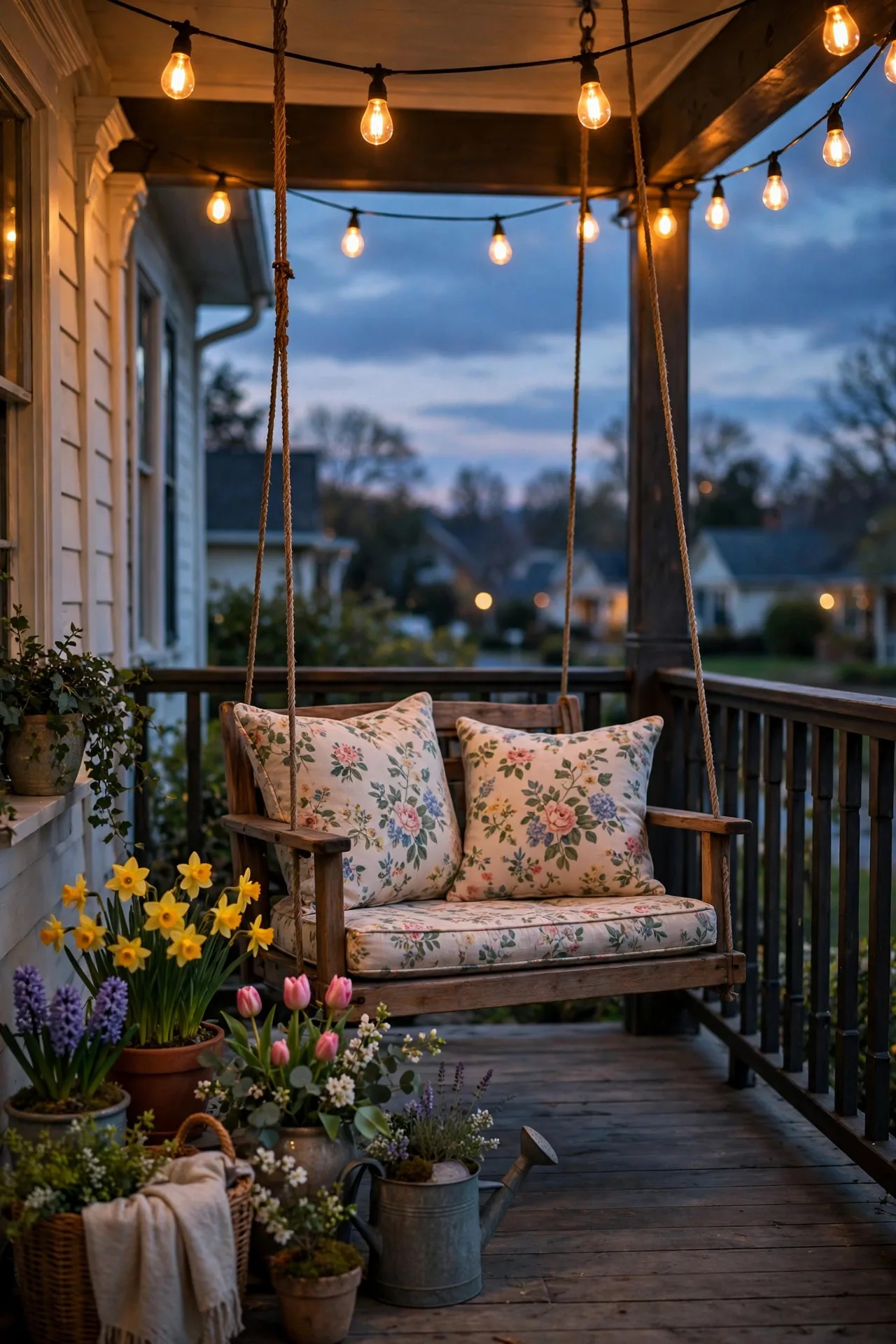
If you have a porch swing or a little seating nook, overhead Edison bulbs will change how often you actually use it — I say this from experience, because mine went from daytime-only to our favorite evening spot the week I hung them. I string a short canopy of oversized LED Edison bulbs (the amber-filament style) overhead, keeping the lowest bulb at least 7 feet off the floor so nobody conks their head. On a covered porch, screw sturdy hooks into the ceiling joists — never just into drywall or thin beadboard — and let the strand dip into a gentle catenary curve. The exposed-filament look gives you that nostalgic warmth at 2700K, and because they're LED, they stay cool even inches above your head. Pair the overhead bulbs with a lantern on the side table (see idea 3) and you've got two layers of light in one corner, which is exactly the kind of layering that makes a porch feel like a real outdoor room.
Suggested budget range: $30 – $80.
8. Fairy Lights in a Potted Topiary or Boxwood
There's something almost storybook about a tidy boxwood ball sparkling with fairy lights — very spring garden party. I wrap a 50-bulb warm-white strand around a potted topiary in a loose spiral, starting at the base and working up, spacing the loops about 3 to 4 inches apart so the whole thing reads as one glowing globe rather than random twinkles. Battery boxes tuck into the soil at the back of the pot; solar-topped fairy lights work too if the pot sits in full sun. The trick to making it look expensive instead of tangled: wrap on a cloudy afternoon so you can see what you're doing, step back every few loops, and hide the first and last inches of wire behind the foliage. Two matching topiaries flanking the door, both lit, will make your whole facade look intentional and cared-for. Refresh the topiary itself with a spring feeding and you'll have the prettiest entry on the street through summer.
Suggested budget range: $30 – $90.

9. Mini Lights Woven Through Window Boxes
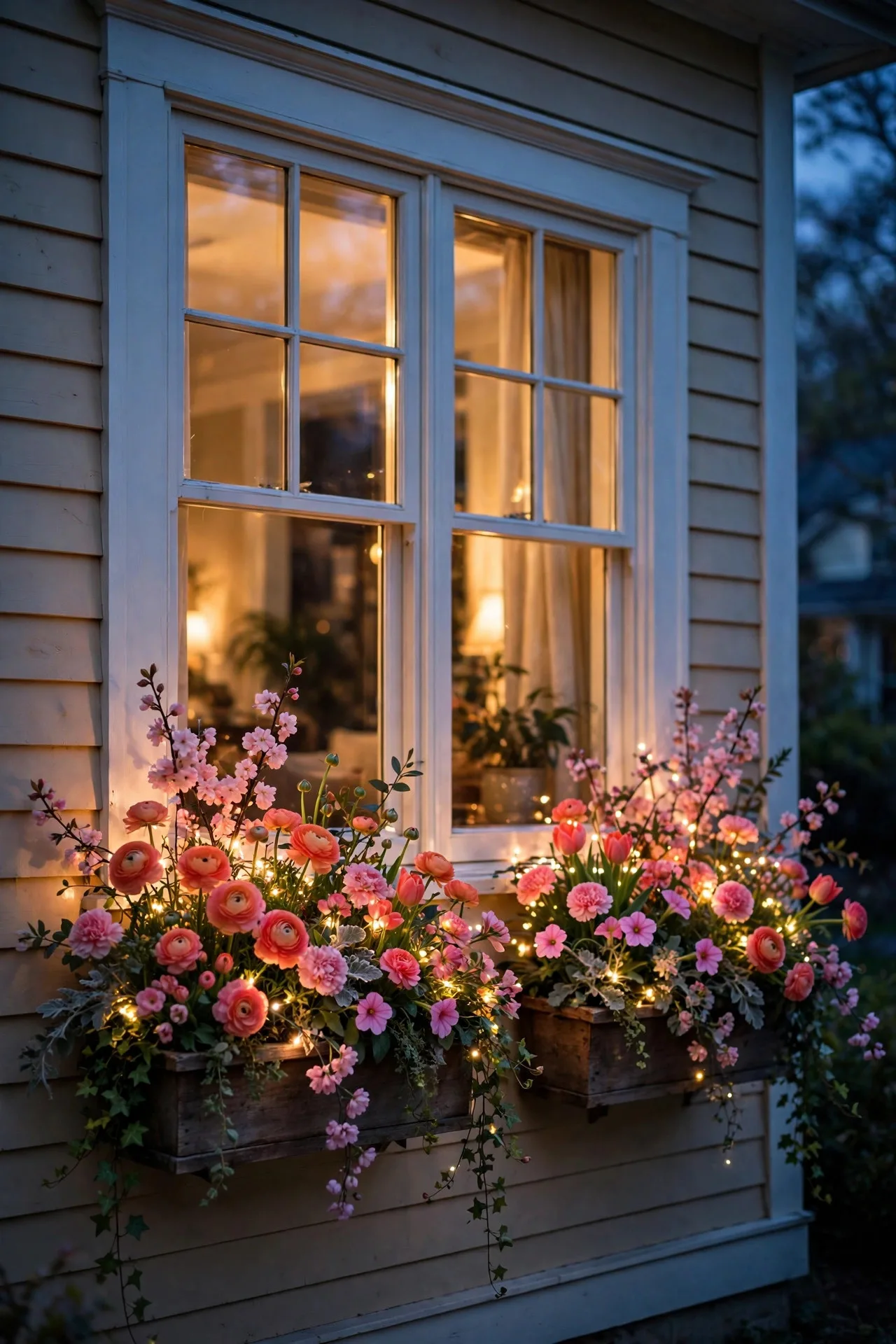
Window boxes are a spring staple, and weaving a short strand of micro lights through the flowers is the detail that makes passersby slow down. I use one 20-to-33-foot copper-wire strand per box, tucking the wire along the back edge first and then weaving it forward through the blooms so the lights peek out between petals. Battery-powered strands with a six-hour timer are perfect — no cords, no fuss, and the battery box hides behind the box itself. Stick with LED only (incandescent heat will scorch delicate petals and dry moss), and choose a warm white that flatters pink and coral flowers especially. Watering tip: aim the spout low and keep the battery box elevated above the soil line so it never sits in a puddle. This one photographs beautifully for anyone selling a home in spring, by the way — curb appeal after dark is an underrated thing.
Suggested budget range: $12 – $35.
10. A String-Light Canopy Over the Seating Area
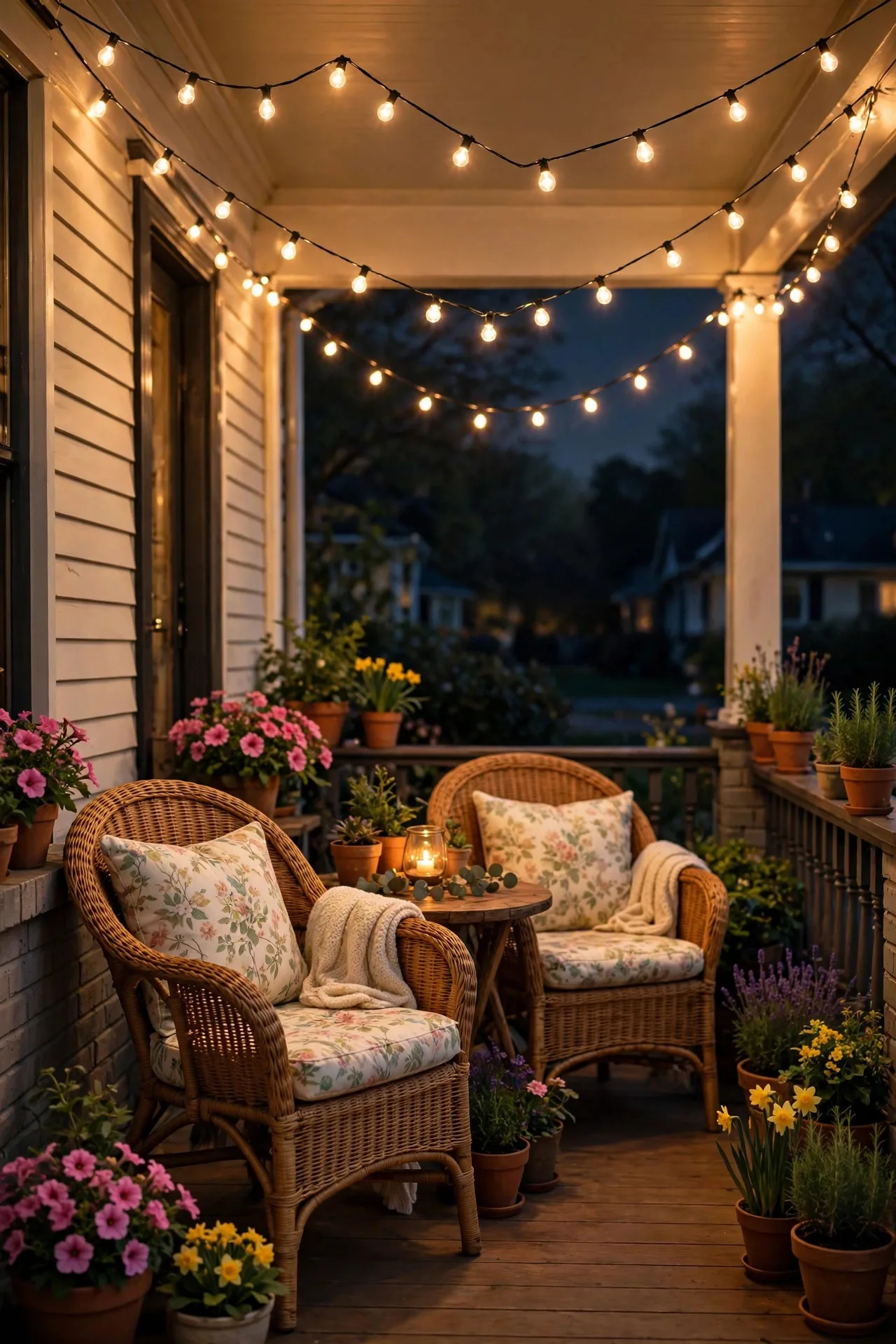
When you want the full wow, nothing beats a canopy of string lights overhead — it's the fastest way to make a plain porch feel like a bistro patio. For a covered porch, I zigzag strands back and forth across the ceiling on cup hooks spaced about 3 feet apart; for an open porch or stoop, run them from the house to two sturdy shepherd's hooks or posts set in planters weighted with concrete. Keep spans under 15 feet between supports to avoid heavy sagging, and leave a gentle 6-to-8-inch dip — perfectly straight reads tense, while a soft curve reads cozy. Warm-white LED strands with connectable ends let you cover a 10-by-12-foot porch with just two or three sets. One practical note: plug everything into an outdoor-rated timer or smart plug so the canopy glows from dusk to about 11 p.m. automatically. On breezy nights, give each strand a gentle tug test before the season — spring storms have a way of finding loose hooks.
Suggested budget range: $40 – $120.
11. Mason Jar Solar Lanterns on Steps and Tables
Mason jar solar lanterns are the sweet spot between charming and cheap — they cost almost nothing to run and they look like something from a farmers' market. The premise is simple: a wide-mouth jar with a solar lid that holds a small LED (fairy-light lids give you a whole sparkle instead of a single bulb), charging all day and glowing all evening. I line them along porch steps, spacing one jar every two or three steps, and cluster a few more on side tables and the railing. For spring, drop a sprig of lavender or a couple of silk wildflowers inside for that fresh, gathered look. Make sure the lids are actually weather-resistant if they'll live outside full-time, and give the solar panels a wipe every few weeks — spring pollen is the enemy of solar charging. Honestly, a set of six jars for the price of a pizza might be the best value in this entire list.
Suggested budget range: $20 – $50.

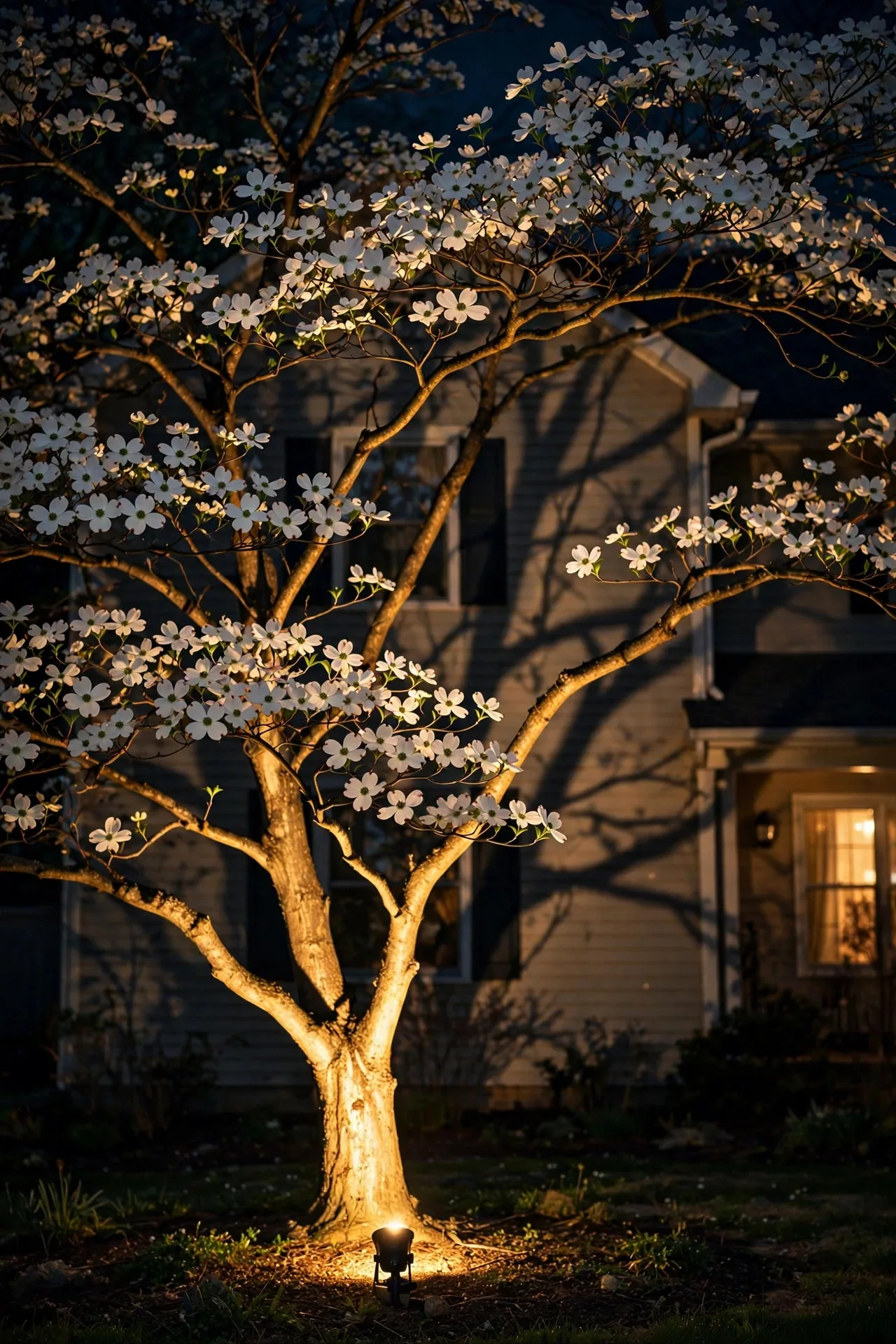
12. Uplight a Flowering Tree or Dogwood
April and May are peak bloom for dogwoods, redbuds, and cherry trees — and uplighting one turns your whole front yard into evening theater. I set a warm-white outdoor spotlight at the base of the tree, angled up into the canopy from about 3 feet out, which throws dramatic shadows of the branches across the lawn and makes the blossoms glow from below. One well-placed 200-to-400-lumen spot is plenty for a young tree; a mature dogwood might want two. Solar spotlights are the easy option (no trenching, no cords), but plug-in low-voltage kits give you a steadier, brighter beam — either way, keep the fixture aimed up and shielded so it never shines into the street or a neighbor's window. This is also my favorite of these spring porch lighting ideas for sheer drama-per-dollar, because a $35 spotlight can make a $500 landscape look like a million bucks after dark. Angle, test at night, adjust — don't judge the aim in daylight.
Suggested budget range: $25 – $80.
13. A Motion-Sensor Welcome Light by the Door
Spring evenings are for coming and going — dinner on the patio, sunset walks, neighbors dropping by — so a light that greets you without thinking about it is pure gold. I mounted a small motion-sensor LED light above the side door and one near the steps, set to a warm 2700K so the glow feels welcoming instead of interrogation-bright. Most models let you tune the sensitivity and the on-time; I set mine to about five minutes with a medium sensitivity so passing cats don't throw a rave. Mounting height matters: 7 to 9 feet off the ground gives you the best coverage cone. Battery and solar models exist if you'd rather skip wiring, though hardwired versions with a dusk-to-dawn sensor are the most reliable for a main entry. Just aim the sensor slightly downward and away from the street, or every passing car becomes your personal spotlight operator.
Suggested budget range: $20 – $70.

14. Layered Candle Lanterns for Evening Entertaining
Spring is officially porch-sitting season, and a cluster of lanterns at table height is what makes a casual hangout feel like an occasion. I gather four or five lanterns of mixed sizes on the coffee table or along the railing ledge, each holding a flameless LED pillar, and let their overlapping glows do the work — it's the classic lighting designer's trick of grouping small sources instead of relying on one big one. Stagger the heights (tall at the back, short in front) and mix clear and seeded glass for texture. Real candles have a lovely flicker, but between the breeze, the pollen, and the fire risk around spring decor, I keep flame outdoors strictly to citronella-style torches placed well away from the house — LED-only inside lanterns, always. Remote-controlled pillars mean you can dim the whole cluster from your chair when the conversation gets good. Add a throw blanket and you've got the coziest seat in the house, outside the house.
Suggested budget range: $35 – $100.

15. Net Lights Over Spring Shrubbery
Net lights aren't just for December — draped over azaleas, forsythia, and fresh boxwood, they create a blanket of twinkles that string lights can't match. I lay a 4-by-6-foot warm-white net over each shrub, pulling it gently into shape so the grid sits evenly over the foliage rather than bunched in one spot. The grid pattern means you get hundreds of evenly spaced points of light with zero wrapping skill required, which is why I recommend nets to every lighting beginner. Choose LED nets with an outdoor rating, and plug them into the same timer as your other porch lights so everything fires up together at dusk. When the shrubs leaf out fully in June, you can lift the nets off in minutes and roll them up for fall — they store flat, which is more than I can say for tangled string strands. For a really lush look, pair net-lit shrubs with solar path lights (idea 5) and you've got the full front-yard frame glowing.
Suggested budget range: $15 – $45.

16. Backlit or Illuminated House Numbers
This is the idea nobody thinks of and everybody notices — backlit house numbers that make your address readable from the street all evening. After dark, a glowing address is practical (delivery drivers will love you), secure, and honestly just looks sharp against a freshly painted door. The easiest route is a slim LED-backlit number plaque mounted beside the door at about 5 feet off the ground, hardwired into your existing porch light circuit by an electrician — or a solar-powered number sign if you'd rather skip wiring entirely. Go for a warm glow that matches your other porch lights; cool-white numbers next to warm-white sconces will look mismatched. Size the numerals at least 4 inches tall for street readability, and mount them on a contrasting background (dark plaque, light numbers, or vice versa). It's a small detail, but it's the kind of small detail that makes a house feel finished.
Suggested budget range: $30 – $110.

17. Pastel Paper Lanterns for a Garden-Party Vibe
When spring turns party season — Easter brunch, Mother's Day, graduation — a string of pastel paper lanterns sets the mood instantly. I hang a strand of round lanterns in blush, mint, and butter yellow across the porch for gatherings, then take them down after the weekend. A few rules keep this pretty instead of problematic: use LED-only strands inside paper lanterns (paper and hot incandescent bulbs are a fire risk I will never endorse), keep them under a covered porch away from direct rain, and bring them inside overnight since damp paper sags fast. Battery-powered LED strands are ideal because you can hang the whole garland with no cords. The soft pastel glow against evening blue is genuinely lovely, and because the setup takes ten minutes and costs less than a fancy centerpiece, it's my go-to for last-minute entertaining. Store them flat between parties and one set lasts for seasons.
Suggested budget range: $18 – $45.

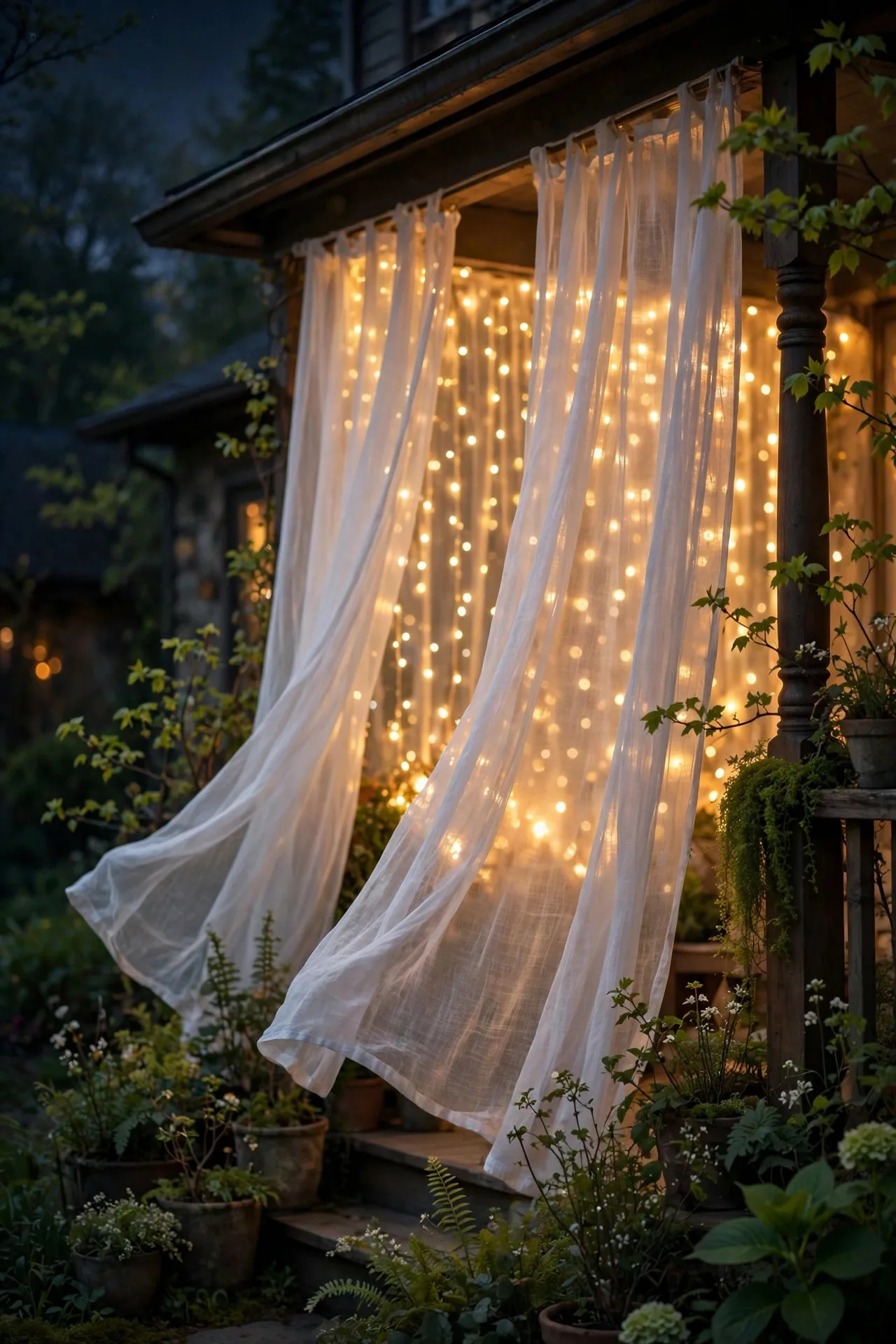
18. Fairy-Light Curtains Behind Sheer Porch Drapes
This is the romantic one: sheer outdoor curtains on the porch, with a curtain of fairy lights hung just behind them. The fabric diffuses the tiny LEDs into a soft, dreamy glow that turns an ordinary porch into something out of a wedding venue. I hang the sheer panels on a tension rod or wire cable, then drape a 300-bulb curtain-light strand on the same rod a few inches behind, letting it fall in gentle folds. Outdoor-rated curtains are a must — indoor sheers mildew fast — and the same goes for the lights; look for a proper IP44 outdoor rating or better. Tie the curtains back on breezy days so they don't billow into the lights. The layered effect (fabric plus light plus the greenery beyond) is exactly the layering philosophy at its most dramatic, and it works beautifully for spring because the whole thing reads light and airy rather than heavy. Fair warning: once you see it lit up, you will never want to take it down.
Suggested budget range: $45 – $130.
19. Put It All on Timers for Dusk-to-Dawn Magic
The best spring porch lighting ideas mean nothing if the lights never turn on — which is why my final idea isn't a light at all, but the automation that runs them. An outdoor smart plug or a classic dusk-to-dawn timer means every strand, lantern, and spotlight clicks on at sunset and off when you choose, no memory required. I run my whole porch through two outdoor-rated smart plugs: one for the string-light canopy and railing lights, one for the uplights and planters, so I can stagger the timing and dim them from my phone. Photocell timers are the set-and-forget option — they sense darkness and adjust automatically as spring sunsets shift later through May. Make sure whatever you buy is rated for outdoor use and matches your load (most porch setups draw well under the rating, but check). This is the unglamorous finale that makes everything above it actually happen, night after night, all spring long. If you enjoyed the layering approach here, you'll love seeing how the same principles work in other seasons — my fall porch lighting collection uses the same three-layer method with autumn colors.
Suggested budget range: $15 – $60.

Frequently Asked Questions
What color temperature is best for spring porch lighting?
Warm white, always — look for 2700K to 3000K on the packaging. That golden range flatters spring flowers, wood tones, and skin tones alike, while cooler bulbs (4000K and up) make even the prettiest porch look flat and bluish. If you're mixing sources, keep them all in the same warm range so the whole porch glows as one.
Are solar porch lights reliable in spring?
Yes, with two caveats. Spring's longer days give solar panels plenty of charge time, but pollen and overcast spells can cut performance — wipe panels monthly and choose stakes with a decent battery capacity (600mAh or better). Solar is perfect for accents like path lights and mason jars; for your main layers, I still pair solar accents with wired or plug-in lights for consistent brightness.
How do I keep outdoor string lights safe in spring weather?
Buy strands with a true outdoor rating (look for UL-listed or ETL-listed for wet locations), plug them into a GFCI-protected outlet, and keep connections off the ground where puddles form. In storm season, take down paper lanterns and check that hooks and clips are snug after heavy winds. LED bulbs stay cool, which removes most heat risk around plants and fabrics.
When should I put up spring porch lights?
Most of the US can start in late March through April, once the worst of the frost is past and you can work comfortably outside. I like to refresh the whole setup the same weekend I swap winter planters for spring ones — new bulbs, new timers, clean fixtures — so everything comes online together as the evenings warm up.
Spring Porch Lighting: A Fresh Glow for the Season
The secret behind all of these spring porch lighting ideas is the same one I started with: layer it. A canopy or string glow overhead, lanterns and sconces at eye level, and a low shimmer along the walkway or in the planters — three warm layers and your entry goes from dark and forgettable to the spot everyone gravitates to on a spring evening. Start with the ideas that fit your porch and your budget (the fairy-light planters and solar jars are nearly free to try), put it all on a timer, and let spring do the rest. Then pour yourself something cold and go enjoy it — that's what a porch is for. For more inspiration, browse the rest of our outdoor lighting ideas, including my outdoor Christmas light ideas if you want to see how these same layering tricks carry into the holidays.