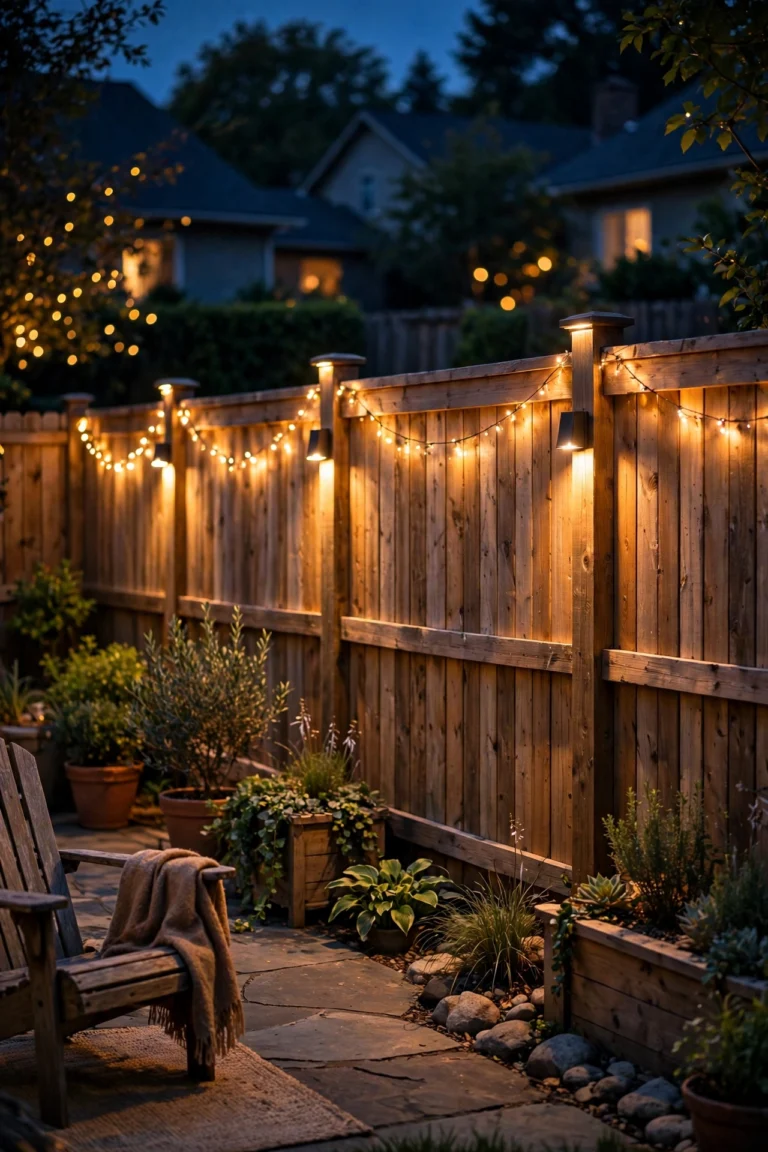
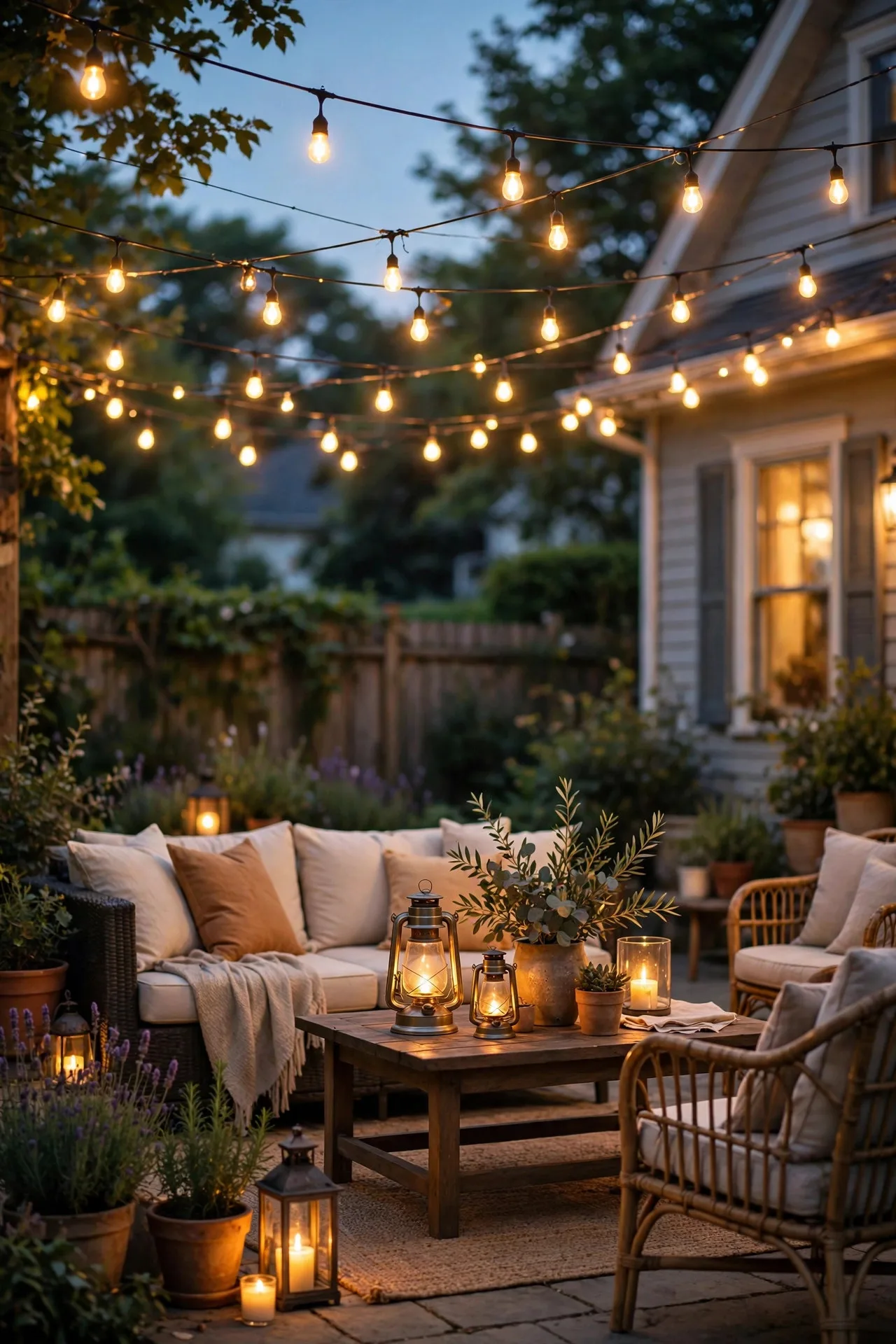
There's a particular magic to a summer night on the patio — the air finally cool, the mosquitoes kept at bay by citronella and a good fan, and a sky that takes its sweet time going dark. And honestly? The whole mood lives or dies on the lighting. These summer patio lighting ideas will show you exactly how I layer light the way designers do: one ambient layer to wash the space in glow, one task layer where you actually eat and grill, and one sparkle layer that makes everything feel like a celebration. By the end of this post, you'll have a plan for your patio no matter its size — from a tiny apartment slab to a sprawling backyard setup — plus real budgets for every idea. Grab a cold drink and let's make your warm nights outside unforgettable. Every idea below includes real placement measurements, bulb and timer guidance, and an honest budget range — so you can start with one glowing corner tonight and layer your way to a fully lit patio.
1. A Café String Light Canopy: The Classic Summer Patio Lighting Idea
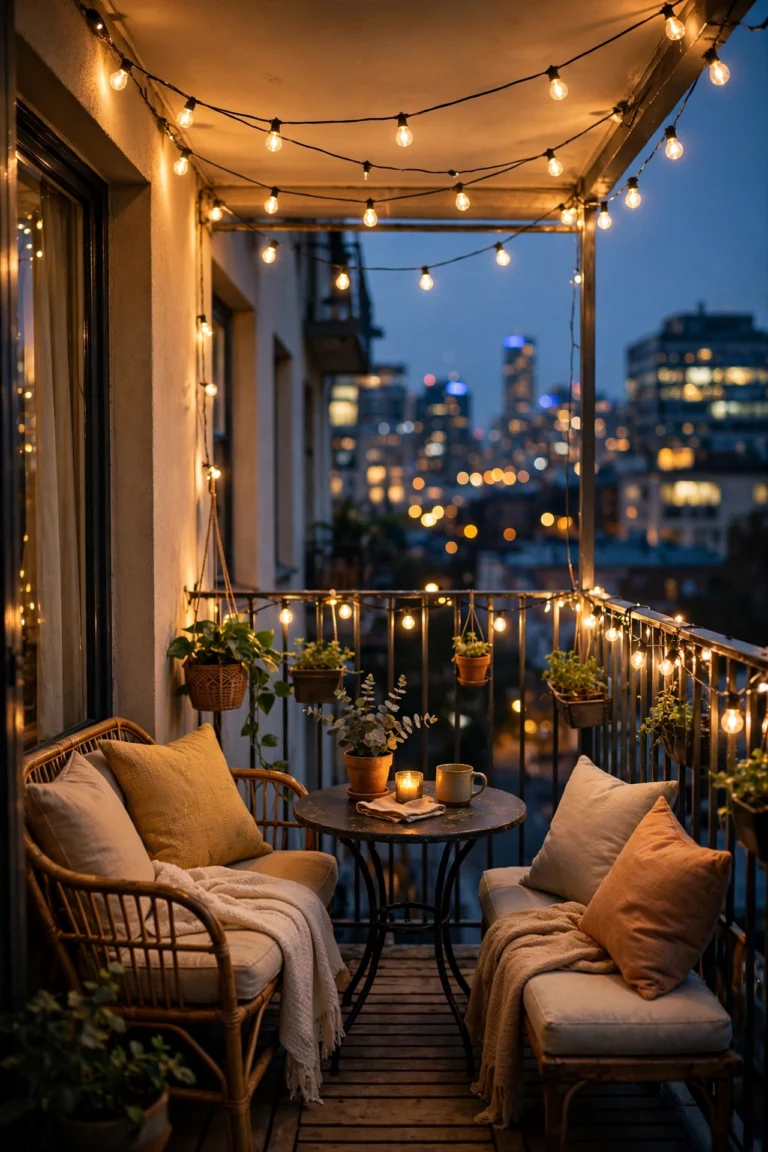
This is the single highest-impact thing you can do to a patio, and in my experience it's where every great summer patio starts. You're building a ceiling of light. Hang commercial-grade LED string lights (the thick G40 globe style on heavy-duty wire) in a zigzag or crisscross pattern 8 to 10 feet overhead, sagging slightly — about 4 to 6 inches of drape per span — so it feels like a bistro ceiling rather than a tight clothesline. Anchor to the house, a fence, a pergola, or planter posts sunk in weighted umbrella stands. Space bulbs about 2 feet apart for a full, even glow; anything wider starts to feel sparse.
Choose 2700K warm white for that golden-hour-always feeling — cooler bulbs make the patio look like a parking lot, trust me. Look for outdoor-rated strands (UL-listed for wet locations) with shatterproof bulbs, and plug them into a dusk-to-dawn timer so they light themselves. Keep one strand per 100 square feet of patio as a rough rule of thumb. The whole job takes an afternoon with a ladder and a friend.
Suggested budget range: $60 – $180.
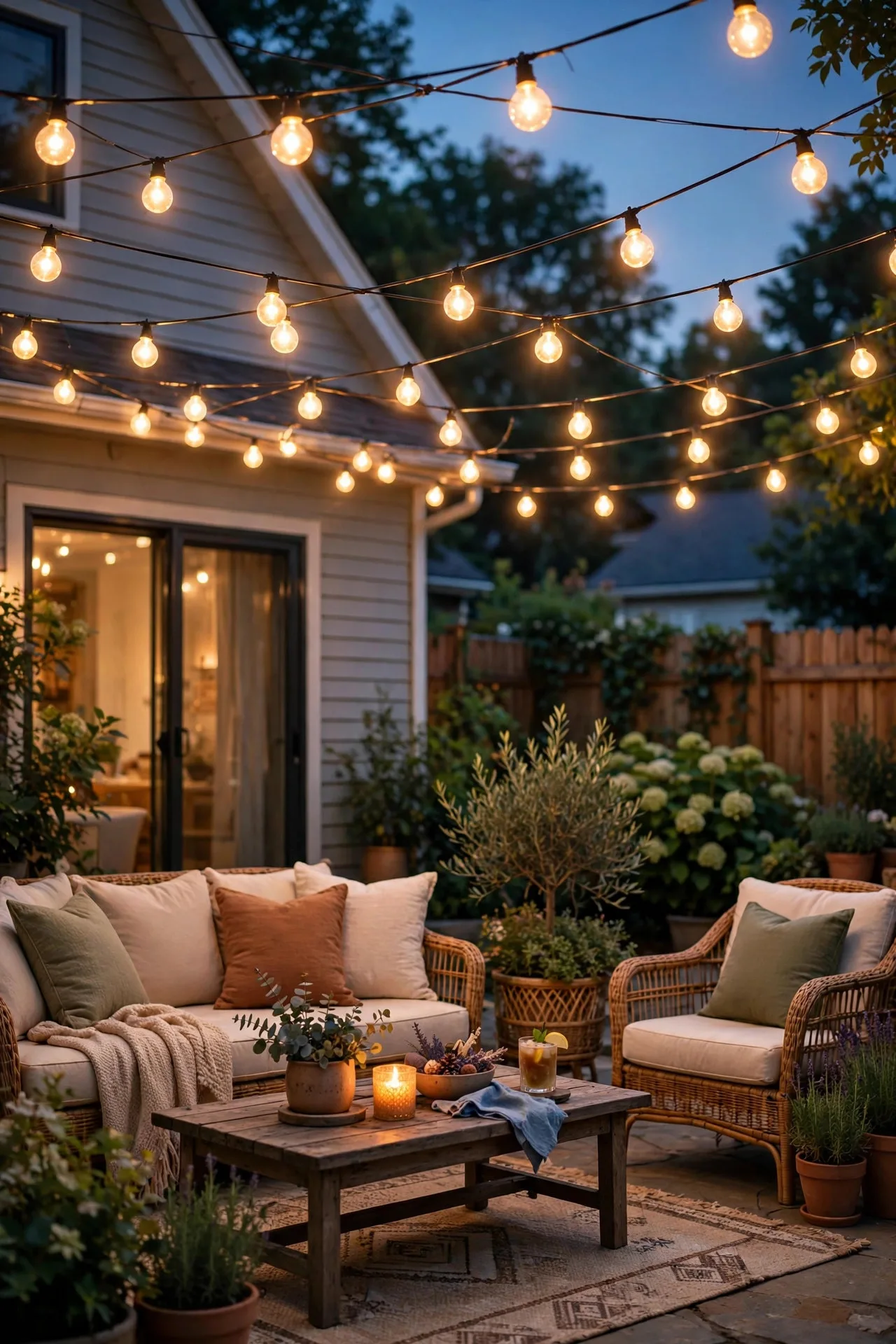
2. Paper Lantern Clusters
Paper lanterns are pure summer — they catch the breeze, they glow like little moons, and grouped together they look far more expensive than they are. The trick is layering: cluster three to seven lanterns in graduated sizes (8, 12, and 16 inches) at staggered heights, hanging from your canopy strands, a pergola beam, or a tree branch over the patio. Use only LED bulbs or battery tea lights inside — paper plus heat is never the combination, no matter how pretty.
Outdoor-rated paper lanterns have a coated skin that sheds light rain, but honestly, I bring mine in during big storms and they'll last all season. Hang them 7 feet or higher so nobody bonks a head, and space clusters about 6 feet apart so each one reads as its own little constellation. The warm white glow pairs beautifully with string lights since it adds round, soft shapes to all those straight lines. For parties, mix in a few pastel or blush-toned lanterns — they photograph like a dream.
Suggested budget range: $25 – $75.
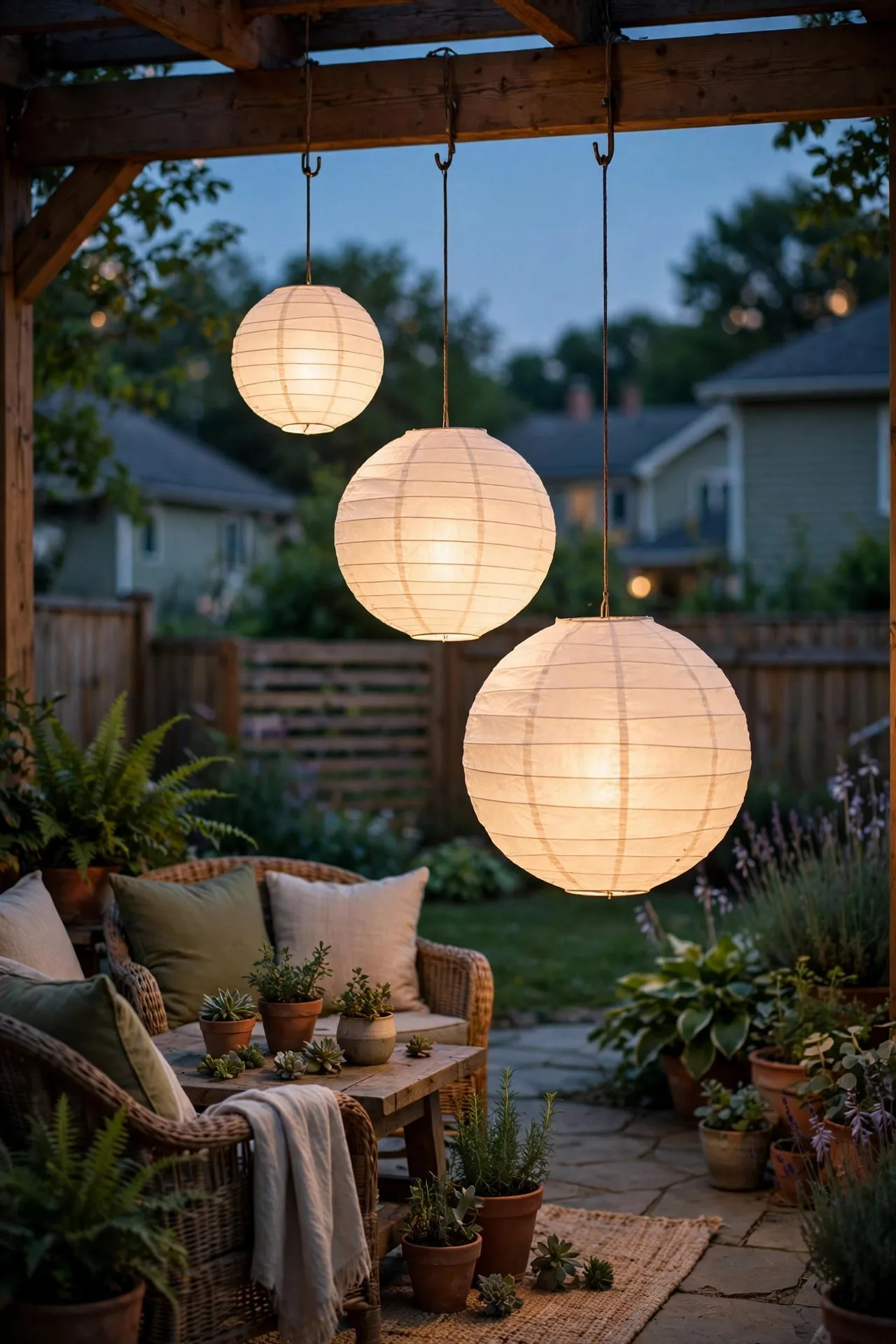
3. Flameless Candle Lanterns on Every Table
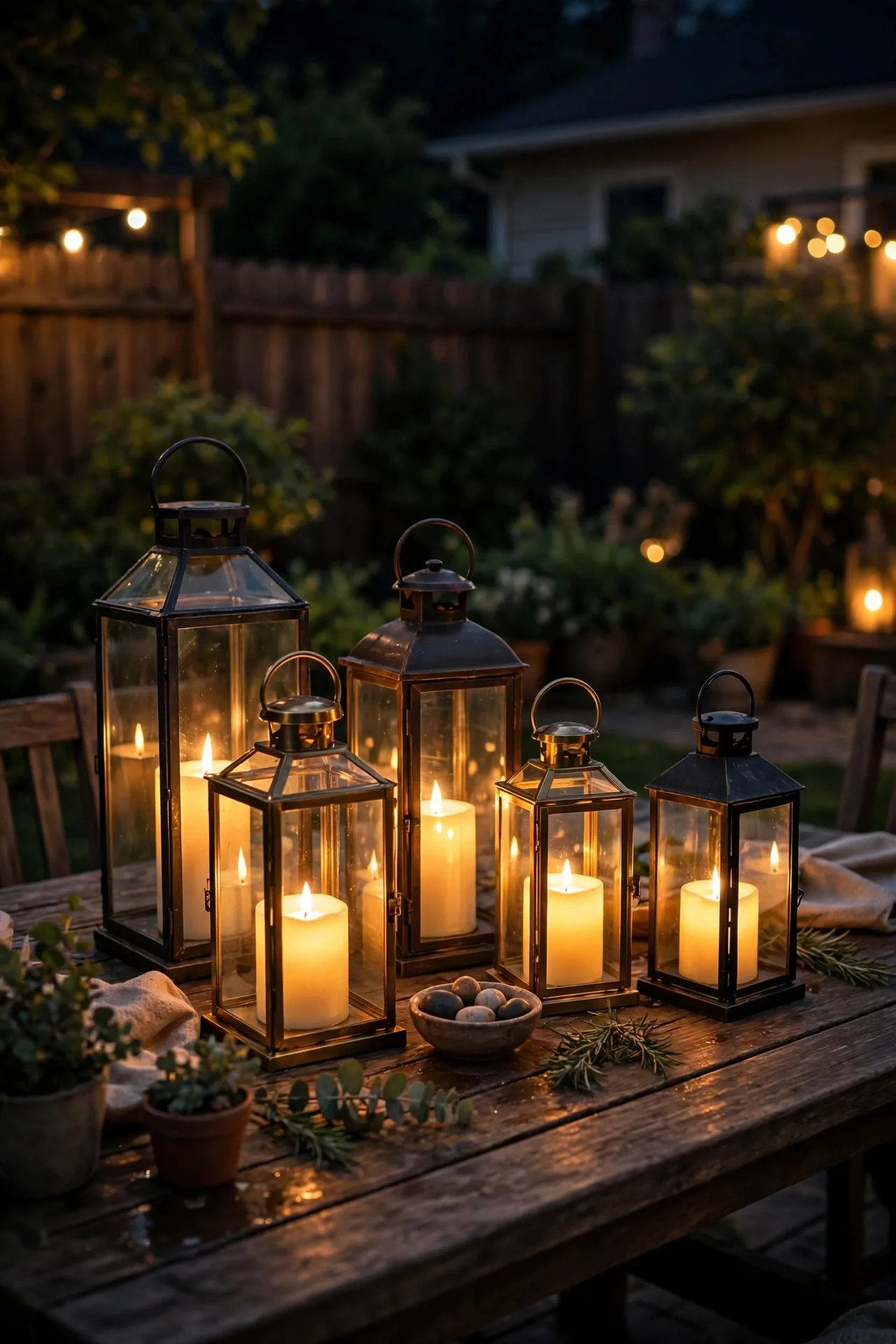
Real candles on a summer patio last about eleven minutes before the breeze eats them, so flameless is the way. I always recommend glass or metal lanterns with flickering LED pillars — from a few feet away, nobody can tell the difference, and you get zero wax mess on the tablecloth. Group them in odd numbers (three or five), mixing heights between 8 and 14 inches, and run them down the center of your dining table or scatter them across side tables and the outdoor bar.
Set them on battery timers — the 5-hour auto timers are perfect since they click on at dusk and off before you head in. Choose amber-toned LEDs (2200–2700K) for the most candlelike glow; the cool-white ones look like office lighting and ruin the mood. Weather-wise, covered lanterns can handle summer showers fine, but I tuck mine under the table if a real downpour is coming. Keep them away from grill splatter zones, and never put a real flame version on a tablecloth or near fabric runners.
Suggested budget range: $30 – $90.
4. Tiki Torches With Citronella
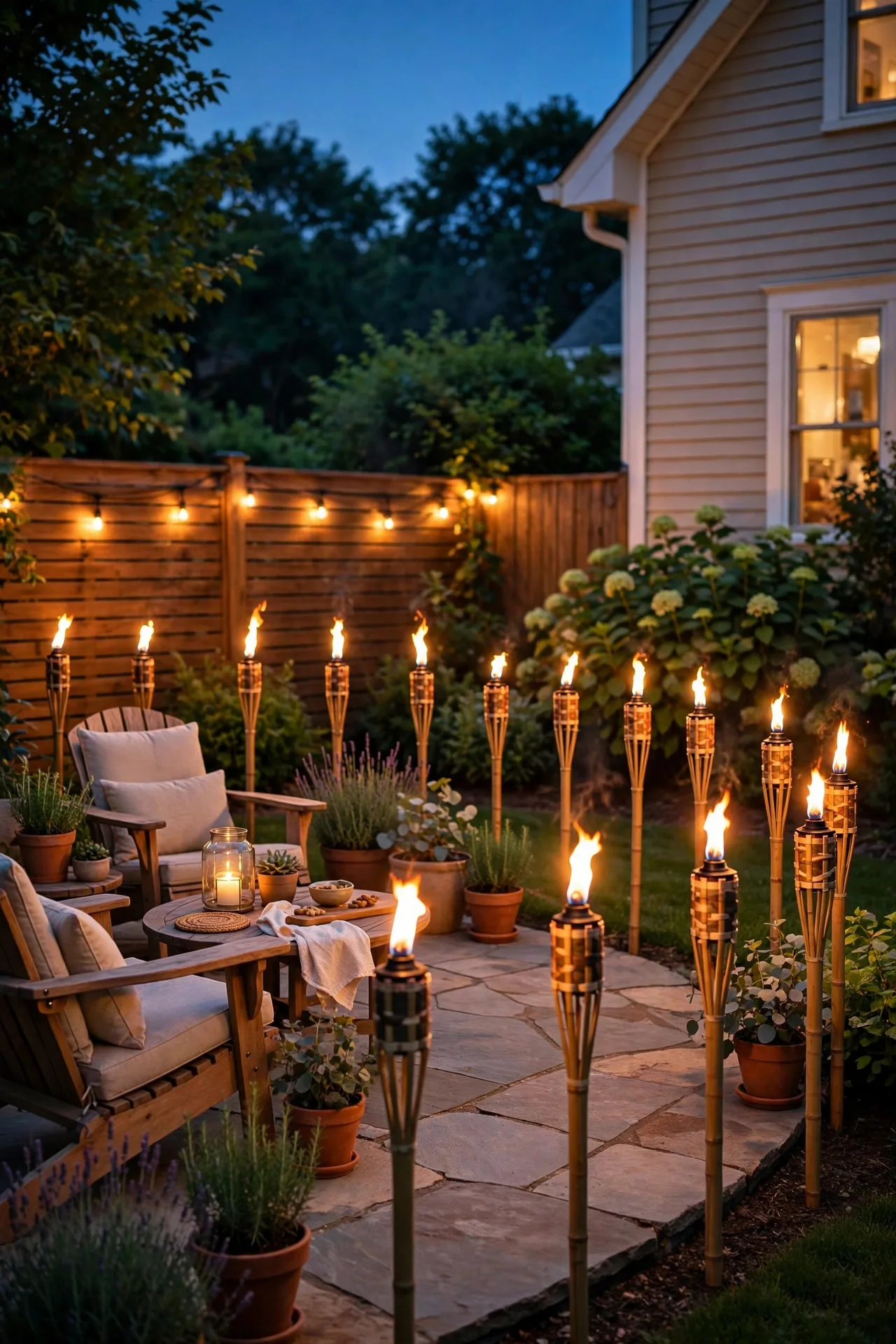
Tiki torches are doing double duty: they're one of the most iconic summer patio lighting ideas, and the citronella versions genuinely help keep mosquitoes off your ankles. Place them around the patio perimeter, 6 to 8 feet apart and at least 6 feet from anything you'd sit on — they throw real flame, so this is a layer that needs respect. Fill with citronella oil and use torch stands or weighted bases rather than sticking them in soft soil that tips in wind.
Burn time is about 5 to 6 hours per fill, so one fill covers dinner and the after-dinner linger. Light them about 30 minutes before guests arrive to let the citronella get working. Safety rules I never bend: extinguish before bed (always, even with a snuffer cap), keep a small bucket of sand nearby, and skip torches entirely on windy nights over 20 mph. Solar tiki torches with flickering LED flames are a lovely zero-maintenance alternative if open flame near kids makes you nervous.
Suggested budget range: $40 – $120.
5. Solar Path Markers Along the Patio Edge
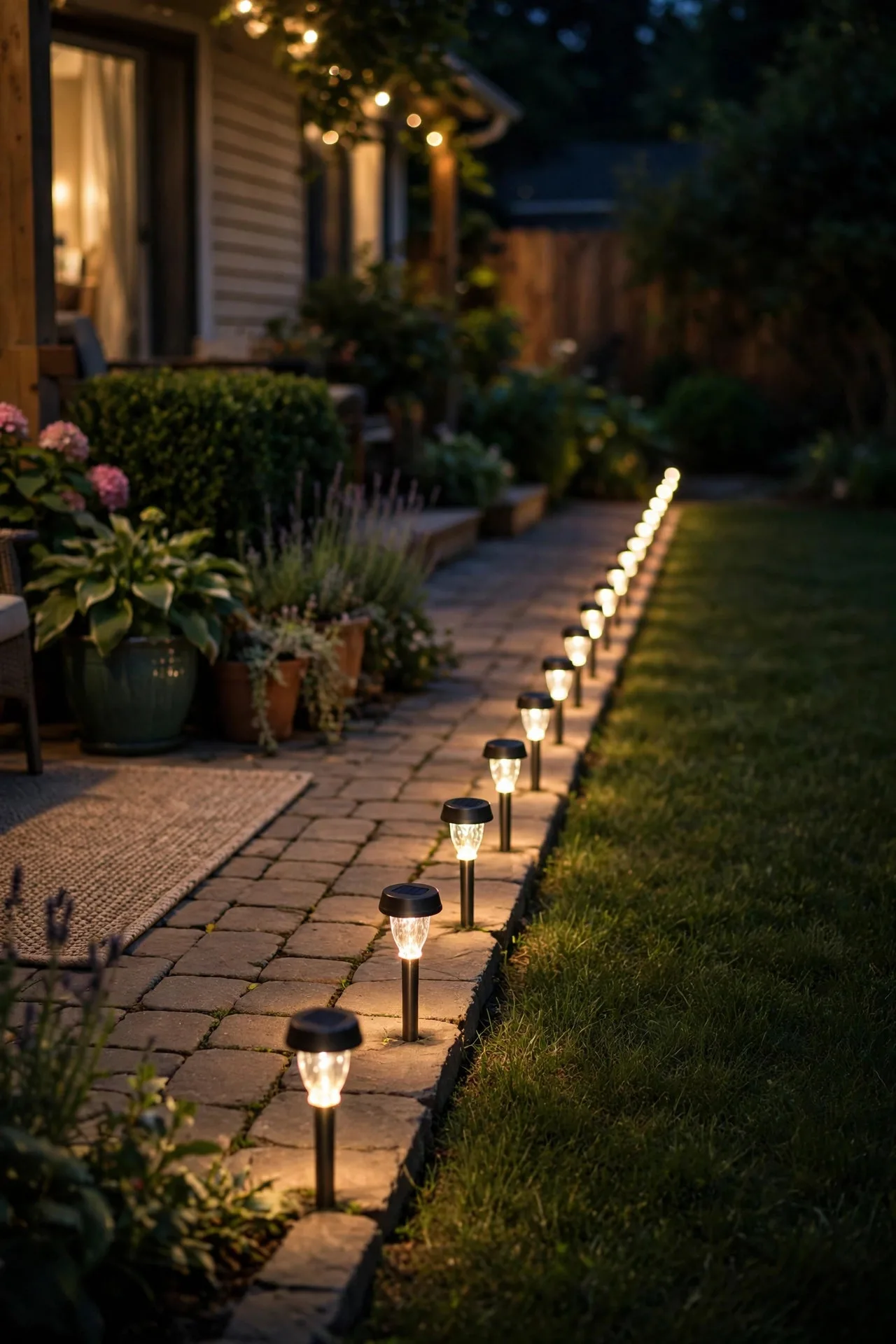
Here's an idea that costs almost nothing and solves a real problem: the trip-to-the-kitchen stumble zone. Solar stake lights with warm-white LEDs mark the patio's edge and the path to the back door, so barefoot midnight ice-cream runs don't end in disaster. In my experience, solar works beautifully for this in summer because you get maximum daylight charging exactly when you need the lights most.
Placement matters more than the product: push stakes 6 to 12 inches into soil or mulch right at the transition from patio to lawn, spacing them 4 to 6 feet apart for a continuous line of light. If your patio meets lawn with no bed to stake into, choose solar disc or puck lights that sit flush on the paver edge — mower-friendly and trip-proof. Wipe the solar panels once a month; dust and pollen cut charging by more than half. They'll glow 6 to 8 hours on a full summer charge. If you want to go deeper on going solar around your whole exterior, these solar exterior lights cover the full rundown.
Suggested budget range: $20 – $60.
6. An Edison Pendant Over the Dining Table
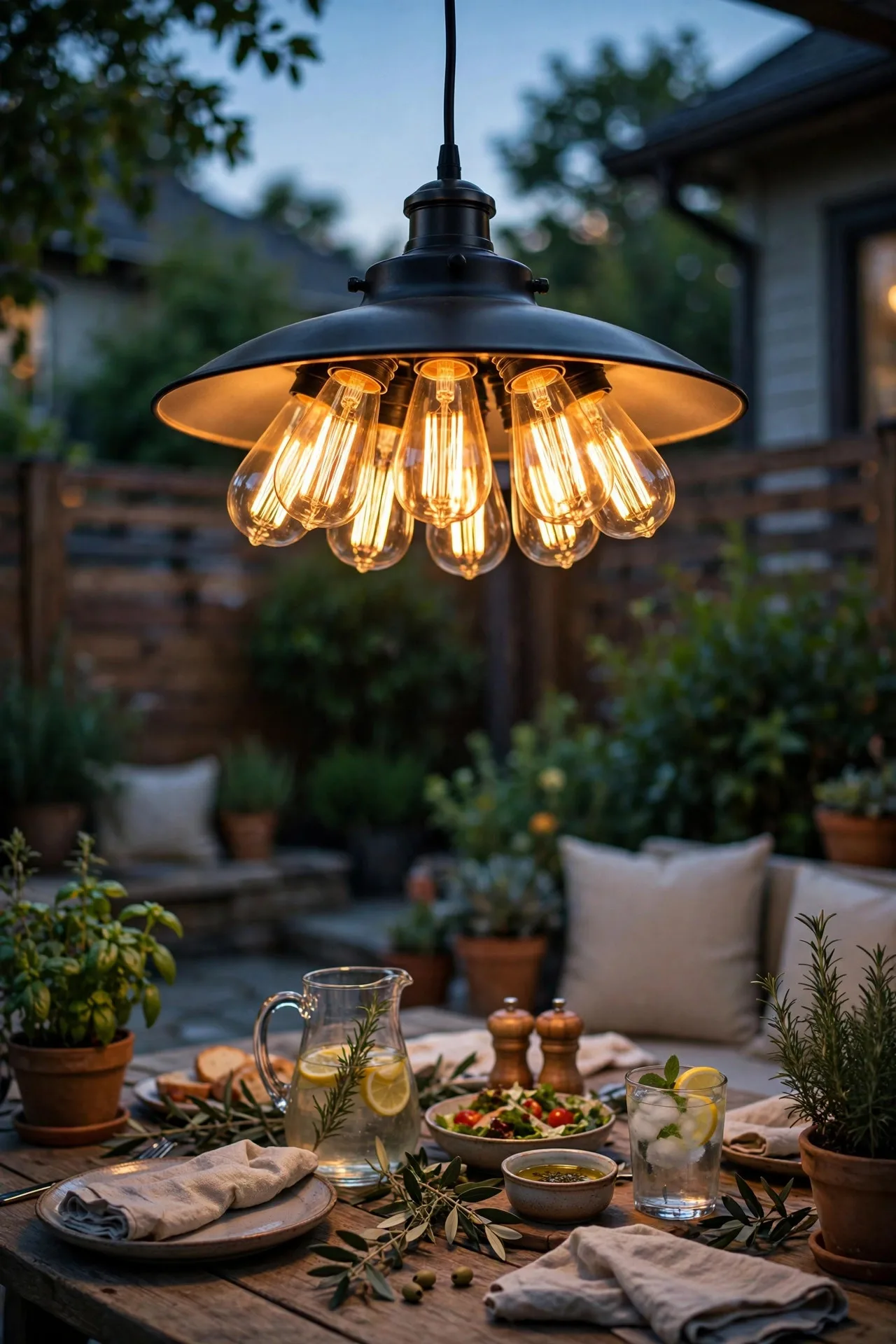
Overhead pendant light over the outdoor dining table is the restaurant trick that makes your patio feel like a destination. Hang a single large pendant — or two smaller ones spaced 3 feet apart — from the canopy, pergola, or an extended arm bracket on the house wall. Bottom of the shade should sit 30 to 34 inches above the tabletop, close enough to light faces and food, high enough not to block sightlines across the table.
Use a damp-rated pendant (check that rating — "indoor" pendants corrode fast outside) with a clear-seeded or wire-cage shade so the LED Edison filament bulb stays visible. Those filament LEDs are the look: the exposed coils glow amber at 2200K and you see them even in daylight as a design detail. Dimmer-compatible versions let you drop the mood after dessert. Wire it through a GFCI-protected outdoor circuit or a heavy-duty outdoor extension cord tucked along a beam. This is your task layer doing its job — bright where you eat, moody everywhere else.
Suggested budget range: $70 – $200.
7. Pergola Beam String Light Wrap
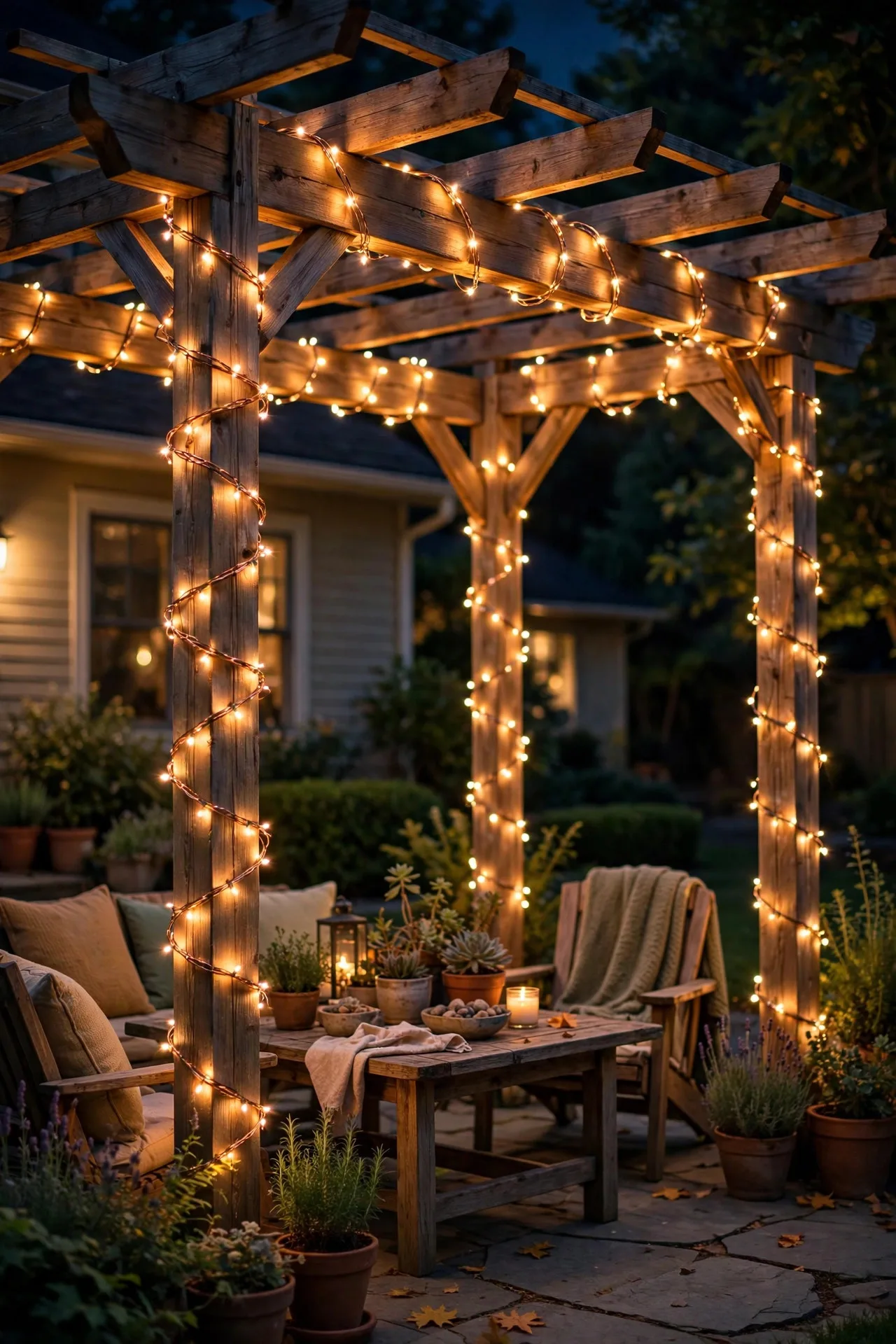
Got a pergola? Don't just string lights across the top — wrap them. Spiral-wrapping string lights around the pergola's posts and crossbeams turns the structure itself into a glowing frame, and it reads beautifully from inside the house too. Use thinner copper-wire fairy lights for this (100+ LEDs per 33-foot strand) because they wrap tightly and disappear against wood in daylight.
Start at the bottom of each post and spiral upward, keeping the wire snug with small outdoor zip ties every 18 inches — you want roughly 2 to 3 wraps per foot of post. Then run one pass along each crossbeam in loose swags. The combination of wrapped posts plus a beam swag gives you two depths of light, which is exactly the layering that separates "nice" from "wow." Solar copper-wire strands exist and work fine here since summer sun hits pergolas all day; just make sure the little solar panel faces south and isn't shaded by the beams above it.
Suggested budget range: $25 – $80.
8. An Outdoor Chandelier Moment
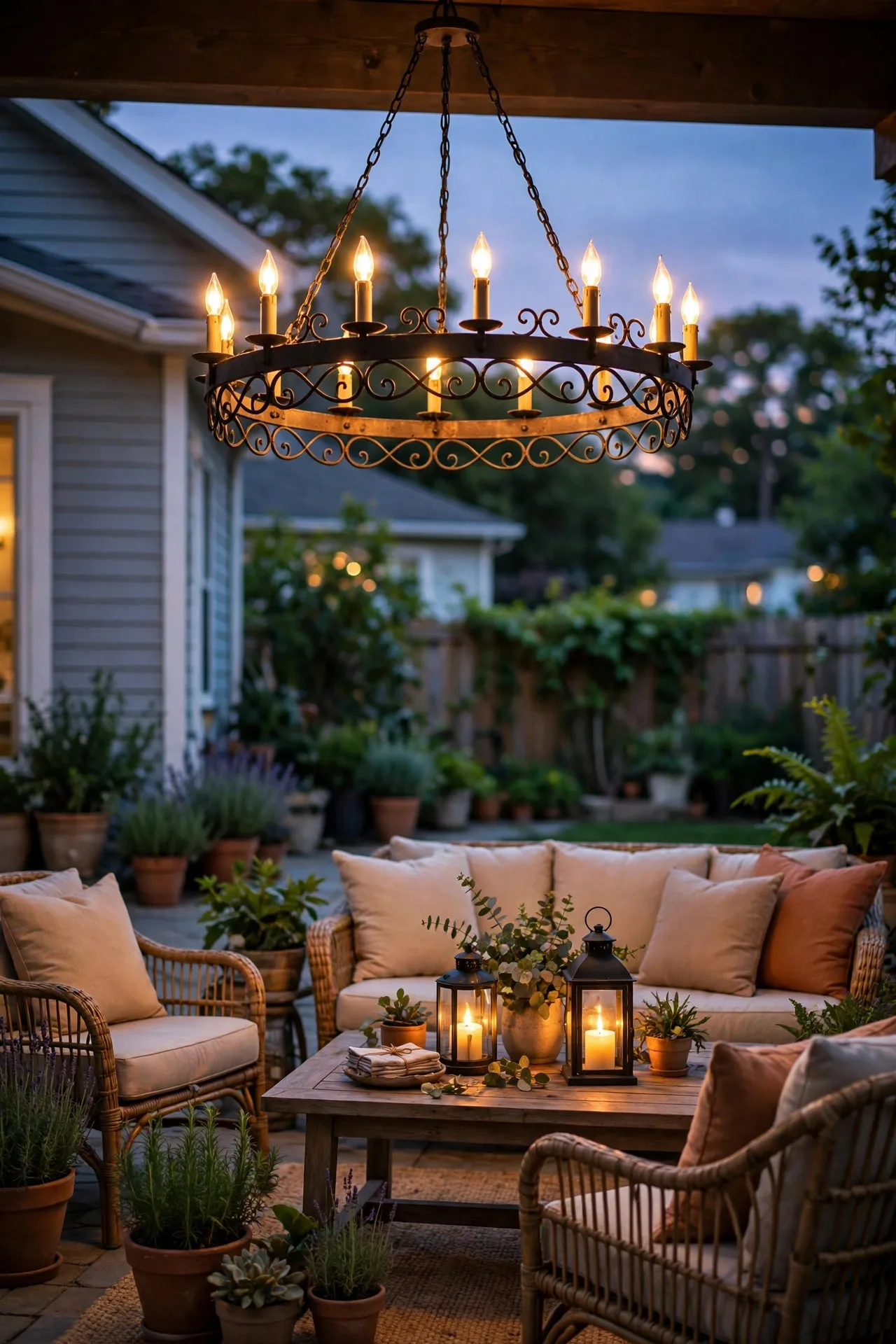
A chandelier outside sounds extravagant until you hang one — then it just sounds like the best decision ever. A single statement chandelier (wrought-iron ring, beaded drum, or a mini antler style) hung 7 feet above a seating area or the dining table becomes the patio's centerpiece. It anchors the whole lighting plan the way a rug anchors furniture.
Hang from a pergola beam, a heavy shepherd's-hook-style patio hanger, or a ceiling-mount bracket on a covered porch roof. Keep it 7 to 8 feet off the ground so tall guests clear it, and use only damp- or wet-rated fixtures — this matters more than the style. Fit it with dimmable warm LED candelabra bulbs so you can go full sparkle for parties and soft glow for quiet nights. Weight is the thing people forget: a 15-pound chandelier needs a real beam or a rated bracket, not a screw eye in fascia. When it's lit and the candles-on-the-table layer is going too, the patio honestly feels like a wedding venue you never have to leave.
Suggested budget range: $100 – $300.
9. Fire Pit Glow as Your Anchor Layer
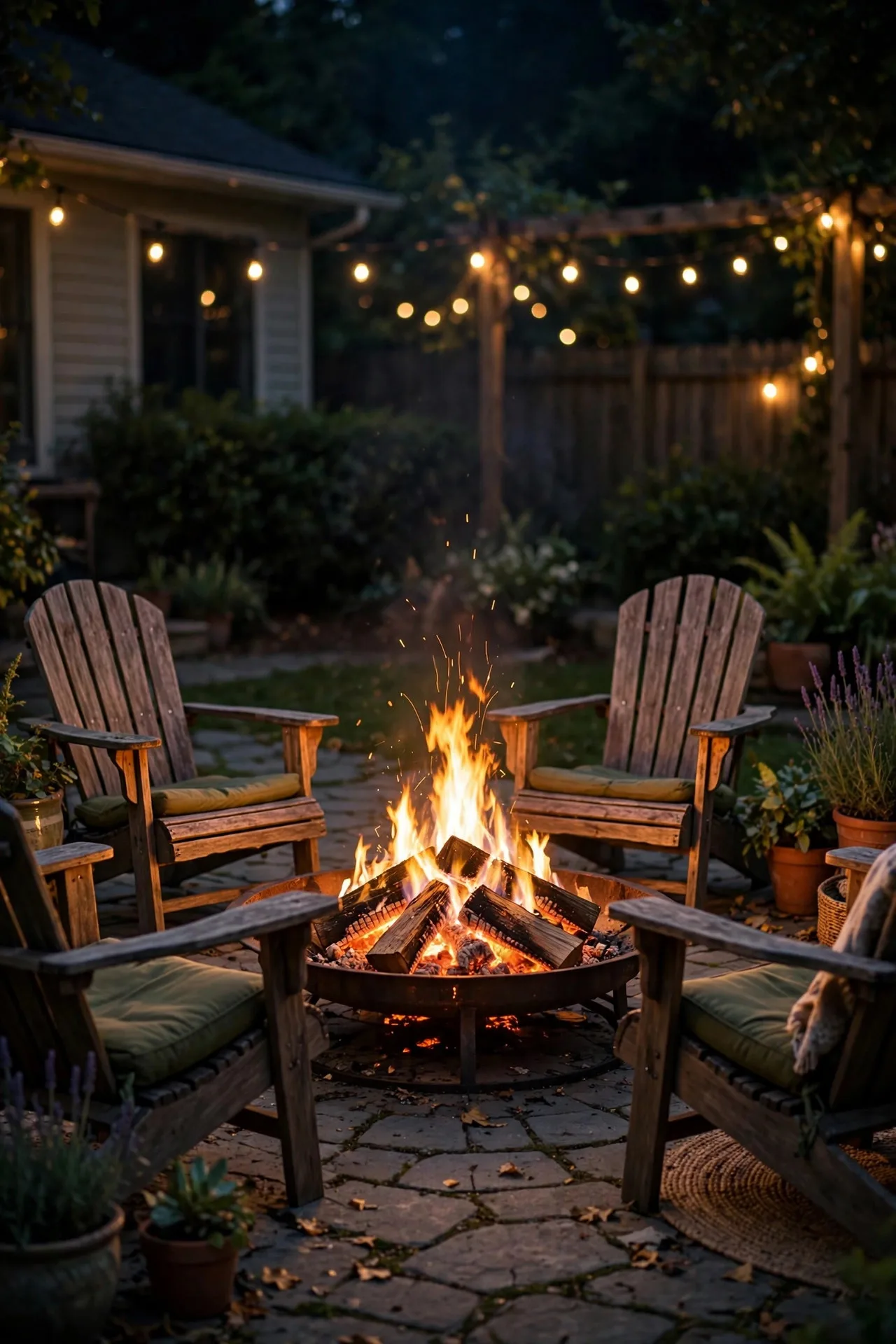
If your patio has a fire pit, it's already the brightest, warmest light source you own — so build the plan around it. A fire pit throws gorgeous flickering light about 10 to 12 feet in every direction, which means the string lights and lanterns around it should be dimmer and fewer. Think of it as the sun of your patio solar system: everything else orbits at a lower brightness so the fire stays the star.
Arrange seating 4 to 6 feet from the fire's edge — close enough to feel the warmth and light faces, far enough to be safe. Keep your canopy lights and pendants on dimmers so you can dial them down to 30 percent once the fire's going; full-brightness strings plus a roaring fire just wash each other out. Wood-burning pits need 10 feet of clearance from structures and overhanging lights, so double-check that your canopy strands aren't directly above the flames. If you're still deciding on a setup, pairing your lighting with one of these backyard fire pit ideas makes the whole plan come together. Gas fire tables are easier on clearances and give you a dial for exact flame height.
Suggested budget range: $150 – $600.
10. Uplight Your Planters and Palms
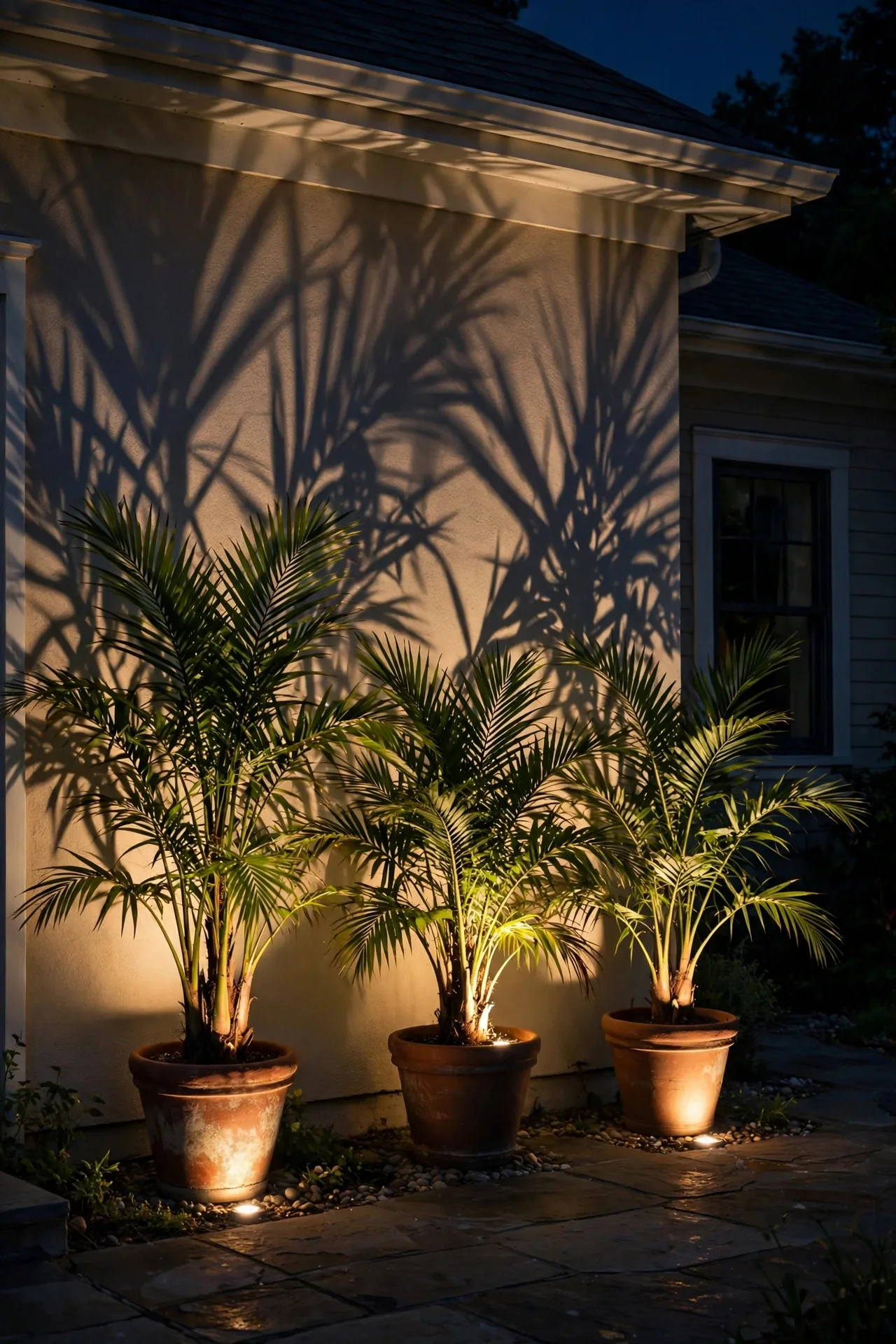
Uplighting is the landscape-lighting move that makes planters, potted palms, and ornamental grasses look like sculpture after dark. Set a small waterproof LED spot or well light at the base of each feature plant, aimed up through the foliage so leaves catch the light and throw dramatic shadows on the house wall behind. In my experience, three uplights on three plants does more for a patio's "designed" feeling than almost any other single addition.
Use warm-white 2700K spots with adjustable heads so you can fine-tune the angle — 45 degrees from the base is the sweet spot for most container plants. Solar uplights exist and are fine for summer, but wired low-voltage spots (12V) are brighter and more reliable for a plant you really want to showcase. Tuck the fixtures behind the pot rim or mulch so you see the effect, not the hardware. This is your accent layer: it gives the eye somewhere to rest between the dining table and the fence line. Group planters in threes of varying heights for the best silhouette.
Suggested budget range: $40 – $130.
11. Deck and Step Edge Lights
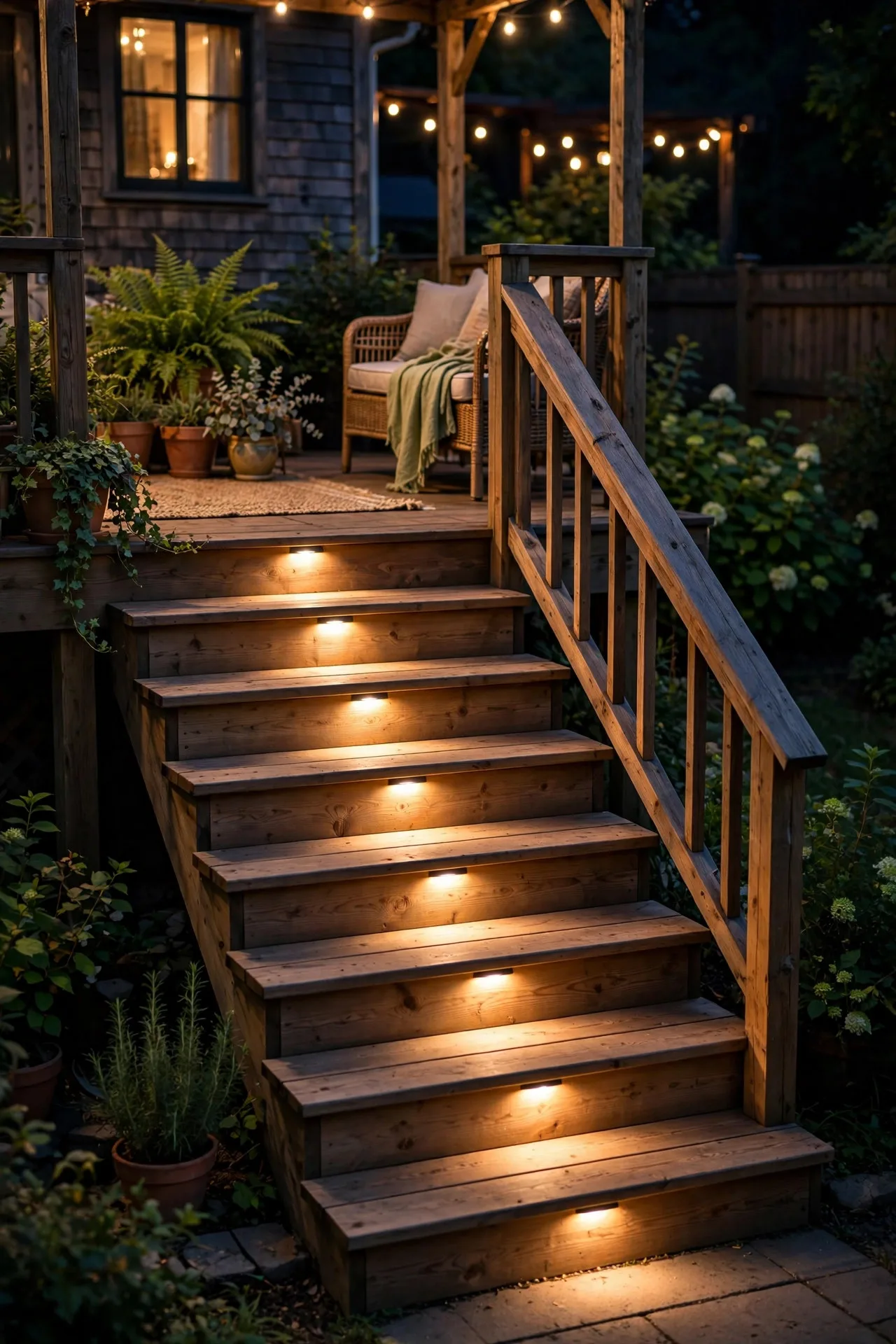
Steps are the number-one trip hazard on a lit patio — everything looks flat in ambient glow, and that one stair edge disappears. Recessed step lights or adhesive LED strip on the riser solve it beautifully and look incredibly high-end. Mount them on the vertical riser face, under the stair nosing, so the light washes down across the tread without shining in anyone's eyes.
Solar stair lights that clip onto the step edge are the easiest retrofit — no wiring, and summer sun keeps them charged. For a permanent look, low-voltage step lights wired into a 12V transformer give a cleaner finish and run off the same dusk timer as your other wired lights. Space them every 2 to 3 steps on a staircase, or every 3 to 4 feet along a long deck edge. Stick with warm white to match the rest of the patio; cool-white step lights make the transition from your warm canopy jarring. It's a small detail guests will never consciously notice — which is exactly why it works.
Suggested budget range: $35 – $120.
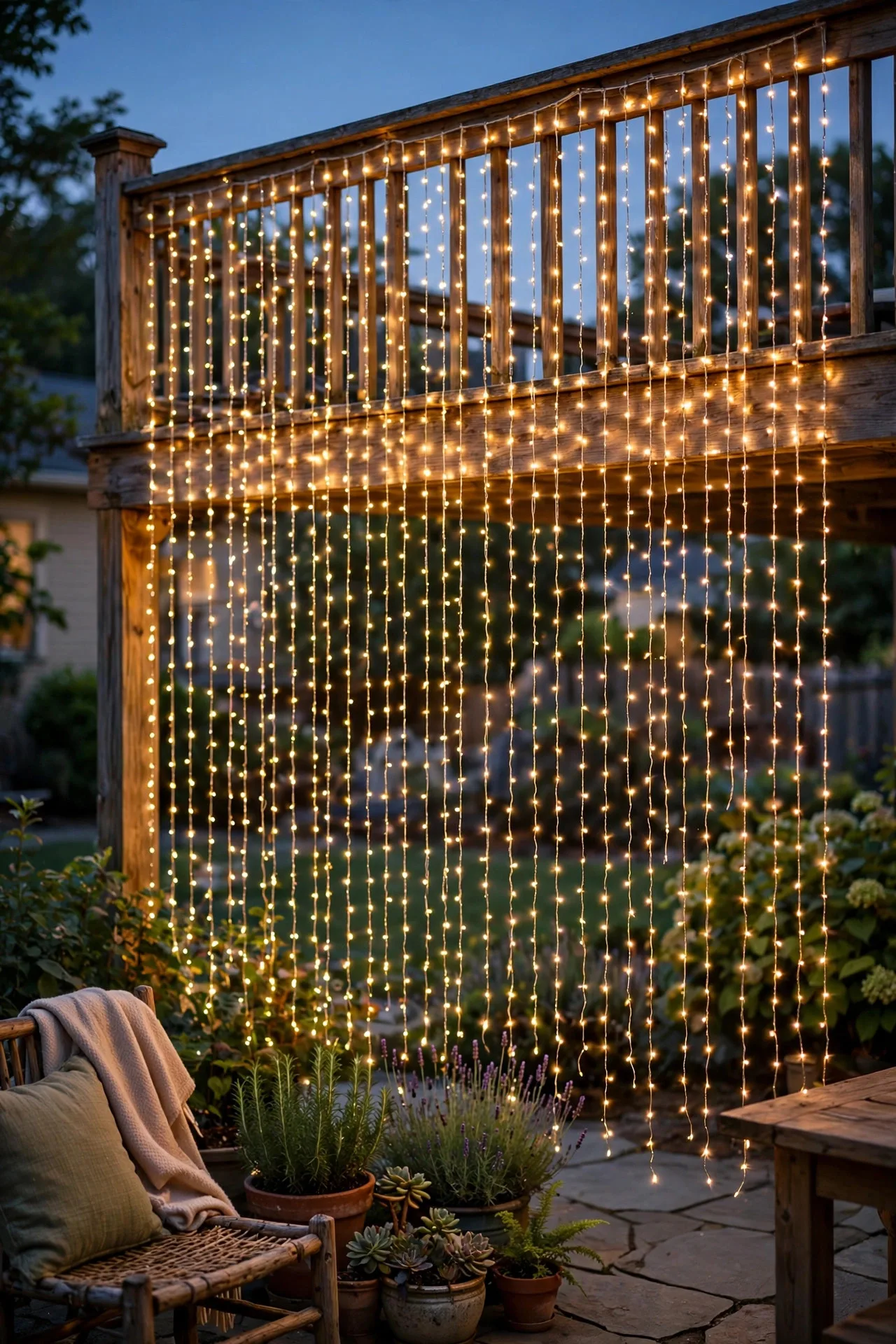
12. A Fairy Light Curtain: A Budget Summer Patio Lighting Idea That Wows
If your patio has a railing, fence panel, or even a trellis wall, hang a curtain of fairy lights down it and thank me later. These are the dense copper-wire strands with 200+ tiny LEDs — draped vertically from the top rail, they make a shimmering wall of light that turns an ordinary railing into the prettiest backdrop on the patio. Space the drops 4 to 6 inches apart for full coverage.
Hang from small adhesive outdoor hooks or cup hooks under the top rail, letting strands fall 2 to 3 feet. Solar versions with the panel zip-tied to the rail top work wonderfully in summer. The key detail: keep the curtain behind your seating, not in front of walkways — it's decorative, not task lighting, and you don't want guests brushing through it. Layer it with your canopy lights overhead and you've got two depths of glow in one corner, which photographs beautifully. On quiet nights I leave just the curtain on and skip the canopy — instant cozy.
Suggested budget range: $20 – $70.
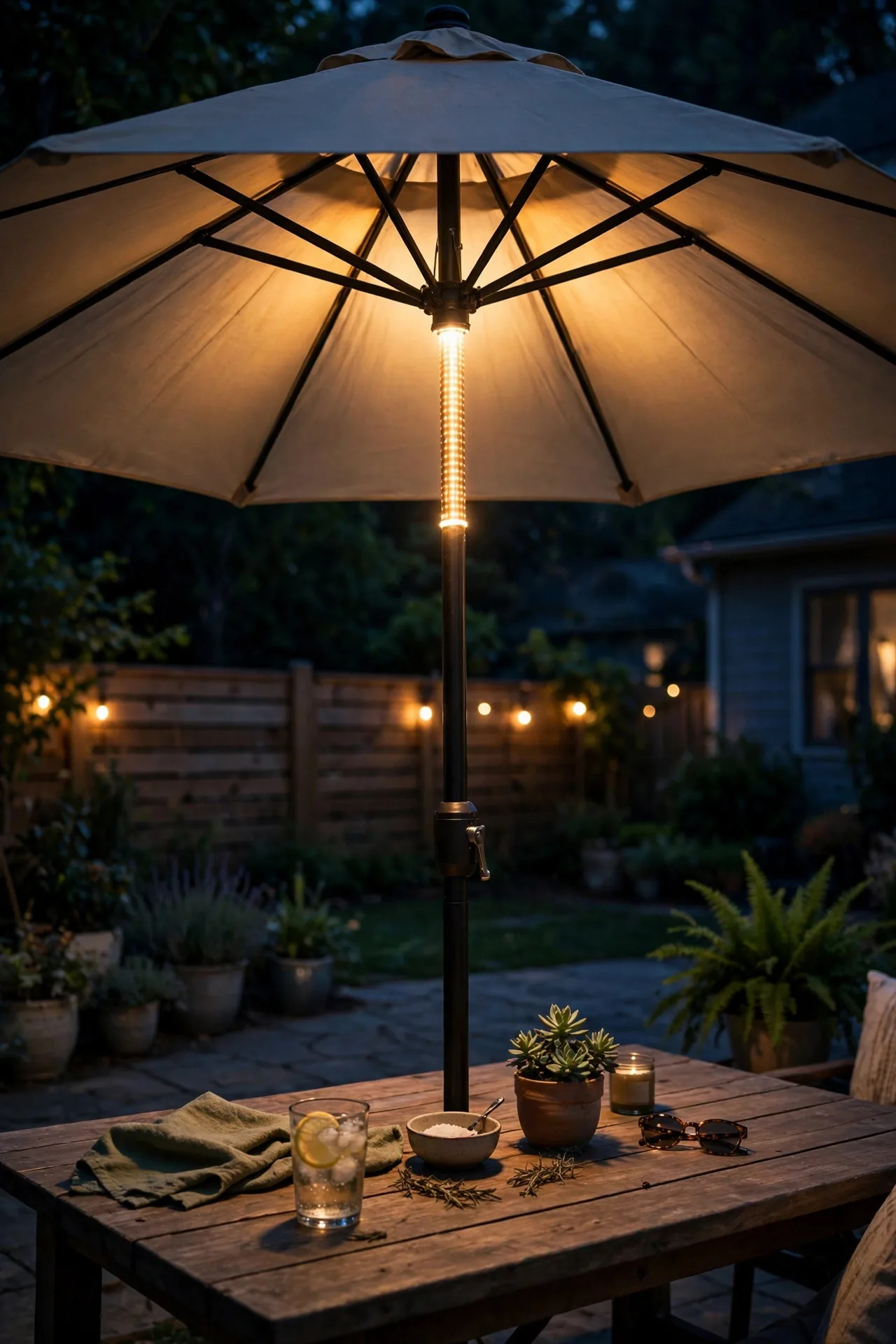
13. Umbrella Pole Lights
The patio umbrella shades by day and goes completely dark by night — which is a shame, because it's usually right over the seating. Clamp-on umbrella lights fix that in about thirty seconds. These are rings or clusters of small LEDs that clamp around the umbrella pole just under the canopy, throwing light up into the fabric and down onto the table.
Choose warm-white LED versions with at least 20 lumens — dimmer ones are decorative but won't actually light your card game. Most run on AA batteries or a small rechargeable pack; I always recommend the rechargeable ones because umbrella lights get used every single night in summer and battery costs add up fast. Some fancier versions include Bluetooth speakers, but honestly the light alone is the win. Look for models with a dimmer switch so you can go bright for dinner and low for the late-night wind-down. It turns your daytime shade into your nighttime chandelier.
Suggested budget range: $15 – $50.
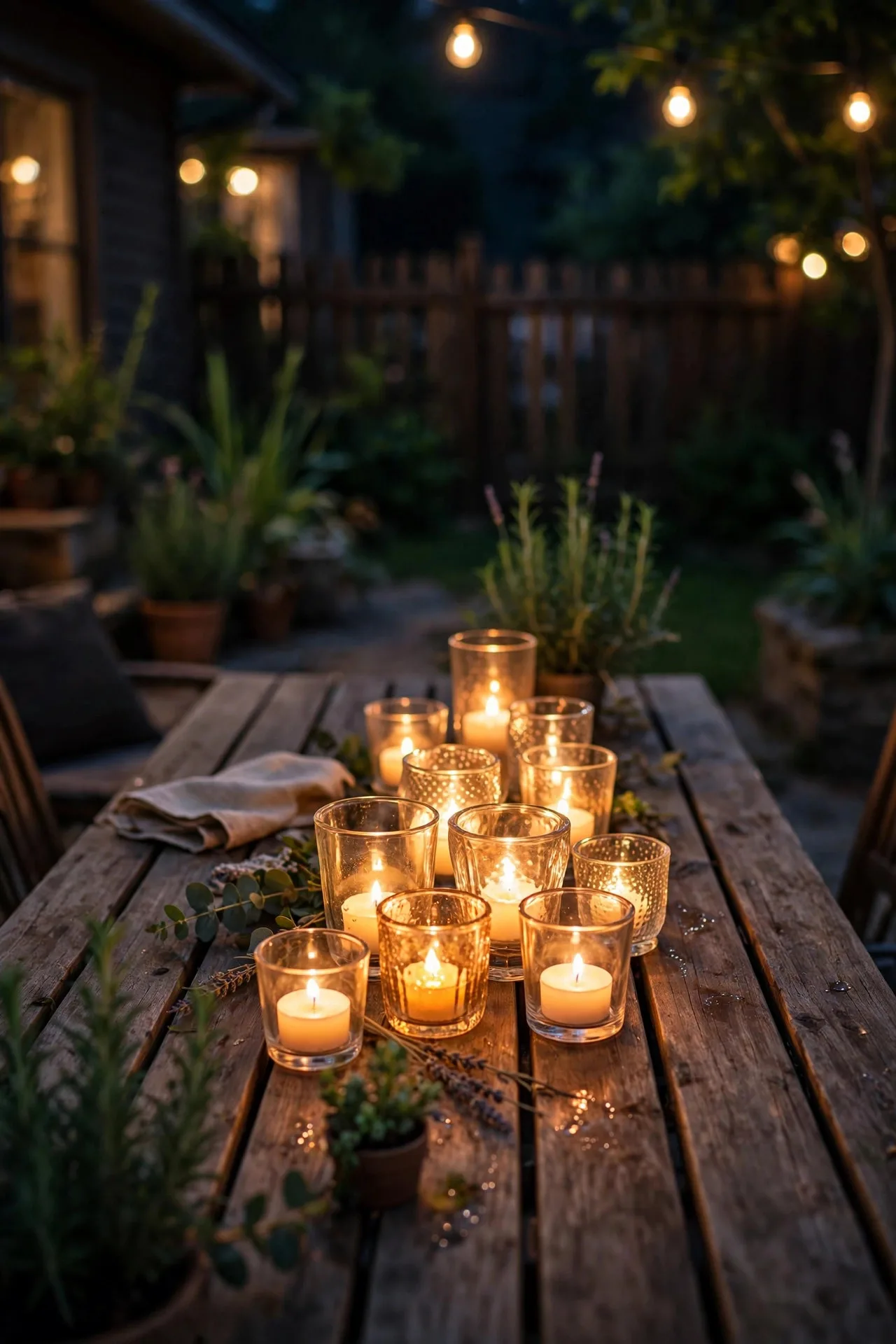
14. A Tea Light Cluster Centerpiece
Sometimes the simplest summer patio lighting ideas are the best ones. A low, sprawling cluster of glass tea light holders down the center of the dining table — or across the coffee table in the seating area — gives you candlelight flicker at about 2700K without the fire hazard. Use flameless LED tea lights (flicker mode, not steady) in glass holders of different heights so the glow scatters at different levels.
The magic number is five to seven holders for a standard dining table, grouped loosely rather than in a straight line — straight lines read as "conference room," loose groups read as "dinner party." The amber glass ones are my favorite because they warm the light even further, down toward 2200K candle tones. They're rain-safe under an umbrella or canopy but should come inside in a real storm. And a safety note that matters: even flameless tea lights in glass get knocked over by wind, so use heavier holders or a low tray to corral them on blustery nights.
Suggested budget range: $15 – $45.
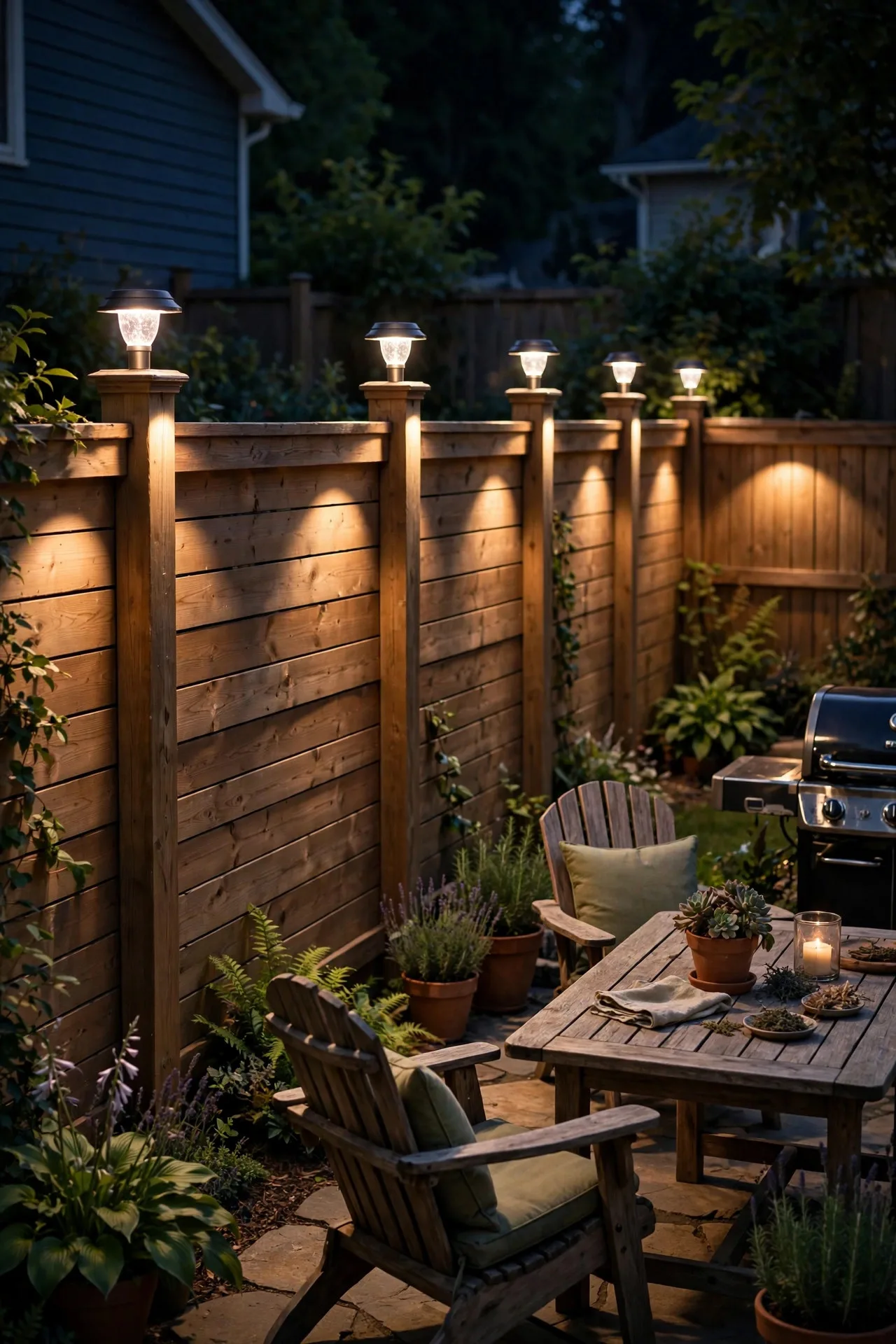
15. Solar Post Cap Lights on the Fence
Fence posts are free real estate for light. Solar post cap lights sit right on top of each post and cast a soft downlight pool around it — line a whole fence run and you get a rhythm of light that defines the patio's boundary beautifully. It's one of those ideas that looks custom but installs in minutes.
Measure your post tops before ordering (4×4 and 6×6 are the common sizes, but actual dimensions run a quarter inch under). Most caps just friction-fit or screw down with two screws. Choose warm white — cool-white caps make the fence look like a security perimeter. They charge all day in summer sun and glow 8 to 10 hours, and they need zero wiring, which makes them the easiest win on this whole list. Every 8 feet is the standard post spacing, so a typical patio fence needs just four to six caps. They won't light the party, but they'll make the edges feel finished and safe.
Suggested budget range: $30 – $90.
16. Hidden Rope Lights Under Benches and Counters
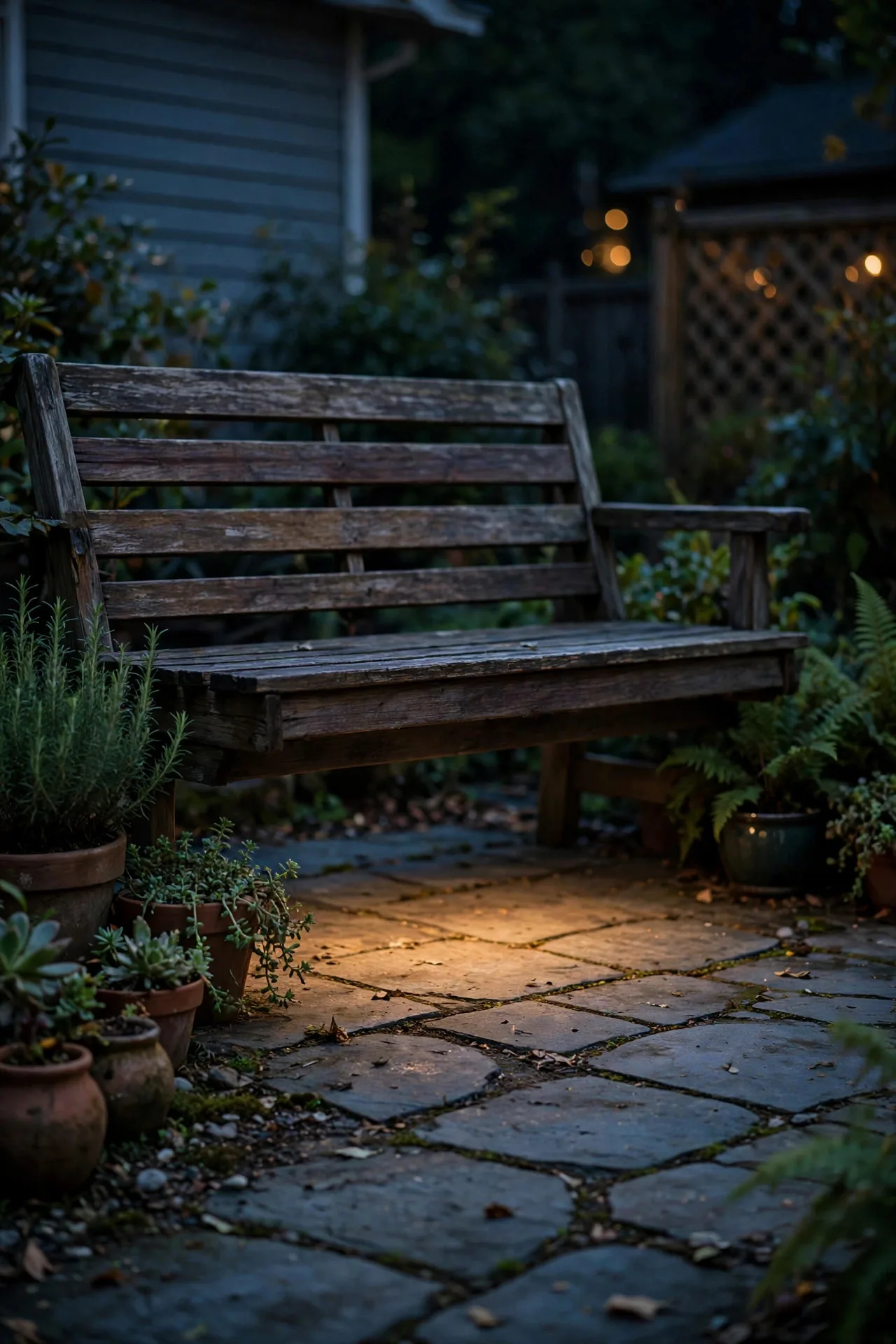
Here's the designer secret for making a patio feel like it floats: hide LED rope or strip lights underneath things. Mount warm-white LED strip under the lip of built-in benches, under an outdoor bar counter, along the underside of a deck railing, or behind a planter ledge. The light washes down and pools on the ground, creating a soft glow line with no visible source.
Use IP65-rated waterproof strip (that's the outdoor rating you want) in 2700K, and mount it in an aluminum channel with a diffuser — bare strip dots look cheap, diffused strip looks custom. Plug into the same dusk-to-dawn timer as your other wired lights so the whole hidden layer wakes up together. This is pure accent lighting: it won't help you see your food, but it will make every edge of the patio read as intentional. I've seen a $30 strip under a bench get more compliments than a $300 chandelier. That ratio never gets old.
Suggested budget range: $30 – $100.
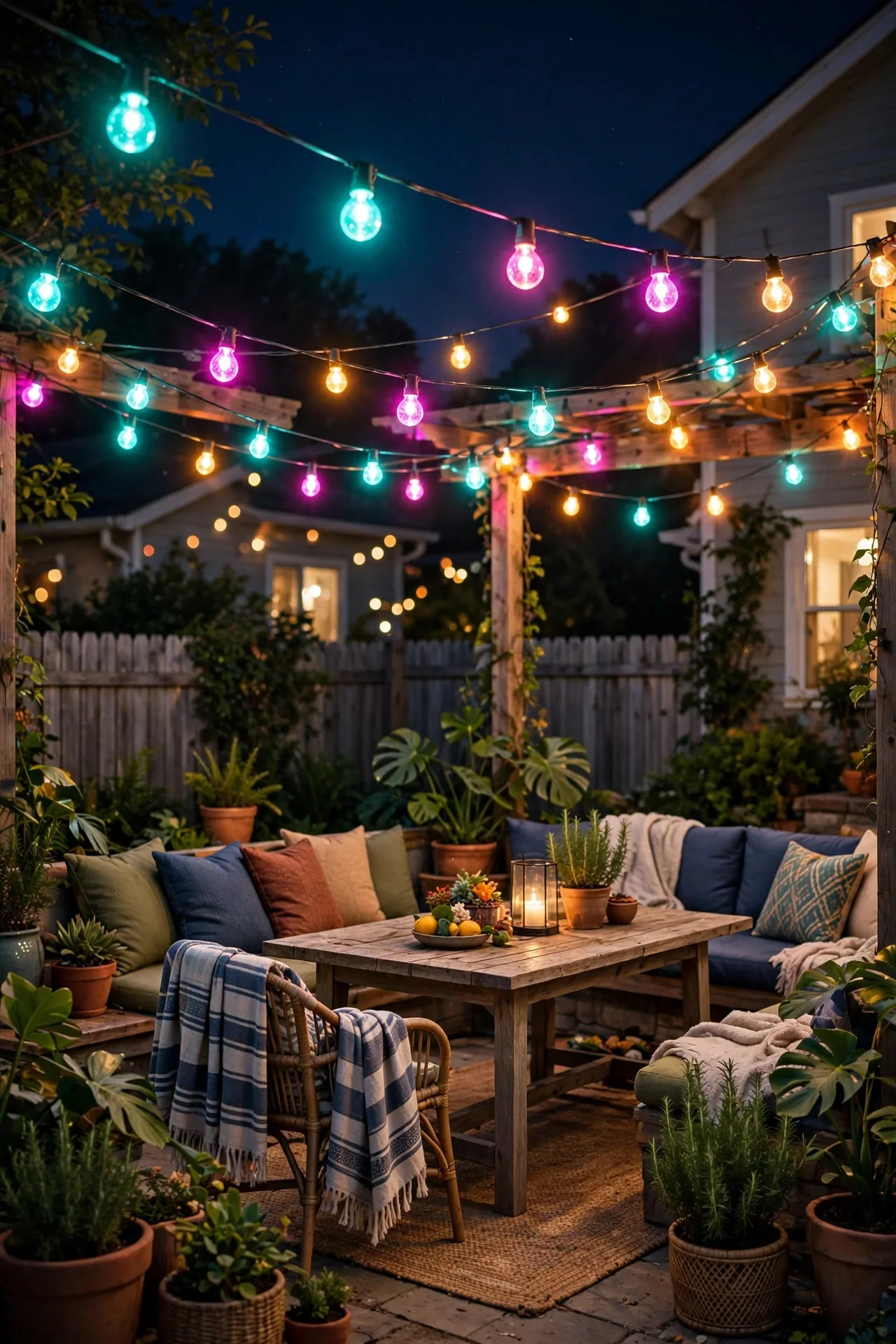
17. Color-Changing Smart Bulbs for Party Nights
For the nights when the patio needs to feel like an event, color-changing smart bulbs are absurdly fun. Screw them into your canopy strands (G40 smart versions exist), your pendant fixtures, or any standard outdoor socket, and control the whole scene from your phone. Warm white for Tuesday dinner, deep teal and magenta for the Fourth of July, soft amber for a late-summer birthday.
A few practical notes from someone who's run these for two summers: they need your Wi-Fi to reach the patio, so check signal strength out there before you buy a dozen — a mesh node near the back door fixes most dead zones. Group the bulbs into zones (dining, seating, fence line) in the app so you can dim each layer independently instead of one all-or-nothing setting. And keep at least one fixture on a plain warm-white bulb as your "always on" fallback, because smart bulbs occasionally need a firmware nudge at the worst moment. When they work — which is most of the time — they're the easiest way to restyle the whole patio in ten seconds.
Suggested budget range: $50 – $150.
18. Lantern Stakes in the Flower Beds
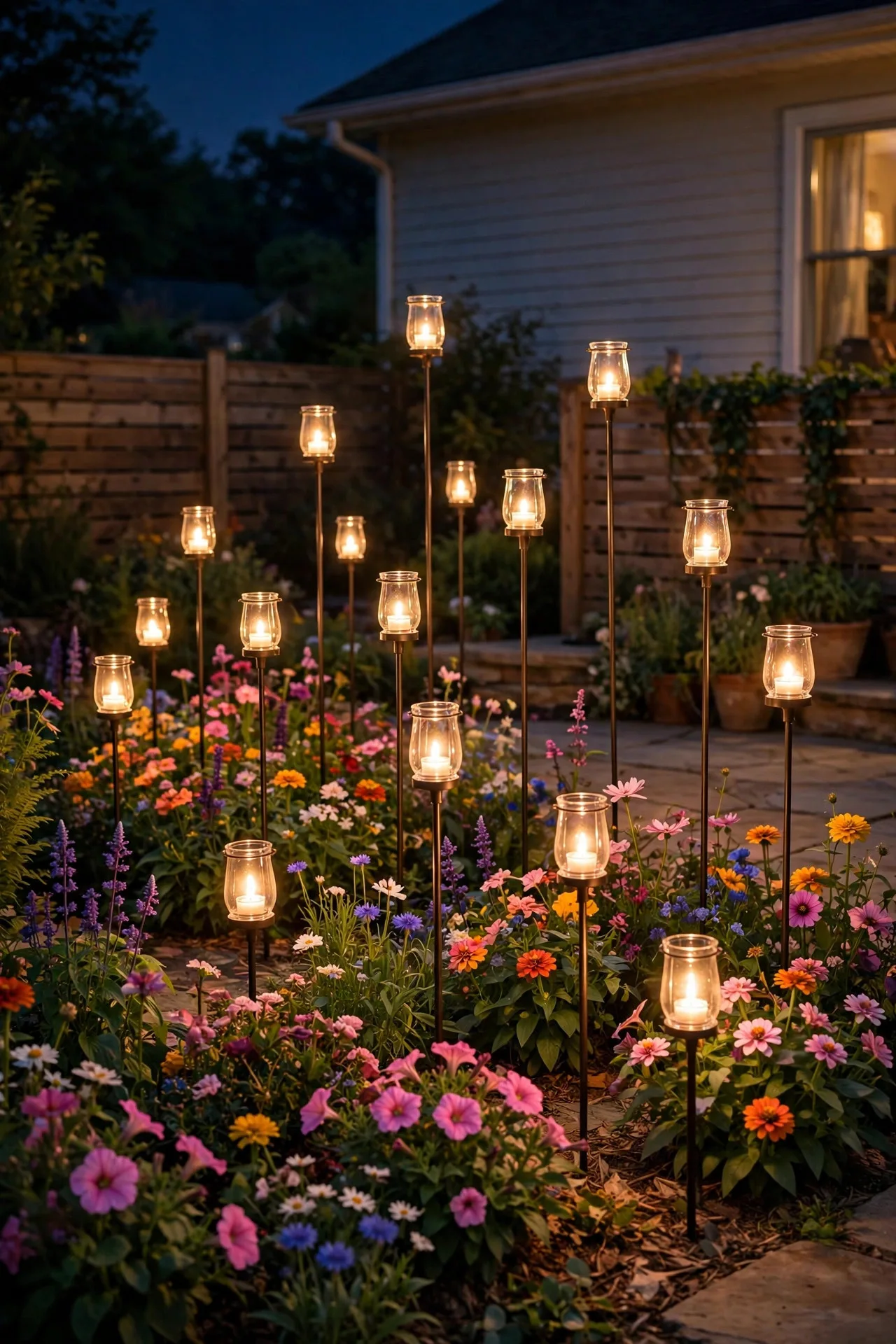
Those flower beds ringing the patio are doing nothing after dark — lantern stakes fix that. These are small glass or metal lanterns on 24- to 36-inch stakes with a solar panel or battery light inside. Push three to five of them into the beds at varying depths, staggering heights so they don't line up like soldiers.
They're a perfect mid-layer between the patio floor and the fence: brighter than path markers, dimmer than the canopy. Solar versions charge fine in summer even tucked among plants, as long as the little panel peeks above the foliage. Choose designs with clear glass panels so the light actually escapes — frosted looks pretty in the store and disappointingly dim outside. Space them 3 to 4 feet apart along the bed's front edge so they read as a connected constellation from the seating area. Honestly, this is the idea that makes neighbors slow down on their evening walks.
Suggested budget range: $25 – $75.
19. Mason Jar Solar Lights Hanging From Branches
If you have a tree overhanging the patio, you have the prettiest free light fixture on earth. Hang mason jars fitted with solar lid lights from sturdy branches at staggered heights — 6 to 8 feet off the ground so heads clear them easily. The jars catch the warm LED glow and scatter it in the most romantic way, like fireflies you can count on.
Use real glass jars with wire hangers (the wire bail lids are perfect for hanging) and solar lids with warm-white LEDs — the cool-white versions look like laboratory specimens. Hang them on outdoor-rated twine or thin wire, not string that rots in humidity, and keep jars at least 2 feet from the branch trunk so wind doesn't smash them together. Five to seven jars over a seating area is the sweet spot; more than that starts to feel like a craft fair. On nights when the fireflies are actually out, the jars and the real thing together are pure summer magic.
Suggested budget range: $20 – $60.

20. Wall Lantern Sconces Flanking the Door
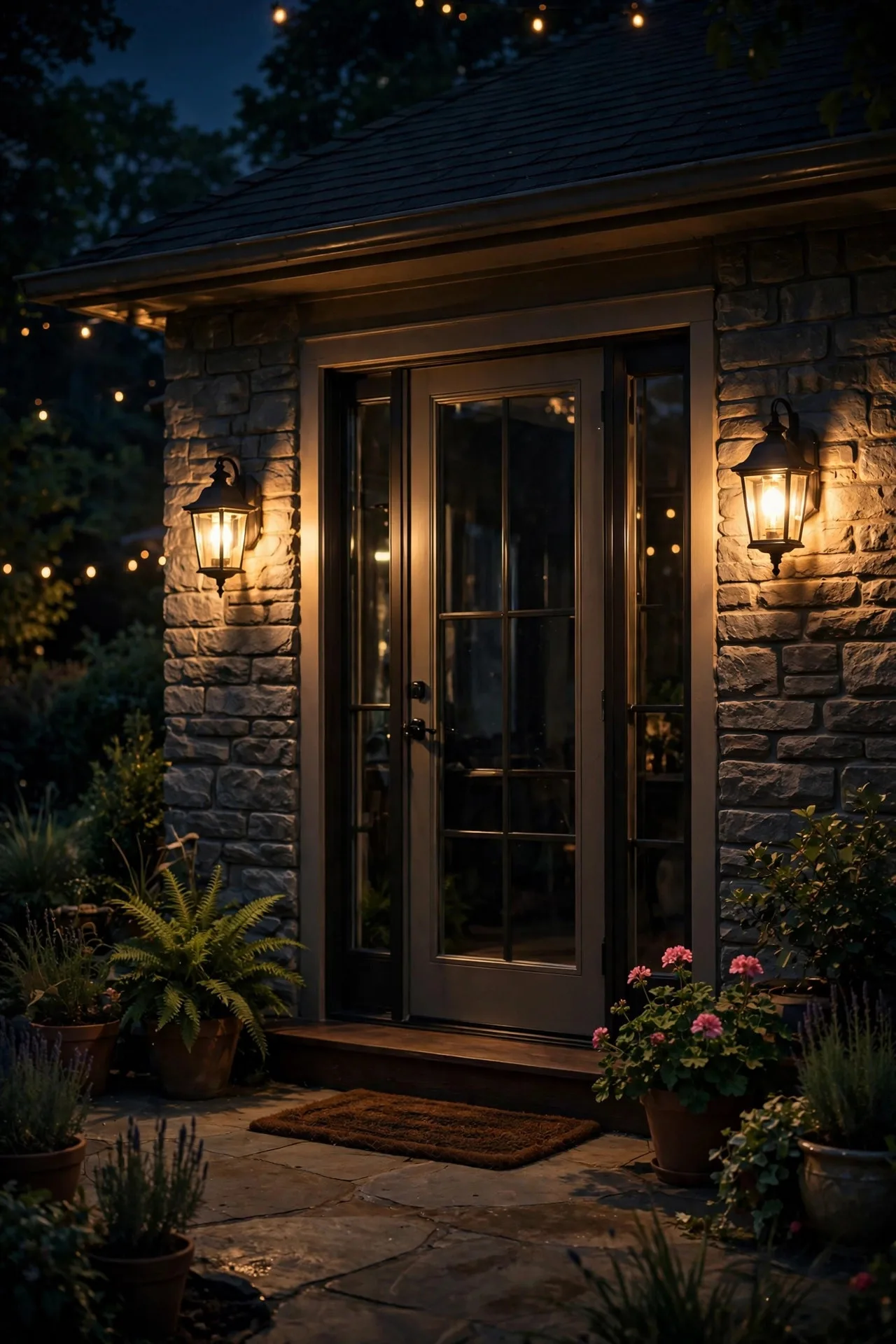
The wall where the patio meets the house is your patio's "front door," and it deserves the same treatment. A pair of outdoor lantern sconces flanking the back door gives you a welcoming pool of light exactly where people arrive, plus practical task light for the grill zone or the steps. Mount them 60 to 66 inches off the patio floor — roughly eye level — and 6 to 8 inches from the door frame on each side.
Choose wet-rated fixtures with clear or seeded glass (frosted glass cuts output noticeably) and fit them with dimmable warm LED bulbs. If you're wiring new, this is a job for a GFCI-protected circuit and — honestly — an electrician for the hardwiring; the fixture itself is a twenty-minute swap if a box already exists. Motion-sensor versions are brilliant for the back door since your hands are always full of grill tools or drink trays. This is also your security layer: a well-lit back door is one burglars skip.
Suggested budget range: $60 – $200.
21. Moonlight Downlights From a Tree
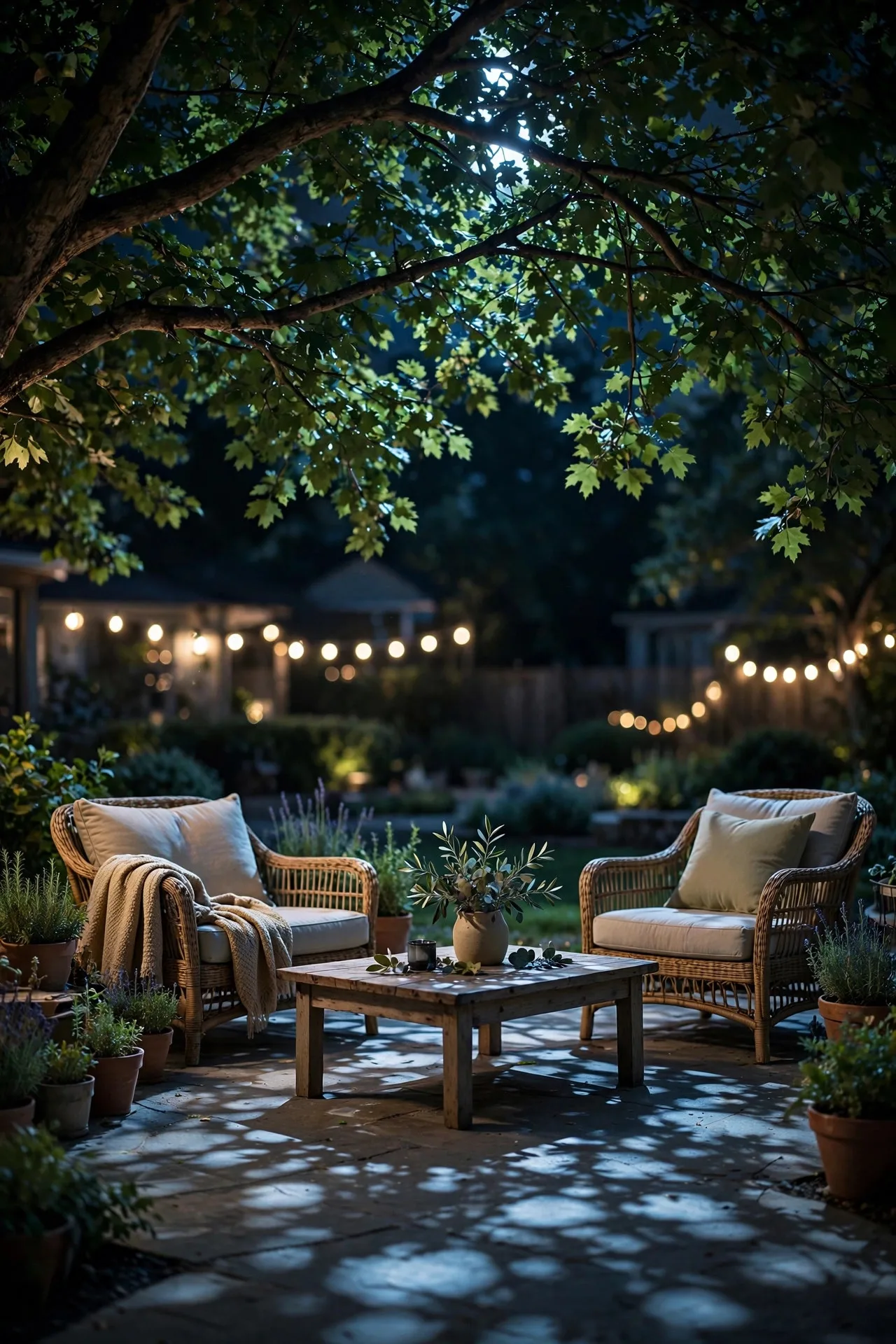
Real moonlight is the most flattering light there is — soft, cool, dappled through leaves. You can fake it beautifully with one or two downlights mounted high in a tree (15 to 20 feet up), aimed down through the branches. The leaves break the beam into that dappled pattern, and the patio gets a wash of gentle light with no fixture in sight.
Use low-voltage 12V LED downlights in a cool-neutral 4000K for this one — it's the rare case where warm white is wrong, because actual moonlight is cool and your brain knows it. Mount with tree-friendly straps (never nails or screws into a living tree) and run the low-voltage cable down the back of the trunk, tucked and zip-tied. Aim the beam to land on the seating area or lawn edge, not straight down the trunk. It's subtle — you won't read by it — but combined with your warm canopy lights, the cool-warm contrast is what makes a patio feel deep and three-dimensional instead of flat.
Suggested budget range: $50 – $140.
22. Floating Orbs in a Water Feature
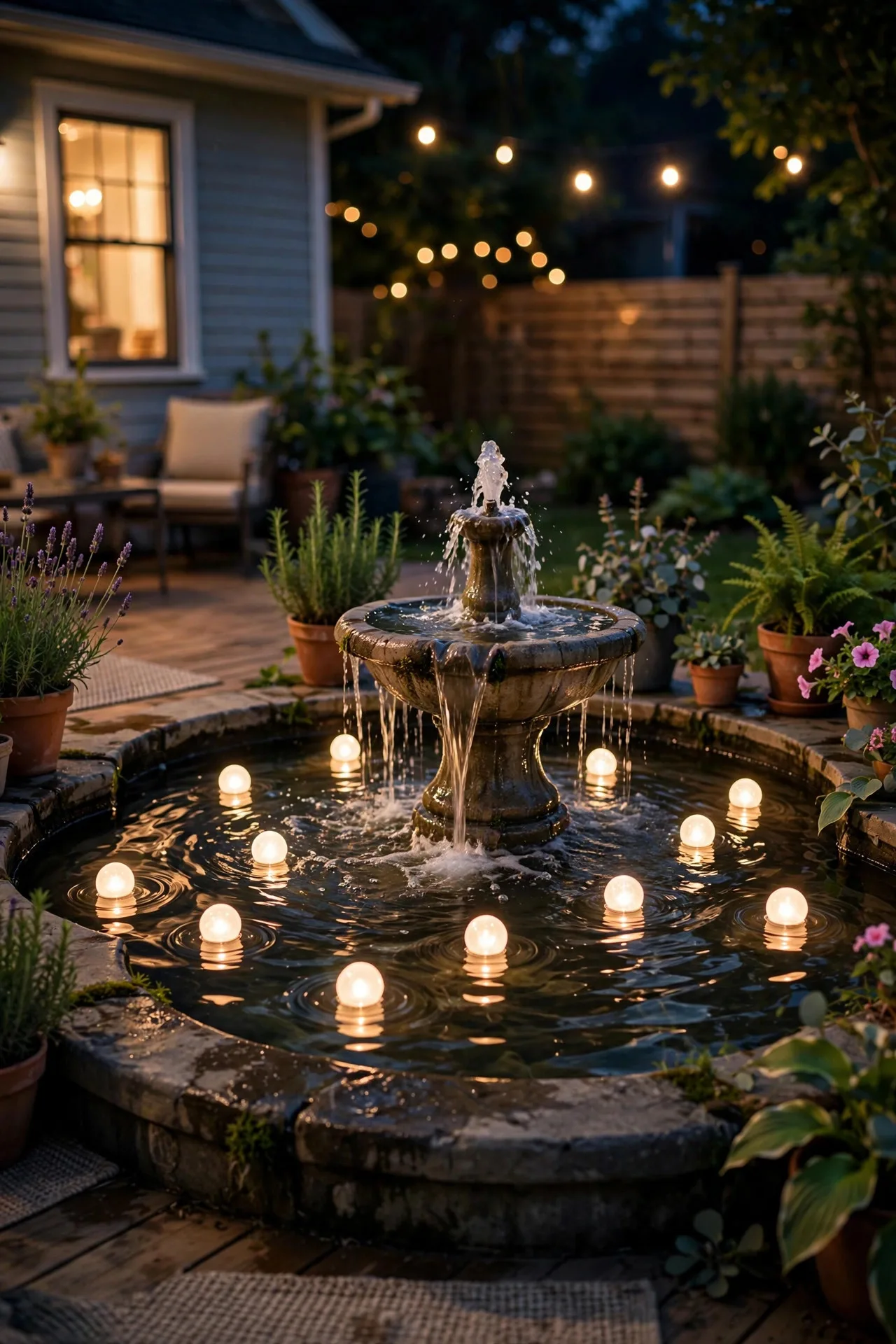
If your patio has a fountain, birdbath, or even a big ceramic bowl of water, floating LED orbs turn it into a glowing centerpiece. These are waterproof spheres (3 to 6 inches) with color-changing or warm-white LEDs inside — they drift, they bob, and they throw rippling reflections across everything nearby. A bowl fountain with three floating orbs is genuinely one of the prettiest things I've ever had on a patio.
Choose submersible-rated orbs (IP68 — that's the "can live underwater" rating) and warm white or soft amber for the most elegant look; the rainbow-cycling ones are fun for about four minutes. Solar-charging orbs float and charge all day, then glow at dusk automatically. Keep the water feature at least 5 feet from seating so splashes don't reach cushions, and change the water weekly in summer heat so it doesn't get swampy. No water feature? A wide ceramic planter bowl filled with water and three orbs costs almost nothing and works just as well.
Suggested budget range: $25 – $70.
23. Hurricane Candle Bowls for Windy Nights
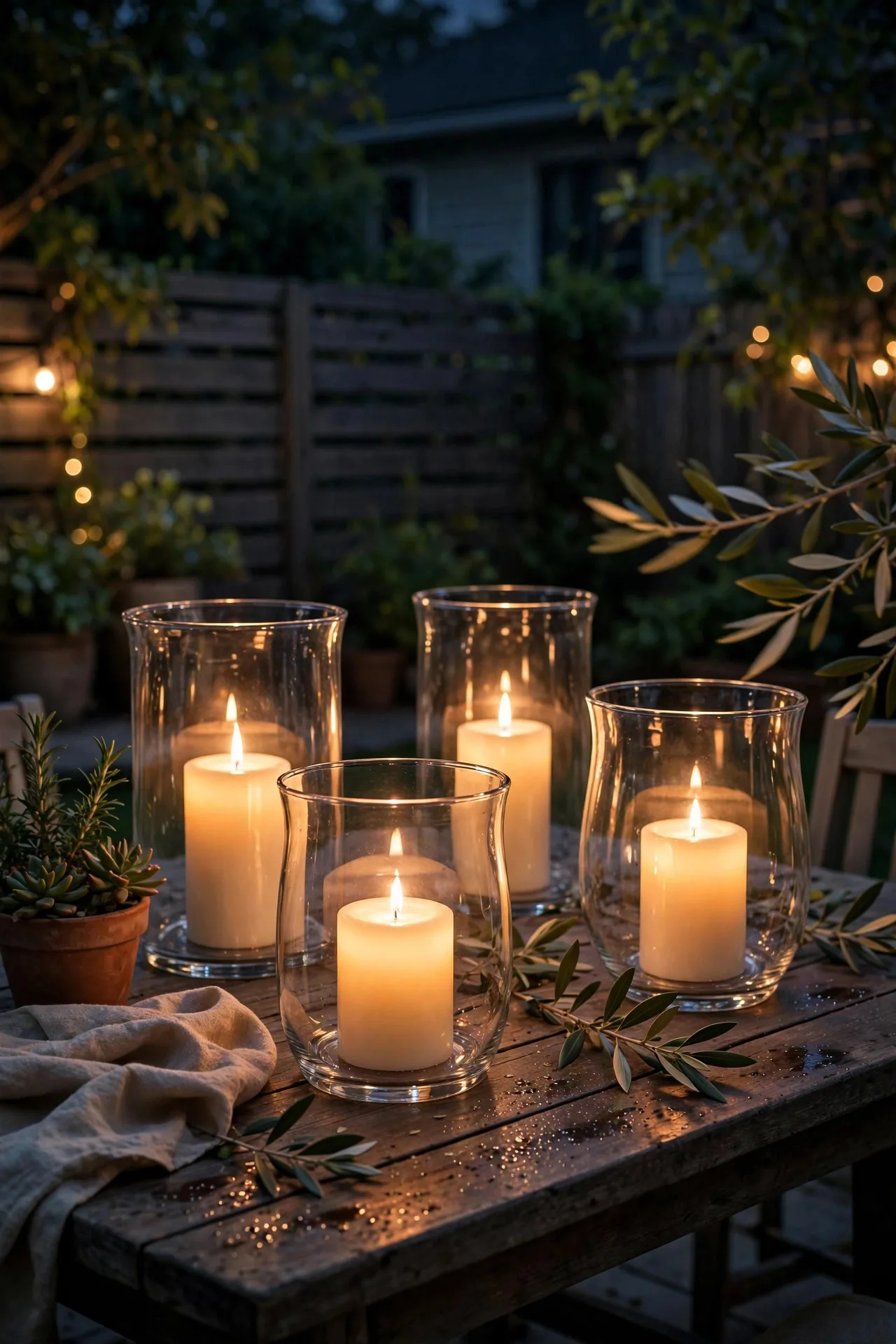
Summer evenings aren't always still, and nothing kills the mood like relighting candles every ten minutes. Hurricane candle bowls — big glass cylinders around a wide pillar candle or a chunky flameless LED — shrug off breezes that would murder a taper. They're my go-to for exposed patios where the wind has opinions.
Use LED pillars with a real wax exterior and flicker mode for the most convincing look; from across the table you genuinely can't tell. Group one large hurricane (12 inches tall) with two smaller ones (8 and 10 inches) on a low tray in the center of the table or on the coffee table in the seating area. The glass does two jobs: it blocks wind and it magnifies the glow. If you prefer real flame, use only wide, stable pillars — never tapers in a hurricane on a windy patio — and keep them 3 feet from anything flammable, including that cute fabric table runner. Extinguish real candles before you head in, every single time.
Suggested budget range: $30 – $80.
24. Bistro Lights on Freestanding Poles
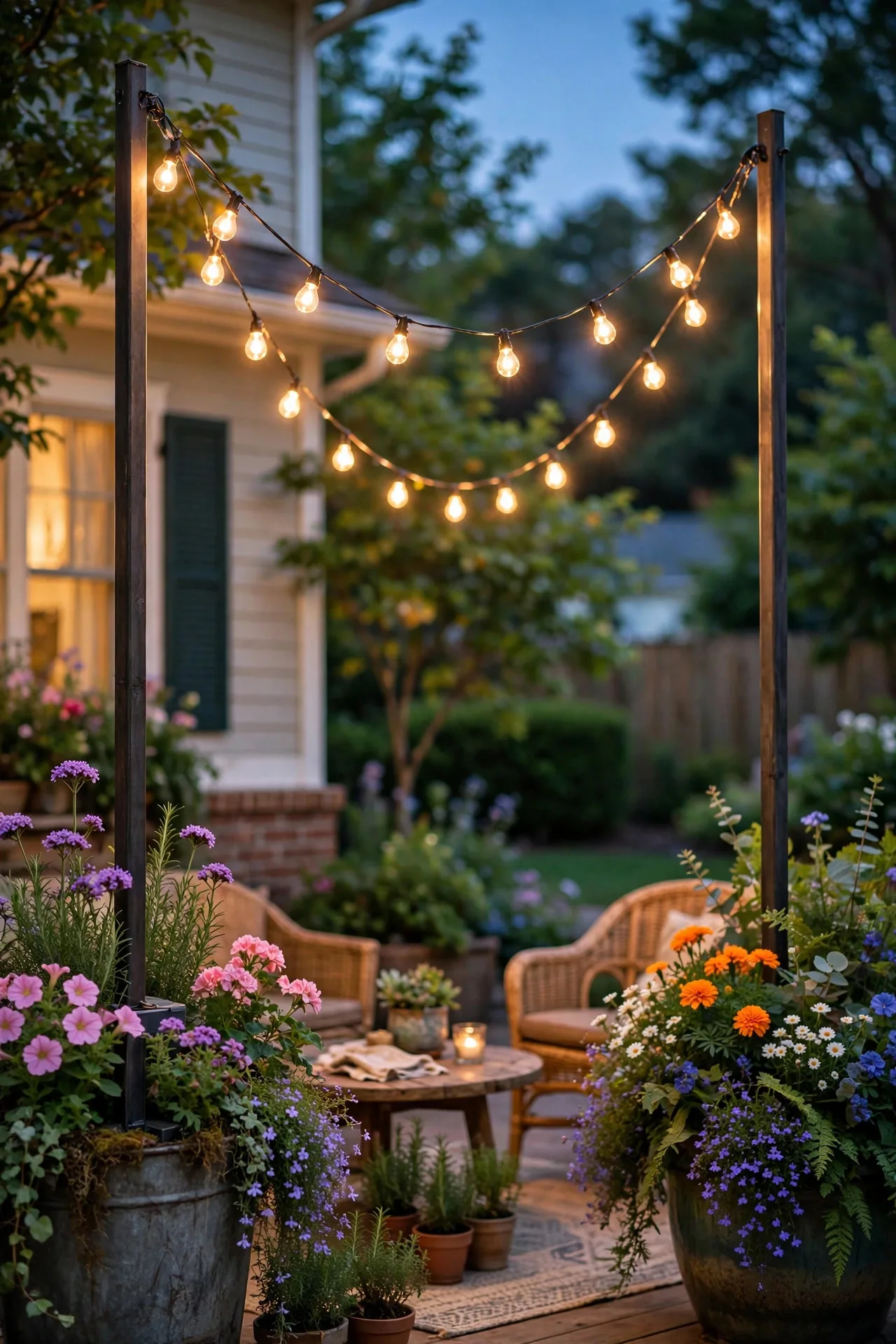
Renters and HOA-restricted patios, this one's for you. When you can't drill into anything — no house wall, no pergola, no fence you own — freestanding poles hold your bistro lights up anyway. These are 9- to 10-foot metal poles on heavy weighted bases (or planter poles that sit inside a big flower pot), and you string your lights pole to pole like a maypole of glow.
Set two to four poles 10 to 12 feet apart around the seating area, fill the planter bases with soil and flowers (the plants hide the mechanics), and drape one strand of LED bistro lights between each pair with a gentle 6-inch sag. The whole setup breaks down in an hour if you move, and nothing is permanently attached to anything. Weight the bases properly — a summer thunderstorm will find your weak pole, I promise. This is the same canopy magic as idea #1, just without needing a single screw in your landlord's siding.
Suggested budget range: $80 – $220.
25. A Master Timer for All Your Summer Patio Lighting Ideas
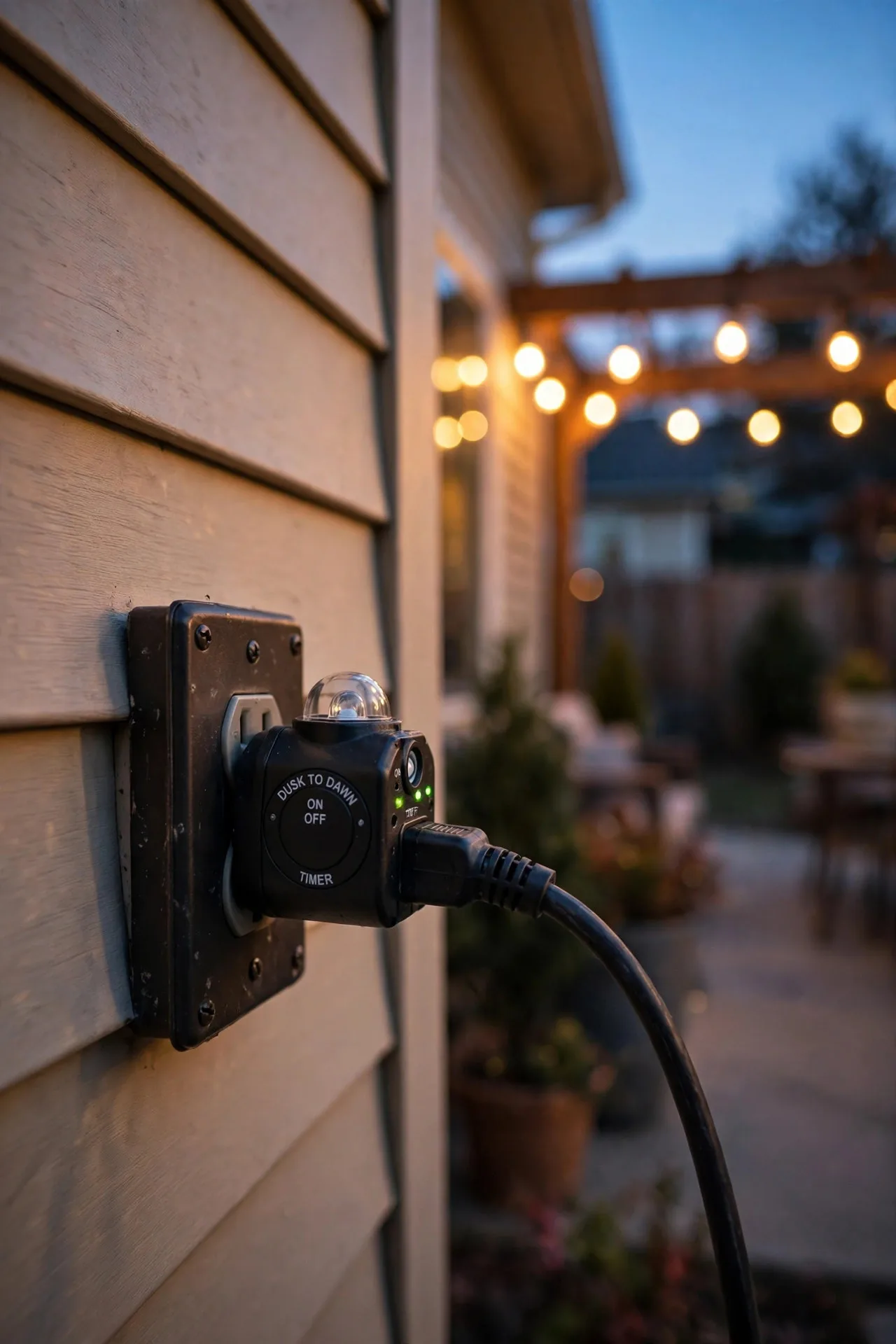
Here's my final idea, and honestly it might be the most important one: put the whole plan on a master timer. Every layer we've built — the canopy, the pendants, the hidden strips, the sconces — should wake up at dusk and sleep at bedtime without you touching a switch. A dusk-to-dawn photocell timer plus a countdown or smart timer means your patio is always glowing when the sky goes dark, even if you're still inside making the salad.
The practical setup: plug all your wired lights into outdoor-rated timers or smart plugs on a GFCI-protected circuit, set the photocell to trigger at dusk, and add a cutoff timer for 11 p.m. or midnight so you're not lighting the neighborhood all night (your neighbors and your electric bill will both thank you). Group by layer — canopy on one timer, accent and hidden lights on another — so you can run just the cozy layers on quiet nights. Solar lights mostly self-manage, so this is really about your plug-in pieces. A patio that lights itself feels like a small miracle every single evening, and it costs less than one nice dinner out.
Suggested budget range: $25 – $90.
Frequently Asked Questions
What color temperature is best for summer patio lighting?
Warm white, always — 2700K is the sweet spot for patios. It mimics golden-hour sunlight, makes skin tones look great, and keeps food looking appetizing. Cooler temperatures (4000K and up) make a patio feel like a commercial parking lot. The only exception is a moonlight-style downlight from a tree, where a cooler 4000K reads as actual moonlight. If you're mixing fixture types, keep everything at 2700K except that one accent, and the whole patio will feel cohesive.
Are outdoor string lights weatherproof enough to leave up all summer?
Quality outdoor-rated string lights are absolutely fine to leave up all season. Look for a UL listing for wet locations, shatterproof LED bulbs, and heavy-duty wire — those are the three things that separate the strands that last from the ones that die in July. What kills cheap strands is water in the sockets and UV-brittled wire, so keep connections under eaves or use connection boxes, and take strands down in severe storms. Paper lanterns and fabric shades are the exception: bring those in during heavy rain.
Should I choose solar or wired patio lights?
Use both, in the right places. Solar shines (literally) for accents — path markers, post caps, lantern stakes — where wiring is a pain and brightness demands are low. Wired or plug-in lights win for anything that needs real brightness or reliability: pendants over the dining table, chandeliers, and hidden strip lighting. Summer is solar's best season since long days mean full charges, but wired lights on a dusk-to-dawn timer will never leave you with a dead zone on a cloudy week. If you're weighing the tradeoffs in detail, this LED vs. solar comparison breaks it down honestly.
How much does it cost to light a patio for summer?
A cozy, complete patio lighting plan runs $200 to $600 for most patios — a canopy of string lights, some lanterns and flameless candles, solar accents, and a timer. You can absolutely start with $50 and one great idea (the umbrella light or the fairy-light curtain are my favorite budget starters) and layer in more over the season. The most common mistake is buying everything at once; add one layer at a time, live with it for a week, and you'll know exactly what the patio still needs.
Conclusion
The secret to unforgettable summer patio lighting ideas isn't any single fixture — it's layering. A canopy of light overhead, task light where you eat, and sparkle at the edges, all in warm 2700K tones, all waking up at dusk on their own. Start with one layer this weekend — honestly, the string light canopy alone will transform your warm nights outside — and build from there. Your patio is about to become the room everyone wants to be in. For more ways to glow up your outdoor spaces, browse our backyard lighting ideas and keep the magic going all season long.