There is a special kind of frustration in pulling into a dark driveway at night, groceries in the trunk, unable to see the steps, the bins, or where the lawn ends. That is exactly the problem solar flood light ideas solve so well: big, bright, wide light right where you need it, with no electrician, no trenching, and no bump in your power bill. In my experience, the secret is layering. A motion-activated flood handles security, a gentle dusk-to-dawn wash covers everyday visibility, and one or two well-aimed beams make the yard feel welcoming instead of interrogated. Modern panels and lithium batteries have quietly gotten very good, too — a decent solar flood today throws 800 to 1,500 real lumens and recharges in a single sunny day. Below I'm sharing 17 ways I use them around a house, from the garage door to the back gate, with mounting heights, beam angles, and honest budgets for each. Pick two or three zones to start, and your whole property will feel safer and prettier after dark.
1. The Motion-Activated Classic Over the Garage Door
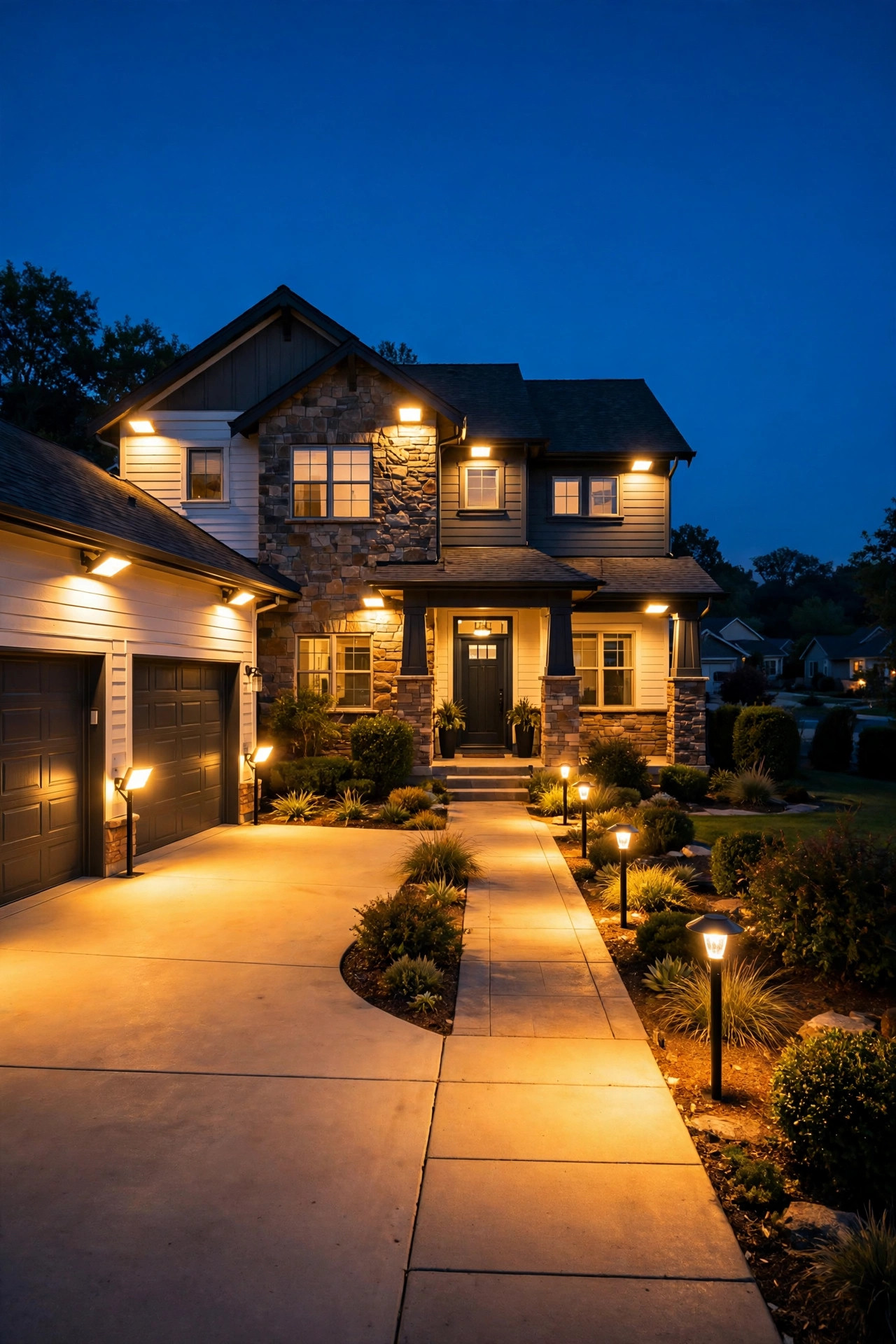
If you only buy one solar flood, make it this one. Mount a motion-activated unit centered above the garage door, about 9 to 10 feet up, and angle the head down roughly 30 degrees so the beam pools on the driveway apron instead of blinding you through the windshield. Look for a PIR sensor with adjustable sensitivity and a 120-degree detection arc, plus a timer that keeps the light on 20 to 60 seconds after motion stops. A model in the 1,000 to 1,500 lumen range lights two parking spots comfortably. In my experience, the cheap units fail at the sensor, not the LED — spend a little more for one with replaceable batteries and an IP65 rating or better. Face the panel south if you can, and wipe it down every few months; a dusty panel quietly steals half your runtime. For deeper help tuning sensitivity so passing cars don't trigger it all night, my motion sensor outdoor lights guide walks through the settings dial by dial.
Suggested budget range: $30 – $70.

2. A Wide-Beam Wash for the Whole Backyard
Backyards need area light, not a spotlight, and a wide-beam solar flood with a 120-degree or broader spread is the tool for it. Mount it under the eave or on a fence post at 10 to 12 feet, aimed across the lawn's diagonal so the beam stretches as far as possible. Two smaller floods aimed from opposite corners honestly beat one giant one — you get even coverage without that single harsh hotspot in the middle. Choose a dusk-to-dawn model with a dim standby mode: it idles at 20 to 30 percent brightness all evening, which is plenty for letting the dog out, then jumps to full power when the sensor trips. Check the battery capacity in the listing; for all-night dim mode you want at least 8,000 mAh, ideally more. Keep the beam off your neighbor's windows by tilting the head down and using the included visor if it has one. This is the light that makes summer evenings in the yard actually usable.
Suggested budget range: $40 – $90.

3. Dual-Head Floods That Turn Corners
The corner of a house is where single-head floods give up: one wall gets light, the other stays black. A dual-head solar unit fixes that beautifully. Each head pans and tilts independently, so you aim one down the side wall and the other across the front or back yard, and the corner itself stays lit because the beams overlap. Mount it 8 to 10 feet up, right on the corner trim if the siding allows, and spend five minutes after dark walking the perimeter to fine-tune the angles — this is a two-trip-up-the-ladder job, and that's fine. Dual heads also shine above a garage's side door or at the peak of an L-shaped driveway where cars turn. Look for heads you can angle at least 180 degrees horizontally, an IP66 rating for that exposed corner weather, and a panel you can tilt toward the sun independently of the light heads. It's a small upgrade that makes the whole house feel deliberately lit.
Suggested budget range: $35 – $75.

4. A Separate Solar Panel for Shady Spots
Here's the honest problem with solar floods: the places that most need light — the north side of the house, under the big oak, beside the tall fence — are exactly the places with no sun. The fix is a flood with a detached panel on a 10- to 16-foot cable. The light lives in the shade where you need it; the panel lives on the sunny fence line or roof edge where it can actually charge. Mount the panel facing south, tilted about 30 to 45 degrees, and bury or clip the cable neatly along the wall so it doesn't become a trip line or a weed-whacker casualty. This setup unlocks under-deck lighting, covered-patio floods, and that dark passage between house and fence. Because panel and light are separate, you can also upgrade positioning later without replacing the fixture. In my experience this is the single most underused trick in solar lighting — people give up on a spot instead of just moving the panel.
Suggested budget range: $35 – $80.

5. Dusk-to-Dawn Solar Flood Light Ideas for All-Night Peace of Mind
Motion lights are great, but some spots simply feel better lit all night: the front walk, the steps off the deck, the stretch of driveway guests use. Dusk-to-dawn solar flood light ideas built around a photocell do that without any wiring — the light wakes at sunset, holds a soft 200 to 400 lumen glow, and sleeps at sunrise. The trick is battery math: a unit that advertises all-night runtime needs a big battery, 10,000 mAh or more, and a panel sized to refill it even in December. Many models cheat by dimming to almost nothing by 3 a.m., so read reviews for winter performance specifically. Mount these a touch lower than security floods, around 8 feet, since the job is gentle guidance rather than glare. I love one over the front steps paired with the motion flood at the garage — visitors get a lit path, and you get the security burst only when it matters. Layered, calm, and completely automatic.
Suggested budget range: $30 – $65.

6. A Matched Pair at the Driveway Entrance
The end of the driveway is where guests hesitate, delivery drivers guess, and your mailbox hides in the dark. A matched pair of solar floods on short posts or the gate pillars changes all of that — one aimed down the drive toward the street, one aimed back up toward the house, so the whole entrance reads as a lit room instead of a tunnel. Keep them at 6 to 7 feet high so the light stays friendly rather than towering, and choose matching warm-white 3000K output so the pair looks intentional. Motion mode works beautifully here: the lights greet arrivals and ignore the empty street if you aim the sensors down the drive rather than across it. If your entrance has pillars, wall-mount the floods on the inner faces so they're protected from passing mirrors. For wider layout help on the drive itself, my driveway lighting ideas cover spacing and layering in detail. First impressions start at the curb — this is an easy one to get right.
Suggested budget range: $50 – $110.

7. Uplight Your Trees and Facade
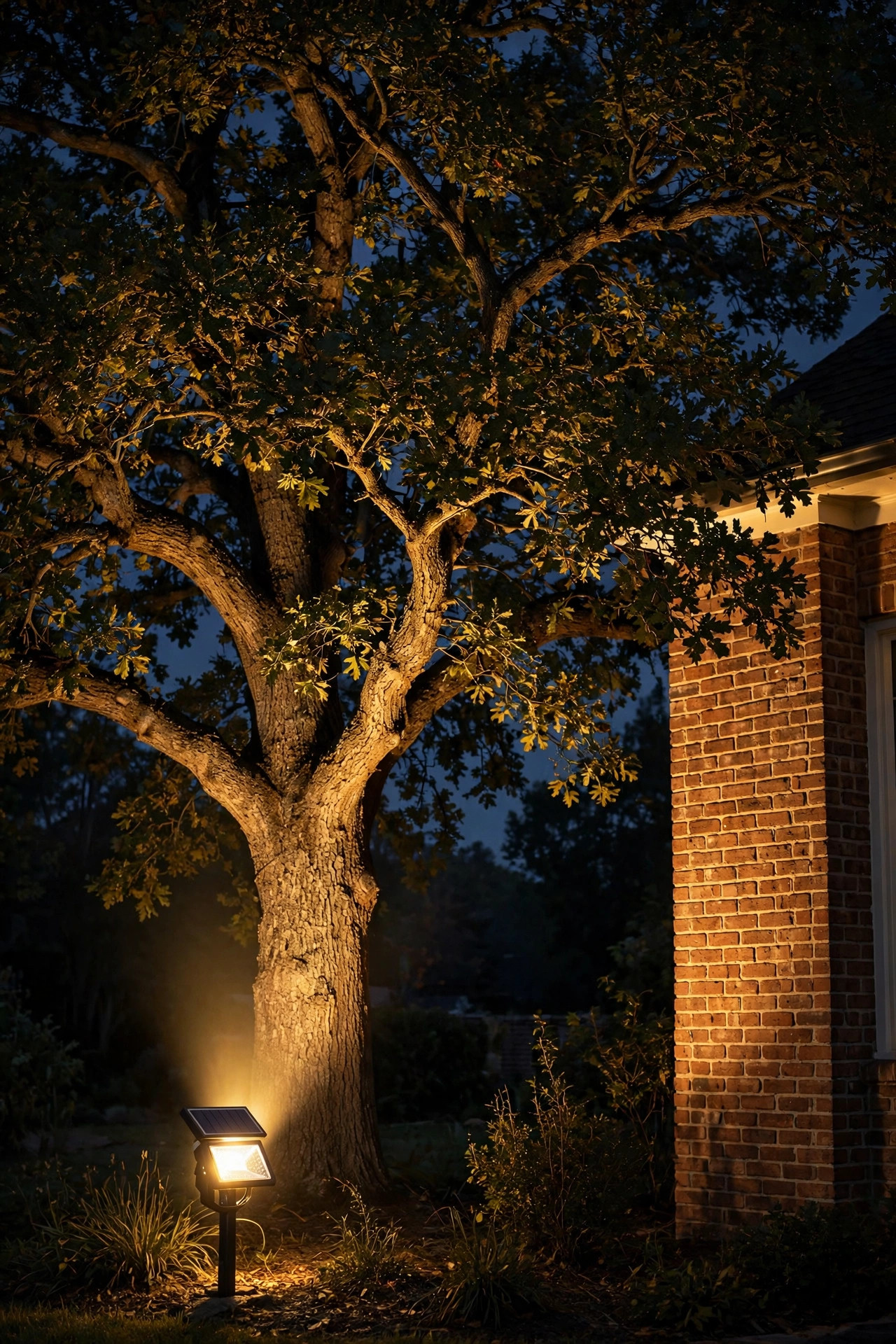
Flood lights aren't only for security — aimed upward, they become the prettiest accent lights you own. Set a solar flood at the base of your best tree, 12 to 18 inches out from the trunk, and tilt it up into the canopy; a wide beam gives you that soft moonlit wash through the branches. The same trick grazes a brick or stone facade beautifully, pulling out texture that flat daytime light hides. Because these are accents, you don't need blinding output — 300 to 600 lumens in warm white (2700–3000K) looks elegant, while cool white reads like a parking lot, honestly. Stake-mounted models made for landscaping are ideal here since they sit invisibly in the bed by day. Keep the panel clear of mulch splash and fallen leaves, and expect to re-aim after storms. One warning: resist uplighting every tree. One hero tree lit well looks like a magazine; six lit trees look like a garden center. Pick your favorite and let the rest stay silhouettes.
Suggested budget range: $25 – $60.
8. A Soft Front-Yard Wash for Curb Appeal
Real-estate photos are shot at dusk for a reason: a house washed in warm light looks loved. Two solar floods placed low in the front beds, aimed up and across the facade, give you that look every night with zero wiring. Space them to cover the frontage evenly — roughly one flood per 15 to 20 feet of wall — and cross the beams slightly so shadows soften. Warm white is non-negotiable here; 2700K makes siding and brick glow, while 5000K daylight bulbs will make your home look like a dentist's office. Keep output moderate, 400 to 800 lumens per fixture, because the goal is a wash, not a stadium. A photocell or timer mode that runs from dusk to about midnight is the sweet spot: curb appeal for the evening hours, darkness for sleeping, and a battery that easily keeps up. Angle the heads so no beam crosses a front window directly. Honestly, this is the cheapest " renovation" I know — neighbors will ask what you did to the house.
Suggested budget range: $45 – $100.

9. Back-Door Security With a PIR Sensor
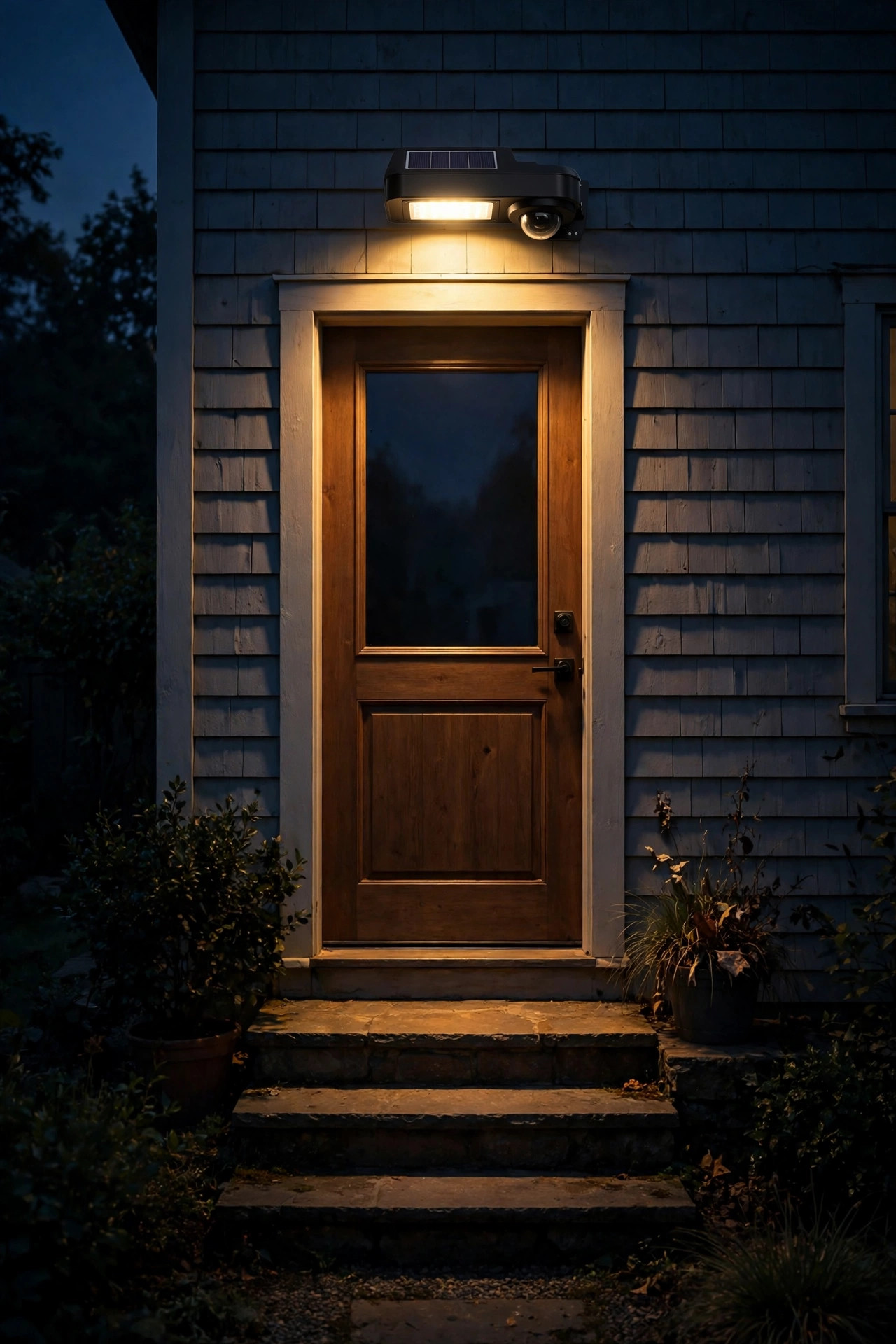
The back door is statistically where unwanted visitors try first, and it's often the darkest spot on the house. A solar flood with a good PIR sensor mounted 9 feet up, centered over the door and aimed down the steps, changes the whole equation. Set the sensor to its widest arc and the timer to about 60 seconds — long enough to fumble keys without the light quitting on you. I like models with a gentle standby glow that jumps to full brightness on motion: the soft glow says "occupied home," and the burst says "you've been seen." Position the panel where roof runoff won't sheet over it, and test the detection zone at night by walking the yard's natural approach paths. If you have a dog door or a busy bird feeder in range, drop the sensitivity a notch and angle the sensor slightly downward to shrink the trigger zone to human height. Simple, cheap, and genuinely reassuring.
Suggested budget range: $28 – $60.
10. Light the Side Yard and the Gate
Every house has that one narrow passage — bins, hoses, the AC unit, a gate nobody can find the latch on after dark. A compact solar flood mounted high on the wall turns it from a gauntlet into a walkway. Because the space is tight, you don't need much power: 400 to 700 lumens with a wide, soft beam beats a blinding 2,000-lumen unit bouncing off two walls. Aim it along the passage rather than across it, so the light travels the length of the path. Motion mode is perfect here since nobody lingers in a side yard. Mount the gate-side flood so its beam catches the latch and handle; you'll thank yourself every trash night. If the passage is fully shaded, this is the spot for that separate-panel model from idea #4. Add a small reflector or a pale gravel strip underfoot and the modest light you have goes twice as far. Unglamorous, yes — but this is the light you'll actually use every single week.
Suggested budget range: $25 – $55.

11. A Hardworking Flood for the Shed or Barn
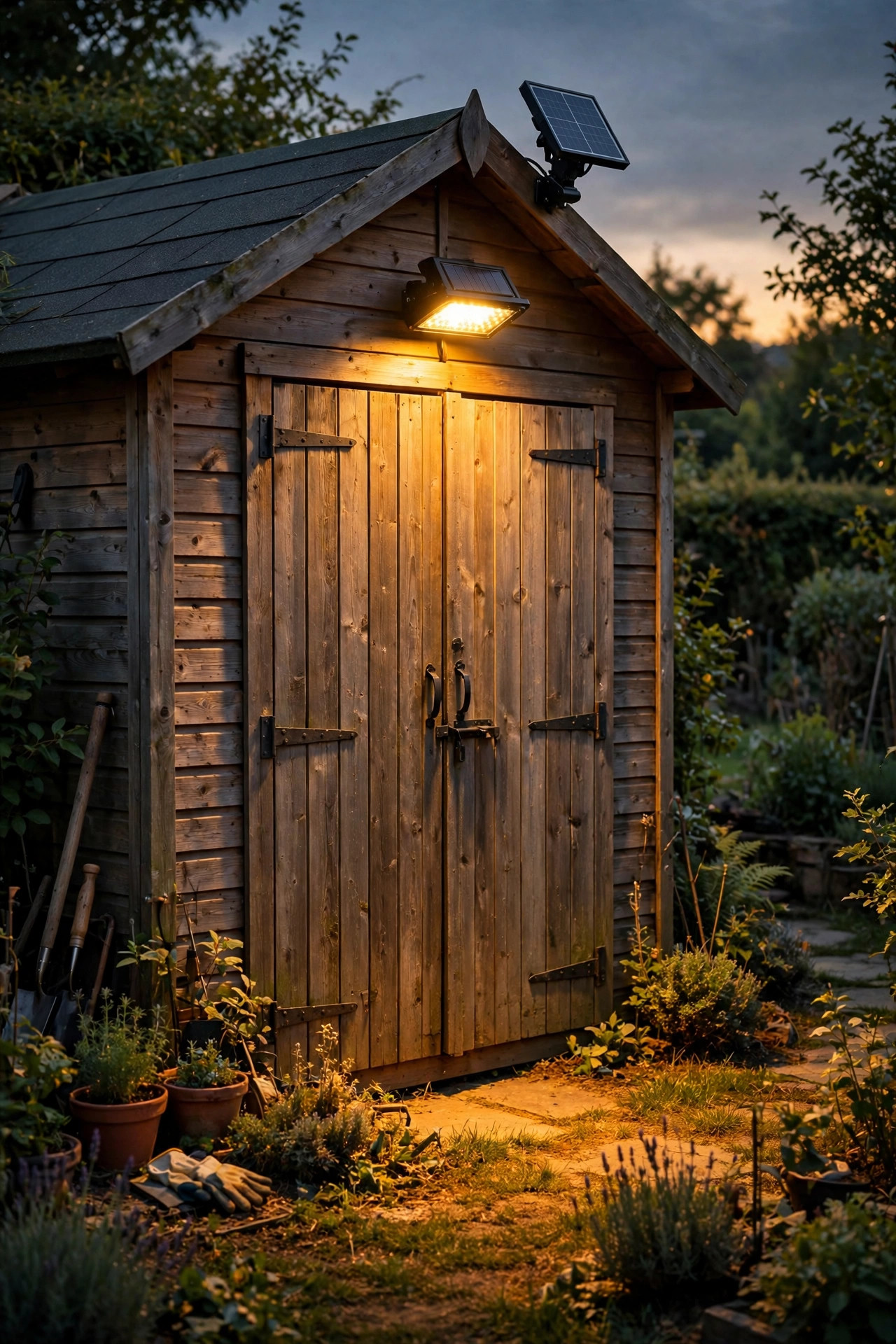
Outbuildings are where solar floods really earn their keep, because running power to a shed costs hundreds while a solar unit costs the price of a nice lunch. Mount a bright motion flood — 1,200 lumens or more — over the doors, aimed across the work apron in front. It lights your arrival, your unloading, and your lock-up, then shuts itself off. If the shed roof faces south, you have the best panel real estate on the property; mount the panel on the roof edge with a clear sky view and it'll outperform any wall-mounted unit. For a barn or workshop with animals, choose a model with a manual override or a remote so you can hold the light on during evening chores instead of waving at the sensor every minute. Check the operating temperature range if your winters are serious, and bring the battery indoors during the coldest months if the unit allows removal. Utilitarian, dependable, and done in twenty minutes with a drill.
Suggested budget range: $35 – $85.
12. Pool and Patio Wash Lighting
Pools and patios need light that's present but never harsh — you're lighting faces and footing, not interrogating swimmers. A pair of solar floods mounted on the house wall or pergola posts at 8 to 9 feet, aimed at the patio's far edge so the beam skims across, gives a soft ambient wash. Indispensable detail: keep every fixture and its beam path well clear of the water itself, follow your local code setbacks for anything near a pool, and never place a light where a wet hand can reach it while someone is in the water. Warm white at moderate brightness, 500 to 900 lumens, keeps skin tones kind and bugs less interested than cool white does. A dimmer or two-stage model is worth it here: full brightness for cleanup, low glow for conversation. Angle heads away from lounge chairs so nobody's staring into a lens. Done right, the patio feels like a resort terrace — and nobody tripped on the step getting there.
Suggested budget range: $40 – $95.

13. Ground-Stake Floods for Beds and Borders
Not every flood needs a wall. Ground-stake solar floods — a small panel and head on a sturdy spike — push up into garden beds and throw a fan of light across paths, borders, and low shrubs. Used in a row every 6 to 8 feet, they outline a walkway far more elegantly than those little mushroom path lights, and each one is genuinely bright enough to see by. They're also the most flexible lights on this list: when the planting changes or you re-route a path, you just pull the stake and move it. Look for metal stakes rather than plastic, adjustable heads, and panels you can tilt as the seasons change the sun's angle. Output of 200 to 400 lumens per unit is the sweet spot for beds. One practical note: mark their positions before the fall leaf drop and spring mulching, because a buried panel charges nothing. Gardeners especially love these — they light the plants and the path in the same gesture.
Suggested budget range: $20 – $50.

14. A Portable Flood for Projects and Camping
Some of the handiest solar floods never get mounted at all. Portable units with a kickstand, a handle, and often a USB port for charging a phone are part work light, part lantern, part emergency kit. Charge one on a sunny windowsill or the dashboard and it will light a tent site, a plumbing repair under the sink, a roadside tire change, or a power outage with total indifference to extension cords. The good ones offer two or three brightness levels and run 6 to 10 hours on low. I keep one in the garage and one in the car, honestly. When you shop, prioritize a metal kickstand that actually holds its angle, a battery indicator, and a panel big enough to recharge the unit in a day rather than a week. It's the least decorative idea on this list and possibly the most useful — every household ends up borrowing it for something. Consider it the Swiss Army knife of solar lighting.
Suggested budget range: $25 – $55.

15. Warm-White Solar Flood Light Ideas for Entertaining
Security floods default to a blue-white 5000–6500K that flatters nothing and no one. For the spaces where people gather, hunt down warm-white solar flood light ideas in the 2700–3000K range and the whole mood changes: food looks appetizing, faces look rested, and the patio feels like golden hour on demand. Mount one or two warm floods high — under an eave or on a pergola corner — and aim them to bounce softly across the entertaining zone rather than straight down on the table. If your flood has a remote, warm models often include a gentle amber mode that's even kinder after dark. Layer with string lights or lanterns if you have them; the flood provides the base level of visibility and the small lights provide the sparkle. Keep one brighter cool-white motion unit for the driveway if you like, but let the backyard stay warm. Guests may not know why your patio feels so good, but they'll stay later. That's the review that counts.
Suggested budget range: $35 – $80.

16. Spotlight a Flagpole or Address Marker
A flag deserves light after dark — flag etiquette actually asks for it — and a solar flood aimed up a flagpole is the no-wiring way to honor that. Set the fixture 3 to 5 feet from the pole's base, tilted steeply upward with a narrower beam if your model offers one, and let the flag catch the light as it moves. The same setup flatters an address pillar, a carved stone marker, or a garden statue: one focused flood, aimed with intention, reads as landscape design rather than hardware. Choose a dusk-to-dawn model so the display keeps its own schedule, and size the panel generously since all-night runtime is the whole point. Keep the beam tight enough that you're not washing the street or a neighbor's bedroom. Test the angle on a breezy evening, because a flag in motion needs a wider cone of light than one hanging still. Small project, outsized pride — this is the one that makes people slow down as they pass your house.
Suggested budget range: $30 – $70.

17. Layer Your Solar Flood Light Ideas Into Zones
Here's my whole philosophy in one idea: stop thinking in fixtures and start thinking in zones. Divide your property into three — arrival (driveway, garage, front walk), living (patio, pool, back door), and perimeter (gates, side yards, shed). Give arrival a bright motion flood plus a soft dusk-to-dawn guide light. Give living warm, dimmable washes people can sit in. Give the perimeter motion-only floods that stay dark until something moves, which saves battery and keeps the night sky intact. This is why layering solar flood light ideas beats buying five identical units: each zone gets the brightness, color, and behavior it actually needs, and no single failure leaves you in the dark. Sketch it on paper before you shop, count your mounting points, and buy for the plan rather than the sale rack. Your future self, arriving home on a rainy night to a house that lights itself in welcome, will be very glad you did.
Suggested budget range: $120 – $300.

Frequently Asked Questions
How many lumens do I actually need in a solar flood light?
For a single parking spot or a back door, 800 to 1,200 lumens is plenty. To wash a whole backyard or a two-car drive, look at 1,500 to 2,500 lumens — or two smaller floods aimed from opposite corners, which honestly gives more even light. For accents like trees and beds, 200 to 600 lumens looks elegant. Ignore listings with wildly inflated numbers; if a palm-sized panel claims 10,000 lumens, it's marketing, not physics.
Do solar flood lights work in winter and on cloudy days?
Yes, with realistic expectations. A good panel still charges on bright overcast days, just more slowly, and quality lithium batteries hold enough reserve for two or three dull days in a row. In deep winter, angle the panel more steeply toward the low sun, keep it swept clear of snow and leaves, and consider motion mode instead of all-night dusk-to-dawn to stretch the runtime. Most "failed" solar lights I see are simply dirty or shaded panels.
Solar vs. wired flood lights — which is better?
Wired floods win on raw brightness and unlimited runtime, and they're still my pick for a main security light over a garage if you already have power there. Solar wins everywhere else: no electrician, no trenching, no running cost, and you can move it in five minutes. For most yards, a thoughtful mix is ideal — I compare the trade-offs in depth in my solar vs wired landscape lighting guide.
Where should I mount a solar flood light, and where does the panel go?
Mount security floods 8 to 10 feet up, high enough to spread the beam and discourage tampering, angled down so the light pools where people walk. The panel wants the sunniest spot you have — ideally south-facing, unshaded between 9 a.m. and 3 p.m. If the perfect light position is shady, choose a model with a separate cable-mounted panel and put each half where it belongs.
Conclusion
The best solar flood light ideas aren't about one giant fixture — they're about the right light, in the right zone, behaving the right way: a motion burst at the garage, a soft glow at the steps, a warm wash where your people gather. Start with your darkest, most-used spot, mount one good unit this weekend, and live with it for a week before you buy the next. You'll learn your yard's light the way you learned its soil — by paying attention. Browse more of my outdoor lighting ideas here on the site for driveways, patios, and paths, and before long your whole property will greet you after dark.