
Our deck sits exactly one step above the lawn — eleven inches of height, no railing, nothing grand — and for the first two summers we owned this house, it simply vanished at night. Guests stepped off the edge into the flower beds, and honestly? So did I. The fix wasn't a floodlight. The fix was thinking about ground level deck lighting ideas the way I think about every space I light: in layers. On a low deck the layers just sit closer to the boards — a soft glow right at deck level, clear definition along the edge so nobody misjudges the drop, and one warm focal point that draws people outside. Because there's no railing and barely any structure to mount things on, low decks reward creative placement: fixtures hide in the fascia, tuck into the planting beds, and sit flush exactly where feet land. Below are the 17 setups I've tested on our own deck and helped neighbors copy since, from $25 solar step lights to a full layered system, each with an honest budget so you can pick your starting point tonight.

1. Flush-Mount Recessed Deck Dots Around the Perimeter
If your low deck gets only one upgrade, make it this one. Recessed deck dots are small round LED fixtures, about 1.5 to 2 inches across, that sit completely flush with the boards. You drill a hole with a hole saw, drop the fixture in, and daisy-chain the low-voltage cable underneath. I spaced ours about 4 to 5 feet apart, a few inches in from the edge, and the effect is exactly what a ground-level deck needs: a dotted outline that says "the deck ends here" without any glare in your eyes while you're sitting down. Choose fixtures rated for foot traffic and wet locations, and stick to warm 2700K to 3000K so the boards glow amber instead of hospital white. Run the cable before you close up any skirting, because the crawl space under an eleven-inch deck is not somewhere you want to army-crawl later — ask me how I know. Connect everything to a small low-voltage transformer with a built-in dusk sensor and the whole perimeter lights itself every night. In my experience this is the single highest-impact change per dollar on a low deck.
Suggested budget range: $60 – $140.

2. LED Strip Lights Hidden Under the Fascia Edge
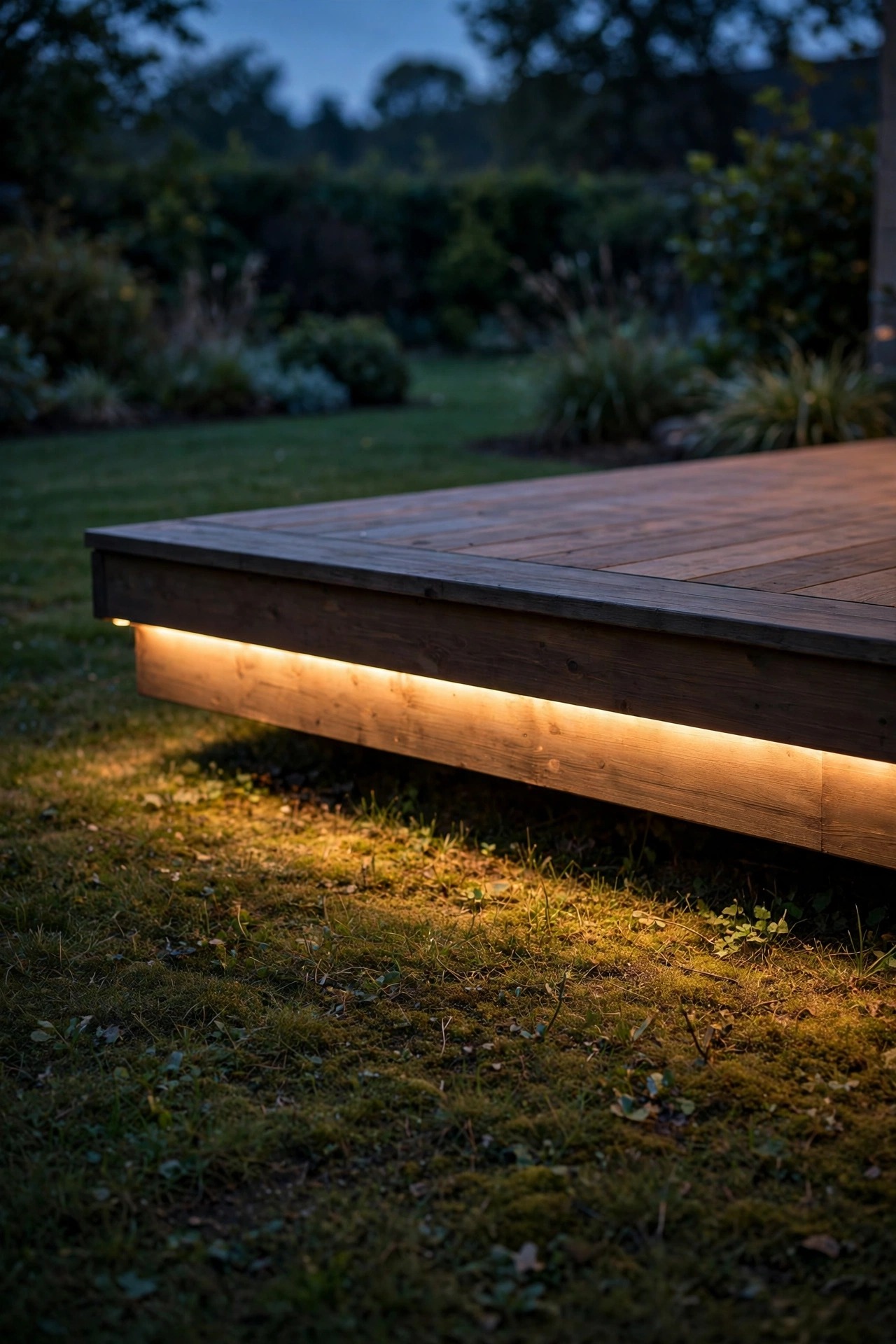
This is the trick that makes visitors ask if our deck is floating. An outdoor-rated LED strip runs the full length of the deck inside a slim aluminum channel, tucked up under the fascia board so you never see the strip itself — only a ribbon of light spilling down the skirt and pooling on the ground below. Ground-level decks are perfect for it because the drop is short, so the wash is concentrated and dramatic. Use IP65-rated tape at minimum, seal every cut end with its cap and a dab of silicone, and choose a 24-volt system for runs longer than about 16 feet so the far end doesn't dim. It's the same hidden-channel approach I use for under-rail LED strip lighting on stairs, adapted to a deck with no rail at all. Add a remote dimmer and the edge glow goes from "evening definition" down to "barely-there ember line" for stargazing. One honest warning: mount the channel with screws, not just the tape's adhesive backing, because summer heat under a sun-baked fascia will peel adhesive loose by July.
Suggested budget range: $40 – $110.
3. Solar Step Lights for the One Step Down
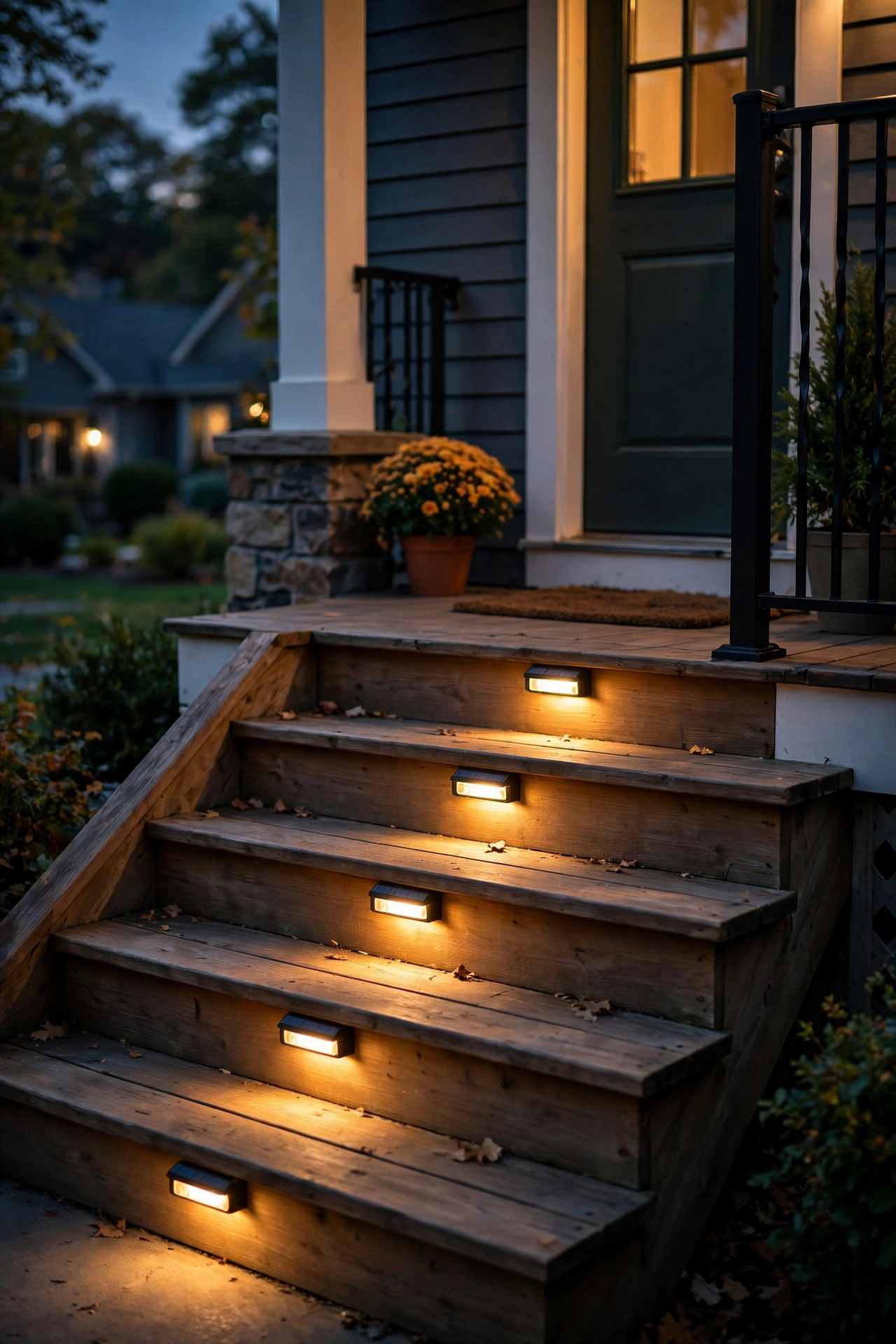
Every ground-level deck has that one step — and that one step is where every twisted ankle in our family has happened. Solar step lights solve it for pocket change and zero wiring. The screw-mount style attaches to the riser face so the little panel charges all day and a warm pool of light lands exactly on the tread below; the sit-on style just rests on the step's edge, weighted and done. Screw-mount wins in my yard because the sit-on ones wander off with the dog. Here's what nobody tells you: most solar step lights default to a bluish daylight white that looks awful on wood, so read the listing carefully and buy only ones that say warm white, around 3000K. If your deck has two or three steps or a stepped platform edge, my roundup of deck stair light ideas covers riser, tread and side-mount options in more depth. Wipe the little solar panels with a damp cloth once a month — pollen film quietly cuts their charge, and a clean panel easily doubles the hours of light you get on a winter evening.
Suggested budget range: $25 – $60.
4. Post Cap Lights on Short Corner Posts
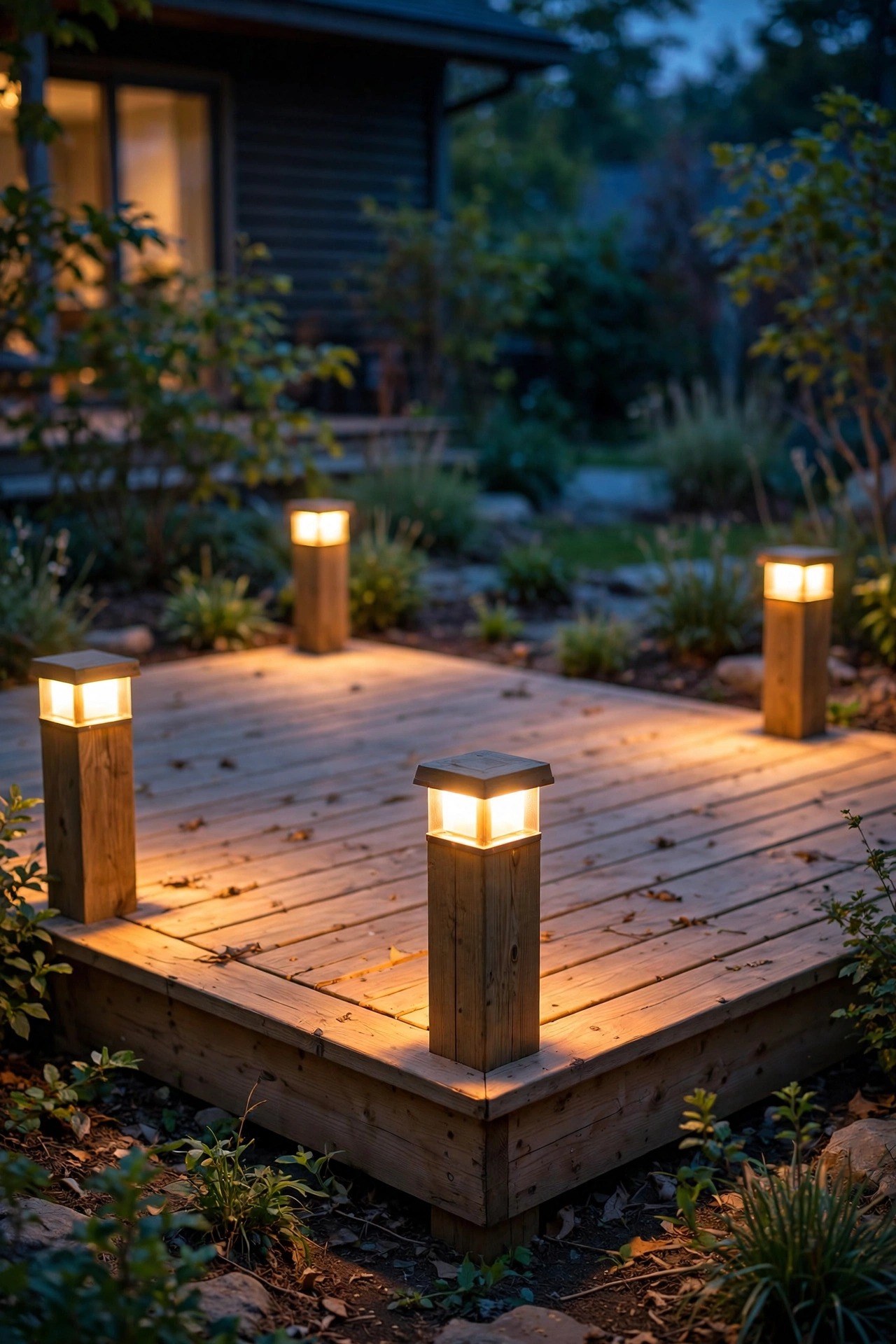
"No railing" doesn't have to mean "nothing vertical to light." Even without a railing, most low decks either have corner posts already or can gain two short ones in an afternoon: a 4×4 post at each corner, standing just a few inches above the deck surface, capped with a light. Post cap lights at that height land right around seated eye level once everyone's in chairs, which is the most flattering light there is — faces glow, nobody squints. Solar caps are the five-minute option and work well on sunny corners; low-voltage wired caps are brighter, consistent, and worth it on shaded decks. Measure your post before ordering, because 4×4 and 6×6 caps are not interchangeable and the adapter rings only forgive so much. I rounded up the styles that hold up outdoors in my guide to deck post cap lights if you want the detailed comparison. On our deck, two wired caps at the far corners plus the recessed dots from idea one completely changed the space for under $200 total, and the caps are still the first thing guests compliment.
Suggested budget range: $80 – $200.
5. Solar Ground Level Deck Lighting Ideas: Flush Disks at the Lawn Edge
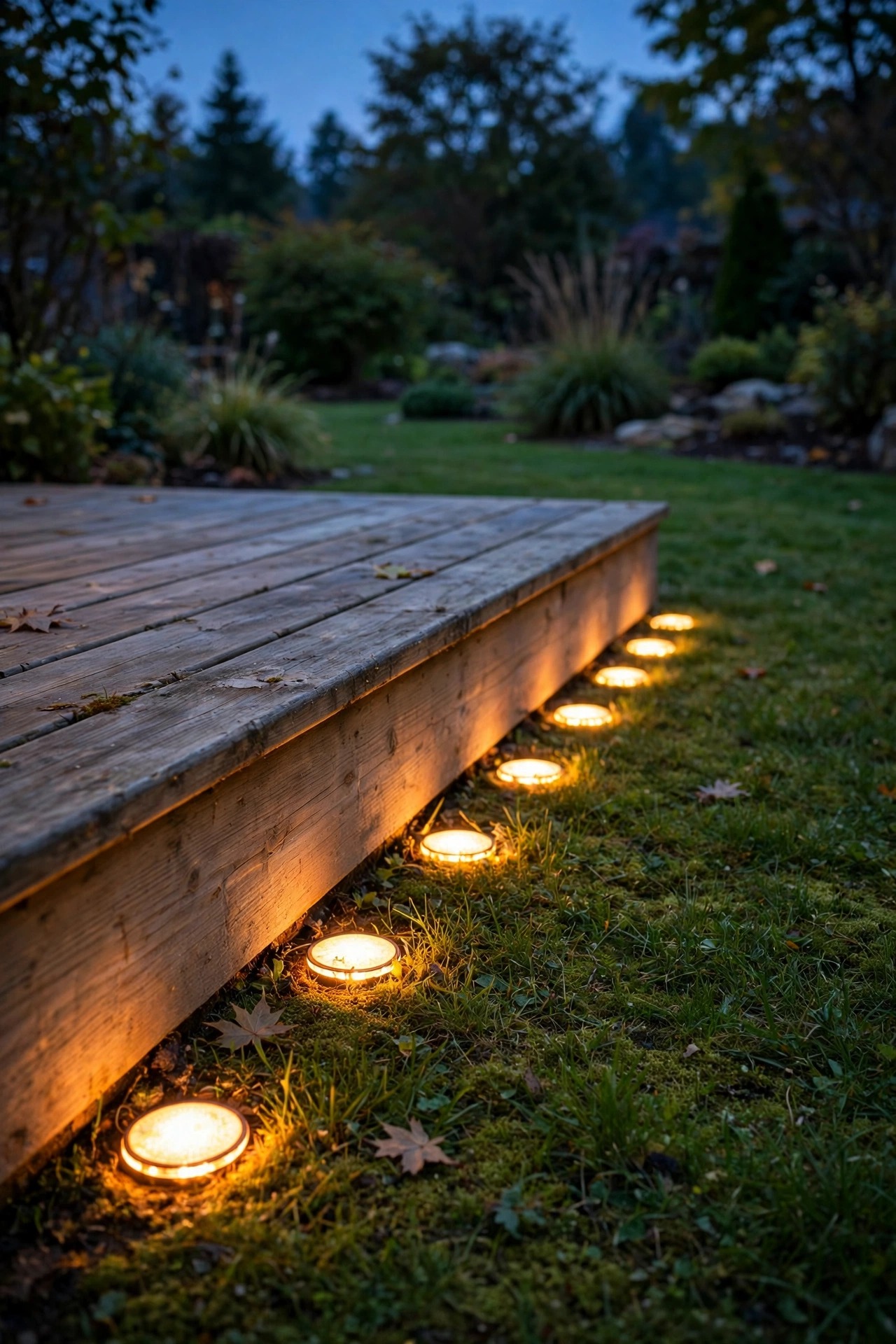
Here's where solar ground level deck lighting ideas really earn their keep. Solar disk lights are flat, puck-shaped fixtures that sit flush in the soil — you can mow straight over them — and they throw their light upward in a soft halo. I push them into the lawn and beds about 8 to 12 inches out from the deck edge, one every 3 to 4 feet, and together with the recessed dots they draw a double outline: light on the boards, light on the ground, zero doubt about where the step is. Be honest with yourself about brightness, though. Disks are wayfinding lights, not work lights; each one is a gentle glow, and the magic is in the repetition, not the power. Buy warm white versions, give the panels a full sunny day before judging them, and keep the grass trimmed short around them so the little panels actually see the sun. In shady yards, swap every other disk for a wired low-voltage puck on the same transformer as your other fixtures — nobody will ever notice the mix, and the line stays unbroken on cloudy weeks.
Suggested budget range: $30 – $70.
6. Pathway Lights Ringing the Deck at Lawn Level
A ground-level deck with no railing needs a boundary, and a loose circle of low path lights builds one out of light instead of lumber. I use low-voltage path lights, 12 to 18 inches tall, spaced 5 to 6 feet apart in the planting beds around the deck rather than in a stiff soldier line along the edge. Tucking them into the plantings — slightly staggered, some a foot farther out than others — keeps it looking like a garden that happens to glow, not a runway. The circle does three jobs at once: it defines the "room," lights the route from the deck to the gate or fire pit, and bounces gentle light back up under everyone's chin. Tie them into the same transformer as your deck dots and fascia strip, and the whole yard comes on with one dusk sensor. Keep every bulb the same warm color temperature, because one cool-white fixture in a warm circle sticks out like a typo. And angle the shades downward where you can — on a low deck you're often looking down at fixtures from a chair, and a shielded bulb is always kinder.
Suggested budget range: $70 – $180.

7. String Lights on Planter Poles Overhead
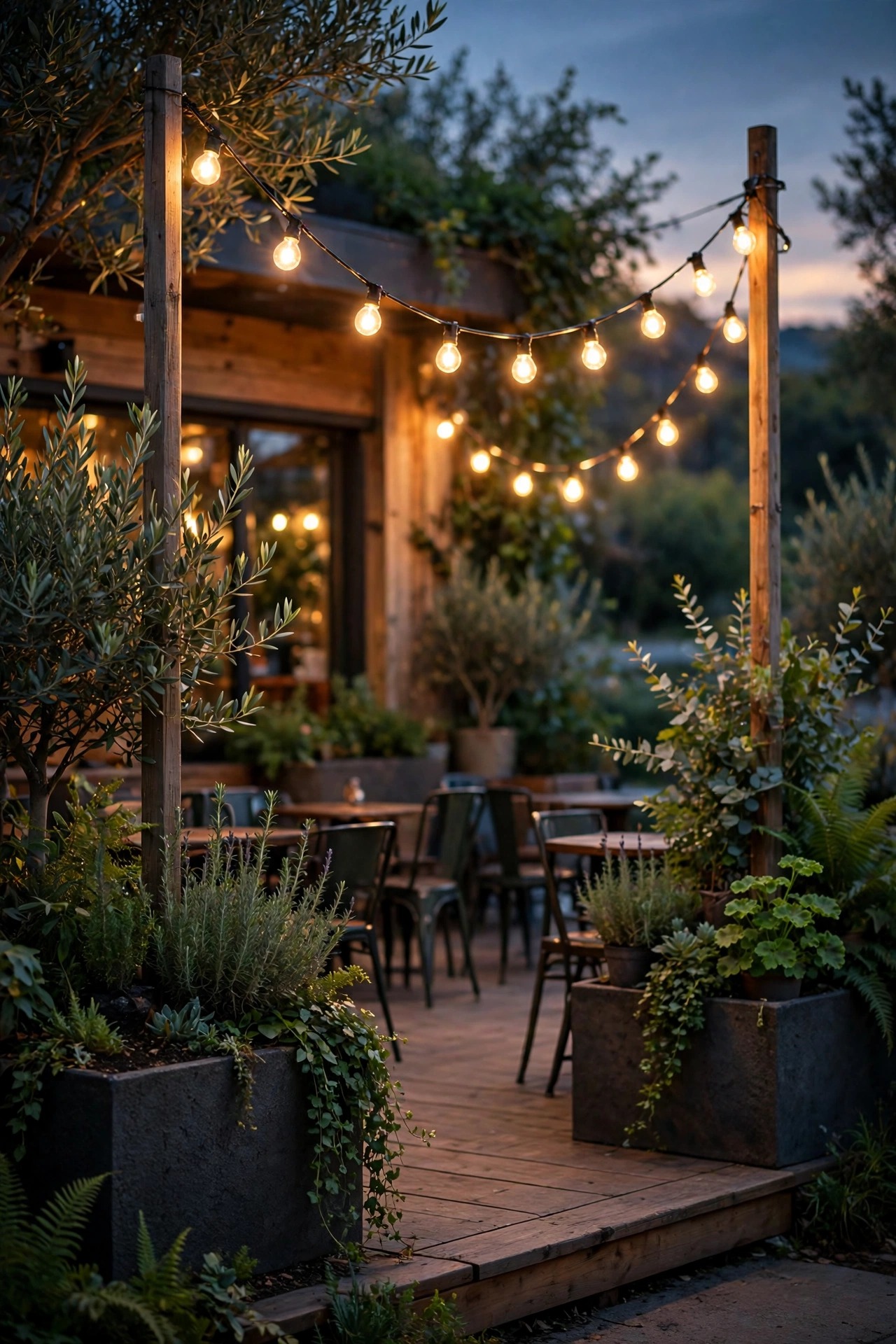
Low decks have no pergola and no railing posts to string lights from, so I borrow my favorite workaround: planter poles. Set an 8- to 9-foot pole into a heavy planter — a half-barrel or large resin pot — pour in a bag of concrete or pack it tight with gravel, plant flowers around the base, and anchor your string lights to the top. Two poles at the far corners and two house-side hooks give you a full canopy over a 12-by-16 deck. Height matters here: because the deck surface itself is low, swags should still clear about 7 feet above the boards so taller guests aren't ducking under the drape. Use commercial-grade string lights with shatterproof LED bulbs, keep the bulbs warm white, and add a guide wire along each run so the cord isn't carrying its own weight across long spans. Honestly, this is the layer that makes our little one-step deck feel like a destination instead of a doorstep. Ground the planters with trailing greenery and the poles disappear into the garden by day, then hold a ceiling of light by night.
Suggested budget range: $90 – $220.
8. Uplights Aimed at Trees and Shrubs from the Deck Edge
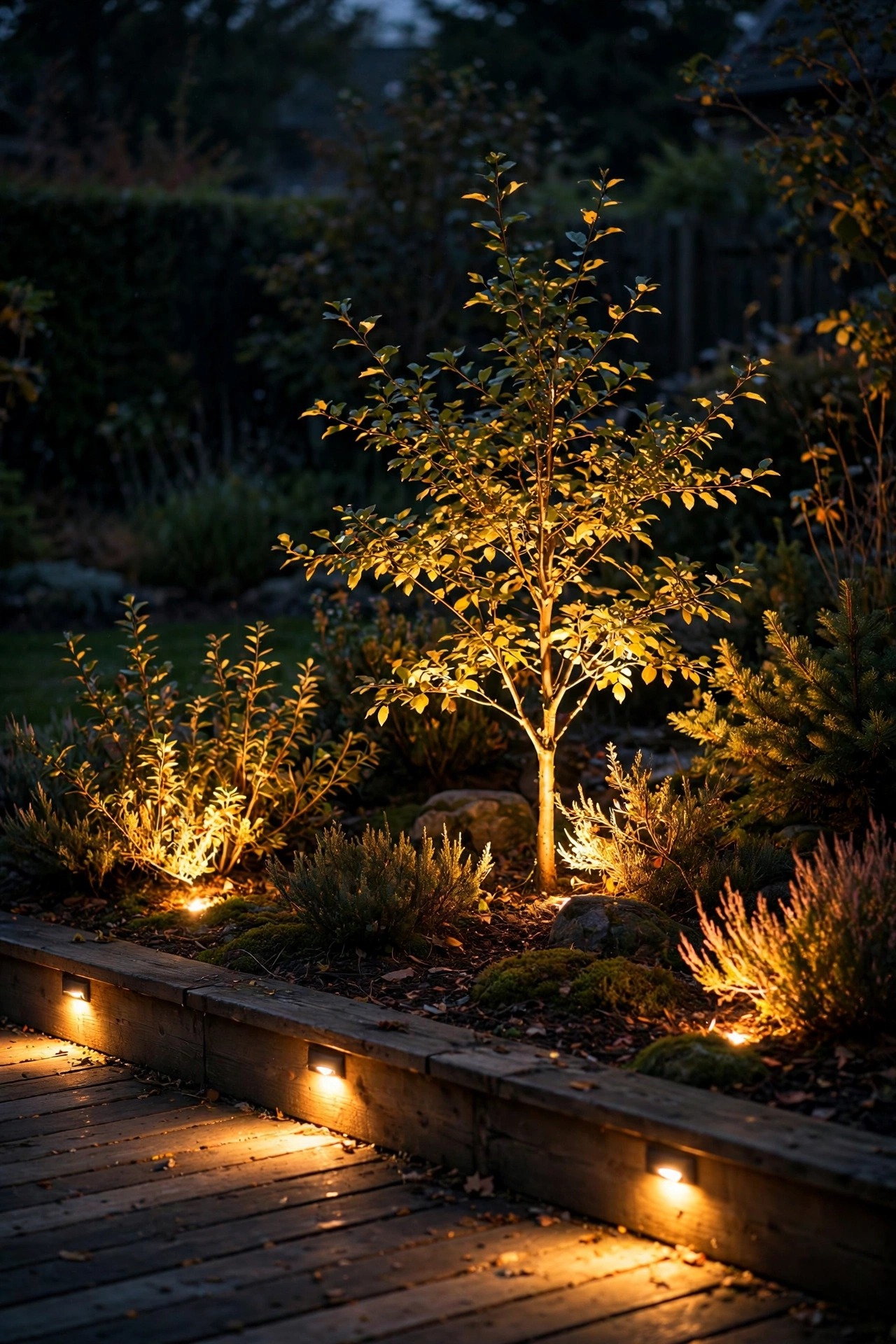
Some of the best light for a low deck doesn't land on the deck at all — it lands in the garden around it. I placed three low-voltage spotlights at the deck's corners, angled up into a small ornamental tree and two big shrubs, and the reflected glow that bounces back is softer and prettier than any fixture pointed at the seating. This is borrowed scenery as lighting design: the eye travels out to the lit canopy, the yard feels twice as deep, and the deck becomes the front-row seat. Choose adjustable-head spots with a medium beam, around 35 to 40 degrees, and always aim from behind or beside the seating so nobody stares into the source. Shielding matters — a fixture with a glare guard or a simple position behind a plant keeps the bulb hidden. Start with two uplights, live with them a week, then add the third; uplighting is the easiest layer to overdo, and one blazing tree trunk looks like an interrogation. Done right, this layer costs little, runs on the same transformer as everything else, and quietly does the work of a much bigger system.
Suggested budget range: $60 – $150.
9. In-Ground Well Lights Washing the Deck Skirt
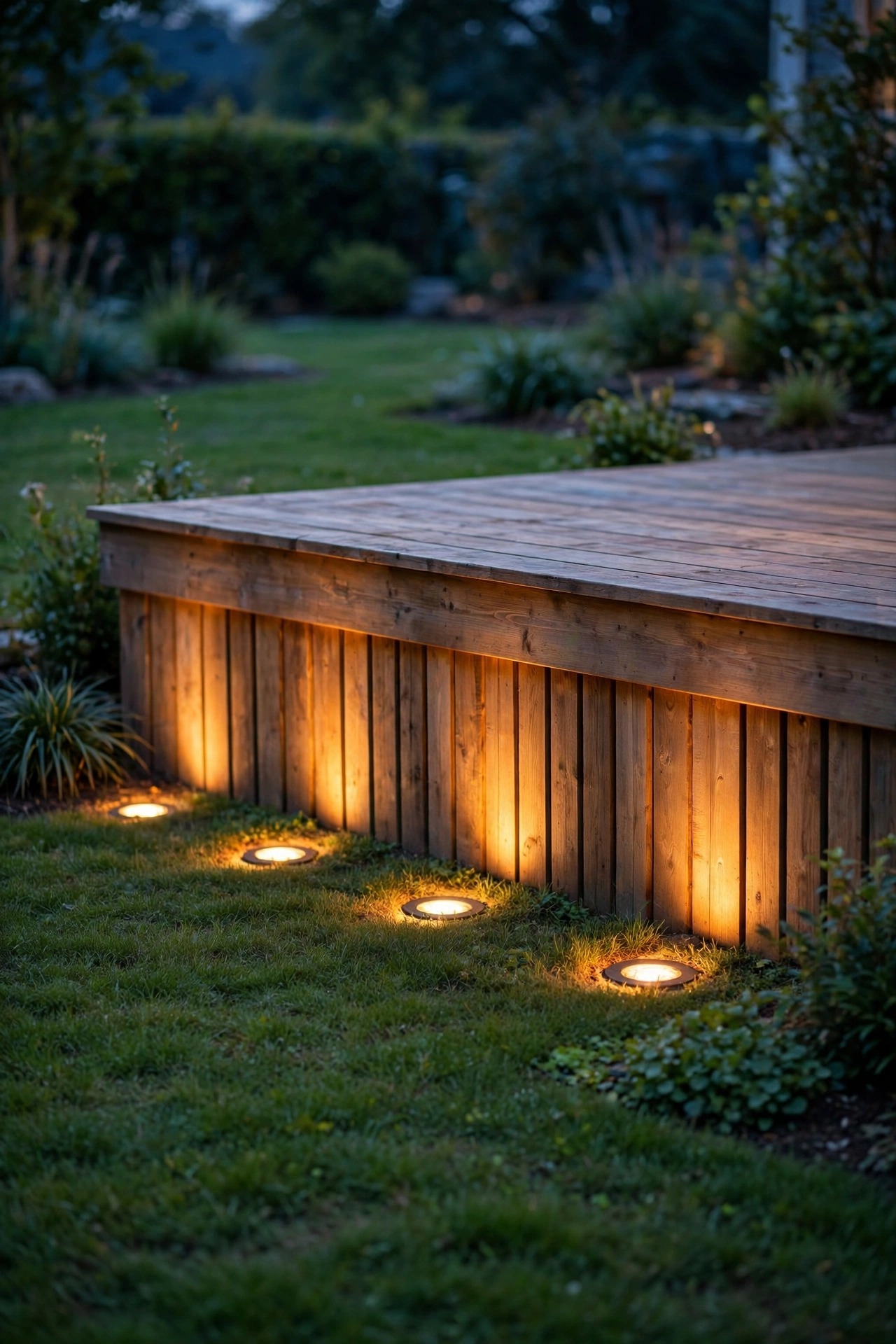
If the fascia strip in idea two is a whisper, well lights are a statement. These fixtures bury flush in the lawn or bed, their tops level with the soil, and shoot a focused wash straight up the deck skirt and fascia. Set 12 to 18 inches out from the deck, they graze every board line and knot with light and shadow, and a plain low deck suddenly has architecture. Three non-negotiables from my own soggy experience: buy fixtures with drainage built in, bed each one in a pocket of pea gravel about 6 inches deep so rainwater escapes instead of pooling in the housing, and choose LED only, because halogen in a sealed well cooks itself and everything near it. Space them 4 to 6 feet apart for an even graze, or cluster two closer together where you want a brighter accent near the step. Because the tops sit flush, the mower passes right over and kids can run across them barefoot. This is the most "custom-built" looking upgrade on the list, and it still rings in under the cost of one decent outdoor rug.
Suggested budget range: $90 – $240.
10. Backlit Lattice Skirting for a Floating Glow
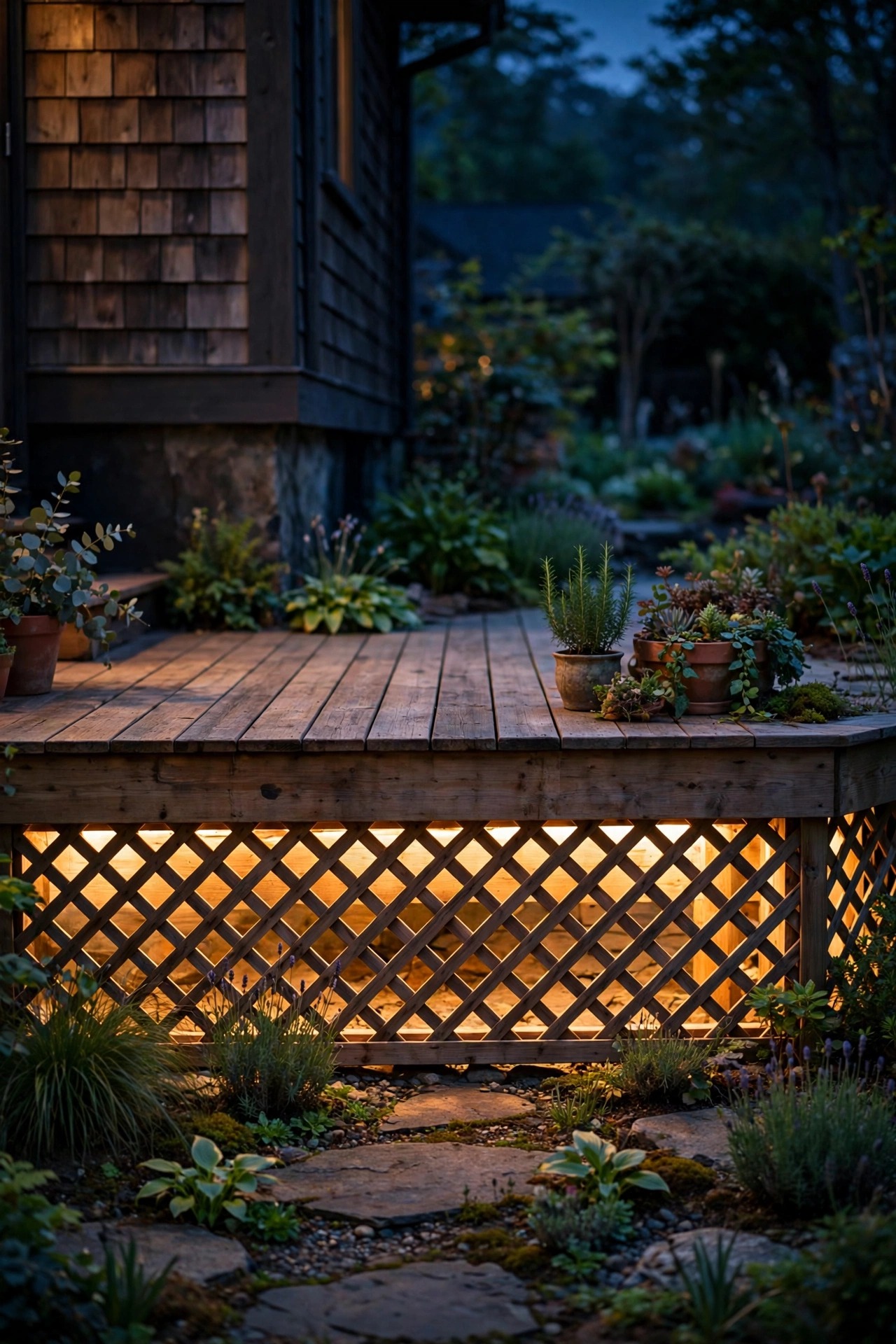
If your low deck wears lattice skirting, you own a light diffuser you didn't know about. Mount a rope light or a second LED strip on a simple batten inside the skirting, 6 to 12 inches behind the lattice, and the whole diamond pattern glows like a paper lantern stretched around the deck. The fixtures vanish, the lattice pattern does the decorating, and the deck floats on a band of light at ankle height — which, not coincidentally, also lights the step zone. Two safety notes I take seriously: LED only, since these lights run cool and sit near wood and dry leaves, and clear the leaf litter out from under the deck every fall so nothing combustible nests against the wiring. Keep the strip on the same circuit as the fascia light and both layers come on together at dusk. This trick works on solid skirting too if you leave a shadow gap at the bottom — an inch of recessed space under the bottom board lets the light spill out in a clean line. Either way, it's the cheapest "wait, how did you do that?" on this whole list.
Suggested budget range: $50 – $130.
11. Lantern Clusters Grouped on the Deck Boards
Never underestimate the humble lantern — especially three of them. I keep clusters of battery lanterns at the two corners of our deck and beside the step: one tall, one medium, one small, always in odd numbers, always grouped tight so they read as one glowing arrangement instead of clutter. Battery lanterns with built-in timers are the move here; set them once and they wake up at dusk for six hours every night all season with no winding, no cords, no matches. Flameless candles inside glass hurricanes give the same effect for a tabletop. Because ground-level decks blur into the garden, lanterns also act as movable furniture — I drag a cluster to wherever we're sitting, then back to the corners when we go in. Keep them out of the direct walking line to the step, because a lantern at shin height in the dark is a trip hazard wearing a disguise. In my experience, dollar for dollar, this is the fastest warmth you can add: one trip to the store, batteries in, and tonight the deck already feels furnished.
Suggested budget range: $35 – $90.

12. Fairy Lights Woven Through the Planting Beds
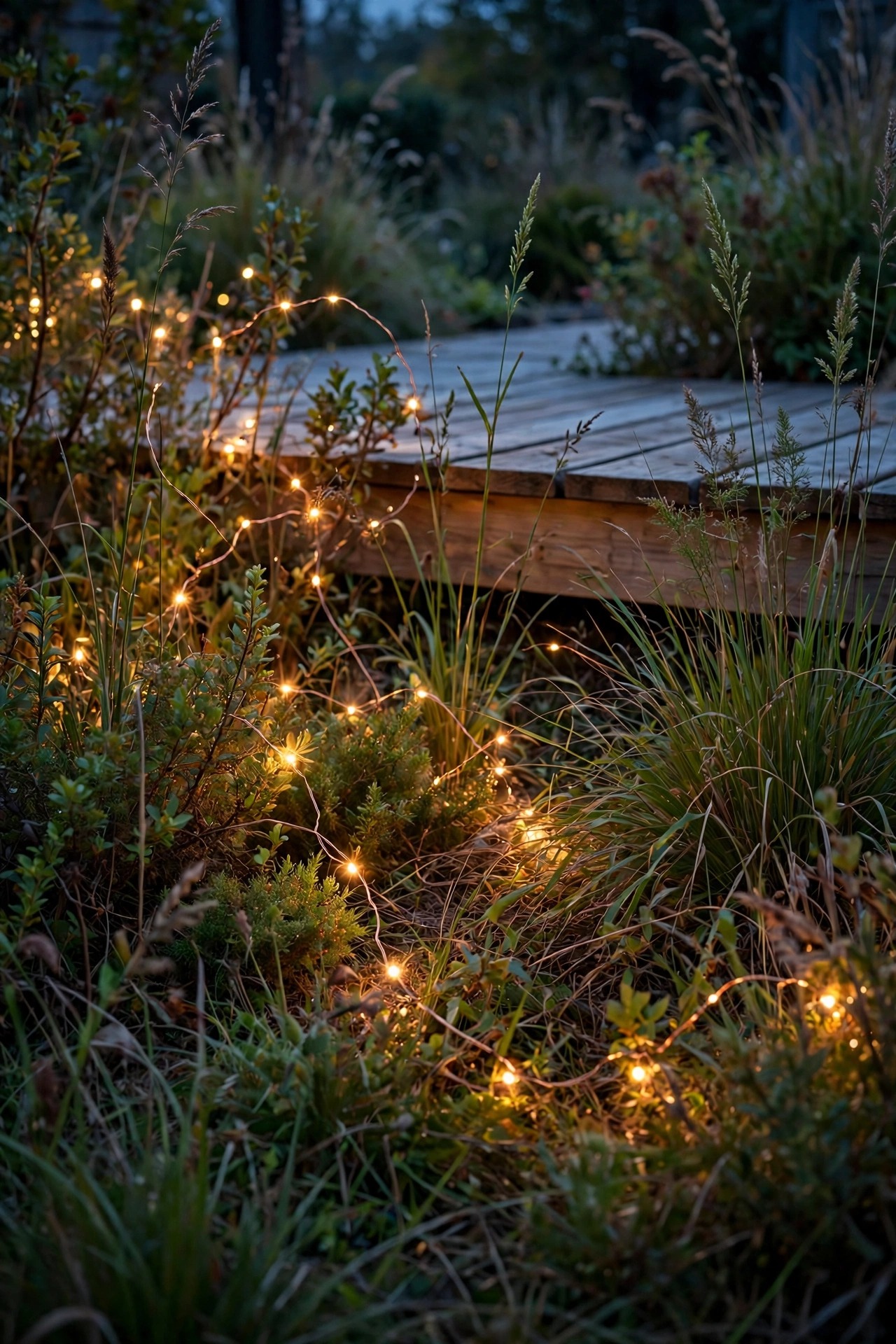
Copper-wire fairy lights are the ground-level deck's secret weapon, because a low deck spends its life surrounded by plantings at exactly fairy-light height. I weave two or three strands through the shrubs and ornamental grasses that edge our deck — never wrapped tight, just draped and tucked so the tiny warm points sparkle through the leaves like fireflies that clock in at dusk. Battery and solar packs both work; hide the little battery box under a leaf or behind a pot and nobody finds the machinery. The lights run cool to the touch, so they're safe against foliage, and the wire all but disappears by day. This layer is pure atmosphere — it won't light your plate — but paired with the edge definition from your dots or disks, it makes the boundary between deck and garden feel enchanted instead of abrupt. Expect a strand to last a season or two outdoors before the wire tires; at this price I treat them as annuals, like the petunias. Plant a fresh strand each spring and the ritual becomes part of opening the deck for the year.
Suggested budget range: $20 – $55.
13. A Fire Bowl Centerpiece for Real Flame Light
Every layered lighting scheme needs a focal point, and nothing focal-points like real fire. A low fire bowl at the center of the deck — or a tabletop model on the outdoor dining table — gives you flickering, dimming, alive light that no LED fully imitates, plus gentle warmth on shoulder-season evenings. Now the grown-up paragraph, because this is a wooden deck we're discussing: check your decking first. Composite boards soften with heat, so on composite or PVC decking choose a propane tabletop bowl raised on its stand, and put a heat-shield mat under any fire feature regardless of material. Keep the bowl at least 3 feet from cushions, railings and the house, never leave it burning unattended, and keep it out of the traffic lane to the step — guests carrying plates plus open flame is a combination nobody needs. On our wood deck, a mid-size propane bowl has run three seasons without a scorch mark, following exactly those rules. Treat the flame as your chandelier: build the electric layers quieter around it and let the fire be the brightest thing in the yard.
Suggested budget range: $70 – $250.

14. Flameless Candles in Hurricane Holders
For the look of candlelight with the conscience of an LED, flameless candles are my weeknight answer. The good ones — wax-feel bodies, a flickering warm diode, a built-in timer — read as real candles from three feet away, especially grouped inside tall glass hurricanes that protect the "flame" and amplify the glow. I line three hurricanes down the middle of the dining table and park two more on the step corner, where they double as a soft marker for the drop after dark. The timers are the whole game: set them at dusk once, and they perform a faithful six-hour shift every evening while you're still making dinner. No wind blowing them out, no wax on the boards, no fire worries near the cushions or the kids' marshmallow operations. Scatter a few small votive versions among the lantern cluster from idea eleven and the two layers braid together beautifully. When a storm threatens, the whole fleet comes inside in one trip — try that with hardwired fixtures. It's the lowest-commitment idea on this list, and the one renters ask me about most.
Suggested budget range: $25 – $65.

15. Moonlighting from a Nearby Tree
If you're lucky enough to have a tree overhanging or standing near your low deck, moonlighting is the most beautiful trick in outdoor lighting. A fixture mounted 15 to 20 feet up the trunk aims down through the branches, and the light arrives on your deck dappled and shifting, exactly like a full moon through leaves. Because a ground-level deck has no height of its own, this overhead layer matters more than it does on a raised deck — it's often the only ambient light that covers the whole surface at once. Most people choose a slightly cooler white for moonlighting to mimic the moon; I split the difference at 3000K so it still flatters faces and food. One fixture covers a circle roughly 15 to 20 feet across. Full honesty: this is the one idea on the list I'd hire out. It means a tall ladder or a lift, a secure mount that grows with the tree, and cable run safely up the trunk — an arborist or lighting pro handles it in an hour. The result, though? Guests ask what kind of moon does that. Worth every penny once.
Suggested budget range: $120 – $300.

16. Smart Ground Level Deck Lighting Ideas on Timers and Sensors
The best smart ground level deck lighting ideas aren't gadgets — they're automations that make every other idea on this list effortless. Start with the transformer: plug it into a weatherproof smart plug or swap in a transformer with an astronomical timer, and your whole wired system learns your sunset, turning on at dusk and off at 11 p.m. without a single seasonal adjustment. Then add one motion sensor at the step, tied to a couple of fixtures or a smart bulb in the nearest lantern zone, so the midnight dog trip lights itself and goes dark again on its own. Zoning matters more than apps: put the pretty layers — fascia strip, uplights, disks — on the dusk schedule, and the practical step light on motion, and the deck behaves like it has a staff. Voice control through a smart speaker is a nice party trick for dimming the string lights from your chair, but the unglamorous timer is the real upgrade. In three years, our system has never once "forgotten" to light the step — which is more than I can say for the version of me flipping a switch.
Suggested budget range: $45 – $120.

17. Layer It All: My Three-Level Formula for Low Decks
When neighbors ask where to start, I don't hand them this whole list — I hand them the order. Level one is definition: mark the edge and the step so the deck is safe, using recessed dots, solar disks, or step lights. Level two is wash: add one soft ambient source like the hidden fascia strip, uplights in the garden, or moonlighting, so the space feels lit rather than dotted. Level three is the focal point: fire, lanterns, or string lights overhead — the thing eyes land on. Buy them in that order as the budget allows and the deck works at every stage; buy them out of order and you get a gorgeous fire bowl on a deck nobody can find the edge of. Keep every source between 2700K and 3000K so the layers blend instead of arguing, put the wired layers on one transformer and one timer, and let solar fill the gaps the wire can't reach. That's the whole formula. A deck eleven inches off the ground has no business glowing this big — and yet, following these three levels, it absolutely does.
Suggested budget range: $250 – $600.

Frequently Asked Questions
How do you light a ground-level deck with no railing?
You light the edges and the garden instead of the structure. The fixtures that matter on a railing-free deck mount to the deck itself — recessed dots and strip lights in the fascia — or sit in the ground around it, like solar disks, path lights and uplights. Add one vertical accent, such as short corner posts with cap lights or poles in planters, and the space feels complete without a single rail to attach anything to.
Are solar lights bright enough for a low deck?
For defining edges, marking the step and adding sparkle, yes — modern warm-white solar fixtures handle those jobs well in a sunny yard. For cooking, reading or a fully shaded deck, solar alone will disappoint. My honest recommendation is a hybrid: a small low-voltage wired system for the main layers, solar filling in at the lawn edge and in the beds. You get reliability where it counts and flexibility everywhere else.
What color temperature looks best on a ground-level deck?
Warm white, 2700K to 3000K, across everything. Warm light flatters wood, skin and food, and it keeps a low deck feeling like an outdoor room instead of a parking pad. The bigger secret is consistency: five warm fixtures and one cool-white one looks like a mistake, not a mix. Whatever temperature you choose, buy every fixture and replacement bulb to match it.
Can I install low-voltage deck lighting myself?
Yes — 12-volt low-voltage lighting is the friendliest electrical project there is, because the cable can't hurt you and doesn't need conduit; in planting beds it buries under a few inches of mulch or soil. The transformer plugs into an existing GFCI-protected outdoor outlet. If you need a new outlet installed, or you ever graduate to line-voltage fixtures, that's electrician territory — hire it out and sleep well.
Conclusion
A low deck doesn't need height to have presence — it needs intention. Start with the ground level deck lighting ideas that keep everyone safe, add a wash of ambient glow, finish with one warm focal point, and your one-step deck will hold its own against any raised showpiece in the neighborhood. If you're still gathering inspiration, browse the rest of my outdoor lighting ideas here on the site — the planters, paths and porches all borrow from the same layering playbook. Pick your first layer this weekend, and I'll see you out there at dusk.


