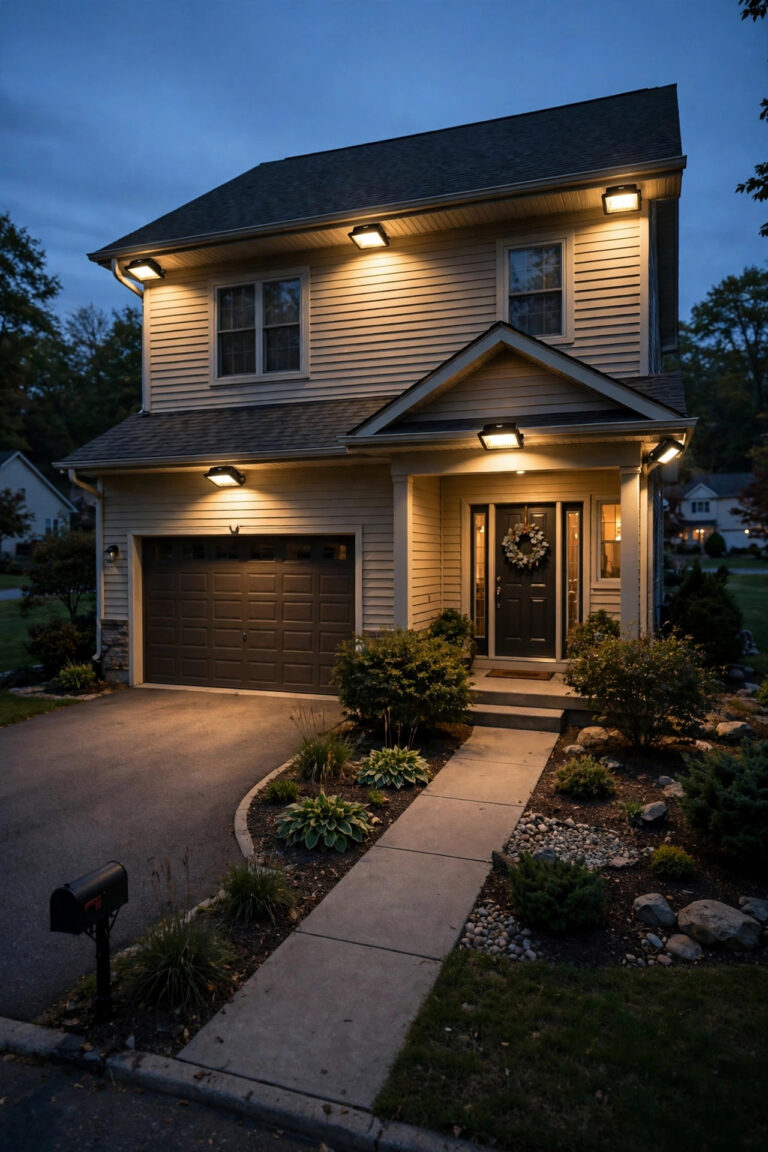
A wraparound deck is a gift right up until the sun goes down. Then the front stretch glows from the porch light, the side facing the kitchen goes pitch black, and somebody inevitably misses the last step carrying a tray of drinks. Ask me how I know. The fix is not one big fixture — it is treating all four sides as one connected space. These wraparound deck lighting ideas are built on the same layering philosophy I use everywhere: low lights for safety on stairs and edges, mid-height lights for faces and food, and a little sparkle up high so the whole deck reads as one warm room outdoors. Work your way around the house side by side, repeat your fixture choices so it looks intentional instead of patched together, and put everything on timers so the whole loop lights itself at dusk. By the end of this list you will have a plan for the entertaining side, the quiet side, and that forgotten stretch along the side yard that nobody uses after dark — yet.

1. Recessed Stair Lights on Every Stair Run
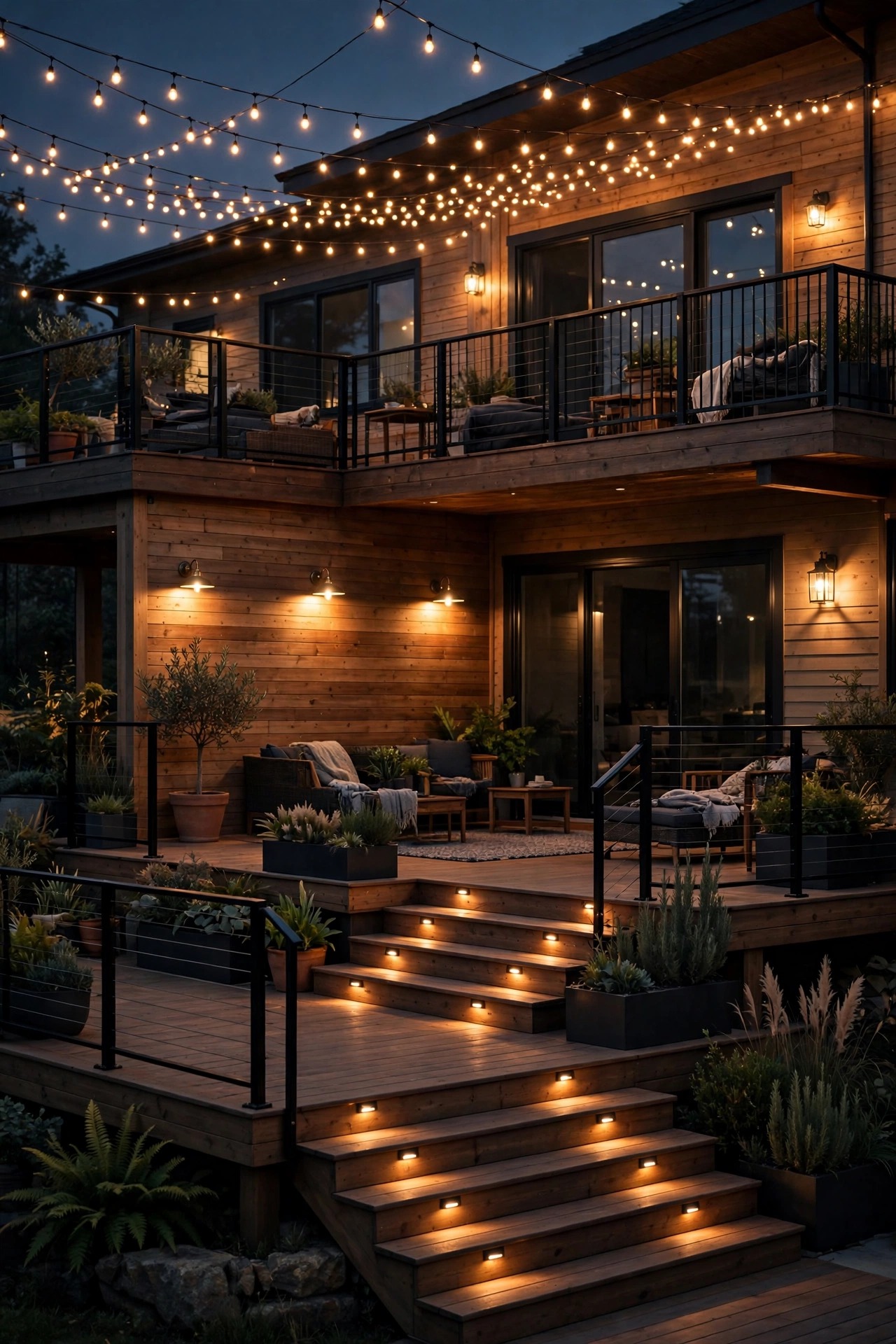
Wraparound decks have more stairs than anyone remembers — the main run off the entertaining side, the little two-step drop by the side door, the wide steps down to the lawn. Every single run needs its own light, because a lit staircase on the south side does nothing for the one on the east. I install small recessed LED step lights into the riser of the top and bottom step of each run, plus one in the middle of runs longer than five steps. Aim for fixtures rated for outdoor wet locations, wired into a low-voltage 12-volt system so there is no electrician-level danger in the runs between them. Space them so the pools of light overlap slightly — dark gaps between steps are exactly where ankles roll. If you are planning your runs, my notes on deck stair light ideas cover riser versus tread mounting in more detail. Keep the color temperature at 2700K so the light reads warm on wood, and choose hooded or louvered faces that throw light down onto the tread instead of into your eyes as you climb.
Suggested budget range: $60 – $180.

2. Post Cap Lights: The Classic Wraparound Deck Lighting Ideas Move
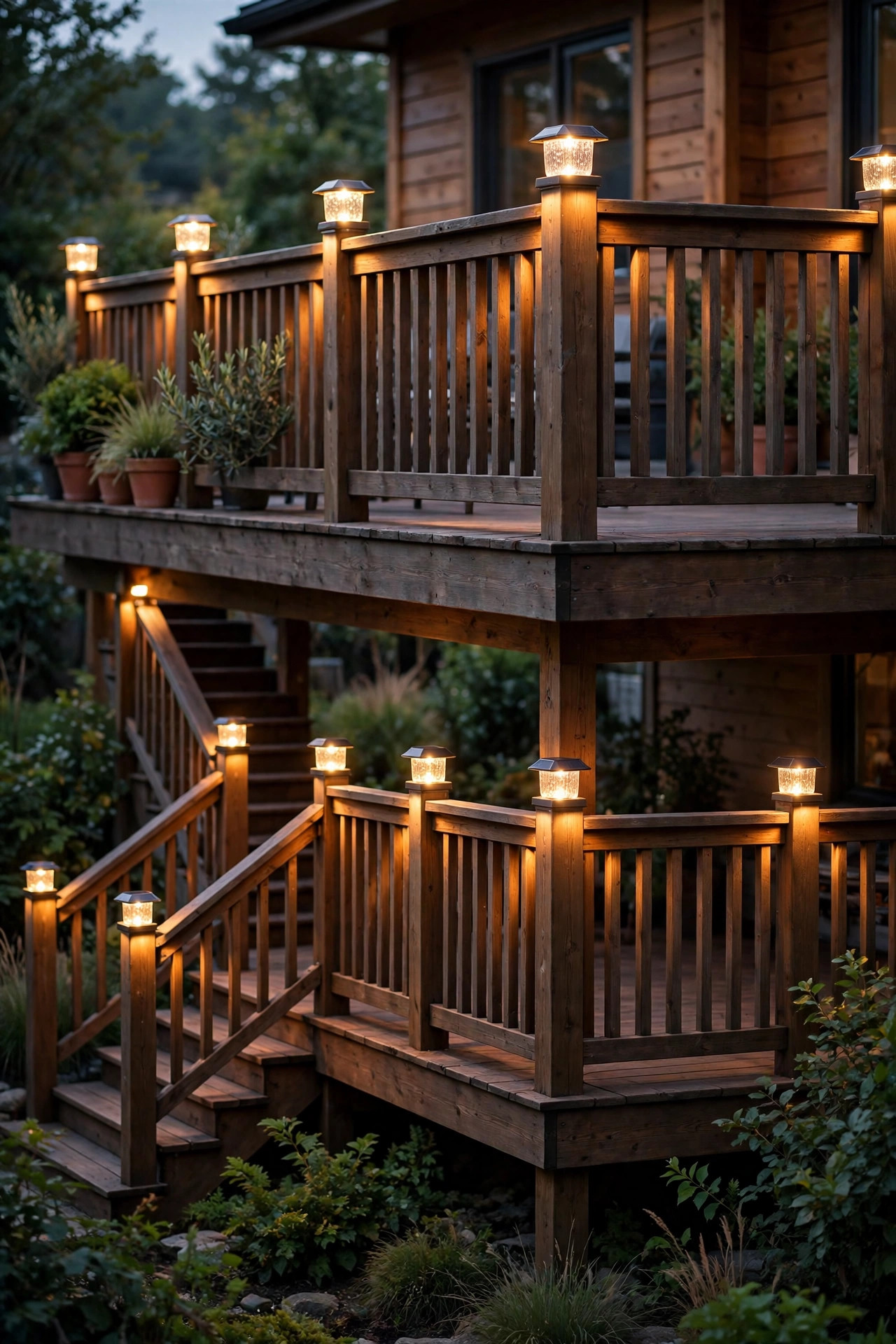
If a wraparound deck has one signature fixture, this is it. A solar or low-voltage cap light on top of every railing post turns the entire perimeter into a dotted line of warm light you can see from the street — and from the lawn it instantly tells your feet where the deck edge is. On a big wraparound, consistency is everything: pick one cap style and repeat it on every post, every side, no exceptions. Solar caps are the easy route and the newer ones genuinely last all evening, but on the shaded north side I hardwire low-voltage caps instead, because a solar panel under a maple tree is a sad little thing by 9 p.m. Standard caps fit 4×4 and 6×6 posts; measure before you order, because post sizes on older decks are not always what the lumber stamp promised. My deeper dive into deck post cap lights compares solar and wired honestly. Expect to replace solar cap batteries every year or two — budget for it and you will never be annoyed by it.
Suggested budget range: $80 – $300.
3. Under-Rail LED Strip Lighting
This is the single most flattering light on any deck, wraparound or not. An outdoor-rated LED strip tucked under the top rail washes the balusters and deck boards with a soft, shadowless glow that makes everyone look like they are in a restaurant commercial — in the good way. Run it continuously around all four sides so the effect never stops at a corner; the corners are where cheap installs give up, and a simple corner connector keeps the line unbroken. Choose a strip rated IP65 or better, 2700K, and mount it in an aluminum channel with a diffuser so you see the glow, not individual dots. On a low-voltage system the strips tap into the same transformer as your step lights. One honest warning: adhesive backing alone will not survive a summer of heat and a winter of frost. Screw the channel up every 18 inches or so and the strip will still be tight in five years. Dim it to about 60 percent for everyday evenings — full blast is for finding a dropped earring.
Suggested budget range: $90 – $260.

4. Swagged String Lights From Corner to Corner
String lights are what turn the entertaining side of a wraparound into the place everyone drifts toward. The wraparound advantage nobody talks about? You have house walls and corner posts on every side, so you almost never need extra poles — run swags from the house corner out to the railing corner post and back, in soft scallops about 12 to 18 inches deep. Use commercial-grade LED string lights with shatterproof bulbs, not the fragile glass party strands; on a permanent install the cheap ones become a yearly replacement subscription. Keep swags at least 7 feet above the deck boards at their lowest dip so tall guests and raised glasses clear them. I like to carry one shorter swag around the corner onto the quiet side too, so the two spaces feel related rather than one lit and one abandoned. Plug the whole run into a smart plug or timer and set it to come on at dusk — string lights you have to remember are string lights that stay dark.
Suggested budget range: $50 – $160.

5. Soffit Downlights Under the Eaves
Most wraparound decks sit right under the house eaves, and that overhang is free lighting infrastructure. Recessed or surface-mount downlights in the soffit wash the house-side edge of the deck with broad, even light — the kind that makes grilling, serving, and finding the door handle effortless on every side of the house. Space them 4 to 6 feet apart and line them up with the posts below so the rhythm looks deliberate. Because this is line-voltage work tied into the house wiring, this is the one idea on the list where I genuinely recommend hiring an electrician unless you truly know your way around a junction box; permits and GFCI protection are not optional near outdoor moisture. Put them on a dimmer switch just inside the door and you get two lights in one: bright task light for the grill master, soft ambient light for everyone else. Choose sealed, wet-location-rated trims so wind-driven rain at the eaves cannot reach the housing.
Suggested budget range: $250 – $700.

6. Wall Sconces Flanking Every Door
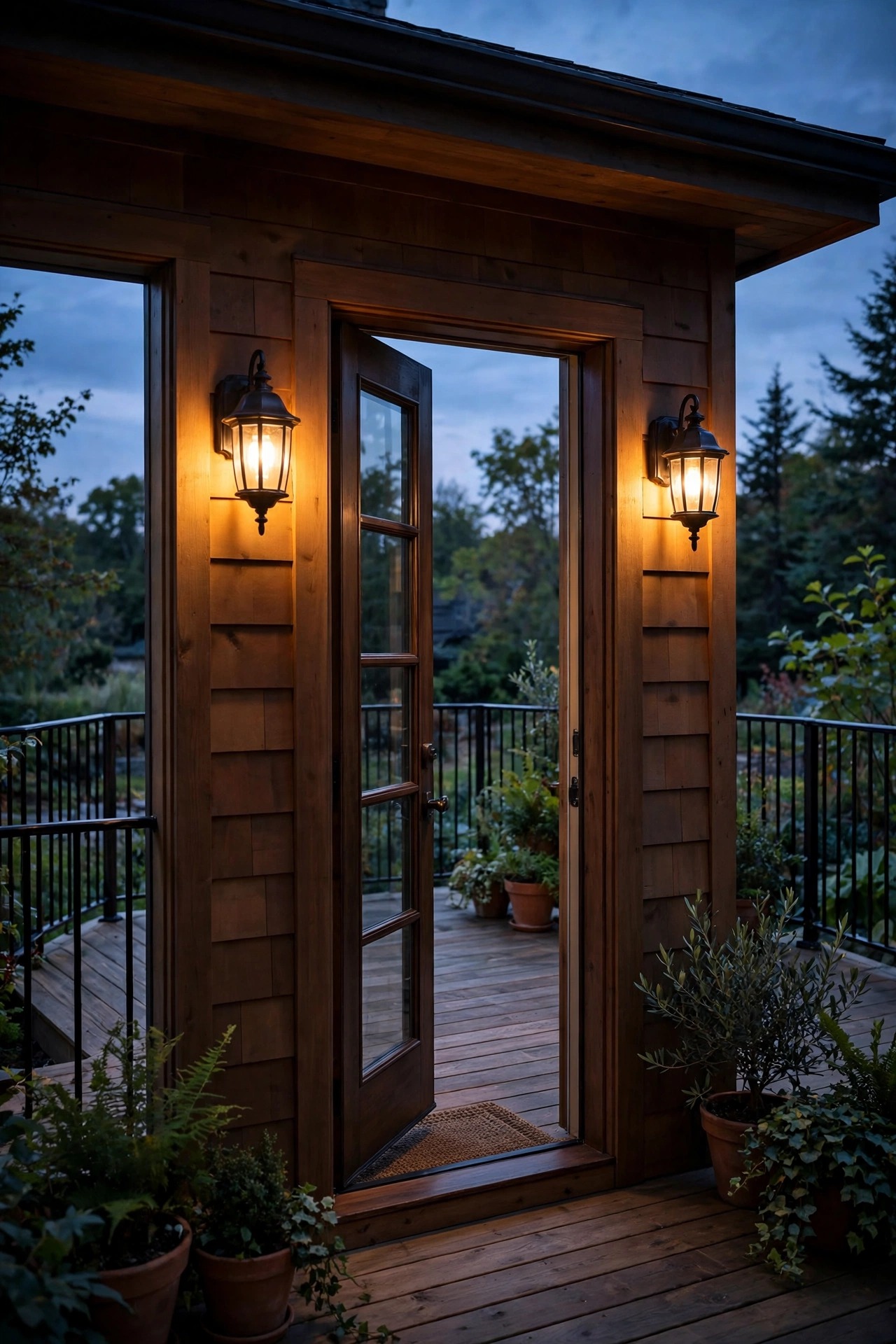
Count the doors that open onto your wraparound deck. Kitchen door, primary suite door, that side door nobody uses — each one deserves flanking light, and matching sconces at every door is what makes four separate deck stretches read as one designed space. Mount sconces 66 to 72 inches above the deck boards, use LED filament-style bulbs at 2700K, and pick a finish that matches your post caps or house trim so the whole loop feels coordinated. On doors you use constantly, a sconce pair plus a motion sensor is overkill; on the rarely used side door, a single sconce with a dusk-to-dawn bulb is plenty and costs almost nothing to run. Keep the style consistent even when the count changes — same fixture family, scaled effort. And please, match your bulb color temperatures across every door. One daylight-white bulb glowing blue-white among the warm ones will draw your eye every single night, I promise.
Suggested budget range: $70 – $240.
7. Solar Stakes Along the Deck Skirt
The ground line around a wraparound deck is a long, dark trip hazard — the step from the last board to the grass disappears completely at night. A row of solar stake lights pushed into the planting beds along the deck skirt fixes the whole perimeter for almost no money and zero wiring. Space them 4 to 6 feet apart, close enough that your eye connects the dots into a line. Taller stakes, 12 to 18 inches, read more like design and less like a runway, and they keep their little panels above low groundcover. The honest trade-off: solar stakes are markers, not floodlights. They tell you where the edge is; they will not light a conversation. That is fine — that is their job in the layers. Buy stakes with replaceable batteries and plan on swapping them every couple of years. On the north side where shade starves the panels, alternate solar stakes with a few wired low-voltage path lights so that stretch never goes fully dark in winter.
Suggested budget range: $35 – $110.

8. In-Floor Deck Pucks Tracing the Walking Path
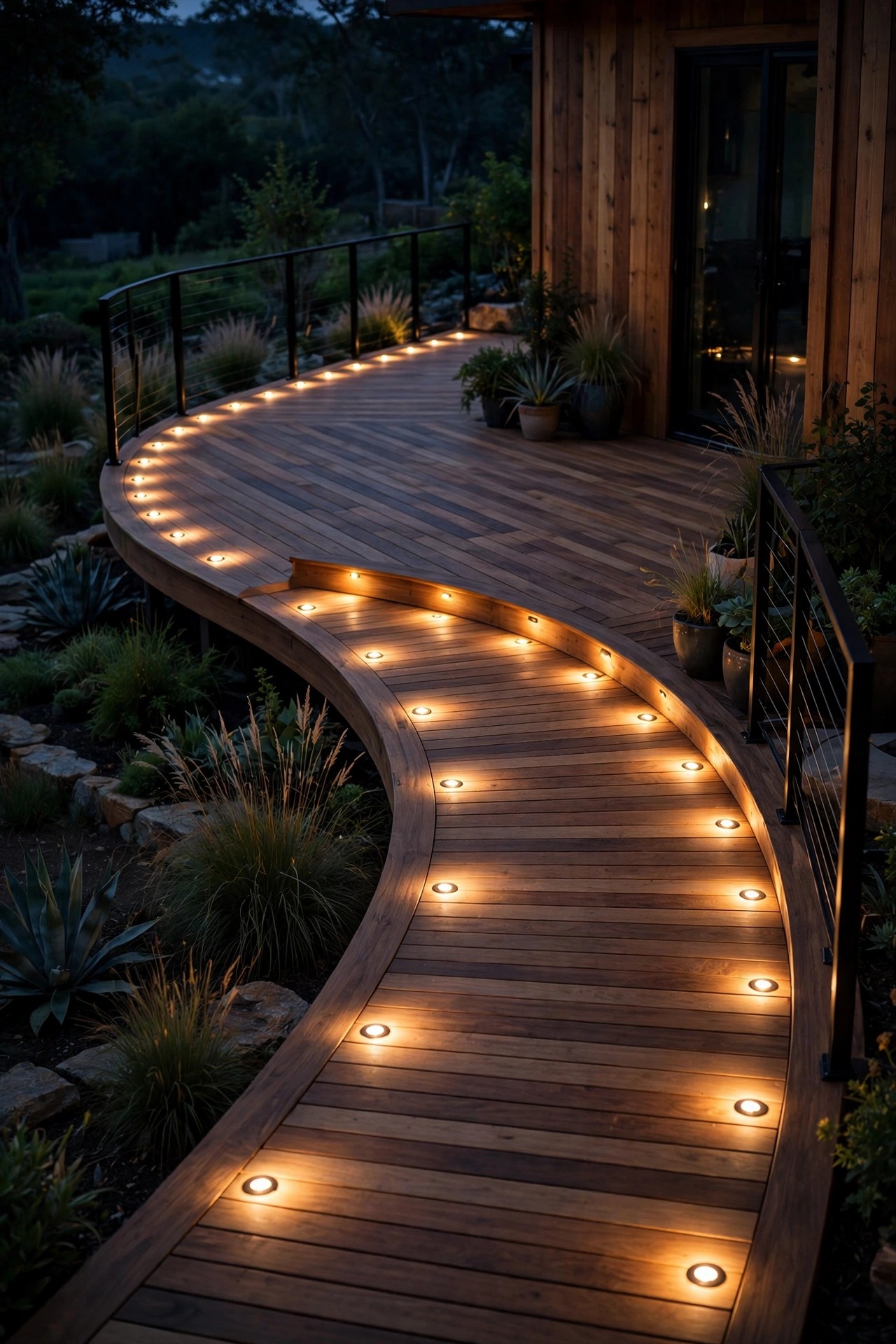
Here is the trick hotels use that nobody copies at home: a dotted path of light that leads you around the building. Small recessed puck lights set flush into the deck boards, spaced 5 to 6 feet apart along the walking line, guide guests from the front door around the corner to the grill without a single word of direction. They are especially worth it on the long side run of a wraparound, which is basically a hallway with a view. Choose pucks rated for foot traffic and wet locations, wire them in a simple daisy chain on the low-voltage system, and keep the light output modest — these are breadcrumbs, not landing lights. Installation means drilling the boards, so measure twice and start on the least visible stretch while you get your confidence up. Composite boards drill cleanly; older pressure-treated boards can splinter, so a sharp Forstner bit and painter's tape over the drill point are your friends.
Suggested budget range: $120 – $320.
9. Lantern Clusters Where the Deck Turns
Every corner of a wraparound deck is a little decision point, and a cluster of lanterns makes each turn feel like a destination instead of a hallway bend. Group three battery-operated LED lanterns in graduated heights on a small side table or directly on the boards in the corner, and let them be the warm, flickery layer your hard fixtures cannot fake. Battery lanterns with built-in timers are the whole secret: set them once, they glow for five hours every evening, and they come inside only when the batteries finally give up. Keep real candles out of deck corners — a knocked-over flame next to a dry railing is a story nobody wants. If a corner has a post, hang one lantern from a shepherd's hook bracket on the post and cluster two below it for a vertical arrangement that reads from the whole yard. This is also the easiest seasonal lever you own: swap in amber lanterns in October, deep red in December, plain warm white the rest of the year.
Suggested budget range: $40 – $130.

10. Uplights Washing the Siding at Each Corner
Stand in your yard at night and look back: a wraparound deck wraps the house, so lighting the house itself lights the whole scene. One low-voltage uplight tucked into the planting bed at each exterior corner, aimed up the siding or at a brick chimney, adds the architectural layer that makes neighbors slow down on their evening walk. A narrow 30-degree beam works on two-story walls; a wider 60-degree wash suits single-story stretches. Keep fixtures a foot or so out from the foundation so the beam spreads instead of burning a hot stripe up the wall, and shield the lamp so anyone sitting on the deck is not staring into the source. This is the one layer I put on its own switch or smart zone — uplights are drama, and drama should be optional on a Tuesday. They also quietly do security work, erasing the black corners where the deck turns away from the street.
Suggested budget range: $100 – $280.

11. Lighted Planters Anchoring the Corners
Corners again — they earn the attention, because a wraparound has twice as many as a regular deck. A pair of oversized planters flanking each corner turn, each with a small solar uplight buried in the soil or a glowing planter body, gives the turn weight and a soft pool of light at foot level. I plant them simply: one thriller grass or small evergreen per pot, nothing fussy, because at night the silhouette is the show. Solar puck lights designed for planter soil are cheap and genuinely effective; push them in at a slight angle aimed at the foliage so the plant glows instead of the dirt. Match planter color and material on all four sides for that designed-not-collected look — black or weathered zinc reads classic against almost any siding. In freezing climates, bring solar pucks and battery lanterns in for winter but leave fiberglass planters out; resin and fiberglass shrug off frost that cracks ceramic into expensive gravel.
Suggested budget range: $60 – $220.

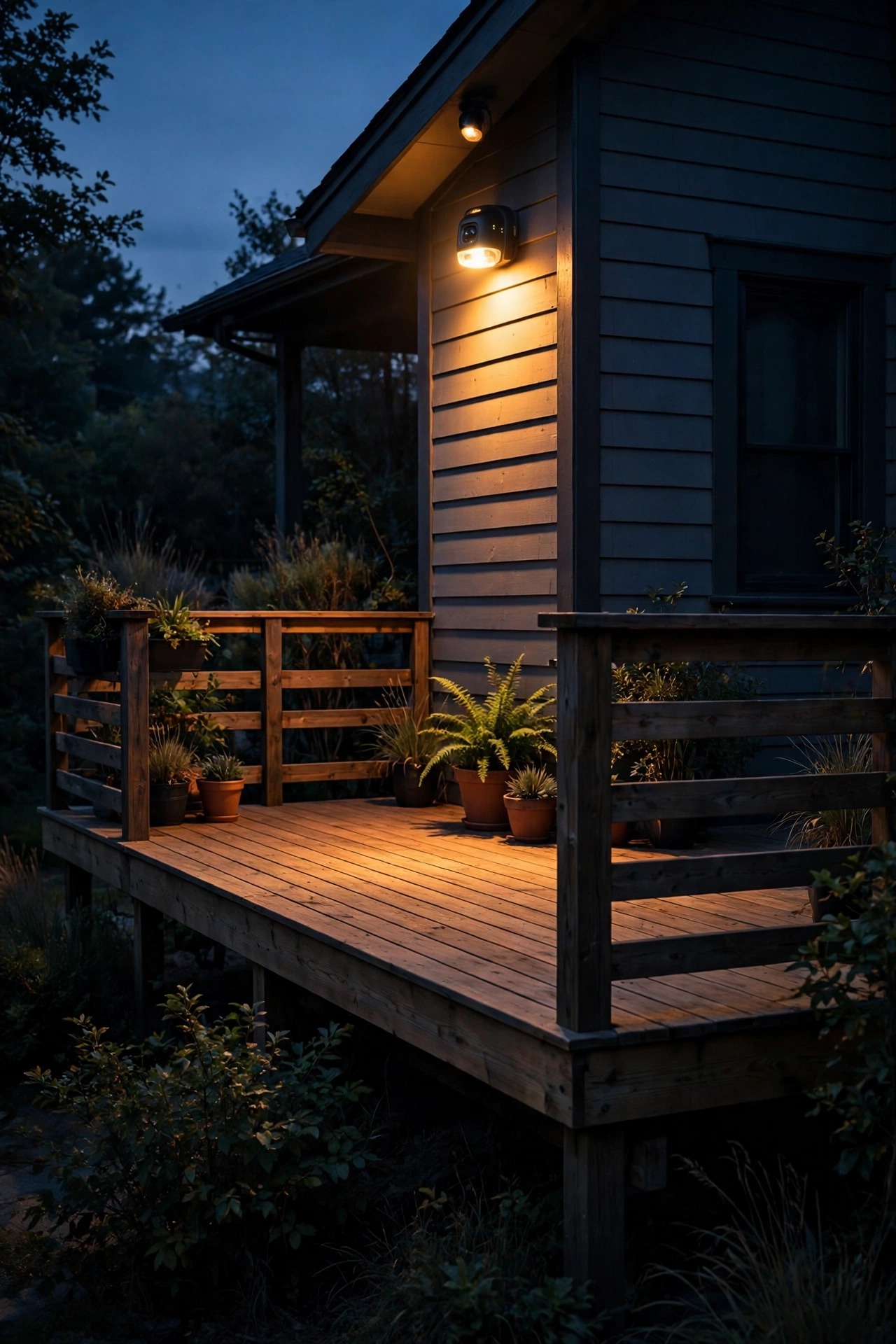
12. Motion-Sensor Lights for the Dark Side Stretch
Every wraparound has one: the side that gets no door, no seating, no love — usually the run past the utility boxes where you haul the trash bins. Do not light it like a lounge; light it like a path with a purpose. A motion-sensor fixture at each end of the stretch, set to a warm 2700K LED and a two-minute run time, gives you full brightness exactly when you are carrying something and darkness the rest of the night. Battery and solar motion lights are honestly fine here because the duty cycle is tiny, and they save you trenching wire to the least-loved side of the house. Angle the sensor heads along the walking direction, not at the neighbor's bedroom window, and keep the fixtures under the eave or railing line so they are invisible during the day. Your future self, arms full of recycling on a January night, will be extremely grateful.
Suggested budget range: $30 – $90.
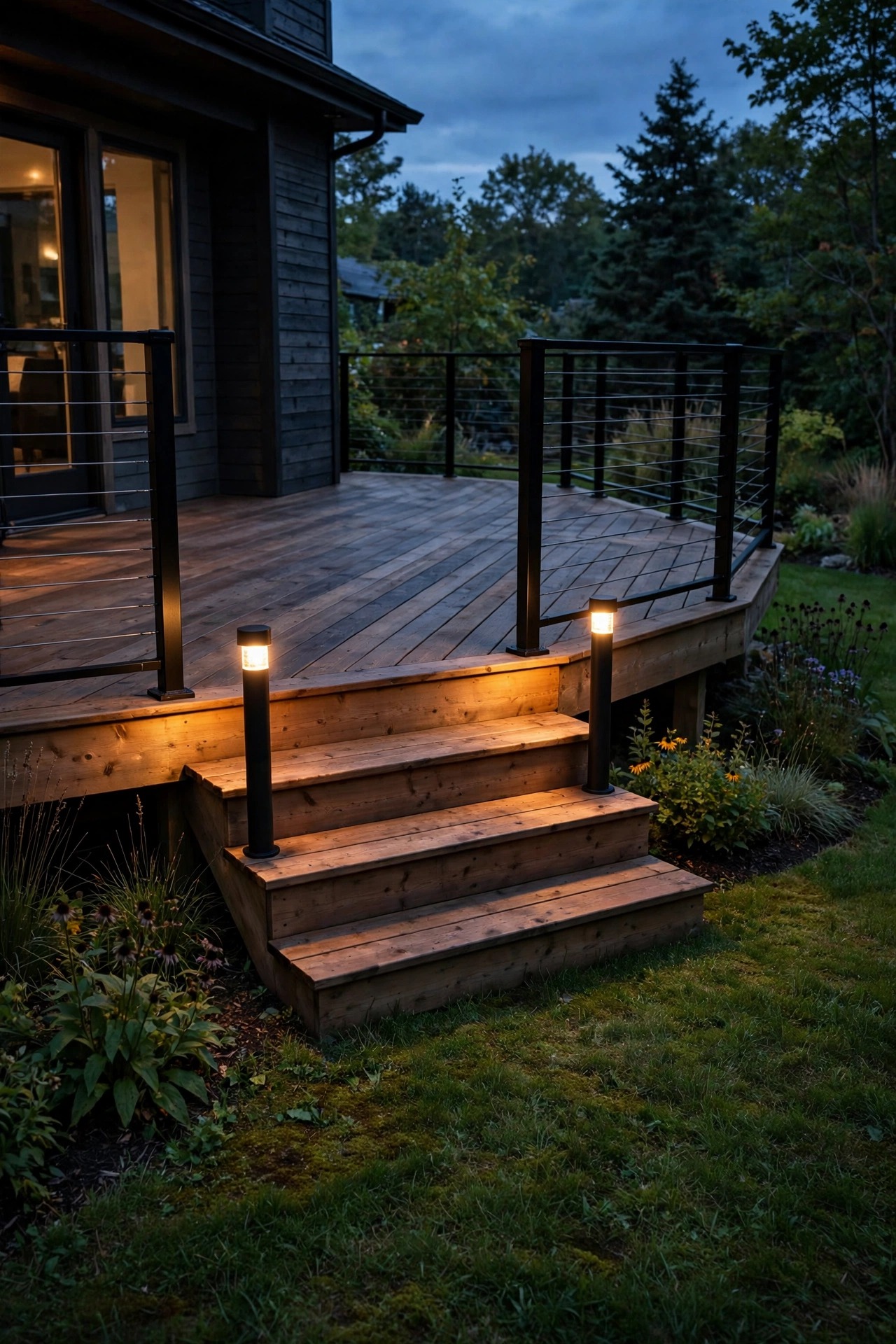
13. Low Bollards Where the Steps Meet the Lawn
The transition off the deck is where guests hesitate — one step down into black grass. Short bollard lights, 12 to 18 inches tall, planted in pairs flanking each ground-level step-off point make the landing obvious from ten feet away. Think of them as punctuation: one pair at the main yard steps, another at the garden gate side, another where the deck spills toward the fire pit. Low-voltage bollards are sturdier than solar here and their light is steadier through winter. Space pairs evenly if you have several step-off points along one side so the rhythm carries. Keep the bollard style simple and dark-finished; during the day they should nearly disappear into the beds. If your deck has only one true step-off, a single pair plus your skirt stakes from earlier covers it — do not invent transitions just to spend money. Honestly, restraint is a design choice too.
Suggested budget range: $70 – $200.
14. Dusk-to-Dawn Photocell Bulbs in Existing Fixtures
The cheapest upgrade on this entire list: unscrew the bulbs in the fixtures you already own and screw in LED bulbs with built-in photocells. They sense darkness themselves, come on at dusk, and go off at dawn with no timer, no smart home, and no one remembering anything. On a wraparound deck with sconces at three doors and a porch fixture or two, that is your baseline layer — the lights that are simply always there — handled for the price of a pizza. Choose 2700K filament-style versions so the light quality matches everything else on the deck. One caution: photocell bulbs and dimmer switches do not get along; put them on plain switches and let the sensor do the thinking. They also need to see daylight, so skip them in fully enclosed fixtures that sit in permanent shade, or they will glow politely at noon. Lifespan is typically rated in the tens of thousands of hours, which works out to years of evenings before you think about them again.
Suggested budget range: $15 – $45.

15. Fairy Lights Woven Through the Railing Greenery
If any side of your wraparound borders the garden, that railing deserves the soft treatment. Copper-wire fairy lights woven loosely through railing planters, a climbing rose, or the balusters themselves give you that bokeh sparkle that makes an ordinary Tuesday feel like a small occasion. The wire nearly disappears by day, and solar-powered strands mean zero outlets involved — genuinely useful on the far side of the deck where the nearest receptacle is two corners away. Weave loosely, maybe a strand every 12 to 18 inches of greenery, because a dense wrap reads crafty while a loose one reads magical. A word of care: LED fairy lights only anywhere near fabric cushions, dry foliage, or paper decorations — the old incandescent minis get warm enough to matter. Expect two to three seasons from a strand before the wire tires; at this price that is a fair trade, and replacing them becomes a pleasant little spring ritual with coffee in hand.
Suggested budget range: $20 – $60.

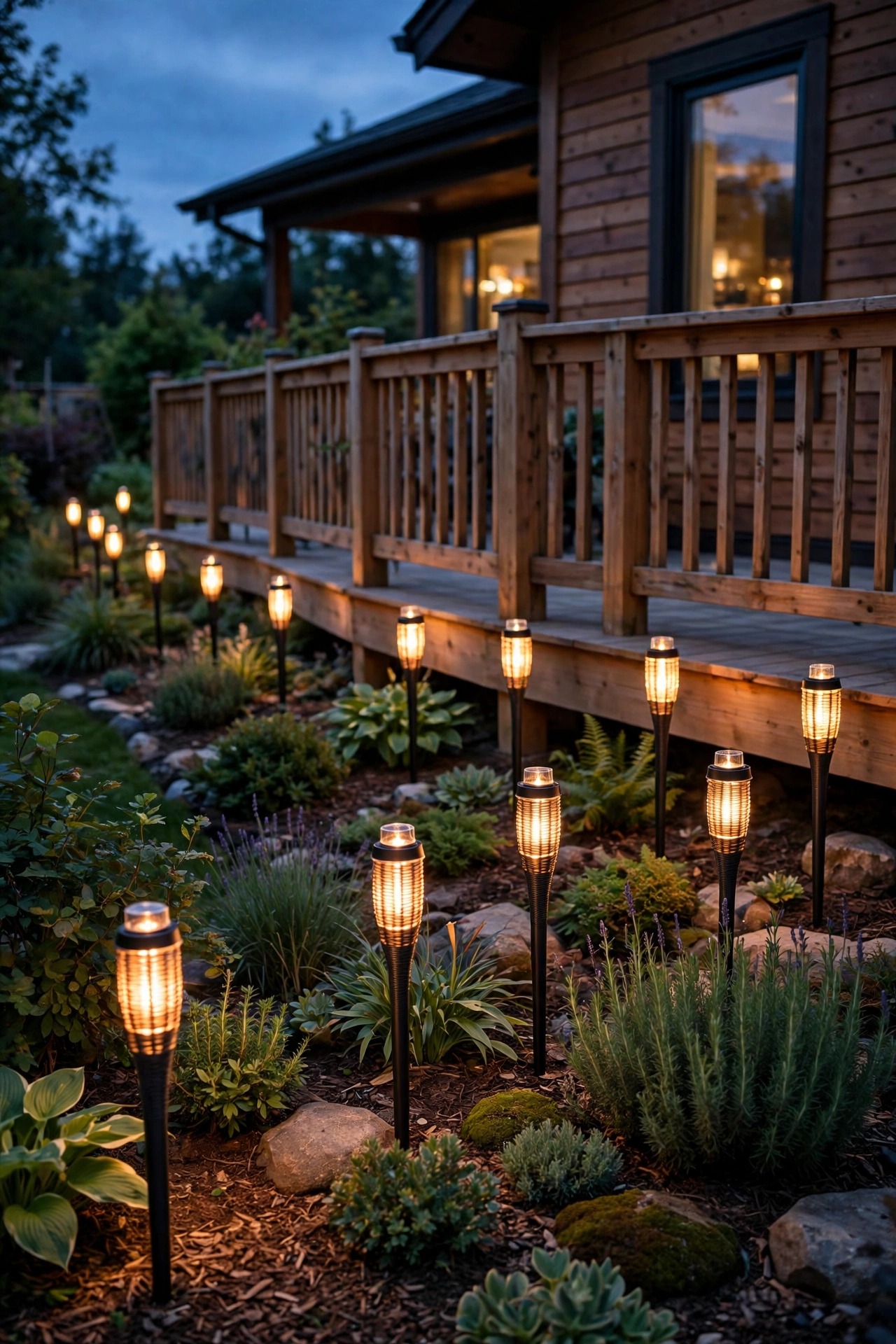
16. Flameless Torch Stakes Along the Quiet Side
Most wraparounds have one contemplative stretch — the side with the porch swing, the reading chair, the view of the garden instead of the grill. That side wants flame energy without flame rules. Solar torch stakes with flickering LED flames, staked in the bed just beyond the railing every 5 to 6 feet, give you a row of dancing light that never blows out, never needs oil, and never makes you nervous near dry mulch. Real tiki torches are lovely for a party and a genuine hazard as permanent deck neighbors; the flameless versions are the ones still glowing in February when nobody is hosting anything. Choose stakes at least 30 inches tall so the flame sits near railing height and reads across the yard. Group them in odd numbers along the run — threes and fives look composed, pairs look like a sale display. Because they are solar, give them the sunniest spots in that bed and let your wired layers carry the shady corners.
Suggested budget range: $35 – $95.
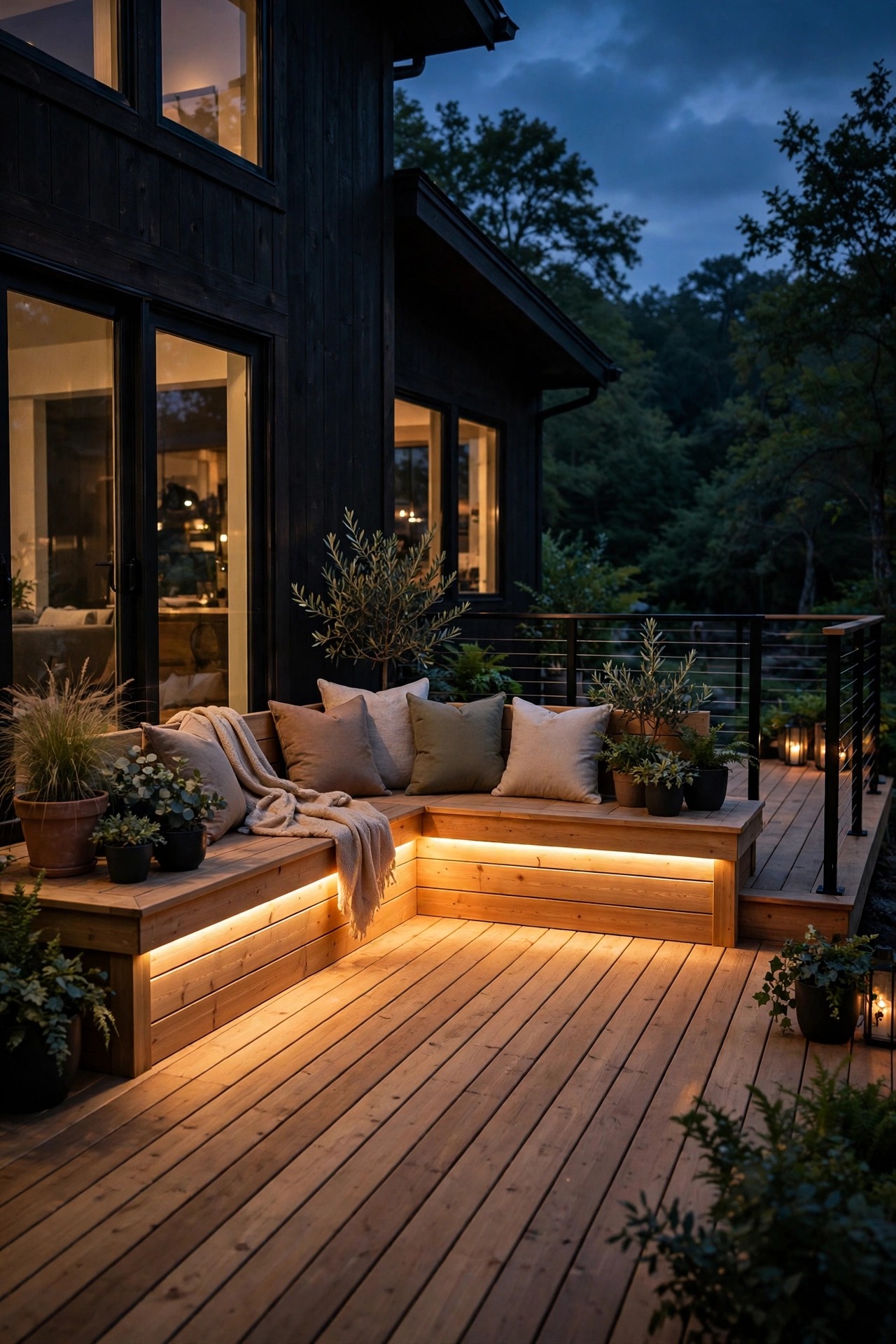
17. Under-Bench Glow for Built-In Seating
Built-in benches are wraparound royalty — they turn corners into seating — but at night a bench floats in the dark and shins find it before eyes do. A short run of the same under-rail LED strip, mounted under the front edge of each bench seat, throws a gentle wash onto the boards below and makes the whole seating run look like it is levitating slightly, in the best way. It is a ten-minute add-on if your deck already has a low-voltage system nearby: same transformer, same color temperature, one more homerun of wire along the joists. Keep the strip back at least 2 inches from the bench face so you see glow, not hardware, and so kicked heels never meet the channel. On corner benches the light bends around the turn with a flexible strip and the effect doubles. Guests will not be able to name why the seating corner feels expensive. It is this. It is always this.
Suggested budget range: $45 – $130.
18. One Smart Timer, Four Zones
Nineteen ideas collapse into chaos without a conductor, so here is the control scheme I set up on every wraparound: divide the deck into four zones — entertaining side, front, quiet side, and path-and-stairs — and give each zone its own timer channel or smart plug. The safety zone (stairs, pucks, skirt) runs dusk to dawn at full reliability; the entertaining zone runs dusk to midnight; the sparkle layer — strings and fairy lights — runs dusk to 11 p.m. on weekends and stays dark on weeknights unless you tap the app. A single low-voltage transformer with a built-in astronomical timer handles the wired zones and adjusts itself for sunset all year, which is the feature you will love most in December. Label every zone inside the transformer box with a paint pen. Future you, troubleshooting one dark side in the rain, will want to hug present you for that label. Keep photocell fixtures off the timed zones — they are already doing their own thinking.
Suggested budget range: $60 – $200.
19. Layered Zones: The Wraparound Deck Lighting Ideas Finale
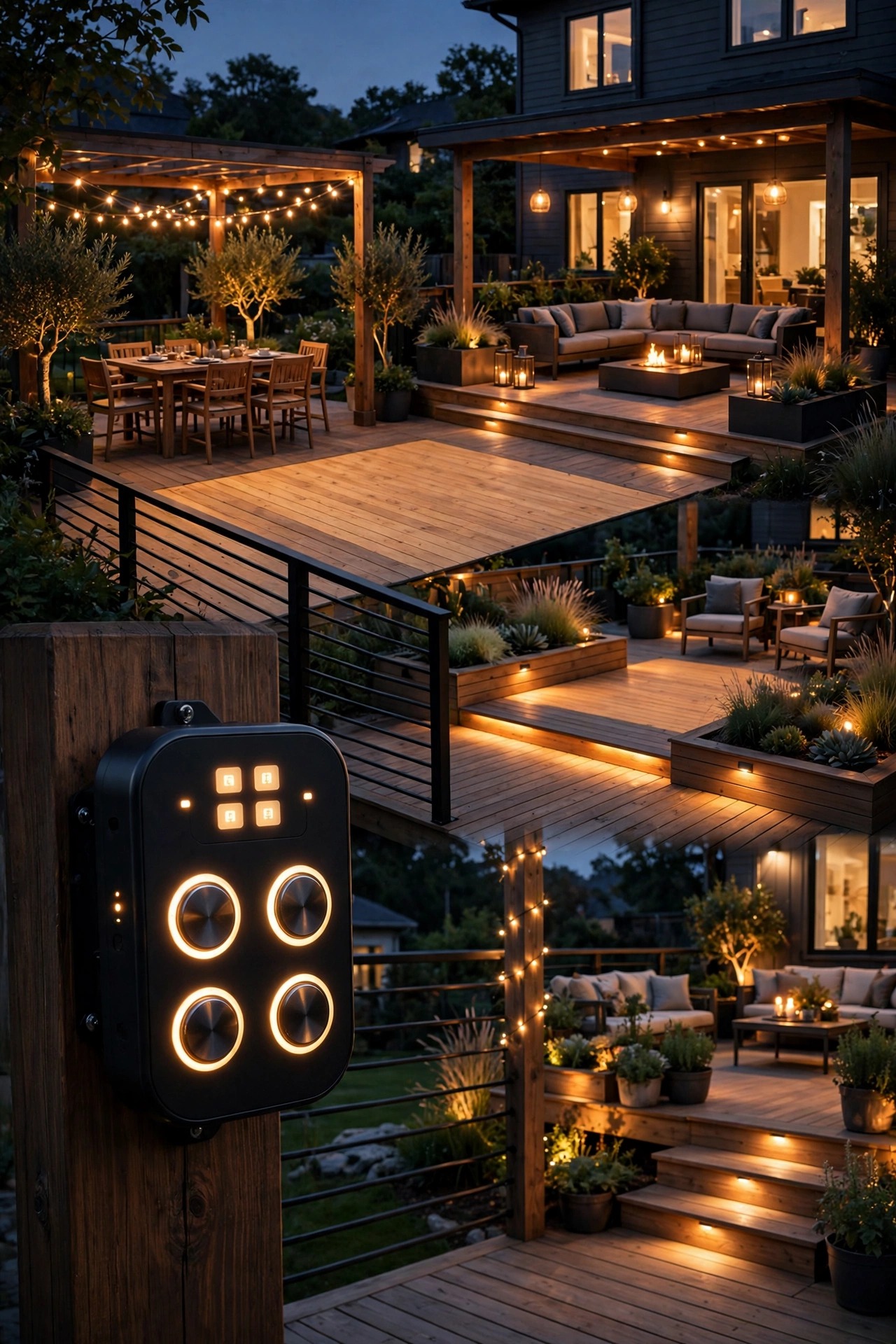
Let me pull it all together the way I would finish your deck on the last evening of the project. Pick the side you entertain on and give it all three heights: sparkle high with the string light swags, warmth at face level from the door sconces and lantern clusters, and a low foundation of under-rail strip and step lights so nobody's drink ever goes missing. Then echo the recipe more quietly on the other sides — same layers, fewer fixtures, lower brightness — so the whole loop feels like one house breathing in unison instead of four decks arguing. Stand in the middle of the yard when you are done and squint: you should see a continuous warm outline, no black gaps at the corners, and no single bulb harsh enough to star in the picture. Anything that glares gets a shield, a hood, or a dimmer. This layering is the real secret behind all nineteen ideas — fixtures are just the delivery system for balance. Repeat your choices, mind your corners, and let the timers run the show every night without being asked.
Suggested budget range: $200 – $600.
Frequently Asked Questions
How many lights does a wraparound deck actually need?
More than a regular deck, but fewer than your cart suggests. As a working rule, plan step lights on every stair run, a marker at every corner turn, and perimeter fixtures — post caps or under-rail strip — spaced so their pools of light nearly touch, roughly every 6 to 8 feet. Most wraparounds land somewhere between 30 and 60 individual light points, but they share transformers and timers, so the system is simpler than the count sounds. Buy in phases: safety first, ambience second, sparkle last.
What color temperature is best for deck lighting?
Warm white, 2700K, is the sweet spot for wood decks and evening skin tones — it is the color of candlelight and late sunsets. Match every fixture and bulb on the deck to the same number, because a single 4000K bulb will glare blue-white against the warm ones all night. If you love a slightly crisper look on stone or composite, 3000K is as cool as I would go outdoors.
Can I run wraparound deck lighting on solar alone?
On the sunny front and south stretches, honestly yes — modern solar post caps, stakes, and fairy lights are good. On shaded north sides and under trees, solar fixtures fade by mid-evening in summer and early in winter. My standard compromise is a hybrid: hardwired low-voltage for the safety layer (stairs, paths, transitions) and solar for accents and sparkle. That way the lights that protect ankles never depend on the weather.
Do I need an electrician, or can I DIY this?
Almost everything on this list is DIY-friendly 12-volt low-voltage work, which is safe to run yourself with basic tools — no conduit, no panel work. The exceptions are the line-voltage jobs: soffit downlights and hardwired sconces tied into house wiring. For those, hire a licensed electrician and expect permits and GFCI protection to be part of the quote. Mixing the two — pro for the house wiring, you for the low-voltage loop — is how most of my favorite decks got built.
Conclusion
A wraparound deck asks a little more of you than a simple back deck, but it gives more back, too — four sides of evening, each with its own mood, all connected by one warm loop of light. Start with the stairs and edges, repeat your fixtures around every corner, and let timers quietly run the show. If you want to keep going, browse more deck lighting ideas here on the site — and remember, the best wraparound deck lighting ideas are never about one hero fixture. They are about balance, repeated faithfully around the whole house, so no side of your deck is ever the dark side again.