A white or cream-colored house is a gift at noon — bright, clean, classic — and a genuine puzzle after dark. Pale siding reflects far more light than brick or dark paint, so the same fixtures that look perfect on your neighbor's house can turn yours into either a flat gray box or a glowing lighthouse that hurts to look at. The good news is that white house curb appeal lighting mostly comes down to restraint and warmth. Because your siding bounces light around so generously, you need fewer fixtures and lower brightness than almost anyone else on the street. In my experience, the winning formula is layering: a soft wash on the facade, a little contrast from dark fixtures, gentle guidance along the walk, and one or two accents on the architecture you love most. Below are 15 ideas I come back to again and again for white, cream, and pale gray homes, each with placement advice, the brightness reality, and an honest budget range.
1. Gentle Wall Washing: The Foundation of White House Curb Appeal Lighting
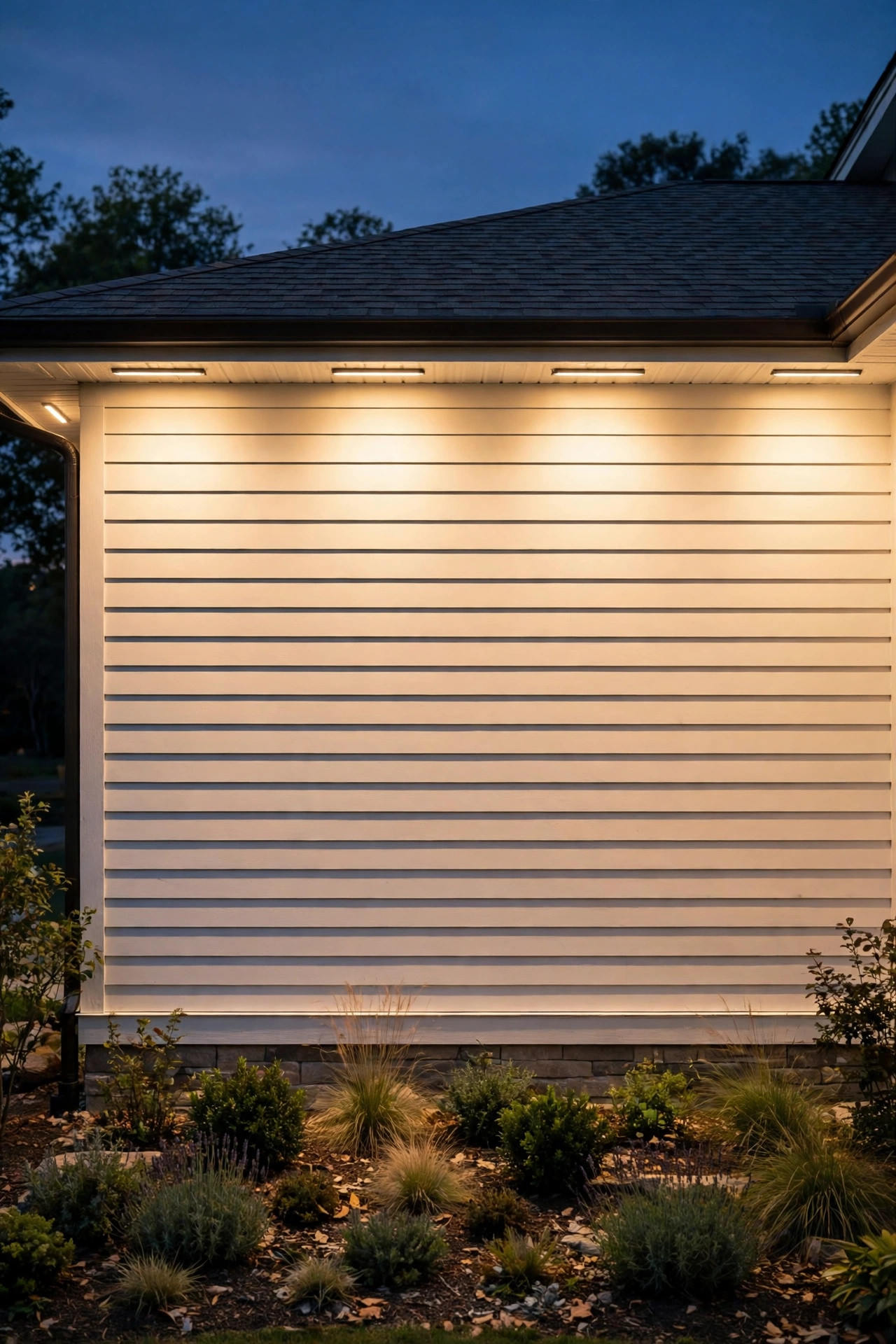
If you do only one thing, do this. Wall washing means placing wide-beam flood fixtures a few feet out from the house and letting a broad, even sheet of light settle over the siding — no hot spots, no zebra stripes. On white and light-colored homes it works beautifully because the pale surface becomes the diffuser: the whole facade takes on a soft, even glow that reads expensive from the street. Use fixtures with a beam spread of 60 degrees or wider, set them 3 to 4 feet from the wall, and space them roughly as far apart as the wall is tall for seamless overlap. Keep output modest — around 300 to 500 lumens per fixture is plenty on white, where you'd need double that on dark brick. Aim slightly upward but keep the beam off the windows; light spilling into bedrooms is the number one complaint I hear. My full wall washing guide covers the placement math in detail. Low-voltage well lights or spike floods both work here, and everything should be wet-location rated. Suggested budget range: $250 – $800.
2. Matte Black Sconces for Contrast at the Front Door
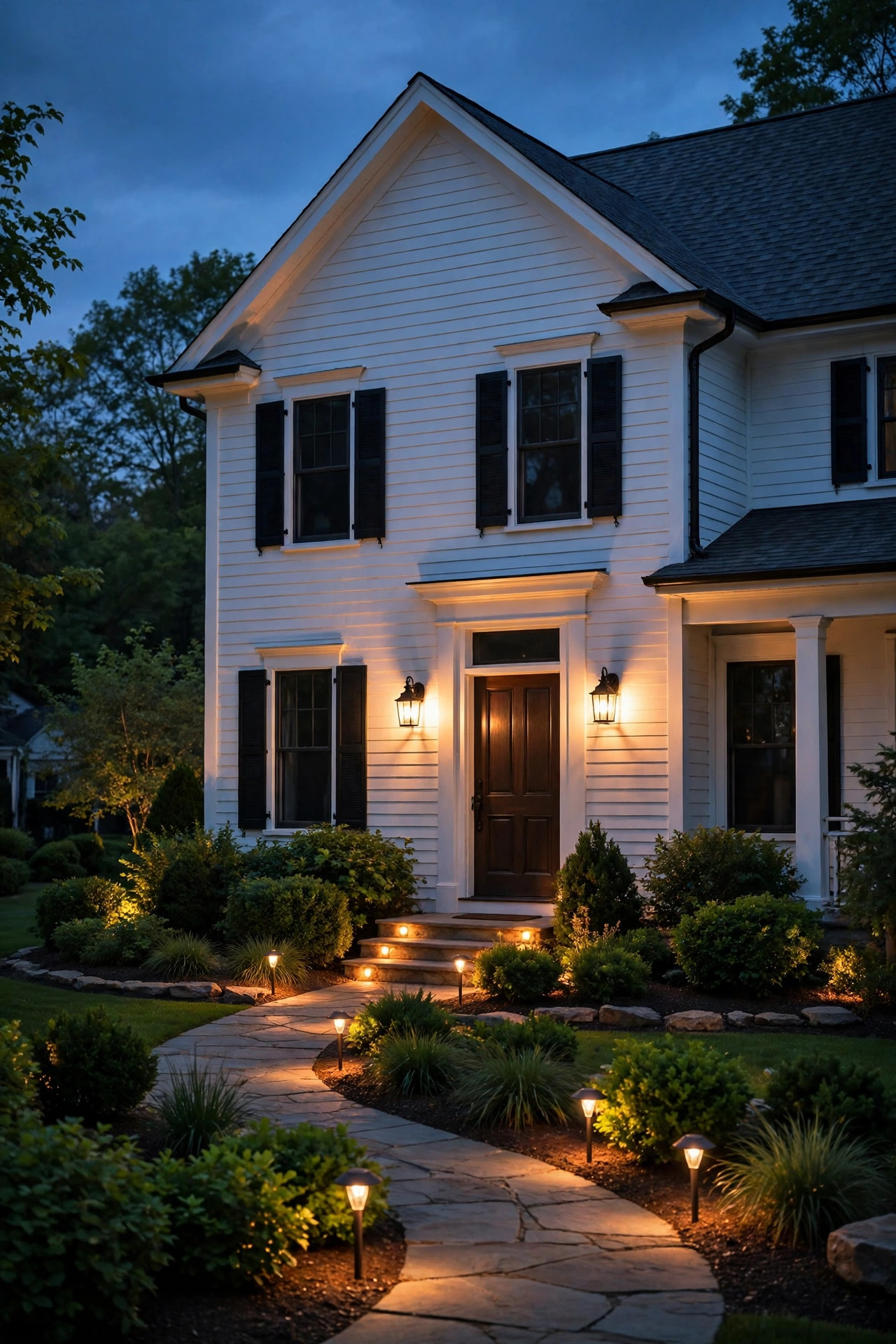
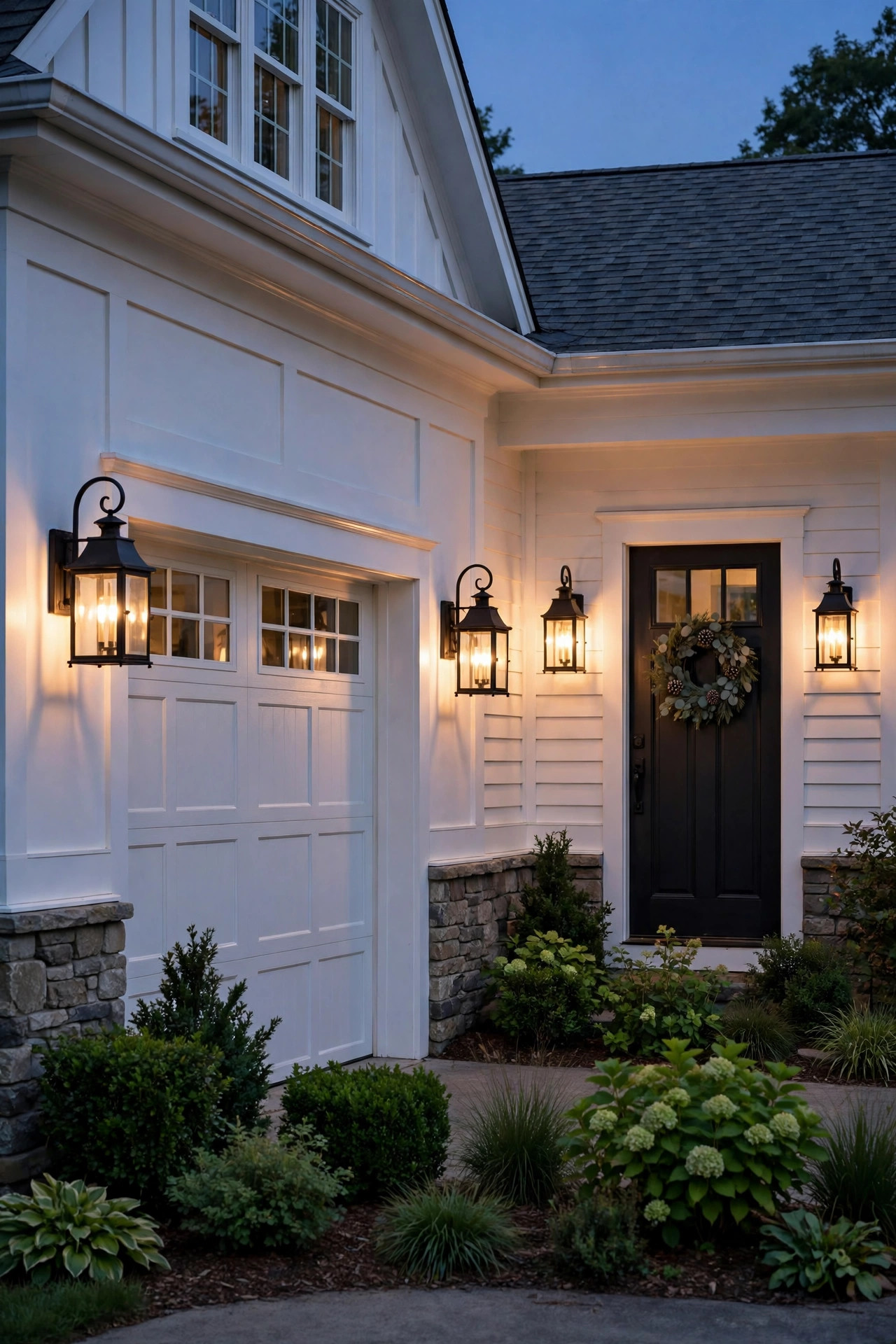
On a white house, the fixtures themselves are part of the decor, and pale-on-pale disappears. That's why matte black or oil-rubbed bronze sconces flanking the front door are my default recommendation: the dark silhouettes give the facade punctuation, define the entry during the day, and frame a warm pool of light at night. Size matters more than people think — each sconce should be roughly one-quarter to one-third the height of the door, mounted with the center of the fixture about 66 inches from the porch floor. If your door has sidelights or the entry is wide, go a size up rather than adding a third fixture. Inside, choose warm LED filament-style bulbs around 2700K and keep them at 40-watt equivalent or lower; a bare bright bulb against white siding throws glare straight into guests' eyes. Lantern styles with seeded or frosted glass soften things further and hide the bulb entirely. Pair the sconces with a matching black fixture at the garage (idea 15) so the whole front elevation speaks the same language. Suggested budget range: $120 – $450.
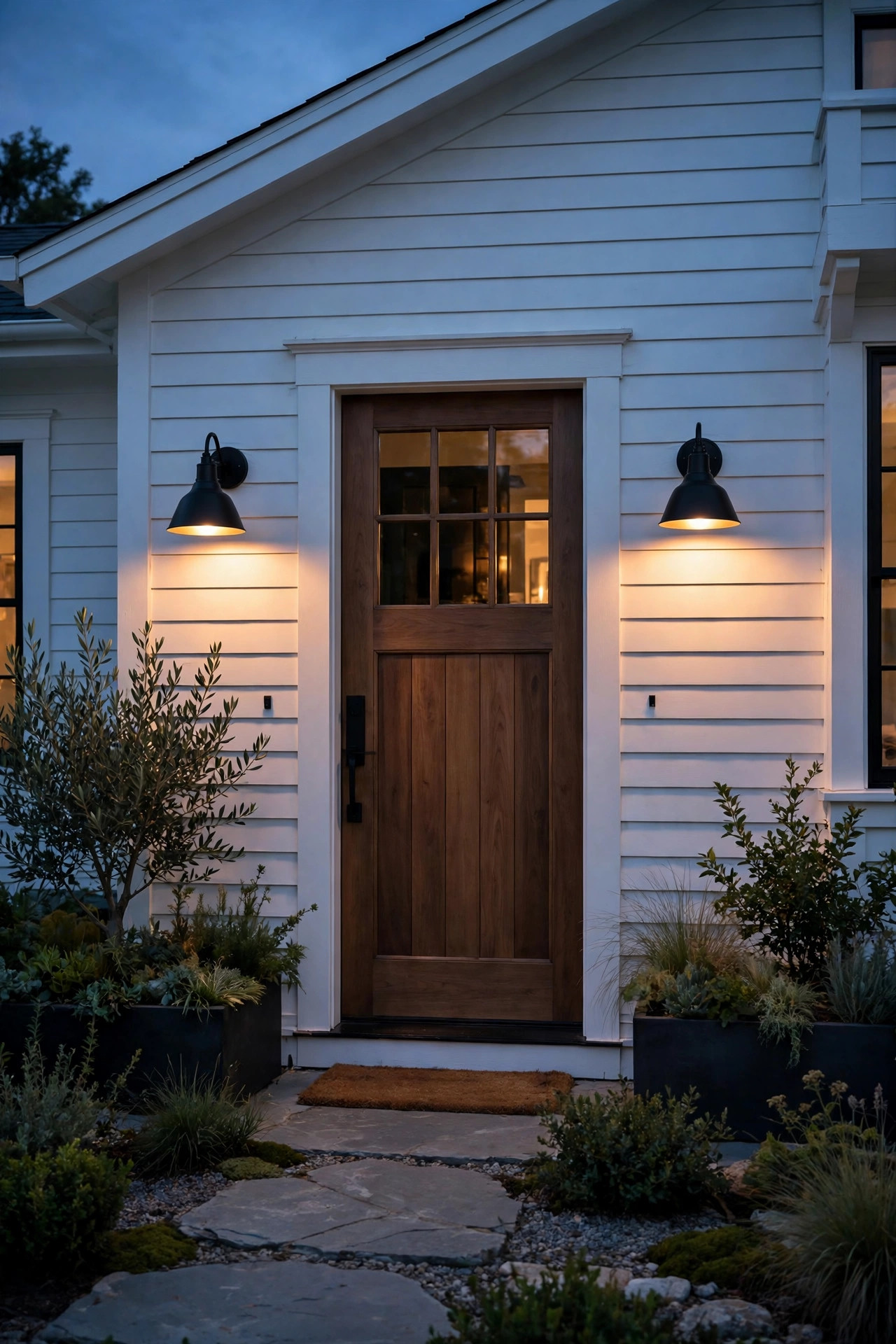
3. Stick to 2700K Warm White So Pale Siding Never Looks Blue
Color temperature makes or breaks a light-colored home. Cool white and daylight bulbs — anything 4000K and up — push white siding toward blue-gray and make a charming house look like a clinic parking lot. Warm white at 2700K does the opposite: it flatters cream, ivory, and soft white paints, warms up white vinyl, and gives the whole facade that golden, lamplit quality everyone actually wants. Honestly, this is the single cheapest upgrade on the list, because it usually means swapping bulbs rather than buying fixtures. Audit every exterior bulb you own, including the ones in path lights and porch pendants, and standardize them all at 2700K (3000K is acceptable for landscape accents if you prefer a touch crisper). Mixed temperatures are the giveaway of an unplanned yard — one blue porch light among warm path lights looks like a mistake, because it is. When you shop, check the Kelvin number on the box, not the words "warm white," which manufacturers stretch shamelessly. I explain the whole scale in my piece on why 2700K warm white wins outdoors. Suggested budget range: $30 – $120.

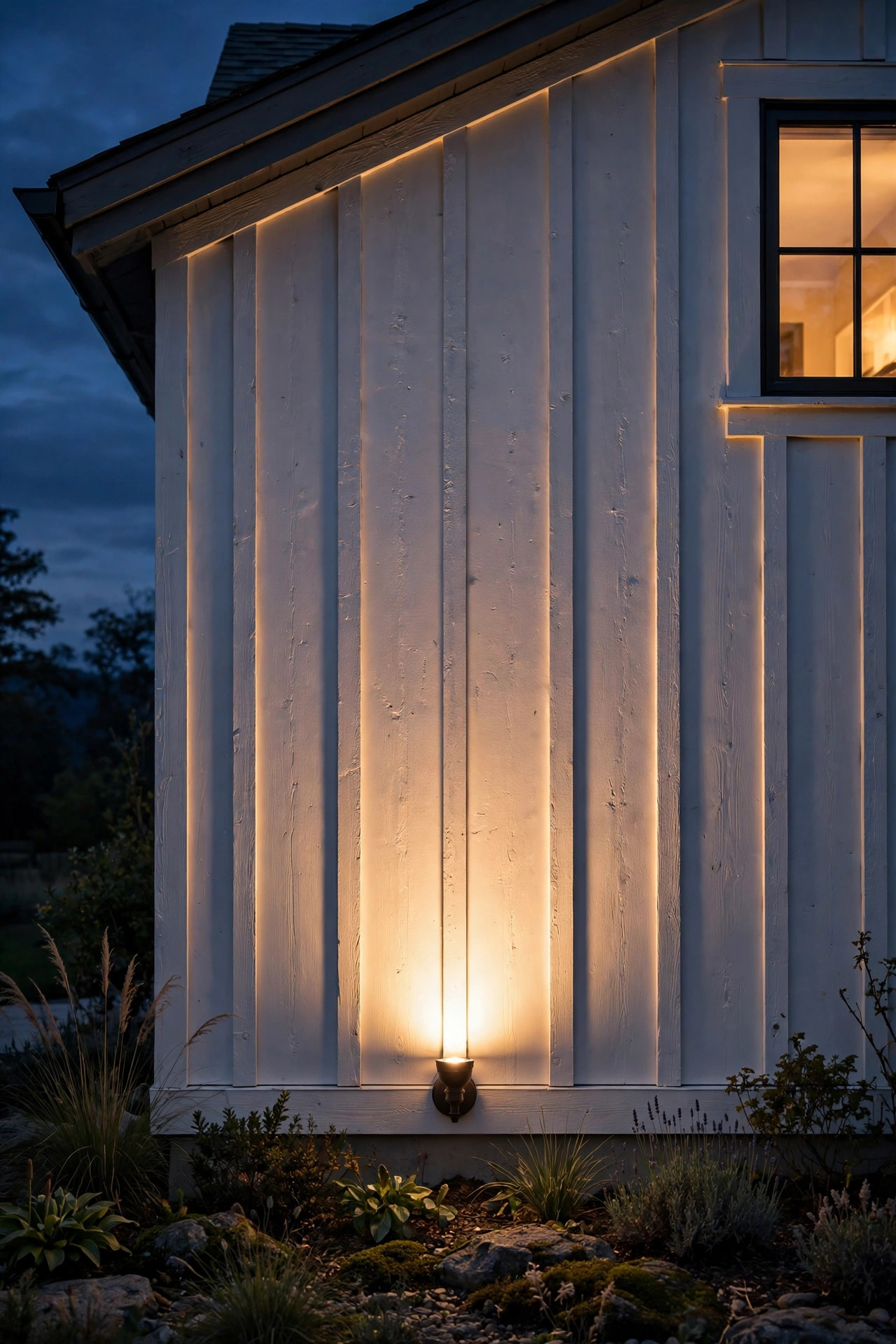
4. Grazing Light to Show Off Siding Texture
Smooth light shows color; grazing light shows character. If your white home has board-and-batten siding, shiplap, shingles, or painted brick, place fixtures just 6 to 12 inches from the wall with a narrow beam aimed steeply upward. The light rakes across the surface and every shadow line pops, turning a flat white wall into a textured one. This is the difference between a house that looks painted and a house that looks built. Grazing works best on one feature wall rather than the whole facade — the gable end, the section beside the front door, or a painted brick chimney chase — because texture everywhere gets busy fast. Use narrow spot fixtures around 15 to 25 degrees, and test at night before final mounting: a few inches of fixture distance changes the drama completely. One caution from experience: grazing is brutally honest. It will highlight wavy siding, sloppy caulk lines, and every cobweb, so give the wall a wash and a quick once-over first. Stick to warm 2700K here too, and keep the rest of the facade softer so the textured section stays the star. Suggested budget range: $150 – $500.
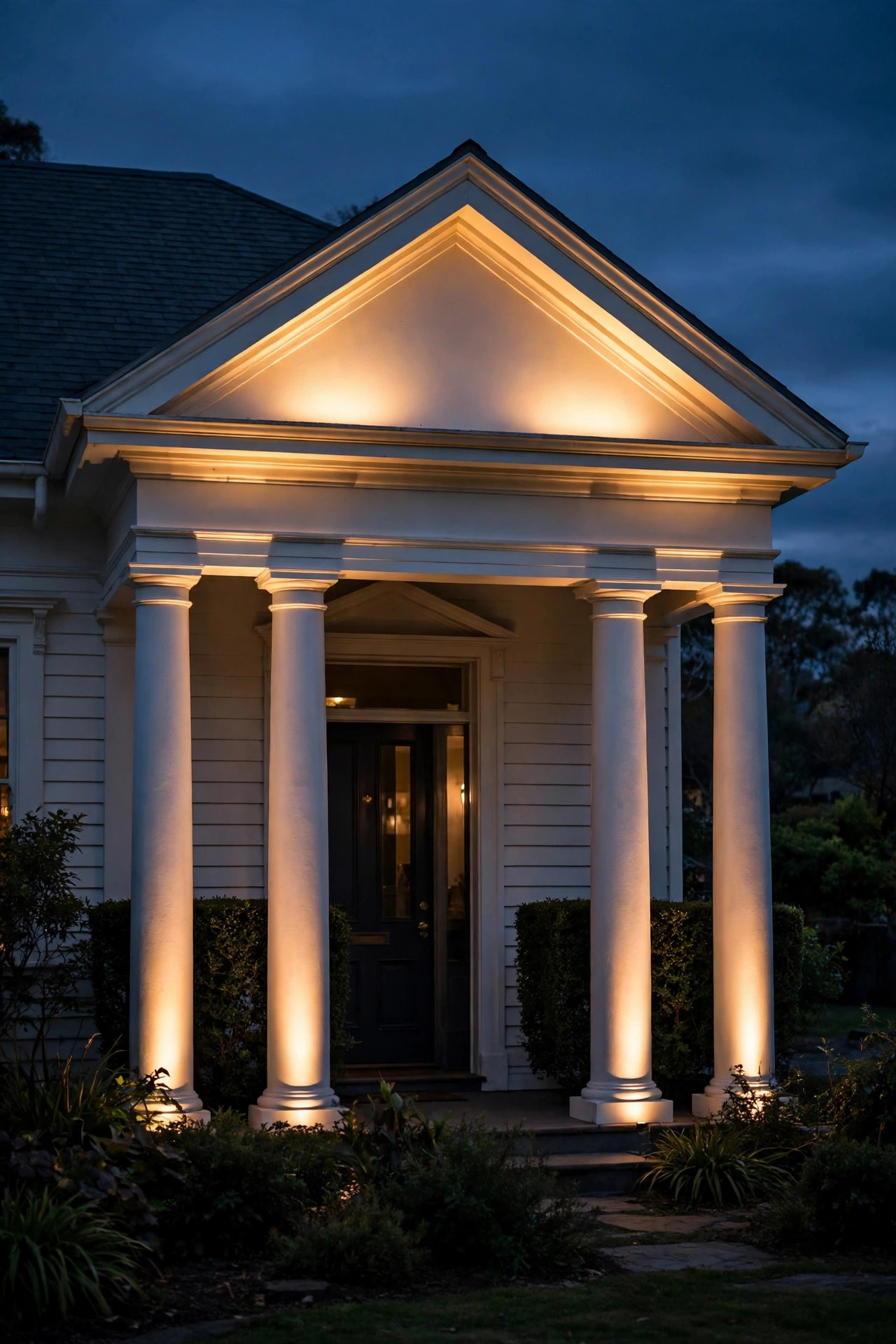
5. Uplight the Architecture, Not the Whole Facade
The temptation with a white house is to floodlight all of it, precisely because it lights up so easily. Resist. Selective uplighting — a narrow beam on the columns, a soft spot on the gable peak, one fixture washing the stone chimney — creates depth and shadow, which is what makes a facade interesting at night. A uniformly lit white wall has no shadows left, and without shadows it just looks flat and, frankly, a little startled. Pick two or three architectural moments across the front of the house and leave the rest in comfortable darkness; your eye reads the lit moments as a composition. Fixtures with adjustable heads help, and so do honeycomb louver accessories that trim stray glare. Mind the windows: an uplight aimed through a bedroom window will be remembered by your guests and your family for all the wrong reasons, so check sightlines from inside before you finalize angles. Columns take a single narrow spot at the base aimed straight up; gables want a wider flood set a few feet back. This less-is-more approach is also kind to the budget and the electric bill. Suggested budget range: $180 – $650.
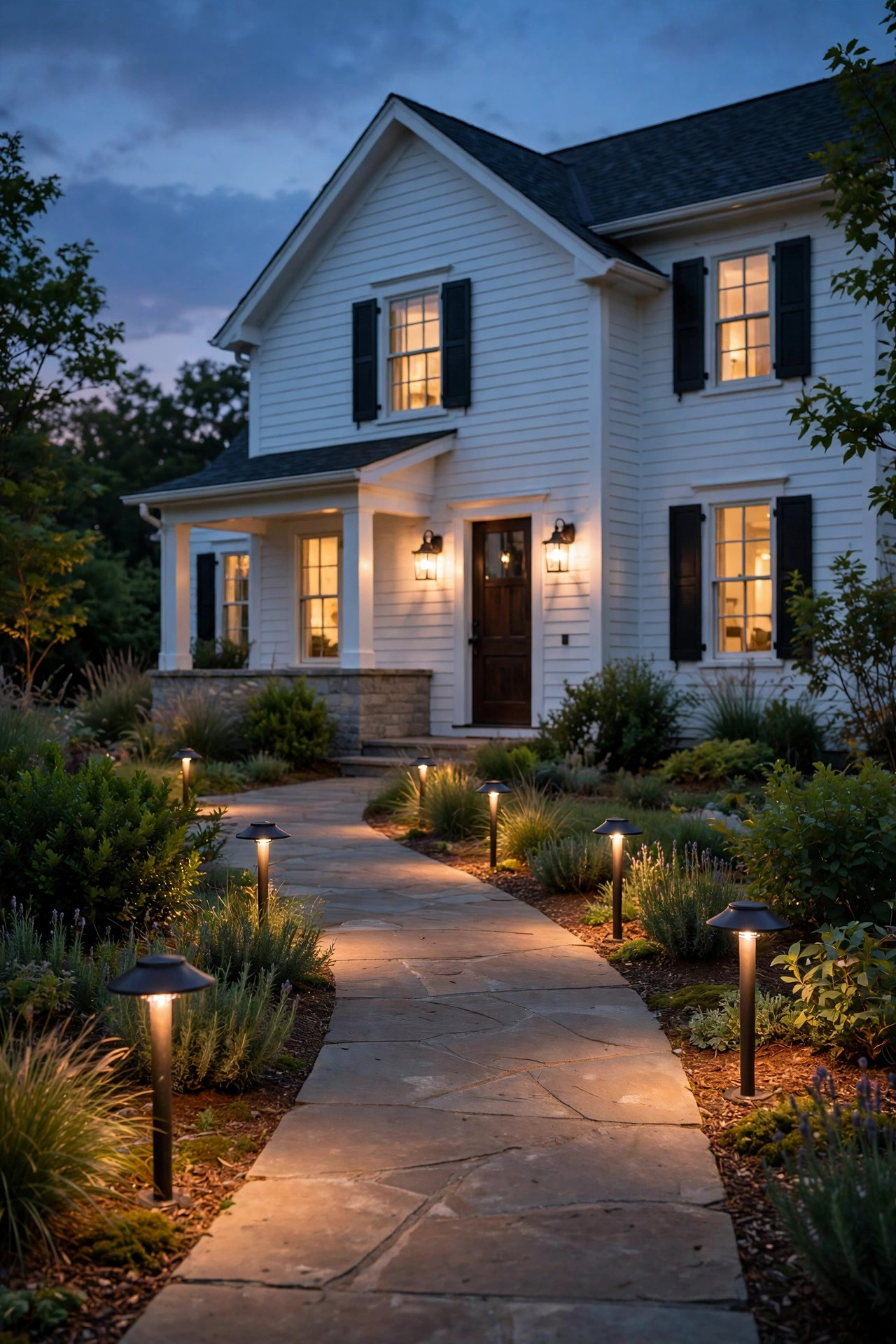
6. Shielded Path Lights That Keep Glare off the Siding
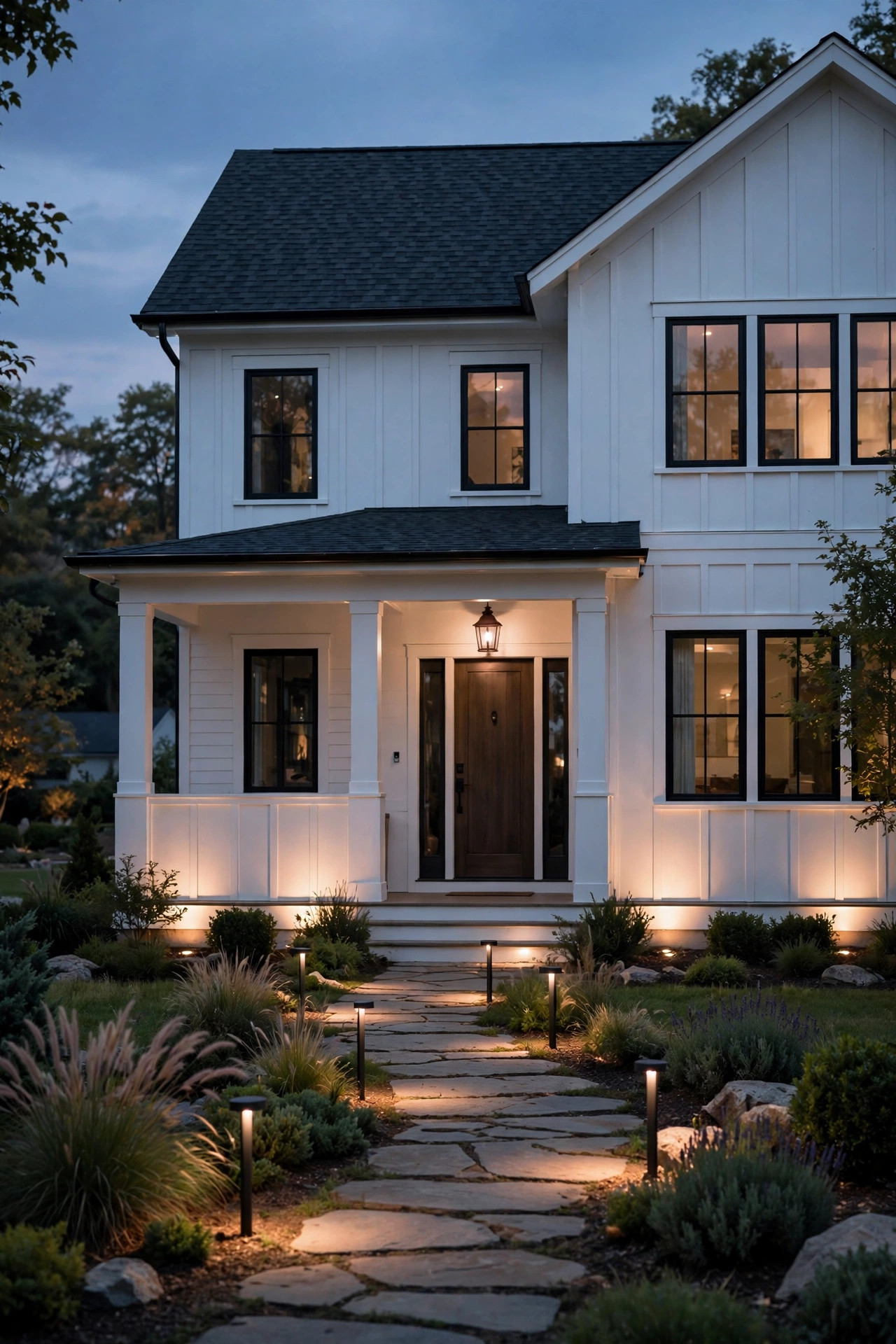
Walkway lighting does double duty on a light-colored home: it guides guests, and it bounces. Every unshielded path light near the house throws half its output sideways onto your pale siding, creating random bright smudges that fight with your planned facade lighting. Choose path fixtures with a hat, louver, or shield that puts the light down on the path where it belongs — mushroom and pagoda styles are classics for a reason. Space them 6 to 8 feet apart, staggered on alternating sides of the walk rather than in matched pairs, which avoids the airport-runway look and halves the fixture count. Keep brightness low, around 100 to 200 lumens each; on a light walkway bordered by pale siding, that's genuinely plenty, and your facade wash stays the brightest thing in the composition, as it should be. Solar versions have improved enormously and are fine for the sunny half of the yard, but I still prefer wired low-voltage anywhere the walk passes under trees, because winter shade starves solar panels exactly when the nights are longest. Wet-location ratings and stakes that actually stay upright through frost heave are worth the small premium. Suggested budget range: $150 – $600.
7. A Dark-Finish Porch Pendant or Lantern Overhead
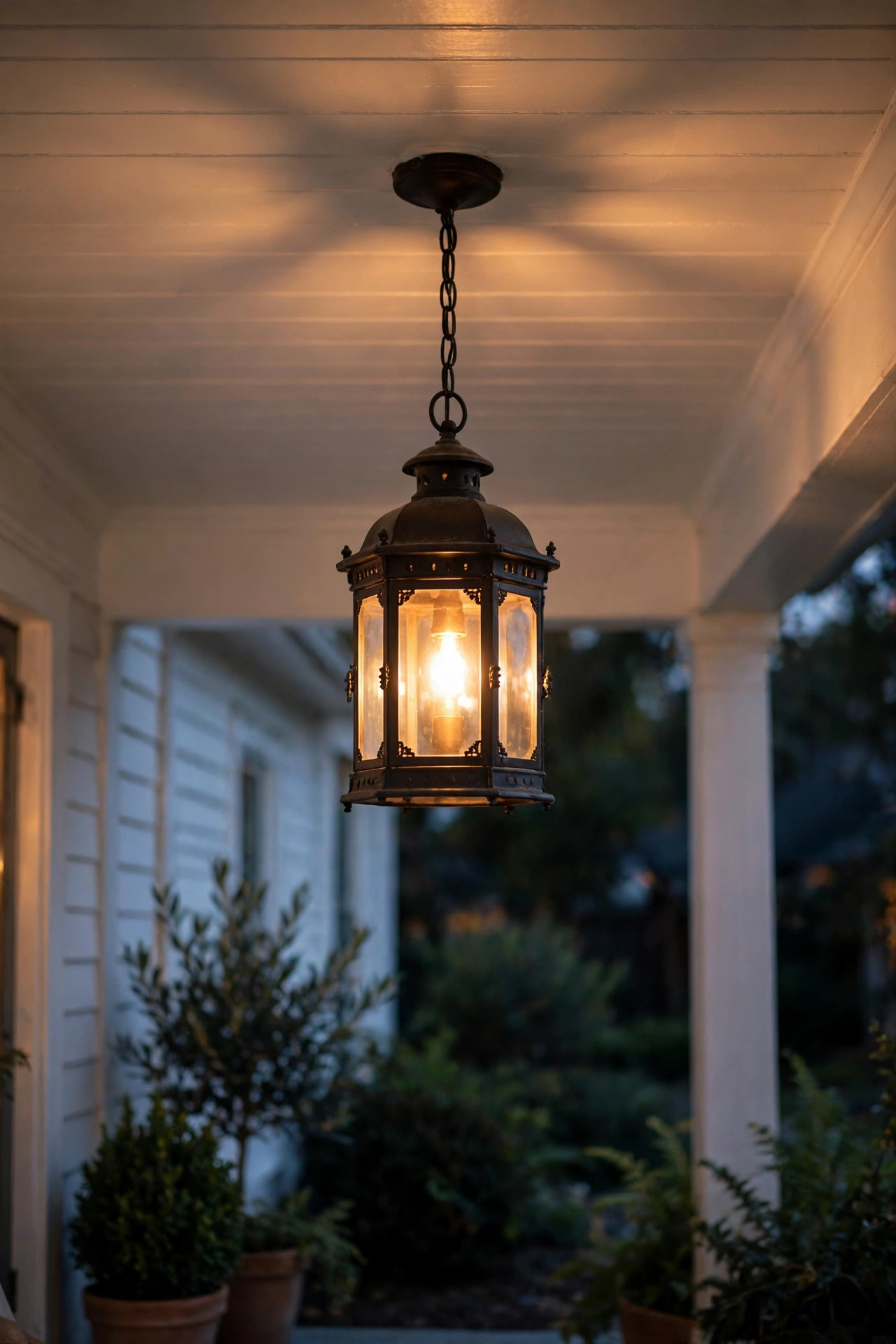
If your porch has a ceiling, the overhead fixture is the one guests stand under — and on a white or cream porch, a dark pendant or hanging lantern gives the whole space a center. Choose matte black, bronze, or even an aged copper finish, and let it hang so the bottom of the fixture sits at least 6 feet 8 inches above the porch floor, centered on the door when the architecture allows. Size up: a pendant at least 12 inches wide reads properly from the street, and small fixtures vanish against a big pale facade. Frosted or opal glass keeps the light soft; if you love clear glass and visible filaments, use a dimmable warm bulb and run it low, because a bright bare bulb overhead on a white porch ceiling blooms into glare. This fixture is also the perfect place for a smart bulb or a timer, so the porch greets you at dusk without any thought. Coordinate the finish with your door sconces so the entry reads as a set, and if the porch is deep, one pendant at the door plus a flush mount farther out keeps the far corners from going cave-dark. Suggested budget range: $90 – $400.
8. Moonlighting from a Front-Yard Tree for Soft, Natural Light
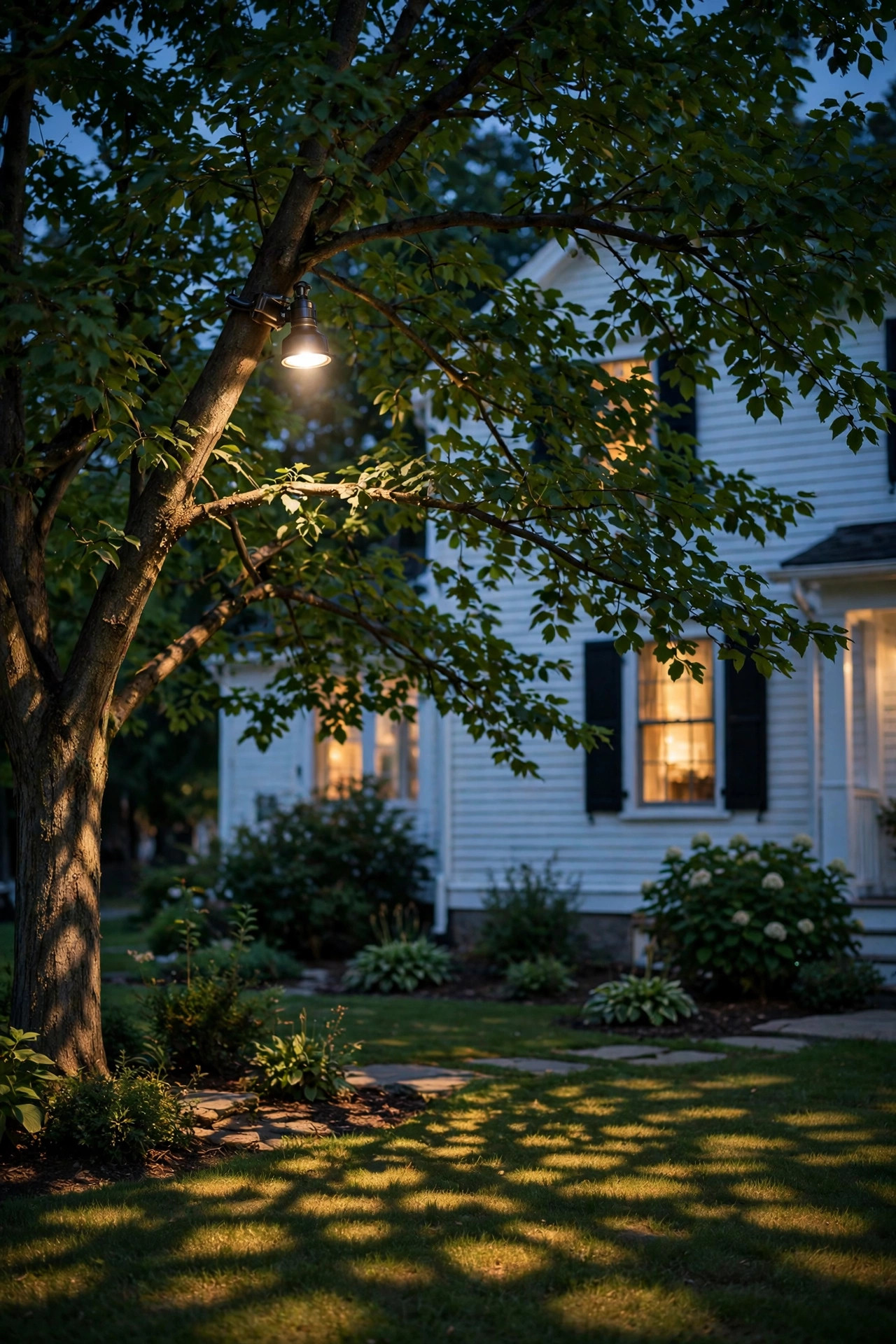
Moonlighting is the gentlest light I know, and light-colored homes wear it beautifully. A fixture mounted 15 to 25 feet up in a front-yard tree, aimed down through the branches, lays a dappled pattern across the lawn and walk that mimics real moonlight — and because your white facade sits behind it catching soft reflected light, the whole front yard feels lit without any single bright source. Use a cool-neutral tint here if you like (this is the one place a slightly higher color temperature reads as natural), but honestly the warm 2700K standard works too and keeps continuity with the rest of your lighting. The fixture needs a proper tree-mount with a junction box and enough slack cable for growth; never screw a cheap stake light into a trunk. This is the one idea on the list where I usually suggest hiring a pro, because it involves ladders, tree health, and aiming from height — expect the install to cost more than the fixture. Down below, keep path lights dim so the dapple can do its quiet work. The effect is especially kind to white houses because it never blasts the siding directly. Suggested budget range: $400 – $1,200.
9. Accent Spots on Dark Shutters, Doors, and Trim
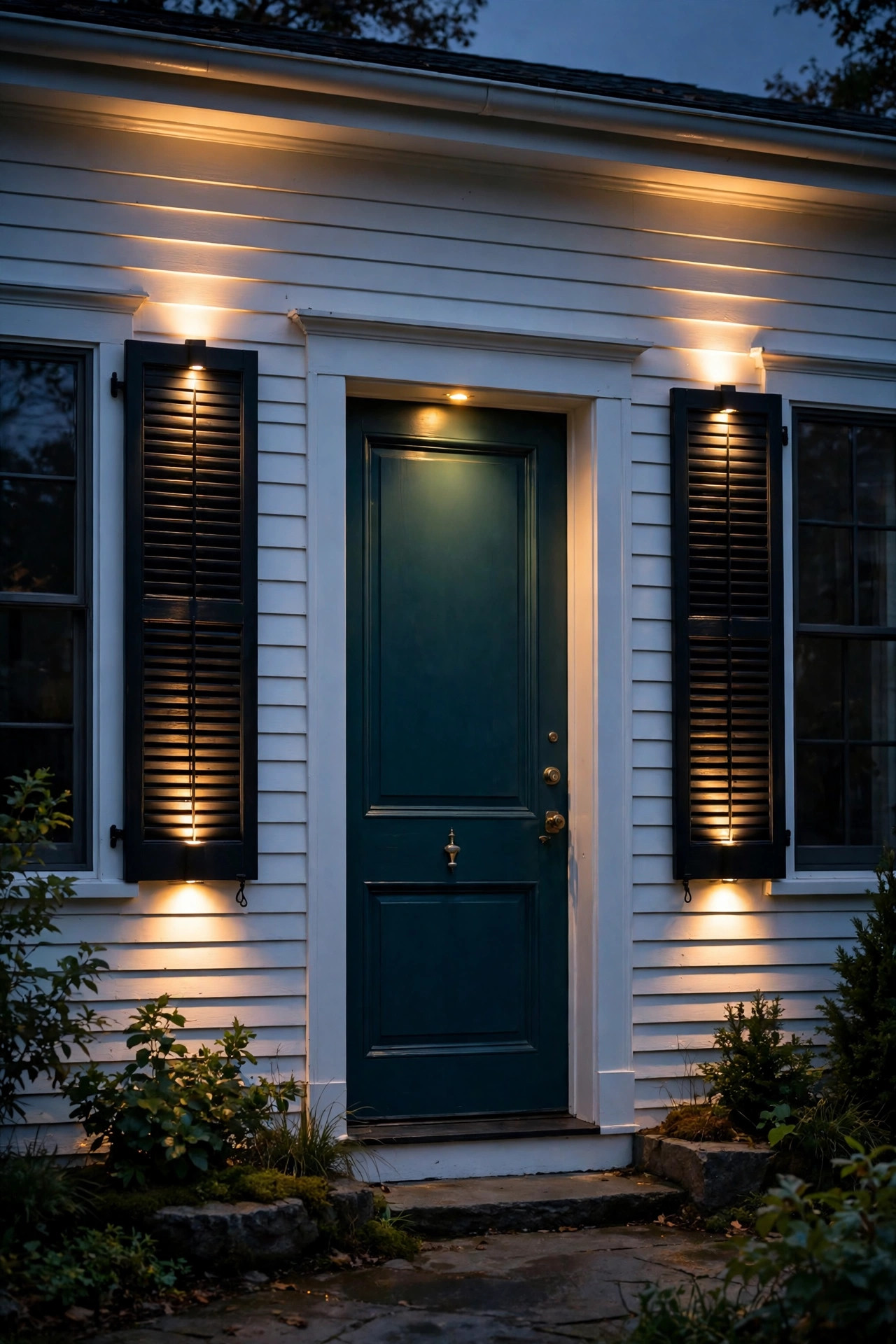
Here's a trick that only works on light-colored homes: light the dark parts. If your white house has black or deep-green shutters, a navy or red front door, or dark window trim, a small accent spot on each of those elements makes the whole facade read richer, because the eye gets contrast points instead of one big pale field. A single narrow-beam spot at the base of each shutter pair, or a discreet uplight washing the front door, is enough. The door especially rewards the attention — it's the focal point of the house, and a wash of warm light makes a painted door glow like it's lacquered. Keep these accents subtle; you're defining edges, not spotlighting a stage set. Small low-voltage spot fixtures with adjustable heads are ideal, and you can hide them in the foundation plantings so they disappear by day. This is also a lovely way to use fixtures you already own: if your current setup lights the siding but the house still looks flat, aim two of those floods at the shutters and door instead and watch the depth appear. It's the fastest fix for the "my house looks like a big white rectangle" problem. Suggested budget range: $100 – $400.
10. Foundation Planting Uplights for a Green Layer Against White
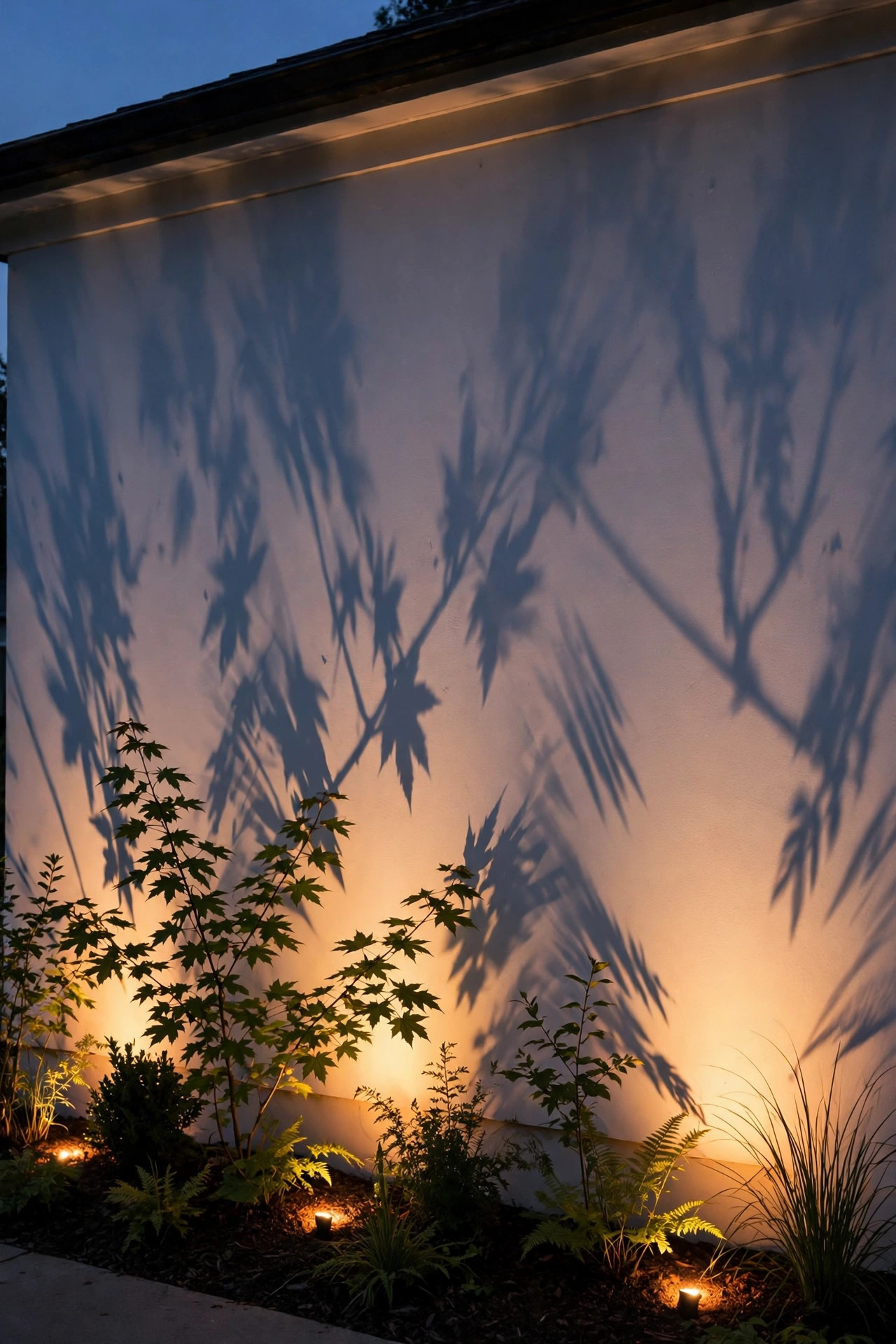
Every light-colored home needs a middle layer between the lawn and the siding, and foundation plantings lit from below provide it. A small uplight tucked into a hedge, ornamental grass clump, or hydrangea throws leafy shadows up the white wall and adds the one color your palette is missing: green. Those moving shadows keep a big pale facade from looking sterile, and they change with the seasons, which no fixture can fake. Place one fixture per major planting cluster, set 12 to 18 inches out from the shrub, and aim through the plant rather than at the house — the plant is the subject; the wall is just the canvas catching the shadow play. Wide beams work best here, and modest output again, since the white wall behind will amplify everything. Evergreens earn their keep in winter when deciduous shrubs are bare sticks, so make sure at least a couple of lit clusters are evergreen. This layer also softens the hard line where house meets ground, the spot where white homes can look like they're floating. It's inexpensive, forgiving, and the layer neighbors ask about most. Suggested budget range: $120 – $450.
11. Low Bollards Along the Driveway for a Finished Edge
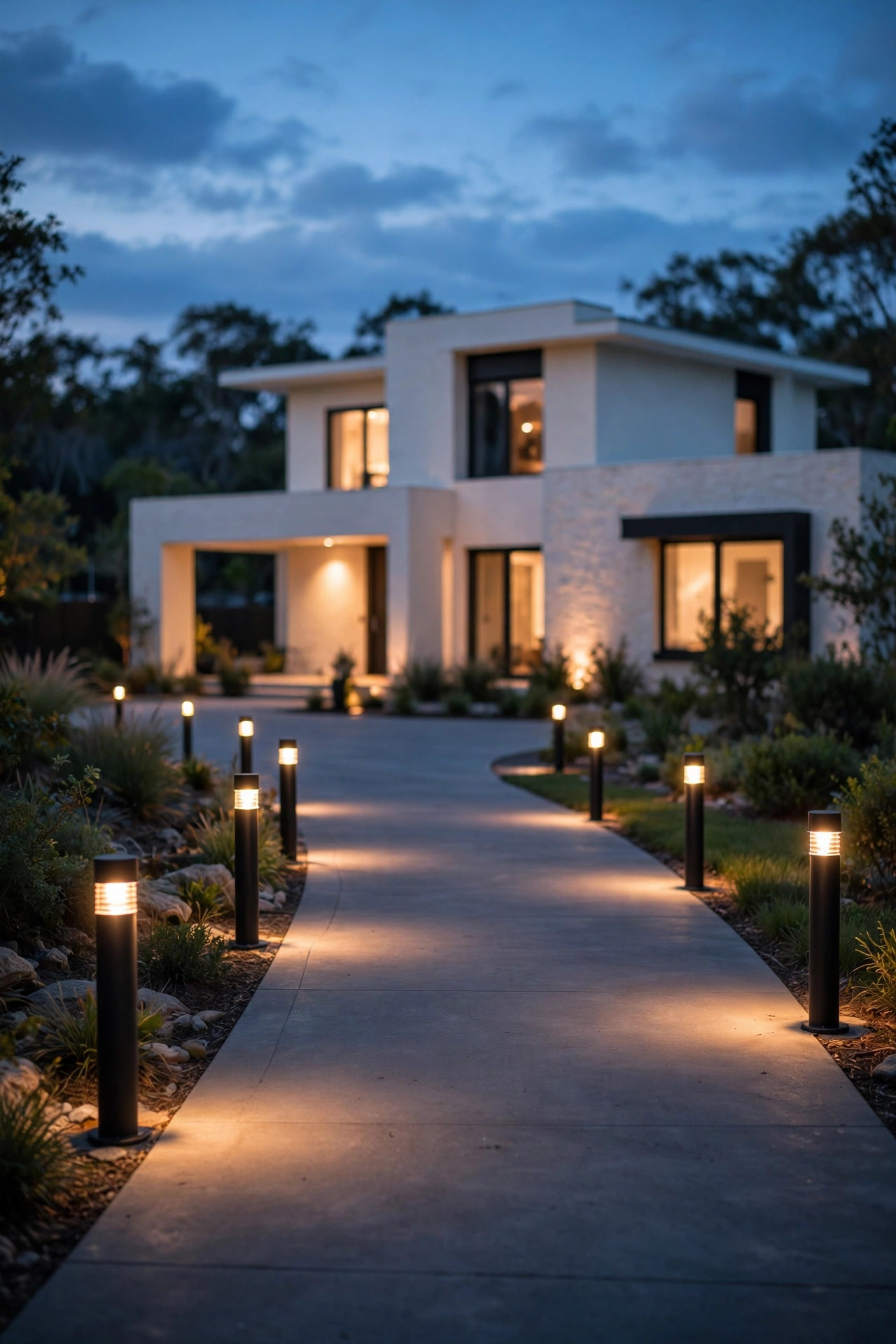
Driveway edges are where white houses gain or lose their "finished" look after dark. Short bollard lights — 24 to 30 inches tall, with louvered optics that push light down and out — give the driveway a calm, deliberate border without spraying light onto the siding or into drivers' eyes. Choose a dark finish to echo your door sconces, and space bollards 10 to 14 feet apart along one side only; a single well-placed row looks intentional, while double rows drift toward runway. On a white or light-gray concrete drive, keep output around 200 to 300 lumens per bollard — the pale surface will do the rest, just as it does on the house. Set each bollard on a concrete footing or a ground sleeve so it stays plumb; a leaning row undoes the whole effect by spring. Bollards also physically nudge guests' tires away from the lawn edge, a side benefit anyone with a sprinkler head near the drive will appreciate. Wired low-voltage is my pick here for reliability, and a shared transformer run with the path lights (idea 6) keeps the project tidy. Suggested budget range: $350 – $1,100.
12. Step Lights for a Safe, Welcoming Stoop
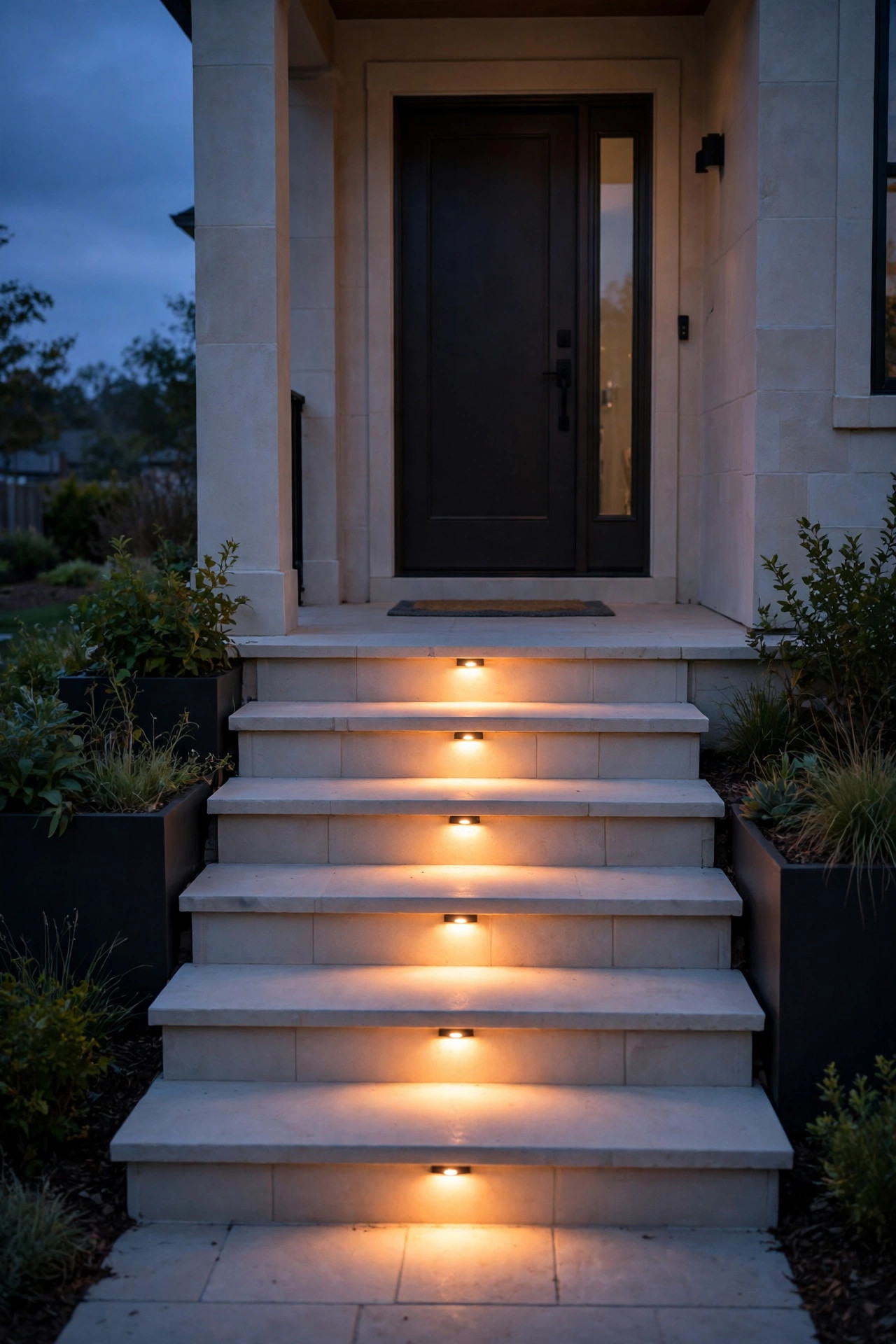
Front steps are the most practical lighting problem on any house, and on a light-colored stoop the fix is delightfully subtle. Small recessed step lights — set into the riser of each step or into the wall beside the stairs — wash each tread with just enough light to read its edge, and because pale concrete and painted risers reflect so well, even tiny 50-to-100-lumen fixtures do the job. If your steps are wood or composite and recessing isn't an option, slim surface-mount fixtures under each tread nosing give the same floating-stair effect and install in an afternoon. Keep the color temperature matched to your porch fixtures, and put the step lights on the same timer or photocell circuit so the entry always comes on as one composition. This is one of the few places where a slightly brighter light is justified — safety beats mood — but on light treads you still need less than you'd guess. Guests arriving with arms full of casserole dishes will thank you silently every time. Wet-location rating is non-negotiable here, and LED-only, since these fixtures sit where hands and hems pass close. Suggested budget range: $80 – $350.
13. A Backlit House Number Guests Can Actually Find
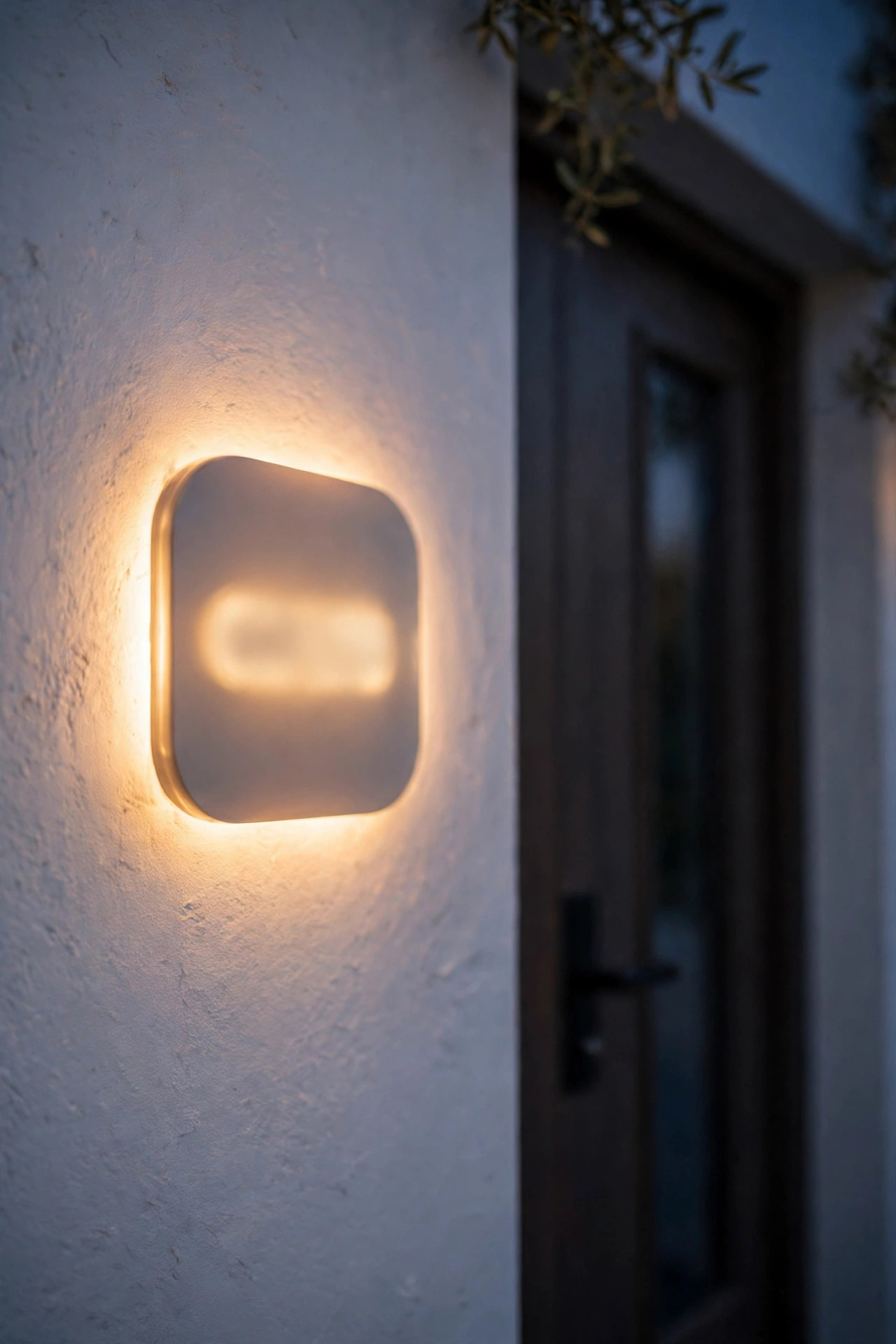
Few upgrades pay off daily like a lit house number, and on a white house you get a styling bonus: a backlit number plaque in matte black or brushed bronze becomes a crisp piece of jewelry on the pale wall. The soft halo style — numbers floating slightly off the wall with warm light leaking from behind — is my favorite for light siding, because the glow outlines each digit against the white and reads clearly from a moving car. Mount it beside the door at about eye level, or on a porch column if the door wall is busy, and wire it to the same circuit as the sconces so it keeps the same schedule. Solar versions exist and are fine on a sunny south-facing wall, but hardwired is noticeably brighter and more consistent in winter. Choose numbers at least 4 inches tall — most local codes ask for that anyway — and a font with some weight to it; hairline modern numerals disappear against bright siding in daylight. Delivery drivers, rideshare guests, and emergency services all find you faster, and honestly the nighttime look alone justifies the modest cost. Suggested budget range: $40 – $180.
14. Dimmers and Smart Controls to Dial In Your White House Curb Appeal Lighting
This is the idea that quietly fixes everyone else's mistakes. Because white and light-colored siding reflects so much light, white-house owners almost always end up overlit — fixtures chosen for a brick house are simply too strong. Smart controls let you correct that without replacing a single fixture: set landscape zones to run at 60 or 70 percent, bring the porch up a touch for gatherings, and drop everything to a gentle ember after 11 p.m. A smart transformer or a few smart plugs on the porch circuits give you schedules, dusk-to-dawn automation, and dimming from your phone. Zoning is the real prize: facade wash on one zone, path and steps on another, accents on a third, each at its own level. If your outdoor lighting for curb appeal and home value research has you planning a bigger project, controls are where a modest spend protects the whole investment, because the perfect brightness is different in December and July. Start the facade lower than feels right and live with it a week — on white siding, your eyes adjust and the "too dim" setting usually turns out to be exactly right. Suggested budget range: $60 – $350.
15. Matched Garage Carriage Lights to Complete the Elevation
The garage door is the largest single surface on most suburban fronts, and on a white house it's a vast pale field that begs for framing. Carriage-style lanterns flanking the garage door — matched in finish and family to your front-door sconces — break up that expanse and make the whole elevation read as designed rather than accumulated. Mount them on either side of the door at about 66 inches, or, for a wide double door, one centered above it works too if the trim allows. Keep the glass and bulb treatment consistent with the entry fixtures: same temperature, same filament style, similar brightness per fixture. Scale is the common error here — garage doors are big, so choose lanterns a size larger than instinct suggests, generally 12 inches or taller, or they'll look like earrings on a barn. A motion-activated boost is genuinely useful on the garage circuit, brightening when a car pulls in while idling at a soft glow the rest of the evening. When the entry, porch, and garage all share a fixture language, a white house stops looking plain and starts looking classic — which, honestly, is the whole point of the palette. Suggested budget range: $150 – $500.
Frequently Asked Questions
What color light looks best on a white house?
Warm white, around 2700K, wins almost every time. It flatters white, cream, and ivory siding with a golden tone, while cool 4000K-plus bulbs push pale paint toward blue-gray and make the house look stark. Standardize every exterior bulb — porch, landscape, and garage — on the same temperature so the whole front reads as one plan.
How bright should exterior lights be on light-colored siding?
Dimmer than you think. Pale siding reflects a large share of the light that hits it, so facade washes work at roughly 300–500 lumens per fixture, path lights at 100–200, and step lights under 100. If fixtures feel harsh, dimming controls or lower-output bulbs fix it more cheaply than new fixtures.
Do black light fixtures work on white and light-colored homes?
Beautifully — they're the easiest contrast a pale house can get. Matte black or oil-rubbed bronze sconces, pendants, and bollards define the entry, show up crisply against light siding during the day, and keep the nighttime look from going flat. Just keep the finish consistent across the front of the house.
How do I stop my white house from looking washed out at night?
Light less of it, and light it in layers. Wash one section of facade, accent the dark shutters and door, keep path and step lights low and shielded, and leave some shadow in between. A house lit edge-to-edge in one flat brightness is what reads as washed out; contrast is the cure.
Conclusion
White house curb appeal lighting rewards a light touch: warm 2700K bulbs, a soft wash instead of a flood, dark fixtures for contrast, and layers that leave room for shadow. Because your siding does so much reflecting for you, a handful of well-placed, modest fixtures will outperform a yard full of bright ones every time. Start with the facade wash and the front-door sconces, live with them for a week, then add layers as the house asks for them. Browse the rest of my outdoor lighting ideas here whenever you're ready for the next layer — your white house is about to become the one the neighbors slow down for.