There is a special kind of heartbreak in finishing a beautiful pergola and then realizing the nearest outlet is forty feet away, on the far side of the patio, behind the grill. Ask me how I know. That is exactly why I fell in love with solar pergola lighting ideas: every single option on this list runs on sunshine, which means no trenching, no electrician, and no extension cord snaking across the pavers waiting to trip your father-in-law.
Here is the secret nobody tells you, though: solar only looks magical when you layer it, the same way you would with wired lighting. One lonely strand reads "weekend project." Three layers — something glowing overhead, something at eye level, something washing the posts — reads "outdoor room." Below are the 19 setups I recommend most, from five-minute installs to a full layered finale, plus my honest rules for panel placement so everything actually stays lit past dessert.
1. Solar Pergola Lighting Ideas Start With Draped String Lights
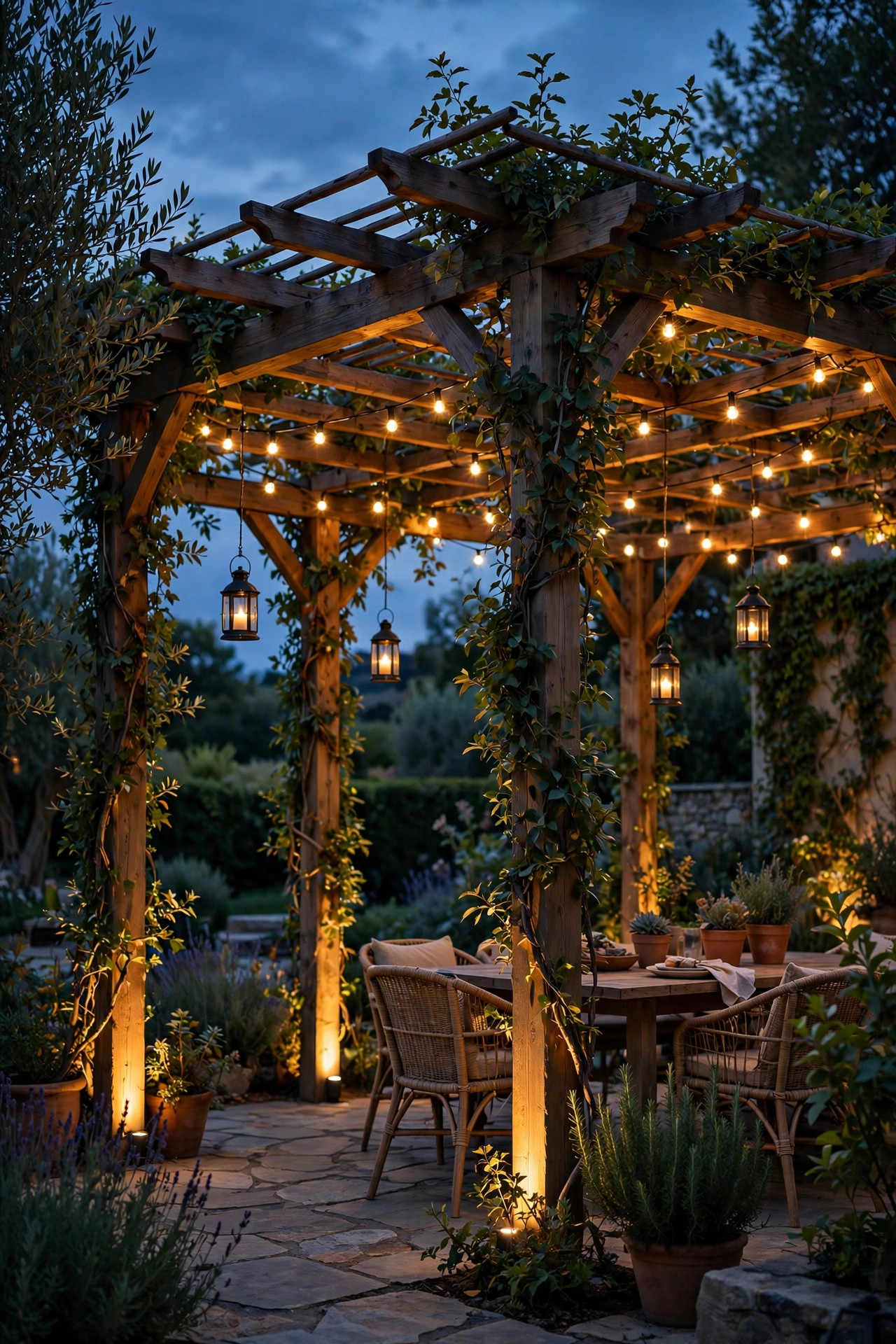
If you only buy one thing, make it a long strand of solar string lights sagging in gentle swags between the beams. It is the look everyone pictures, and honestly? It earns it. I run two 48-foot strands corner to corner in an X, then let the middles dip about 12 inches — deep enough to feel romantic, shallow enough that tall guests are not ducking bulbs.
The details matter. Choose warm white, 2700K, with shatterproof plastic bulbs; glass and pergola breezes are enemies. The solar panel is the whole game: clip it to the top of a south- or west-facing post where it gets six-plus hours of direct sun, never under the roofline in shade. Cable ties every 18 inches keep the catenary curve tidy, and a remote on/off switch saves you climbing a step stool nightly. My full walk-through of panels, strand lengths and runtimes is in my guide to solar string light ideas, but the short version is simple: charge it well, drape it generously, and the whole pergola glows until midnight.
Suggested budget range: $25 – $60.
2. Hang Solar Pendant Lights Over the Table
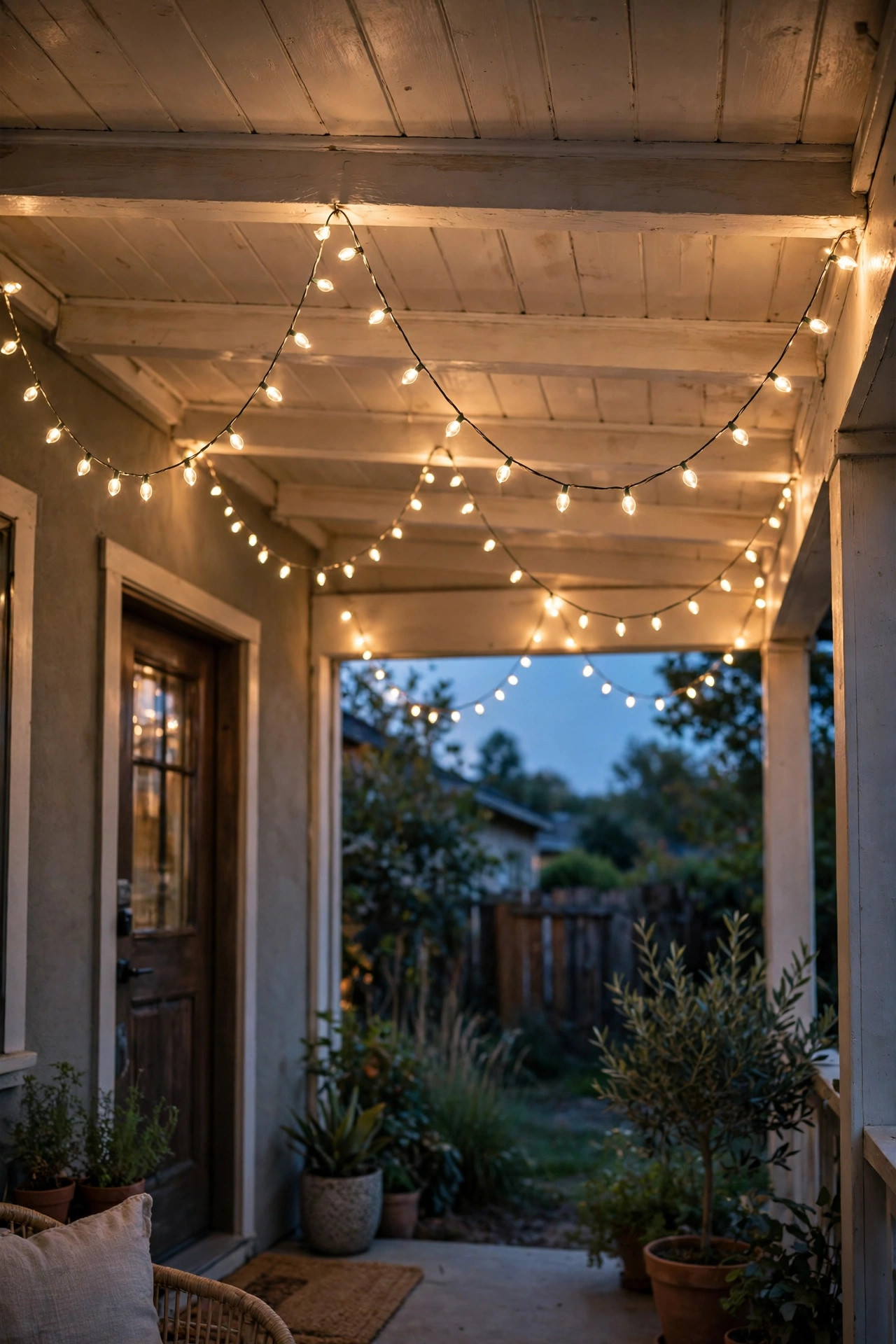
String lights give you atmosphere; pendants give you focus. A solar pendant hung directly over the dining table puts a pool of light exactly where the food, the board game and the faces are, and it makes the pergola feel like a room with a ceiling instead of a frame in the yard.
Most solar pendants hang from an S-hook or a short chain off the center beam — five minutes, no tools. The better designs use a separate panel on a 10-foot cord, so you can park the panel up on the sunny roof while the shade hangs below in the shade. Aim for 300–500 lumens per pendant and hang the bottom of the shade 30 inches above the tabletop, right at eye level when seated. Two smaller pendants beat one big one over a long farmhouse table; space them a third of the table length in from each end. On cloudy weeks, a pendant with a replaceable rechargeable battery is worth the small premium — swap in a charged spare and dinner is saved.
Suggested budget range: $30 – $80.

3. Cluster Hanging Solar Lanterns at Different Heights
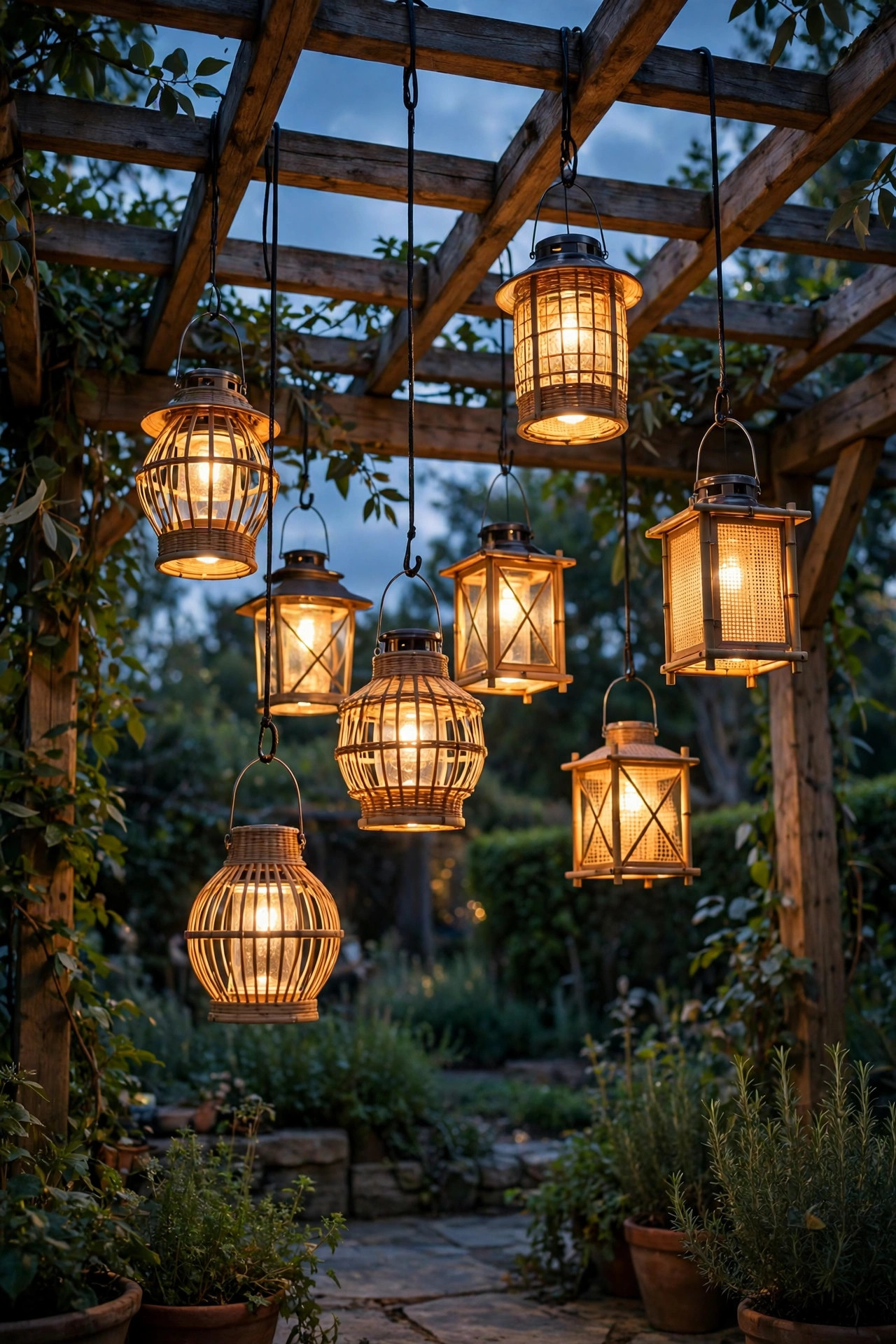
Lanterns are my favorite eye-level layer, because they put warm light right where people actually sit instead of only overhead. I hang solar lanterns from the pergola's cross beams in loose clusters of three — one at 5 feet, one at 6, one at 7 — and the staggered heights do the same visual work a stylist charges for.
Metal lanterns with flicker-effect LEDs read like real candles with none of the fire risk near curtains or dry vines, which matters; I only ever use LED flames under a pergola roof. Look for IP65 ratings so a sideways rainstorm is a non-event, and panels built into the lantern top so each one charges independently — if one hangs in a shadier corner, just rotate the cluster weekly. A matched set of six looks intentional; a flea-market mix looks collected. Both work. I keep a running list of my favorite styles and sizes in my roundup of solar lantern ideas if you want the shortcut. Ten minutes with a handful of hooks and the corners of your pergola stop disappearing after dark.
Suggested budget range: $20 – $50.
4. Cap the Posts With Solar Post Cap Lights
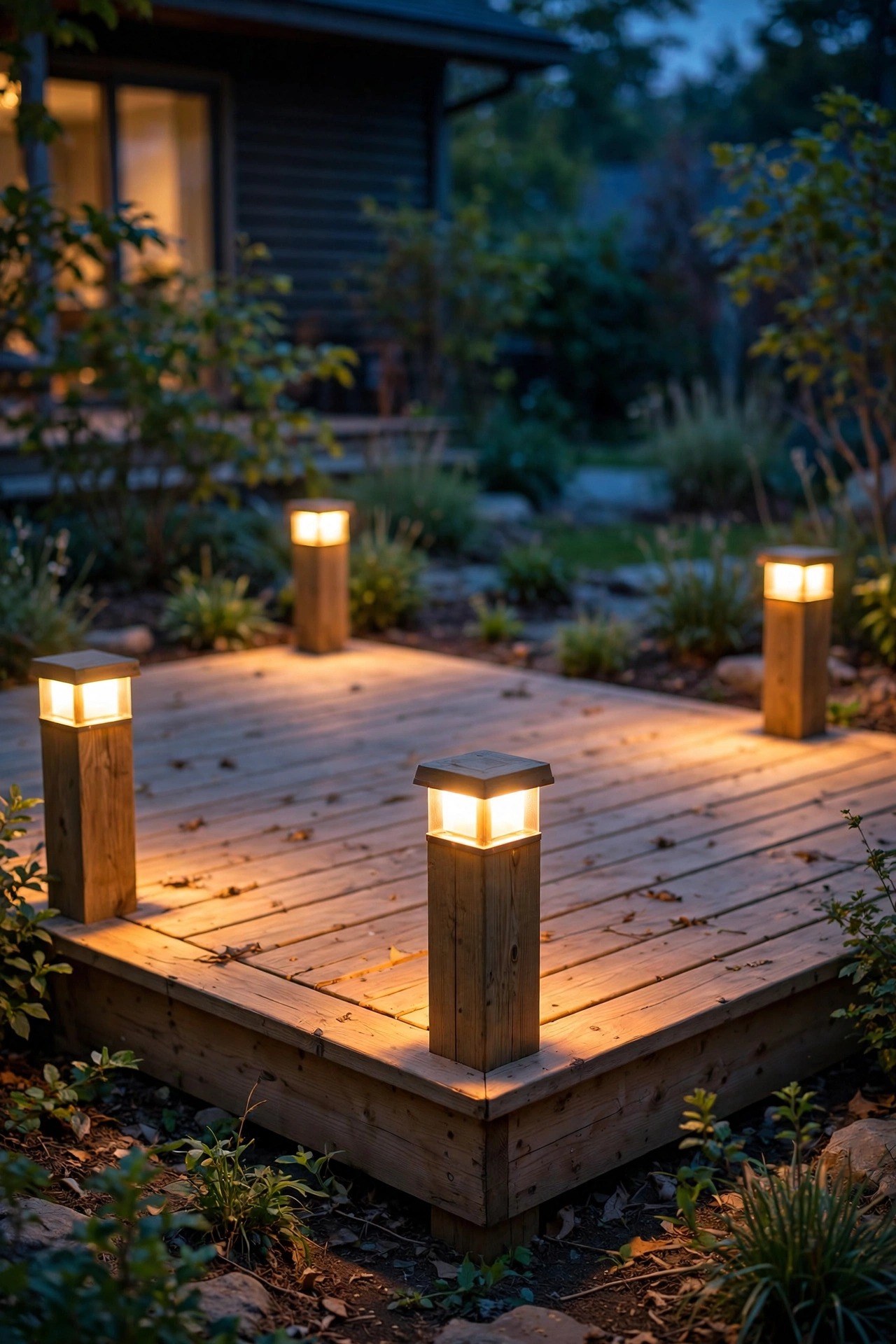
Every pergola post is a free light fixture waiting to happen. Solar post cap lights slip over 4×4 or 6×6 posts — measure yours before ordering, because "fits most posts" has burned me before — and wash a soft halo of light down the column that outlines the whole structure beautifully from the street.
In my experience these are accents, not task lights: expect 20–60 lumens each, enough to mark the architecture and keep guests from walking into a post with a drink in hand. That is genuinely useful. The flat top panel gets decent sun even on a partially shaded post, and most caps run eight hours on a full charge. Installation is two screws, or a bead of outdoor adhesive if your posts are composite and you would rather not drill. Run caps on all four (or six) posts for symmetry — mismatched heights or one dead cap looks sadder than none at all, so buy one spare when you order. Replaceable batteries stretch these from a two-season purchase into a five-year one.
Suggested budget range: $30 – $75.
5. Weave Solar Fairy Lights Through the Vines
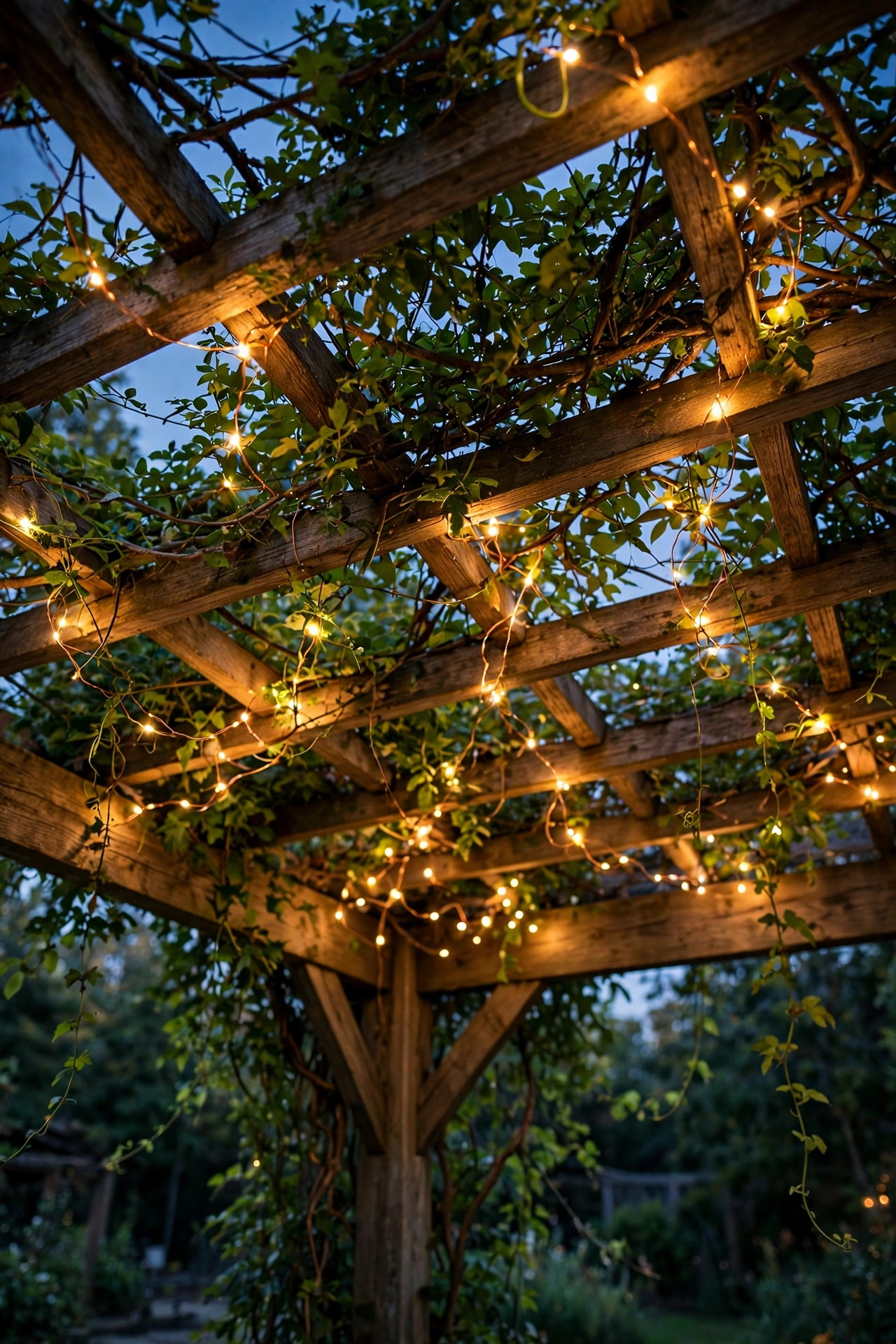
If your pergola carries wisteria, jasmine or grape vines, you already own the prettiest light diffuser in the neighborhood. Copper-wire solar fairy lights were made for this: the wire is thin enough to vanish into foliage, and a few hundred micro-LEDs scattered through the leaves look like fireflies that clocked in for the evening.
I weave one 66-foot strand per beam, threading it loosely — never cinch wire tight around living stems, because the vine will grow and strangle itself by midsummer. Leave slack loops and re-tuck them when you prune. Fairy lights are pure sparkle, maybe 1–2 lumens per bulb, so think of them as the jewelry layer over your string lights or pendants, not a replacement. The panel hides neatly in the sunniest patch of the roof growth. One safety note I repeat every time: LED-only near leaves and dry vine tendrils, always, and keep the battery pack where rain cannot pool on it. Set the timer mode to steady-on instead of twinkle for dinners — twinkle reads festive, but it makes reading a menu surprisingly hard.
Suggested budget range: $12 – $30.
6. Suspend a Solar Chandelier as the Centerpiece
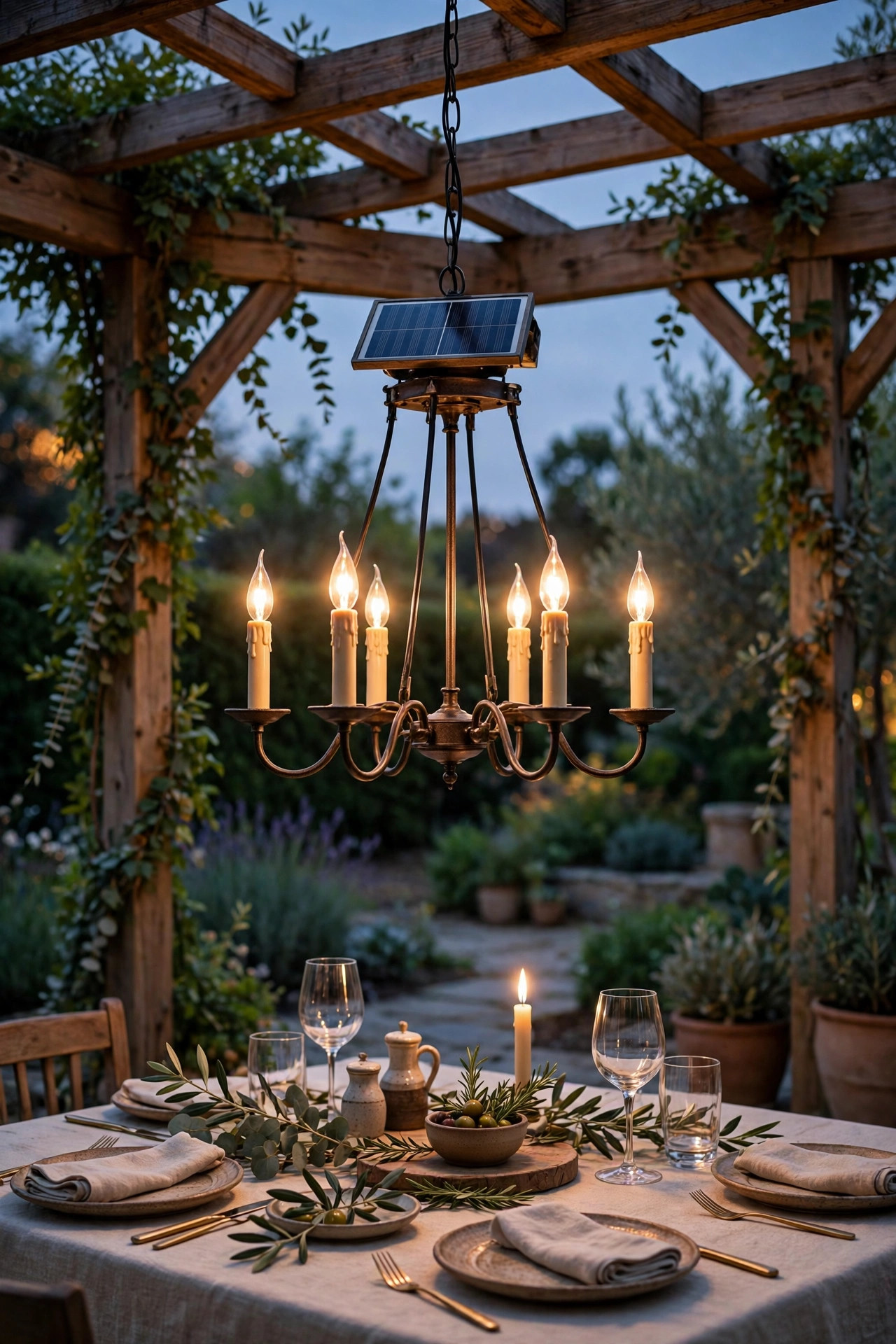
Yes, solar chandeliers are a real thing, and yes, they are as fun as they sound. A lightweight chandelier frame fitted with solar-powered candle bulbs hangs from the center beam and turns a plain pergola into an outdoor dining room with a capital D. Guests always ask where it is plugged in. Nowhere, friends. Nowhere.
Hang it from a rated hook screwed into the center of a main beam — pergola chandeliers run 5–15 pounds, so a screw eye into solid wood, never a adhesive hook. The panel usually mounts on the chandelier's top or on a cord; angle it toward the midday sun. Height matters: the bottom of the fixture should sit about 36 inches above the table so sightlines across stay open. Flickering candle-style bulbs at 2700K sell the illusion best. Because it is the centerpiece, everything else can stay simple: a chandelier plus post caps plus fairy lights is a complete three-layer scheme. Bring it into the garage for winter if you get hard freezes — the fixture will thank you with extra seasons of life.
Suggested budget range: $45 – $120.
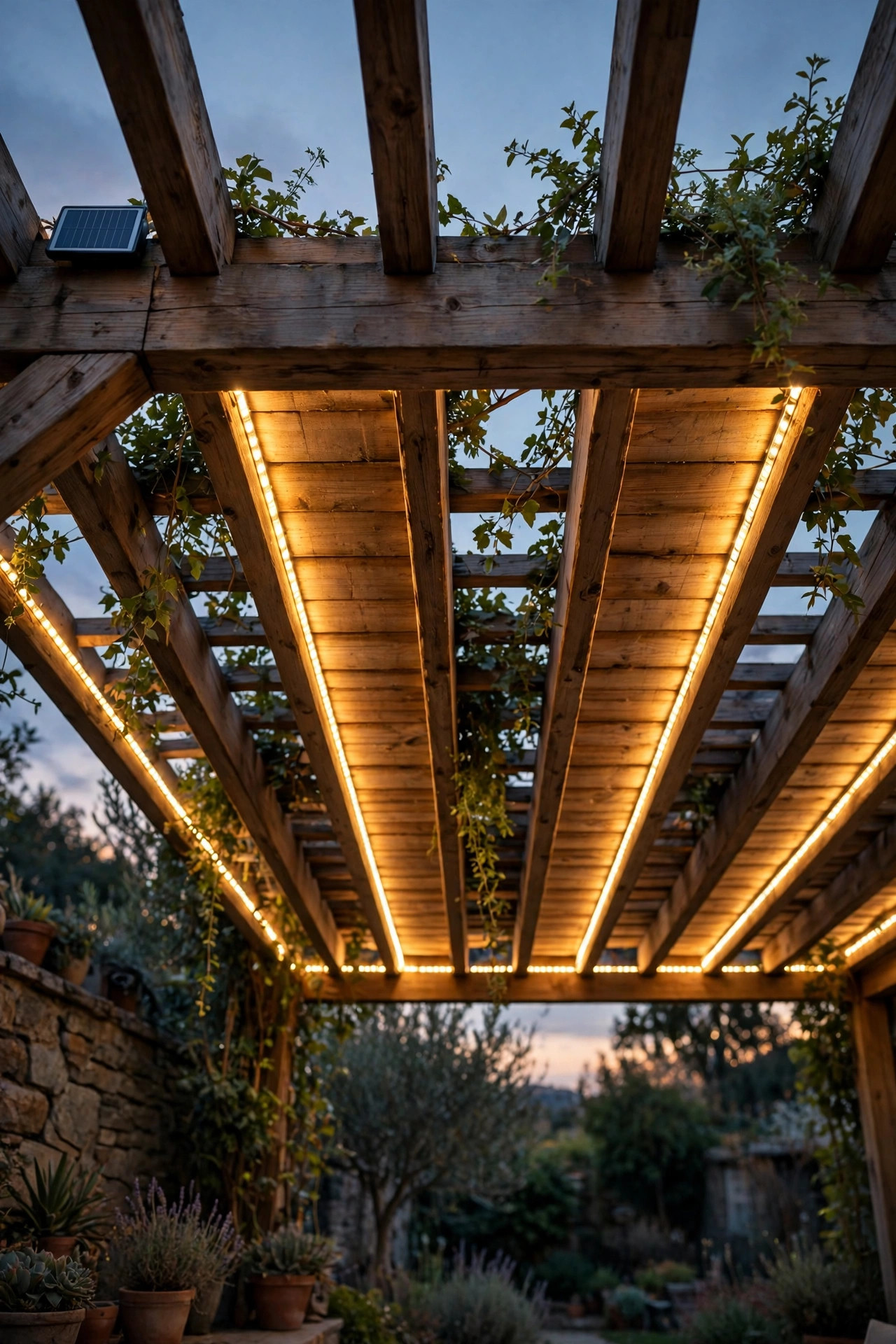
7. Run Solar Strip Lights Under the Rafters
Under-rafter strip lighting is the modern move: a slim solar LED strip tucked along the underside of each beam throws a clean, indirect wash across the whole ceiling plane, and the light source itself disappears. It reads "architect-designed" for the price of a pizza.
Solar strip kits pair an adhesive-backed strip with a separate panel and battery box, and that separation is the point — the strip lives in the shade doing its job while the panel sunbathes on the roof. Wipe the beam with rubbing alcohol before sticking the strip down, then add a clip every 2 feet anyway, because summer heat softens adhesive right when you have company. Choose 2700–3000K; anything cooler makes a pergola feel like a parking structure. A 16-foot strip per main beam, run front to back, lights a 12×14 pergola evenly with zero hotspots. Motion or timer remotes are common in these kits, and dimming to 50 percent stretches runtime deep into the night while looking, honestly, better than full blast.
Suggested budget range: $18 – $45.
8. Wash the Columns With Solar Uplights
Here is the layer most people skip, and it is the one that makes a pergola look expensive. Solar spotlights staked in the planting beds at the base of each post, aimed up the column, graze the wood grain and throw light into the canopy above. Landscapers call it uplighting; I call it the difference between flat and dimensional.
Stake the fixture 12–18 inches out from the post base and tilt it to about 30 degrees so the beam rakes the column instead of blasting past it. Two uplights per post is lush; one is plenty if your posts are chunky. Solar spotlights are the hardest-working lights in this category — look for 100–200 lumens, an adjustable head, and a panel you can angle separately from the lamp. These charge in the open beds, which conveniently get the sunniest exposure in the whole setup. A warm 3000K beam on cedar or white-painted posts is genuinely gorgeous, and the spillover lights the floor edge so nobody trips on the step down to the lawn.
Suggested budget range: $22 – $55.

9. Hang a Solar Curtain Light on the Open Side
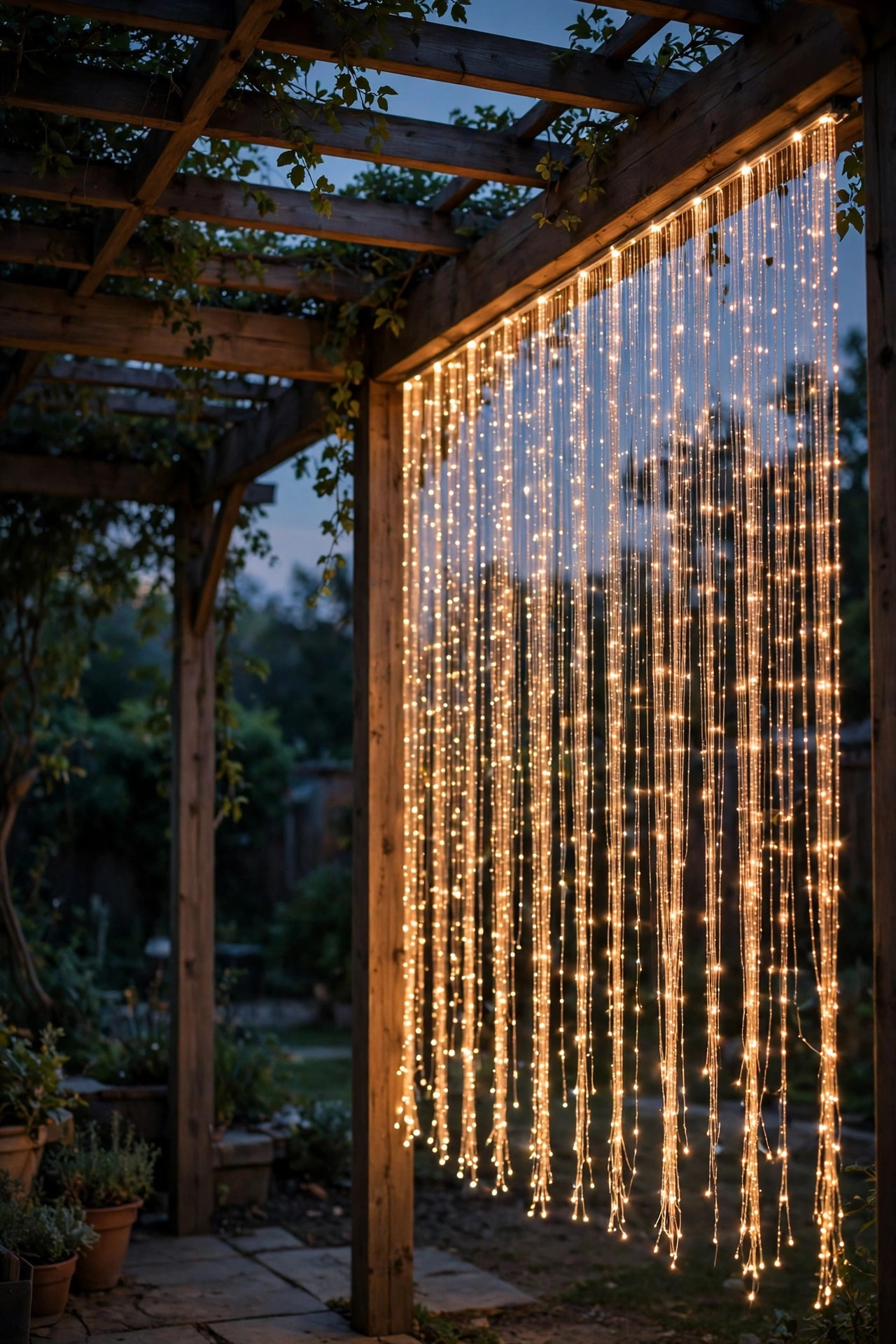
Every pergola has one side that faces the neighbors, the road, or the sunset glare at exactly dinnertime. A solar curtain light — a grid of fine strands dropping from a top wire — turns that open side into a glowing waterfall of light that doubles as a privacy screen. It is the most complimented thing in my yard, full stop.
Mount the top strand along the beam with hooks every 12 inches and let the drops fall 6–8 feet. The panel sits on the roof edge above, drinking in sun all day. Curtain strands are delicate, so this is the one idea I do not leave up in storm season; they unclip in five minutes. Choose steady warm white over flashing modes, and pair the curtain with a plain dark backdrop — a fence, a hedge — so the grid reads crisply. Behind a dining bench it photographs like a bistro. One honest caution: in very windy spots the strands tangle into a light-up knot, so weigh exposure before you commit.
Suggested budget range: $20 – $45.
10. Dangle Solar Mason Jar Lights From Hooks
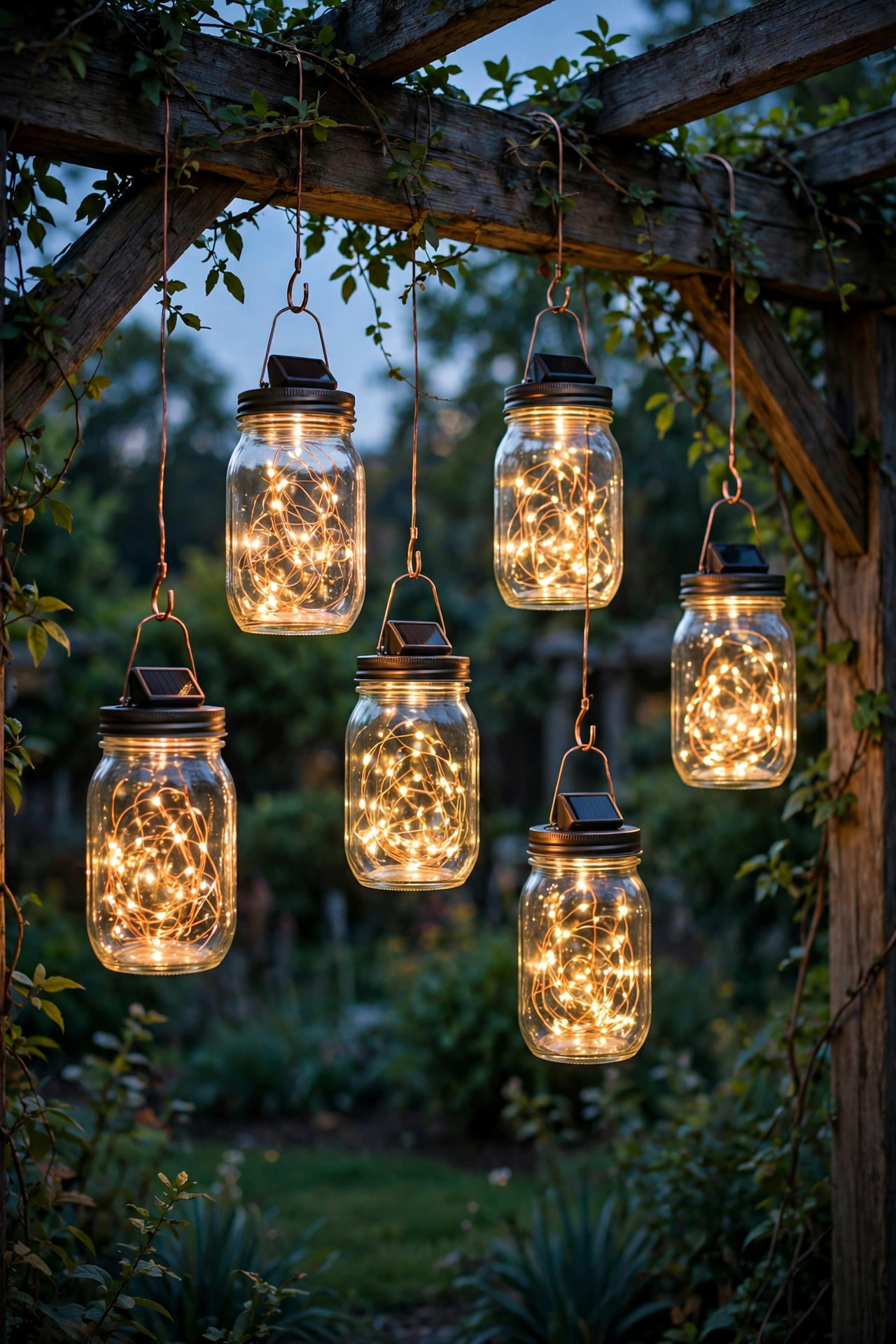
Mason jar solar lights are the five-minute craft project that looks like you tried much harder. Each jar lid carries a tiny panel, a battery and a coil of fairy lights inside the glass; you charge them on a sunny step all afternoon, then hang them from hooks along the beam at dusk. Rustic, charming, done.
Hang jars in odd numbers — three over a coffee table corner, five down a beam — at heights that vary by 6 inches or so. Frosted jars diffuse the glow and hide the battery pack; clear jars show off the copper coil and throw prettier sparkle patterns on the ceiling. Because each jar is self-contained, this is my go-to recommendation for pergolas in partial shade: worst case, you carry the jars to a sunny windowsill for a recharge day. They are not weatherproof enough to live outside through a wet winter, so plan on a shelf for January. For renters, this is the whole list in one idea — no holes, no hardware, no trace left behind.
Suggested budget range: $15 – $35.
11. Circle the Perimeter With Solar Flame Torches
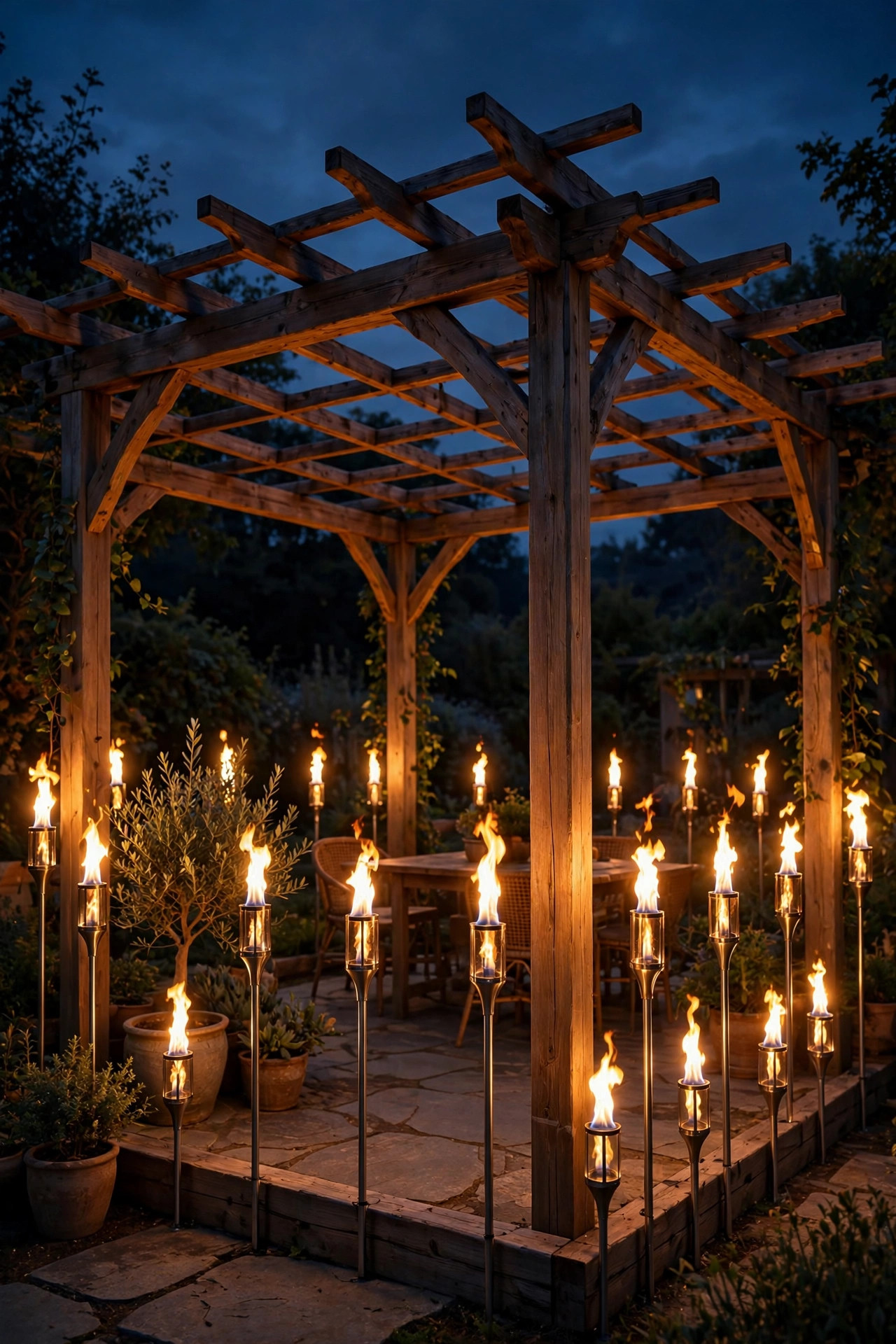
Solar torch lights with dancing flame effects give a pergola a resort glow without a single real flame near wood, cushions or curtains — and that last part is the entire point. I stake them in the beds around the pergola's outer corners and along the step edge, where the flicker frames the structure like torches around a courtyard.
Space torches 3–4 feet apart for a continuous rhythm; closer reads busy, farther reads random. Most run 6–10 hours, and the flame effect is convincing from about 10 feet away, which is exactly where your guests will be. Because the panels sit on top of the torch head, keep overhanging vine growth trimmed so each head still sees the sky. These are ambiance only — the warm orange color is closer to 1800K than to white light, so do not count them toward seeing your dinner. Layer them under real overhead light and they are pure mood. In my experience a set of six around a mid-size pergola is the sweet spot between tiki lounge and tasteful.
Suggested budget range: $25 – $60.
12. Outline the Beams With a Solar Rope Light
If draped strands feel too boho for your house, outline the beams instead. A solar rope light clipped straight along the top edges of the pergola draws the architecture in light — crisp, modern, and especially good on aluminum or square-profile pergolas where swags fight the geometry.
Mounting clips every 12 inches keep the rope dead straight, and that straightness is the whole aesthetic, so take the ten extra minutes with a level line of painter's tape as a guide. Rope lights sip power, which makes them the runtime champions of this list — ten-plus hours is normal. Run one continuous rope around the full rectangle rather than stopping at corners; the unbroken outline is what reads as custom. Warm white only, please: cool white rope light is how outdoor spaces end up looking like a gas station. The panel mounts flat on the roof peak. Pair the outline with soft interior layers — lanterns, table candles — so the pergola glows from inside its frame instead of looking like a sign.
Suggested budget range: $15 – $40.
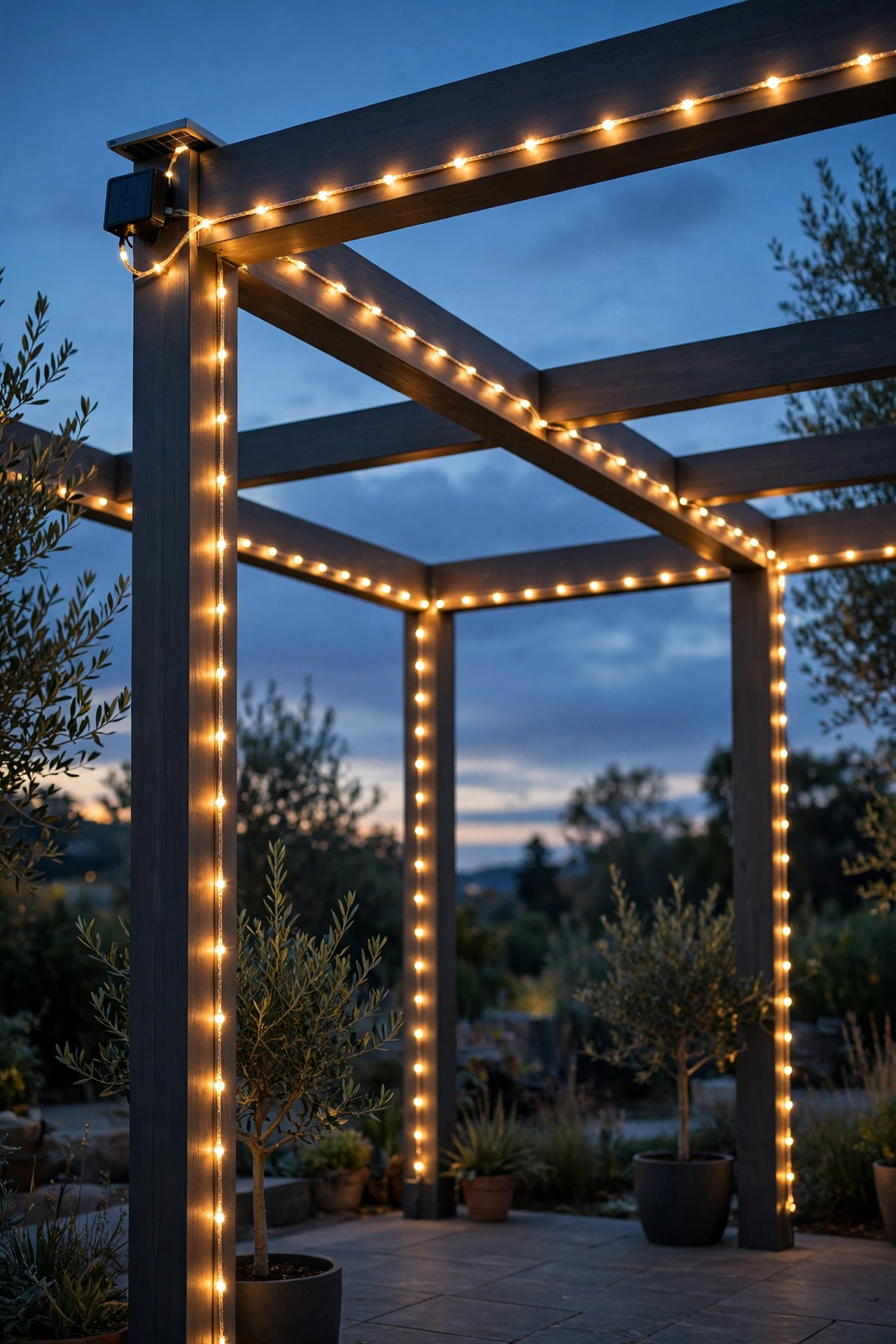
13. String Solar Globe Lanterns Corner to Corner
Globe lantern strings — the paper-look orbs, usually nylon rather than real paper — bring a soft, festival softness that bare bulbs cannot. Strung corner to corner over a pergola, the orbs float like little moons, and because each globe diffuses its LED, the light is flattering and shadow-free. Dinner guests look great under globes. This is known.
Solar versions hide the panel at one end of the strand, so plan that end at your sunniest corner. Orbs run 4–6 inches across; on a big pergola, the larger size holds its own better. Nylon globes shrug off rain and collapse flat for storage, unlike actual paper, which I learned about so you do not have to. Keep swags shallower than bulb strands — about 8 inches of dip — because globes swing in wind and a deep swag turns them into slow-motion wrecking balls against the posts. Mix one globe strand with one plain strand of warm bulbs for texture if a full set of orbs feels too themed. It photographs beautifully either way.
Suggested budget range: $28 – $65.
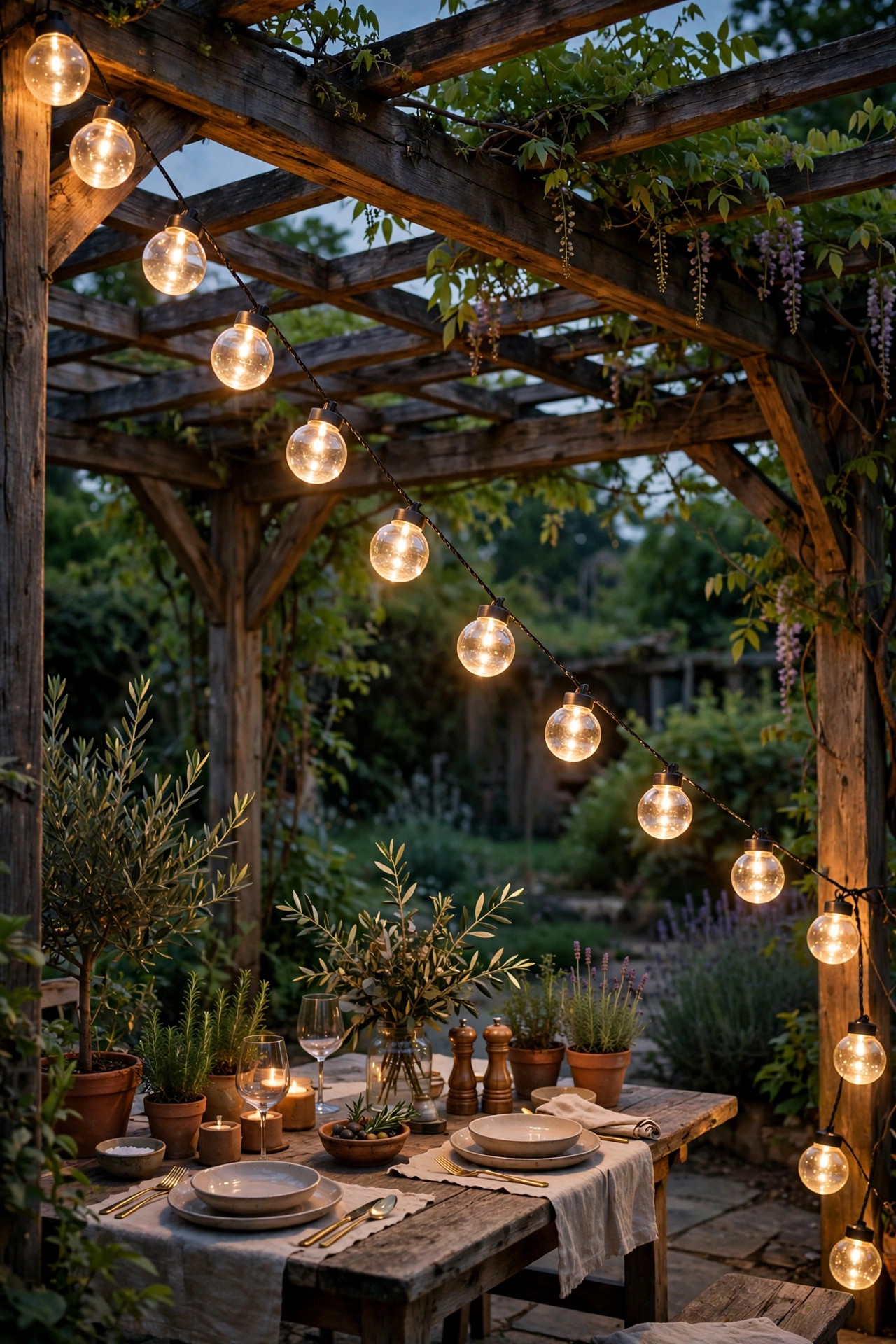
14. Use Remote-Panel Solar Downlights in Deep Shade
The number one complaint about solar is "mine never charge," and nine times out of ten the pergola roof is the culprit — a louvered or vine-covered top shades everything beneath it. Remote-panel downlights solve this properly: the fixtures mount under your beams like little recessed cans, while a cabled panel sits up on the sunny roof doing the charging.
This is the closest solar gets to hardwired performance. Expect a focused 200–400 lumen pool under each light, which makes these the best solar choice over a grill station or reading chair. Space cans 3–4 feet apart along the beam and run the cable neatly with clips; a dangling wire ruins the built-in illusion. Panels on these kits are bigger, so they charge respectably even on bright overcast days. Installation takes a screwdriver and a ladder and about an hour for four lights. If your pergola is deeply shaded and every other solar light has disappointed you, start here — this is the idea that converts skeptics.
Suggested budget range: $35 – $90.
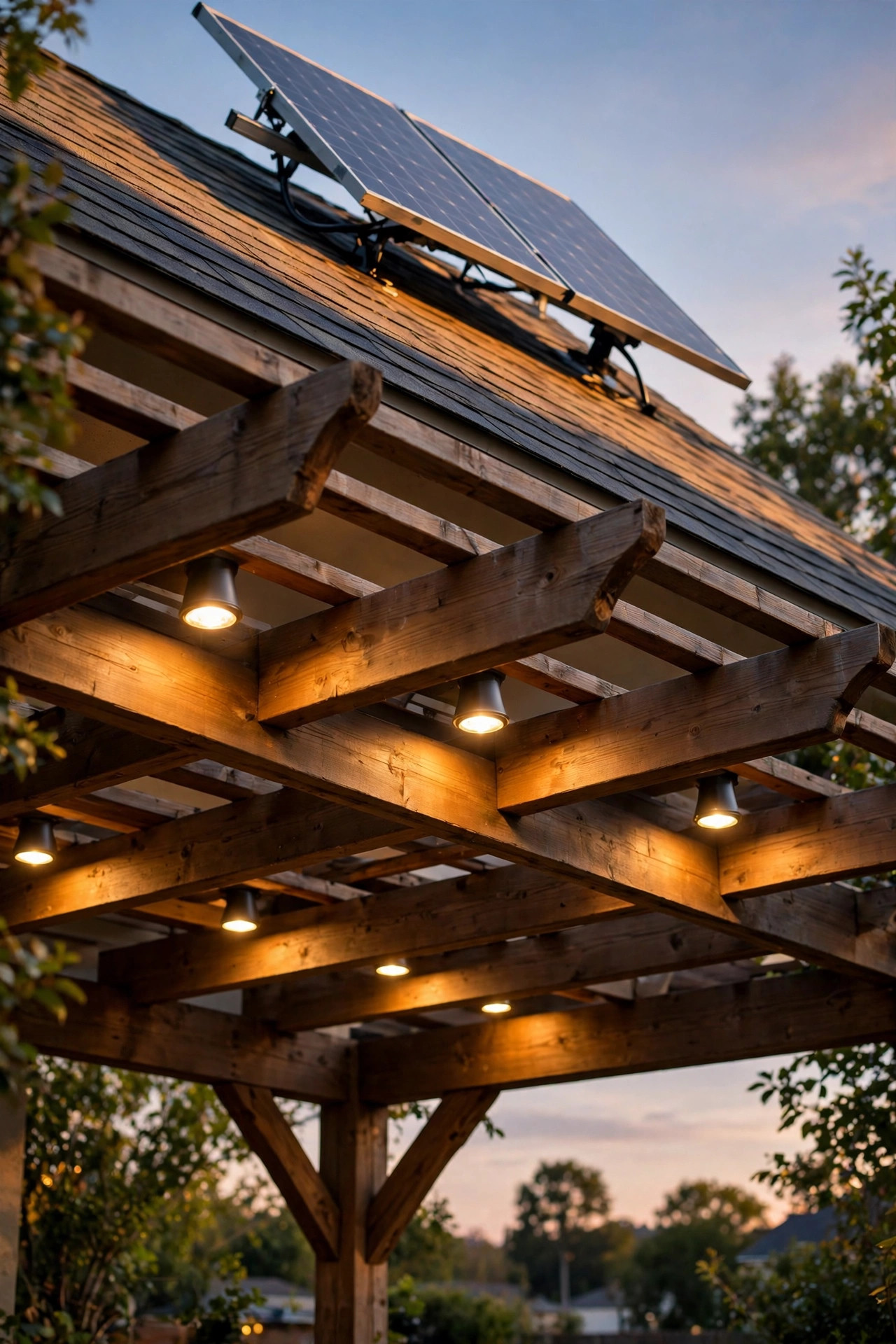
15. Add a Solar Motion-Sensor Light for Arrival and Security
Pretty is important, but a pergola you stumble toward in the dark is a pergola you will not use on weeknights. One solar motion-sensor light mounted on the approach-side post fixes that: it wakes to a bright 800–1,500 lumens when anyone walks up, then settles back to a dim glow or off after 20–30 seconds.
Mount it 7–8 feet up on the post facing the path or gate, tilted slightly down so the sensor's cone covers the walkway. These are usually the coolest-white lights in a kit world, so look for a warm or neutral 4000K option if you can find one, and treat it as a utility player rather than part of your pretty scheme — it lives outside the pergola's glow, not inside it. The oversized panel and battery in most motion lights make them the most reliable chargers on this list, even facing north. Bonus: the same light politely illuminates the step, the cooler run, and the dog's midnight garden patrol.
Suggested budget range: $18 – $40.
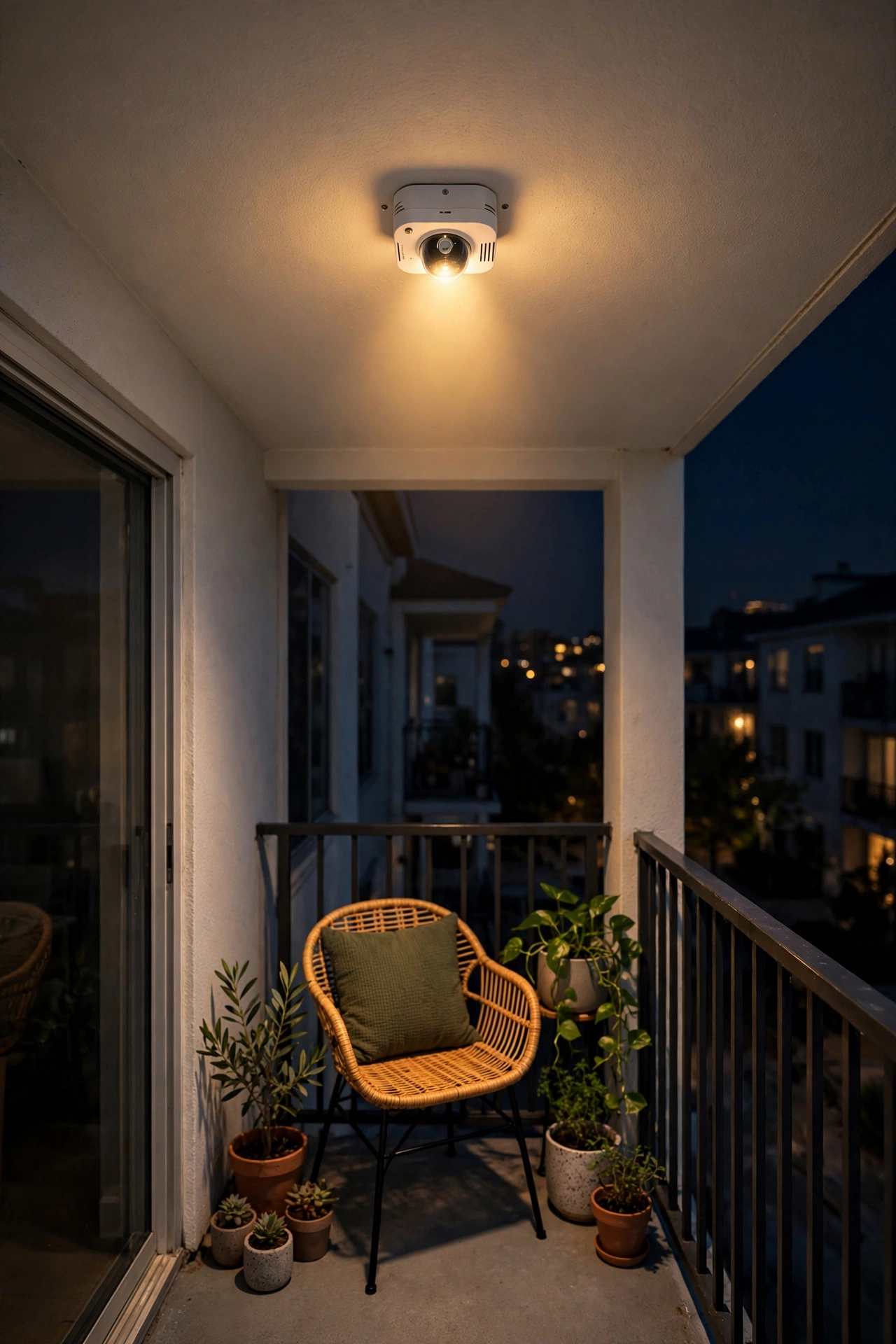
16. Set the Table With Solar Lanterns and Flameless Candles
Overhead light shows you the table; table-level light makes it glow. Small solar lanterns and solar-charged flameless candles scattered down the center of the table are the layer your guests' faces actually sit in, and face light is the difference between a photo you frame and one you delete.
I run a low line of three mini lanterns or a cluster of flameless pillars in the middle, keeping everything under 8 inches tall so sightlines and serving dishes survive. Real flame near pergola curtains and paper napkins is a gamble I stopped taking years ago — LED flicker at the table is now good enough that nobody mentions it. Charge table pieces on the sunniest corner of the pergola floor during the day, or line them up on a south-facing step in the morning like little soldiers reporting for duty. Because they are loose, they migrate: two on the side table, one by the drinks, wherever the evening needs a pool of warm. Buy a couple extra; table lanterns have a mysterious habit of adopting new homes.
Suggested budget range: $15 – $35.

17. Edge the Floor With Solar Path and Step Lights
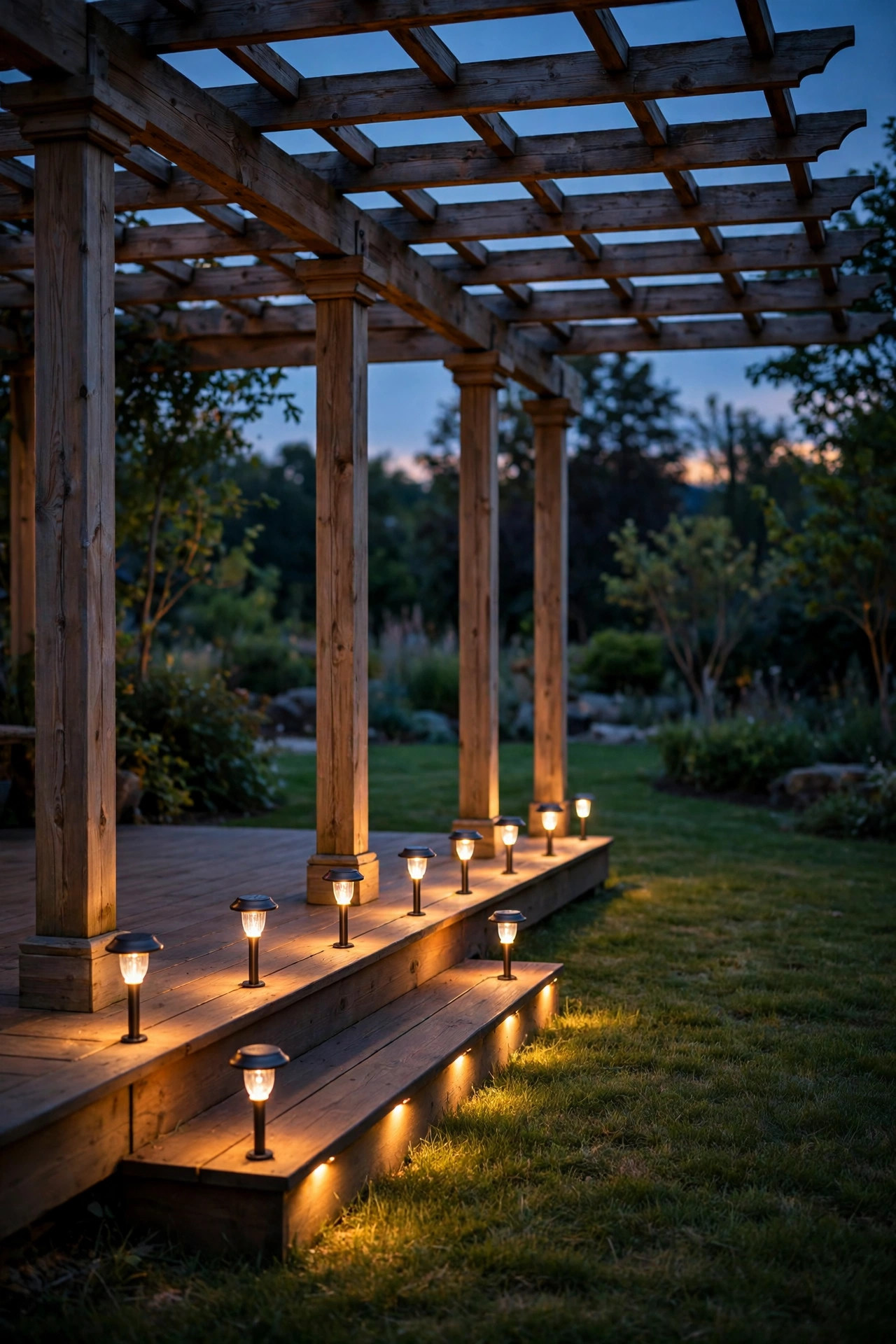
A pergola floor usually has an edge — a step down to the lawn, a border of pavers, a change from deck to stone — and that edge is where ankles get rolled in the dark. Short solar path lights or flush solar step lights marking the boundary are the safety layer that also happens to look like a runway in the best way.
Stakes go in the beds flanking the opening, spaced about 4 feet apart, or choose disk-style lights that sit flush in the deck boards for a zero-profile look you can walk over barefoot. Keep these dim and warm — their job is punctuation, not illumination, and bright ground lights glare up into sitting eyes. The spillover also washes the floor just enough to find a dropped fork, a real and recurring problem in my house. Because they sit low under the roofline's shadow at the structure's edge, pick models with slightly larger panels, or angle the stake so the panel tips toward open sky. Ten minutes to install, and the pergola gains a defined footprint after dark instead of fading into the yard.
Suggested budget range: $20 – $50.
18. Cool Things Down With a Solar Fan Light
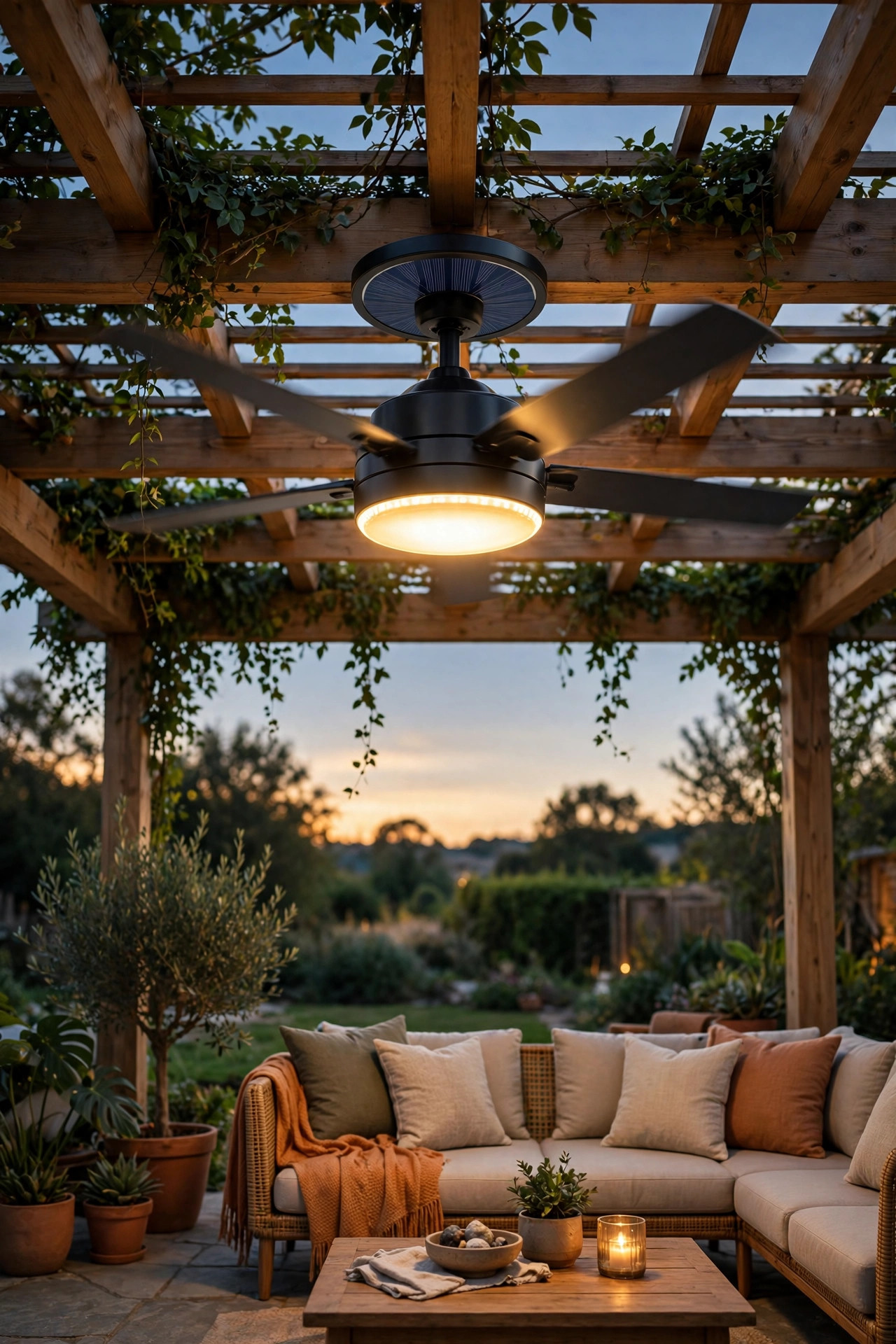
On still August nights the prettiest pergola in the world loses to the living room, because air matters as much as light. A solar fan light — a ceiling-style fan with a built-in light, powered by a roof panel and battery pack — moves the air, discourages the mosquitoes that hate a breeze, and lights the table in one fixture.
Hang it from the center beam on a proper fan-rated mount screwed into solid wood; a pergola beam carries the weight fine, but never trust a hook meant for a plant. Expect gentle-breeze performance rather than indoor-fan power, and runtime of 4–6 hours on the battery after a full sunny day — long enough for dinner and cards, which is the assignment. The built-in light usually lands around 3000K, which blends happily with warm string lights. Remote controls with speed and timer settings are standard, and on cool evenings you just use the light. For southern climates and screen-free pergolas, this is the idea that adds the most actual evenings outside per dollar.
Suggested budget range: $60 – $150.
19. My Favorite Solar Pergola Lighting Ideas, Layered Together
Everything above is a solo act; this is the band. When friends ask what I would do with one free Saturday and a modest budget, it is this exact recipe: draped string lights overhead for the canopy, a pendant or small cluster of lanterns at eye level over the table, uplights washing two posts, and path lights edging the floor. Four products, three layers plus a safety edge, and the pergola stops looking lit and starts looking designed.
Order matters when you shop. Buy the overhead layer first and live with it a week; your eyes will tell you exactly where the dark corners are, and that is where layers two and three go. Match every piece to 2700–3000K so the layers blend into one warm room instead of competing colors. Total runtime trick: stagger the timers so fairy lights and lanterns flicker on at dusk while the big strands wait for full dark — the pergola deepens as the night does. This combo has carried my pergola through three summers of birthdays, book clubs and one very memorable thunderstorm-watching session, all without a single foot of wire.
Suggested budget range: $75 – $180.

Frequently Asked Questions
Do solar lights work if my pergola roof is shaded?
Yes, with the right style. Lights with a remote panel on a cord are built for exactly this: the fixtures live in the shade while the panel sits on the sunny roof. Self-contained pieces like mason jar lights can also be carried to a sunny spot for a recharge day. What will not work is a small built-in panel trapped under dense vines all day.
How bright are solar pergola lights, really?
Honestly? Most are accent-level: string lights and lanterns land in the 10–100 lumen range per piece, which is perfect for atmosphere. Solar pendants and remote-panel downlights reach 200–500 lumens and can genuinely light a table. For reading or grilling, plan one stronger piece per task zone rather than expecting the whole setup to do it.
How long do solar lights stay lit at night?
After a full sunny day, expect 6–10 hours from most solar pergola lights — on at dusk, still glowing past midnight in summer. Cloudy days and winter's shorter days cut that, sometimes in half. Replaceable rechargeable batteries are the fix for tired lights; the LED and panel almost always outlive the battery by years.
What color temperature looks best on a pergola?
Warm white, 2700–3000K, every time. It flatters wood, skin and food, and it mimics candlelight and sunset. Cool white solar lights (5000K and up) look harsh and clinical outdoors. When a product only lists "warm white" without a number, that is almost always the right family — just make sure every layer matches.
Conclusion
Zero wiring does not have to mean zero atmosphere. The solar pergola lighting ideas that actually work all follow the same recipe: give every panel its six hours of sun, then layer something overhead, something at eye level, and something at the base of the posts. Start with the string lights, add the layer your pergola asks for next, and you will be eating outside long after the neighbors have gone in. For even more ways to finish the look — including a few wired options for the truly ambitious — browse my full collection of pergola lighting ideas and pick your next project.