Every summer, my patio umbrella does double duty. All afternoon it is the hardest-working shade-maker in the yard, and then the sun drops, dinner moves outside, and suddenly that same umbrella becomes a dark cave over the table. I fixed that problem years ago with patio umbrella lights, and honestly? It is still my favorite five-minute upgrade in the whole backyard. A soft pool of light under the canopy makes the table feel like a tiny outdoor dining room — you can see your plate, your people, and your lemonade, without a harsh porch floodlight glaring in everyone's eyes. The trick, as always, is layering: a gentle wash of light from the umbrella itself, a little sparkle at the edges, and a warm color temperature so food and faces look their best. In this post I'm sharing the 15 setups I've tried myself, borrowed from neighbors, or installed for friends — from a $15 roll of fairy lights to a solar hub that charges all day while it shades you. Every one of them is renter-friendly, weather-aware, and simple enough to finish before the burgers come off the grill.
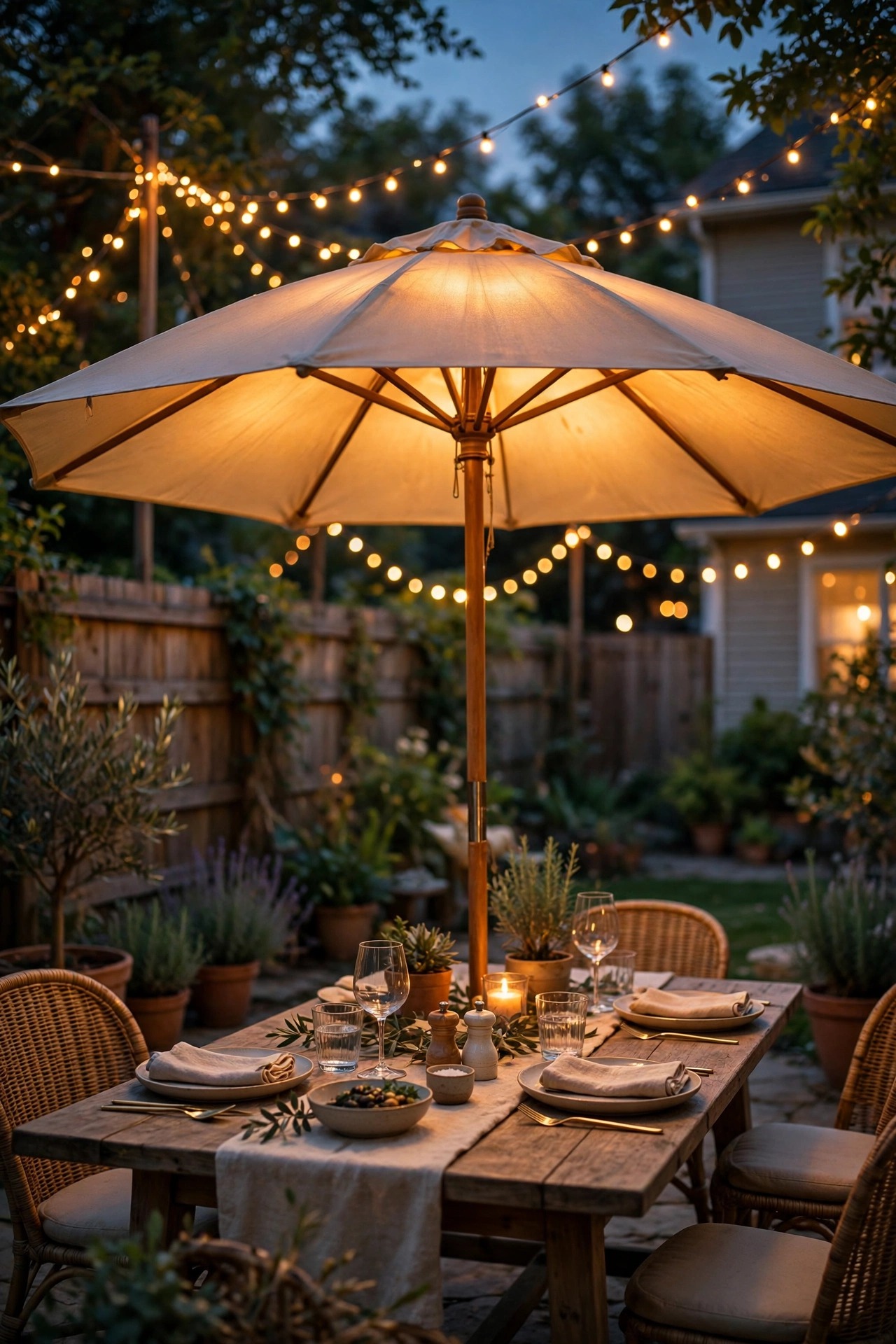
1. The Classic Clamp-On Hub Light
If you only buy one thing from this list, make it the clamp-on hub light. This is the round, donut-shaped disk that squeezes open, wraps around the umbrella pole just under the canopy, and clicks shut — no tools, no wiring, no drama. Most have two or three dozen small LEDs angled slightly downward, which is exactly where you want the light: on the table, not in your eyes. Look for one with at least two brightness settings, because full blast is great for a card game but a little much for a slow glass of wine. In my experience, the rechargeable versions beat the battery-eating ones; a USB charge overnight gives me a week of evening dinners. Measure your pole before ordering — most hubs fit poles from about 1 to 2 inches in diameter, and a loose fit means a slowly sliding light by dessert. One more tip: mount it as high on the pole as the canopy ribs allow. The higher the source, the wider and softer the pool of light on the table below.
Suggested budget range: $25 – $45.

2. Copper-Wire Fairy Lights Woven Through the Ribs
This is the look that gets me the most compliments, and it might be the cheapest idea here. Take a battery-powered string of copper-wire fairy lights — the kind with tiny warm-white LEDs on a wire so thin it nearly disappears — and weave it loosely along each rib of the umbrella, working from the center hub outward. The wire bends and holds its shape, so you don't need clips or tape, and when the lights come on the whole canopy glows like the inside of a lantern. I run the little battery pack down the pole and tuck it into a small pouch or clip it at table height so it's easy to switch on. Choose the timer version if you can find it; mine clicks on at dusk and off four hours later, and I forget it's even there until someone asks how the umbrella "does that." Two safety notes from experience: use LED fairy lights only (they stay cool against fabric), and bring the battery pack inside during heavy rain unless it's rated for outdoor use.
Suggested budget range: $12 – $25.

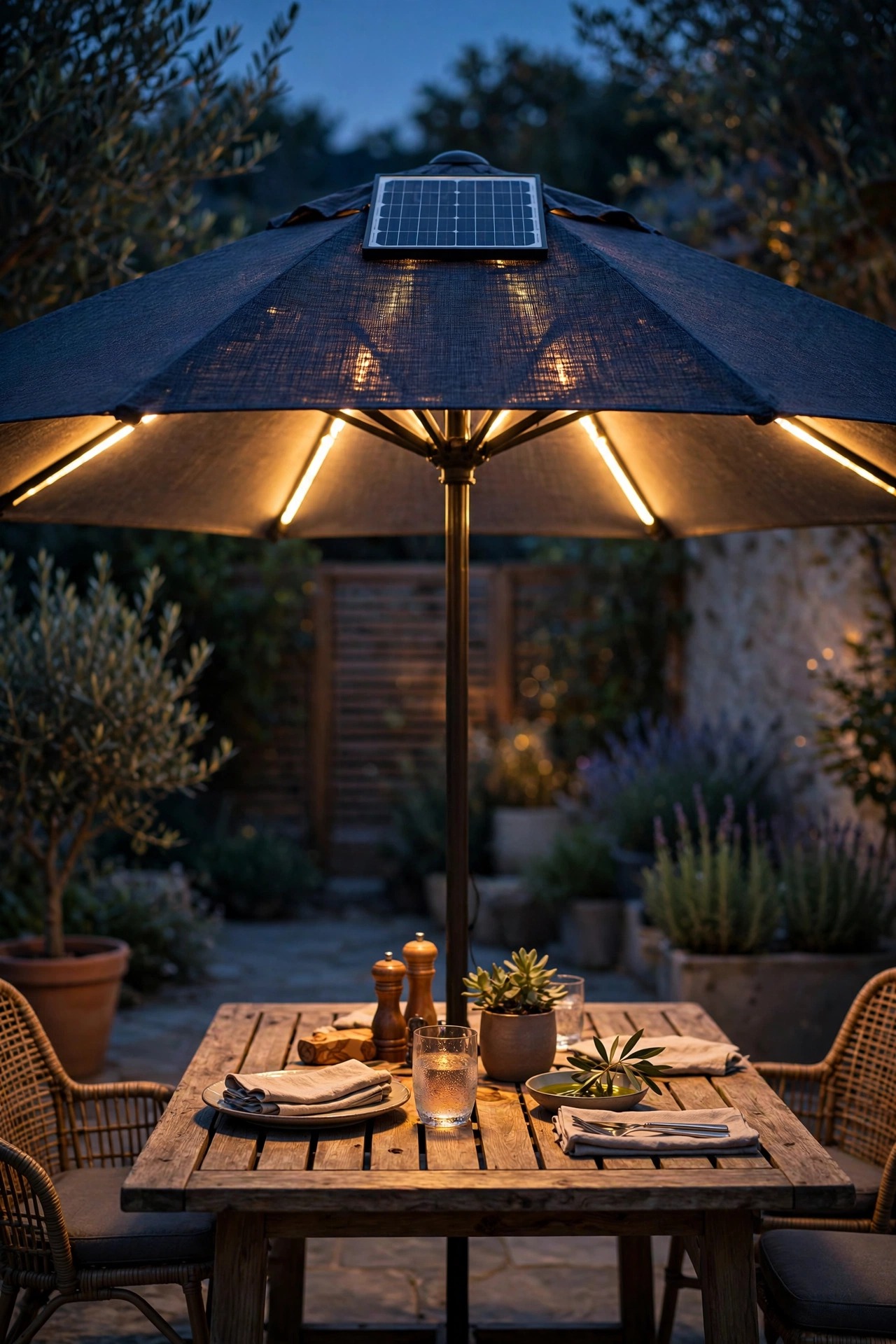
3. Patio Umbrella Lights With a Solar Twist
Solar versions of the clamp-on hub are perfect if your patio sits in full sun all day — which, let's be honest, is exactly where umbrellas live. The small solar panel either sits on top of the canopy or clips to the finial, soaking up charge while the umbrella does its day job, and the light runs for six to eight hours after dark. I always recommend a model with a removable panel on a short cord, because you can angle it toward the sun even when the umbrella is tilted. Expect a slightly softer glow than a plug-in or USB hub; for dinner conversation it's lovely, but for reading a novel you may want a second light source. Wipe the panel with a damp cloth every few weeks — pollen film quietly steals brightness, especially in spring. And a realistic note: on a heavily overcast day, charge time drops, so solar works best as your everyday glow with a rechargeable backup for marathon evenings.
Suggested budget range: $20 – $40.
4. String Lights Draped From the Canopy Edge
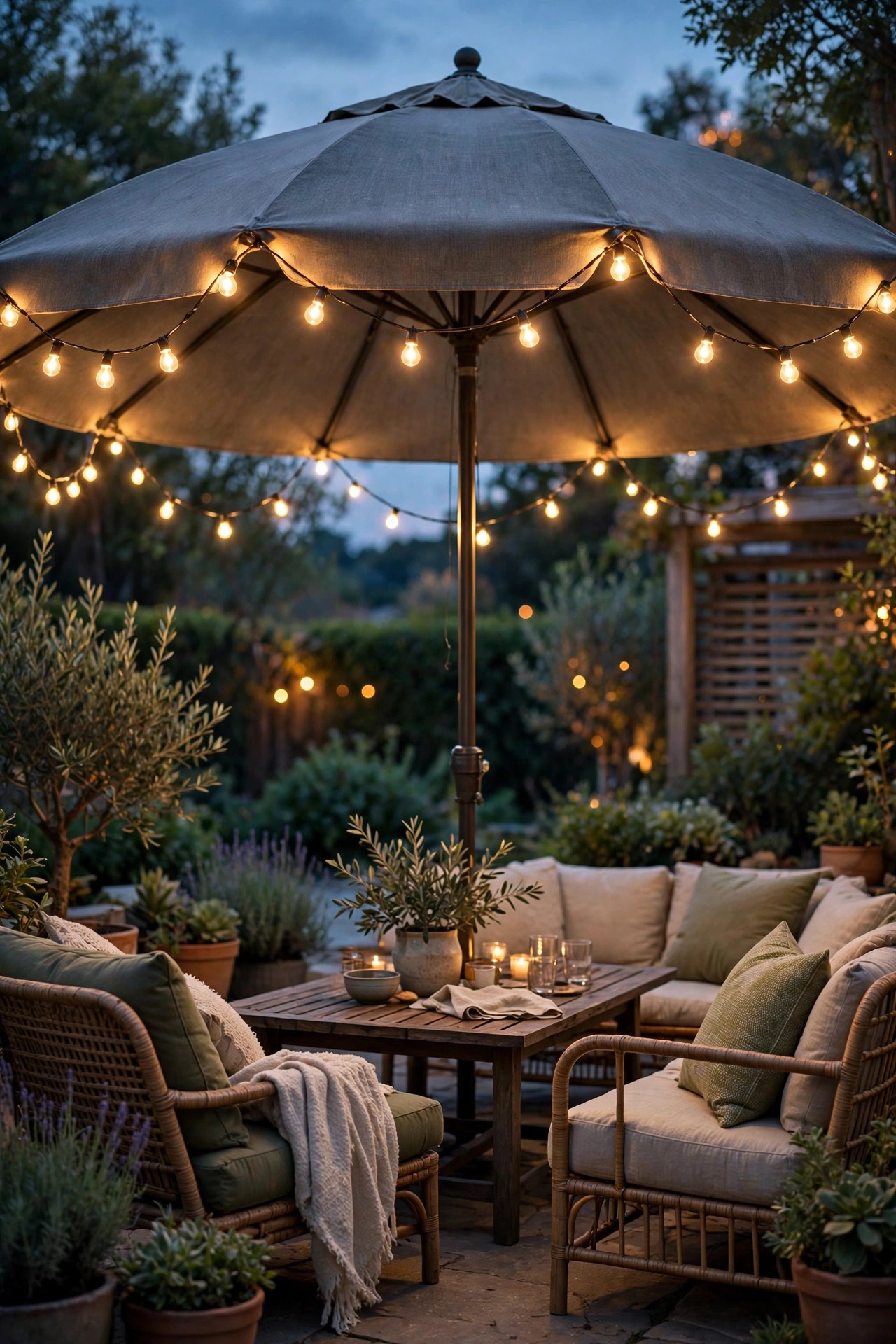
For a bigger, bistro-style statement, drape a strand of outdoor string lights around the outside edge of the canopy, clipping each bulb socket to the rim with small gutter-style clips or the little hooks made for umbrella ribs. The effect is half café, half backyard wedding, and the light spills both under the umbrella and out into the yard, which makes the whole patio feel bigger. I like shatterproof LED filament bulbs in the 2700K range here — they give that vintage glow and sip power. If your strand is heavy, run it in gentle swags between rib tips rather than one tight circle; the fabric will thank you and the drape looks prettier anyway. This is also the easiest idea to scale: on my bistro string light ideas page I show the same swag technique stretched across a whole deck. Keep the plug end near the pole and use an outdoor-rated extension cord with the connection tucked up under the canopy, out of the rain drip line.
Suggested budget range: $20 – $50.
5. LED Strip Lights Along the Ribs
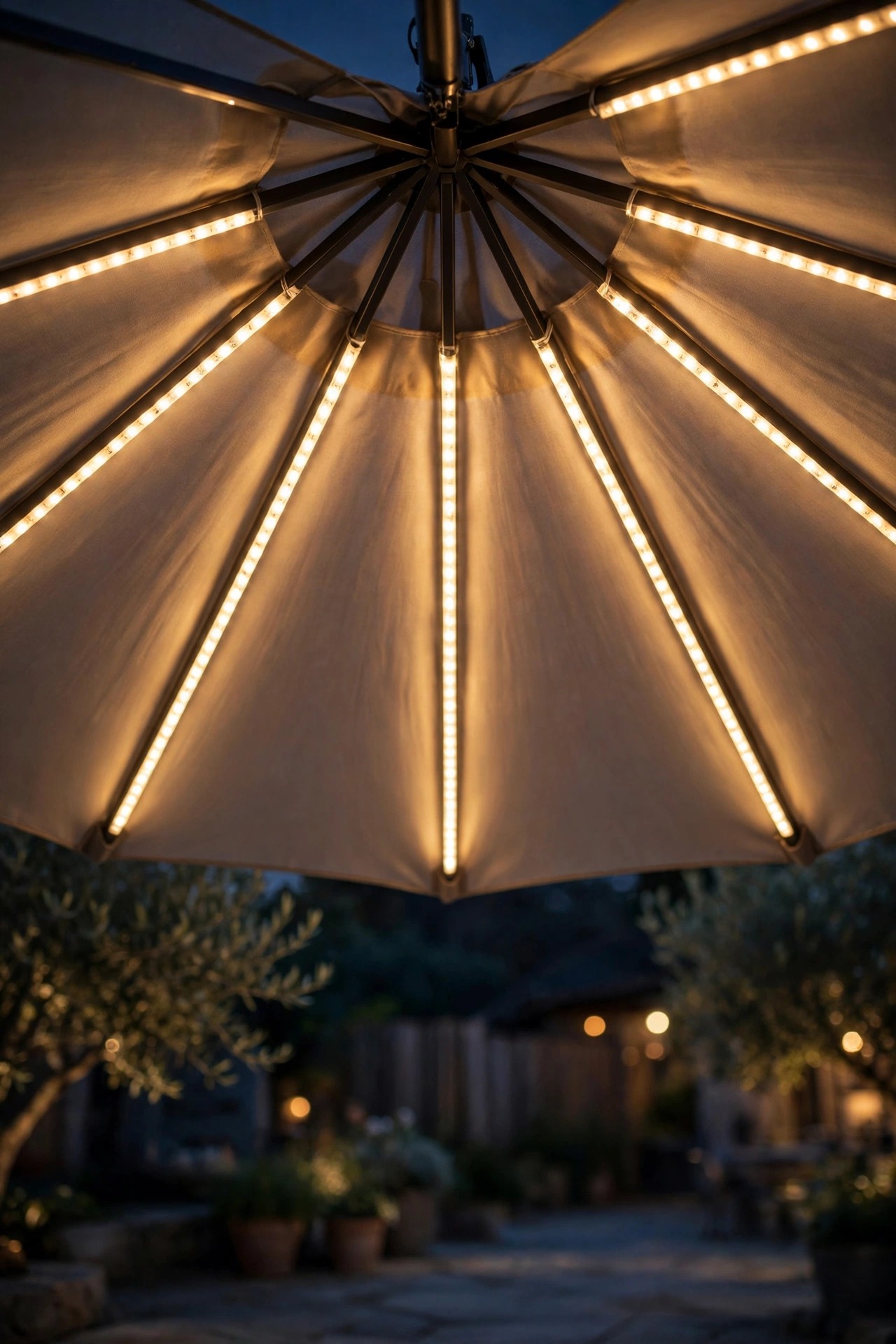
If you love a clean, modern look, adhesive LED strip lighting is your friend. Flexible waterproof strips stick neatly along the underside of each rib, radiating out from the hub like spokes, and the light they throw is smooth, even, and shadow-free — wonderful for game nights and serving food. Peel-and-stick adhesive alone rarely survives a hot summer on fabric, so I reinforce with the tiny clear clips that come in most kits, one every foot or so. Battery-pack strips keep things cordless, but the recharge time is real; if your umbrella lives near an outlet, a USB-powered strip plugged into a small power bank tucked in the pole's crank housing is a neat compromise. Choose warm white, around 2700K to 3000K — cool-white strips under a canopy read more "office" than "evening on the patio," a lesson I learned the blue-tinted way. Most strips can be trimmed at marked points, so measure one rib, cut once, and use it as your template for the rest.
Suggested budget range: $15 – $35.
6. A Lantern Hanging From the Center Hook
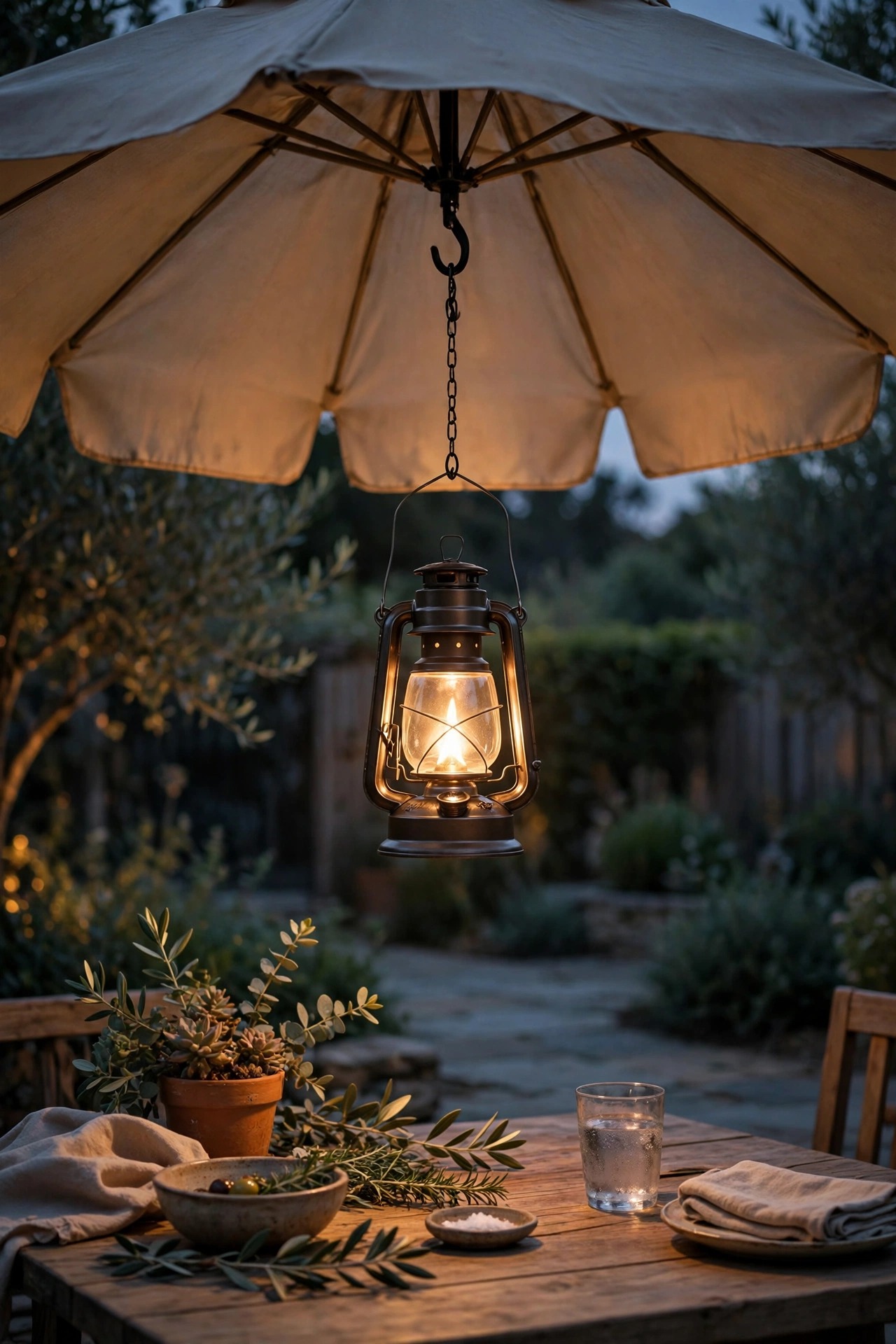
Many umbrella frames have a small hook or loop at the center hub, and it is practically begging for a hanging lantern. A single battery-operated lantern with a warm flickering or steady glow hangs right over the middle of the table, giving you that old-fashioned camp-lantern pool of light that makes everything feel cozy. Keep the lantern light — under two pounds is my rule — and hang it on a short cord or carabiner so it doesn't swing into anyone's forehead when the breeze picks up. Flameless is non-negotiable for me here: an LED lantern with a realistic flame effect gives the mood without an open flame inches from canopy fabric. This idea layers beautifully with a dim hub light; the lantern becomes the warm focal point while the hub fills in the shadows at the table's edge. When the season ends, the lantern just moves to my porch railing, which is the kind of multi-tasking I appreciate.
Suggested budget range: $15 – $40.
7. Color-Changing Patio Umbrella Lights for Party Mode
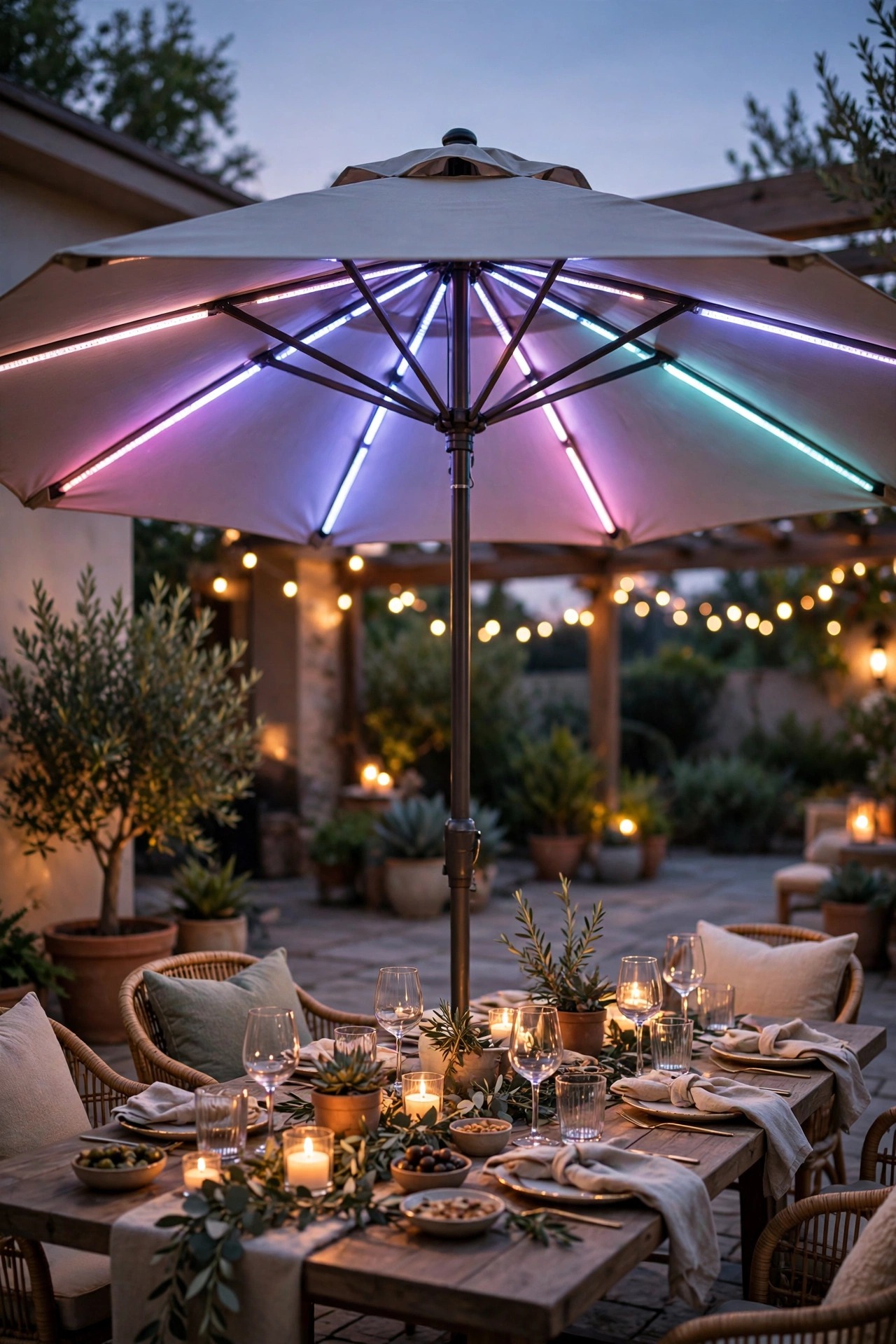
Sometimes warm white is the assignment, and sometimes it's a birthday, the Fourth of July, or a backyard movie night and you want a little theater. Color-changing umbrella hubs come with a small remote that cycles through a dozen colors plus the trusty warm white, and switching from "dinner" to "party" takes one button press. My honest advice: use color as an accent, not the whole meal. A soft teal or amber under the canopy looks festive; rapidly strobing rainbow mode will send your guests home with a headache, so save it for the kids' dance break. These hubs are the same clamp-on shape as idea one, so installation is the same two-minute job. Pair them with the plainer lights elsewhere in the yard — if you enjoy the effect, keep exploring color-changing options for other fixtures without turning the whole yard into a carnival.
Suggested budget range: $30 – $55.
8. Lights for Cantilever and Offset Umbrellas
Offset umbrellas are wonderful for shading a sectional or a pool edge, but the pole sits off to the side, so a standard hub light leaves the far side of the canopy in shadow. The fix is a set of individual rib lights: small battery or solar units that clip directly onto each arm of the frame and point downward. Sold in sets of four to eight, they spread the light evenly across that big canopy, and most twist or tilt so you can aim them. I've also had good luck with a fairy-light weave on a cantilever — the arms are sturdy, the wire wraps easily, and there's no center pole for a battery pack, so I clip the pack to the main mast at arm's reach. One caution: cantilever canopies catch wind like sails, so choose low-profile clips and bring lights in when you close up for a storm, same as you would the cushions.
Suggested budget range: $35 – $70.

9. Battery Puck Lights for a Clean, Hidden Glow
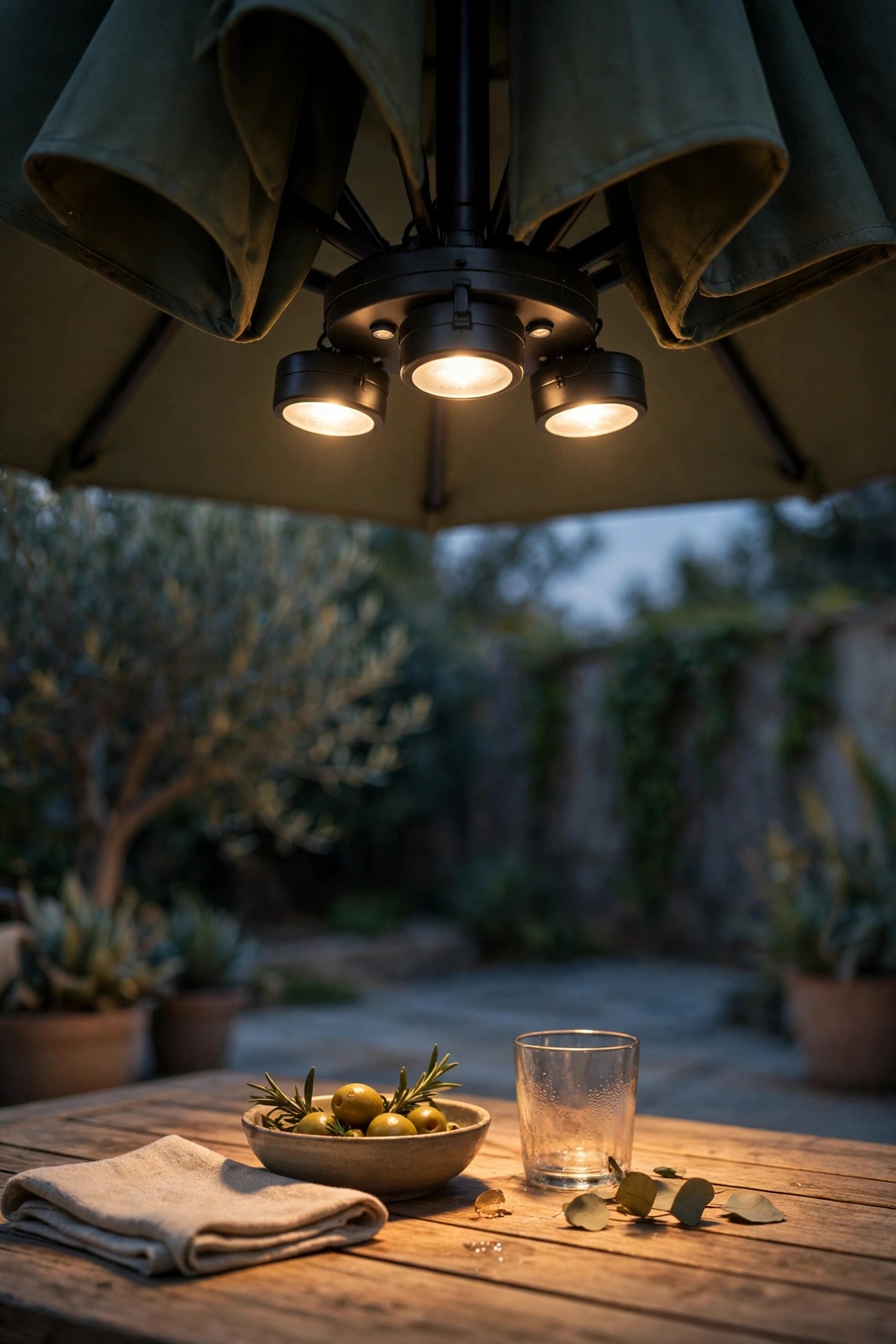
If visible fixtures bother you, puck lights are the minimalist answer. These flat, round, stick-on lights — about the size of a hockey puck — press onto the underside of the canopy hub or along the ribs, and from below all you see is soft light appearing from nowhere. Most run on batteries with a remote that handles on/off, dimming, and a timer, which means no reaching up and fumbling in the dark. Stick three around the hub for a standard 9-foot umbrella, or five on a big 11-footer. Adhesive pads struggle on textured canopy fabric, so I cheat: a small square of outdoor hook-and-loop tape on the hub's flat underside holds mine through wind and weather. Battery life is the trade-off — expect a month or two of nightly use per set — so this is my pick for occasional hosts rather than every-night entertainers. Keep a spare set of batteries in the patio storage box and the swap takes thirty seconds.
Suggested budget range: $15 – $30.
10. Mason Jar Pendants on the Rib Ends
For a farmhouse or garden-party look, hang a small solar mason jar light from the end of each rib. The jars charge in the sun all day — lids with built-in solar panels and a strand of tiny LEDs inside the glass — and at dusk your umbrella is circled with eight little firefly jars. It is pure decoration rather than task light, so think of this as the sparkle layer and pair it with a hub light if you actually need to see your dinner. Hang jars on short lengths of twine or thin wire so they sit just below the canopy edge and don't bang against the fabric in a breeze. Real glass jars are charming but heavy; the plastic versions weigh almost nothing and survive the inevitable one that gets knocked off its hook. I also love this trick for weddings and showers — it photographs beautifully, and afterward every jar goes home as a favor or into the garden beds as path accents.
Suggested budget range: $20 – $45.

11. Paper Lanterns Strung Beneath the Canopy
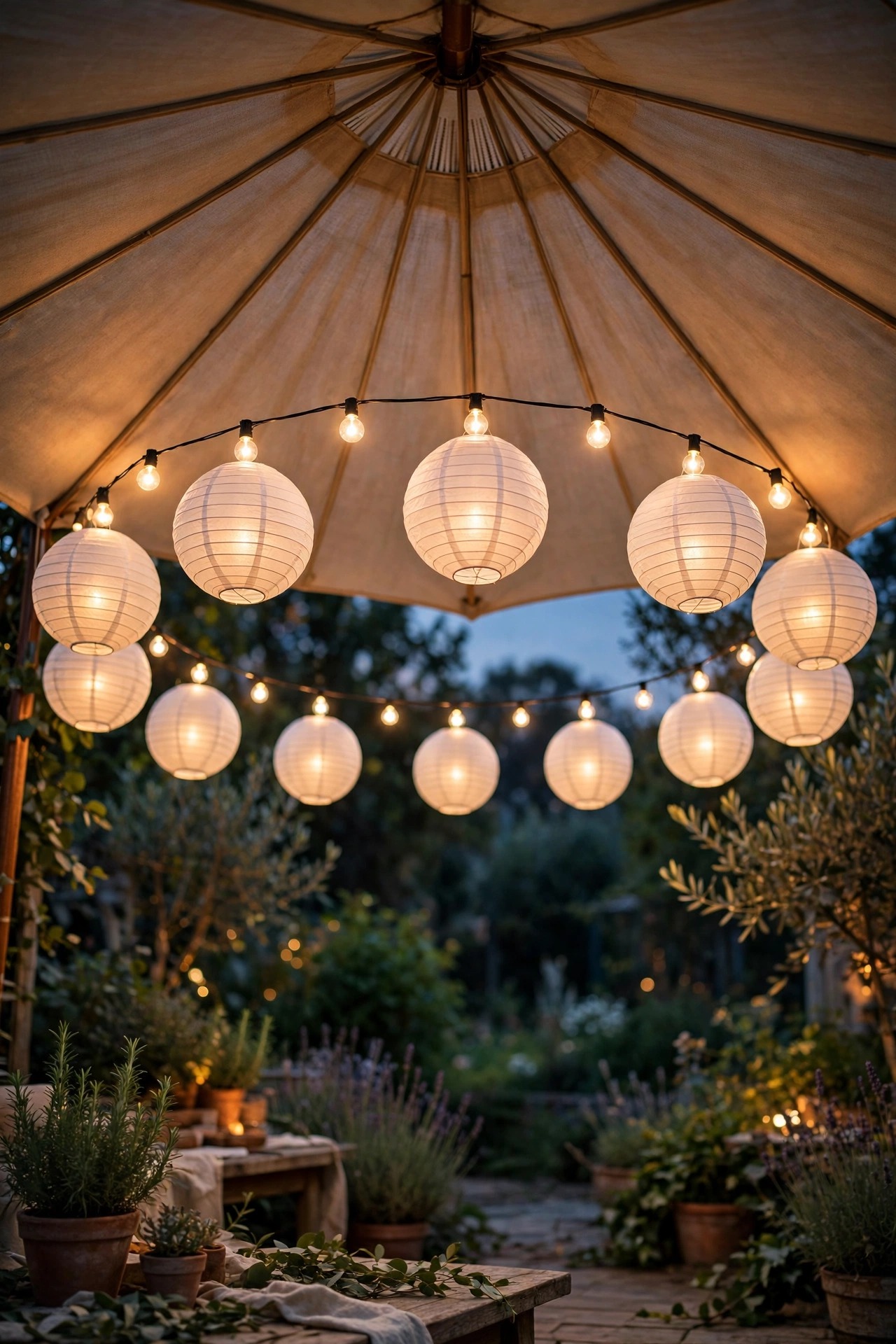
Paper lanterns turn an umbrella into a festival tent, and they are the easiest seasonal swap I know — white for summer, orange for fall, red and green when December rolls around. Use the battery-operated lanterns with built-in LED bulbs, or thread a fairy-light strand through plain lanterns; either way, hang them in a circle under the canopy on short hooks clipped to the ribs, keeping them a good two feet above head height. Sizes between 6 and 10 inches look balanced on a standard umbrella; bigger lanterns overwhelm it. The non-negotiable rule in my house: LED only, never a real candle or an incandescent bulb inside paper, and the lanterns come down before any storm — paper and wind-driven rain are not friends. Stored flat in a bin, a set lasts me several seasons. For daytime parties, the unlit lanterns alone still look festive, which makes this the rare idea that earns its keep around the clock.
Suggested budget range: $15 – $35.
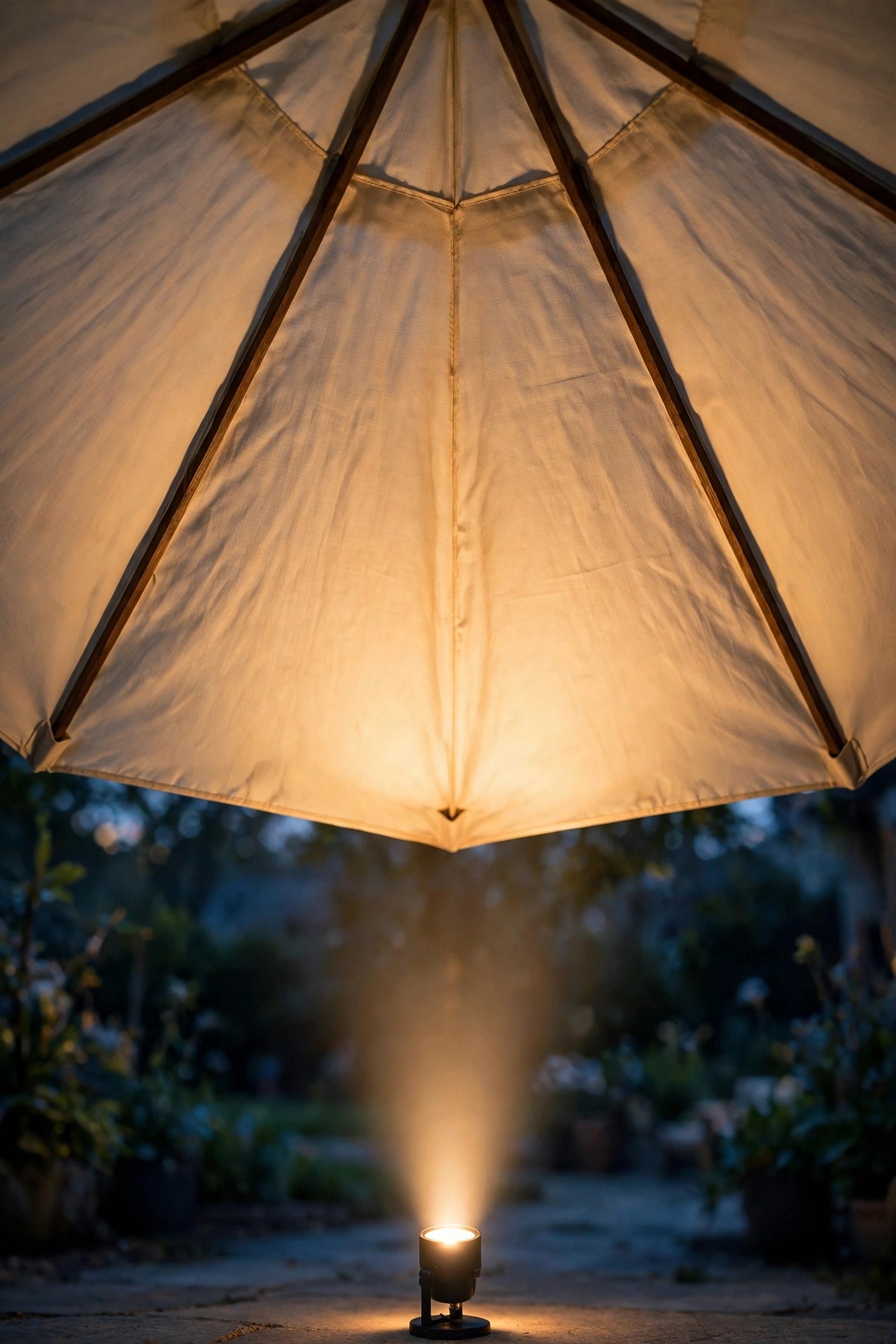
12. Uplight the Canopy From Below
Here's a trick I stole from landscape lighting: place one low-voltage or solar spotlight on the ground or the table's edge and aim it up into the underside of the canopy. The fabric becomes a giant lampshade, bouncing warm light back down over the whole seating area with no visible fixture at all. It works best with light-colored canopies — cream, sand, and pale gray reflect beautifully — while very dark fabrics soak the light up, so test before you commit. A single 300-lumen spot with a wide beam is plenty; you're washing, not searching. Keep the fixture shielded from direct view so nobody stares into the bulb, and angle it slightly off-center to avoid a hot spot in the middle of the fabric. I use this under our market umbrella on the small bistro set where a hub light would feel crowded, and guests always ask where the light is "hidden." Aiming light upward instead of down is one of my favorite tricks for making a small seating area feel twice its size.
Suggested budget range: $25 – $60.
13. A Flameless Candle Cluster on the Table
Not every solution has to attach to the umbrella. A cluster of flameless candles in varied heights, gathered on a tray in the center of the table, works with the umbrella's shade by day and becomes a flickering centerpiece the moment the sun goes down. Under a canopy, even a small breeze is blocked, so this is about glow, not wind protection — the magic is how candlelight flatters faces and food at close range. Mix two lanterns with three pillar candles for an easy collected look, and choose the versions with a timer so the whole tray wakes up at dusk without you thinking about it. Because they're LEDs, there's no wax dripping on your table runner and no flame anywhere near the canopy fabric above. On its own a candle cluster is mood lighting, so for a full dinner I'd layer it with a dim hub light; for wine and conversation after the meal, candles alone are honestly perfect.
Suggested budget range: $15 – $35.

14. Dusk-to-Dawn Sensor Lights That Think for You
If your umbrella stays open all season, a light with a built-in photocell is the set-and-forget champion. These hubs and rib lights sense darkness and switch themselves on at dusk, then off at dawn or after a set number of hours — no remote hunting, no switches, no coming home to a dark patio. I first added one for vacation peace of mind, so the backyard looked lived-in while we traveled, and I kept it because lazy is a feature, not a bug. Place the sensor where the canopy doesn't shade it at twilight; if the umbrella's own shadow falls across the photocell, the light may switch on early or flicker at dusk, which is the sensor reading shadow, not a defect. Motion-sensor versions exist too and are handy on a side-yard umbrella over the grill, where you want light only while you're actually standing there. Battery models with sensors sip power in standby, so a single charge stretches noticeably longer than an always-on light.
Suggested budget range: $25 – $45.
15. The Layered Combo: Umbrella Light Plus a String-Light Perimeter
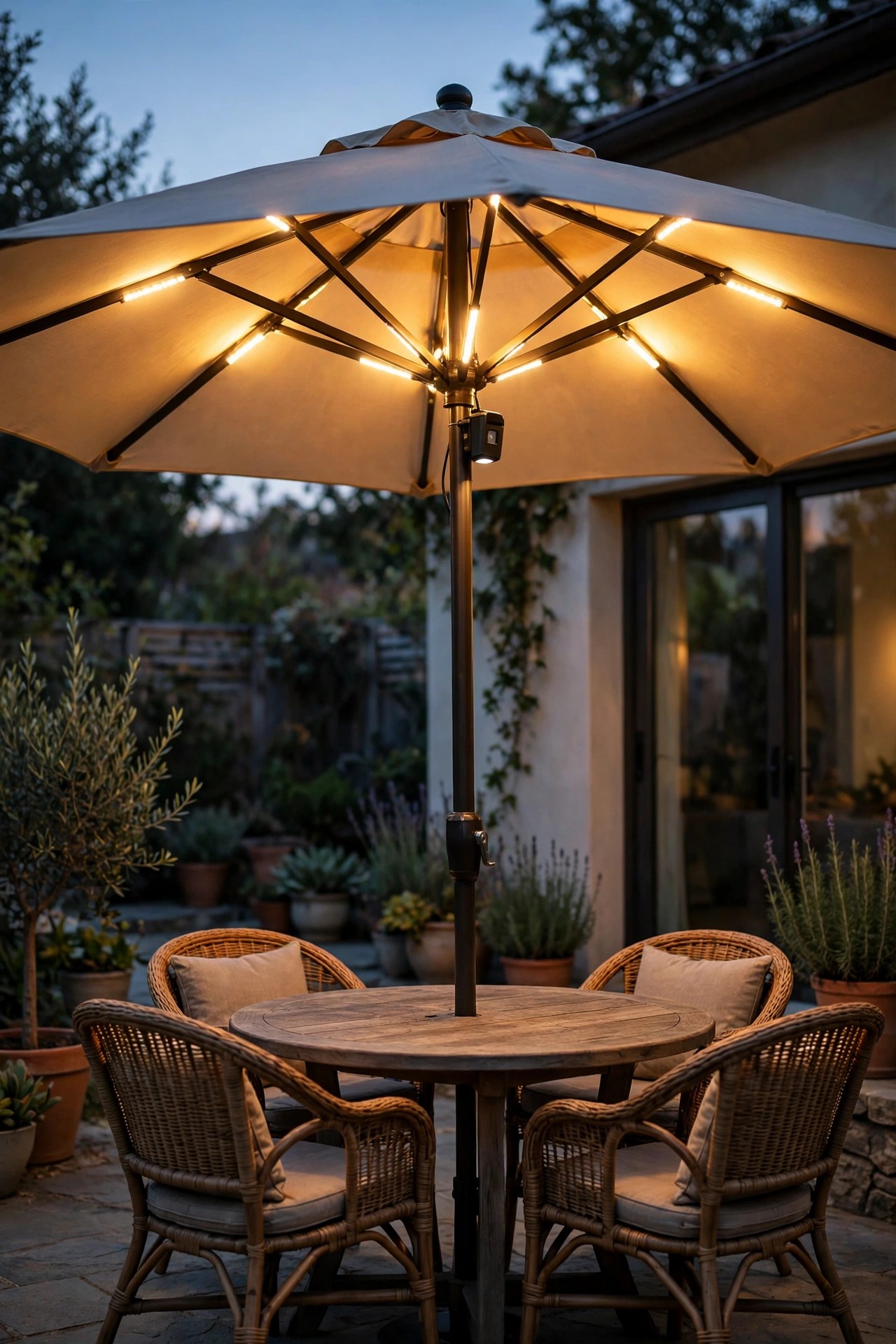
My own patio, most nights, is this final idea: layers. A dimmable hub light on the umbrella handles the table, a strand of string lights runs from the umbrella's edge out to the fence or a pair of poles, and a couple of lanterns mark the steps. Each layer is modest on its own; together the yard looks like it was designed, and nobody sits in a pool of darkness or a blast of glare. The unifying rules are simple: keep everything in the same warm color temperature family, put lights on timers where you can, and dim the umbrella layer as the evening winds down so the string lights become the stars. If you're starting from zero, build it in order — umbrella first, perimeter second, accents last — and live with each layer for a week before adding the next. My broader patio lighting ideas guide walks through whole-patio layouts if you want to plan the full picture before you shop.
Suggested budget range: $50 – $90.

Frequently Asked Questions
Are patio umbrella lights waterproof?
Most are water-resistant rather than truly waterproof, and there's a difference worth respecting. Look for an IP44 rating or better, which means the light shrugs off splashes and normal rain under a canopy. Even so, I bring battery packs and remotes inside during hard storms, and I never leave a plug-in connection sitting in a puddle. The canopy itself shields the lights from the worst of it, but wind-blown rain finds everything eventually.
How many lumens do I need under a patio umbrella?
For dining and conversation, 200 to 400 lumens total is the sweet spot — enough to see plates and faces without glare. A standard clamp-on hub usually lands right in that range. If you play cards or games at the table, lean toward 400 to 600 lumens or add a second light source. More than that under a low canopy starts to feel like a stadium, so dimmable beats mega-bright every time.
Can I leave my umbrella lights up all season?
Battery and solar lights built for outdoor use can stay up all summer, and mine do. What shortens their life is heat plus moisture trapped inside battery compartments, so check seals once a month and swap batteries before they leak. The canopy fabric itself lasts longer if you close the umbrella during storms — and whatever is clipped to it lives longer too. Over winter, I bring everything small and electronic inside.
What color temperature looks best under an umbrella?
Warm white, 2700K to 3000K, is the answer almost every time. It flatters skin, makes food look appetizing, and matches the glow of string lights and lanterns elsewhere in the yard. My outdoor light color temperature guide explains the whole scale if you're mixing fixtures. Cool white above 4000K tends to look bluish and harsh under fabric, so save it for the workshop.
Conclusion
A shaded table shouldn't have to go dark at sunset. Whether you clamp on one simple hub, weave fairy lights through the ribs, or build the full layered combo, patio umbrella lights turn the best seat of the afternoon into the best seat of the evening — usually in minutes, and almost always for less than the cost of the umbrella itself. Start with the layer your evenings actually need, keep the color warm and consistent, and let the canopy do the rest. If tonight's dinner runs long because nobody wants to leave the table, you'll know it worked — and when you're ready for the next project, browse the rest of my outdoor lighting ideas here on the site for paths, porches, and garden beds that deserve the same glow.