Stand on your porch, look up, and you will find the one decision that quietly shapes your whole entry: a flush mount vs pendant porch light is not really a style question at all — it is a ceiling question. I learned this the hard way with a gorgeous lantern pendant that hung exactly where our screen door wanted to swing. Honestly, the right answer almost always comes down to two honest measurements: how high your porch ceiling sits, and how much clear space your door, your head, and your tallest guest need beneath the fixture. Get those right and the style choice becomes the fun part instead of a compromise. In this guide I will walk you through the clearance math I use on every porch, how each fixture actually spreads light across your steps and door hardware, what wind and weather do to a hanging fixture, and what both options really cost in 2026. By the end, you will know which fixture your ceiling is asking for, and how to hang or mount it so the whole entry glows.

The Short Answer
Short version: your ceiling decides. If your porch ceiling is under about 8 feet, choose a flush mount or semi-flush — you keep the full 7-foot clearance rule with headroom to spare, and nobody ducks. At 9 feet or higher, especially over a two-story entry, a pendant earns its keep: it drops the light to where faces and door hardware actually are and gives the entry a focal point. Both fixtures wire to the same ceiling box, both want a damp or wet rating, and both look best at 2700 to 3000K. Measure first, then shop.
The One Measurement That Decides Everything
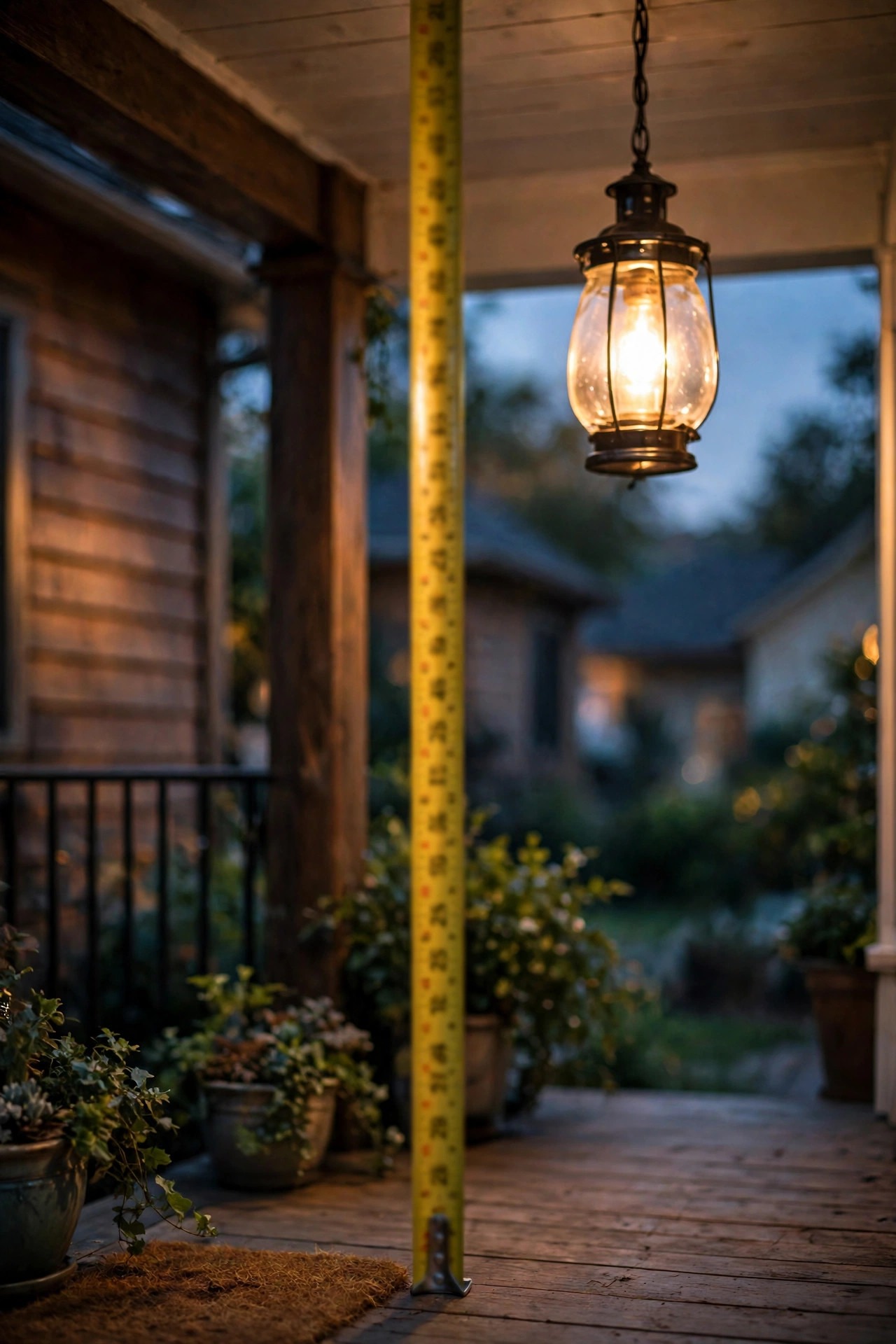
Grab a tape measure and stand in the middle of your porch. The number that matters is the distance from the porch floor to the ceiling, and the rule it feeds is simple: the bottom of any ceiling fixture should hang no lower than 7 feet — 84 inches — above the floor. That clearance lets a tall guest in boots walk under without ducking, and it is the line every other decision hangs from. Now do the subtraction for your ceiling. An 8-foot ceiling gives you 96 inches total, so a hanging fixture gets just 12 inches for its canopy, stem, and body combined — and most pendant bodies alone are 10 to 16 inches tall. The math simply refuses. That is why porches under about 8 feet belong to flush mounts and semi-flush fixtures, which need only 4 to 13 inches of depth. At 9 feet, you have 24 inches of drop to play with, and pendants come alive. At 10 or 11 feet, you can hang a statement lantern and still clear everyone comfortably. Two more measurements before you shop. First, your door: a standard door is 80 inches tall, and its top corner sweeps an arc as it opens, so a centered pendant must clear that swing or sit far enough out of the door's path. Second, check for a sloped or beamed ceiling — beams steal inches exactly where you planned to hang, and slopes need a swivel canopy or a chain. Write all three numbers down. They will make the rest of this guide feel easy.
Meet the Flush Mount (and Its Semi-Flush Cousin)
A flush mount does exactly what its name promises: it sits tight against the ceiling, with the fixture body tucked into a depth of about 4 to 8 inches. Its close cousin, the semi-flush mount, drops the fixture a few inches on a short stem — usually 6 to 13 inches total — which buys a little air circulation around the bulb and a lot more style presence. In my experience, these are the hardest-working fixtures in the porch world. They never sway in a storm, they leave your door swing completely alone, they work on the beamed and low ceilings where nothing else fits, and because the back plate seals against the ceiling, wind-driven rain and nesting bugs have a much harder time getting in. The honest trade-off is drama. On an 8-foot ceiling, a flush mount is exactly right: present, tidy, and bright. On a 12-foot ceiling, that same fixture reads as a postage stamp, and its light pools up high where nobody needs it. Sizing helps more than people expect. I like a flush mount diameter around one-quarter to one-third of the porch depth, so a 6-foot-deep porch wants a fixture roughly 15 to 18 inches across, not the little 10-inch disc most stores push by default. If you want the full family portrait before you decide, I keep a running roundup of porch ceiling light ideas that shows how much personality this category has gained — lanterns, cages, drums, and seeded-glass styles a world away from the bland builder discs of twenty years ago.

When the Pendant Wins the Flush Mount vs Pendant Porch Light Debate
A pendant takes the light off the ceiling and brings it down to where life happens: face height, door-hardware height, the height of the wreath you hung in October. That drop is why pendants win on porches with 9-foot ceilings and taller. Instead of a glow stranded overhead, you get a warm pool of light around the door, and a fixture with enough presence to act as the entry's focal point. Wide porches can even run a pair of pendants in a row, which is one of my favorite looks over a long porch with a swing at one end. The hardware decision matters more than most people realize. A rigid stem gives you a fixed, architectural drop and zero sway, which I prefer on open porches. A chain is adjustable link by link and forgiving on sloped ceilings, because gravity levels the fixture for you — but it will move a little in the wind. Either way, the fixture body plus the drop has to fit inside your clearance budget from the measurement section: ceiling height minus 84 inches is all you get. Pendants also expose their bulbs at guest eye level, so glass choice becomes a comfort choice, something I will come back to in the mistakes section. If you are already leaning this way, browse my favorite outdoor pendant light ideas for shapes that are properly rated for weather, from classic lanterns to barn-style domes. Just promise me you will run the tape-measure math before you fall in love.
How Each Fixture Actually Spreads Light
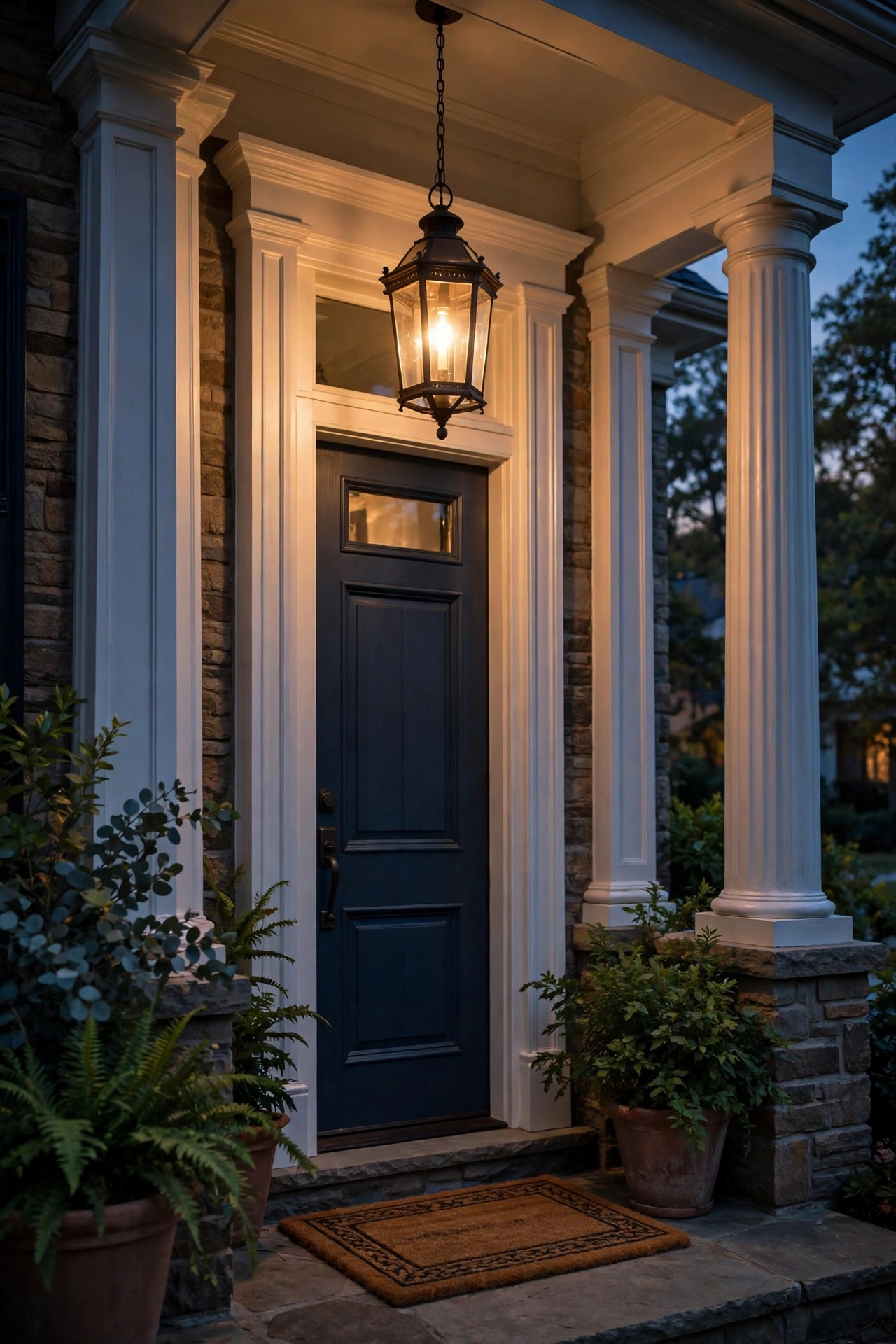
Here is the difference nobody mentions in the store aisle: these two fixtures do not just sit at different heights, they throw completely different light. A flush mount fires its light down and out from the ceiling plane, and the ceiling itself bounces some of it back, so you get a wide, even, fairly shadowless wash. That is wonderful for finding keys, reading the house numbers, and lighting the steps uniformly. The catch is height. Light weakens fast as it travels — a bulb at 12 feet delivers roughly a quarter of the brightness at the floor compared with the same bulb at 6 feet. So a tall ceiling quietly taxes a flush mount, and the porch floor can end up dimmer than the lumens on the box promised. A pendant inverts the bargain. It pools strong light in a circle beneath itself — perfect at the door, dramatic on a wreath — but the porch corners, the far step edge, and the sides of the door go comparatively dark. The fix is layering, and honestly it is the fix for almost everything in outdoor lighting: pair the pendant with wall sconces flanking the door, and let each fixture do the job it is best at. Whichever style you choose, aim for about 800 to 1,100 total lumens at the entry — roughly a 60- to 75-watt incandescent equivalent — in a warm 2700 to 3000K. Then stand outside at dusk before you call it done. The right spread is the one where faces, treads, and hardware are all lit, without a single hotspot making you squint.

Wind, Weather, and Porch Exposure
Porch ceilings feel sheltered until the first sideways rainstorm. On a covered porch that never sees direct rain, a damp-rated fixture is the standard requirement, and it will live a long, happy life. But on an open porch, a corner entry, or any ceiling that catches wind-driven rain, step up to a wet-location rating. It costs very little more, and the seals, sockets, and finishes are built for actual water contact. This is where the two styles diverge again. A flush mount hugs the ceiling with its back plate sealed flat, so wind has almost nothing to grab and rain has almost no way in. A pendant hangs in the weather by design. On a chain, a light fixture will sway in gusts, and I have seen open-top shades collect a genuinely impressive amount of rainwater and dead moths. A rigid stem, a downward-facing shade, and a sealed or sloped top solve nearly all of it. Weight matters too: a heavier fixture swings less, but it must hang from a box rated for it — a standard ceiling box is typically rated around 50 pounds, which covers most pendants easily. In coastal air, choose powder-coated aluminum or resin over painted steel, whichever style you pick, because salt finds the cheap finish by the second season. My rule of thumb: the more open your porch, the more the flush mount's sealed-up simplicity earns its keep, and the more a pendant needs a stem and a wet rating to earn its place.

Style Range: Farmhouse Lanterns to Modern Drums
If you have not shopped flush mounts lately, prepare to retire an old prejudice. The category has moved far beyond the frosted hallway dome. You can get flush and semi-flush lanterns with seeded glass, black cage frames over filament bulbs, shallow drums with soft diffusers, and craftsman squares that echo the sconces by your door. Pendants still win on pure range — barn domes, carriage lanterns, globes, industrial cages, woven-look shades — but the gap is narrower than it was five years ago. Proportion is where style is actually decided. For a pendant, I size the fixture body at roughly one-quarter to one-third of the door height: an 80-inch door pairs well with a pendant body in the 16- to 24-inch range at the right drop, while a petite 10-inch pendant vanishes over a tall entry. For flush mounts, diameter does the same work — think one-quarter to one-third of the porch depth, as covered earlier. Then repeat a finish somewhere: match the fixture to your door hardware, mailbox, or house numbers, and the whole entry reads as one decision instead of three accidents. Glass is the last style lever. Clear glass shows off a pretty filament bulb but throws glare at eye level on a pendant. Seeded or opal glass softens everything and hides a plain bulb beautifully. On most porches, that is the choice I would make twice.

Installation: Same Box, Different Math
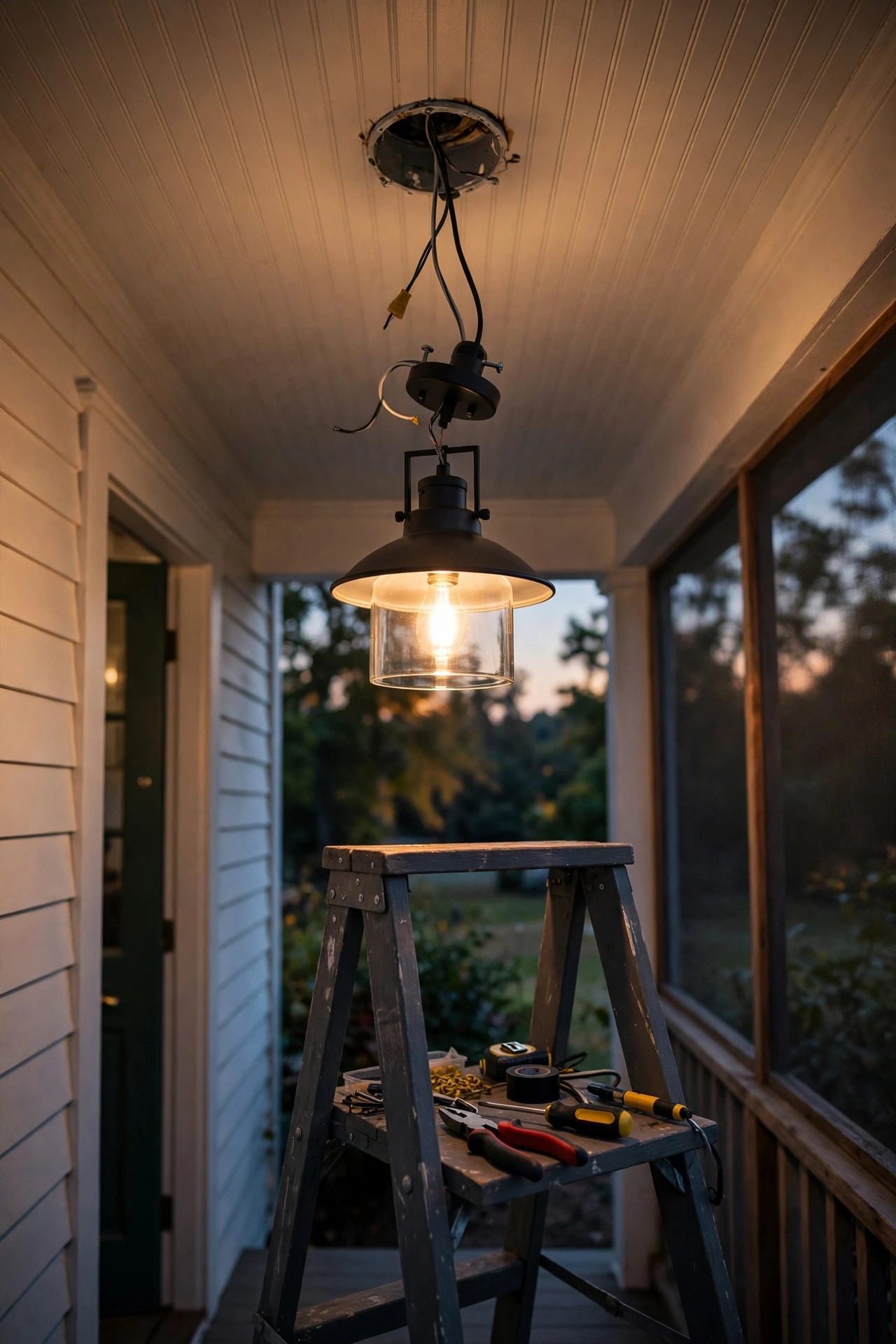
Good news first: flush mounts and pendants mount to the exact same ceiling junction box, so this swap is one of the friendliest electrical jobs on the house. Breaker off, old fixture down, two or three wire connections, new fixture up — most homeowners finish in under an hour, and I walk through the whole sequence in my guide on how to install a porch light. The flush mount is the simpler of the two: it bolts flat, and there is nothing to measure beyond centering it. The pendant asks for one calculation, and it is worth doing on paper before anything comes out of the box. Take your ceiling height, subtract the 84-inch clearance line, then subtract the fixture body's height — what remains is your stem or chain length. Stems usually come in mix-and-match segments of 6, 12, and 18 inches, so you can dial the drop in small steps. With chain, count the links before you cut, and leave a little slack for the canopy and hanging loop. On a sloped or vaulted porch ceiling, chain levels itself by gravity, while a stem needs a swivel canopy to hang straight. Two honest warnings. If your porch has no ceiling box at all, adding one means new wiring through the ceiling, and that is electrician territory in most towns — the costs section below covers what that runs. And if your existing box wobbles or is a lightweight plastic one, replace it with a properly braced box before hanging anything heavier than a few pounds. A pendant moving gently over a decade will find every weakness in a lazy mount.
Bulb Access, Cleaning, and Everyday Upkeep
Think about the second year, not just the first evening. A flush mount on an 8-foot ceiling puts its bulb about seven and a half feet up — a step-stool job, a little annoying, and totally fine a couple of times a year. On a 12-foot ceiling, that same bulb change becomes a ladder project, which is one more argument for dropping tall-ceiling light down on a pendant: a pendant whose bottom sits at 7 feet is the easiest ceiling fixture in the world to service, often reachable while standing flat-footed on the porch floor. Design details matter here. Open-bottom pendants let dead bugs fall through or brush out in seconds, while closed bowl shades become little insect museums that need unscrewing and washing — pretty, and a chore. Flush mounts with twist-off glass diffusers are nearly as easy, and they keep bugs out of the light almost entirely. Whichever style you land on, I strongly recommend a socketed fixture — one that takes a standard screw-in LED bulb — over a fully integrated LED unit. An integrated fixture is beautifully slim and can run 15 to 20 years, but when its driver eventually fails, you replace the whole fixture. A socketed fixture lets you swap a bulb in two minutes, change your mind about color temperature, and keep the hardware you love for decades. Put a quick wipe of the glass on your spring and fall porch-cleaning list, and either style will look new for years.

Tall Entries, Transoms, and Two-Story Porches
A two-story entry plays by different rules, and it is where flush mounts go to disappear. Under an 18- or 20-foot portico ceiling, a flush fixture is a tiny bright dot whose light gives up long before it reaches your guests, and the entry — the grandest surface on the house — reads as empty. This is pendant territory, and not a shy pendant either: scale the body up to 24 to 36 inches, hang it on a long stem or chain so the fixture floats in the upper-middle of the space rather than hugging the ceiling, and let it be the chandelier moment your facade has been waiting for. The 84-inch clearance rule usually is not the binding constraint here; composition is. If your entry has a transom window above the door, you get a bonus effect — a centered pendant silhouettes against that glass at night and glows within the foyer's line of sight too. Just confirm the drop does not park the fixture directly across the transom's center mullion from your main interior viewpoint, and check the door swing exactly as you would on a small porch, because tall entries often hide double doors with a wider combined arc. For double doors, either center one generously sized pendant on the pair or flank with matching wall sconces to widen the welcome. Open porticos also mean full weather: wet-rated, stem-mounted, and heavy enough not to wander in a storm. Get the scale right, and visitors feel the entry before they reach the mat.

What It Costs in 2026
Let us talk real numbers for 2026. Flush mount fixtures run about $25 to $120 for good-looking, outdoor-rated options, with semi-flush styles at $40 to $180. Pendants typically run $45 to $250, and the oversized fixtures a two-story entry demands can reach $200 to $450. The installation math is friendlier than most people fear because both styles use the same box: a DIY swap costs $0 beyond the fixture and an hour of your Saturday, while an electrician's swap usually runs $125 to $250, since most charge a one-hour minimum in the $75 to $150 range. If your porch has no ceiling box and needs new wiring run, budget $250 to $600 for that electrician visit. Running costs are a rounding error with LED: a 12- to 15-watt bulb burning five hours a night uses about 27 kilowatt-hours a year, which at a typical $0.17 per kilowatt-hour is under $5 annually — and even a dusk-to-dawn habit at twelve hours a night lands near $11 a year. Ownership costs favor socketed fixtures: a replacement LED bulb is $4 to $8 every decade or so, versus replacing an entire integrated fixture at full price when its driver dies. Two honest project totals to plan around: a low-porch glow-up with a quality semi-flush, done DIY, lands around $60 to $150 all-in. A two-story pendant statement with an electrician's help lands around $300 to $700. Either way, this is one of the cheapest curb-appeal upgrades on the house per dollar of visible difference.
5 Mistakes That Ruin the Effect
Mistake 1: Hanging a pendant in the door's swing path. The top corner of your door sweeps a wide arc, and a pendant centered a little too close becomes a very expensive bell. Measure the swing before you mount, and remember that storm doors swing out even farther. Mistake 2: A flush mount lost on a tall ceiling. A 12-inch disc under a 14-foot ceiling is a postage stamp that lights nothing below the rafters. Scale up dramatically, or drop the light on a pendant where it can actually reach your guests. Mistake 3: Ignoring the 84-inch rule. A pendant whose bottom hangs at six and a half feet will meet a tall uncle's forehead exactly once. Do the subtraction — ceiling height minus fixture and stem — before the fixture goes up, not after. Mistake 4: A damp-rated fixture on a rain-blown porch. Covered-porch ratings fail fast where wind drives water sideways. If rain can reach the ceiling, buy the wet rating and save yourself the corrosion and the tripped breaker. Mistake 5: A bare bulb at eye level. A pendant puts its bulb right where guests look, and a clear-glass shade around a bright filament bulb is glare, not ambiance. Choose seeded or opal glass, or step down to a softer 40-watt-equivalent bulb, and the same fixture turns warm and welcoming. Every one of these mistakes is cheap to avoid at the measuring stage and annoying to fix after the ladder is put away — which, honestly, is the whole philosophy of porch lighting in one sentence.
My Verdict on the Flush Mount vs Pendant Porch Light Choice, Porch by Porch
After all the measuring, here is how I actually call it on real porches. Low, covered porch under 8 feet: a flush mount or semi-flush, damp-rated and sized generously — do not fight the math. Standard 8- to 9-foot ceiling: semi-flush if you love a clean look, or a short pendant if your clearance budget honestly allows it after the door-swing check. Nine to eleven feet: this is pendant country — hang one centered on the door and enjoy the focal point. Two-story entry: a long-drop pendant at large scale, wet-rated, with sconces considered to ground the composition at human height. Open and windy porch of any size: a rigid stem over a chain, or the sealed simplicity of a flush mount. Rental or temporary situation: swap in a flush mount you love and keep the original fixture in a labeled box — the job is fully reversible in about twenty minutes. Notice what never decides it: the photo in the catalog. Ceiling height, door swing, exposure, and how you use the porch at night decide it, and style gets the final, enjoyable vote inside those lines. Run your numbers, pick your side, and your entry will look like it was always meant to.
Frequently Asked Questions
Can I hang a pendant from an 8-foot porch ceiling?
Almost never comfortably. An 8-foot ceiling leaves only 12 inches between the ceiling and the 84-inch clearance line, and that 12 inches has to hold the canopy, the stem or chain, and the fixture body itself — most pendant bodies alone are 10 to 16 inches tall. A very short mini-pendant can squeak in over a corner where nobody walks, but for the main entry, a semi-flush mount gives you the same personality with none of the forehead risk. If your heart is set on a hanging look, semi-flush is the honest answer at this height.
How low should a porch pendant hang?
The bottom of the fixture should sit at least 7 feet — 84 inches — above the porch floor, and I measure from the floor itself, not from the top step if your porch has one. On a 9-foot ceiling, that means roughly a 2-foot total drop including the fixture body; on taller ceilings, the fixture can float lower in the room's composition as long as the 84-inch rule holds. Also check the door: the fixture must clear the top corner of the door's swing arc, which on a standard 80-inch door passes just under the fixture line when you have planned with the rule.
Does a porch ceiling light need to be wet-rated or damp-rated?
It depends on how much weather reaches your ceiling. A fixture under a solid, covered porch roof that never takes direct rain is fine with a damp rating, which covers humidity and the occasional mist. If your porch is open on the sides, sits in a windy spot, or you can see rain reach the ceiling during storms, choose a wet-location rating — the sockets and seals are built for direct water contact. When in doubt, go wet-rated: the price difference is small, and the corrosion protection is real.
Is a flush mount bright enough for a porch?
Yes — brightness is about lumens and height, not fixture style. A flush mount with an 800- to 1,100-lumen LED bulb (about a 60- to 75-watt incandescent equivalent) in warm 2700 to 3000K lights a typical porch beautifully from an 8- or 9-foot ceiling. Where flush mounts struggle is tall ceilings, because light fades with distance. Past about 11 feet, either size up the lumens, add door sconces to layer the light, or switch to a pendant that brings the light closer to the people. Test your setup at dusk before deciding — five minutes outside tells you more than any spec sheet.
Conclusion
Here is the honest summary I give every friend who texts me a photo of their porch ceiling: measure first, and let the tape measure make the first cut. Under 8 feet, a flush mount keeps your entry bright, safe, and duck-free. At 9 feet and up, a pendant drops warm light exactly where your guests stand and turns the ceiling into a design moment. Either way, the best flush mount vs pendant porch light decision is the one that respects the 7-foot rule, matches your porch's exposure rating, and layers with the sconces by your door. Pick your fixture, hang it at the math we worked through, and enjoy that first dusk when the whole entry glows.