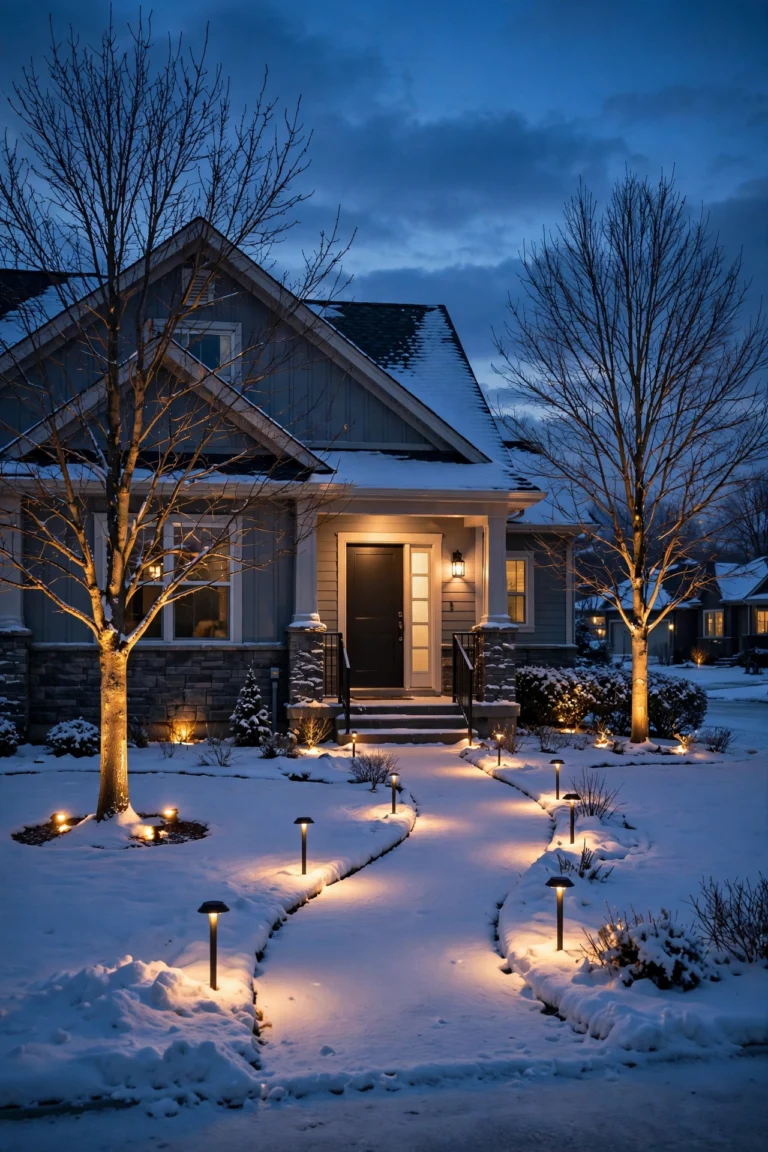
Here is the problem I kept running into: I wanted bright security light exactly when something moved in the yard, but I did not want to pay to blast that same corner with electricity from dusk to dawn. Solar motion sensor lights solved both halves of that equation for me, and after three seasons of swapping, testing and occasionally cursing at fixtures, they are now the hardest-working lights on our property. The concept is simple. A solar panel charges a battery all day, a passive infrared sensor watches for movement, and the light stays dark and costs nothing until the moment it is needed. That is the dual-purpose magic: safety and deterrence on demand, plus a power bill of exactly zero dollars. In this post I am sharing the fifteen placements and tricks that earned their keep twice over at our house, from the driveway flood that startles raccoons and package thieves alike to the dim-idle step lights that guide midnight dog walks without waking the neighbors. I will also be honest about where solar struggles, because panel placement matters more than any number printed on the box.
1. Start Where It Matters: A Driveway Floodlight That Works Twice
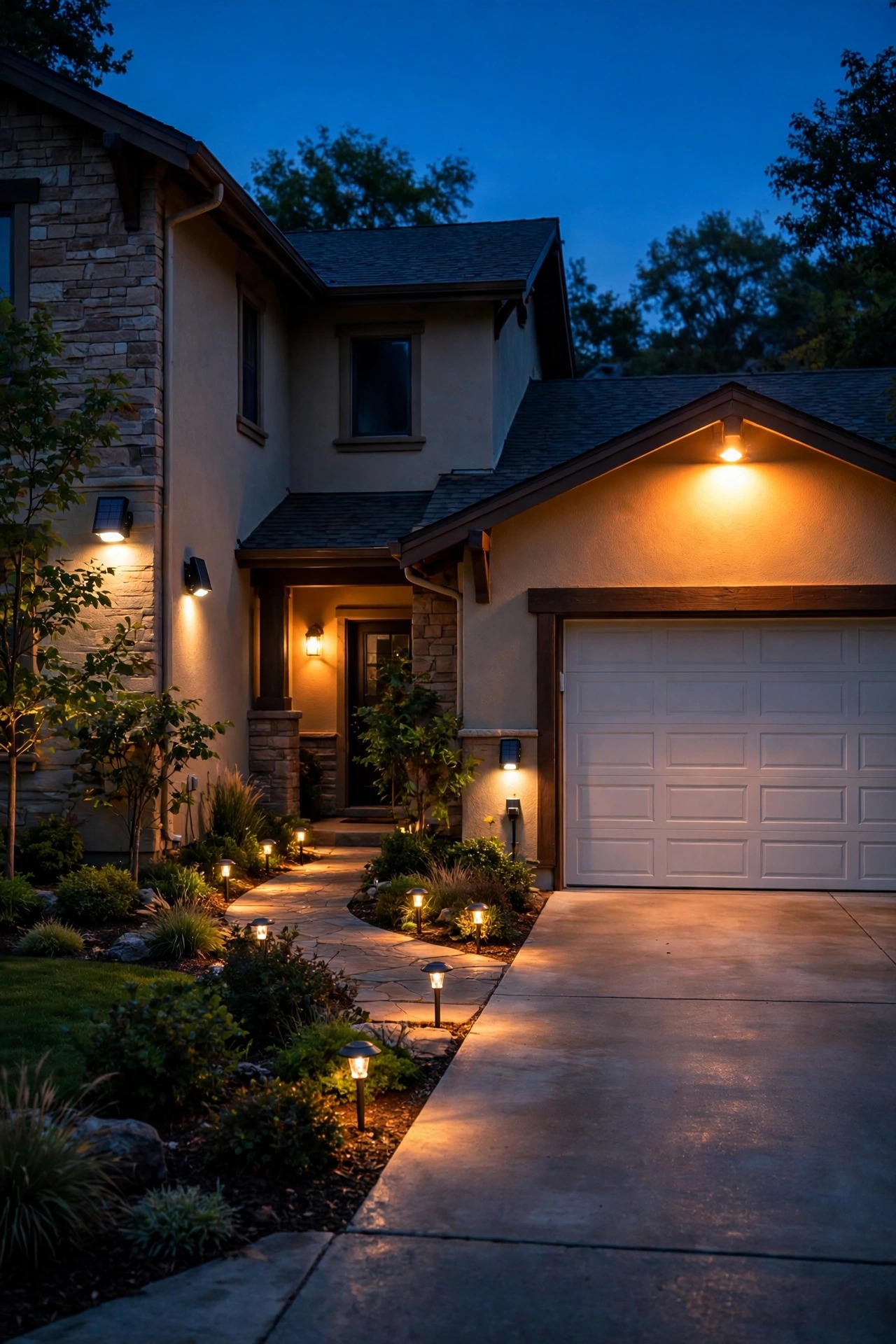
Most evenings, our driveway is dark by design — and then a car turns in, or a neighbor walks a dog past the curb, and one wide wash of light says someone is paying attention. Mount a solar floodlight 9 to 10 feet up on the garage wall or eave, sensor facing down the drive, and angle the heads so the beam lands on the pavement instead of the street. Look for 1,500 to 2,500 lumens and a detection range you can dial between 10 and 30 feet; too sensitive and every passing car burns your battery for nothing. Here is the dual-purpose part. For safety, a sudden flood of light is a genuine deterrent and it lets you find the keyhole, the ice patch and the recycling bin you forgot. For savings, there is no electrician, no conduit and no nightly runtime cost at all — the light only spends stored sunshine when something actually moves. If your eave shades the panel, pick a model with the panel on a separate cable and park it on the sunny side of the roof. I cover the wired equivalents in my full guide to motion sensor outdoor lights, but for most driveways, solar wins on simplicity alone.
Suggested budget range: $35 – $90.

2. Give the Front Door a Dim-Idle Lantern With a Bright Welcome
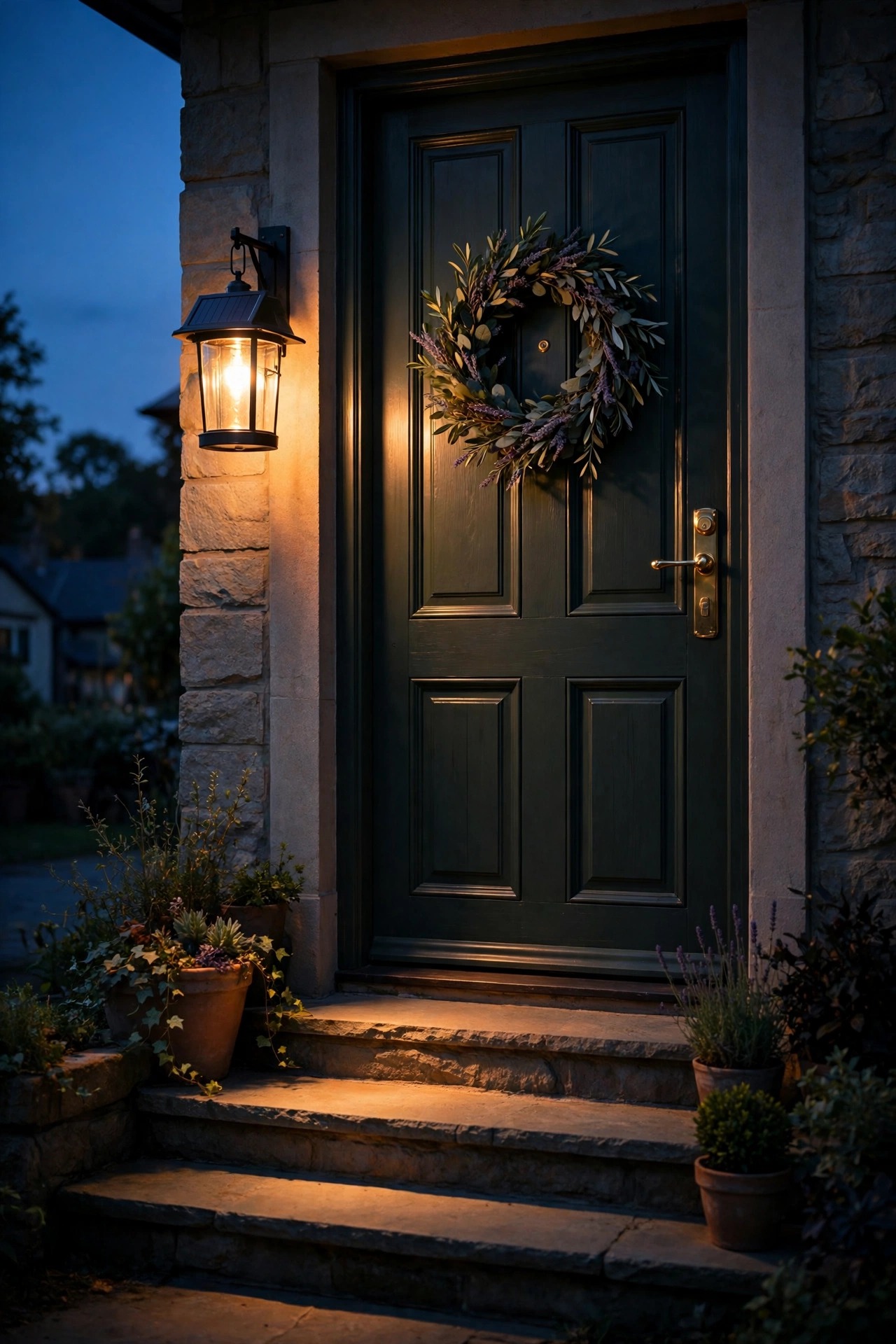
An always-on porch light is welcoming but wasteful, and a motion-only light can feel abrupt when you step out with a coffee. The sweet spot beside a door is a dim-idle lantern: it glows at a soft 10 to 20 percent all night, then lifts to full brightness the moment someone approaches. That low idle glow means the entry is never a black hole — visitors see the steps, delivery drivers see the doorbell, and a camera sees a face instead of a silhouette. The savings half is just as real. Running at a sip instead of a blast stretches a modest panel and battery through December, when a fully always-on fixture would fade by midnight. Mount the lantern 6 to 7 feet up beside the door, on the handle side, and give its little panel the clearest sky the porch allows — above the roofline if the ceiling blocks the sun. Warm 2700K light keeps the welcome friendly rather than interrogation-room. Of every fixture on this list, this is the one guests actually compliment, and it is quietly guarding the door the whole time.
Suggested budget range: $30 – $75.
3. Line the Walkway With Motion Sensor Path Lights That Wake in Sequence
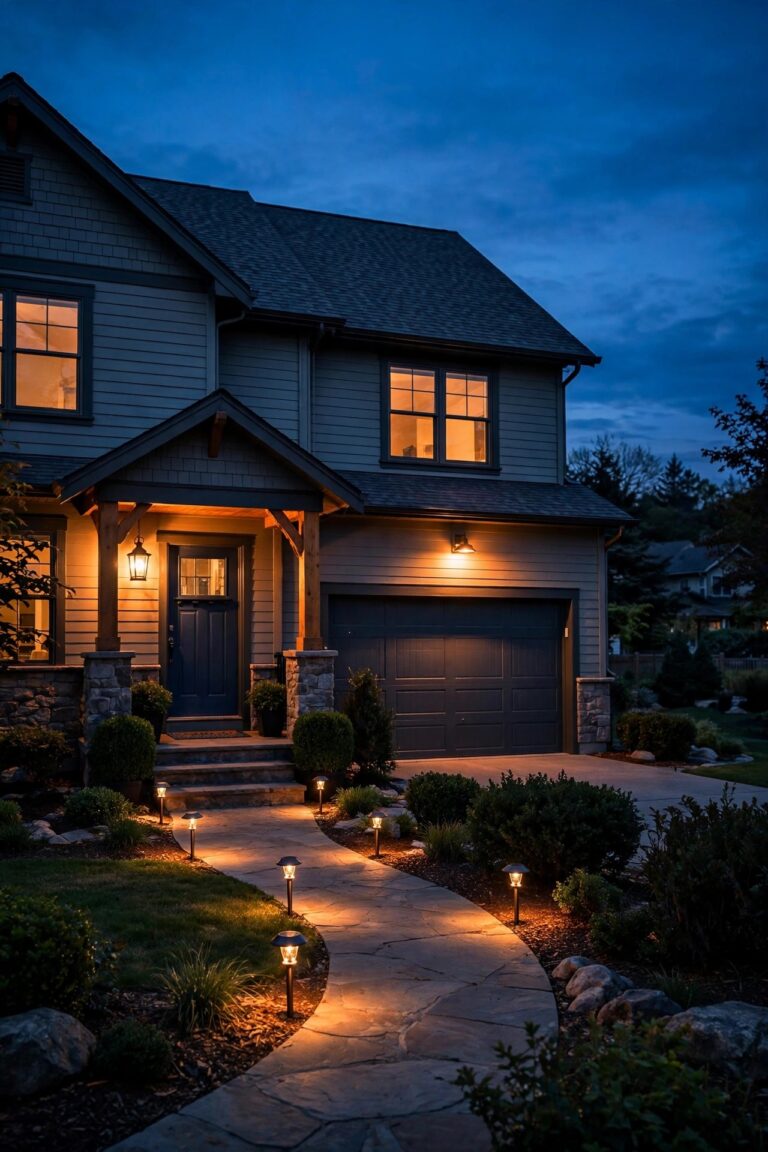
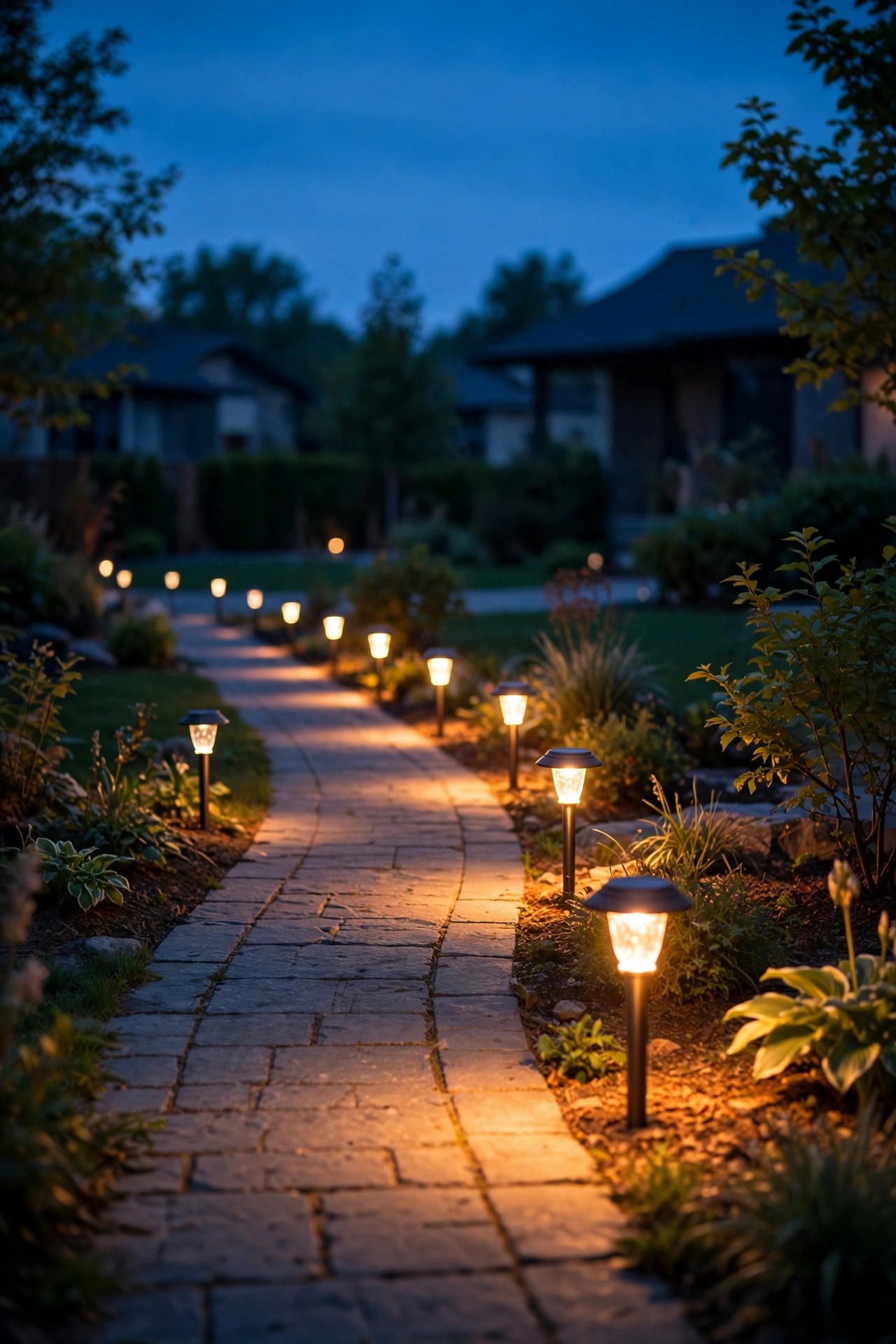
Standard solar path lights glow at one tired level until they fade. Motion-boost path lights are smarter: a faint 10 to 20 lumen marker glow most of the night, then a proper 100-plus lumen wash as you walk past, fixture by fixture, like a slow wave traveling with you. That rolling light is the safety win — every crack, hose and sprinkler head shows up exactly when your feet are about to meet it. The savings win is the battery math. A low idle draw plus short boosts means even a string of cloudy days rarely empties the pack, which is precisely when cheap always-on stakes give up. Stagger four to six lights 6 to 8 feet apart along the front walk, alternating sides so the pools of light overlap slightly. Spend a little more for stakes with replaceable batteries and metal or heavy resin bodies; the two-dollar versions are the ones people mean when they say solar does not work. In my experience the front walk is where this style proves itself fastest, because you feel the difference the very first night you carry groceries in after dark.
Suggested budget range: $25 – $60.
4. Guard the Side Gate and the Dark Passage Nobody Sees
Ask any police officer where a burglar tries first and the side gate makes the list — it is hidden, quiet and usually pitch black. A compact solar wall light mounted on the gate post or the fence right beside it fixes that blind spot in about ten minutes. Aim the sensor along the passage, not across it, so anyone slipping down the side of the house triggers it early, and angle the light down the path rather than into the neighbors windows. The safety job is obvious: that passage is no longer anonymous. The savings job is about installation. Getting wired light into a side yard means trenching cable under lawns and garden beds, which is exactly the project nobody finishes. Solar skips it entirely, and because the light only runs on motion, a small panel still performs even on a partly shaded fence — though I do pick the sunniest stretch of wall I can. Add a second small stake light at the far end pointing back toward the gate latch, and the whole corridor works both ways: light to enter by, light to leave by, zero dollars on the meter.
Suggested budget range: $20 – $50.

5. Put a Spotlight on the Trash and Recycling Corner
Not every security light guards something glamorous. Our bins live in a narrow corner behind the garage, and that corner did double duty as the darkest, least pleasant spot on the property — until a motion spotlight moved in. Now the light pops on when a raccoon starts shopping and when I am out there at 10 p.m. balancing a bag in each hand. That is the honest dual purpose of this spot: it discourages four-legged and two-legged visitors equally, and it saves me carrying a phone flashlight in my teeth. There is a savings angle beyond convenience, too. Corners like this almost never have an outlet, so wiring one means an electrician visit that costs more than a decade of fixtures. A twenty-dollar solar spot on the fence solves it permanently. Mount it 7 to 8 feet up, aim it down at the bins rather than across the yard, and keep the sensor range short so it ignores the street. Do one test walk from the neighbors side to confirm the beam stays home. It is the least romantic idea on this list and the one I would replace first if it ever died.
Suggested budget range: $18 – $45.

6. Light the Deck and Patio Steps Before Someone Misses One
More people get hurt on their own stairs at night than by any intruder, so deck and patio steps are where I point solar motion lights with real conviction. Small fixtures tucked on the riser or the side wall of each step wash the tread in light the instant a foot approaches — or, in dim-idle mode, keep a gentle marker glow burning so the edge of every step reads clearly. The safety math is simple: light exactly where feet land, appearing exactly when feet arrive. The savings math is about what you skip. Wiring step lights usually means a low-voltage transformer, cable runs under decking and a weekend on your knees. Solar step lights screw on in minutes and sip so little power that even partially shaded decks keep them going, because each boost lasts seconds. One honest caveat: a north-facing deck under a big tree is the hardest case in solar. There, choose models with a remote panel you can park in a sunny gap, or accept dim-idle only. One light per two treads is my rhythm, and warm light keeps the deck feeling like a hangout instead of an airport.
Suggested budget range: $22 – $55.

7. Mount a Corner Flood Where Two Fence Lines Meet
The back corners of a yard are where fences, shadows and good hiding spots all meet. A wide-angle solar flood mounted at the corner solves the geometry: sensors on better models sweep 180 to 270 degrees, watching both fence lines at once, and the heads flood the whole corner when anything crosses. For safety, this is pure deterrence — a corner that lights itself up is a corner nobody chooses to linger in, and it gives you a clear view from the back windows before you let the dog out. For savings, one well-placed solar corner flood replaces two wired fixtures and the conduit run to reach them, which on a big lot can be the most expensive cable on the property. If there is no structure at your corner, sink a sturdy 4×4 post at 8 to 9 feet and mount to that; it looks intentional, like a little yard lighthouse. Battery size matters more here than anywhere, because wide sensors trigger often. Choose the largest rechargeable lithium pack in your price class and a sensitivity dial you can actually reach from a step stool. Your future self, adjusting it in October, says thanks.
Suggested budget range: $30 – $70.

8. Aim One at the Garden Shed, Garage Service Door or Workshop
Sheds and garage service doors protect the most stealable things most of us own — tools, bikes, mowers — and they almost never have power run to them. A solar flood over the shed door is practically made for this job. The panel usually gets the best sun on the lot, since shed roofs sit out in the open, and the light fires only when someone approaches the padlock. Safety-wise, it startles anyone testing the door at 2 a.m. and saves you the flashlight juggle when you are putting the mower away at dusk. Savings-wise, compare it honestly with the alternative: trenching power to a shed commonly runs several hundred dollars before the fixture itself, while this is two screws and a ladder. Look for a model with a manual override switch or remote, because sometimes you are the one working in the shed after dark and want the light to simply stay on. Mount the light above the door swing, panel tilted toward the south sky, and wipe the panel when you clean the gutters. Cheap insurance for expensive tools, powered by the roof it sits on.
Suggested budget range: $28 – $65.

9. Let Solar Motion Sensor Lights Fix the Spots With No Outlet at All
Every property has them: the far gate at the end of the fence, the mailbox down by the street, the carport, the chicken run, the pad where the trailer sleeps. Wiring any one of them is a project; wiring all of them is a second mortgage. This is where solar motion sensor lights stop being a compromise and become the obvious answer. A small fixture on the mailbox post lights your evening mail run and makes the box visible to anyone casing the street. The same style at the carport turns a dark parking cave into a watched space. At the far gate, it greets your own teenagers and discourages everyone else. The savings are not about electricity here — they are about the electrician you never call and the trench you never dig. Each spot takes ten minutes and two screws. The honest limit is canopy: under heavy tree cover a standard panel starves, so choose remote-panel versions and mount the panel on a post in the nearest sunny clearing. Map your no-outlet spots on a Saturday morning and you will find at least three candidates before coffee.
Suggested budget range: $20 – $60.

10. Split the Difference With a Remote Panel Where Shade Wins
Shade is the number one reason people conclude solar lights are junk, and most of the time the fixture is innocent — its panel is simply living under a porch roof, an eave or a maple. Remote-panel models separate the two jobs. The light mounts exactly where light is needed, even in full shade under the deck stairs or porch ceiling, while the panel travels on a 9 to 16 foot cable to a sunny roof edge, fence top or railing. Safety improves immediately, because shaded entries and stairwells are precisely where reliable light matters most and where standard solar quietly fails by February. Savings follow: one good panel position rescues a spot you would otherwise have to wire, and a properly fed battery delivers full brightness boosts instead of the sad dimming spiral. Installation tips from my own mistakes: give the cable a gentle drip loop so water does not follow it into the housing, tilt the panel roughly to your latitude angle facing south, and wipe it clean monthly — a dusty panel in winter can lose a third of its harvest. Panel placement decides everything in solar. This is the idea that proves it.
Suggested budget range: $35 – $85.

11. Choose Dim-Idle Plus Boost Over Weak Always-On
If you take one buying lesson from this whole list, make it this: the mode matters more than the lumens. Weak always-on solar lights make a promise they cannot keep — a fixed glow that looks fine at 8 p.m., tired by midnight and dead by the first cloudy week of December. Motion-based modes flip the economics. The battery banks sunshine all day and spends it in bright, useful bursts only when a person, pet or car actually needs light. That is why a motion fixture at 1,000 honest lumens feels brighter than an always-on one rated higher: it is always at full strength when it counts. When you shop, look for real controls, not just an on-off switch: a sensitivity dial, a dwell setting from about 10 seconds to 2 minutes, and a daylight threshold so it never triggers at noon. Dim-idle plus boost is my default; full-off motion-only suits rarely used corners. There is a savings layer beyond electricity, too. Shallow, occasional discharge is gentle on batteries, so packs in motion fixtures commonly outlast those in always-on lights by a year or more. Bright when it matters, asleep when it does not — that is the whole trick.
Suggested budget range: $25 – $70.

12. Pair Solar Motion Lights With Your Camera Zones
A camera without light records silhouettes; light without a camera just gets ignored. Paired well, solar motion lights make your cameras genuinely useful after dark. The rule I follow is simple: put the light beside or slightly behind the cameras view, aimed across the zone, never straight at the lens, and let the boost give you color footage of faces and clothing instead of the white-oval ghost that infrared alone produces up close. Because the fixtures need no outlet, you can add light at the exact corner the camera watches — the driveway apron, the back door approach — instead of settling for whichever wall has power. The savings compound: better footage means the modest camera you already own performs like an upgrade, and a visible light snapping on is itself a deterrent before anything is recorded — light is the cheapest layer of outdoor lighting for home security there is. One tuning note: if the boost flares the exposure for a second, angle the heads a touch lower or move the fixture a few feet to the side, then do a test walk and actually watch the footage back. Thirty seconds of checking in October saves a winter of useless clips.
Suggested budget range: $30 – $80.

13. Cover the Pool Gate and Backyard Entries for Night Swims and Late Arrivals
Pool gates are safety equipment, and in many towns the latch has to sit high and self-close by code — which makes fumbling for it in the dark a genuinely bad idea. A solar motion light above the gate turns every night swim, hot tub run and late guest arrival into a lit, deliberate entry instead of a guess. It also quietly watches the one backyard door that must never stand open, because a pool area that announces arrivals is a safer pool area. Solar brings a second, underrated safety win here: no new wiring anywhere near water. Avoiding a cable run and a GFCI project around the pool deck removes a whole category of electrical worry, and the fixture itself should still be properly outdoor-rated for wet locations. The savings are the familiar ones — no electrician, no trench, no runtime cost — and warm 2700K light keeps the pool deck feeling like a resort instead of a facility. Mount the light on the gate post or the fence just inside it, sensor watching the approach path, and test it from a kids eye level as well as your own. Little swimmers deserve light that finds them first.
Suggested budget range: $25 – $60.

14. Build a Test-and-Tune Habit Into Every Fixture You Hang
Here is the unglamorous habit that separates solar lights that work for years from the ones people rip out by spring: hang it, then test it at night like you mean it. Walk the zone slowly and note exactly where the light triggers — you want a person picked up at 20 to 30 feet, not at 6. Then fix the false triggers, because a light that fires for every passing car and swaying branch spends its whole battery by 3 a.m. and deep-discharges itself to death. Angle sensors slightly down, shorten the range until street traffic disappears, and turn sensitivity down in small steps until the cat stops setting it off but a person at the fence line still does. This is the safety half and the savings half in a single ten-minute walk: reliable light when it matters, and a battery that survives to matter next year. Re-aim after big storms and repeat the walk when the seasons change, since low winter sun and bare branches redraw every sensor map. Bring a step stool, a phone flashlight you hopefully will not need, and a little patience. Your fixtures will repay it every single night.
Suggested budget range: $0 – $20.

15. Layer Solar Motion Sensor Lights Two Deep in Every Zone
One light per zone is a start; two layered lights are a system. My formula for each area — driveway, entry, side gate, back corners — is one high fixture for the wide deterrent wash and one low fixture for guidance: a flood above, path or step lights below, their sensor fields overlapping so you are never standing in a dark gap between triggers. When one fires, you get the alert; when the second fires, you get the welcome. The safety difference is night and day compared with a single fixture, and the savings still hold, because every layer is solar and motion-driven. Run the honest whole-yard math: six to eight decent fixtures commonly land between $150 and $300 total, against $1,000 or more for a wired equivalent with trenching — and the only recurring cost is fresh battery packs every two or three years. I worked through the long-term numbers in my breakdown of what solar lights really cost over the long term if you want the full comparison. Start with the driveway and front door this weekend, live with the glow for a week, and let the yard itself tell you where layer two goes next.
Suggested budget range: $150 – $300.
Frequently Asked Questions
Do solar motion sensor lights work in winter and on cloudy days?
Yes, with honest expectations. Short December days and low sun mean smaller harvests, so a fixture that boosts forty times a night in June might manage twenty in January — still plenty for a door or gate. Clear the panel of snow and leaves, face it south with no shade, and prefer dim-idle modes in winter so the baseline glow never drains the pack. Quality panels still charge on bright overcast days, just more slowly.
How bright should solar motion sensor lights be?
Think in lumens, not watts. Path and step boosts feel right at 100 to 300 lumens, doors and gates want 700 to 1,200, and driveway or corner floods earn their keep at 1,500 to 2,500. Anything advertised with huge lumen numbers at a tiny price is flattering itself; judge by the first night in your own yard and by the return policy.
How long do the batteries last, and can I replace them?
The rechargeable pack inside most fixtures lasts two to three years before boosts noticeably shorten. That is exactly why I buy fixtures with replaceable, standard-size battery packs — a five-minute swap restores full performance for a few dollars. A light that has gone dim and lazy is usually asking for a battery, not a burial, so check the pack before replacing the whole fixture.
Where should I never mount a solar motion sensor light?
Three places. Never where the panel sits in all-day shade — under deep eaves or on a north wall under trees — unless the model has a remote panel. Never with the sensor aimed at a busy street, a dryer vent or an AC unit, all of which cause false triggers that drain the battery. And never aimed into your neighbor's windows; tilt floods down into your own yard and test from their side of the fence.
Conclusion
Solar motion sensor lights earned their place at our house because they refuse to do only one job. They watch the driveway and light the groceries in. They guard the side gate and guide the midnight dog walk. And they do all of it on stored sunshine, with no trench, no electrician and no line on the power bill. Start with the two spots that matter most — for most of us that is the driveway and the front door — choose dim-idle plus boost, give every panel the sunniest home you can, and do the night test walk before you call it done. Then wander through the rest of my lighting ideas here on the site and pick your next zone. The yard gets safer and the bill stays at zero, one fixture at a time.