Intro
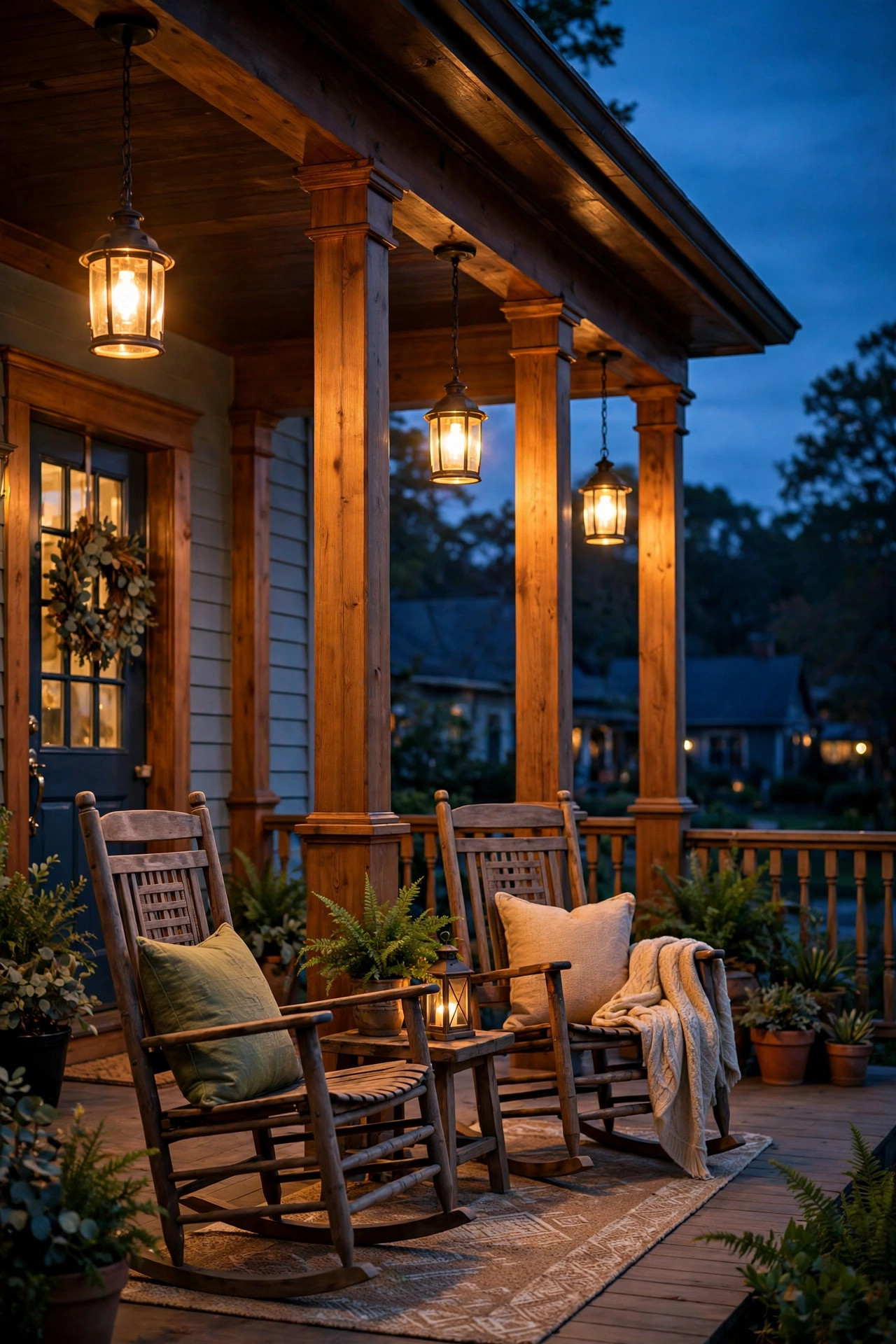
There's something about a porch with a glowing pendant light that makes the whole house feel alive after dark. In my experience, these outdoor pendant light ideas work magic because they solve the number-one problem with porch lighting: most porches get one lonely ceiling fixture, and it either floods the space with harsh light or barely reaches the steps. A well-chosen pendant changes everything — it pulls the light down to where you actually live, right over your rocking chairs, your front door, or that dining table where summer dinners stretch past sunset.
I always recommend layering your lighting, and pendants are the "middle layer" that most porches are missing. Think of it this way: you want something overhead (your pendant), something at eye level (wall sconces or lanterns), and something low (path lights or step lights). That trio is what makes a porch feel deep and inviting instead of flat and forgettable, honestly? It's the difference between a porch you walk past and a porch you sit on.
Below are my 17 favorite outdoor pendant light ideas — everything from classic lantern styles to smart dimmable designs — with real measurements for hanging heights, chain lengths, and spacing so you can get it right the first time. Let's light it up.
1. Classic Lantern Pendants by the Front Door
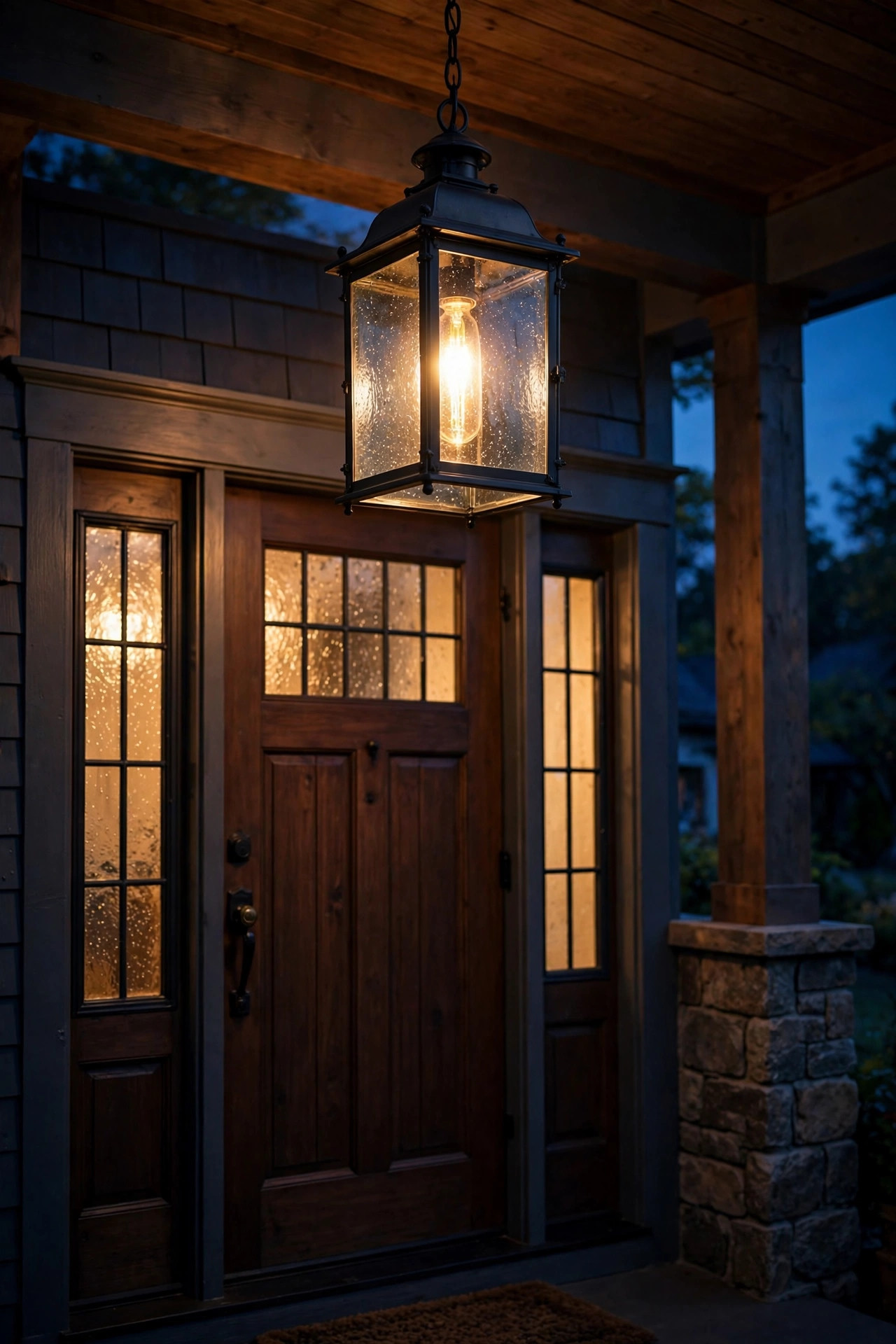
If your porch could only have one light, I'd hand it a classic lantern pendant without hesitation. The black metal frame, the clear glass panels, the little seeded-glass texture that catches the flame-look of an LED filament bulb — it's the visual shorthand for "welcome home." I always recommend hanging a single lantern pendant centered on the door, with the bottom of the fixture landing at least 7 feet above the porch floor so nobody knocks their head, and roughly 6 to 8 inches above the top of the door frame. On a wide porch, two pendants spaced evenly across the ceiling look balanced, but measure first — pendants wider than 14 inches can start to crowd a narrow porch.
For bulb choice, a dimmable warm-white LED filament bulb at 2700K gives you that candlelit feel without the fire risk, and at 800 lumens it's plenty for a door area. Make sure whatever you buy is damp-rated at minimum (covered porches count as damp locations), and look for the UL or ETL listing stamped right on the socket. If you're pairing this with sconces, I have a whole set of entryway lighting ideas that coordinate beautifully with lantern pendants.
Suggested budget range: $60 – $180.
2. Barn-Style Dome Pendants for a Farmhouse Porch
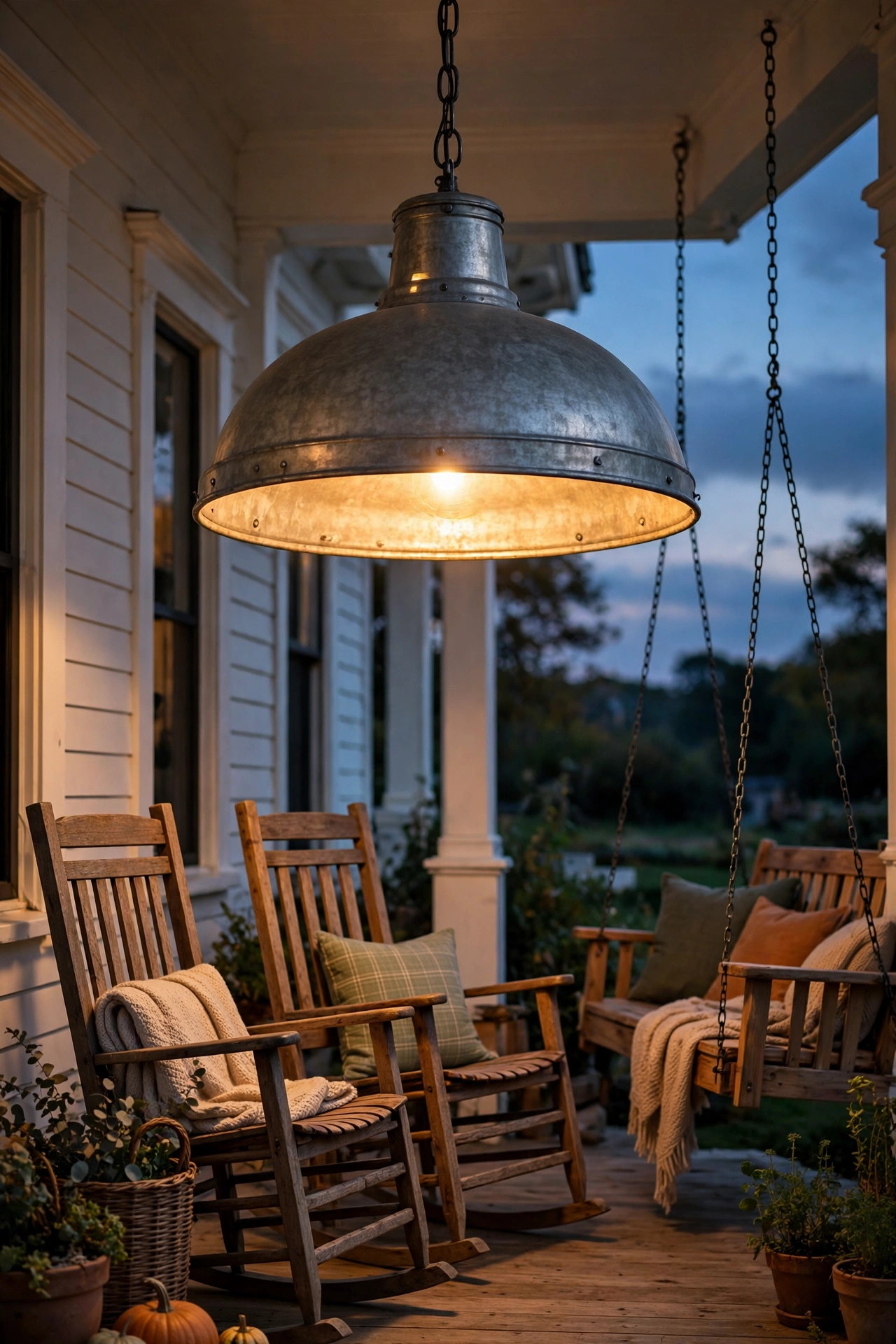
Barn pendants — those wide, flared metal domes that look like they were lifted off a dairy farm — are the farmhouse porch's best friend. The genius of the dome shape is that it throws light straight down in a wide, generous pool, which is exactly what you want over a porch seating area or steps. I always recommend a dome diameter of about 12 to 16 inches for a standard porch; anything under 10 inches looks lost against a tall ceiling, and anything over 18 inches belongs on a great big wraparound.
Hang the bottom of the dome about 7 to 8 feet off the floor for walkways, and use a chain rather than a rod if your porch ceiling slopes — chain lets the fixture hang plumb while the canopy sits flush against the angle. Most barn pendants come with 6 feet of adjustable chain, and you'll typically remove links to fit an 8-to-9-foot ceiling, leaving the fixture body roughly 18 to 24 inches below the ceiling. Look for a galvanized steel or powder-coated finish (go for the baked-enamel look if you want that authentic enamelware feel), damp-rated for covered porches, with a porcelain socket inside so it can handle outdoor humidity.
Suggested budget range: $50 – $150.
3. Hurricane-Glass Outdoor Pendant Light Ideas Over the Dining Table
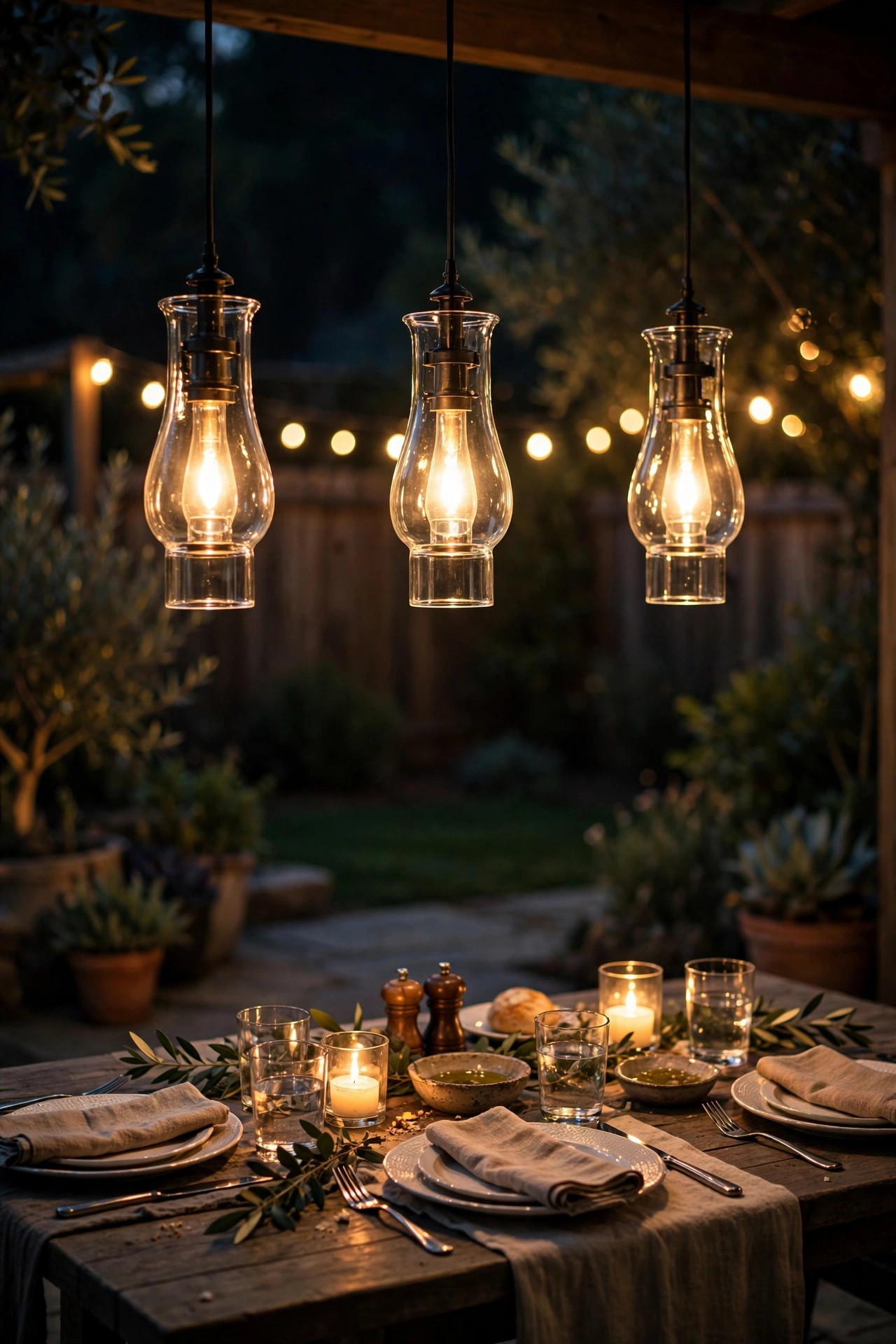
Nothing says summer-evening dinner party like a row of hurricane-glass pendants swaying gently over a patio table. These are some of my favorite outdoor pendant light ideas for entertaining spaces because the glass chimney protects the bulb from wind gusts while throwing a soft, flickering-looking glow across the table. For the classic three-pendant row, space the fixtures 24 to 30 inches apart on center, and hang them so the bottom of the glass sits 30 to 36 inches above the tabletop — low enough to feel intimate, high enough that nobody's staring into a bare bulb.
If your table is longer than 6 feet, scale up to four pendants rather than stretching three too far apart. Choose hurricanes made from thick borosilicate-style glass with a weighted metal cap up top; thin souvenir-style glass will fog and crack after one season of temperature swings. Since these hang over a dining area on an open patio, I'd reach for a wet-rated fixture here rather than merely damp-rated — summer storms don't check your porch roofline before rolling in. Use dimmable 2700K LED filament bulbs (40-watt equivalent each) on a dimmer so you can drop the light low for dessert and conversation.
Suggested budget range: $90 – $300 for a set of three.
4. Woven Rattan Pendants for a Breezy Boho Patio
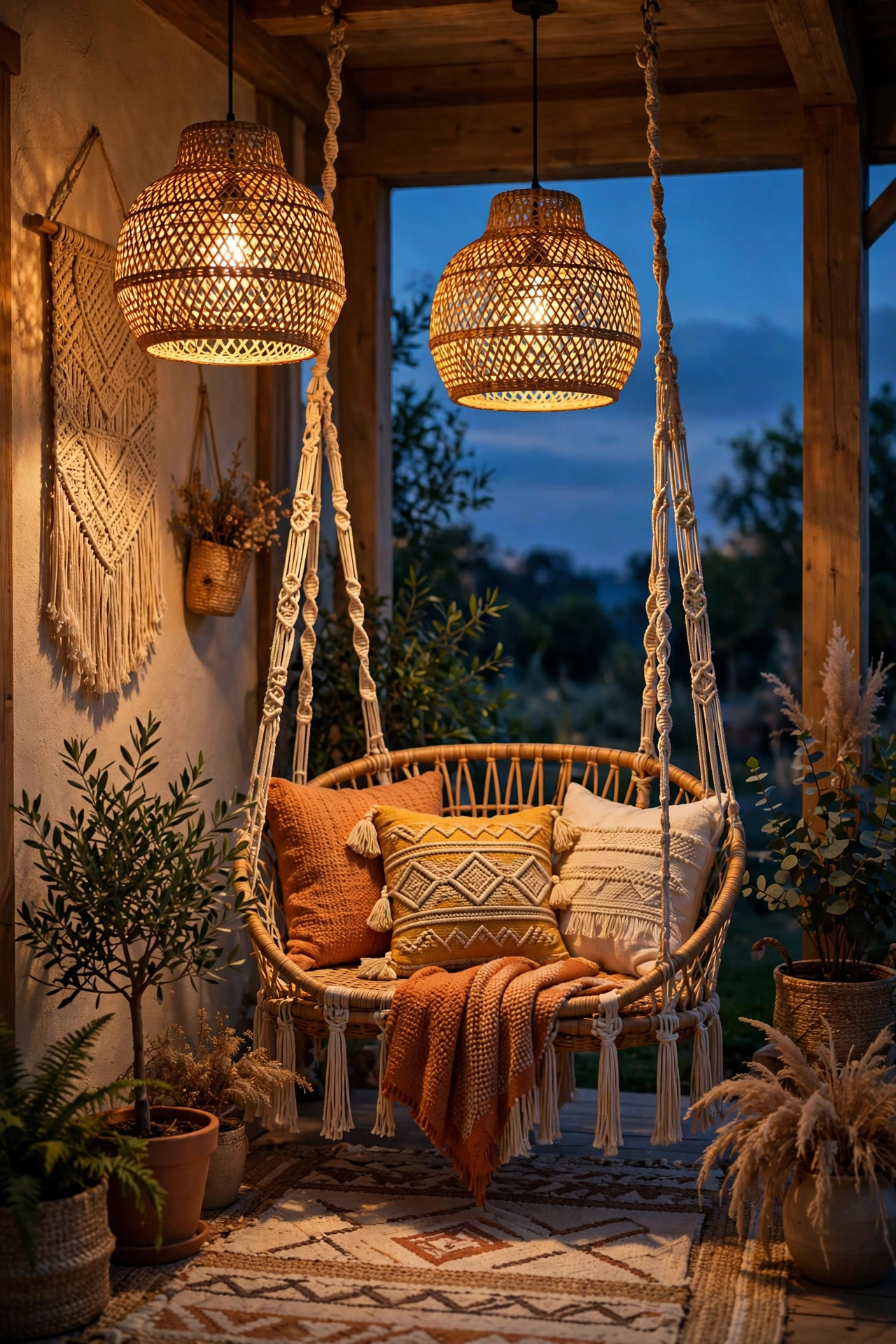
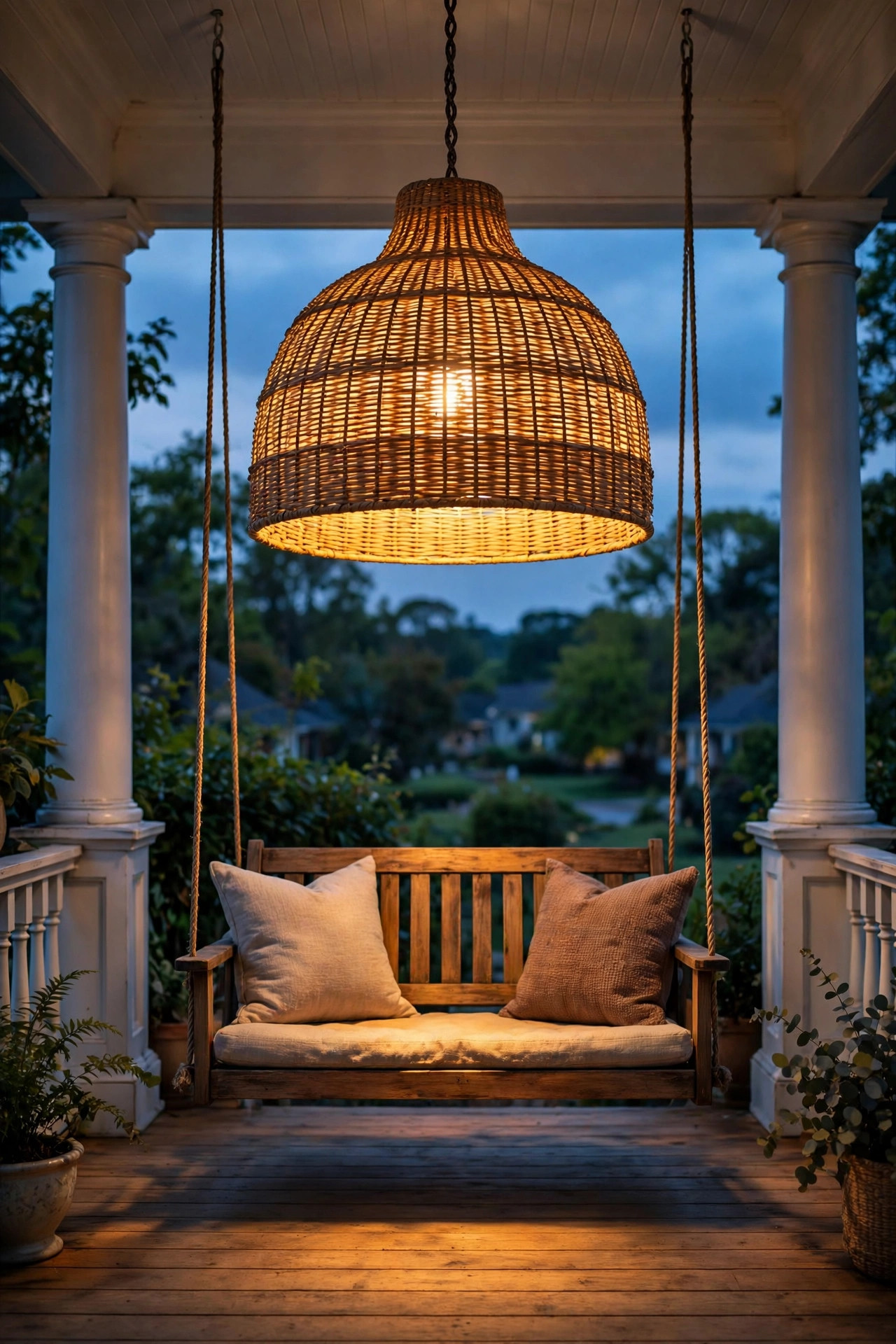
Rattan and wicker pendants give a covered porch instant vacation energy — that dappled, dappled light filtering through the weave is pure magic on a summer night. In my experience, these look best in pairs or trios over a porch swing or a cozy reading nook, hung with the bottoms at about 6 to 7 feet so the woven texture reads at eye level from nearby seating. Because natural rattan doesn't love driving rain, I always recommend these for covered porches and patios with real roof coverage — and double-check that the fixture itself is damp-rated, since the rattan is decorative and the wiring inside still has to be rated for humidity.
For bulbs, use a frosted LED at 2700K rather than a clear filament here; clear bulbs create hot spots through the open weave, while a frosted bulb softens into an even, glowing orb. Keep the wattage modest — 40-watt equivalent (about 450 lumens) per pendant is plenty when you're hanging two or three. One electrical safety note: woven shades sit close to the bulb, so always use cool-running LEDs (never incandescent) and confirm the shade keeps at least 2 inches of clearance around the bulb per the manufacturer's instructions.
Suggested budget range: $70 – $220 for a pair.
5. Exposed Edison Bulb Cage Pendants for Industrial Edge
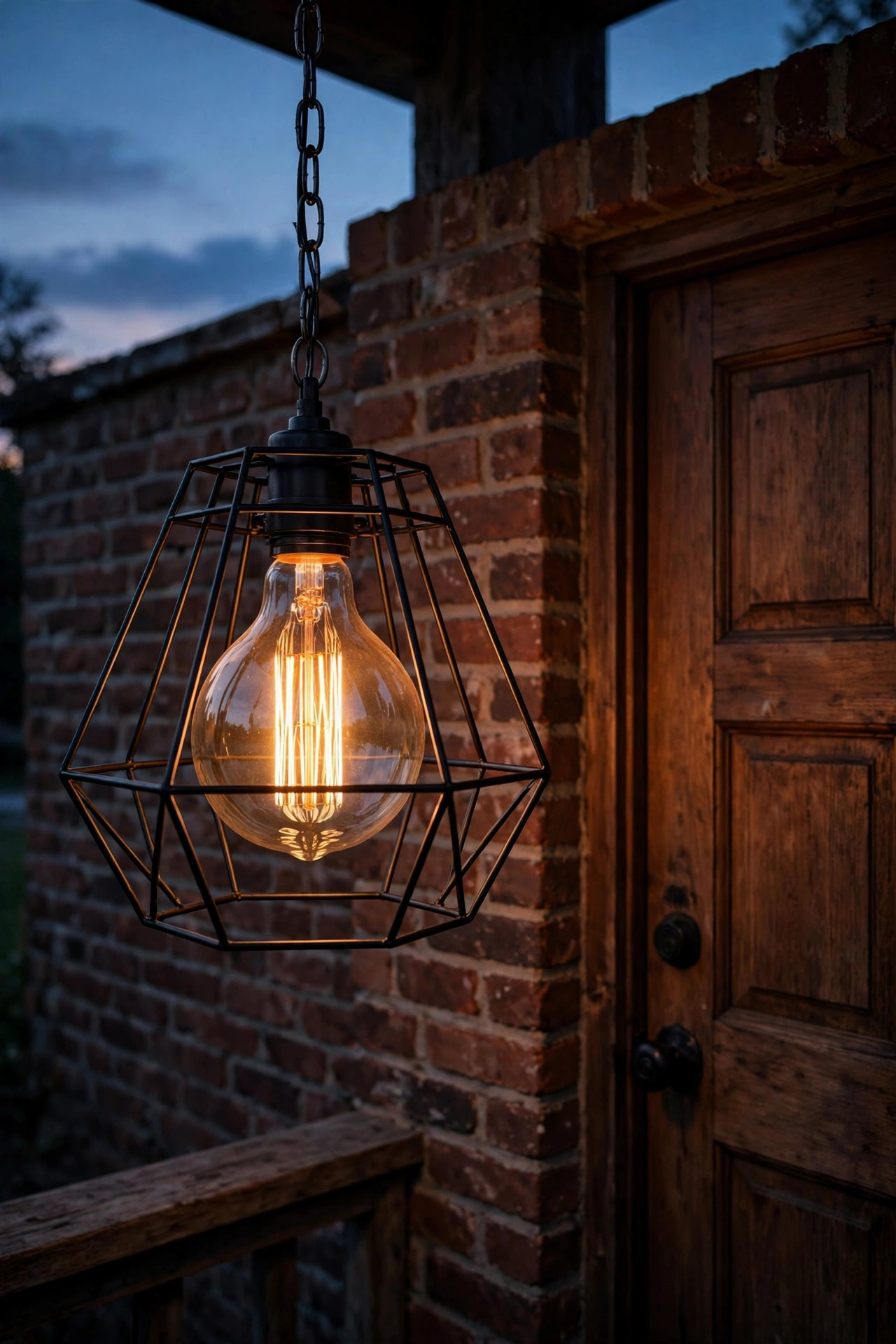
Industrial cage pendants — a bare bulb inside a geometric wire cage — are the cool-kid answer to porch lighting, and honestly? They work. The open cage means zero glare issues and maximum bulb visibility, so splurge on beautiful oversized LED Edison-style bulbs with the visible filament loops; they're the whole show here. I always recommend hanging a single cage pendant over a side door or a small porch nook at about 7 feet to the bottom of the cage, or a trio over a long narrow porch spaced 4 feet apart.
Because there's no shade diffusing anything, keep these on a dimmer — full brightness from an exposed bulb gets harsh fast, especially over 800 lumens. A dimmable 2200K-to-2700K "warm dim" LED Edison bulb is the dream pick: it drops to a candlelight amber as you dim, which feels incredible on autumn evenings. Look for blackened steel or oil-rubbed bronze cages with a damp rating, and hang them on chain (not rod) so you can fine-tune the drop length link by link. The canopy-to-cage drop on a standard 9-foot porch ceiling usually works out to about 12 to 18 inches.
Suggested budget range: $40 – $130 per pendant.
6. Sleek Matte Black Globe Pendants for Modern Homes
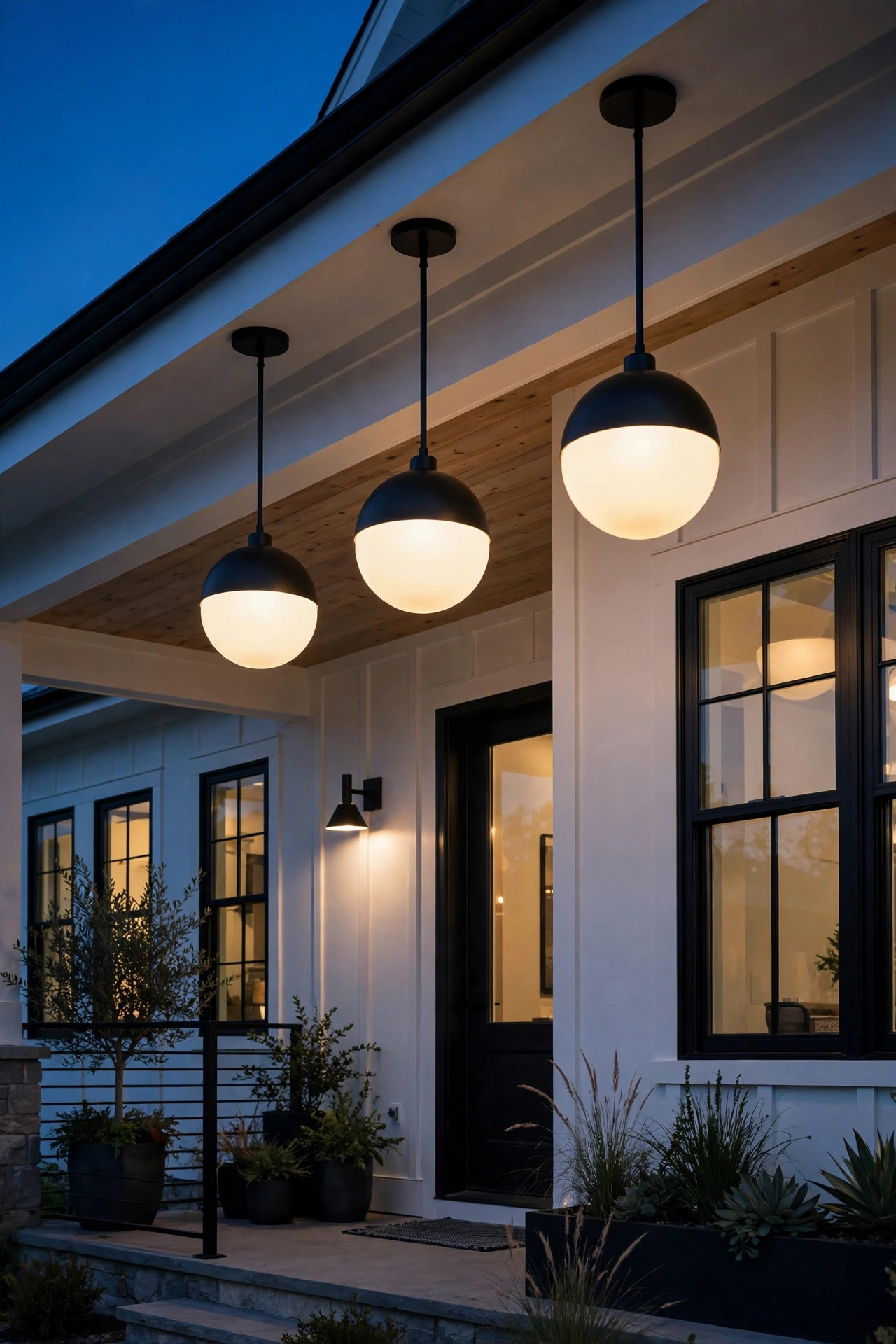
If your house has clean lines — think modern farmhouse, contemporary ranch, or that crisp black-and-white exterior everyone loves — matte black globe pendants are the move. The globe's frosted or opal glass diffuses the bulb into a perfect, glare-free moon of light, which is ideal over seating areas where you'll be looking up at the fixture. I always recommend globes in the 10-to-12-inch diameter range for porches; smaller and they disappear against a big ceiling, larger and they start to feel like cafeteria lighting.
Hang these on slim down-rods rather than chain for the cleanest look — most come with 3 to 4 adjustable rod sections you can stack to fit ceiling heights from 8 to 10 feet. Keep the bottom of the globe at 7 to 8 feet above the floor in walkway zones, and drop them a touch lower (about 6 feet 8 inches) over conversation areas for a cozier feel. Wet-rated versions exist for exposed patios; otherwise, damp-rated is fine under cover. Pair with 3000K LEDs here instead of 2700K — the slightly cooler white keeps modern exteriors looking crisp rather than sleepy.
Suggested budget range: $55 – $160 per pendant.
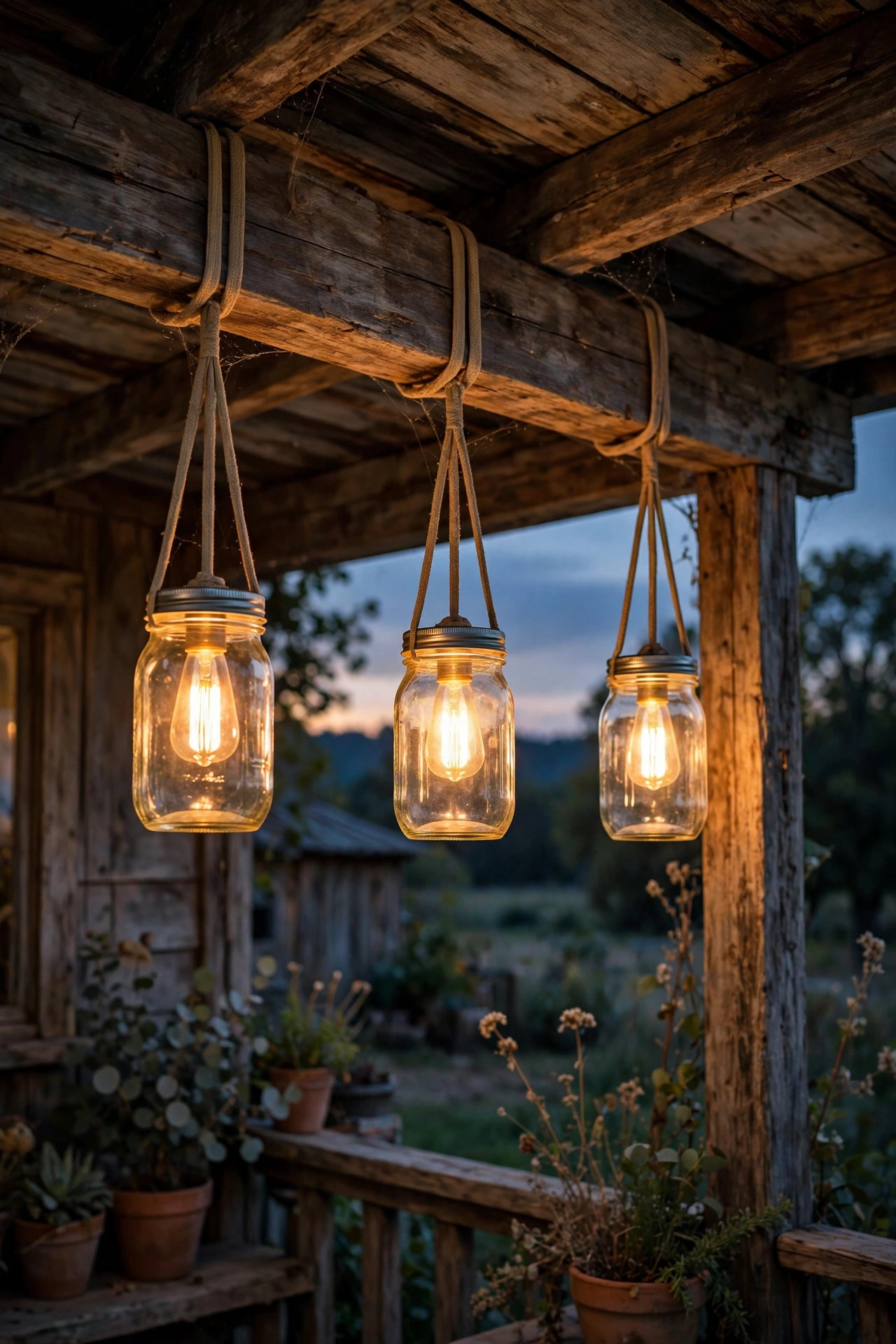
7. DIY Mason Jar Pendants for Rustic Charm
I have a soft spot for mason jar pendants because this is the one idea you can genuinely build in an afternoon. The concept is simple: a weatherproof pendant cord kit, a wide-mouth mason jar with a hole drilled in the lid, and a warm LED filament bulb inside. Hang two or three down a porch beam or across a pergola rail, spacing them 3 to 4 feet apart, with the jars bottoming out around 6 feet 6 inches above the floor in seating areas. The glass jar diffuses the bulb into something that looks like fireflies caught mid-dance — I swear.
But here's the electrical-safety reality check I give everyone who tries this: the jar itself is not a fixture rating. You need a pendant cord kit that's listed for damp (or wet) outdoor locations, with a proper strain-relief and a socket rated for outdoor use. Drill your lid holes smooth, add a rubber grommet where the cord passes through, and never seal the jar airtight — an LED needs a little ventilation, and trapped moisture will fog the glass. Also, use a screw-in socket rated for the wattage you're pulling (a 4-watt LED is plenty), and always, always turn off the breaker before wiring anything. This is where my electrical safety tips post earns its keep — give it a read before you touch a wire.
Suggested budget range: $25 – $75 for a set of three.
8. One Oversized Statement Pendant Over the Porch Swing
Instead of a row of small lights, try one dramatic oversized pendant centered over your porch swing or rocking chairs. I'm talking 20-to-24-inch shade diameter — a giant lantern, a huge woven basket shade, or an oversized dome. In my experience, one big fixture reads more intentional and high-end than three timid ones, and it anchors the whole seating arrangement the way a rug anchors a room. The sizing rule I use: the shade diameter should be roughly one-fourth to one-third of the width of the seating zone it's lighting. A 24-inch pendant over a 6-foot swing zone? Chef's kiss.
Hang it lower than you'd think — about 6 feet 6 inches to 7 feet at the bottom, so it sits at conversational height above the swing. Because it's one large, heavy fixture, the electrical box matters more here than with dainty pendants: it should be a fan-rated or heavy-duty box that can support the weight (some 24-inch shades weigh 15 to 20 pounds), and you want it lagged into a joist, not just drywall-anchored. Damp-rated minimum, wet-rated if your swing hangs off the porch edge where rain blows in. Choose a 2700K LED at 800 to 1,100 lumens and put it on a dimmer — big pendants carry a room, so give yourself brightness control.
Suggested budget range: $90 – $250.
9. Copper Dome Outdoor Pendant Light Ideas for Coastal Porches
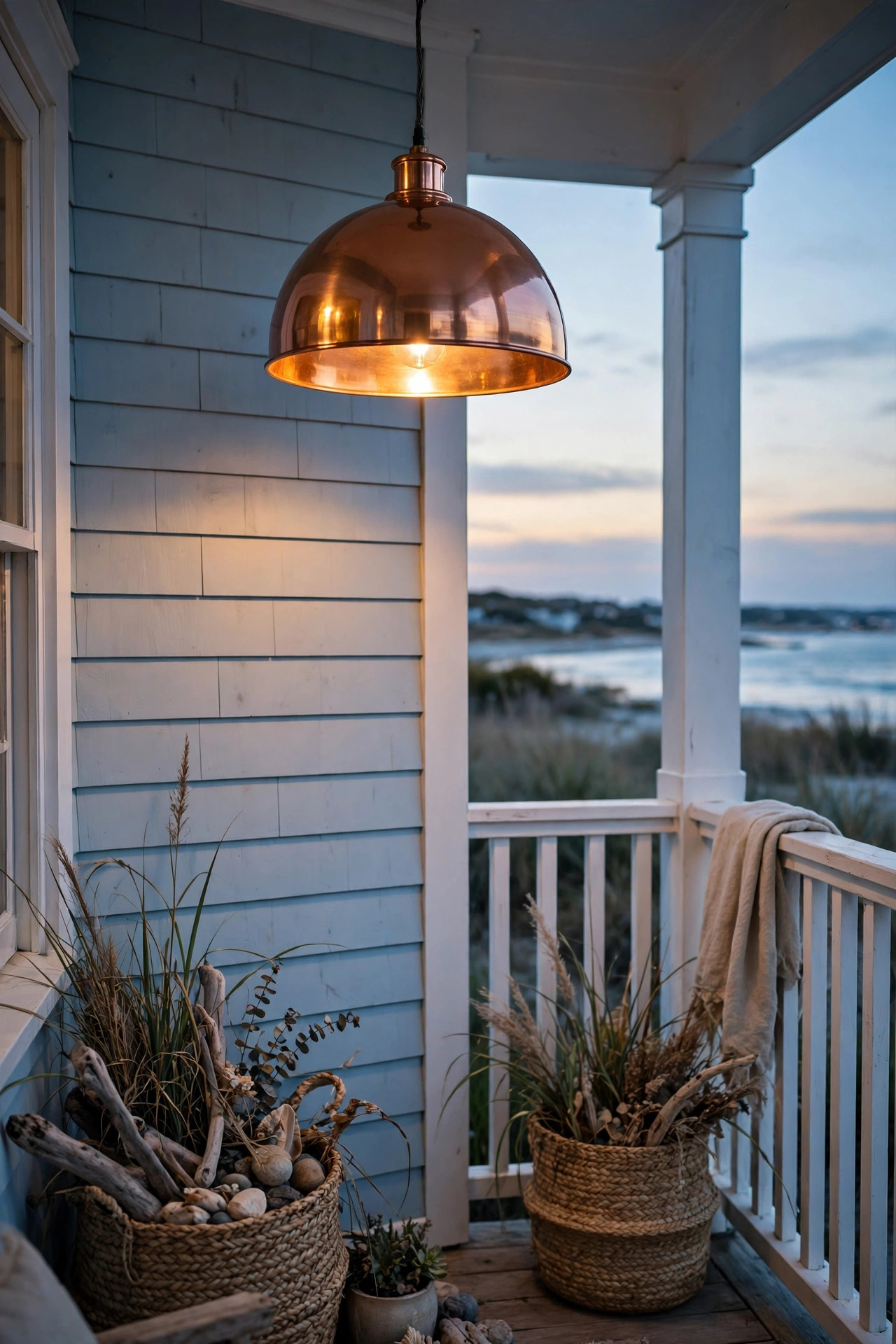
Copper pendants on a coastal porch are like the perfect pair of earrings — they just finish the look. The metal starts out bright and penny-like, then settles into a soft, weathered patina that looks incredible against white shiplap, beadboard ceilings, or pale blue porch paint. These are some of my favorite outdoor pendant light ideas for anyone dealing with salt air, because copper is naturally corrosion-resistant where cheaper painted metals will start bubbling and rusting after two seaside seasons.
Hang a single copper dome centered over the entry door (bottom at 7 feet, as always for doors) or a pair over porch seating, spaced 4 to 5 feet apart. The reflective interior of a copper dome throws a surprising amount of light downward, so a single 60-watt-equivalent LED (800 lumens) usually does the job. Look for solid spun copper rather than copper-plated steel — the plated versions are cheaper but the coating can flake where salt spray sits. Wet-rated is worth the small premium on coastal porches since wind-driven rain reaches under roof edges more than you'd expect. And skip lacquered "bright copper" finishes if you want the patina; let it age naturally.
Suggested budget range: $80 – $220 per pendant.
10. Galvanized Bucket Pendants for Farmhouse Utility Style
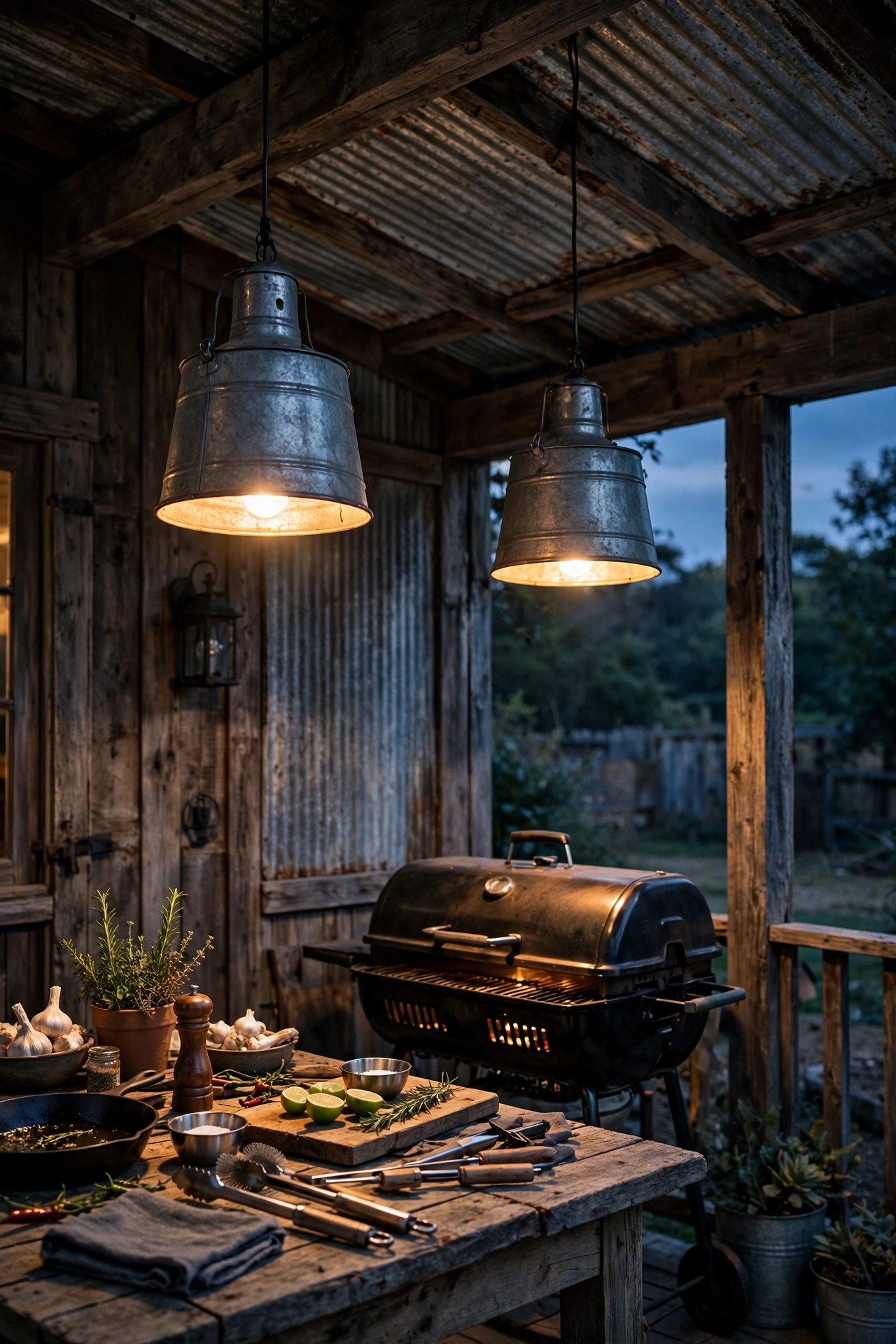
Galvanized metal bucket pendants are the workhorse of farmhouse lighting — inexpensive, nearly indestructible, and they look like they belong on a wraparound porch that's seen a hundred years of summers. The upside-down bucket shape focuses light in a tight, downward pool, which makes them fantastic over grill stations, potting benches, and porch work tables where you actually need task light. I always recommend sizing them generously: a 14-to-16-inch bucket over a work area, hung so the bottom sits about 6 feet 6 inches above the work surface's standing zone.
Because the shade is fully metal with a small opening, you'll get dramatic light-and-shadow contrast — gorgeous, but it means the pool of light is smaller than you'd expect from the shade size. Plan on spacing multiples 3 to 4 feet apart for even coverage, and use a bright 3000K LED (1,000 to 1,200 lumens) since this is task lighting, not mood lighting. Galvanized steel handles rain beautifully, so wet-rated versions are common and cheap. One caveat: metal shades get hot to the touch with high-output bulbs, so stick with LEDs and keep the shade out of head-bump range — 7 feet minimum over walkways.
Suggested budget range: $35 – $110 per pendant.
11. Seeded-Glass Bell Pendants for Vintage Romance
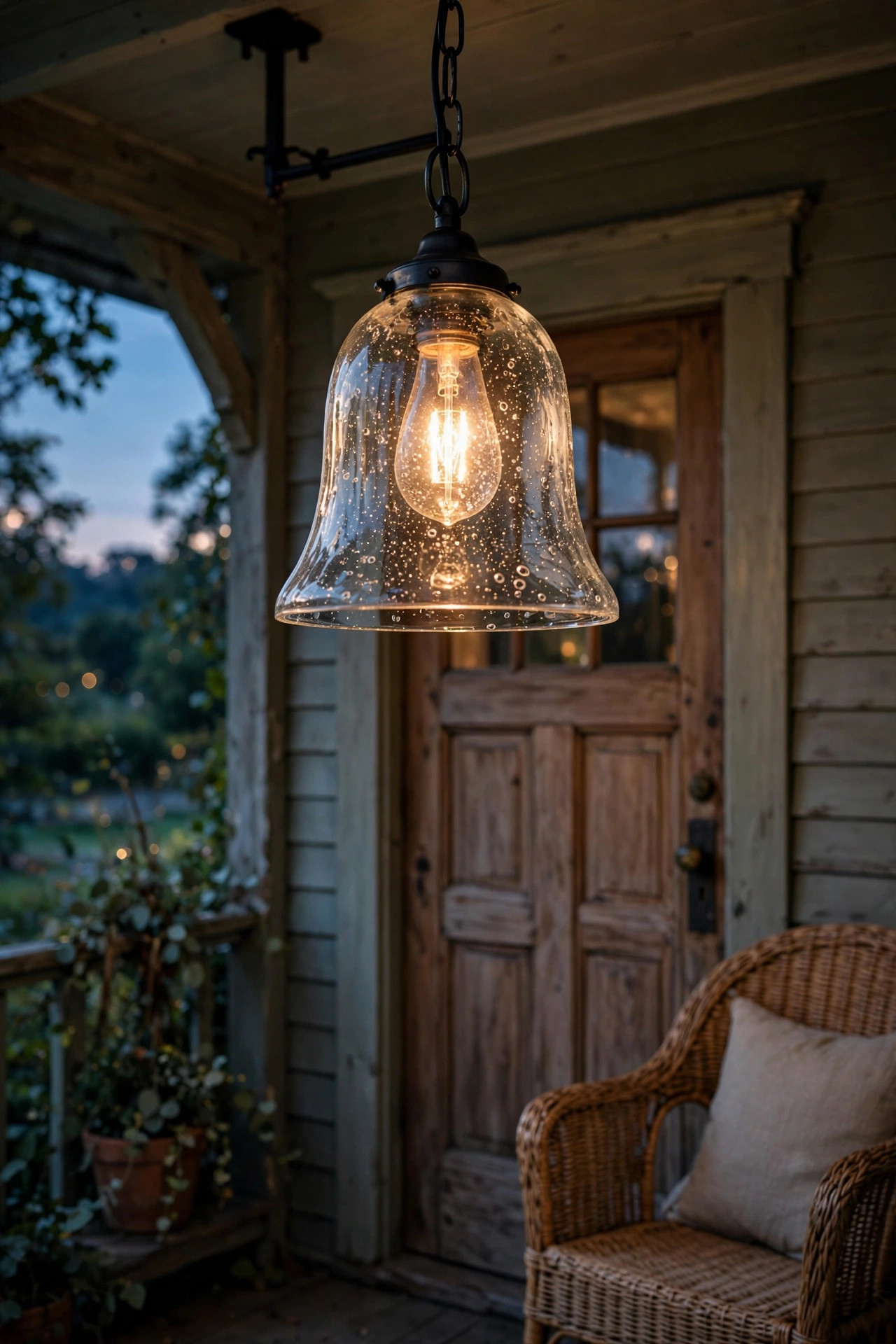
Seeded glass — that hand-blown look with tiny trapped air bubbles — is the detail that makes a bell-shaped pendant feel like it came from a 1920s bungalow, even when it's brand new. The bubbles catch and scatter the light into a sparkle that's impossible to replicate with plain glass, and at night the whole fixture seems to shimmer. I always recommend bell pendants in pairs flanking a porch doorway or centered over narrow porch sections where a wide dome would feel squat; the taller, narrower profile of a bell (usually 12 to 16 inches tall) elongates low porch ceilings beautifully.
Hang them so the widest part of the bell sits at eye level from the street — roughly 5 feet 6 inches to 6 feet at the bottom of the glass — which puts the fixture itself at a flattering height for curb appeal photos and actual humans walking up your steps. Just be careful on low-traffic side porches: bell glass is fragile, so keep the bottom edge at 7 feet minimum anywhere people walk. Use clear LED filament bulbs at 2700K so the seeded texture really shows; frosted bulbs hide the sparkle. Damp-rated versions are standard since these live under porch roofs in most applications.
Suggested budget range: $60 – $170 per pendant.
12. Smart Dimmable Pendants on Timers and App Control
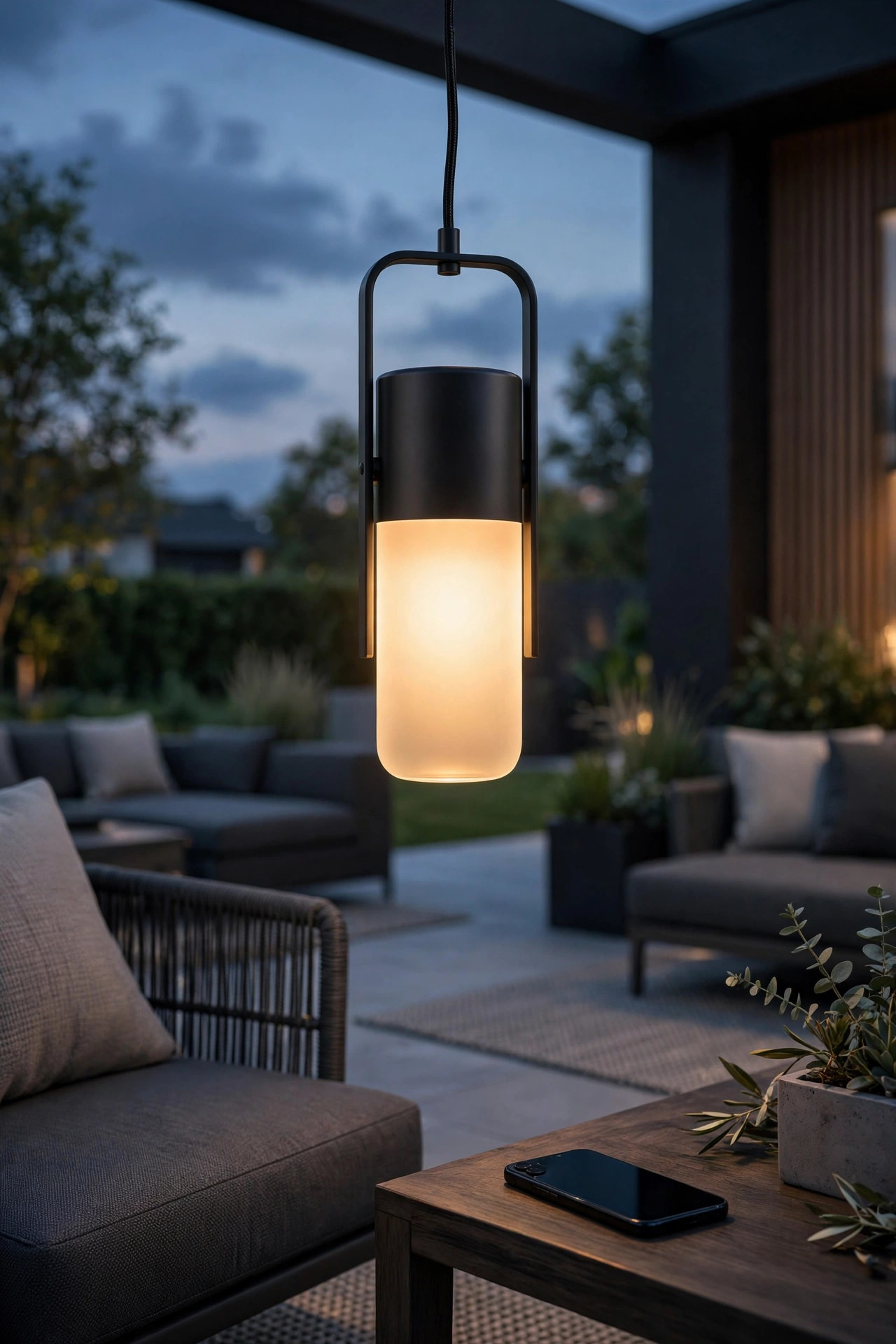
Here's the 2026 upgrade: smart outdoor pendants you can dim from the couch, set on a dusk-to-dawn timer, and warm or cool on demand. In my experience, the single best investment in porch lighting isn't a prettier shade — it's a bulb with a brain. Screw a smart outdoor-rated LED bulb into any damp-rated pendant socket, set it to 2700K for evening lounging and 3000K when you're grilling or reading, and put the whole thing on an astronomical timer so it fades on at sunset without you lifting a finger.
A few honest notes from living with these: smart bulbs need a solid Wi-Fi signal on the porch, so if your router is three rooms away, add a mesh node or outdoor-rated extender first. Also, check that your bulb is actually rated for enclosed or outdoor fixtures — some smart bulbs overheat in sealed pendants, and heat is the enemy of electronics in summer. I always recommend keeping one "dumb" bulb on hand too, because when the Wi-Fi hiccups at 9 p.m., you'll still want light. Dimming range matters more than color features for outdoor use; look for bulbs that dim smoothly down to 5 percent without flickering.
Suggested budget range: $70 – $200 including smart bulbs and a timer switch.
13. Solar-Powered Pendants Where Wiring Can't Reach
No junction box? No problem. Solar pendant lights hang from a shepherd's hook, a pergola beam, or a tree branch where running wire would cost a fortune — and they're honestly? Better than they've ever been. Modern solar pendants use high-efficiency panels and 18650-style rechargeable batteries that can push 6 to 8 hours of glow on a full sunny-day charge, which covers most evening porch sessions. I always recommend hanging them where the solar panel (usually built into the top of the fixture) gets at least 6 hours of direct sun — under a solid porch roof, they simply won't charge, so reserve these for open pergolas, tree branches, and fence-line posts.
Manage expectations on brightness: a good solar pendant puts out 100 to 300 lumens, which is mood lighting, not task lighting. They look best in clusters of three to five, spaced 3 to 4 feet apart, where the combined glow adds up. Most come with a dusk sensor that switches them on automatically, and many have warm-white LEDs at 2700K built in. Maintenance is minimal — wipe the panel with a damp cloth a few times a season and replace the rechargeable battery every 2 to 3 years. Since there's no wiring at all, these are the safest DIY lighting project on this list.
Suggested budget range: $30 – $120 for a set of four.

14. Wet-Rated Chain-Hung Pendants for Open Pergolas
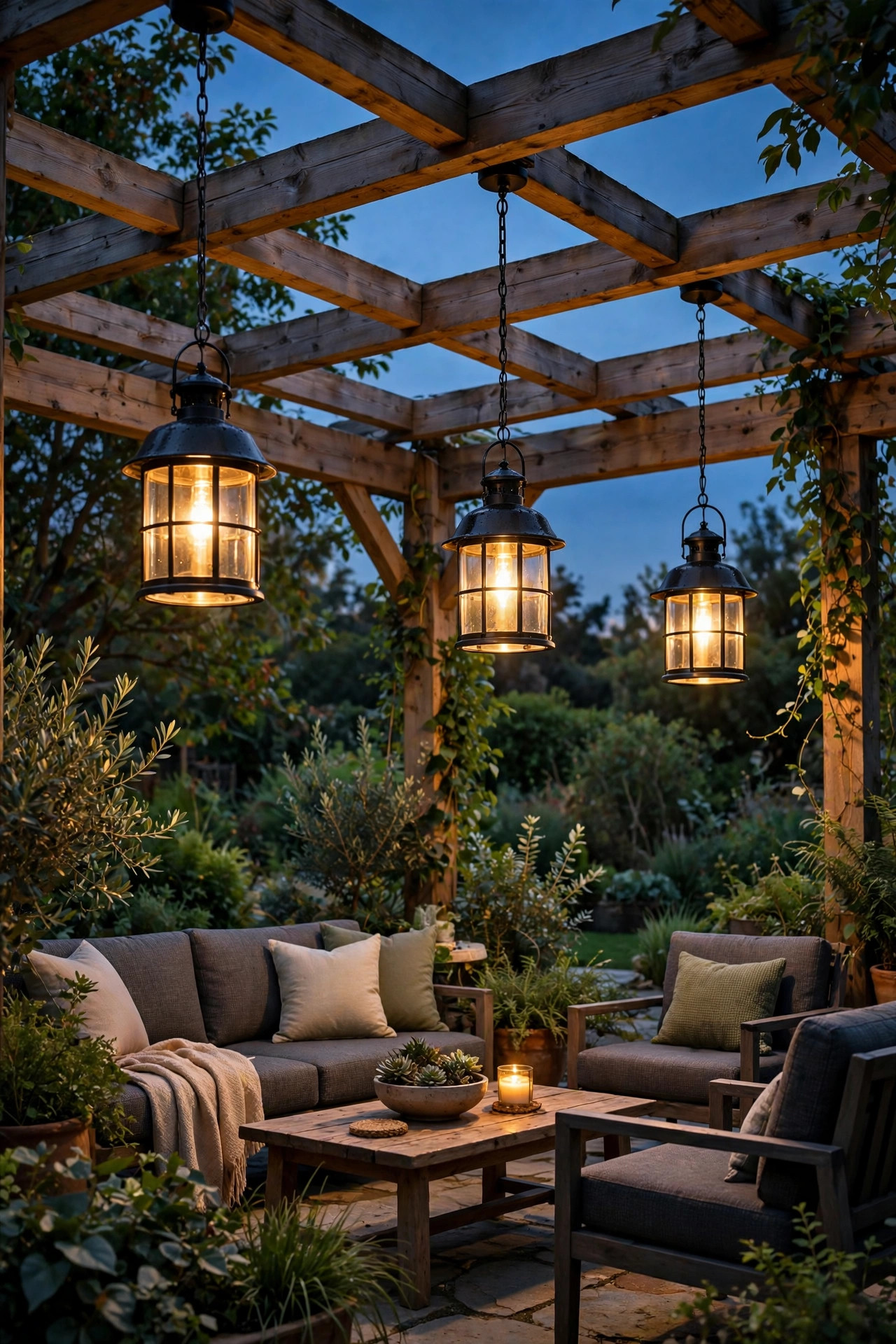
Let's talk about the most important distinction in outdoor lighting: damp-rated versus wet-rated. Damp-rated fixtures handle humidity and indirect moisture — perfect under a solid porch roof. But a pergola with open slats, a gazebo, or any spot where rain falls straight through? That demands wet-rated fixtures, built with sealed gaskets, drainage weep holes, and corrosion-proof hardware. I always recommend checking the label inside the canopy before you buy — it should say "suitable for wet locations" in plain English, with a UL or ETL mark to prove it.
For open pergolas, hang wet-rated lantern or dome pendants from the crossbeams using chain, not rigid rod — chain handles the natural sway and lets you adjust drop length easily. A good rule of thumb: drop the pendant so the bottom sits at 7 to 8 feet above the patio floor, which on a typical 9-foot pergola means about 12 to 18 inches of chain below the beam. Space pendants along the beams 4 to 6 feet apart for even coverage, and wire them on an outdoor-rated circuit with a GFCI breaker, because anything under open sky needs ground-fault protection. Use silicone sealant around the canopy where it meets the beam to stop water tracking down the chain.
Suggested budget range: $65 – $190 per pendant, plus wiring.
15. Clustered Outdoor Pendant Light Ideas at Three Heights
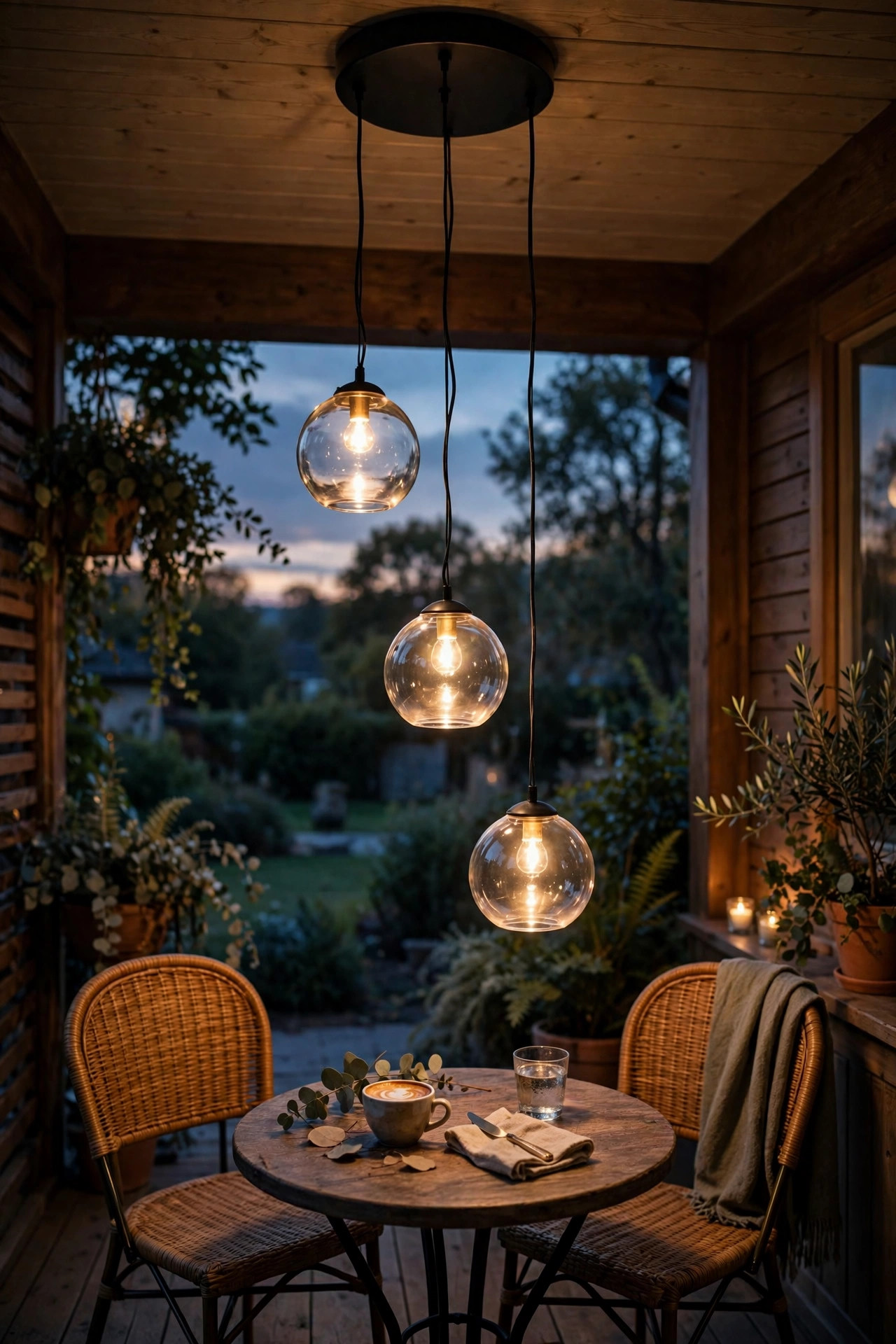
One of my favorite designer tricks — and honestly? One of the easiest — is clustering three pendants at staggered heights over a single spot, like a small bistro table or a porch corner. These clustered outdoor pendant light ideas create instant drama: hang the fixtures 6 to 10 inches apart horizontally, with drops at three different lengths (say 12, 18, and 24 inches below the canopy), so the shades cascade like a waterfall. It works with almost any style — three mini glass globes, three tiny metal domes, or three woven rattan shades all look fantastic clustered.
The wiring is simpler than it looks: all three pendants feed into a single ceiling canopy with a multi-port cord grip, so you only need one junction box. Keep each individual shade small — 6 to 10 inches in diameter — or the cluster gets visually heavy fast. For the bottom edge of the lowest shade, follow the same rules as single pendants: 7 feet above walkways, 30 to 36 inches above a table. Use low-wattage bulbs (25-to-40-watt equivalent each) since three bulbs add up; 2700K keeps the cluster feeling cozy rather than glaring. This is the one idea on this list that reads "custom designer" without a custom price tag.
Suggested budget range: $80 – $240 for a three-pendant cluster kit.
16. Carriage-House Candle Pendants for Old-World Charm
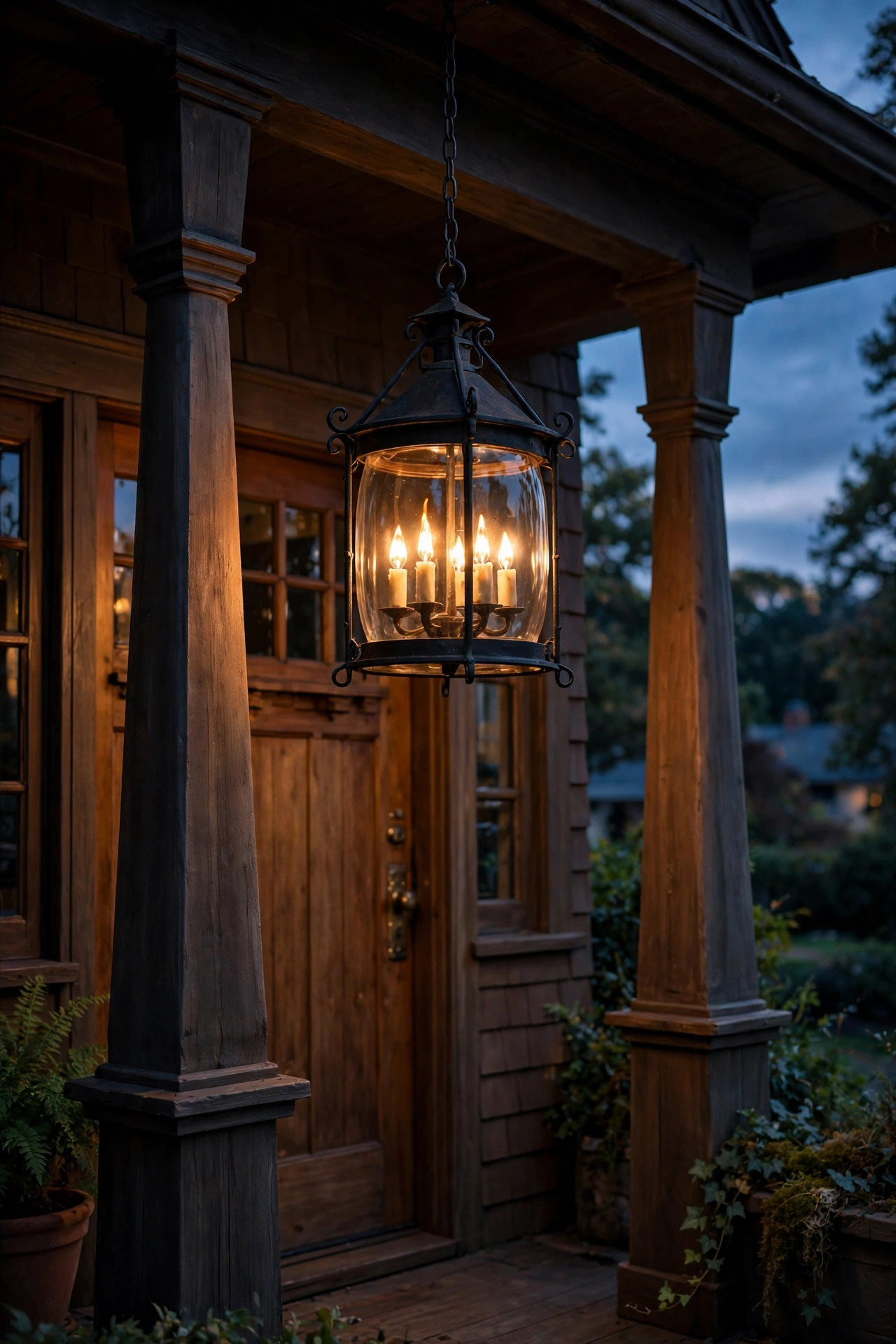
Carriage-house style pendants — the ones with candle-style bulbs inside a lantern cage — bring an old-world, storybook feel to colonial, craftsman, and traditional porches. Instead of one bright bulb, they use three to five small candle-style LED bulbs, each shaped like a flame, which spreads the light into a warm, flickering-looking glow that's flattering on faces and architecture alike. I always recommend these in pairs flanking a wide front door or a garage entry, centered about 6 inches above the door frame with bottoms at 7 feet.
Because the light comes from multiple small sources, carriage pendants illuminate more evenly than single-bulb lanterns — no single hot spot. Use dimmable candle-style LEDs at 2700K, 25-watt equivalent each; five of them in one fixture add up to plenty of light. Look for fixtures with real glass panels (not plastic) and a damp rating minimum — these typically hang under porch roofs. If your heart is set on the look for an exposed spot, hunt specifically for a wet-rated version; they're less common but they exist. The fixture bodies tend to run larger than standard lanterns, so check your porch proportions before committing.
Suggested budget range: $75 – $200 per pendant.
17. Low-Profile Stem-Mount Pendants for Low Porch Ceilings
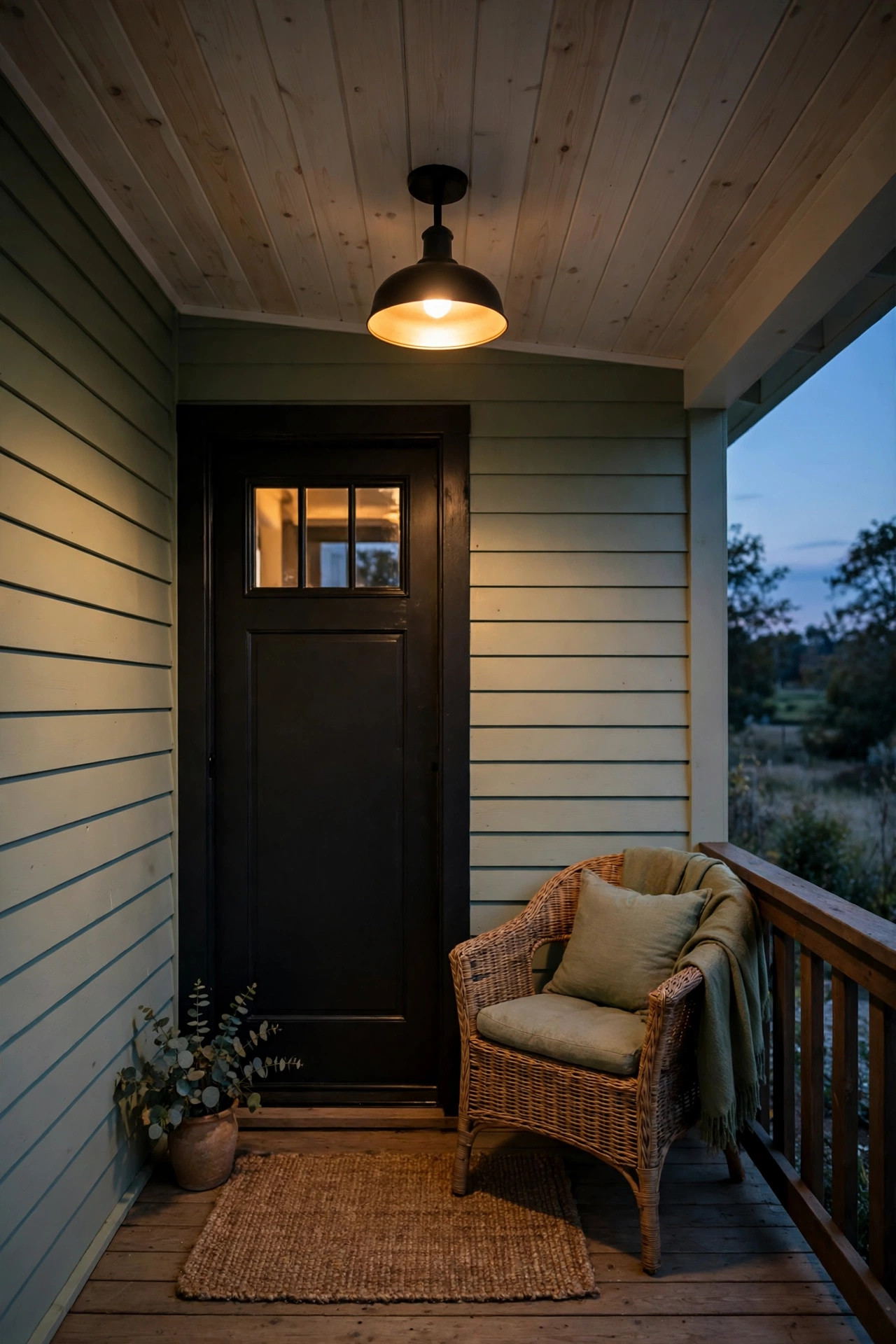
Not every porch has a grand 10-foot ceiling — mine certainly doesn't. If your porch ceiling sits at 8 feet or lower, standard chain-hung pendants leave no room for actual light at a safe height, and flush-mount fixtures can feel flat. The answer is stem-mount pendants: a short rigid stem (usually 6 to 12 inches, with extension options) that connects the canopy directly to a small shade. You get the jewelry-box look of a pendant without the chain eating up your headroom.
Here's the math I use: ceiling height minus 84 inches (7 feet of clearance) equals your maximum fixture drop. On an 8-foot ceiling, that gives you 12 inches total from ceiling to bottom of the shade — a 6-inch stem plus a 6-inch-tall shade fits perfectly. Choose compact shades: 8-to-10-inch domes, small drums, or mini lanterns work best. Damp-rated stem mounts are easy to find; just confirm the canopy covers your junction box fully, since low ceilings put the wiring junction closer to eye level. Use a 2700K LED at 600 to 800 lumens — on a small porch, that's plenty, and anything brighter feels like an interrogation. For more guidance on coordinating these with the rest of your entry lighting, my overview of pendant lighting covers sizing rules that work indoors and out.
Suggested budget range: $45 – $140 per pendant.
Frequently Asked Questions
How high should an outdoor pendant light hang?
It depends on what's underneath. Over walkways, doorways, and any spot where people pass, keep the bottom of the pendant 7 to 8 feet above the floor — that's the headroom clearance standard. Over a patio dining table, hang pendants much lower: 30 to 36 inches above the tabletop, which puts the light right where you're eating and talking. Over a seating area with no table, 6 feet 6 inches to 7 feet at the bottom works well. When in doubt, hang it slightly higher; too-low pendants are the most common porch lighting mistake I see.
Can I use an indoor pendant light outside?
No — and this one really matters. Indoor fixtures lack the sealed sockets, corrosion-resistant finishes, and moisture drainage that outdoor fixtures are built with. Using an indoor pendant on a porch is a genuine fire and shock hazard. For covered porches, buy fixtures labeled damp-rated ("suitable for damp locations"); for pergolas, gazebos, or anywhere rain can reach the fixture directly, you need wet-rated ("suitable for wet locations"). Both ratings should come with a UL or ETL listing mark. When you're shopping, the rating is usually printed on a tag inside the canopy — check before you fall in love with a fixture.
What kind of bulb is best for outdoor pendant lights?
A dimmable warm-white LED, almost always. I recommend 2700K for that classic cozy porch glow, or 3000K if your home's exterior is modern and you want things to look crisp. LED filament bulbs give you the vintage Edison look with a fraction of the heat and energy use — a 4-to-8-watt LED replaces a 40-to-60-watt incandescent. Always match the bulb type to the fixture: clear filament bulbs show off seeded and hurricane glass beautifully, while frosted bulbs are better behind woven or perforated shades to avoid hot spots. And never exceed the maximum wattage printed on the socket — that's a fire-safety rule, not a suggestion.
Do I need an electrician to install outdoor pendant lights?
If you're swapping an existing fixture onto an existing outdoor-rated junction box, it's a very manageable DIY job — turn off the breaker, test the wires with a non-contact voltage tester, match black to black, white to white, ground to ground. But call an electrician if there's no existing box, if you need new wiring run through the ceiling or wall, if the circuit lacks GFCI protection on an exposed patio, or if the fixture is heavy enough to need structural support. In my experience, the electrician's visit for a simple new-box install usually runs $150 to $300, and it's money well spent for anything involving new circuits.
Conclusion
Of all the outdoor pendant light ideas on this list, the ones that will transform your space fastest are the simplest: a lantern pendant centered on your front door, hung at the right height, with a warm dimmable LED inside. But the real takeaway isn't any single fixture — it's the layering principle. A pendant pulls light down to living height, sconces handle the walls, and path lights ground the whole scene. When those three layers work together, your porch stops being a pass-through and becomes the room your family lives in half the year.
So pick one idea, measure twice, buy damp-rated (or wet-rated) — and then go sit on your porch after dark. That's the whole point. If you're hungry for more ways to make your exterior glow, browse my backyard lighting ideas next; your patio will thank you.