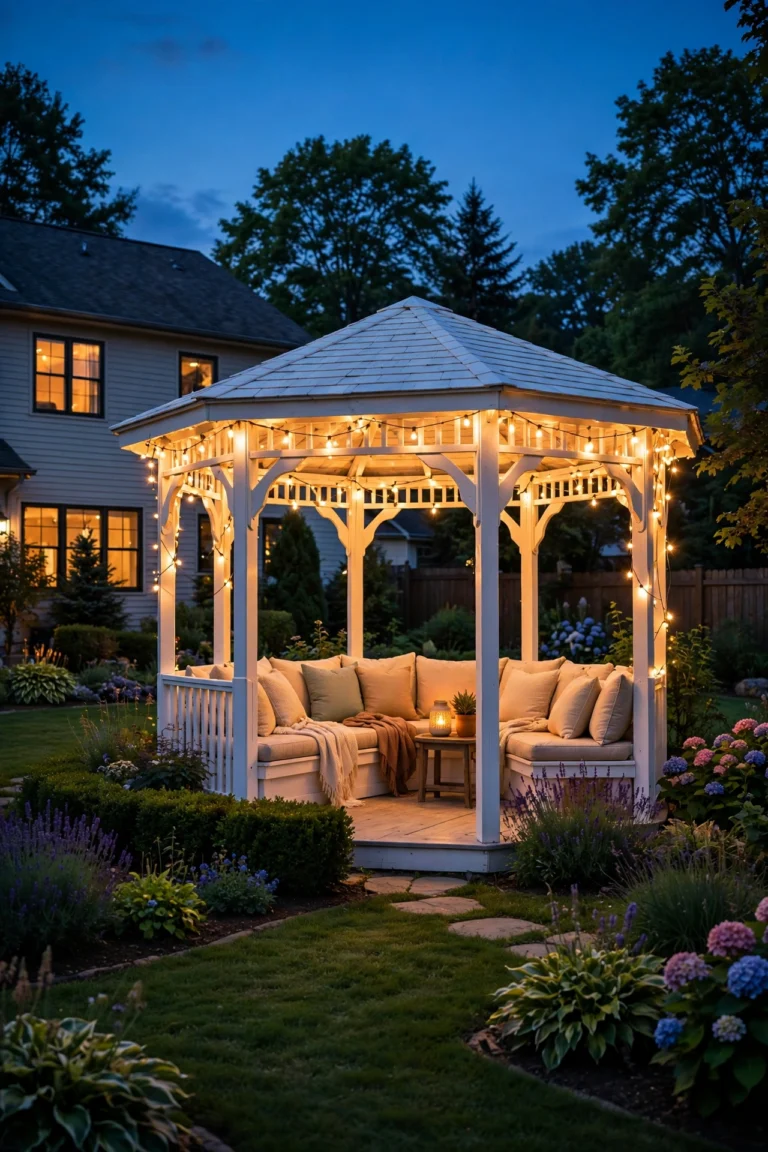
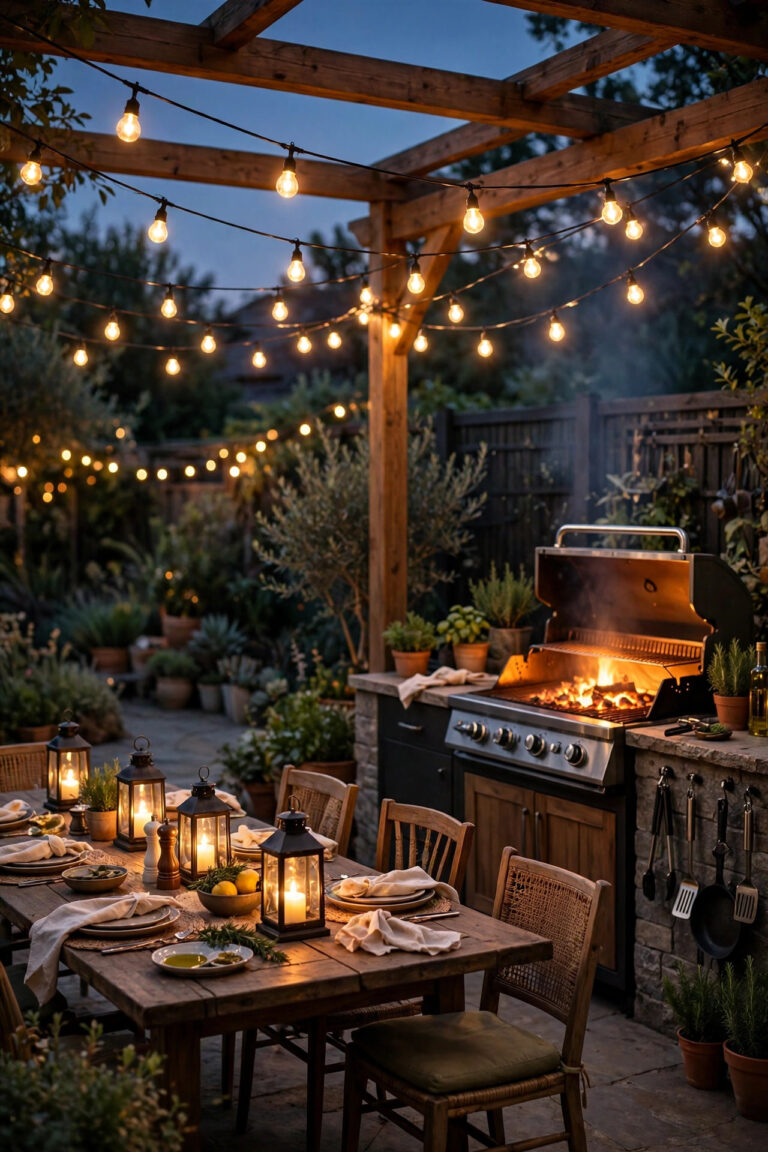
Here's the thing nobody tells you when you screen in a porch: the screens stop the bugs from joining you, but the wrong lighting still invites them to the party — plastered against the mesh, dive-bombing the door every time someone slips in or out. After three summers of experimenting, I've landed on a simple truth: the best screened porch lighting ideas are as much about bug strategy as they are about style. Warm, low, layered light inside the screens keeps the glow cozy and the insects uninterested, while anything bright and blue-white turns your porch into a beacon. My approach is the layering I use everywhere — gentle ambient light up high, soft pools at table level, and nothing harsher than it needs to be — with a few entomology tricks folded in. Below are the 21 setups that let us eat dinner, read, and play cards out here in July without a single moth in the iced tea. Every idea includes placement notes, the color temperatures that actually work, and an honest budget, so you can start with one swap this weekend.

1. Start With Amber Bulbs: The First Rule of Screened Porch Lighting Ideas
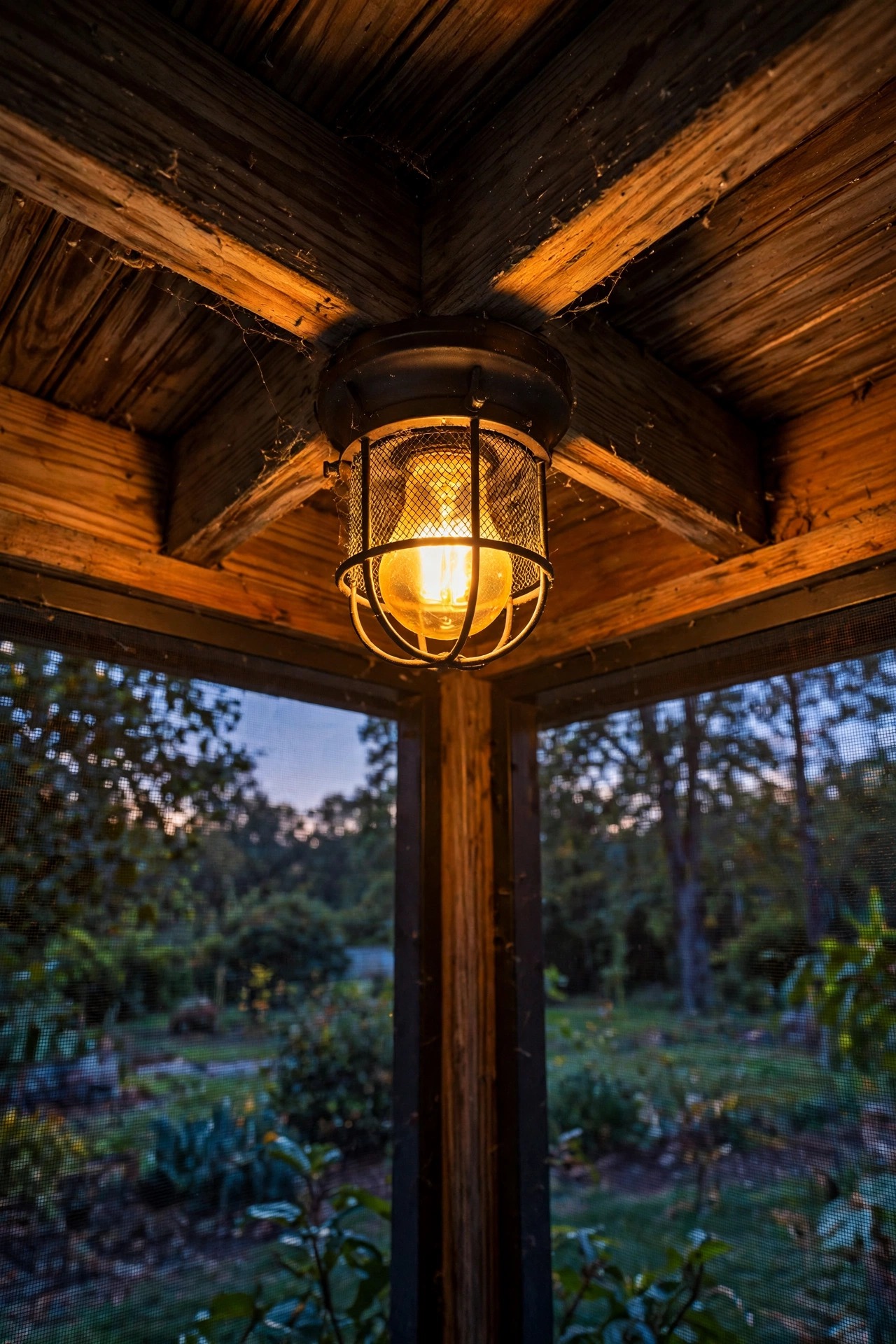
If you change nothing else, change your bulbs. Insects navigate by short wavelengths — ultraviolet and blue — which is why a cool-white bulb pulls every moth in the county to your screens. Amber and yellow-toned "bug light" bulbs filter out most of that spectrum, and warm LEDs in the 2000K to 2200K range attract a fraction of the insects a 4000K bulb does. Swap them into whatever fixtures you already own: the ceiling fixture, the wall lantern by the door, the table lamp. Keep wattage modest, around 40 to 60 watt equivalent, because brightness itself is a draw even in warm tones. I keep a small stash of amber bulbs in the porch cabinet and swap them in every May, then go back to soft white in October when bug season ends. If you want the full science of Kelvin and bugs, my outdoor light color temperature guide breaks it down. Honestly, this ten-minute swap did more for our evenings than any gadget I've bought since — the screens stay clear and the porch just looks golden.
Suggested budget range: $15 – $45.
2. String Lights Swagged Across the Ceiling
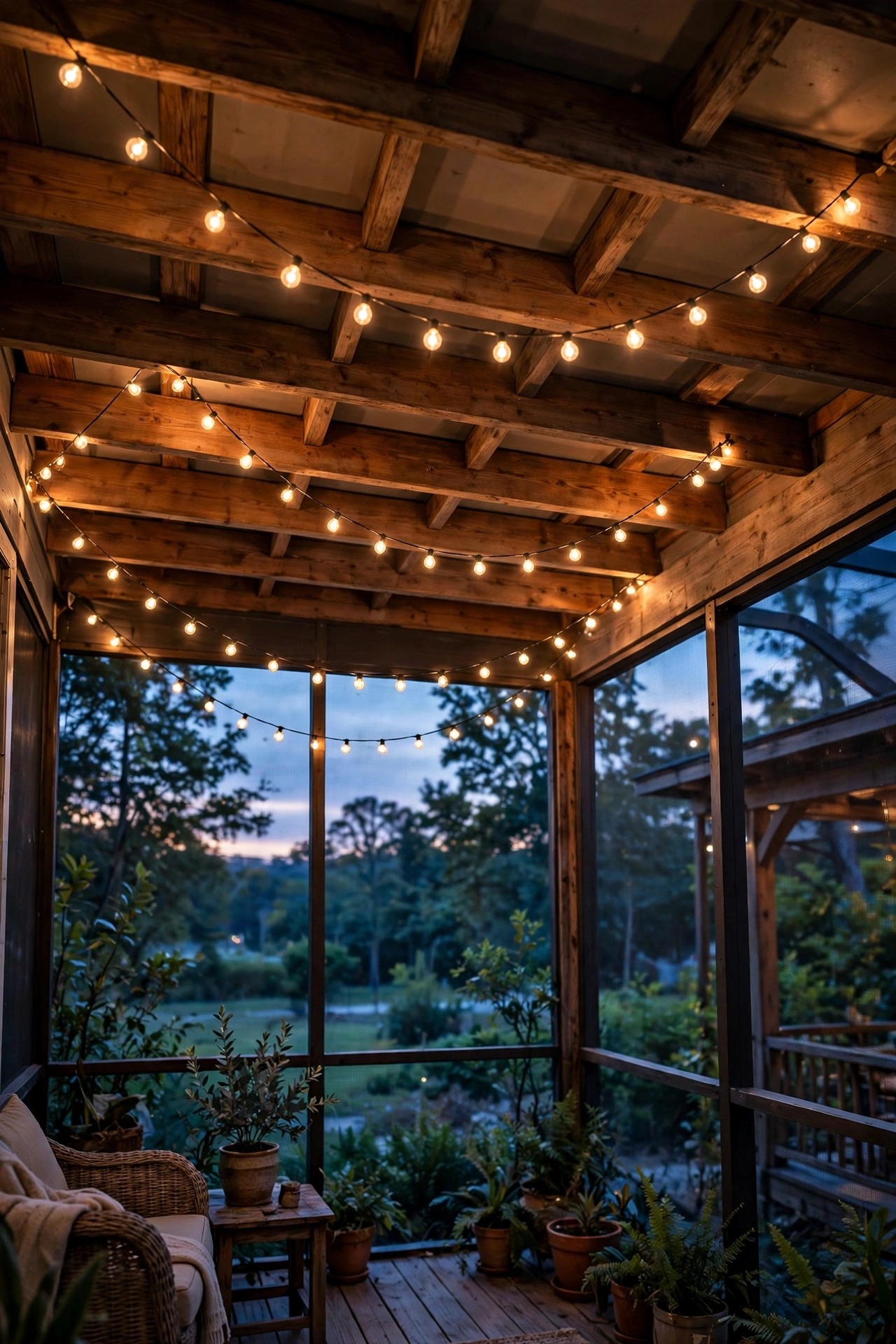
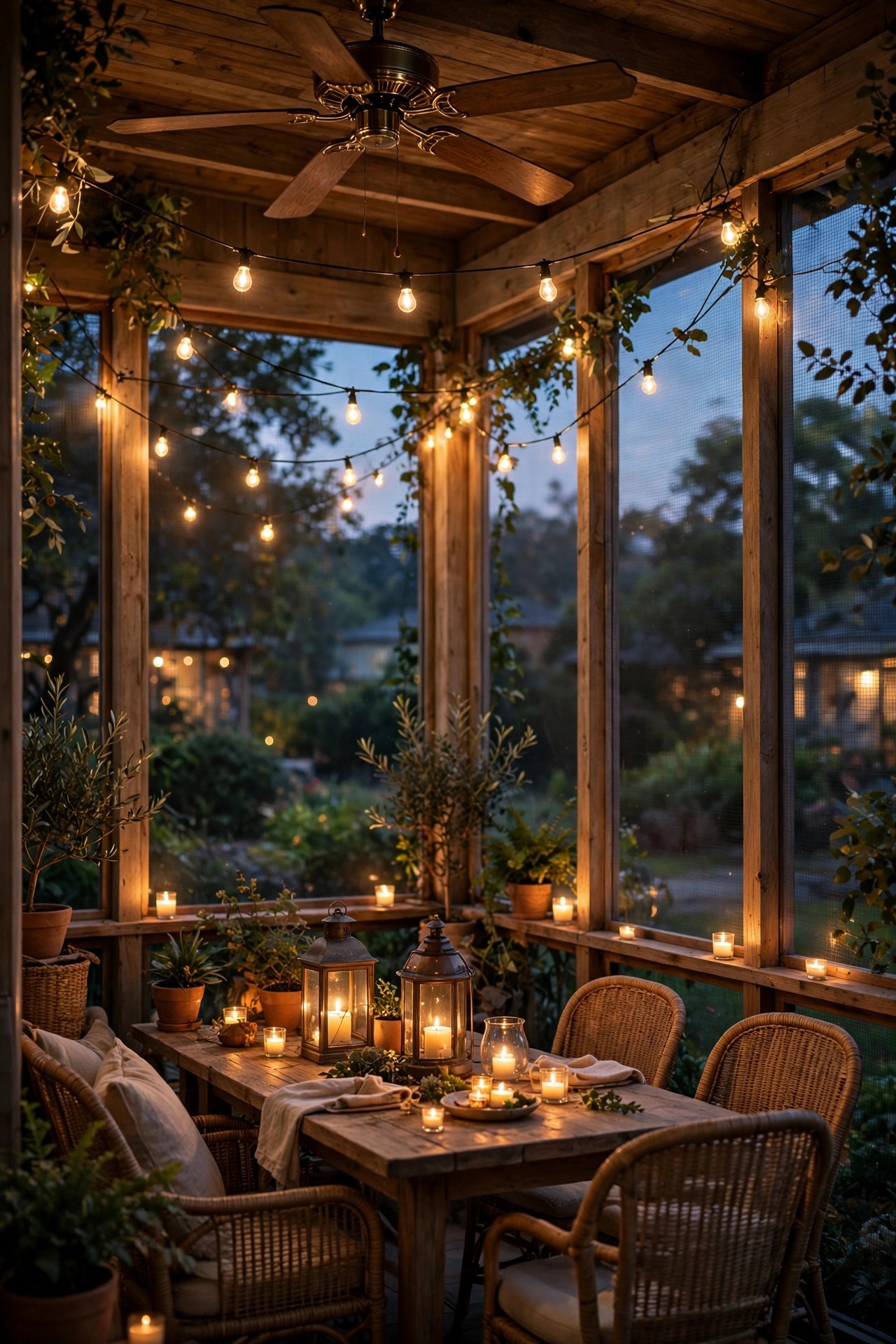
String lights are the ambient layer I reach for first, because they spread a low, even glow instead of concentrating brightness in one bug-magnet spot. Swag two or three strands in gentle arcs between the ceiling beams, keeping the sag to about a foot for every 10 feet of run, and use shatterproof LED filament-style bulbs in 2200K to 2700K. That warm, dim spread reads "café evening" rather than "interrogation room," and because any single bulb is low-output, insects don't fixate on them the way they do a bare porch bulb. Hang the strands from a thin guide wire or screw hooks into the beams rather than stapling through the cord, and put the whole run on a dimmer if you can — dropping to half brightness after dinner is my favorite trick for keeping the mesh clear. Leave at least a few inches between bulbs and the screen so nothing rests against the mesh. For hanging patterns and spacing math, my roundup of bistro string light ideas goes deeper. This is the layer that makes everything else look intentional.
Suggested budget range: $40 – $120.
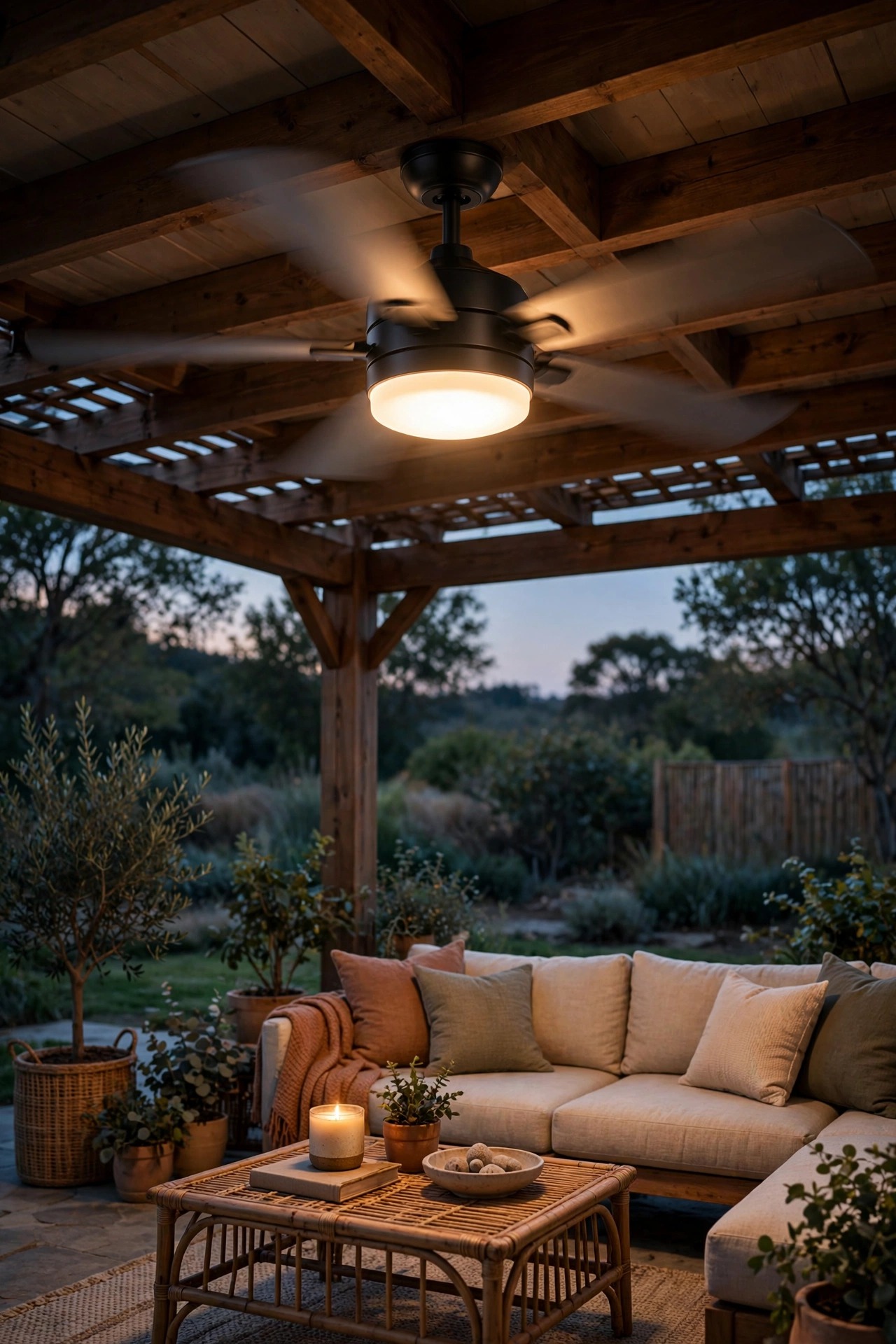
3. A Ceiling Fan With a Dimmable Light Kit
Ask any entomologist what actually keeps mosquitoes away and they'll say moving air before they mention a single bulb. Mosquitoes are weak fliers, and a ceiling fan on low makes the whole porch a no-fly zone while stirring the carbon dioxide plume that draws them in the first place. Choose an outdoor-rated fan — damp location at minimum, wet location if your porch roof leaks or blows rain in — and pair it with a dimmable LED light kit in a warm tone. Run the fan whenever you're out there, even at dusk before the bugs arrive; prevention beats swatting. Mount it so the blades clear at least 7 feet above the floor, and keep the light on its own dimmer switch if your wiring allows, so movie night can be fan-on, lights-low. In my experience, the fan alone cuts our bug company by more than half, and the light kit means the overhead fixture does double duty. It's the hardest-working upgrade on this whole list, and the one I'd install first in a new porch.
Suggested budget range: $180 – $450.
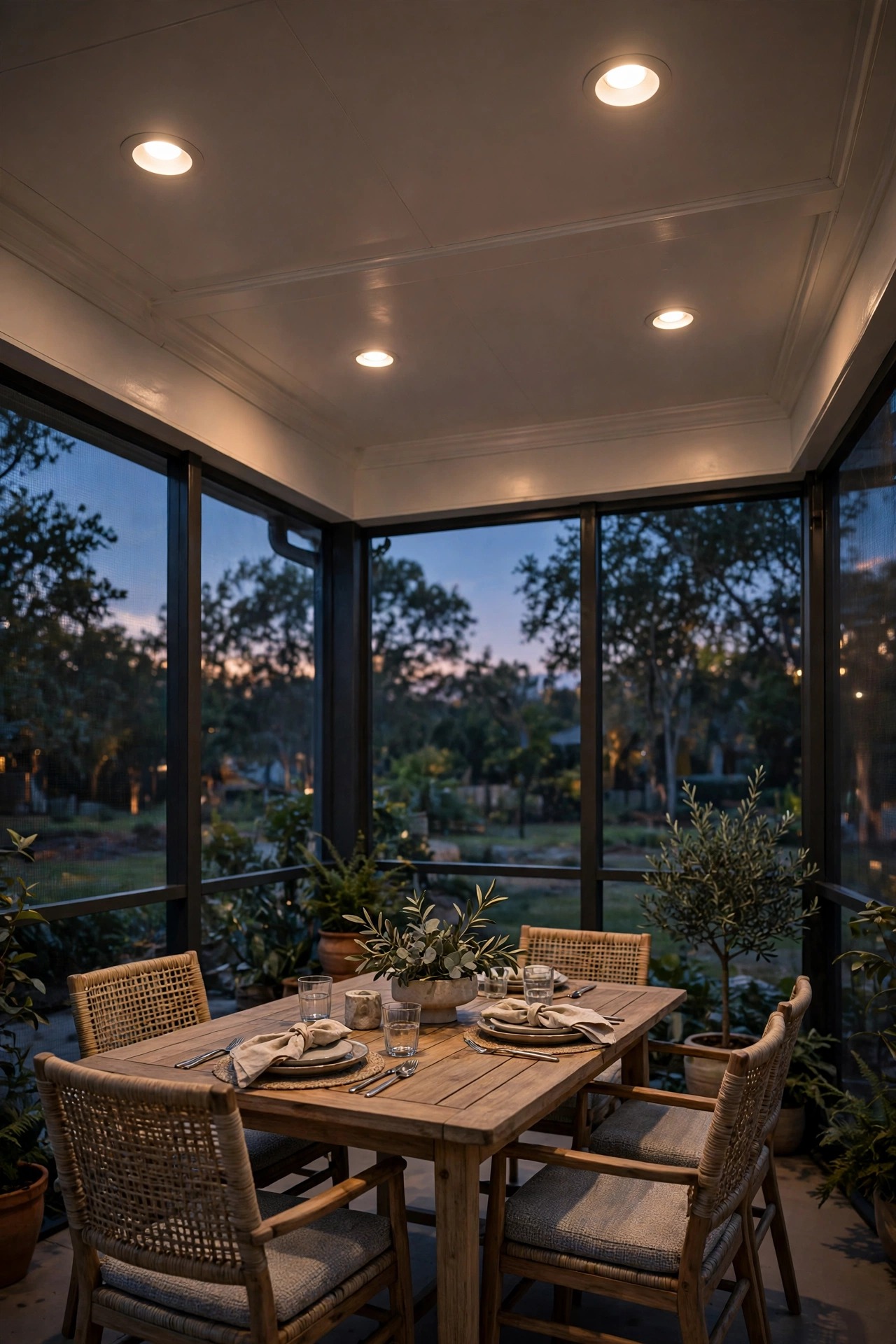
4. Recessed Ceiling Lights on a Dimmer
If your porch ceiling is finished rather than open-beamed, recessed cans give you the cleanest ambient layer — and on a dimmer, they're far less bug-provoking than a single blazing fixture. Space 4-inch or 6-inch damp-rated LED retrofit trims about 4 to 5 feet apart, aimed down at seating rather than at the screens, because light that stops at the floor doesn't silhouette every passing moth against the mesh. Choose 2700K with a high CRI so food and faces look good, and wire the whole row to one dimmer so you can float between "dinner bright" and "firefly dim." One caution from my own mistake: don't let anyone talk you into daylight 5000K trims out here. I tried one in the corner and it collected bugs like a gas station sign; the warm trims beside it stayed clear. Retrofitting existing cans is an afternoon job with the power off at the breaker, but if you're cutting new holes, hire the electrician and get a permit — ceiling work is where DIY confidence should stop.
Suggested budget range: $150 – $400.
5. Sconces Flanking the Screen Door
The door is where your bug battle is won or lost, because every opening lets a few hitchhikers in. Flush-mount or half-lantern sconces on either side of the door — inside the porch — give you task light for keys, drinks trays, and the dog's leash without a bright fixture outside the door pulling insects toward the entry. Keep them at about 66 inches from the floor, fitted with amber or 2200K bulbs, and choose fixtures with the bulb shielded from below so the light washes the wall instead of beaming at eye level. If your door sconces currently live outside, move the bright one to a spot several feet away from the door (more on that decoy trick in idea 13) and let these interior sconces be the gentle greeters. In my experience, dim-by-the-door is the single most underrated habit on this list: guests gravitate to the glow at the table instead, and the threshold stays calm. Match the finish to your ceiling hardware and the whole entry feels designed, not defensive.
Suggested budget range: $60 – $180.

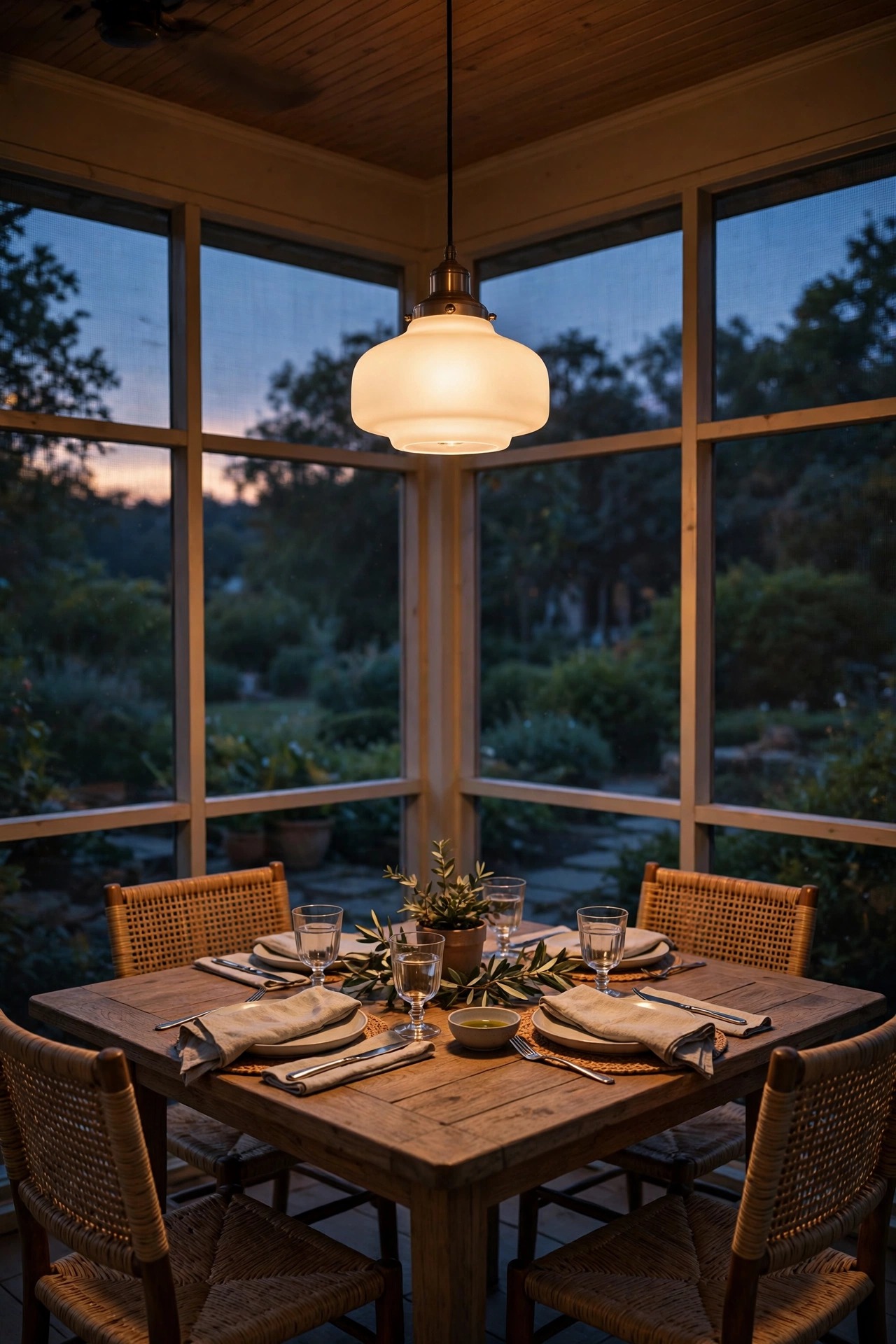
6. A Pendant Light Over the Dining Table
Every porch that hosts meals needs one true task light, and a pendant centered over the table is mine. Hang it so the bottom of the shade sits 30 to 34 inches above the tabletop — low enough to pool light on plates and board games, high enough that nobody clocks their head standing up. An opaque or frosted shade matters here: it throws light down where you want it and keeps a bare bright bulb from advertising itself through the screens to every moth outside. Use a 2700K dimmable LED, and if the pendant is a plug-in swag style, route the cord along a beam to the outlet so nothing dangles in the walkway. Because the light is focused and shaded, the rest of the porch can stay dim and ambient — that contrast is exactly what keeps the insect audience outside looking in rather than pressing against the mesh. Rattan, seeded glass, and black metal shades all work; pick the one that matches your table, and suddenly Tuesday dinner feels like a restaurant patio.
Suggested budget range: $80 – $260.
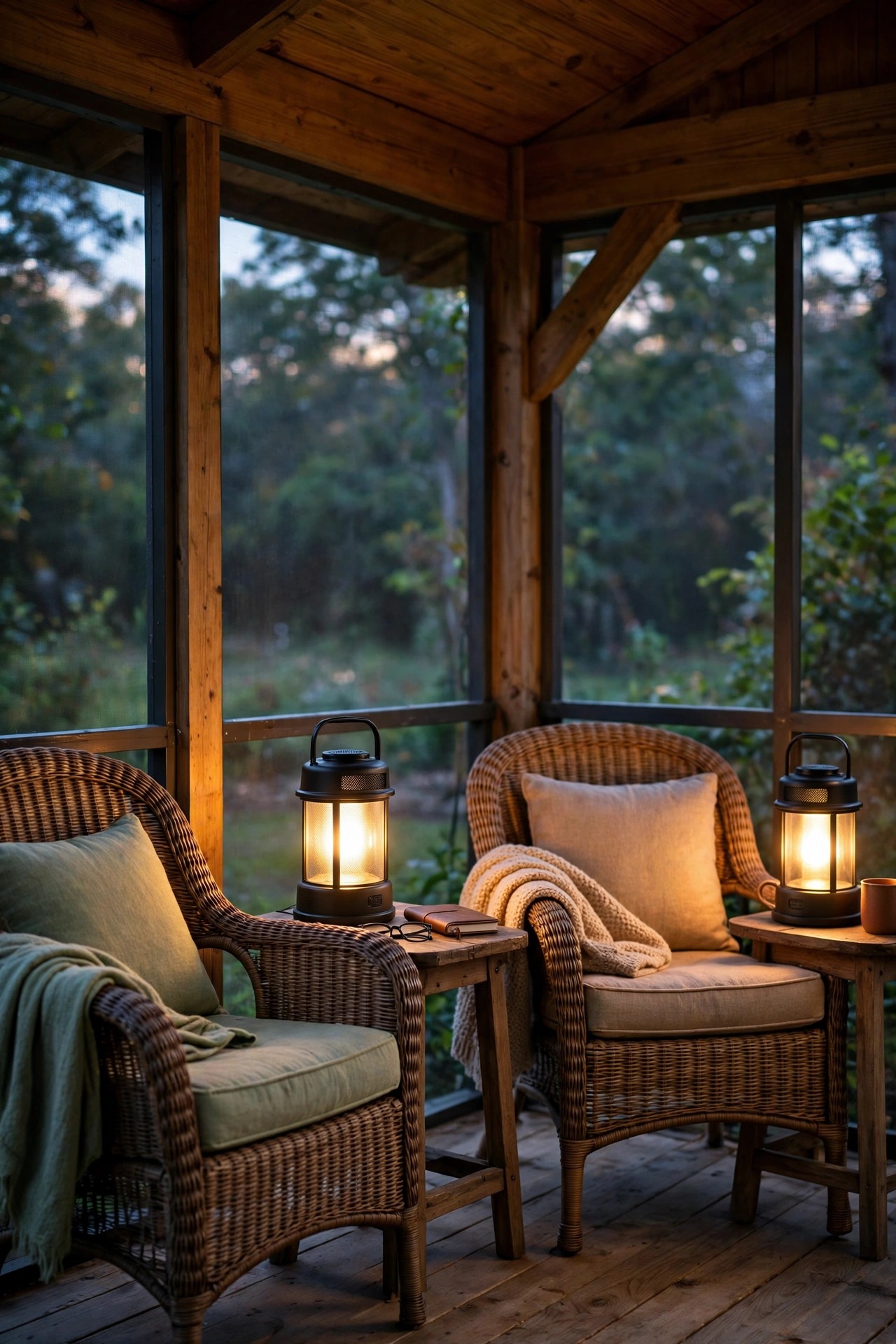
7. Battery Lanterns You Can Carry Anywhere
Not every corner of the porch needs wiring. Battery-powered lanterns with warm LED panels are my secret layer for the reading chair, the side table, and the inevitable card game that migrates around the porch. Look for lanterns with a true dimmer (not just high-low), a 2200K to 2700K glow, and USB recharging so you're not feeding them disposable batteries all summer. Because they're low and local, they light the page or the drink in your hand without raising the porch's overall brightness — and brightness, again, is the bug invitation. I keep three charged in a basket by the door and rotate them. One practical note: bring them inside in winter, since cold storage eats battery life, and wipe the panels monthly because a dusty diffuser dims the glow. Honestly, guests ask about these more than any fixture I own. They read as décor, they work as task light, and when the grandkids visit, one becomes a "camp lantern" for fort duty under the table.
Suggested budget range: $25 – $80.
8. Flameless Candles in Hurricane Lanterns
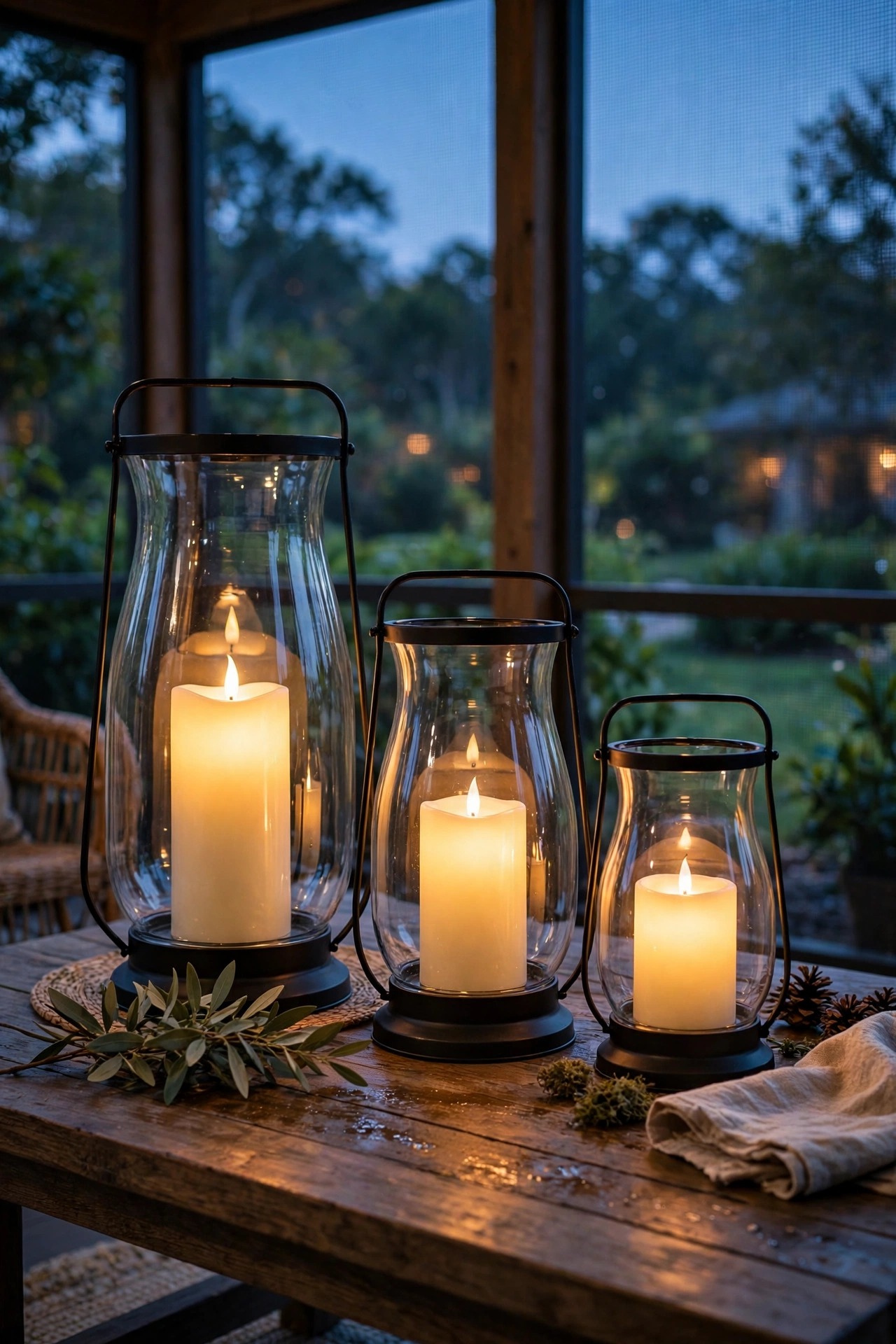
Real candlelight is the warmest, least bug-attractive light there is — insects barely register it — but open flames inside a screened porch make me nervous with cushions, kids, and the occasional gust through a torn screen panel. Flameless LED candles with a realistic flicker solve it. Cluster three hurricanes of different heights on the coffee table or a sideboard, set their built-in timers for dusk, and forget them for the season. The flicker sits around 1800K to 2000K in tone, well below the wavelengths bugs chase, and at ankle-to-table height the glow feels like firelight without the fire. Choose candles with real wax shells if they'll be seen up close, and keep the remote in a drawer — one click handles the whole cluster. I still use two real citronella candles out at the porch steps (idea 19 covers that), but inside the screens, flameless wins on safety and consistency. On a breezy night, when the string lights sway a little, the candle cluster makes the whole porch feel like a lantern room.
Suggested budget range: $30 – $90.
9. Rope Light Tracing the Screen Frames
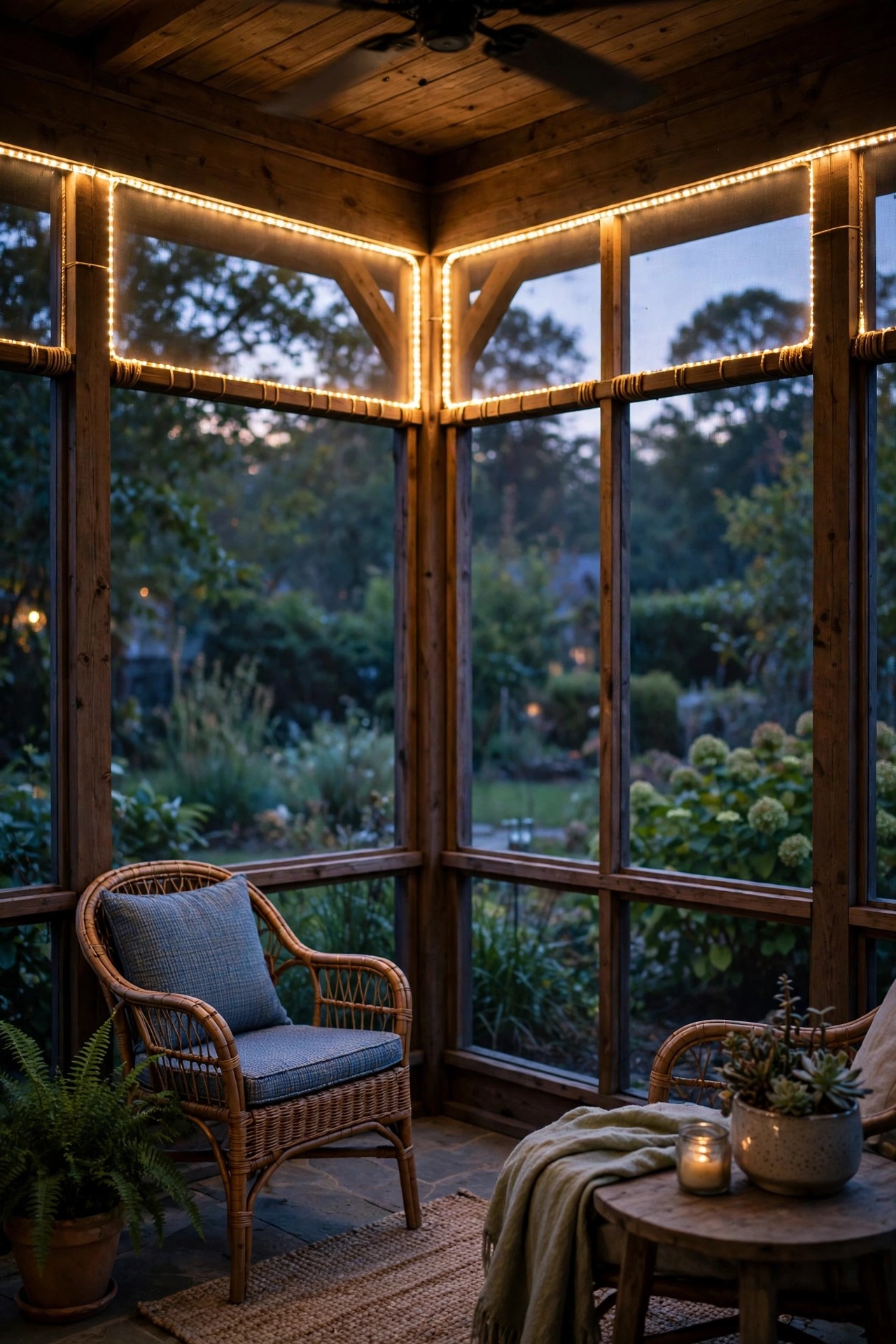
This is my favorite subtle trick: run a warm LED rope light along the inside top edge of the screen frames, where the wall meets the mesh. The light grazes across the porch interior and defines the room's outline without ever pointing a bright source at the screens — and because rope light is a long line of tiny, dim points, it simply doesn't register to insects the way a bulb does. Use 2700K outdoor-rated rope in a mounting channel or clips every 12 inches so it stays arrow-straight, and hide the cord drop behind a corner post. The effect at night is architectural: the porch glows like a pavilion from the yard, but inside, the light is soft enough for conversation. It's also brilliant for safety, since it silhouettes the screen door frame and the step down that guests always miss. Measure your runs before ordering, buy one continuous length per wall to avoid dark seams at connectors, and put it on the same dimmer circuit as the string lights if you can. Pure atmosphere, zero bug drama.
Suggested budget range: $35 – $100.
10. LED Strip Lights Under the Railings
The step down from porch to yard — and the railing beside it — is where ankles get rolled in the dark. A waterproof LED strip tucked under the cap rail or beneath the porch edge throws a ribbon of light onto the boards and the step, exactly where feet need it, while staying completely shielded from view. Shielded is the bug-friendly part: no visible bright source means nothing for insects to orient to, just a soft wash at floor level. Choose IP65 silicone-sleeved strips in 2700K, mount them in an aluminum channel with a frosted diffuser so the dots blend into one line, and power them from a low-voltage transformer you can share with any landscape lighting. Seal every cut end with the end caps and a bead of silicone, because porch edges collect drips. I ran ours along the inside of the railing too, and it doubles as the prettiest night-light for letting the dog out at 11 p.m. — one low strip, no overhead glare, nobody fully waking up. Functional, invisible, and quietly gorgeous.
Suggested budget range: $30 – $85.

11. Fairy Light Mason Jars for the Table
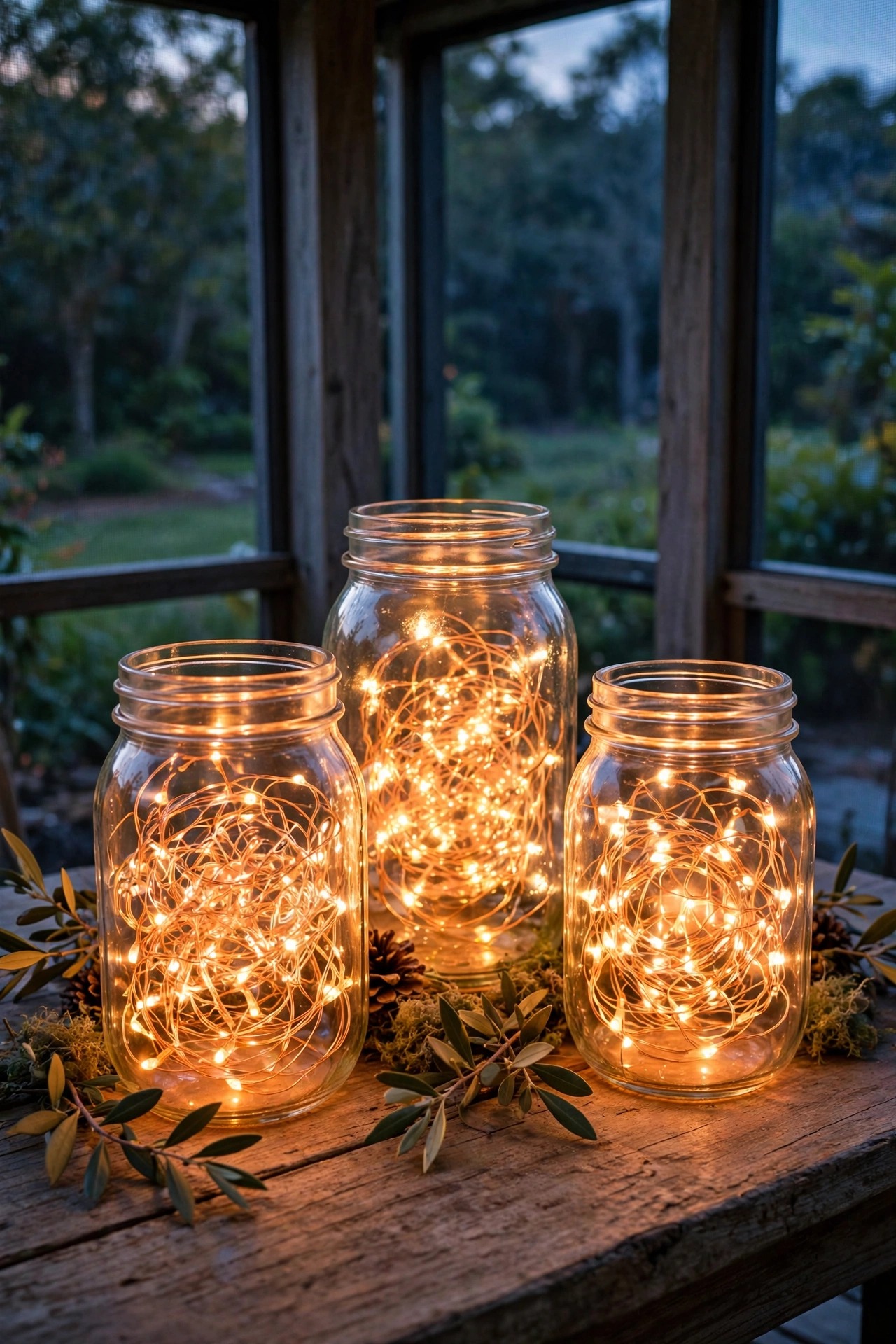
Some nights don't need fixtures at all — they need a centerpiece that glows. Copper-wire fairy lights coiled into mason jars give you three or four points of firefly light down the middle of the table, bright enough to see faces and wine glasses, far too dim and warm to interest a single moth. The copper wire versions run on small battery packs you can hide under a linen runner, and the solar-lid jars charge on the windowsill by day if you'd rather skip batteries entirely. Because the light source is tiny and diffused by glass, it flatters everything and photographs beautifully — this is the setup my friends always copy. Cluster the jars with a sprig of something green from the yard and you've styled the table for the price of a pizza. One honest caution: cheap fairy strands tangle if you look at them wrong, so wind each one around a piece of cardboard for storage. For everyday dinners I still use the pendant, but for slow evenings, the jars win. Nothing on this list is cheaper atmosphere.
Suggested budget range: $20 – $60.
12. Globe String Lights for a Softer Spread
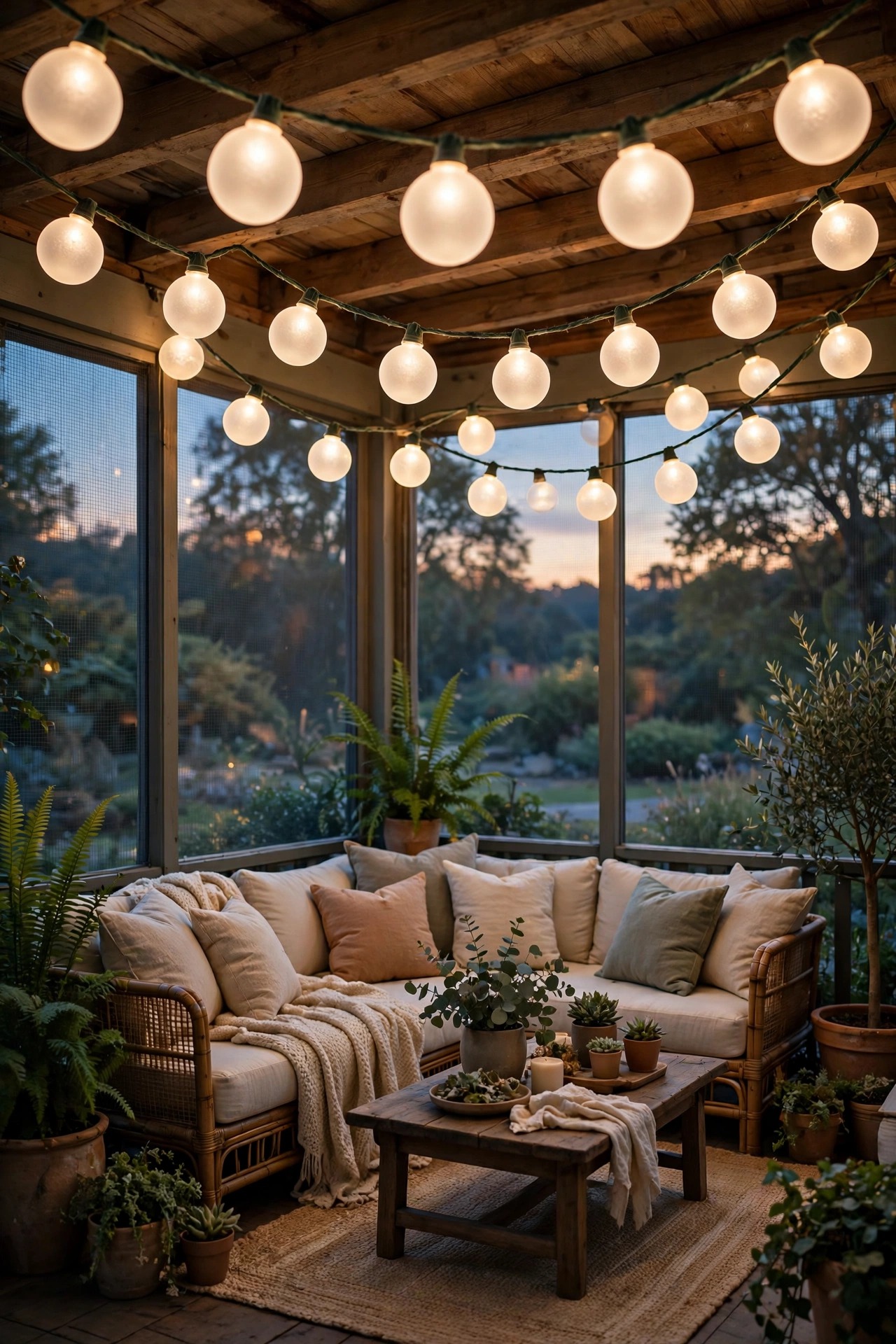
If filament string lights feel a little bistro-busy for your porch, globe strands are their calmer cousin. Opal or frosted G40 globes diffuse the light into soft moons, dropping glare and — because the visible source is larger and dimmer per bulb — presenting a weaker target to passing insects than a bare clear bulb. Space the strands a little wider than you would clear bulbs, about 4 to 5 feet apart across the ceiling, since each globe lights a broad, gentle pool. Keep the total output honest: globes are decorative, so pair them with the pendant or lanterns for actual task light instead of adding more strands when dinner gets dark. Shatterproof plastic globes are the right call over any seating where a dropped bulb could land in someone's lap. I run globes over our sitting end and clear filament strands over the dining end, and the contrast quietly zones the porch into "eat" and "lounge" without a single wall. On a dimmer, the globes at 40 percent are the closest thing to moonlight I've found that plugs in.
Suggested budget range: $45 – $130.
13. A Decoy Light Stationed Out in the Yard
This one feels like cheating, but it works: give the bugs somewhere better to go. Mount one brighter fixture — a small flood or a lantern on a post — 25 to 40 feet away from the porch, ideally near a shrub or the compost corner, and let it be the brightest thing in the yard. Insects drawn to the property gather there instead of at your screens. Meanwhile the porch itself stays warm and dim, which makes the decoy win by contrast. The trick fails if your porch lighting is equally bright, so think of the decoy as permission to keep everything inside the screens low. I use a dusk-to-dawn photocell fixture so it runs itself, fitted with a standard warm bulb — no need for anything exotic, since the yard light's job is simply to outshine. Position it so it doesn't shine into a neighbor's window or back through your own screens; a shielded fixture aimed down at a planting bed is perfect. On heavy moth nights in June, the difference is honestly startling: a party at the decoy, peace on the porch.
Suggested budget range: $25 – $70.
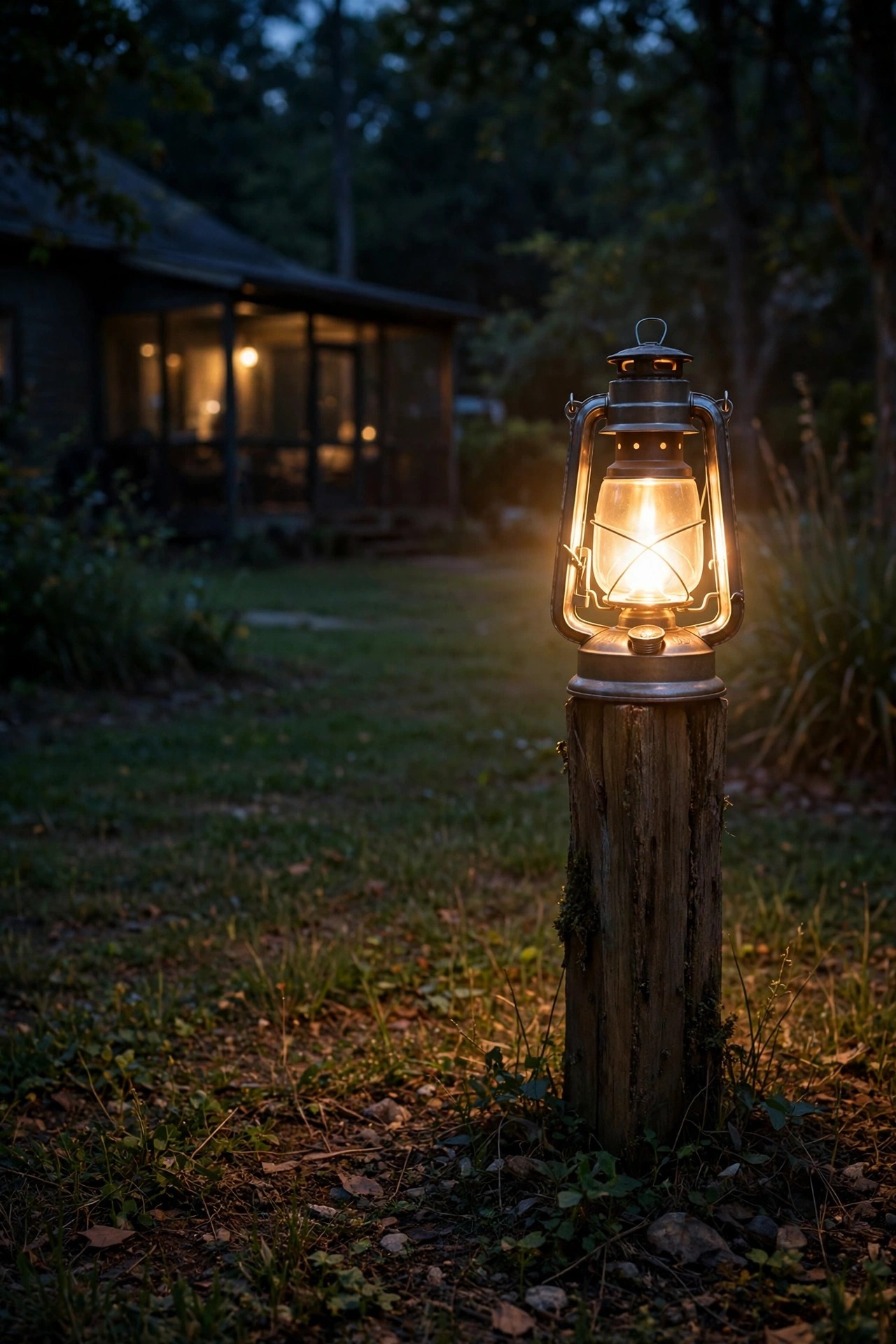
14. A Motion-Sensor Light Outside the Screen Door
The one light on this list that should be bright is the one that only runs for thirty seconds. A motion-sensor fixture mounted outside, above the screen door and aimed at the steps and the latch, gives guests and grocery-carriers a clear, safe arrival — and because it spends 99 percent of the night dark, it never becomes a standing invitation to insects. Set the sensitivity so it triggers from the yard side of the door swing, keep the on-time short, and aim the sensor away from shrubs that wave in the wind and cause false triggers all night. A shielded fixture with the bulb tucked up under the housing keeps the beam on the steps instead of in arriving eyes. Inside the porch, stick with the dim door sconces from idea 5 for lingering light. One more practical point: if you let a dog out at night, the sensor light becomes your best friend — bright for the trip to the yard, dark again before the bugs even notice. Thirty seconds of bright beats all night of dim at a doorway.
Suggested budget range: $30 – $90.
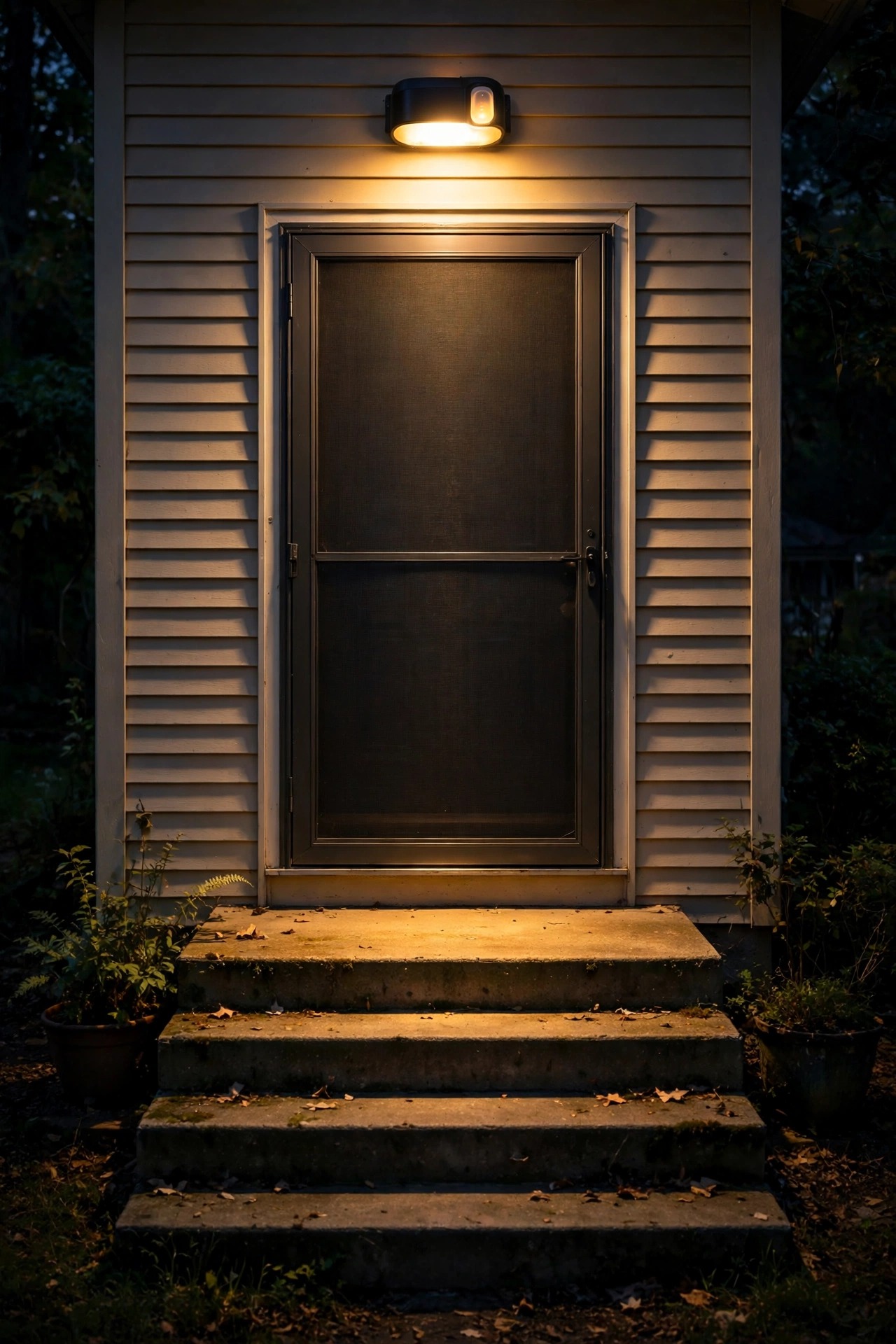
15. Solar Lights at the Porch Steps and Path
The stretch between the yard and the porch steps deserves its own gentle lighting, and solar handles it without trenching or wiring. Two or three solar path lights with warm 2700K output, staked a few feet before the steps, tell feet where the ground changes; a solar step light screwed to the riser finishes the job. Place the panels where they get real midday sun — under the porch eave's shadow line they'll charge poorly and die by 9 p.m., which I learned the disappointing way. Keep them modest: these are markers, not floodlights, and a row of dim warm points reads far more elegantly than bright white dots. Because they're outside the screens and relatively dim, they don't pull insects toward the door the way a bright entry fixture does. Clean the little panels with a damp cloth once a month; pollen film is the number-one reason solar lights "stop working." Rechargeable batteries inside typically last two to three seasons before a cheap swap. Small lights, big safety, zero electrician.
Suggested budget range: $20 – $65.
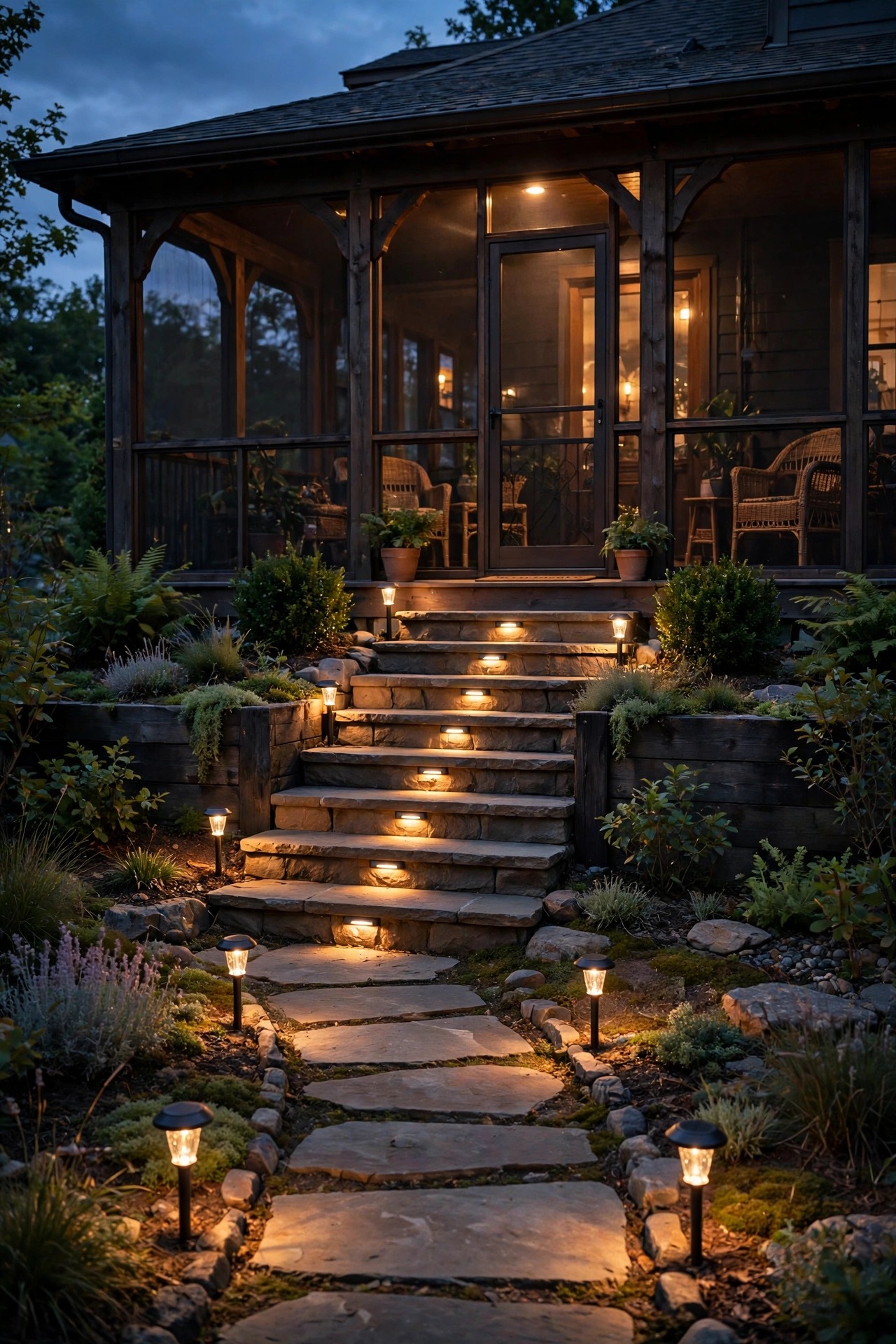
16. Hanging Lanterns on Ceiling Hooks
For a porch with a peaked or vaulted ceiling, hanging lanterns bring the light down to human height, where it's warmer, more flattering, and less of a beacon than a fixture blazing away at the peak. Hang two or three lanterns at staggered heights — the lowest around 6½ feet over a side table, never over a walkway — from swag hooks screwed into the rafters. Battery lanterns or plug-in pendants both work; if you go plug-in, chain the cord up the hook and along the beam so it reads as part of the design. Inside each lantern, a warm flameless candle or a 2200K bulb keeps the tone amber and the bug interest near zero. The staggered heights do something string lights can't: they make a tall ceiling feel intimate instead of cavernous. Group them over the conversation end of the porch and let the dining end keep its single pendant. Swap the candles for tiny pinecone or shell fillers by season if you like — the lanterns are the porch's jewelry, and they take thirty seconds to redress.
Suggested budget range: $40 – $140.
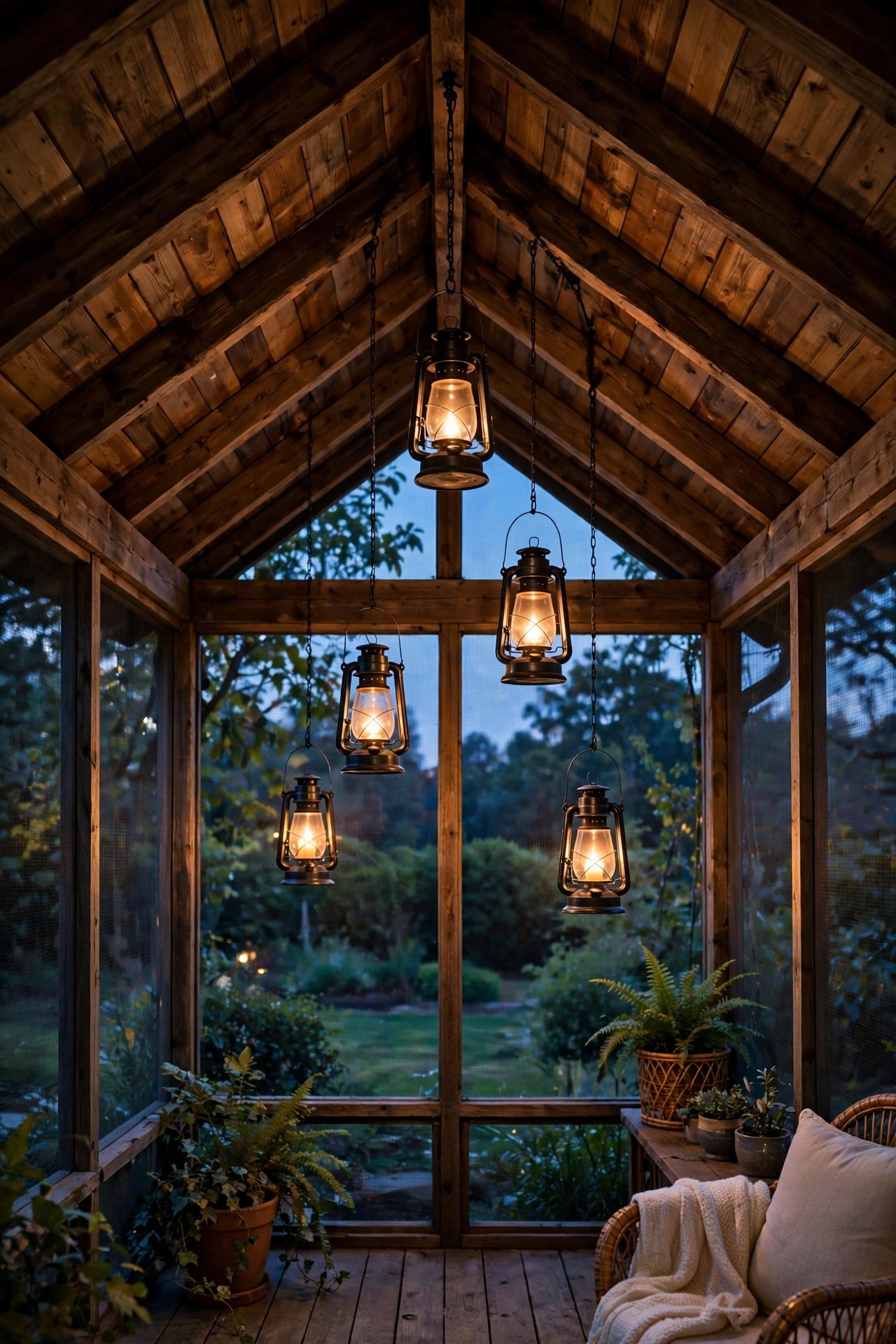
17. Screened Porch Lighting Ideas for Readers: A Damp-Rated Floor Lamp
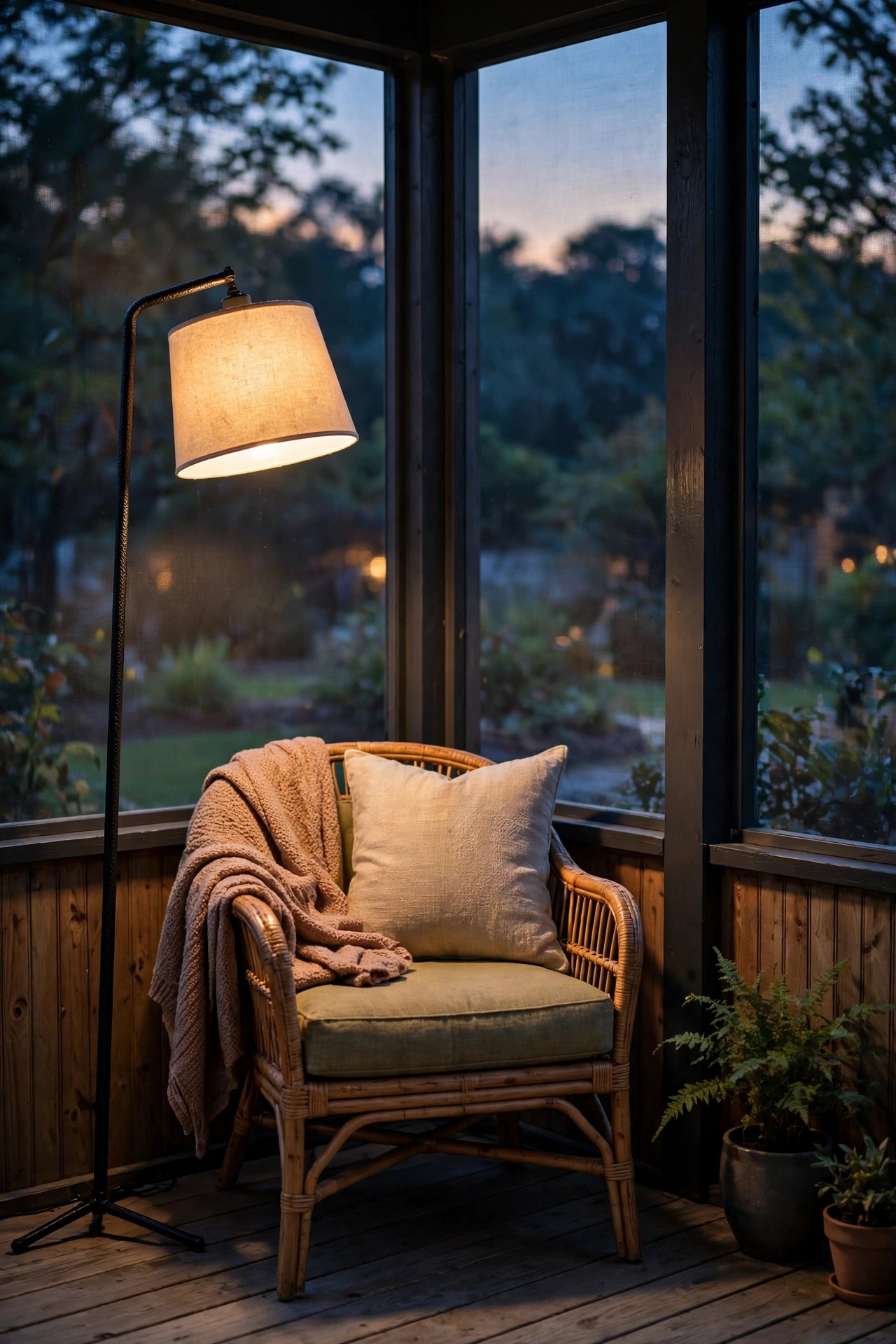
Every porch has one chair that belongs to a reader, and that chair deserves a real lamp. A floor lamp rated for damp locations — check the label, because indoor lamps corrode and their switches fail outdoors — placed behind the chair's shoulder gives you a focused pool of 2700K light that a page loves and bugs largely ignore, since it's low, shaded, and pointed at a book instead of the screens. An arc style can reach over a chaise; a torchiere bounces light off the ceiling for general glow but is my second choice here because it raises overall brightness. Put it on a plug-in dimmer and it becomes two lamps in one. Keep the cord along the wall, never across the door path, and bring the shade in for winter if it's fabric. In my experience this is the idea that converts "the porch is for cookouts" people into "the porch is my evening room" people. A lamp, a throw, and a novel at 8 p.m. with the fan turning overhead — that's the whole dream, sold for the price of one fixture.
Suggested budget range: $70 – $200.
18. Timers and Smart Plugs So Lights Never Blaze All Day
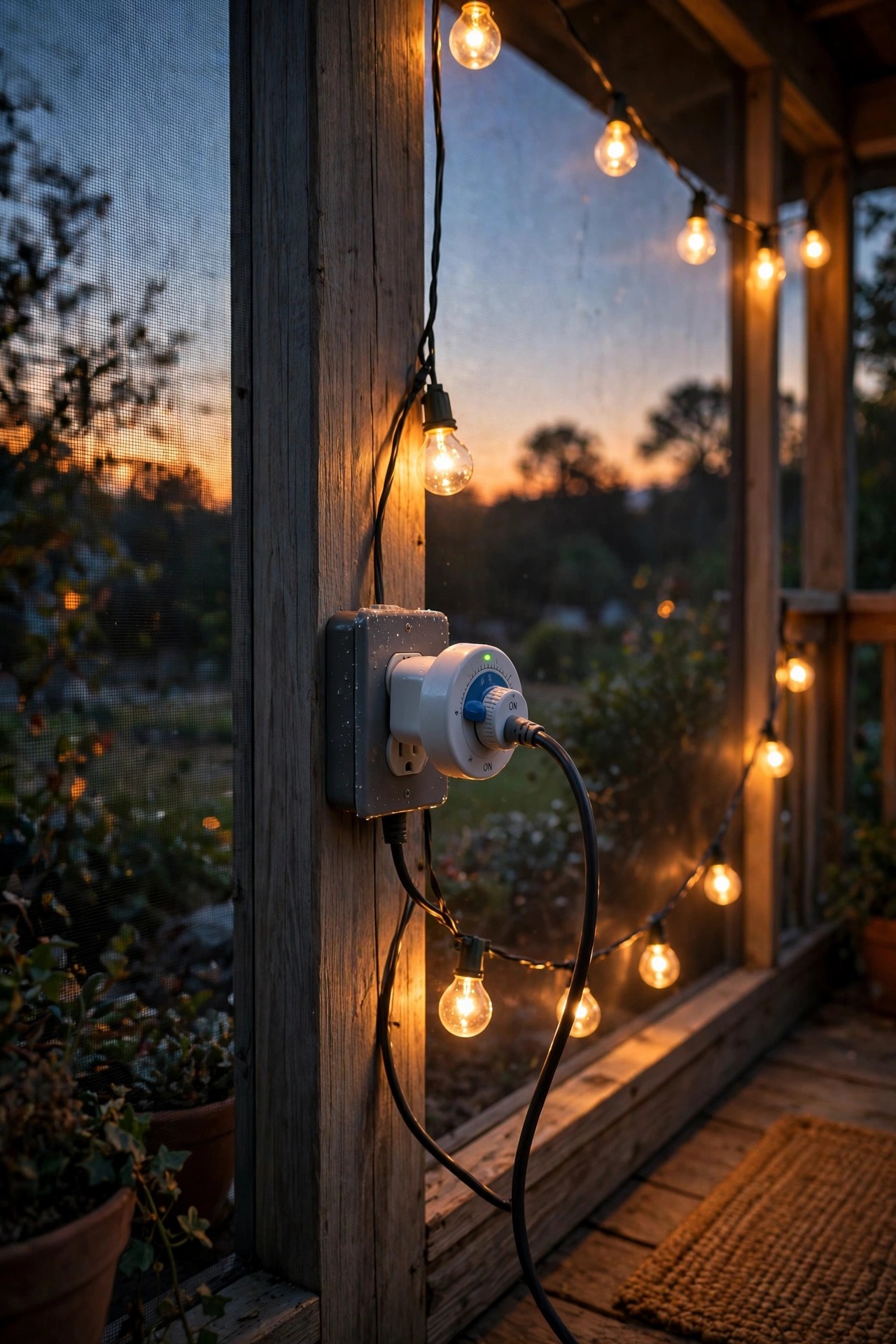
Lights left burning at noon are wasted money, but lights that blaze at full brightness from the moment you flip them on at dusk — and stay that way until bedtime — are a bug strategy failure too. A simple timer or smart plug fixes both ends of the problem: porch lights come on at sunset at the warm dim level you've set, and they step down or switch off at your usual bedtime, so the screens aren't lit like a shop window for insects at 1 a.m. I run the string lights and rope light on one smart plug with a sunset-to-11 p.m. schedule, and the decoy yard light on a photocell so it manages itself. If you go smart, choose a plug rated for outdoor or damp use and remember it needs your Wi-Fi to reach the porch — test the signal before you commit. The photocell and timer options need no signal at all and are honestly the set-and-forget winners for most porches. Automate the routine, and the warm-and-dim discipline in every other idea happens without willpower.
Suggested budget range: $15 – $50.
19. Citronella Candle Clusters at the Screen Edges
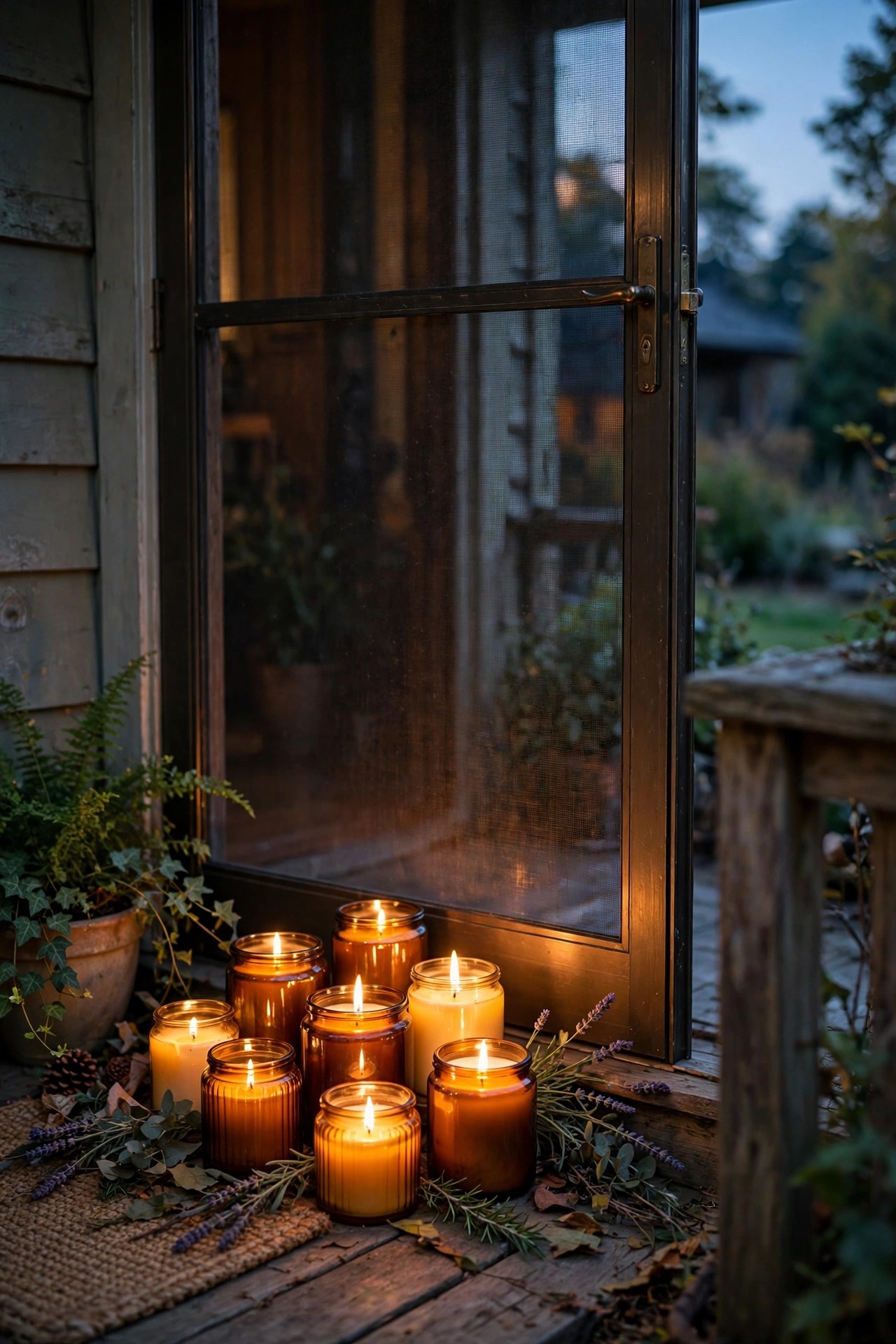
Citronella gets oversold as a force field, but used honestly — as a supporting player near the places bugs actually enter — it earns its spot. I cluster two or three citronella candles or torches just outside the screens at the door side and near any low screen panel where mosquitoes hover waiting for an opening; the scented plume drifts across the entry zone and makes it less welcoming, while the candle flames themselves add a ring of real firelight outside the mesh. Keep them at least a foot from the screen and never leave them burning unattended — outside the porch doesn't mean outside the rules. Inside, stick with the flameless candles from idea 8. Set expectations right: citronella works within a few feet and fades in wind, which is exactly why it belongs at the threshold rather than the table. Paired with the fan and the amber bulbs, it's the third layer of a system, and systems are what actually deliver a bug-free night. The candles' amber jars look pretty doing it, too.
Suggested budget range: $15 – $50.
20. A Soft Wash for the Porch Swing Corner
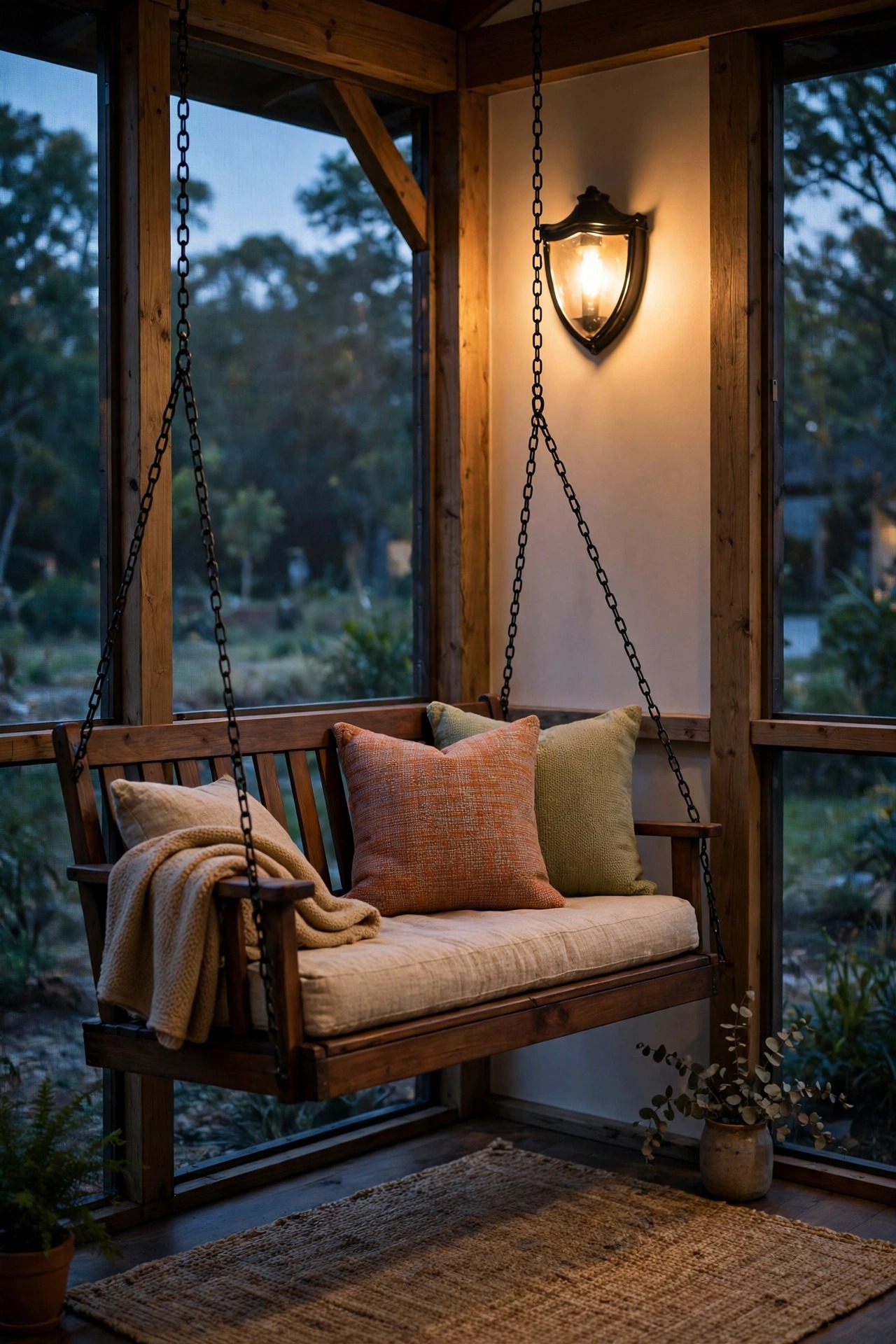
The swing end of our porch is where evenings end up, and it needed light that wouldn't kill the mood or spotlight the sitters. The answer was a single low sconce or a small shielded wall washer mounted beside — not above — the swing, washing the wall behind it so the corner glows by reflection. Reflected light is the gentlest light there is: no visible bulb, no glare, and nothing bright facing the screens for insects to target. Fit it with a 2200K bulb on a dimmer and it goes from "see your knitting" to "barely there" as the night deepens. Keep the fixture clear of the swing's arc by at least a foot — a lesson a friend learned with a lantern and a loud lesson it was. If you're planning a whole swing nook, my porch swing lighting ideas cover placement around chains, canopies, and side tables. Two cushions, one blanket, a soft wall glow, and the fan moving the air: the swing corner is where the bug-free strategy completely disappears into comfort.
Suggested budget range: $50 – $150.
21. Pull It All Together: The Layered, Bug-Smart Finish
The last of my screened porch lighting ideas isn't a fixture — it's the combination, because layering is what makes the whole system work. Here's the recipe as it runs at our house: amber bulbs as the base tone, string lights or globes overhead at a dimmer's mercy, one honest task light over the table, lanterns and candles low where people actually sit, a fan moving the air, a decoy light glowing out in the yard, and everything warm — 2700K at the brightest, 2200K where you can. Notice what's missing: no single bright source, nothing blue-white, nothing beaming at the screens. Build it in stages if budget demands. The bulbs and jars this weekend, the fan next month, the pendant when the electrician's already coming for something else. Stand in the yard at 9 p.m. and look back at your porch: it should glow like a lantern, warm and low, while the one bright light minds its business out by the shrubs. That's a porch the bugs ignore and the neighbors envy.
Suggested budget range: $100 – $300.
Frequently Asked Questions
What color light attracts the fewest bugs on a screened porch?
Amber and warm yellow tones win by a wide margin. Most flying insects home in on ultraviolet and blue wavelengths, so bulbs in the 2000K to 2200K range — including purpose-made amber bug bulbs — draw far fewer moths and beetles to your screens than cool-white 4000K or daylight 5000K bulbs. Keep brightness modest too; a dim warm bulb beats a bright warm bulb.
Do I still need a bug zapper if my porch is screened?
No — and I'd argue you shouldn't run one nearby at all. Zappers work by attracting insects with ultraviolet light, which pulls more bugs toward your porch than would otherwise come, and the screens are already doing the real work. If you own one, move it well away from the porch so it functions like the decoy light in idea 13 rather than a dinner bell at your door.
Why do moths gather on the outside of my screens at night?
Because your interior light is shining through the mesh, and the screen becomes the closest thing to the light they can reach. Lowering interior brightness, switching to amber tones, shielding fixtures so they don't beam directly at the mesh, and running a brighter decoy light out in the yard all reduce the gathering. A fan inside disturbs the ones that do slip through.
Are LED lights better than incandescent for keeping bugs away?
Generally, yes. LEDs emit almost no ultraviolet and very little heat, both of which attract insects to older bulbs. The catch is color: a cool-white LED can still draw bugs with its blue content, while a warm 2200K to 2700K LED is one of the least attractive light sources you can buy. Choose warm LEDs and you get the efficiency and the bug benefit together.
Conclusion
A bug-free porch night isn't about one magic product — it's about screened porch lighting ideas that respect how insects actually behave: warm color, low brightness, shielded fixtures, moving air, and one decoy doing the bright work far from where you sit. Start with the amber bulb swap and a fan, add the layers that fit your porch and your budget, and you'll feel the difference the very first evening. Browse the rest of the lighting ideas on the site for the yard and paths beyond the screens — and I'll see you out there at dusk, iced tea in hand, not a moth in it.