A shaded courtyard is the room everyone underestimates. Ours sits under a mature maple and the north side of the house, so it gets maybe two hours of direct sun on a good day — and honestly? It is my favorite place to sit from May through October. Cool at noon, private, and green in a way sunny beds never manage. The trick that changed everything was accepting one truth: most shaded courtyard lighting ideas fail because they lean on solar fixtures that never get enough sun to charge. Once I switched to wired, plug-in, and battery pieces — and started layering light high, middle, and low — the courtyard went from gloomy cave to evening retreat. These 17 ideas are the ones that actually worked in deep shade, including the layering formula I use everywhere. If your courtyard gets more sun than mine, my broader courtyard lighting ideas roundup covers the sunnier setups too.
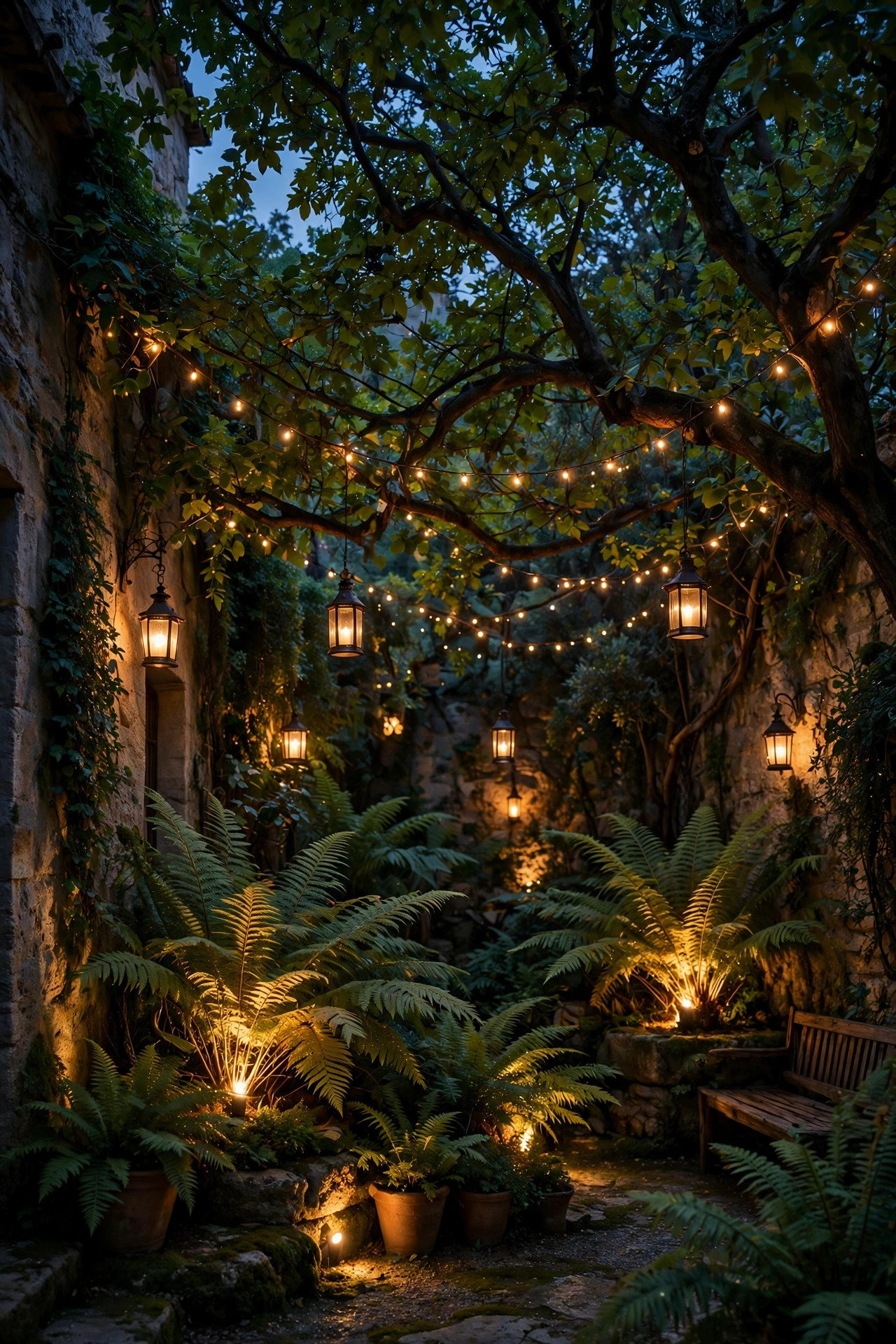
1. Wired Low-Voltage Path Lights: The Foundation of Shaded Courtyard Lighting Ideas
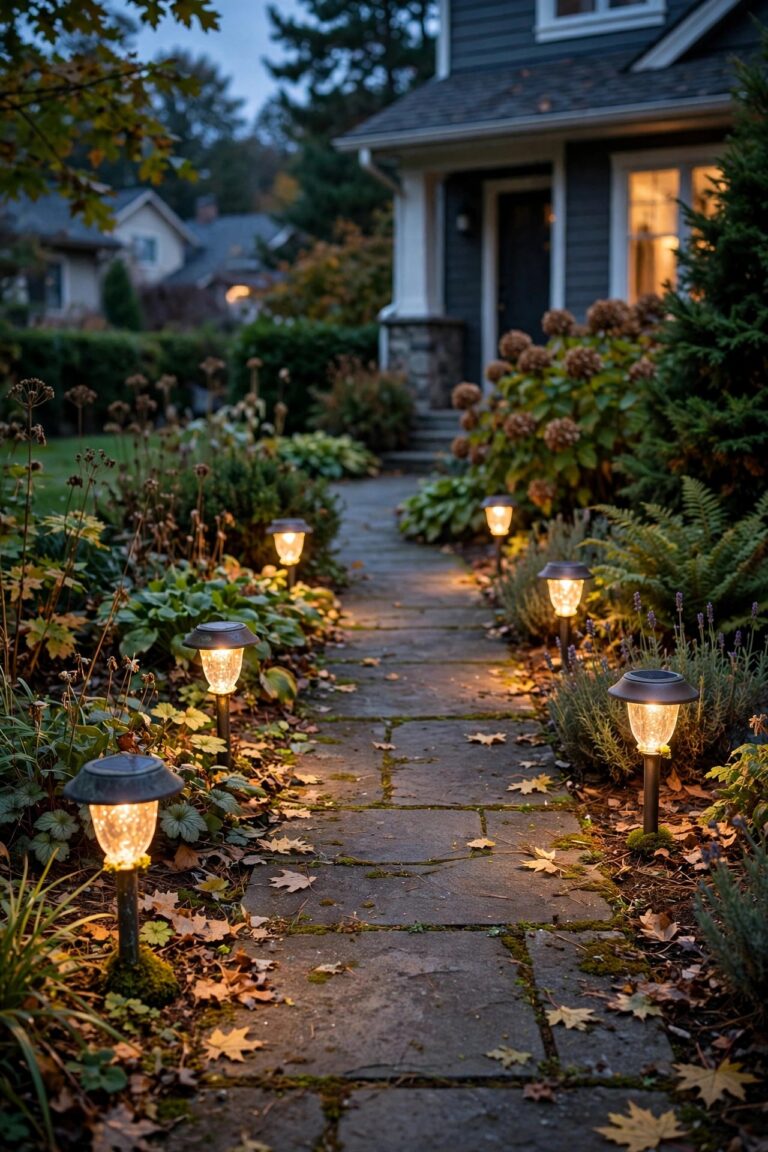
If you only do one thing from this list, make it this one. Standard solar path lights are the number-one disappointment in a shaded courtyard because a fixture sitting under a canopy might get one hour of weak, dappled sun — not the six to eight hours its little panel needs. A wired low-voltage system does not care about your tree cover at all. I run a 12-volt transformer plugged into a GFCI outlet on the house wall, and a single cable looped around the courtyard feeds eight path fixtures. Each one puts out a steady 100 to 200 lumens from dusk to whenever the timer shuts off, rain or shine, January or June. Space fixtures 6 to 8 feet apart along the walkway and stagger them on alternating sides so the path reads as a gentle zigzag of pools instead of an airport runway. Push the stakes into the soil by hand, bury the cable just 2 to 3 inches deep under mulch, and use gel-filled waterproof connectors at every junction. The whole starter setup took me one Saturday, and it has outperformed every solar set I ever tried out there.
Suggested budget range: $120 – $300.

2. Use Solar Fixtures With Remote Panels
Solar is not banned from a shaded courtyard — it just has to cheat. Fixtures with a separate solar panel on a 9 to 16 foot cable let you park the light where you want the glow and park the panel where the sun actually lands, usually up on a fence cap, a pergola beam, or the one sunny corner of the roofline. I have two spotlights aimed at a stone bench whose panels live ten feet away on top of the garden wall in full afternoon sun, and they run a solid five to six hours after dark even in winter. Look for panels rated at least 2 watts with a real cable, not the stubby 6-inch leads on bargain sets, and angle the panel south, tilted about 30 degrees. Run the cable along the back of borders and pin it down with landscape staples so it disappears. This is also the kindest option for renters and for anyone whose courtyard is all pavers with nowhere to trench a low-voltage line. Just know the limits: remote-panel solar is accent light, not primary light, so pair it with one wired anchor from idea one.
Suggested budget range: $45 – $110.

3. Moonlight From the Tree Canopy
The single prettiest effect in a shaded courtyard comes from above. Mounting two or three shielded downlight fixtures 15 to 20 feet up in the tree canopy sends soft, dappled light filtering through the leaves — it genuinely looks like a full moon decided to park over your courtyard. This is the technique pros call moonlighting, and there is a full walkthrough in my moonlighting trees guide if you want the deep version. The basics: use fixtures with a glare shield or honeycomb louvre so you never see the bare bulb from below, aim them mostly straight down with a slight outward tilt, and pick a cooler 4000K lamp for this one layer only — moonlight reads blue-ish, and mixing that one cool source against warm light everywhere else looks intentional and lovely. Attach fixtures with stainless straps, never screws into the trunk, and leave slack in the cable for tree growth. Hire an arborist or electrician for the climb if heights make you nervous; it is worth it. One fixture over the seating area and one over the path is plenty for a small courtyard.
Suggested budget range: $180 – $450.
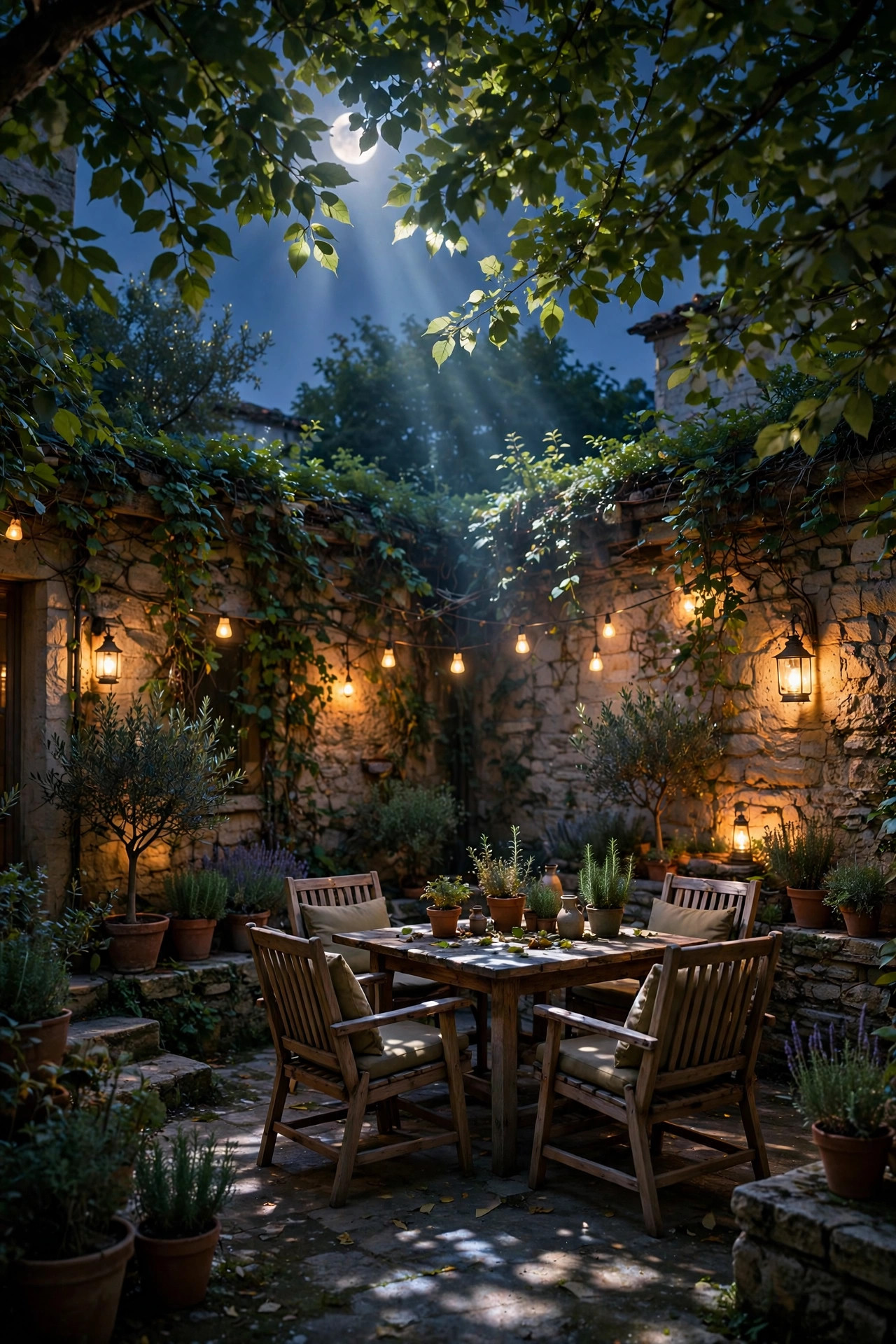
4. Uplight the Canopy for a Green Ceiling
Flip idea three upside down and you get the other canopy trick: well lights or bullet uplights at the base of the trunk, aimed up into the branches. In a shaded courtyard the canopy is already your ceiling during the day, and uplighting turns it into a glowing green vault at night — ferns and hostas below stay in soft shadow while the leaves overhead catch all the light. Use a narrow 15 to 30 degree beam so the light stays in your tree instead of spraying the neighbors windows, and angle the fixture slightly off the trunk so bark texture rakes dramatically. Two fixtures per mature tree, set about a foot from the base, is my formula. Warm 2700K makes oak and maple foliage look rich and golden; go too cool and it turns swampy. Because these sit at ground level in a damp, shaded garden, spend the extra money on solid brass or marine-grade fixtures with sealed lenses — cheap aluminum corrodes fast in soil that never fully dries. Pair this with low path light and the courtyard feels twice its size.
Suggested budget range: $90 – $260.

5. Swag String Lights Under the Branches
String lights are the fastest mood upgrade in any courtyard, and shade is secretly their friend: because a shaded courtyard is dim even at golden hour, the bulbs show up earlier in the evening and look twice as cozy against the dark green backdrop. I swag two 48-foot commercial-grade strands from the house wall to a hook on the tree, crossing over the seating area. Since the space is enclosed, runs are short — use that to your advantage and add gentle dips of 8 to 12 inches per swag for that cafe look. Choose shatterproof LED filament bulbs in 2700K, one to two watts each, and put the whole strand on a plug-in dimmer so you can drop it to 40 percent for dinner-party glow. Anchor into masonry or solid wood with screw hooks, never into the tree with tight wire that will girdle a growing branch; a loose stainless cable loop with slack is kinder. Plug into a GFCI outlet with an in-use weather cover, and keep connections off the ground on hooks. In deep shade this layer is often all the ambient light you need.
Suggested budget range: $60 – $160.
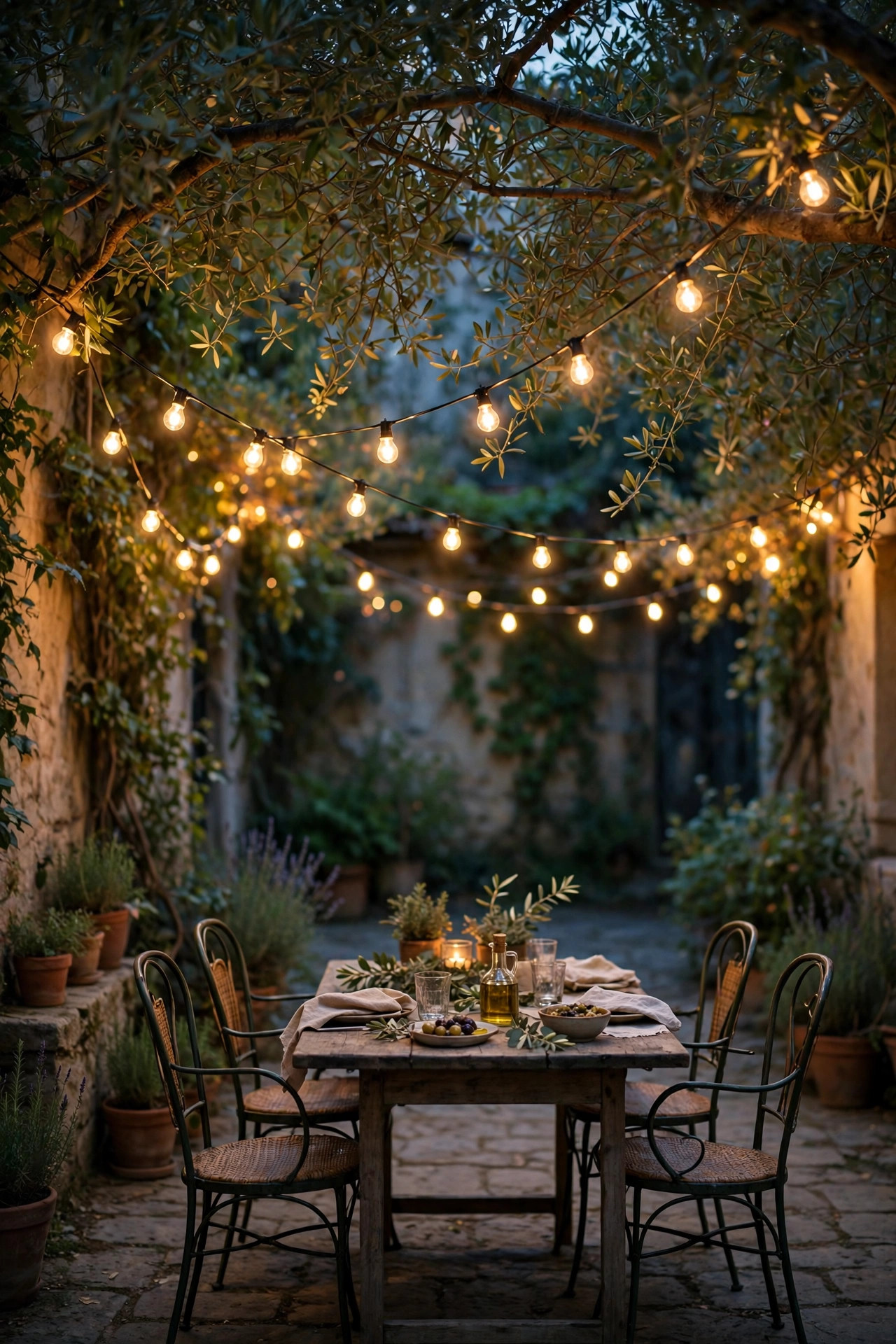
6. Wash the Walls With Sconces
Courtyard walls are giant reflectors waiting to be used. A pair of wall-wash sconces mounted on the house wall or garden wall bounces light softly around the whole space instead of leaving bright pools surrounded by murk, which matters in a low-light garden where every lumen counts twice. I favor fixtures that throw light both up and down — the up-light grazes the wall texture and any climbing vines, the down-light pools gently at the base where the ferns are. Mount them 5 to 6 feet high and space pairs 8 to 10 feet apart on the longest wall. Brick and stone look incredible washed at a narrow angle from a few inches out; on stucco, pull the fixture a bit farther from the wall for a softer spread. Hardwired is cleanest if you have an electrician coming anyway, but plug-in sconces with a cord cover look nearly as tidy and need no permits. Keep them on the same timer as the path lights so the whole courtyard wakes up as one scene at dusk.
Suggested budget range: $70 – $220.
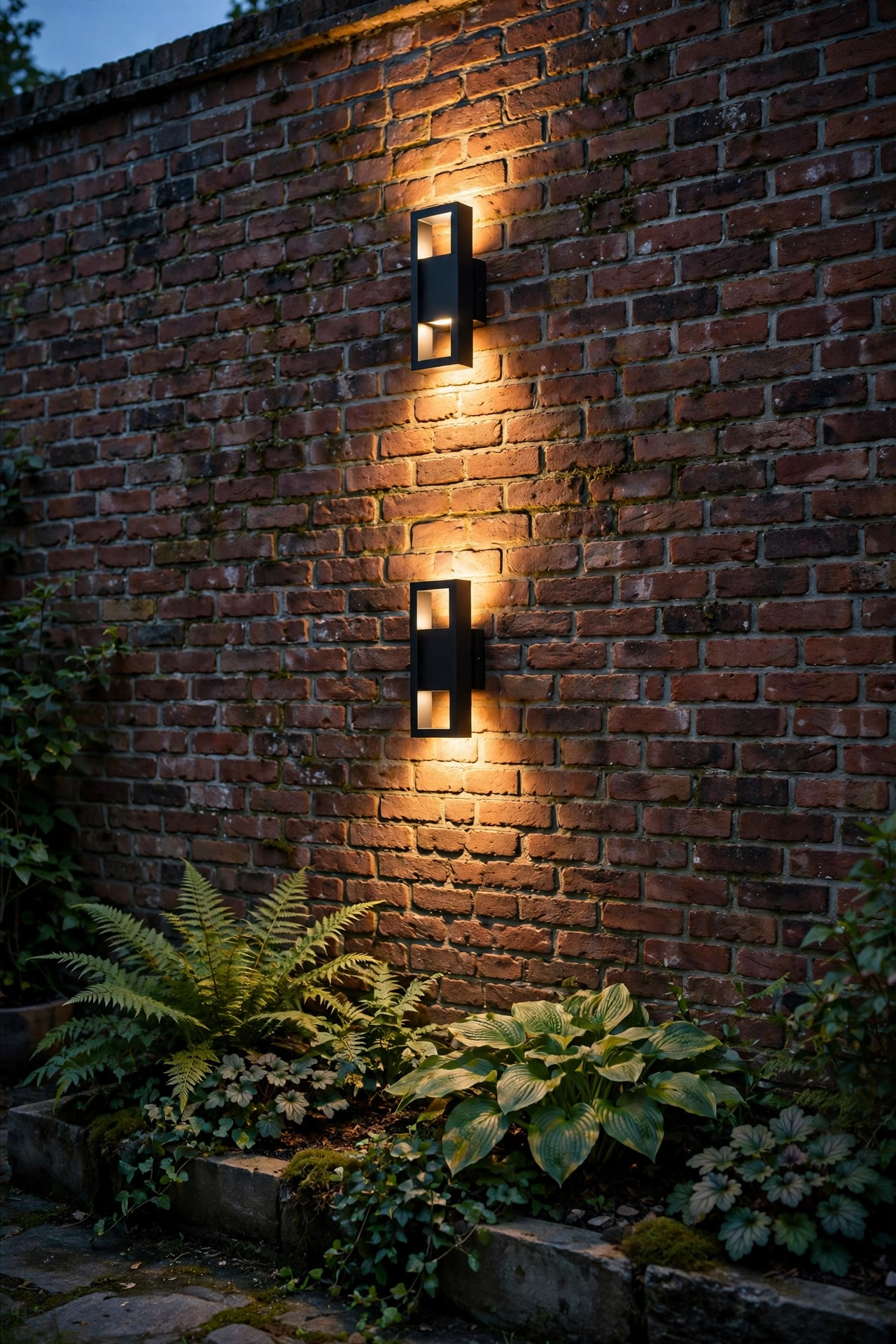
7. Lean on Rechargeable Lanterns With Timers
Some corners of a shaded courtyard have no outlet nearby and no soil to bury cable in — that is lantern territory. Modern rechargeable LED lanterns are a different species from the dim camping lights of ten years ago: the good ones run 8 to 15 hours per charge, dim in steps, and hold a genuinely candle-warm 2700K. I keep three in graduating heights clustered by the bench and two flanking the door, and my favorite models have a timer mode that repeats the same five-hour window every night after one setup. Charge them on a Sunday with your phone cables and forget them all week. Mix metal and woven textures so the cluster looks collected rather than matched, and bring them under cover during hard freezes to protect the batteries. They are also your storm insurance: when a summer thunderstorm knocks the power out, the courtyard is still glowing. For a shaded space where wiring every corner gets expensive fast, lanterns deliver the highest glow-per-dollar of anything on this list.
Suggested budget range: $40 – $130.

8. Weave Fairy Lights Through Shade Shrubs
Hostas, ferns, and hydrangeas are the backbone of a low-light garden, and a strand of copper-wire fairy lights woven through them turns ordinary foliage into the prettiest accent in the courtyard. The wire is nearly invisible by day, and at night each leaf seems to hold its own tiny star. Use plug-in or low-voltage sets here rather than solar — same charging problem as always in deep shade. My method: start at the back of the shrub and spiral outward, tucking the wire just under the top layer of leaves so the lights glow through the foliage instead of sitting on top of it. A 33-foot strand handles two medium hostas or one big hydrangea. Keep it subtle — 2700K warm white, never flashing modes, and one strand per feature plant rather than wrapping everything in sight. Since the wire runs low through damp beds, choose sets rated for outdoor use with a sealed transformer indoors or in a weatherproof box. This is a five-dollar-a-shrub transformation that guests always ask about.
Suggested budget range: $15 – $45.

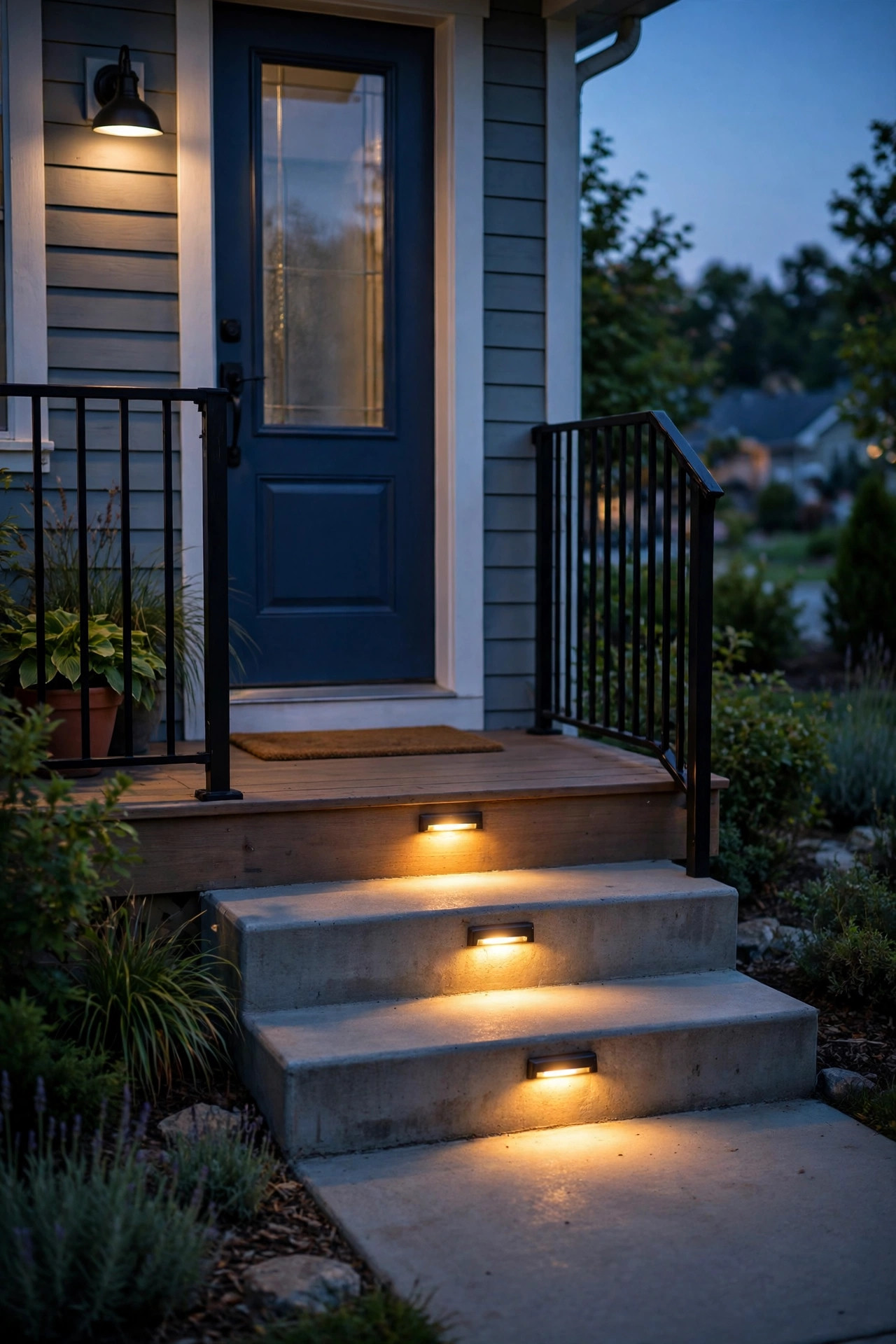
9. Light the Steps and Level Changes
Every shaded courtyard I have ever visited has one sneaky hazard: a step or level change that disappears completely after dark because the space never gets bright to begin with. Fix safety and style in the same move with dedicated step lights. Recessed lights in the riser are the clean look, but surface-mount low-voltage pucks screwed under a tread nosing are a one-hour retrofit and just as effective. Aim for a light every step or every other step, and match the color temperature to the rest of your layers so the staircase reads as part of the scene. On stone steps, I also like small bollard-style fixtures at the top and bottom landings to bookend the run. Wire them into the same low-voltage transformer as the path lights — the circuit barely notices the extra draw, since each step light pulls only one to three watts. Honestly, this is the idea I would install first in a courtyard where older parents or grandkids visit after dark. Pretty matters, but nobody enjoys a twisted ankle with their lemonade.
Suggested budget range: $55 – $180.
10. Cluster Lanterns in the Darkest Corner
Every low-light courtyard has one corner that swallows light — usually the far corner where the fence, the house, and the tree all meet. Instead of fighting it with one bright fixture that will just glare, lean in with a lantern cluster at floor level. Group three to five lanterns of different heights on a small gravel patch or an old wooden crate, mixing flameless candles and rechargeable LED lanterns, and let that corner become a deliberate glowing hearth. Odd numbers and varied heights are the whole styling secret; a straight row of identical lanterns looks like a store shelf. Add one large potted fern behind the cluster and the light catches the fronds from below for a jungle-at-dusk effect that costs almost nothing. I set mine on a plug-in timer through a single smart plug, so the corner lights itself even when I forget. Because nothing here is wired in, you can rearrange the whole vignette in ten minutes when the mood changes or the season turns. Dark corners are not problems — they are stages.
Suggested budget range: $35 – $120.

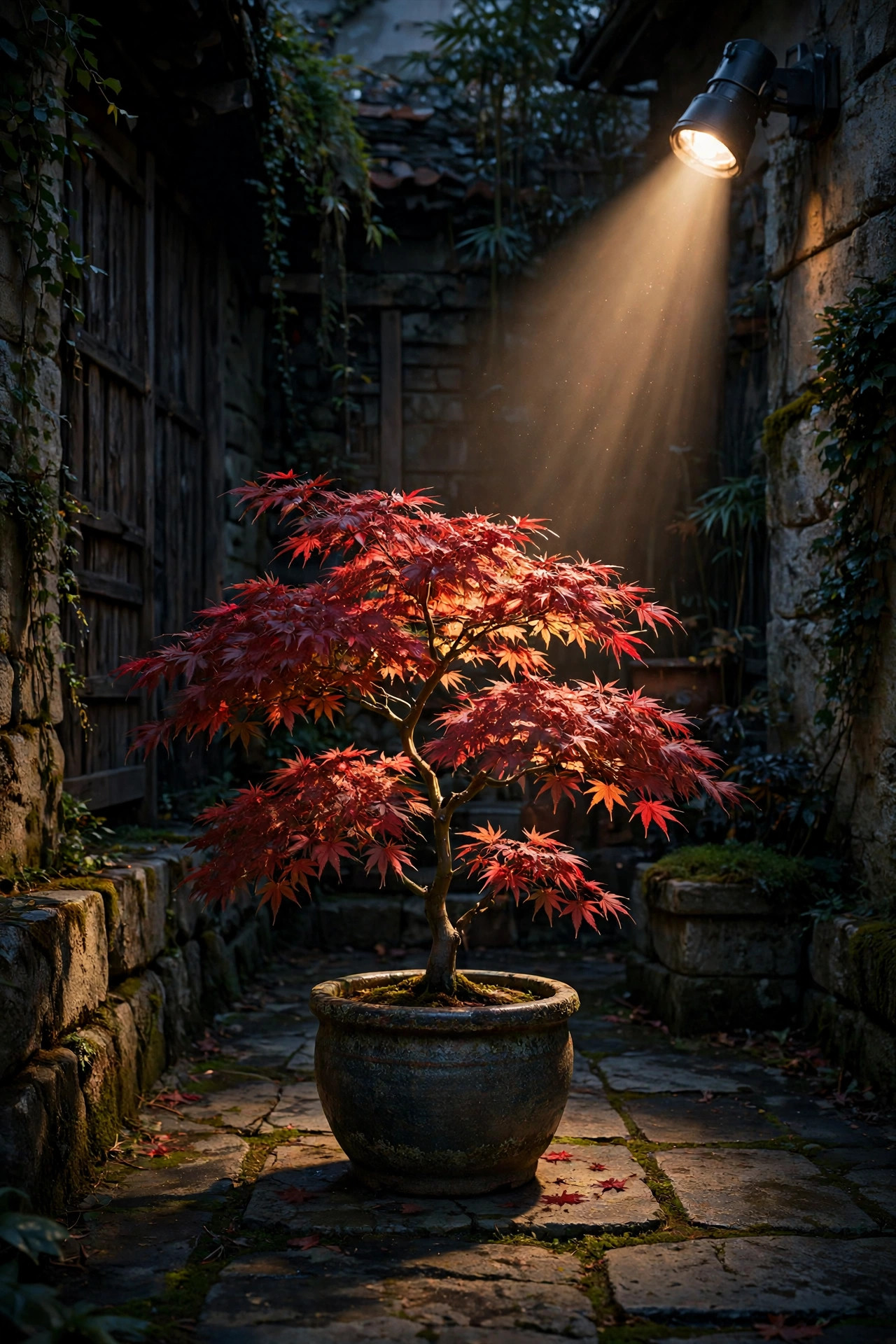
11. Spotlight One Focal Point
A shaded courtyard does not need more light everywhere — it needs one star. Pick a single focal point, a small fountain, a stone statue, a birdbath, or your best potted Japanese maple, and give it a dedicated spotlight while everything else stays soft. Two narrow-beam fixtures crossed at 45-degree angles keep a sculpture looking dimensional instead of flat, and a single underwater-rated light inside a fountain basin makes the water itself glow and ripple light onto the walls. This is where a wired fixture earns its keep again: focal lights burn the longest hours and get noticed most, so consistent full brightness matters. Aim carefully from a seated eye level — walk the courtyard, sit in every chair, and check that no beam hits anyone in the eyes. My maple gets one 5-watt, 3000K fixture at its base, and it is the first thing every guest photographs. Choose your star with restraint; the moment everything is featured, nothing is. One hero, softly lit, makes the whole low-light garden feel designed.
Suggested budget range: $50 – $170.
12. Hide Strip Light Under Bench and Wall Caps
The most sophisticated looking light is the kind you cannot find the source of. LED strip light tucked under a bench seat, a retaining-wall cap, or the edge of a raised planter throws a soft ribbon of light downward with no visible fixture — perfect for a shaded courtyard, where glare-free light keeps the calm, dim mood intact while still showing you where to sit and step. Use outdoor-rated, fully silicone-sleeved strip, not the indoor adhesive kind, and mount it in an aluminum channel so it survives damp air that never quite dries out under the trees. Warm 2700K again, and put it on a dimmer — at full blast it looks like a diner, at 50 percent it looks like magic. My favorite run is 9 feet under the cap of the low stone wall behind our seating: it washes the hostas below, defines the edge of the patio, and cost less than a single fancy path light. Low-voltage strip runs happily off the same transformer as your path lights with a simple splitter.
Suggested budget range: $45 – $140.

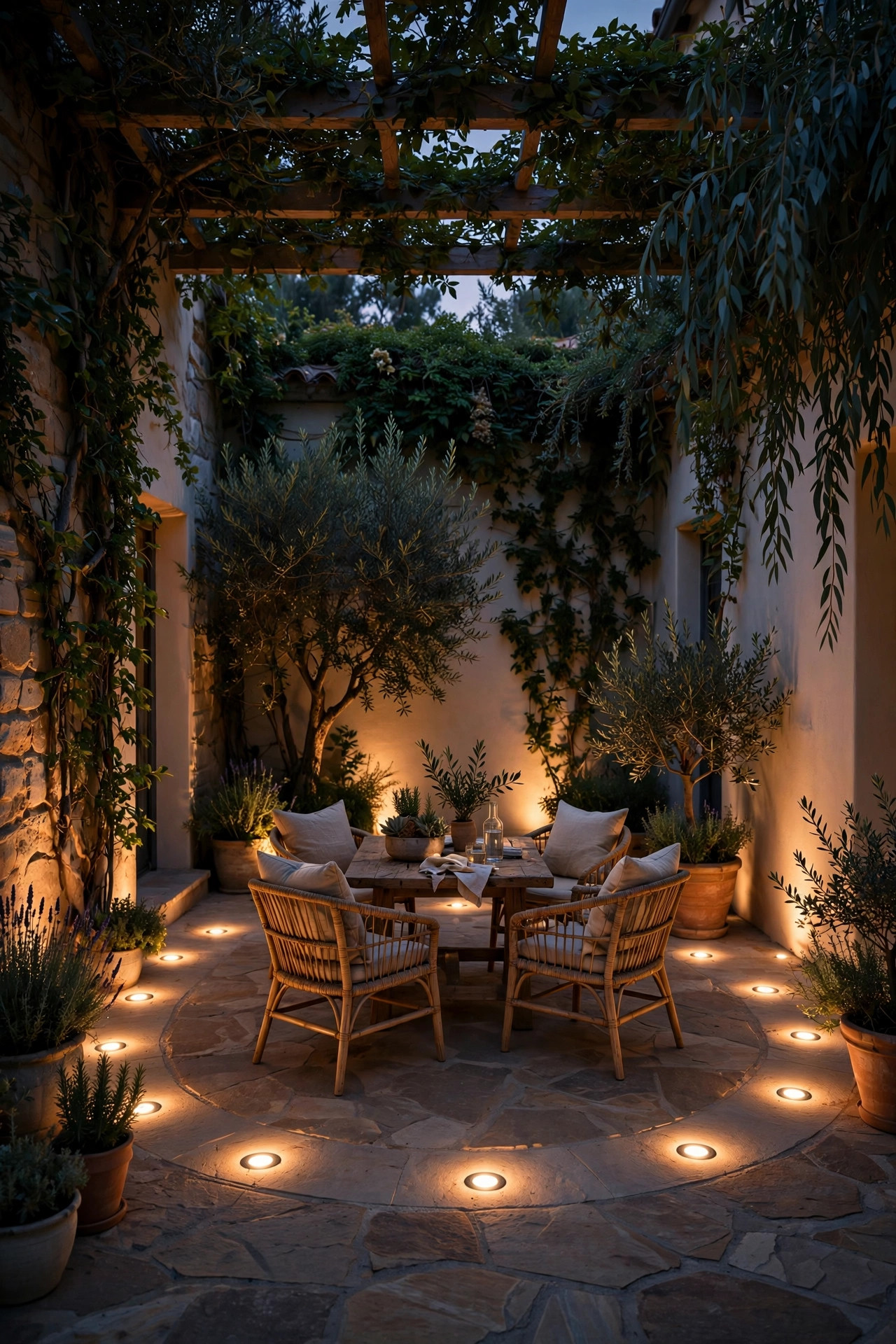
13. Circle the Seating With Ground Well Lights
Well lights sit flush in the ground and throw light straight up, and circling a seating area with four to six of them creates the feeling of sitting inside a soft bowl of light — walls, foliage, and faces all catch a gentle bounce while the fixtures themselves vanish into the pavers or gravel. In a shaded courtyard this solves the “dark cave” problem without a single visible lamp. Space them 3 to 4 feet out from the seating edge, tilted models let you lean the beam toward a wall or planting instead of straight at the sky. Non-negotiable in shade: choose fixtures with tempered glass rated for foot traffic and a proper drainage gravel pocket underneath, because ground in a low-light garden stays wet and a flooded well light fails fast. LED modules in the 200 to 400 lumen range are plenty — you are painting ambiance, not landing planes. I run ours only in the evenings we sit outside, on their own switch, and the effect still surprises me every single time.
Suggested budget range: $110 – $290.
14. Set Flameless Candles in Glass Hurricanes
There is a reason every courtyard in every romantic movie glows with candlelight: shade plus flame is unbeatable atmosphere. Real candles in a garden under trees, though, mean wind, wax on pavers, and one nervous eye on the dry leaf litter all night. Flameless candles with a realistic flicker solve all of it. I use the kind with a real wax shell and a timer chip — set them once to come on at dusk for five hours and they handle themselves for months on one set of batteries. Tuck three inside oversized glass hurricanes on the table, a pair on the wall ledge, and one low by the door, and the whole courtyard gets that warm, moving light that no steady bulb quite matches. Group by threes, vary heights from 4 to 9 inches, and choose ivory over bright white wax so they look right in daylight too. In damp shade, store spares indoors in winter and wipe the hurricanes monthly; condensation is the only upkeep this idea ever asks for.
Suggested budget range: $25 – $85.

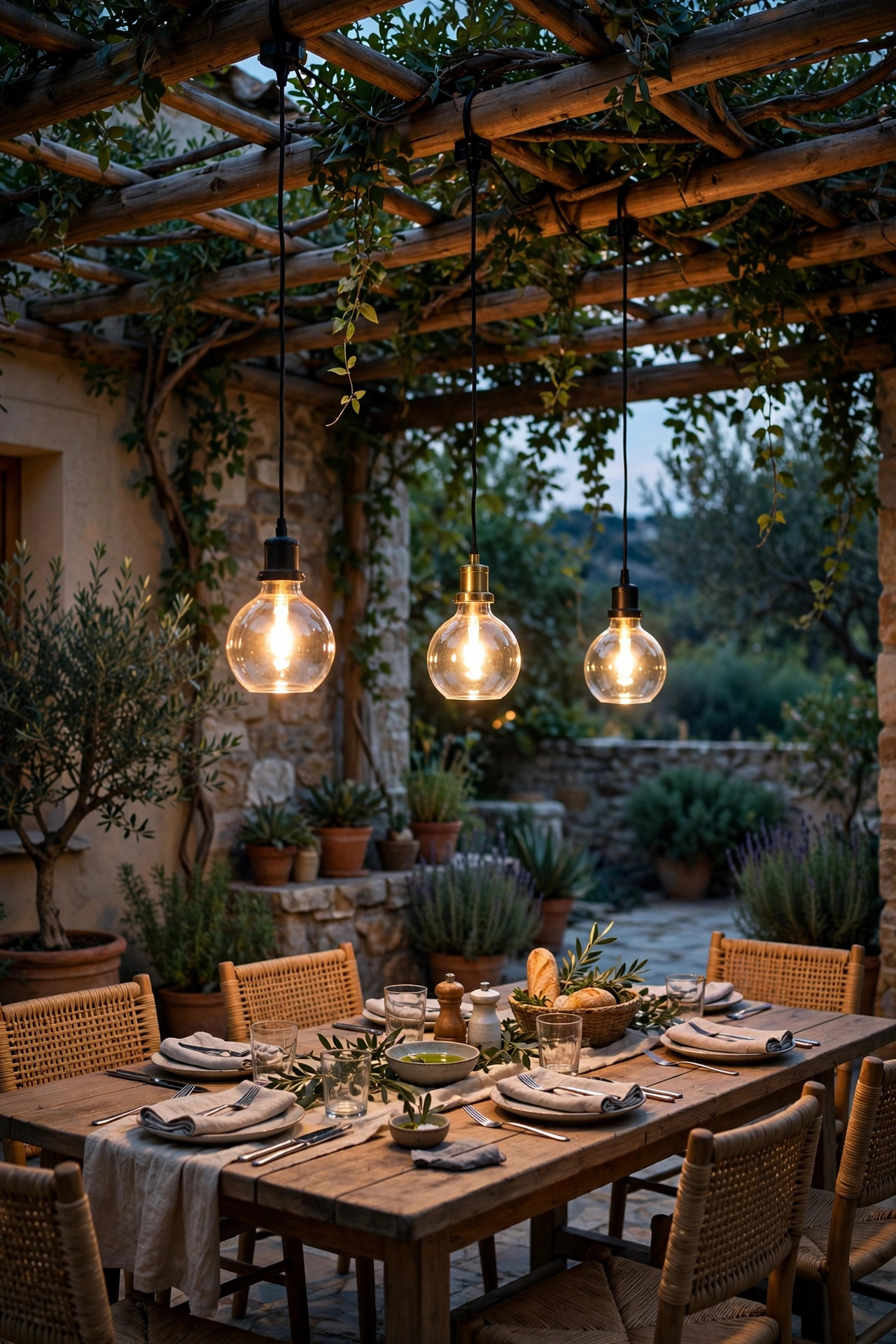
15. Borrow Power With Plug-In Pendants
If your courtyard has a pergola, a trellis, or even a sturdy branch over the table, a plug-in pendant or two gives you real dining-table light — the kind you can read a menu by — without hiring an electrician. Outdoor-rated swag pendants come with 15 to 25 feet of cord, so you can route power from the house outlet, up the post, and across to exactly where the light belongs. Hang the shade 30 to 36 inches above the table surface and use a dimmable LED bulb in an enclosed, damp-rated fixture; exposed filament bulbs are pretty but throw harsh light in a small enclosed space. In deep shade, a pendant does double duty by day as a design feature — a woven or matte-black shade reads like garden sculpture against all that green. Secure the cord with proper cable clips every couple of feet and keep the plug connection inside a weatherproof in-use cover at the outlet. This is the layer that turned our courtyard from a sitting spot into an actual outdoor dining room, even on the darkest side of the house.
Suggested budget range: $65 – $190.
16. Add Motion-Activated Accents for Late Trips
Not every light in a shaded courtyard needs to be part of the evening show. The path to the gate, the trip to the compost bin, the step off the back door — those want light that appears when you do and disappears when you leave. Battery motion-sensor lights have gotten genuinely good: mine trigger from 10 to 15 feet, stay on 20 to 30 seconds, and run most of a season on one charge because they only fire a few times a night. Mount one at the gate, one over the back steps, and one low on the fence near the bins, angled down so they light feet, not faces. Choose warm-white models to stay consistent with your other layers — the stark blue-white security look kills a courtyard mood instantly. Solar motion lights are the one solar exception I allow in shade, since their batteries sip power in short bursts, but rechargeable USB models are more reliable under heavy canopy. Test the aim at night before final mounting; a sensor pointed at a swaying branch will perform a light show nobody asked for.
Suggested budget range: $30 – $95.
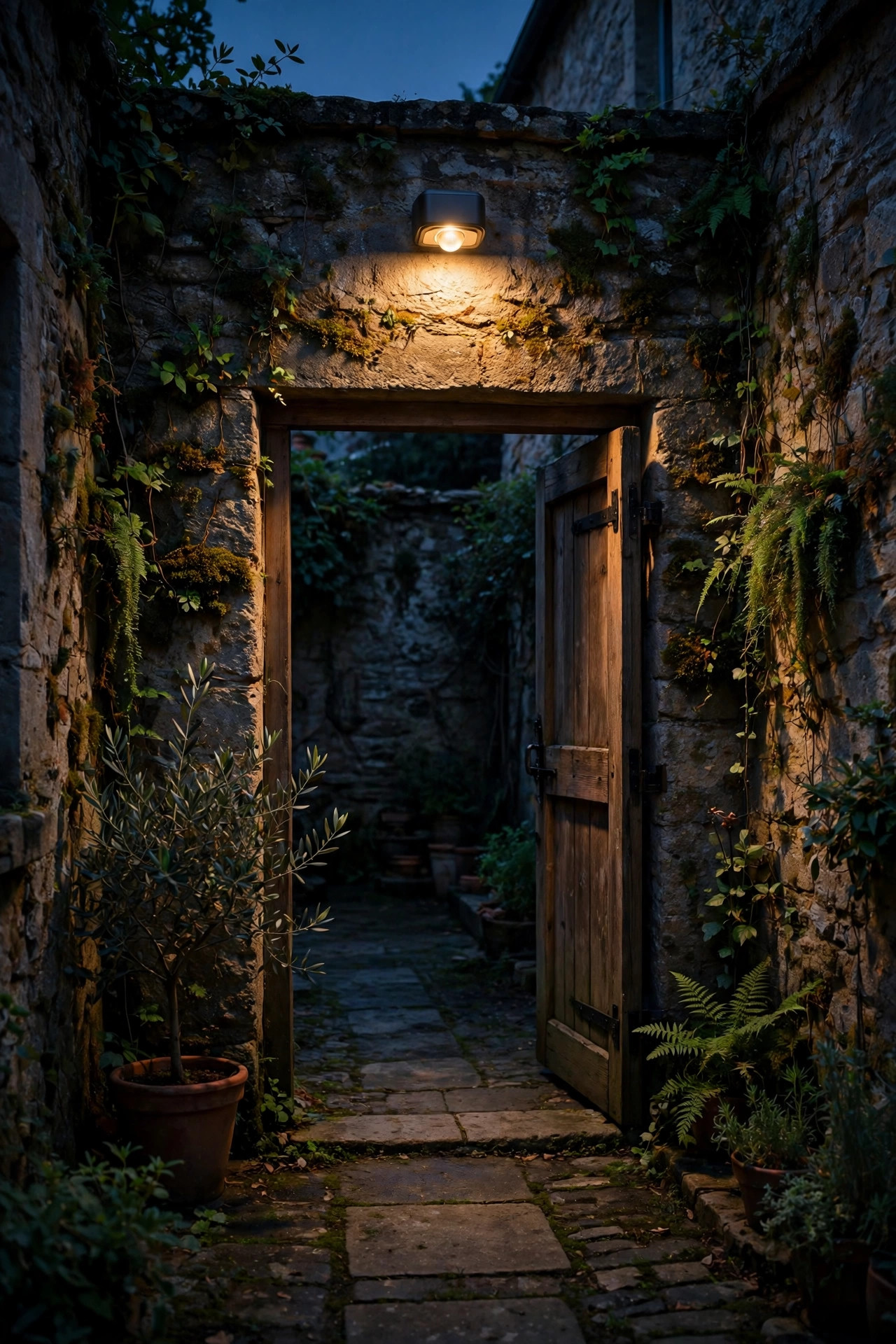
17. Layer Your Shaded Courtyard Lighting Ideas With One Timer and the Three-Height Rule
Here is the formula behind every shaded courtyard lighting idea in this post, the one I wish someone had handed me at the start: light at three heights, controlled as one scene. High layer — canopy moonlighting or string lights. Middle layer — wall sconces, pendants, and lanterns at eye level. Low layer — path lights, well lights, fairy lights in the shrubs, and strip light. When all three heights glow at once, a dim courtyard stops reading as dark and starts reading as deep, and you can honestly use fewer total fixtures than a one-layer setup. Tie the wired layers to a single astronomical timer or smart plug set to switch on at dusk, so the scene builds itself every evening without you touching anything, even in December when dusk lands before dinner. Keep everything 2700K except the one moonlight layer, brightness modest, and dimmers wherever you can manage them. My garden lighting ideas guide uses this same three-height approach for sunnier beds if you want to see the formula travel. Start with one layer this weekend — low is easiest — and add a height per season.
Suggested budget range: $25 – $75.

Frequently Asked Questions
Do solar lights work in a shaded courtyard?
Mostly no, and it is not your fault or the fixture being cheap. A standard solar light needs six to eight hours of direct sun to charge fully, and a courtyard under trees or on the north side of a house might deliver one or two hours of dappled light. The result is a weak glow that dies by 9 p.m. Solar works in shade only with a remote panel placed in a sunny spot, or for motion lights that sip power in short bursts. For dependable all-evening light, wired low-voltage is the honest answer.
What color temperature looks best in a low-light garden?
Warm white, 2700K to 3000K, for nearly everything. Warm light flatters green foliage, stone, and skin, and it keeps a shaded space feeling cozy instead of clinical. The single exception is canopy moonlighting, where a 4000K lamp reads as natural moonlight against the warm layers below. Whatever you choose, keep every fixture in a layer the same temperature — a random cool bulb in a warm scene always looks like a mistake.
How bright should a shaded courtyard be?
Softer than you think. A shaded courtyard is already dark-adapted by evening, so modest light goes a long way: 100 to 200 lumens per path fixture, 200 to 400 for ground wells, and dimmable ambient layers you can run at half power. The goal is contrast and gentle pools of light, not daylight. If you can read a book everywhere, it is too bright; if you can see faces, steps, and edges comfortably, you have it right.
Can I light a courtyard with no outdoor outlet?
Yes. Rechargeable lanterns and flameless candles need no power at all, battery motion lights cover the paths, and remote-panel solar spots handle accents if any nearby surface gets sun. For a bigger setup, an electrician can add one GFCI outlet to the house wall — usually a modest job — and that single outlet can run an entire low-voltage system on a timer. Start with the no-wiring layers and add the outlet when you are ready to commit.
Conclusion
A low-light garden is not a limitation; it is a head start on atmosphere. The shaded courtyard lighting ideas that actually work all respect one fact — shade starves solar — and build instead on wired low-voltage anchors, borrowed power, rechargeable layers, and light placed at three heights. Pick one layer this weekend, put it on a timer, and watch your darkest outdoor room become the one nobody wants to leave. Browse more ideas around the site and plan your next layer; your courtyard after dark is about to become your favorite view.