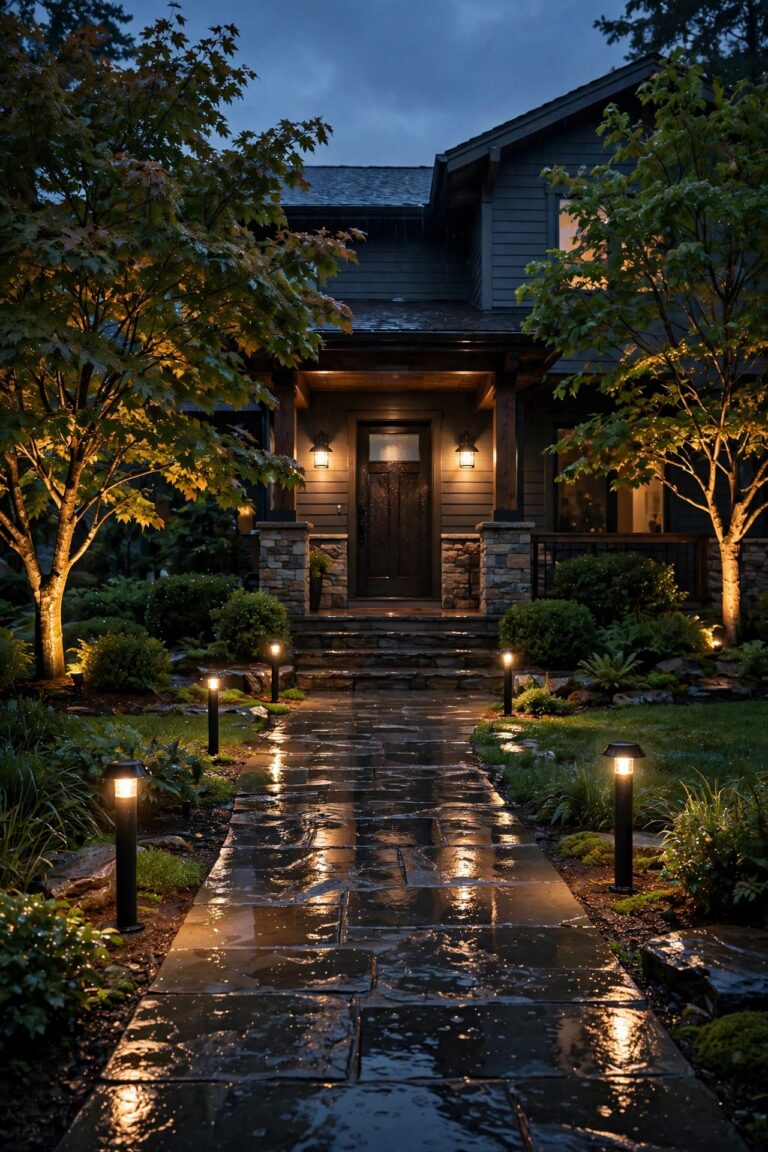
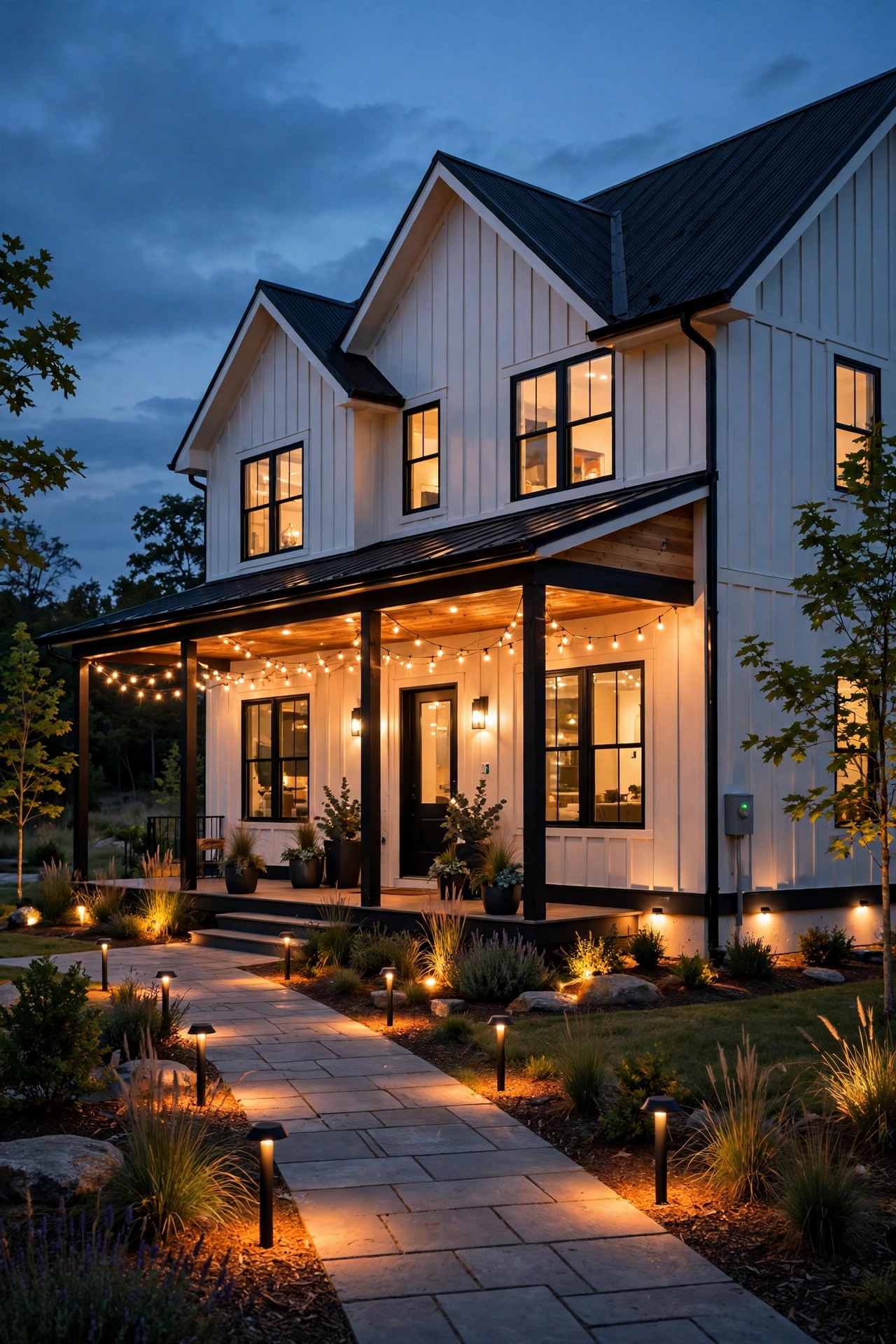
There is a reason the modern farmhouse look keeps winning hearts: it takes the clean lines and matte black finishes of contemporary design and warms them up with wood, texture, and a genuinely welcoming glow. Nowhere does that balance matter more than outside, where the right modern farmhouse outdoor lighting ideas can make a home feel polished from the street and cozy the second you step onto the porch. In my experience, the secret is layering. I always plan three layers: ambient light for overall warmth, task light where you walk, cook, and unlock doors, and accent light that shows off siding texture, trees, and plantings. Keep every bulb in the warm 2700K to 3000K range, repeat your finishes so the house reads as one story, and let a few rustic pieces do the talking. Below, I have gathered 25 ideas that mix old and new without ever feeling cold or themed, from gooseneck barn lights over the garage to mason jar lanterns along the garden path. Mix, match, and steal whichever ones fit your home best.
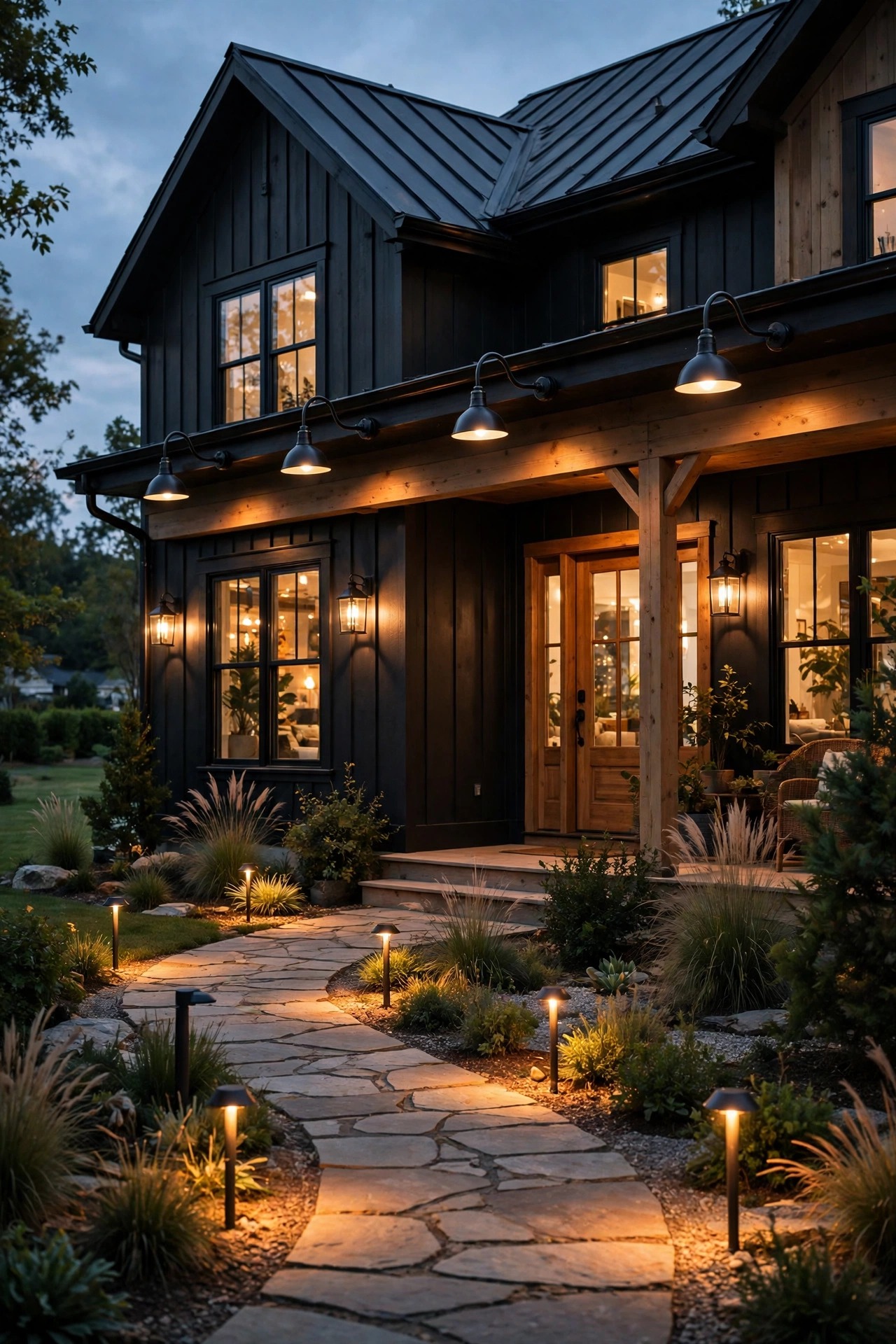
1. Build Your Modern Farmhouse Outdoor Lighting Ideas Around Three Layers
Before you buy a single fixture, decide how your light will layer. This is the step that separates a house that looks styled from one that just looks lit. Layer one is ambient: soft, general light from porch pendants, ceiling fixtures, and wall sconces that sets the overall mood. Layer two is task lighting for the places where you actually do things: steps, walkways, the grill station, the door lock. Layer three is accent light, the fun part, where spotlights graze your board-and-batten siding, uplight a maple, or turn a stone wall into a feature. In my experience, most farmhouse exteriors need fewer fixtures than people think; they just need each one placed with a job to do. Sketch your house at dusk, mark where you walk and gather, then assign every fixture to a layer. Stick with warm 2700K bulbs throughout so the layers blend seamlessly, and put each layer on its own switch or smart plug. That way you can run the full glow for guests or just the path lights on a quiet Tuesday night.
Suggested budget range: $150 – $600.
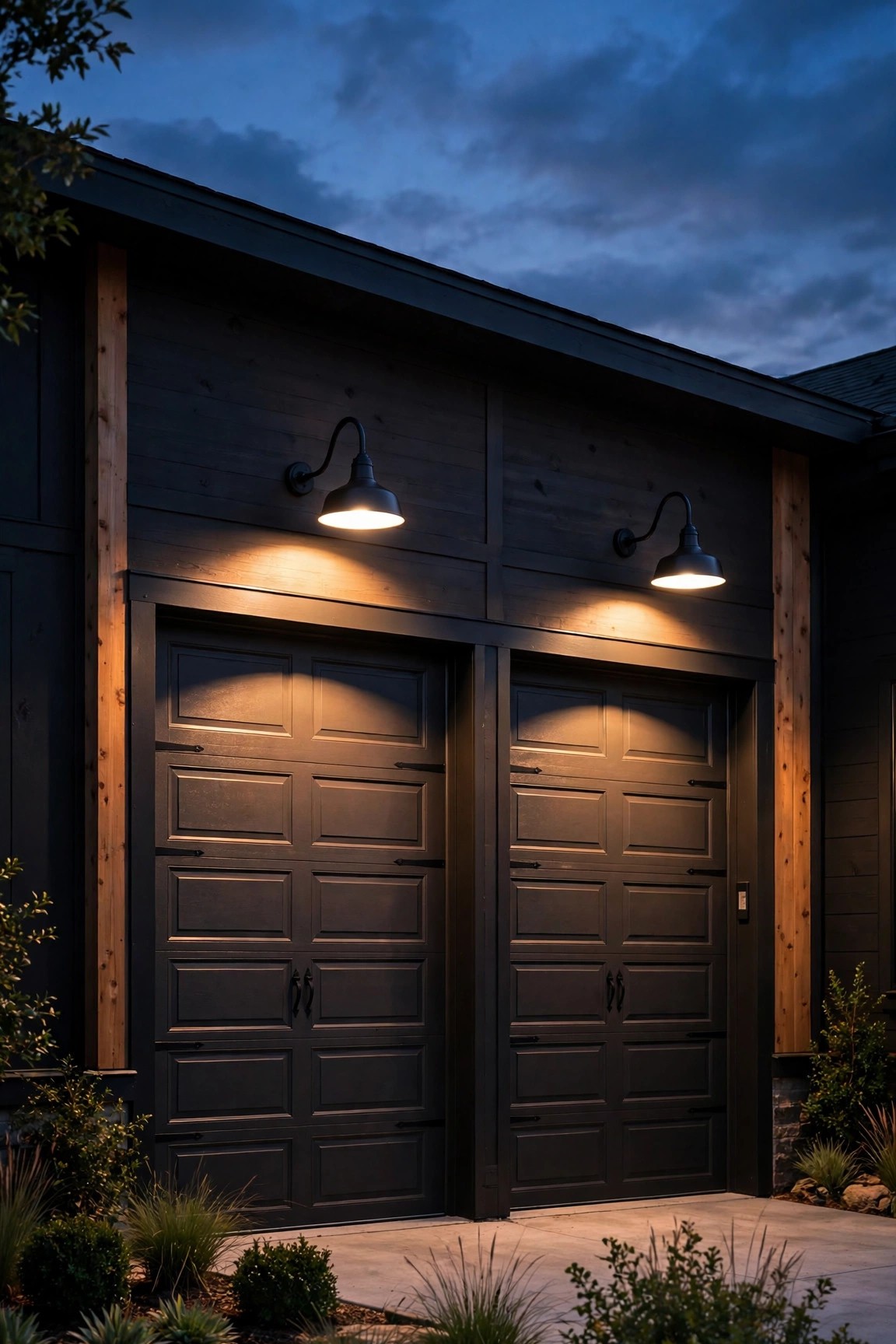
2. Matte Black Gooseneck Barn Lights
If one fixture defines this style, it is the gooseneck barn light. That curved arm and wide metal shade started on real working farms, and in matte black it reads perfectly modern against white siding, natural wood doors, and galvanized accents. I love a pair over garage doors, a single one over a side entry, or a row of three marching along a long porch. Choose shades 12 to 16 inches wide for garages, and mount them 9 to 11 feet up so the light pools where you park without glaring into windshields. Look for wet-location-rated fixtures with sealed sockets, and pair them with LED filament-style bulbs for that warm vintage glow at a fraction of the energy. For a deeper dive on sizes, finishes, and placement, my guide to gooseneck barn lights covers everything I have learned from hanging them. One caution from experience: cheap thin-metal shades dent and rust at the screw holes within two seasons, so spend a little more for powder-coated aluminum or steel.
Suggested budget range: $60 – $180.
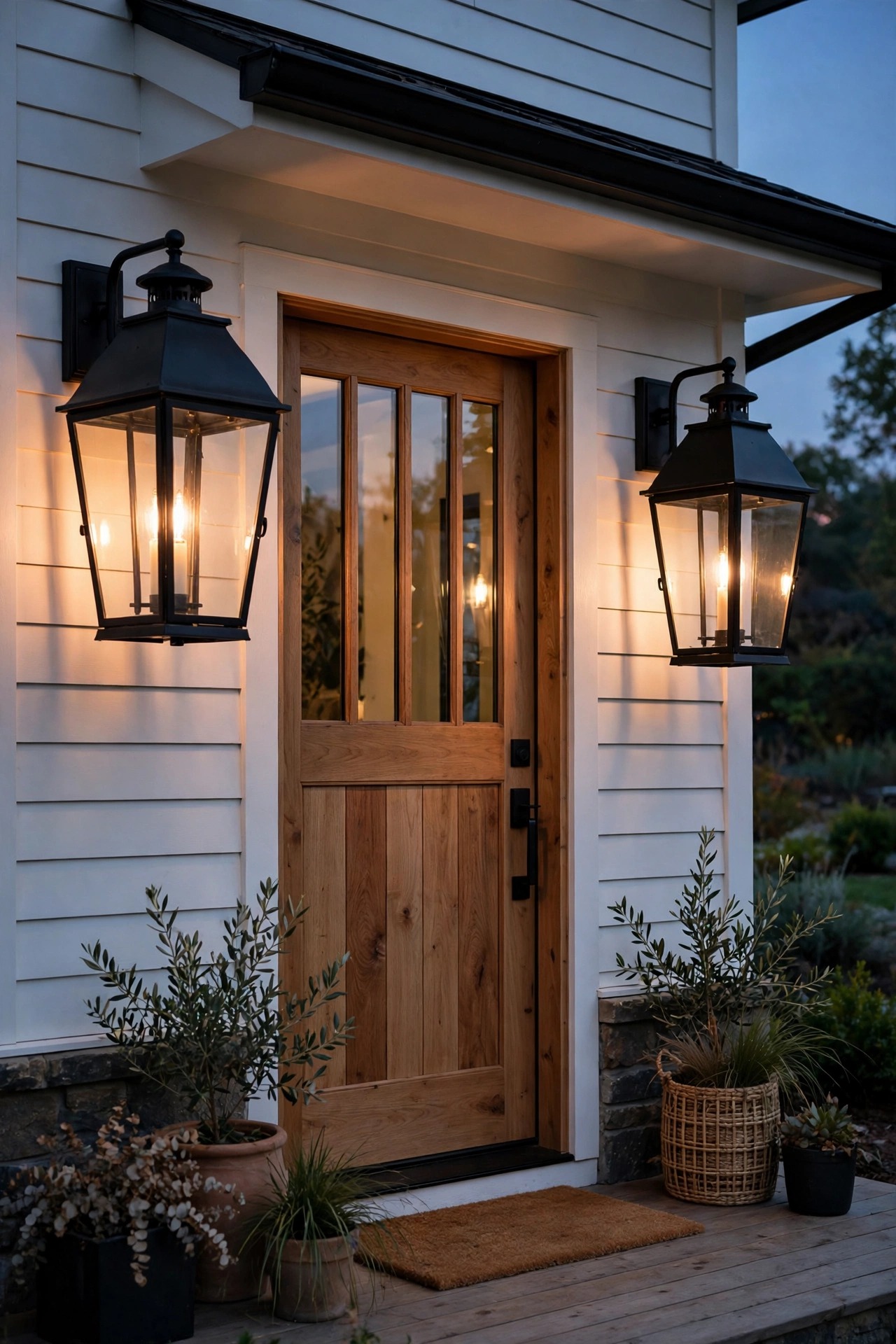
3. Oversized Lantern Sconces at the Front Door
Oversized lantern sconces are the jewelry of a modern farmhouse entry. The trick that makes them feel current instead of colonial is scale and simplicity: clean rectangular frames in matte black, clear or seeded glass, and a single visible filament bulb. Go bigger than feels safe. A sconce that stands one quarter to one third the height of your door rarely looks too large once it is mounted, and undersized fixtures are the number one farmhouse lighting mistake I see. Mount pairs so the bulbs sit about 66 inches from the porch floor, roughly at eye level, and put them on a dimmer so you can soften the welcome for late-evening porch sitting. If your entry has wall space on only one side, a single oversized lantern plus a matching pendant overhead still gives you that balanced, intentional look. Match the finish to your door hardware and house numbers so the whole entry reads as one deliberate decision.
Suggested budget range: $80 – $250.
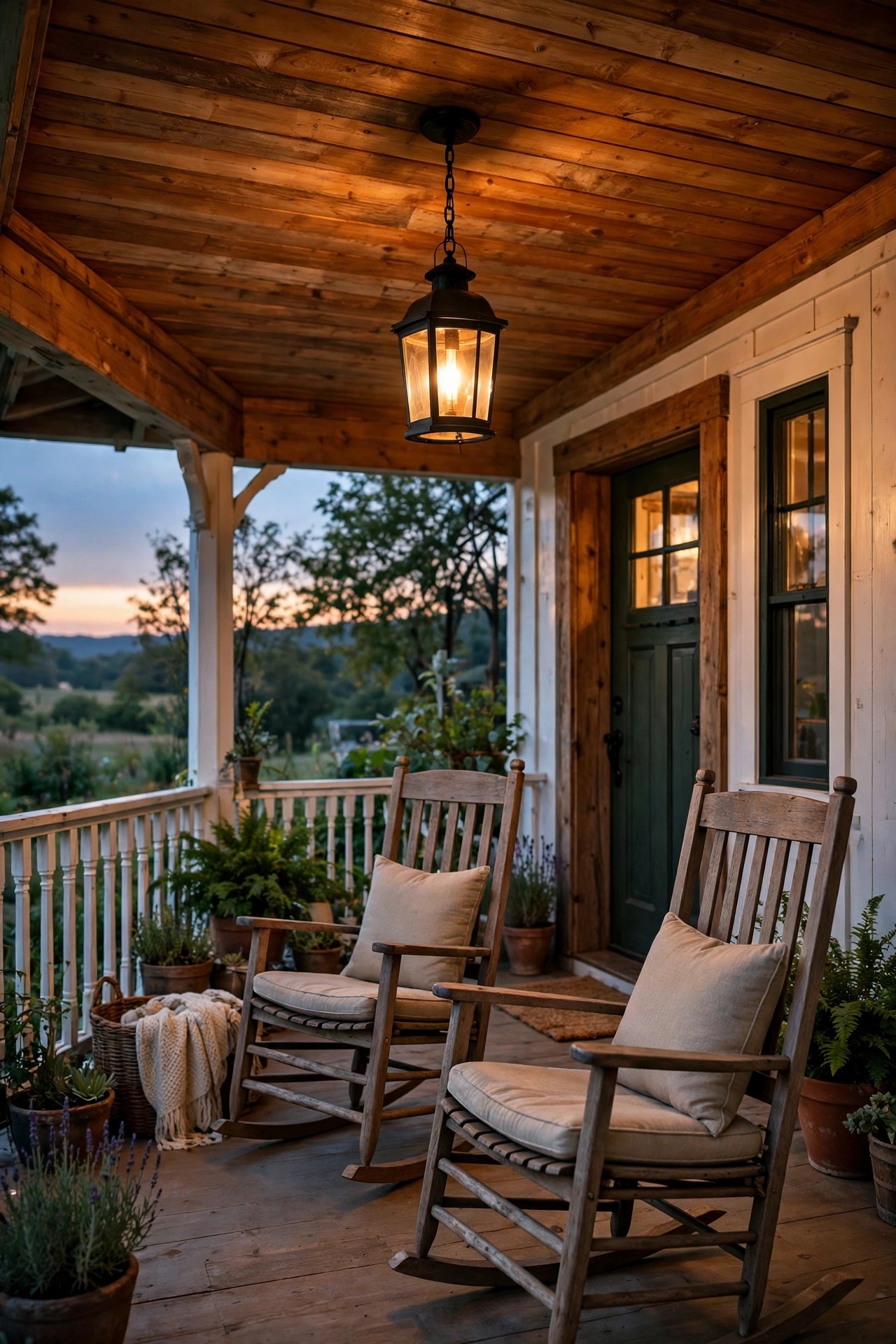
4. A Wood Porch Ceiling With a Black Pendant
Nothing warms up a modern porch like a wood ceiling, and nothing finishes it like a black metal pendant hanging over the door or seating area. Stained tongue-and-groove, or even simple beadboard painted a warm soft white, sets the backdrop; then one oversized lantern pendant, or a pair of smaller black pendants, delivers the contrast that makes the style sing. Hang pendants so the bottom sits 7 to 8 feet above the porch floor, high enough to clear tall guests and a swinging screen door. Add two or four recessed can lights on a separate dimmer for the nights you need real light for packages, projects, or a card game at the porch table. Honestly, this combination is where I send friends who want the biggest transformation for the least demolition: the ceiling does the cozy, the black metal does the modern, and together they make an ordinary porch feel like the best room in the house.
Suggested budget range: $200 – $700.
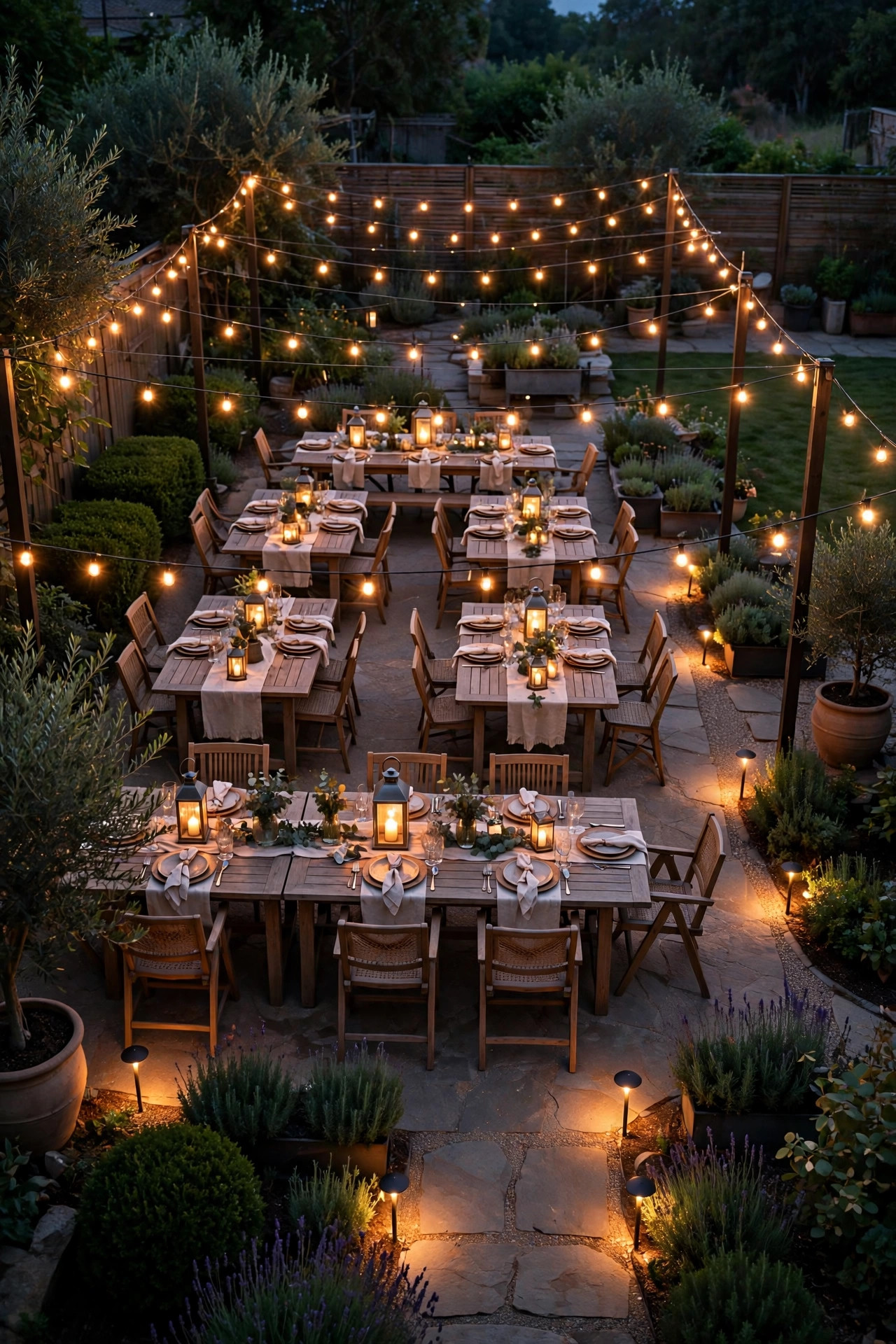
5. Edison Bulb String Lights With Black Cable
String lights are the hardest-working layer in a farmhouse backyard. Heavy-duty outdoor strands with LED Edison-style bulbs give you that café glow over a patio, a long farm table, or the open space between the house and a big shade tree. For the modern farmhouse balance, choose black cable strands rather than green or white, and hang them in gentle swags with 12 to 18 inches of drape between anchor points. Use a steel guide wire on spans longer than 15 feet so the weight never pulls on the sockets. Space bulbs 12 to 24 inches apart for an even glow, and put the whole run on a smart plug so it fades on at dusk without any effort from you. Shatterproof LED bulbs are worth every penny here: one dropped strand on a concrete patio will convince you. Keep a few spare bulbs in the drawer, because one dark socket in the middle of a swag is all anyone will notice.
Suggested budget range: $40 – $150.
6. Modern Path Lights With Farmhouse Warmth
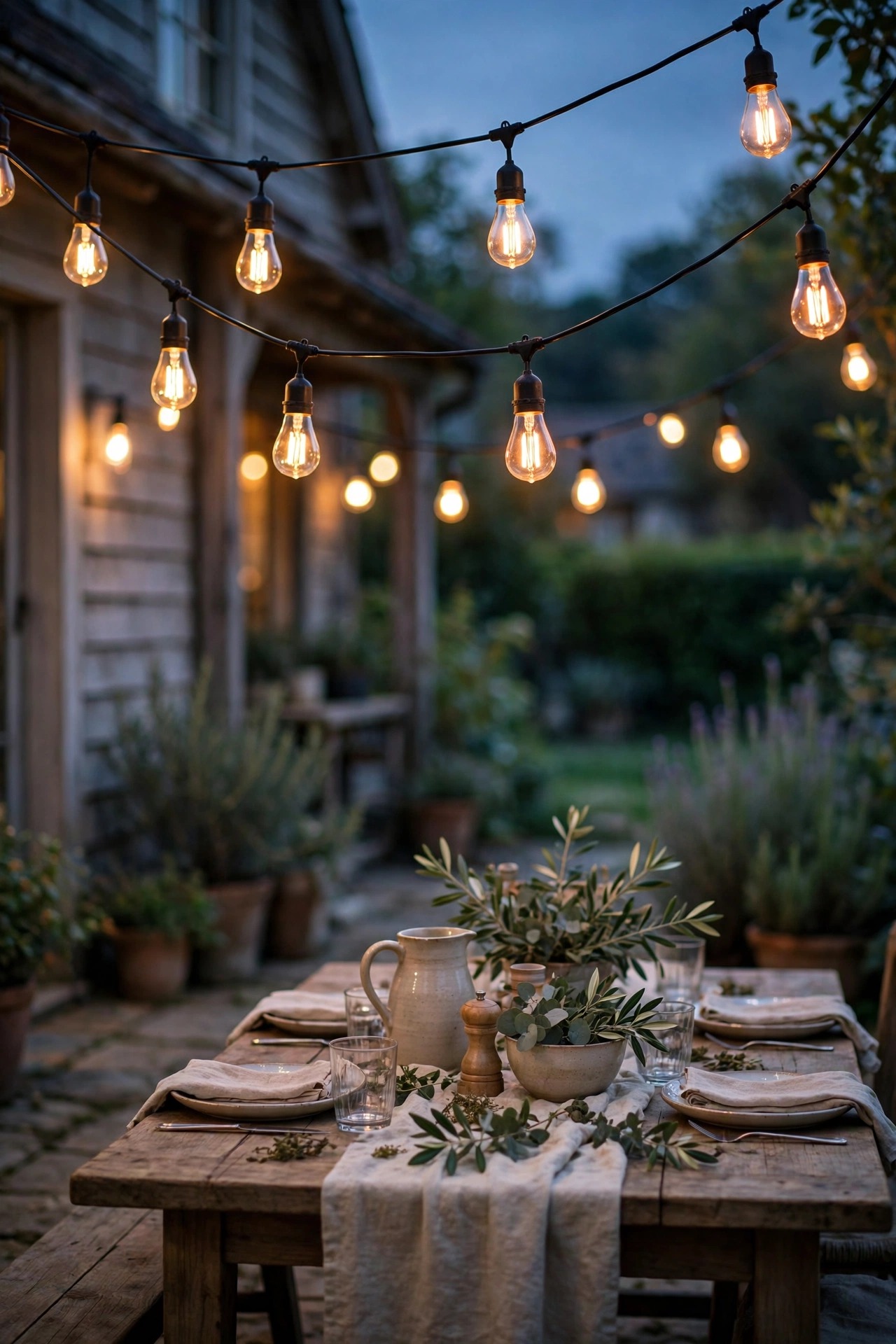
Walkway lighting is where the two styles shake hands. Sleek black path lights with clean lines keep the look modern, while warm 2700K light and a gentle rhythm of fixtures spaced 6 to 8 feet apart keep it welcoming rather than runway-like. I prefer fixtures 12 to 18 inches tall that throw light down and out in a soft pool, staggered on alternating sides of the path instead of lined up like soldiers. Low-voltage wired systems are my first choice for reliability, and they cost pennies a night to run. If you are comparing silhouettes, my roundup of modern path light ideas shows how different shapes change the feel of the very same walkway. Whatever you choose, buy one extra fixture while you are at it. Matching a discontinued path light three years from now is a headache I would not wish on anyone. In winter, brush snow off the fixtures after storms so the pools of light stay even and the lenses stay safe through freeze and thaw cycles.
Suggested budget range: $120 – $400.
7. Galvanized Metal Accents to Break Up the Black
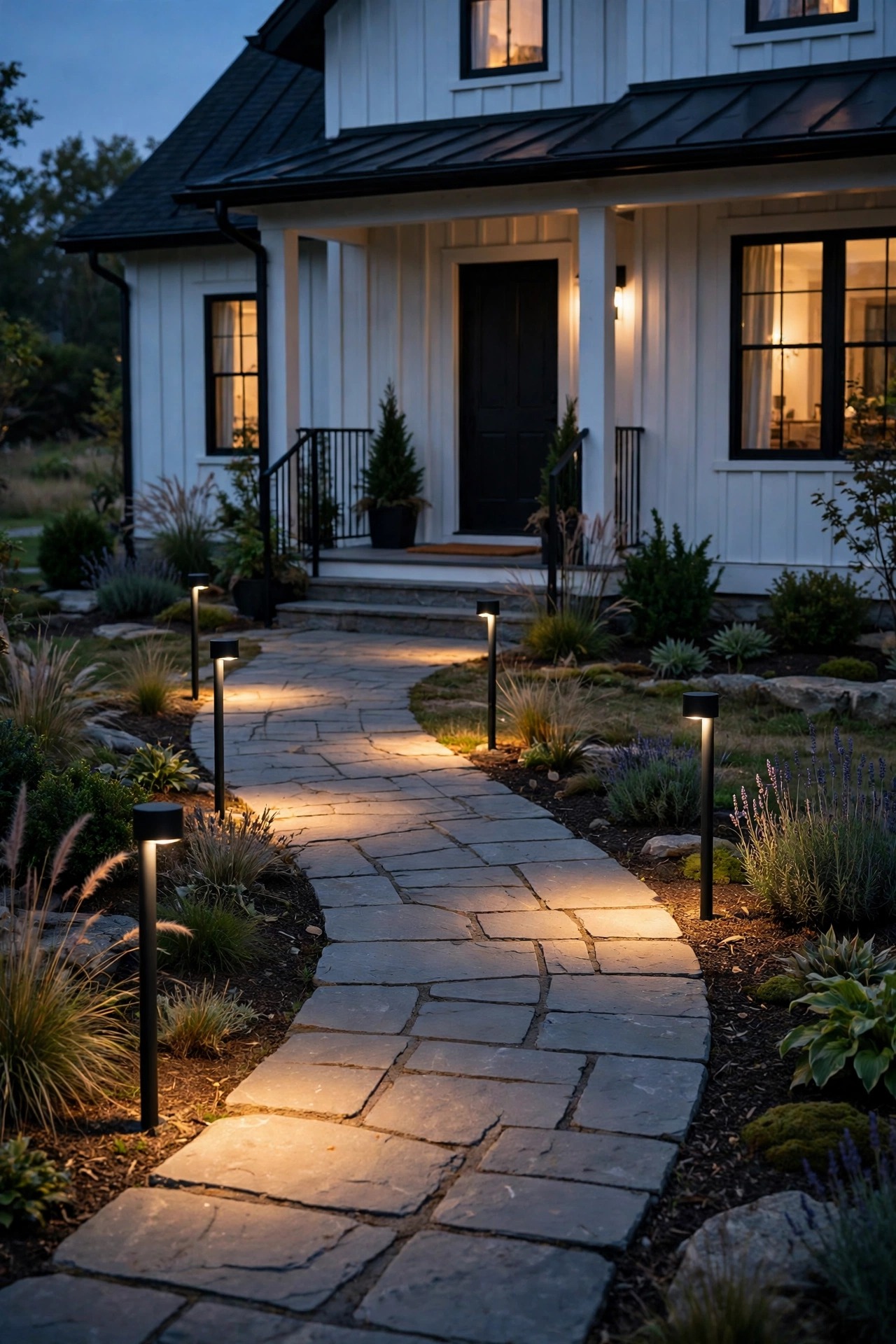
Matte black everywhere can tip a house from modern farmhouse into plain modern, so I always break it up with a galvanized or weathered-metal accent. A galvanized wall lantern by the mudroom door, a metal-shade pendant over the potting bench, or galvanized planters with small uplights tucked inside keeps the farm roots visible. The rule I follow is roughly 70 percent black fixtures and 30 percent mixed metal and wood tones, with each accent finish repeated at least twice so nothing looks like an accident. Galvanized finishes also hide dust and pollen beautifully, which matters on a country property where everything outdoors wears a fine coat of both by June. Just avoid mixing shiny chrome or polished nickel into the plan; those cool, glossy finishes fight the whole palette. Weathered, matte, and a little bit imperfect is exactly the point of this style. A galvanized watering can or wash tub beside the door, caught by that same soft light, doubles the effect for free.
Suggested budget range: $50 – $200.
8. A Lantern Post Light at the Driveway Entrance
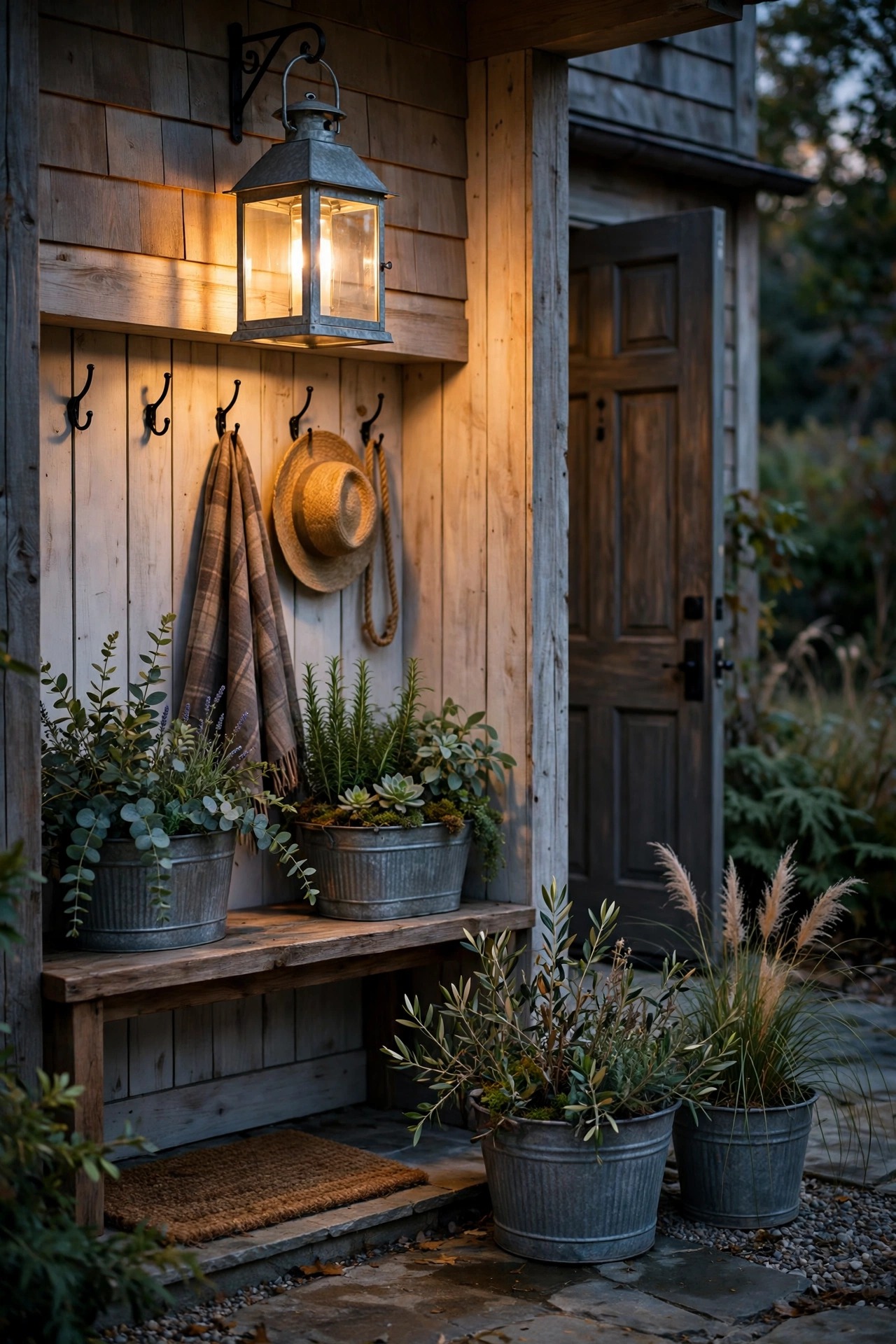
A lantern-style post light where the driveway meets the road is pure farmhouse hospitality: it says someone is home, and glad about it. Choose a black post that stands 7 to 9 feet tall once installed, topped with a clear-glass lantern and a warm filament bulb. On long drives, a pair flanking the entrance looks best; on shorter ones, a single post paired with a small mailbox light keeps it simple. Set the post back at least 2 feet from the drive edge so mirrors, delivery trucks, and snowplows clear it, and bury the cable about 6 inches deep in conduit where it crosses under gravel. If running wire is not in the cards this year, a solar post lantern with a replaceable battery is a respectable stand-in, just expect a softer, shorter glow on winter nights. If the post will stand in a windy spot, set it in a concrete footing so it stays straight and proud for decades.
Suggested budget range: $150 – $450.
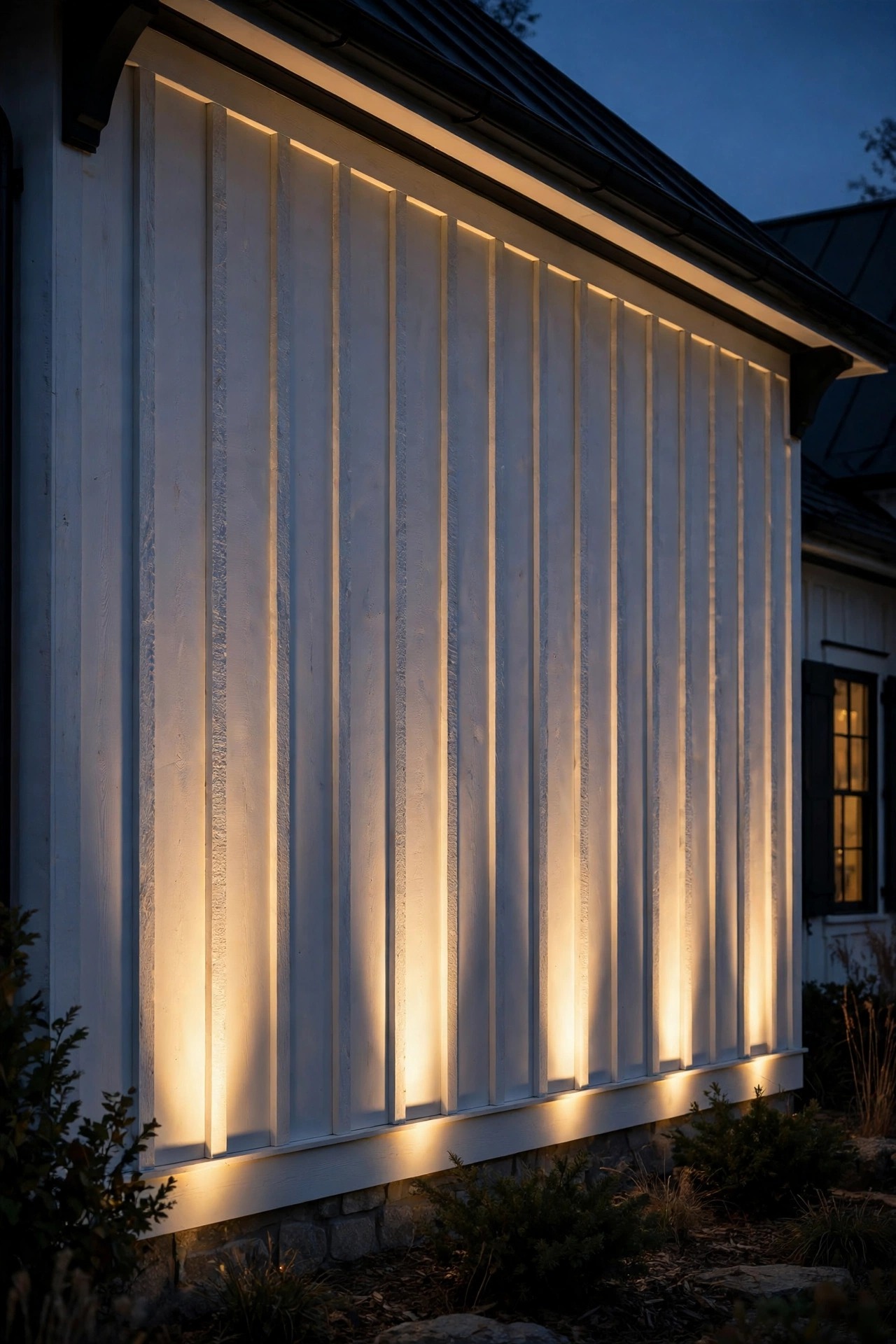
9. Uplighting That Shows Off Board-and-Batten Siding
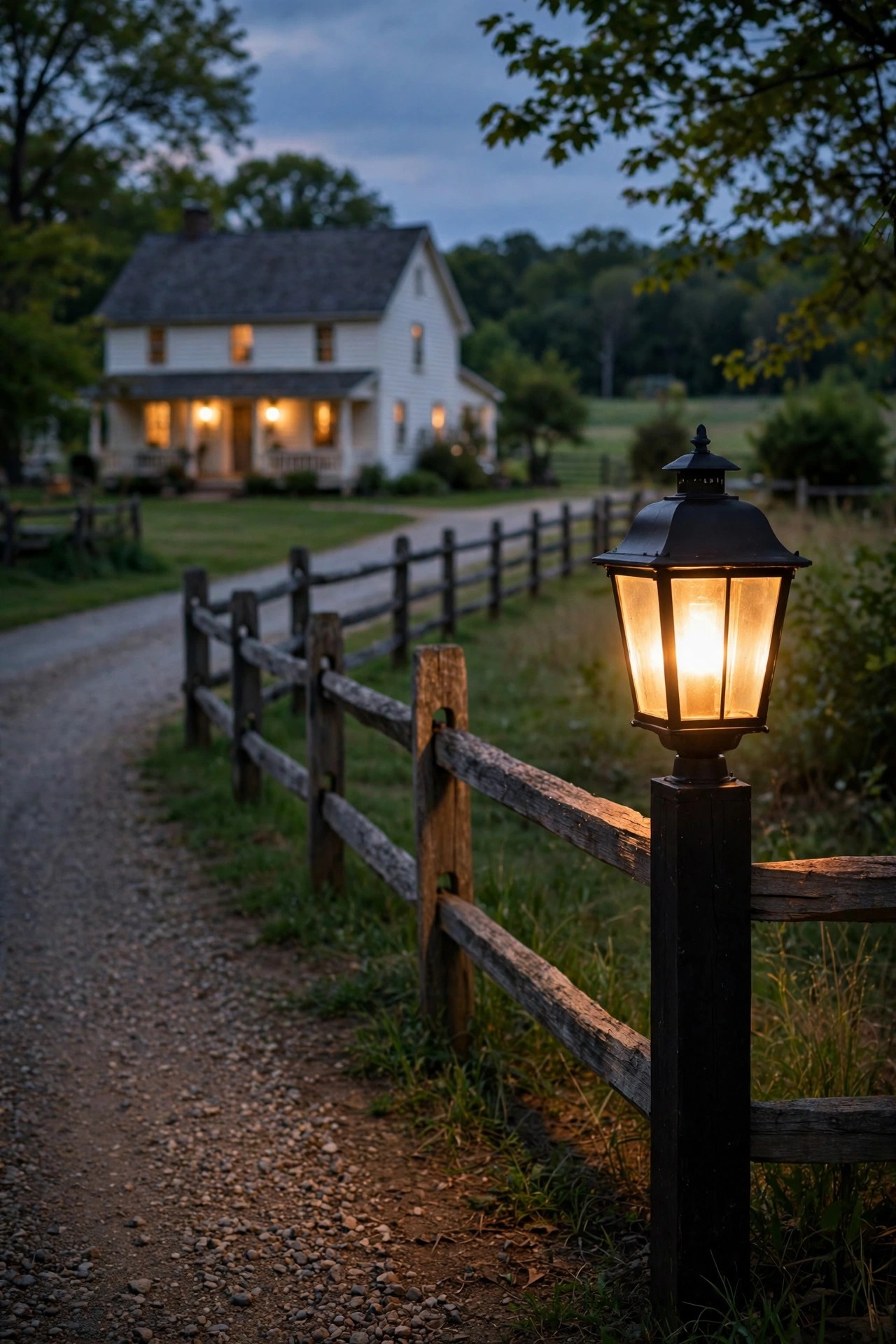
Board-and-batten siding has beautiful shadow lines, and at night most houses waste them completely. A few well-aimed uplights change that. Set small black well lights or adjustable spotlights 12 to 18 inches out from the wall and aim them straight up, so the battens throw long, soft shadows across the boards. Two or three lights per wall is plenty; you are grazing texture, not floodlighting a stadium. Choose narrow 30 to 45 degree beams for drama, or wider beams for a gentle, even wash. Keep the fixtures tucked behind shrubs or low ornamental grasses so the source disappears and only the glow remains. In my experience, this is the single most complimented trick in the whole modern farmhouse playbook, and it costs far less than most people expect for the impact it delivers. After the first week, walk the yard at night and nudge each angle, because siding texture changes with the seasons as shrubs grow and get trimmed back.
Suggested budget range: $90 – $300.
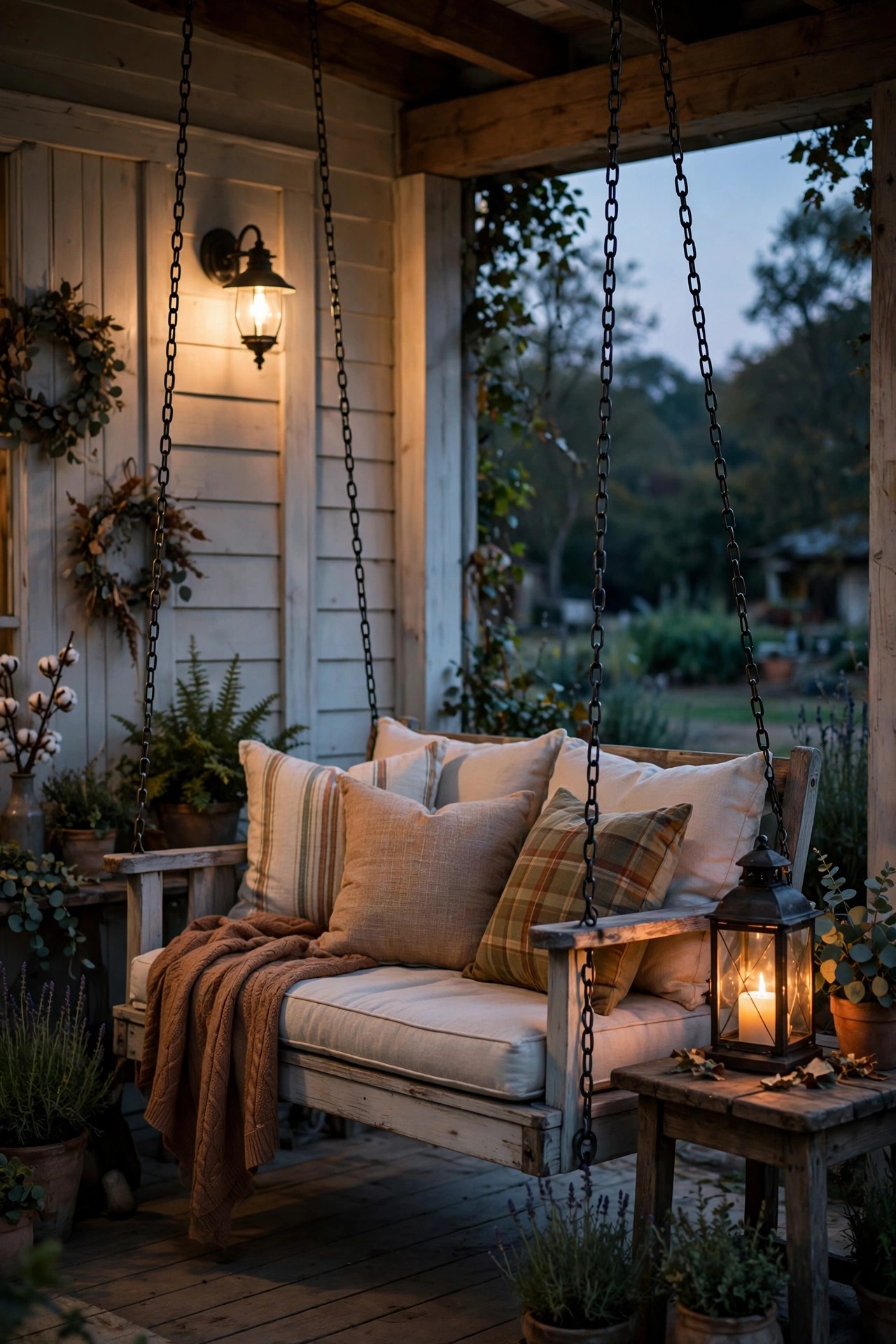
10. A Soft Glow for the Porch Swing Corner
A porch swing deserves its own little lighting scene. Two small black sconces on the wall behind the swing, mounted low and dimmed way down, give you enough light to read or sip sweet tea without killing the evening mood. If wall space is tight, hang a pair of flameless lantern pendants from the ceiling beams instead. I keep swing lighting warmer and dimmer than anywhere else on the porch, toward the 2200K to 2700K end of the range, because this is the unwind zone. The broader layout matters too: my favorite arrangements in this farmhouse porch lighting guide show how to balance swing corners with door and step lighting. Add a small side-table lantern holding a timer candle for the finishing touch, and you have built the seat that everyone in the family will quietly fight over. A woven throw over the swing arm and a small outdoor rug underfoot finish the corner, and the low light makes both look twice as expensive.
Suggested budget range: $60 – $220.
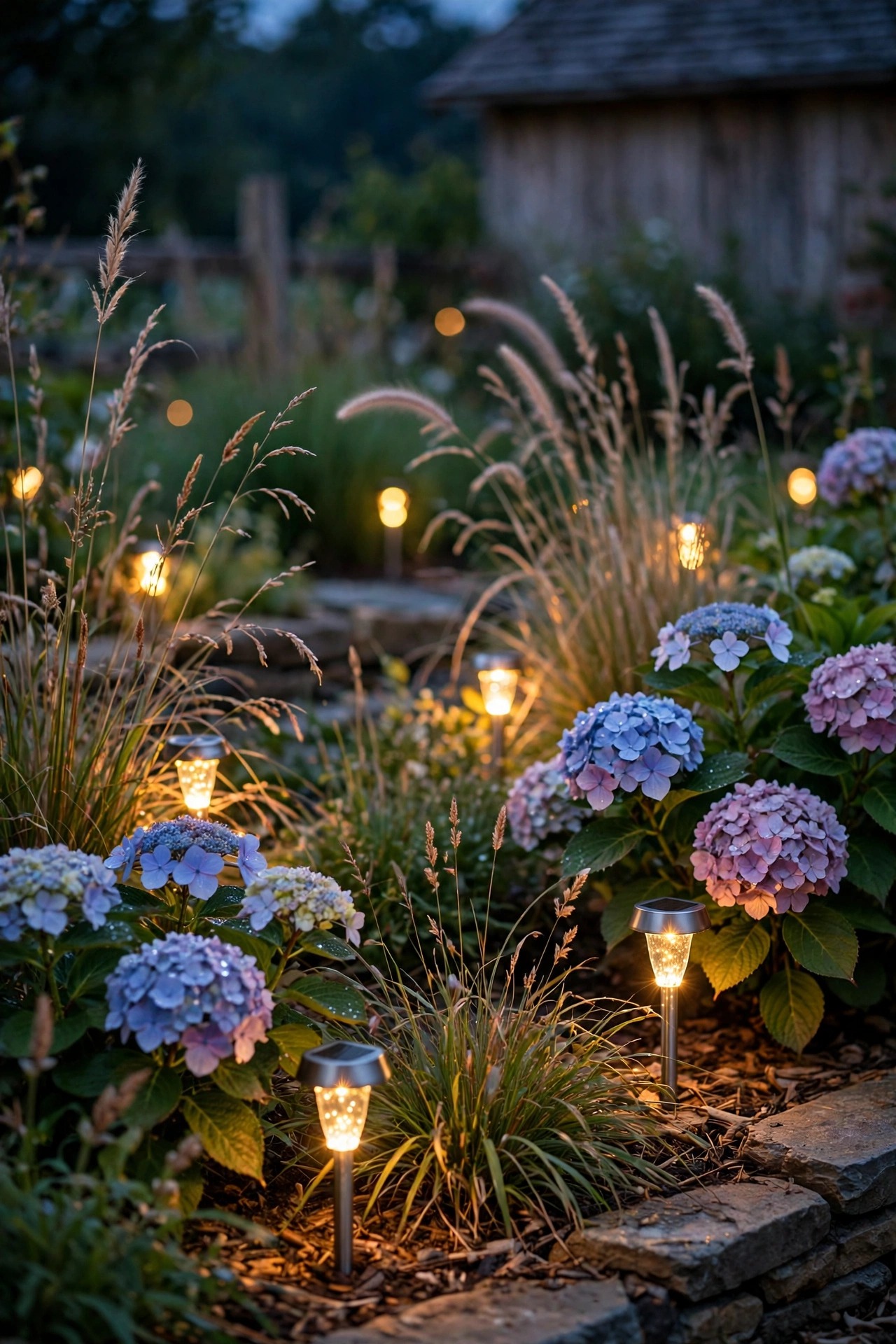
11. Solar Stake Lights Tucked Into Garden Beds
Solar stake lights have grown up. The better ones now come in matte black metal with real glass lenses and warm LEDs that genuinely last past midnight in the summer months. I use them in garden beds rather than along paths, dotted among hydrangeas, ornamental grasses, and herbs, where a low sparkle reads like fireflies on purpose. Push the stakes in so the light sits just above the foliage line, and group them in loose clusters of three instead of evenly spaced rows. Clean the little solar panels with a damp cloth every few weeks; a film of pollen is the main reason solar lights fade earlier than they should. Expect two to four seasons from budget stakes, and noticeably longer from metal ones with replaceable batteries. They will never light a task, but for pure garden magic per dollar, nothing else comes close. Stick to one style and finish across all your beds, because a jumble of mismatched stake designs reads as clutter instead of charm.
Suggested budget range: $30 – $120.
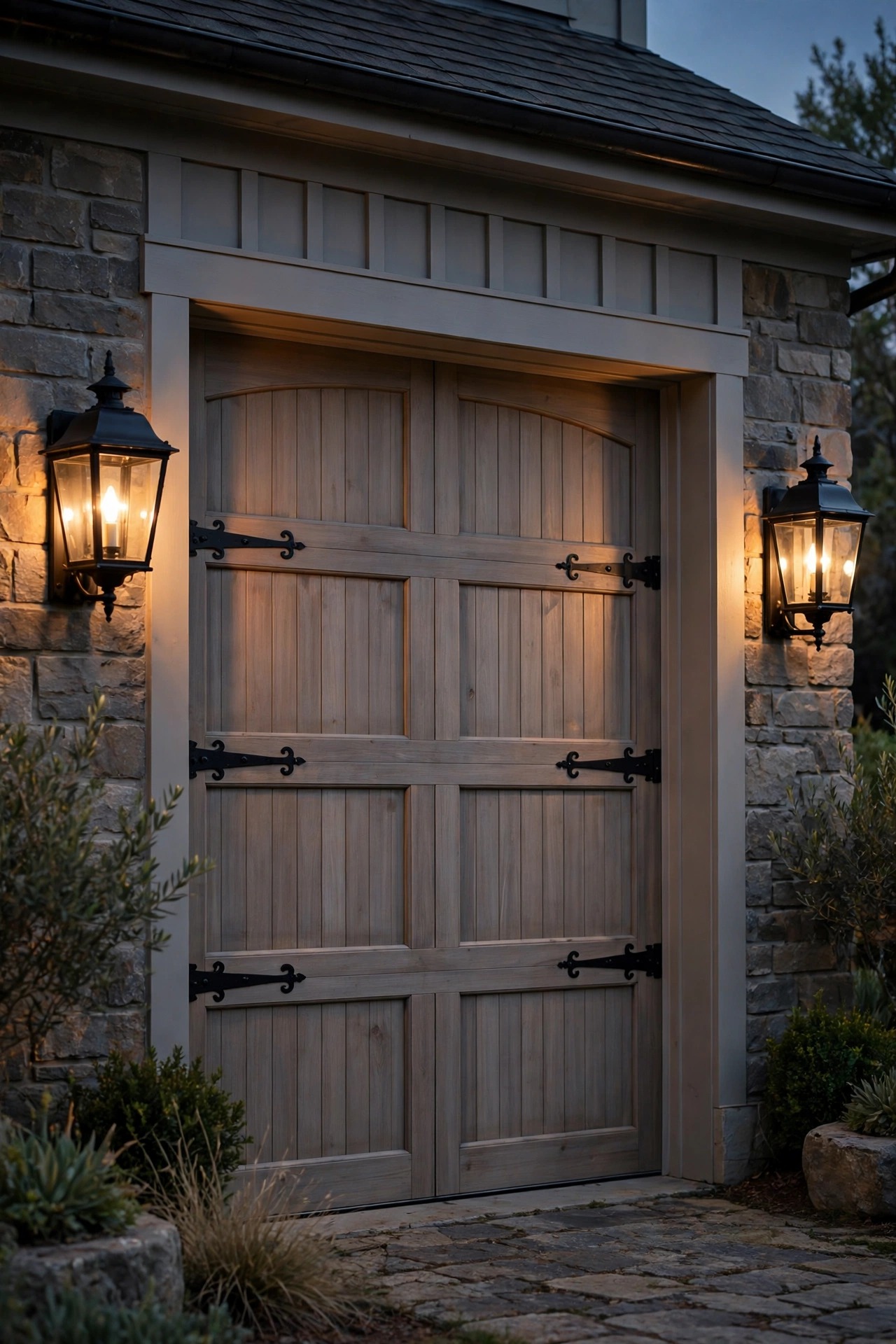
12. Carriage-Style Lanterns for the Garage
The garage is often the biggest blank wall on the house, and carriage-style lanterns fix it fast. Black lantern fixtures with X-brace or cross details echo barn doors beautifully, especially above or beside carriage-style garage doors dressed up with strap hinges and handles. Mount one lantern centered between double doors, or a pair flanking a wide single door, sitting about 5 to 6 feet up on the trim. Scale matters here too: garage lanterns should be noticeably larger than your front door sconces, because you view them from the street, not from three feet away. Put them on the same photocell or smart control as your other entry lights, so the whole front of the house wakes up together at dusk. It is a small coordination trick that makes the entire property feel planned rather than pieced together over the years. If your doors are white, paint the trim board behind each lantern to match, so the black fixture floats cleanly against it.
Suggested budget range: $90 – $300.
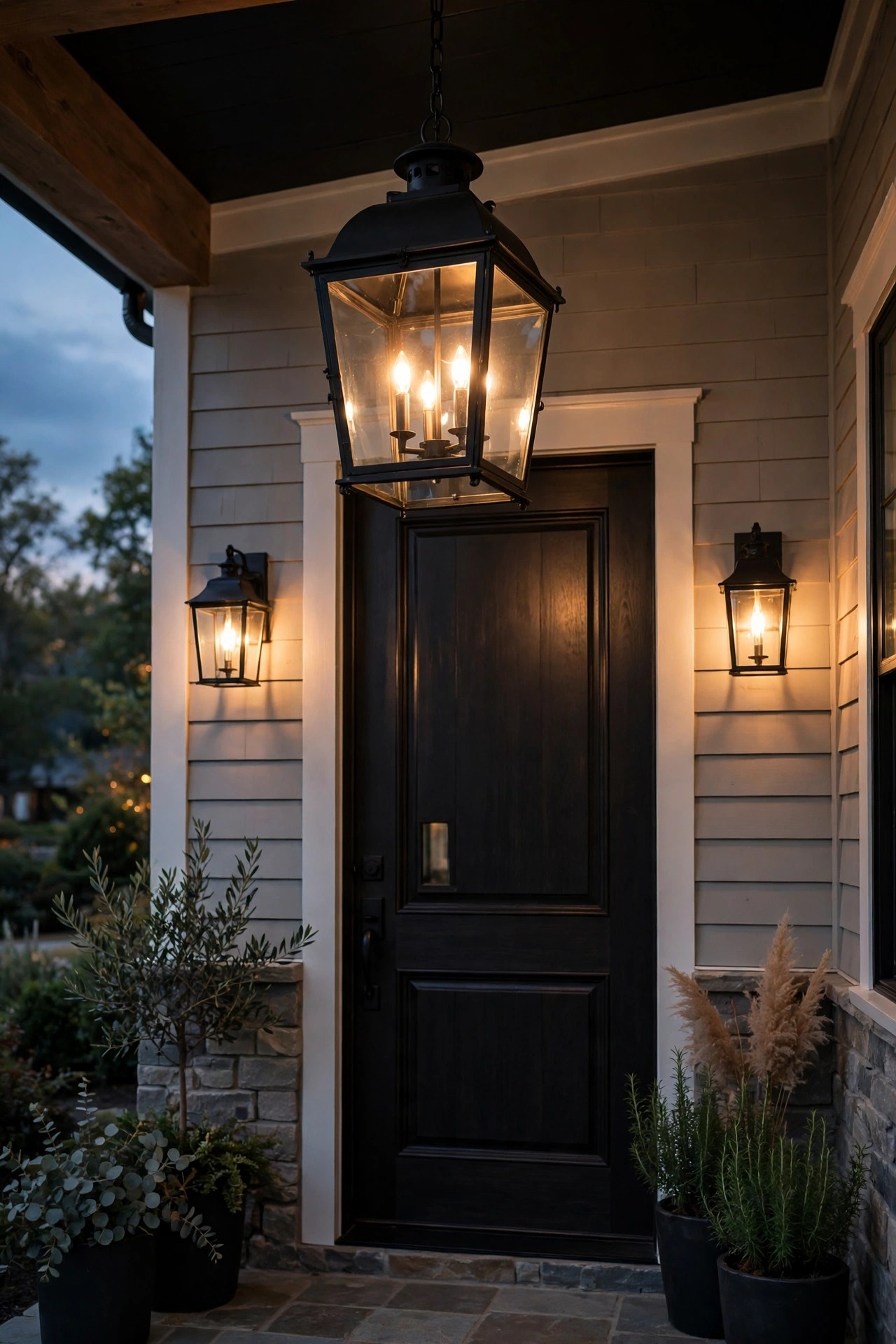
13. The Front Door Statement Every Set of Modern Farmhouse Outdoor Lighting Ideas Needs
Every great entry has one moment that does the heavy lifting, and for this style it is the front door arrangement. My favorite formula: an oversized black lantern pendant centered over the door, two matching sconces at the sides, and a warm bulb temperature that makes a wood door glow like honey. If your porch is too shallow for a hanging pendant, a flush-mount lantern in the same frame style keeps the family resemblance. Seeded glass is the farmhouse secret weapon here: it softens bulb glare and hides dust between cleanings. Layer in a softly lit wreath in winter, or a pair of lanterns on the steps in summer, and the entry always looks finished. This is the view your guests remember and the photo every visitor takes, so if the budget forces hard choices, spend here first and simplify somewhere else. While you are at it, center the whole arrangement on the door itself rather than the porch, so the composition looks right from the street.
Suggested budget range: $150 – $500.
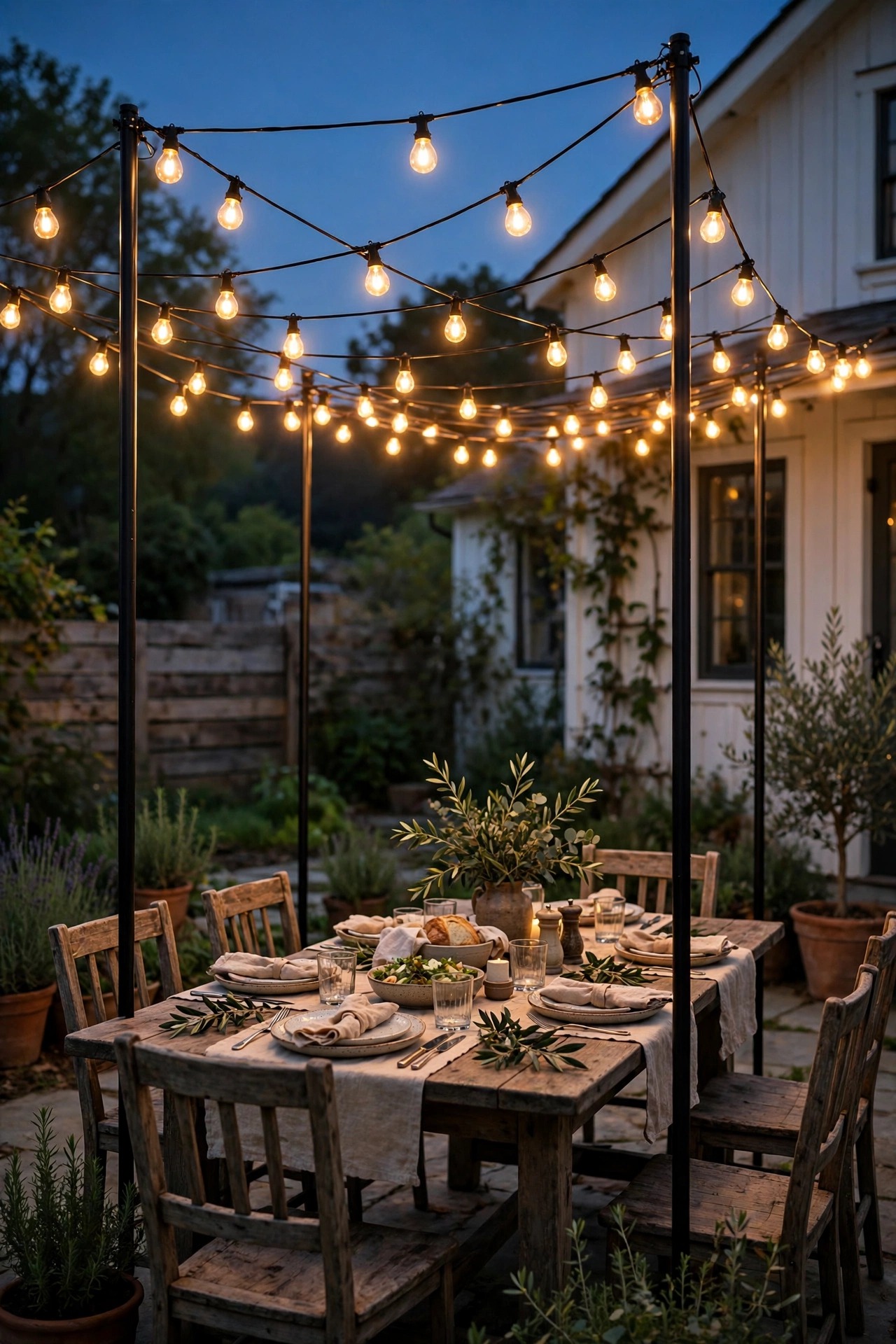
14. String Light Poles for a Backyard Dining Canopy
No tree, no problem. Black metal or wood-and-metal string light poles let you float a canopy of bulbs over a backyard dining table anywhere on the property. Set the poles in weighted planters filled with concrete or gravel, or sink them 18 to 24 inches into the ground at the corners of your patio. Poles 9 to 10 feet tall keep bulbs safely above heads, raised glasses, and patio umbrellas. Run two crossing strands for a gathered, tented feel, and anchor the center point a touch higher than the edges so rain sheds off instead of pooling in the swag. I always add a dimmer-rated smart plug to the setup: string lights at full blast can overpower a dinner conversation, but at about 60 percent they are pure magic. On breezy nights, a strand clipped to its guide wire every few feet stays calm and quiet. Matte black poles all but disappear after dark, which leaves nothing visible but the floating canopy of bulbs you actually want to see.
Suggested budget range: $100 – $350.
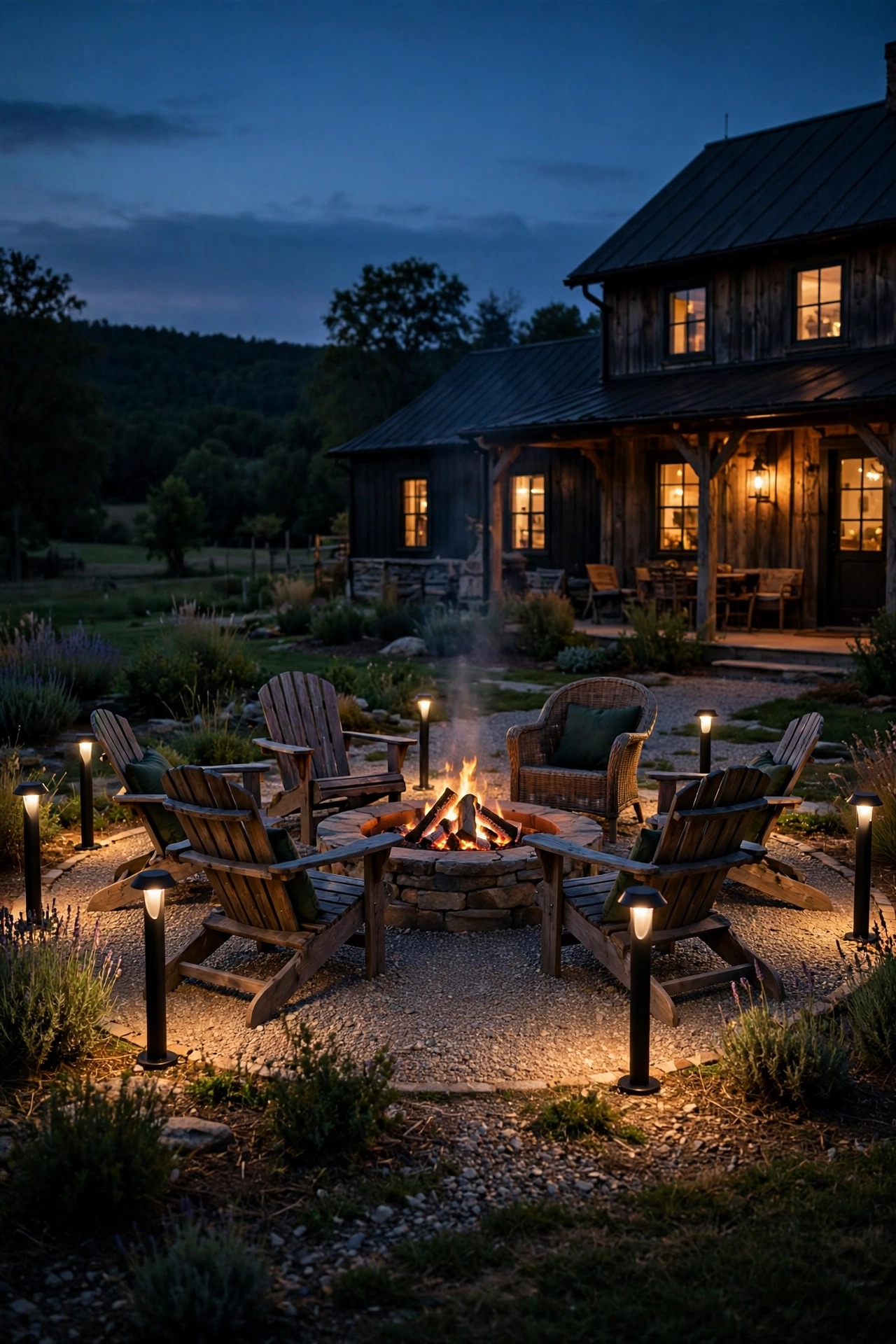
15. Low Bollard Lights Around the Fire Pit
Firelight is the original farmhouse light, and your fixtures should support it, not compete with it. Short black bollard lights, 12 to 18 inches tall, placed at the edges of the fire pit circle mark the seating zone and keep guests from tripping over logs, chair legs, and uneven ground in the dark. Aim for the lowest brightness that still defines the space; the flames should stay the star of the evening. Keep all fixtures and wiring at least 3 feet from the fire pit, and remember that LED is the only safe choice anywhere near sparks and heat. A couple of solar lanterns resting on the wood pile add charm without a single wire to run. Honestly, the best fire pit lighting is the kind you barely notice until the moment it saves someone a stumble. Set a flat stone under each bollard if your soil is soft, so the fixtures stay level and upright through the seasons.
Suggested budget range: $80 – $280.
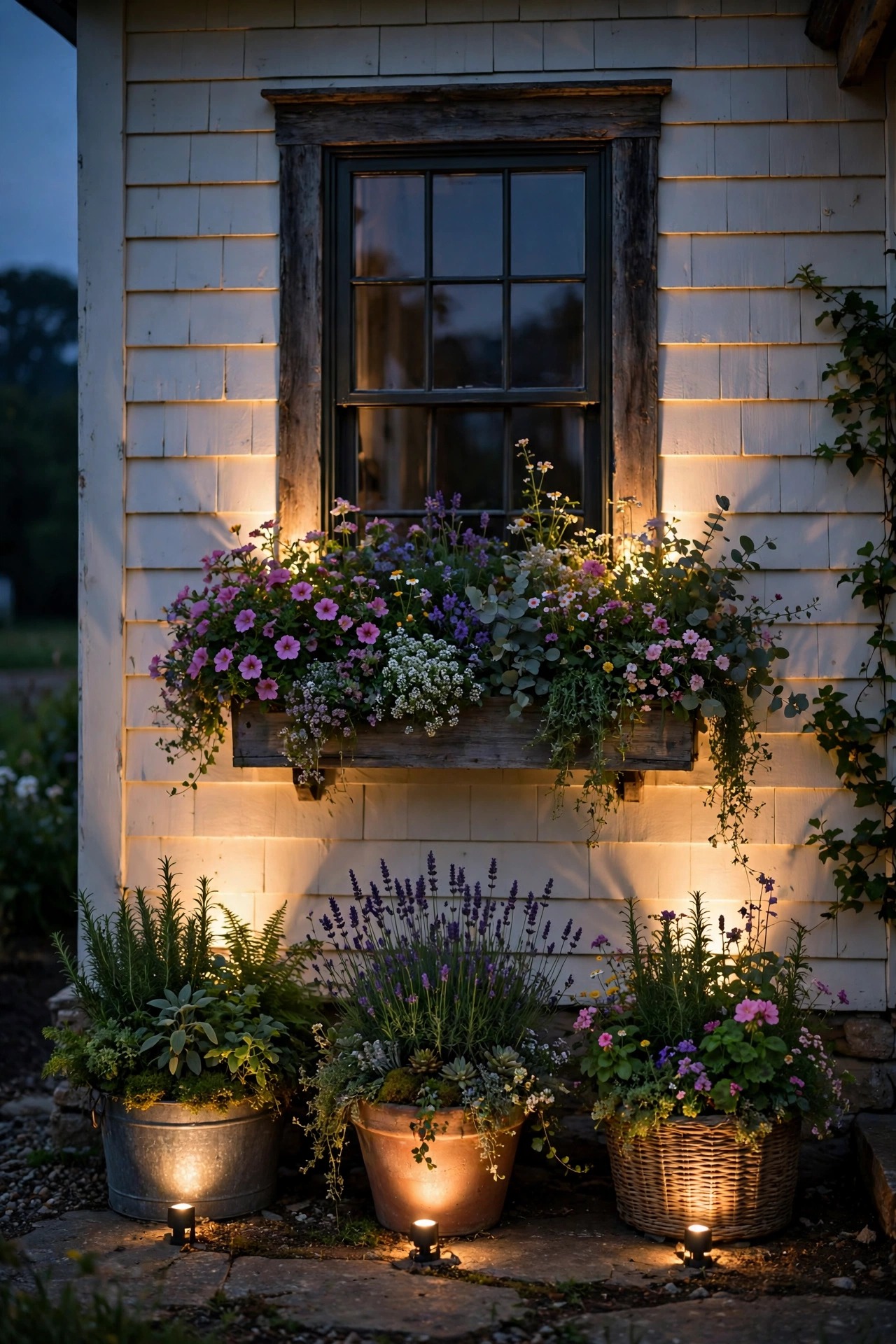
16. Spotlights for Planters and Window Boxes
Big farmhouse planters and window boxes deserve an evening encore. Tiny black spotlights staked at the base of a planter and aimed up into the foliage turn geraniums, grasses, and trailing vines into soft sculptures after dark. Battery and solar mini-spots with warm LEDs make this a ten-minute project with no wiring at all. In window boxes, a slim light bar mounted just under the box, or two small spots shining up from the ground, gives the same effect; just angle them so the light never shines straight through the glass and annoys the people inside. Rotate your aim as plants grow through the season, because a spotlight buried under July foliage lights nothing but leaves. It takes two minutes every few weeks and keeps the glow exactly where the beauty is. Cluster two or three planters together and light the group with a single shared spot for a softer, more natural pool of light.
Suggested budget range: $40 – $160.
17. A Motion-Sensor Barn Light for the Side Yard
The side yard and mudroom entrance need light that works as hard as you do. A black barn-style fixture with a built-in motion sensor and dusk-to-dawn photocell gives you hands-free light when you are hauling groceries, firewood, or a wiggly dog through the dark. Mount it 8 to 10 feet up, angled down at the path, and set the sensor range carefully so passing deer and raccoons do not trigger it all night long. Many newer fixtures offer a lovely trick: a low, warm glow that runs all evening and brightens when motion is detected, so the farmhouse look never switches off entirely. Choose a fixture rated for wet locations, and if it sits near a bedroom window, pick one with an adjustable shutoff timer. Practical can still be pretty, and this fixture proves it nightly. Walk the path a few evenings in a row before you finalize the angle, because small adjustments make a big difference in coverage.
Suggested budget range: $70 – $200.
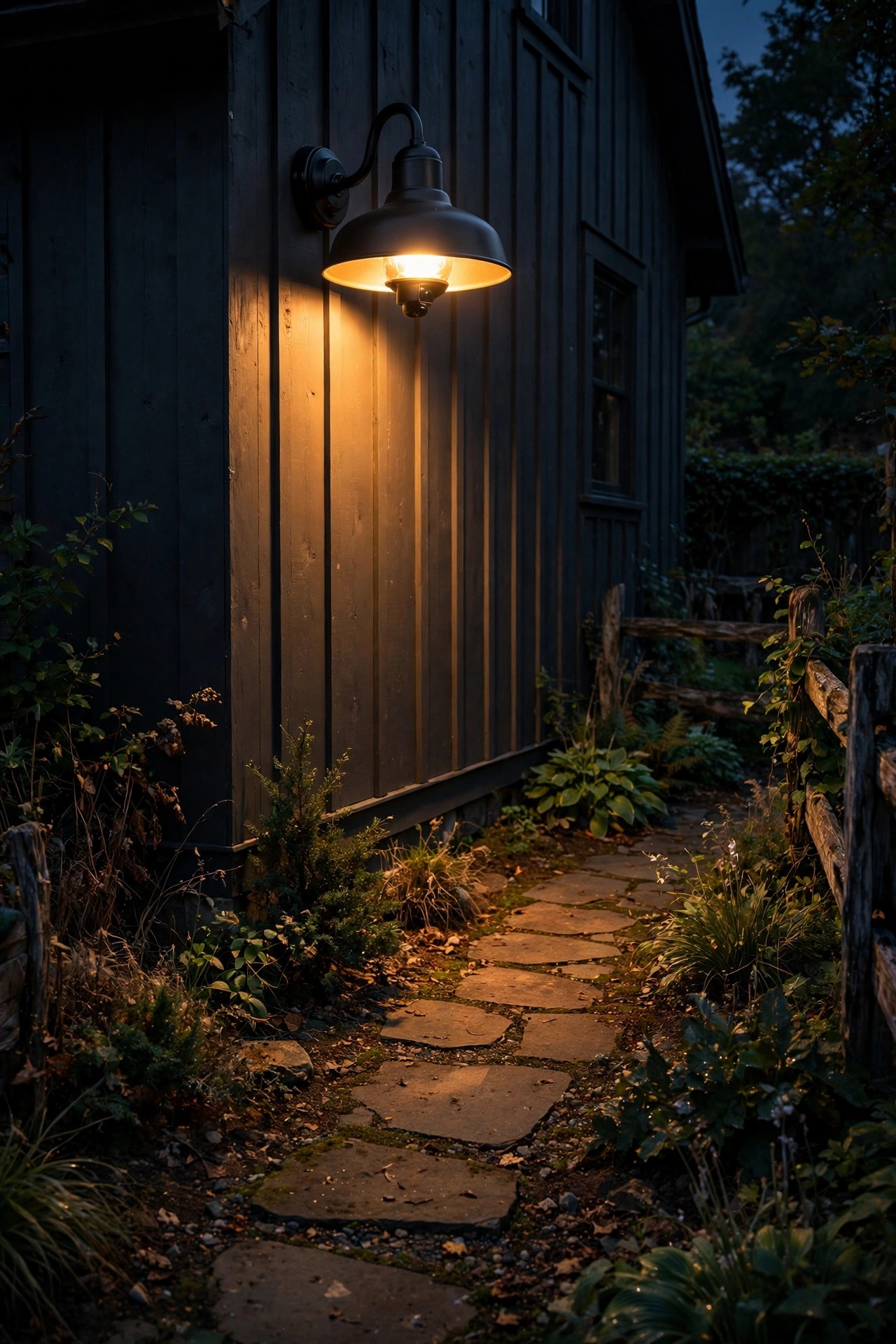
18. Copper Accents That Warm Up Black Fixtures
A touch of copper is the fastest way to keep black fixtures from feeling stark. Copper path light caps, a copper-trimmed lantern by the door, or even copper planters with uplights tucked inside add a living finish that deepens and patinas with the seasons, which suits a farmhouse perfectly. Use copper the way you would use a spice: two or three touches across the whole exterior, repeated so the choice looks deliberate. It pairs especially well with natural wood doors, cedar shakes, and warm-toned stone. Avoid lacquered copper that stays mirror-bright forever; that kind of shine belongs to a different house entirely. Let it weather naturally, and by next summer it will look like it has always been part of the farm. Guests may not name what changed, but they will feel the warmth. Copper also loves company from warm brass tones, so a brass kick plate or house numbers can quietly join the mix.
Suggested budget range: $60 – $240.
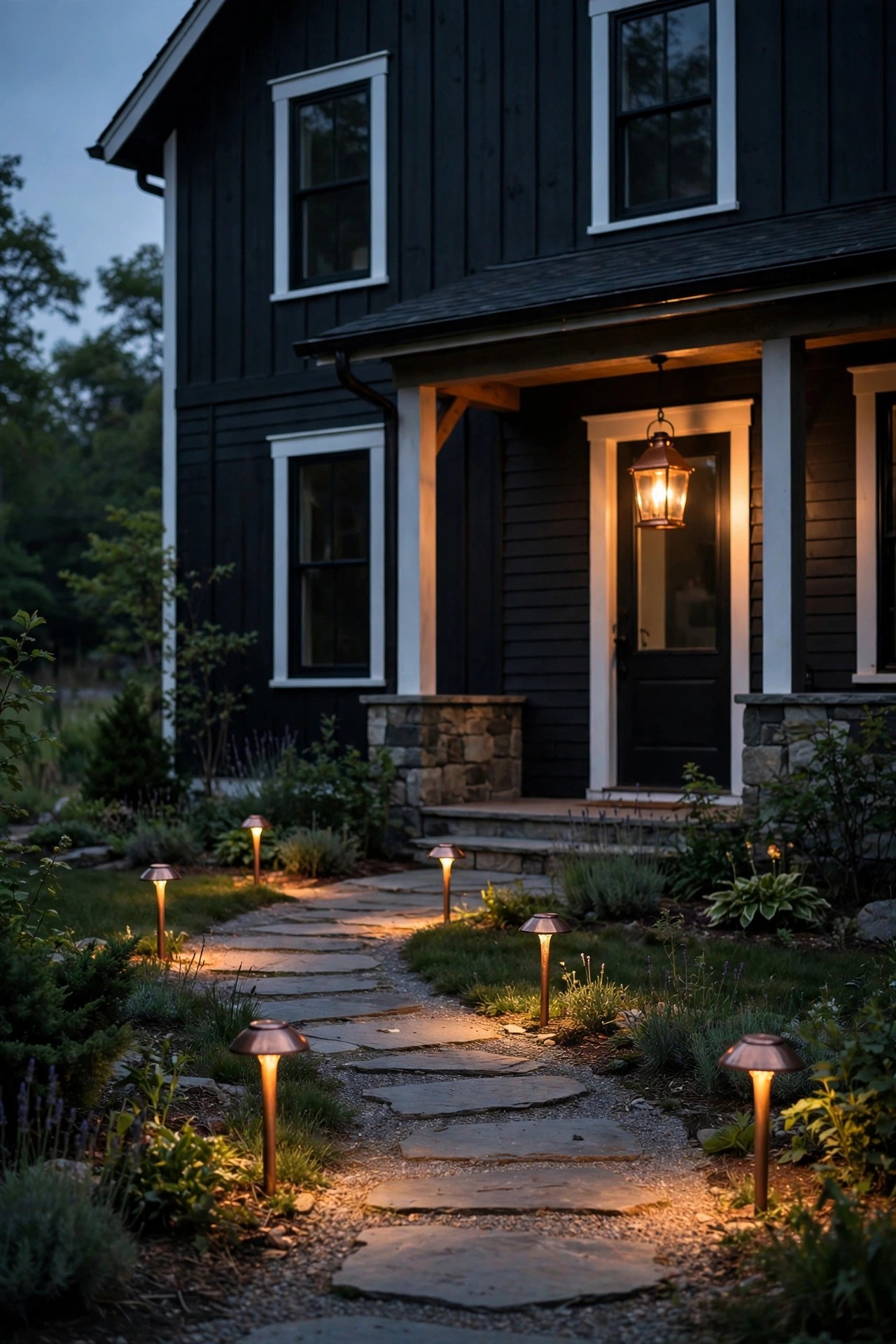
19. Step Lights for Wide Porch Stairs
Farmhouse porches often have wide, welcoming steps, and those steps need light as much as any part of the yard. Small recessed step lights tucked into the risers, or slim black fixtures mounted on the side stringers, wash each tread in a soft stripe of light that shows exactly where the edge falls. Place one light every two to three steps, or on every step for extra-wide staircases, and keep them shielded so the glow points down, never into eyes. Wired low-voltage versions tie neatly into your path light system and share its transformer. This is a safety feature that reads as pure style, and after one dark winter evening carrying a pot of soup to a neighbor, you will wonder how you ever lived without it. Your guests will quietly thank you, too. Aim the wash toward the tread edges rather than the middle, so feet read each step clearly even when someone is carrying in groceries.
Suggested budget range: $90 – $320.
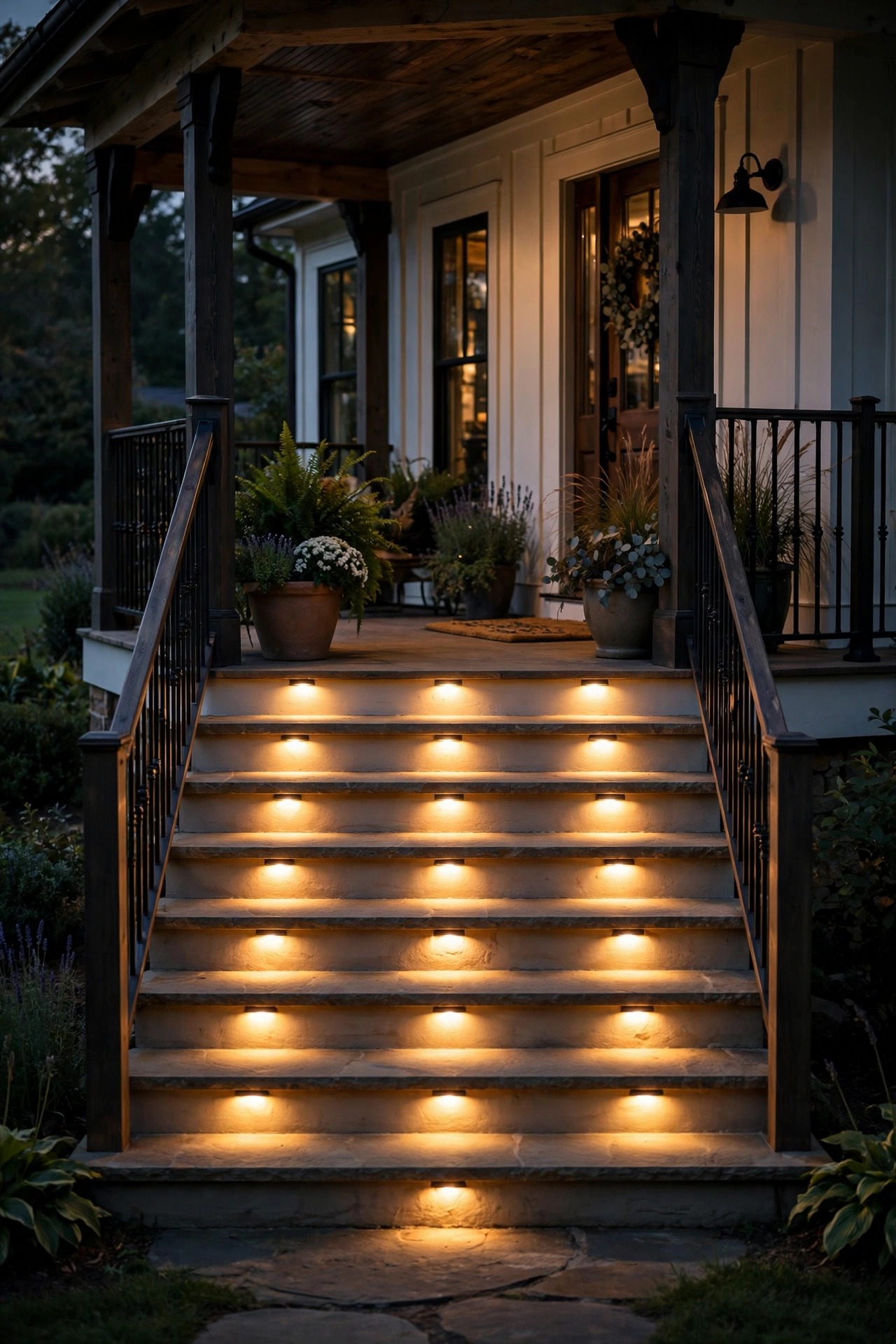
20. Dusk-to-Dawn Photocell Bulbs for Zero-Effort Glow
The cheapest upgrade on this entire list might be the smartest: swap the bulbs in your existing porch and garage fixtures for LED dusk-to-dawn bulbs with built-in photocells. They click on at sunset and off at sunrise with zero timers, zero apps, and zero remembering. Pick warm 2700K filament-style versions so the farmhouse glow stays intact, and make sure the fixture shade does not cover the little sensor window on the bulb itself. I use these in every secondary fixture, the ones I want dependable but do not need to dim or schedule. They are also perfect for a barn, shed, or chicken coop light that you want standing guard all night. At just a few dollars of electricity per bulb per year, it is farmhouse practicality at its finest. Buy a spare pack when you find your favorite bulb, because manufacturers love to discontinue the exact warm tone your house already wears.
Suggested budget range: $15 – $60.
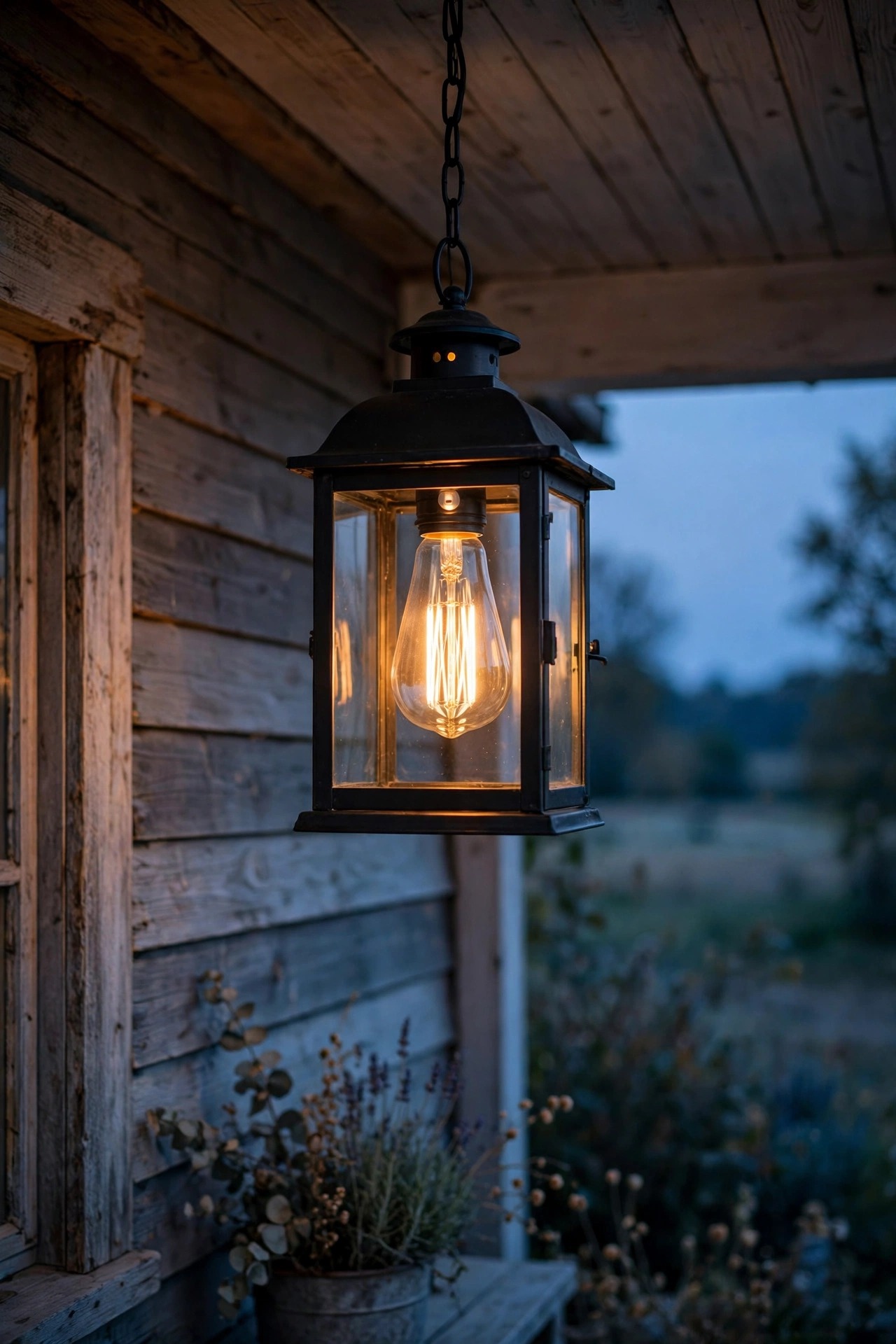
21. Pergola Lighting in Black Metal and Cedar
A cedar or rough-sawn wood pergola dressed with black metal lighting is modern farmhouse in its purest form. Wrap the beams with black-cable string lights, add two black lantern pendants over the table, and tuck slim LED strip lights along the top of one beam for a soft wash when you need more than ambience. Keep cords tidy with black clips that match the cable; white zip ties showing against dark beams will cheapen the whole structure. If the pergola stands alone out in the yard, solar string lights with their panel staked in full sun save you from trenching a cable across the lawn. Either way, dimmers are your friend here, because pergola nights run from kids doing homework to anniversary dinners. One sturdy structure, three kinds of light, and you have an outdoor room that works from April through October. Hang a dark-finish ceiling fan under the pergola roof if your climate runs hot, and still August nights become some of the best ones.
Suggested budget range: $120 – $450.
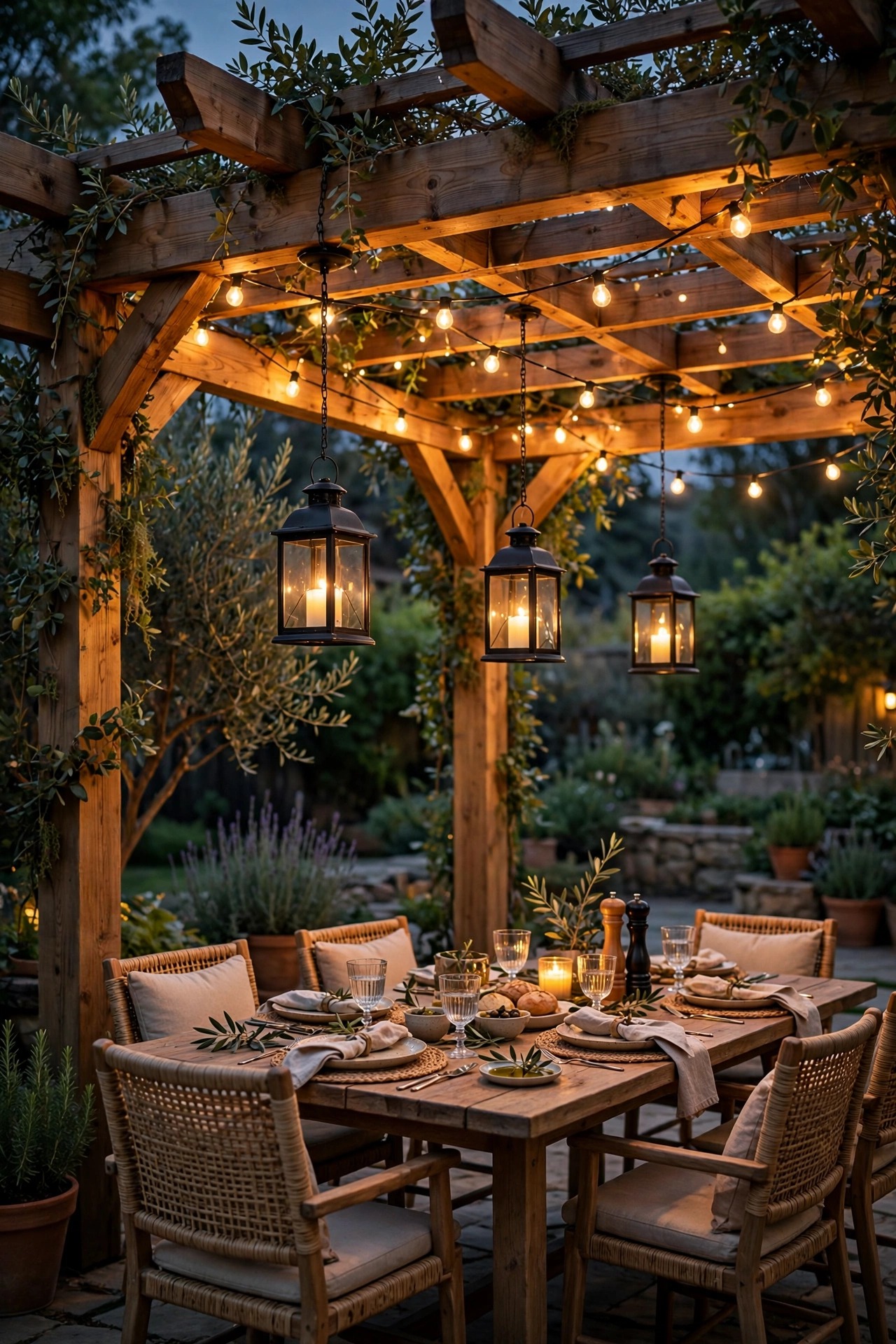
22. Illuminated House Numbers That Match the Palette
House numbers are tiny, but at night they do serious work for guests, deliveries, and emergency vehicles. Backlit numbers in a clean matte black finish, or a simple black plaque washed by a small picture-style light, fit the modern farmhouse palette beautifully. Mount the numbers where the porch light, or a dedicated little fixture, washes them evenly, and choose digits at least 4 to 6 inches tall so they read clearly from the street. Solar number plaques have improved a lot in recent years and install with two screws and no wiring at all. Whichever route you take, check the result with a slow drive-by at night before you call it done. If you cannot read your own numbers from 25 feet away, neither can the pizza driver or the ambulance. Angle the light slightly downward so the numbers read clearly without throwing glare into the eyes of anyone standing at the door.
Suggested budget range: $35 – $150.
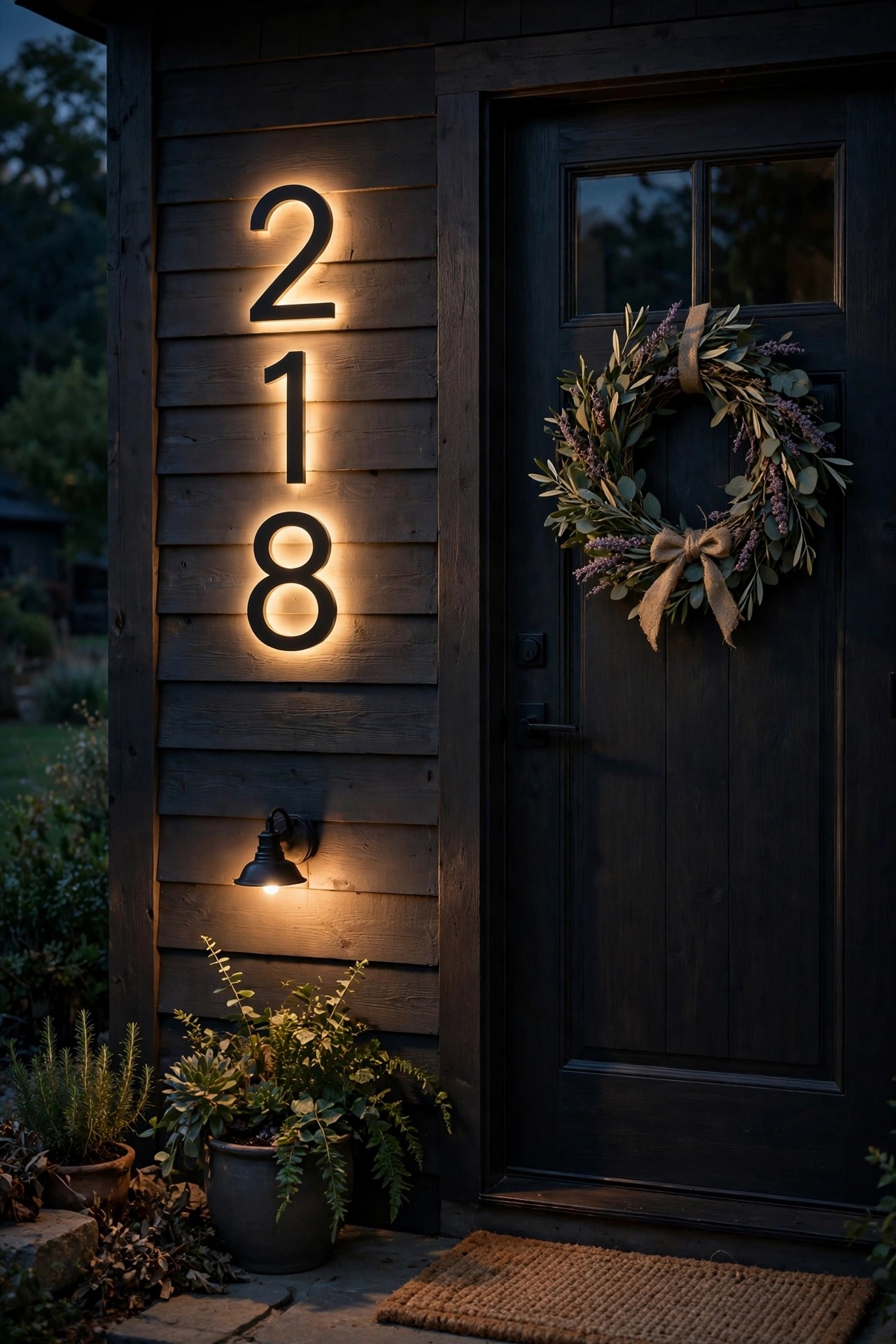
23. Mason Jar Lanterns on Shepherd's Hooks
For pure farmhouse charm, nothing beats mason jar lanterns. Fill jars with solar fairy light strings or flameless tea lights, hang them from black shepherd's hooks along a garden path or around the patio, and you have instant country magic for almost no money. Cluster the hooks at different heights, roughly 30 to 48 inches, for a gathered look rather than a marching line. Solar lids made to fit mason jars turn each one into a self-charging lantern; just set the jars in sunshine during the day if your display spot is shady. Because there is no real flame involved, these are safe around kids, pets, and dry mulch alike. On a summer night with the crickets going and the jars twinkling, this might honestly be my favorite light in the whole yard. Swap the fairy lights for tiny amber bulbs in autumn, and the very same jars carry your display straight through the fall season.
Suggested budget range: $25 – $90.
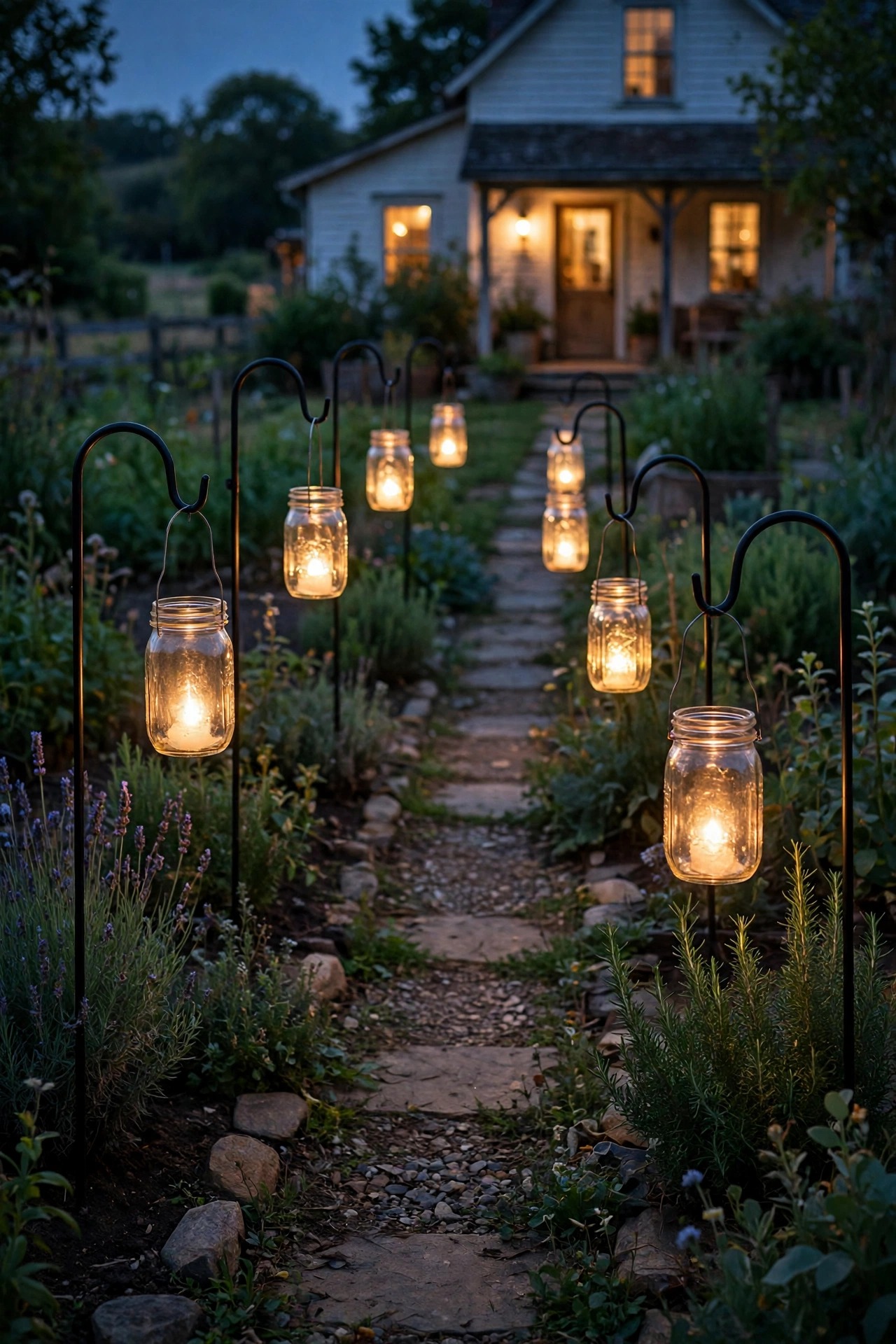
24. One Warm Temperature and Smart Dimmers Everywhere
Here is the quiet rule that holds the whole style together: every bulb on the property lives between 2700K and 3000K, and anything guests see gets a dimmer. Mixed temperatures are why some houses look patchy in photographs; one blue-white porch bulb can undo ten good decisions in a single glance. Smart dimmers and plugs also let you build scenes: full welcome for arrivals, low glow for late nights, path-only for ordinary weekdays. When you replace bulbs, buy the same color temperature and a similar brightness so fixtures match across the yard. I keep a small labeled box of spares in the mudroom, sorted by fixture. It sounds fussy until the first time a bulb dies an hour before company pulls in, and then it sounds like genius. Label each smart plug with the zone it controls, and future you will never play guessing games at the panel in December.
Suggested budget range: $50 – $250.
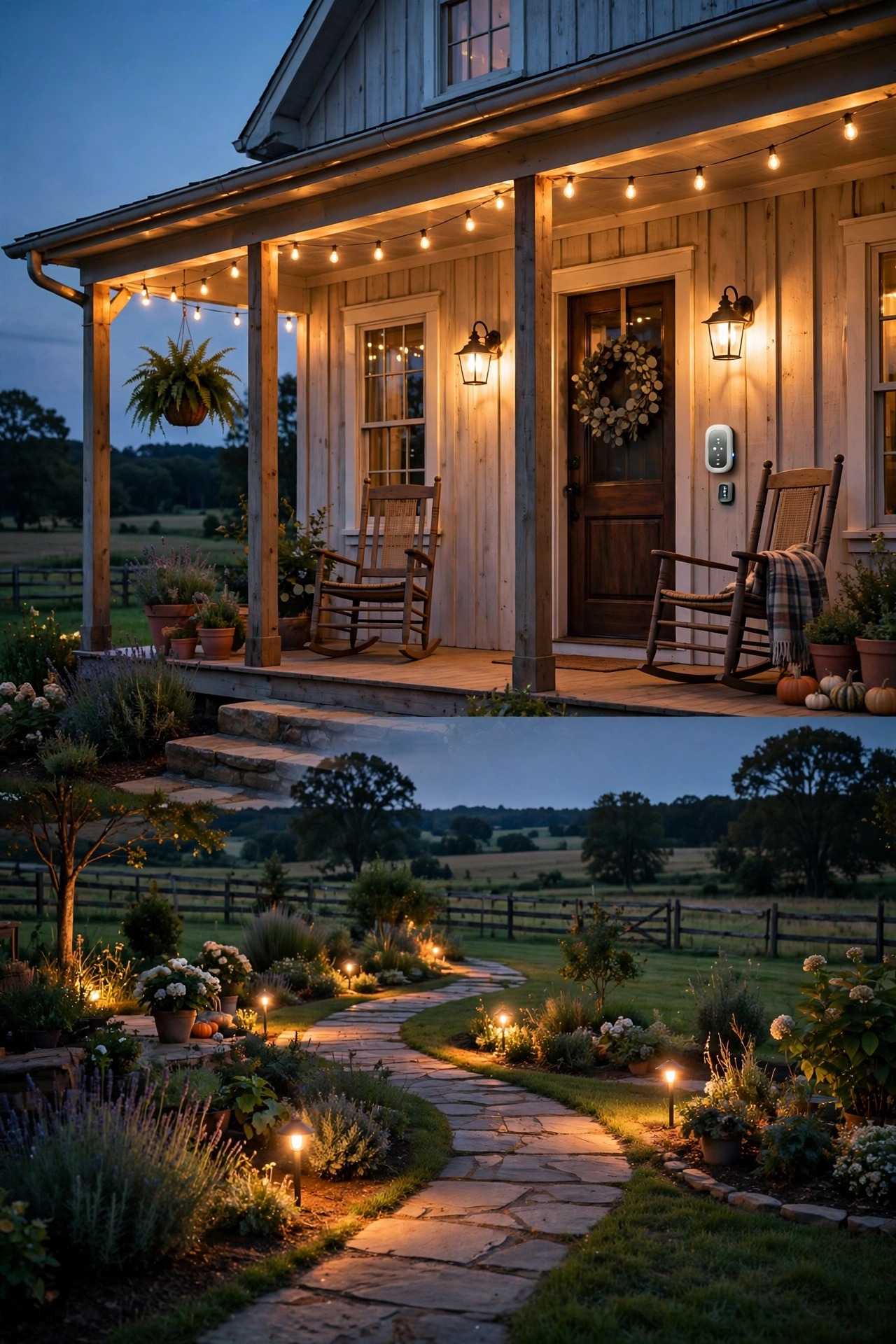
25. Timers Pull Your Modern Farmhouse Outdoor Lighting Ideas Together
After twenty-four ideas, the finale is the system that runs them all while you think about dinner instead. Put path and landscape lights on a transformer with a photocell and timer, strings and porch fixtures on smart plugs, and set everything to follow the sunset rather than a fixed clock time. A good rhythm in my house: accent and path lights on at dusk, string lights joining when we head outside, and everything but the entry lantern dimming down around eleven. Do one slow walk at night each season, phone flashlight off, and fix the hot spots, dead bulbs, and fixtures the shrubs have quietly swallowed. That little ritual keeps the whole design honest year after year. The best modern farmhouse glow looks completely effortless, and with a simple system humming behind it, it truly is. Start with just the entry and path on timers if the full system feels like a lot; you can always add another zone next season.
Suggested budget range: $75 – $300.
Frequently Asked Questions
What color temperature is best for modern farmhouse outdoor lighting?
Warm white, every time. I keep all outdoor bulbs between 2700K and 3000K, which mimics the glow of a filament bulb or a lantern flame and flatters wood, stone, and skin tones. Cooler 4000K and 5000K bulbs read as office or hospital light and will instantly break the farmhouse mood, no matter how pretty the fixture is. If a fixture will sit near a fire pit or string lights, lean toward 2700K so everything blends into one warm pool of light.
Can I mix black fixtures with galvanized and copper finishes?
Yes, and honestly, you should. A yard done entirely in matte black can feel more modern than farmhouse. My rule of thumb is about 70 percent black fixtures with 30 percent accents in galvanized metal, weathered copper, or natural wood tones. Repeat each accent finish at least twice, in different zones of the yard, so it reads as a design decision instead of a mismatch. Keep everything matte and slightly weathered, and skip shiny chrome or polished nickel, which fight the palette.
Are solar lights bright enough for a driveway or walkway?
For accents, absolutely; for real task lighting, usually not yet. Quality solar path lights give a gentle marker glow that is fine for edges and garden beds, but they dim on cloudy weeks and midwinter nights, exactly when you need light most. For a driveway, main walkway, or steps, I recommend low-voltage wired lights on a transformer for consistent brightness all night. Use solar where wiring is impractical, and choose models with replaceable batteries and glass lenses to stretch their lifespan.
How much does a modern farmhouse outdoor lighting refresh cost?
It depends entirely on how many layers you tackle. Swapping in photocell bulbs, solar stakes, and mason jar lanterns can refresh a porch and garden for $150 to $400 in a single weekend. A mid-range plan with new entry sconces, a gooseneck or two, and a low-voltage path system usually lands between $800 and $2,000 in fixtures. A full layered design with pergola lighting, uplighting, and smart controls can run $3,000 to $6,000, still far less if you install the low-voltage pieces yourself.
Conclusion
Modern farmhouse style works because it refuses to choose between polish and comfort, and your lighting should not choose either. Start with the layers, repeat your black and warm-metal finishes, keep every bulb warm, and let a few character pieces like gooseneck lights and mason jar lanterns carry the story. If you build your modern farmhouse outdoor lighting ideas on those simple rules, the house will look intentional from the road and feel like a deep breath the moment you pull into the drive. Browse the rest of my outdoor lighting guides here for more ways to layer, save, and glow, and I will see you out on the porch.