There is something about the first night of Hanukkah, standing on the porch with the candles lit inside, that makes me want the whole yard to glow along with the menorah. Over the years I have collected hanukkah outdoor lighting ideas that feel festive without turning the house into a carnival — deep blues, warm golds, and soft white sparkle layered the same way I layer any good lighting scheme. That is always my philosophy: one layer for sparkle up high, one at eye level for warmth, and one low layer to guide feet safely along paths and steps. Blue and gold is honestly one of the prettiest palettes to work with, because the cool blue makes the warm gold look richer by contrast. Whether you go big with a lighted menorah on the lawn or keep it simple with lanterns on the steps, these nineteen ideas will help your home shine for all eight nights — and most of them go up in an afternoon with a ladder, some clips, and a hot cup of cocoa.
1. Start With a Blue and Gold Plan for Your Hanukkah Outdoor Lighting Ideas
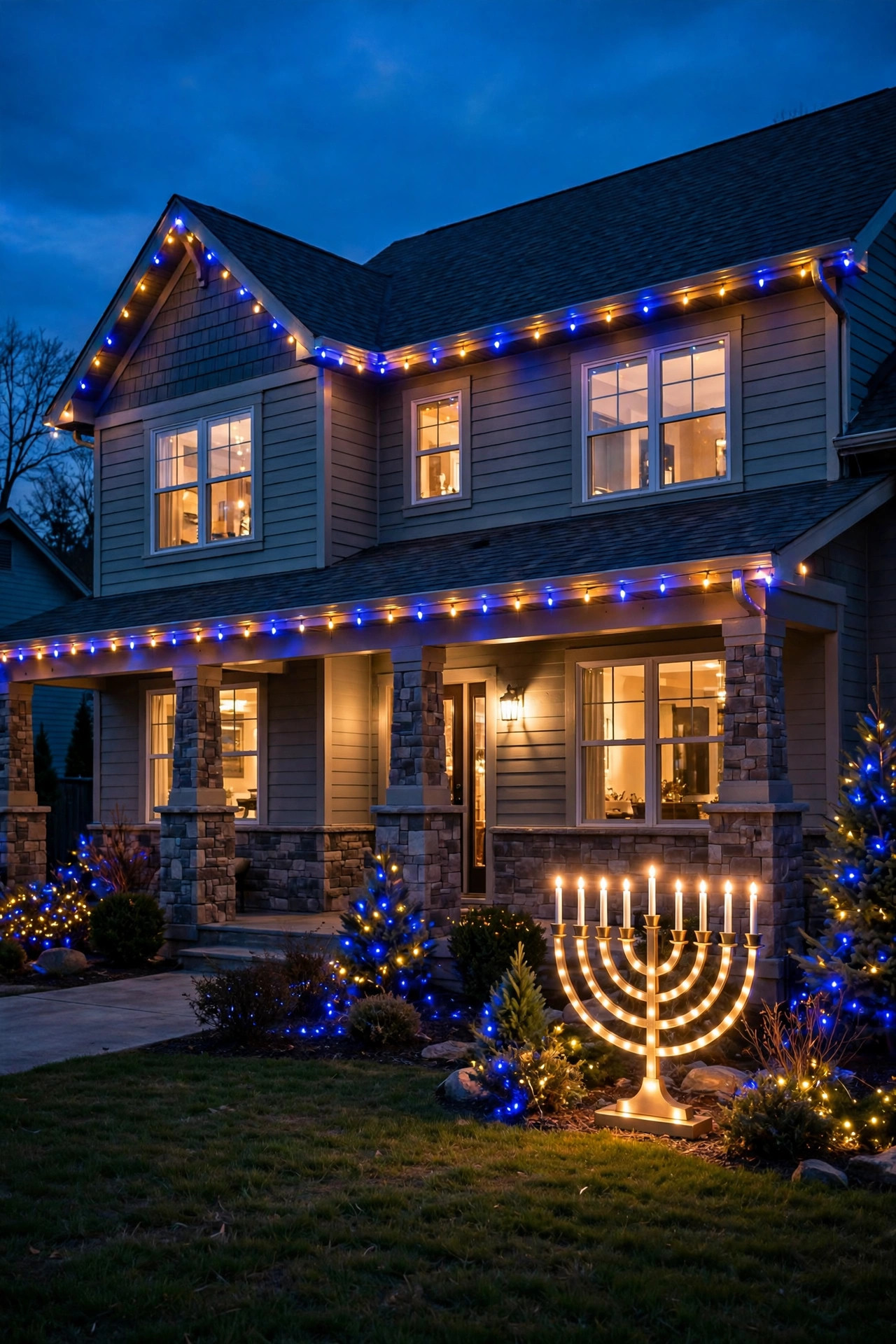
Before I hang a single bulb, I sketch the yard on paper and assign every zone a color: blue for the roofline and trees, gold for the porch and entry, soft white anywhere I need a neutral sparkle. This sounds fussy, but it is the difference between a display that looks designed and one that looks like a clearance bin exploded. Decide which two or three features are your stars — the menorah display, the roofline, the big front tree — and let everything else support them. I also count my outlets and extension cords at this stage, because December me is always grateful that November me measured the run from the porch outlet to the oak tree (38 feet, for the record). Check that every strand and fixture is rated for outdoor use, and plan for GFCI-protected outlets only. If you are mixing older strands with new LED ones, test them all in the garage first. A plan keeps the palette disciplined — roughly two-thirds blue and white, one-third gold accents — and it keeps you from buying doubles. Trust me, a ten-minute sketch saves a second trip to the store in the snow.
Suggested budget range: $10 – $40.
2. Drape Blue and White String Lights Along the Roofline
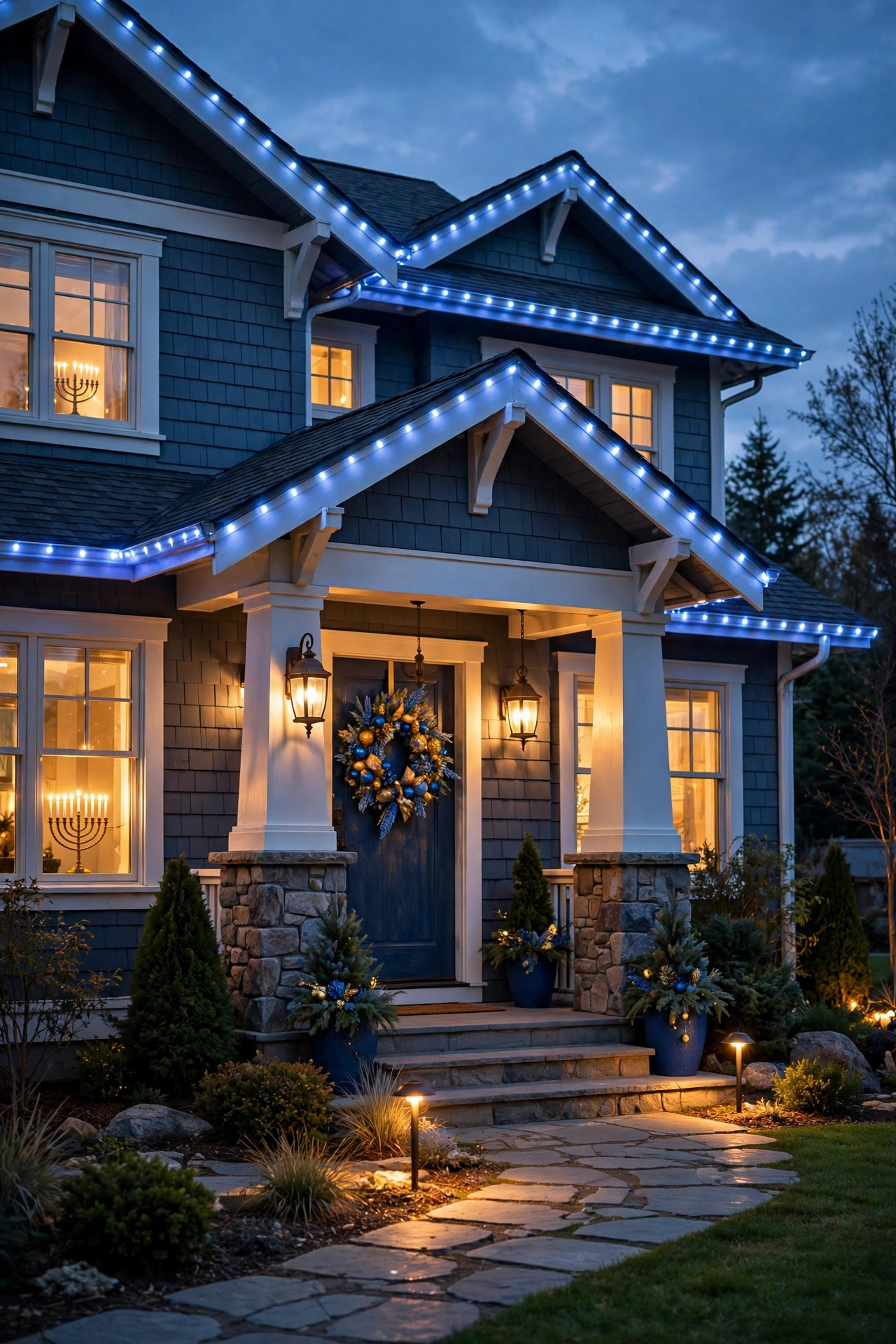
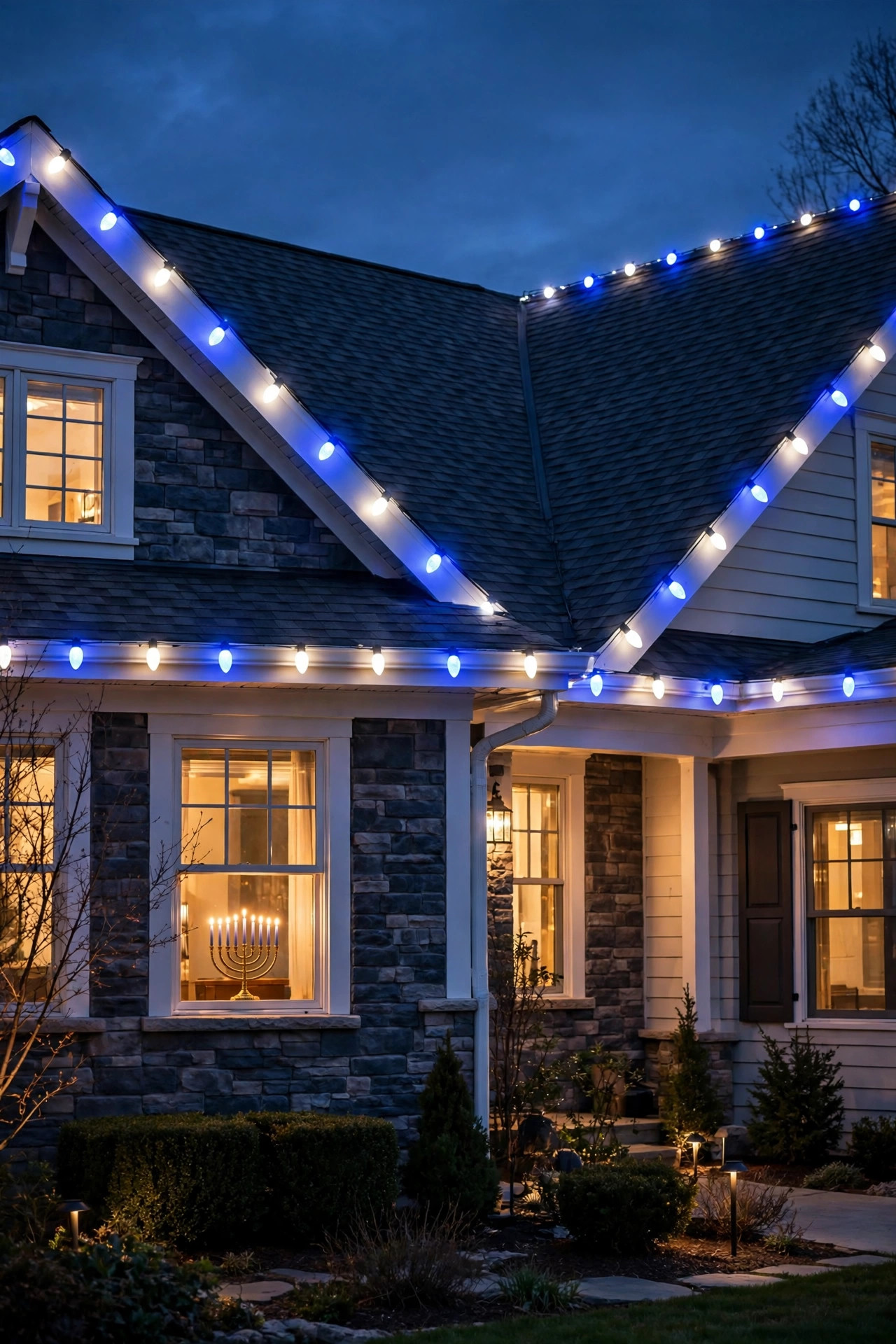
The roofline is the backbone of the whole display, and alternating blue and soft white bulbs along the eaves gives you that classic Hanukkah look from the street. I use C9-style LED string lights on the main roofline because the larger bulbs read well from a distance, spacing them evenly with gutter or shingle clips every 12 inches or so — never nails or staples through the cord, which can damage the insulation and create a real hazard. Work from the outlet outward, and keep the plug end near a covered, GFCI-protected outlet with a weatherproof in-use cover. If your strand pattern alternates colors, count the pattern before you climb so the sequence stays consistent around corners. For a two-story home, a telescoping pole with a clip attachment keeps your feet on the ground for most of it, which I strongly prefer. LED C9s stay cool, sip electricity across all eight nights, and the blue reads a true, deep blue rather than the washed-out teal of cheap incandescents. The effect against a dusting of snow is honestly magical.
Suggested budget range: $35 – $90.
3. Make a Lighted Menorah the Star of the Front Yard
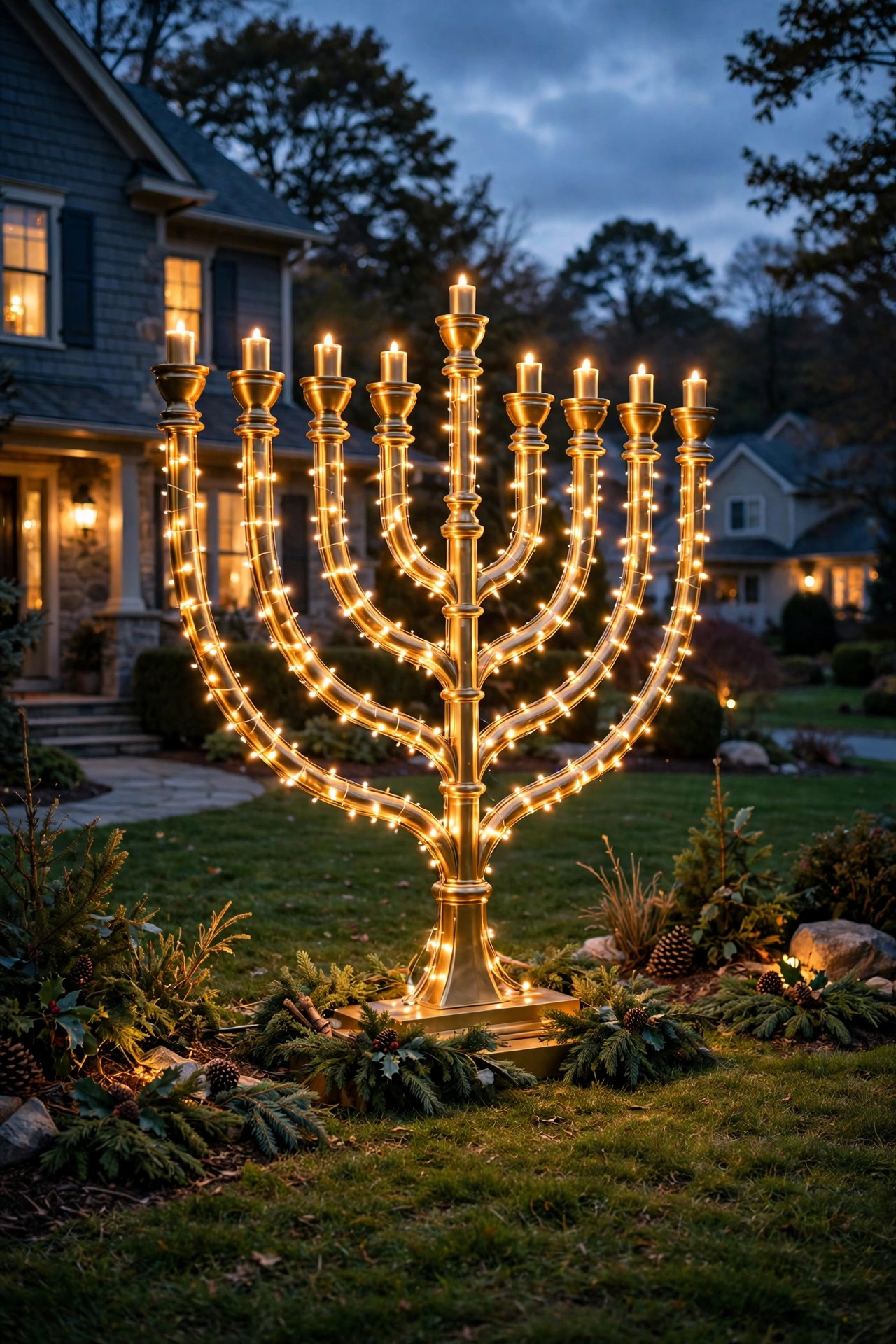
Every Hanukkah display deserves a focal point, and a lighted outdoor menorah is the one that stops neighbors on their evening walks. You can buy ready-made outdoor menorah frames wrapped in blue and white lights, or build a simple version from PVC pipe or a wooden frame and outline it with rope light. Mine stands about 4 feet tall on the front lawn, anchored with ground stakes so December wind cannot tip it, and I outline the branches in warm white with the shamash — the helper candle — in gold at the center. Here is my favorite detail: light one additional branch each night, just like the real candles inside. It turns the display into a countdown the whole street can follow, and kids adore checking it. Run the cord low along the ground and cover any walkway crossing with a cord protector so nobody trips. Keep the frame at least a few feet from shrubs so the shape reads clearly, and use a timer so it glows from sundown to about 11 p.m. It is the single most meaningful piece in the yard.
Suggested budget range: $60 – $180.
4. Weave Gold Fairy Lights Through Bare Shrubs
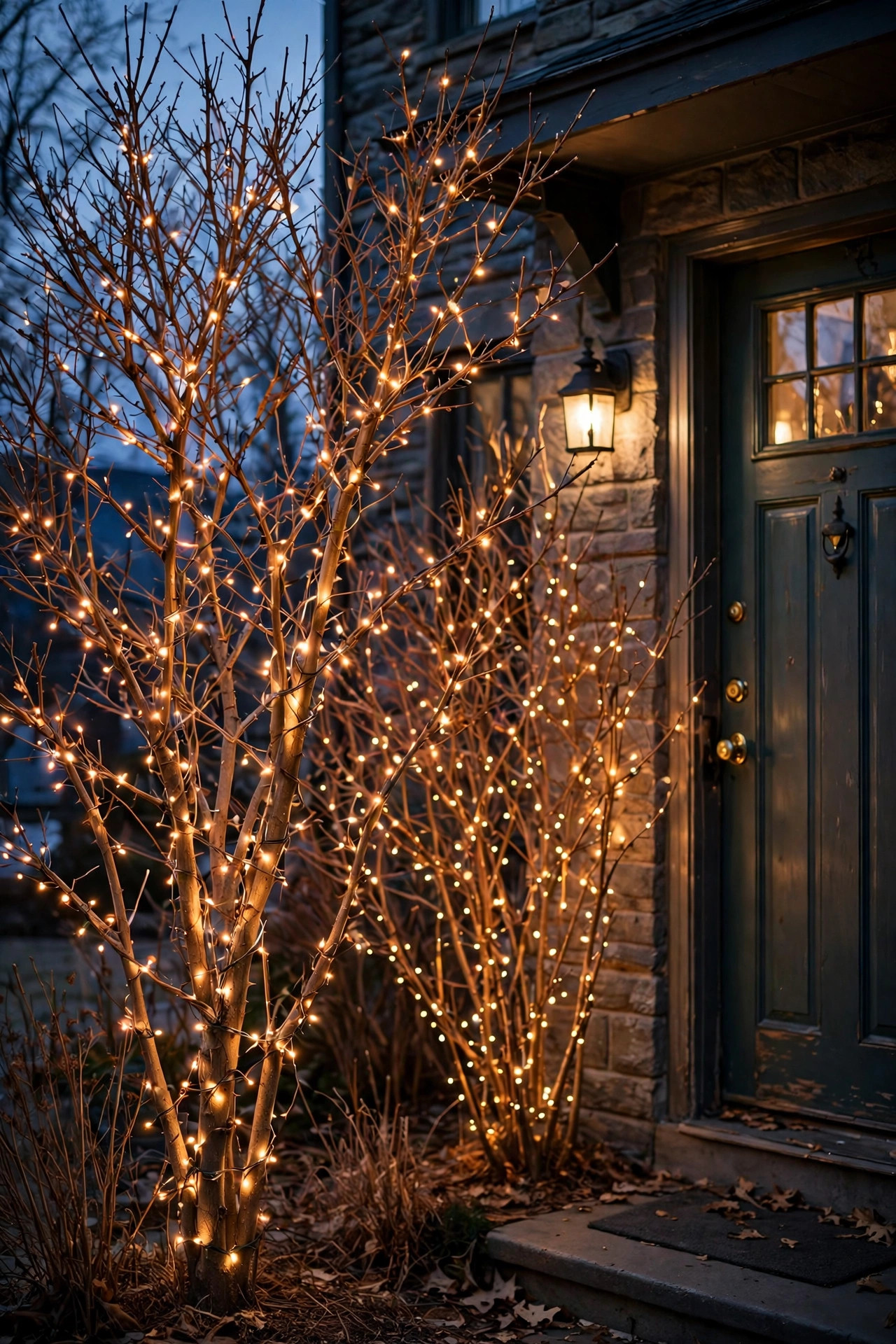
Winter shrubs may look bare and twiggy in December, but that is exactly what makes them perfect armatures for copper-wire fairy lights. The thin wire disappears against the branches, so all you see is a cloud of tiny warm gold points floating in the dark — it is the prettiest budget trick I know. A 33-foot strand handles one medium shrub; I start at the trunk and spiral outward, tucking the wire along branches rather than wrapping tight circles, which looks more natural and is gentler on the plant. Solar-powered fairy lights work here if the panel gets a few hours of daylight, but for reliable brightness through eight nights I prefer plug-in or battery packs tucked into a weatherproof battery box at the base. Cluster the treatment on two or three shrubs near the entry rather than scattering single strands everywhere — repetition near the door looks intentional. The gold warmth plays beautifully against blue roofline lights, and because fairy lights are LED and cool to the touch, there is no worry about dry winter foliage. Take them down before spring growth starts so the wire never girdles new branches.
Suggested budget range: $15 – $45.
5. Line the Walkway With Deep Blue Path Lights
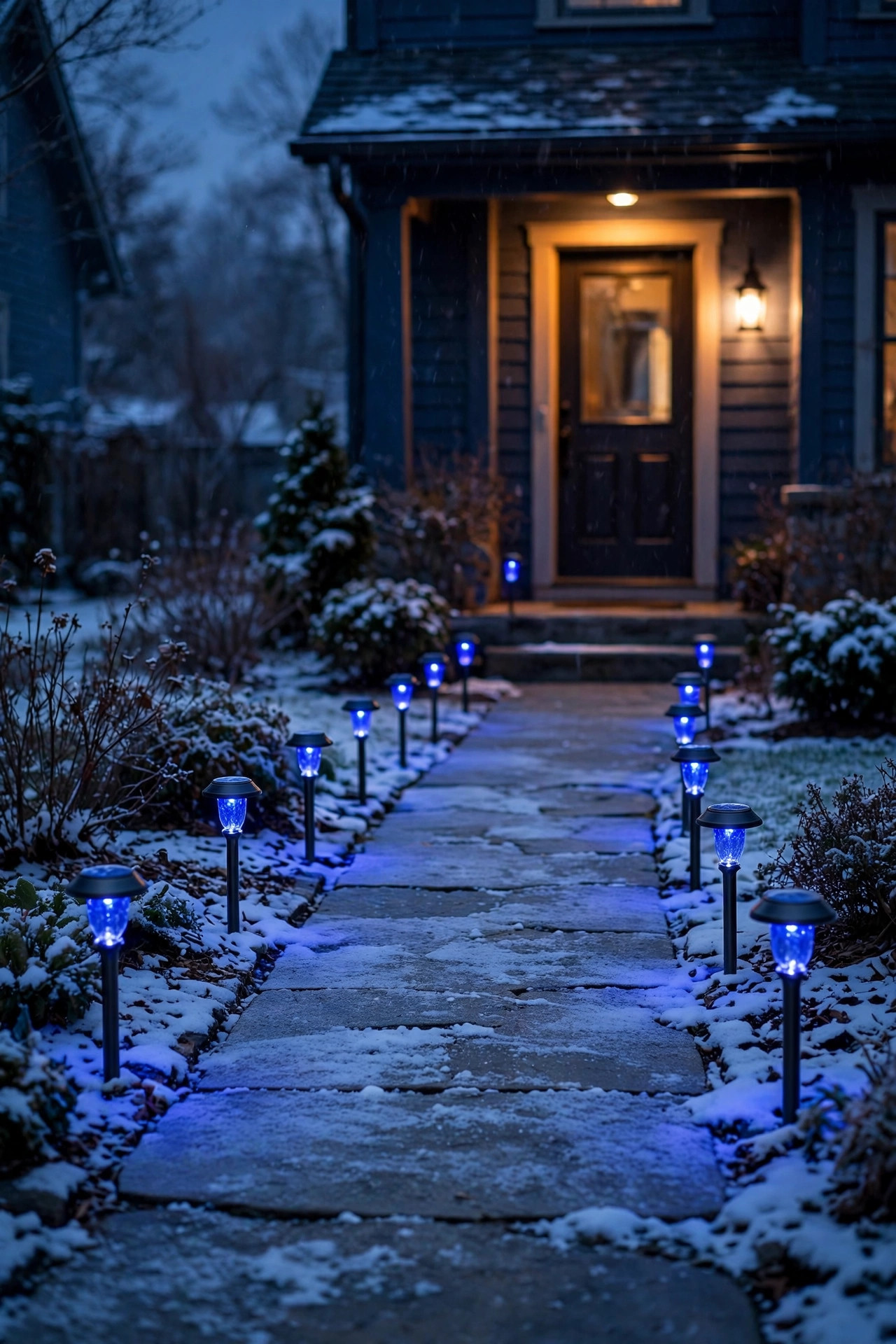
Guests arriving for latkes after dark need a safe, visible path, and a row of deep blue path lights makes the walk to your door feel like part of the celebration. I space solar stake lights every 4 to 6 feet, alternating sides of the walk for a more designed feel, and I press them in before the ground freezes hard — in cold climates, get them in by early December or pre-drill the holes with a spare stake. True blue solar stakes can be dimmer than white ones, so look for models rated at 10 lumens or higher and clean the little panels weekly; a quick wipe makes a surprising difference on short winter days. If your walkway is shaded, low-voltage wired path lights with blue LED bulbs are the dependable route, and my notes on lighting a winter walkway cover spacing and glare in more depth. Keep fixtures low and shielded so the light pools on the paving instead of shining into eyes. Blue at ground level plus gold at the porch creates the layered contrast that makes the whole scheme feel rich.
Suggested budget range: $25 – $80.
6. Hang Dreidel Light Stakes Around the Garden Beds
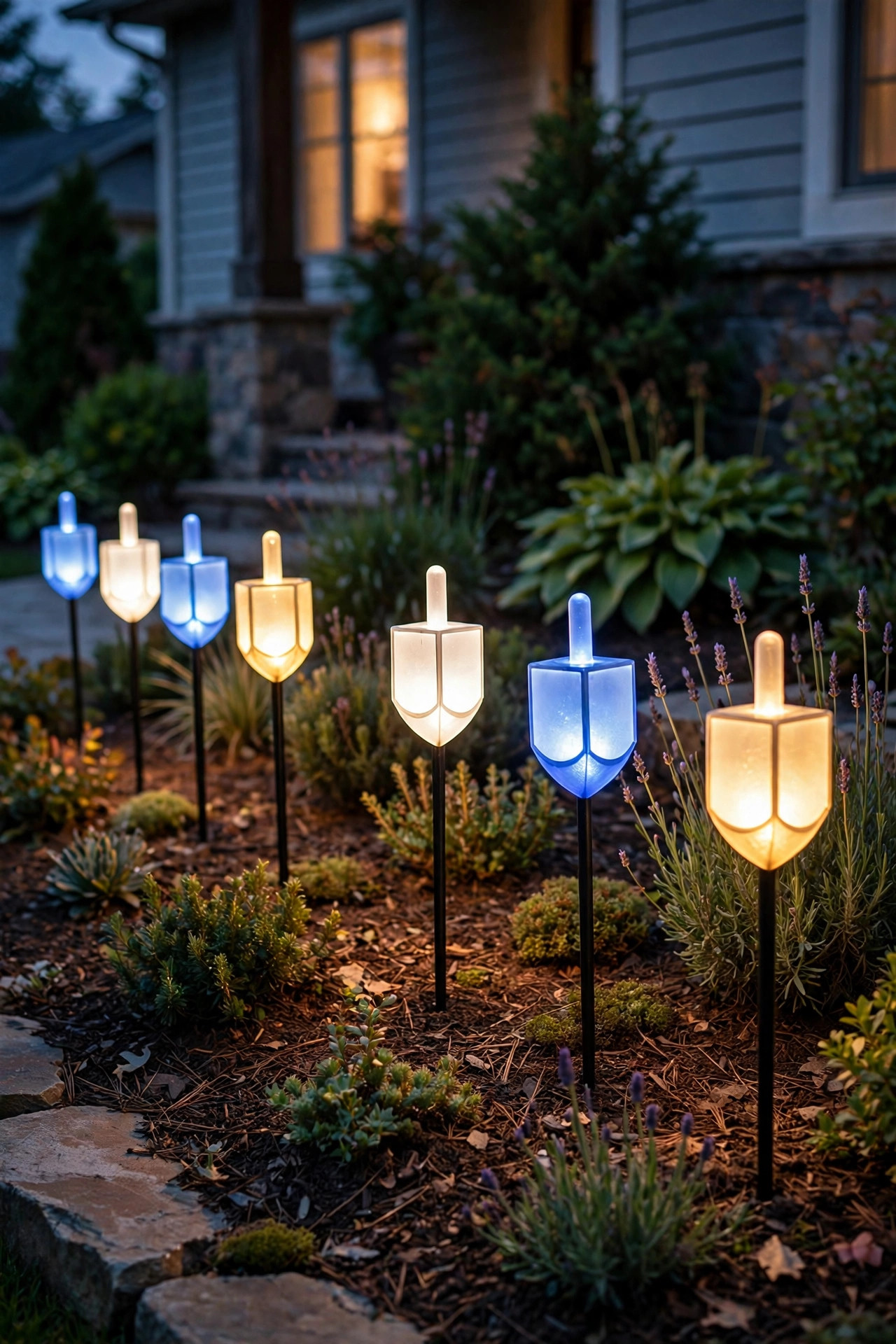
Dreidel-shaped light stakes are pure joy, and tucked along the front garden beds they give the display a playful note that balances the elegant roofline. Most sets come as connected strands of five to eight dreidels, each 8 to 10 inches tall, in blue, white, and gold. I push the stakes in along the curved edge of the bed where they are visible from the street but not blocking the path lights, and I angle a few slightly toward the sidewalk so the shapes read clearly. Because these are novelty lights, the glow is more decorative than functional — think of them as jewelry, not lighting. Connect no more strands end-to-end than the packaging allows, usually three, and keep connections off the wet ground by resting them on the mulch inside small weatherproof connector covers. Battery-operated singles also exist and are handy for a bed far from an outlet. Kids in the neighborhood start asking when the dreidels are coming out right after Thanksgiving, which tells you everything. Stored coiled loosely in a labeled bin, a good set lasts for many seasons of play.
Suggested budget range: $20 – $50.
7. Cluster Lanterns With Flameless Candles on the Porch Steps
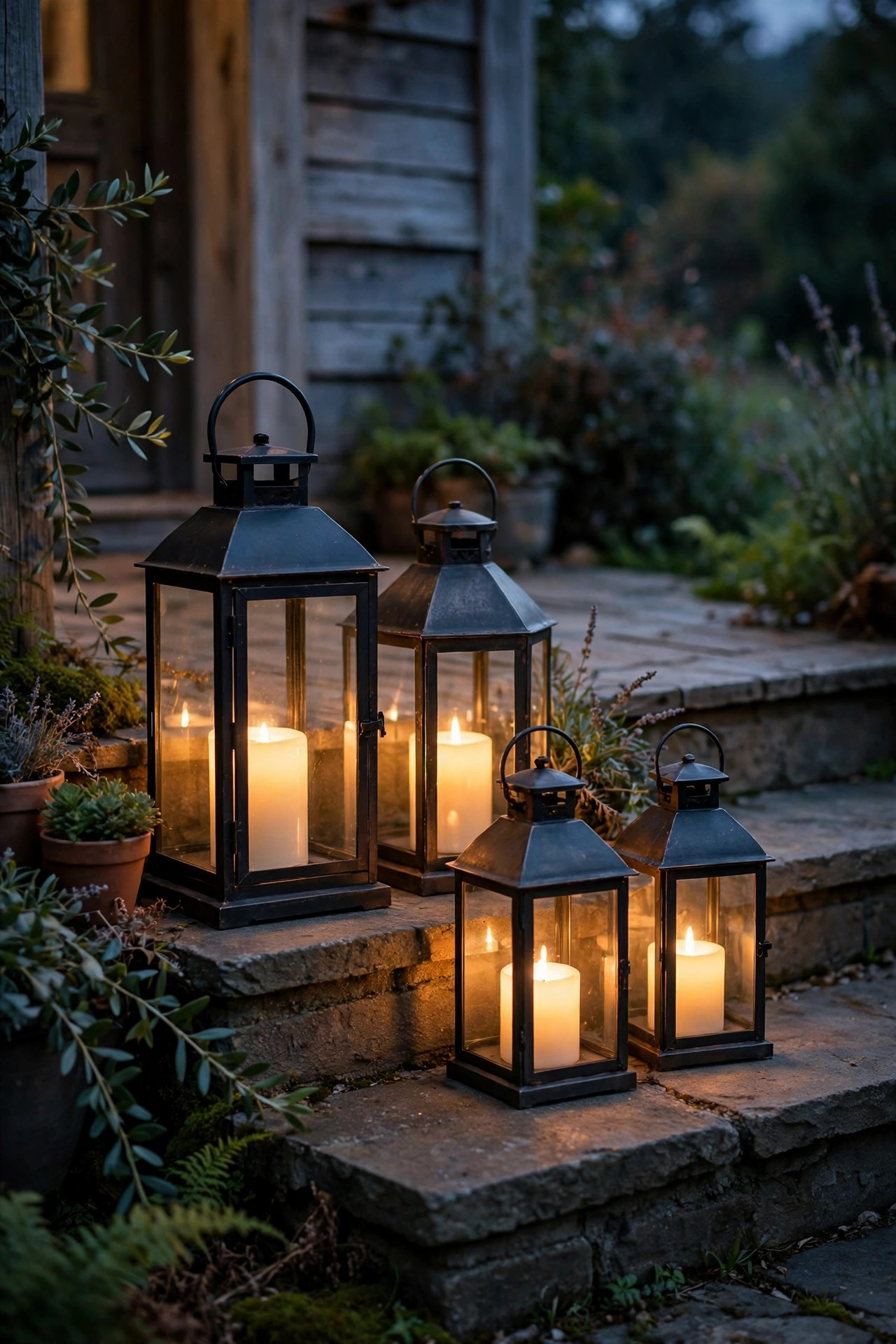
For the eye-level layer of warmth, nothing beats a cluster of lanterns glowing on the porch steps. I group three metal lanterns in graduated heights on one side of the steps — odd numbers just look better — and fill them with flameless LED candles in a warm gold tone. Flameless is non-negotiable outdoors: real flames plus winter wind plus a guest carrying a casserole is a combination I never risk, and LED candles with a flicker effect look convincing from three feet away. Many come with a built-in timer that turns them on at the same time daily, which is perfect for an eight-night stretch. Choose lanterns rated for outdoor use with drainage at the base, and bring the candles in during heavy rain or a deep freeze below about 0 degrees, since battery performance dips in extreme cold. A dusting of faux snow or a few gold ornaments tucked beside the lanterns finishes the vignette. From the street, that warm cluster anchors the whole blue-and-white scheme and says someone thoughtful lives here.
Suggested budget range: $30 – $75.
8. Wash the Front Trees in Blue Uplight
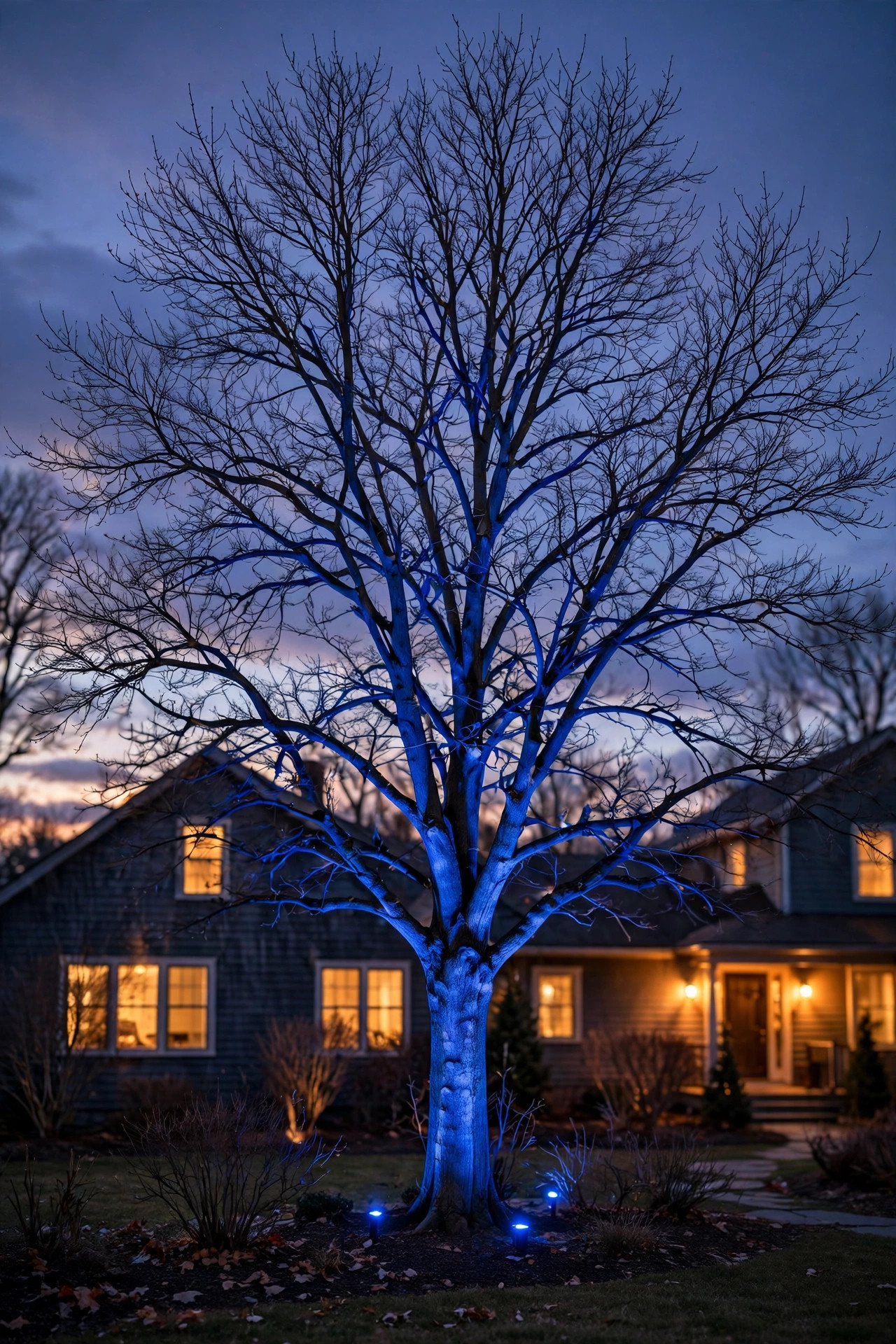
Uplighting a bare deciduous tree in blue turns its branching silhouette into sculpture, and it is the dramatic note my display gets the most compliments for. A single LED spot or well light at the base, aimed up into the canopy from 1 to 2 feet out from the trunk, does the job. Use a fixture with a replaceable bulb or a color-changing LED spotlight set to a rich cobalt, and angle it slightly so the light grazes the bark texture rather than blasting straight up. If you have two front trees, light only one in blue and leave the other dark or in warm white — restraint keeps it classy and saves the budget. Low-voltage fixtures are the safest DIY route and wire into the same transformer as landscape lights; a 10 to 20 watt LED is plenty for a mid-size tree. Bury or mulch-cover the cable run so it is not a trip hazard in the dark. In my experience, blue uplight against a light snowfall, with flakes drifting through the beam, is the single most beautiful sight of the season.
Suggested budget range: $25 – $70.
9. Swag Gold Curtain Lights Across the Porch
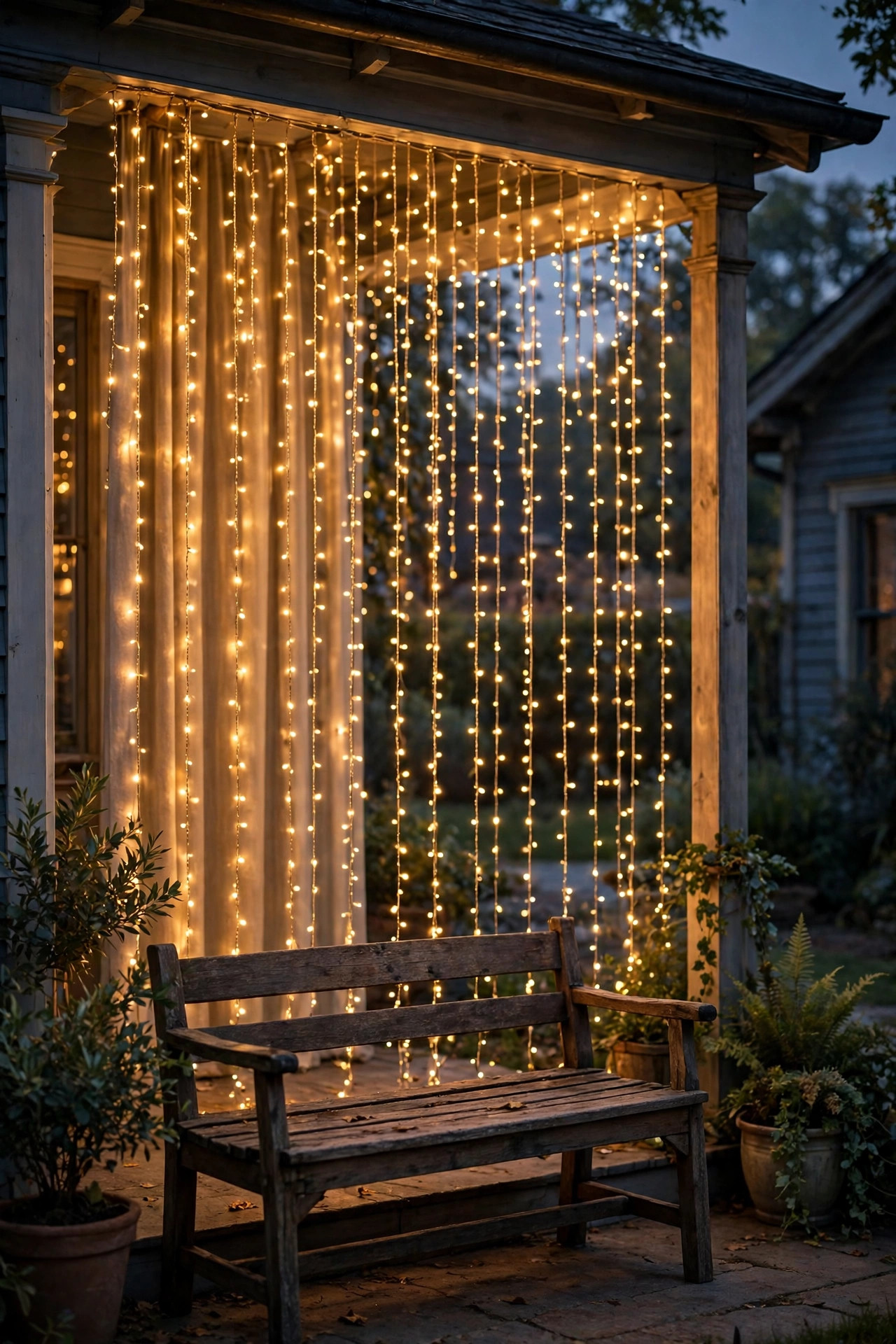
Curtain lights — those cascading strands that hang like a waterfall — make a porch feel like it is draped in liquid gold. A standard panel is about 6 feet wide by 6 feet long with drops of varying lengths, and one panel swagged across the porch opening or behind the porch railing creates a sparkling backdrop for everything in front of it. I hang mine from small adhesive-free hooks on the porch beam and let the drops fall behind the railing so guests never brush against them. Choose warm white rather than yellow-gold strands if your other accents are already gold; the contrast of warm white falls against blue roofline lights reads gold by comparison anyway. Most curtain sets include twinkle and fade modes — I set mine to a slow fade, which feels calm and candle-like rather than disco. Keep the controller box sheltered under the porch roof, and avoid letting strands puddle on the floor where meltwater collects. Behind a pair of rocking chairs or a bench, the effect at eye level is pure holiday-card material.
Suggested budget range: $20 – $55.
10. Add a Lighted Star of David Window Display
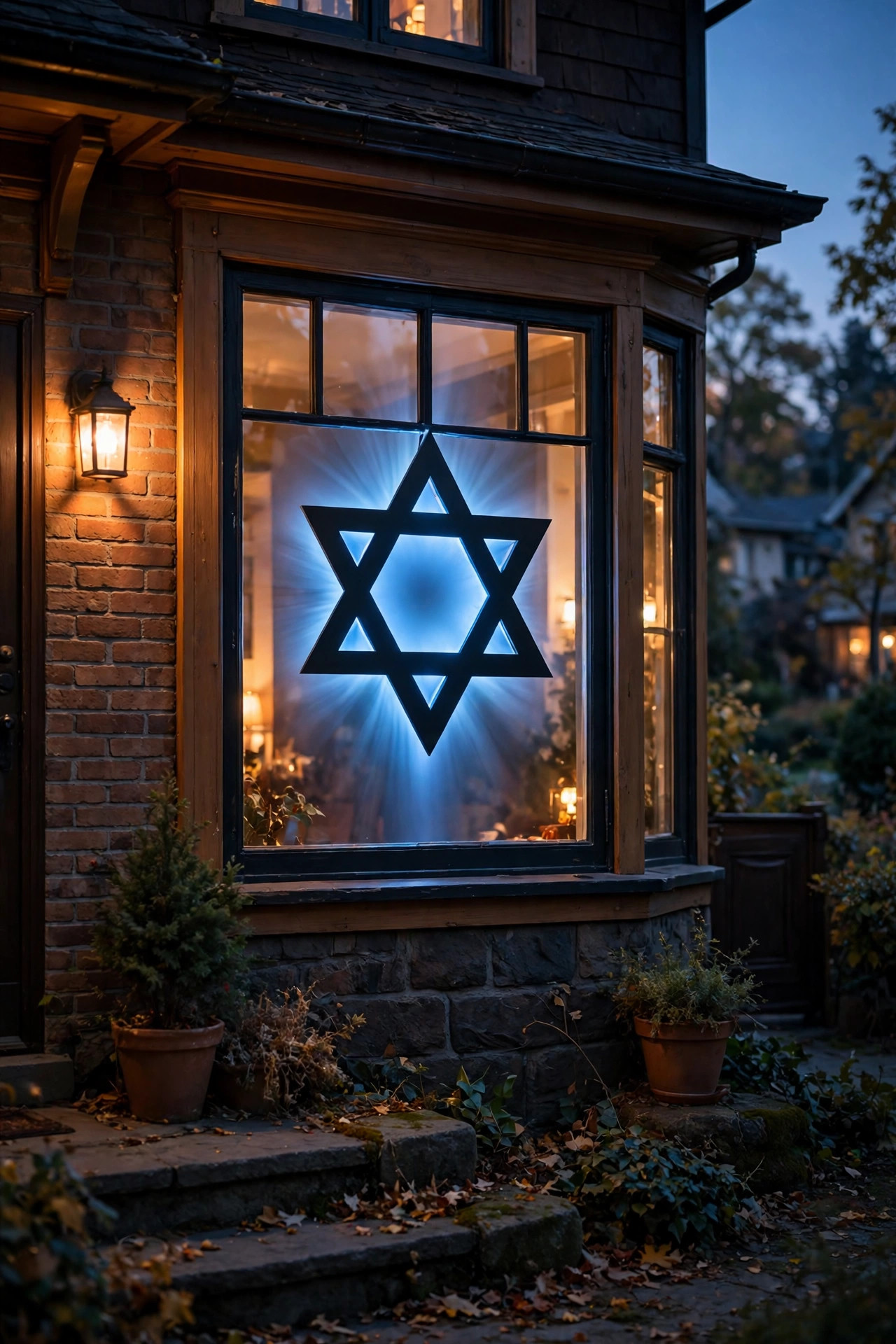
A lighted Star of David in the front window bridges the indoor and outdoor displays, glowing like a beacon that ties the menorah on the lawn to the candles inside. Window silhouettes come as suction-cup frames wrapped in mini lights, usually 12 to 18 inches across, in blue or warm white. I hang mine in the center of the largest front window using the included suction cups plus a backup loop of clear fishing line over the window latch — December suction cups can let go in the cold, and the fishing line is cheap insurance. From outside, the silhouette reads crisply through the glass; from inside, you barely notice the frame against the curtain edge. Plug it into the same timer as the interior tree or window candles so the whole window composition switches on together at sundown. If you have two front windows flanking the door, a matched pair looks beautifully symmetrical. Keep the design modest in scale relative to the window — about a third of the glass width — so it reads as an accent rather than a billboard.
Suggested budget range: $18 – $45.
11. Run Cool White Icicle Lights Under the Eaves
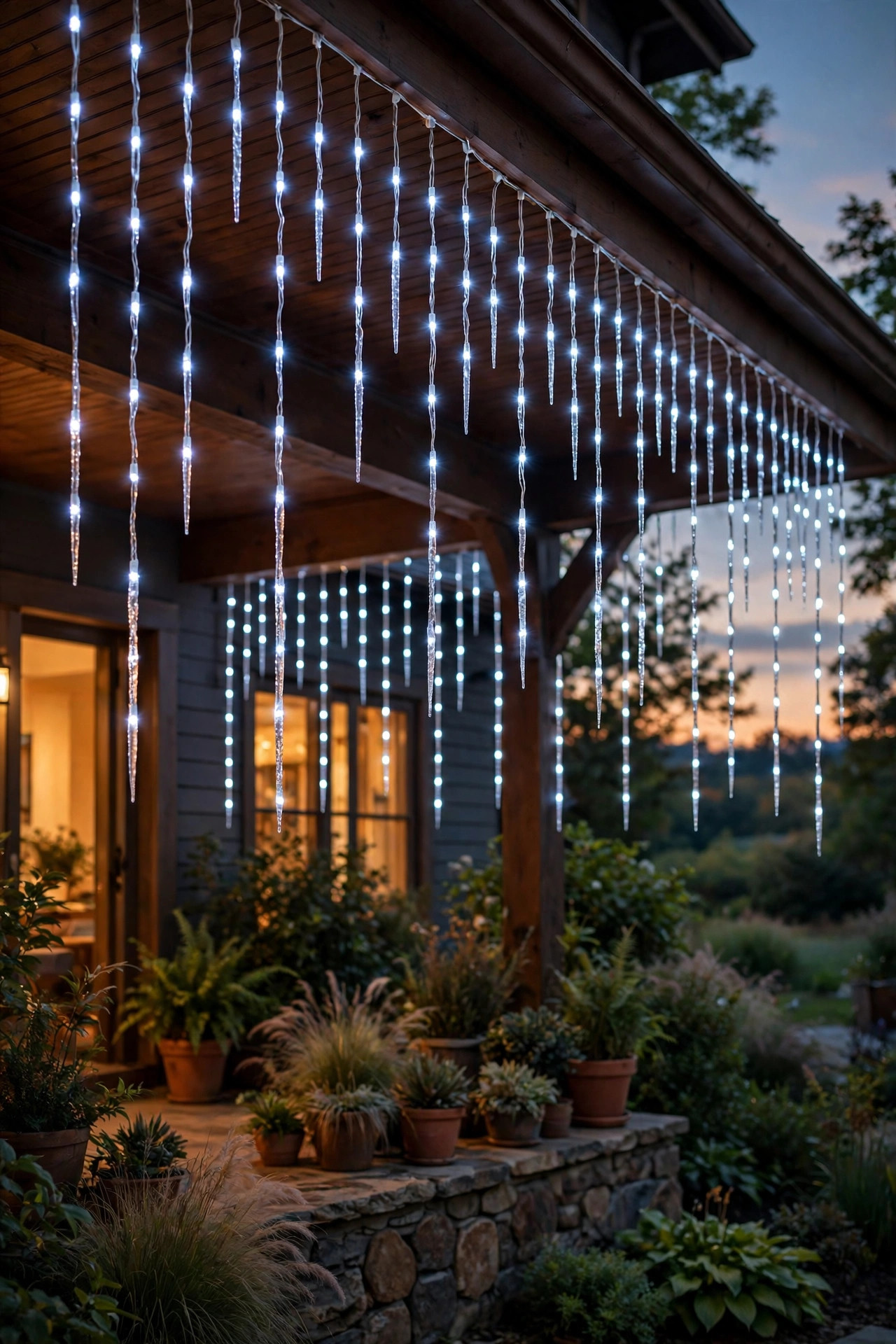
Icicle lights are the winter texture layer. Their staggered drops mimic the real icicles forming along northern eaves, and in cool white they harmonize with the blue palette while adding movement and sparkle. I hang them under the porch roof edge rather than the main roofline — the porch is where guests actually stand, and the drops at varying lengths, usually 12 to 24 inches, catch the light from the lanterns below. Mix a few strands with twinkle bulbs scattered among steady ones, roughly one twinkling bulb in ten, so the effect shimmers instead of strobing. Use the same all-in-one gutter and shingle clips as the roofline strands, and mind the drip line: plug connections should sit up under the eave, never dangling where meltwater runs. If your eaves already carry the blue and white C9s from idea two, keep the icicles to the porch only, or the two patterns will fight. LED icicle strands are light enough that a 20-foot run is an easy one-person job with a step ladder. The overall impression is frosty, festive, and unmistakably wintry.
Suggested budget range: $20 – $60.
12. Scatter Solar Blue and White Stakes Through the Flower Beds
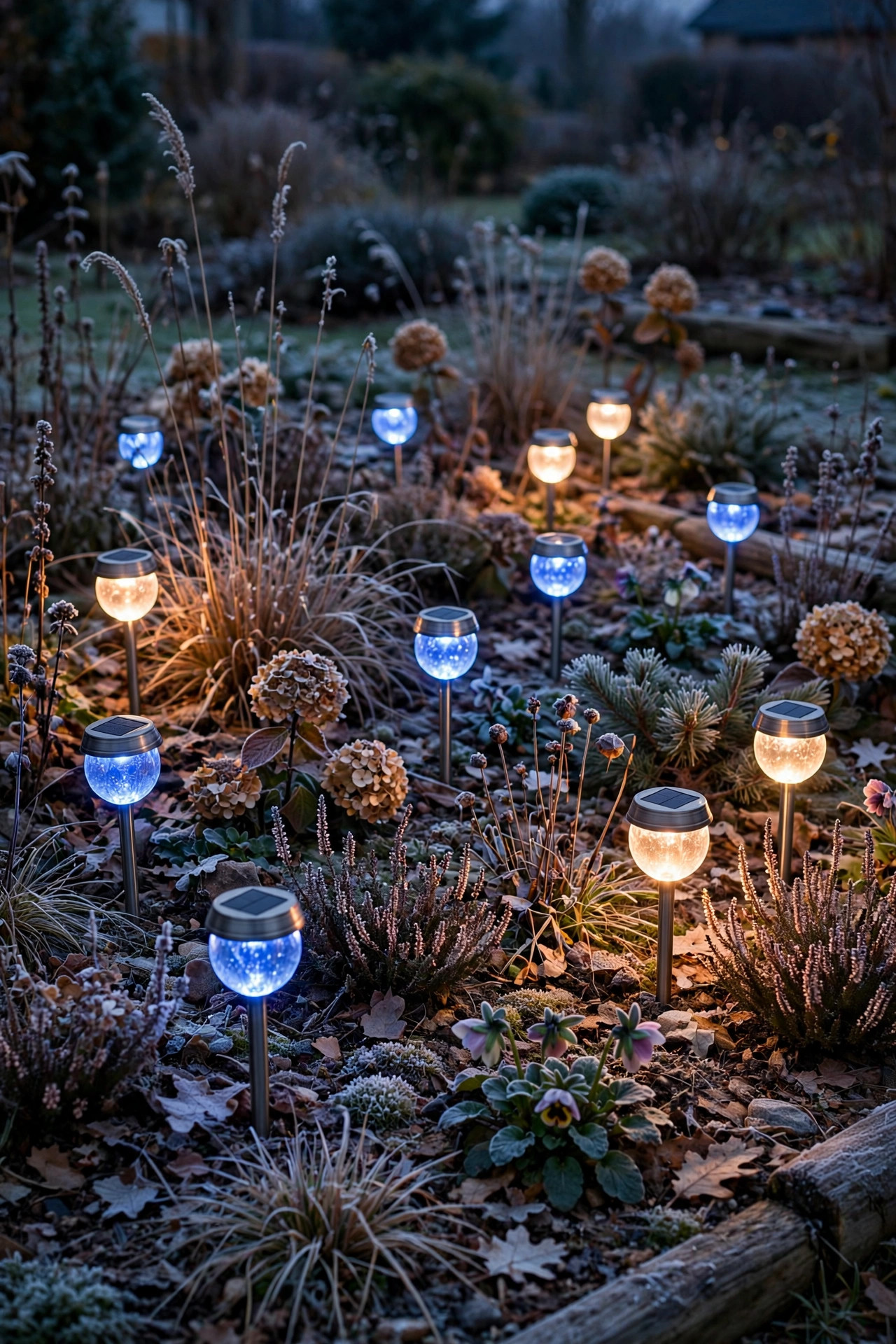
Not every bed sits near an outlet, and solar stakes solve that gracefully. Modern sets come shaped as simple globes, mini lanterns, or snowflakes in blue and warm white, and scattered through the front beds they echo the bigger display in miniature. I push six to ten stakes into each bed at irregular intervals — nature does not do grids, and neither should you — clustering them near the dreidel stakes and shrubs that already carry light. Be honest about December sun: with short days and low sun angles, solar stakes often glow for 4 to 6 hours rather than the 8 to 10 promised in June, so place them where the display matters most, near the entry, and treat them as accents. Wipe the panels when you shovel; snow film cuts charging dramatically. Keep spare rechargeable batteries on hand, because one tired battery dims a whole stake by the fifth night. For beds fully shaded by the house, skip solar entirely and run a battery fairy strand instead. Accent lighting is all about the sparkle, and these little points of blue do it cheaply.
Suggested budget range: $15 – $40.
13. Build a String Light Canopy Over the Patio for Latke Night
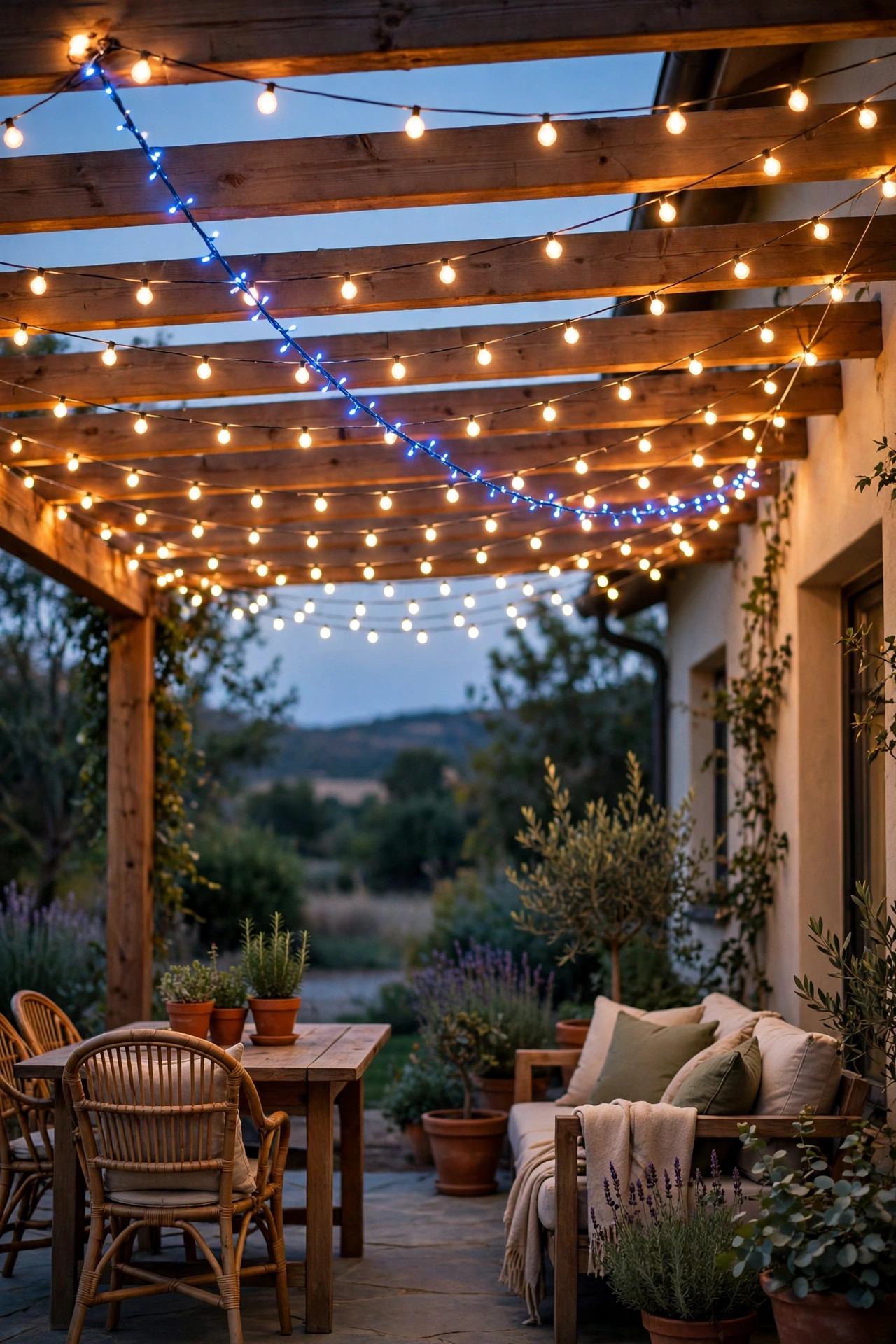
If your family fries latkes outdoors or gathers on the patio with hot cider, a canopy of string lights overhead makes the space feel like a room. I zigzag warm white globe strands from the house to two poles at the patio edge, swagging each run with a gentle dip, and add one blue strand woven through the middle as the Hanukkah signature. My full method for spans, anchor points, and pole heights lives in my roundup of backyard string light ideas, but the short version is: support any span over 15 feet with a guide wire so the weight never strains the sockets. Use outdoor-rated globe lights with shatterproof LED bulbs — glass over a patio where kids play dreidel is a worry I do not need. A dimmer rated for LED strings lets you drop the canopy to a candle-like glow during dinner and bring it up for cleanup. The blue accent strand reads festive without overwhelming the warm white, and from the kitchen window the whole patio glows like a snow globe.
Suggested budget range: $40 – $120.
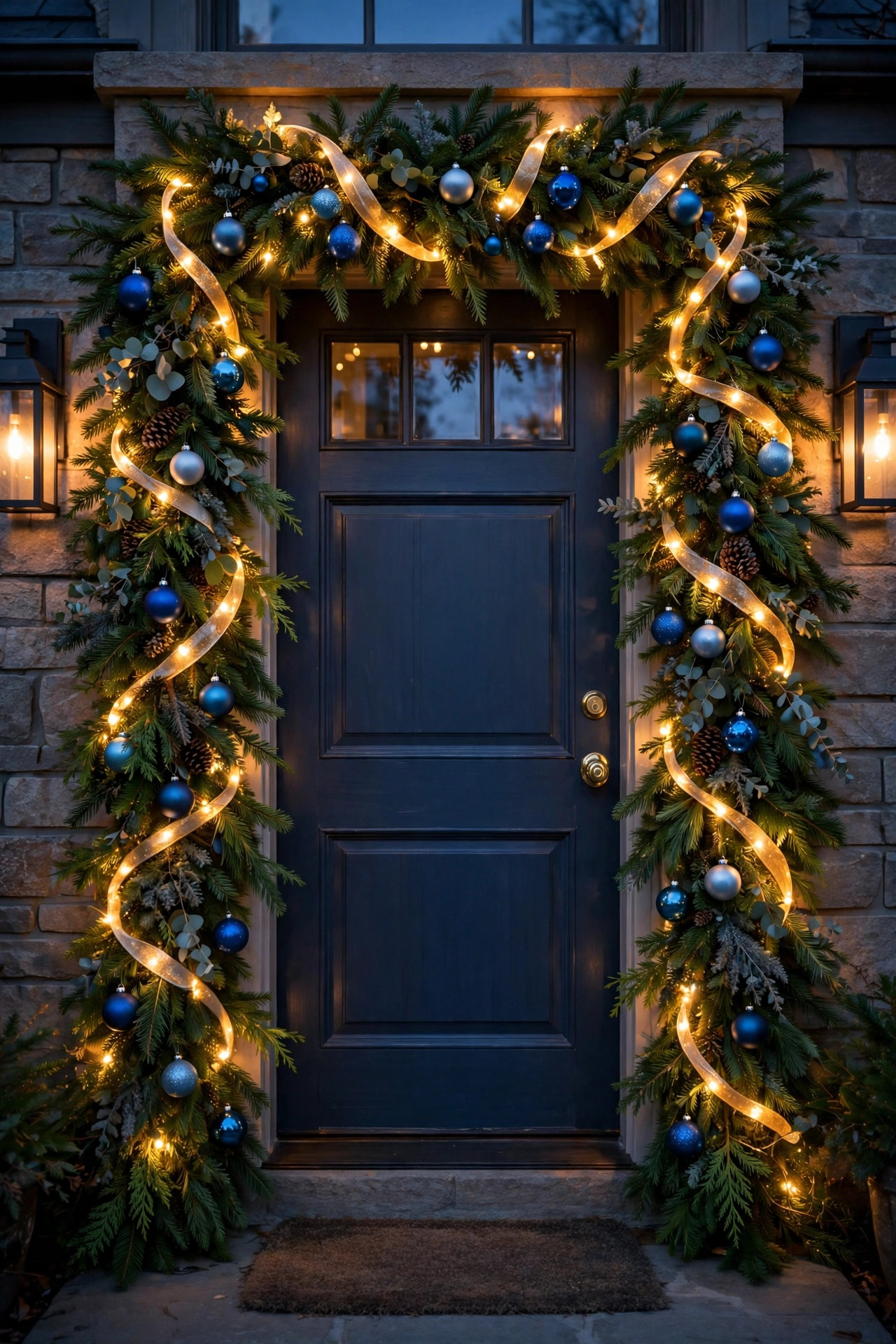
14. Thread Gold Ribbon Lights Through the Front Door Garland
A pre-lit or hand-wrapped garland over the front door is the handshake of the house, and threading battery gold ribbon lights through it makes the entry glow without a cord crossing the threshold. Ribbon lights — a flat metallic mesh ribbon studded with tiny LEDs — weave through garland greenery and hold their shape, so you can form loops and bows that stay put. I wrap one 10-foot ribbon light through a 9-foot pinecone-and-evergreen garland, add blue ornaments for the palette tie-in, and hang the whole thing on a pair of damage-free door-frame hooks. The battery pack tucks behind the garland at the top corner, reachable for the timer button but invisible from the walk. Set the built-in 6-hours-on timer on night one and it will greet you at sundown all eight nights. Keep ribbon lights for sheltered entries only; they are water-resistant rather than waterproof, and a storm door or porch roof overhang is the ideal home. Against a dark door, the gold shimmer is pure elegance.
Suggested budget range: $25 – $60.
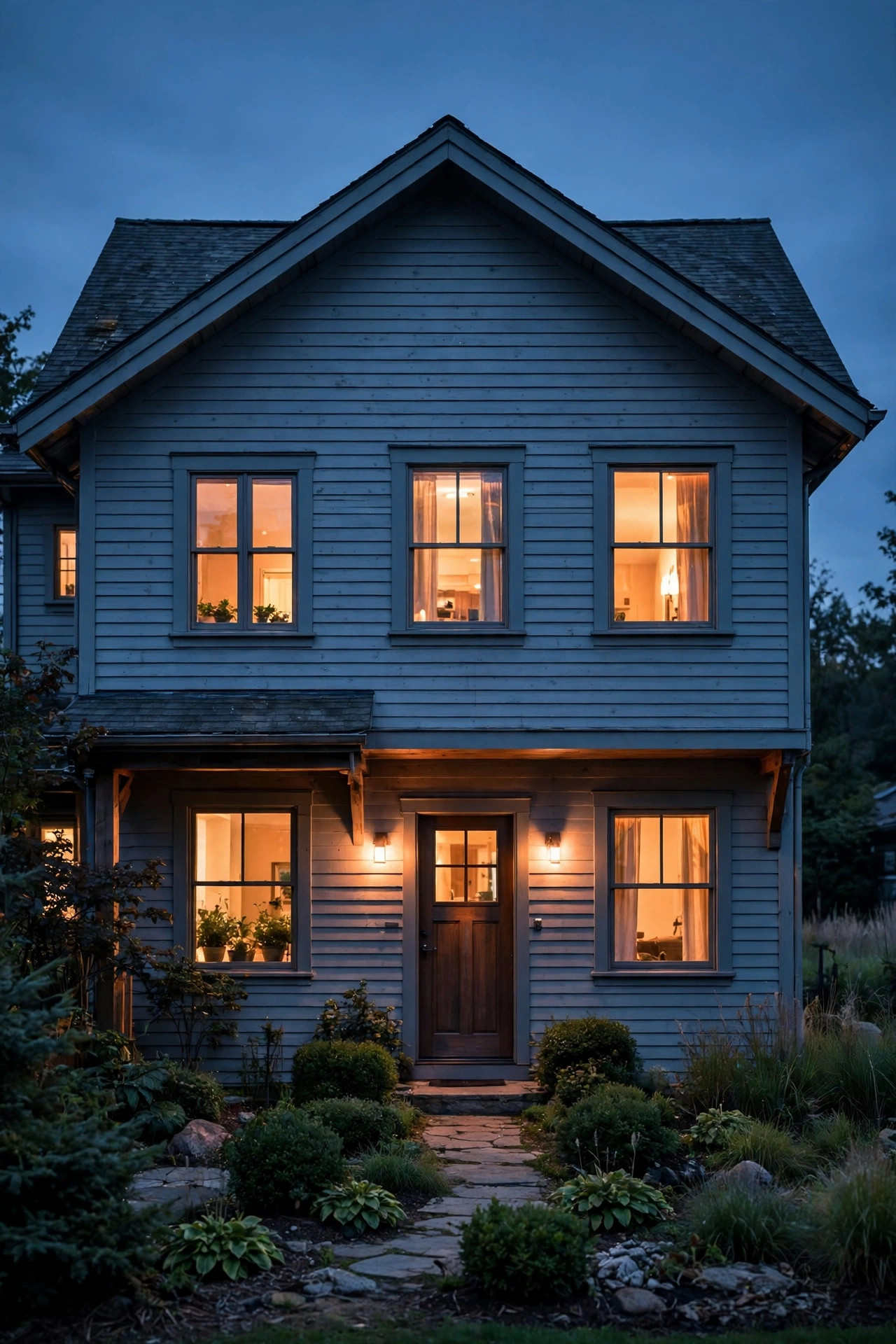
15. Graze the Facade With a Soft Blue Wash
Wall washing the front of the house in a soft blue gives the display a designer backdrop and makes warm windows and gold accents pop by contrast. Two color-changing LED flood fixtures placed 6 to 8 feet out from the wall, angled up at about 30 degrees, cover a typical one-story facade. Set them to a medium blue and the lowest brightness that still reads — the goal is a wash, not a nightclub — and let the roofline C9s and window candles supply the sparkle. Smart floods on a schedule are worth it here, because you can dial the exact shade once and have it return nightly. Stake the fixtures firmly and point them away from the street and neighbors' windows; a wash aimed across the siding grazes brick and stone texture beautifully but can glare if it is aimed too flat. This is also a forgiving technique: minor unevenness in the wash disappears behind shrubs and the menorah display. On a light-colored house the blue reads vivid, so start dim and step back to the curb to judge the effect like a passerby would.
Suggested budget range: $30 – $85.
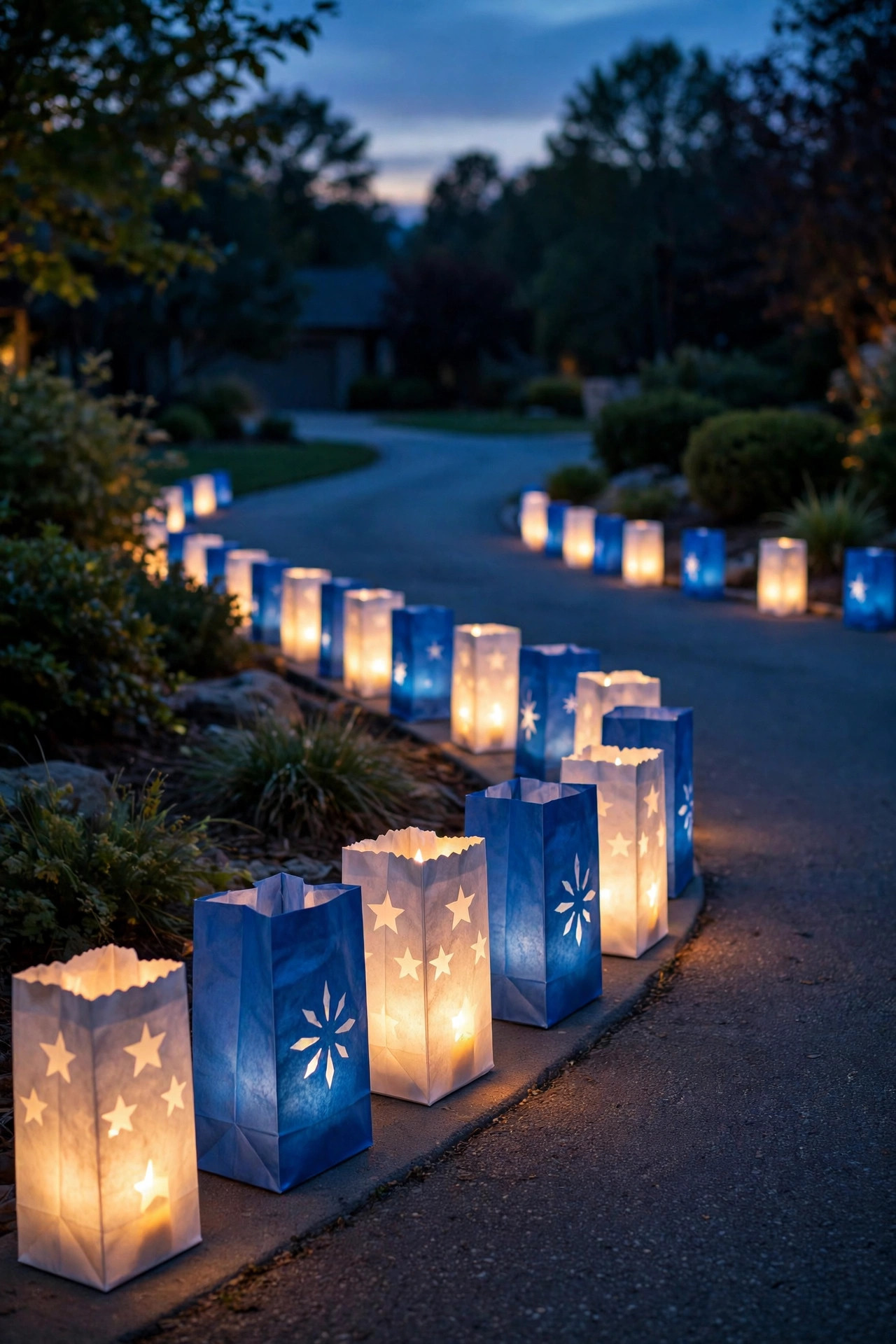
16. Set Luminarias Along the Driveway Edge
Luminarias — little glowing bags — are borrowed from Southwestern tradition, but in blue and white they suit Hanukkah beautifully and light the driveway where guests park. Use weatherproof LED luminaria kits or heavy paper bags weighted with two inches of sand and fitted with flameless tea lights; never real candles in paper, not even for one evening. I line them 3 feet apart along one side of the driveway, the side guests walk on, and alternate blue and white for a gentle rhythm. The LED versions shrug off wind and can be reused every night without relighting, which matters on night six when enthusiasm for setup dips. If snow is falling, plastic luminaria shells are the practical choice and still glow softly through the flakes. Turn them on at sundown as part of your nightly routine — ours happens right after the menorah lighting inside, and the sequence has become a small ritual the kids insist on. From the street, a dotted line of blue and white leading up the drive makes the whole property feel considered and welcoming.
Suggested budget range: $15 – $45.
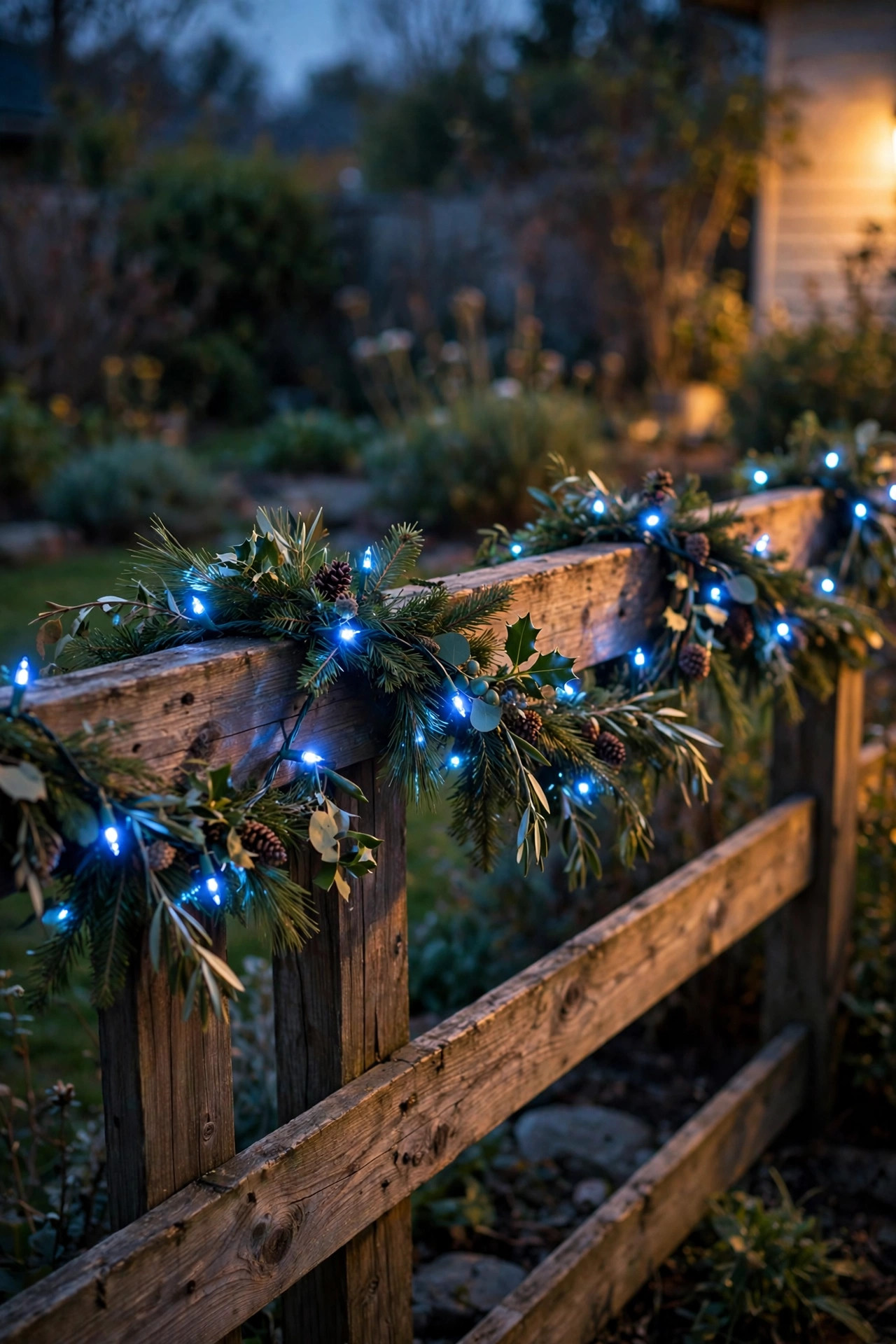
17. Wrap the Fence in Twinkle Garland Lights
The side fence or the stretch of railing along the front steps is prime overlooked real estate. A garland strand — greenery with built-in warm white twinkle lights — wrapped along the top rail ties the yard zones together and gives the eye a horizontal line to travel. I secure a 9-foot pre-lit garland along the fence with zip ties every 18 inches, snipping the tails flush so nothing pokes out, and weave in a second plain strand of blue mini lights for the palette. The twinkle effect matters here: against the steady roofline, a little motion along the fence keeps the display feeling alive. Solar garlands exist but dim early in December; plug-in or a battery pack with a timer is more reliable for a fence near the house. If your fence runs long, garland just the section visible from the street and the gate — lighting everything is rarely necessary, and the budget saved funds the good stuff elsewhere. Stand at the curb when you finish and check that the fence line complements rather than competes with the menorah.
Suggested budget range: $25 – $65.
18. Put Every Light on Timers for All Eight Nights
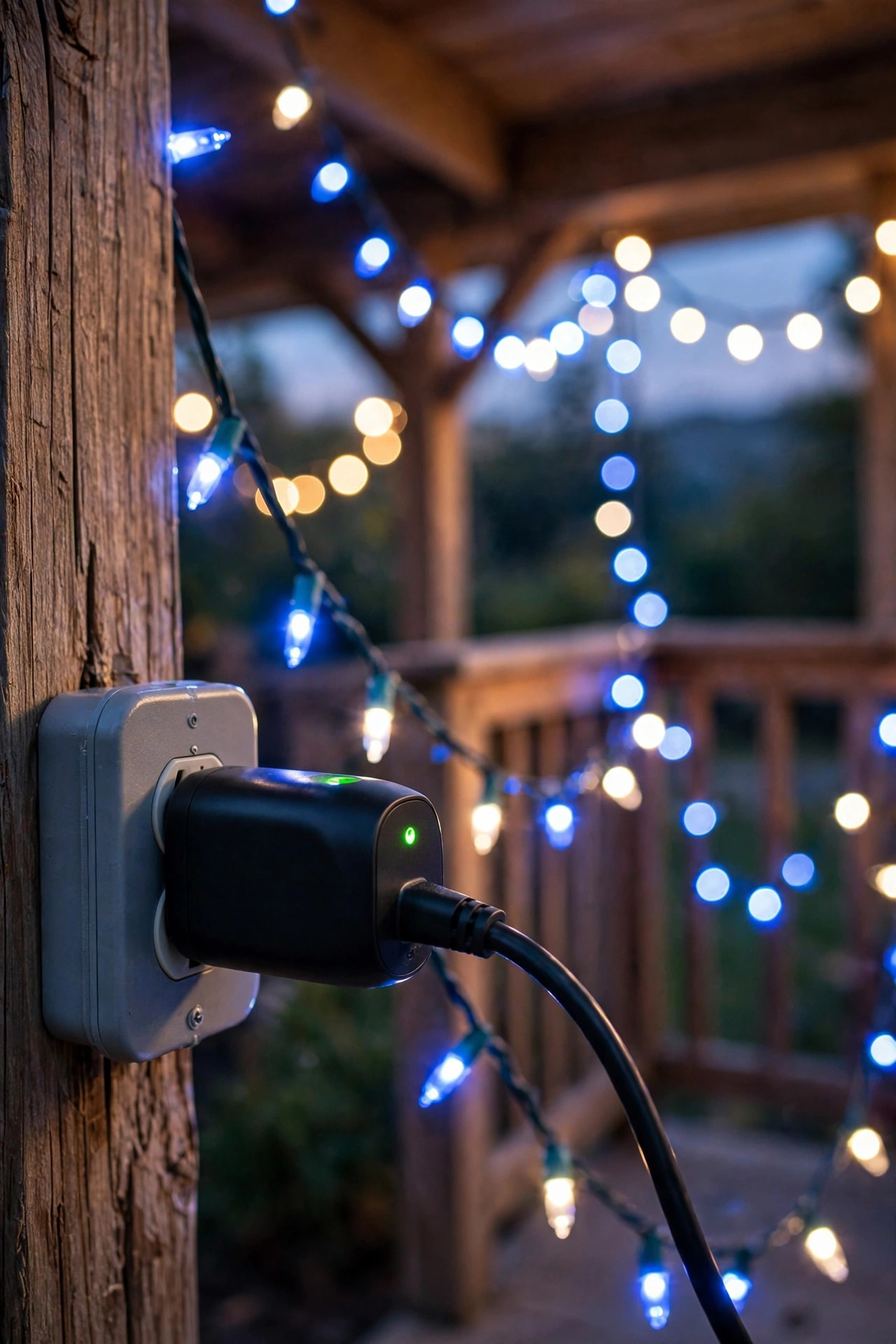
Eight nights is a marathon, and timers are how you run it without nightly ladder trips or forgotten switches. I plug the roofline, menorah, and facade floods into outdoor smart plugs on an astronomical schedule that tracks local sundown, and the battery pieces run on their own built-in 6-hour cycles. My deeper walkthrough of schedules and plug ratings is in my guide to outdoor lighting timers and automation, but the essentials are simple: outdoor-rated plugs only, kept off the ground under a covered outlet, and a photocell timer as a no-fuss backup for at least the path lights. Program everything to switch off around 11 p.m. — plenty of glow time, considerate to neighbors, and cheaper on the electric bill. The menorah gets its own plug so I can still advance one branch each evening by hand; some rituals deserve to stay manual. Test the full system on night one before guests arrive, then the display runs itself while you are inside frying latkes and telling the story. Consistency night after night is what makes a display feel professional.
Suggested budget range: $20 – $55.
19. Layer All Your Hanukkah Outdoor Lighting Ideas Into One Cohesive Display
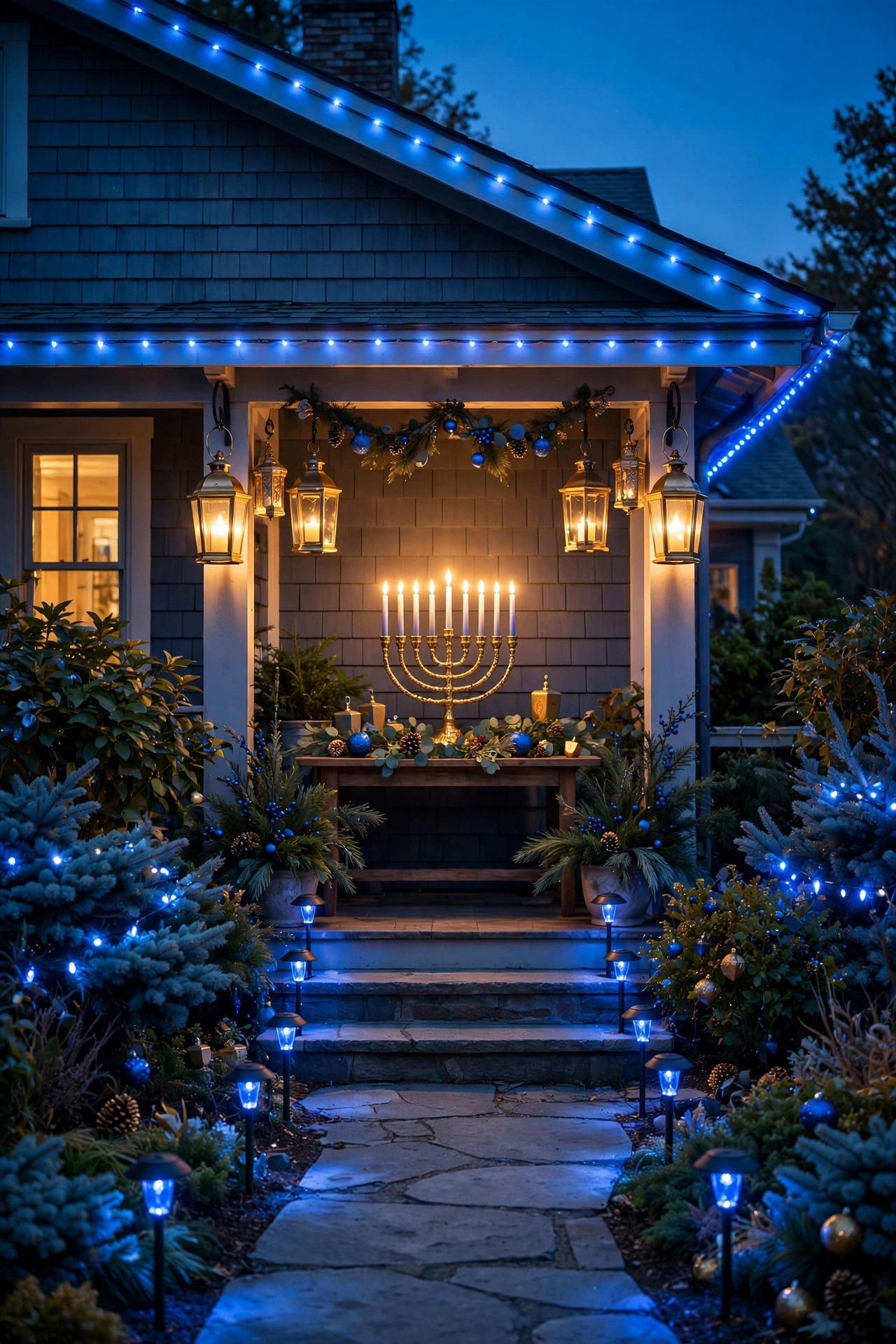
The finale is really a method: take every layer from this list and check them against each other on the first night. Stand at the curb with a mug of something warm and look for balance — sparkle up high from the roofline, icicles, and tree uplight; warmth at eye level from the lanterns, garland, and curtain lights; guidance down low from the path lights and luminarias. Blue should dominate, gold should accent, and warm white should stitch the two together. If one zone shouts louder than the menorah, dim it or drop a strand; the focal point always wins. Photograph the house from the street, because a phone screen shrinks the scene and exposes hot spots and dark gaps your eyes forgave in person. Make your tweaks on night one, and nights two through eight are pure enjoyment. That is the quiet secret of every display people stop to admire: it is rarely more lights, it is the same lights layered on purpose. When all your hanukkah outdoor lighting ideas work as one composition, the house does not just look decorated — it looks like it is celebrating.
Suggested budget range: $50 – $150.
Frequently Asked Questions
What colors work best for Hanukkah outdoor lights?
Blue and white are the traditional base, and warm gold is the accent that keeps the palette from feeling cold. I aim for roughly two-thirds blue and white to one-third gold or warm white, and I test one strand before buying in bulk, because LED blues vary from icy sky to deep cobalt between product lines.
Can I leave my Hanukkah lights up for all eight nights?
Yes — LED strands and outdoor-rated fixtures are designed for continuous seasonal use, and most people hang everything before night one and take it down after night eight. Run them on timers for about five to six hours each evening, check connections after any storm, and never leave damaged or frayed cords in service.
Are blue LED lights safe to use outdoors in winter weather?
They are, as long as the packaging is rated for outdoor use and the plugs connect to GFCI-protected outlets. LEDs actually perform happily in cold weather and use up to 75 percent less energy than incandescent strands. Keep connection points off the ground and out of puddles with weatherproof covers, and bring battery packs indoors during extreme cold snaps.
How much does it cost to decorate outside for Hanukkah?
A simple display — one or two string light strands, path stakes, and lanterns — runs $75 to $150. A fuller layered setup with a lighted menorah, roofline lights, and uplighting lands between $300 and $600, and nearly everything is reusable for years, so the per-season cost drops quickly after the first year.
Conclusion
The heart of every great display is the same: pick a palette, layer it high, middle, and low, and let one meaningful focal point lead. These hanukkah outdoor lighting ideas in blue and gold will carry your home through all eight nights with warmth and sparkle to spare, and most of the pieces will serve you for a decade of Decembers. Start with the menorah and the walkway this year, add a layer each season, and browse the rest of our lighting ideas here whenever you are ready to grow the display. Happy Hanukkah — may your home glow a little brighter every night.