There's a particular kind of maddening that comes with landscape lights flickering across a yard you were perfectly proud of an hour ago. One path light strobes like a tiny disco ball. Two spotlights pulse in a slow, seasick rhythm. A whole flower bed winks every time the breeze picks up. Honestly? Flicker used to send me straight to the parts store, swapping bulbs at random and hoping. I've learned better. A flicker is never random — it's your system telling you exactly where it hurts, in a language of patterns. In my experience, nine causes explain nearly every case of flickering landscape lights, and most of them cost less than a pizza to fix once you know which one you're dealing with. This guide walks through all nine causes in the order I actually check them, shows you how to read the pattern your lights are making, and covers what each fix costs in 2026. By the end, you'll be able to stand in your driveway at dusk, watch the flicker for ten seconds, and say: I know what that is.

The Short Answer
Flickering is your lighting system losing power for split seconds at a time, and there's a short list of usual suspects: a loose or corroded connector, voltage sagging at the end of a long run, a bulb whose driver is giving up, water sitting where it shouldn't, or a transformer that's overloaded or failing. Read the pattern before you buy anything. One light flickering points at that fixture or its connector. A group flickering together points at a shared connection or cable. The whole yard pulsing at once points at the transformer or its controls. Match the pattern to the cause below and you'll fix it in one trip outside, not five.
First, Read the Flicker: The Pattern Is the Diagnosis
Before you touch a single tool, stand outside after dark and just watch for a full minute. I know it sounds too simple, but the pattern is the diagnosis — the flicker is telling you where to look.
One fixture flickering while the rest stay steady? The problem lives within about two feet of that light: its bulb, its socket, or its connector. Everything past a certain point flickering or sputtering, while lights closer to the transformer are fine? There's a failing connection or a damaged cable at exactly that point — the last happy light and the first unhappy one bracket your problem. The whole run flickering together, worst at the far end? That's voltage drop or an overloaded transformer starving the line. The entire yard pulsing in unison, every zone at once? Now you're looking at the transformer itself or its controls. And if it only flickers on breezy nights, or after rain, or when the sprinklers run — something physical is making and breaking contact: a loose connector moving in the wind, or water getting somewhere it shouldn't.
One more distinction worth noticing: a steady, rhythmic on-off cycle, like a slow strobe, usually means a photocell is switching the system off and on. A random, sputtery flicker almost always means a physical connection problem. Random equals mechanical; rhythmic equals electrical or control. Write your pattern down — seriously, in your phone's notes — before you start. Every cause below matches one of these shapes, and matching first saves you the parts-swapping spree I see in so many yards.

Cause 1: Loose or Corroded Connectors (the Answer, More Often Than Not)
If I had to bet on one cause before even seeing your yard, this is it. Most landscape fixtures connect to the main cable with pierce-point connectors — little plastic clips whose metal teeth bite through the cable's insulation to touch the copper. They're fast to install, and for the first few seasons they work fine. But plastic relaxes in summer heat, teeth lose their bite, and the tiny punctures let in moisture. A film of corrosion builds on the copper, resistance climbs, and the connection starts behaving like a loose bulb in a socket — making contact, losing it, making it again, dozens of times a minute. That's your flicker.
The giveaway is the wiggle test. After dark, with the system on, gently wiggle the fixture's lead wire and tap its connector. If the flicker changes, stutters, or stops for a second, you've found your culprit. Check the connector and the fixture socket for green or white crusty buildup, too — corrosion announces itself.
The fix takes ten minutes. Turn the power off at the transformer. Snip out the old connector and cut the cable back until the copper is bright, not dull brown. Reconnect with gel-filled direct-burial connectors — the kind with sealant inside that keeps moisture out for good — or a proper solderless splice, then give each wire a firm tug to prove it holds. Never just re-clamp the old pierce connector tighter; in my experience, that buys you two weeks, not a fix. Of the yards I get called to, well over half stop flickering right here, with this one cause.

Cause 2: Voltage Drop at the End of a Long Run
Low-voltage cable isn't a perfect pipe. Every foot of it resists the current a little, so the voltage that leaves your transformer at 12 or 13 volts might arrive at the last fixture on a long run at 9 — and that gap is where flicker breeds. A halogen bulb just glows dim and orange down there. An LED is fussier: its little driver circuit needs a minimum voltage to run steady, and when the supply hovers right at that edge, the driver cuts in and out. The result is a light that strobes, shimmers, or pulses while its neighbors closer to the transformer burn perfectly steady.
Voltage drop gets worse with thinner cable (14-gauge instead of 12), longer runs, and every fixture you've added over the years. If your far-end lights have always been dim and now flicker too, this is almost certainly your story. I explain the math and the fixes in depth in my guide to landscape lighting voltage drop — but the short version: split the run in two, move the transformer closer to the middle, step up a cable gauge, or use the transformer's higher voltage tap (13, 14, or 15 volts) so the far end lands in the happy zone. Measure before and after with a basic multimeter: you want every fixture seeing roughly 10.5 to 12.5 volts with all the lights on.

Cause 3: An Overloaded Transformer
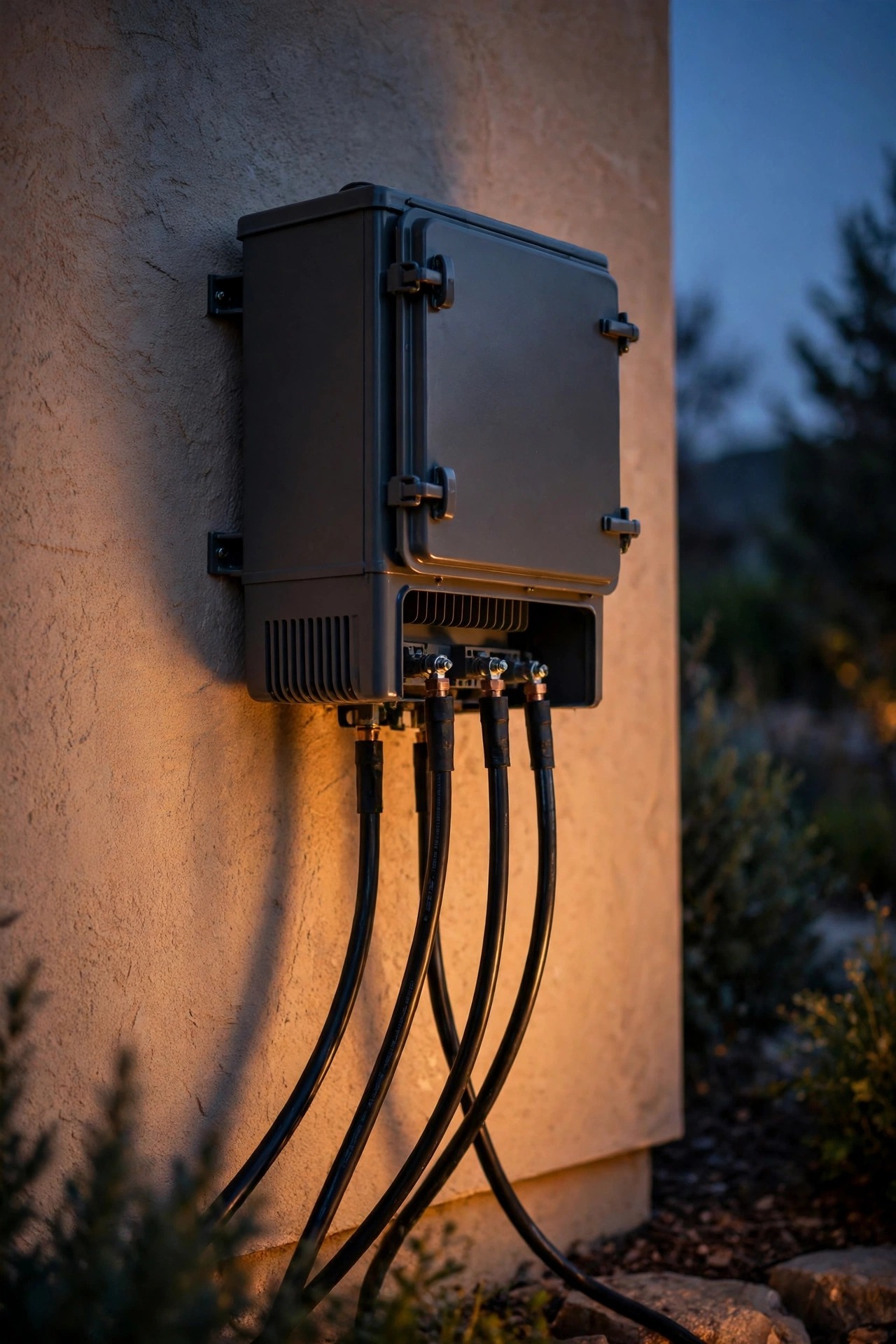
Every transformer has a wattage budget — a 200-watt unit, say — and the unwritten rule is to spend no more than about 80 percent of it. Add up the bulbs on a system that's grown fixture by fixture over five summers, and you may be running at 98 percent without knowing it. An overloaded transformer can't hold its voltage steady under full load. The output sags and wavers, and the whole run flickers together, often getting worse on warm nights when the transformer is already running hot.
Here's the test I use: while the lights are flickering, switch off one zone or unscrew a few bulbs. If the rest immediately settle down and burn steady, load is your problem. Honestly, this one sneaks up on people — nobody does the math when they add "just two more path lights."
The fixes are painless. Rebalance fixtures across zones, move a run to the transformer's second terminal pair if it has one, or upsize the transformer — a bigger unit takes about twenty minutes to swap. The cheapest cure of all: convert your halogen bulbs to LED. Swapping ten 20-watt halogens for 4-watt LEDs frees up 160 watts of budget, and the flicker usually leaves with the old bulbs.
Cause 4: A Bulb That's Failing — or Just Cheap
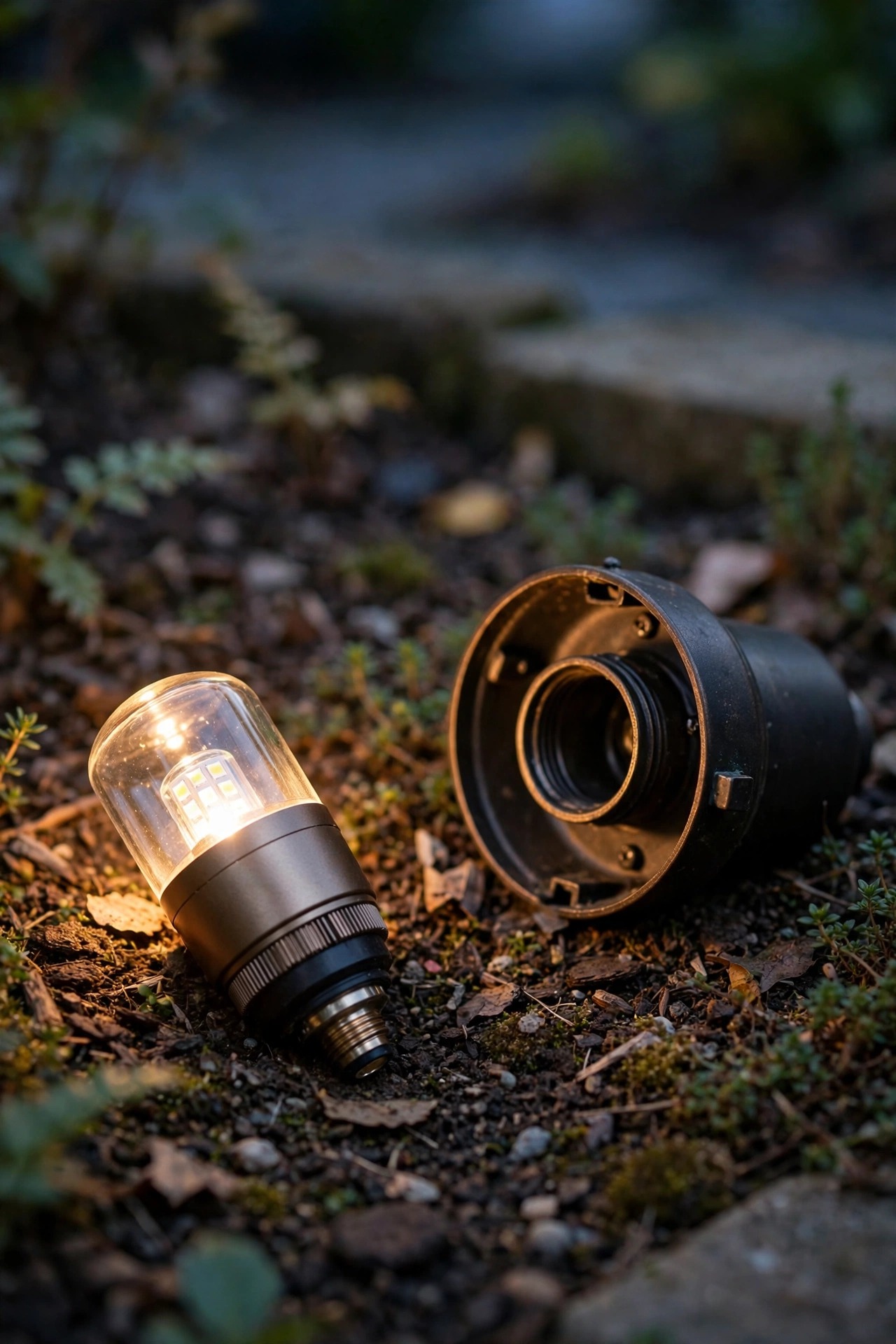
Sometimes the flicker really is the bulb. Every LED bulb hides a tiny electronic driver that converts your transformer's AC into the DC the diode wants, and bargain-bin drivers are the first thing to fail — often months before the bulb dies outright. The warning sign is a single light that flickers in a run where everything else is rock steady. Old halogen bulbs do it too: a filament thinned by years of heat can make intermittent contact as it expands and cools, sputtering like a candle before it finally lets go.
The swap test settles it in two minutes. Take the flickering bulb out and trade places with an identical bulb from a fixture that's behaving. If the flicker follows the bulb, you've found your culprit. If the flicker stays with the fixture, the bulb is innocent — go back to Cause 1 and check its connector.
One more wrinkle: compatibility. Some LED retrofit bulbs simply don't get along with certain electronic transformers or dimmer controls, and they'll flicker from day one no matter what you do. If a new bulb flickers in a fixture where the old one was steady, that's not a wiring fault — it's a mismatch. Look for bulbs specifically rated for low-voltage landscape use, and match the bulb type to what the fixture was built around.
Cause 5: Water Where It Shouldn't Be
When someone tells me their lights flicker after rain and behave all week, I don't start with the transformer — I start with water. Rain, sprinklers, and morning dew get into fixtures and connectors that look perfectly sealed. Inside a socket, moisture bridges the contacts and creates a sputtering, partial connection. Inside an unsealed connector buried in mulch, it feeds that green, crusty corrosion that slowly eats the copper. Even condensation counts: a path light whose lens gasket has flattened with age can fog inside and drip right onto the bulb pins.
The pattern gives it away: flicker that arrives with wet weather and vanishes after two dry days is water until proven otherwise.
Fix it on a dry afternoon. Power off, open the fixture, and dry everything — a paper towel in the socket, an hour of sunshine with the lens off. Clean any crust from the socket contacts gently, reseat the bulb with a dab of dielectric grease on its base to keep the next rain out, and make sure the lens gasket sits evenly all the way around. Then lift the fixture's connector up out of the mulch and give it a little height on a stake or a stone; connections that live in damp mulch are connections you'll be fixing every spring.

Cause 6: A Nicked or Partly Cut Cable
This is the sneaky one. A garden edger, a shovel, an aerator, or a determined mole slices through a few strands of a buried cable without severing it. The remaining strands carry the full load — barely. As they heat up, or as the soil shifts, or as someone simply walks across the lawn above the nick, the connection opens and closes. Everything past the damage flickers or drops out, while everything before it burns steady.
That "flickers when you step on the grass" detail is diagnostic gold, so watch for it. Other clues: the problem started right after yard work, and the boundary between happy lights and flickering ones sits near a bed edge, a walkway crossing, or anywhere a tool regularly bites the ground.
The fix is a proper repair, not tape. Dig up the cable at the suspect spot — you've already bracketed it between the last steady light and the first flickering one. Cut out the damaged inch or two, back to clean, bright copper on both sides, and rejoin it with gel-filled direct-burial splice connectors, the waterproof kind meant to live underground. I walk through the whole repair in my guide to how to splice landscape lighting wire, including how to test your splice before the dirt goes back. Bury it, and make a note on your phone where the splice lives; future-you will be grateful.

Cause 7: A Photocell Fighting Its Own Lights
Here's a cause that feels supernatural until you see it. Your transformer's photocell — the little eye that senses darkness — turns the system on at dusk. But if one of your own fixtures shines on that eye, the photocell thinks dawn has arrived and switches everything off. Darkness falls, it switches back on. On, off, on, off — a slow, regular pulse sweeping the whole yard, sometimes every few seconds, sometimes every minute. From the street, it reads as a strange, rhythmic flicker.
This usually starts right after a change: a new fixture near the transformer, a spotlight re-aimed during fall cleanup, or a brighter replacement bulb. The test takes ten seconds — cover the photocell completely with your thumb or a piece of black tape. If the cycling stops and the lights hold steady, you've found it.
The cure is free. Move the photocell (many unplug and relocate on a short lead) to a spot that gets honest daylight but never sees your fixtures — a north-facing wall is ideal. Or shield the eye with a small hood, or aim the offending fixture away. While you're at it, check that mulch or a fast-growing shrub hasn't buried the sensor; a photocell in permanent shade runs your lights all day, which is a different problem but the same neighborhood of fix.
Cause 8: Dimmers, Timers, and Smart Plugs That Don't Get Along
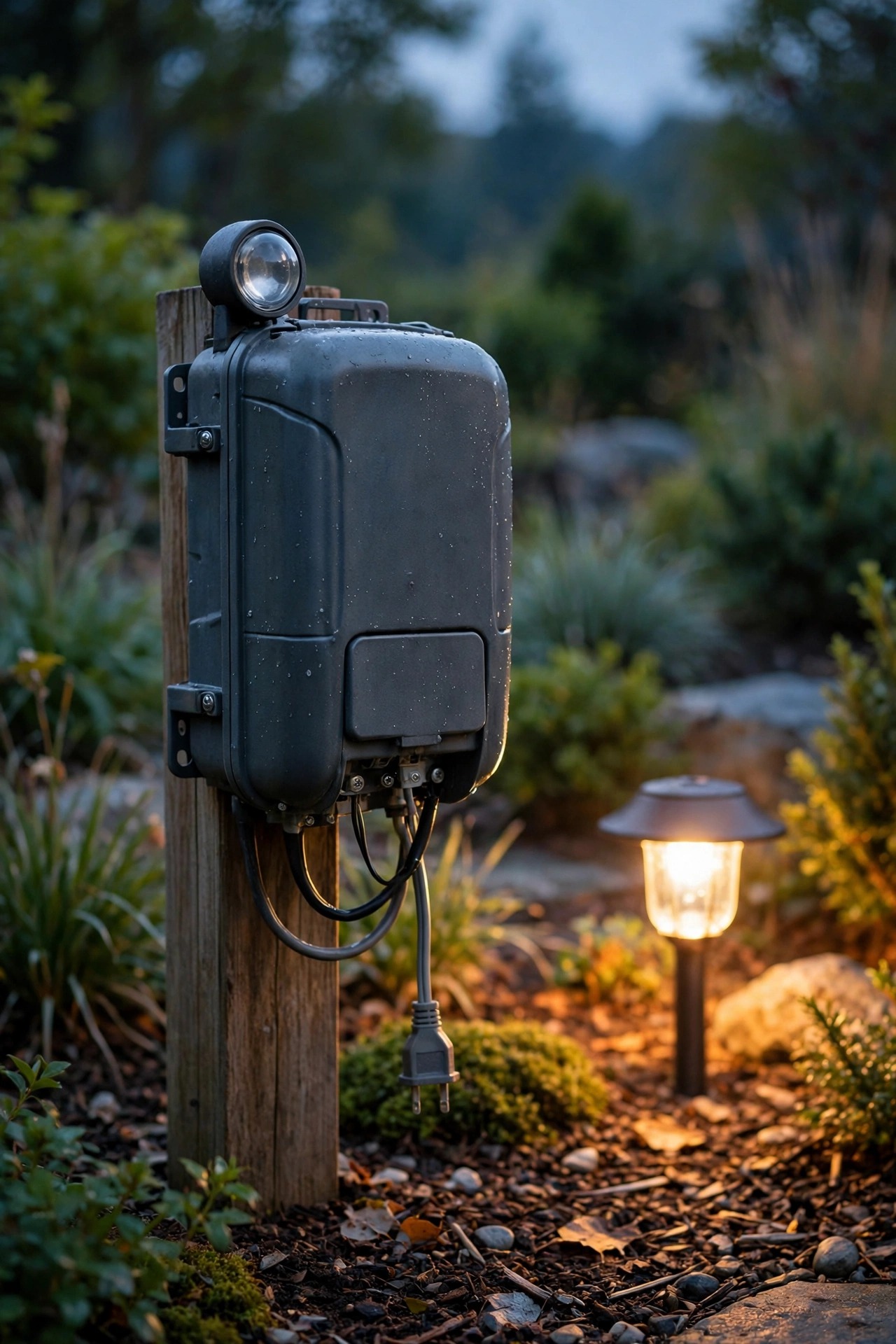
Not every flicker comes from the yard. Some are born at the outlet. Certain smart plugs, plug-in timers, and especially anything with a dimming feature don't deliver clean, full power — they trim the AC waveform to save energy or dim a load, and transformers hate it. A magnetic transformer answers with a buzz and wavering output; an electronic one may just flicker outright. Non-dimmable LED bulbs downstream make it worse. The whole system shimmers together, which sends people hunting through their flower beds for a fault that's actually sitting in the outlet.
The test takes a minute: unplug the transformer from the smart plug or timer and plug it straight into the outlet. If the lights go steady instantly, the control device is guilty.
The fix is to use a simple on/off smart plug or timer rated for transformer and motor loads — never a dimming one — or skip the add-on entirely and use the timer and photocell built into most transformers, which were designed for exactly this job. The same story applies to a wall dimmer feeding an outdoor outlet: set it to full and leave it there, or swap it for a plain switch and let the transformer do the thinking.
Cause 9: A Transformer on Its Way Out
When every zone flickers in unison and the controls check out clean, suspicion lands on the transformer itself. Two failure modes show up. The simple one is loose terminal screws: the lugs where your cables attach vibrate and heat-cycle over the years until contact gets sketchy, and a loose terminal can even arc — listen for a faint sizzle and look for darkened, heat-tinted metal around the screw. The deeper one is internal: a component inside is dying, and the output voltage wanders up and down no matter how clean the connections are.
Safety first here — unplug the transformer before opening the terminal compartment, every time. Tighten the terminal screws firmly, and if a lug or wire end looks green or burnt, cut back to bright copper and re-land it. Then plug in and measure the output right at the terminals with a multimeter; I show the exact routine in my guide to testing landscape lighting with a multimeter. A healthy unit holds its tap voltage steady, within a few tenths of a volt. If the reading drifts or dances with tight, clean connections and nothing else changing, the transformer is done — and honestly, at that point a replacement is money better spent than another weekend of detective work.
Step-by-Step: How I Hunt Down Landscape Lights Flickering
When a neighbor calls me over, this is the exact order I work in — cheapest and likeliest first, digging last.
1. Watch for one minute. Which lights flicker: one, a group, a whole run, the whole yard? When: always, on windy nights, after rain? Your pattern from the first section picks your lane.
2. Do the bulb swap test. If one fixture flickers, trade its bulb with a steady neighbor. Flicker follows the bulb — replace it. Stays with the fixture — keep going.
3. Wiggle-test the connections. System on, work from the transformer outward, gently shaking each fixture lead and connector on the flickering branch. The one that changes the flicker is your fault.
4. Bypass the controls. Plug the transformer straight into the outlet, tape over the photocell, and set any timer to manual-on. Steady now? Your problem was a control, not the yard.
5. Divide the run in half. Disconnect the back half of a flickering run at a midpoint connector. If the front half goes steady, the fault lives in the back half — divide that half again. Three rounds of this corners almost any fault within a few feet.
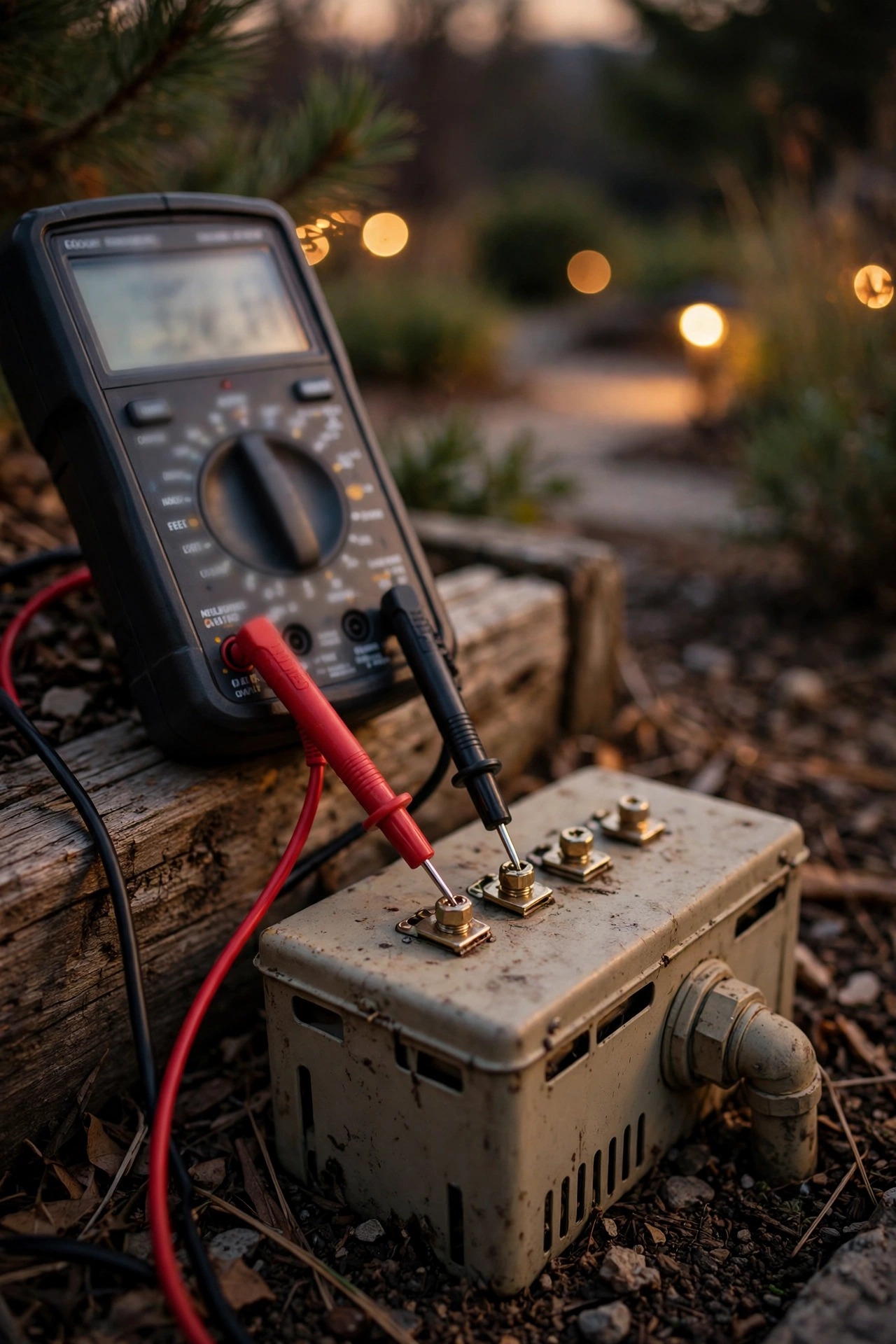
6. Measure the voltage. Multimeter at the transformer terminals, then at the very last fixture, all lights on. A drop beyond about 1.5 to 2 volts end-to-end means voltage drop or an overloaded unit is in play.
7. Only now dig. If it's a cable fault, you've already narrowed it to a short stretch of bed — open that, repair it properly, and test before you bury.
Nine times out of ten, the flicker surrenders somewhere between steps 2 and 4 — which is to say, before you've spent a dime.

What It Costs in 2026 to Stop Landscape Lights Flickering for Good
Here's the part that surprises people: the fix is usually the cheapest line item in this whole hobby. A pack of gel-filled direct-burial connectors runs about $12 to $25 for twenty, and most flicker repairs use two. A quality replacement LED bulb — MR16 or G4, the sizes most landscape fixtures take — is $6 to $14. A direct-burial splice kit with everything included is $10 to $18. A tube of dielectric grease is about $6 and lasts for years of sockets. The one real tool worth owning is a basic digital multimeter at $25 to $50; it pays for itself the first time it saves you from replacing a healthy transformer.
Bigger-ticket items, if your diagnosis lands there: a replacement 200- to 300-watt transformer runs $120 to $280, and swapping one is a twenty-minute job. If you'd rather hand it off, a landscape lighting technician typically charges $90 to $175 an hour, and most flicker calls are solved inside the first hour with parts from the truck — call it $150 to $300 all-in for a pro fix with a warranty on the work.
My honest advice: spend the $25 on connectors and a Saturday coffee before you spend anything else. In most yards, landscape lights stop flickering for less than the cost of the pizza you order while admiring them.
5 Mistakes That Make Flickering Worse
1. Replacing bulbs first. It's everyone's instinct and it's usually backwards — bulbs are the cause maybe one time in five. Swap-test with a bulb you already own before buying anything.
2. The twist-and-tape splice. Twisting bare wires together, wrapping them in electrical tape, and burying the lump is the single most common DIY repair I dig up. Tape is not waterproof, the joint corrodes within a season, and next spring's flicker is worse than this fall's. Gel-filled connectors exist precisely for this job and cost next to nothing.
3. Cranking the tap to fix the far end. Moving the run to the 15-volt tap does nothing for a loose connector — and if the real problem is a nick or a bad splice, the extra voltage just arcs harder at the fault while the fixtures near the transformer get over-voltaged and die young.
4. Adding fixtures to a struggling run. More load on a sagging, overloaded, or voltage-dropped system deepens every one of those problems. Fix the flicker first; expand second.
5. Ignoring it. A flickering connection is an arcing connection, and arcing generates heat that melts connector plastic and can take out a whole section when it finally fails for good. The ten-minute fix in October becomes the weekend project in April.
Frequently Asked Questions
Why do my LED landscape lights flicker when the halogen ones never did?
Halogen filaments are forgiving — give them 9 volts and they just glow dimmer. An LED's driver circuit is not: below its comfort voltage it switches on and off rapidly, which your eye reads as flicker. That's why LED conversions so often "reveal" voltage drop and tired connections that were there all along. The wiring didn't get worse; the bulb got honest. Fix the voltage and connection issues from the causes above and LEDs run beautifully steady.
Why do my lights flicker only after it rains or the sprinklers run?
Water is getting into a fixture socket or an unsealed connector, bridging the contacts just enough to sputter. As things dry out over a day or two, the flicker fades — which is why it feels like the system fixed itself. It didn't. Dry the fixture out, reseat the bulb with a dab of dielectric grease, and replace any buried connector that isn't the gel-filled waterproof kind before corrosion makes the problem permanent.
Can flickering landscape lights be a fire hazard?
Low-voltage systems are inherently gentle — 12 volts won't shock you, and a flicker there is mostly a nuisance and a slow connector-killer, not a fire starter. Two exceptions deserve respect: a connector arcing inside dry mulch should get a prompt fix, not a shrug, and if the flickering is in line-voltage (120-volt) fixtures like porch lights or lamp posts, treat it seriously — kill the breaker and let an electrician look. That voltage is a different animal.
How much does it cost to fix flickering landscape lights?
Usually very little. The most common fixes — reseating a bulb, remaking a connector with a gel-filled one, tightening a terminal — run from free to the price of a small parts pack, and the full 2026 price list lives in the cost section above. The expensive outcomes are only a failed transformer or hiring a pro, and the diagnosis in this guide tells you which situation you're in before you spend anything.
Conclusion
Flickering feels like a mystery, but it's really a message. Nine times out of ten, landscape lights flickering comes down to one unglamorous culprit — a connector that's loosened its grip, a run stretched too far, a bulb quietly giving up — and your lights have been describing it in pattern language the whole time. Read the pattern first, test before you buy, and fix the connection before you replace the hardware. Do that, and the next dusk you step out into will be all steady, golden glow — no disco, no seasick pulsing, just the yard you meant to build. If you're still chasing a gremlin after working through the causes, browse my other troubleshooting and lighting guides here for the next layer of detective work — and honestly? You'll probably find it starts with a connector. It usually does.