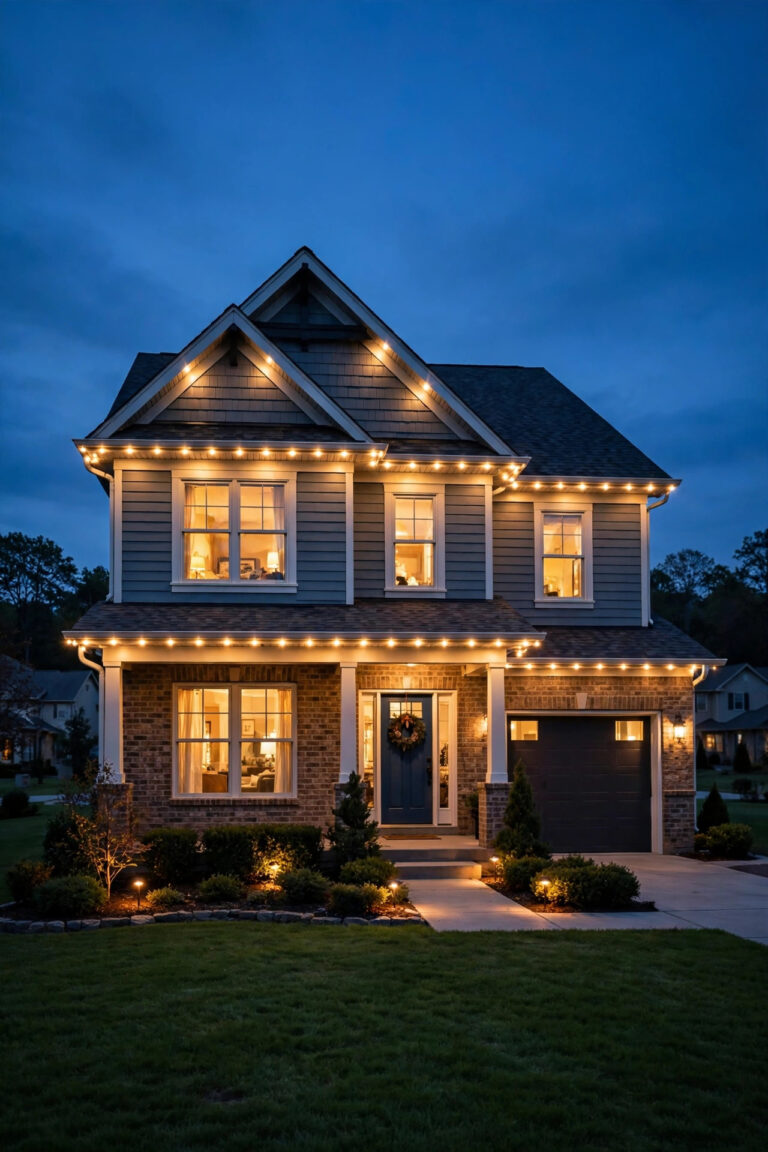
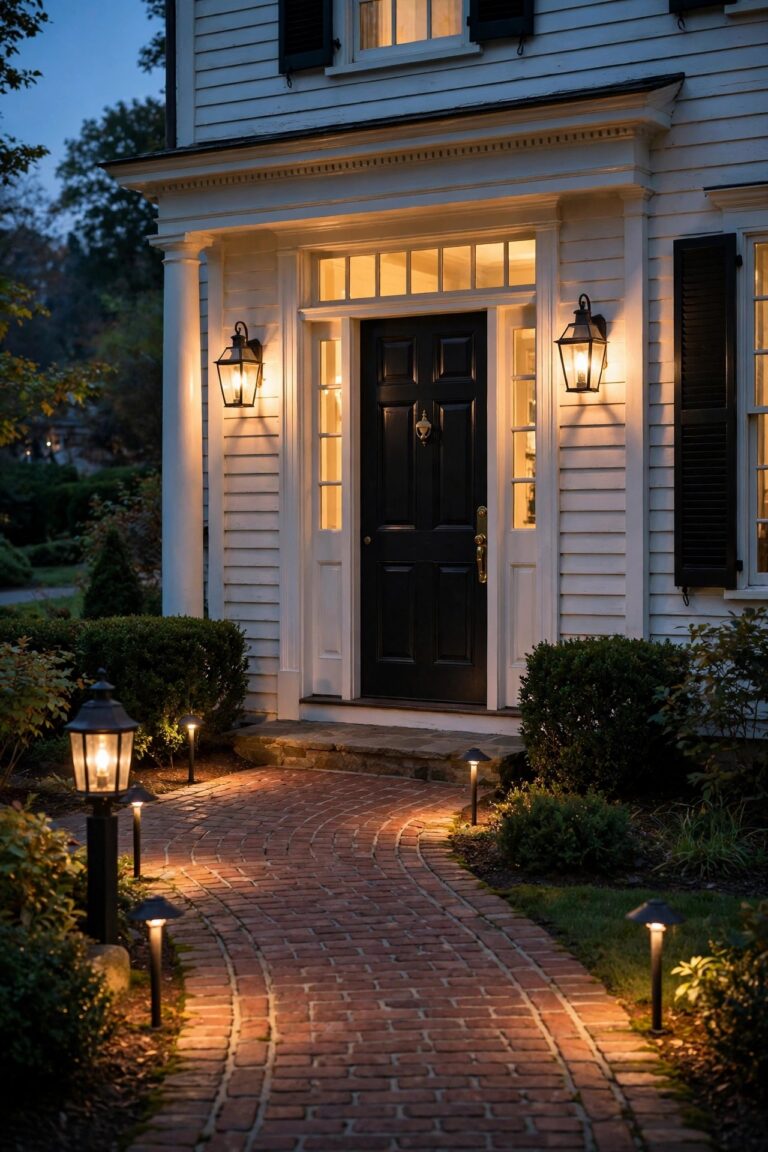
If your porch has no junction box, no outdoor outlet, and no budget for an electrician, I have good news: solar wall sconces have quietly become the easiest way to get that warm, flanking-the-door glow without running a single wire. The newest generation charges on a cloudy Tuesday and still greets you at the door on Friday night — most of my picks run eight to twelve hours on a single day's charge. In my experience, the secret is layering — a welcoming pair by the door, a little task light where you fumble for keys, and a soft wash along the steps — exactly the same philosophy I'd use with wired fixtures. In this post I'm sharing 17 solar wall sconce ideas for every porch style, from classic black lanterns to farmhouse goosenecks, plus the honest details that actually matter: where the panel needs sun, how high to mount them, and what each option really costs.

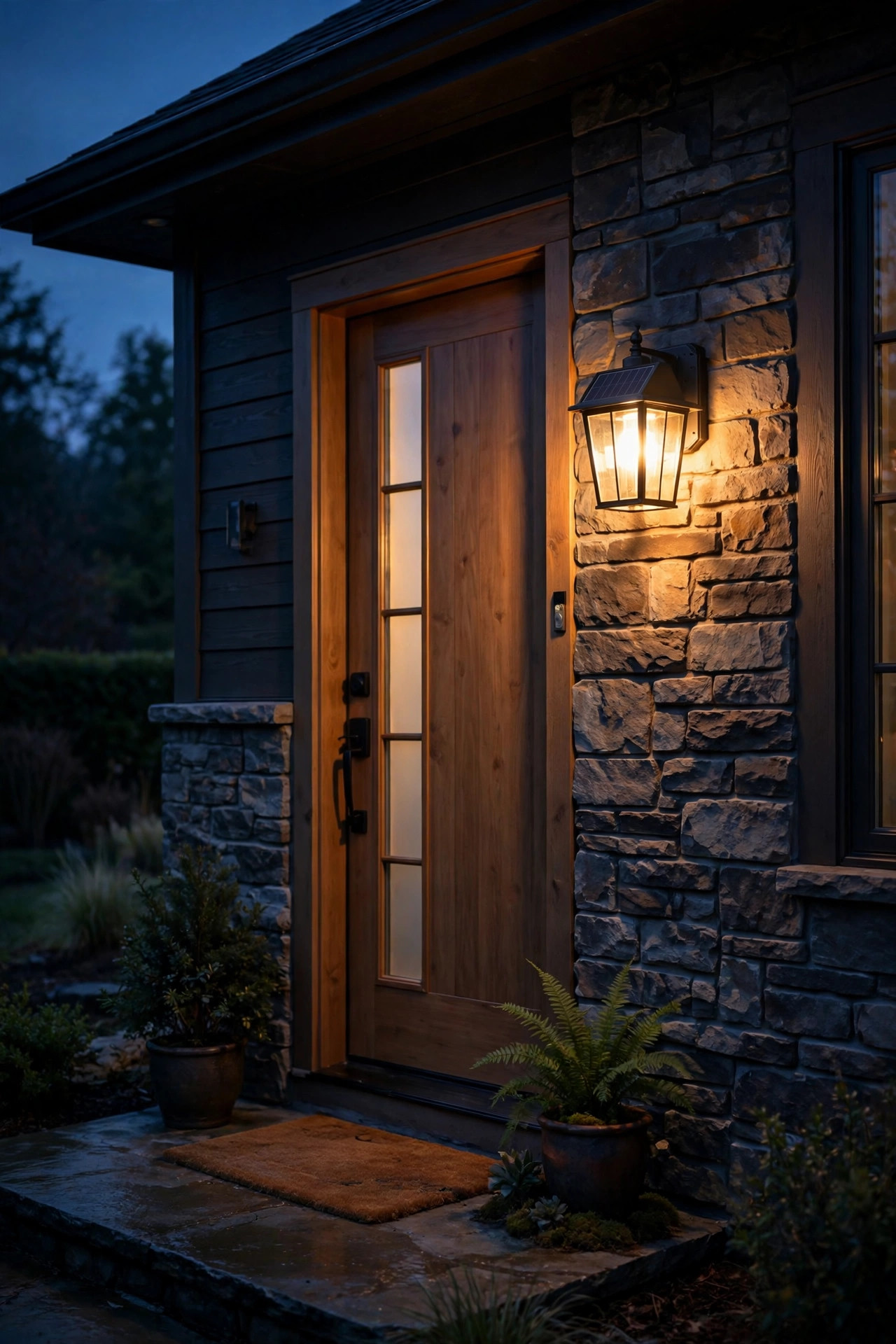
1. Classic Lantern-Style Solar Sconces Flanking the Front Door
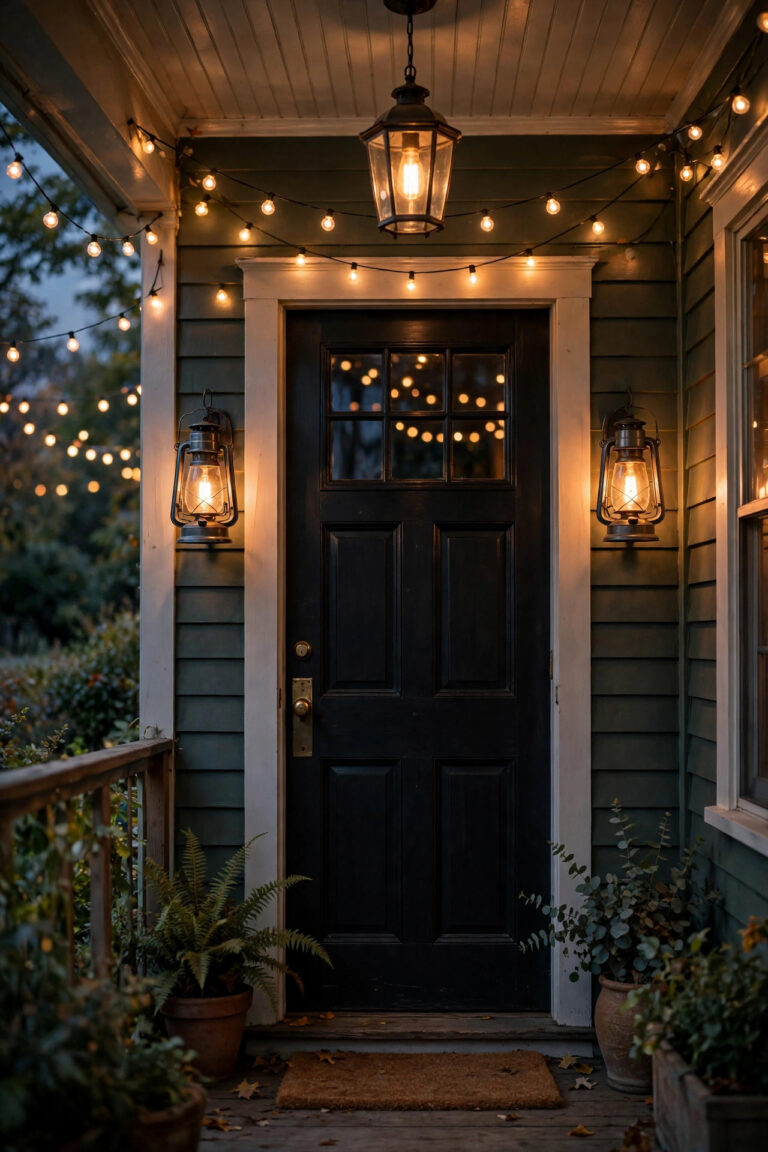
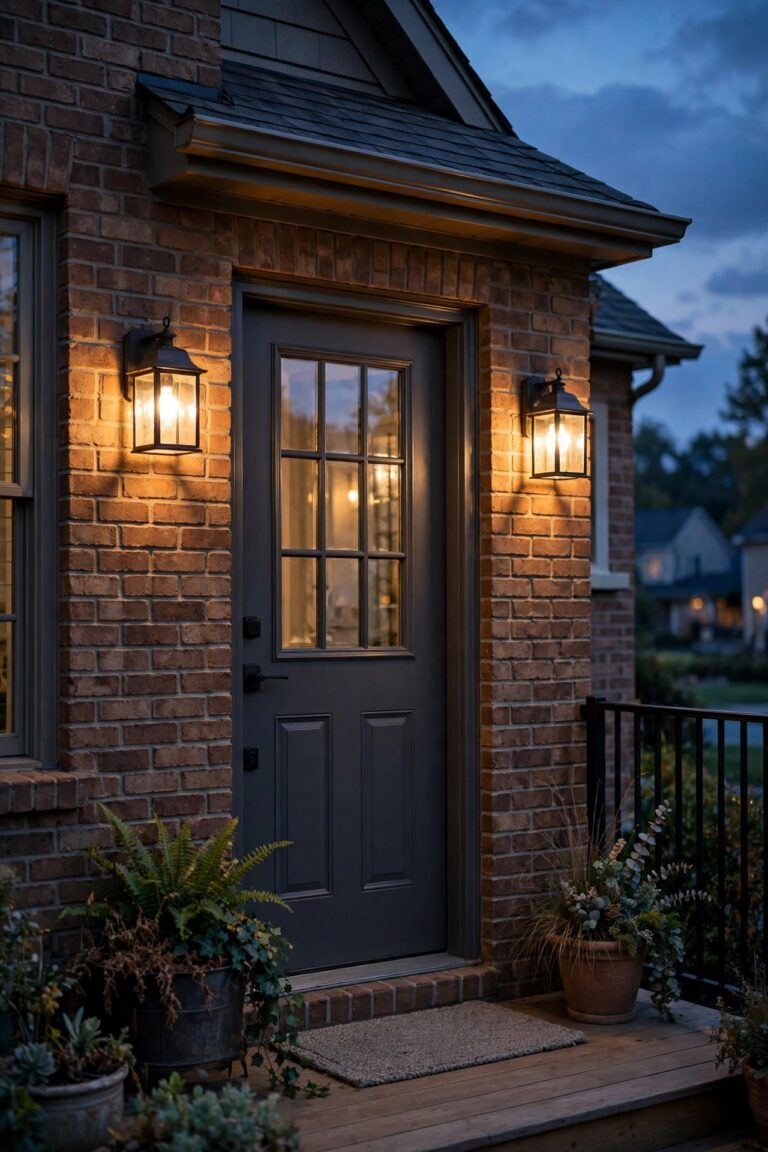
This is the look most of us picture: two black metal lanterns with clear glass, one on each side of the door, glowing like they were hardwired in 1920. Solar versions mount with just two screws each — no junction box, no electrician, about ten minutes per fixture. Hang them 66 to 72 inches from the porch floor, roughly at eye level, and keep the pair symmetric even if it means a stud finder and a little patience. Sizing matters more than people think: each sconce should be about one-quarter to one-third the height of your door, so a standard 80-inch door wants fixtures around 12 to 16 inches tall. Choose warm white output around 2700K so the glow reads candle-like instead of clinical. The one catch is the little solar panel on top — it needs a few hours of direct sun, so this style shines (literally) on south- and west-facing porches. If your entry is deeply shaded, skip ahead to idea #5. Styled with a seasonal wreath and a pair of planters, honestly, guests will never guess these run on sunshine.
Suggested budget range: $30 – $70.

2. Motion-Sensor Solar Wall Sconces for a Safer Entry
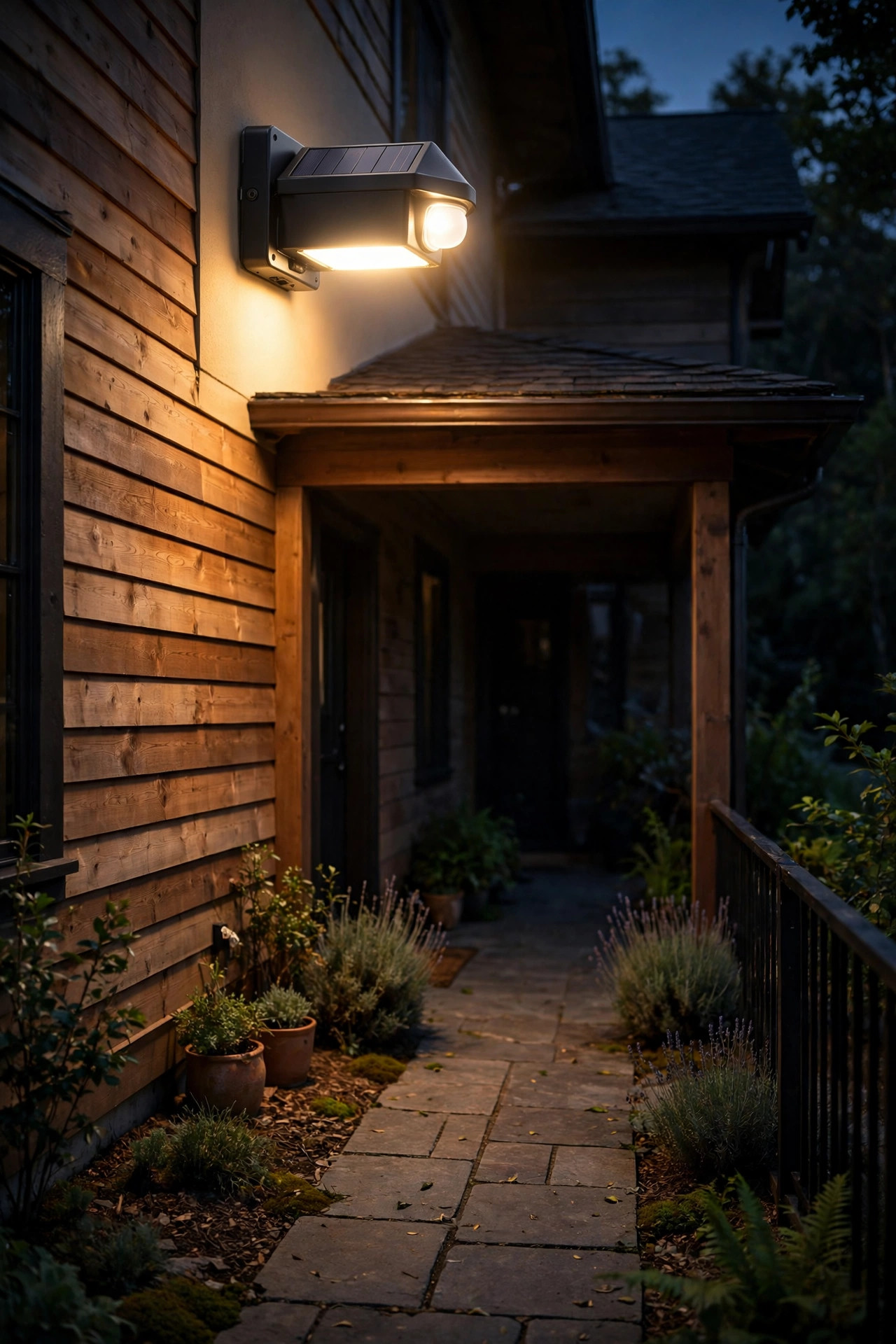
If your porch doubles as your security system, motion-sensor solar sconces are the hardest-working option on this list. They idle at a soft dim glow — just enough to see the doorstep — then jump to full brightness when someone walks up, usually 400 to 800 lumens, which is plenty to find a keyhole and check who's there. Look for a detection range of 10 to 16 feet and a 120-degree sensor angle; mount them about 7 to 8 feet high so the sensor watches the walkway, not the street. I always recommend models with adjustable sensitivity, because a fixture that fires for every passing car will drain its battery by midnight and annoy the whole neighborhood. These are wonderful for side doors, back porches, and the garage-adjacent entries we all actually use most. One honest note: in deep winter, when nights run 14 hours, the battery may fade before dawn — that's normal physics, not a defect. Pair one motion sconce with one dusk-to-dawn fixture (idea #6) and you get security plus an all-night welcome.
Suggested budget range: $25 – $60.
3. Up-Down Solar Sconces for a Modern Wash of Light
For a clean, modern porch, up-down solar wall sconces throw two fans of light — one washing up the siding, one pooling down — and the effect looks far more expensive than it is. The fixtures are usually simple cylinders or slim rectangles in matte black or brushed nickel, which suits mid-century, contemporary, and minimalist farmhouse exteriors alike. They work best on a flat, unobstructed wall section: brick, smooth siding, or stucco all show off the beam pattern beautifully. Mount them at about two-thirds of the wall height, and space a pair at least 6 to 8 feet apart so the light fans don't collide into one bright blob. Because the panels sit on top of a fairly small fixture, these need genuinely good sun — an unshaded stretch of wall is non-negotiable. Brightness is modest, typically 100 to 200 lumens, so think of these as architecture-accenting mood light rather than task light, and layer them with path lights below. If you've browsed my front porch lighting ideas before, you know this is the layered look I come back to again and again.
Suggested budget range: $35 – $80.

4. Farmhouse Gooseneck Solar Sconces
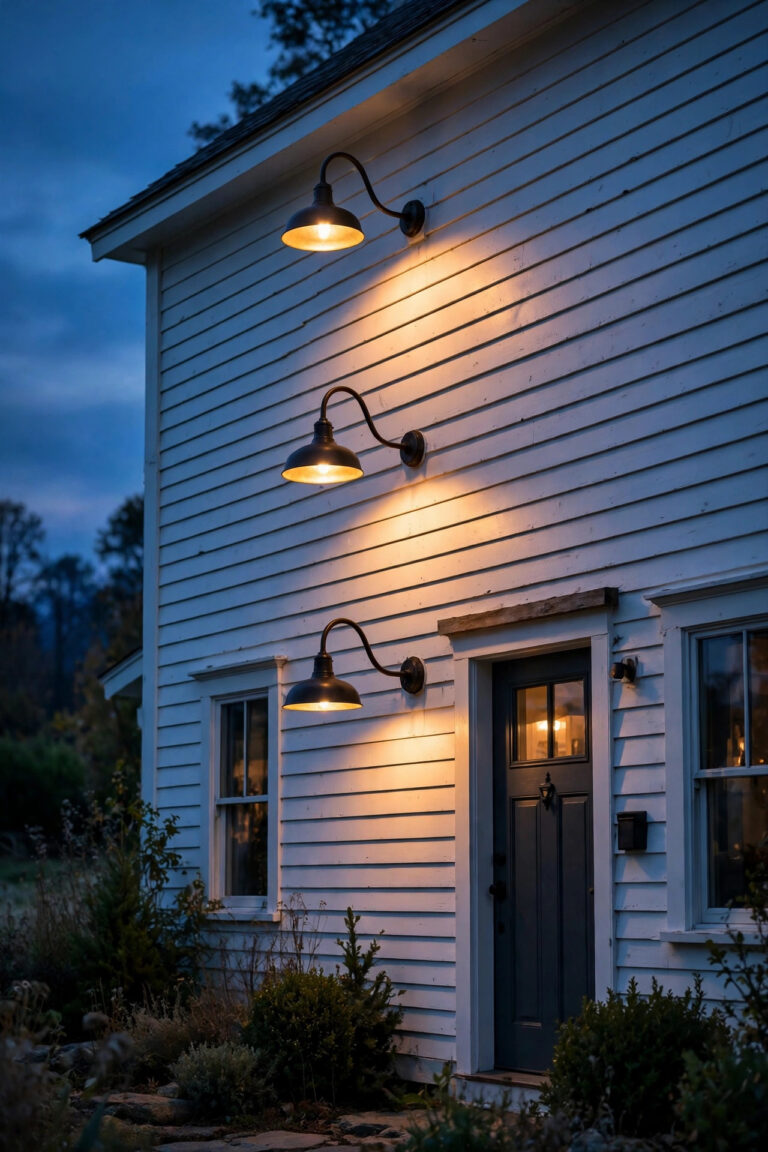
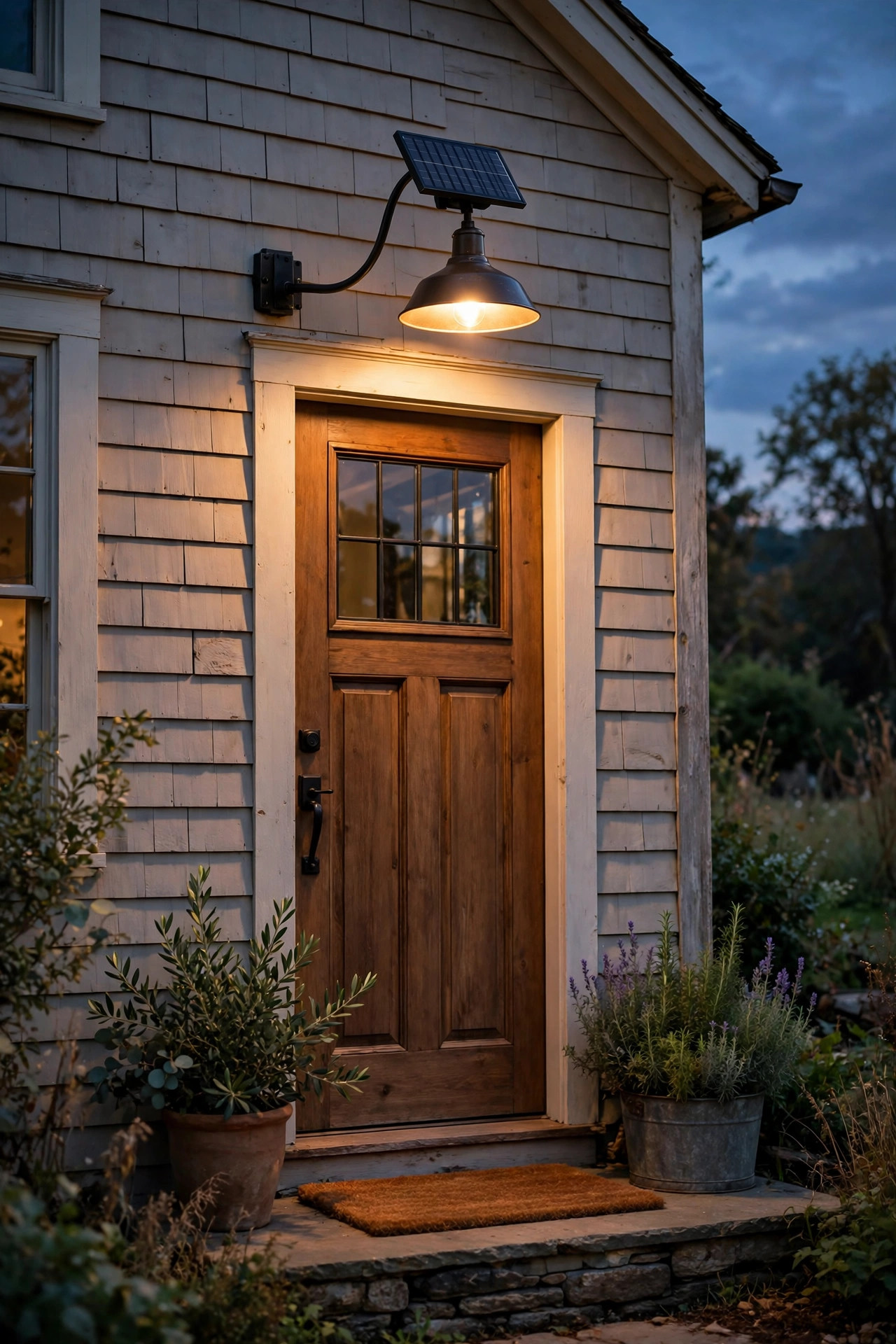
A curved gooseneck arm and a wide metal shade — it's the barn-light silhouette everyone loves, now in a solar version that screws straight onto the wall. I love these over a front door on a farmhouse or cottage porch, where the downward throw of light pools right on the welcome mat and lights up house numbers beautifully. Choose a shade around 10 to 12 inches wide for a front door; smaller 7-inch versions suit side doors and mudroom entries. Matte black is classic, but a galvanized or oil-rubbed bronze finish softens the look against white board-and-batten siding. The solar panel usually sits on top of the shade, tilted slightly, so wipe it down a few times a year — a dusty panel is the number one reason these underperform. Because the light points down, glare stays low and the mood stays warm, especially in 2700K. One installation tip from my own porch: pre-drill into brick or fiber-cement siding and use the included anchors; into wood, the screws bite fast and the whole job takes fifteen minutes.
Suggested budget range: $40 – $90.
5. Solar Sconces With Separate Panels for Shaded Porches
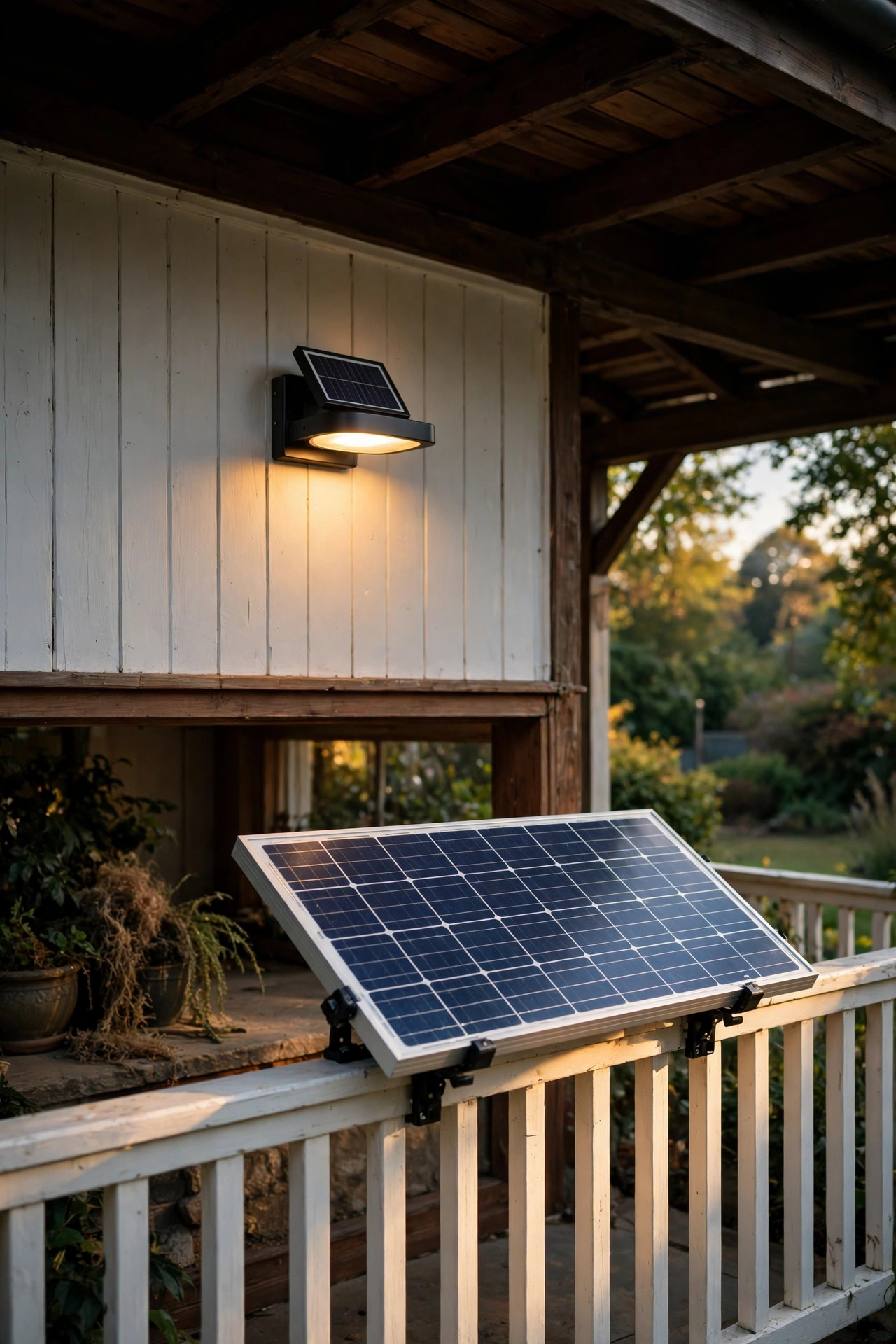
Here is the idea that saves every covered, north-facing, tree-shaded porch: sconces with a detachable solar panel on a cable. The fixture mounts in the shade where you need the light, and the panel travels 6 to 16 feet away to wherever the sun actually lives — a railing top, the porch roof edge, a sunny fence post. This is exactly how I lit my own covered entry, and it changed everything. Run the cable neatly along trim and secure it with small clips so it disappears. Angle the panel south if you can, tilted up about 30 to 45 degrees, and clear of overhanging branches. Because the panel is bigger than the built-in kind, charging is faster and winter performance is noticeably better. These cost a little more, but honestly, for a porch that gets less than four hours of direct sun, they are the only solar option I'd buy — everything else will leave you disappointed by November. It's the same no-electricity thinking behind my favorite front yard lighting ideas with no electricity, applied right at your front door.
Suggested budget range: $45 – $95.
6. Dusk-to-Dawn Solar Sconces That Glow All Night
Some of us just want the porch lit when we come home, period — no sensors, no surprises. Dusk-to-dawn solar sconces use a small photocell to switch on at twilight and run until sunrise or until the battery gives out, whichever comes first. The trick is managing expectations: a fixture that burns all night runs dimmer by design, usually 30 to 100 lumens, which reads as a warm candle-style glow rather than a floodlight. Look for battery capacity of at least 2,000 mAh and a stated runtime of 10+ hours; oversized panels on top help enormously in winter. I keep two of these flanking my door from October through February, when the evenings feel longest, and the house simply looks lived-in and loved. They pair beautifully with brighter solar path lights along the walk — sconces for welcome, path lights for footing. Avoid placing them directly under a bright streetlight, which can fool the photocell into switching off; a foot or two of shadow solves it. Simple, steady, and quietly beautiful.
Suggested budget range: $30 – $65.
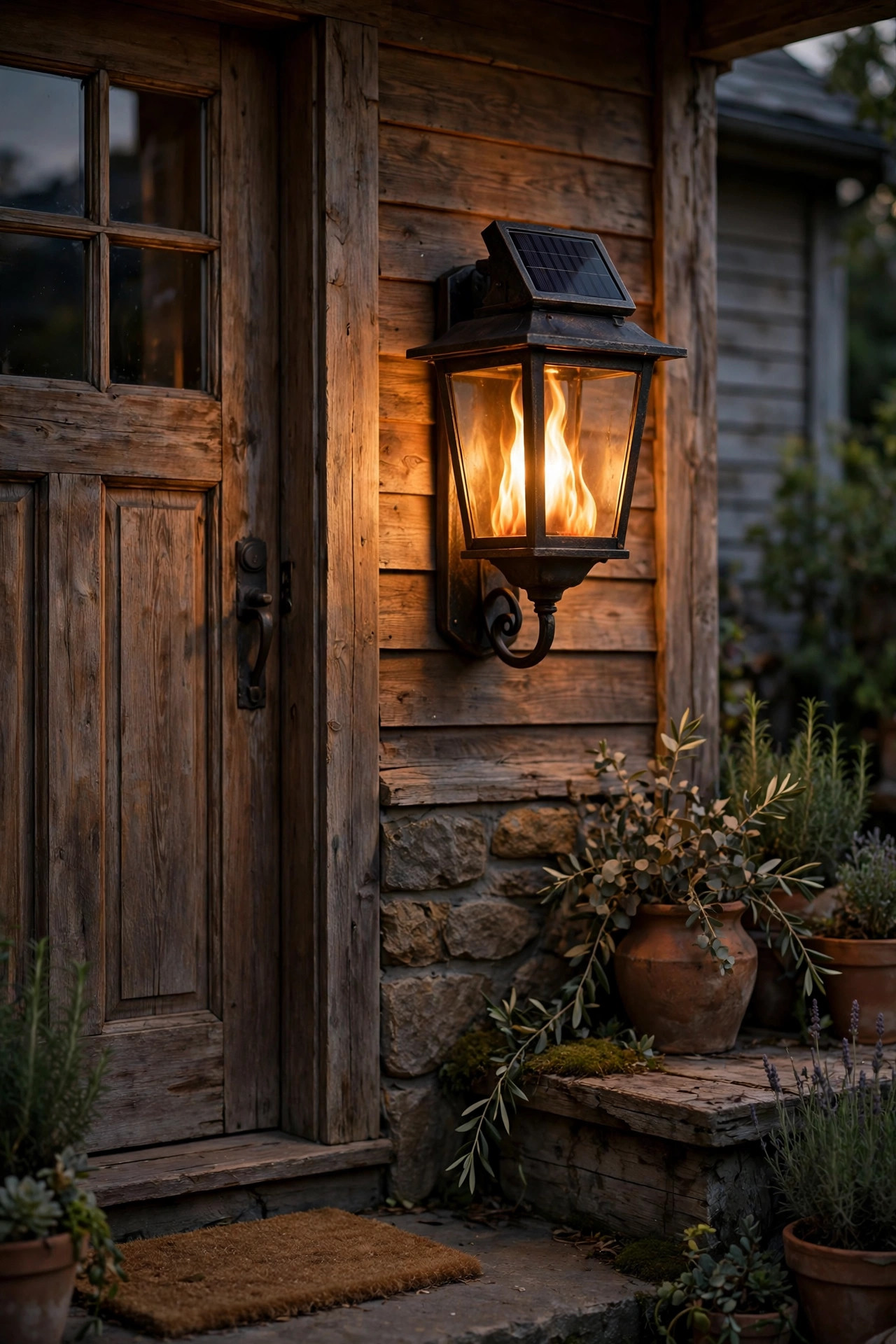
7. Flame-Effect Solar Sconces for a Cozy, Flickering Glow
If cozy is your whole personality (same), flame-effect solar sconces replace the steady bulb with a cluster of LEDs that dance and flicker like a real torch flame. The effect is surprisingly convincing from the sidewalk, and it turns an ordinary Tuesday evening on the porch into something that feels like a cabin getaway. These suit rustic, craftsman, and boho porches especially well, and they're magical flanking a door dressed with fall garlands or summer ferns. Output is low — these are ambience, not illumination — so I like to pair them with discreet solar step lights so nobody misses a stair in the pretty dark. Because there's no real flame, they're safe near wreaths, dried arrangements, and wooden doors, which is more than I can say for actual lanterns with candles. Choose warm amber tones (around 1800–2200K color feel) for the most realistic flicker, and check that the housing is rated IP44 or better so rain doesn't sneak into the electronics. Battery life is usually excellent since the LEDs sip power.
Suggested budget range: $25 – $55.
8. Oversized Statement Solar Sconces for Tall Entries
Two-story foyers, tall transom windows, grand covered entries — small fixtures get swallowed by big architecture. Oversized solar sconces, 18 to 24 inches tall, give a tall entry the proportion it deserves and read as a deliberate design choice from the street. The general rule I use: the fixture should be roughly one-quarter to one-third the height of the door surround, trim included. Big fixtures also carry bigger panels and batteries, so runtime and brightness often beat their smaller cousins — a happy bonus. Mount them centered on the trim or pilasters, and if your entry has columns, placing the sconces on the columns themselves (idea #9 covers narrow ones) creates a gorgeous gateway effect. Finishes like aged bronze or matte black keep the look grounded rather than flashy. One caution: these are heavier, so anchor into solid framing or use proper masonry anchors — drywall-style anchors in siding alone won't hold through a storm season. When the proportions are right, an oversized pair makes the whole front of the house look custom-built.
Suggested budget range: $60 – $140.

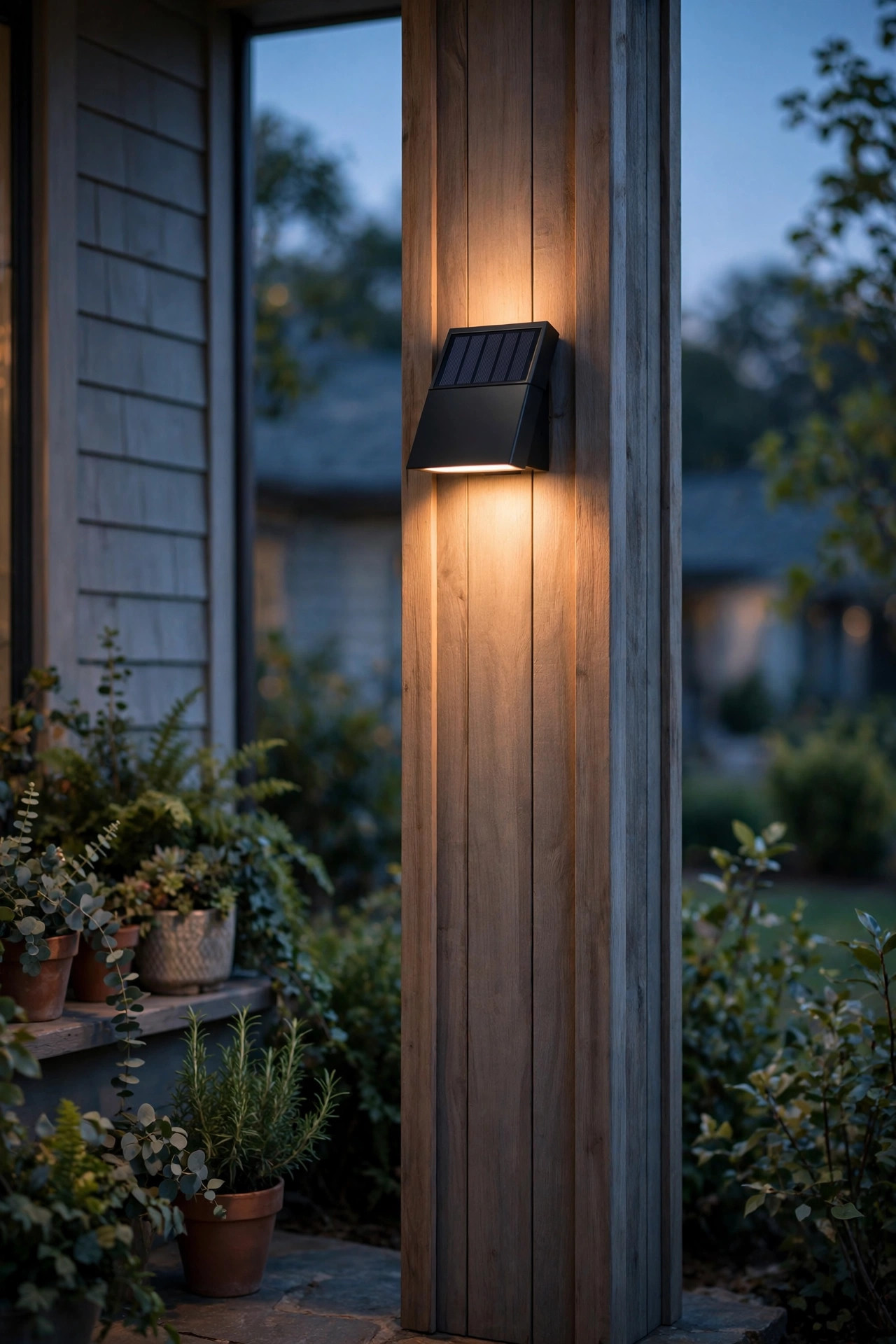
9. Slim Solar Sconces for Narrow Porch Columns and Trim
Not every porch gives you a wide, flat wall. If your door is framed by narrow columns, slim trim boards, or tight brick returns, standard sconces simply don't fit — and that's where slim-profile solar sconces, just 3 to 5 inches wide, earn their keep. Many are designed to mount vertically on a column face, throwing light both outward and softly down the column for a subtle architectural highlight. Because the footprint is small, installation is forgiving: two short screws, and if you're renting, heavy-duty outdoor mounting tape handles the lighter models surprisingly well. Brightness is modest, so buy these in pairs or even fours — a slim sconce on each column of a two-column porch looks intentional and balanced. Check the panel position before you buy; on the slimmest models the panel faces straight up, which works on open porches but struggles under deep roofs. For covered porches, choose a slim model with a front-tilted panel or go back to the separate-panel style in idea #5. Small fixtures, big difference in how finished an entry feels.
Suggested budget range: $20 – $45.
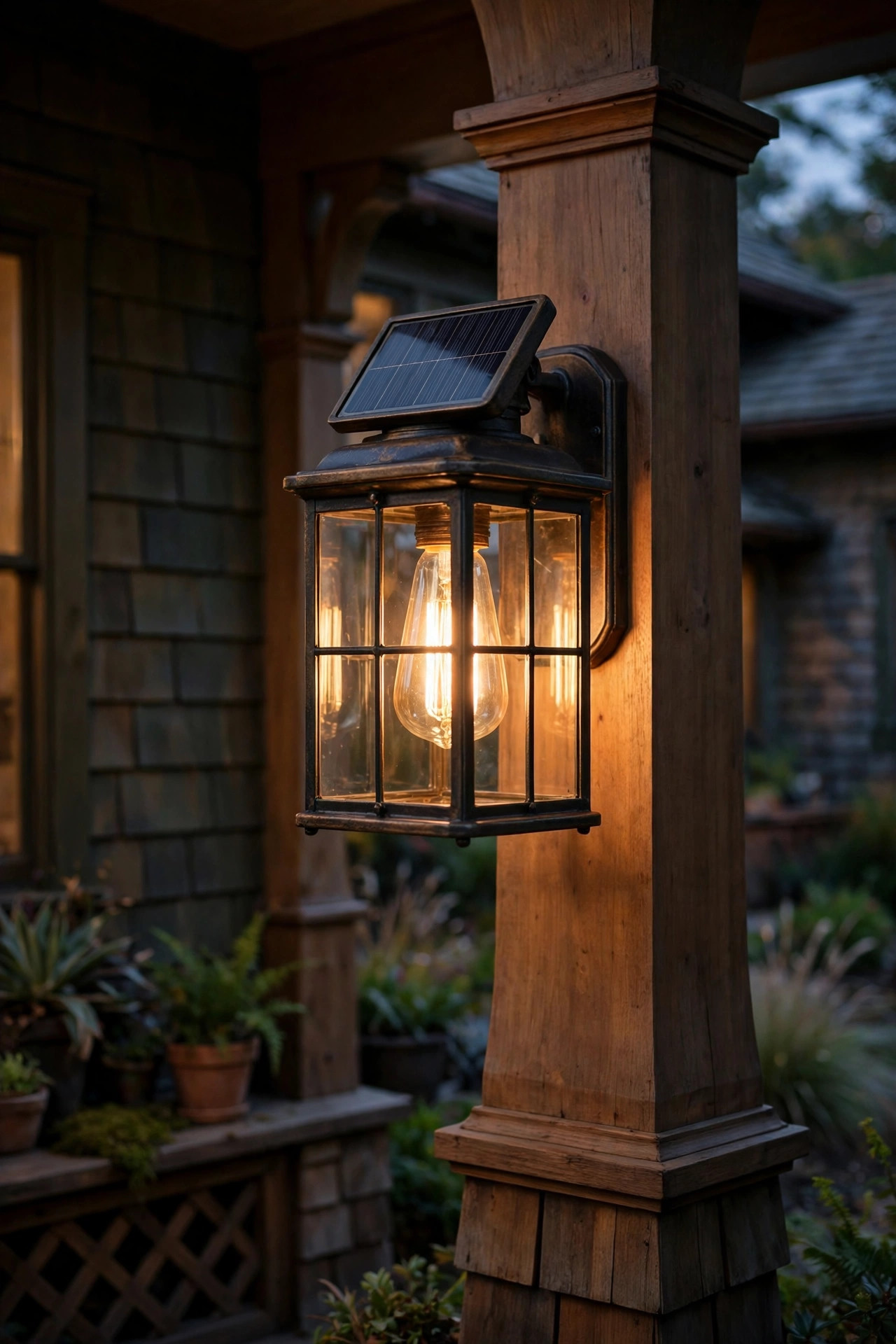
10. Filament-Style Solar Sconces With a Vintage Edison Glow
There's something about a visible filament bulb behind clear glass that makes a porch feel instantly warm and storied. Solar versions now use LED filaments that mimic the old Edison look — a gentle 2200K to 2700K amber glow — while sipping so little power that runtime stretches to 10 or 12 hours. The clear glass shows off the filament, so these fixtures double as decor even at noon; seeded or lightly smoked glass softens the look further and hides fingerprints. I reach for this style on craftsman bungalows, colonial revivals, and any porch with a wooden door, where the vintage note just belongs. Keep the glass clean with a quick wipe when you clean the panel — dusty glass dims the prettiest bulb. These are ambience-first fixtures, usually under 100 lumens, so layer them with a brighter task light near the lock if your porch is your main nighttime entrance. Honestly, of everything on this list, this is the style that gets me the most compliments from neighbors walking past at dusk.
Suggested budget range: $35 – $75.
11. Dual-Mode Solar Sconces: Dim All Night, Bright on Motion
Can't decide between the all-night glow of idea #6 and the security burst of idea #2? Dual-mode sconces do both: they hold a low, warm standby light from dusk to dawn, then flare to full brightness for 20 to 30 seconds when the sensor trips. In my experience this is the single best configuration for a main entry, because you get the welcoming look without burning the battery on full blast all night. When you shop, look at the standby-to-bright ratio — a gentle 20-lumen idle jumping to 300+ lumens on motion is the sweet spot. These fixtures also tend to have larger batteries, since the design assumes all-night duty. Place them where the sensor's view covers your approach path; a sconce beside the door watching the steps beats one watching the street. If your porch serves double duty as your package-drop zone, the motion flare also gives delivery drivers light exactly when they need it. It's the configuration I'd hand a friend who said "just tell me which one to buy."
Suggested budget range: $40 – $85.
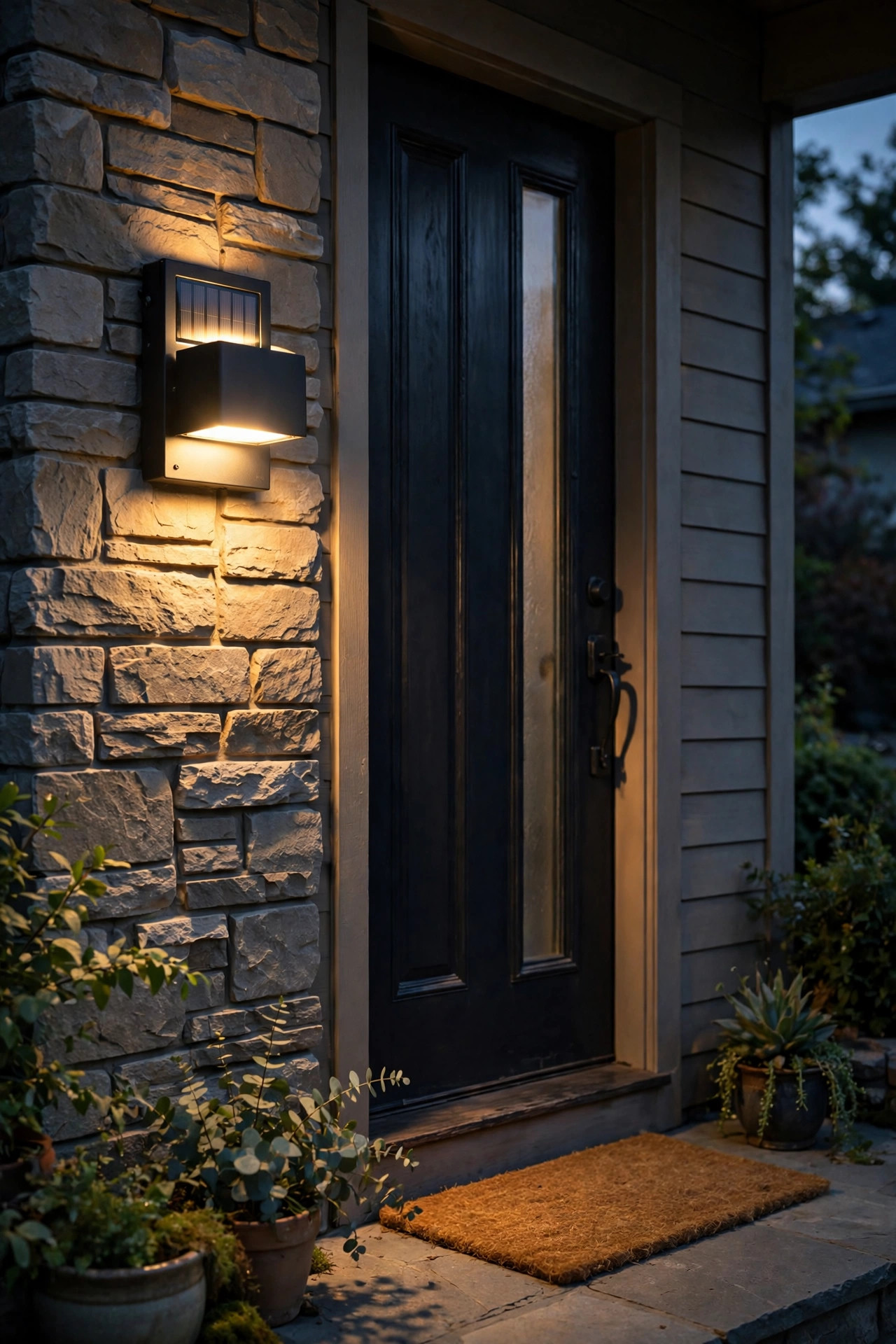
12. A Row of Solar Sconces Down the Porch Steps
Steps are where dark porches actually become dangerous, so a short row of small solar sconces along the stair wall or railing wall is one of the smartest buys on this list. Mount them low — about 12 to 18 inches above each tread line, or evenly spaced every second or third step — so the light pools on the treads themselves rather than shining in your eyes. Downward-facing or shielded styles work best here; you want to see the edge of each step, not the bulb. Because they're small and low, these fixtures often hide in plain sight during the day, which design purists love. Solar step sconces are inexpensive enough to buy in sets of four or six, and matching the finish to your door sconces keeps the whole entry reading as one designed scheme. A practical note: the lowest fixture in the row gets the most splashed rain and kicked-up mulch, so choose IP65-rated models for this job and give them a quick rinse when you sweep the porch. Safety lighting that also looks like a boutique hotel entry? Yes, please.
Suggested budget range: $15 – $40.
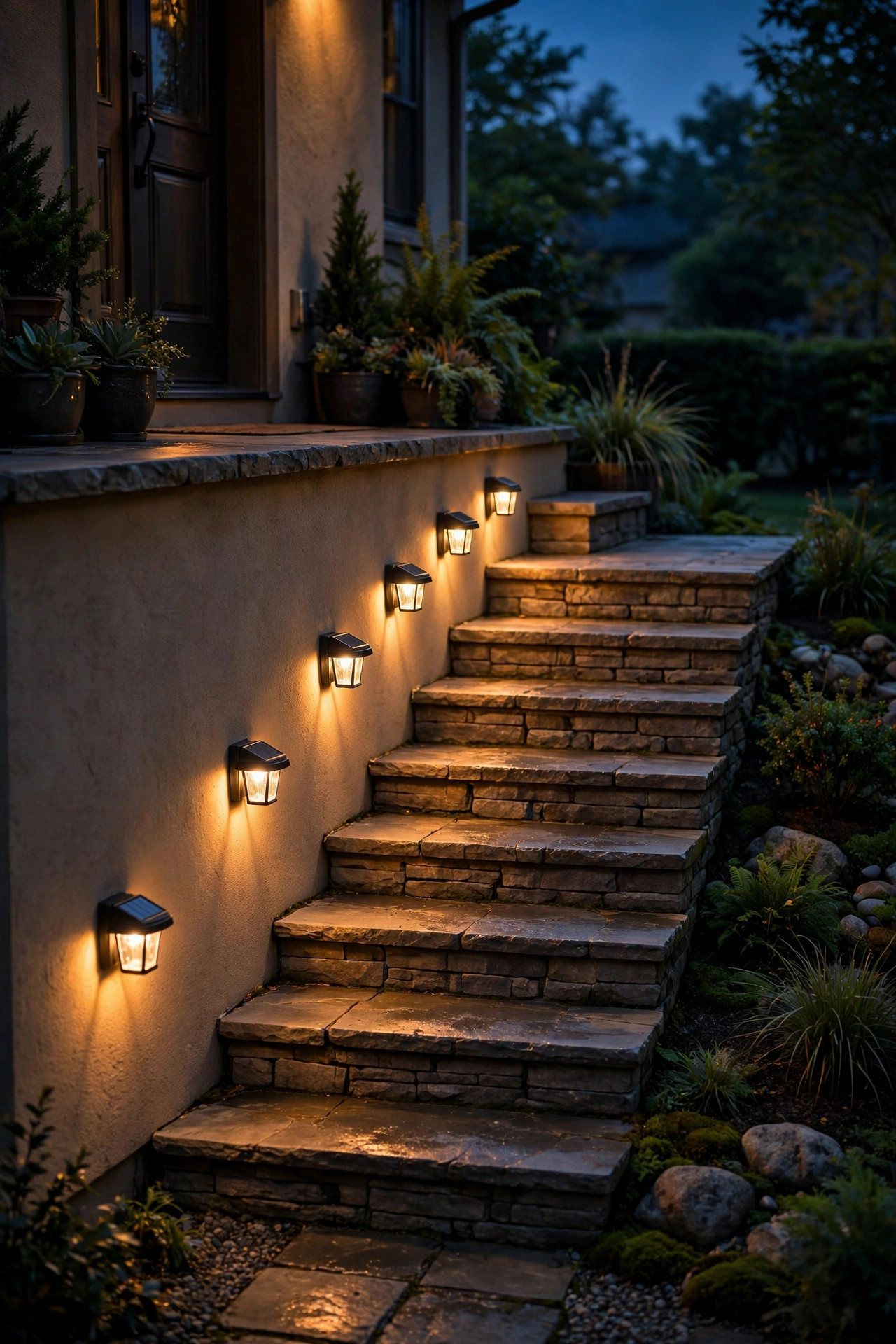
13. Corner-Mount Solar Sconces for Wraparound Porches
Wraparound porches have a lighting problem at the corner: a flat-wall sconce lights one side and abandons the other. Corner-mount solar sconces solve it with a bracket or angled housing that throws light in both directions around the bend, so the whole L-shaped porch stays connected after dark. Mounted at the corner column, one fixture does the work of two — helpful when your budget or your sun exposure is limited. Look for designs with light panels on two faces, or a curved diffuser that wraps the corner. These are also lovely at the corner of a garage or the turn of a side porch where guests round the house to the backyard. Keep mounting height consistent with your door sconces, around 66 to 72 inches, so the porch reads as one intentional scheme rather than a collection of gadgets. Battery and panel sizes vary a lot in this niche category, so favor models with at least 1,500 mAh capacity. When the corner glows, the entire porch suddenly looks twice as big from the street.
Suggested budget range: $35 – $80.
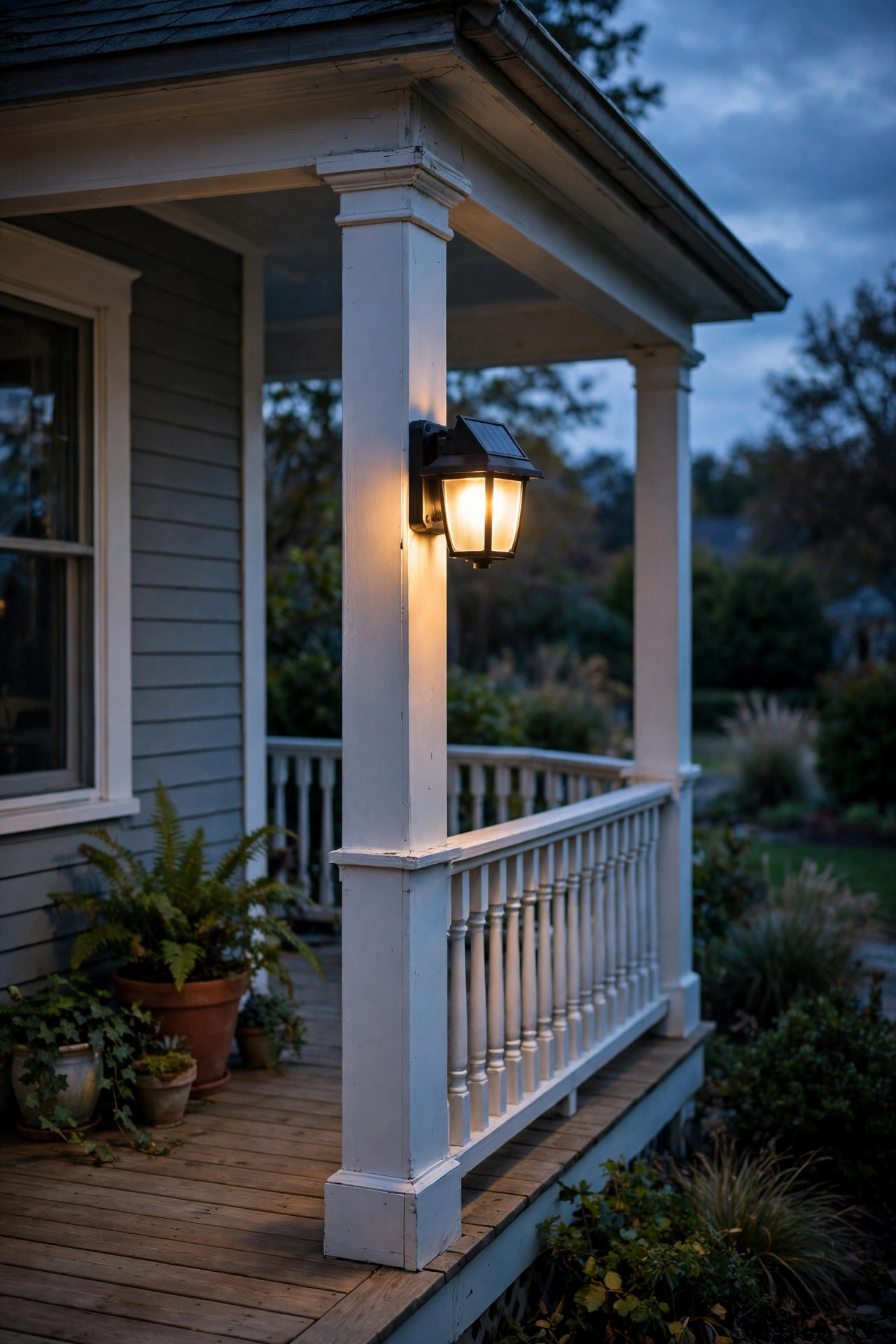
14. Solar Sconces With USB Backup Charging for Cloudy Weeks
Here's the honest truth about solar: a week of Pacific Northwest rain or a snowy Midwest December will humble any panel. Sconces with removable battery packs or USB charging ports let you top up indoors when the weather refuses to cooperate — pop the pack out, charge it overnight, and your porch never goes dark. This feature matters most for dusk-to-dawn styles and for porches under heavy tree cover, where charging is marginal even in summer. Some models go further with hybrid designs: solar first, USB as a genuine second source. When comparing, check whether the battery is a standard replaceable size, because a proprietary pack that's discontinued in three years turns the fixture into e-waste. I keep one USB-backup pair on my shadiest wall and charge them maybe four times a winter — a tiny chore for a never-dark entry. If you're weighing solar against low-voltage for a tricky spot, my solar vs wired landscape lighting comparison walks through the trade-offs honestly.
Suggested budget range: $45 – $100.

15. Rustic Wood-and-Metal Solar Sconces
For cabin, craftsman, and lodge-style porches, an all-metal fixture can feel a little cold — wood-and-metal solar sconces bring the warmth. Think a weathered cedar or acacia backplate with a black metal cage or shade, glowing like a lantern hung by the cabin door. The wood softens the fixture against log siding, stone veneer, and natural cedar doors in a way painted metal just can't. A few care notes from experience: choose fixtures where the wood is genuinely sealed or made from naturally rot-resistant stock, and expect to re-oil the backplate every year or two, just like a wooden door. Mount them slightly under the porch roof edge if you can, since standing water on a horizontal wood surface is the enemy. The solar panel usually rides on top of the metal shade, discreet and effective. Pair these with a coir doormat, a couple of enamel planters, and maybe a wool-plaid pillow on the porch bench, and the whole entry leans into that mountain-lodge welcome. Rustic porches forgive a lot, but they reward fixtures that match their materials.
Suggested budget range: $50 – $120.
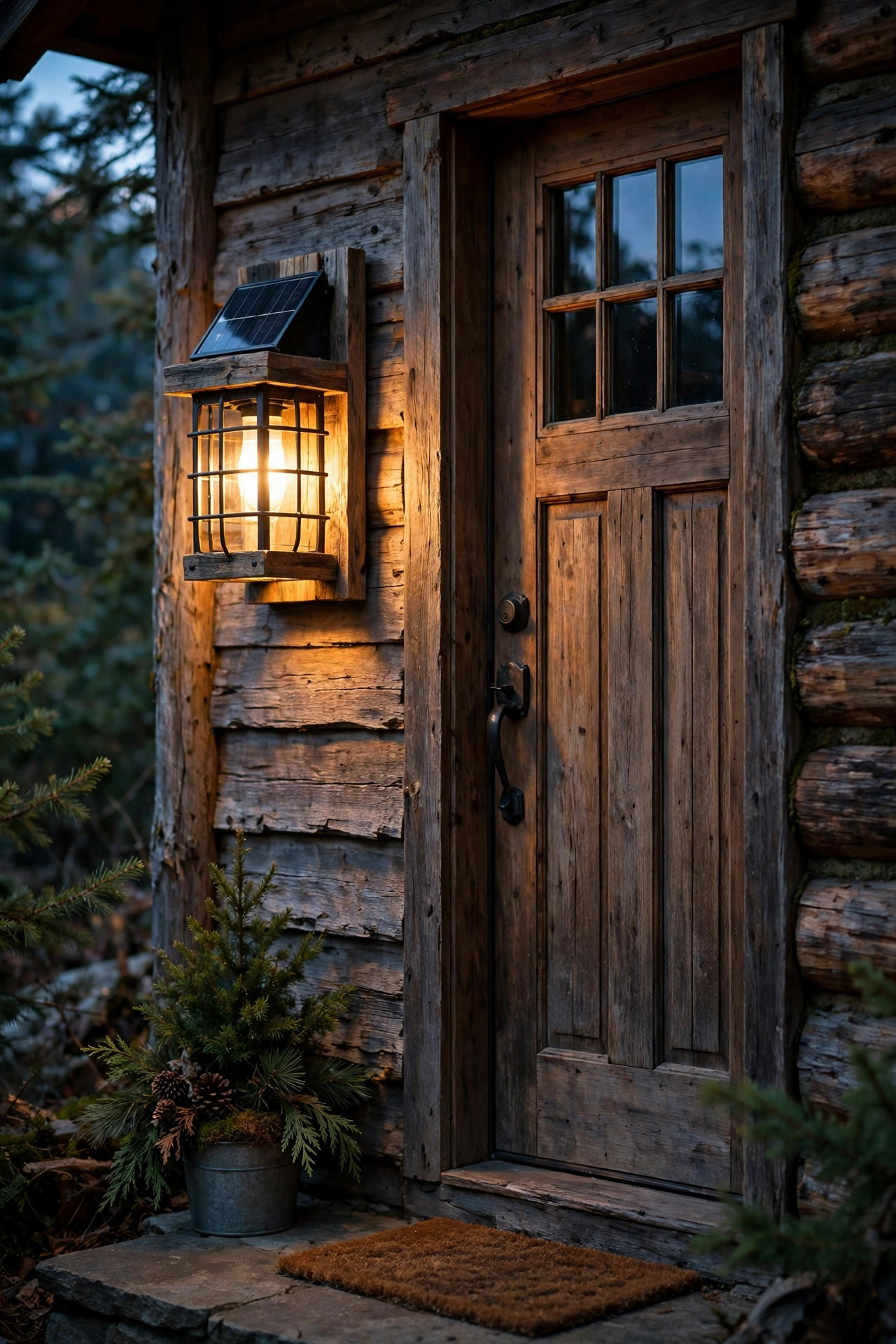
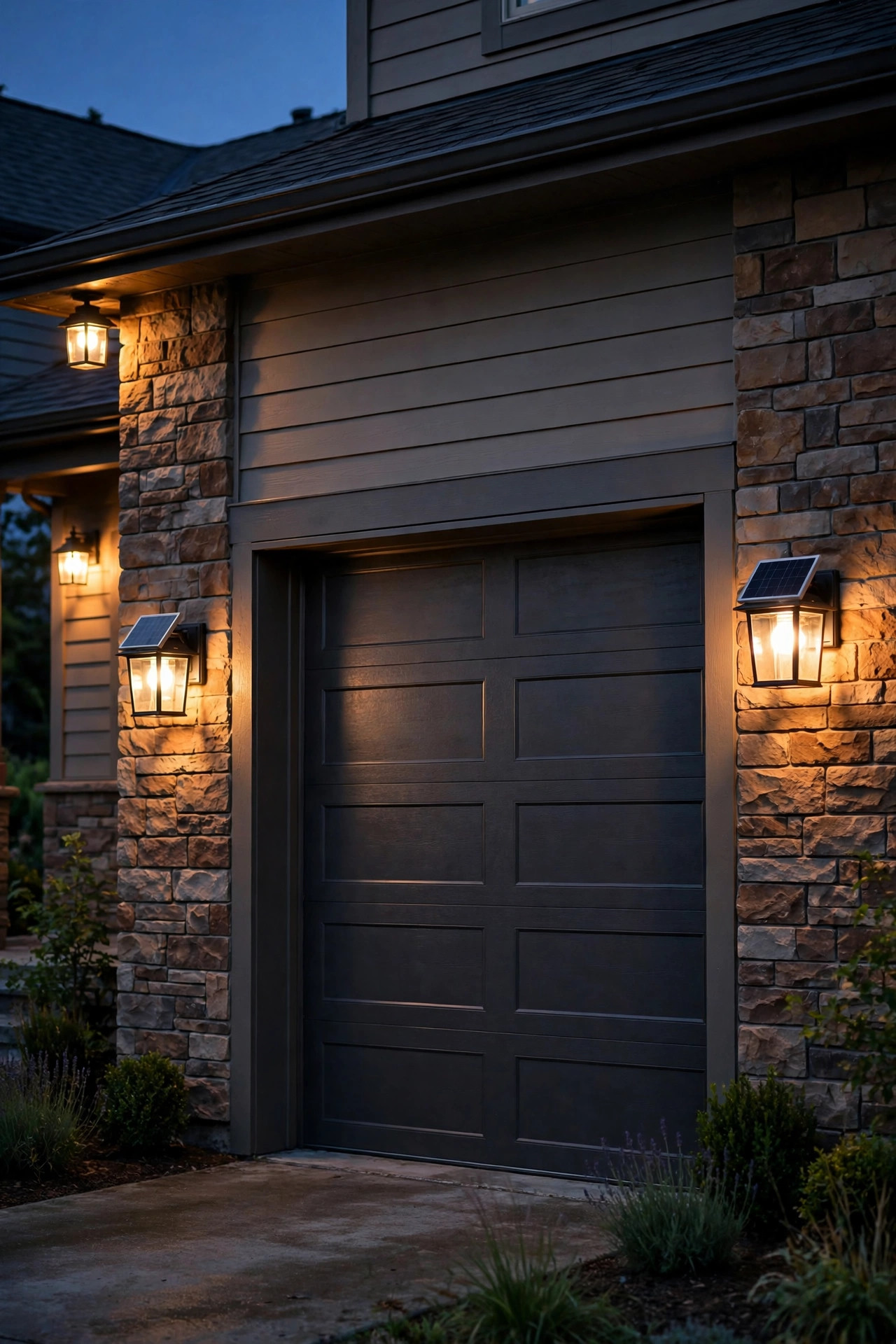
16. Matching Solar Sconces Flanking the Garage Door
Your porch sconces don't have to stop at the porch. Adding a matching solar pair beside the garage door ties the whole front of the house together, and since most garages sit in full sun, the panels charge beautifully — these are often the best-performing solar fixtures on the property. Use the same size rule as the front door: roughly one-quarter to one-third the height of the garage door, mounted 66 to 72 inches up on the trim or pillars between doors. Matching the porch fixtures exactly creates that custom, builder-grade look; if your porch style is discontinued, match the finish and silhouette family as closely as you can. Motion-sensor models make extra sense here, lighting the driveway apron as you pull in, while dusk-to-dawn models keep the facade looking composed all evening. One practical caution: garage walls often have hose bibs, vents, and trim quirks, so measure your mounting surface before ordering — you need a flat patch at least as wide as the fixture's backplate. The result is curb appeal that looks professionally lit, with zero trenching.
Suggested budget range: $30 – $70.
17. Smart Solar Sconces With Remotes and Timers
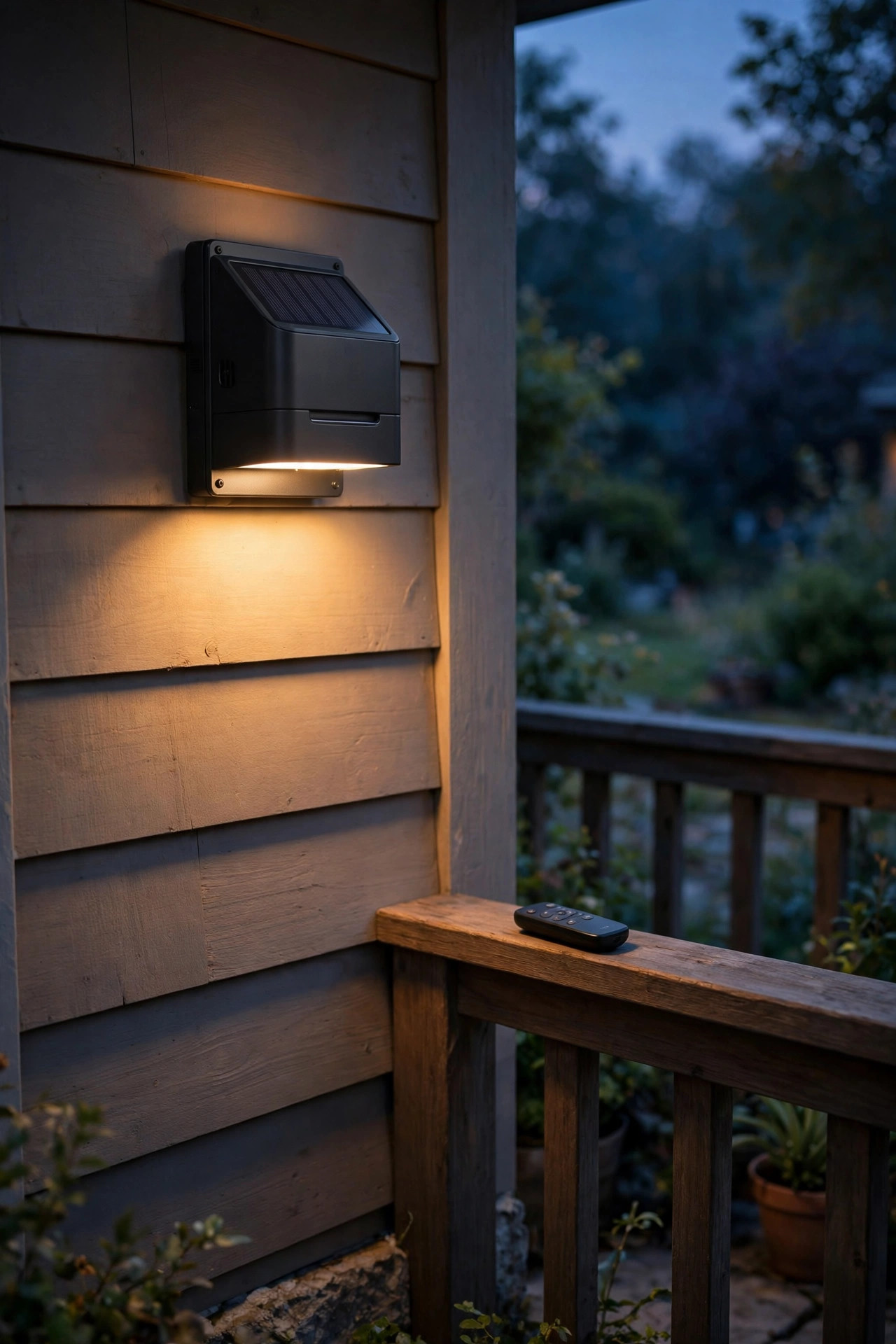
The newest solar wall sconces borrow tricks from smart lighting: a little remote or app-free timer control that lets you set brightness, choose a 4-, 6-, or 8-hour runtime instead of all-night, and sometimes switch color temperature between warm 2700K and a crisper 4000K. The timer feature is the real star — instead of the fixture dying at 3 a.m. in winter, you tell it to run from dusk for exactly six hours at a steady brightness, and it budgets its battery accordingly. That's how you get consistent light for evening porch-sitting without the sad fade. Remotes typically work through the porch door glass, so you can bump the brightness from the couch when guests arrive. These cost more and the electronics are more complex, so buy from listings with clear battery specs and at least a one-year warranty. I wouldn't put smart models on every wall — one or two at the main entry, where you actually linger, is the sweet spot. It's solar lighting, finally, on your schedule instead of the sun's.
Suggested budget range: $55 – $130.
Frequently Asked Questions
How bright are solar wall sconces compared to wired porch lights?
Most solar wall sconces produce 30 to 200 lumens in steady mode, while motion-sensor models can burst to 400–800 lumens. A wired porch light with a standard bulb is around 800 lumens, so solar reads dimmer on paper — but for doorway welcome light, 100 well-placed lumens looks surprisingly warm and sufficient. For task-level brightness, choose a dual-mode or motion model, or pair sconces with solar path lights.
Will solar sconces work on a shaded or north-facing porch?
Built-in-panel models need roughly 4 to 6 hours of direct sun to charge fully, so a deeply shaded porch will leave them dim and short-lived. The fix is a separate-panel sconce (idea #5): mount the fixture in the shade and run its panel to a sunny railing or roof edge. USB-backup models (idea #14) are the other good answer for chronically low-sun porches.
How do I install solar wall sconces — do I need an electrician?
No electrician and no wiring at all. Most models mount with two screws into siding, trim, or masonry anchors, and the job takes 10 to 20 minutes per fixture with a drill and a level. Charge the battery in full sun for a day before first use — most fixtures ship with a partial charge and an on/off switch that must be set to "on" to charge at all.
Do solar wall sconces work in winter?
Yes, but with shorter runtimes: winter days charge less and winter nights run up to 14 hours. Bigger panels, separate-panel designs, and timer modes that cap runtime at 6 to 8 hours all help. Clear snow and dust off the panel, and angle it toward the low winter sun. Expect a well-matched fixture to still give you a reliable evening glow.
Conclusion
The best solar wall sconces prove that a porch without wiring isn't a porch without options — it's a porch with seventeen of them. Start with the pair that solves your biggest problem: separate panels if your entry is shaded, dual-mode if you want welcome plus security, classic lanterns if style is the whole point. Keep the panels clean, mount at eye level, and layer in step or path lights where feet actually land. Browse more of my porch and outdoor lighting ideas here on the site, and you'll have an entry that glows like it was wired by a pro — with a ten-minute install and a zero-dollar electric bill.