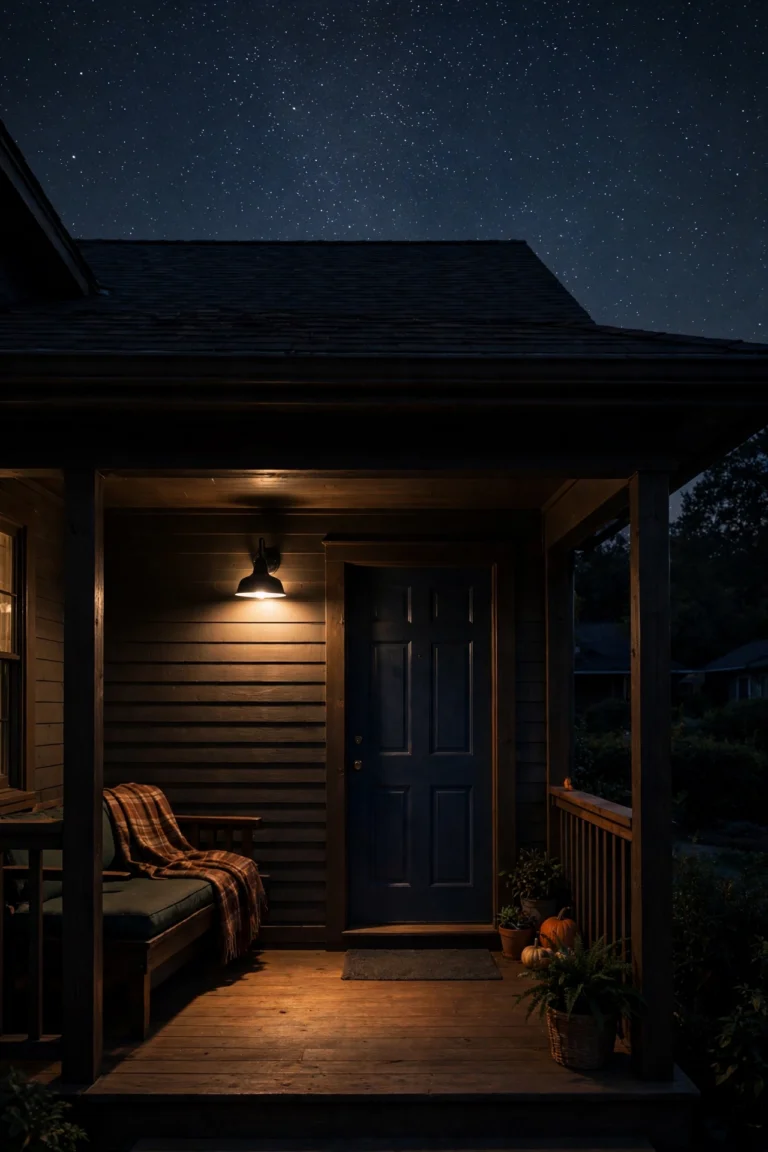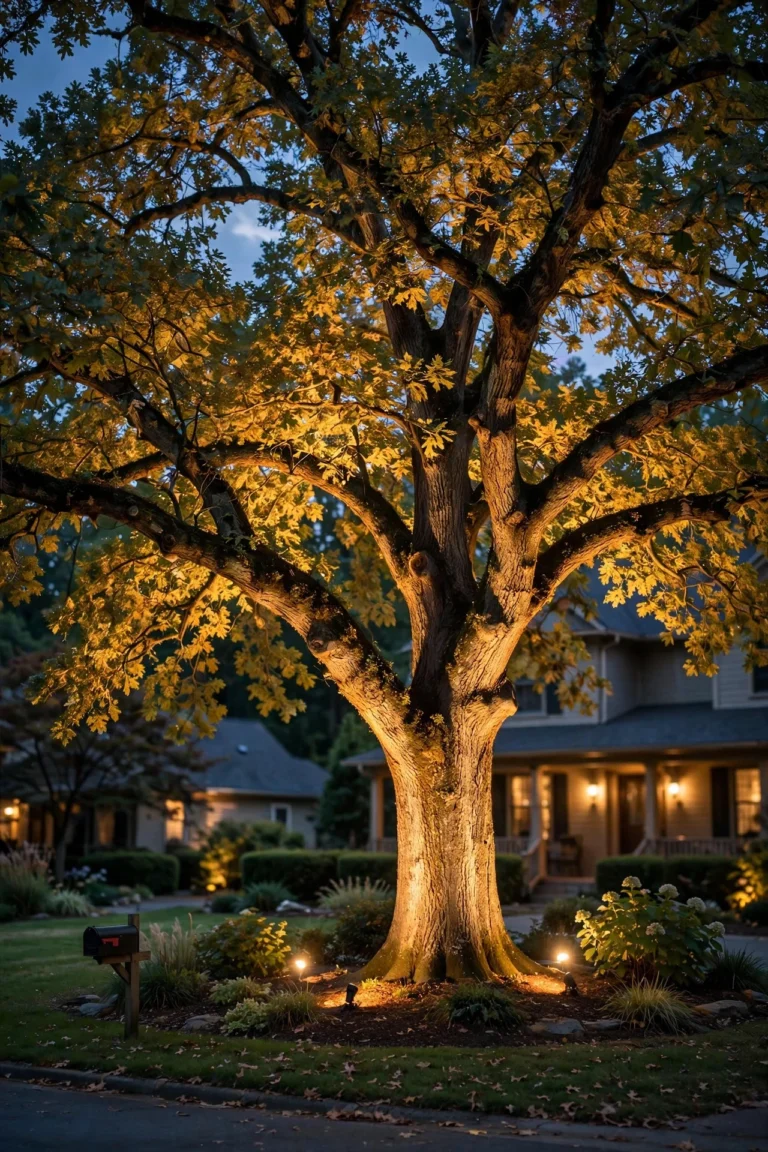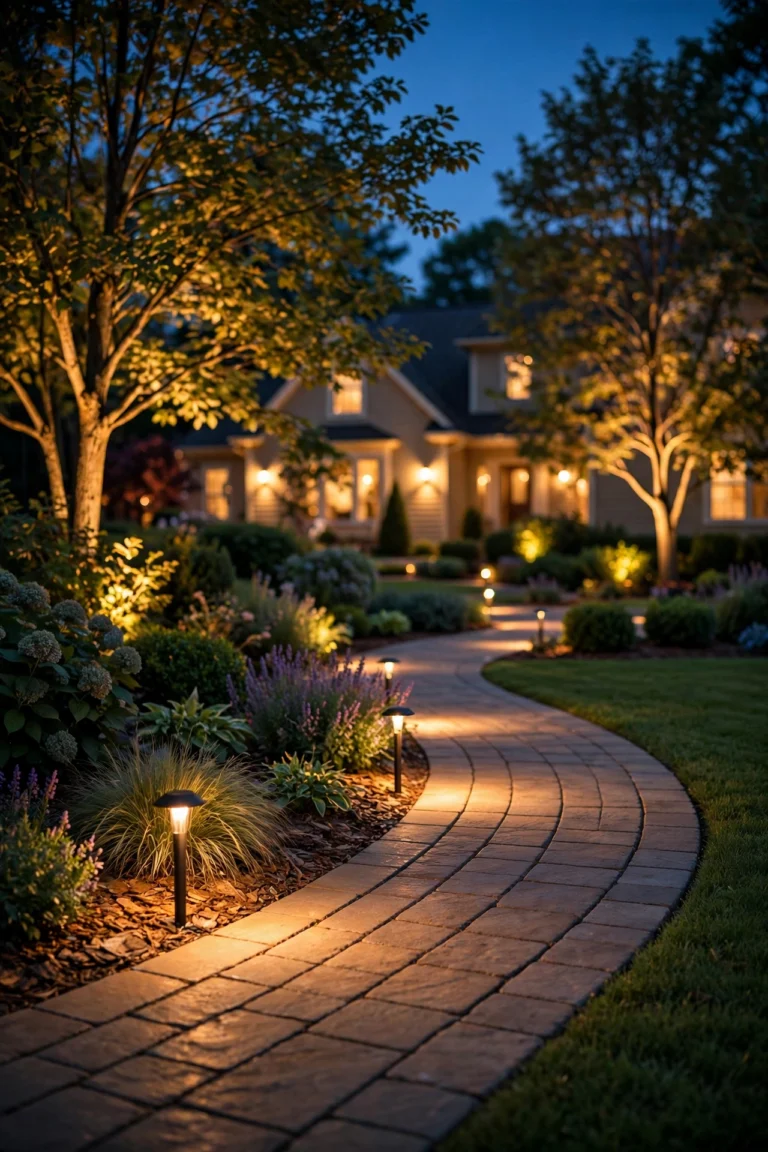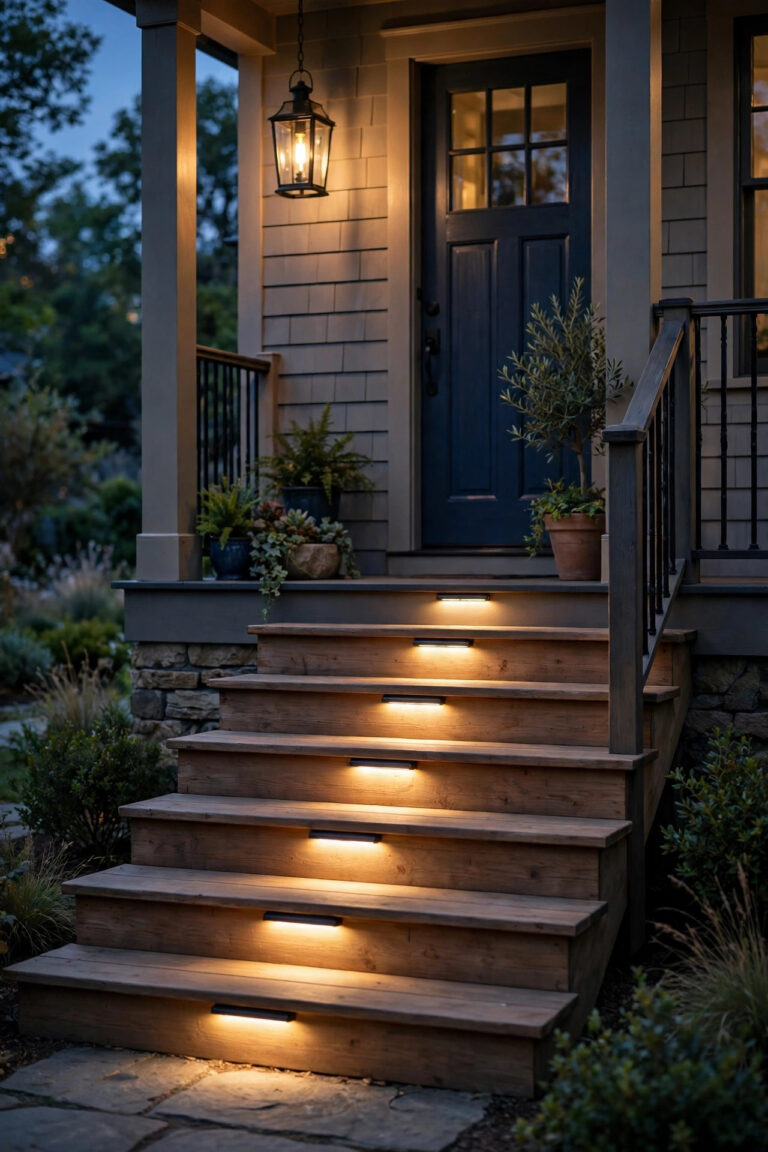
If I had to pick one fixture that instantly makes a house look more expensive after dark, it would be the up-down sconce. Instead of throwing a single blob of light at your front step, it paints two soft fans of light — one climbing the wall, one pooling below — and suddenly plain siding has depth, brick has texture, and your entry looks designed instead of just lit. That's why I reach for up down wall sconce ideas whenever a facade feels flat: they are the wall-washing layer of my lighting plan, the piece that works quietly alongside path lights and porch fixtures. They're also one of the easiest upgrades I know, because most of them are a simple one-for-one swap with whatever fixture is already wired by your door. In this post I'm sharing 19 ways to use them, from the classic cylinder pair flanking a front door to solar, smart, and dark-sky-friendly versions, with honest notes on sizing, spacing, color temperature, mounting heights, and what each one really costs.
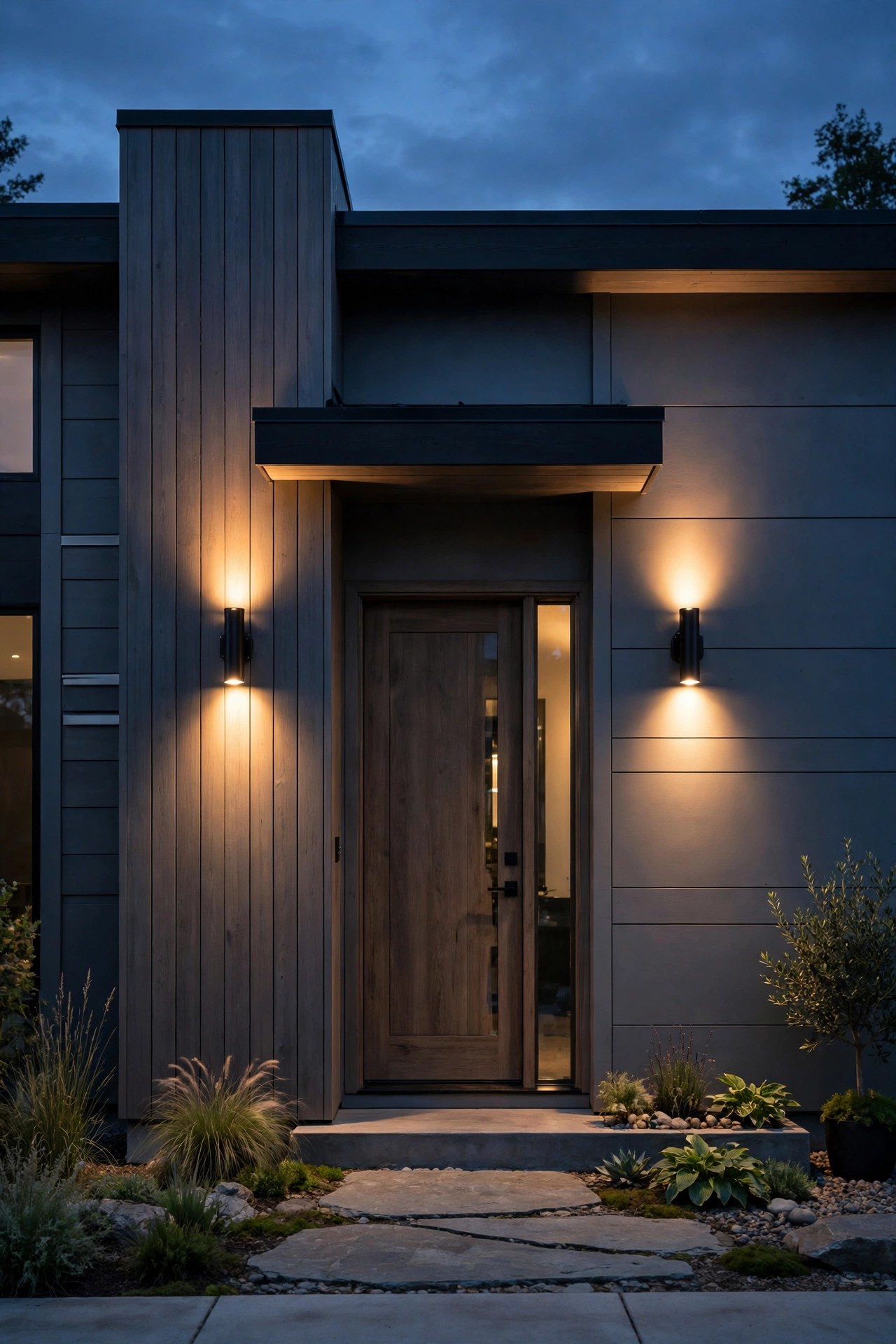
1. The Classic Pair: Dual Cylinders Flanking the Front Door
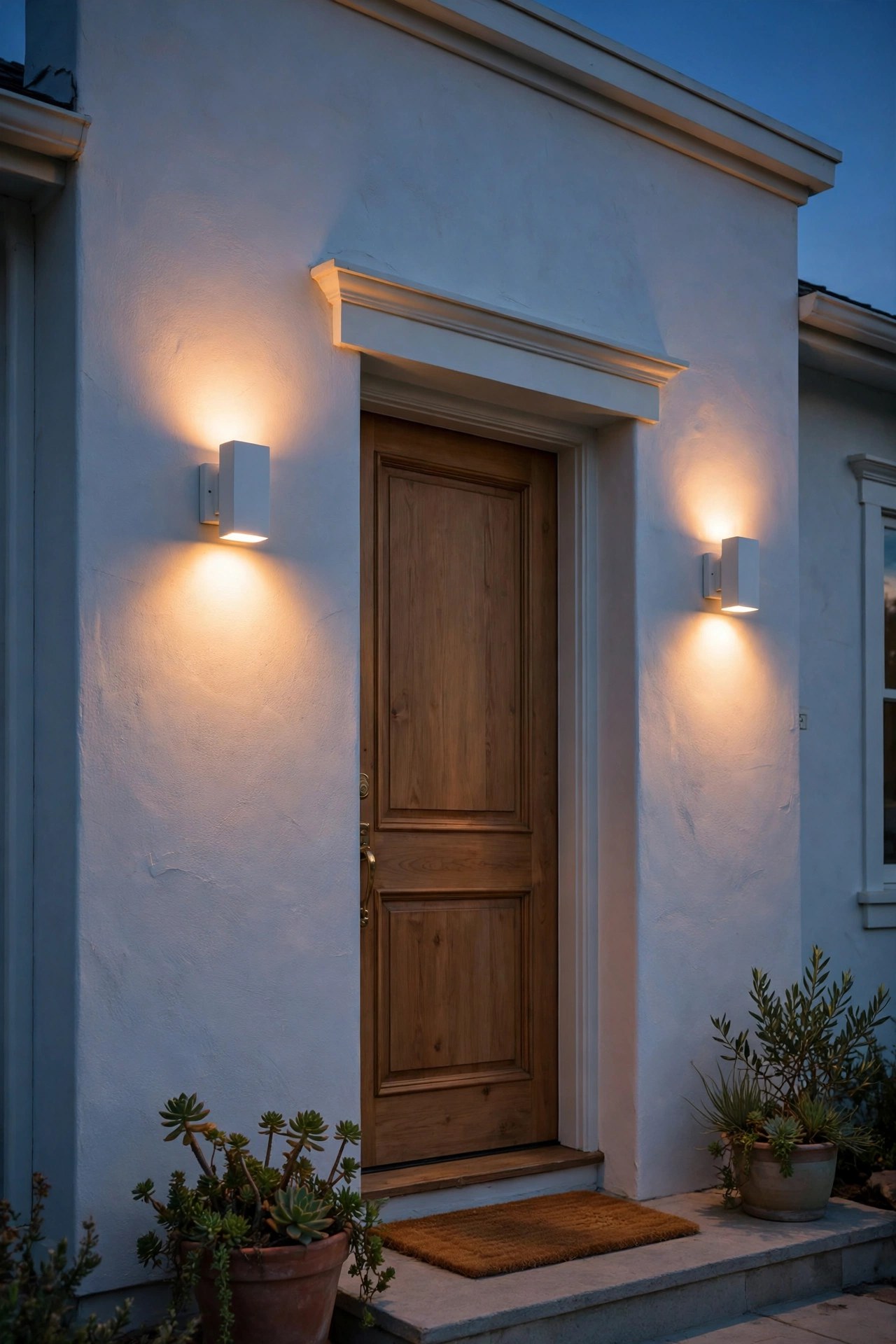
Start with the look that made these fixtures famous: two sleek cylinder sconces, one on each side of the front door, each washing light up and down the wall. In my experience this pairing works on almost any style of home because the shape is so quiet — no scrollwork, no lantern cage, just clean lines and beautiful light. Size matters more than people think: choose fixtures roughly one-quarter to one-third the height of your door, so for a standard 80-inch door, a sconce around 12 to 18 inches tall looks balanced. Mount them with the center of the fixture about 66 inches from the ground, level with the middle of the door frame. Warm 2700K LED bulbs keep the wash golden instead of clinical, and if your cylinders take replaceable bulbs, filament-style LEDs give a lovely glow through the open ends. Keep the pair on the same switch or timer as your porch light so the whole entry scene comes on together at dusk.
Suggested budget range: $70 – $220.
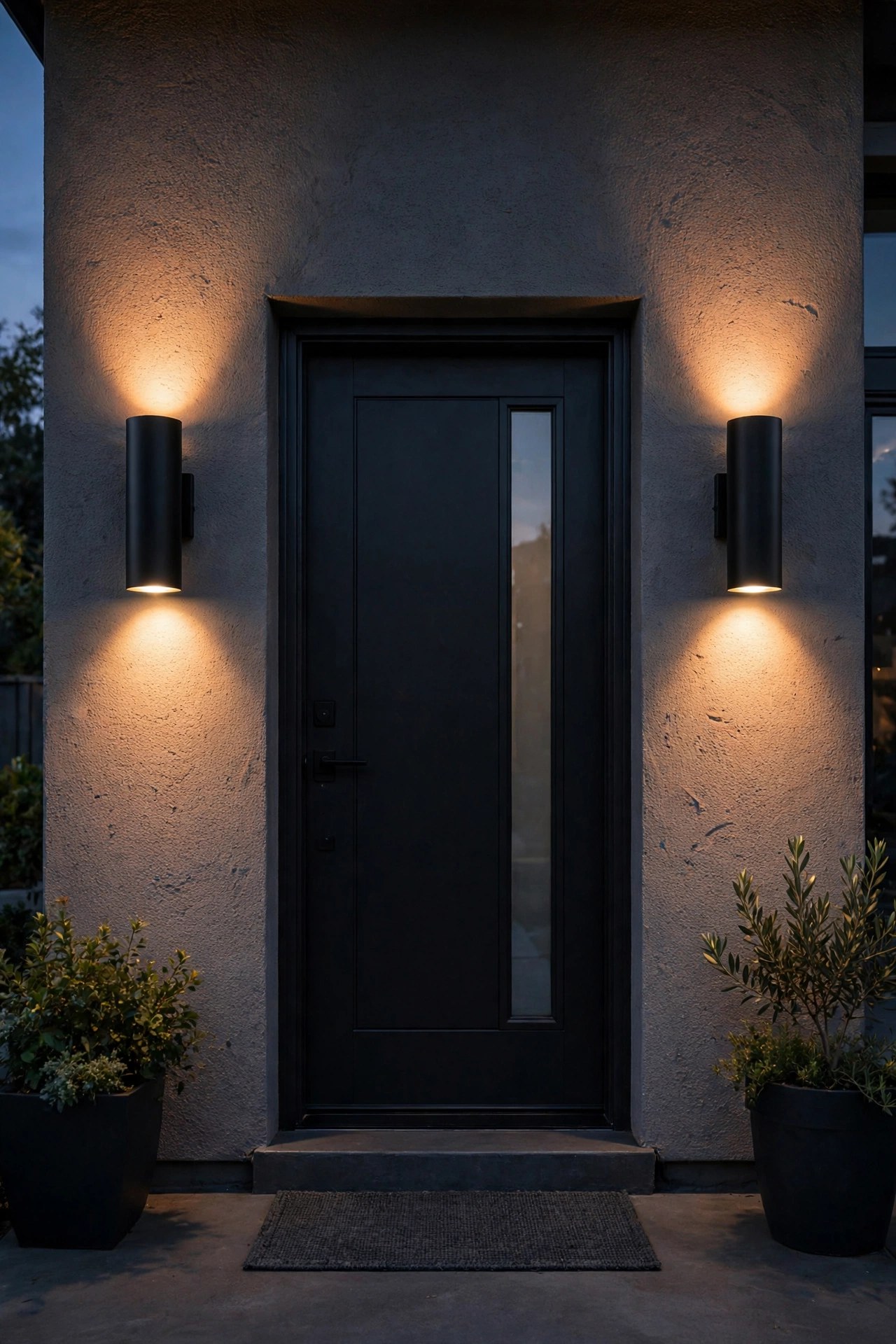
2. Slim Vertical Bar Sconces for Tall, Narrow Walls
Some walls give you almost nothing to work with — the skinny strip of siding between two windows, the narrow pier beside a garage door, the sliver of wall on a townhome entry. A slim vertical bar sconce was made for exactly those spots. These long, narrow fixtures, often 18 to 24 inches tall but only 3 to 4 inches wide, shoot light from both ends and turn a leftover strip of wall into a deliberate design moment. Because the fixture itself reads like a line of architecture, it suits modern and mid-century homes especially well. Install one centered on the pier; if you have two narrow piers, mirror the pair for symmetry. Look for integrated LED versions with a sealed housing — the long, thin shape doesn't always shelter a replaceable bulb well in driving rain. Keep the color temperature consistent with your other entry lighting, ideally 2700K to 3000K, so the narrow beams blend into one scene instead of competing.
Suggested budget range: $60 – $180.
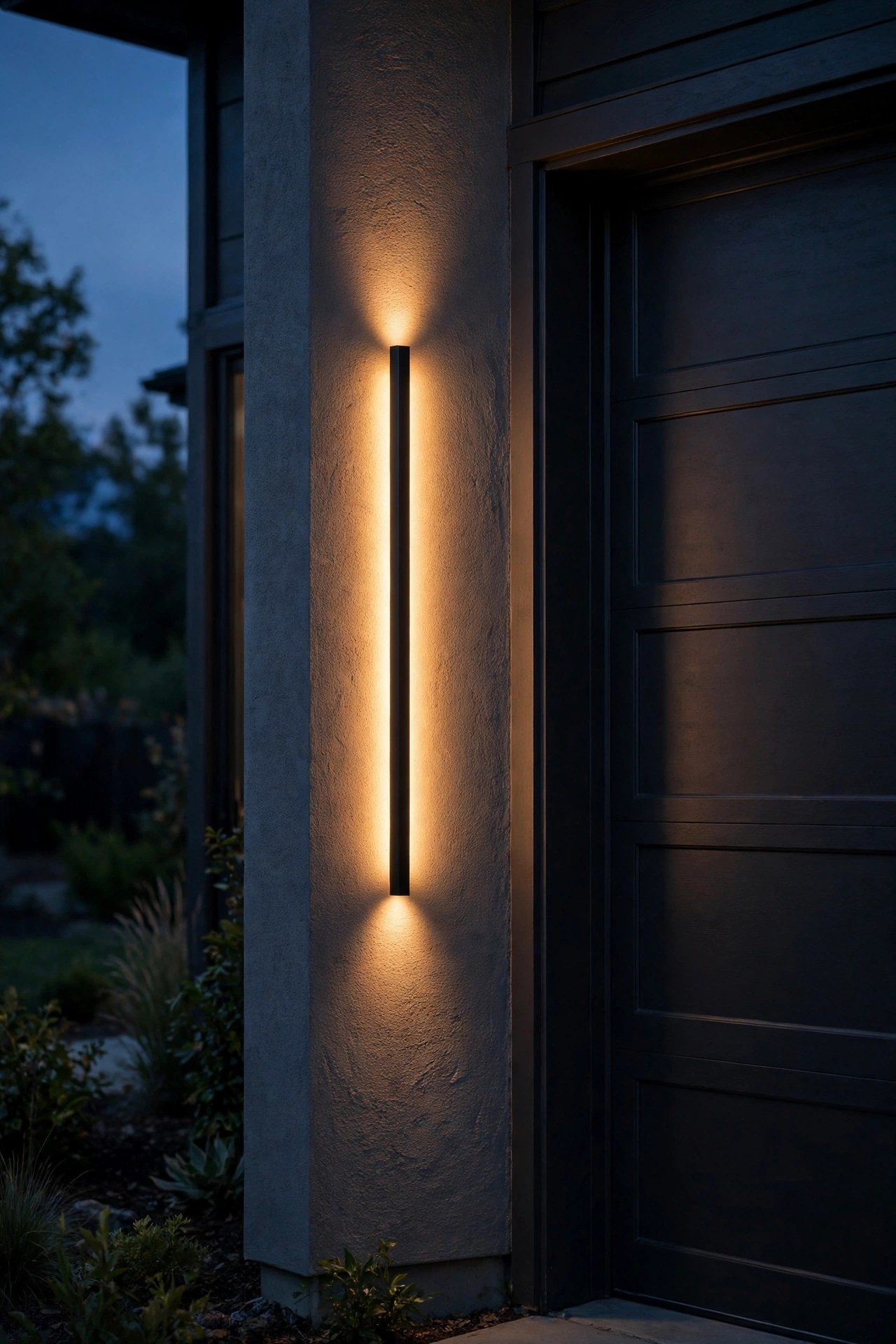
3. Cube Sconces With Adjustable Beam Angles
Cube-shaped up-down sconces are the tinkerer's favorite, because many of them let you adjust the beam. Little sliding shutters or rotating inserts inside the top and bottom openings narrow the wash into a sharp blade of light or open it into a wide fan, so one fixture can graze a textured wall dramatically or wash a smooth one softly. I love these on contemporary homes with mixed materials — stone on one section, smooth stucco on another — because you can tune each fixture to its surface. A narrower beam, around 30 to 45 degrees, shows off texture; a wider beam flatters flat siding. Set both ends the same way for a tidy, symmetrical look, or widen the downward beam near walkways where you want a bigger pool of light underfoot. Choose a powder-coated aluminum housing rated for wet locations, and check that the adjustment mechanism is metal rather than plastic — you'll thank yourself in five winters when it still moves freely.
Suggested budget range: $50 – $160.
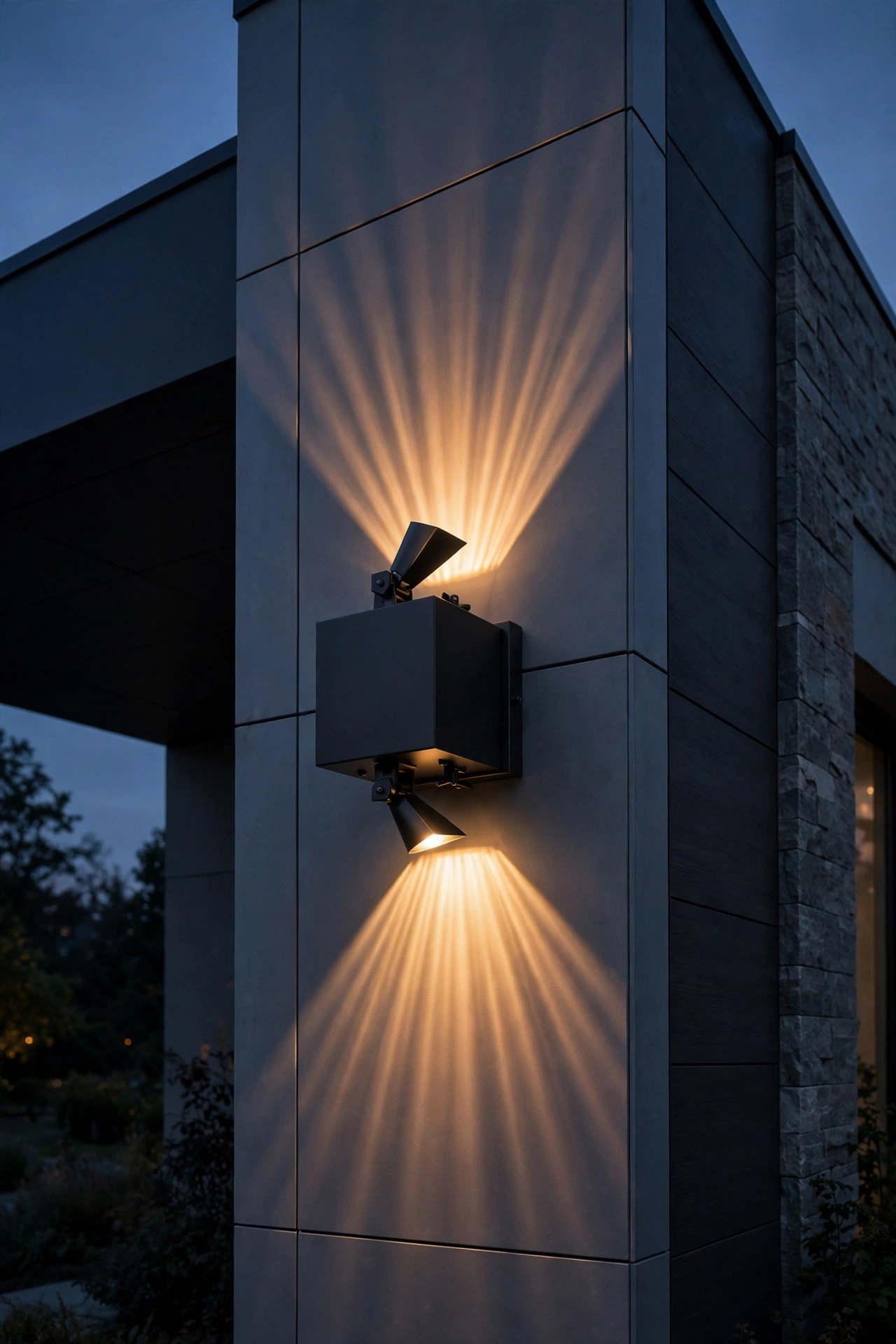
4. Wide-Wash Up-Down Sconces for Brick and Stone
Brick and stone are the surfaces up-down lighting was born for. A wide, soft wash raking across rough masonry pulls every bump and mortar line into relief, and a house that looked ordinary at noon can look like a boutique hotel by nine o'clock. For these facades, choose fixtures with a wide beam spread — 60 degrees or more — and enough output to matter, roughly 800 to 1,200 lumens total between the two beams. Mount the sconce a touch higher than usual, around 7 feet, so the upward fan has room to bloom across the wall before it fades. Warm light is non-negotiable here: 2700K makes red brick look rich and honeyed, while cool white turns it gray and tired. If your wall is very tall, place sconces between windows so the washes overlap slightly and you don't get dark bands. My wall washing guide linked below digs deeper into beam angles for masonry if you want to nerd out with me.
Suggested budget range: $80 – $240.
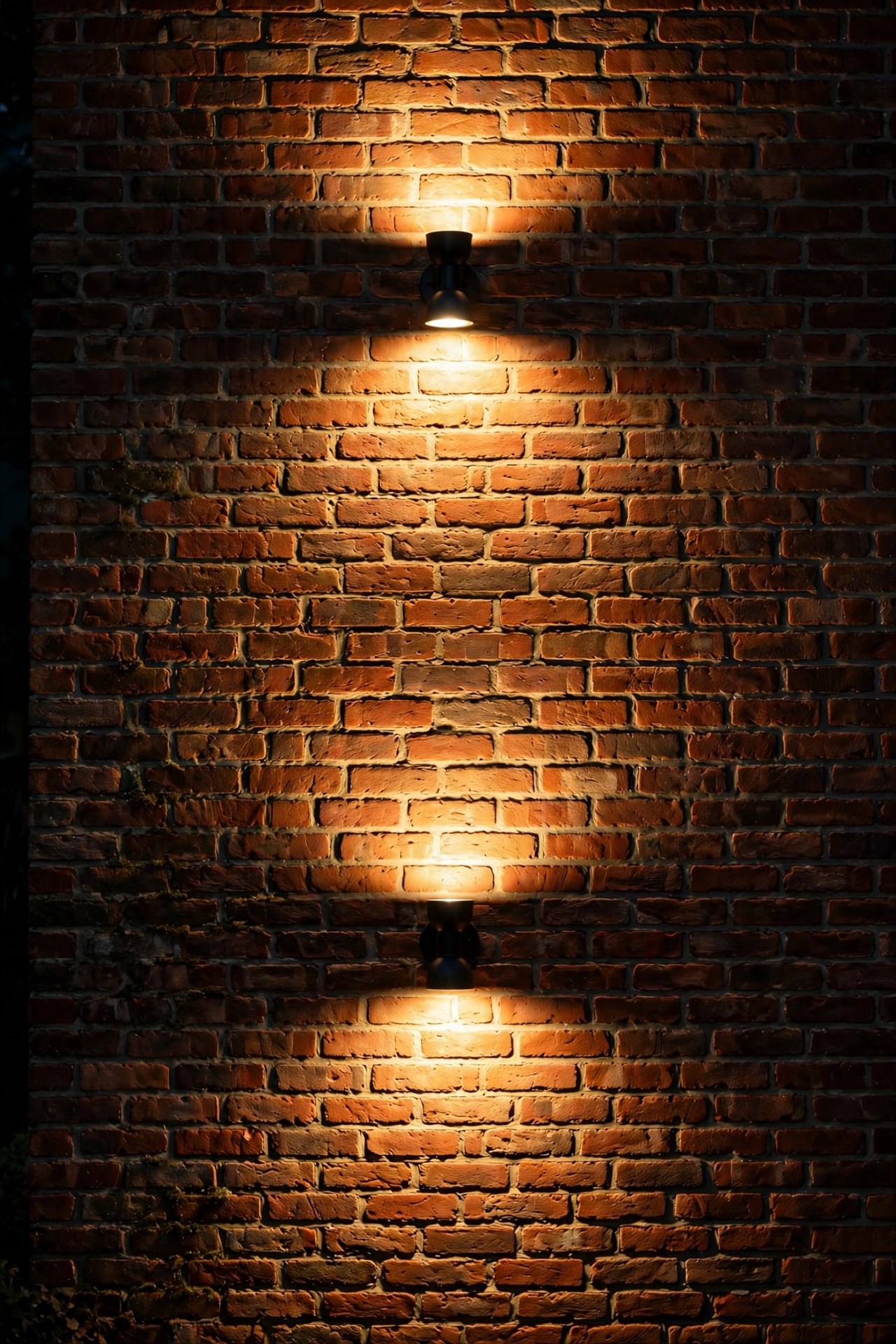
5. Narrow-Beam Grazing Light for Board-and-Batten and Textured Siding
Where a wide wash flatters smooth walls, a narrow beam is the trick for texture. Mount the sconce close to the wall with a tight beam — think 15 to 30 degrees — and the light skims along board-and-batten, shiplap, cedar shake, or stucco, carving long shadows out of every ridge. This is called grazing, and honestly, it's the most dramatic effect on this whole list for the least money. The key is restraint: grazing exaggerates everything, including wavy siding and sloppy paint, so test one fixture before committing to a full set. It also works best in a warm color temperature, since cool light makes the shadows read harsh and blue. Space grazers evenly, one per batten bay or centered on each siding panel rhythm, so the shadow stripes march down the wall in a pattern. Because the beam is narrow, these fixtures can be lower-output — 400 to 700 lumens — which makes them gentle on the electric bill too.
Suggested budget range: $45 – $140.
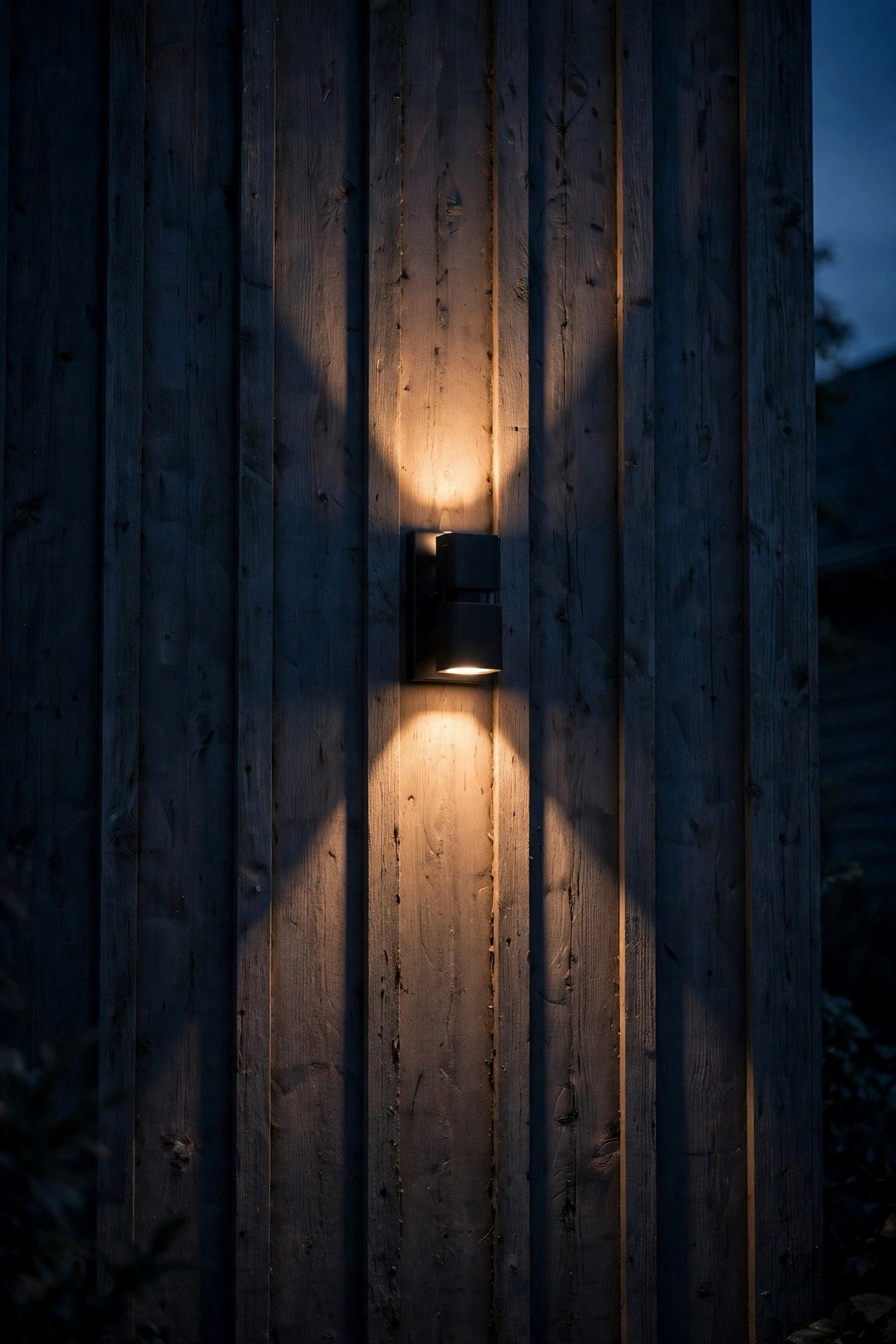
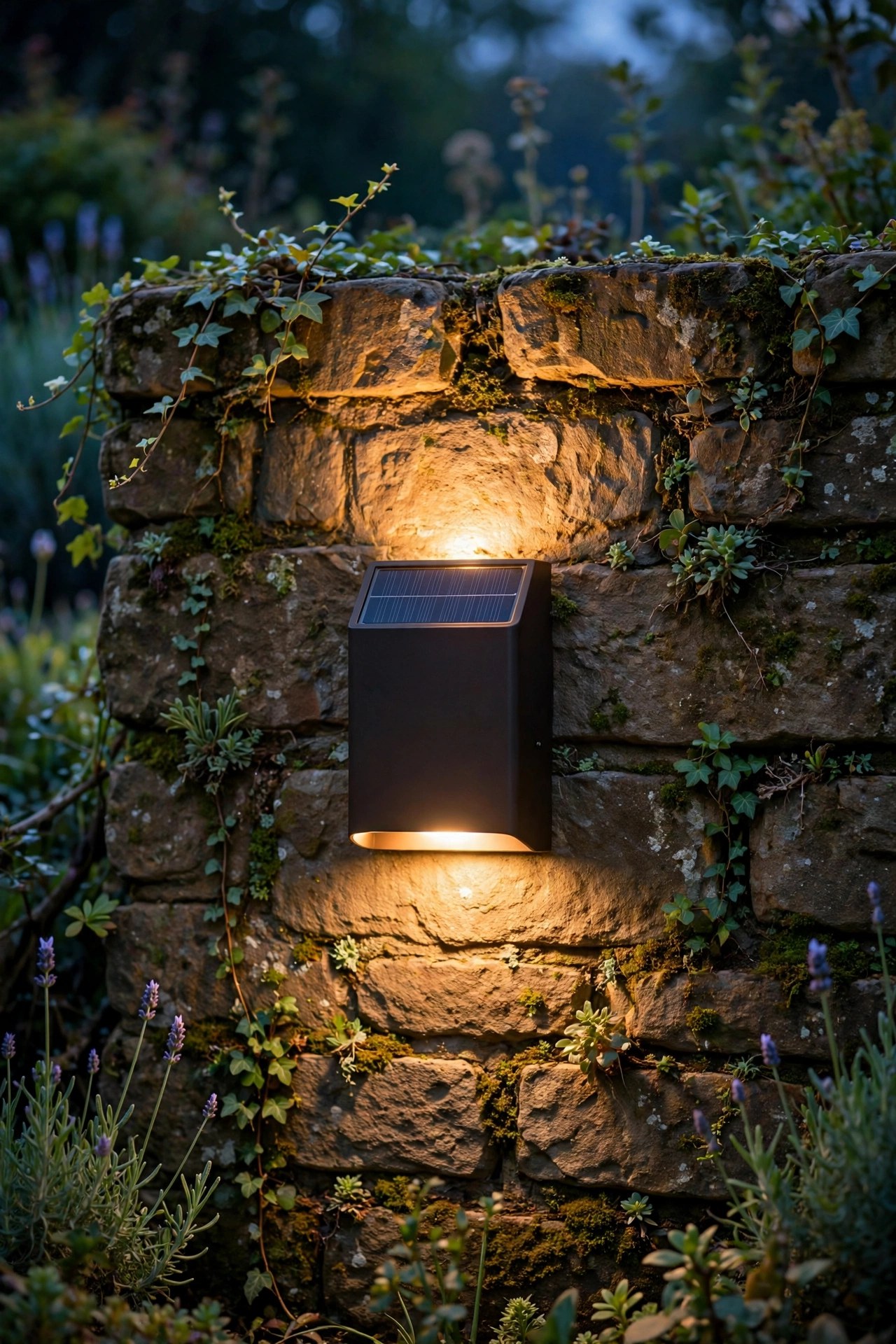
6. Solar Up-Down Sconces Where There's No Wiring
No junction box? No problem — solar up-down sconces have gotten genuinely good. A small panel on top of the fixture charges all day, and at dusk you get the same twin fans of light with zero trenching, zero electrician, and zero added electric bill. Be honest with yourself about placement, though: these need real sun, ideally six hours of direct light on the panel, so they shine on south- and west-facing walls and disappoint on a shaded north entry. Expect a softer output than wired fixtures — usually 100 to 300 lumens — which reads as ambiance rather than security lighting, and that's fine for a garden wall, fence line, or garage side. Look for models with a replaceable battery and a real glass or sturdy lens; the cheapest all-plastic sets cloud over within a season. Mount with the included screws into siding or a mounting block, and wipe the panel clean every month or so for best charging.
Suggested budget range: $25 – $70.
7. Dusk-to-Dawn Photocell Up-Down Sconces
If you love the look but know you'll forget the switch, a built-in photocell is your best friend. These fixtures sense darkness themselves, clicking on at dusk and off at dawn with no timer to program and no light left burning at noon because someone flipped the wrong switch. I especially recommend them for side doors, basement entries, and rental properties — anywhere the lighting needs to just handle itself. Choose an integrated LED model with the sensor tucked discreetly into the housing, and check the fine print for one detail: the sensor should be positioned so the fixture's own upward beam doesn't fool it into thinking it's daytime, a flaw in some bargain designs that makes them flicker or cycle. Pair photocell sconces with a smart bulb or switch elsewhere in the yard if you want manual override for parties. Expect a long service life — most integrated LED versions are rated 30,000 to 50,000 hours, which at dusk-to-dawn hours works out to a decade or more.
Suggested budget range: $55 – $150.
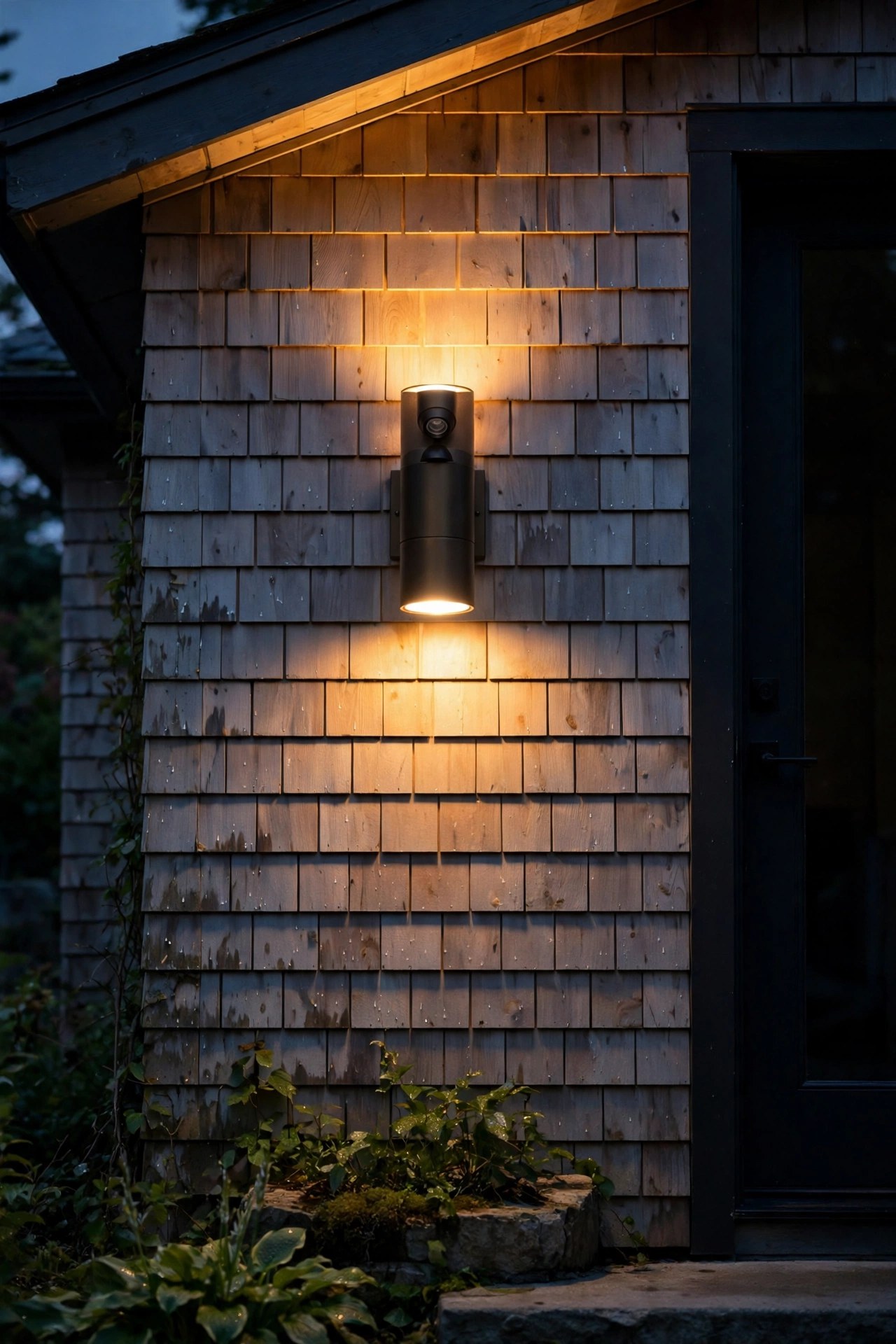
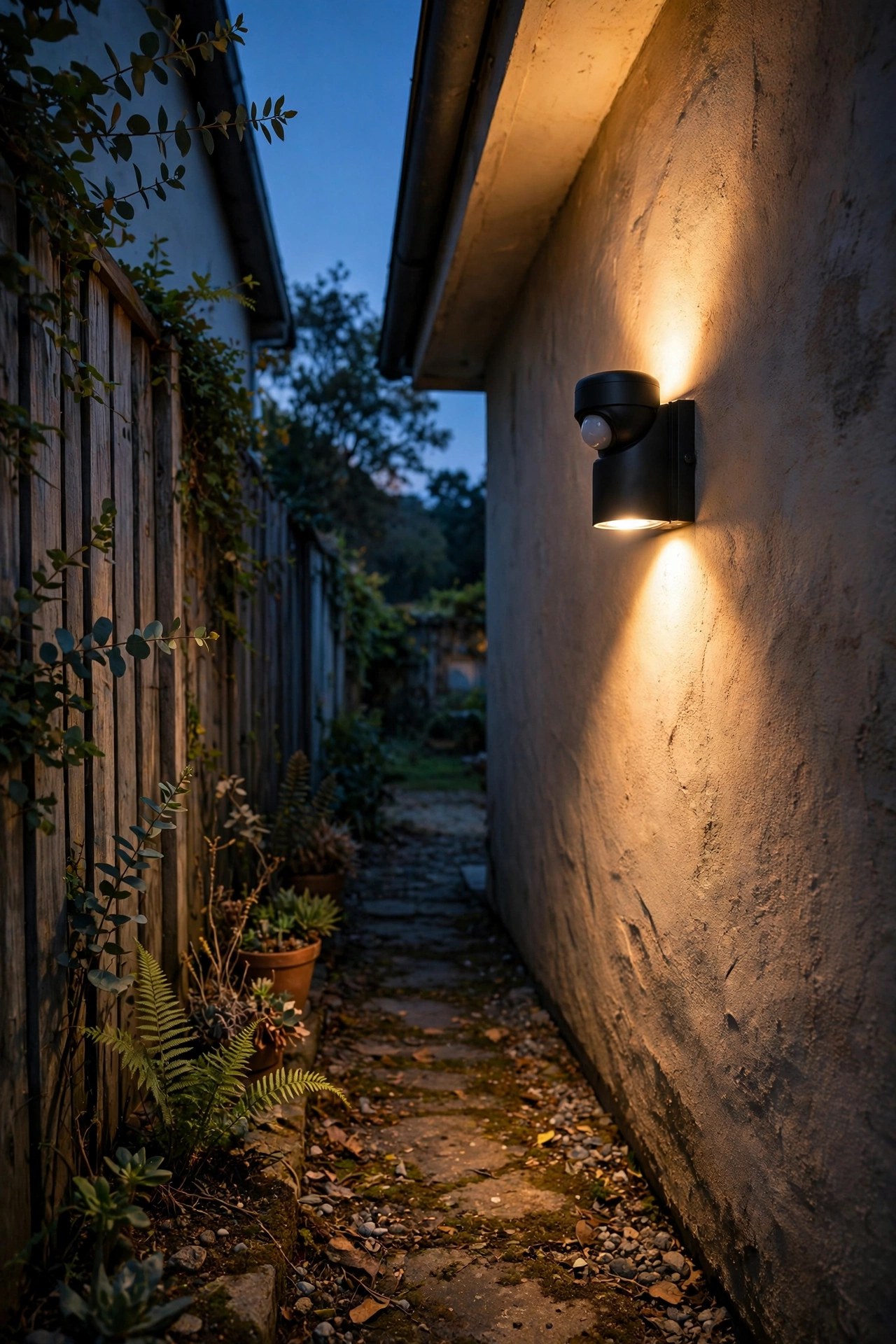
8. Motion-Sensor Up-Down Sconces for Side Yards and Security
Every house has that one passage — the side yard where the bins live — that stays pitch black until you're standing in it. A motion-sensor up-down sconce gives you the pretty wash when it matters and darkness (plus savings) the rest of the night. Better models offer a dual-level mode I absolutely love: a dim 20 to 30 percent glow from dusk to dawn so the wall never looks dead, then a jump to full brightness when the sensor trips. Look for an adjustable detection range of about 10 to 30 feet and a timer that holds the bright setting for 1 to 5 minutes. Position the fixture so the sensor's view isn't blocked by a downspout or shrub, and angle it slightly so passing sidewalk traffic doesn't trigger it all evening. Brightness around 1,000 to 1,500 lumens at full power is plenty for a side passage, and a warm-to-neutral 3000K keeps it welcoming rather than interrogation-room.
Suggested budget range: $60 – $170.
9. Smart Wi-Fi Up-Down Sconces You Control From Your Phone
Smart up-down sconces take the classic fixture and hand you the remote. From an app you can dim the wash for a quiet evening, brighten it when a package is due, set schedules that track sunset automatically, and group every sconce on the house into one "scene" that turns on together. My favorite use is vacation mode: while you're away, the sconces follow a slightly randomized schedule so the house looks lived-in instead of timer-perfect. If you choose a smart-bulb version rather than an integrated smart fixture, standard cylinder sconces with two smart bulbs give you independent control of the up beam and down beam — dim the top for a subtle graze, keep the bottom brighter for the walkway. Just check your Wi-Fi signal at the fixture location before ordering; exterior walls are notorious dead zones, and a fixture at the far side of a brick house may need a mesh node nearby. Group them with the rest of your smart outdoor lighting so one tap lights the whole property.
Suggested budget range: $90 – $260.
10. Matte Black Up-Down Sconces on Light-Colored Siding
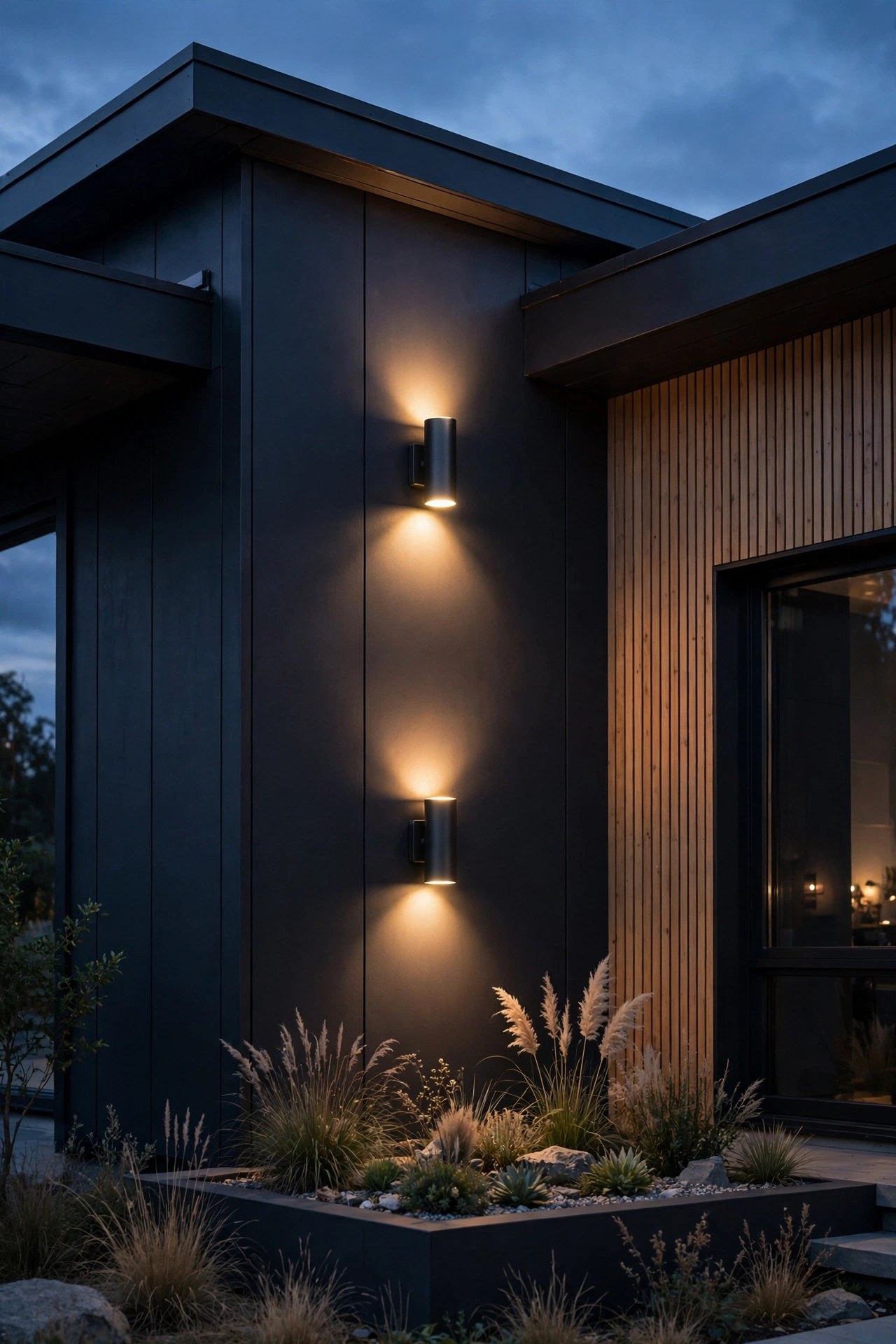
Some combinations are popular because they simply never miss, and matte black fixtures against white, cream, or light gray siding is one of them. By day, the crisp black cylinder reads like punctuation on a pale wall; by night, it disappears entirely and all you see is the light itself — two soft golden fans with no visible source. That disappearing act is exactly why designers specify black fixtures on light homes so often. A few practical notes: matte black shows dust and pollen more than glossy finishes, so plan a quick wipe-down in spring. Choose a powder-coated finish rated for exterior use, especially within a few miles of the coast, where salt air eats cheap paint. Warm 2700K bulbs are essential here — the contrast of black fixture and pale wall makes cool white light look especially stark. This is also the easiest scheme to match across fixture types: black up-down sconces at the door, black path lights, black lantern at the mailbox, done.
Suggested budget range: $60 – $200.
11. White and Brushed-Metal Sconces for Coastal and Modern Homes
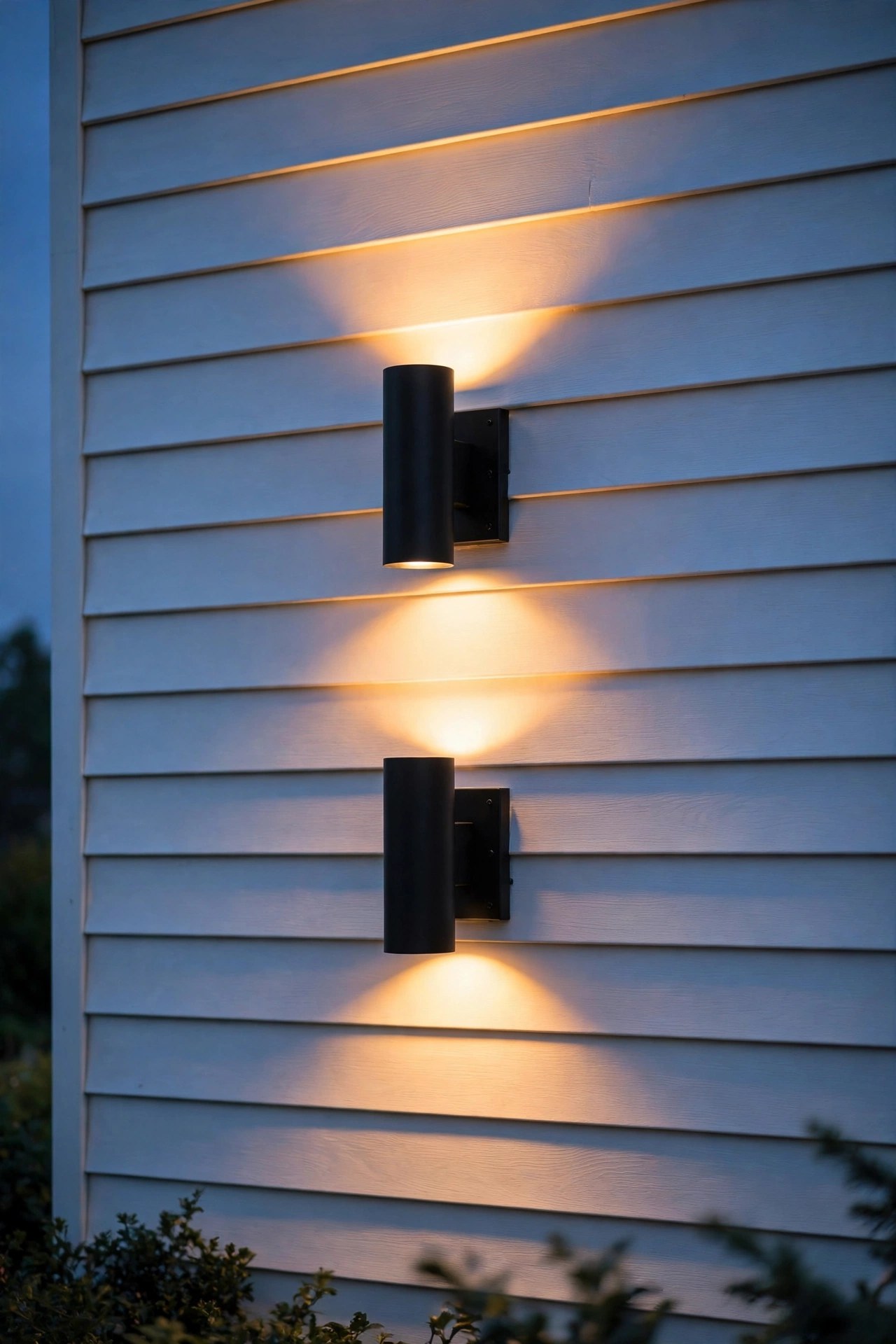
Flip the contrast for homes where black would feel too heavy. White up-down sconces on white or pale siding nearly vanish into the architecture — all light, no fixture — which is a beautiful, gallery-like effect on modern and coastal homes. Brushed nickel, stainless, and weathered zinc finishes split the difference, adding a little glint by day while staying quiet at night. Coastal friends, this is your section: within salt-spray zones, choose marine-grade or solid stainless construction and sealed integrated LEDs, because standard "outdoor rated" finishes can pit and streak within a couple of seasons. Rinse fixtures with fresh water a couple of times a year to keep the finish honest. On a beach-house facade, I like the downward beam slightly stronger than the upward one, washing the entry steps and stoop where sandy feet actually travel. Pair with pale stone or shell-colored pavers and the whole entry glows like late-afternoon light, hours after sunset.
Suggested budget range: $70 – $230.
12. Up-Down Sconces Between Garage Doors
A three-car garage gives you two perfect piers of wall, and most builders put nothing on them but a lonely coach light over the middle bay. Replace that afterthought with up-down sconces on the piers between the doors, and the whole garage elevation turns rhythmic and intentional. The washes draw bright vertical lines that make a wide, flat facade look taller and narrower — a genuinely flattering trick. Match the fixture finish to your door hardware and house numbers for a pulled-together look. Mount all the sconces at exactly the same height, centers around 72 to 78 inches since garage walls are taller, and measure twice: a quarter-inch of drift is invisible on a porch but glaring across a matched row. Put them on a photocell or timer circuit so the driveway scene lights itself nightly. If your garage doors have windows, keep the sconce output moderate, around 600 to 900 lumens per fixture, so you're not shining straight into a parked car's windshield reflections all night.
Suggested budget range: $120 – $320.
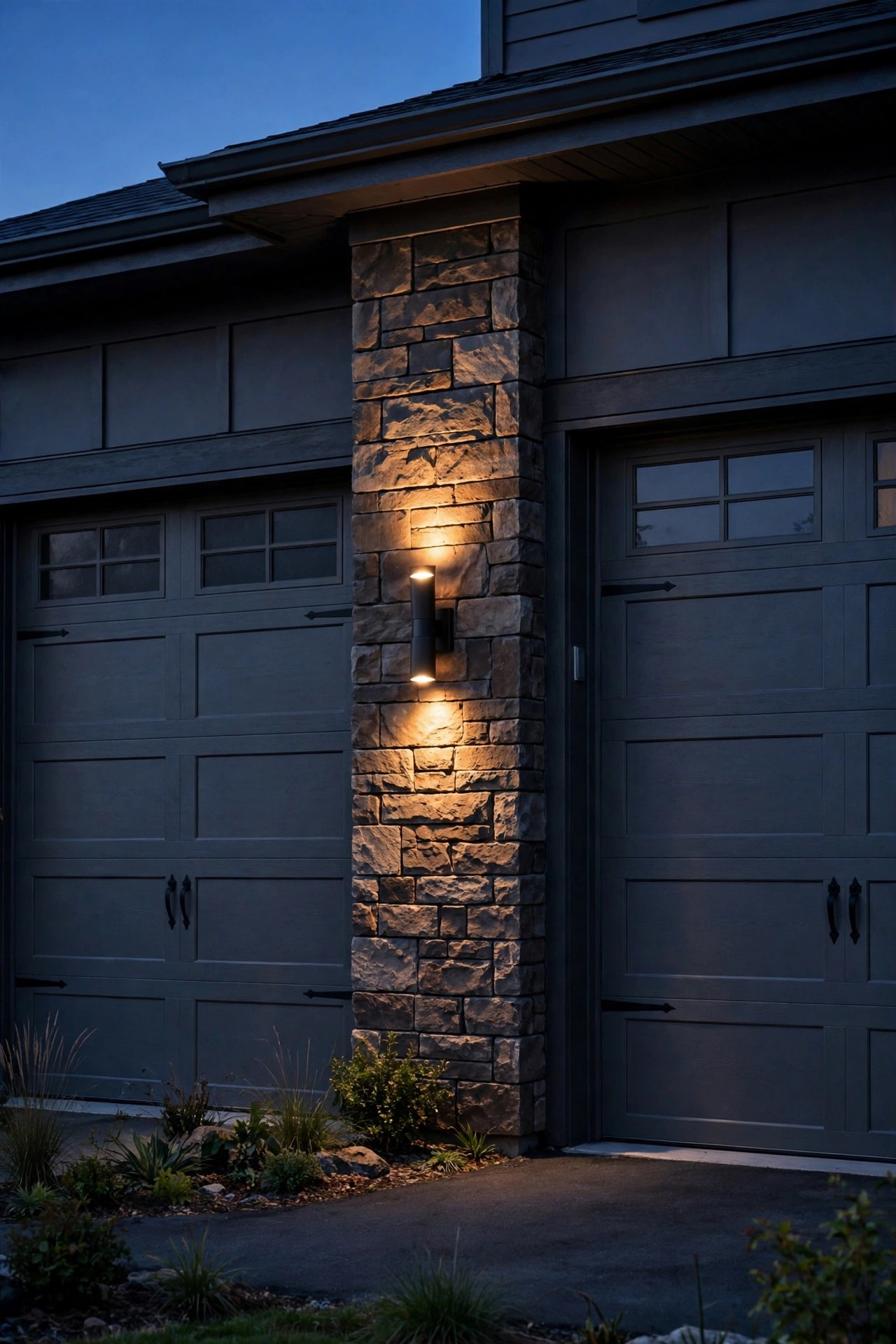
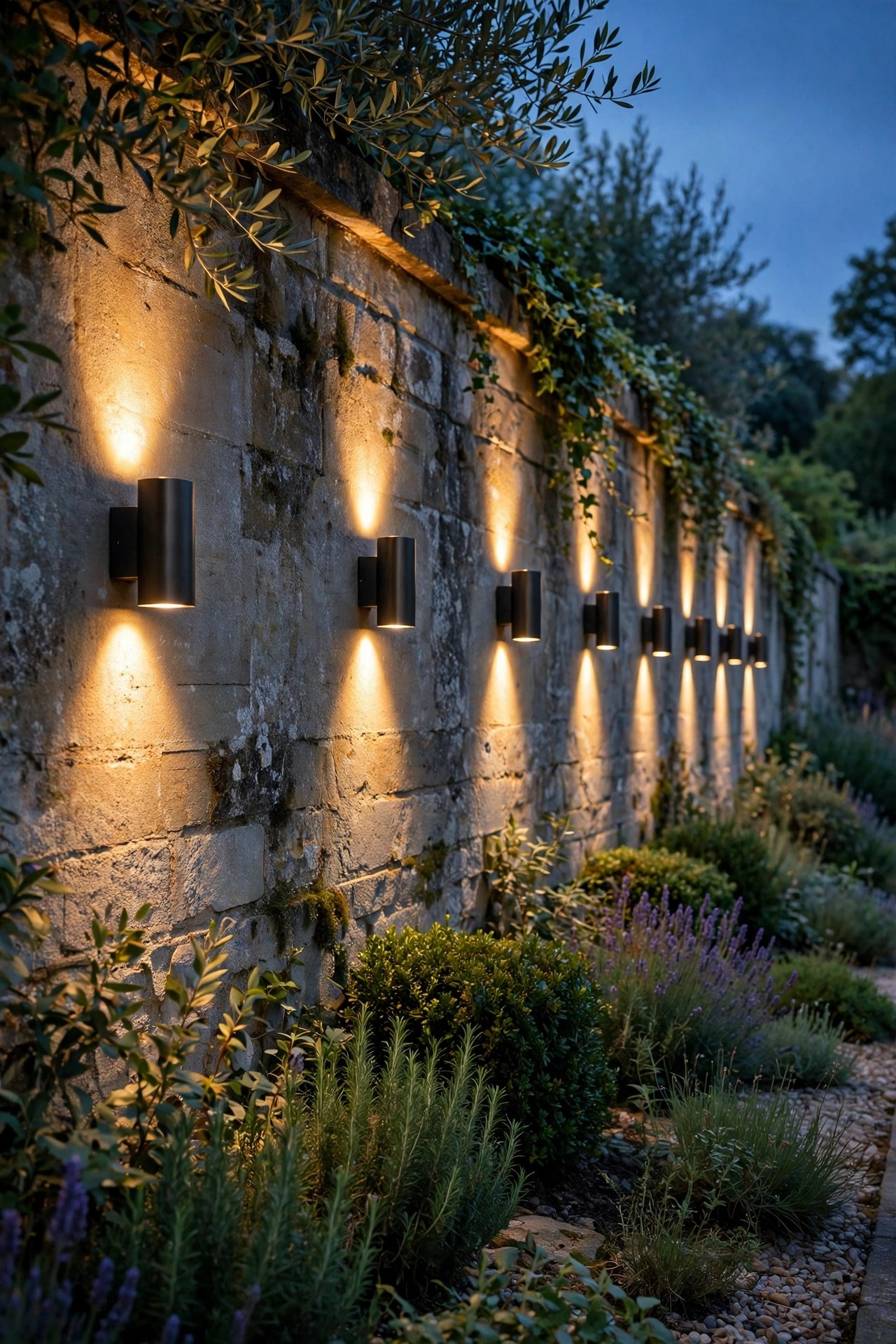
13. Repeat Your Favorite Up Down Wall Sconce Ideas Down a Long Wall
Long, blank walls — the side of a ranch, a garden wall, the stretch between a porch and the corner of the house — are where repetition turns a fixture into architecture. Line up three, five, or seven identical up-down sconces at even intervals and the row of light fans becomes a colonnade effect that looks far more expensive than it is. Spacing is the whole game: in my experience, 8 to 12 feet apart works for most residential walls, close enough that the downward pools nearly touch, far enough that each upward fan reads separately. Wire them on one circuit with one timer so they behave as a single gesture. This is also the most forgiving way to light a wall with windows at irregular intervals — just keep the rhythm steady and skip a bay where a window truly crowds a fixture. It remains one of my favorite up down wall sconce ideas for ranch homes, where that long low facade is begging for exactly this kind of structure.
Suggested budget range: $180 – $520.
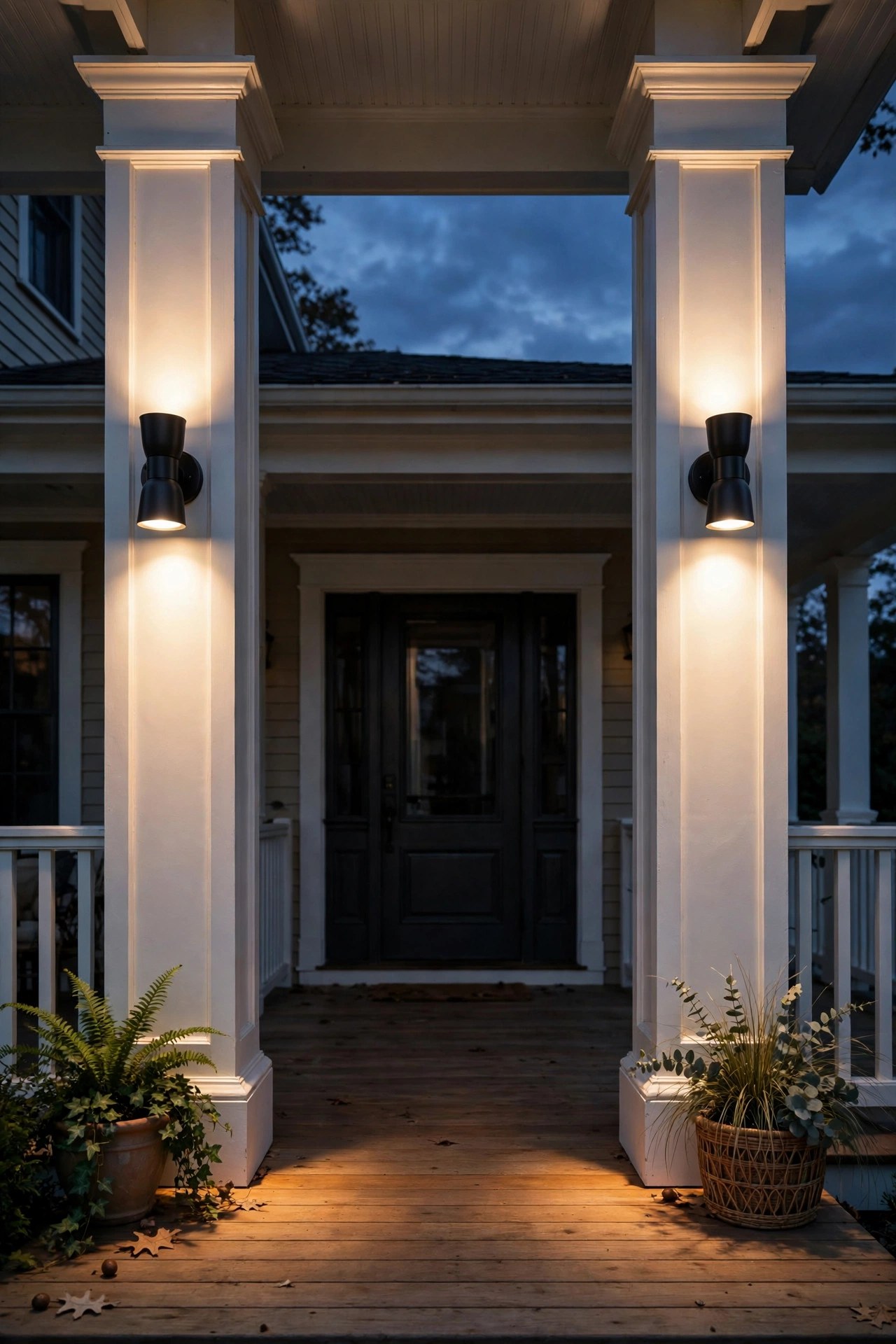
14. Up-Down Sconces on Porch Columns and Piers
Porch columns are prime real estate that most people light from exactly one direction — down, from the ceiling — and then wonder why the porch still feels flat. Mount an up-down sconce on the front face of each column and the porch gains a whole new layer: the upward beam grazes the column and catches the porch ceiling edge, while the downward beam pools on the floorboards and steps below. On a wraparound porch, a sconce per column keeps the rhythm going around the corner. Choose smaller-scale fixtures for slender columns, around 8 to 10 inches tall, so they sit on the column face without wrapping the edges. If your columns are brick or stone piers, a masonry mounting block gives the fixture a flat, plumb seat. Run the wiring inside hollow columns where possible; for solid ones, surface conduit painted to match is barely noticeable. The effect at night — a glowing colonnade framing your rocking chairs — is pure Southern postcard.
Suggested budget range: $90 – $260.
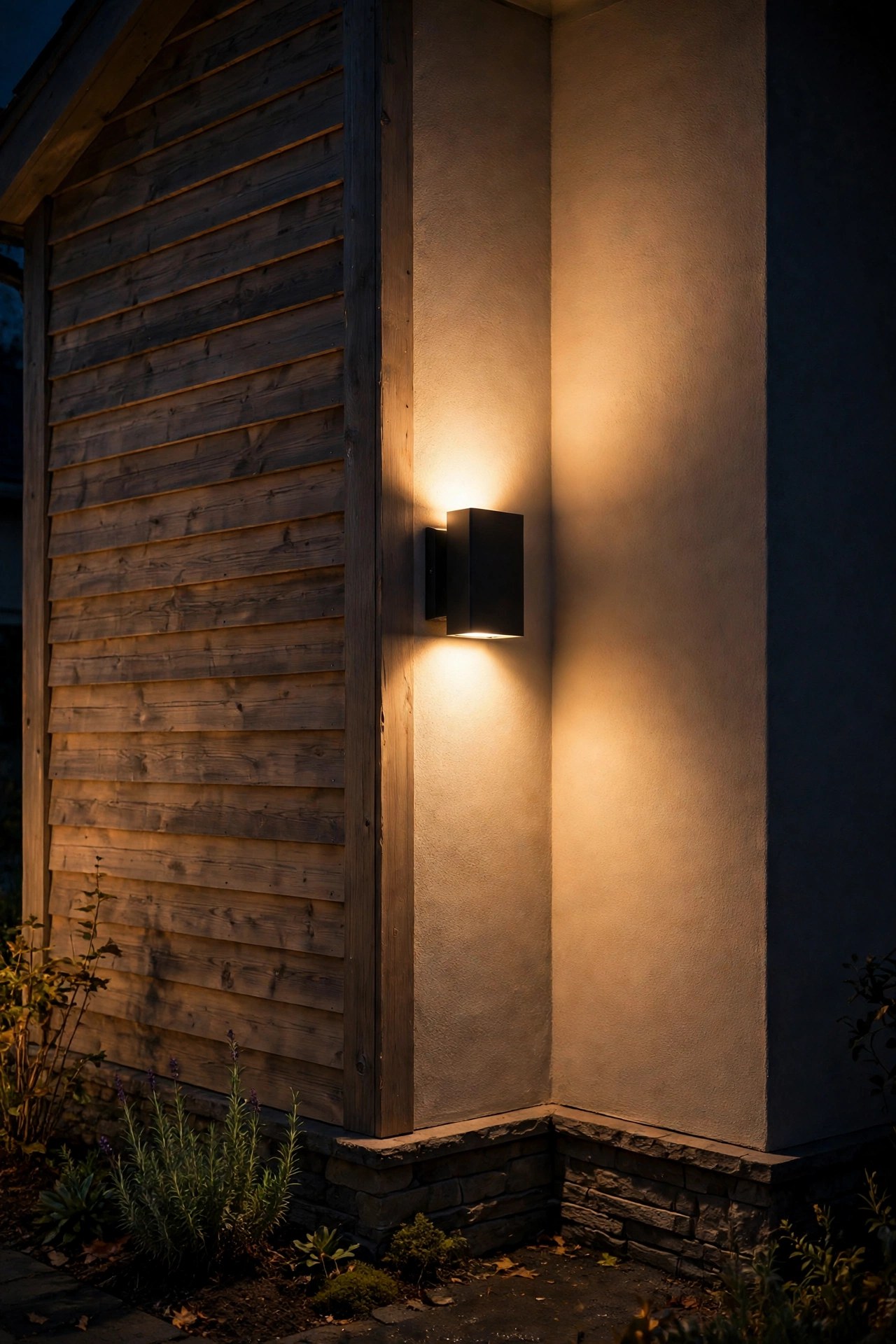
15. Corner-Mounted Up-Down Sconces for Wrap-Around Light
The corners of a house are where light usually dies — porch fixtures reach the front, the side yard fixture reaches partway, and the corner itself stays a dark notch. A corner-mounted up-down sconce, or a standard sconce placed just beside the corner on each face, stitches the two walls together with matching washes. Some manufacturers make true corner brackets that hold one fixture at a 45-degree angle, washing both walls from a single point; they're a small premium but genuinely elegant on modern homes. Corners are also smart security placement, since a lit corner removes the classic hiding spot without a single floodlight. When I use two standard fixtures instead of a corner mount, I place them the same distance from the corner on each wall — symmetry sells the effect. Keep the upward beam in mind near rooflines: on a one-story home, a corner sconce near the eave will graze the soffit beautifully, but check that no nest-building birds have claimed the warm spot come spring.
Suggested budget range: $75 – $210.
16. Low-Glare Shielded Up-Down Sconces for Dark-Sky Nights
Upward light has a reputation problem, and fair enough — a bare beam fired at the sky wastes energy and washes out the stars. The fix isn't giving up the look; it's choosing shielded, low-glare designs. Many modern up-down sconces recess the LED deep inside the housing, cap the upward opening with a diffuser, or use a louvered top that spills a soft fan across the wall while sending almost nothing straight up. The wall still glows — the light just lands on your house instead of the Milky Way. Aim for fixtures whose upward beam spreads wide and shallow rather than narrow and punchy, and keep total output modest; a shielded 500-lumen wash beats a glaring 1,200-lumen one for neighbor relations every time. Warm color temperatures, 2700K and below, also scatter less in the night sky. If you care about this — and more towns are writing it into lighting ordinances — my dark-sky-friendly fixtures elsewhere on the site pair beautifully with this style.
Suggested budget range: $65 – $190.
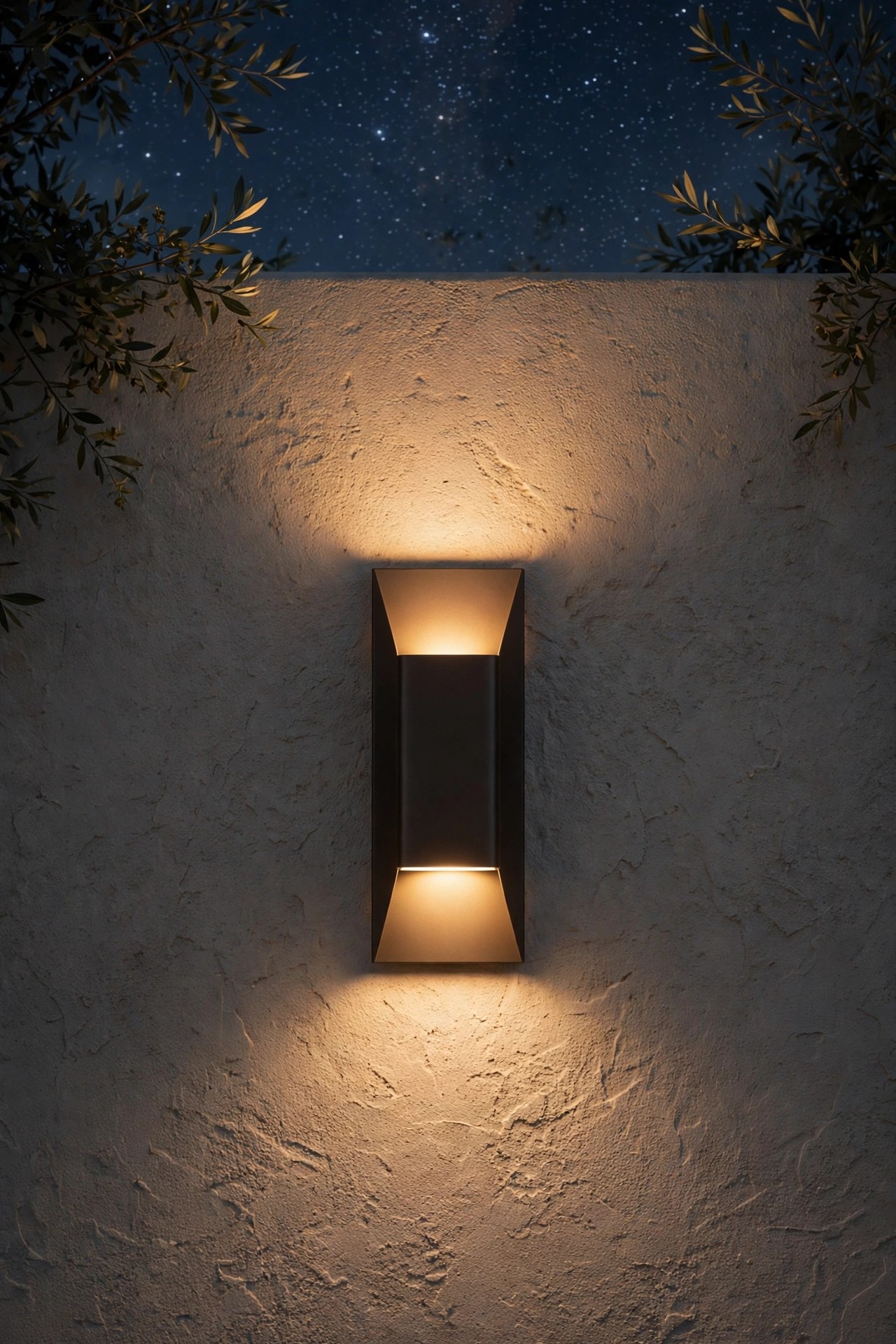
17. Extra-Tall Sconces for Two-Story Entries
Standard sconces get lost on a grand two-story entry, and honestly, that's a scale problem, not a style problem. The fix is fixtures with presence: extra-tall up-down sconces, 24 to 36 inches long, whose long bodies echo the height of the entry and whose washes have the output to climb a tall wall. Think of the sizing rule from idea one, scaled up — for a double-height facade, the fixture should read clearly from the street, not disappear into a speck. Output matters here too: look for 1,200 to 2,000 lumens so the upward fan still reads at the second story instead of dying at ten feet. Mount the pair flanking the door with centers a little higher, around 84 inches, and let the long downward wash light the stoop generously. These fixtures cost more and deserve a careful install — solid blocking behind the siding, a level line checked twice — but on a tall entry they deliver that hotel-portico drama nothing else touches.
Suggested budget range: $180 – $480.
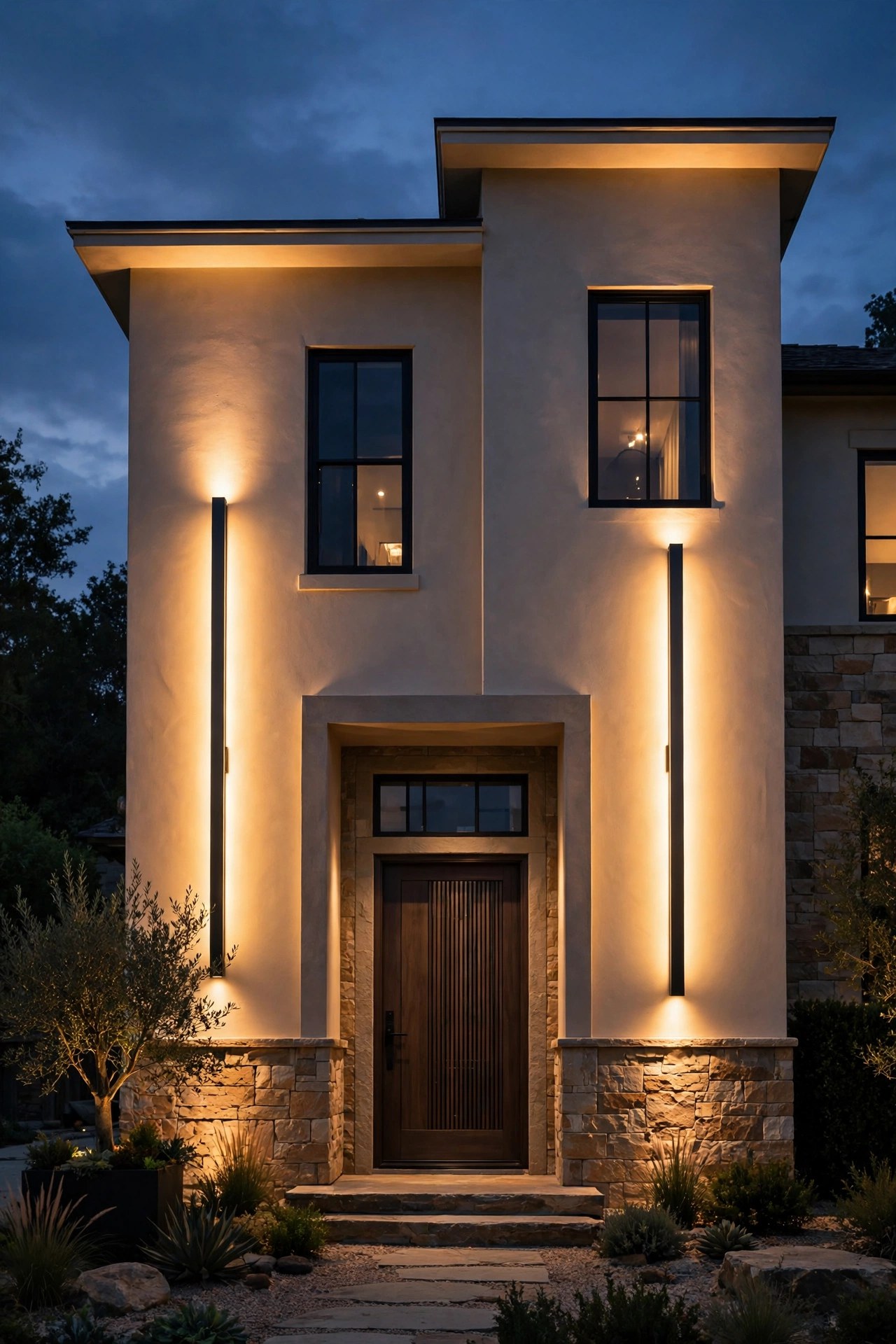
18. Paired Sconces Framing Windows and Shutters
We frame doors with sconces without thinking twice, but windows deserve the same treatment — especially the big front window or the pair of windows flanking a fireplace bump-out. A sconce on each side of a window turns it into a lit composition at night: the beams wash the trim and shutters, the glass picks up a soft reflection, and the wall between windows stops reading as dead space. This works wonderfully on symmetrical facades, where you might run sconces at the door and both front windows for a full, formal rhythm. Keep the fixtures smaller here — the window is the star, the sconce is the supporting act — and match the finish to your shutter hardware or window trim color for cohesion. One caution from experience: position the fixture so its beam doesn't fire straight through the glass into a living room or bedroom. A few inches of offset toward the outer edge of the trim keeps the glow outside where it belongs.
Suggested budget range: $110 – $300.
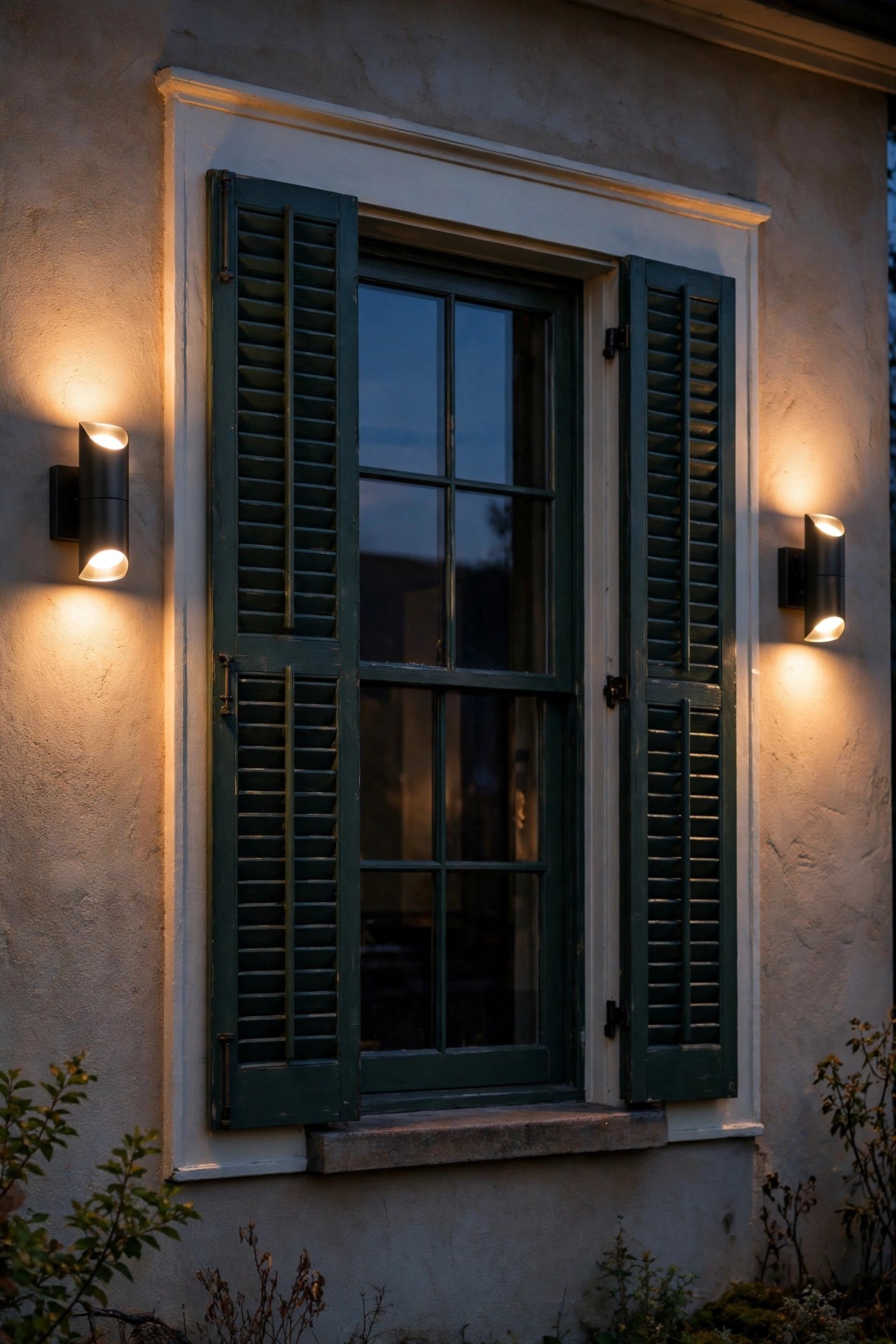
19. Mix and Match Up Down Wall Sconce Ideas for a Layered Wash
Here's the idea I end almost every consultation with: you don't have to choose just one. The best facades layer two or three of the up down wall sconce ideas from this list at different scales — statement cylinders at the front door, a quiet row of slim bars along the side wall, one shielded fixture at the back corner — all in the same finish and the same 2700K color temperature, so they read as one family. Think of it the way you'd layer indoor lighting: the entry pair is your focal point, the repeats are your rhythm, the functional motion and photocell pieces are your workhorses. Shop the whole set at once when you can, because finishes drift between production runs and "matte black" from spring may not match "matte black" from fall. Put everything on one timer or grouped smart scene, stand at the curb after dark, and adjust like a painter — dim the side wall, brighten the door — until the whole house holds together as a single wash of light.
Suggested budget range: $250 – $700.
Frequently Asked Questions
How high should up-down wall sconces be mounted?
For most entries, mount the fixture so its center sits 62 to 72 inches from the ground — roughly eye level to slightly above — which places it in the upper third of a standard door's height. On taller walls and two-story entries, 78 to 84 inches keeps the washes proportional. Whatever height you choose, keep every fixture on the same wall at exactly the same height; the eye forgives almost anything except a row that drifts.
What color temperature looks best for a modern wash of light?
Warm white, 2700K to 3000K, wins for nearly every home. It makes brick look rich, keeps white siding creamy instead of blue, and feels welcoming from the street. I cover the full range of options in my outdoor light color temperature guide, but the short version is: save the cool 4000K+ whites for work areas, and keep your decorative washes warm and consistent across every fixture.
Are up-down sconces better than a regular porch light?
They do different jobs. A lantern or porch light throws light outward for visibility; an up-down sconce paints the wall itself, adding depth and curb appeal — which is why I usually layer both rather than choosing. If glare-free ambiance and architecture are the goal, start with sconces; if you need strong task light at a door, add a fixture that shines outward too. My uplighting vs downlighting guide breaks down when each effect earns its place.
Can I install up-down sconces myself?
If you're replacing an existing fixture on an existing junction box, yes — it's a standard swap: power off at the breaker, connect black to black, white to white, ground to ground, seal the backplate with exterior caulk on the top and sides, and leave the bottom open so any moisture can escape. Adding a brand-new box where none exists, or running new wire, is electrician territory in most jurisdictions. Either way, choose fixtures rated for wet locations and check that the wall surface is flat enough for the backplate to seal.
Conclusion
Of all the fixtures I recommend, up down wall sconce ideas deliver the most transformation per dollar, because they light the house itself — the siding, the brick, the trim — instead of just the air in front of it. Start with one classic pair at the front door, then repeat the rhythm wherever the facade goes quiet: the garage piers, the long side wall, the porch columns. Keep the finish consistent, the color temperature warm, and the mounting heights level, and your home will hold that designed, golden wash from the street every single night. For more ways to layer light around them, browse my modern outdoor lighting ideas and the rest of the guides here — your facade is a blank canvas, and dusk is the perfect time to paint it.