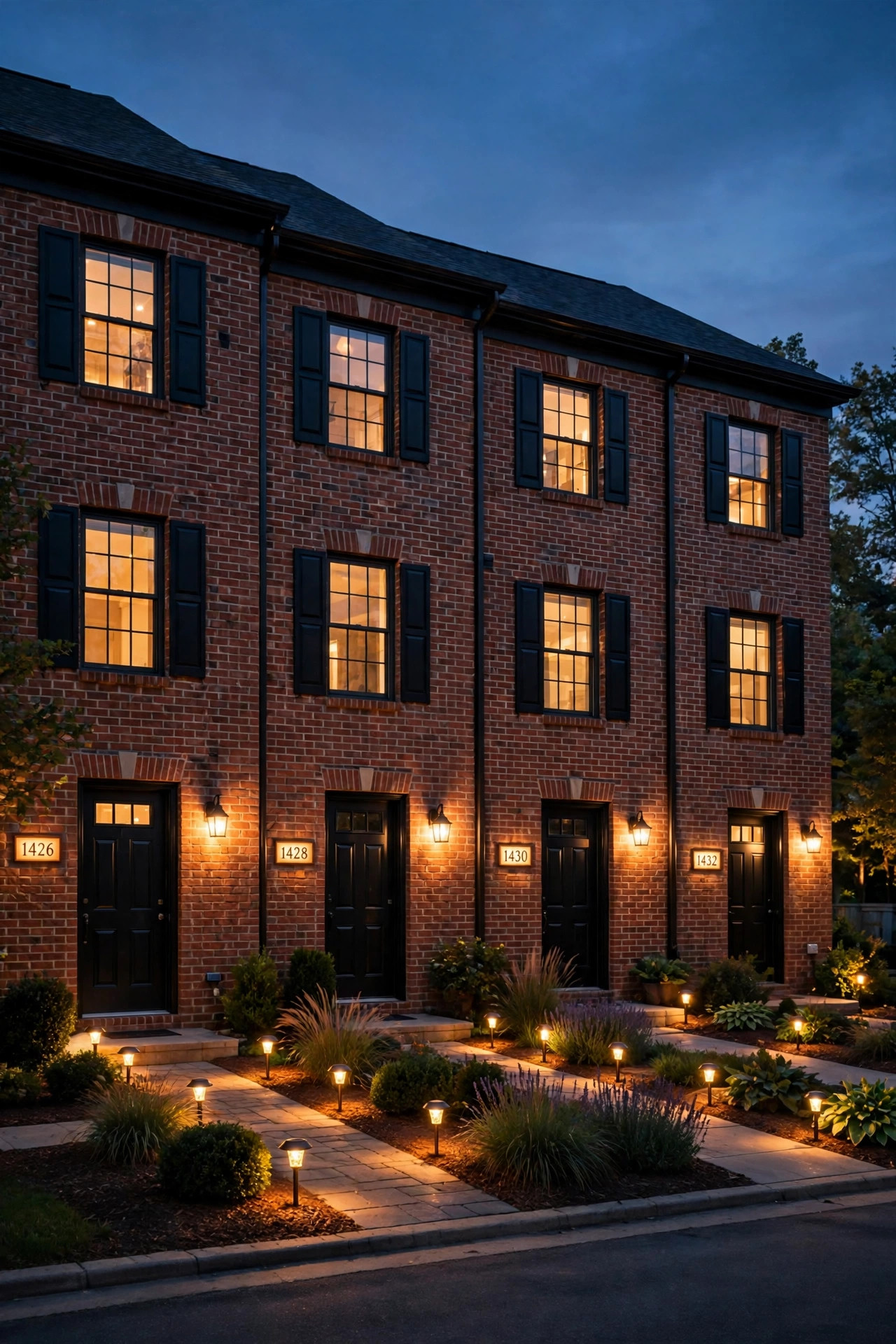
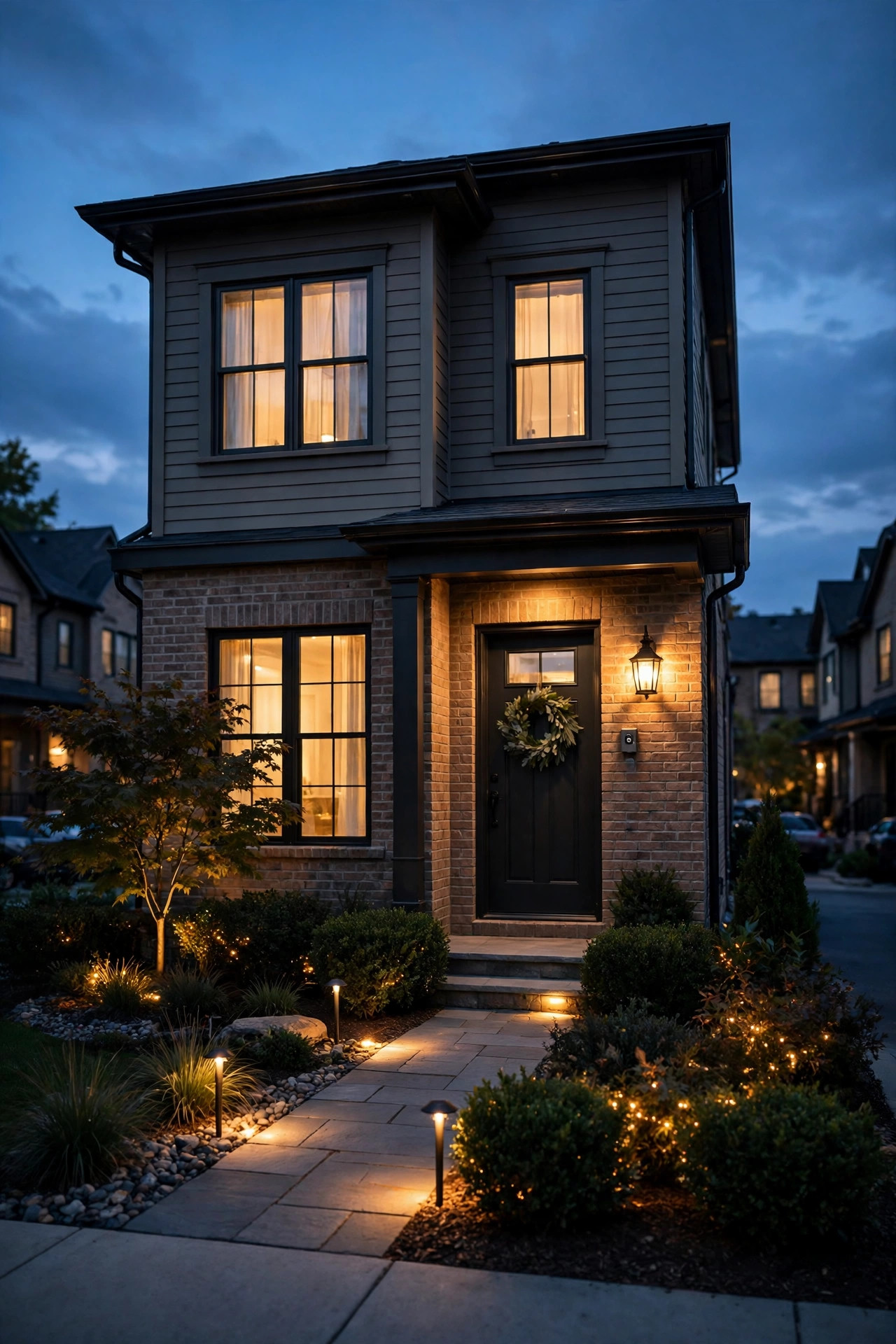
Townhome living comes with a lighting puzzle nobody warns you about: your front yard might be 12 feet wide, your neighbor's bedroom window is 6 feet from your porch, and the HOA has opinions about everything. But honestly? A small frontage is an advantage — a few well-chosen fixtures go a long way. The best townhome front yard lighting ideas work in layers, just scaled down: a welcoming layer at the door, a safety layer along the walk, and one soft accent layer to give the facade depth. You don't need a big budget or a big yard, and almost everything on this list is renter-of-the-future friendly — nothing that requires tearing up shared landscaping. These 15 ideas are the exact ones I recommend to friends in row houses and townhomes, sized for narrow lots, short walkways, and close quarters, with real prices and the spacing numbers that actually work.
1. A Slim Pair of Sconces Flanking the Front Door
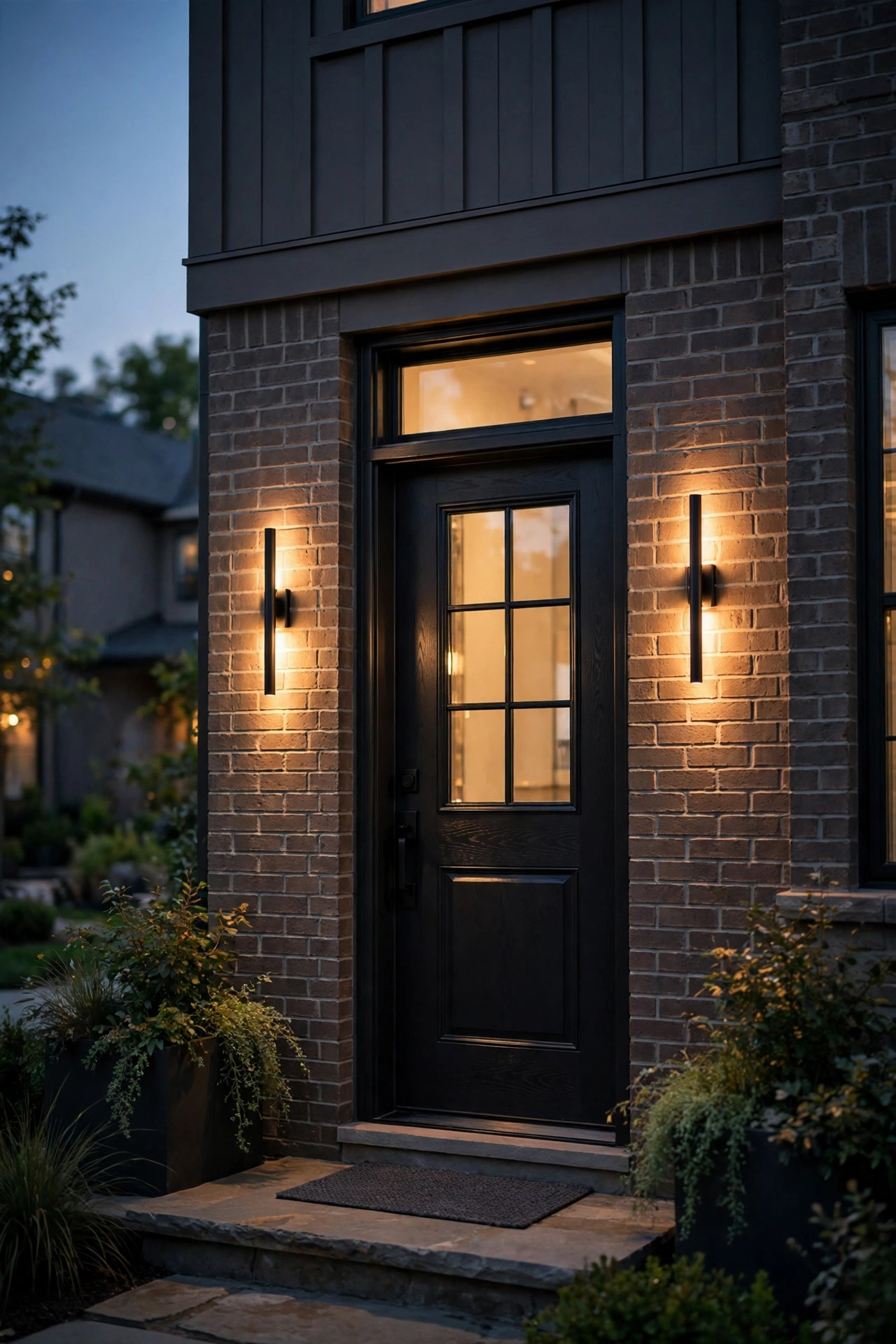
If you do only one thing on this list, make it this one. A pair of narrow sconces on either side of the front door instantly makes a townhome entry look finished, and because townhome doors sit close to the property line, slim fixtures (5 to 7 inches wide) read elegant instead of overwhelming. Mount them 60 to 66 inches from the ground to the center of the fixture, and 6 to 10 inches out from the door frame. In my experience, a warm 2700K LED bulb around 450 to 800 lumens per side is the sweet spot — bright enough to find your keys, soft enough not to glare into the neighbor's windows. Choose fixtures with the light directed downward or frosted glass if your door faces another home directly across a narrow street. Check your HOA rules first; many townhome communities require matching exterior fixtures, and sconces are usually the easiest approval to get since most builders installed a single basic one originally.
Suggested budget range: $60 – $180.
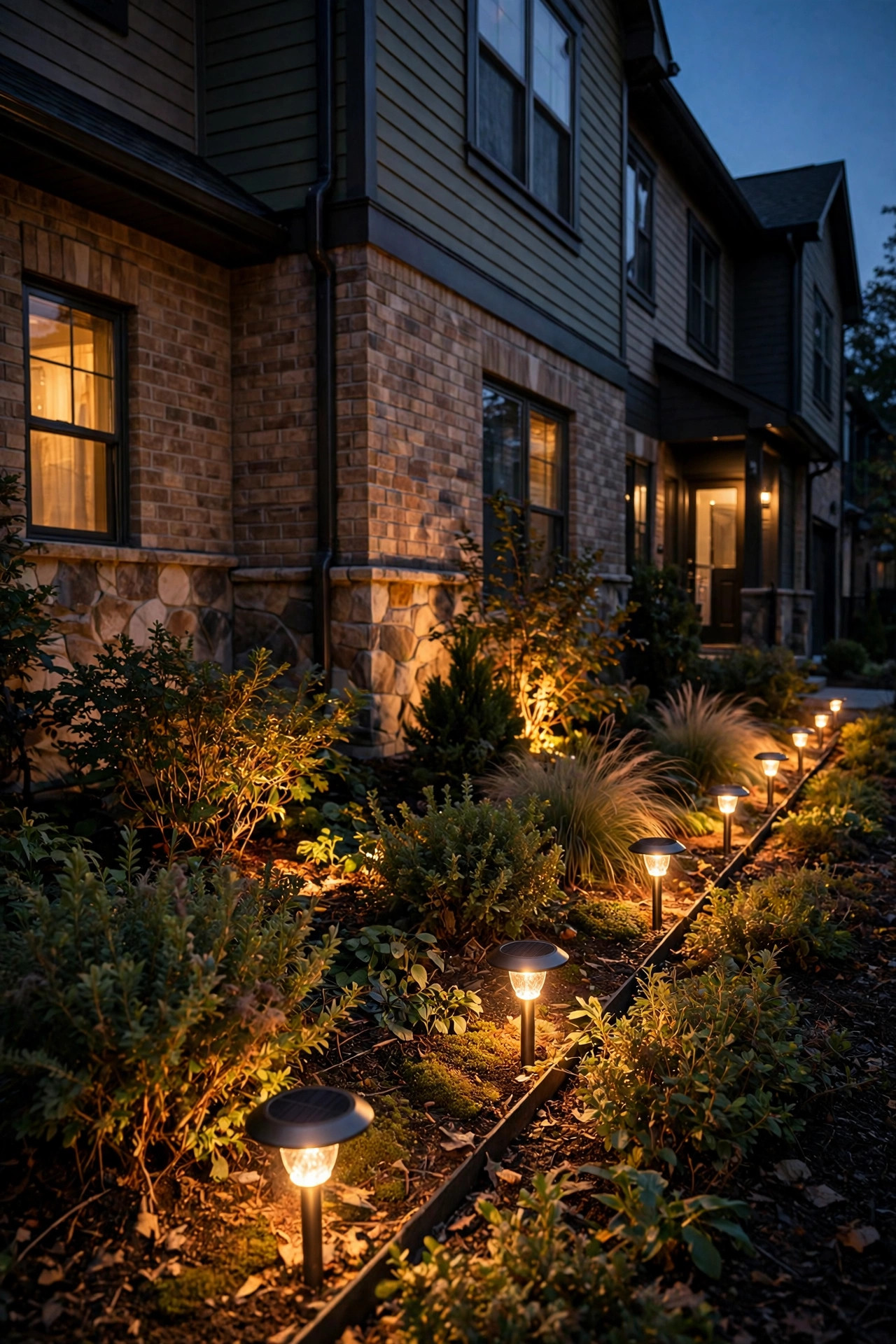
2. Solar Path Lights Along a Short Walkway
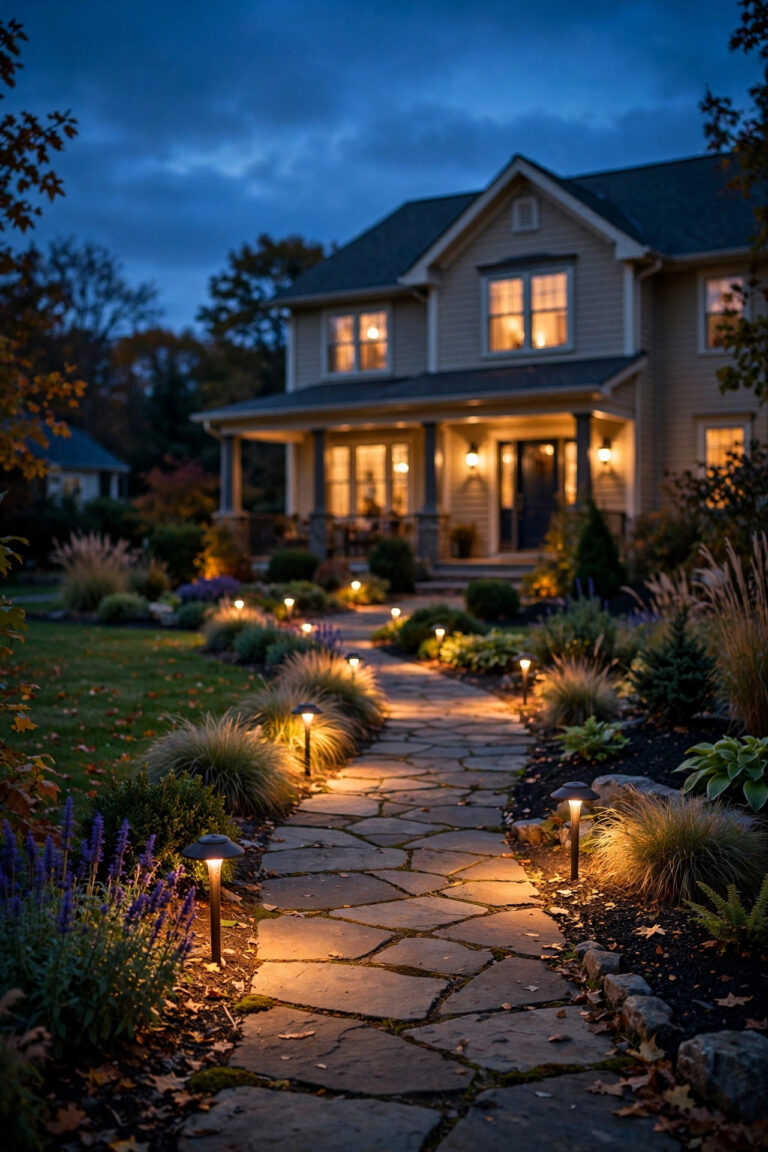
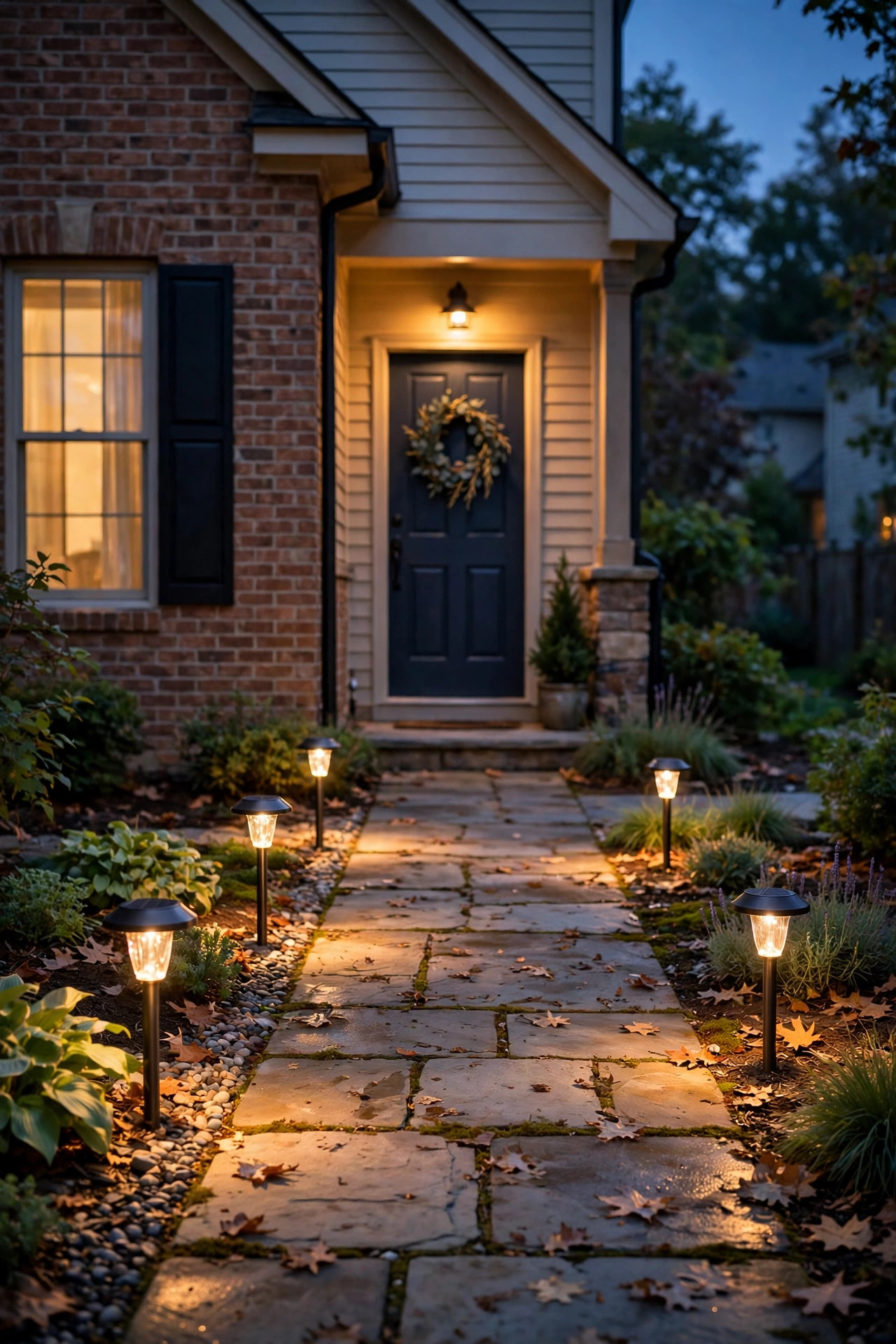
Most townhome walkways are only 8 to 15 feet long, which means a set of six solar path lights — three per side, staggered — covers the whole run beautifully. Staggering matters more than symmetry in a short space: alternating sides every 24 to 30 inches avoids that airport-runway look and actually lights more of the path. Push the stakes 12 to 18 inches back from the walkway edge so mower wheels and snow shovels don't take them out. Solar is perfect here because townhome front beds are often too narrow to trench low-voltage cable without hitting irrigation or your neighbor's plantings. Look for lights rated at least IP44 with warm-white output (some cheap sets glow a harsh blue — avoid anything labeled "cool white" or over 4000K). For a deeper look at how solar stacks up against wired systems, I compared both in my guide to lighting a full front yard on the site. Honestly, for a 12-foot walk, solar wins on effort every single time.
Suggested budget range: $25 – $60.
3. A Wall-Mounted Lantern Beside the Garage Door
Townhomes with front-facing garages have a lot of flat, blank wall — and one lantern-style fixture beside the garage door breaks it up better than almost anything. A single carriage-style lantern at about 66 inches high adds the same architectural rhythm the big suburban houses get from a pair, without crowding your narrow facade. If your garage door has a small strip of planting bed in front of it, even better: the lantern's glow will catch the shrubs below and double the effect. Match the finish to your door sconces (matte black and oil-rubbed bronze are the most forgiving) and keep the bulb temperature identical — mismatched color temperatures are the number-one thing that makes a small facade look accidental. A dusk-to-dawn photocell bulb means it runs itself, which matters when the garage light is the one guests actually navigate by. This is also one of the kindest lights you can add for package deliveries and rideshare drivers trying to find you after dark.
Suggested budget range: $45 – $120.

4. Backlit House Numbers Guests Can Actually Find
Ask any delivery driver: townhome rows are the hardest addresses to find at night because every unit looks identical. Backlit house numbers fix that and look genuinely high-end doing it. Mount 5- to 8-inch numerals on standoffs about an inch off the wall so the halo of light floats behind them, and wire them to the same circuit as your porch light or choose a solar version if your entry gets decent afternoon sun. Place them where a driver sees them from the street — beside the door is classic, but on a garage-facing unit, beside the garage lantern works even better. Brushed nickel and matte black both read well against brick, stucco, and siding. In my experience this is the single upgrade that gets the most compliments per dollar on a townhome, because it reads as custom architecture rather than decor. Keep the glow warm (2700K to 3000K) so it matches the rest of your layers instead of looking like signage.
Suggested budget range: $30 – $90.
5. Uplight the One Small Tree or Topiary You Have Room For
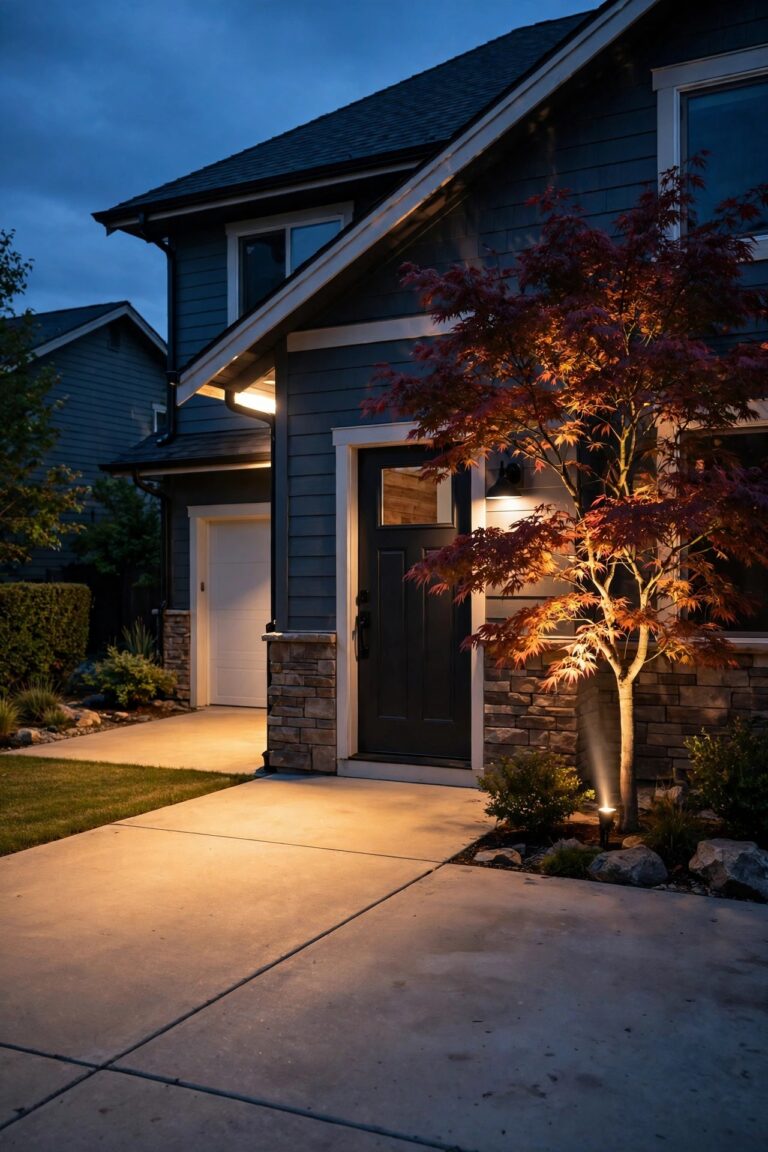
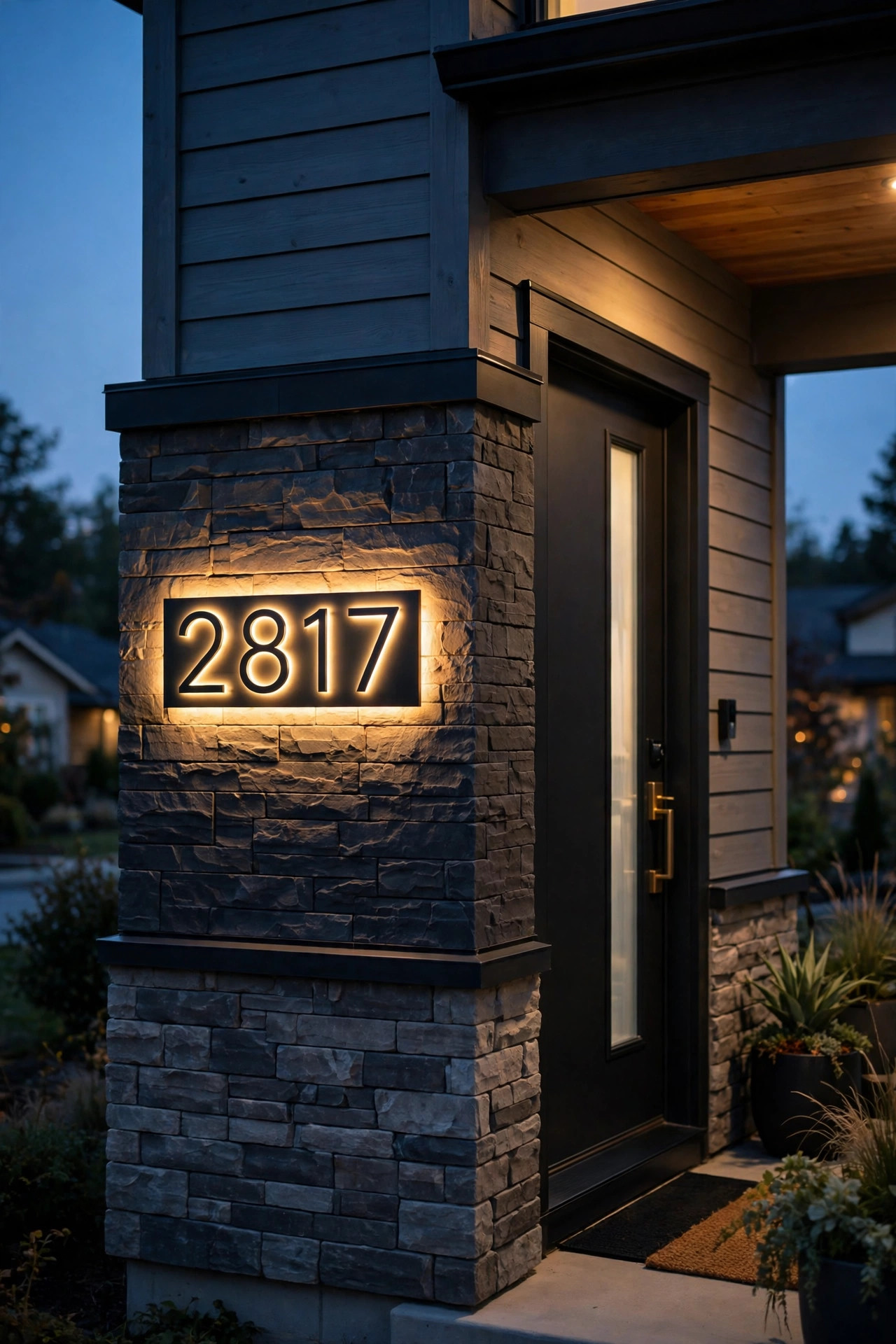
A detached house gets a canopy of trees; a townhome gets one ornamental — a dwarf Japanese maple, a spiral topiary in a pot, a skinny holly by the corner. That one plant deserves a light. A single low-voltage or solar uplight staked 12 to 18 inches from the trunk, aimed up through the branches, turns your one piece of greenery into a living sculpture and throws beautiful moving shadows across the facade on breezy nights. Keep it to one fixture: on a narrow lot, two competing uplights look busy, and restraint is what makes small yards feel designed. For a potted topiary flanking the door, a small solar spotlight tucked into the pot itself is enough — no wiring across the stoop. If you're curious how uplighting compares with washing light downward, my breakdown of small yard lighting tricks covers the small-space version of both. Choose a warm bulb and a narrow beam (around 30 degrees) so the light stays on your plant, not in the upstairs windows.
Suggested budget range: $20 – $70.
6. Fairy Lights Woven Through Planters and Window Boxes
Townhome front yards often have more containers than soil — planters on the stoop, a window box, pots flanking the garage. Copper-wire fairy lights turn all of them into one connected glow. Weave a 16- to 33-foot strand through a planter's trailing plants (ivy and sweet potato vine hide the wire beautifully), letting a few loops spill over the edge like light pouring out. The wire is nearly invisible by day, which keeps HOAs happy, and battery or solar versions mean no cord crossing the walkway. I always recommend the warm-white sets with a built-in timer — six hours on, eighteen off — so you set them once in October and forget them until the batteries fade around the holidays. Keep strands out of the direct path of sprinklers, and bring battery packs under the pot's rim so rain doesn't pool in them. Two planters and a window box, all twinkling at the same warmth, make a 10-foot frontage feel like a boutique hotel entry. It's the cheapest transformation on this entire list.
Suggested budget range: $15 – $40.

7. Recessed Step Lights for a Safe Townhome Stoop
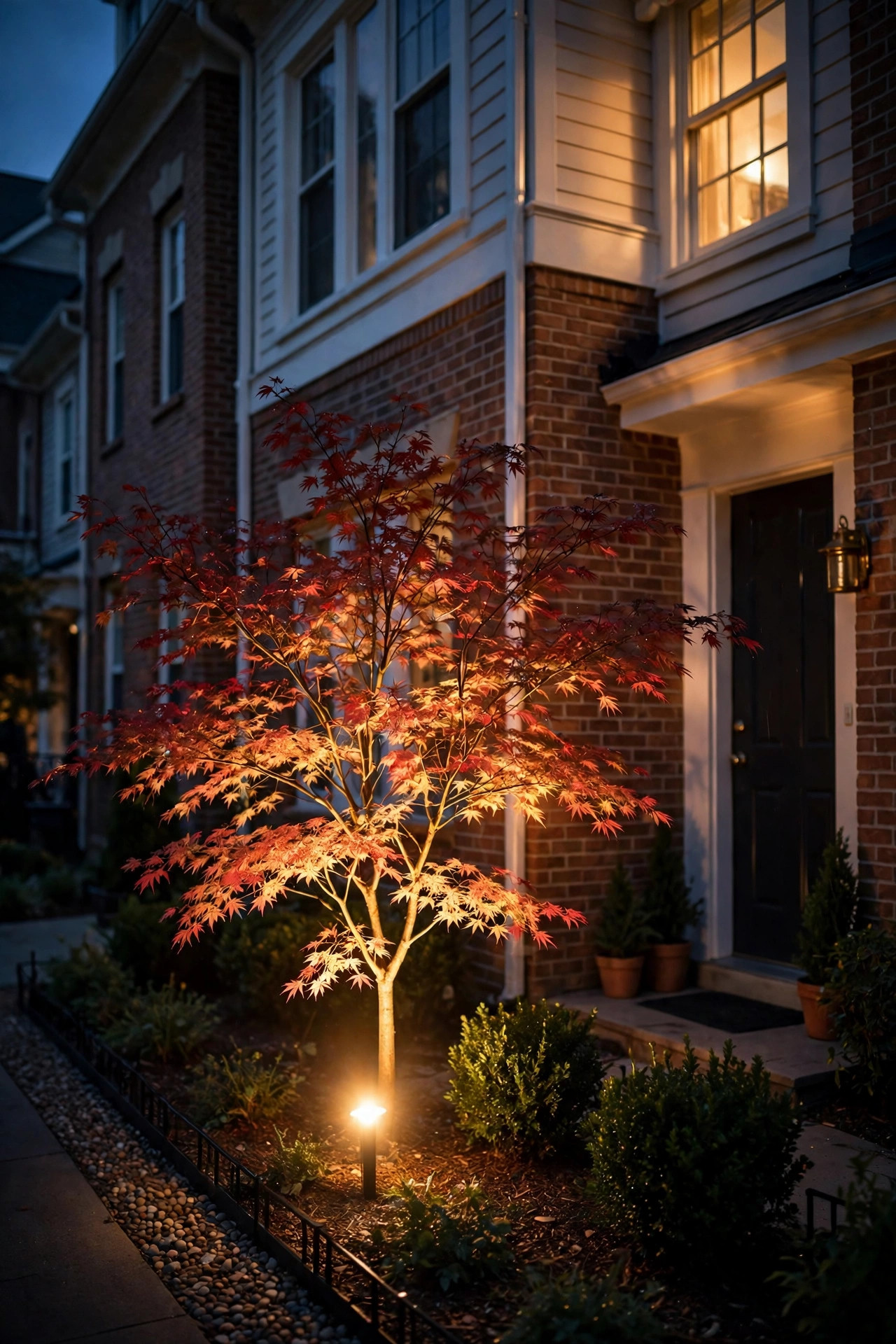
Row house stoops are charming and treacherous in equal measure — narrow treads, often no handrail light, and guests carrying bags up steps they can't see. Recessed LED step lights fix this quietly. Mount one small fixture into the riser of every other step, or surface-mount a slim light on the wall beside the steps if cutting into masonry isn't an option (or isn't allowed). Each light only needs to throw a soft pool 2 to 3 feet wide; brightness around 50 to 100 lumens per step is plenty and won't blast your neighbor's stoop, which may be three feet away. Hardwired low-voltage versions are the most reliable, but solar step lights have gotten genuinely good and install with two screws and no electrician. This is pure safety spending, and I'll be honest: it's the idea I'd fund first for any townhome with more than two front steps, especially with older family members visiting after dark.
Suggested budget range: $35 – $95.
8. String Lights Along the Tiny Porch Rail
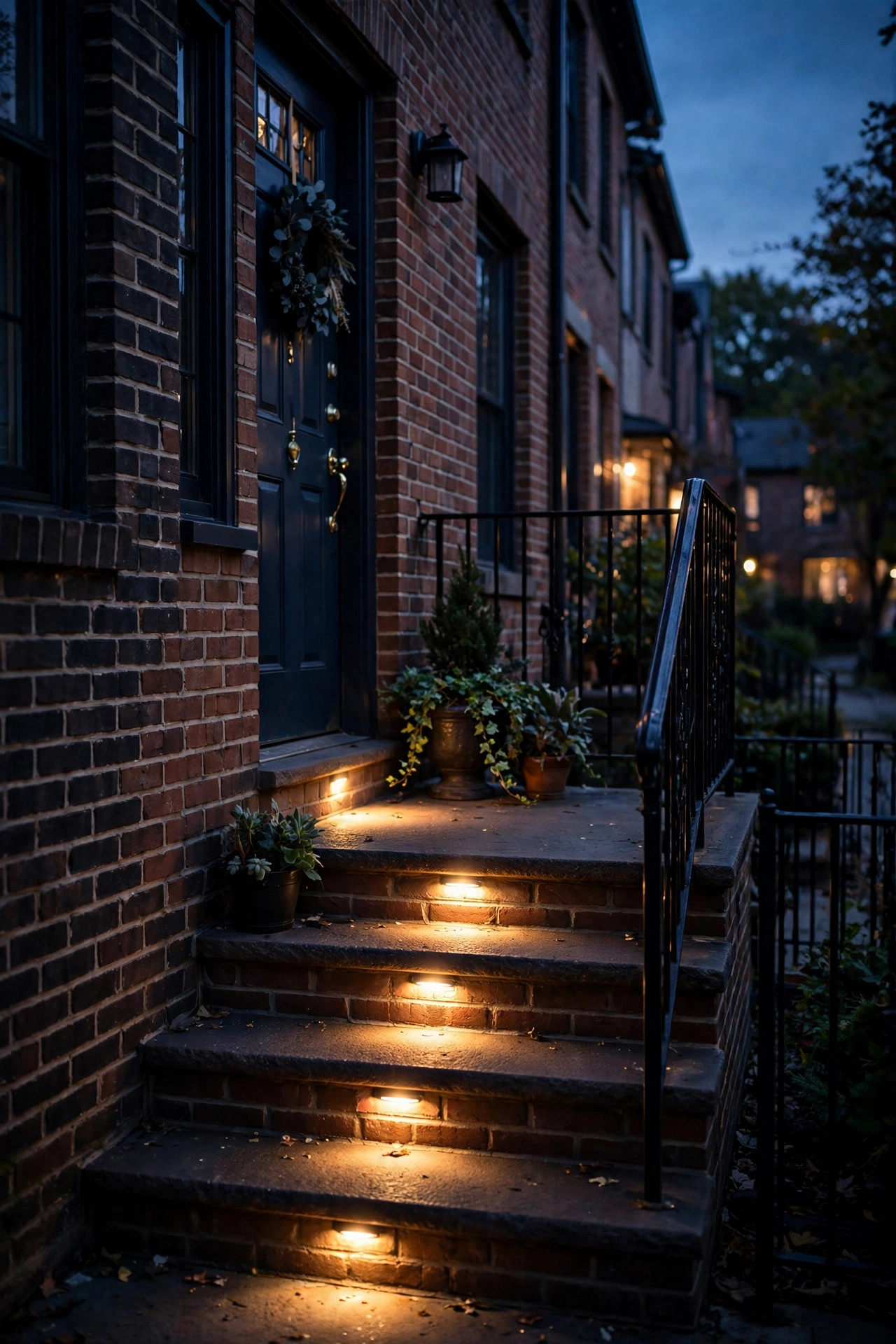
A townhome porch might only be 5 feet deep, but that little rail is prime string-light territory. Run one strand of outdoor string lights along the top rail or swagged gently between the porch posts — on a small porch, a single 25-foot strand with bulbs every 12 inches is plenty, and the glow reflects off the ceiling to light the whole space. Choose shatterproof LED bulbs (glass and concrete stoops are enemies) and a strand rated for outdoor use; I hang mine with small screw-in hooks rather than clips so wind doesn't redecorate. The key to keeping it classy in close quarters: one strand, warm white, gentle swag. The moment you add a second color or a zigzag ceiling web, it tips from bistro to dorm room. Your neighbors across the narrow street will see this light all evening, so soft and warm is a kindness as well as a style choice. Add a plug-in timer and it turns itself on for your arrival home.
Suggested budget range: $20 – $50.
9. Wash the Brick or Stone With One Soft Light
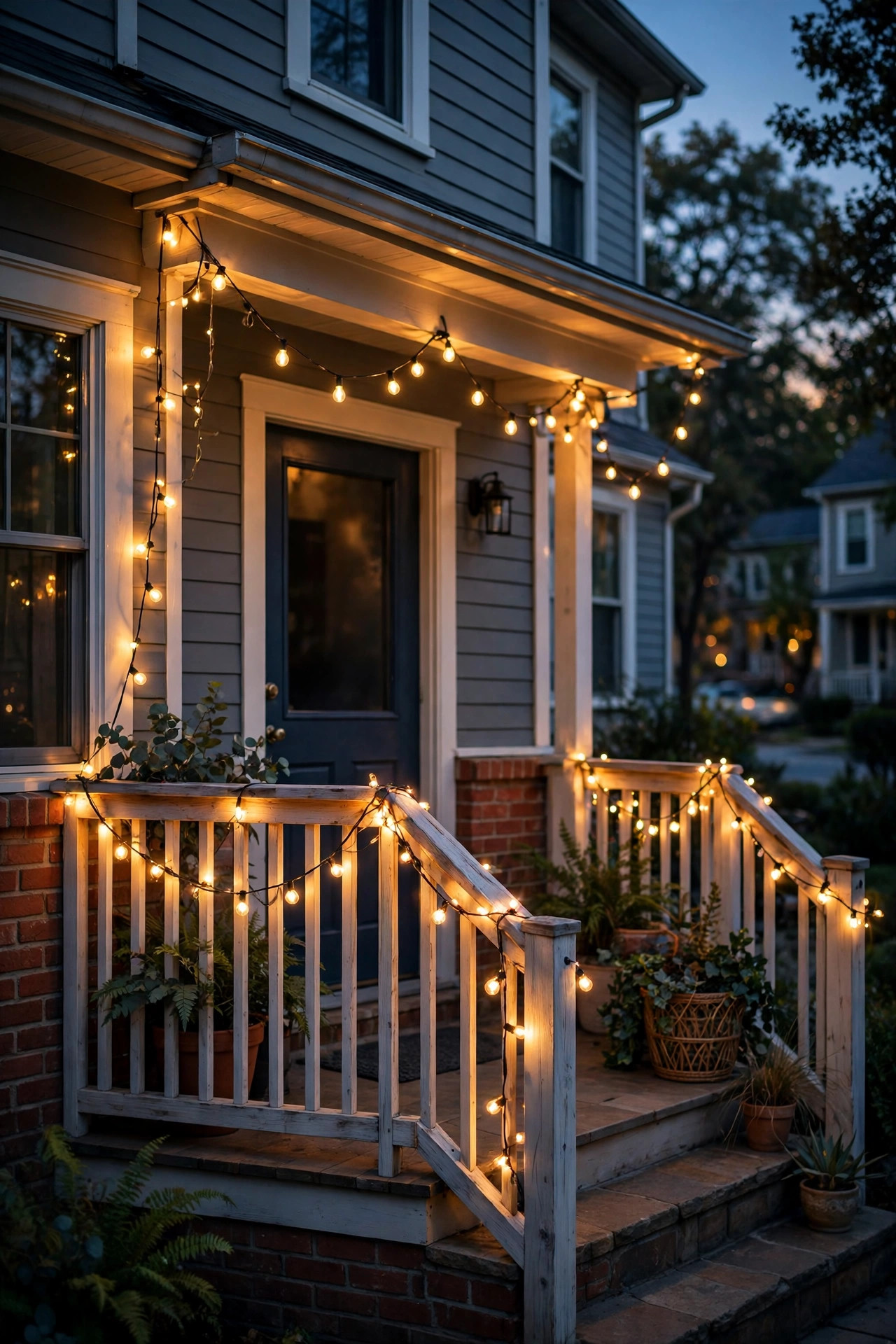
So many townhomes and row houses have gorgeous brick or stone facades that go completely black at night. One ground-level wash light brings the texture back. Set a wide-beam fixture (60 degrees or more) in the planting bed 12 to 18 inches from the wall, aimed straight up so the light grazes across the masonry — grazing is what reveals every bump and mortar line. On a narrow facade, center the fixture under a window rather than under a blank stretch, so the composition has a focal point. This is the technique designers use on front yard landscape lighting projects of every size, and it scales down perfectly. One caution for attached homes: keep the beam tight to your own facade. Light spilling onto a neighbor's siding or into their windows is the fastest way to an HOA letter, so shield the fixture or choose one with a glare guard. Warm 2700K against red brick is, honestly, one of the prettiest things in residential lighting.
Suggested budget range: $30 – $85.

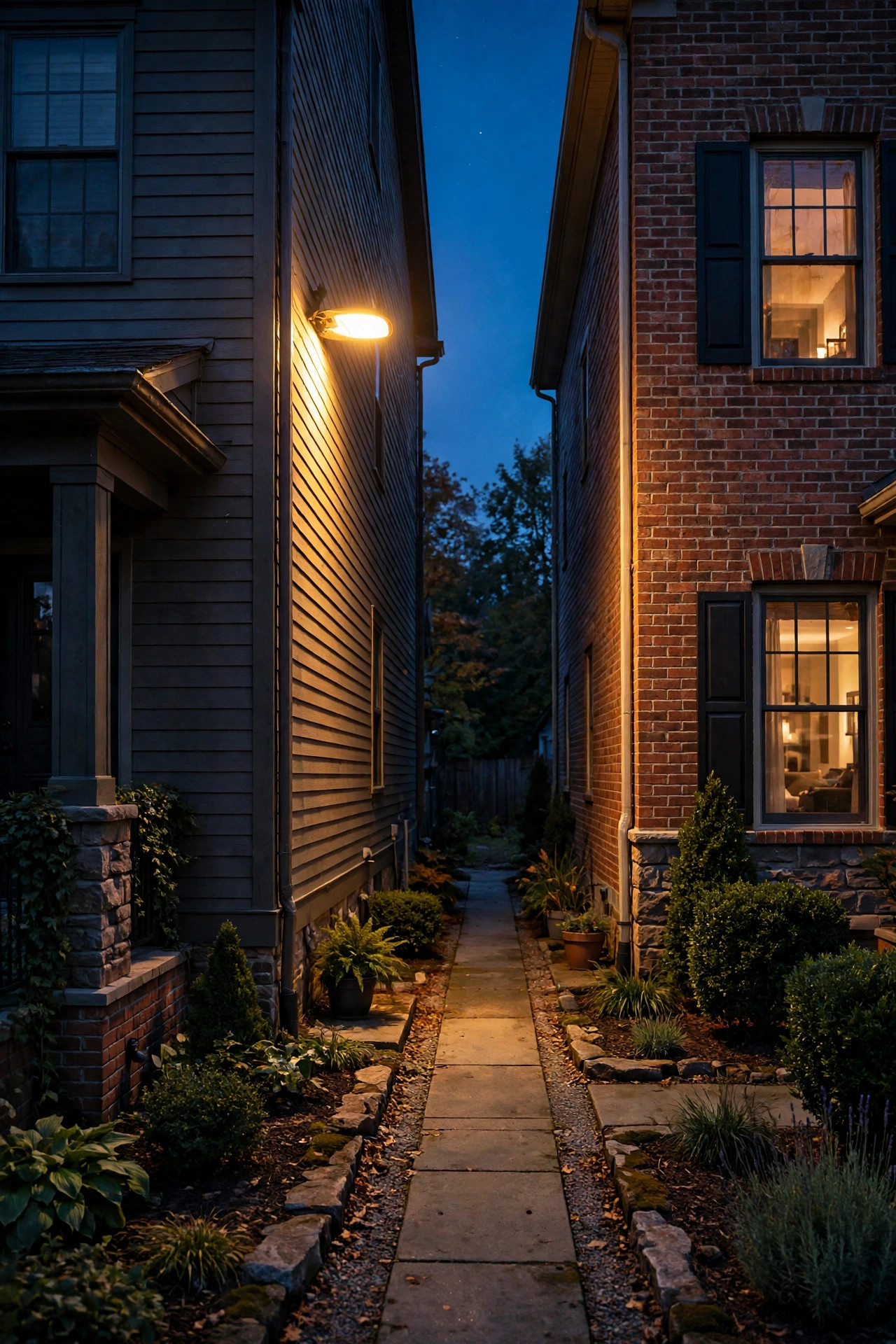
10. A Motion-Sensor Light for the Shared Walkway or Side Gate
Many townhomes share a side walkway or rear-access path with the unit next door, and it's usually pitch black. A motion-sensor light mounted 7 to 8 feet up covers your stretch without burning all night — which your neighbors will thank you for, since a sensor light that only wakes when someone passes is far less intrusive than a dusk-to-dawn flood. Aim the sensor along the path, not across it, and set the range so it triggers at about 15 to 20 feet; too sensitive and every cat in the community will put on a light show. Keep the brightness moderate — 800 to 1,200 lumens is plenty for a path, and anything flood-sized belongs on a detached lot, not six feet from someone's bedroom window. Solar sensor lights work well on a sunny side wall and need no wiring at all. If your community has a shared rear alley for trash bins, this same fixture by your gate makes those evening trips feel much safer.
Suggested budget range: $25 – $75.
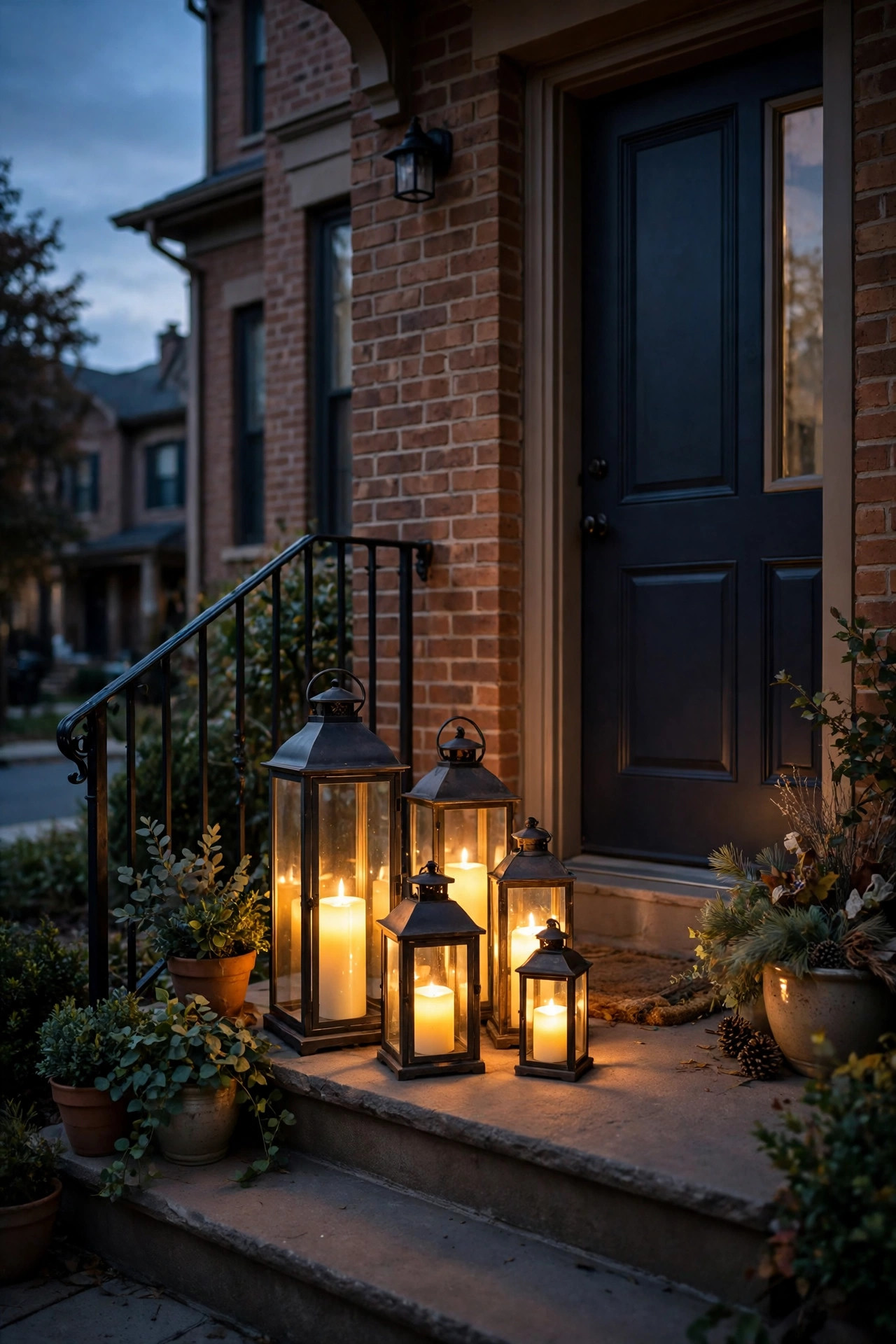
11. Flameless Lanterns Grouped on the Stoop
Real candles near a front door make me nervous anywhere; on a townhome stoop with neighbors' doors feet away and community no-open-flame rules, they're a non-starter. Flameless LED candles in weatherproof lanterns give you the same flicker with zero risk. Group two or three lanterns of different heights on one side of the door — odd numbers look intentional — and choose resin or powder-coated metal lanterns, since thin glass ones don't survive winter stoops. Most flameless candles now come with timers and surprisingly realistic flicker; set them to come on at dusk so the stoop greets you. This grouping trick is the fastest way I know to make a bare concrete stoop feel styled, and it pairs beautifully with the sconce pair from idea one: sconces for architecture, lanterns for warmth. Because nothing is wired or permanent, it's fully HOA-proof and moves with you to the next home. Swap in a pumpkin or a sprig of greenery per season and the same lanterns work all year.
Suggested budget range: $30 – $80.
12. Solar Disk Lights Edging a Narrow Planting Bed
Townhome planting beds are often just 18 to 24 inches deep — too shallow for most staked lights, which end up leaning into the mulch by July. Solar disk lights solve it: flat pucks that sit directly on the soil or gravel and glow upward through the plants. Space them 18 to 24 inches apart along the bed's front edge, tucked just behind the border stones, and they'll outline your whole frontage in a low ribbon of light. Because they sit flush, mowers and edgers pass right over them, and there's nothing for a shared-lawn crew to knock over. They charge even in partial sun, though a south-facing bed will keep them glowing noticeably longer into the night. I'll be straight with you: disk lights are accent, not illumination — pair them with real path or porch light for safety, and think of these as the jewelry. For the price of a pizza, they make a builder-basic bed look planted and planned.
Suggested budget range: $20 – $45.
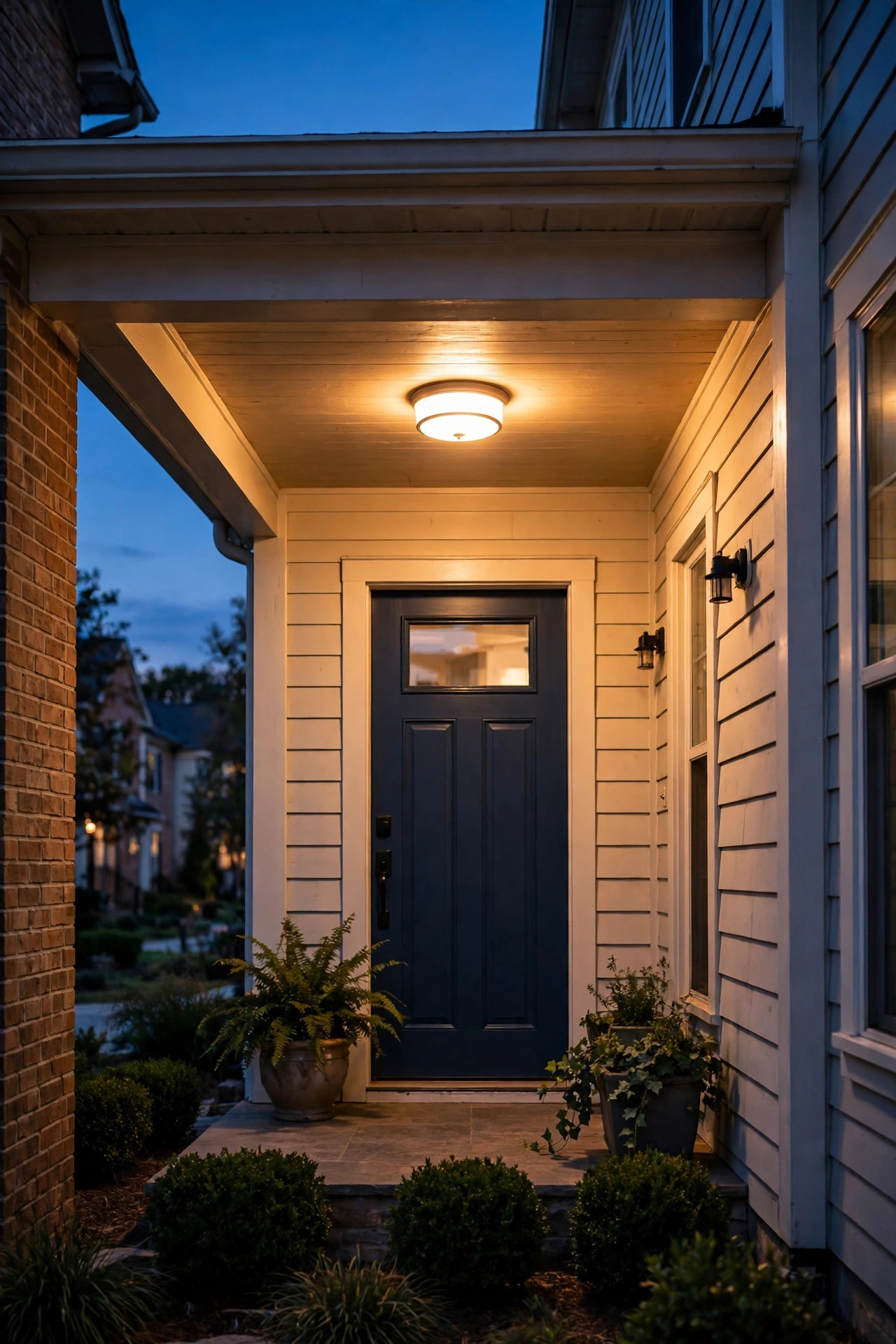
13. A Flush-Mount Ceiling Light for the Covered Porch
Many townhome porches have a small covered ceiling that's doing nothing after dark — the builder's bare bulb included. A flush-mount or short semi-flush ceiling fixture spreads light across the whole porch instead of in two sconce pools, which makes a tiny porch feel twice its size and lights the door hardware, the mat, and the step edge all at once. Choose an outdoor-rated (wet-location) fixture 12 to 16 inches wide with frosted or opal glass so no bare bulb stares at visitors — or at the neighbors directly across the street, whose porches face yours. Around 800 to 1,200 lumens at 2700K is comfortable for a small porch. If your porch has no ceiling box, a plug-in pendant on a hook achieves the same spread with zero wiring. This is often the single brightest improvement for townhome entries because it fixes the top-down shadow that makes faces at the door look gloomy on doorbell cameras.
Suggested budget range: $40 – $110.
14. A Pre-Lit Wreath and Garland for Instant Seasonal Glow
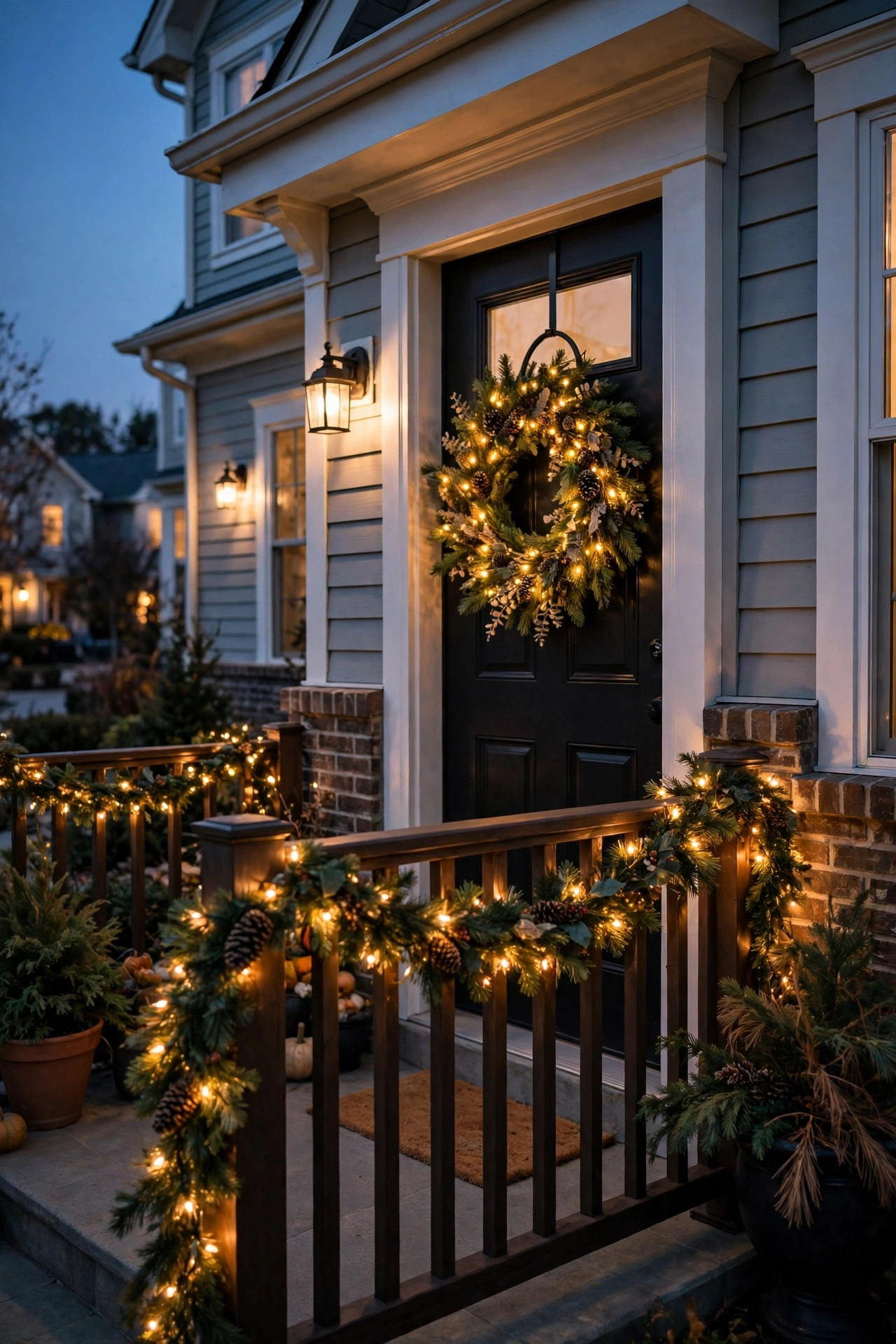
When your whole front yard is 10 feet wide, seasonal decorating has to live on the door and rail — which is exactly why a pre-lit wreath and matching garland punch so far above their weight on a townhome. A 24-inch battery-operated wreath with a timer becomes your entire holiday facade in four minutes, and a garland swagged along the porch rail (or framing the door) doubles the effect without touching the landscaping your HOA maintains. Keep the light color consistent with your permanent fixtures — warm white reads classic against brick and siding alike. The off-season move I swear by: the same garland, unlit decor swapped, works for fall with faux leaves woven in. Because everything is battery-powered and hangs on hooks, there's no extension cord across the shared walkway and nothing to argue about in the community rules. Store them in one labeled bin and this becomes the easiest decorating you'll do all year.
Suggested budget range: $35 – $90.
15. Put the Whole Frontage on a Timer and Photocell Routine
The final layer isn't a fixture — it's a schedule. Townhome front yard lighting ideas only feel effortless when the lights run themselves, and with neighbors this close, a routine is also good manners: on at dusk, off by 11 p.m., nothing glaring at 3 a.m. The simple stack I recommend: photocell bulbs or a photocell adapter in the sconces, an outdoor smart plug with an astronomical timer for the string lights and lanterns' charging station, and solar everywhere else since it self-manages. Set string lights to a slightly earlier off-time than the sconces — the entry stays lit for late arrivals while the decorative layer clocks out first. This staggered fade is a trick from dark sky outdoor lighting practice, and on a row of attached homes it keeps the whole street calmer after midnight. Total setup takes twenty minutes, costs less than one fixture, and from then on your little front yard just glows on cue, every single evening, without you touching a switch.
Suggested budget range: $15 – $60.
Frequently Asked Questions
How many lights does a townhome front yard actually need?
Fewer than you think. Most townhome front yards look fully lit with 6 to 10 light sources total: a door layer (sconces or a ceiling fixture), a path layer (3 to 6 small lights), and one accent (an uplight or wash). Because the area is small and walls bounce light around, each fixture does more work than it would on a sprawling lot. Start with the door and path, live with it a week, then add the accent.
Will my HOA allow front yard lighting changes?
Usually, yes — with conditions. Most townhome HOAs restrict permanent hardwired fixtures and anything that changes the facade's appearance, but solar lights, lanterns, planters, and plug-in options are rarely regulated since they're removable. Swapping existing sconce or porch fixtures for a matching style is typically fine too. When in doubt, submit the architectural form with a photo of the fixture; small, classic, warm-white choices almost always get approved.
How do I light a front yard I share walls and space with neighbors?
Aim everything down or at your own facade, keep beams off neighboring windows, and use timers so decorative lights are off by 11 p.m. Warm 2700K light reads softer across close distances than cool white. If you're adding anything near a shared line — especially motion sensors — a quick friendly heads-up to the neighbor goes a long way. Dark-sky-style shielded fixtures are your best friend in attached housing.
Solar or low-voltage: which is better for a small front yard?
For most townhomes, solar wins on practicality: no trenching through narrow (often HOA-maintained) beds, no transformer to hide, and easy removal. Low-voltage wired light is brighter and more consistent, and it's worth it for the two workhorse layers — door sconces are usually already wired, and one wired uplight or wash light gives you reliable accent light. My honest recommendation is the hybrid most of this list uses: wired at the door, solar everywhere else.
Conclusion
A small frontage isn't a limitation — it's a shortcut. The right townhome front yard lighting ideas use the same three layers as any great lighting plan, just edited down: welcome at the door, safety along the walk, and one soft accent for depth. Pick the two or three ideas that solve your actual problems first, keep every bulb at a warm 2700K, put it all on a timer, and your row house will be the one people slow down for on evening walks. Browse the rest of our outdoor lighting ideas for more small-space inspiration, and start with the sconces — you'll feel the difference the very first night.