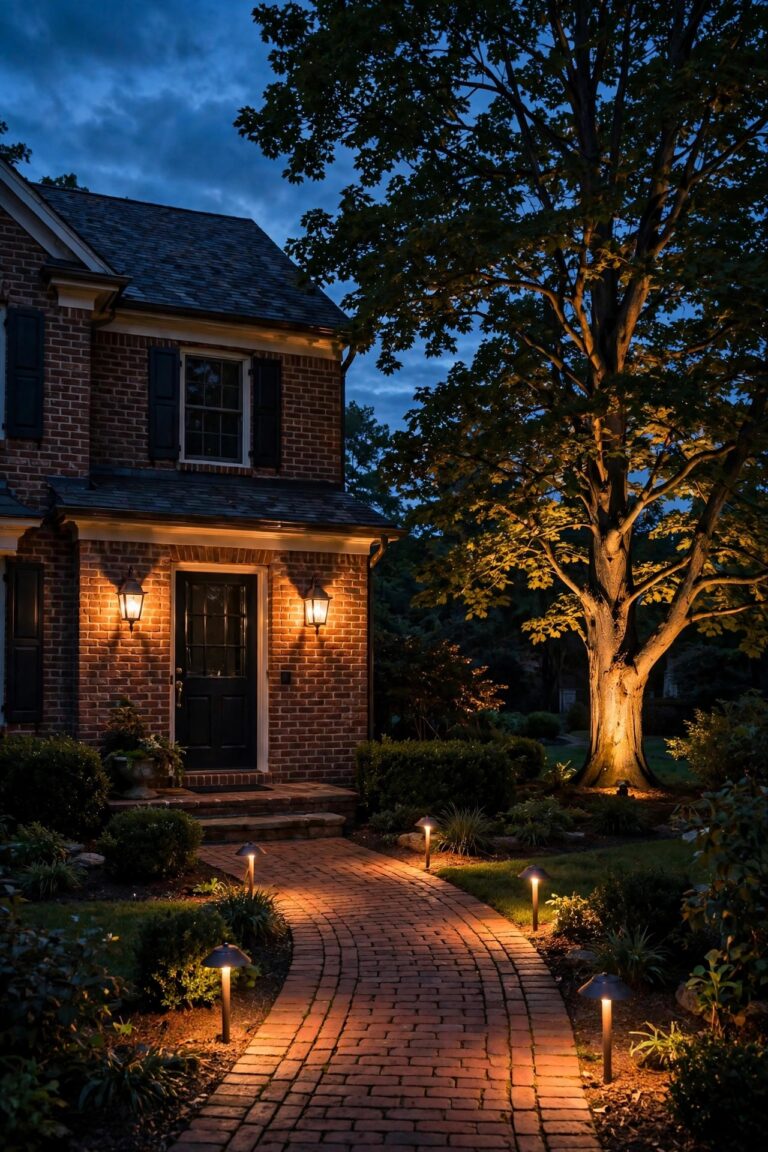
There is a moment in the desert, just after the sun drops behind the mountains, when the whole yard turns violet and the adobe walls still hold the day's warmth. That is the hour the best southwestern outdoor lighting ideas are built for. Out here, lighting is not about flooding the yard with brightness; it is about echoing the landscape — amber pools on gravel paths, a saguaro standing lit like sculpture, farolitos flickering along a low garden wall. In my experience, desert homes glow best with the same layering I use everywhere: low light for safe footing, eye-level light for welcome, and a little high light for atmosphere, all in warm tones that flatter stucco, stone, and weathered timber. The ideas below lean on materials that belong to the Southwest — rusted iron, punched tin, terracotta, saltillo tile — plus the timers and photocells that let a desert yard run itself. Whether your place is a Santa Fe courtyard, a Tucson adobe, or a Phoenix xeriscape, there is a plan here that will feel native to your land.
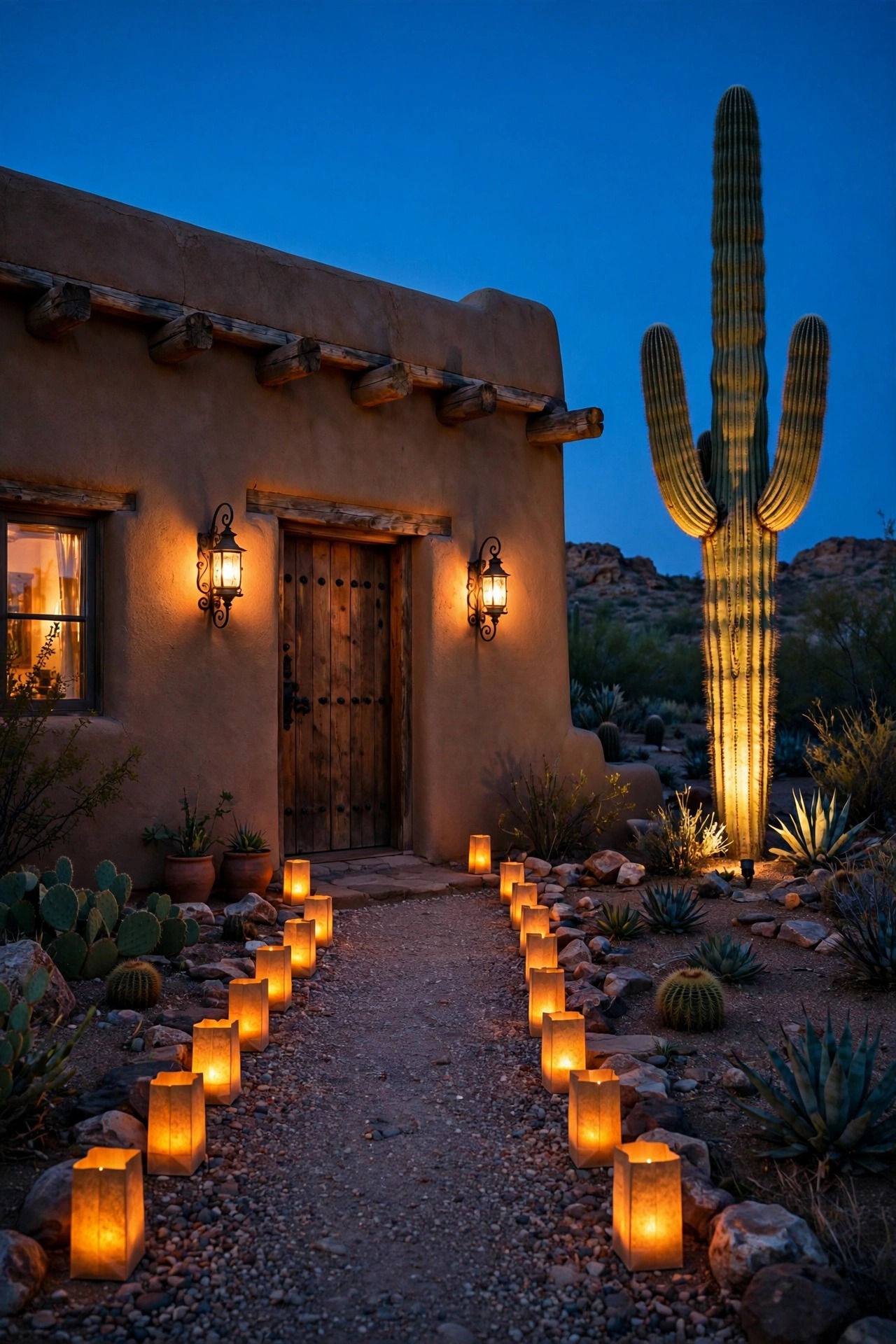
1. Start With a Three-Layer Plan for Southwestern Outdoor Lighting Ideas
Every desert yard I have ever admired follows the same quiet plan: light in three layers. The low layer lives at ankle height — farolitos, short path stakes, and step lights that pool glow where feet land on gravel, flagstone, or saltillo. The middle layer is the welcome layer: door sconces and courtyard lanterns at about 66 inches, where punched tin and seeded glass can actually be admired. The high layer is atmosphere — a soft wash under the portal beams, moonlight spilling through a mesquite, string lights floating over the patio. When the three burn together on warm bulbs, the yard does not look lit, it looks embers-and-starlight, and that is the whole Southwestern mood. Before buying anything, sketch your yard and assign every fixture to one layer; if something fills no layer, it is clutter. I also map my dark zones on that sketch, because in the desert the unlit silhouettes of mountains and cactus are half the show. Honestly, restraint is the desert's best lighting designer — leave gaps of shadow and the glow you do place will feel twice as rich.
Suggested budget range: $150 – $400.
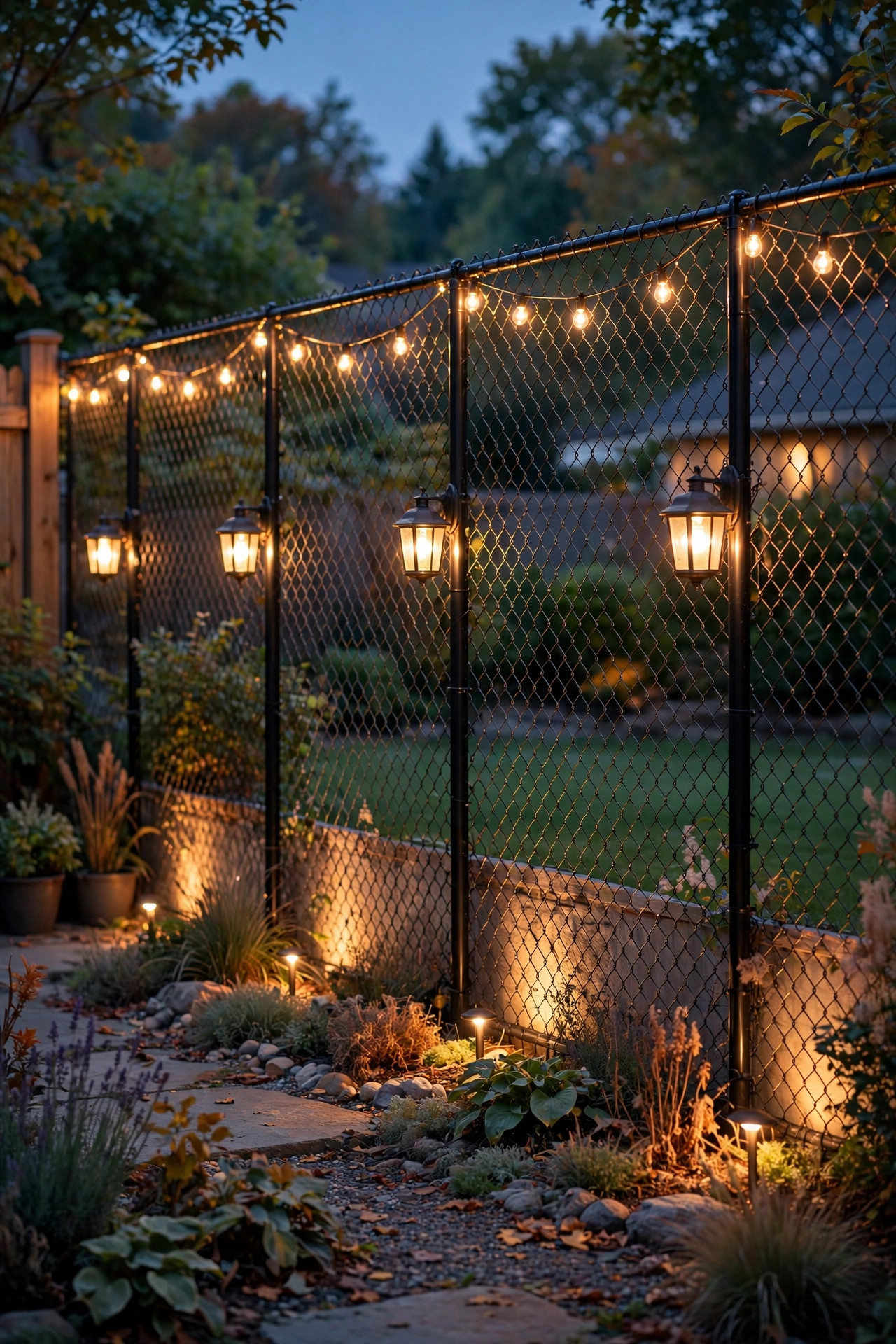
2. Line the Front Walk With Farolitos
Farolitos — the little lanterns Northern New Mexico lines its walls and walks with — are the fastest way to give a front yard desert soul. The traditional version is a candle in sand inside a paper bag, but for nightly use I recommend electric or LED farolitos styled to look the same: a soft, warm, flickering glow with zero fire risk. Space them 3 to 4 feet apart along the walk, and always in a loose rhythm rather than a perfect runway line; stagger a few onto the low wall or beside a prickly pear for that gathered, festive look. For wired versions, a low-voltage run is simple because desert landscaping rarely means digging through roots — the cable tucks neatly under gravel. Solar farolitos work beautifully out here too, since a desert path gets the full sun they crave; just brush dust off the panels monthly, because a dusty panel can cut the charge noticeably. Keep the glow warm, 2200K to 2700K, so the light reads as candlelight against the stucco. For more walkway lantern styles and spacing tricks, my lantern path light ideas covers the full range from rustic to modern.
Suggested budget range: $40 – $120.
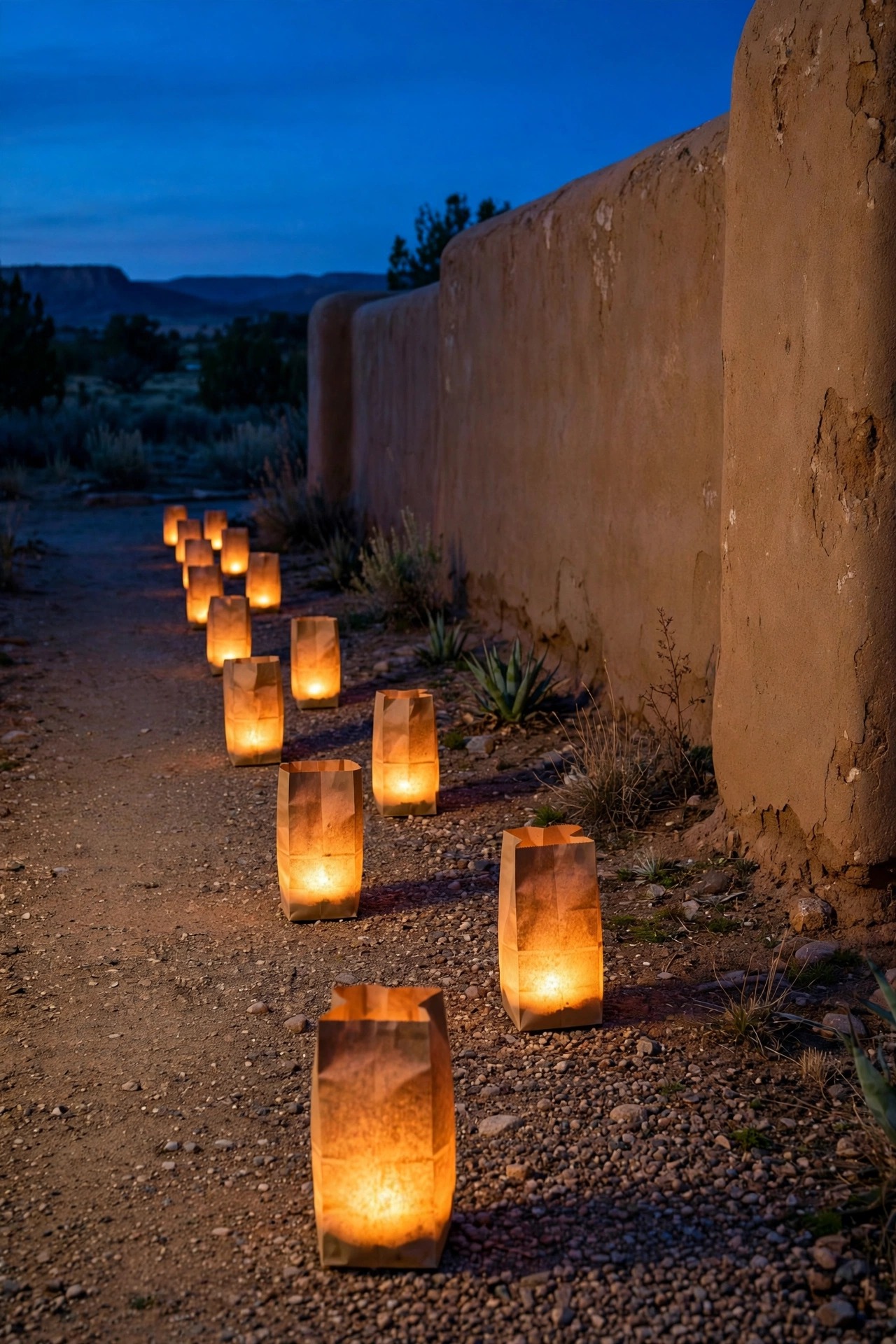
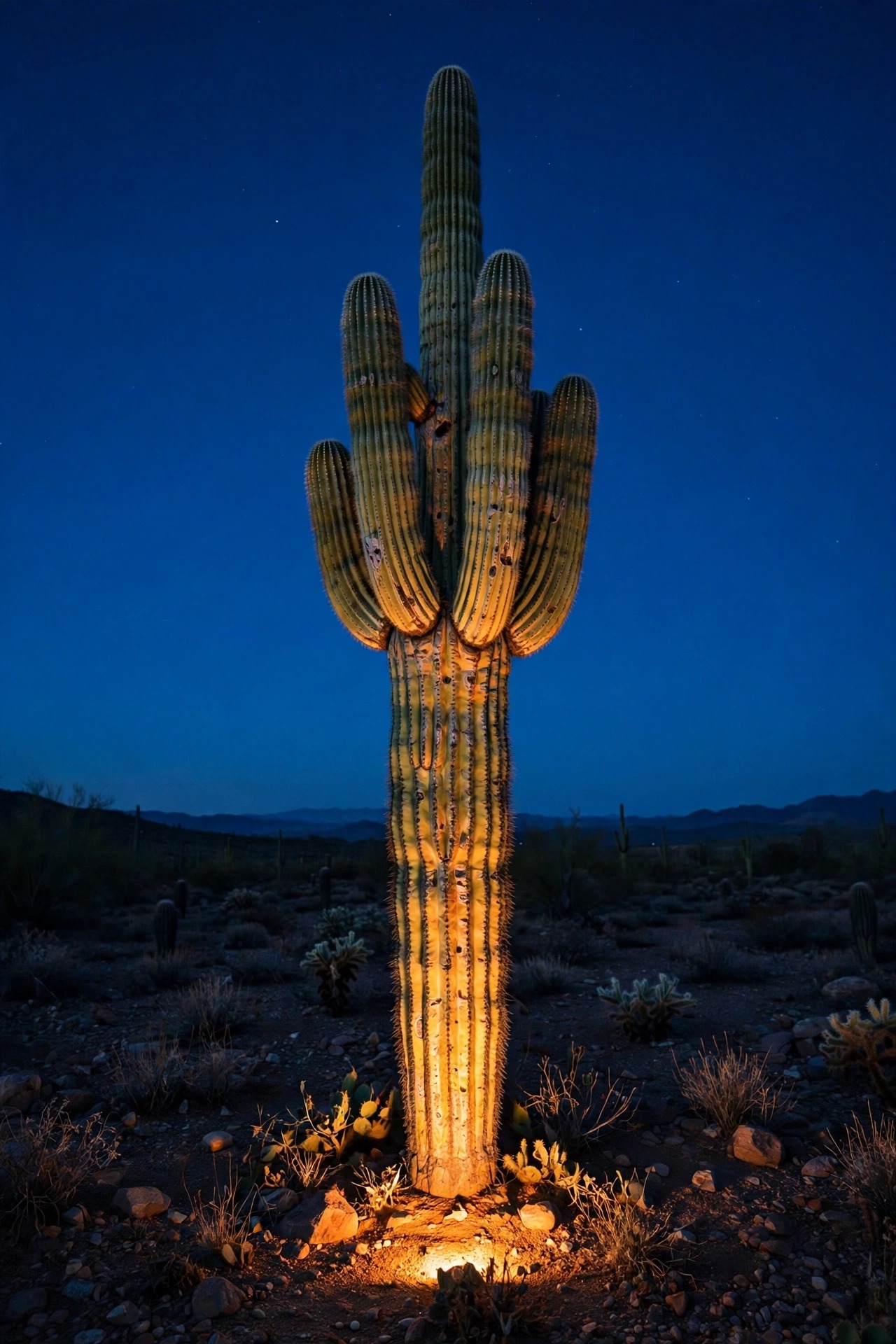
3. Uplight a Saguaro or Sculptural Agave Like Art
In a Southwestern yard, your specimen cactus is sculpture, and it deserves gallery treatment. A single well light or a narrow-beam spot placed 12 to 18 inches from the base of a saguaro, aimed straight up its ribs, turns it into a glowing green column against the night sky. Agaves love a slightly wider beam from 2 feet out, washing the rosette so every leaf edge catches light. Use one fixture per plant, not two — cross-lighting a cactus flattens it and kills the drama. Choose a 2700K LED with a tight 15- to 30-degree beam, and bury a low-voltage well light flush in the gravel so the source stays invisible by day. Desert caution matters here: keep fixtures and cable clear of pack rat nests, and use gopher-proof armored cable or conduit where rodents chew. Never nail or strap anything to a saguaro; in Arizona they are protected plants, and the light should honor them from the ground. In my experience this single move — one dramatic plant, one hidden light — does more for a desert yard after dark than a whole box of path stakes.
Suggested budget range: $60 – $180.
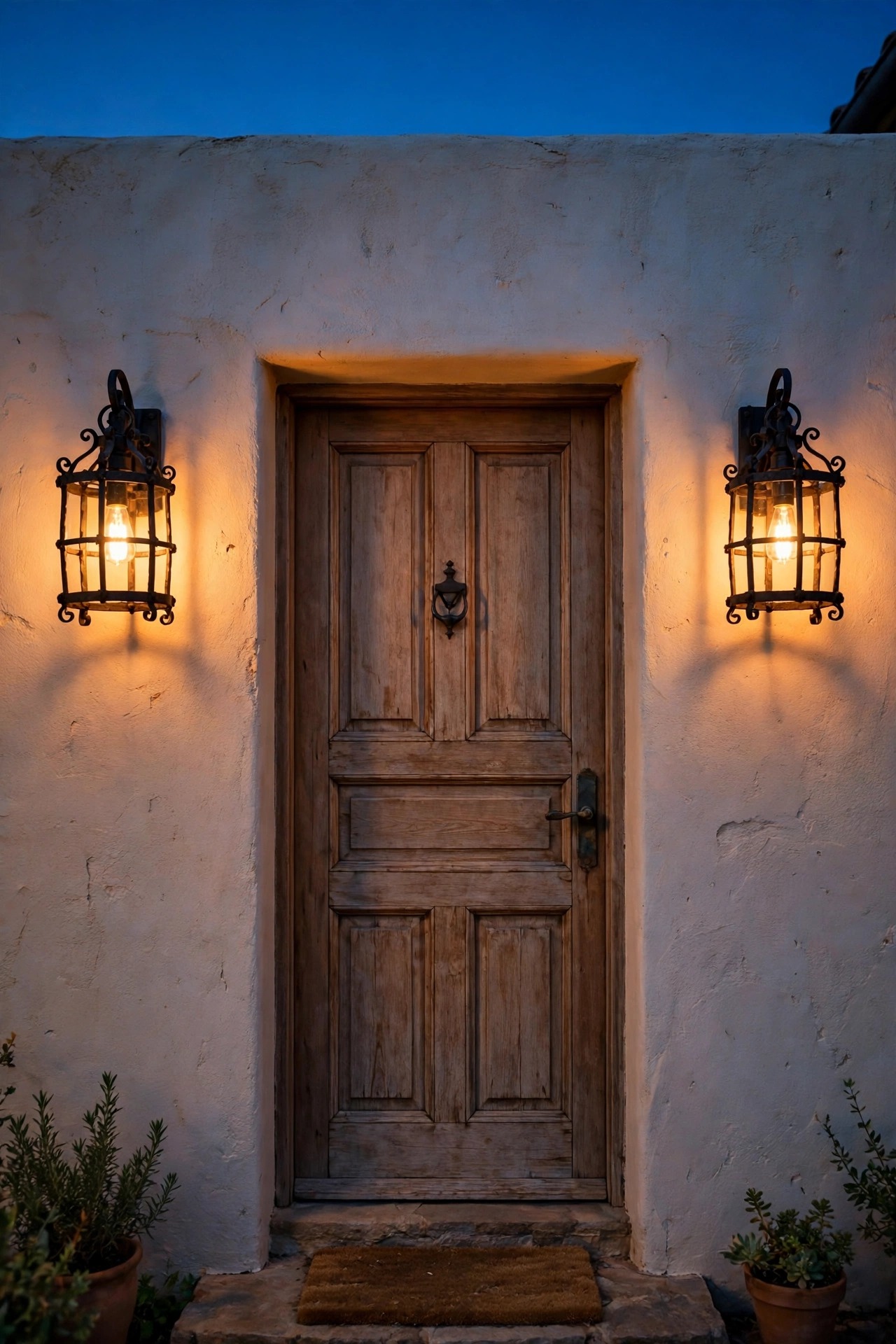
4. Flank the Front Door With Rustic Iron Sconces
The front door of an adobe or stucco home wants iron — black, rusted, or oil-rubbed, with shapes that look hand-forged. A matched pair of iron sconces flanking the door is the handshake of a Southwestern house. Size generously: each fixture should stand roughly one-quarter to one-third the height of the door, so 14 to 18 inches tall for a standard entry, mounted with the bulb center near 66 inches. Punched or pierced metal shades throw little starbursts of light across stucco, and seeded glass keeps the look soft rather than glaring. Inside, warm 2700K LED filament bulbs, 40- to 60-watt equivalent, give that lantern-oil warmth without the heat — important when summer evenings still sit at 95 degrees. Choose wet-location rated fixtures with a finish that can weather honestly; desert sun bleaches cheap paint within two seasons, so powder-coated or genuinely rust-patina finishes age best. I put my door sconces on a photocell so the welcome turns itself on at dusk, because honestly, nobody remembers a switch when the sunset is putting on a show. Caulk the top of the backplate to keep monsoon rain out of the electrical box.
Suggested budget range: $140 – $320.
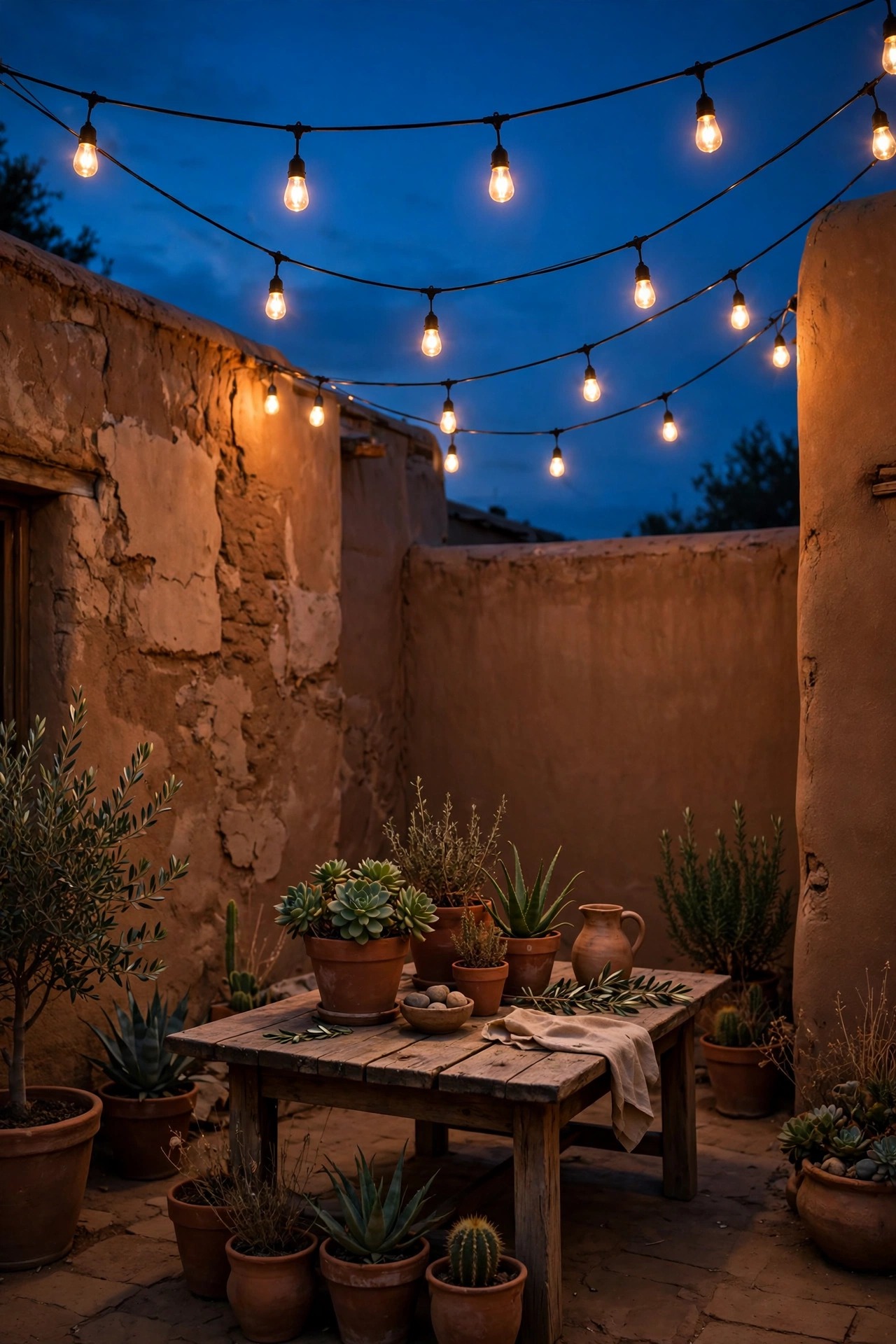
5. Swag String Lights Across the Courtyard
A Southwestern courtyard is an outdoor room walled in adobe, and like any room it wants a ceiling of light. Commercial-grade string lights swagged across the courtyard in two or three gentle catenary curves give you that ceiling for very little money. Anchor into the walls with stainless eye hooks set into studs or masonry anchors — never into stucco alone, which crumbles under tension. Keep the swags high, 8 to 9 feet at the lowest dip, so tall guests and patio umbrellas pass under easily. I favor warm 2700K shatterproof LED bulbs spaced 12 to 18 inches apart; the slightly larger vintage-style globes read more Santa Fe, while small bulbs feel like a desert café. Run them on a dimmer and you get two moods in one fixture: bright enough for serving dinner, low enough for stargazing afterward. Desert-specific tip: choose wire rated for UV exposure, because the same sun that charges your solar lights will make cheap PVC cable brittle in two summers. When a monsoon storm rolls in, a quality commercial strand rated for outdoor wet locations just rides it out, dripping and glowing.
Suggested budget range: $80 – $250.
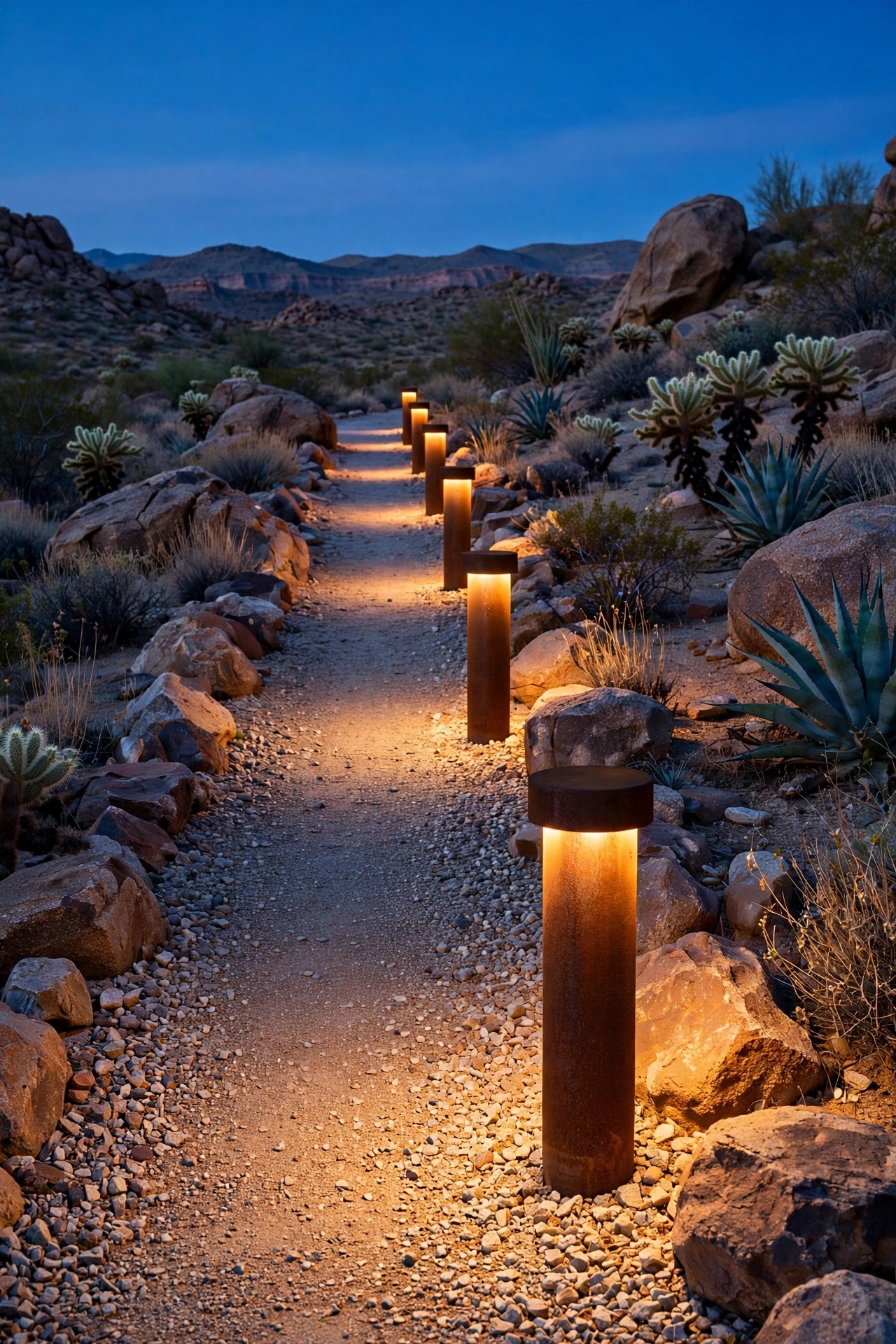
6. Mark the Driveway With Corten Steel Bollards
A desert driveway edged in decomposed granite or river rock deserves better than plastic solar stakes. Short bollards in corten steel — the metal that rusts to a rich, stable terracotta brown and then stops — look like they grew out of the landscape. Choose bollards 18 to 24 inches tall with a shielded, downward light source so they wash the drive edge without throwing glare into drivers' eyes. Space them 8 to 10 feet apart on alternating sides rather than in matched pairs; the staggered rhythm guides the eye without the airport-runway effect. Low-voltage wired bollards are worth the small trenching effort here, because a driveway is exactly where you want guaranteed light every single night, not solar's cloudy-week gamble. Set each bollard plumb in a small concrete footing — desert soil shifts with the rare heavy rain, and a leaning bollard looks sad fast. The rust finish pairs beautifully with gravel, boulders, and the weathered wood of a ranch gate. In my experience, corten is the one material that looks better in year five than year one, which makes it a rare bargain in the desert sun.
Suggested budget range: $250 – $600.
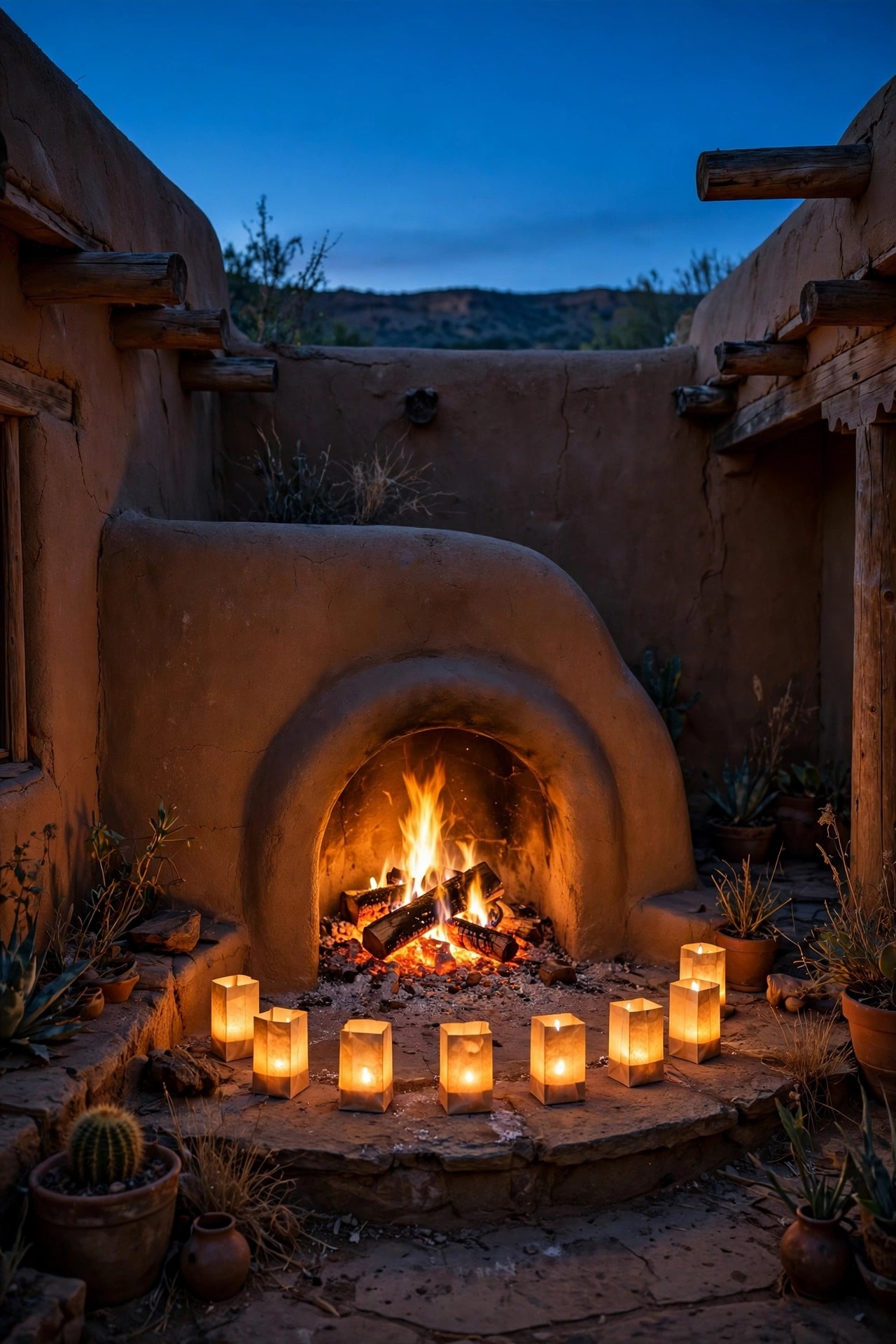
7. Build the Evening Around a Kiva Fireplace or Fire Bowl
Every Southwestern evening eventually gathers around flame. A beehive-shaped kiva fireplace tucked into the courtyard corner, or a simple steel fire bowl on the patio, gives your lighting plan a living, flickering center that no bulb can imitate. Build the electric lighting around it to support, not compete: keep nearby fixtures dim and low, farolitos on the hearth edge, and a single soft wash on the wall behind so the fireplace silhouette reads. Follow local fire codes and any seasonal burn restrictions — desert communities take these seriously, and many allow gas-fueled features when wood fires are banned. A gas kiva with an electronic ignition is the pragmatic choice for nightly use, and it lights like a lantern with one switch. Keep seating 3 to 4 feet back, use a spark screen for wood, and never place real flame under the string lights. For layout dimensions, clearances, and seating arrangements that actually work, I send everyone to my fire pit area lighting guide before they pour a single footing. Honestly, the fire is the one light guests remember on the drive home.
Suggested budget range: $300 – $1,500.
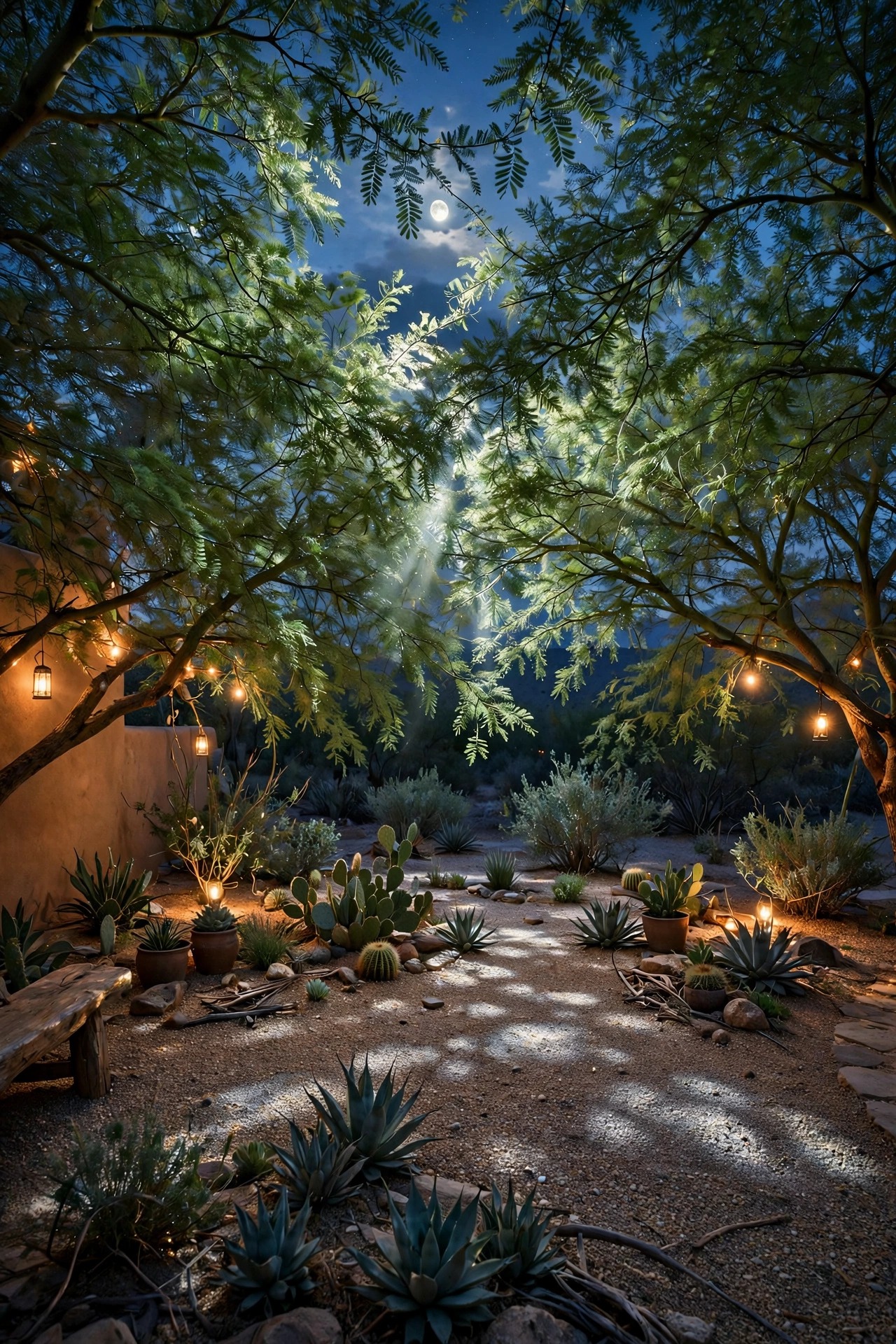
8. Moonlight a Mesquite Tree From Its Own Branches
Moonlighting — mounting a soft light high in a tree so it filters down through the branches like real moonlight — was made for the mesquite. Its lacy, wide canopy throws dappled shadows across a patio or gravel garden that no ground fixture can fake. Mount one or two shielded downlights 14 to 18 feet up, aimed through gaps in the canopy, and keep the color a touch cooler than the rest of the yard, around 3000K, so it reads as moonlight against your warmer lantern glow. Use stainless or brass hardware with a strap that can grow with the tree, and have an arborist or experienced installer do the climbing — mesquite wood is hard, brittle, and thorny. The cable runs down the trunk's back side in flexible conduit, invisible from the seating area. This is the most professional-looking effect in this whole list, and it doubles as gentle security light for the whole yard. If you want the full technique — fixture angles, spacing, and how to avoid hot spots — my tree uplighting guide walks through both moonlighting and uplighting step by step. Under a moonlit mesquite, honestly, even folding chairs feel like furniture.
Suggested budget range: $150 – $400.
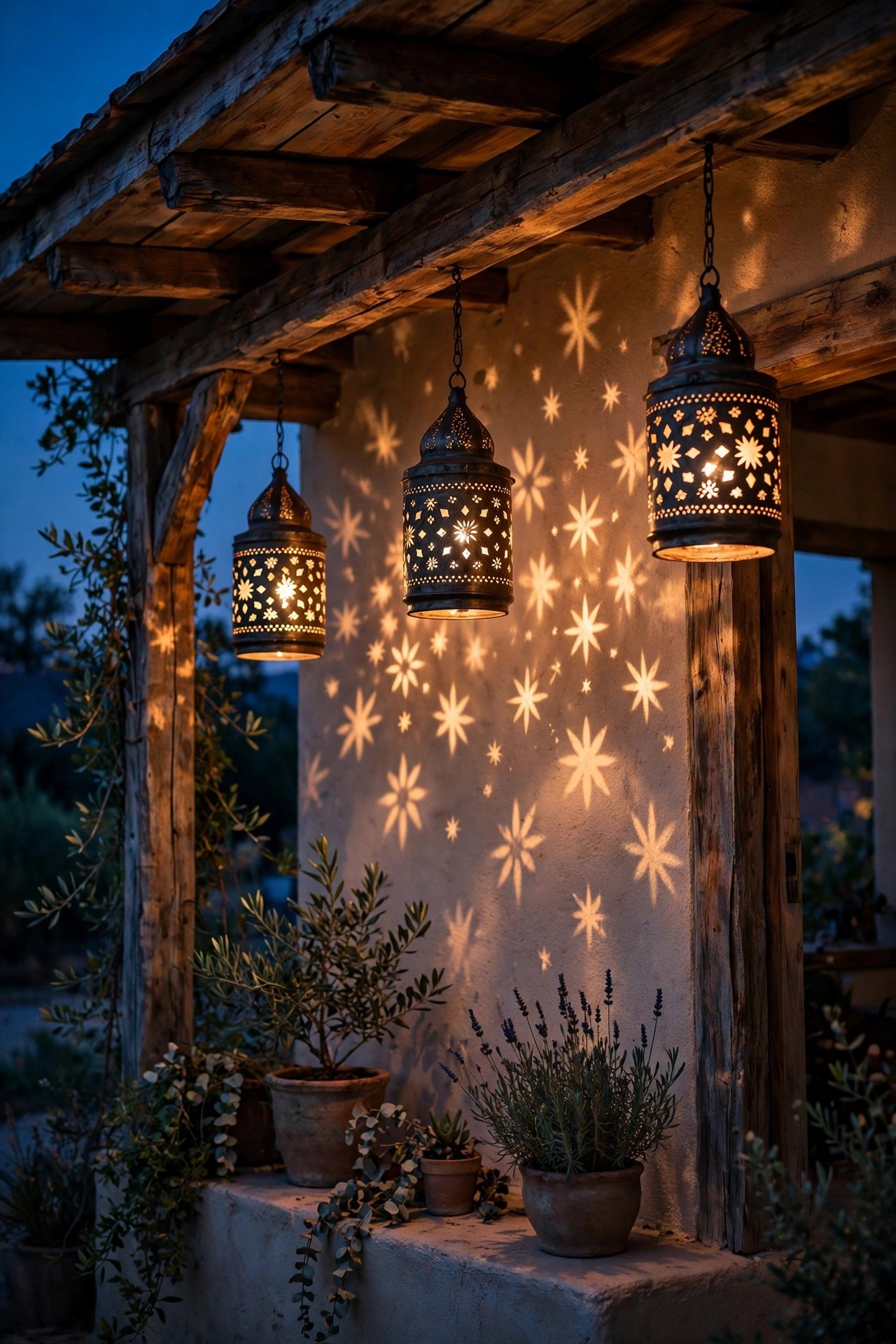
9. Hang Punched-Tin Lanterns Under the Portal
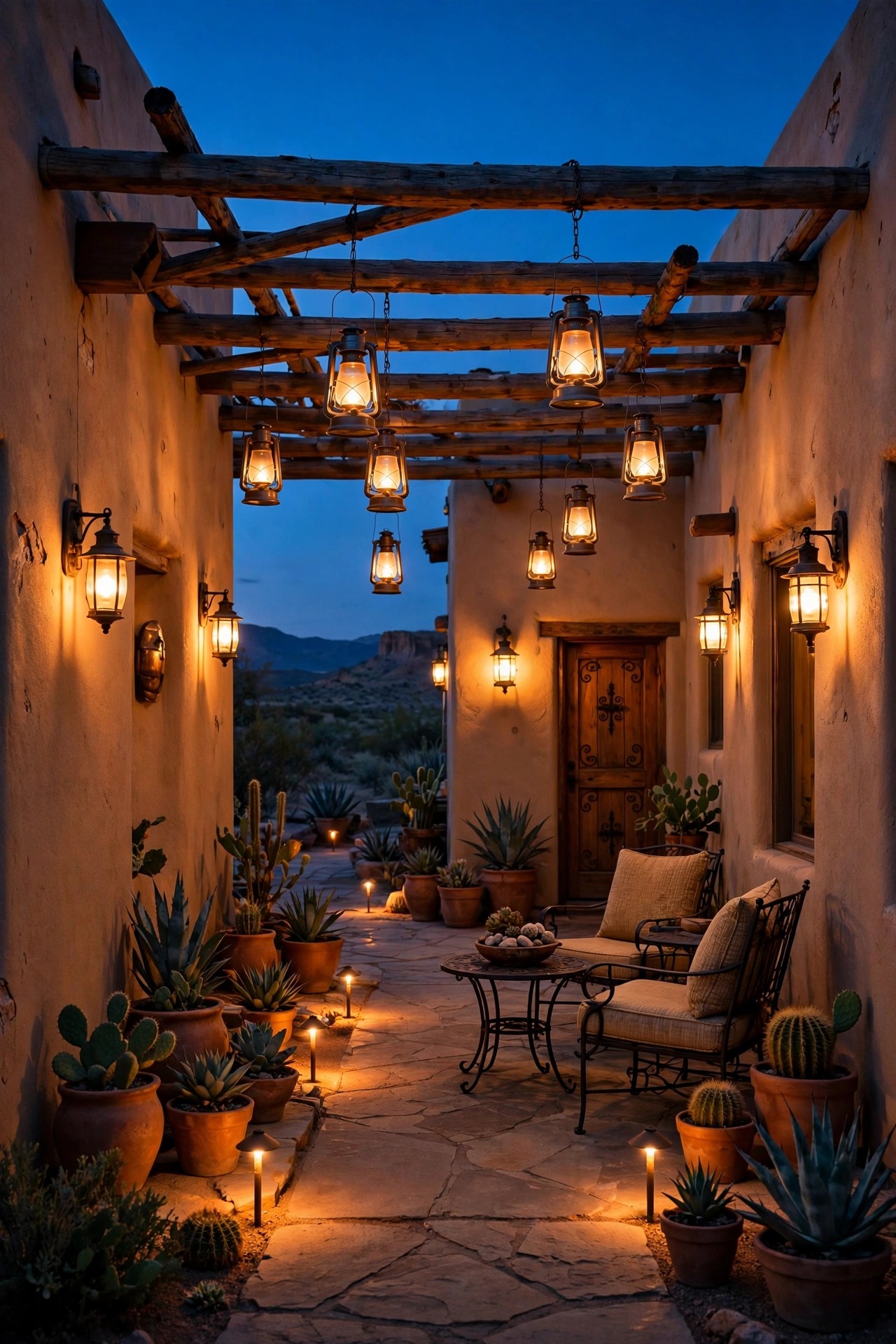
The portal — that covered porch that runs along the front of a Southwestern home — is prime lantern territory. Punched-tin lanterns, the hojalata style with hand-stamped stars, moons, and sunbursts, throw patterned light across vigas and stucco in a way that feels centuries old. Hang three to five in a loose row or cluster at slightly varied heights, bottoms around 7 feet above the floor, mixing shapes so the light patterns overlap organically. Because the tin shades the bulb, you can use a slightly brighter warm LED, 60-watt equivalent at 2700K, without glare; the piercings do the dimming for you. Electric hardwired versions exist, but I love the flexibility of plug-in lanterns on a single switched cord run hidden along a beam. Desert tip: tin and galvanized finishes shrug off the climate, but if your portal catches monsoon wind, choose lanterns with enough weight or a short chain so they hang steady instead of clanging against the posts. Wipe the dust out of the punchwork twice a year — desert dust is fine as flour and it dims those little starbursts more than you would guess.
Suggested budget range: $90 – $220.
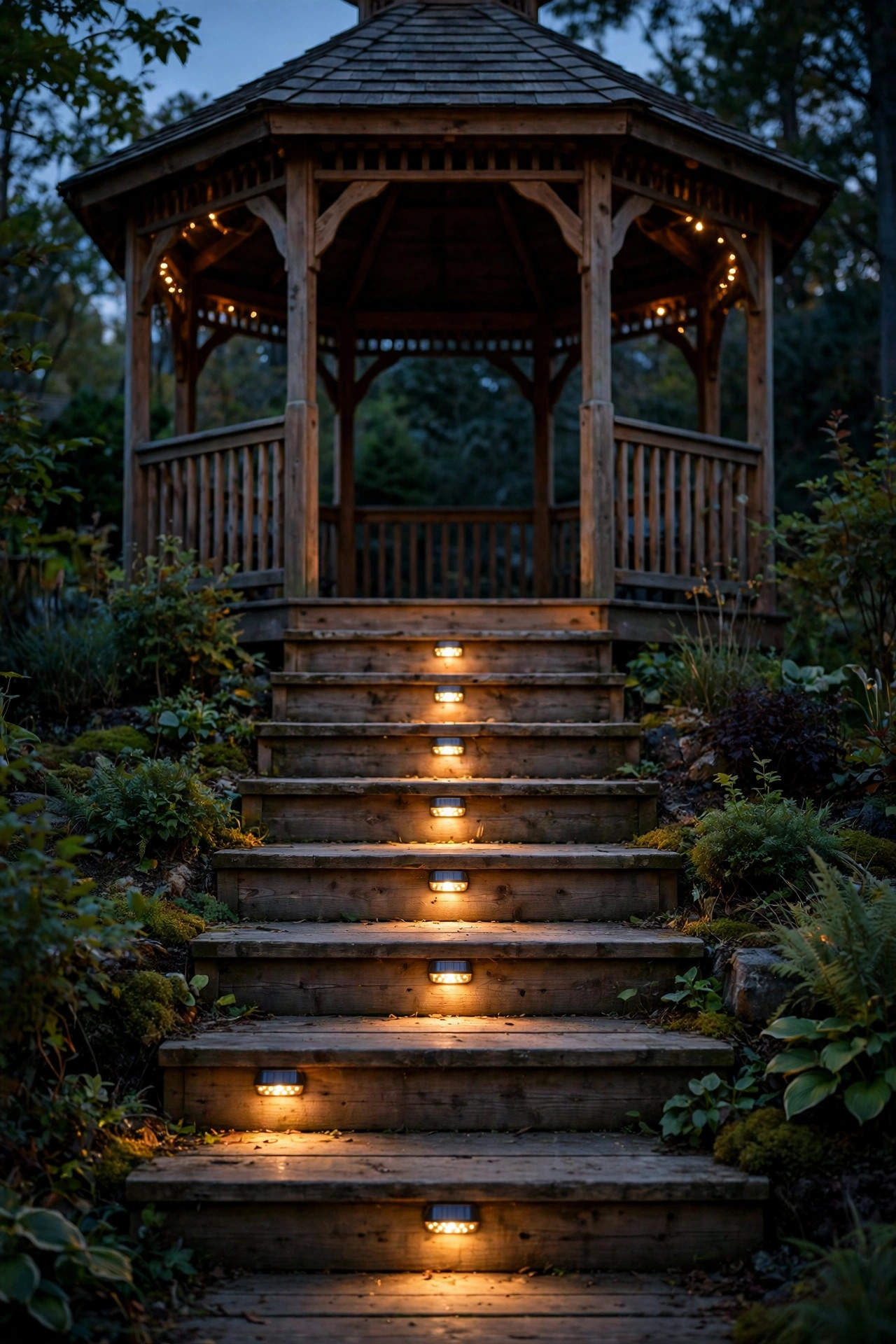
10. Set Step Lights Into Adobe and Stone Steps
Southwestern entries love a level change — two broad steps up to the portal, a step down into a sunken courtyard — and every one of those steps wants its own light. Recessed step lights set into the riser, or small louvered fixtures mounted on the side wall of the stair, wash each tread in a soft pool that reads as hospitality and works as safety. Space one fixture per step on wide stairs, or center one on every other tread for narrow runs, keeping the source shielded so guests see the glow, never the bulb. Warm 2700K again, and choose fixtures rated for masonry or concrete installation if they will be buried in adobe or stone; the housing must handle the alkaline environment and the occasional monsoon splash. On existing steps where cutting is not an option, solar step lights with a real all-night runtime are a fair compromise — the desert sun charges them honestly. Wire wired versions in a loop with the path lighting so one photocell runs the whole arrival sequence. In my experience, guests comment on step lights more than any other fixture; a lit step feels like the house is paying attention.
Suggested budget range: $100 – $280.
11. Trust Solar Stakes in the Gravel Beds — With Desert Rules
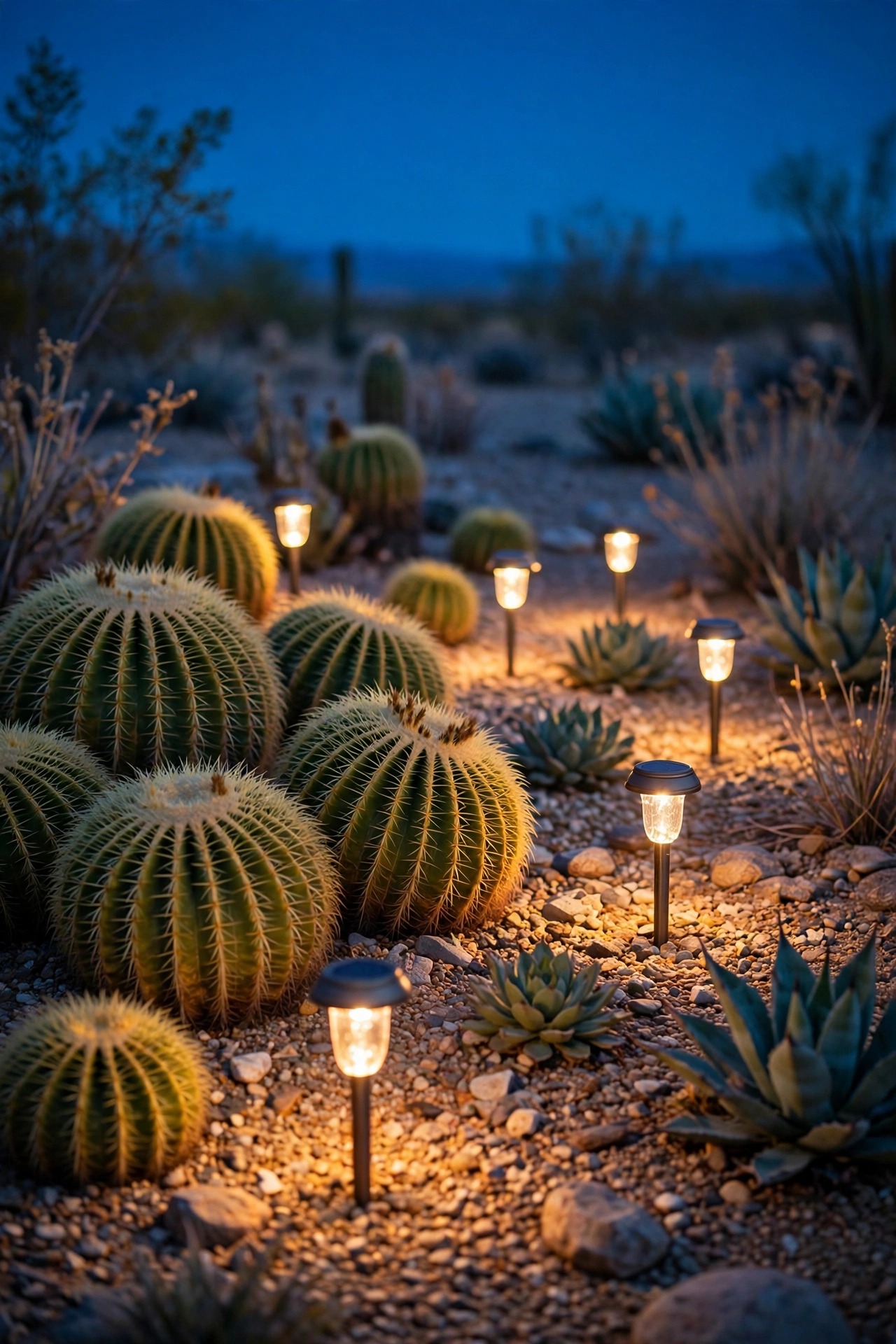
Solar lighting has a mixed reputation everywhere except the desert, where it finally makes sense: 300 days of sun will fully charge even modest panels. Solar stakes and solar spotlights tucked into gravel beds — lighting a barrel cactus cluster, a boulder, a drift of desert marigold — cost nothing to run and need no trenching through caliche. But follow desert rules. First, clean the panels monthly; a film of dust can halve the charge. Second, expect batteries to fade faster here, because summer heat is hard on them — plan on replacing rechargeable cells every 18 to 24 months, and choose stakes with replaceable batteries. Third, not all solar is equal: look for panels that are separate, larger crystalline cells rather than the tiny film squares, and warm-white output around 2700K so they blend with your wired lights. Stake them at varied distances from paths rather than in parade lines, and aim solar spots from low in the gravel so the fixture disappears. Honestly, solar in the desert is the supporting actor — farolitos, cactus, and texture — while your wired fixtures carry the lead roles.
Suggested budget range: $50 – $150.
12. Wash the Ramada With Hidden Beam Lighting
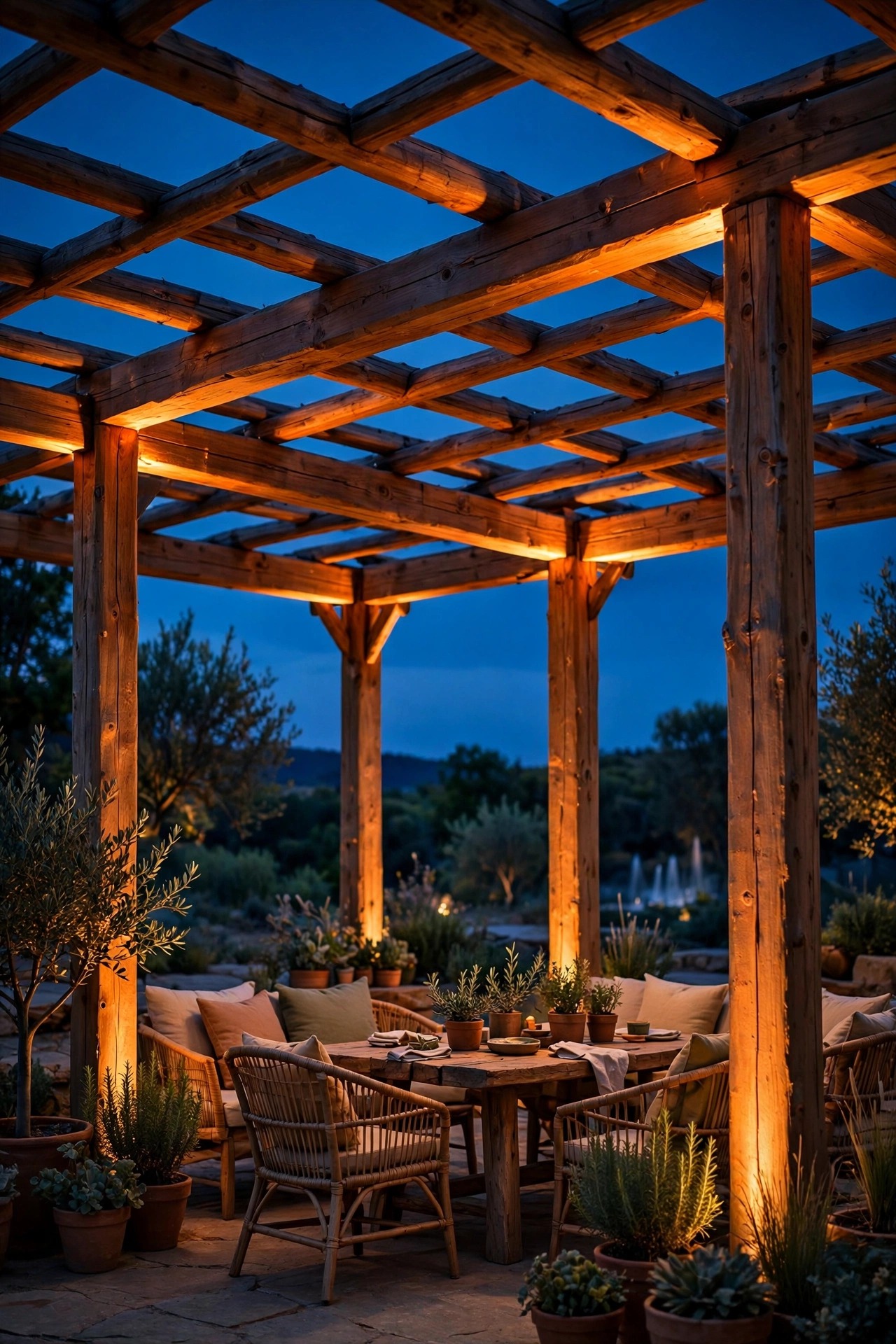
A ramada or pergola is the desert's answer to the gazebo — an open shade structure over the outdoor kitchen or pool deck — and its flat beams hide a lovely trick. LED tape or a slim low-voltage strip mounted on top of a beam, or tucked into a routed channel underneath, washes the ceiling and posts in indirect light with no visible fixture at all. The effect is a floating plane of warm glow that makes the whole structure feel lantern-lit. Use 2700K tape rated for outdoor wet locations, and hide the driver box in a shaded, ventilated spot — electronics hate the 120-degree corner of a sun-blasted wall. Where the ramada meets an adobe wall, a gentle uplight at the base of each post adds the vertical layer. Keep the strip dimmable; full brightness is for grilling, and the low end is for the long, slow part of the evening. This is also the kindest light for faces at a dinner table, because it bounces rather than beams. In my experience, hidden sources are what separate a yard that looks professionally lit from one that just looks bright.
Suggested budget range: $200 – $500.
13. Backlight the Address Numbers in a Rustic Frame
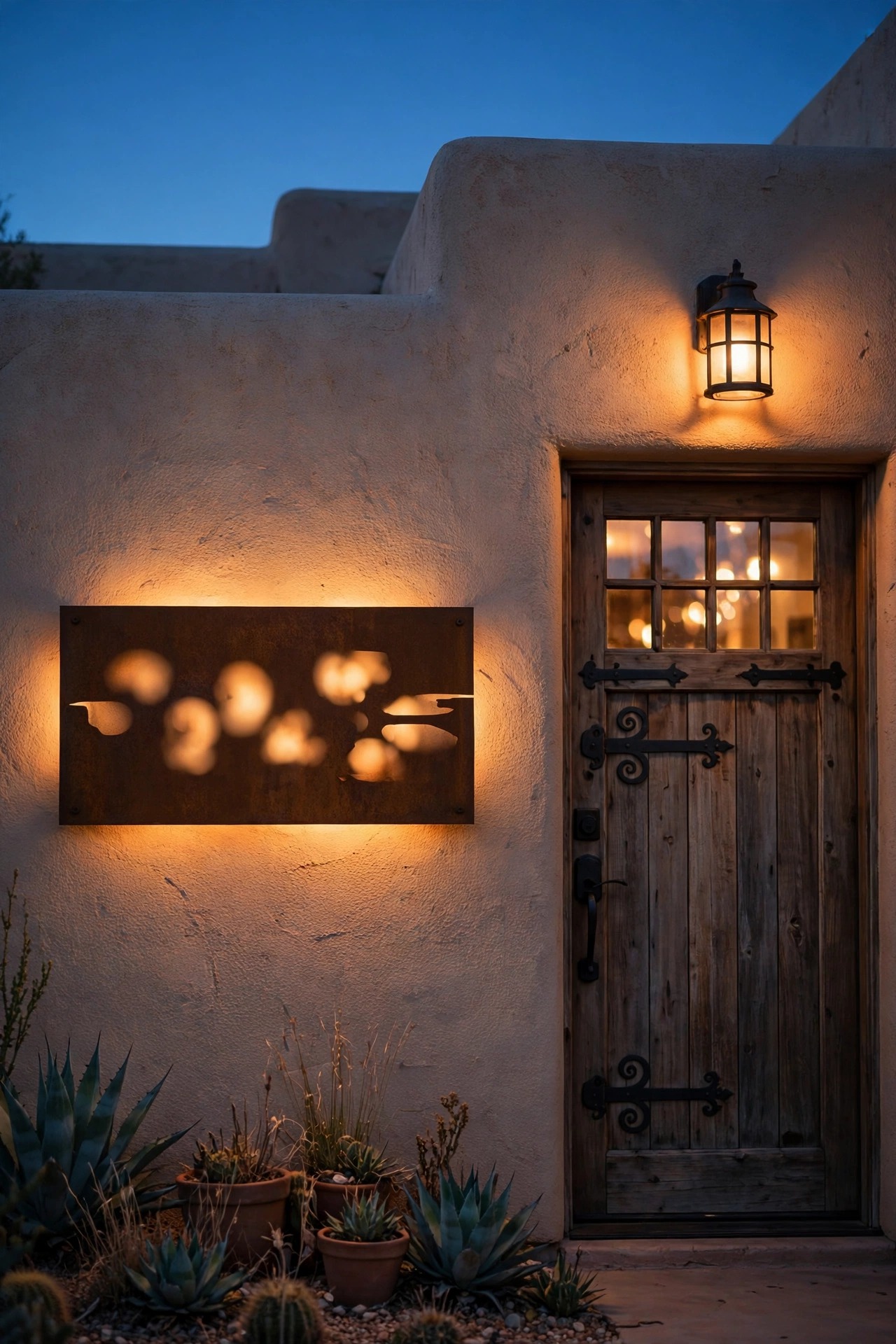
Guests finding your house after dark, on a rural desert road with three mailboxes and no streetlights, will bless you for lit house numbers. A backlit address plaque — warm LED behind frosted numbers, or numbers mounted on a standoff panel of corten steel, weathered wood, or talavera tile with a small wash light — turns a chore into a design moment. Mount it at eye level beside the door or on the entry gate pier, and wire it into the same photocell circuit as the sconces so it keeps desert hours. Keep the digits at least 4 inches tall; many local codes require that for emergency visibility, and it happens to look right at driveway distance too. If your entry sits far from the street, add a second small lit marker at the road — a number stone with a solar spot does the job. Backlit styles read best at 2700K, bright enough to read at 30 feet but never glowing like a motel sign. Honestly, this is the smallest project on this list and the one delivery drivers will thank you for weekly.
Suggested budget range: $60 – $160.
14. Graze Light Across an Adobe or Stone Wall
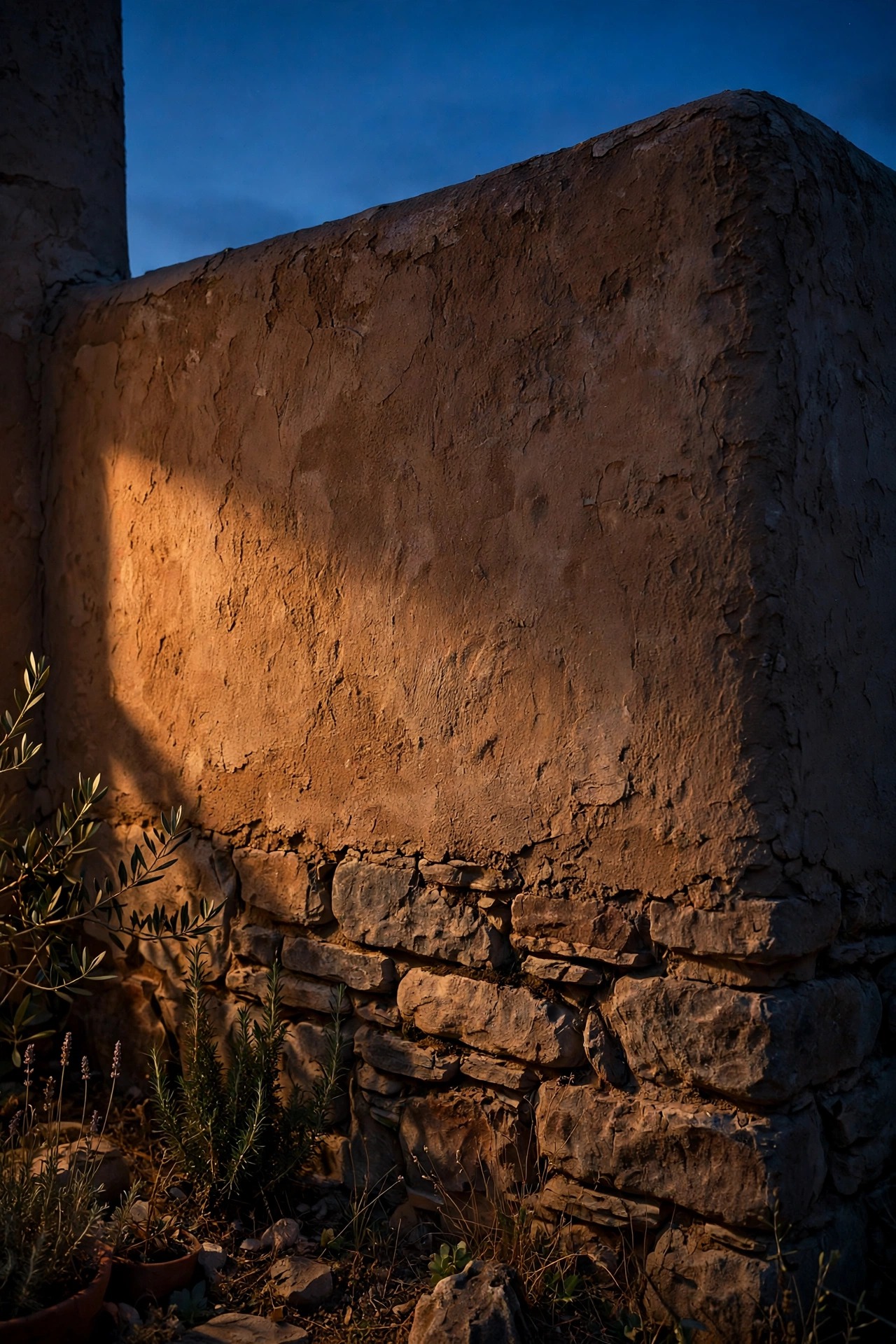
Flat light on a textured wall is a waste of a good wall. Grazing — placing a fixture close to the surface and aiming along it — rakes light across every bump of adobe, every edge of stacked stone, every ripple in a mud-plastered garden wall, and turns plain architecture into the evening's artwork. Use a narrow-beam uplight set just 4 to 6 inches from the base, or a slim linear fixture along a wall cap shining down. The shadows do the decorating. This technique loves Southwestern materials: hand-troweled stucco throws long soft shadows, rough stone goes dramatic, and even a plain block wall gains a woven texture after dark. Work in odd numbers of fixtures along a long wall, spacing them 6 to 8 feet apart so the scallops of light overlap gently. Keep the beam warm, 2700K, and modest in brightness — grazing exaggerates everything, including over-lighting. I often aim one grazer at the courtyard's back wall and let it serve as the yard's backdrop, so seating areas can stay darker and moodier in front of it. One grazed wall can carry a whole courtyard; test with a flashlight before you commit to trenching.
Suggested budget range: $120 – $300.
15. Commit to One Warm Color Temperature Everywhere
Nothing undoes a Southwestern yard faster than a bulb salad — cool blue-white solar stakes arguing with an amber porch lantern and a greenish floodlight. Desert light has a native palette: the last hour of sun runs golden, and your fixtures should live in that same family. I standardize everything at 2700K, with 2200K flame-style bulbs allowed anywhere they pretend to be candles or firelight. When you shop, read the Kelvin number on the box, not the words soft white, which mean different things to different makers. Buy two spare bulbs in the exact model you install, because product lines change and a replacement at 3000K will stick out every single night. If some of your existing fixtures are integrated LED, you cannot change their color — plan around the warmest permanent fixture and swap the offenders in the most visible spots first, usually the door and patio. The payoff is subtle but total: matched warmth makes stucco look richer, wood look older, and the whole yard feel like one place instead of a lighting aisle. Honestly, this discipline costs almost nothing and it is the difference between styled and accidental.
Suggested budget range: $40 – $120.
16. Put the Whole Yard on Timers and Photocells
The desert runs on dusk, and your lighting should too. A photocell that wakes the low-voltage transformer at sunset and a timer that rests it at midnight or 1 a.m. gives you a yard that performs nightly without a single decision from you. I run three zones with different bedtimes: the welcome zone of door, steps, and numbers stays on until the timer ends the night; the courtyard entertaining zone rides a dimmer and manual override for late evenings; the accent zone of cactus uplights and wall grazing switches off earliest, around 11, out of respect for the genuinely dark desert sky and the neighbors who moved here for it. Astronomical timers that self-adjust for the shifting sunset are worth the small premium at this latitude, where dusk swings by more than an hour across the year. Keep one manual switch by the back door for the nights you host — automation should serve the party, not schedule it. In my experience, a well-timed yard also cuts the electric bill by a third compared with dusk-to-dawn everything, and the fixtures last longer between bulb changes.
Suggested budget range: $60 – $200.
17. Light the Fountain or Water Jar for a Desert Oasis Moment
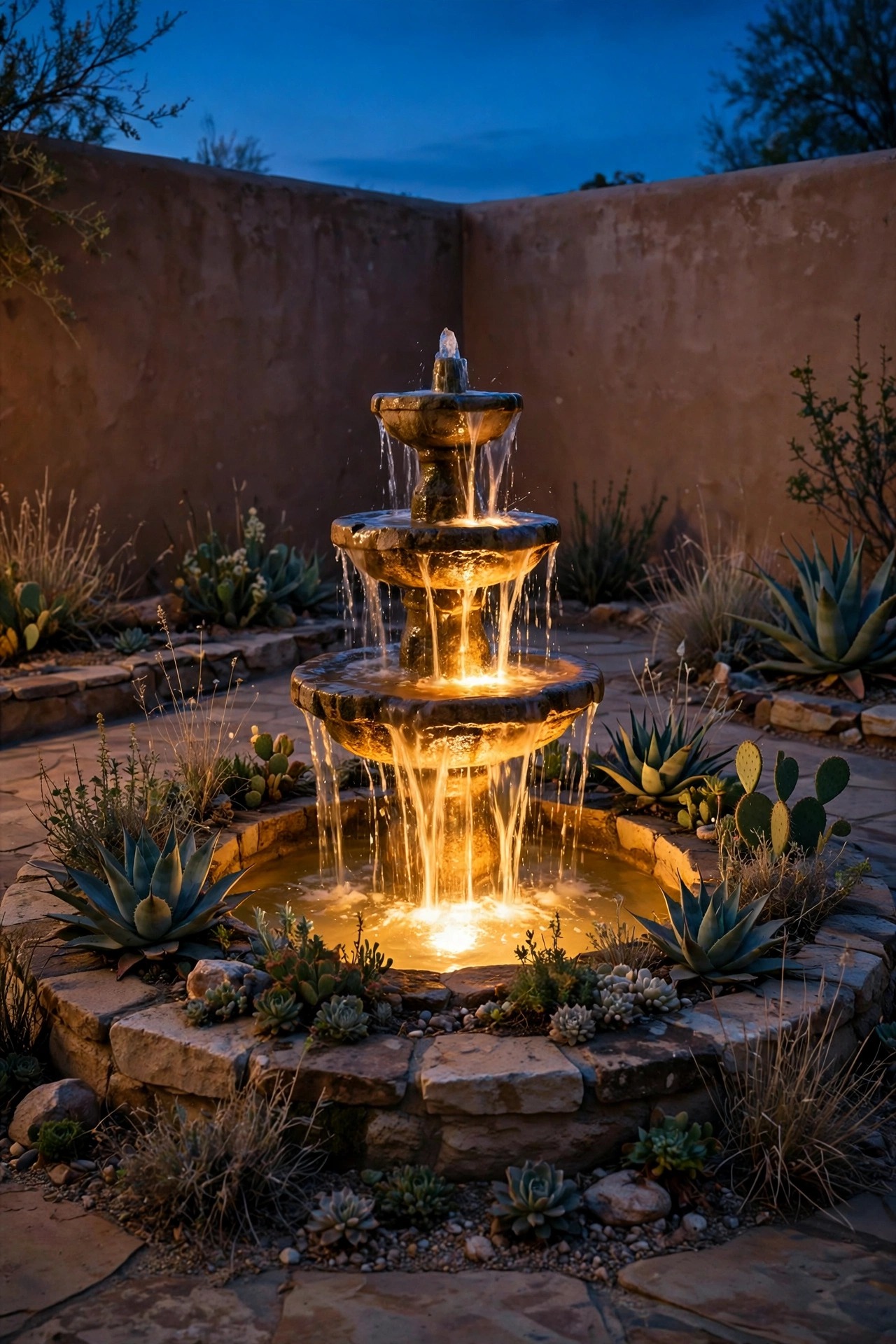
Water is precious in the desert, which is exactly why a small lit water feature feels so luxurious. A tiered fountain, a bubbling glazed pot, or a simple recirculating water jar becomes the courtyard's jewel with one submersible warm LED tucked into the basin, aimed up through the falling water. The light dances; still fixtures cannot do that. Choose a fixture rated for full submersion, IP68, on a low-voltage circuit with a GFCI-protected outlet — water and electricity rules do not bend for ambience. A 2700K submersible spot makes the water look honeyed; keep it modest, because an over-lit fountain reads as a hotel lobby. If your feature is a still reflecting bowl, a light beside rather than inside it, grazing across the surface, gives a quieter shimmer. Scale matters out here: a modest 30-inch fountain lit well beats a grand dry one every time. Evaporation in a desert summer means topping up weekly, and a fountain on a timer should only run while the light is on, so the two belong on the same circuit — moving water, warm light, and that soft sound against the quiet yard.
Suggested budget range: $80 – $250.
18. Bury Well Lights in the Gravel for Glow Without Fixtures
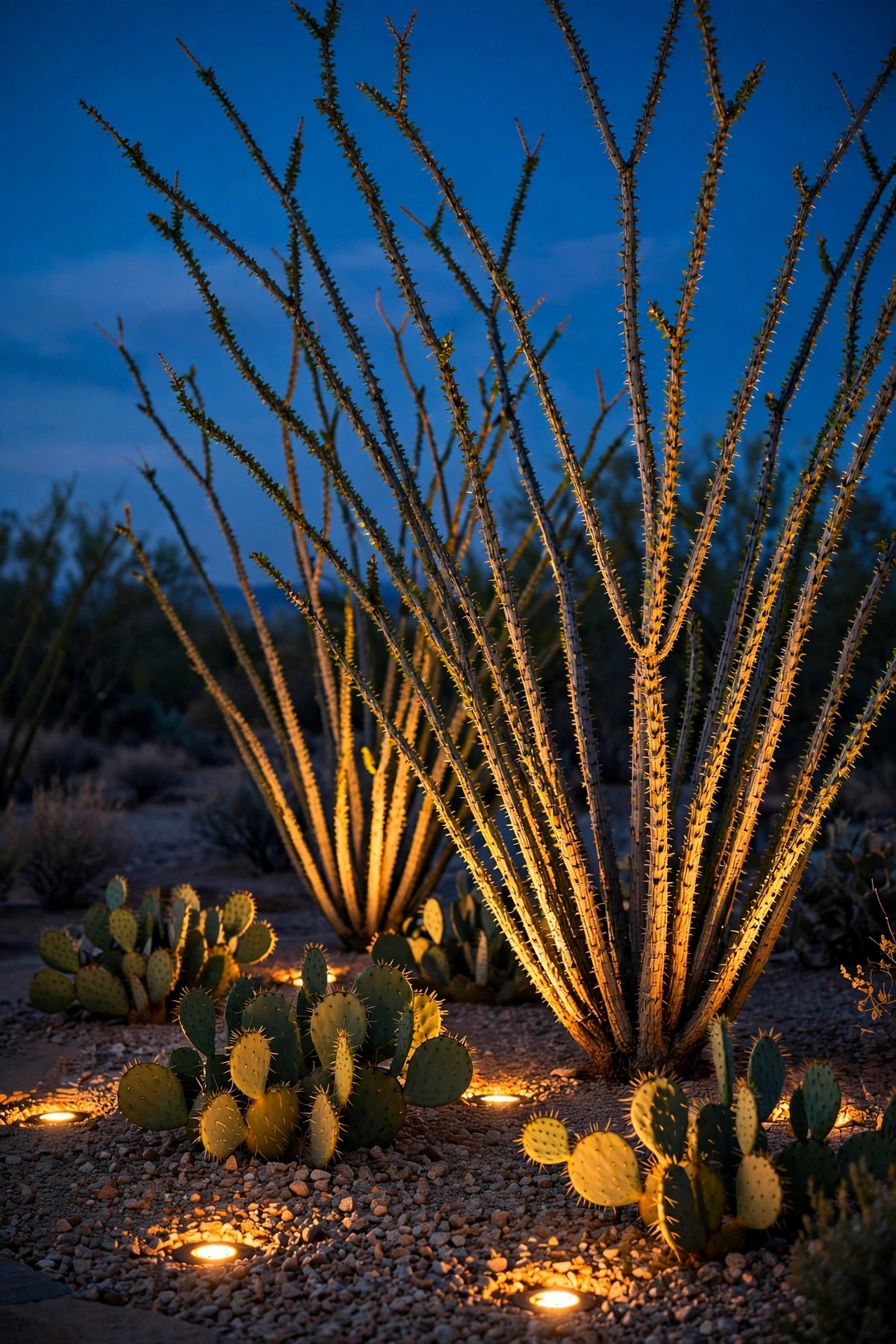
Some desert plantings look best with no visible hardware at all — a gravel garden of ocotillo, prickly pear, and boulders, where a row of visible stakes would spoil the wildness. In-ground well lights solve it: the fixture buries flush in the gravel, vanishes by day, and at night the plants simply glow from within. Use well lights with a honeycomb louver or deep-set lens so the source stays hidden even when you stand over it, and aim the washing versions at plant clusters rather than single stems. Space them by effect, not by tape measure — light the ocotillo from 18 inches, let the prickly pear catch spill, leave the boulder dark between them. Desert-grade details matter here: choose fixtures with sealed, gasketed housings that shed irrigation water and monsoon runoff, and bed them in a small pocket of coarse gravel so they drain instead of sitting in caliche mud. Low-voltage cable in conduit survives the inevitable future shovel. In my experience, three well-placed well lights give a gravel bed more mystery than a dozen stakes, and mystery is the desert's native decorating style.
Suggested budget range: $150 – $380.
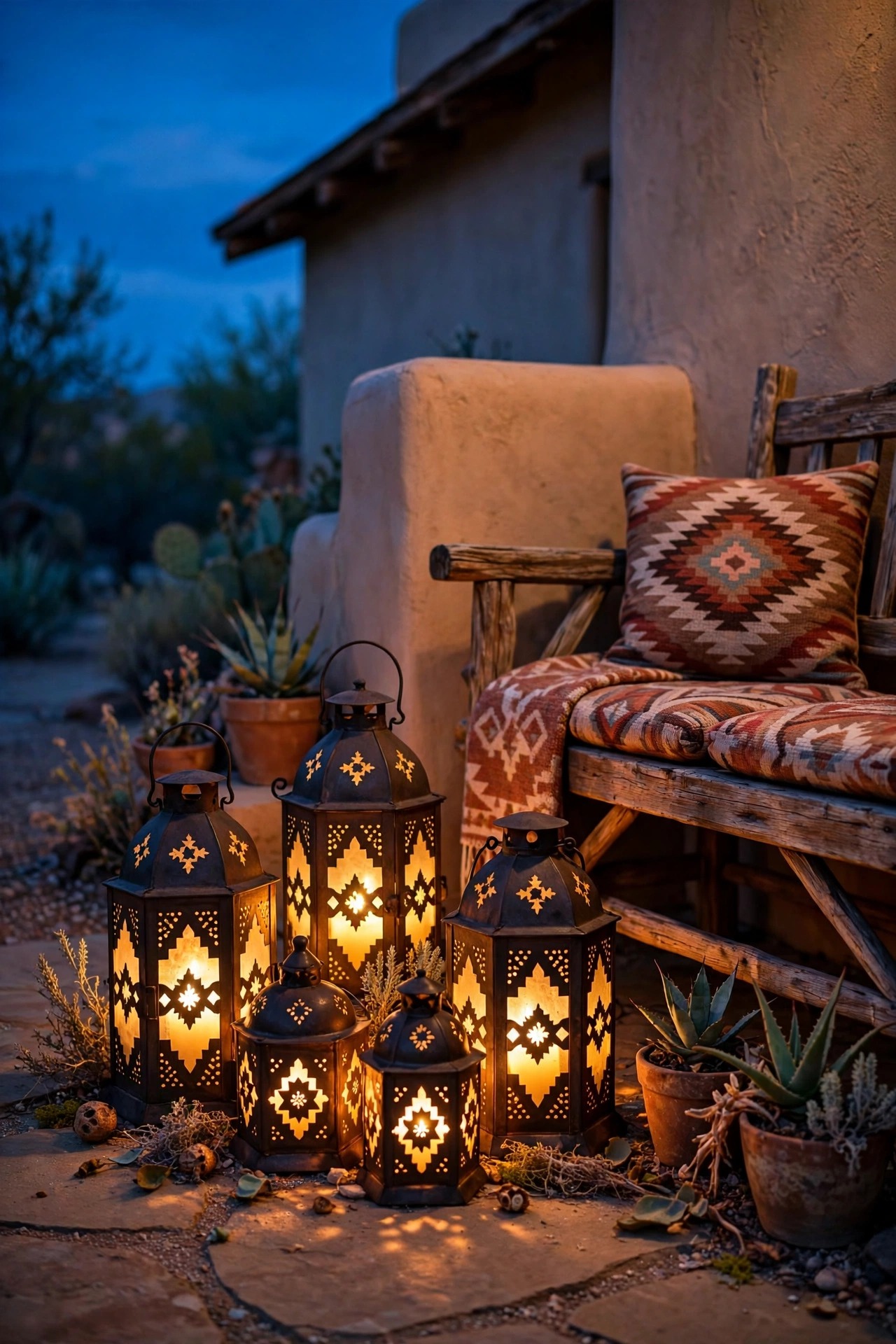
19. Cluster Lanterns on the Ground at the Portal Corner
Not every layer needs wiring. A cluster of three to five lanterns grouped on the ground — at the corner of the portal, beside the entry bench, flanking the outdoor fireplace — gives a low, gathered glow that feels collected over years rather than installed in a weekend. Mix heights and materials within one family: black iron with punched tin, a tall floor lantern anchoring two shorter ones, all burning flameless LED candles on timers so the cluster lights itself at dusk. Flameless is non-negotiable near cushions, woven blankets, and the dried chile ristras everyone hangs by the door. Group in odd numbers, overlap the lanterns slightly, and let one sit a step apart from the group for that relaxed, unarranged look. Hurricane glass keeps the candle glow steady in evening breezes, and heavy bases keep monsoon gusts honest. This is the arrangement I move around seasonally — closer to the door in winter, spread toward the courtyard for summer parties. Honestly, if a guest asks where you got your lighting designer, it is usually this twenty-minute cluster they are looking at.
Suggested budget range: $70 – $180.
20. Choose a Rustic Motion Light for the Side Yard and Gate
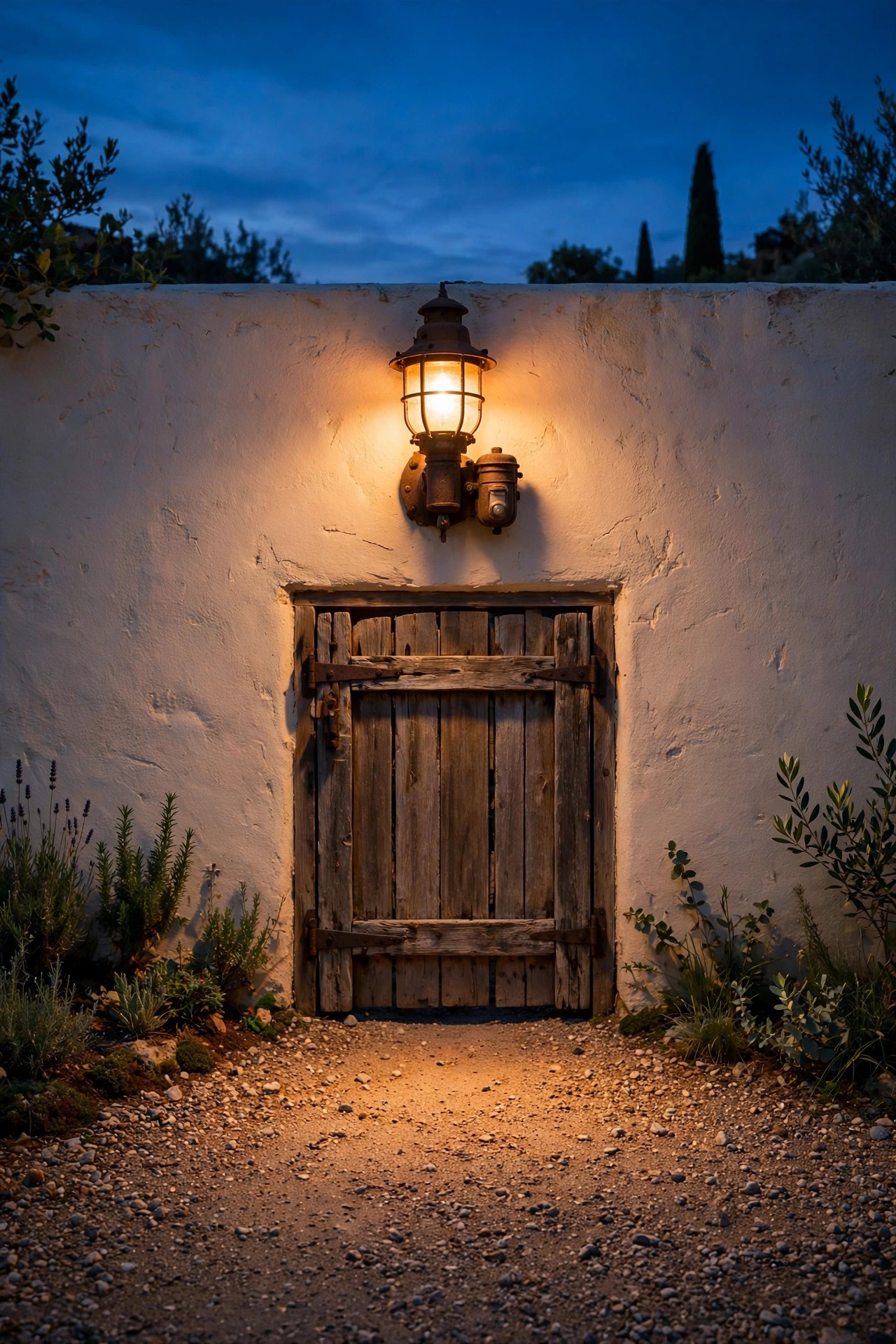
Every home has a working side — the gate, the woodpile, the path to the trash bins and the casita — and it deserves light that arrives when you do. A motion-sensor fixture in a rustic iron or weathered finish gives you security and safe footing without burning all night or spoiling the dark sky your accents depend on. Mount it 7 to 8 feet high at the gate or side door, aimed along the path rather than across it, so the beam welcomes you instead of blinding you. Set the sensitivity so desert wildlife — javelina, rabbits, the neighbor's cat — does not trigger a nightly light show; most quality fixtures let you dial the range down to 15 or 20 feet. A warm 2700K LED matters here too: a harsh blue-white security blast makes the whole property feel like a parking lot for the three minutes it runs. Choose a fixture with a dusk-to-dawn low-glow mode if you can find it, so the side yard idles at lantern level and brightens as you approach — the politest security light ever made, and perfect for guests finding the casita after dark.
Suggested budget range: $80 – $200.
21. Finish With a Dusk Walk-Through of Your Southwestern Outdoor Lighting Ideas
The last step of every install I do is the walk-through, and it is where good yards become great ones. Wait until full dark, then start at the street and experience your home the way a guest does: driveway, gate, walk, steps, door. Carry a notepad and a dimmer's mindset. You are hunting for three things — glare, gaps, and arguments. Glare is any bare bulb you can see; shield it, lower it, or swap it warmer. Gaps are the dark step, the unlit turn, the address nobody can read. Arguments are fixtures fighting each other in color or mood, like a cool solar stake glowing beside a warm farolito. Then walk the courtyard and sit where your guests sit, checking sightlines from chair height, because lighting that works standing often glares at seated eye level. Adjust aim while the fixtures are warm and the night is honest. This is also when I remove one fixture — there is always one too many, and Southwestern outdoor lighting ideas succeed on editing as much as adding. Finish on the patio with the timed zones doing their show, and simply enjoy the desert doing the rest.
Suggested budget range: $0 – $100.

Frequently Asked Questions
What color temperature is best for Southwestern outdoor lighting?
Warm, always. I standardize on 2700K across the whole yard because it echoes sunset on stucco and timber, and I drop to 2200K flame-style bulbs anywhere a fixture pretends to be candlelight or firelight, like farolitos and kiva-side lanterns. The one exception is moonlighting in a mesquite, where 3000K reads as believable moonlight against the warmer layers below. Avoid anything 4000K or above outdoors; it turns adobe gray and makes the yard feel like a service station.
Can solar lights really work in a desert yard?
Yes — the desert is the one climate where solar shines, literally, with around 300 sunny days a year in most Southwestern cities. The rules are maintenance and quality: clean the dust off panels monthly, choose stakes with larger crystalline panels and replaceable batteries, and expect heat to shorten battery life to roughly 18 to 24 months. Use solar for accents and path sparkle, and keep wired low-voltage on the jobs that must never fail, like steps, gates, and the driveway.
How do I keep fixtures from rusting out or fading in the desert sun?
Choose finishes that treat weathering as a feature: corten steel that rusts once and seals, powder-coated iron, galvanized and punched tin, and solid brass or copper that patinas. Cheap painted finishes chalk and peel within two summers of UV. For anything with a lens, a gasketed wet-location rating keeps out the fine dust that rides monsoon winds. A yearly wipe-down and one check of seals before monsoon season keeps most fixtures looking intentional for a decade.
How much does a full Southwestern outdoor lighting scheme cost?
A welcoming front yard — farolitos, door sconces, step lights, and a few solar accents — lands between $400 and $900 in fixtures if you install it yourself. A full courtyard scheme with string lights, a moonlit mesquite, grazing walls, and a lit water feature typically runs $1,500 to $3,500. Professional installation of a wired low-voltage system adds roughly $150 to $300 per fixture. Phase it: plan the layers first, wire the bones once, and add the pretty accents season by season.
Conclusion
The desert gives you the backdrop for free — violet dusk, sculptural plants, walls that hold the light. Your job with these southwestern outdoor lighting ideas is simply to answer it in kind: layer low, middle, and high, keep every bulb in the warm family, honor the cactus like art, and let timers run the show so you can sit in the courtyard and watch the mountains go dark. Start with the walk-through layers and the front door, and the rest can grow season by season. For more inspiration, browse the rest of my outdoor lighting ideas here on the site — your desert evenings are about to get much longer, in the best way.