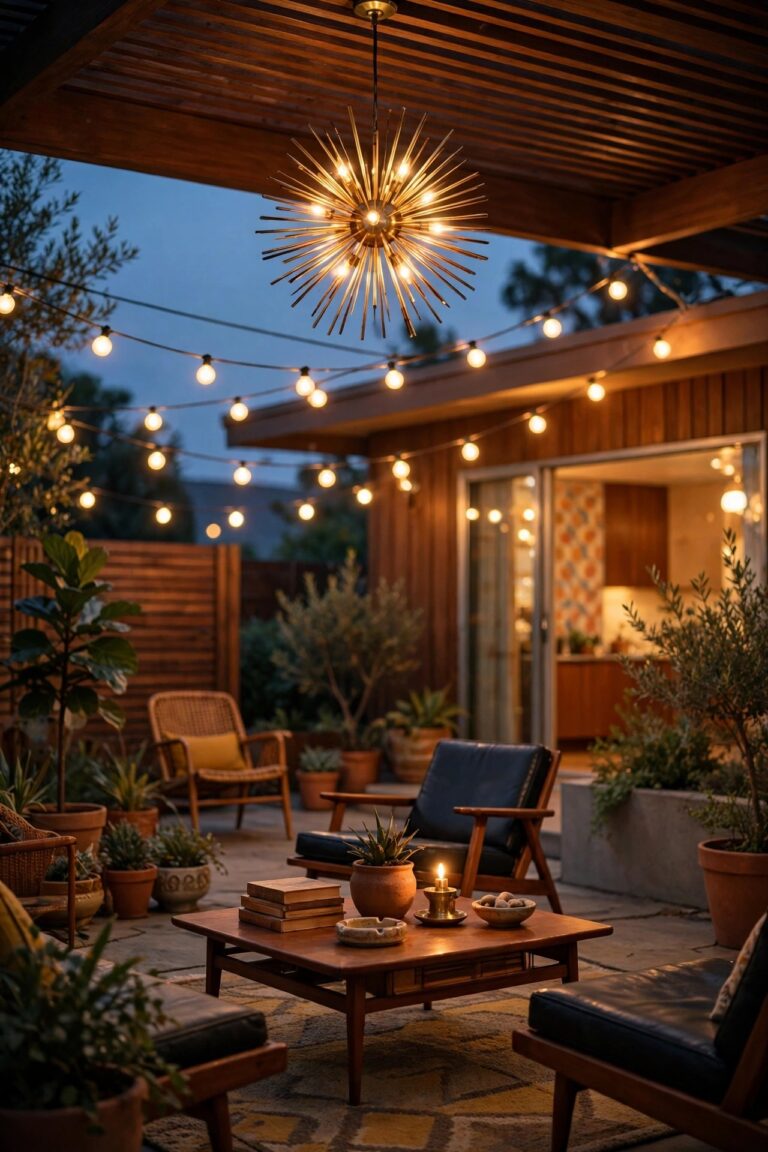
Golden hour is my favorite hour of the whole day, and honestly, it is the one I used to waste. The sun would drop, the patio would fall into flat blue shadow, and we would all drift inside just as the air turned perfect. Then I started treating sunset as a design cue instead of a curfew, and these golden hour patio lighting ideas changed how our evenings work. The trick is never one big bright light. It is layering: a soft canopy overhead, a warm glow at sitting height, and low light at ankle level so feet and steps stay safe. As the sky deepens from gold to indigo, each layer takes over from the daylight a little more, so there is no jarring moment when the patio suddenly goes dark. Most of what follows is solar, battery powered, or plug-and-play, which means no electrician and no weekend lost to wiring. Pick three or four ideas, set them to come on just before sunset, and watch your patio hold the evening a good hour longer than it used to.
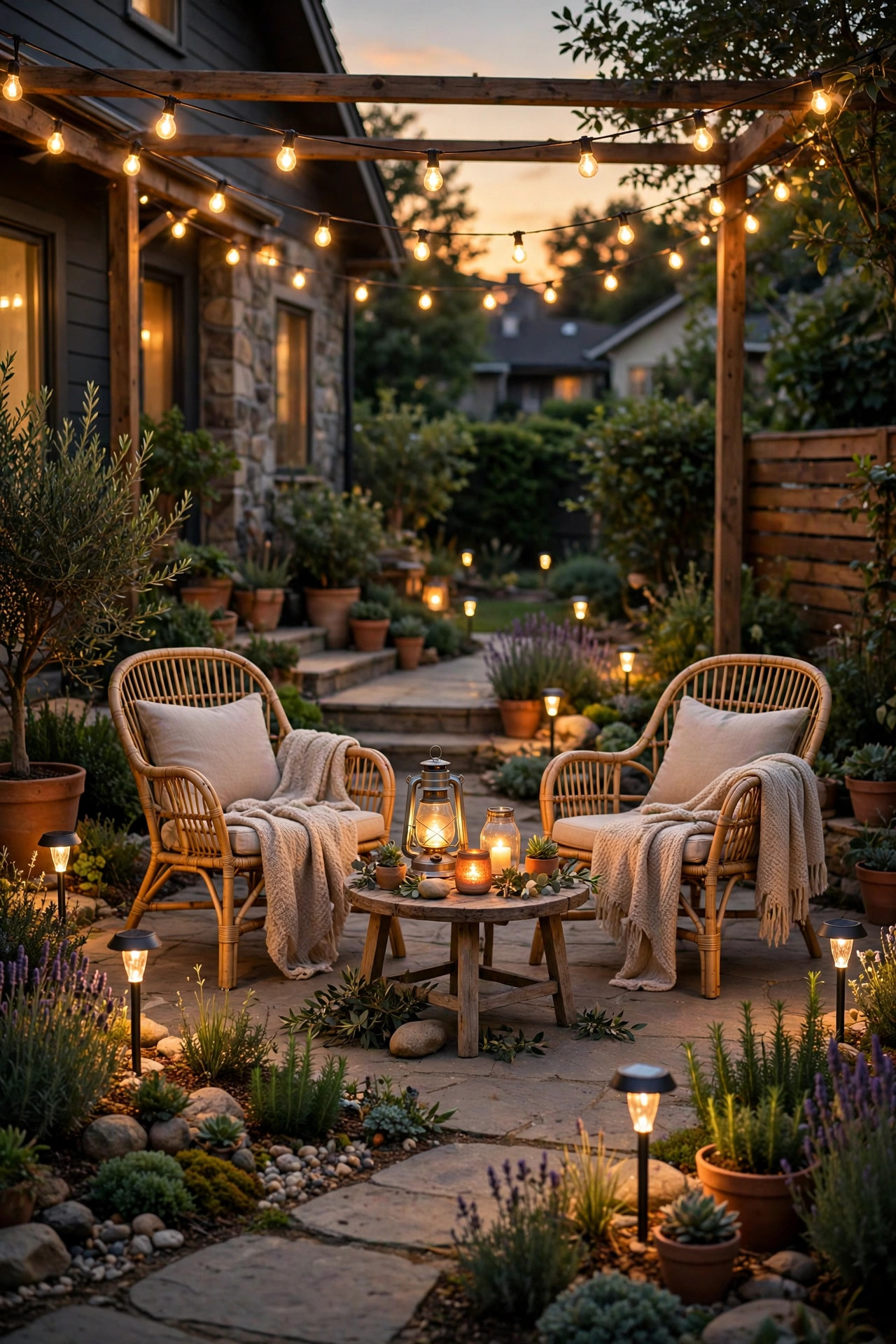
1. Start With a Golden Hour Patio Lighting Ideas Plan That Layers the Light
Before I buy a single bulb, I stand on the patio about fifteen minutes after sunset with a notebook and look at the space the way the dark does. Every patio breaks into three bands: overhead, where a canopy of light makes the space feel like a room; sitting height, where faces and tabletops need a warm, flattering glow; and ground level, where steps, edges, and walkways need enough light to keep feet safe. I sketch those three bands and note where each one is currently pitch black, because those gaps are exactly where new fixtures belong. I also mark my power sources, one outdoor outlet here, a sunny corner for solar there, so every idea I choose has a way to run. In my experience, layering is what separates a patio that feels magical from one that feels like a parking lot: several small, warm sources always beat one harsh floodlight. If you want the bigger picture before you start, my roundup of patio lighting ideas covers the layouts I borrow from most. A ten-minute plan like this saves real money, because you stop buying random fixtures and start buying the exact layers your patio is missing.
Suggested budget range: $0 – $25.

2. Swag Vintage-Style String Lights Overhead for an Instant Canopy
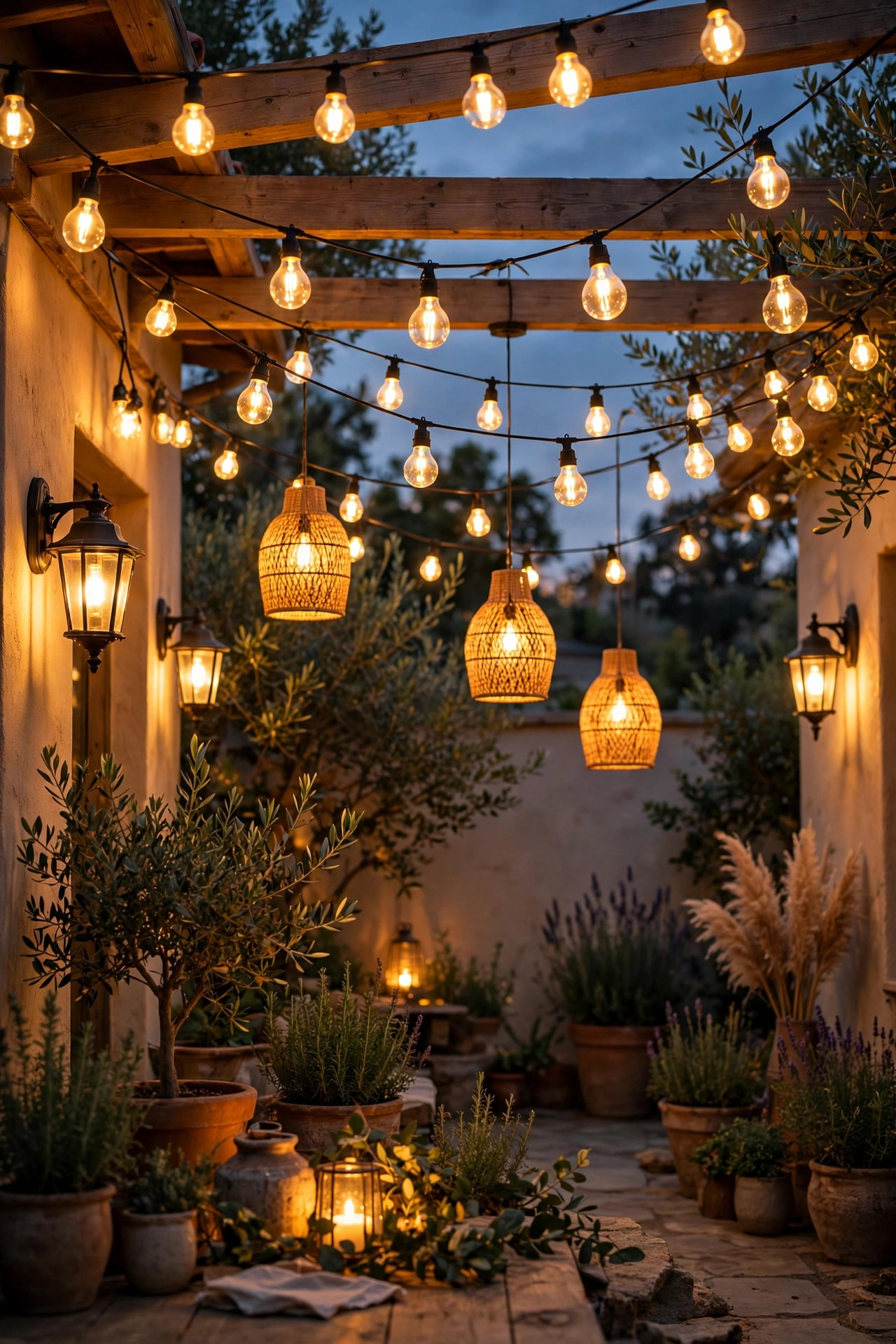
String lights are the fastest way I know to tell the sky, and everyone's mood, that the evening is not over. I use commercial-grade outdoor string lights with LED filament-style bulbs, because the filaments mimic that amber sunset glow instead of fighting it. Run a stainless guide wire first, clipped to the house and to a sturdy post or tree, then hang the strand so the lowest dip sits around 7 feet above the floor; heads clear it, and the swag looks intentional rather than saggy. Two crossing swags cover most 12 by 16 foot patios, and spacing the sockets about 12 inches apart gives an even canopy with no dark pockets. Always plug into a GFCI outlet, keep every connector off the ground, and choose strands rated for outdoor use with sealed sockets. Shatterproof plastic bulbs are worth it if kids or a basketball hoop share the space. I have tried a lot of layouts over the years, and the collection of backyard string light ideas on this site is where I send friends who want the swag patterns drawn out. On a timer, this canopy alone buys you a full extra hour outside.
Suggested budget range: $35 – $90.

3. Cluster Lanterns in Threes for Warm Anchor Corners
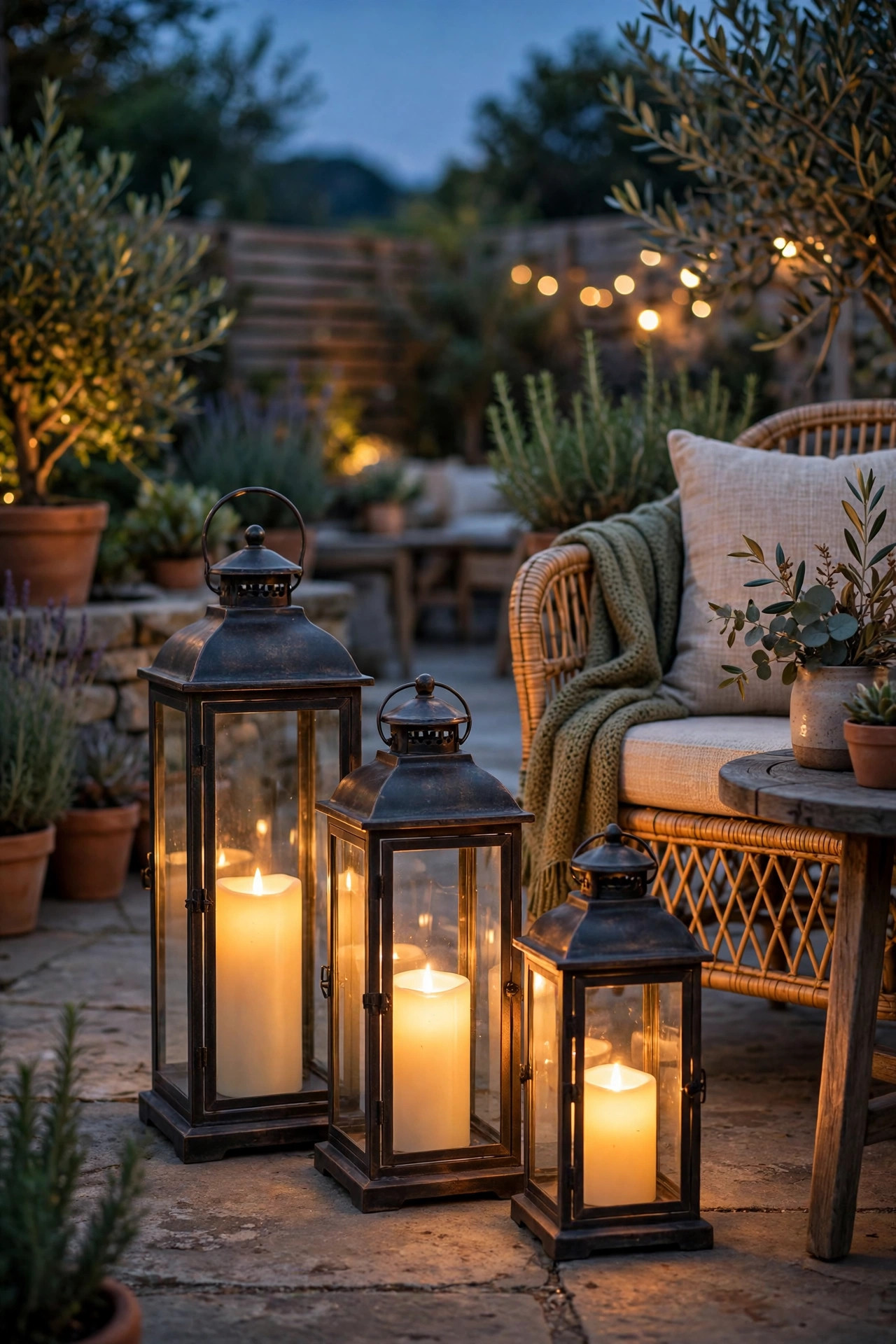
A single lantern looks lonely; three lanterns look like a decision. I group hurricane-style lanterns in odd numbers, mixing heights, a tall 18-inch lantern, a medium one, and a small one, and tuck the cluster beside the sofa, at the foot of the steps, or on the hearth edge. Inside each goes a flameless LED candle with a realistic flicker, which keeps the glow completely safe near cushions, throws, and curious little hands. Real candles are pretty, but wind, wax on pavers, and open flame near fabric make them a hard no for me outdoors. Metal lanterns in matte black or aged copper finishes hold up season after season; I wipe them down and store them in the garage each winter so the glass stays clear. Set the cluster on a small tray or a flat stone if your patio surface is uneven, and keep one cluster near the door so the trip inside for drinks is lit the whole way. In my experience, these corners do the emotional heavy lifting of the whole patio: they are the warm pools of light your eye rests on between the string lights above and the path lights below.
Suggested budget range: $20 – $60.
4. Line the Patio Edge With Solar Path Lights
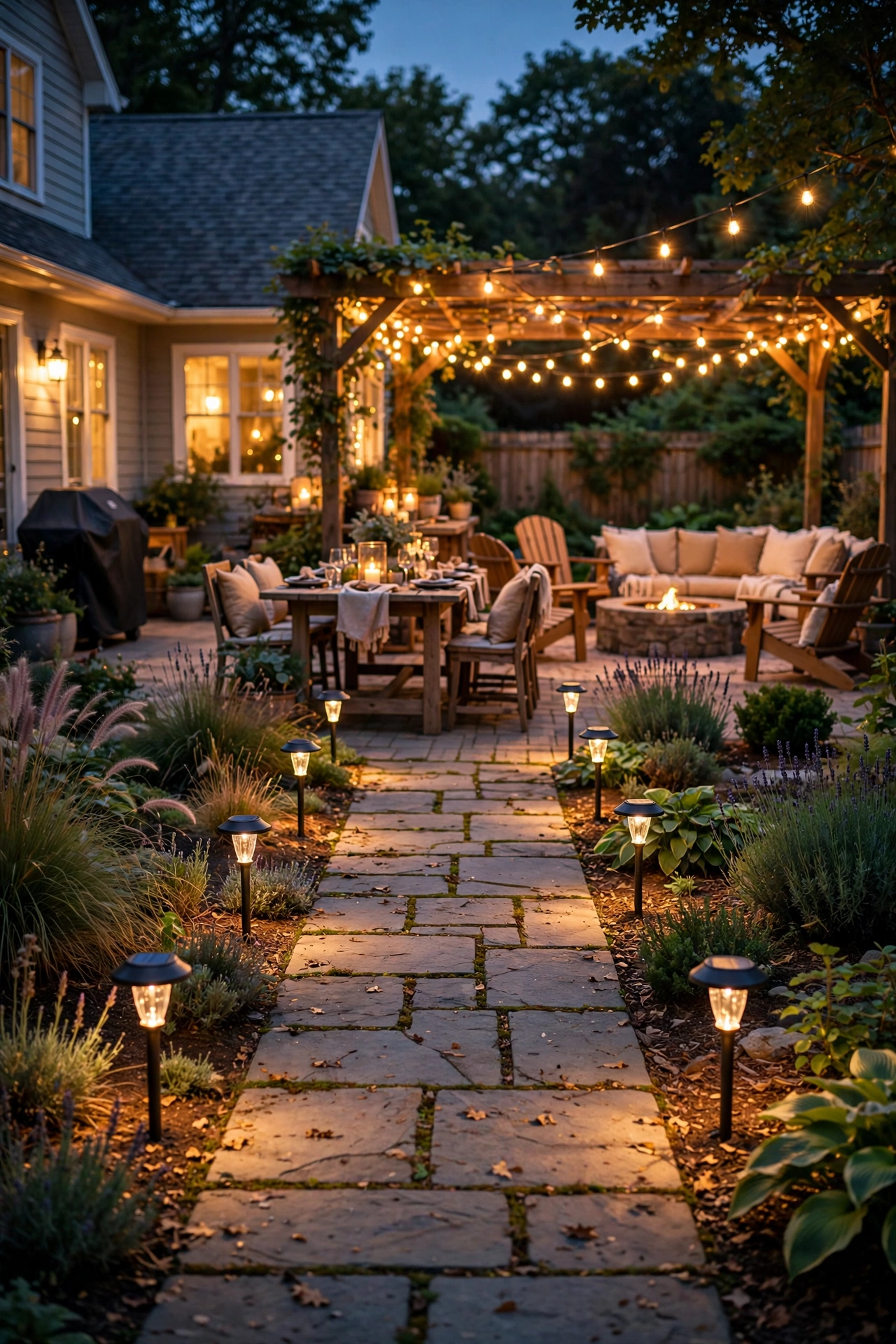
The edge of the patio is where golden hour turns into stubbed toes, so I give it a dotted line of warm light. Solar path lights with a 2700K warm white glow are my default: push the stakes in every 4 to 6 feet along the patio border and down any walkway to the yard, staggering them slightly so the pools of light overlap. That spacing matters more than brightness; a row of modest lights beats three bright ones with dark gaps between them. Choose fixtures with the solar panel on top and nothing shading it, because a stake tucked under a hydrangea will charge poorly and fade by nine. I pull ours up twice a year, wipe the panels with a damp cloth, and swap any tired rechargeable batteries, which brings dim lights back to life for a couple of dollars. Keep stakes a few inches back from the mower line and from where chair legs land. Honestly, this is the least glamorous idea on the list and the one guests thank me for, because nobody has to feel their way back from the garden with a full plate in their hands.
Suggested budget range: $25 – $70.
5. Set Flameless Candles Along the Table for a Sunset Supper Glow
There is a moment at a sunset supper when the food still looks wonderful but nobody can quite see their plate, and flameless candles fix it without a single match. I run a loose line of LED pillar candles down the center of the table, mixed heights again, some inside glass hurricanes, some bare, with a little greenery tucked between them. Most LED pillars have a built-in timer, five hours on and nineteen off, so I set them once and they greet us at the same time every evening like clockwork. Because there is no flame, I can use them on a wooden table, next to paper napkins, and around kids reaching for the bread basket, which is exactly why they replaced real candles at my house years ago. The warm flicker setting reads beautifully against the last of the daylight, and the light sits at face height, which flatters everyone in a way overhead light never will. Keep a spare set of batteries in the kitchen drawer; a candle that dies mid-dessert is a small but real tragedy. This is the cheapest instant atmosphere upgrade I own.
Suggested budget range: $15 – $45.

6. Uplight One Favorite Tree and Let It Glow Into the Night
Every patio has one tree that deserves to be the evening's artwork. A single uplight at its base, aimed up the trunk at about a 45-degree angle, turns rough bark and the underside of the canopy into a golden sculpture that keeps the garden feeling alive long after dark. I use a low-voltage well light or a sturdy solar spotlight making 100 to 300 lumens; more than that blows out the bark texture and looks like a stage set. Set the fixture 3 to 5 feet back from the trunk for a broad wash, or closer in for dramatic grazing light across the bark. Solar spotlights need a panel that sees real sun during the day, so in a shady yard I run a low-voltage line instead and bury the cable a few inches under the mulch. Angle the beam away from seating so nobody stares into it, and check the view from your favorite chair before you bury anything. In my experience, one lit tree does something psychological: it stretches the patio's walls out into the yard, so the whole space feels twice as deep at night.
Suggested budget range: $20 – $80.
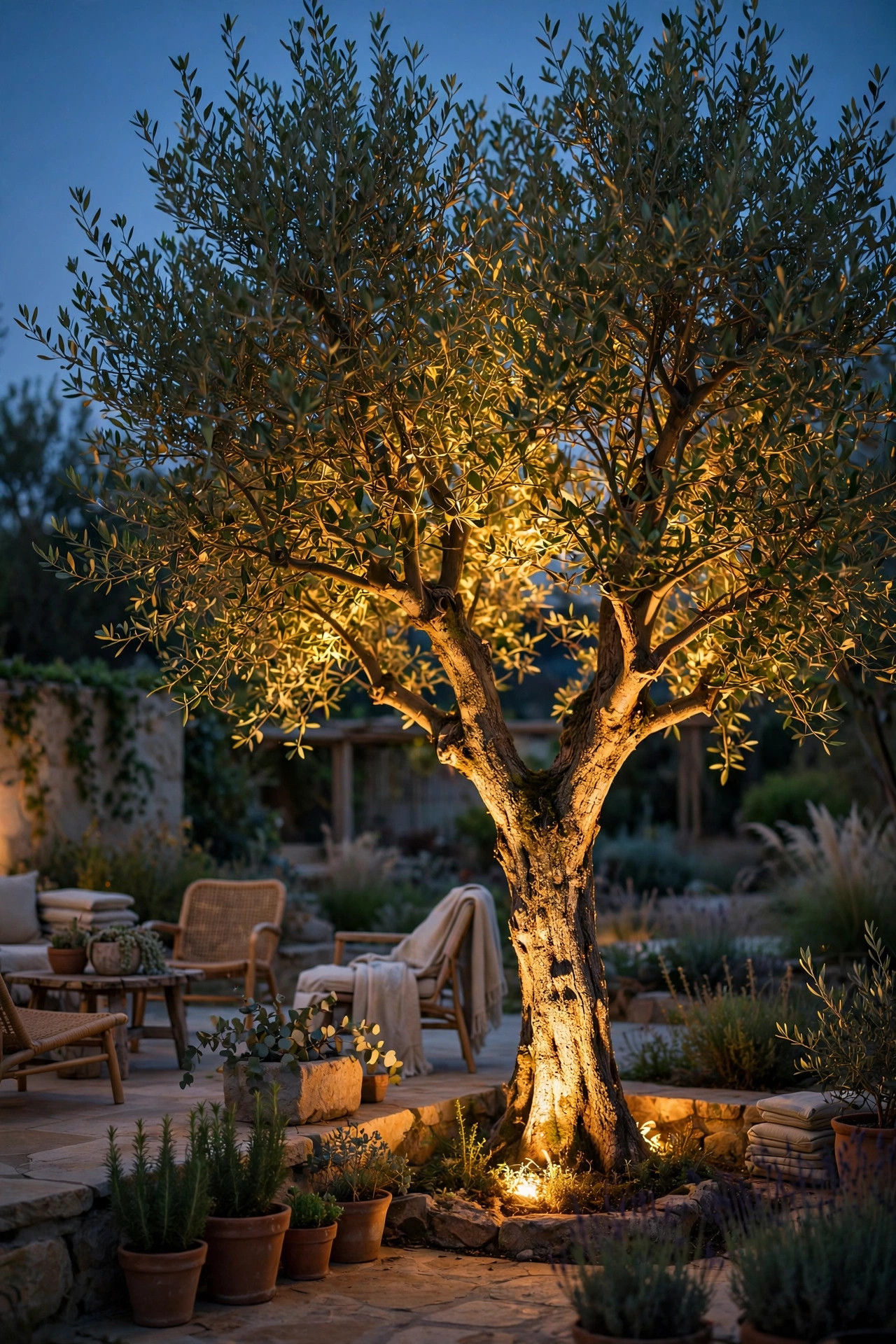
7. Weave Copper-Wire Fairy Lights Through the Planters
Copper-wire fairy lights are the jewelry of my patio, tiny warm points of light that make ordinary planters look enchanted. The wire is thin enough to wind through a lavender bush, along a railing planter, or around the branches of a potted olive tree without any visible hardware, and most strands run on a small battery pack or a solar stake you can hide behind the pot. I weave the strand loosely, letting it follow the plant's own shape, and leave a little slack because plants move and grow. Keep battery packs tucked under the pot rim where rain cannot pool on them, and bring the battery versions in for winter if your climate freezes hard. Solar fairy strands are my pick for railings and fences, since they switch themselves on at dusk with no outlet math at all. This layer is pure sparkle rather than useful light, and that is the point: at golden hour, when everything else provides the work light, fairy lights provide the magic. A twenty-foot strand costs less than a pizza and somehow makes guests ask what my secret is.
Suggested budget range: $10 – $30.

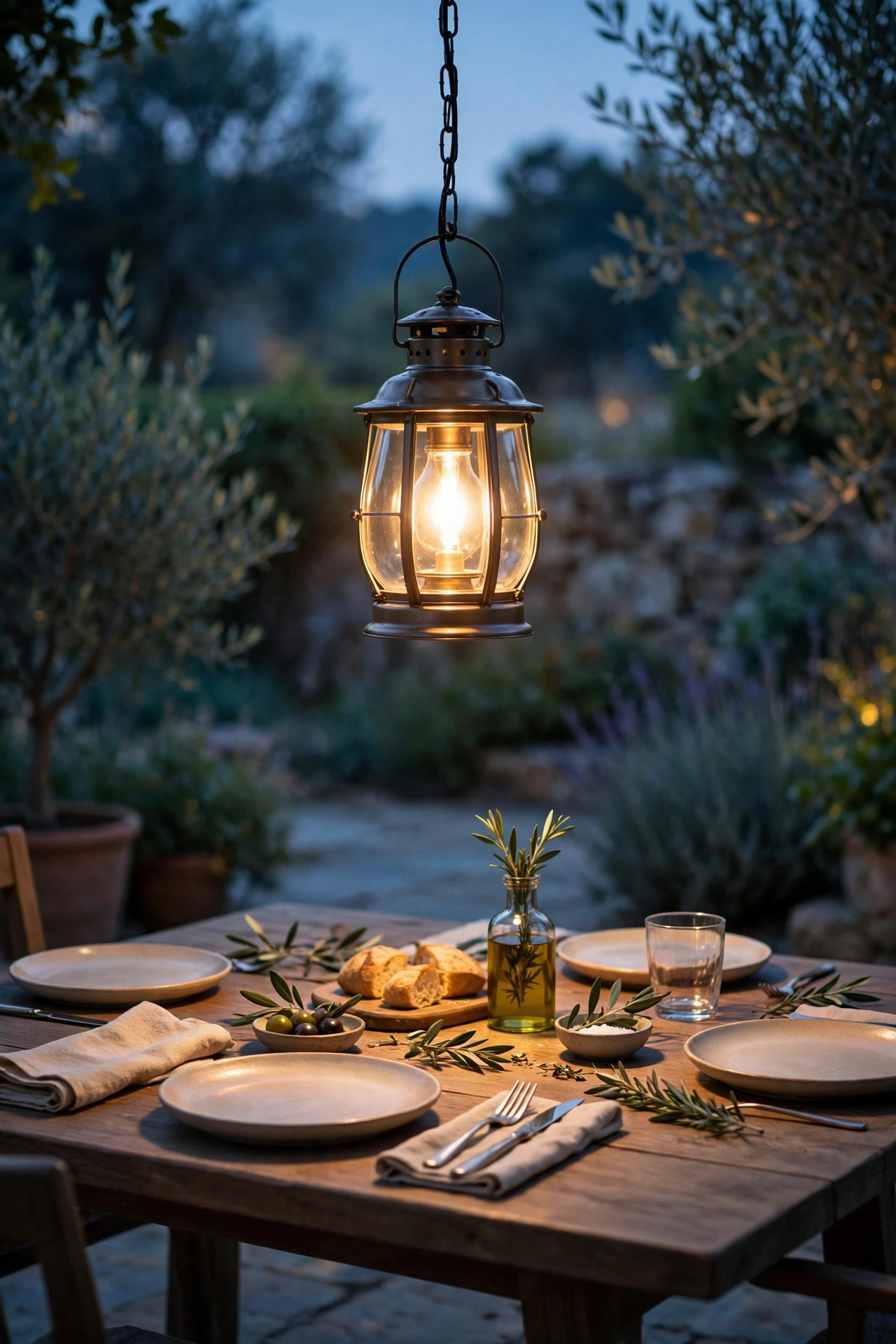
8. Hang a Lantern Pendant Over the Dining Table
Overhead string lights give a patio general glow, but the dining table deserves its own pool of light. I hang a plug-in lantern pendant from the pergola beam or a swag hook centered over the table, low enough that the bottom of the fixture sits about 30 to 36 inches above the tabletop. That height keeps the light on the food and faces where it belongs, out of everyone's eyes, and it makes the table read as a destination from across the yard. A dimmable warm bulb inside lets me run it bright for serving and low for lingering over coffee. If your pendant plugs in, run the cord neatly along the beam with cable clips and down a post to a GFCI outlet; cords draped loosely are both a tripping hazard and an eyesore. No pergola? A shepherd's hook or a wall-mounted swing arm on the house does the same job. In my experience, this one fixture is the difference between a table people pass by and a table people settle at until the last of the light is gone.
Suggested budget range: $30 – $85.
9. Ring the Fire Pit Seating With Low, Soft Light
A fire pit gives you flame, drama, and exactly one problem: everything behind your chair is pitch black. I ring the seating circle with low, soft light that keeps the ground readable without competing with the fire. Short solar lanterns or low bollard lights placed between the chairs, a few feet back from the pit, outline the circle so guests can find their seat, their drink, and the step back up to the patio. Keep every fixture low and warm; anything at eye level washes out the flame and ruins the spell. Clearance matters here: keep solar stakes and lanterns at least 3 feet from the fire's edge, well outside spark range, and use LED sources only, never anything with an open flame of its own sitting in dry mulch. A strip of low-voltage light under a built-in seat wall is the polished version of the same idea. Honestly, the fire should always be the star; this ring of light is just the usher that keeps the audience safe in the dark.
Suggested budget range: $25 – $75.

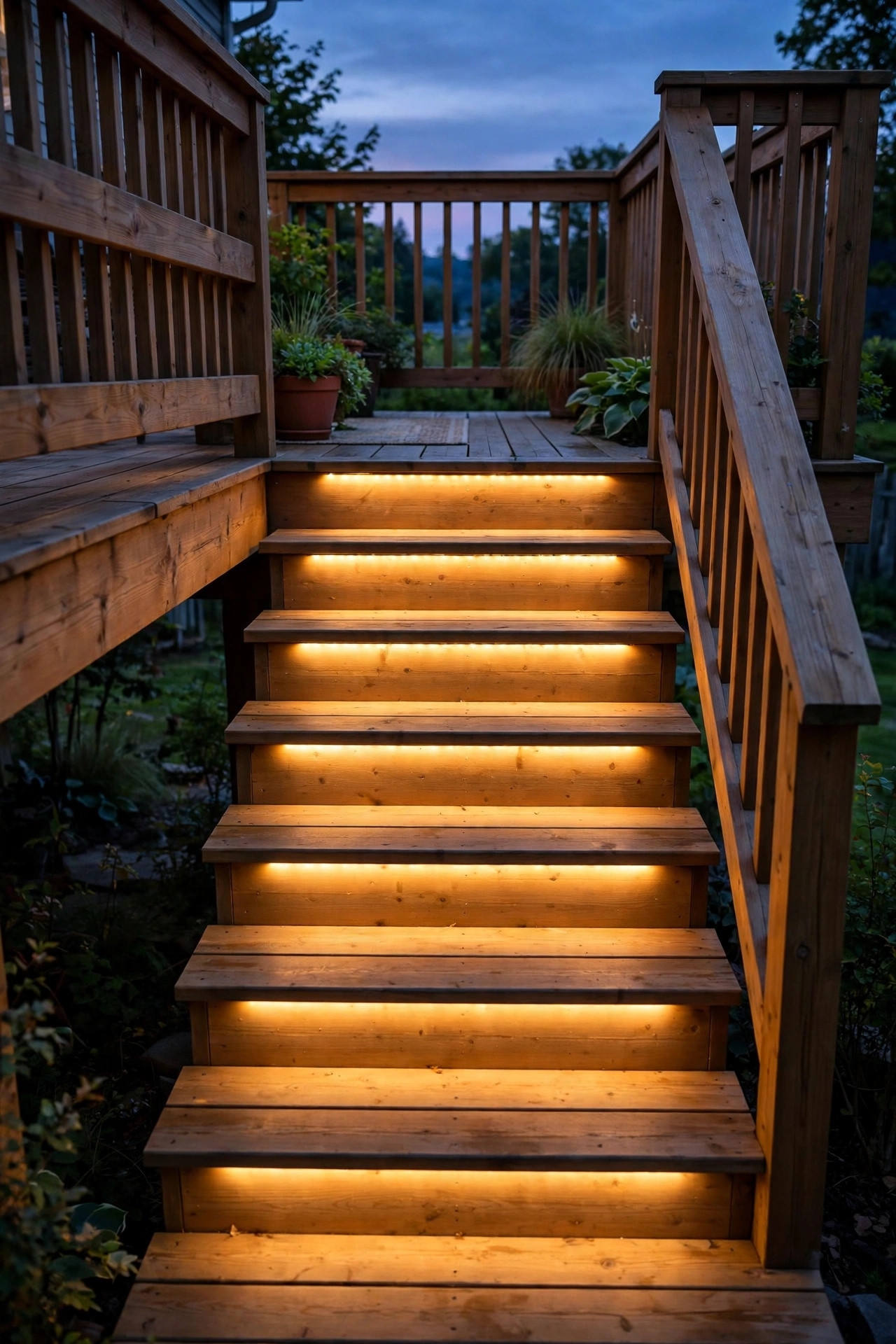
10. Add Step Lights So Nobody Misses the Deck Stairs
Golden hour light is gorgeous and, on stairs, genuinely treacherous, because your eyes are adjusted to the bright sky while the steps sit in shadow. I added small LED step lights to every riser on our deck stairs, and it is the safety upgrade I would undo last. Recessed lights wired into the risers look cleanest, but surface-mount solar step lights stick or screw on in minutes and need no wiring at all, which makes them the renter-friendly route. Shielded fixtures that throw light downward onto the tread are the ones to buy; an unshielded bulb at shin height just glares. Light every step on a long run, or every other step on a short one, and keep the color temperature warm so the stairs match the rest of the patio. If your steps are stone or concrete, adhesive solar lights on the side wall beside the stairs work beautifully. In my experience, this idea never gets compliments, it just quietly prevents the one fall that would have ended the evening, and that is praise enough.
Suggested budget range: $20 – $65.
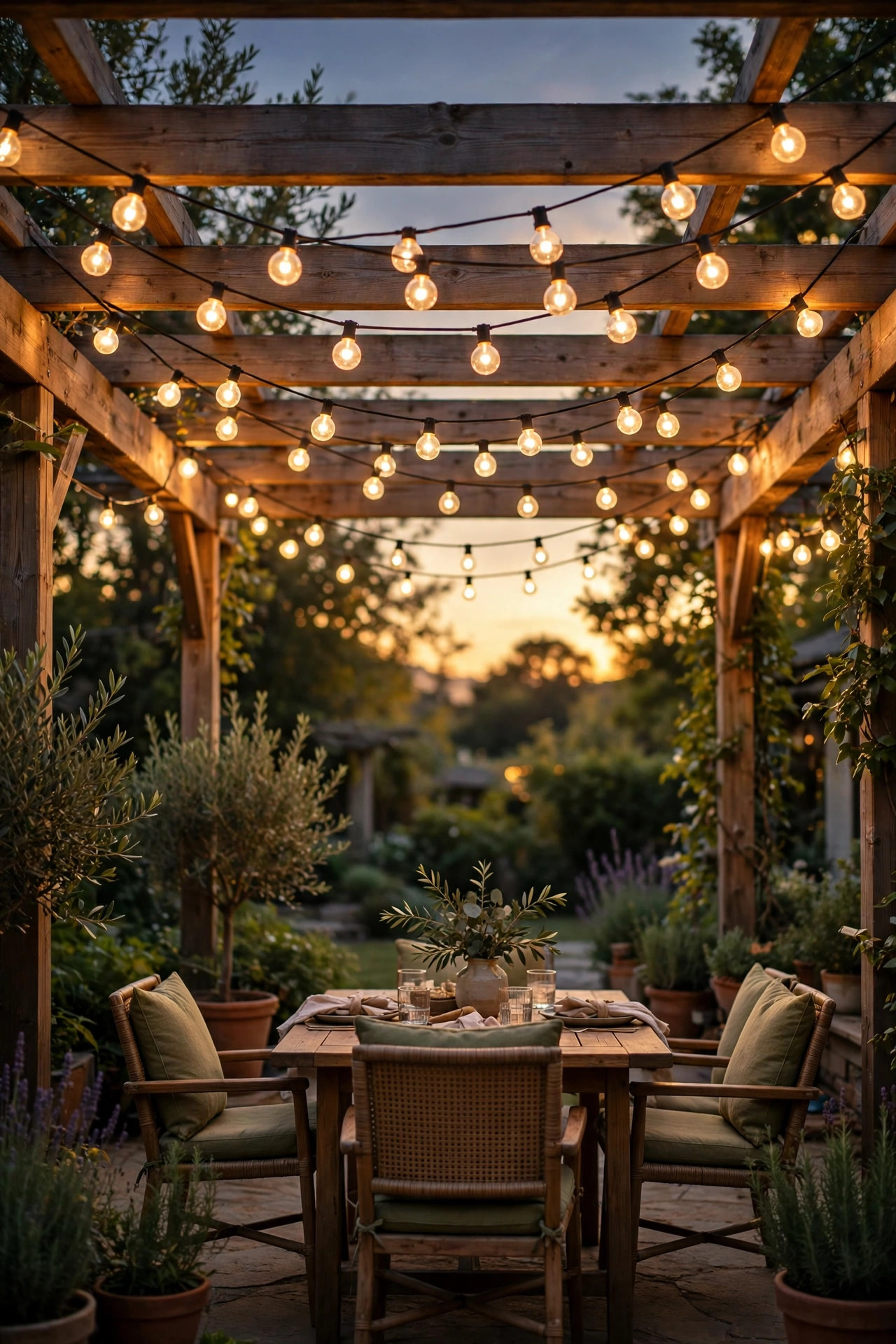
11. Drape Globe String Lights Across the Pergola Beams
If filament string lights are the workhorse, globe lights are the showpiece. Milky globe bulbs throw a softer, more diffused light than exposed filaments, which makes them perfect draped across pergola beams where the strand sits close to where people sit. I run them in parallel lines along the beams, letting each span dip 12 to 18 inches, and secure the cord with clips or zip ties at every beam so nothing sags onto a tall guest's head. Globes in a warm 2700K tone keep the pergola feeling like sunset is happening inside it. Mix scales if you can find them, larger globes on the main span, smaller ones on the cross runs, for a layered, collected look. As with any string light, outdoor-rated strands and a GFCI outlet are non-negotiable, and I bring glass globes in for winter while leaving shatterproof ones up. A pergola without light is a frame; a pergola draped in globes is a room, and it is the room where every sunset toast at my house now happens.
Suggested budget range: $30 – $80.
12. Line the Steps and Walkway With Mason Jar Luminaries
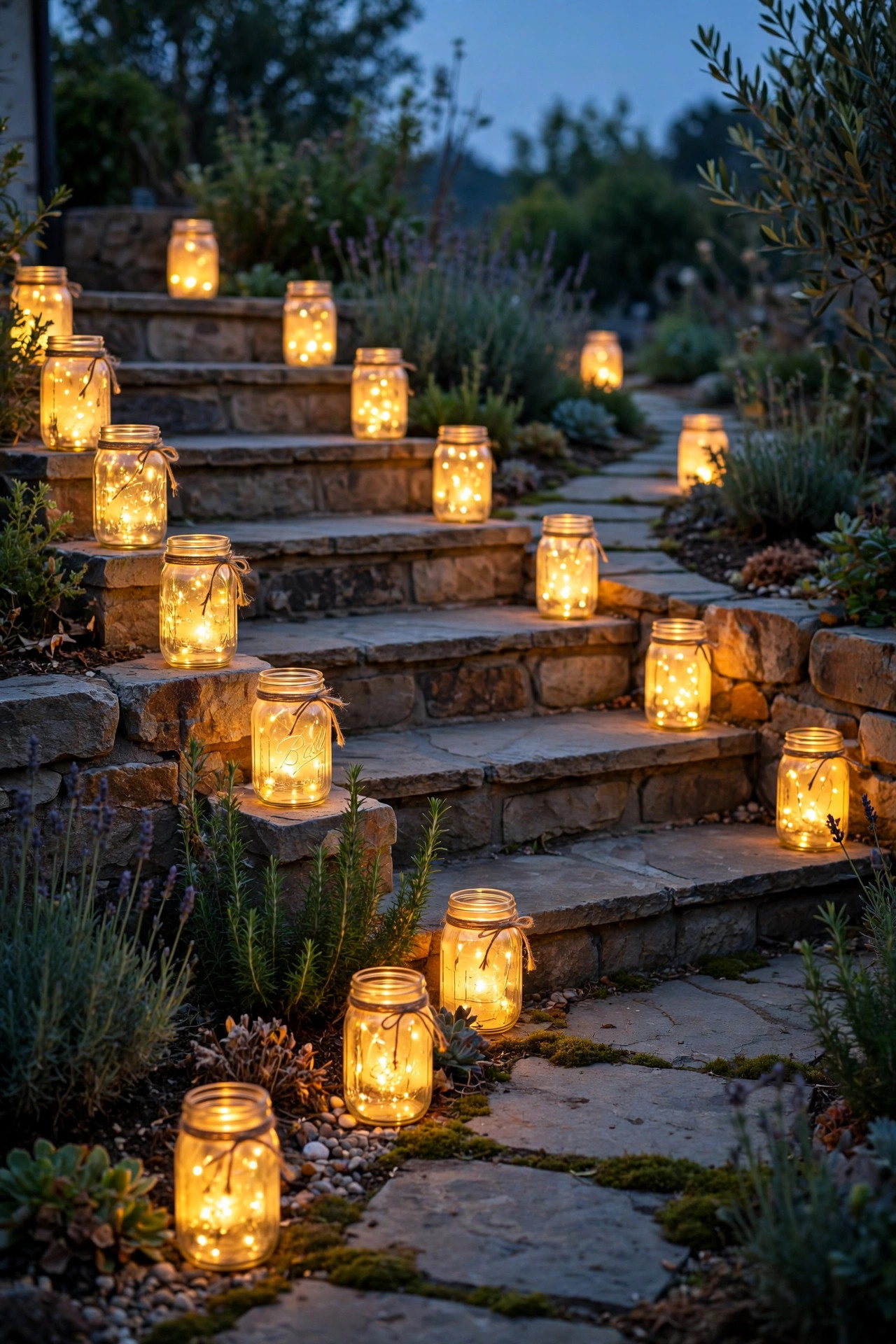
Mason jar luminaries are my favorite ten-minute project: a wide-mouth jar, a solar lid insert or a coil of battery fairy lights dropped inside, and a light that looks like bottled sunset. I line them along the patio steps, down the walkway, and across the top of the garden wall, anywhere a little punctuation of light helps. A spoonful of sand in the bottom keeps them steady in a breeze and holds a flameless tea light centered. The solar-lid versions charge all day on the same steps they light at night, which is the laziest and loveliest arrangement I know. Because the light source is sealed LED, there is no flame to blow out and no wax to scrape off the pavers later. Group them in twos and threes at landings rather than marching them in a perfect row; clusters look gathered, rows look like an airport. Kids love carrying one each as a personal lantern, so I always make extras. Honestly, no store-bought fixture at any price gets asked about as much as these jars.
Suggested budget range: $10 – $35.
13. Swap Harsh Door Lights for Dimmable Warm Sconces
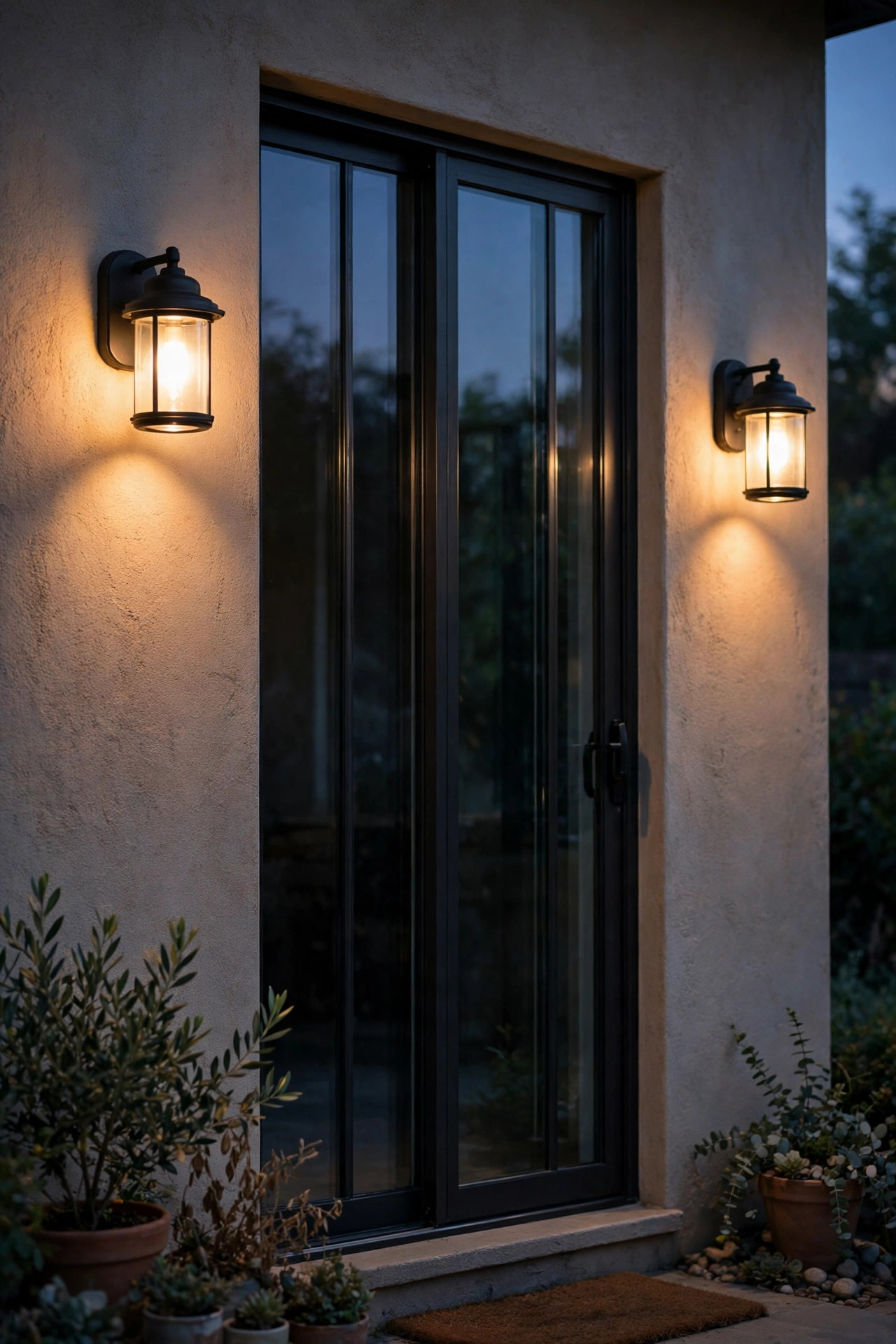
The single brightest saboteur of golden hour at most houses is the builder-grade porch light blasting white glare beside the patio door. I replaced ours with two warm sconces fitted with dimmable LED bulbs, and the whole patio calmed down instantly. Flanking the door at about 6 feet high, sconces wash the house wall with soft light that bounces gently into the seating area instead of stabbing into it. On a dimmer, or with smart bulbs on a schedule, I run them at full for grilling and cooking, then drop them to a third for the long, slow part of the evening. Match the bulb tone to everything else, 2700K, and choose fixtures with frosted or downward-shielded glass so no bare bulb ever meets an eye. If rewiring is not in the cards, a dimmable smart bulb in the existing fixture gets you most of the effect for the price of lunch. This is the idea I push on friends first, because it fixes the light you already have instead of adding more.
Suggested budget range: $40 – $110.
14. Drop Submersible Lights in the Fountain or Birdbath
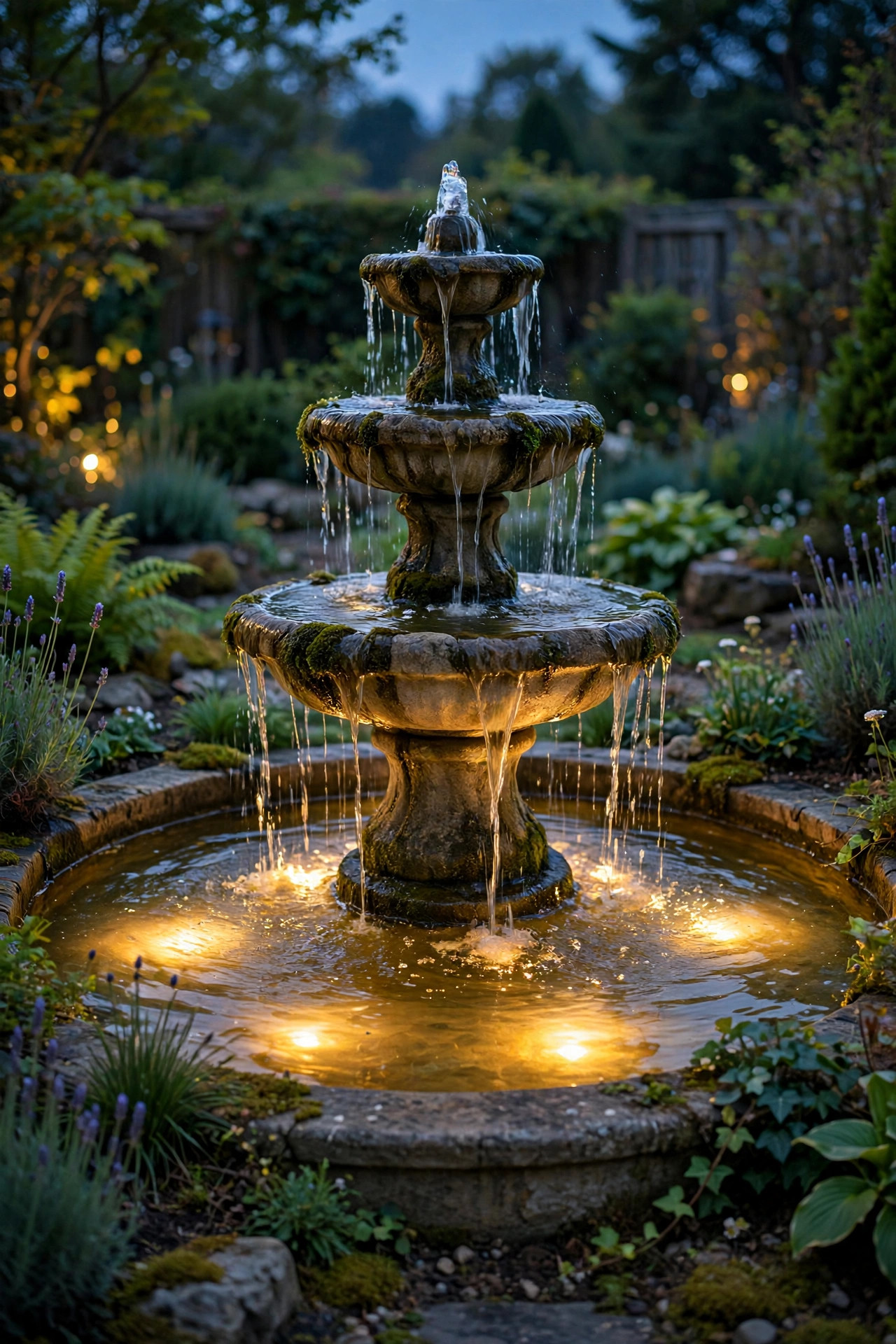
Water plus warm light is the oldest magic trick in the garden, and submersible LED pucks make it nearly free. I drop one or two waterproof puck lights into the fountain basin or the birdbath, set them to warm white, and the water itself starts to glow, rippling light onto everything nearby. Look for pucks rated IP68, which means they are built to live underwater, with a remote so you can change brightness without fishing them out in the dark. Battery life runs weeks at a few hours a night, and a little tray of spare batteries lives in my patio storage box. Keep the color warm; blue and color-cycling modes read as pool party, not golden hour. In a birdbath, one puck under shallow water turns a daytime feature into an evening one, and birds, I promise, do not mind once the light is off at bedtime. In my experience, guests drift toward glowing water the way they drift toward a fire. It is a tiny circle of light that somehow anchors the whole garden after sunset.
Suggested budget range: $12 – $35.
15. Clip a Light Ring Under the Patio Umbrella
An umbrella gives you shade at noon and a dark cave at seven, unless you light it from inside. The fix is a rechargeable umbrella light ring that clamps around the pole and shines down through the ribs, or battery-powered micro lights clipped along the ribs themselves. The ring style lights the whole table evenly and dims in steps, which I love, bright for cards and dinner, low for drinks after. The rib style looks like a tiny canopy of stars and takes five minutes with the little clips in the box. Either way, the light source hides above eye level, so the table glows without glare, and the umbrella canopy bounces the light back down like a lampshade. Rechargeable versions charge by USB overnight; solar ones sip power from a small panel on top of the canopy. If your umbrella tilts, check the light still clears the crank and tilt joint before you clamp it down. This idea rescued our umbrella table from being the seat nobody chose, and now it is the seat everybody wants.
Suggested budget range: $15 – $40.

16. Keep Every Bulb at One Warm 2700K Temperature
Here is the unglamorous secret behind every patio photo you have ever loved: all the bulbs match. Golden hour light is warm, roughly the 2700K neighborhood of a classic incandescent bulb, and when one daylight 5000K bulb sneaks into the mix, it turns its corner blue-white and the whole spell breaks. I read the Kelvin number on every box before it comes home, and I keep a small stash of spare 2700K bulbs so a midnight replacement never introduces a stranger. Amber-leaning 2200K bulbs have their place too, in flame-effect fixtures and wherever bugs gather, but I use them as accents inside one warm family, not as a second scheme. Solar lights vary more between brands, so I buy one, live with it for a night, and then buy the rest of the set. In my experience, this consistency is what makes a patio feel designed rather than accumulated, and it costs nothing extra, just a moment of attention at the shelf. Check your existing bulbs tonight; you may find two temperatures already fighting on your own patio.
Suggested budget range: $10 – $40.
17. Wash the Flower Beds With Low Garden Stakes
The patio does not end at its edge, and neither should its light. Short garden stake lights, the spot variety rather than the path variety, angled into the flower beds give the patio a soft backdrop instead of a black wall. I aim them at the plants with the most texture, ornamental grasses, a hydrangea, the feathery top of a fern, from 12 to 18 inches in front of the bed, tilted up just enough to catch the foliage. Low-voltage stakes on a single run are the reliable option for a big bed, while solar spots handle a small one with zero wiring. Keep beams out of windows, yours and the neighbors', by testing angles after dark; a stake that dazzles the kitchen window gets re-aimed, not removed. This grazing light makes shadows dance when the breeze moves, which at golden hour is pure theater. It also quietly lights the route to the compost bin and the gate, the errands that send people stumbling across dark beds. Beauty and utility in one fixture is always my favorite kind of buy.
Suggested budget range: $25 – $70.
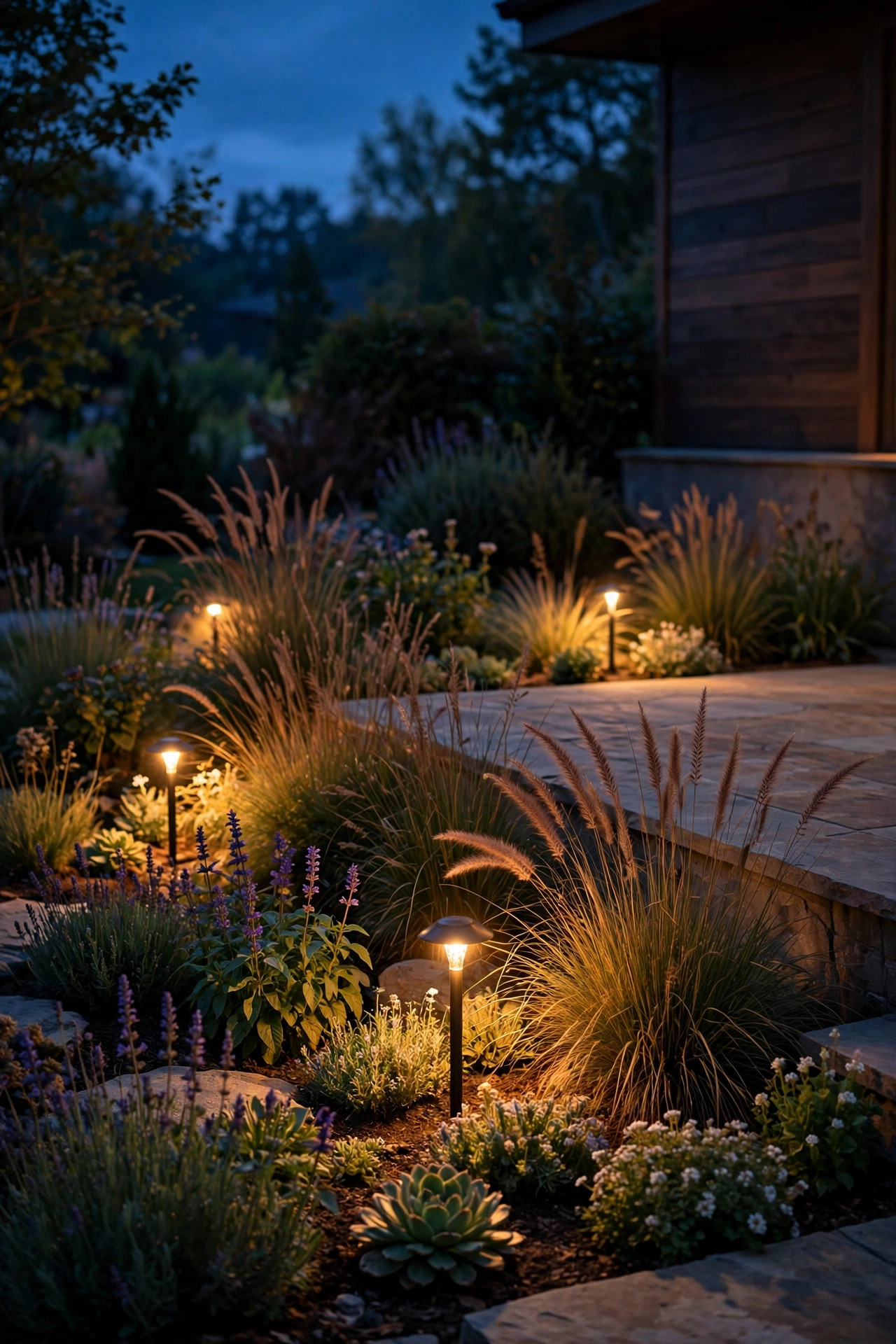
18. Set Timers So Your Golden Hour Patio Lighting Ideas Switch On Before Sunset
The best golden hour lighting is the kind you never remember to turn on, so I let timers do the remembering. My string lights and sconces run on an astronomical timer, which knows the sunset time for my zip code and shifts with the seasons, switching everything on about twenty minutes before sunset and off at 11. Photocell dusk-to-dawn sensors do the same job with no programming at all; the roundup of dusk to dawn outdoor lights explains the sensor options better than I can here. Smart plugs are the third route, and they earn their keep when I want the fire pit ring on a different schedule from the canopy. Solar fixtures handle themselves, which is half their charm. The real trick is staggering: overhead canopy on first, table candles and lanterns a touch later, so the patio warms up gradually the way the sky does. Walking outside to a patio that is already glowing, drink in hand, while the sky is still gold, that is the whole point of this post, and a twenty-dollar timer is what delivers it nightly.
Suggested budget range: $12 – $45.

19. Use Flame-Effect Bulbs for Flicker Without the Firewood
Some nights I want the fire pit's flicker without building the fire, and flame-effect LED bulbs are my shortcut. These bulbs imitate a rising flame with warm orange light that dances instead of glowing steady, and in a lantern or a sconce they read as fire from ten feet away. I put them in the lantern clusters and the door sconces, the spots where a real flame would live if it could. Because they are LEDs, they stay cool, sip power, and can sit inside paper or fabric shades that no real flame should ever touch. One caution from experience: buy one bulb first and watch it for an evening, because the cheap versions flicker like a strobe instead of a candle, and the good ones are genuinely convincing. Keep the rest of the patio steady and warm so the flicker has a calm background to play against. On a Tuesday, when nobody is lighting a real fire, these bulbs give the patio its heartbeat for pennies a month, and the sunset hour feels finished instead of merely lit.
Suggested budget range: $12 – $35.

20. Moonlight the Patio From One High Branch
Moonlighting is uplighting's quieter sibling: instead of aiming a fixture up a trunk, you mount it high in the branches, 15 to 20 feet up, and aim it down through the leaves. The light filters through the canopy and lands on the patio in soft, dappled pools that shift when the breeze moves, exactly the way real moonlight behaves. It is the most natural-looking artificial light I own, broad and gentle with no visible source and no glare from any seat. The catch is installation: somebody has to climb, the fixture and cable get secured to the trunk with room for the tree to grow, and the run back to the transformer should be tidy. I hired an electrician for ours and consider it money well spent, though a confident DIYer with a proper ladder and a spotter can do it. One fixture covers a surprising area, often the whole seating zone, so it can replace several ground lights. In my experience, guests never figure out where this light comes from, and that invisible quality is the highest compliment patio lighting can earn.
Suggested budget range: $60 – $180.
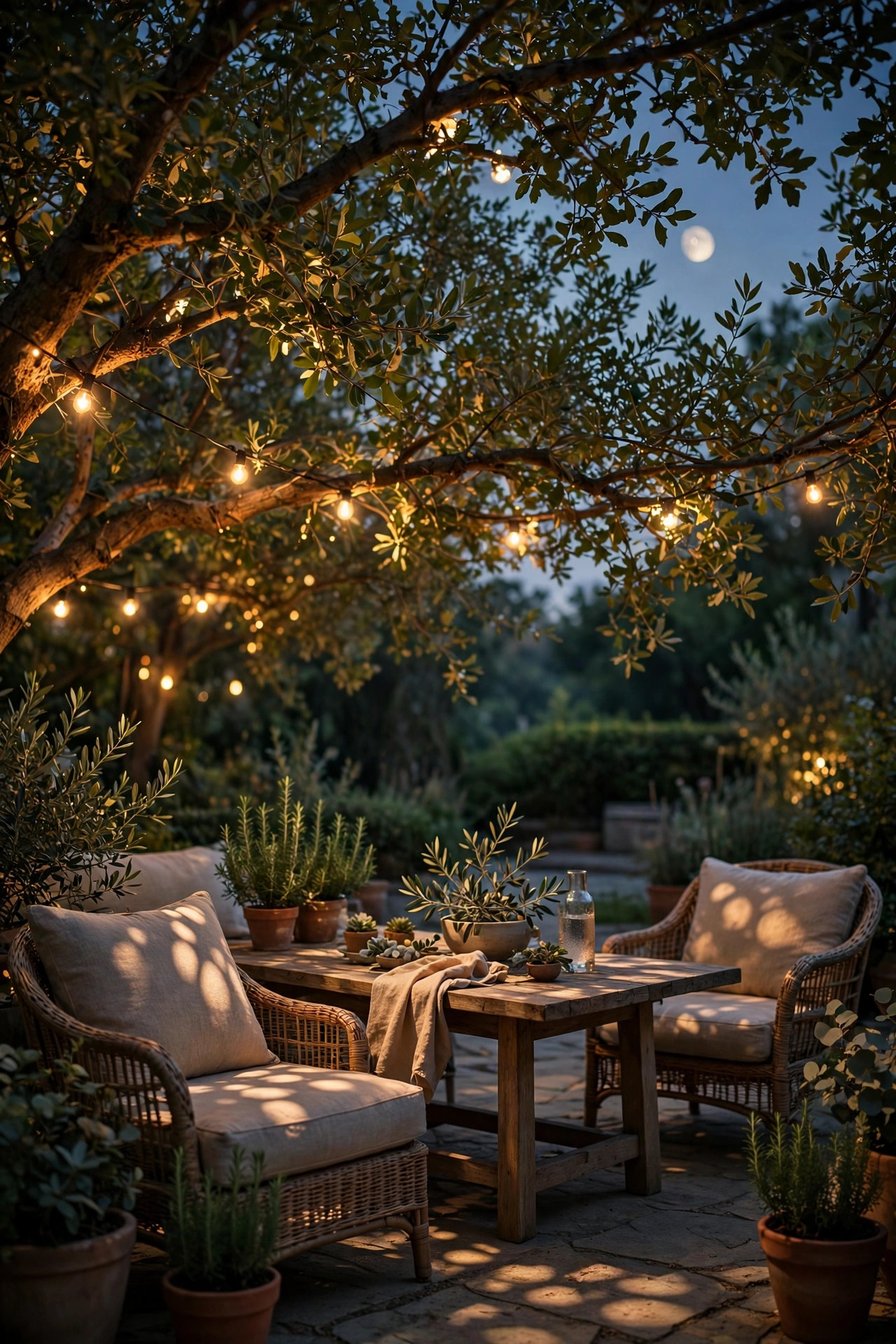
21. Finish With a Dusk Walk-Through of Your Golden Hour Patio Lighting Ideas
The last step is my favorite ritual: once everything is installed, I pour something cold, wait for the exact moment the timers click on, and walk the patio slowly, sitting in every single seat. From the sofa, is anything glaring? From the dining chairs, can I see faces and plates but not bulbs? From the steps, is the footing obvious? I take phone photos from each seat, because the camera is merciless about hot spots and dark holes my eyes politely ignore. Then I make the tiny adjustments, tilting one stake, dimming the sconces a notch, moving a lantern six inches left, and those small moves are where good becomes lovely. I repeat the walk-through twice a year, in spring and again in fall, because plants grow, furniture migrates, and sunset itself moves across the yard with the seasons. Ten unhurried minutes with a critical eye is the cheapest professional finish your golden hour patio lighting ideas will ever get, and it turns a collection of fixtures into a place that feels, unmistakably, like yours.
Suggested budget range: $0 – $20.

Frequently Asked Questions
What color temperature looks best at golden hour?
Warm white at 2700K is the sweet spot, because it closely matches the amber tone of sunset light and blends with it instead of fighting it. Bulbs labeled 2200K lean even warmer and suit flame-effect and accent spots. Anything at 4000K or above reads blue-white against a sunset sky and makes a patio feel clinical, so I keep daylight bulbs for the garage and the workbench, never the patio.
Are solar lights bright enough for a patio at dusk?
For paths, edges, steps, and accents, yes, modern solar stakes and spots handle those jobs well after a day of decent sun. For the main canopy over seating, I anchor the patio with at least one plug-in or low-voltage source, because a string of cloudy days can leave an all-solar patio dimmer than you want. Layering solar accents around one wired anchor gives you brightness you can trust with almost no wiring.
How do I keep patio lights from attracting bugs at sunset?
Warm and amber bulbs draw far fewer insects than white or blue-rich light, which is one more reason to stay at 2700K or warmer near seating. Place your brightest white-ish light, if you have one, away from the table so it works as a decoy at the yard's edge. A small fan near the dining area helps more than any bulb, since most evening biters are weak fliers that cannot cross moving air.
What time should patio lights turn on for golden hour?
Aim for about fifteen to twenty minutes before sunset, so the light is already established when the sky turns gold and grows with the dusk instead of snapping on after dark. Astronomical timers handle this automatically and adjust all year, while photocell sensors simply react to the fading light itself. Then let the accent layers, candles and lanterns, follow a few minutes later for a gradual warm-up.
Conclusion
Golden hour asks so little of us: about an hour of soft sky, already free, every clear evening. The right golden hour patio lighting ideas simply refuse to let that hour end on schedule. Layer a warm canopy overhead, set lanterns and candles glowing at sitting height, keep the ground honest with path and step lights, match every bulb to one warm temperature, and hand the whole routine to a timer. Start with two or three ideas this weekend, pour something you like, and sit in your favorite chair as the lights click on. The sunset will still do the heavy lifting; your patio will just be ready to hold it. For more ways to make the outdoors glow, browse the rest of the lighting ideas here on the site, and I will see you out there at dusk.