
There is a particular kind of evening I chase all summer: the sun dropping behind the fence, a record playing through the open slider, and the patio glowing like a Palm Springs postcard from 1962. Honestly? That look never comes from one expensive fixture — it comes from layers. The best mid-century modern patio lighting ideas all borrow the recipe I use in every outdoor room: a soft ambient layer so nobody squints, honest task light where drinks get poured and steps get climbed, and sculptural accents that show off clean atomic-age lines. In this post I am sharing the 17 ideas I actually install, from starburst pendants and globe string lights to mushroom path lights and flameless tiki torches. You will get spacing numbers, bulb temperatures, and a realistic budget range for every single idea. Whether your patio belongs to a true mid-century ranch or is simply borrowing the vibe, these layers will give you those long, golden, atomic-age nights — no time machine required.

1. Start With a Three-Layer Plan for Mid-Century Modern Patio Lighting Ideas
Every patio I am proud of started on paper, not at the hardware store. I sketch the space and mark three layers: ambient light for a soft overall glow, task light where feet and hands actually work — the steps, the grill zone, the drink ledge — and accent light for the drama, like a sculptural olive tree or a breeze-block wall. Mid-century patios have wonderful bones for this: strong horizontal lines, big sliders, and geometric hardscaping that begs for simple, repeated shapes. Decide fixture finishes now, because the palette is half the look — matte black, brushed brass, and walnut-toned accents sit naturally with teak and concrete, while shiny chrome reads cold and modern in the wrong way. Plan your power at the same time: most of these ideas run happily on one low-voltage transformer fed from an outdoor GFCI outlet, with cable runs tucked along bed edges and expansion joints where nobody sees them. Twenty minutes with a tape measure and a pencil saves you from the classic mistake — beautiful fixtures bought in the wrong order, leaving bright pools and dark holes. In my experience, the plan is the cheapest idea in this whole post and the one that makes every other dollar work harder.
Suggested budget range: $0 – $40.
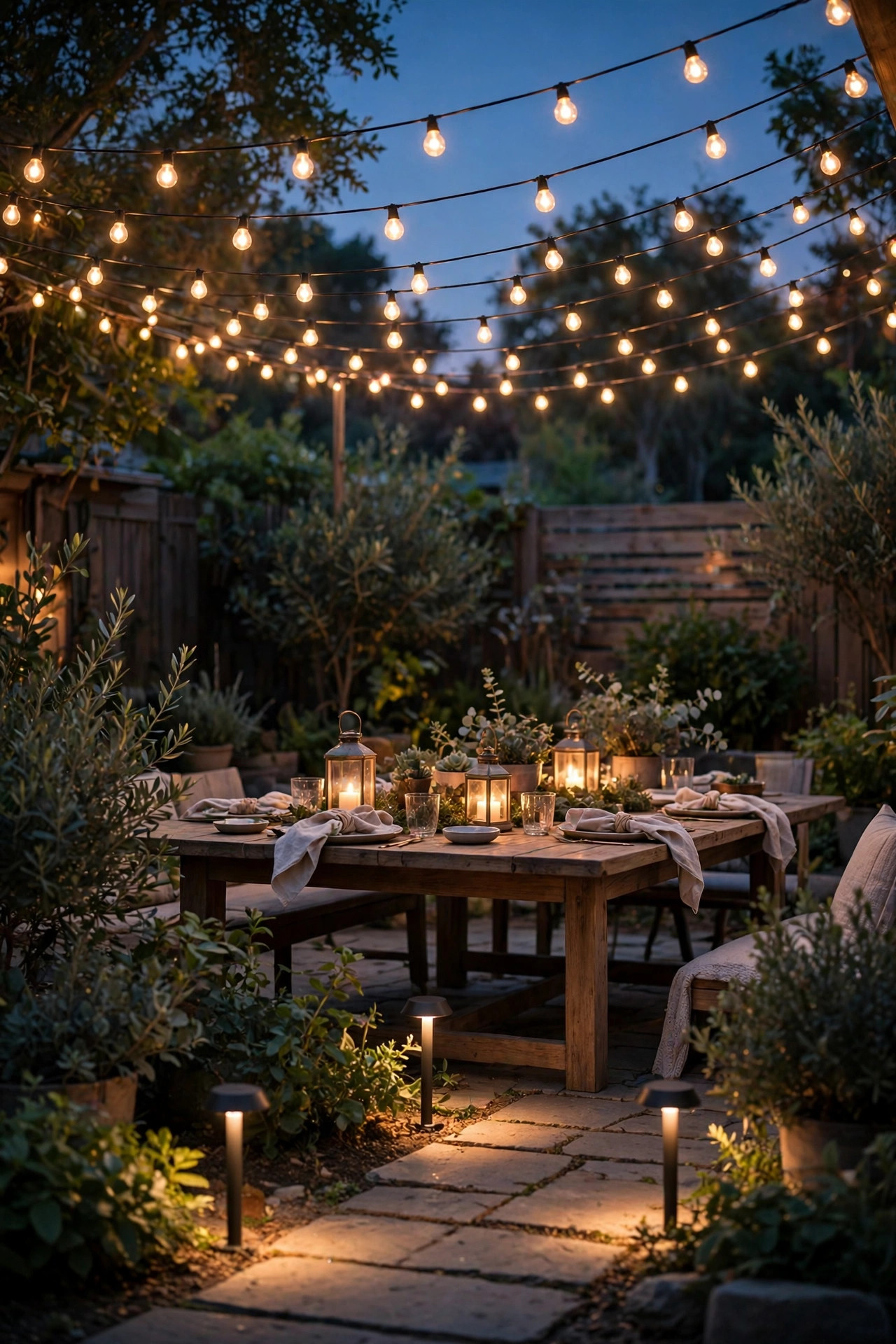
2. Hang a Starburst Sputnik Pendant Over the Dining Table
If mid-century design has a signature silhouette, it is the starburst — and a sputnik-style pendant over the patio dining table is the single most recognizable move you can make. I hang mine 30 to 36 inches above the tabletop, centered so the arms clear raised glasses and tall centerpieces, and I always choose a fixture rated for damp or wet locations with sealed sockets. Warm LED filament-style bulbs at 2700K keep the brass or black arms glowing golden instead of glaring, and a dimmer lets the same fixture swing from bright taco-night task light to low cocktail-hour mood. On a covered patio this is an easy hardwired swap for an existing ceiling fixture; on an open pergola I use a plug-in version with a weatherproof inline dimmer and the cord dressed along a beam with matching clips. Keep the scale honest — a 24 to 32 inch diameter suits most six-person tables, and anything smaller looks lost against wide mid-century rooflines. Guests photograph this fixture more than anything else in my yard, honestly. It is the exclamation point the whole room organizes itself around.
Suggested budget range: $140 – $420.

3. Swag Globe Café String Lights in Clean Straight Runs
String lights belong on every patio, but the mid-century version skips the swoopy carnival drape. I run globe café strands in straight, taut lines or crisp zigzags between the house and two poles, because geometry is the whole point of the era. Opal glass-look globes about 2 to 3 inches across read far more authentic than bare Edison bulbs for this style, and they soften the light beautifully. Space the attachment points so each run sags no more than a few inches, use proper cable guides or a support wire on runs longer than 15 feet, and keep strands at least 7 feet above walking areas. Shatterproof LED globes are my non-negotiable near pools and under trees — one dropped glass globe can end a party. For more layouts and spacing tricks, my roundup of backyard string light ideas covers everything from swags to grids. I put string lights on their own timer so they become the ambient base layer that switches on at dusk without anyone thinking about it. Two crossing runs over a 12 by 14 foot patio is usually plenty; more than that starts to fight the pendant for attention.
Suggested budget range: $45 – $160.
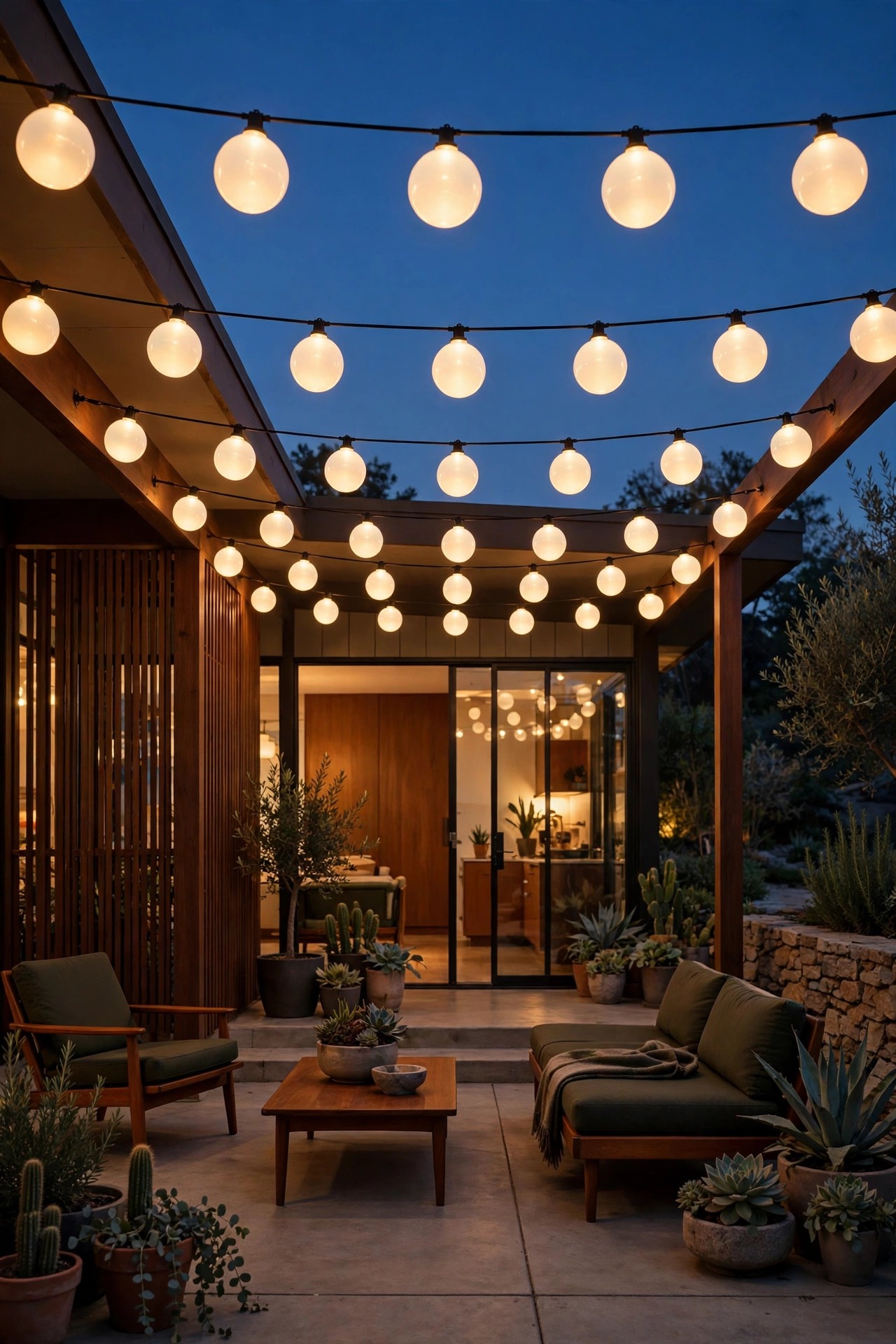
4. Flank the Back Door With Atomic Starburst Sconces
The door your guests actually use deserves the same starburst language as the pendant, scaled down. I mount a matched pair of atomic-style sconces — small sunburst backplates with a single globe or cone shade — on either side of the slider or back door, centered about 66 inches above the patio surface. Matched pairs matter in this style: mid-century design loves symmetry and repetition, and one lonesome sconce reads as an afterthought. Choose wet-location-rated fixtures, aim any adjustable heads slightly downward so light washes the step and handle zone instead of blinding people, and wire the pair to the same switch and dimmer. A globe sconce throws soft, flattering light that suits faces and food; a cone shade throws a focused pool that suits steps and grill paths, so I often pair globe sconces at the door with cone fixtures at the side gate. Keep the finish identical to your pendant arms — brass with brass, black with black — because mixed metals undo the tailored look faster than any other mistake. In my experience this is the highest-value upgrade for ranch homes where the back door is plain drywall-flat: two sculptural sconces instantly give it architecture.
Suggested budget range: $90 – $260.
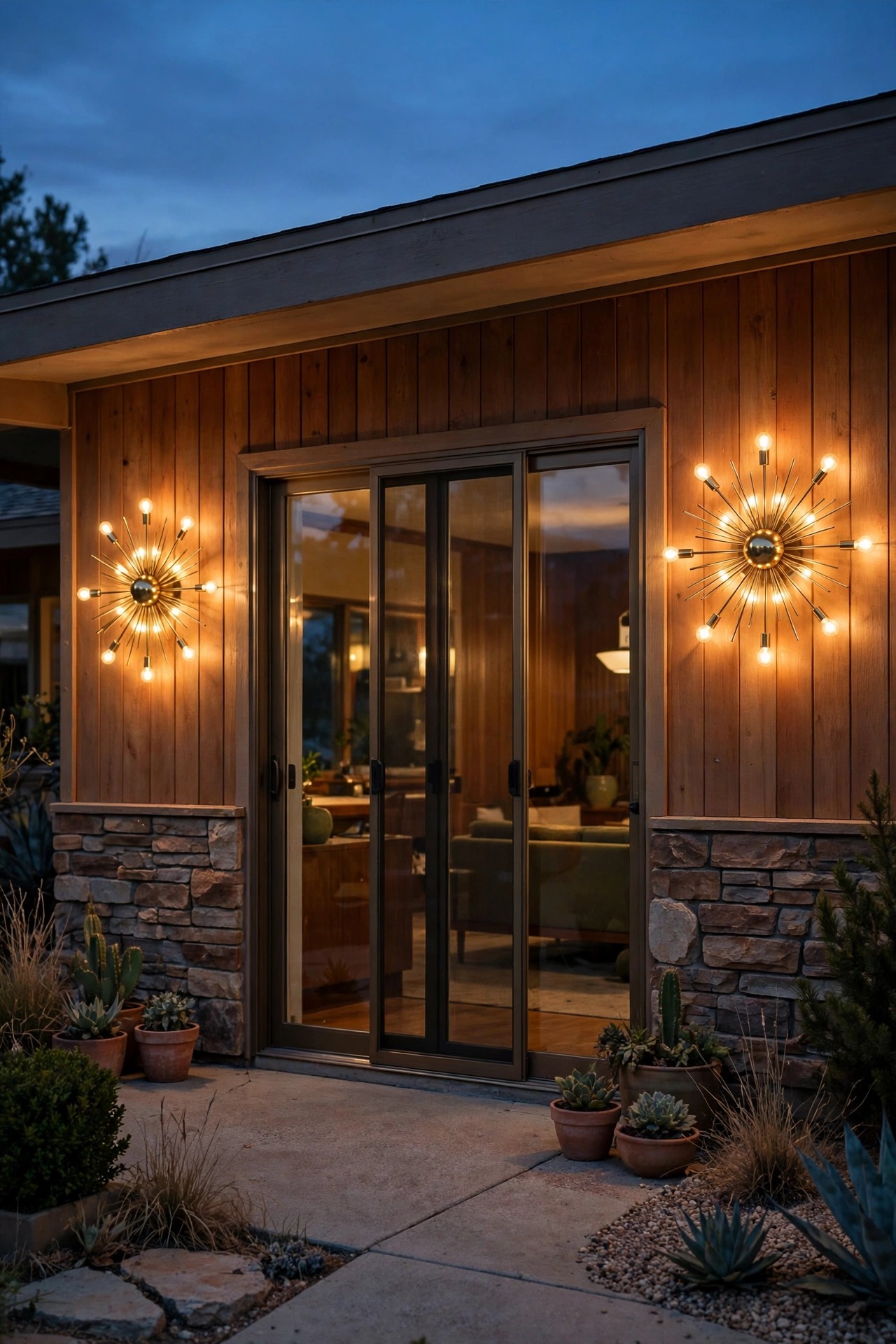
5. Stand an Outdoor Tripod Floor Lamp in the Lounge Corner
Every mid-century living room had a tripod lamp, and the patio lounge corner deserves one too. Outdoor-rated tripod floor lamps with drum or cone shades have become easy to find, and they do a job string lights cannot: they bring warm light down to book-and-conversation height, around seated eye level, which makes faces look good and the corner feel like a room. I park mine beside a lounge chair or at the end of an outdoor sofa, shade bottom roughly 40 inches off the ground, cord run flat along the wall and covered so nobody trips in the dark. Battery and solar versions exist, but I prefer plug-in models on the patio timer circuit for consistent brightness; if you go cordless, pick one with at least 400 lumens and a warm 2700K bulb so it does not read as a camping lantern. Keep the fixture under cover or bring it in during storms, because even outdoor-rated shades dislike driving rain. Paired with a low side table and a textured outdoor rug, one good tripod lamp turns a leftover corner into the seat everyone argues over.
Suggested budget range: $80 – $240.
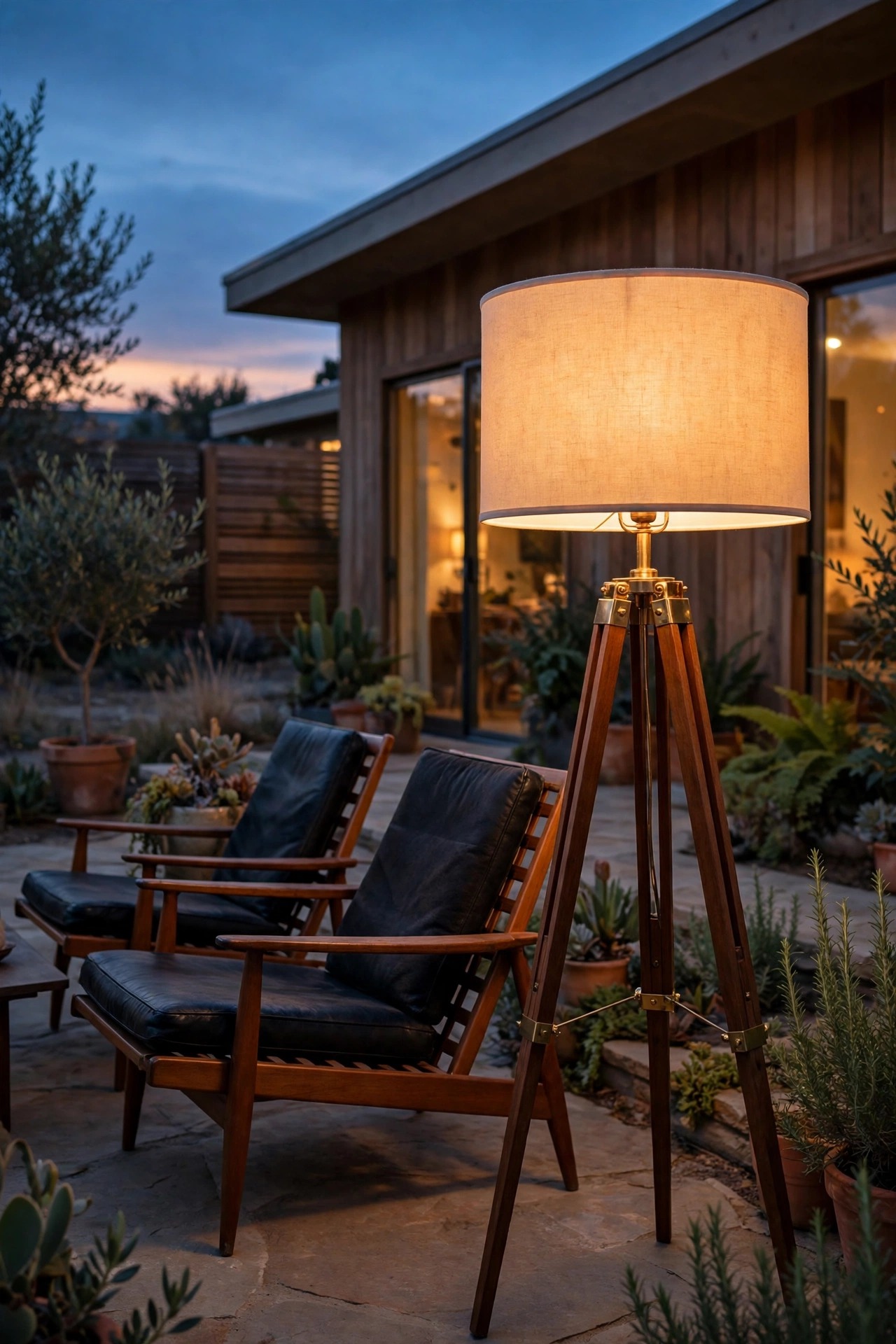
6. Graze the Walls With Retro Cone Uplights
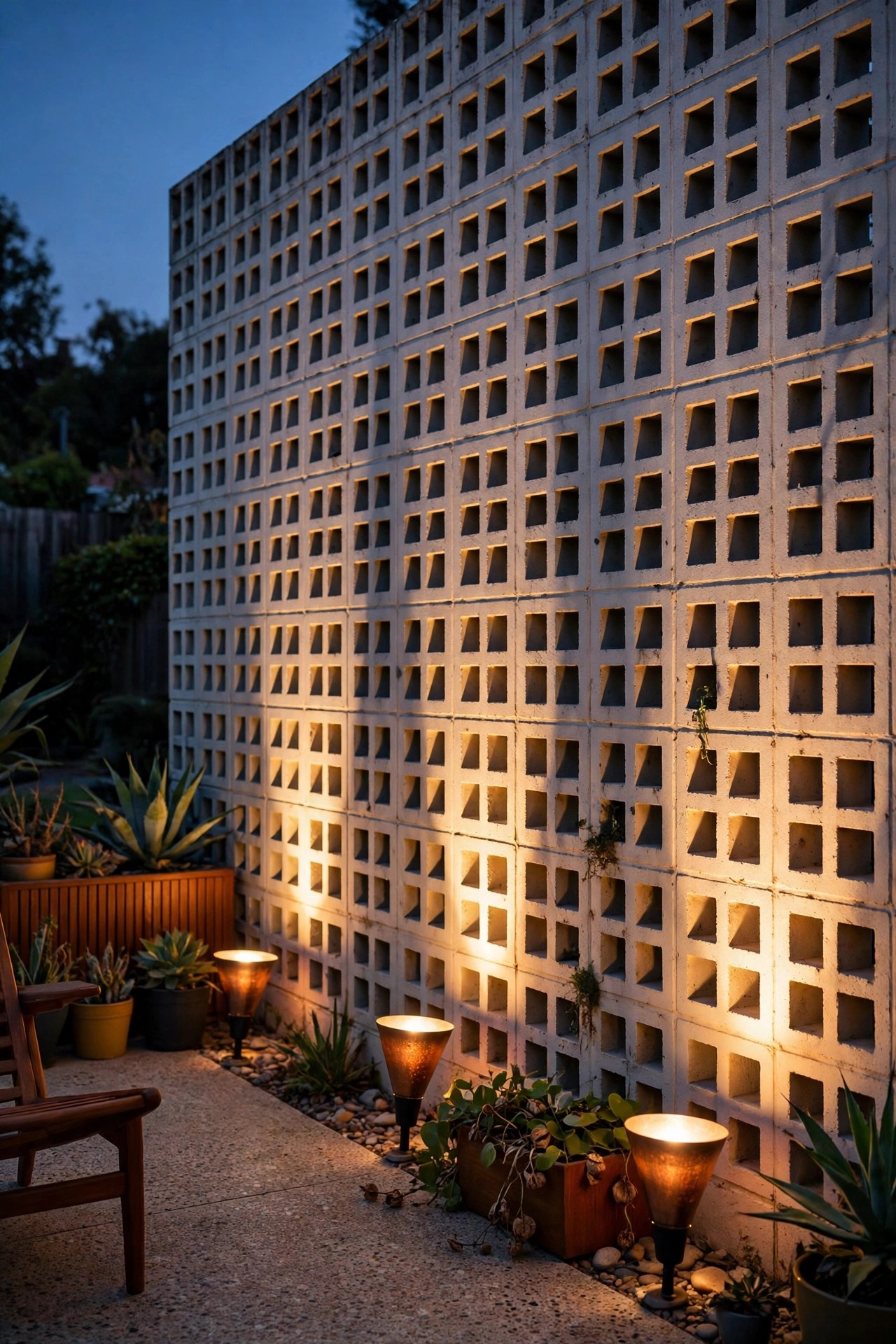
Mid-century homes are full of flat, interesting walls — stucco, board-formed concrete, breeze block — and grazing them with light is how you make a plain patio feel architectural. I set small cone or eyeball uplights 6 to 12 inches out from the wall base and aim them almost straight up, so the beam rakes across the texture and throws long, dramatic shadows from every bump and groove. Breeze-block and stacked-stone walls look spectacular this way; even flat stucco gains a soft gradient that makes the house feel taller. Use fixtures with a narrow 15 to 30 degree beam for true grazing, keep them at 2700K, and space them 4 to 6 feet apart for an even wash or tighter for rhythmic scallops. Well-style fixtures that sit flush in the planting bed stay invisible by day, which suits the uncluttered mid-century look. Watch the windows: aim so beams pass beside glass rather than into it, or your indoor rooms get the light show instead. This is pure accent layer, so it can be subtle — honestly, three well-placed uplights change a patio more than ten random stake lights ever will.
Suggested budget range: $70 – $210.
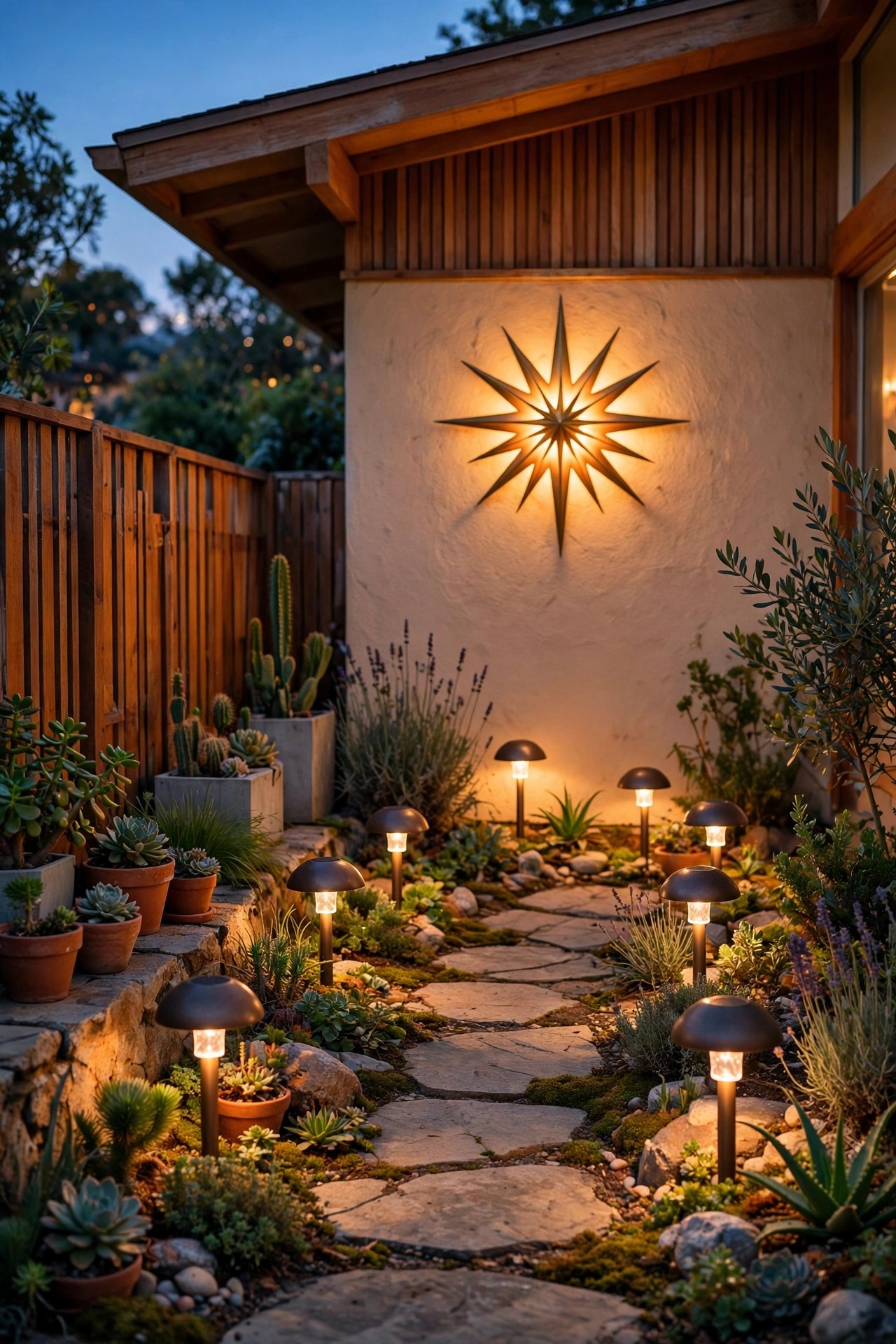
7. Edge the Patio With Mushroom and Saucer Path Lights
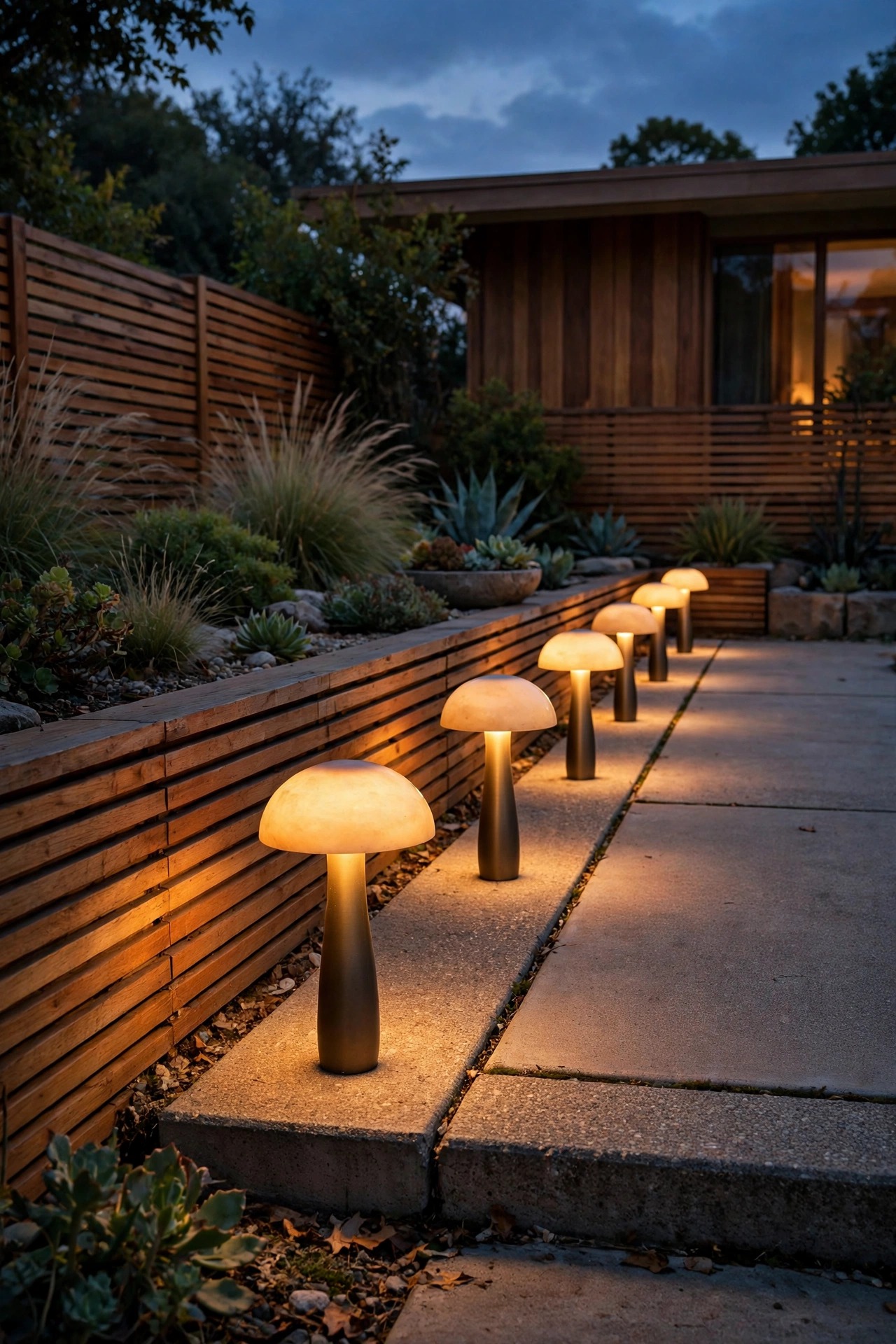
The mushroom path light is a mid-century garden icon — a low stem with a wide flying-saucer cap that throws a perfect circle of light downward and never glares. I line the patio edge and the first stretch of path with them, spaced 5 to 7 feet apart in straight rows, because in this style the repetition is the decoration. Keep caps around 12 to 18 inches high so the light pools on the paving where feet land, and alternate sides only if your path curves; straight mid-century geometry looks best in honest rows. Low-voltage versions wire into the same transformer as your uplights, and the downward throw means almost zero light pollution for neighbors. The wide cap also shields the bulb from rain, which stretches bulb life noticeably. One caution from experience: cheap thin-metal versions dent the first time a mower bumps them, so choose cast aluminum or heavy steel and set each stem perfectly plumb with a small level — a row of leaning saucers looks drunk, not retro. Against gravel or decomposed granite, which so many mid-century yards use, the little circles of light read like a landing strip for very stylish guests.
Suggested budget range: $90 – $280.
8. Mount Downlights Under Pergola Beams for a Clean Ceiling of Light
A pergola or deep eave is a gift: it gives you a ceiling, and ceilings want downlights. I mount small recessed or surface puck downlights under the beams, one every 4 to 5 feet, aimed straight down so pools of light land on the dining or lounge zone without a single visible bulb from a seated position. This is the task layer that makes board games, grilling, and reading labels easy, and on a dimmer it softens into ambient light after dinner. Choose fixtures with a slim profile and matte finish so they disappear against the beam by day — big cans break the clean mid-century line. If your pergola has open rafters, small black cylinder pendants hung at even heights give the same effect with a little more atomic flair. My full walkthrough of pergola dining lighting ideas covers beam spacing and bulb choices in more depth. Wire these on their own switch, separate from the string lights, so you can run mood and function independently. Of everything in this post, beam downlights are the idea guests least notice and most benefit from — which is exactly how good lighting should feel.
Suggested budget range: $120 – $360.

9. Bring Back the Tiki Torch, the Flameless LED Way
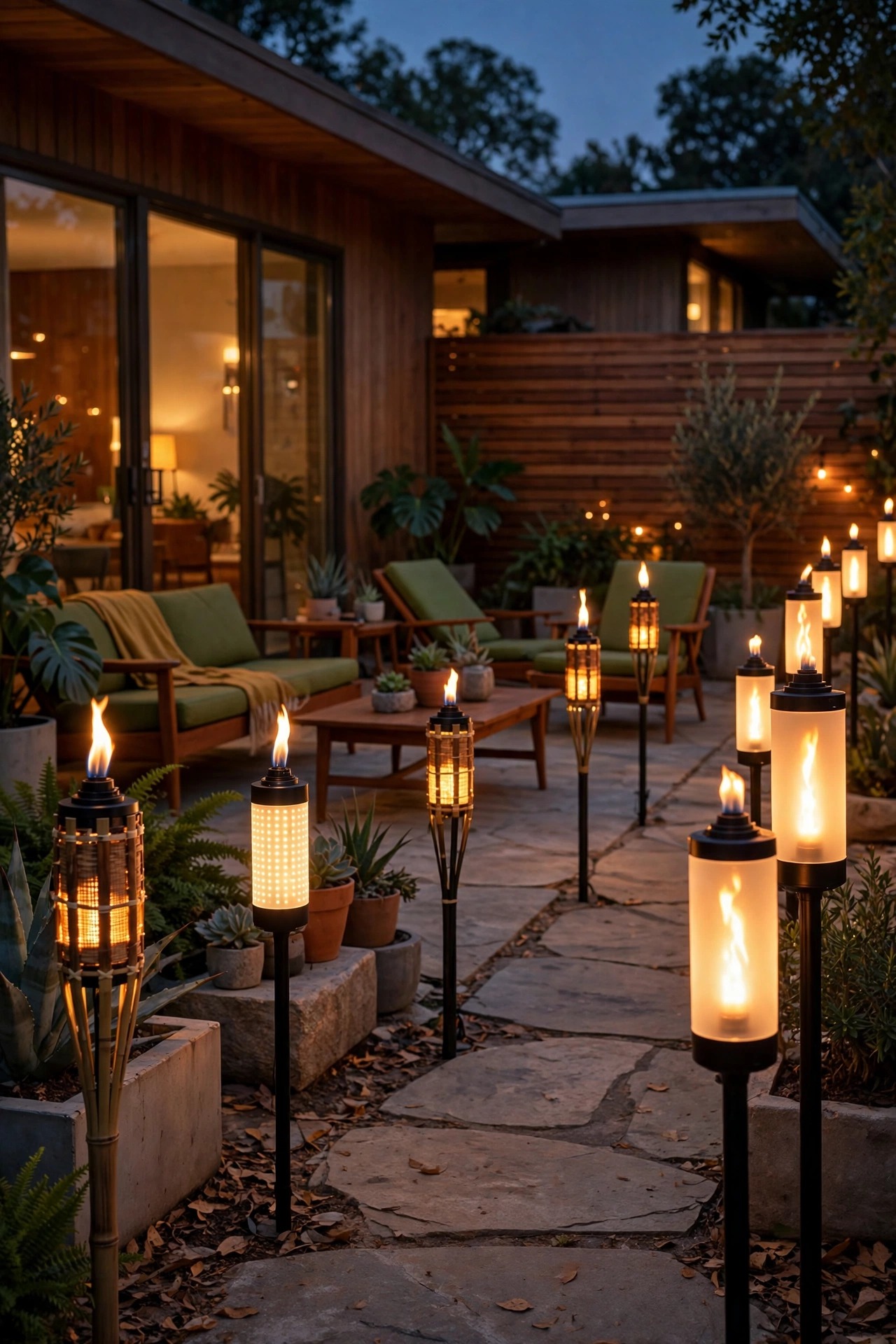
Nothing says atomic-age backyard like a tiki torch — the 1960s patio practically required them. I still use the silhouette, but I have retired the open flame for good: LED flame-effect torches give you the same flickering amber dance with zero fire risk near cushions, dry mulch, and low eaves. Modern versions come as stake torches for beds, tabletop models, and even wall-mounted sconce torches, all solar or rechargeable. I group them where I want movement in the light scheme — flanking the lounge corner, marching down a fence line, or ringing the fire pit zone — because flicker reads as an accent, never as your main light source. Keep the look disciplined: bamboo-look or black metal stakes, all the same height, flames set to the same warm tone. Solar models need a genuinely sunny day spot to charge, so in shaded yards I choose the rechargeable ones and rotate them through a charging spot by the door. The honest truth is that real flame also means fuel smells, soot, and one gust of wind away from trouble; the LED versions let the torches burn all evening, every evening, for pennies.
Suggested budget range: $40 – $150.
10. Scatter Ground Globes for That Moon-Landing Glow
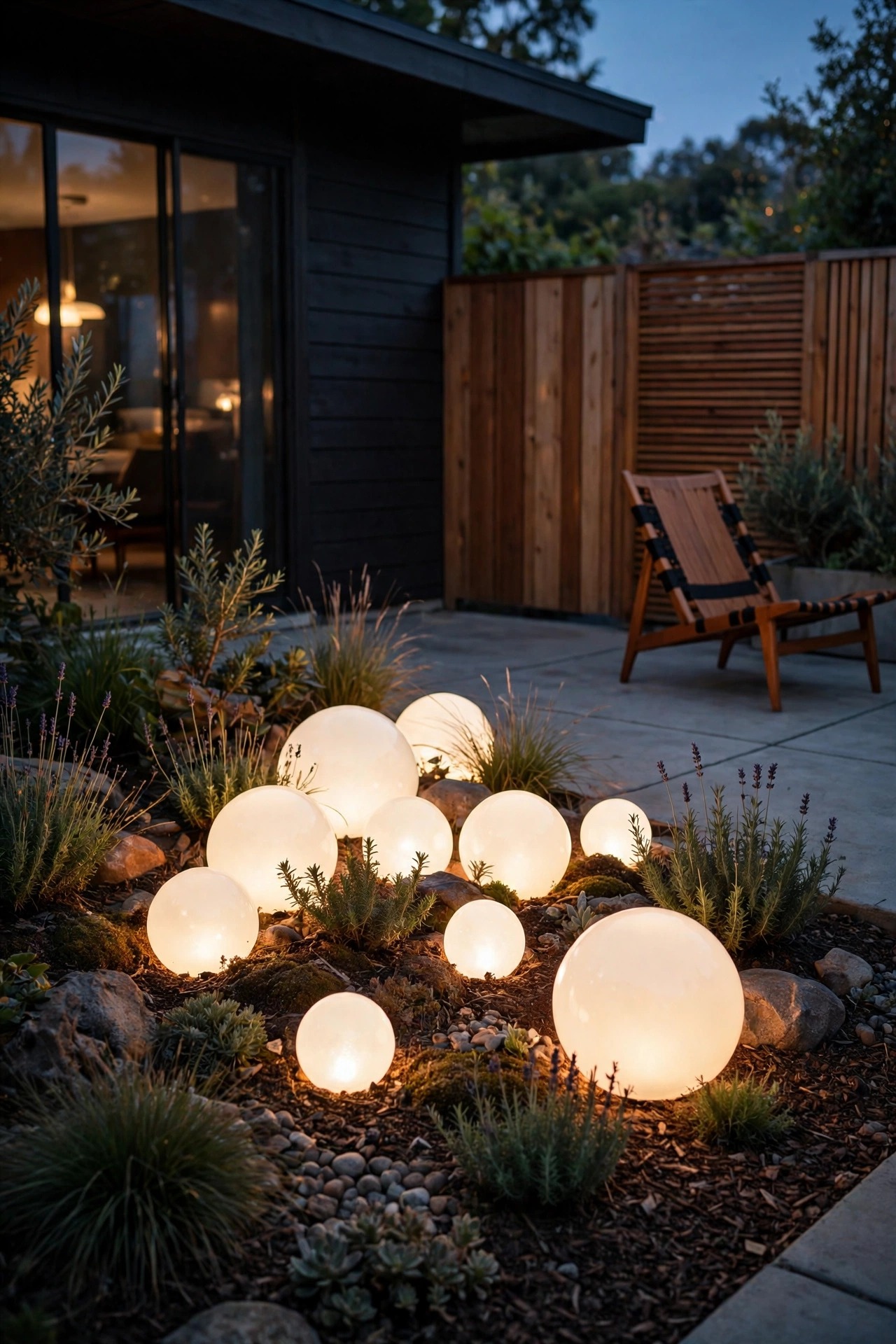
Here is the playful one: smooth glowing orbs resting right on the ground, like little moons that landed in the planting beds. Globe orb lights were made for this style — mid-century design adored the sphere — and they give a patio a soft, sculptural glow that no stake light can copy. I cluster them in odd numbers, three by the lounge steps and five along a bed, mixing 8, 12, and 16 inch diameters so the group feels collected rather than matched. Solar orbs are the easiest, but the better rechargeable versions hold a steadier brightness and one warm tone all night; whatever you choose, insist on 2700K, because the cool white orbs sold for gardens read like pool toys. Set orbs on a small ring of gravel so they sit level and rain drains away instead of pooling underneath. They are accent only — too dim to light a step safely — so pair them with the mushroom lights from idea 7 for honest wayfinding. Kids adore them, dogs ignore them, and photographers love them. In my experience, a cluster of orbs at the far end of the patio pulls the whole room together by giving the eye somewhere warm to land.
Suggested budget range: $50 – $190.
11. Use String Light Poles Where There Is Nothing to Hang From
Plenty of mid-century patios are wide, flat, and gloriously roofless — which leaves the string lights of idea 3 with nothing to hold onto. The fix is dedicated string light poles: slim black steel poles, 9 to 10 feet tall, set in weighted planters or ground sleeves at the patio corners. I like the planter version for this style, because a low rectangular planter with a sculptural agave or snake plant doubles as mid-century decor while it anchors the pole. Space poles no more than 12 to 15 feet apart so strands stay taut and geometric, and always hang the strand from the pole hardware rather than wrapping it, so wind can move without sawing through the cord. My guide to patio string light pole ideas compares base styles and heights if you want the deep dive. Sink ground-sleeve poles at least 18 inches deep in compacted soil or concrete for anything above 9 feet. Done well, the poles read as part of the architecture — four slim black lines framing the patio — instead of party supplies you forgot to take down.
Suggested budget range: $70 – $220.
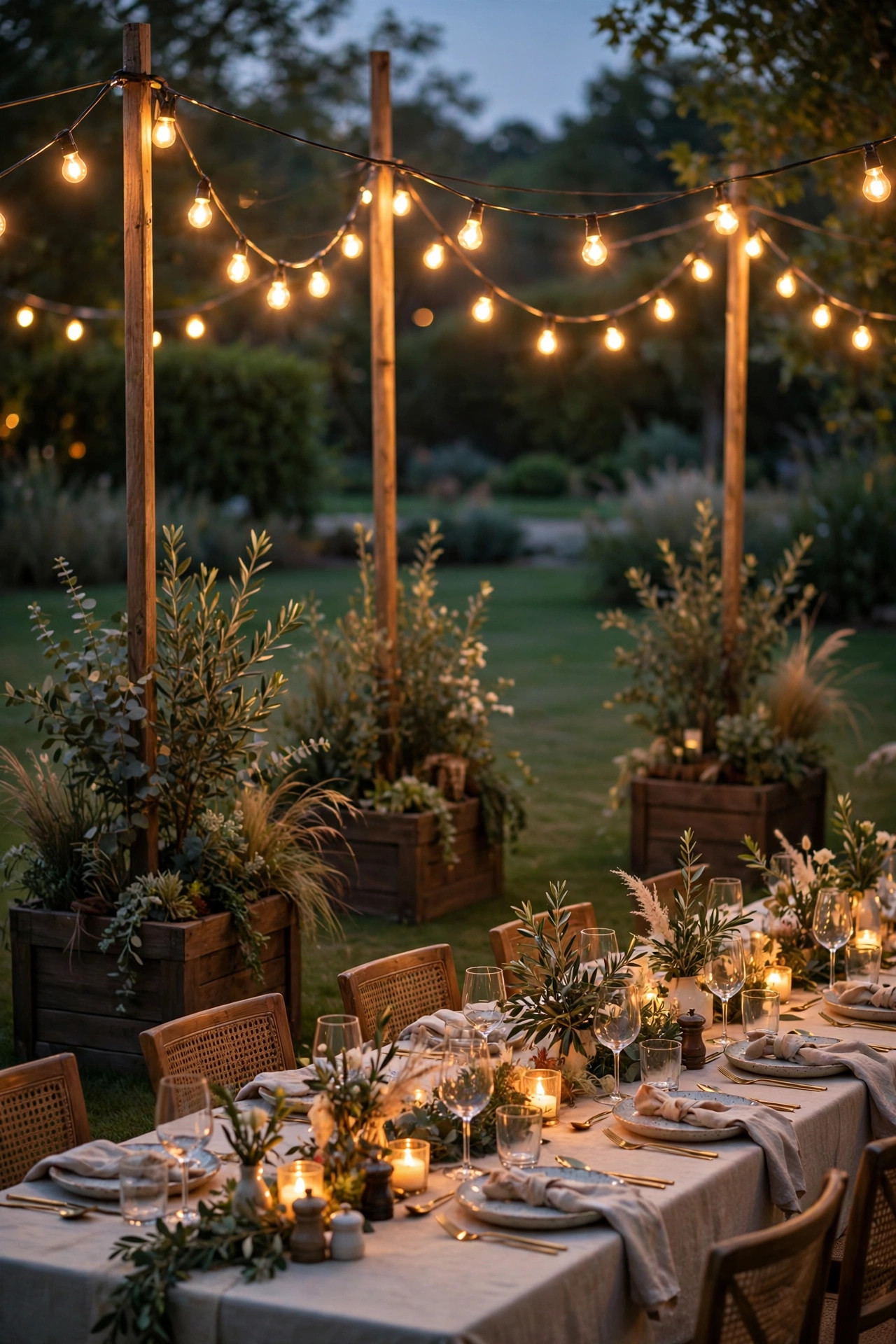
12. Hold Every Mid-Century Modern Patio Lighting Ideas Bulb to One Warm Temperature
This is the discipline idea, and it is the one that separates a designed patio from a decorated one. Mid-century evenings were lit by incandescent bulbs, which means every source glowed the same warm amber. I hold my whole patio to 2700K — string lights, pendant, sconces, path lights, all of it — and I check the Kelvin number on every box before it goes in the cart. One 4000K bulb in a sea of warm light looks like a mistake you can see from the street, and mismatched bulbs are the number one reason DIY patios feel subtly wrong. When you shop solar fixtures, this rule matters most, because bargain solar lights skew blue-white; spend a little more for warm-white models and test one before buying a dozen. Dimming helps too: most LED bulbs look warmer as they dim, so a dimmed 2700K pendant lands right in that candlelit zone for late evenings. If a room needs a slightly brighter task moment, raise the lumens, never the temperature. Honestly, if you follow only one idea in this post, make it this one — color discipline is free, and it makes even bargain fixtures look intentional and expensive.
Suggested budget range: $0 – $60.
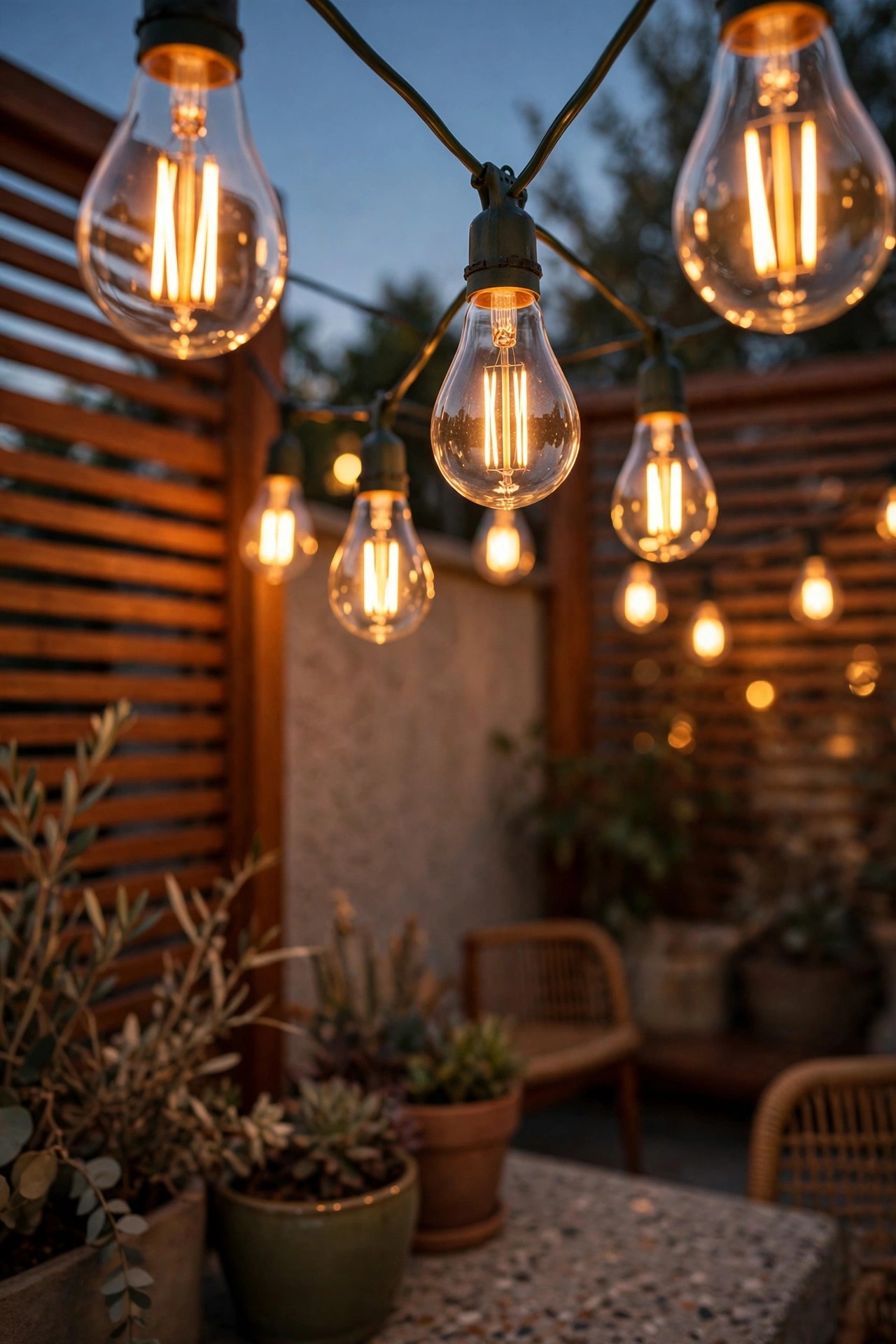
13. Anchor the Fire Pit With Low Wedge Bollards
A fire feature is the natural hearth of the atomic-age patio, but the walk to it crosses the darkest part of the yard. I ring the approach — not the fire pit itself — with two or three low wedge or L-shaped bollards, those angular little fixtures that look like folded metal tents. Their shape throws light down and out in a clean fan, so you see the paving edge and the step without any glare competing with the flames. Keep them 18 to 24 inches tall at most, place them 6 to 8 feet apart along the route, and give the nearest one at least 3 feet of clearance from the fire bowl edge for heat and spark safety. On the fire pit side I add nothing at all: darkness behind the flames is what makes them look bright. If your fire feature is a tabletop fire bowl on the dining table, one bollard at the patio step does the whole job. This is a small idea with an outsized effect, because guests move confidently instead of shuffling — and confident movement is what makes a party feel relaxed instead of careful.
Suggested budget range: $60 – $200.
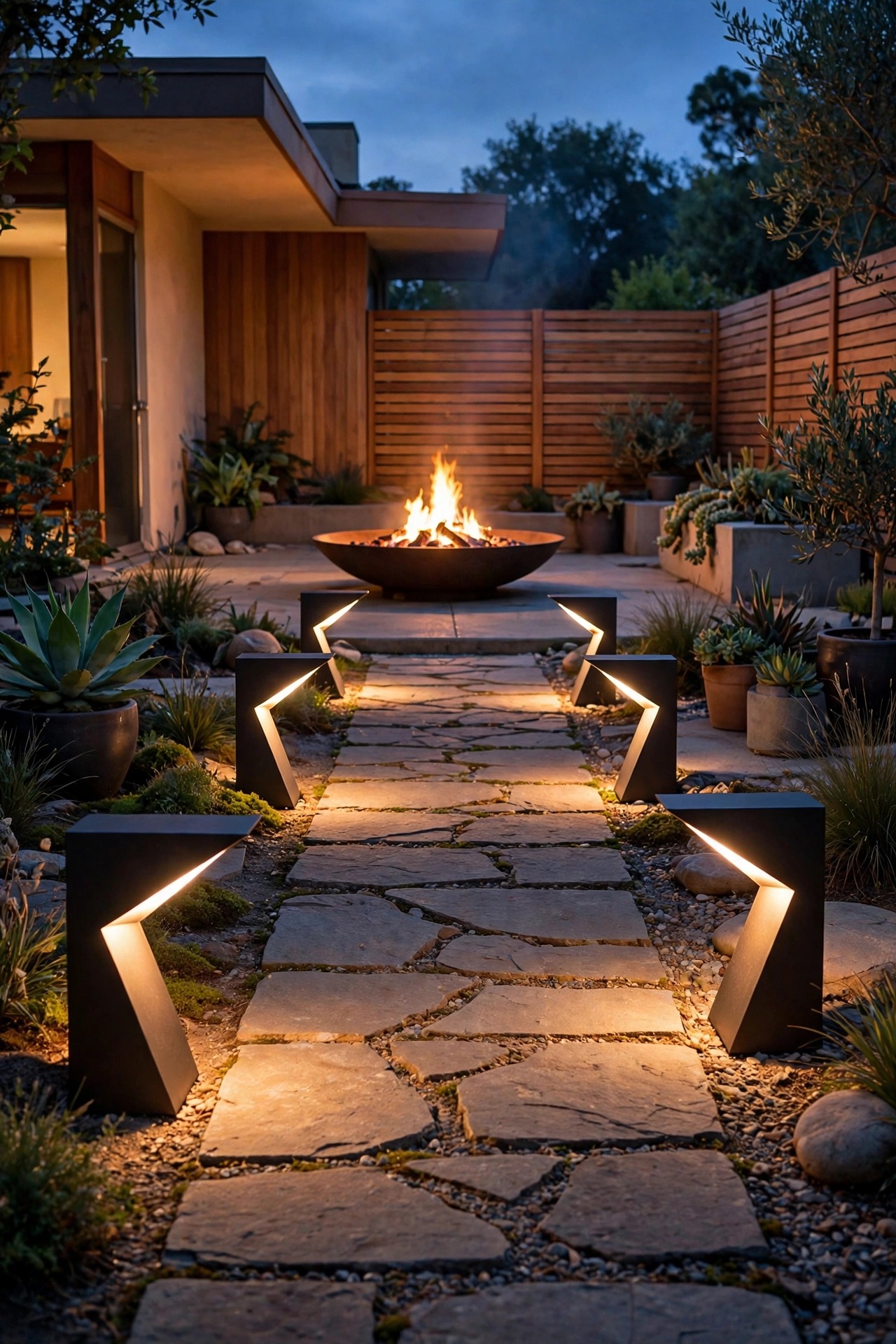
14. Hide LED Strips Under Built-In Benches and Planters
Mid-century patios love built-in furniture — the long concrete bench, the raised planter that doubles as a room divider. A hidden LED strip under the lip of either one floats it off the ground in a ribbon of light, and it might be the most modern-looking trick in this whole retro list. I use outdoor-rated, fully sealed strip in 2700K, mounted in an aluminum channel with a frosted diffuser so you see a smooth line instead of individual dots, and I aim the channel downward for a gentle wash on the paving. The glow outlines the patio architecture after dark, doubles as sneaky-good step and edge lighting, and uses so little power it can share the low-voltage transformer with the path lights. Keep the power supply in a dry, ventilated spot and every connection inside waterproof junction boxes — strips themselves shrug off rain, but sloppy connections are where these installs fail. This is a weekend project once the bench exists: measure twice, cut the strip only on its marked lines, and test before you commit the adhesive. The floating-bench effect photographs beautifully and makes a small patio feel twice its size.
Suggested budget range: $55 – $180.
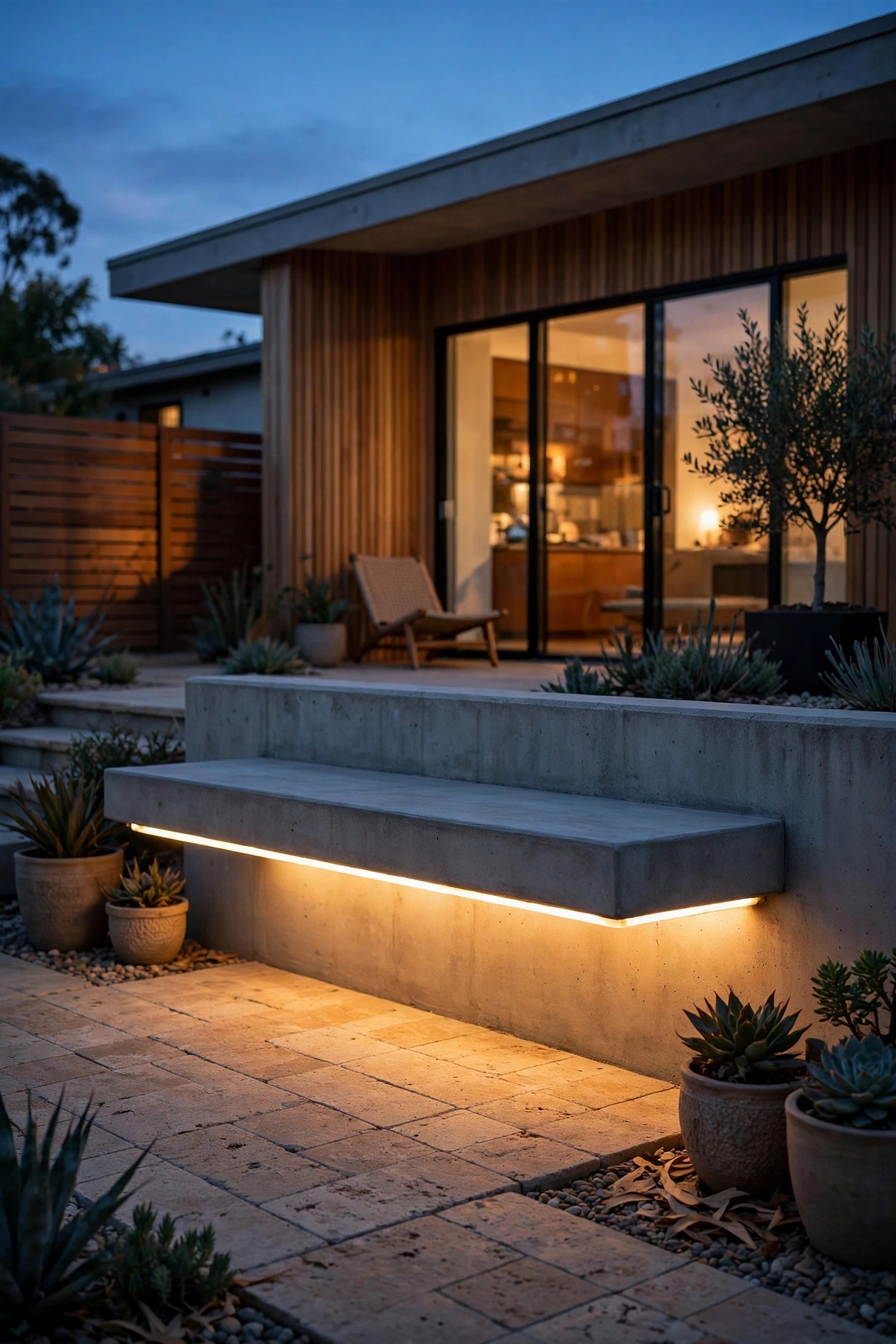
15. Go No-Wire With Solar Fixtures in Retro Shapes
Renters and wiring-shy homeowners, this one is yours. Solar fixtures have finally caught up with the style: you can now find solar mushroom path lights, globe stakes, and starburst wall plaques that look genuinely mid-century instead of garden-center generic. The rules are the same as any solar — panels need six or more hours of direct sun, so map your shade honestly before you buy — plus my usual insistence on warm white, 2700K output. Solar works best as the accent and path layers: a row of solar saucers down the steps, globes in the sunny bed, a starburst plaque by the gate. I still hardwire or plug in the pendant and downlights, because dinner-table light should never depend on the weather. Expect solar brightness to fade a little across a long winter evening, and plan a five-minute panel wipe into your monthly routine, since dusty panels are the top cause of dim solar lights. Swapping tired rechargeable batteries every couple of years restores most fixtures to full glow. Used in the right layer, solar keeps the no-wire parts of the patio flexible — rearrange freely as the furniture moves, which, in my house, is often.
Suggested budget range: $45 – $170.
16. Put Everything on Timers and Dimmers
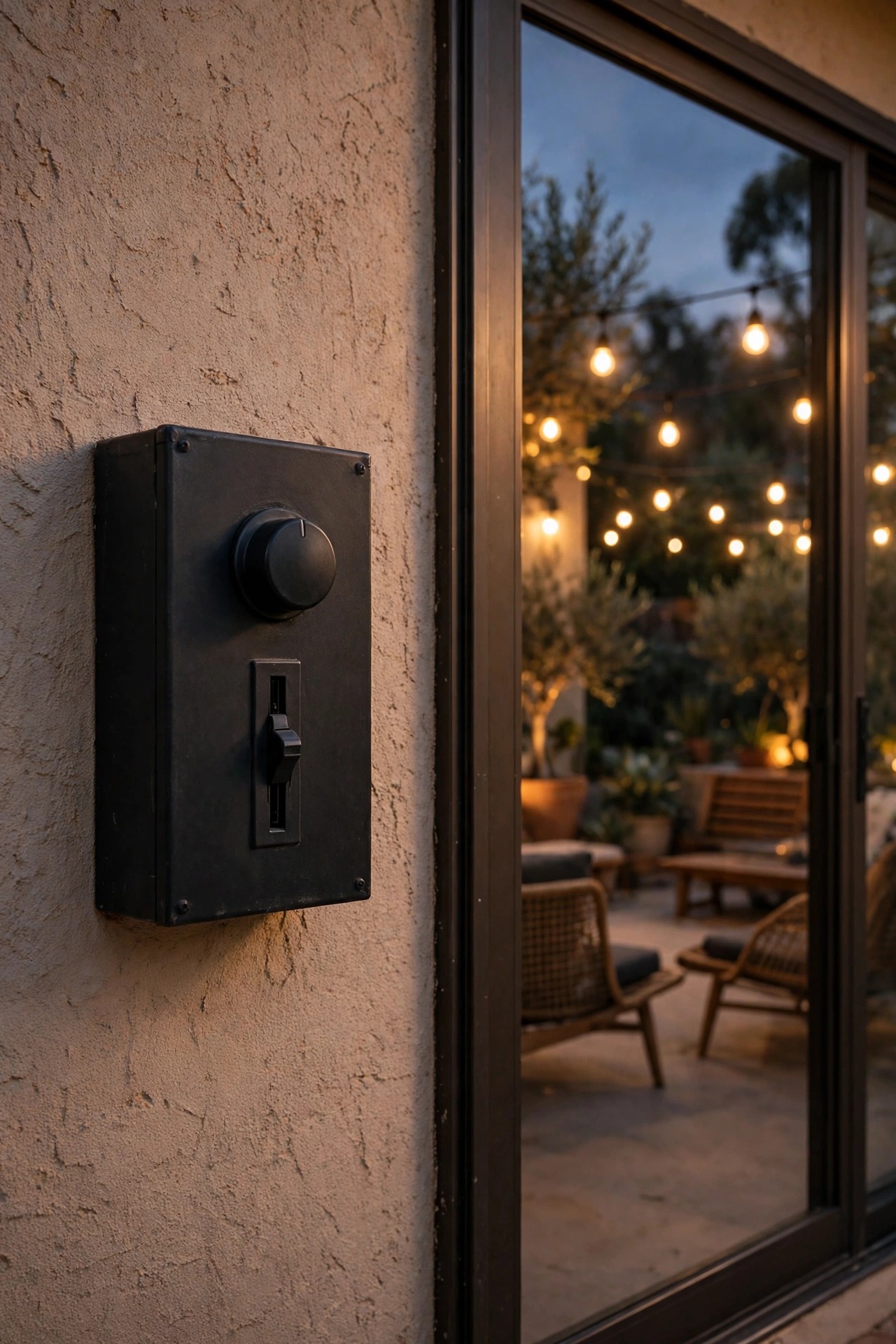
The atomic age loved automation — the timer dial was practically a household member — and your patio should run itself the same way. I put the transformer and plug-in layers on a simple astronomical timer that tracks sunset, so lights arrive with dusk all year without reprogramming. Dimmers matter just as much: the pendant and sconces on dimmers let one patio serve dinner at seven and cocktails at ten with completely different moods. Keep it simple and robust — one timer for the ambient layer, dimmers where people gather, and motion sensors only at the side gate and steps where a surprise pool of light is a safety feature rather than a vibe killer. Smart plugs and app control are fine, but choose gear that still works from a physical switch, because guests should never need an app to find the bathroom. Label the switches inside the door while you are at it; future you, holding a tray of drinks, will be grateful. This behind-the-scenes idea is what makes all the others effortless — in my experience, the patios that glow every single night are the ones nobody has to remember to switch on.
Suggested budget range: $25 – $120.
17. Finish Your Mid-Century Modern Patio Lighting Ideas With the Dusk Walk-Through
The last idea is a ritual, and I never skip it. When everything is installed, wait for full dark, then walk the patio the way a guest would: in from the gate, across to the lounge, up the step, to the table. Carry your phone at arm height and look for the three classic failures — a bulb visible anywhere that stabs your eyes, a step or edge that disappears into shadow, and one fixture glowing a different color from the rest. Fix glare by re-aiming heads down a few degrees or swapping a clear globe for a frosted one. Fix dark spots by nudging a mushroom light a foot closer, not by adding brightness everywhere. Then sit in every chair for a full minute, because a patio is experienced sitting down, and check the view from the kitchen window too — that is the picture you will enjoy most nights. Take one photo; comparing it with next season is the easiest way to see what to improve. Done honestly, this walk-through turns a pile of good fixtures into a composed room, and it costs nothing but twenty quiet minutes at dusk.
Suggested budget range: $0 – $30.
Frequently Asked Questions
What color temperature is best for a mid-century modern patio?
Warm white at 2700K, everywhere. Incandescent bulbs lit the original era, so one consistent warm temperature is what makes modern LED fixtures read as authentically retro instead of mismatched. If a space needs more light, raise the lumens rather than the Kelvin number, and check the box on every bulb and solar fixture before buying — solar gear in particular often defaults to a blue-white 4000K or higher that will clash with everything else.
Can I mix solar and wired lights in the same patio?
Yes, and I recommend it. Use wired or plug-in power for the layers you depend on — the pendant over the table and any downlights — and let solar handle path edges, bed accents, and globes where running cable is awkward. The trick is matching color temperature across both, so test one solar fixture against your wired lights at dusk before buying a full set.
Are globe string lights weatherproof enough to leave up all year?
Commercial-grade strands with sealed sockets and shatterproof LED globes handle year-round weather in most climates, and that is the grade worth buying for permanent runs. Take down lightweight residential strands before storms and for winter in snowy regions, and inspect cords each spring for cracked insulation. Hung taut on proper poles or cable guides, a good strand lasts for years.
How much does a mid-century patio lighting makeover cost in total?
A focused refresh — string lights, a sconce pair, and a row of path lights — lands around $300 to $700. A full layered scheme with a statement pendant, pergola downlights, uplights, and controls typically runs $900 to $2,200 in fixtures, plus an electrician for any new hardwired work. The layered plan means you can build it in stages across a season without redoing anything.
Conclusion
A great mid-century patio is not really about any single fixture — it is about warm light, laid in honest layers, following clean lines. Start with the plan, anchor the room with a starburst pendant and globe strings, keep every bulb at one warm 2700K, and let sculptural accents do the showing off. These mid-century modern patio lighting ideas reward patience: add a layer at a time, do the dusk walk-through after each one, and stop when the room feels composed. If you are still gathering inspiration, browse the rest of my outdoor lighting ideas here on the site — your atomic-age evenings are closer than you think.


