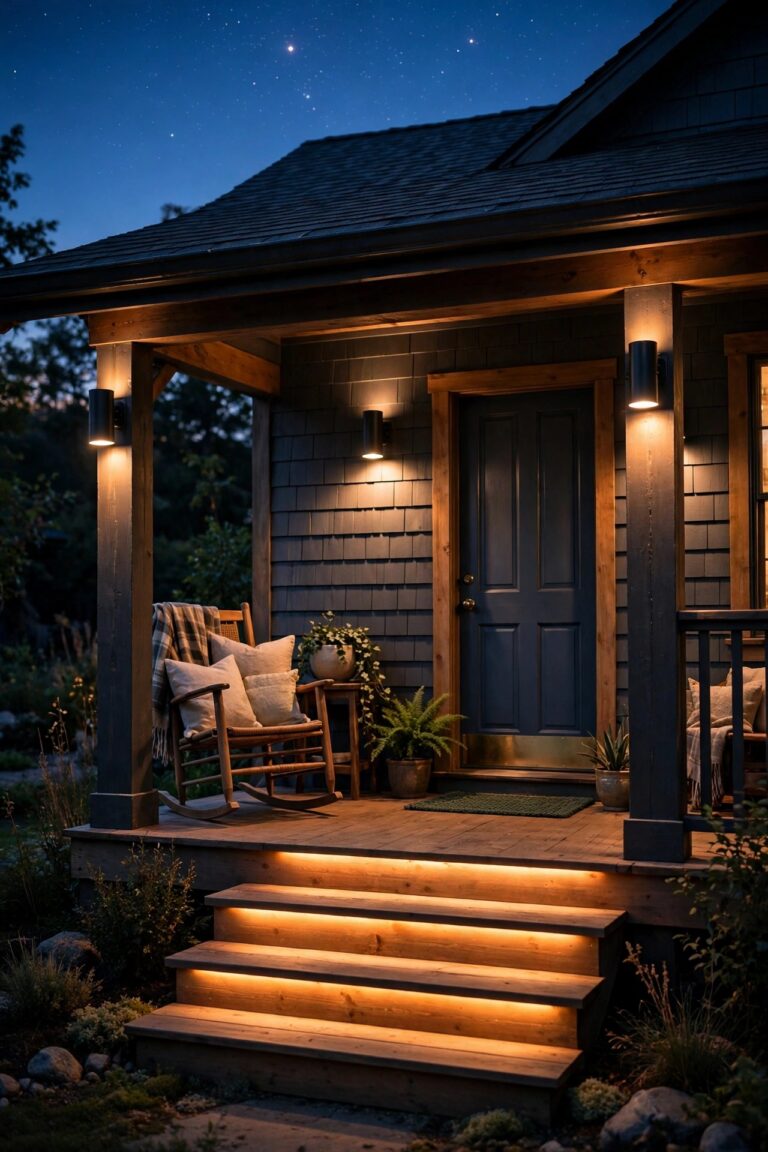
A mid-century porch has a look you can spot from the street: clean horizontal lines, a low roof, warm wood tones, and maybe a breeze-block wall or a pop of turquoise on the door. Lighting can either honor all of that or quietly fight it, and honestly, the wrong fixture is the fastest way to make a beautiful ranch entry feel dated in the wrong direction. The right mid-century modern porch lighting ideas lean on the shapes the era loved — starbursts, globes, sputniks, tapered cones — and pair them with the warm 2700K glow that modern LEDs now do perfectly. In this post I am sharing the 15 ideas I reach for on period homes and retro-inspired entries alike, all built on the layering method I use everywhere: a soft ambient base, clear task light at the door and steps, and sculptural accents that give the porch its after-dark personality. You will get mounting heights, spacing numbers, bulb temperatures, and a budget range for every idea, so you can shop with a plan instead of a guess.
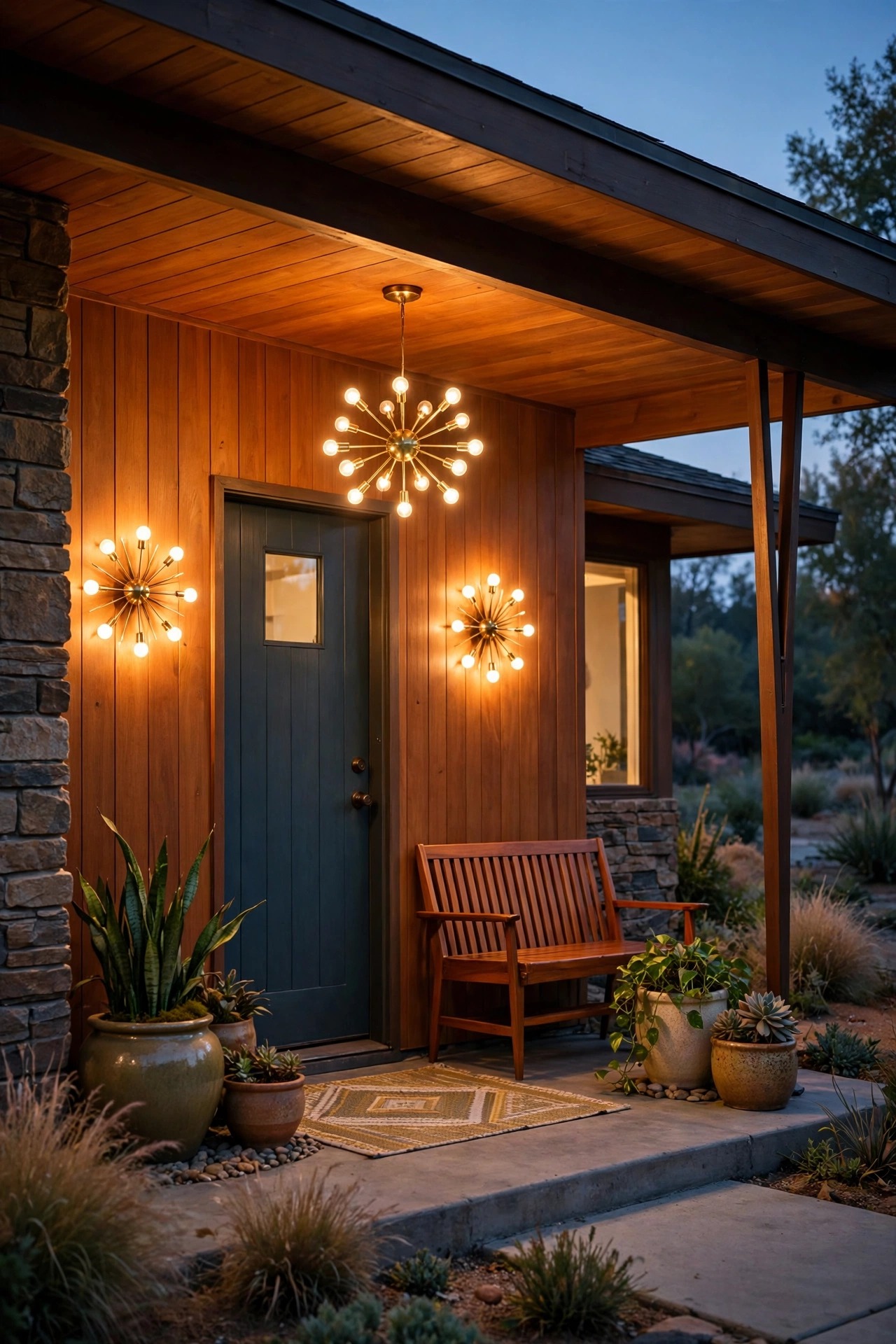
1. Start With a Layered Plan for Mid-Century Modern Porch Lighting Ideas
Every great retro entry I have lit started with a sketch, not a shopping cart. I draw the porch and mark three layers: ambient light for a soft overall glow, task light where hands and feet need it at the door, lock, and steps, and accent light for the sculptural pieces that carry the style. Mid-century homes give you wonderful bones to work with — long low rooflines, clerestory windows, stone or breeze-block accents — and the plan should show those off instead of flattening them. Note your outlet and transformer locations, and decide your finish palette now: matte black and brushed brass are the era's workhorses, with walnut or teak tones wherever wood shows up. I also measure the ceiling height and door width at this stage, because fixture scale is everything in this style. If you want to see layering applied across a whole retro exterior, my roundup of mid-century modern outdoor lighting walks through the full approach. Twenty minutes of measuring saves you from the classic mistake of buying a gorgeous pendant that hangs two inches too low over the door swing.
Suggested budget range: $0 – $40.
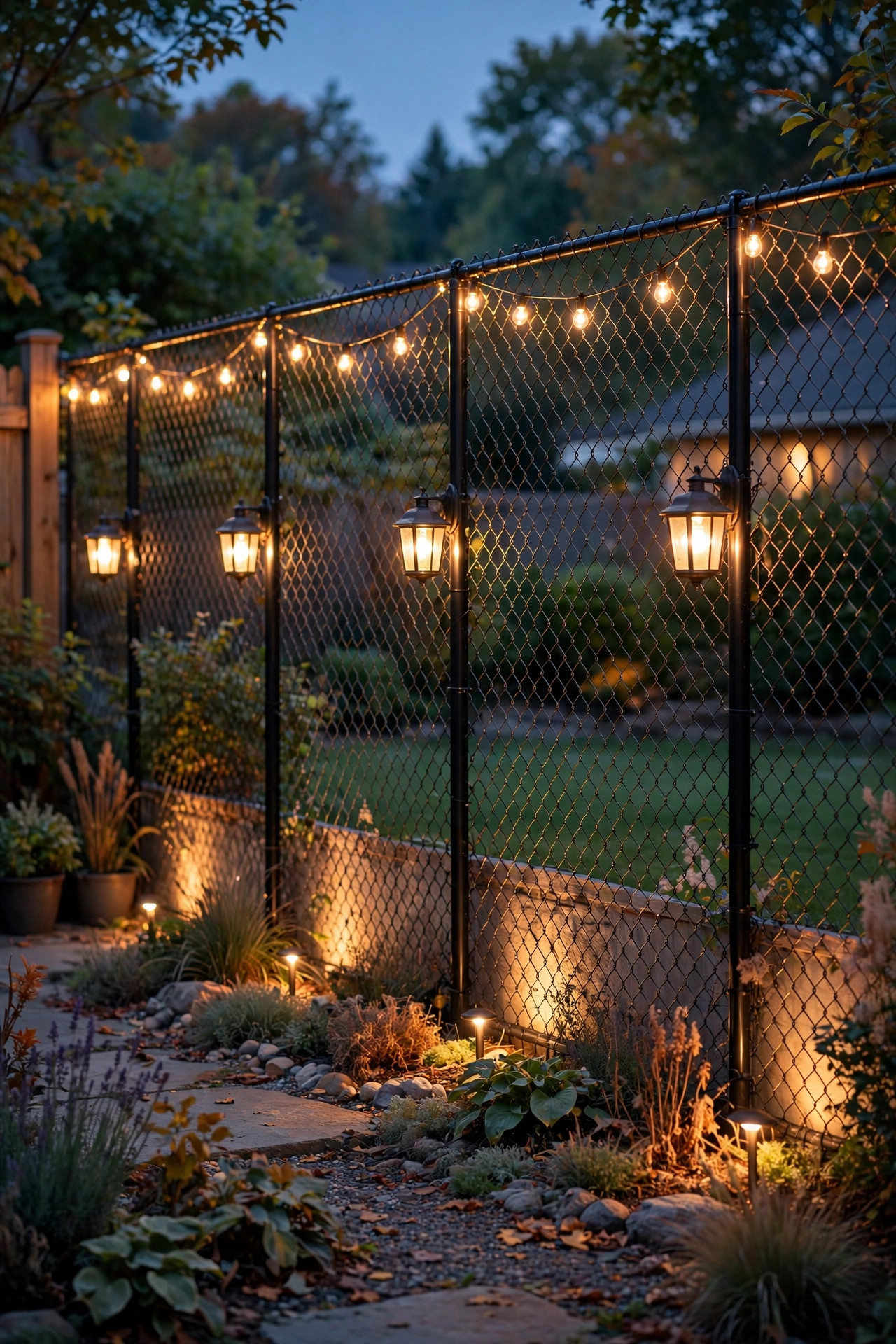
2. Hang a Sputnik Pendant Over the Entry
If one fixture says mid-century the moment it switches on, it is the sputnik — a central sphere with radiating rods tipped in small glowing globes or bare filament bulbs. Over a covered entry it does double duty: real ambient light for the whole porch and a piece of sculpture guests notice before they reach the doorbell. I hang mine so the lowest rod tips sit at least 7 feet above the porch floor, and I center it on the door rather than the porch as a whole when the door sits off to one side, which it often does on ranch plans. Choose a size in proportion — roughly 18 to 24 inches across for a standard entry, up to 30 inches for a wide double-door porch. A dimmer is non-negotiable for me here, because full brightness washes out the starburst effect while about 70 percent gives you that warm atomic-age glow. Use a damp-location rated fixture under any covered porch, and match the rod finish to your sconces so the set reads intentional.
Suggested budget range: $120 – $450.

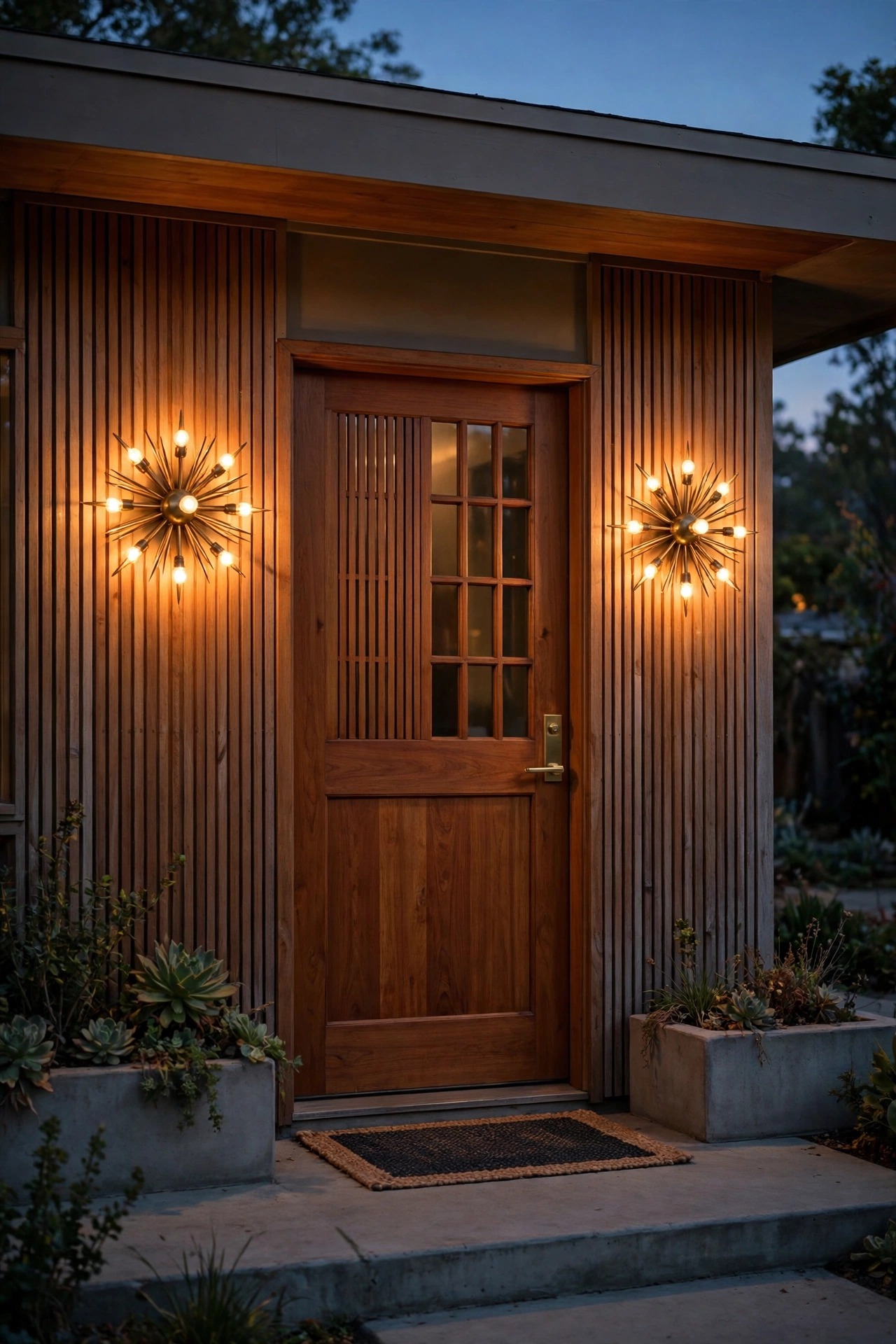
3. Flank the Front Door With Starburst Sconces
A starburst sconce — a medallion of radiating metal spikes with a bulb or small globe at the center — is the era's signature wall piece, and a matched pair flanking the front door is the single most recognizable mid-century entry move. I mount the pair with their centers about 60 to 66 inches above the porch floor, roughly eye level, and keep them at least 6 inches clear of the door casing so the spikes read cleanly against the wall. On a wide entry, a single oversized starburst on the hinge side balances an off-center door better than a forced pair. If you are still deciding between one fixture and two, my front door sconce pair guide lays out the spacing and sizing math in detail. Look for wet-location rated versions if your porch roof is shallow, and choose warm 2700K bulbs behind opal or clear glass — clear glass shows off the starburst shadow play, while opal softens glare for anyone standing at the door. In my experience this pair, more than any other fixture, is what makes neighbors ask what changed.
Suggested budget range: $90 – $320.
4. Choose an Opal Globe Pendant for a Softer Glow
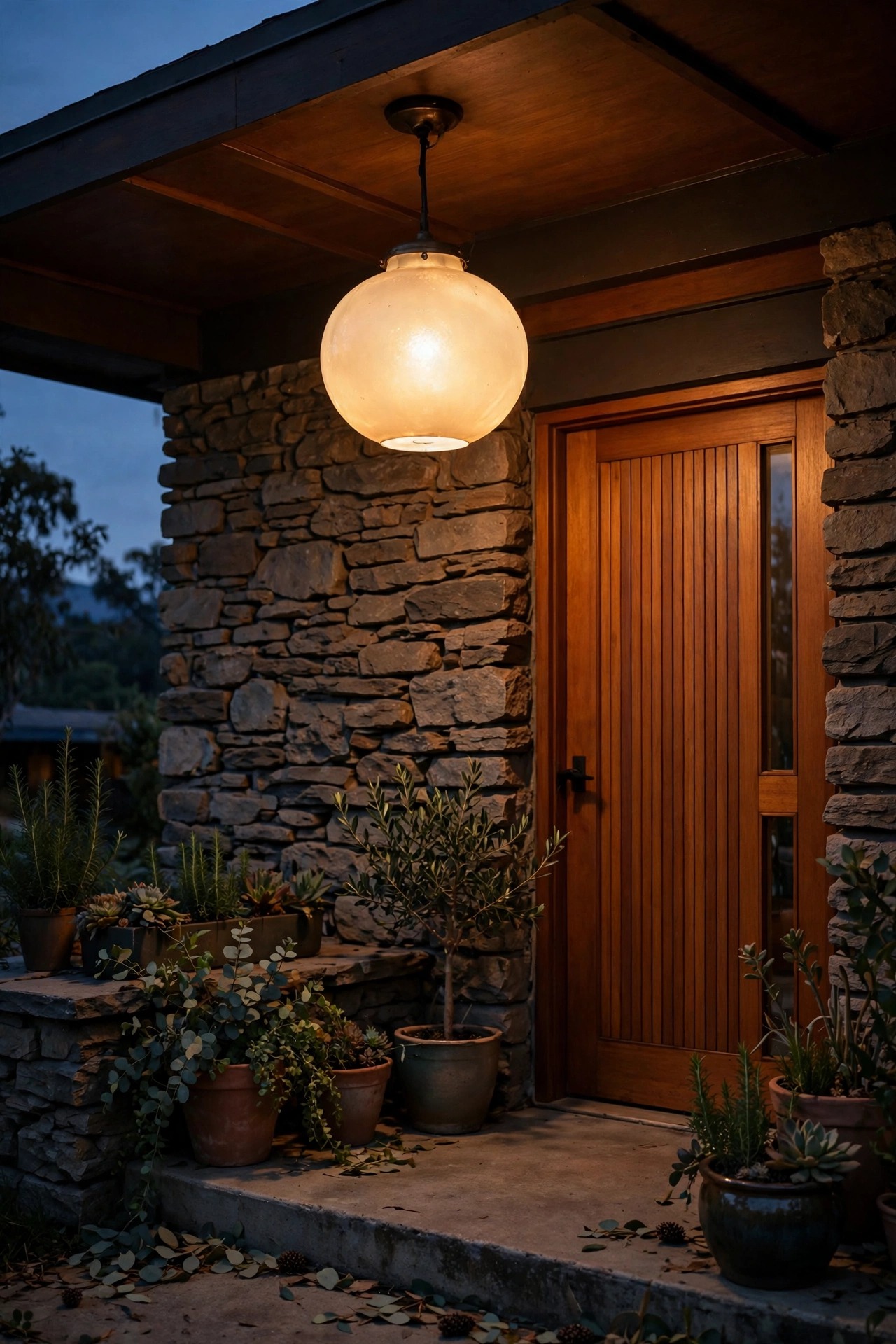
Not every mid-century porch wants the drama of a sputnik. A single opal glass globe on a slim rod or cord is the quieter icon of the era, and it throws the most flattering, shadow-soft light of any porch fixture I own. I use globes from 8 to 12 inches in diameter on a standard porch, centered over the entry landing, and I keep the bottom of the globe at 7 feet or higher. The opal glass hides the bulb completely, so you get an even moon-like glow that is kind to faces in photos and kind to eyes at midnight. Semi-flush mounts work beautifully where ceiling height is tight, and a short rod drop suits the tall ceilings on split-level entries. Because the glass diffuses everything, you can run a slightly brighter bulb — around 800 lumens — without harshness. Pair one globe with the starburst sconces from the idea above and the porch reads layered rather than busy. Just confirm the fixture is damp rated, since opal globes love to collect condensation on humid nights.
Suggested budget range: $80 – $260.
5. Wash the Wall With Cone-Shaped Up-Down Sconces
The tapered cone sconce that throws light both up and down is pure atomic-age geometry, and the twin beams it paints on the wall do something no other fixture does: they make a flat ranch facade look architectural after dark. I space a run of them 6 to 8 feet apart along the porch wall or the wall beside the entry, mounted with the fixture center near 66 inches, so the up-beam grazes the eave line and the down-beam pools on the floor. This is my favorite trick for long, low porches, where the repeated cones create a rhythm that pulls guests toward the door. Choose narrow-beam bulbs if you want dramatic stripes, or wider floods for a gentle wash. Matte black cones disappear against dark siding in the daytime, while brushed brass or copper versions become part of the decor. Because both beams are exposed, glare control matters — look for cones with deeply recessed bulbs or built-in louvers. On a GFCI-protected circuit with wet-location rated fixtures, a row of cones is one of the most reliable, low-maintenance looks in this entire style.
Suggested budget range: $70 – $280.

6. Line the Walk With Atomic-Age Path Lights
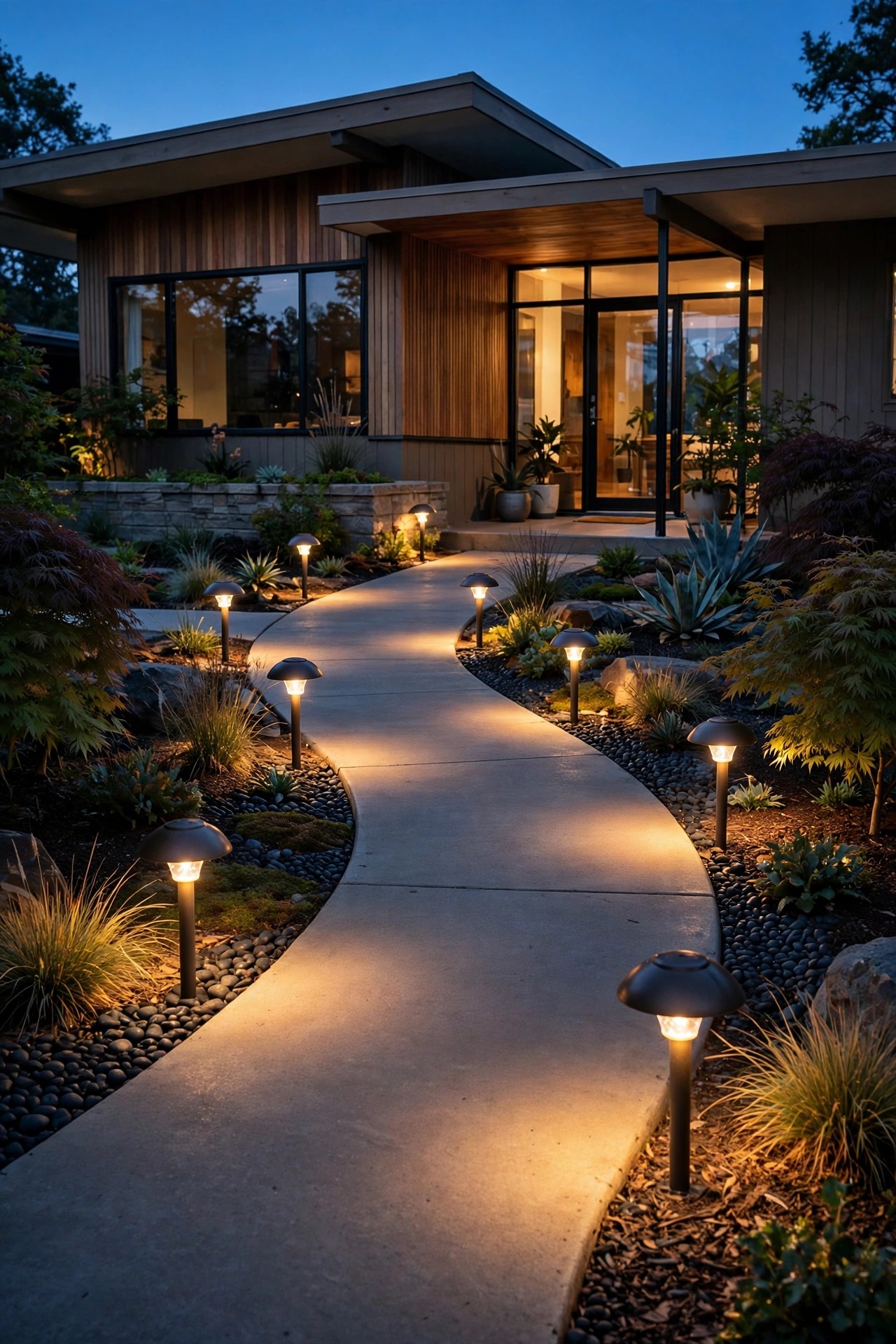
The path from driveway to porch is where mid-century style either carries through or falls apart, and the era gives you wonderful shapes to work with: mushroom caps, tilted saucers, and little starburst stakes. I run low-voltage path lights 6 to 8 feet apart, staggered on alternating sides of the walk rather than in two stiff rows, set back about 12 inches from the path edge so mower wheels and snow shovels pass safely. Aim for pools of light that just touch each other — around 100 to 200 lumens per fixture is plenty, and brighter only reads as an airport runway. Mushroom-style fixtures throw a tidy circle downward with zero glare, which makes them my default beside steps and landings. Keep the finish consistent with your porch fixtures so the whole entry reads as one composition. Bury cable at least 6 inches deep, or run it under the mulch line in beds. In my experience, lighting the walk is the change guests feel most, even if the sputnik gets all the compliments.
Suggested budget range: $60 – $220.
7. Fit a Flush-Mount Saucer Light on a Low Porch Ceiling
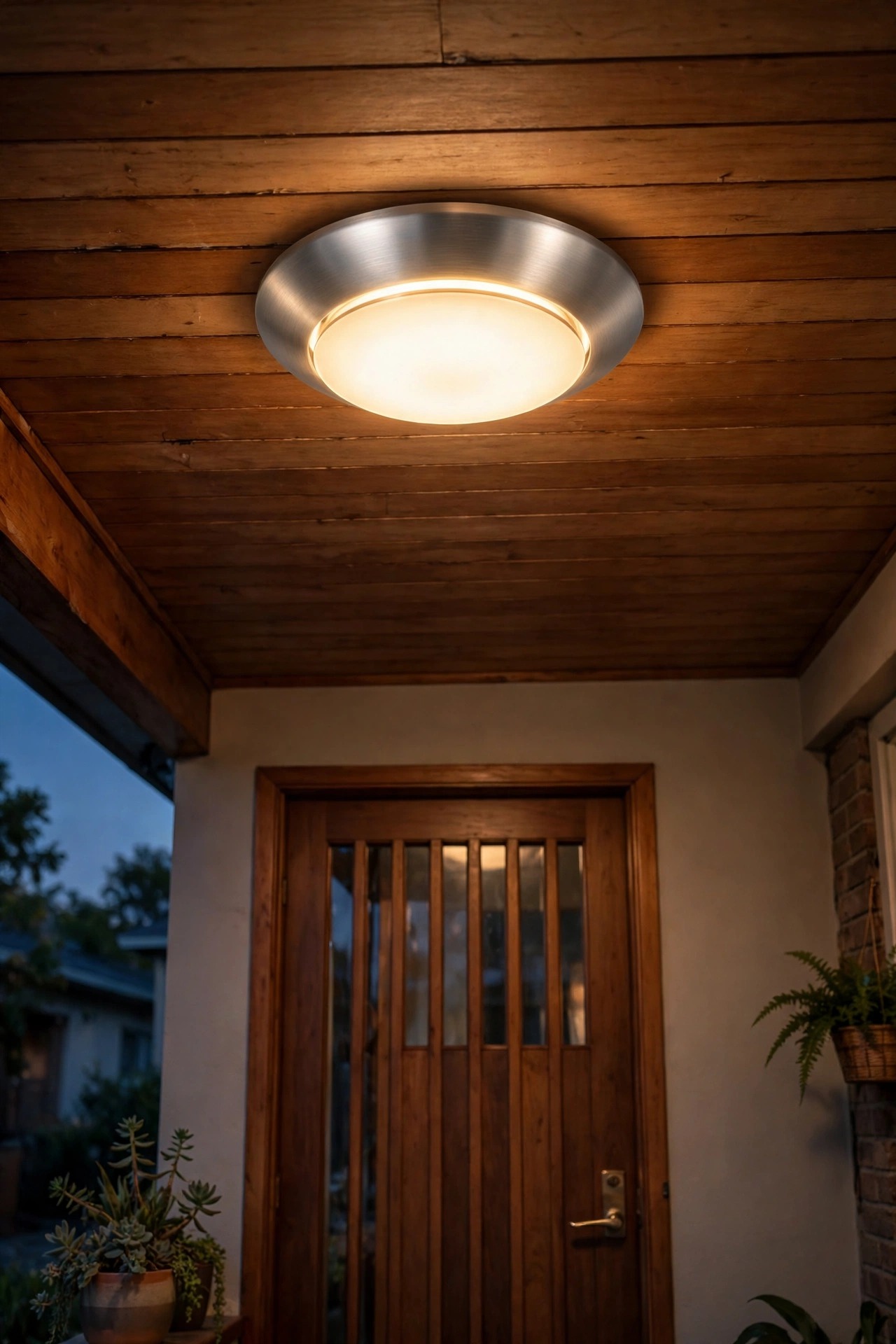
Plenty of ranch and split-level porches have ceilings too low for any pendant — sometimes barely 7 feet — and that is where the flying-saucer flush mount earns its keep. These wide, shallow discs hug the ceiling, spread light evenly across the whole porch, and their silhouette is unmistakably mid-century. I center the fixture on the entry landing and size it generously, 14 to 18 inches across, because an undersized saucer looks lost on a broad ceiling. Choose an integrated LED version or fit it with a 2700K bulb around 800 to 1,100 lumens, and put it on a dimmer if you can, since a ceiling that low puts the light close to eye level when you are seated. Brushed aluminum and matte black are the classic finishes, and a frosted diffuser keeps the look soft. Because flush mounts sit tight to the ceiling box, they are the easiest swap in this whole list — often a fifteen-minute job with the breaker off. Do confirm a damp-location rating, and clean the diffuser each spring, since porch ceilings collect more dust and cobwebs than we like to admit.
Suggested budget range: $45 – $160.
8. Commit to a Two-Finish Palette of Black and Brass
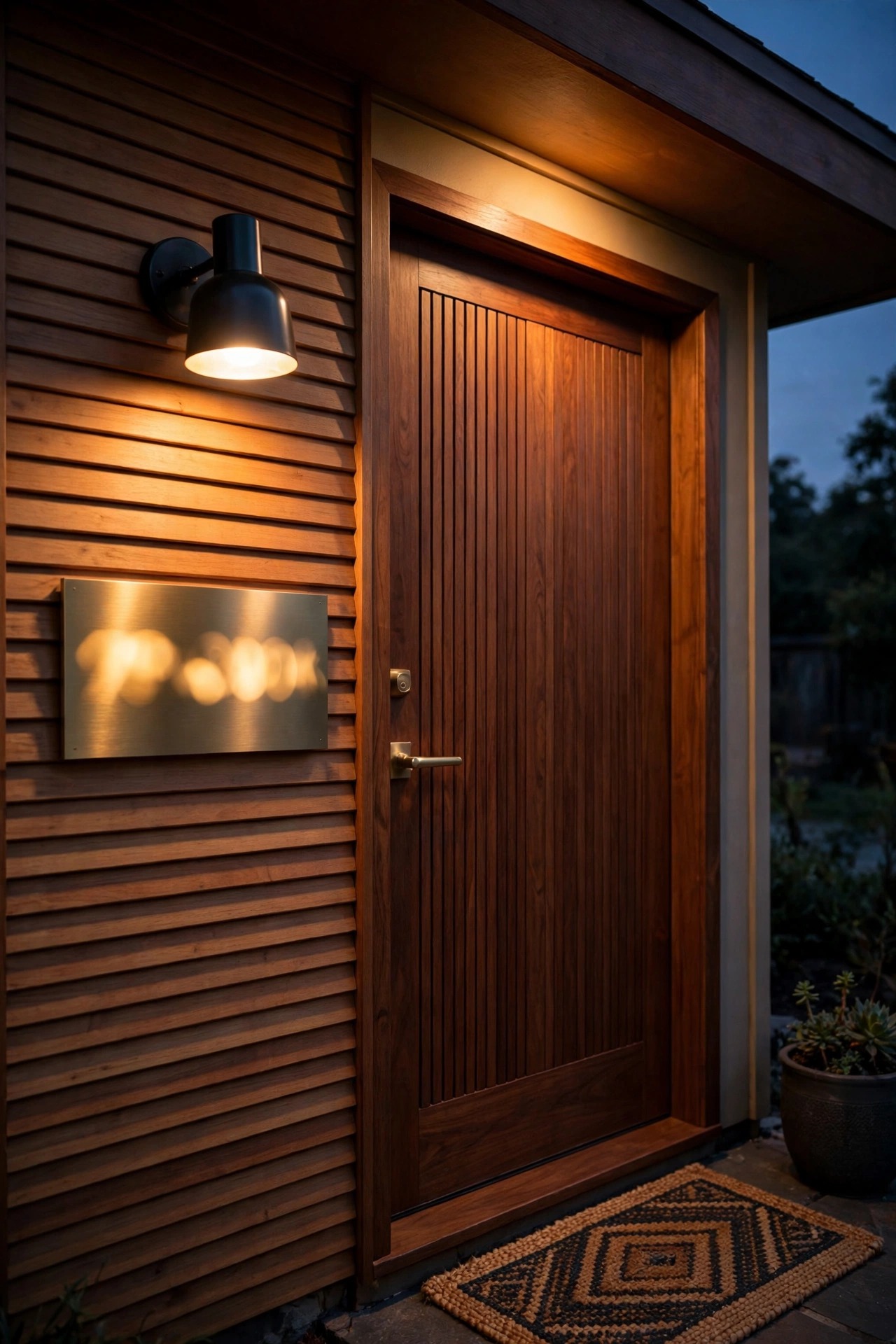
Nothing unravels a mid-century entry faster than five competing metal finishes, and nothing pulls it together faster than a disciplined palette of two. My rule: the big sculptural pieces — pendant, sconces, post light — share one finish, usually matte black or brushed brass, and the second finish appears only as an accent on house numbers, a doorbell plate, or lantern hardware. Black reads crisp against pale stucco and brick, while brass warms up teak doors and walnut accents beautifully. If your fixtures are already mixed, you can unify them for almost nothing: a can of matte black or metallic spray paint made for metal, a light sanding, and an afternoon will bring odd pieces into line. Keep bulb temperature identical across every fixture, because a palette only works when the light itself matches too. I photograph the porch at dusk before buying anything new, and the picture always tells me which finish is the majority — that one wins. Restraint sounds boring, but honestly, it is the whole secret behind those magazine retro entries.
Suggested budget range: $20 – $120.
9. Keep Every Bulb at One Warm Temperature for Mid-Century Modern Porch Lighting Ideas
The fastest way to make a thoughtful retro porch look accidental is mixed bulb colors — one bluish sconce, one amber pendant, one daylight path light. I hold every bulb on the porch and walk to a single warm temperature, 2700K, which flatters teak, brass, brick, and skin tones alike and matches the incandescent glow the era's fixtures were designed around. Where a fixture takes a visible bulb, I choose LED filament styles that mimic the old Edison loops; the sputnik and starburst pieces especially come alive with them. Buy all your bulbs in one shopping trip if you can, because dye lots vary slightly between production runs and even between brands at the same marked temperature. Write the temperature and bulb type inside the fixture or on a phone note, so replacements match years from now. One exception I allow: a porch that doubles as a workspace can hide a single 3000K task bulb, but it should never be visible from the street. Consistency is invisible when you get it right — guests just feel that the entry looks expensive.
Suggested budget range: $25 – $90.
10. Anchor the Steps With a Tapered Post Light
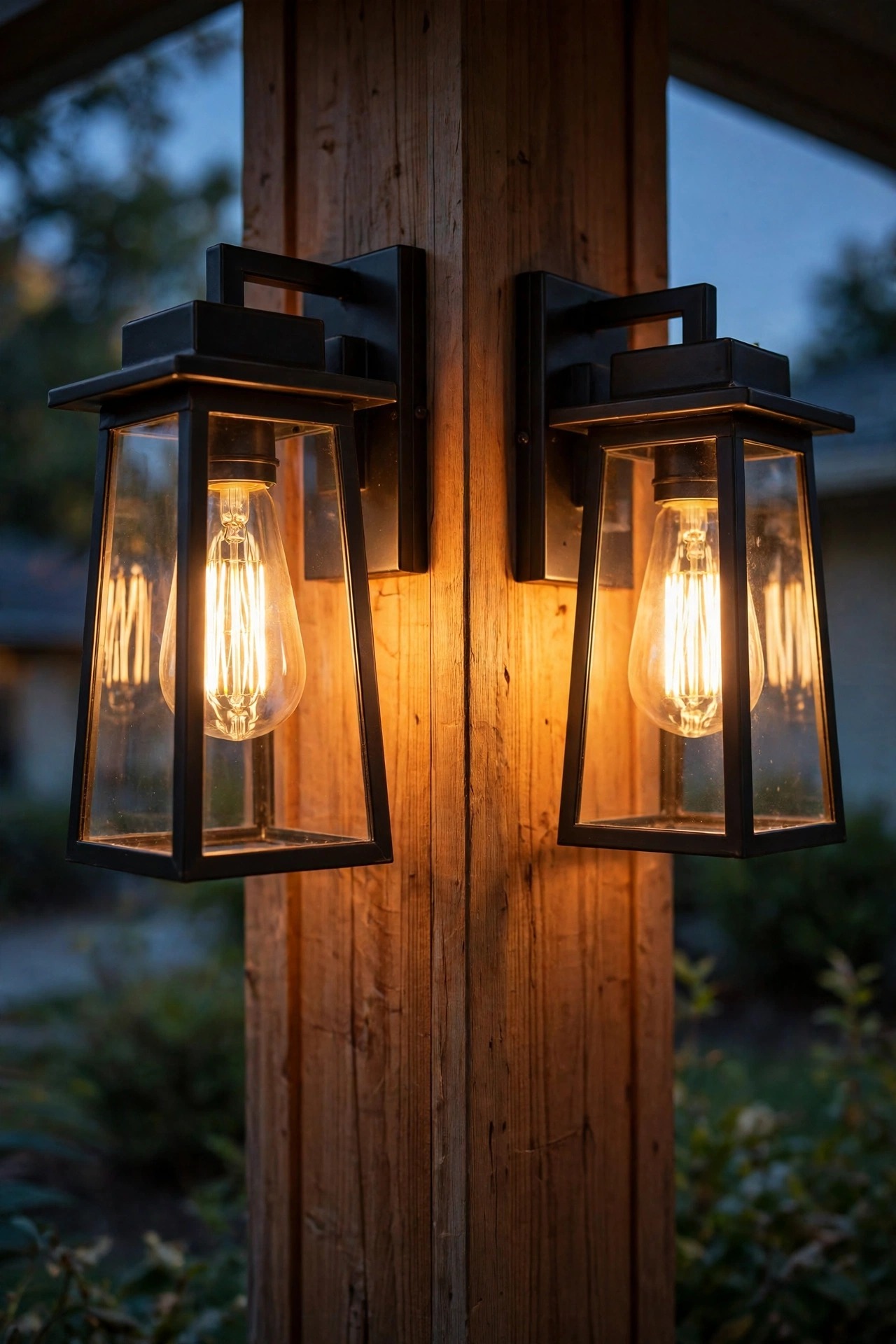
Porch steps are where guests actually get hurt, so the post light at the top or bottom of the run is the hardest-working fixture on this list — and mid-century design gives it a beautiful tapered, almost rocket-like silhouette. I set a single post light at the landing where the steps meet the porch, 36 to 48 inches tall, so it washes the treads without shining into eyes. On wide steps, a matched pair framing the bottom tread looks deliberate and lights both edges. Choose a fixture with a shielded, downward-aimed light source; exposed bulbs at step height are a glare trap. Low-voltage posts are an easy DIY install, and solar versions have finally gotten bright enough for a couple of steps, though I still prefer wired anywhere there are three treads or more. Anchor the post in a small concrete footing or a driven ground sleeve so it stays plumb through freeze and thaw. This is the fixture delivery drivers will silently thank you for every single night.
Suggested budget range: $70 – $240.
11. Add a Perforated Metal Lantern for Patterned Light
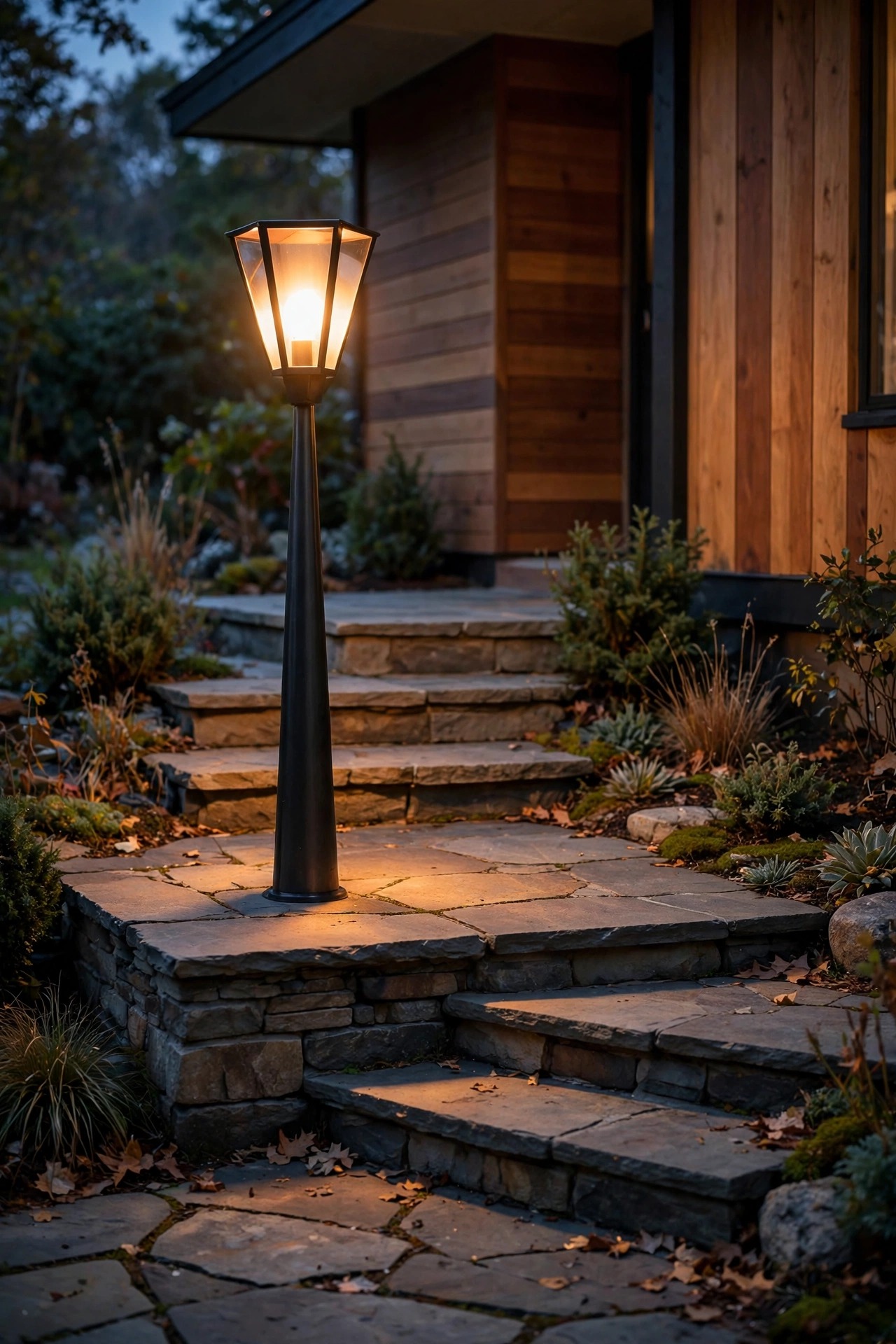
A pierced or perforated metal lantern — a drum or cylinder of metal punched with tiny holes — throws constellations across the porch floor and ceiling, and it is the most playful light in the mid-century toolkit. I place a pair of tabletop lanterns on the porch floor flanking a bench, or hang one larger perforated pendant where I want pattern instead of plain brightness. Because the holes leak light in every direction, these work best as accent layer, not your main door light. LED candles or low-wattage filament bulbs inside give the starfield effect without real flame near cushions and doormats — a safety line I never cross with open flame on a porch. Brass and copper versions warm up as they age, and black ones cast the crispest patterns. Group lanterns in odd numbers at staggered heights for a collected look, and bring plug-in or rechargeable versions inside during the worst winter storms. On a still evening, the moving shadows from a perforated lantern make a plain porch feel like an event.
Suggested budget range: $35 – $150.
12. Put the Whole Porch on Timers and Photocells
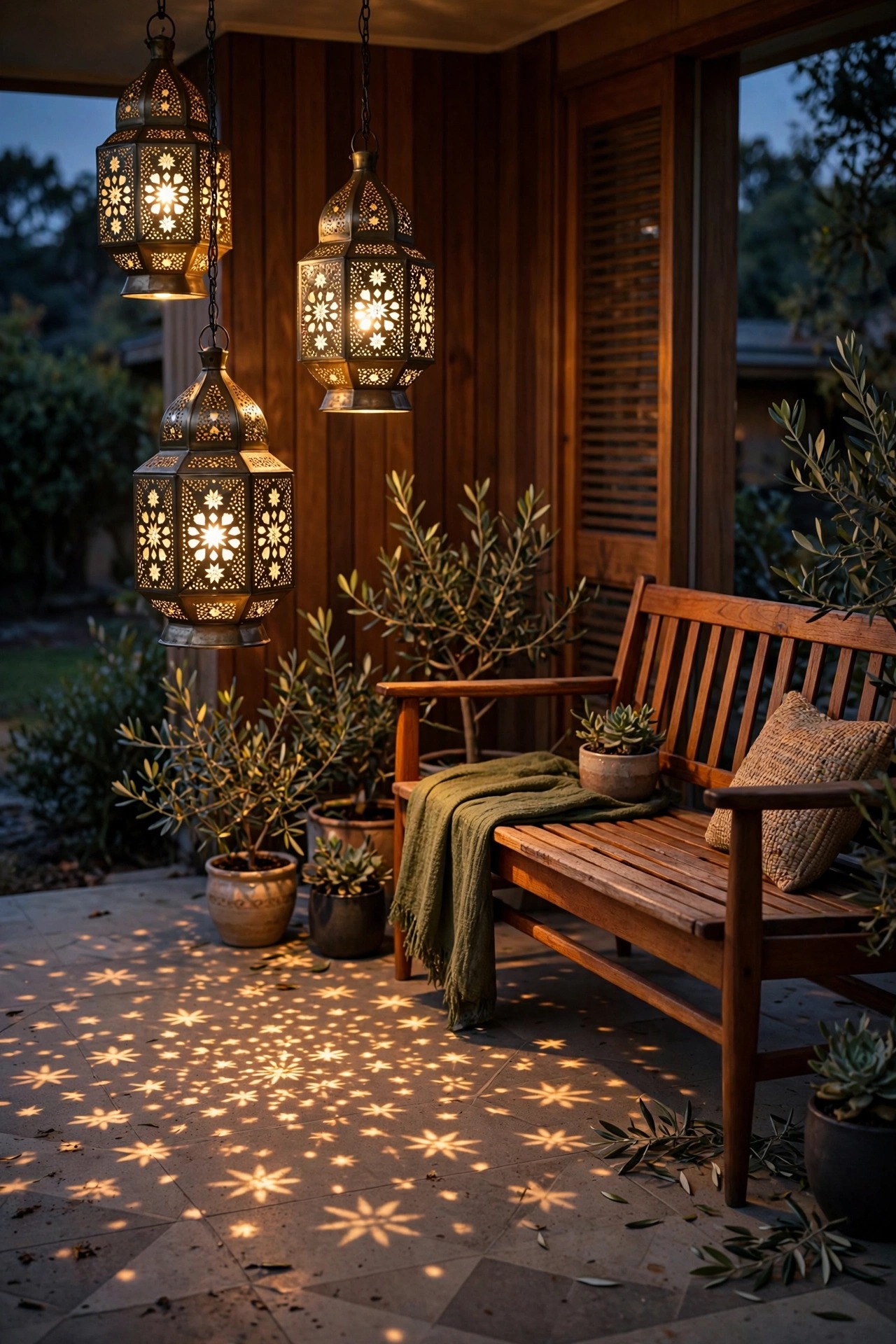
Retro style, modern manners: I never let great fixtures depend on anyone remembering a switch. A photocell on the sconces and post light brings them on at dusk and off at dawn with zero effort, and an astronomical timer on the pendant handles the accent layer, adjusting itself for the seasons. My usual schedule is simple — everything on at dusk, accents off around 11 p.m., and one soft sconce left burning until dawn for security and late arrivals. Smart bulbs in vintage shapes have made this even easier, since each fixture can join the schedule individually with no rewiring. If you go the smart route, choose bulbs rated for enclosed fixtures where needed, and keep one manual switch override so guests are not stranded in the dark. Automation also protects your bulbs, because fixtures that run fewer hours simply last longer. Honestly, the porch that lights itself is the one that actually gets enjoyed — you come home to the glow instead of fumbling to create it.
Suggested budget range: $15 – $90.
13. Give House Numbers and the Mailbox Their Own Light
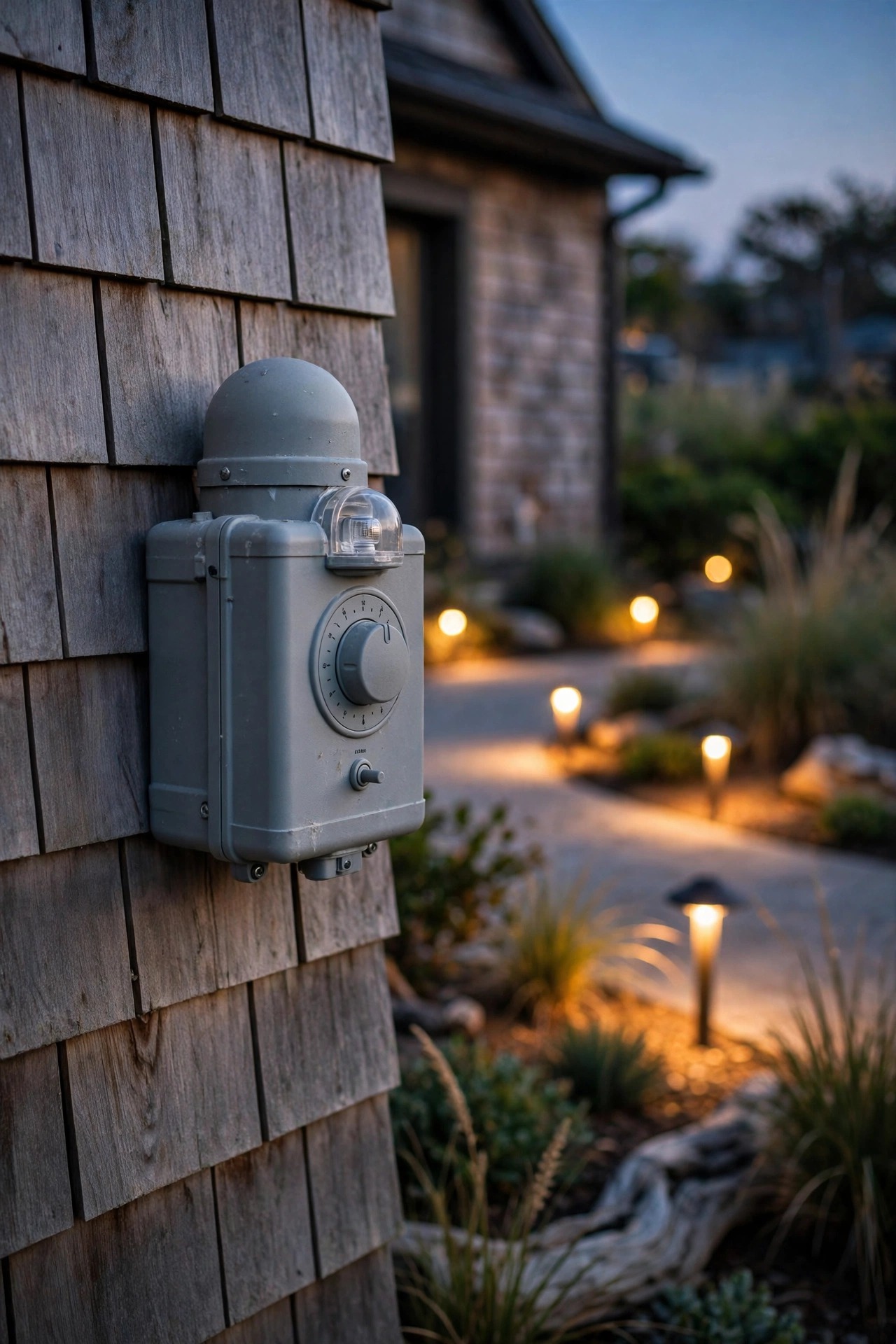
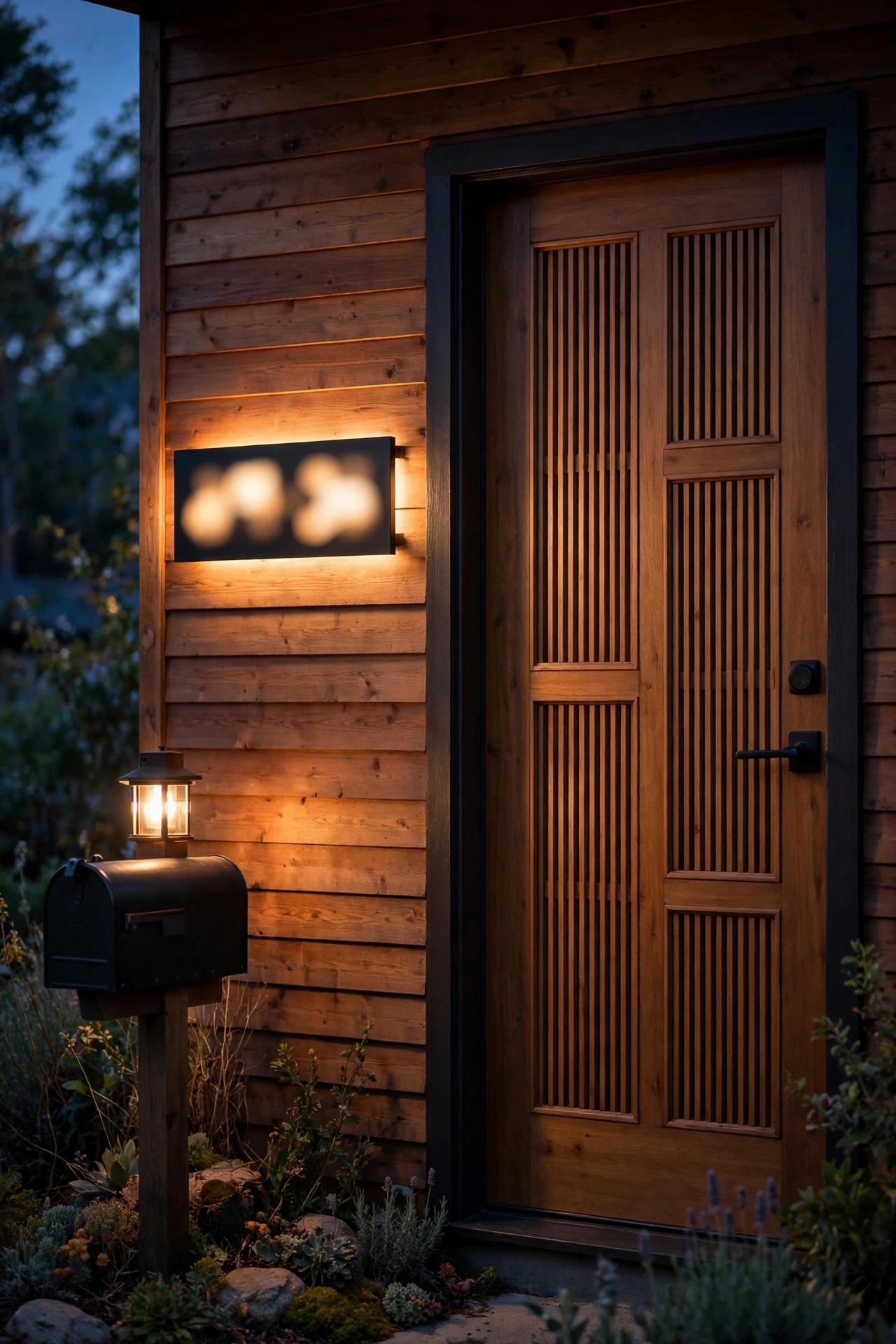
An entry is only finished when a guest can actually find it after dark, and a small dedicated light for the house numbers is the detail that separates styled porches from completed ones. I aim a tiny shielded fixture or a short run of warm light so the numbers wash evenly without glare — backlit numbers in a clean sans-serif are the most period-correct choice of all, and they float beautifully on brick or stone. Mount the light source so the bulb itself is never visible from the street; you want glowing digits, not a spotlight. The mailbox deserves the same treatment: a soft downlight on the post or a solar cap light means carriers and neighbors can read the address in January darkness. Keep these fixtures at 2700K to match the rest of the scheme, and check the view from a car at the curb, since that is the angle that matters. It is a small spend, but on a dark street your lit numbers quietly announce that this home is cared for.
Suggested budget range: $25 – $110.
14. Warm Up the Seating Corner With a Wood-Tone Accent Light
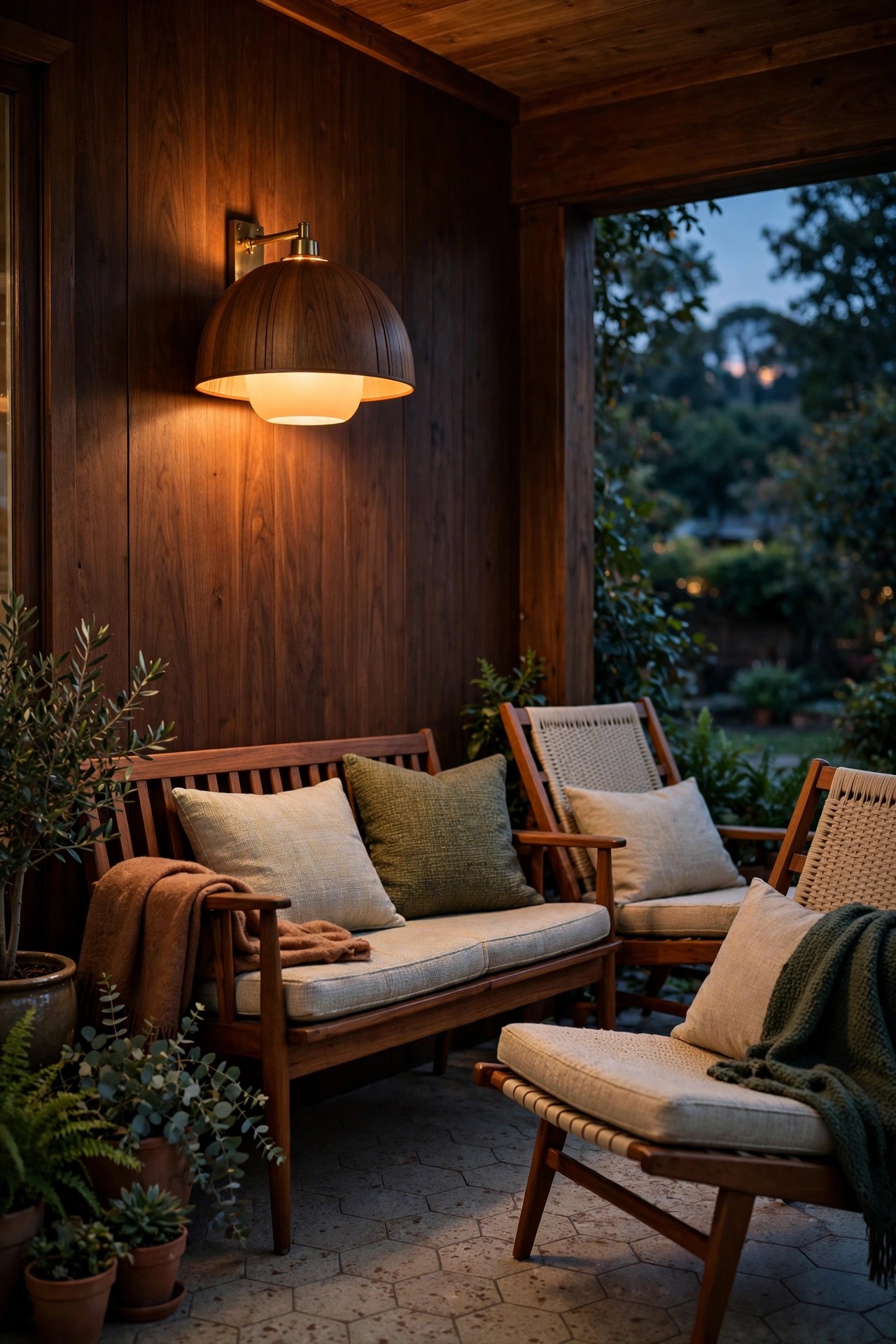
Mid-century porches were meant to be sat on, and the seating corner deserves its own pool of light rather than borrowing glare from the door fixtures. I use a sconce or small pendant with a walnut, teak, or rattan shade over a bench or pair of lounge chairs — the wood tone ties the light to the era's furniture and throws a noticeably warmer, cozier beam than metal alone. Aim for reading-level light at the seat, around 300 to 500 lumens, shielded so it lands on the chair rather than in your eyes. A rechargeable table lamp in a period shape works where wiring is a hassle, and modern versions run a full weekend of evenings per charge. Keep flames out of the picture and choose LED only near cushions and throws. This little zone is where the porch stops being a pass-through and becomes an evening room — coffee in the morning, a book at dusk. In my experience it ends up the most-used square footage of the whole entry.
Suggested budget range: $85 – $300.
15. Finish With a Dusk Walk-Through of Your Mid-Century Modern Porch Lighting Ideas
When everything is installed, I do the ritual that catches what daylight hides: a slow dusk walk-through. Start at the street and walk the guest's exact route — curb, path, steps, door — and look at the porch the way a first-time visitor does. Squint for glare: any bulb you can see directly is a bulb to shield, dim, or re-aim. Check that step edges read clearly, that the door hardware catches a little light, and that the sculptural pieces — sputnik, starbursts, cones — layer without competing. Then stand across the street and take the photo; the camera is brutally honest about hot spots and dark corners our eyes forgive. Adjust timers so the accent layer burns while you are actually awake to enjoy it. This is also when I note which fixtures to clean and which bulbs to log for future matching. Finish this audit and your mid-century modern porch lighting ideas stop being a list of purchases and become one composed scene — the warm, geometric welcome the house was always supposed to have.
Suggested budget range: $0 – $25.
Frequently Asked Questions
What color temperature is best for mid-century modern porch lighting?
I use 2700K everywhere on a mid-century porch. That warm white matches the glow the era's fixtures were designed around, flatters wood, brass, and brick, and keeps skin tones kind at the door. Cooler temperatures like 4000K or 5000K fight the whole palette and make even an authentic sputnik look like office lighting.
Are mid-century style fixtures weatherproof enough for an exposed porch?
Yes, as long as you buy the right rating. Under a deep covered porch, a damp-location rating is enough, but a shallow or open entry needs fixtures listed for wet locations, with sealed sockets and corrosion-resistant finishes. Check that glass globes have drainage or venting, and re-check mounting screws each spring on coastal homes.
Can I mix brass and matte black fixtures on one porch?
Absolutely — in fact, the pairing is a hallmark of the style. Keep one finish dominant on the large fixtures and let the second appear only in small accents like house numbers or hardware. The rule that matters more is consistency of light: same bulb temperature everywhere, so the two finishes read as one deliberate scheme.
How much does a mid-century modern porch lighting refresh cost?
A focused refresh — sconce pair, a pendant, and bulbs at one temperature — usually lands between $300 and $800. Adding path lights, a post light, and automation can take a full entry to $900 to $2,000. Doing the work in layers, starting at the door, spreads the cost without ever leaving the porch half finished.
Conclusion
A great retro entry is never about one hero fixture — it is about layers, warm consistent light, and shapes that respect the architecture they hang on. Start at the door with sconces and a pendant, carry the same finishes and 2700K glow down the walk, and let automation do the remembering. Do that, and your mid-century modern porch lighting ideas become the welcome your home was designed to give. If you want to keep going, browse my favorite entryway lighting ideas for more ways to make the front of the house glow.