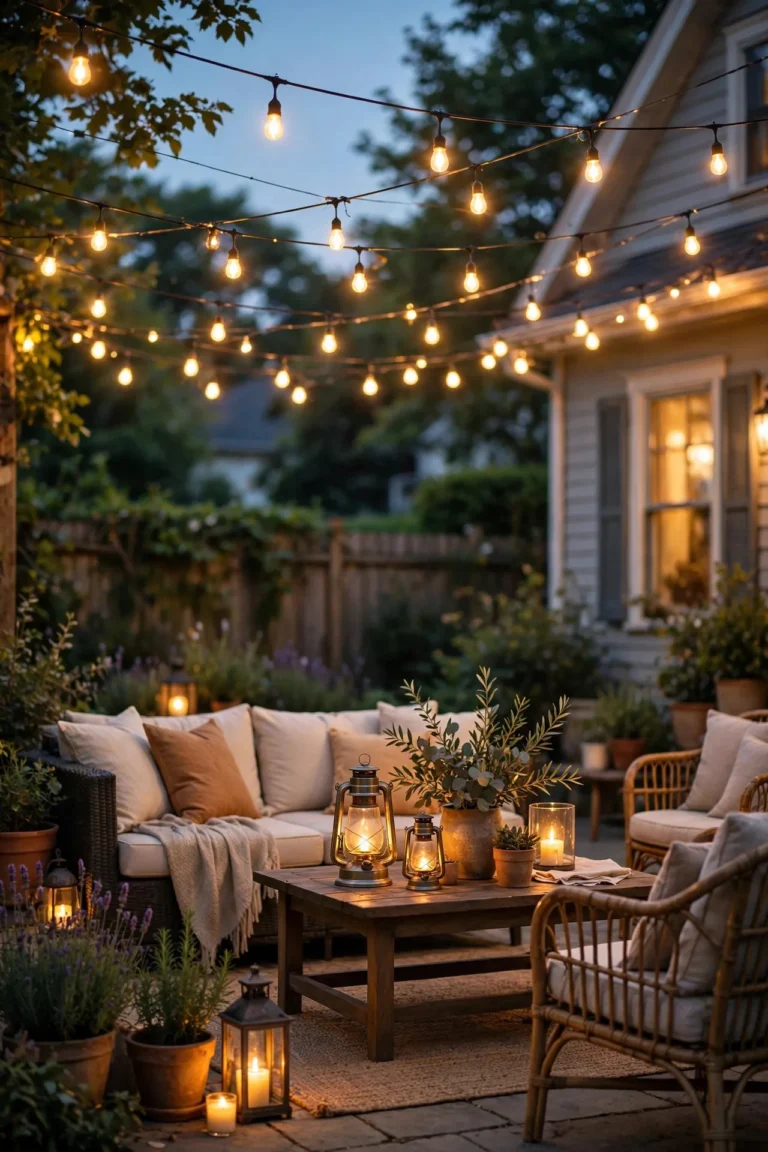
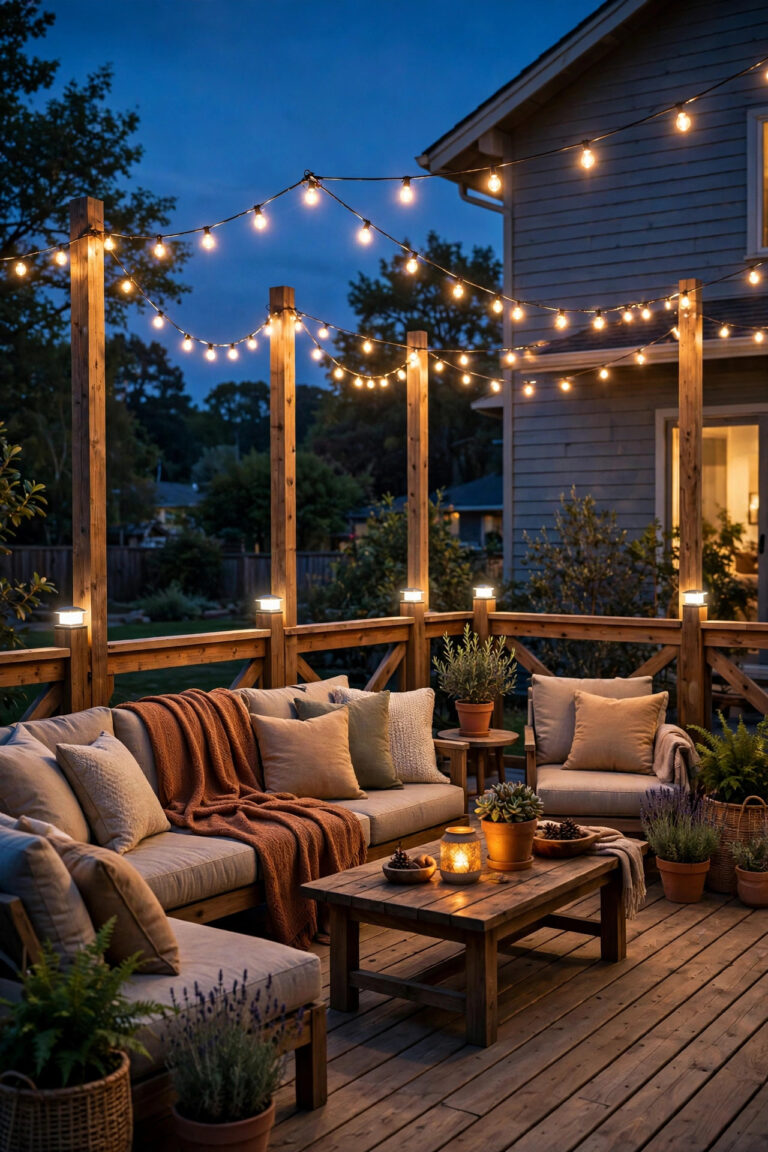
Our backyard had exactly one problem when we moved in: there was not a single outdoor outlet back there. Not one. The nearest power sat on the side of the house, a good 40 feet from the patio, and trenching a new line across the lawn cost more than I wanted to spend on lighting alone. Sound familiar? The good news is that backyard lighting without outlet access has gotten genuinely good in the last few years. Solar panels charge faster, batteries last longer, and efficient LEDs mean a little stored power goes a long way. These days I light our whole backyard — patio, garden beds, the big oak, even the far fence line — without plugging in a single thing. The secret is the same layering philosophy I use everywhere: soft ambient light for overall glow, practical task light where you cook and gather, and accents that make trees and plantings look magical after dark. Below are the 17 solar and battery ideas I have personally tested, loved, and reordered, with honest notes on brightness, placement, and what each one really costs.
1. Solar-Powered String Lights (Backyard Lighting Without Outlet, Solved)
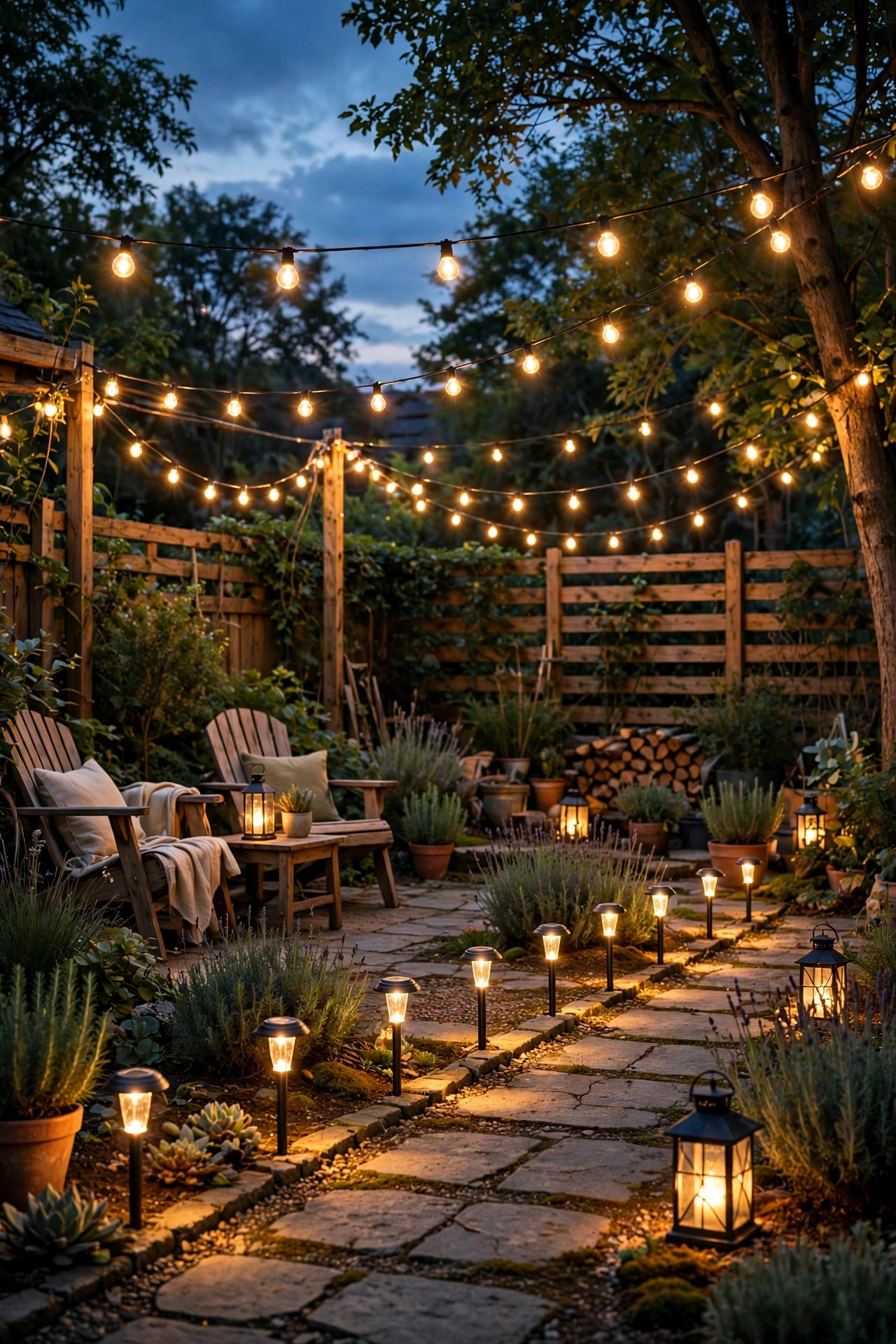
If you buy one thing on this list, make it a solar string light strand with a separate panel you can stake in the sunniest spot. The detachable panel is the whole trick: the lights can hang in your shady patio corner while the panel soaks up sun six feet away. I run two 48-foot strands in a zigzag over our patio, anchored to the fence and a shepherd's hook, and they give that warm café glow everyone asks about. Look for strands with shatterproof plastic bulbs rather than glass, a warm white color temperature around 2700K, and at least eight lighting modes so you can skip the flashing settings. Space your anchor points about 8 to 10 feet apart and let the strand swag gently — a droop of 12 to 18 inches looks intentional and relaxed. On a full charge mine run 8 to 10 hours, which covers every dinner party we have ever thrown. In winter I angle the panel toward the low sun and wipe it monthly; a dusty panel can cut your runtime in half, honestly.
Suggested budget range: $25 – $60.
2. Battery-Operated String Lights With a Timer
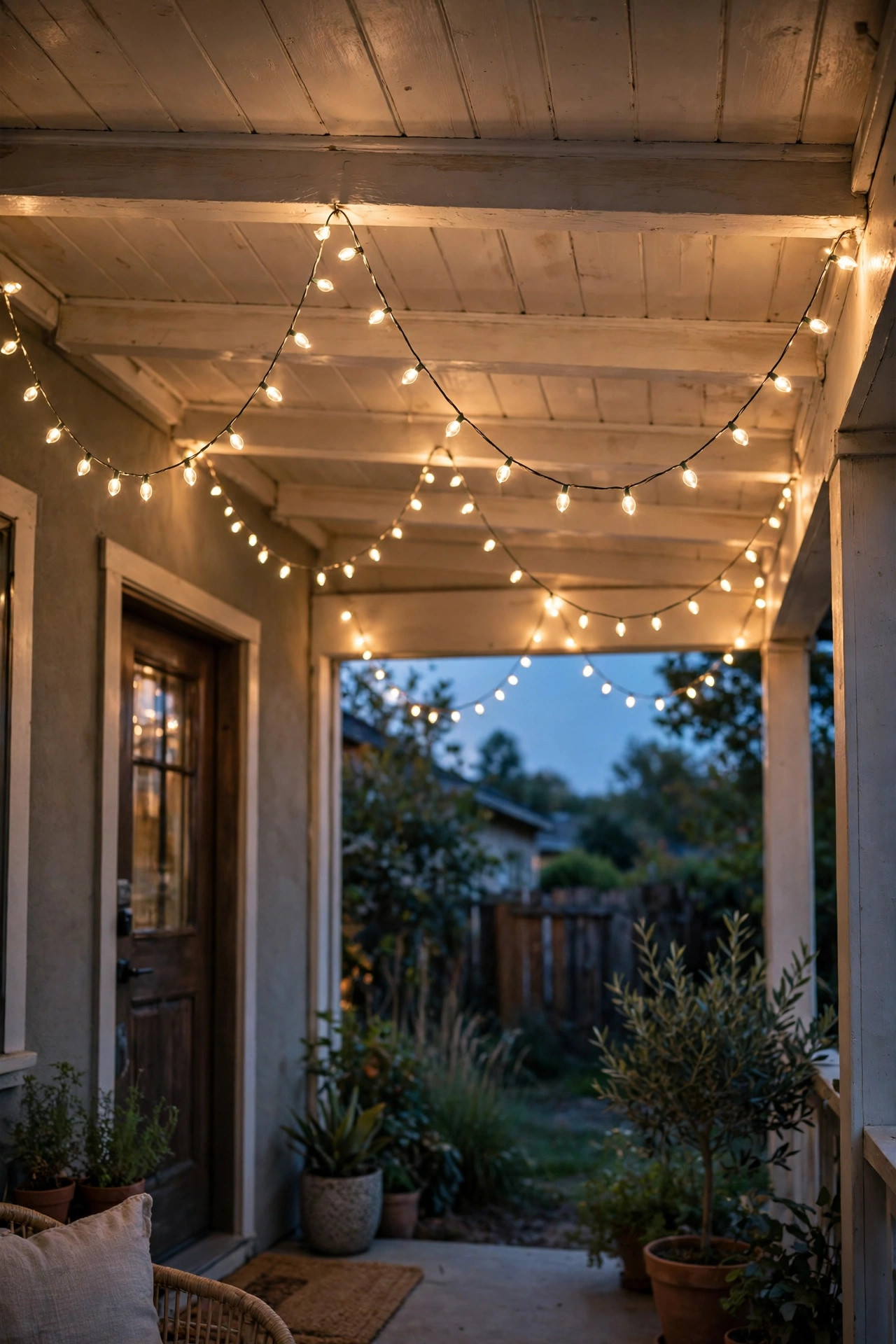
Battery string lights are my secret weapon for the spots solar cannot reach — under the covered porch, inside the gazebo, along the dark north fence. A strand powered by three AA batteries or a rechargeable pack will run 30 to 60 hours depending on brightness, and the built-in timer setting (six hours on, eighteen off) means they greet you every evening without you touching a thing. Copper-wire fairy strands are nearly invisible during the day and look like floating fireflies at night; I weave them through our patio railing and around the umbrella pole. For a chunkier look, battery globe strands give a bistro feel on the fence line. Keep the battery pack in a sheltered spot — tucked under a rail or inside a weatherproof box — because the pack is always the least waterproof part. I swap in rechargeable AAs and rotate two sets, which keeps costs tiny. Expect the light to be more sparkle than floodlight, so layer these with a lantern or two for actual visibility at the table.
Suggested budget range: $12 – $35.

3. Solar Path and Stake Lights Along Walkways
Nothing makes a backyard feel finished like a dotted line of light guiding you from the patio to the garden gate. Solar stake lights push into the soil in seconds, and a set of eight to twelve covers most yards. My honest advice: skip the cheapest dollar-store stakes, which often die by midsummer, and choose mid-range lights with replaceable rechargeable batteries and real glass or thick plastic lenses. Stagger them every 6 to 8 feet, alternating sides of the path, instead of lining them up like an airport runway. Lights in the 10 to 30 lumen range are plenty for wayfinding; anything brighter along a path just glares. If your path runs through shade, choose models with a remote panel or move a few lights to the sunny edge and let them mark the route from there. I keep a full walkthrough of choosing and placing them in my solar path lights guide, including the spacing mistakes I made the first year.
Suggested budget range: $20 – $50.

4. Solar Spotlights for Trees and Garden Features
A single solar spotlight aimed up into a tree canopy creates more drama than a dozen stake lights combined. Modern solar spotlights with a separate cabled panel are surprisingly strong — the good ones throw 200 lumens or more and let you position the panel in full sun while the fixture hides in a shady bed. I use three: one under the Japanese maple, one grazing the stone retaining wall, and one on the birdbath. Place the fixture 12 to 24 inches from the trunk, angled up at about 30 degrees, and step back at dusk to fine-tune; a few inches of adjustment changes everything. Warm white keeps foliage looking lush, while cool white turns leaves a sickly blue-green — trust me on that one. Lights with adjustable heads and both spot and flood lenses are worth the small premium. In deep shade under dense trees, battery spotlights with a timer are the backup plan, but solar handles most yards as long as the panel sees five or six hours of direct sun.
Suggested budget range: $25 – $55.
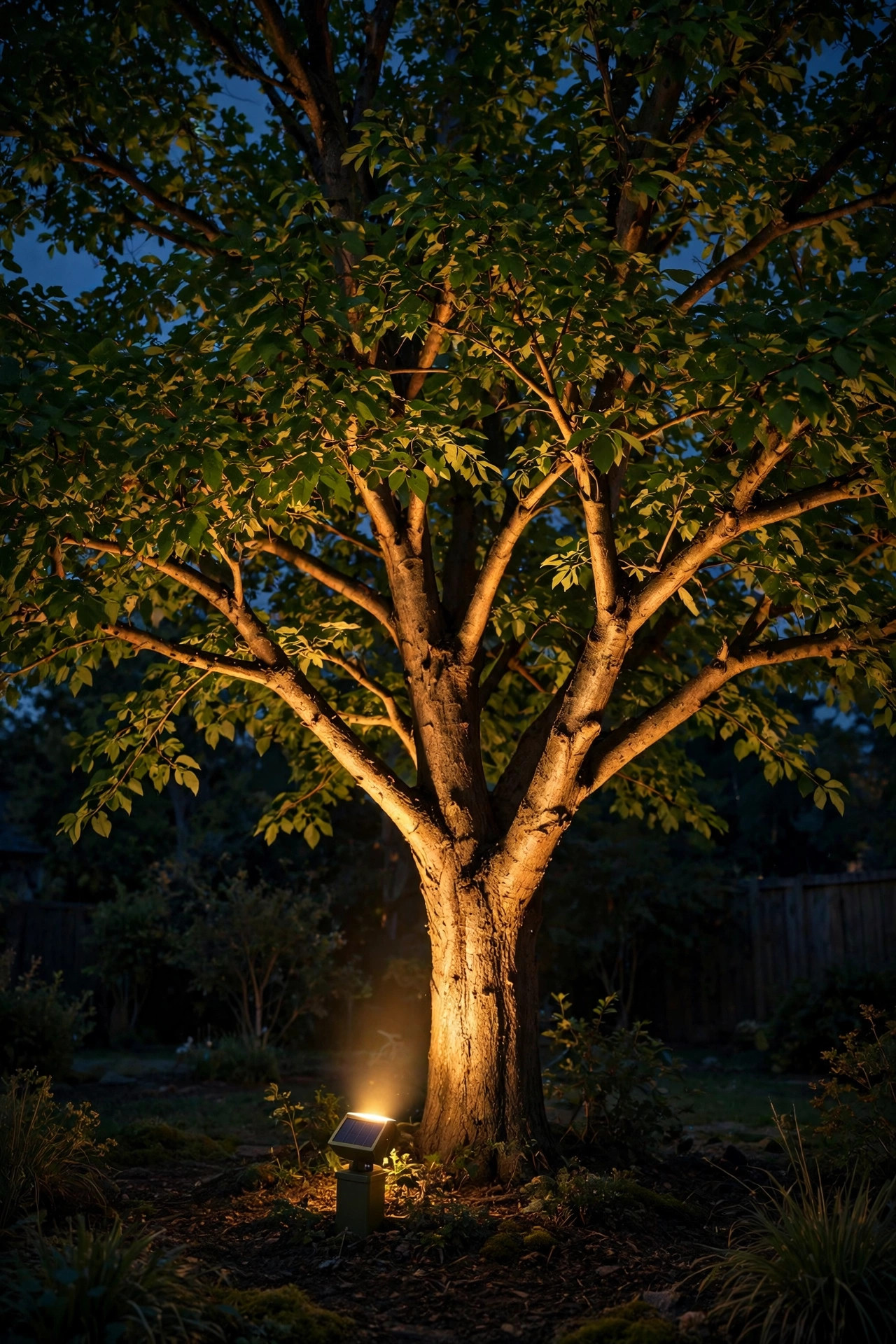
5. Solar Lanterns on Hooks, Tables, and Steps
Solar lanterns are the hardest-working decor in my yard because they move wherever the evening takes us. I hang crackle-glass lanterns from shepherd's hooks along the flower beds, set a pair of larger lanterns on the patio table, and keep two by the back steps so nobody misses the edge at night. The flickering-flame styles are pure coziness, while simple warm-glow lanterns read more modern. Most charge on a small panel in the lid, so store them in a sunny spot during the day — ours live on the patio table, which doubles as their charging station. Expect a soft 5 to 20 lumens: decoration and gentle wayfinding, not reading light. Metal lanterns with an IP44 rating or better survive seasons outside; the painted finishes eventually weather, which I count as patina rather than damage. Group lanterns in odd numbers — threes and fives — at slightly different heights for that collected, styled look instead of a matched set lined up in a row.
Suggested budget range: $15 – $45.

6. Rechargeable Table Lanterns and LED Candles
For the dining table itself, I reach for rechargeable lanterns and flameless candles — the kind you charge by USB once and use for weeks. A dimmable table lantern at its lowest setting gives enough light to see your plate without attracting every moth in the county, and the warm flicker of good LED candles fools everyone until they lean in close. I cluster three candles of different heights on a tray with a small plant for an instant centerpiece, then scatter two lanterns down the table. Because they are portable, they migrate: one ends up by the grill, one lights the cooler, one goes with whoever walks out to the garden. Look for runtimes of 20 hours or more per charge and a simple touch or button dimmer you can operate with messy barbecue fingers. Keep them indoors or in a covered bin between uses, since most are weather-resistant rather than truly waterproof. In my experience, one good rechargeable lantern outperforms a drawer full of cheap battery tea lights every single time.
Suggested budget range: $18 – $40.
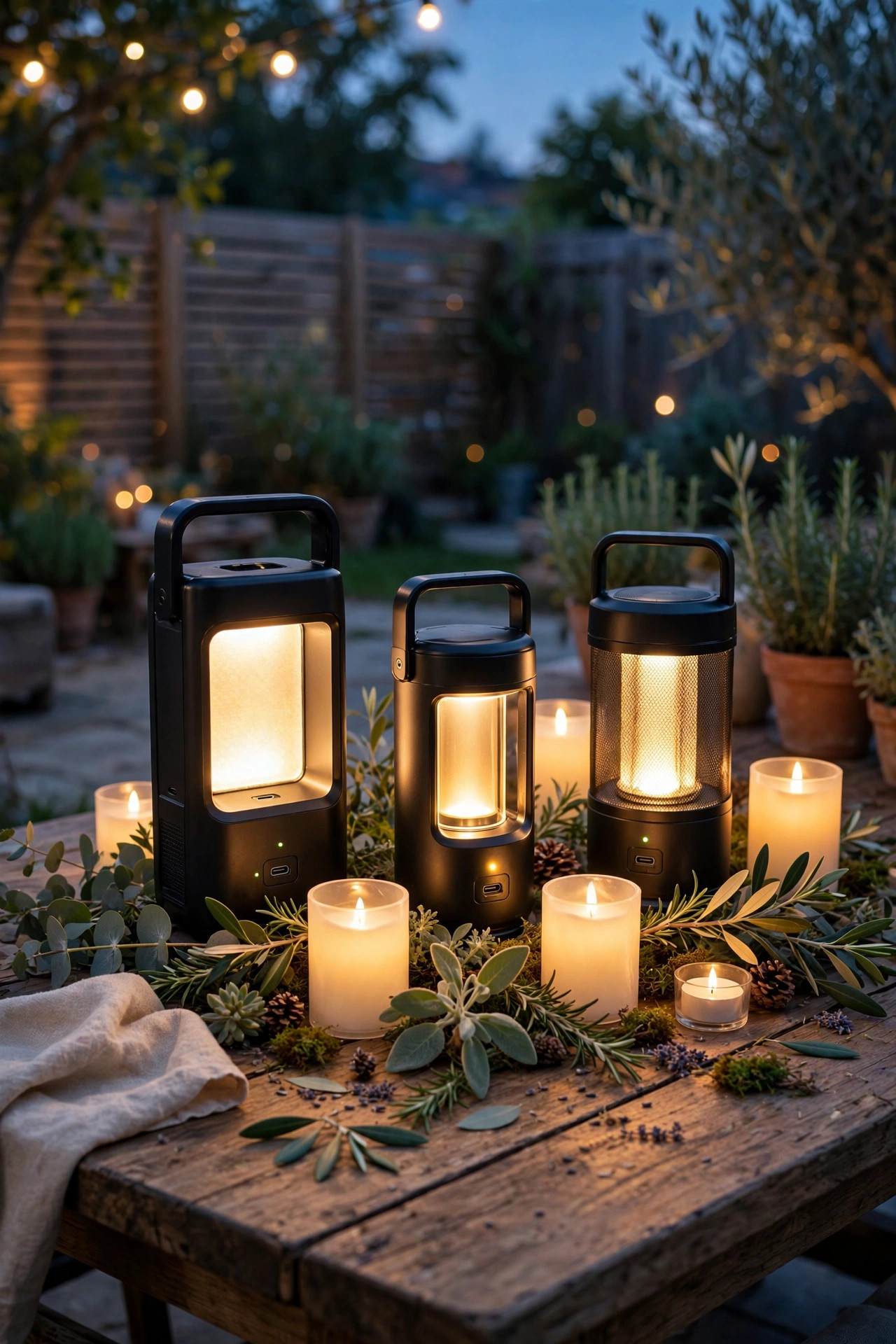
7. Solar Fairy Lights Wrapped in Trees and Shrubs
There is a special kind of magic in a tree that sparkles. Solar fairy light strings — the thin copper or green wire kind with 100 to 200 tiny LEDs — wrap beautifully around trunks, branches, and shrubs, and the wire nearly disappears by day. I wrap our crape myrtle from the trunk up into the main branches every spring and leave it all season; the solar panel stakes into the sunny bed below. Wrapping technique matters: keep spacing between wraps at 4 to 6 inches, work from the bottom up, and do not cinch the wire tight, because the tree grows and tight wire girdles bark. For shrubs, drape net-style solar lights over the top instead of wrapping — much faster, and the coverage looks even. On a full charge these run 6 to 8 hours and switch on automatically at dusk. One caution: squirrels occasionally chew the wire, so I keep a spare strand on hand. It is the highest-impact, lowest-effort project on this whole list, honestly.
Suggested budget range: $14 – $30.
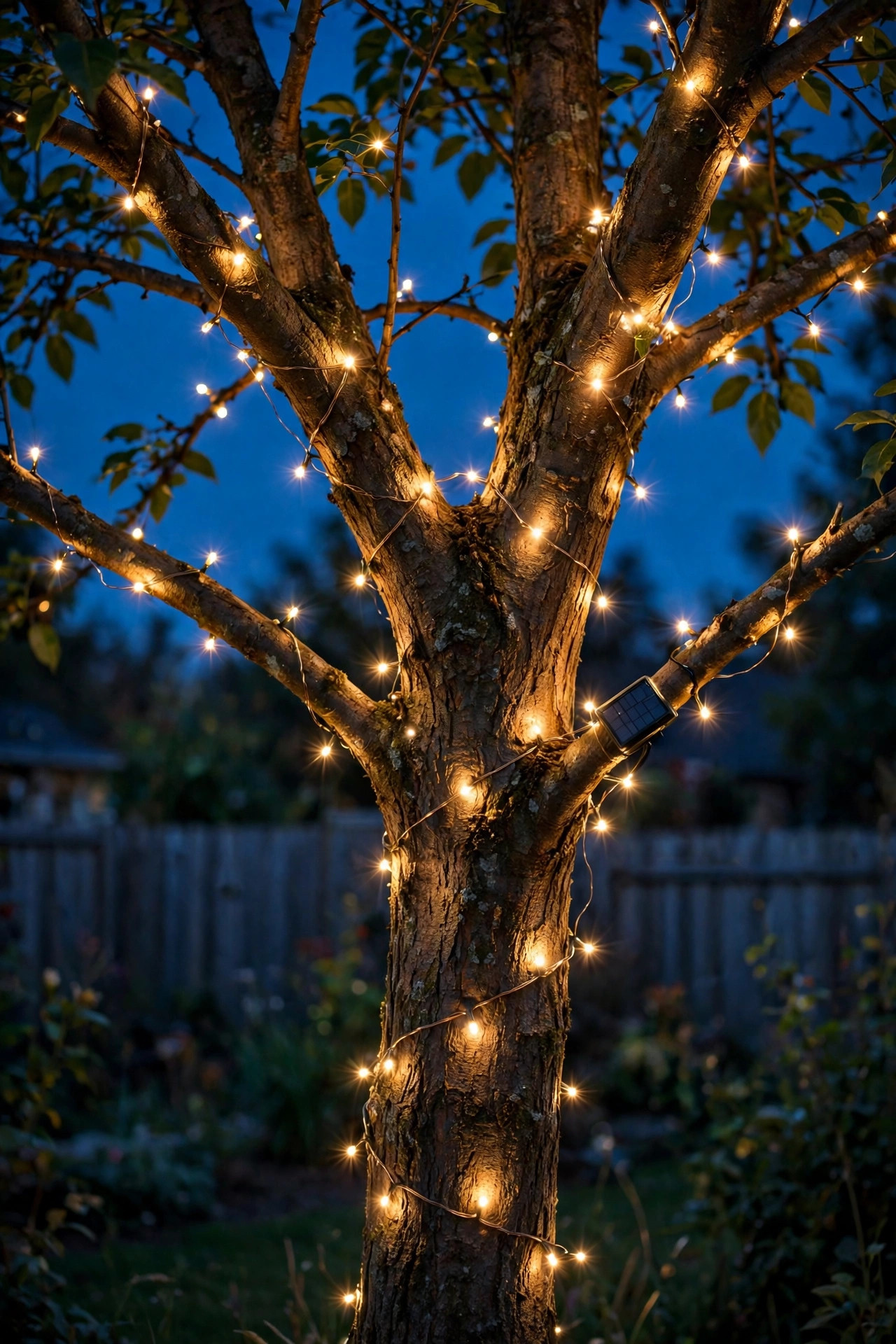
8. Solar Fence and Deck Rail Cap Lights
Your fence line is free real estate for light. Solar post-cap lights sit on top of 4×4 or 6×6 fence and deck posts, charging all day and washing a soft pool of light down each post at night. They define the yard's boundary, make the whole space feel intentional, and keep guests from wandering into the dark corners. Measure your posts before ordering — adapters exist, but the right size looks ten times better. I light every other post rather than every one; the rhythm of light and shadow looks designed, and it halves the cost. Expect modest brightness, around 5 to 15 lumens per cap, so think of them as outline and ambience rather than task light. Flat rail-mount solar lights are the alternative for decks without chunky posts, screwing into the top rail in minutes. Choose warm white to match your other layers, and check that the battery is replaceable so a tired cell does not retire the whole fixture in year two.
Suggested budget range: $30 – $70.

9. Solar Motion-Sensor Lights for Safer Backyard Lighting Without Outlet Wiring
Every no-outlet yard still needs one practical workhorse: a solar motion-sensor light over the back door, the grill zone, or the gate. These mount with two screws, charge from an integrated or cabled panel, and blast 500 to 1,000 lumens when someone walks up — exactly the light you want with an armful of groceries or a curious raccoon at the trash bins. Because they only run at full brightness when triggered, the charge lasts for weeks even in mediocre sun. Position the sensor 6 to 8 feet high, angled to cover the approach path, and keep the panel tilted toward midday sun. I prefer models with three modes — dim all night with bright on motion is the sweet spot — plus a manual off switch for movie nights. This is the one fixture where cool white is acceptable for visibility, though warm options exist and look friendlier. It is not pretty light, but it is the light that makes the pretty light possible to enjoy safely.
Suggested budget range: $20 – $45.
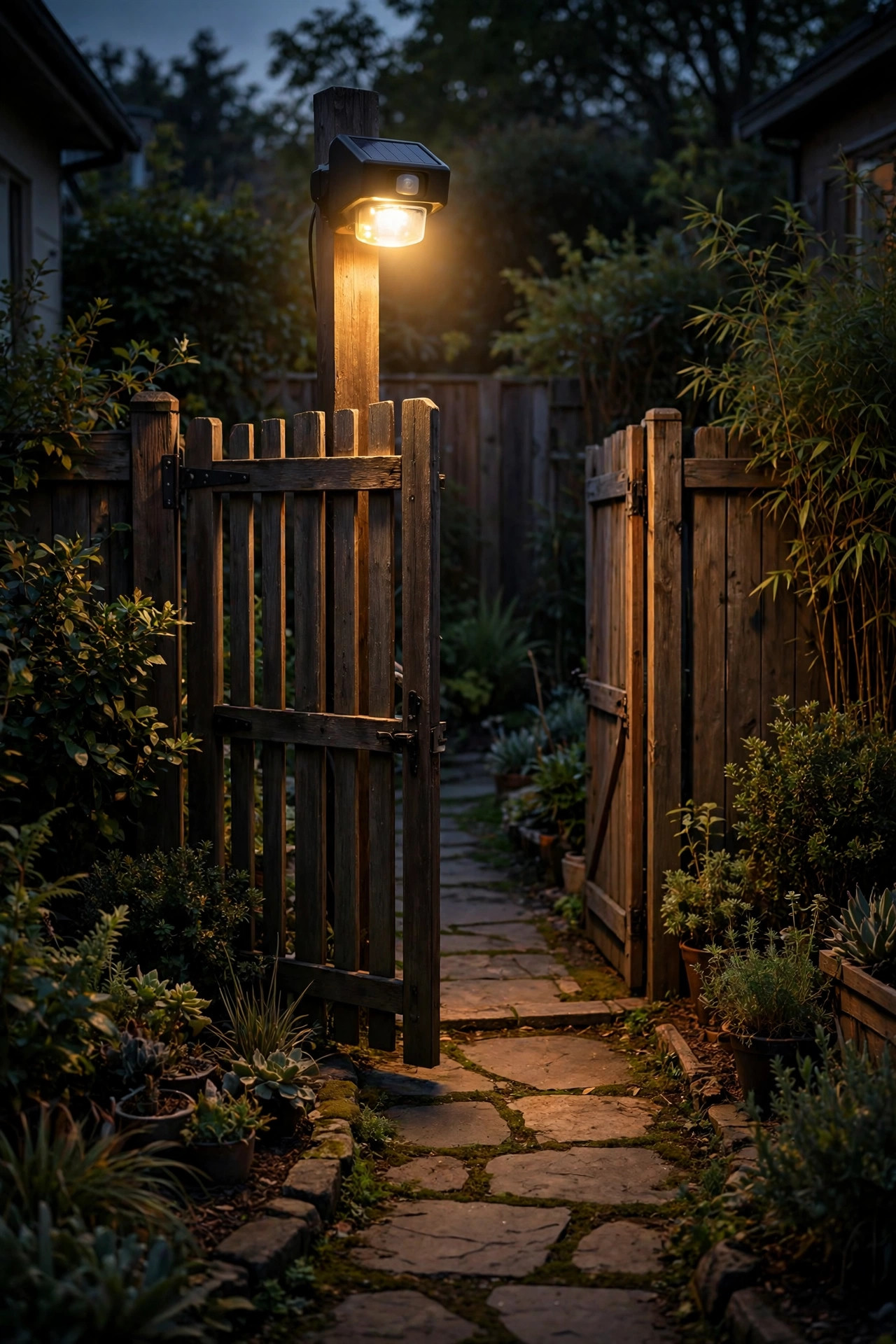
10. Battery Puck Lights Under Umbrellas and Pergolas
Stick-on battery puck lights solve the darkest spot in many backyards: the underside of the patio umbrella or pergola roof, where no sun reaches for solar and no wire can go. A ring of three or four pucks on the umbrella ribs, controlled by one remote, turns a shadowy table into an inviting dinner spot. The adhesive pads work fine on clean, dry surfaces; for umbrellas I add a small zip tie for insurance. Choose warm white pucks with a dimmer and timer — full brightness is harsh at dining distance, and the 30-minute auto-off saves your batteries when you forget. Runtime runs 20 to 40 hours on a set of AAs, better with rechargeables. Under a pergola, mount pucks on the cross beams pointed down at the seating area, spacing them about 3 feet apart. They are also brilliant inside storage benches and shed corners where you grab cushions after dark. Small, cheap, and weirdly satisfying — I keep a spare set in the kitchen drawer at all times.
Suggested budget range: $12 – $28.

11. Solar Flame Torch Lights Along Beds and Paths
Flame-effect solar torches are pure theater, and I am not even a little sorry about it. The better models flicker with a convincing 96-LED flame pattern that reads as real fire from ten feet away, and they stake straight into beds and along paths with zero installation. I run six along the back flower bed where they echo the fire pit and make the whole yard feel like a resort in the evening. They stand about 2 to 3 feet tall once staked, and spacing them 4 to 6 feet apart keeps the rhythm natural rather than runway-like. Runtime is typically 8 to 10 hours after a sunny day; on cloudy stretches they fade earlier, so cluster them where they get morning sun if you can. Keep them away from dry mulch edges and overhanging foliage even though there is no real flame — mostly so leaves do not shadow the panel. If you love the flame look elsewhere on the site, keep the style consistent so the yard feels like one design, not a sampler platter.
Suggested budget range: $30 – $60.

12. Solar Rock and In-Ground Burial Lights in Garden Beds
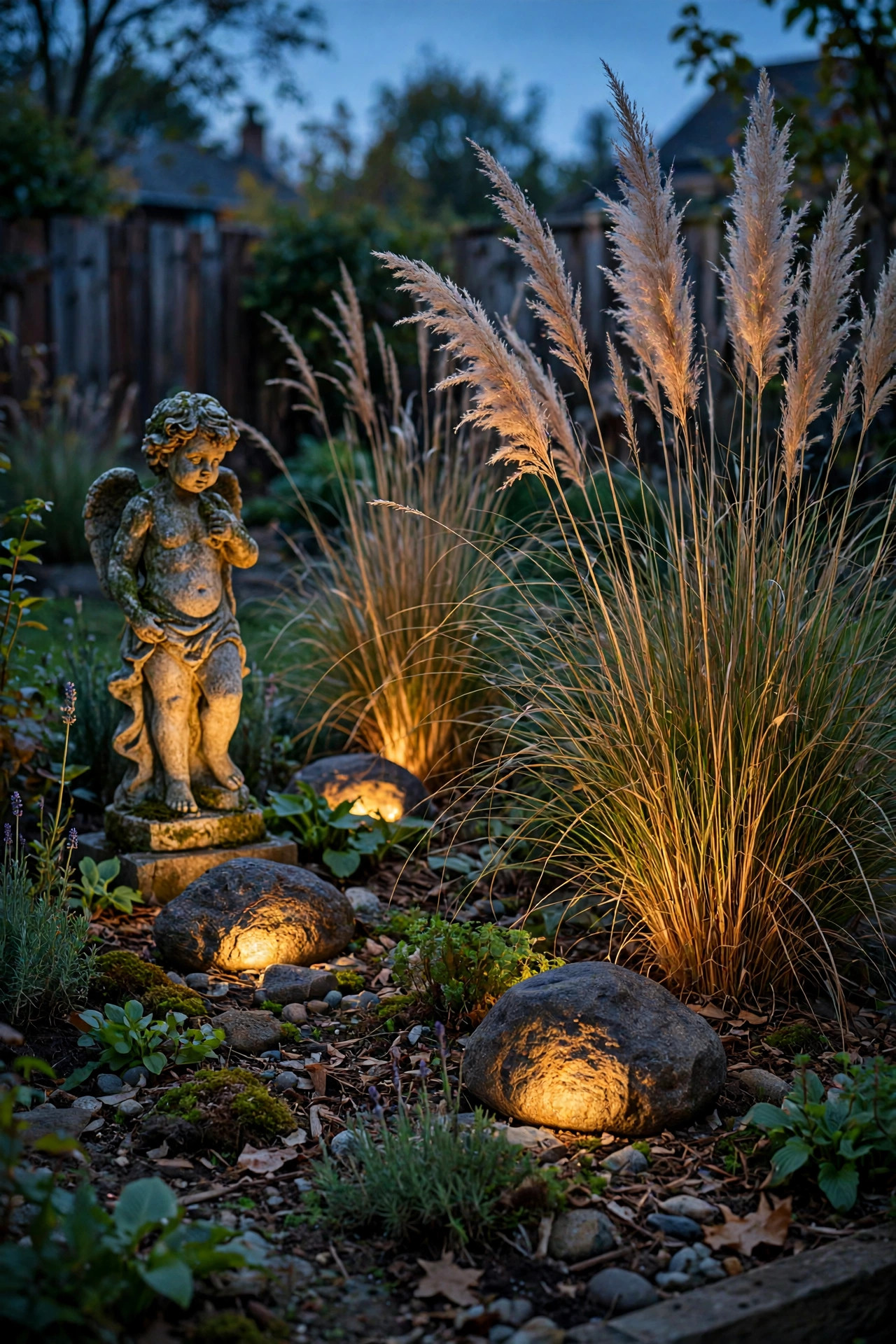
Some lights should be felt, not seen. Solar rock lights — LEDs hidden inside realistic stone housings — tuck into garden beds and spotlight a favorite plant, a piece of garden art, or the base of a small tree without any visible fixture. In-ground solar disk lights sit flush in soil or between pavers and mark bed edges and stepping-stone routes. I use rocks in the front of the deep perennial bed, aimed at the grasses and the stone heron statue, and disks along the stepping stones to the shed. Both types need their little panels kept clear of mulch and leaf litter; a quick hand-swipe during weekend weeding keeps them charging. Brightness is modest, so think accents and markers. Rocks blend best when the stone tone roughly matches your hardscape, and disks survive foot traffic and the mower's edge better than anything raised. In my experience these are the lights visitors never notice as fixtures — they just ask why the garden looks so good at night.
Suggested budget range: $22 – $48.
13. Solar Net and Curtain Lights Over Bushes and Fences
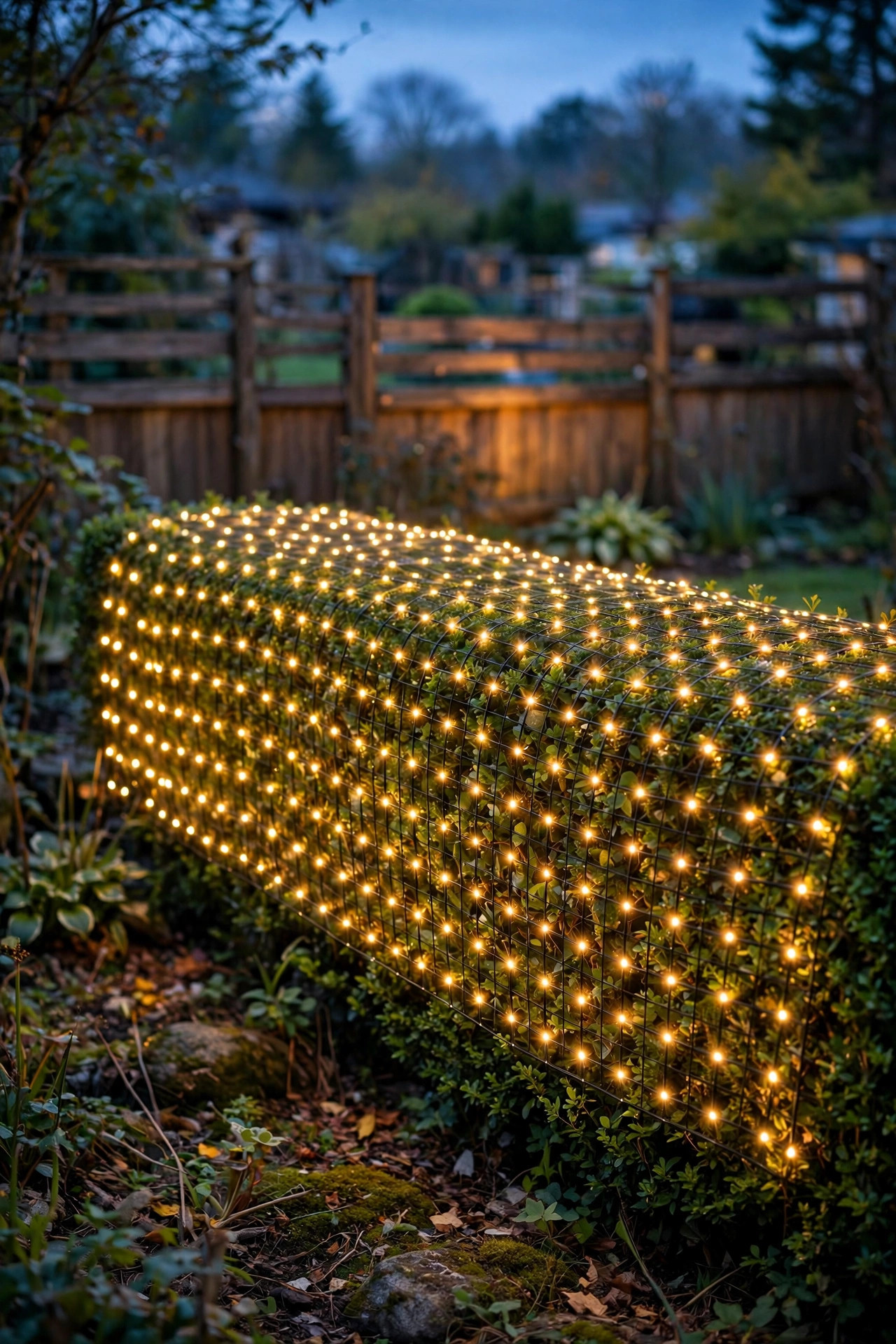
When a big blank fence or a row of shrubs needs help fast, solar net lights are the two-minute makeover. The mesh grid drapes over a hedge or hangs along a fence panel, and hundreds of tiny warm LEDs even out into a soft, starry wash instead of random sparkle points. I drape one net over the lilac hedge behind the patio every summer; from the seating area it looks like the bush is holding fireflies. Solar curtain strands work the same magic on a fence section or pergola side, hanging in neat drops. Secure the edges with small clips so wind does not bunch the net, and stake the panel where it gets unobstructed sun — often on top of the fence itself. These are decorative light, not illumination, so pair them with path stakes or a lantern for actual visibility. Stored loosely in a bin (never wadded tight), a good net lasts three or four seasons. It is the fastest transformation on this list, start to finish.
Suggested budget range: $18 – $38.
14. Battery LED Strip Lights Under Deck Rails and Bench Seats
A hidden strip of light under the deck handrail makes the whole deck float, and battery-powered LED strips mean you can have it without an electrician. Peel-and-stick strips with a small battery pack mount under the rail, under bench seats, or along stair treads, washing warm light downward where feet and drinks need it. Cut the strip at the marked points to fit, press it firmly onto a clean, dry surface, and tuck the battery pack in a weatherproof box mounted beneath the rail. Warm white at 2700K to 3000K keeps the mood consistent with the rest of the yard. With the dimmer remote set around half brightness, a pack of rechargeables lasts us two to three weeks of evening use. Add the optional motion sensor on stair runs so steps light as you approach and switch off behind you. Wipe the mounting surface with rubbing alcohol first — every strip failure I have ever had traced back to dust under the adhesive, never the lights themselves.
Suggested budget range: $16 – $35.

15. Solar Floating Lights for Pools, Ponds, and Birdbaths
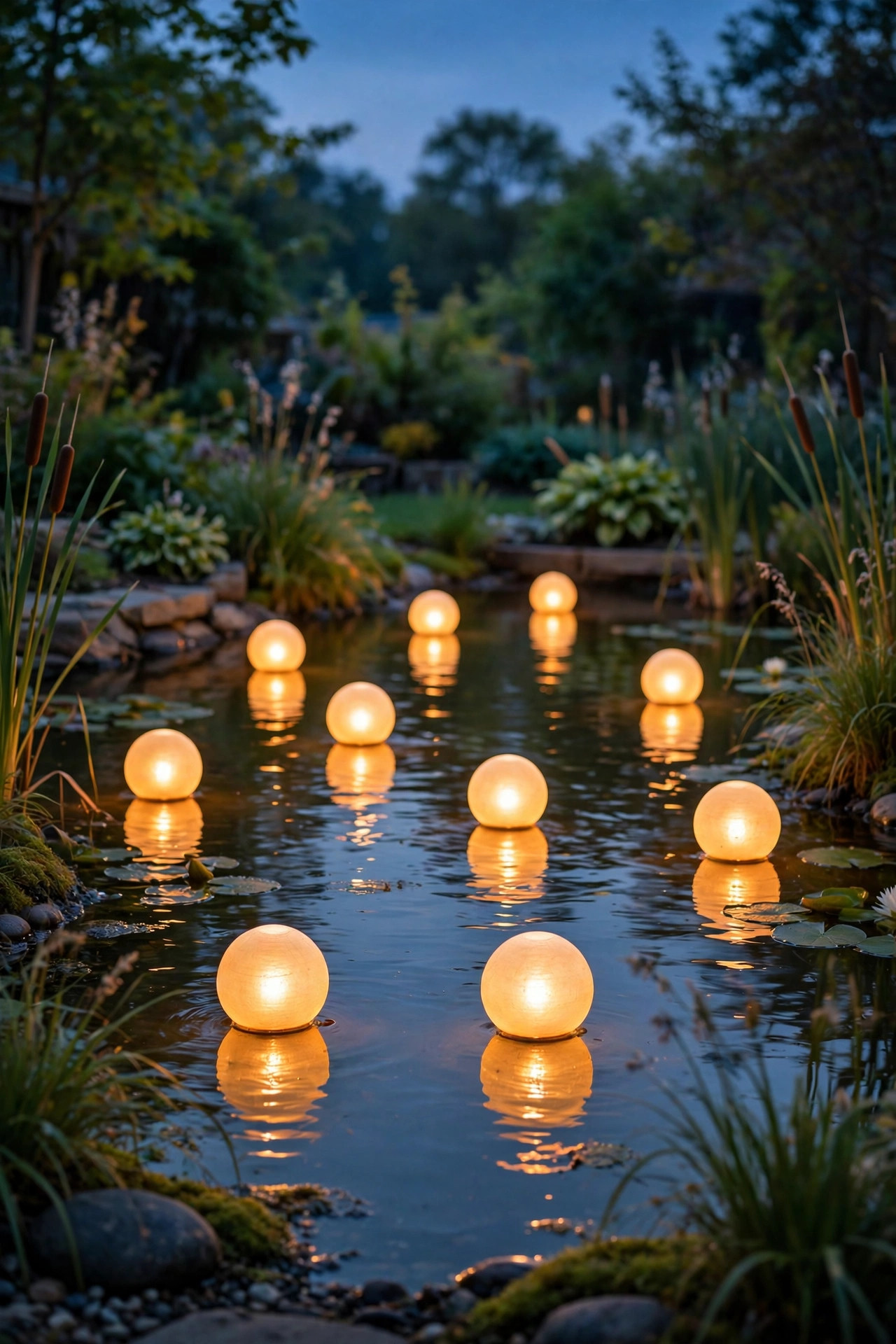
Water doubles every light you put near it, and solar floating lights are the easiest win in a yard with a pool, pond, or even a wide birdbath. The classic floating orbs charge by day and drift glowing at night; color-changing versions are festive, but I always come back to steady warm white for a calm, high-end look. In a pond, tether each orb loosely to a stone with fishing line so they gather artfully instead of all migrating to one corner. Small solar floating disks work in birdbaths and stock tanks too, scaled-down versions of the same trick. Expect gentle glow rather than real brightness — these are mood, pure and simple. Rinse the panels every couple of weeks; a film of algae or dust quietly steals runtime. Bring them in before a hard freeze to protect the seals and batteries. Honestly, floating lights are the detail guests photograph most, and they take ninety seconds to "install."
Suggested budget range: $20 – $42.
16. Solar Shed, Wall, and Barn-Style Lights Without Wiring
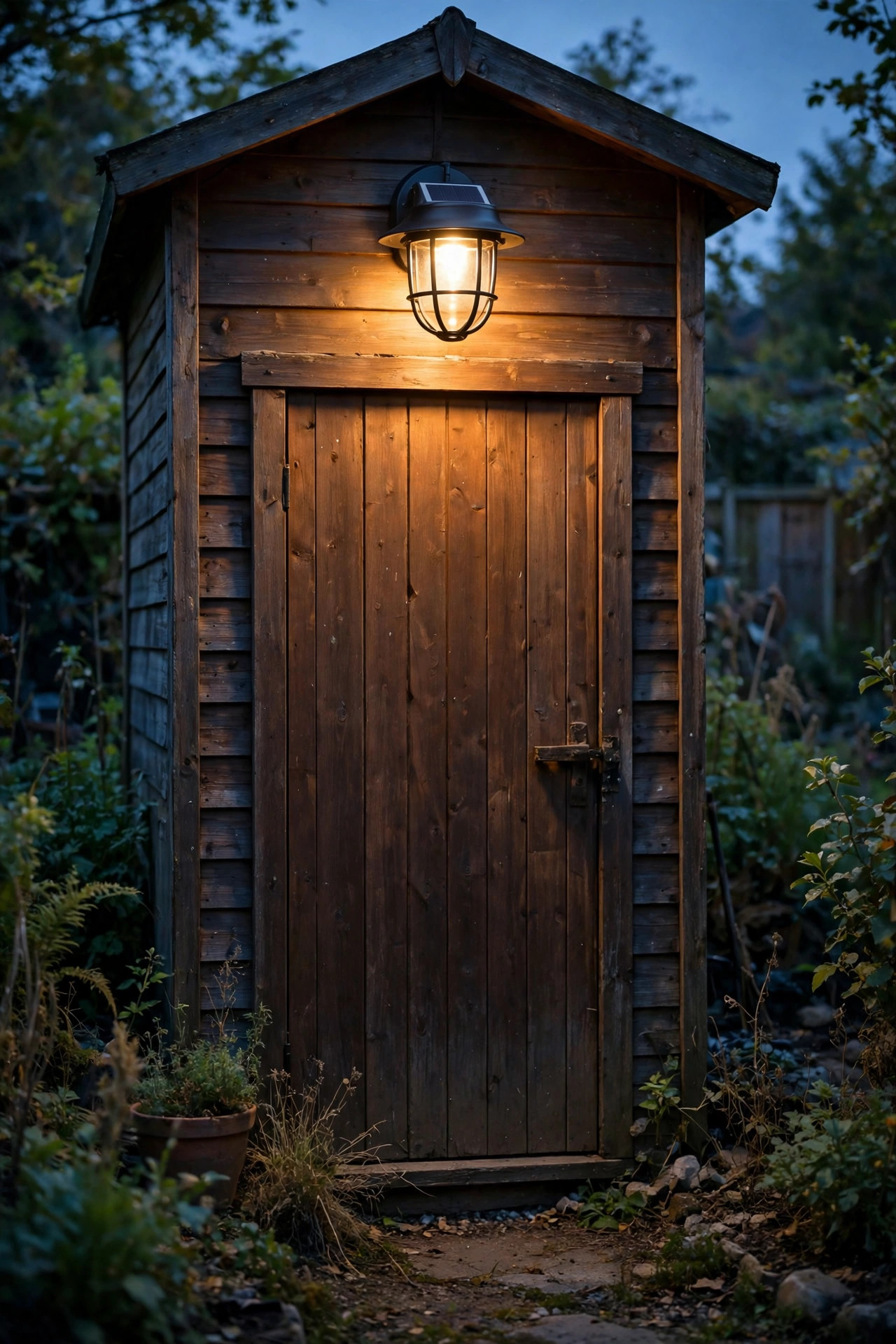
The far corners of the yard — the shed, the side gate, the back of the garage — usually sit in total darkness because running wire out there is a project nobody wants. Solar wall lights shaped like little barn or carriage lamps mount with two screws and fix that in fifteen minutes. The panel sits on top or connects by a short cable, so a shed wall that gets afternoon sun is perfect. I put one over our shed door and one by the compost bins, and both have survived three winters. Look for models with a replaceable battery and a real on-off switch so you can rest them during the darkest weeks if runtime dips. Brightness runs 50 to 200 lumens — plenty to find a lock, a tool, or the right bin at night. Mount them 7 to 8 feet high so the light spreads instead of spotlighting the wall. If you are weighing solar against wired for bigger jobs, my honest comparison of solar vs wired landscape lighting lays out where each one wins.
Suggested budget range: $24 – $50.
17. Glowing Solar Orbs and Moon Lights Scattered on the Lawn
For the finishing touch, I scatter a few glowing solar orbs across the lawn and beds — soft moons that seem to have rolled out of a fairy tale and stayed. They come from 6-inch accents up to statement pieces nearly 2 feet across, with stakes or weighted bases to sit directly on grass or mulch. Three orbs in a loose triangle near the patio, in staggered sizes, is my favorite arrangement; a single large one under a tree looks quietly dramatic. Most offer warm white and color modes, and the remote-controlled versions let you set the whole group at once. Charge time is longer for the big orbs, so place them where afternoon sun reaches, or accept a shorter runtime in deep shade spots. The glow is gentle — think nightlight, not spotlight — so they layer beautifully with string lights overhead and stakes along the path. Bring the largest orbs under cover for hail season. They are whimsical, yes, but in the best way: the yard should have a little wonder in it.
Suggested budget range: $28 – $75.

Frequently Asked Questions
How long do solar backyard lights actually stay on at night?
On a full day of sun, most quality solar lights run 8 to 10 hours in summer — dusk to well past midnight. In winter, with shorter days and a lower sun, expect 4 to 6 hours, and place panels where they catch the midday light. Cloudy days charge partial batteries, so a string of grey days means earlier fade-outs. Lights with larger panels and replaceable lithium batteries consistently outperform the cheapest sets. Brushing dust and pollen off panels monthly makes a bigger difference than most people expect.
Are battery-powered lights bright enough to light a whole backyard?
For ambience and wayfinding, absolutely — layered battery lights can make a yard feel fully lit. For true task brightness, like reading or grilling, one or two stronger pieces do the heavy lifting: a rechargeable lantern on the table or a motion-sensor light near the grill. Think like a lighting designer and layer ambient, task, and accent sources instead of asking one fixture to do everything. That layered approach is exactly what makes evenings in our backyard set up for entertaining feel so comfortable. Rechargeable batteries keep the running cost near zero.
Do solar lights work in winter and cloudy weather?
Yes, with realistic expectations. Solar panels still charge on bright overcast days, just more slowly, and cold weather actually helps panel efficiency while slightly shortening battery output. Angle panels toward the winter sun, keep them clear of snow and fallen leaves, and choose lights with bigger panels for northern yards. Many people run a hybrid setup: solar carries spring through fall, and a few rechargeable pieces that come indoors to charge cover the darkest December weeks. That combination has never left us in the dark.
How do I make solar lights last more seasons?
Three habits matter most. First, keep panels clean — a monthly wipe with a damp cloth restores lost charging. Second, replace the rechargeable batteries every one to two years instead of replacing whole fixtures; most use standard AA or 18650 cells. Third, store purely decorative pieces like fairy strands and floating orbs indoors over winter to protect seals and wiring. Also check that fixtures carry at least an IP44 weather rating for year-round outdoor use, and bring anything rated lower under cover during storms.
Conclusion
A missing outlet is not a life sentence to a dark yard. With smart layering — strings overhead, stakes along the paths, lanterns and accents where you gather — backyard lighting without outlet power can look every bit as warm and intentional as a wired system, for a fraction of the cost and none of the trenching. Start with one or two ideas near the patio, live with them for a few evenings, and add layers as you see what the yard asks for next. Browse the rest of our outdoor lighting ideas for more inspiration, and go enjoy your backyard after dark.