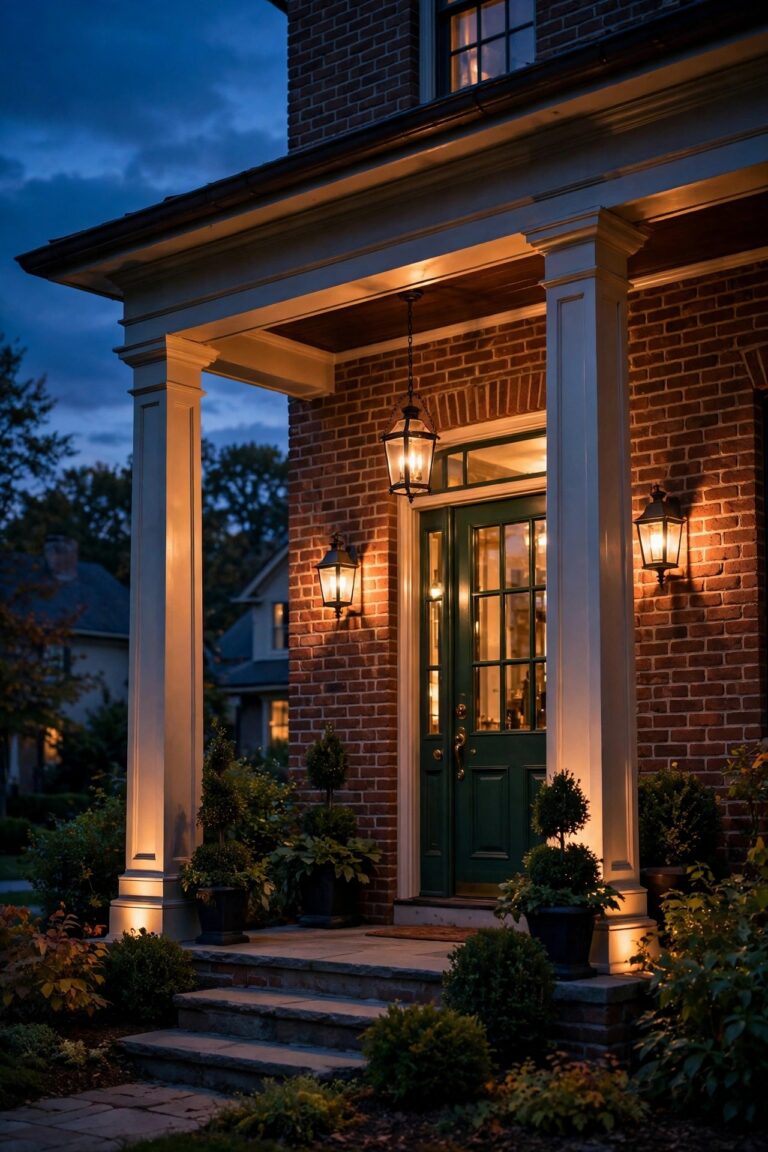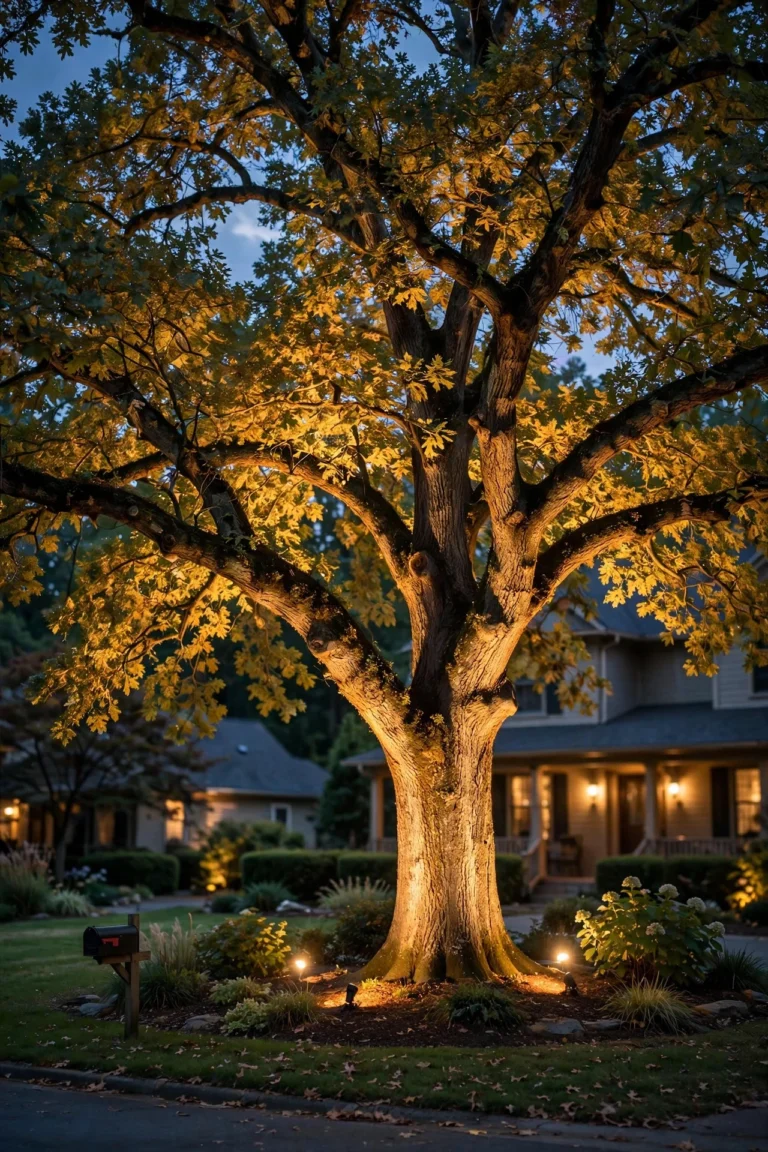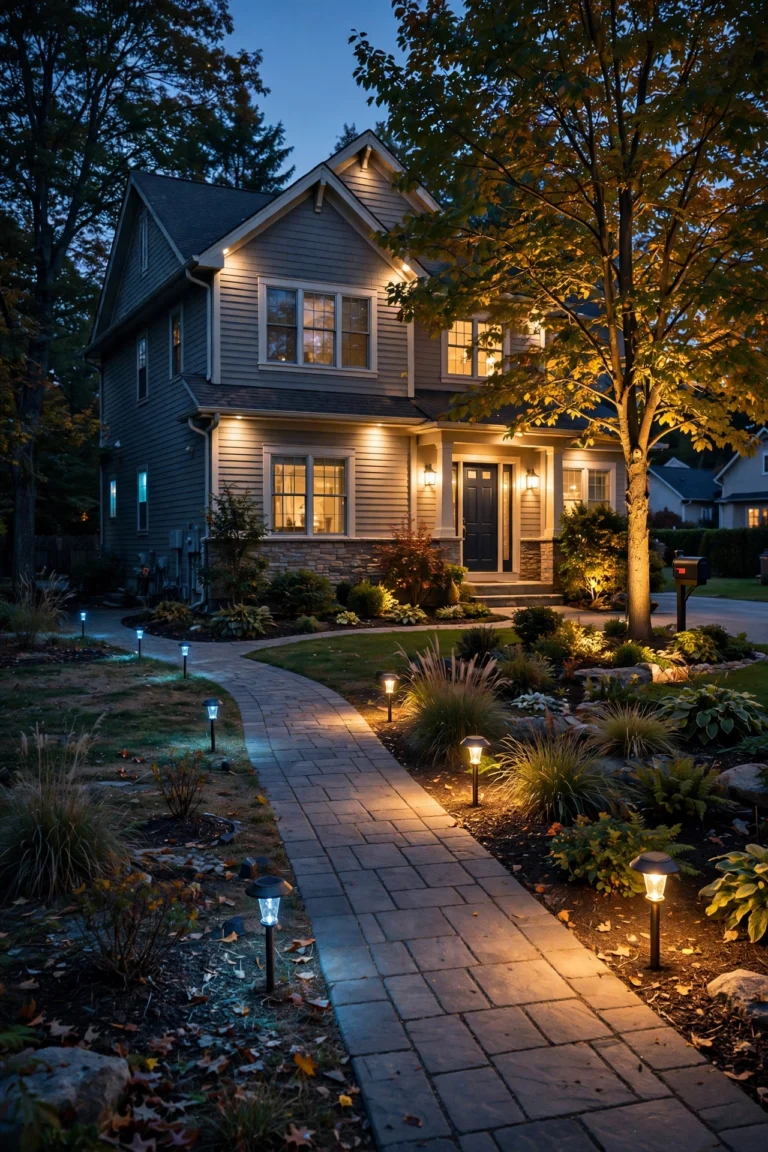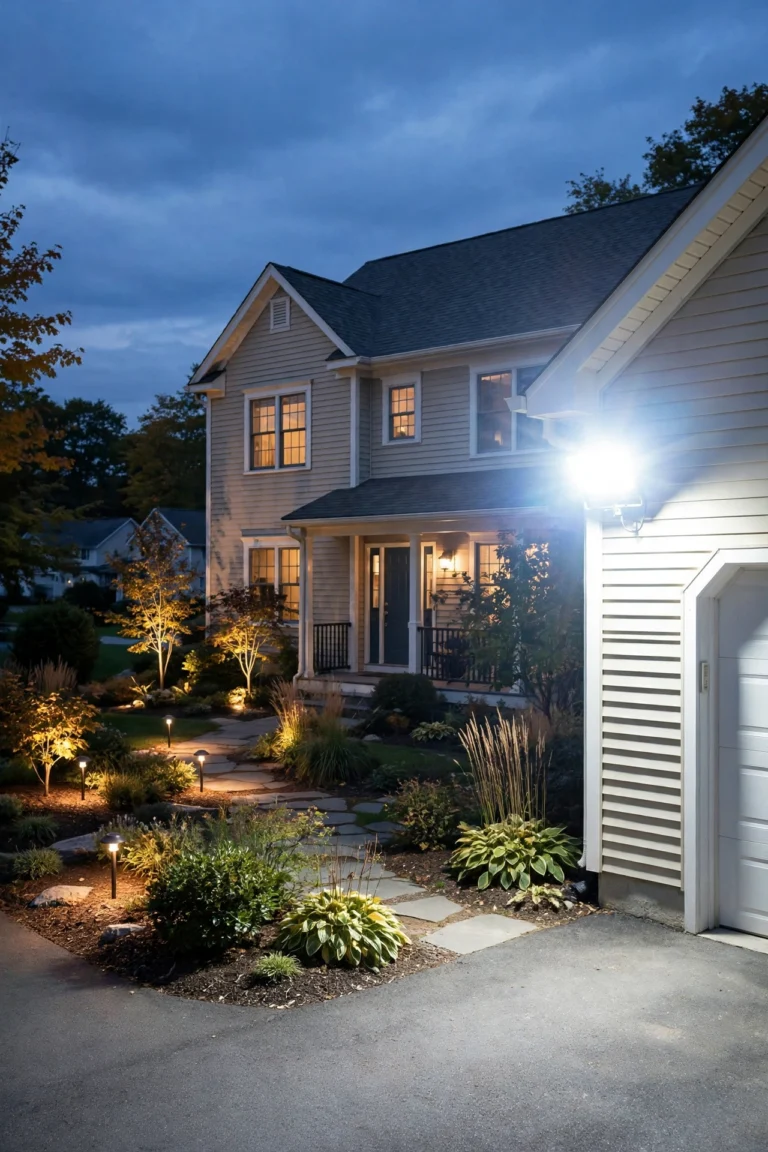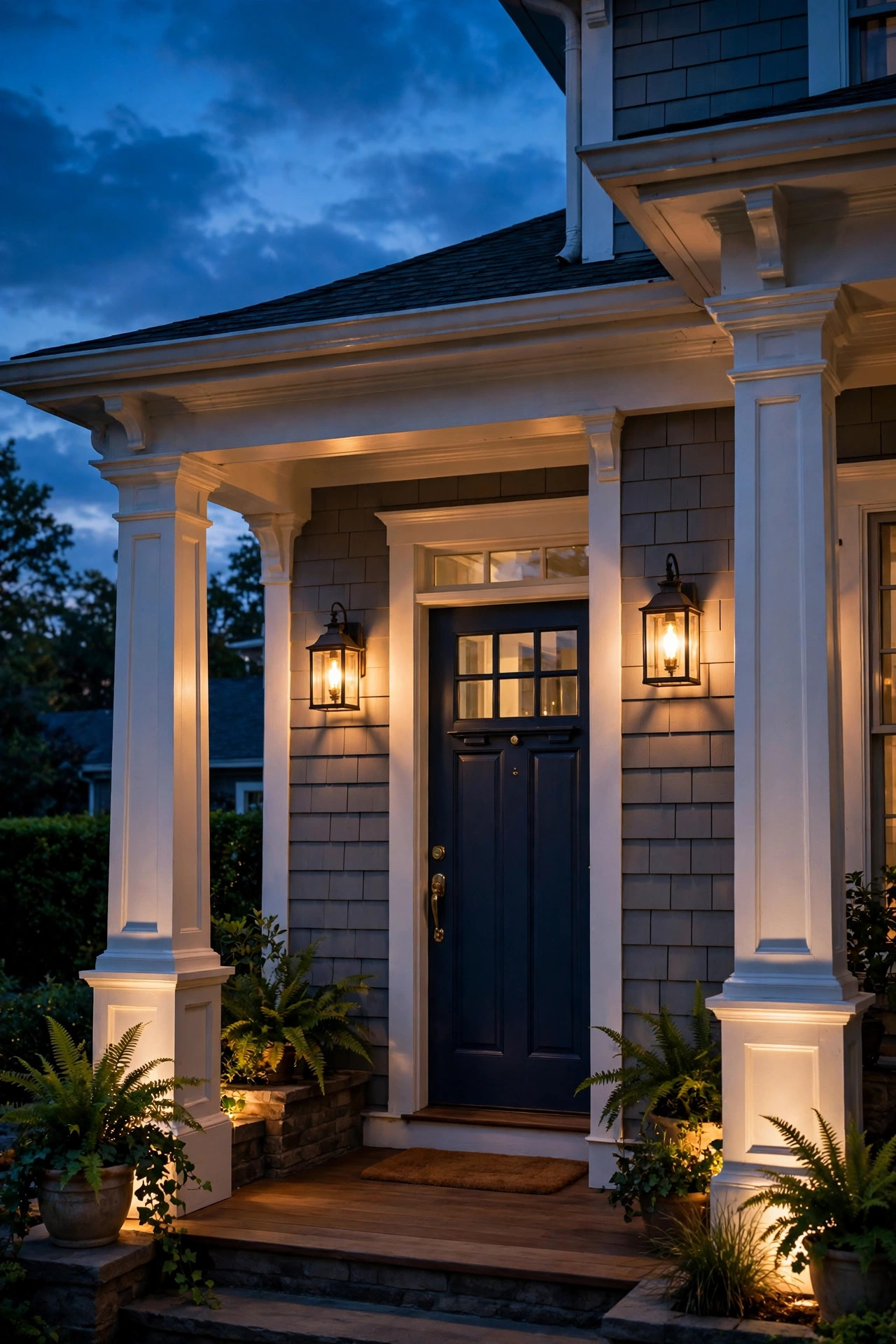
Columns are the unsung heroes of a front porch. They hold the roof up, sure, but visually they frame your front door — and most of us leave that frame dark after sunset. When I started collecting porch column lighting ideas for my own entry, I realized the columns were the easiest place to make the whole house look intentional. A bare porch with two lit columns reads as designed; a fancy porch with dark columns somehow still looks unfinished.
The trick, as with all good outdoor lighting, is layering. One light source gives you a porch lamp. Two or three gentle sources — a wash from below, a lantern at eye level, a little sparkle overhead — give you depth, shadow, and that warm "someone's home" glow. In this list you'll find wired, solar, and battery options, permanent installs and Saturday-afternoon projects, each with placement measurements from my own trial and error. Pick one idea to start, or mix three, like I did.
1. Mount Lantern-Style Sconces Right on the Column Face
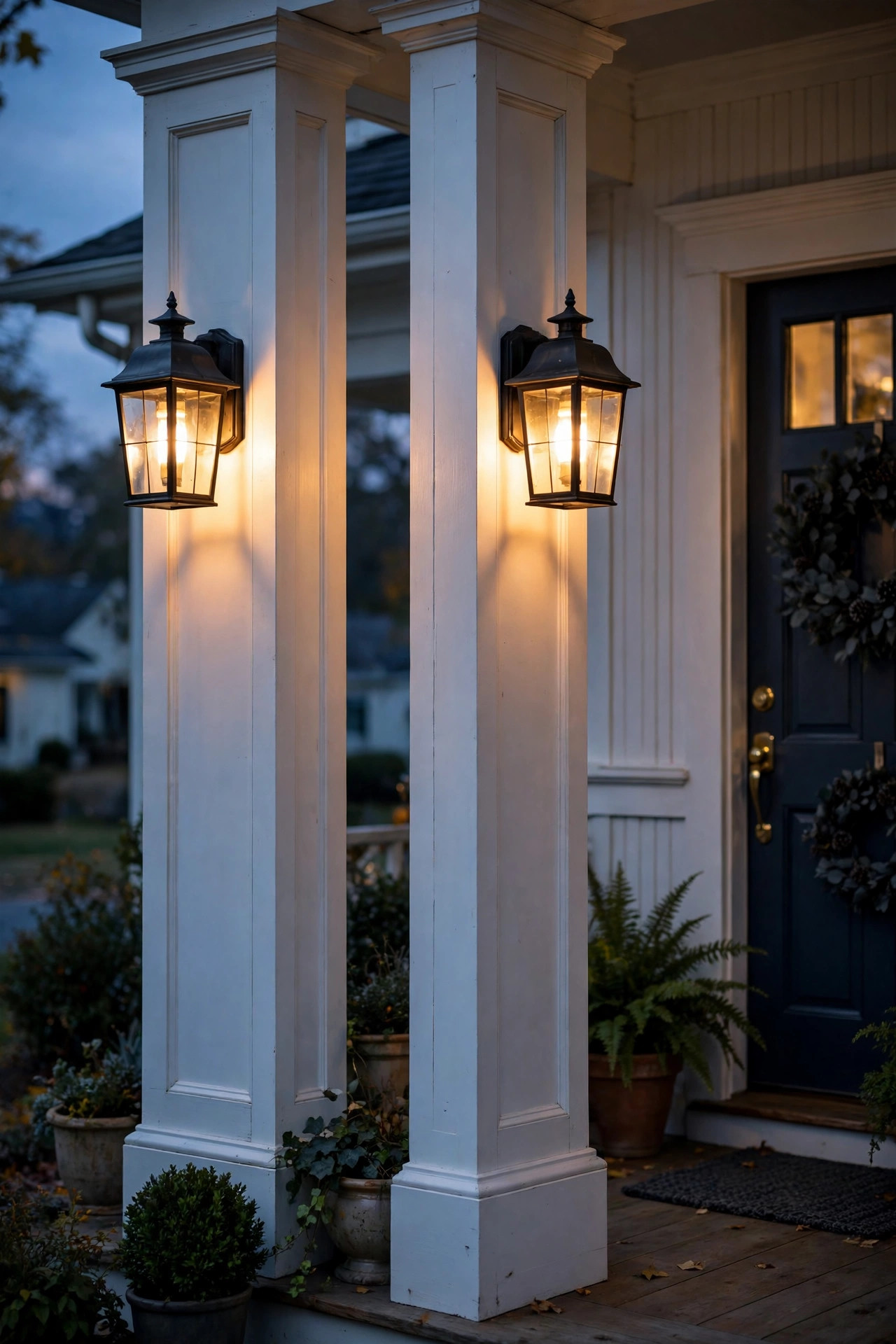
This is the classic for a reason. A lantern-style sconce mounted on the front face of each column, centered about 5½ to 6 feet above the porch floor, throws light exactly where guests look — at eye level, framing the door beyond. On square wood columns wider than 6 inches, a standard backplate mounts cleanly with exterior screws; on round fiberglass columns, choose a fixture with a curved adapter or mount through a flat trim block instead.
Use LED filament-style bulbs at 2700K, 40-watt equivalent or less. Anything brighter glares at eye level and flattens the whole porch. If your columns are brick or stone, you'll need a masonry bit and anchors — doable, but honestly? That's the one version of this project I'd consider hiring out if drilling into brick makes you nervous.
Wire them to the same switch as your porch ceiling light, and put the circuit on a timer or dusk-to-dawn sensor so you're never the dark house on the street. It's the single most traditional of all porch column lighting ideas, and it never looks dated.
Suggested budget range: $60 – $180.
2. Wrap Columns in Warm String Lights, Spiral Style
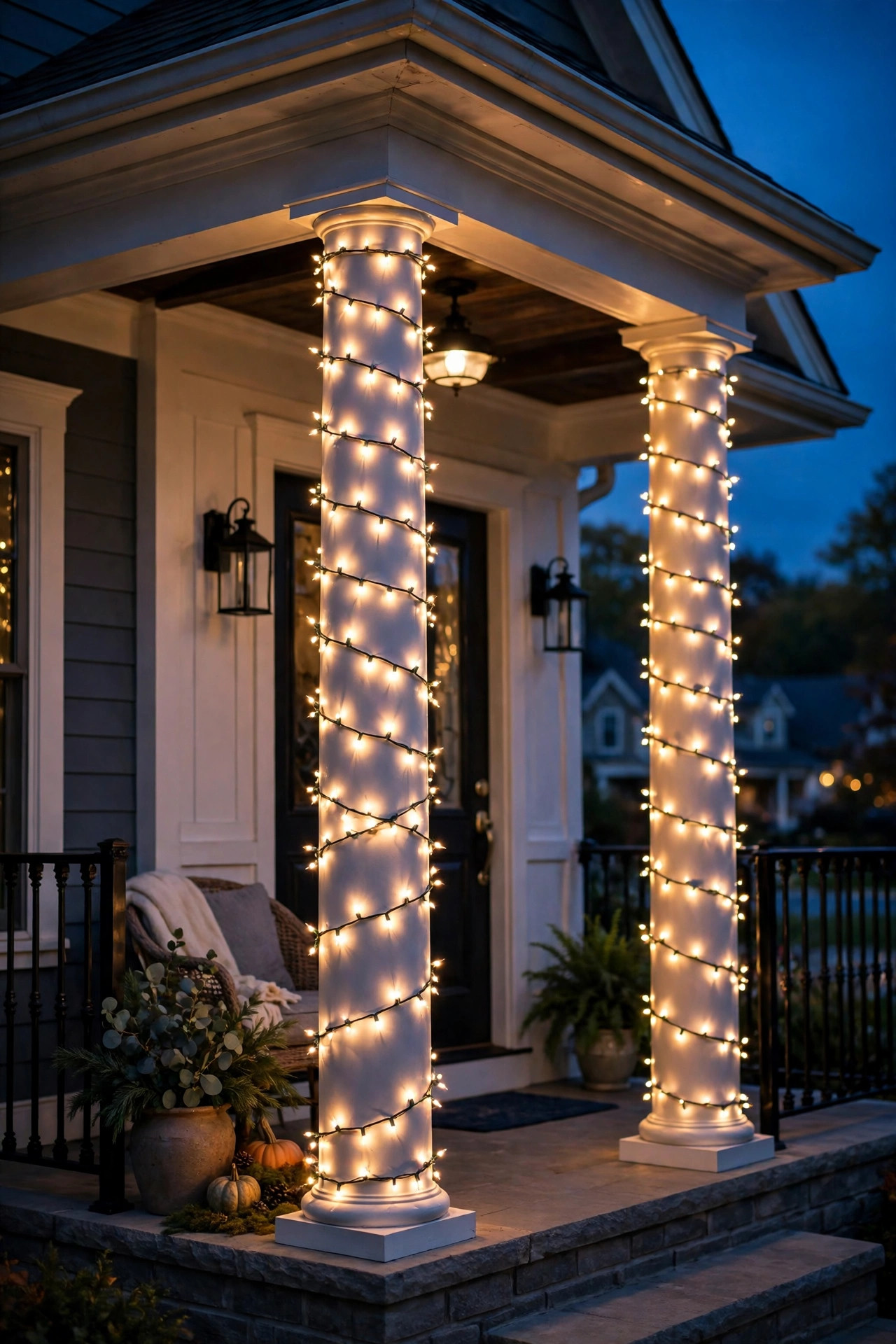
If your porch needs charm tonight and not after a wiring project, spiral-wrapped string lights are your answer. Start at the base, plug-end down, and wind commercial-grade LED string lights upward in even spirals, spacing the wraps 6 to 8 inches apart. Closer wraps (4 inches) read festive; wider wraps read elegant. Secure the cord with clear removable hooks or black twist ties every other turn so nothing sags by week two.
Work out your length before you buy: a standard 8-foot column with 6-inch spacing needs roughly 25 to 30 feet of lights per column. Outdoor-rated strands with shatterproof LED bulbs are the ones that survive a full season — the cheap indoor sets yellow and crack by spring, ask me how I know.
Keep the color temperature honest: choose warm white (2700K on the box). Mixing a cool-white strand on one column and warm on the other is the fastest way to make the whole porch look like a mistake. Plug the whole run into a simple outdoor timer set for dusk to 11 p.m. and the porch lights itself every evening.
Suggested budget range: $25 – $70.
3. Wash Columns From Below With Ground Uplights
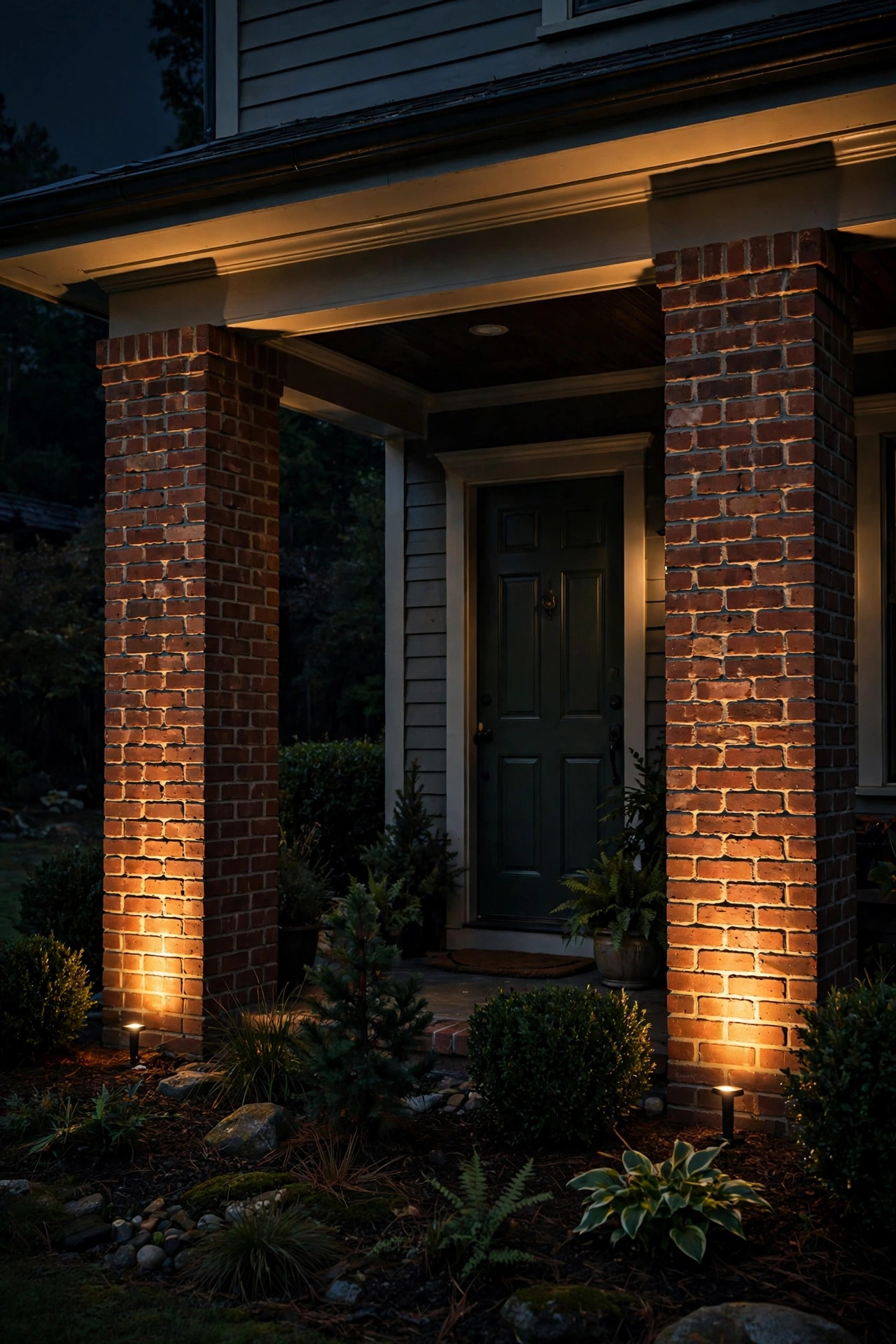
Uplighting is the drama move. A low-voltage spotlight staked in the planting bed 12 to 18 inches in front of each column, aimed straight up the face, turns plain posts into architectural features. The light grazes across the surface, so texture — brick joints, wood grain, stone — suddenly has shadows and depth that flat porch light never gives you.
Choose a narrow beam, around 15 to 24 degrees, so the light climbs the column instead of spilling across the whole porch. A 3- to 5-watt LED MR16 in a brass or powder-coated stake fixture is plenty. Run the low-voltage cable through the bed under mulch and back to a transformer by the house; this is exactly the kind of project a basic low-voltage kit handles in an afternoon.
Angle matters more than wattage. Stand at the street after dark and adjust: you want the beam to kiss the capital at the top without blasting the porch ceiling. It's the foundation of most layered front entries I design.
Suggested budget range: $40 – $120.
4. Cap Square Columns With Solar Post-Cap Lights
If your porch columns are square posts — or sit above square railing posts at the porch edge — post-cap lights are the easiest install on this entire list. They literally sit on top. Most models fit standard 4×4 or 6×6 posts, need no wiring at all, and charge through the day from a small solar panel in the cap.
Be honest with yourself about expectations: a solar cap light gives a gentle halo, maybe a 2-foot pool of usable light below it. It's an accent, not a work light. But two or four of them in a row along a porch edge create a rhythm your eye reads as intentional design, and they cost pennies to run. The mid-priced caps with replaceable batteries outlast the bargain ones by years — budget for the better tier.
Clean the little solar panels with a damp cloth every month or two — pollen film is the silent killer of solar brightness. Expect 6 to 8 hours of glow after a full sunny day, less in December. Pair them with one stronger light near the door for balance.
Suggested budget range: $30 – $90.

5. Hang Pendant Lanterns in the Bays Between Columns
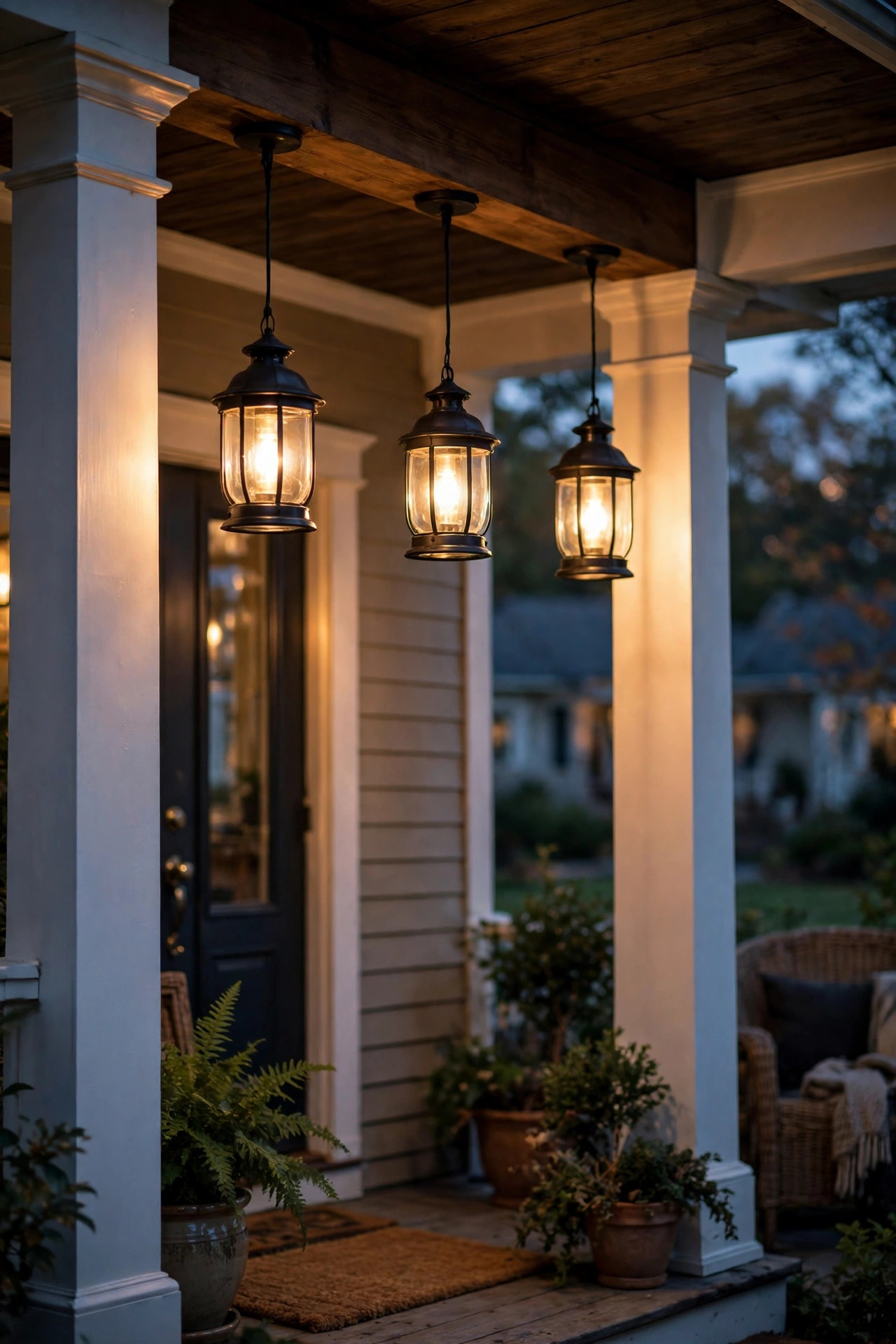
Look up: the open bays between your columns are empty frames begging for a hanging lantern. A pendant or swag lantern hung from the porch beam, centered in each bay and bottoming out at about 7 feet above the floor, fills the vertical space that sconces and uplights miss. Guests see glow at three heights instead of one, and the porch instantly feels taller.
Use outdoor-rated pendants or battery lanterns on adjustable hooks if you don't want to touch wiring. Chain length is your friend: hang, step back, adjust, repeat. Two bays usually want matching heights; a center bay over the steps can sit 6 inches lower as a focal point.
Keep bulbs at 2700K and modest wattage, since these hang closest to eye level from the street. A dimmer or smart bulb lets you drop them to a candle-like level for evenings on the porch while keeping pathway lights brighter. Of all the porch column lighting ideas here, this is the one neighbors ask about most — it reads custom even when it's two lanterns and a ladder.
Suggested budget range: $50 – $160.
6. Tuck LED Rope Light Along the Column Edges
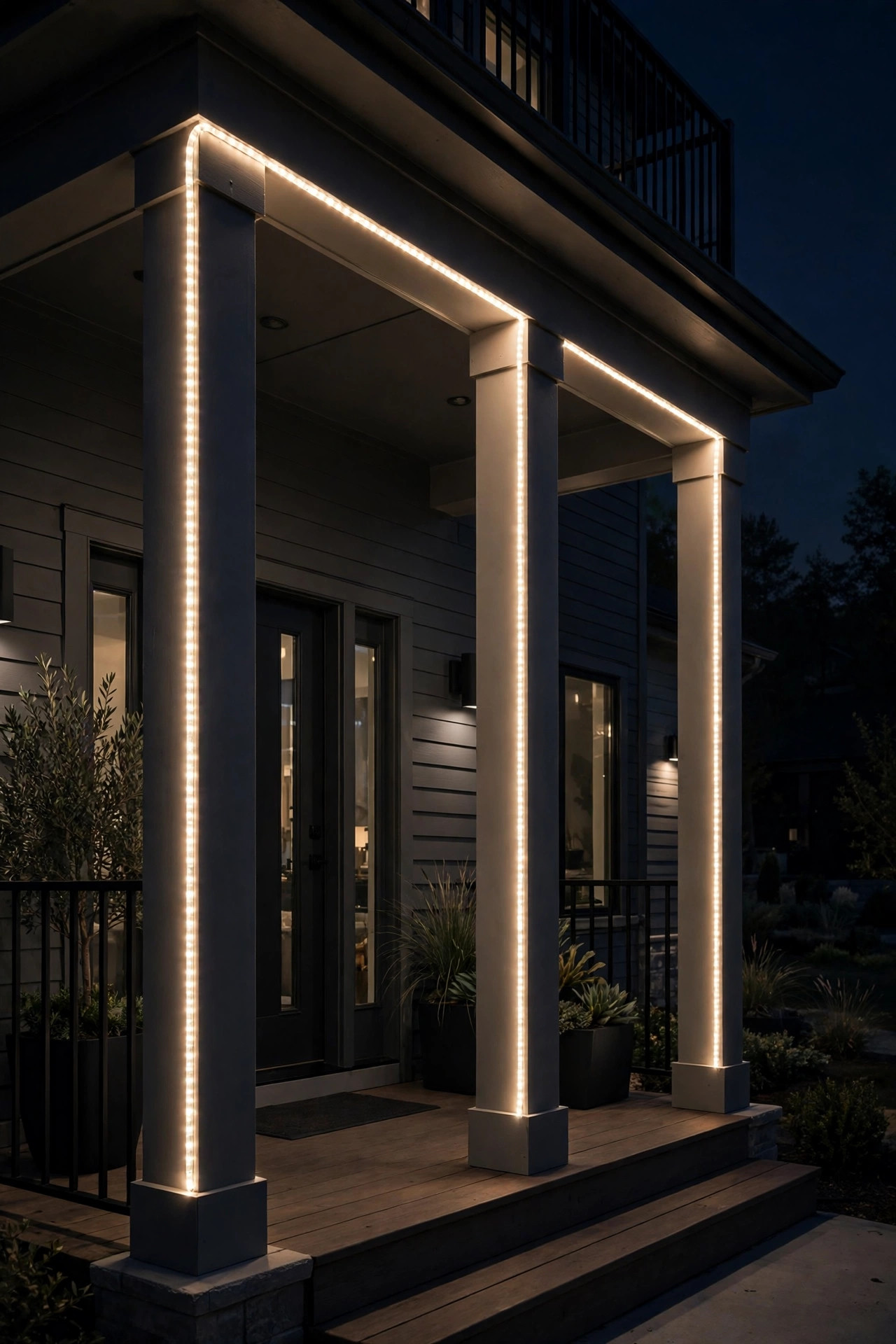
For a clean, modern outline, run LED rope light vertically up the inside edge of each column, hidden in the shadow line where the column meets the porch. You don't see the rope — you see a crisp line of light defining the column's silhouette. It's architectural, a little unexpected, and it photographs beautifully.
Outdoor-rated rope light or LED tape in an aluminum channel both work; the channel diffuses the dots into an even line and gives you a straight mounting surface with screw clips every 12 inches. Warm white only — 2700K or 3000K. Cool white here looks like a convenience store, and I say that with love.
Power it from the porch outlet through a timer, or hardwire the low-voltage version into your landscape transformer. The honest downside: rope light reads modern, so on a very traditional colonial porch it can clash. Test one column first before committing to all of them. Done right, this is the cheapest way to make stock builder columns look like a design feature.
Suggested budget range: $35 – $100.
7. Drape Lighted Garland Around Each Column
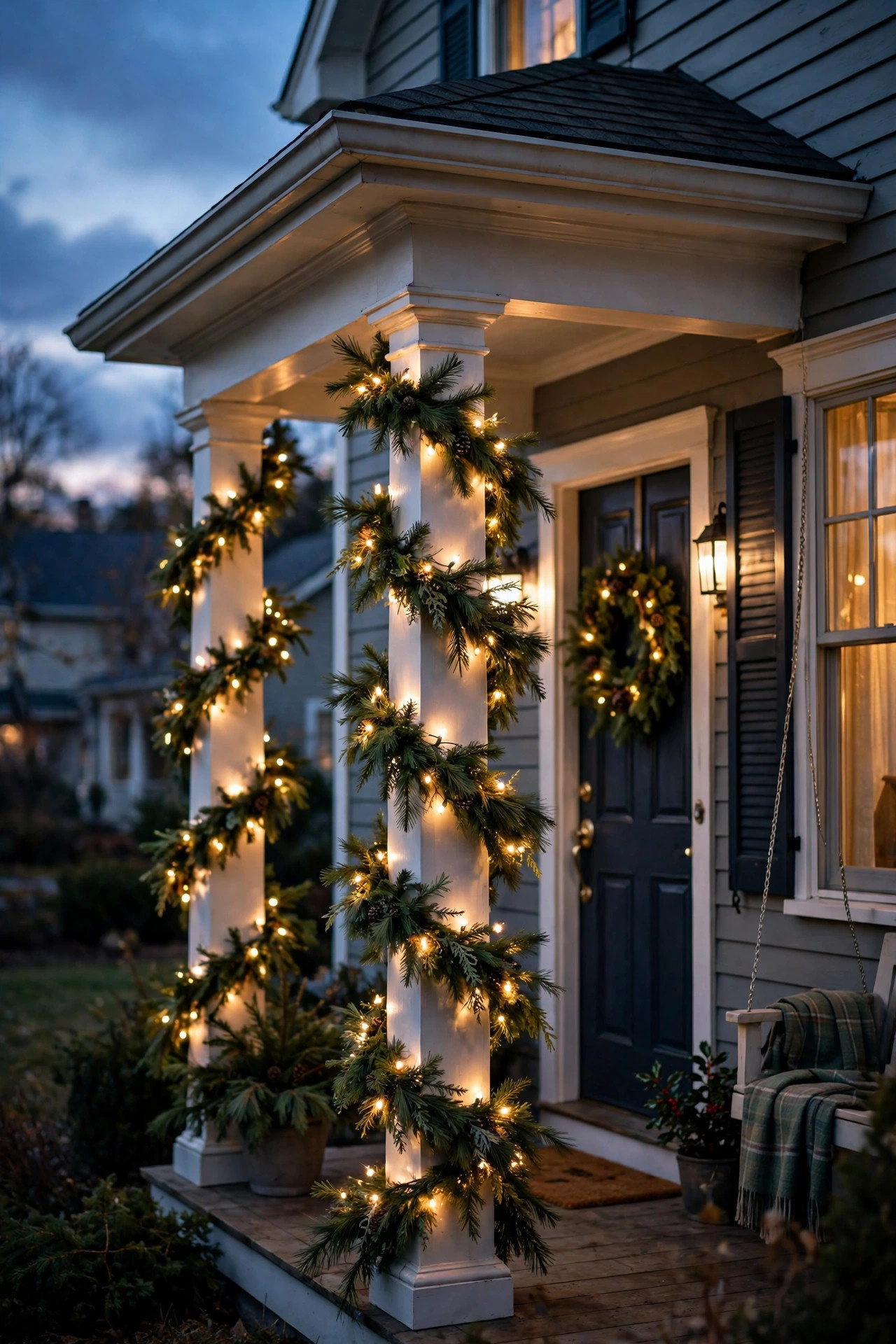
Come fall and the holidays, a lighted garland spiraled around each column is the porch equivalent of a wreath on the door — it just says someone cares about this house. Start at the top, secure with a hook or a discreet zip tie, and spiral down at a gentle angle so the greenery wraps evenly, roughly one full turn every 18 inches of height.
Pre-lit garlands save the two-step tango of separate lights and greens, and battery-operated versions with built-in timers mean no cord across the porch floor. For fall, swap to a leaf garland with warm mini lights; for December, classic pine with warm white. Mixing a few pinecones or ribbon into the wrap costs almost nothing and doubles the effect.
Keep garland clear of any bulb that runs hot — LED garlands only, and never drape fabric or dried leaves against a fixture. One caution from experience: wind works wraps loose over a season, so re-secure monthly and store garlands loosely coiled, not wadded, or next year starts with an hour of untangling.
Suggested budget range: $30 – $110.
8. Hang Battery Lanterns From Decorative Column Hooks
Renters and commitment-phobes, this one's yours. Install a pair of decorative black hooks (or use removable outdoor adhesive hooks) on the inner face of each column at about 6 feet, and hang battery-operated lanterns with timers. Five hours on, nineteen off — they light themselves at dusk every day with zero wiring and zero solar gamble.
Battery lanterns have gotten genuinely good: LED filament styles with a warm flicker mode look convincingly candle-like, and a set of AA batteries lasts a full season on the timer setting. Hang them on the inner faces so the glow washes across the porch rather than blasting the street, and match the lantern finish to your door hardware for that pulled-together look.
The look is more "collected" than "installed," which suits cottages, farmhouses, and any porch with a swing. When a storm rolls in, you can have every light inside in ninety seconds — try that with hardwired fixtures. This is also my go-to suggestion for anyone testing whether they even like column lighting before spending real money on it.
Suggested budget range: $40 – $120.

9. Add Soffit Downlights Above Each Column
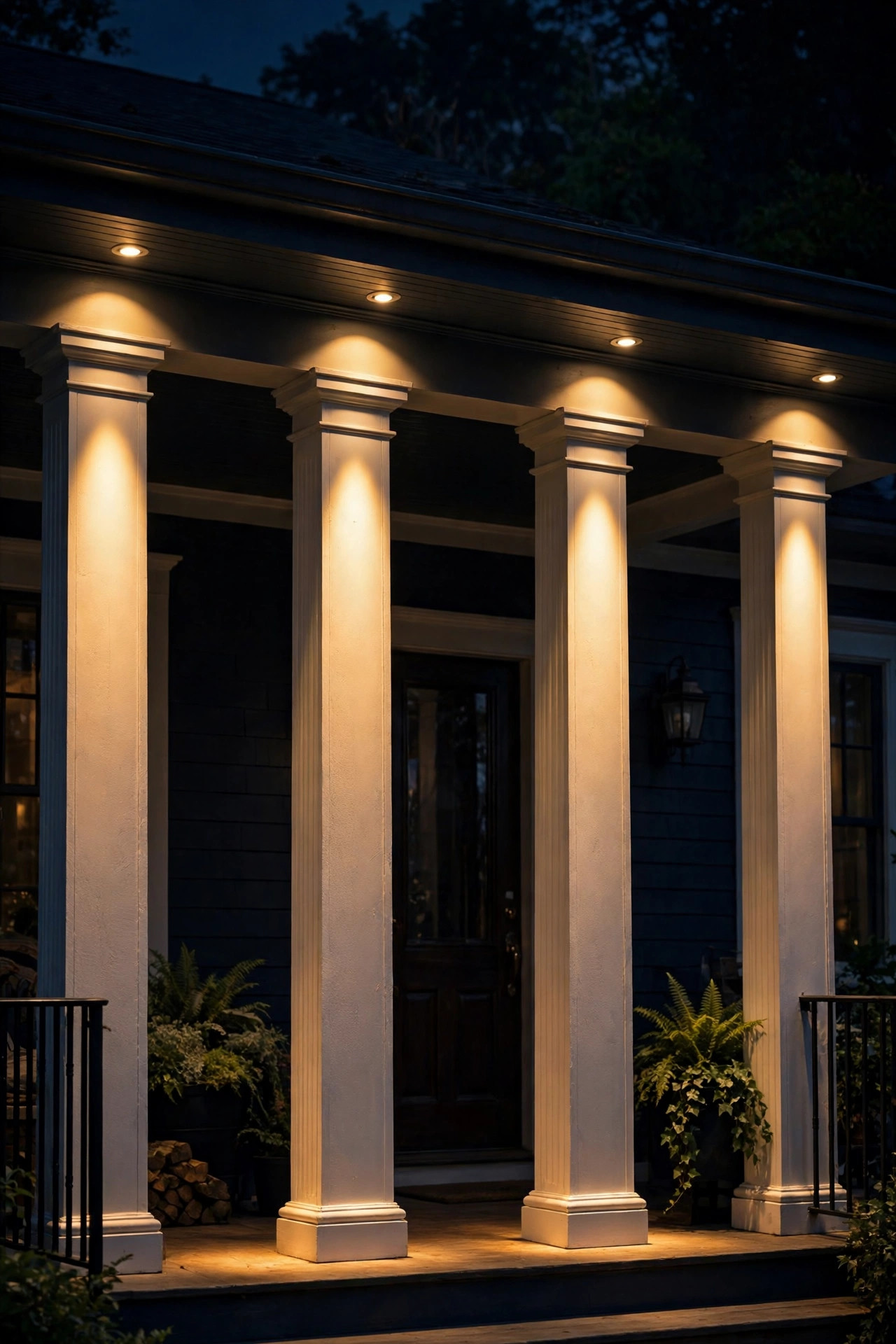
Sometimes the smartest column lighting doesn't touch the column at all. A recessed or surface-mount downlight in the porch soffit (the ceiling) directly above each column throws a cone of light down the column's face and pools at its base. The column becomes a lit pillar in the most literal sense, and the porch gains real, usable light as a bonus.
Space these to match your columns exactly — centered on each column face, typically 6 to 10 inches out from the house. Choose 4-inch LED recessed fixtures with a warm 2700K output and a wide 60-degree beam for a soft wash. On a dimmer, they shift from "welcome the guests" bright to "glass of wine on the porch" low.
This ties into the existing porch ceiling circuit in most homes. If your porch already has a ceiling light, swapping to two or three smaller downlights — one per column bay — often uses the same junction with a little extra wiring. It's the most permanent of these porch column lighting ideas, and the one that adds the most actual visibility for steps and locks.
Suggested budget range: $120 – $350.
10. Set Flameless-Candle Lanterns at the Column Bases
Ground-level glow changes everything about how a porch feels at night. A hurricane lantern with a flameless LED candle set at the base of each column — on the porch floor, flanking the steps, or on a low plant stand — adds the lowest layer of the lighting stack and makes the whole entry feel grounded and calm.
Flameless is non-negotiable for me near columns and siding: real candles tip, drip, and scorch, and LED candles with a true flicker have gotten so convincing that guests lean in to check. Choose lanterns at least 12 inches tall so they hold their own visually against a full-height column, and set them on the timer function so they greet you at dusk without a thought.
Group in odd numbers if your columns stand near planters — a lantern plus two pots beats a lonely lantern. Keep them a few inches out from the column base so the light wraps the base with a soft halo instead of hiding behind the post. On a wide porch, this base layer is what makes the difference between "lit" and "atmospheric."
Suggested budget range: $25 – $80.
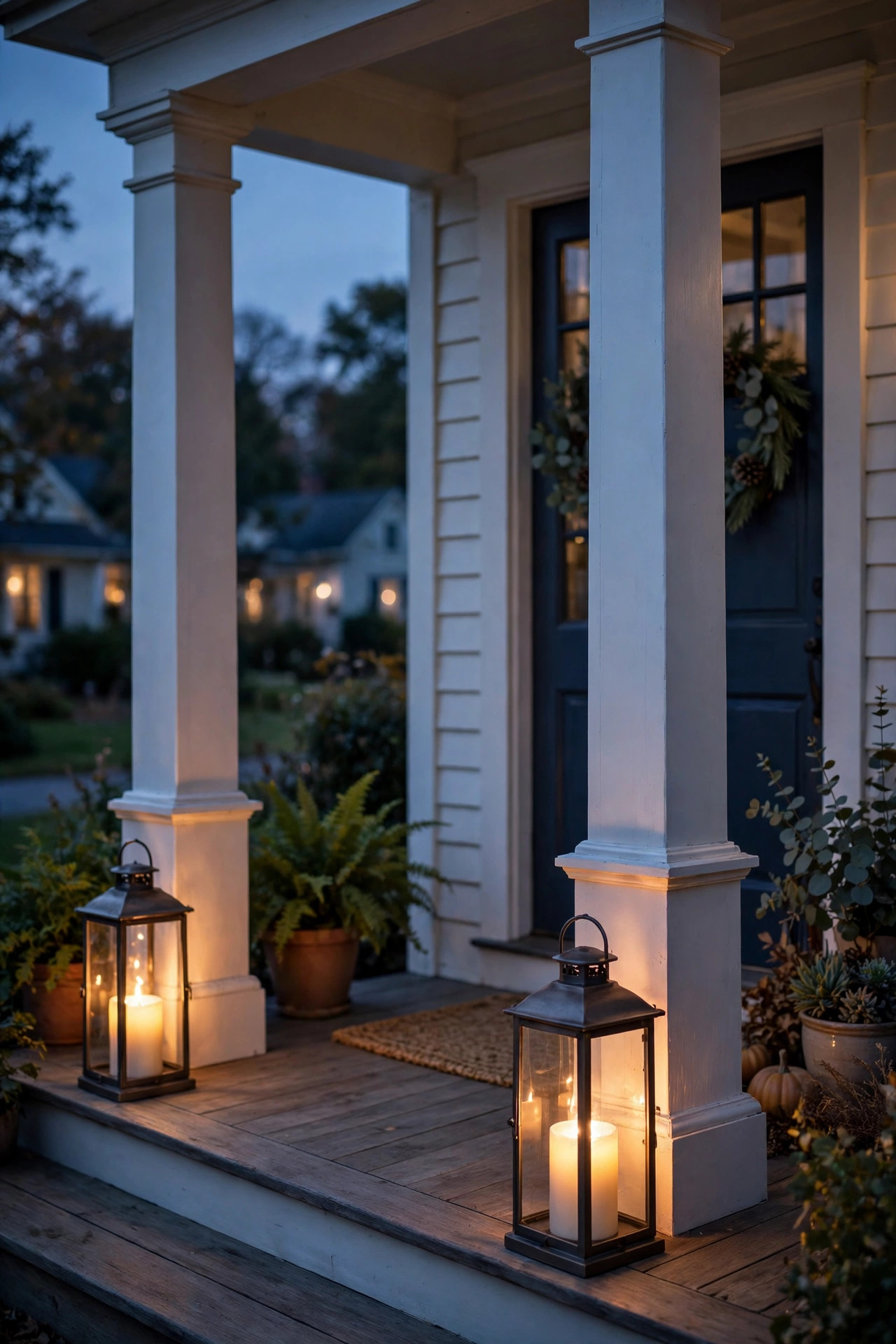
11. Go Symmetrical: Matching Fixtures on Every Column
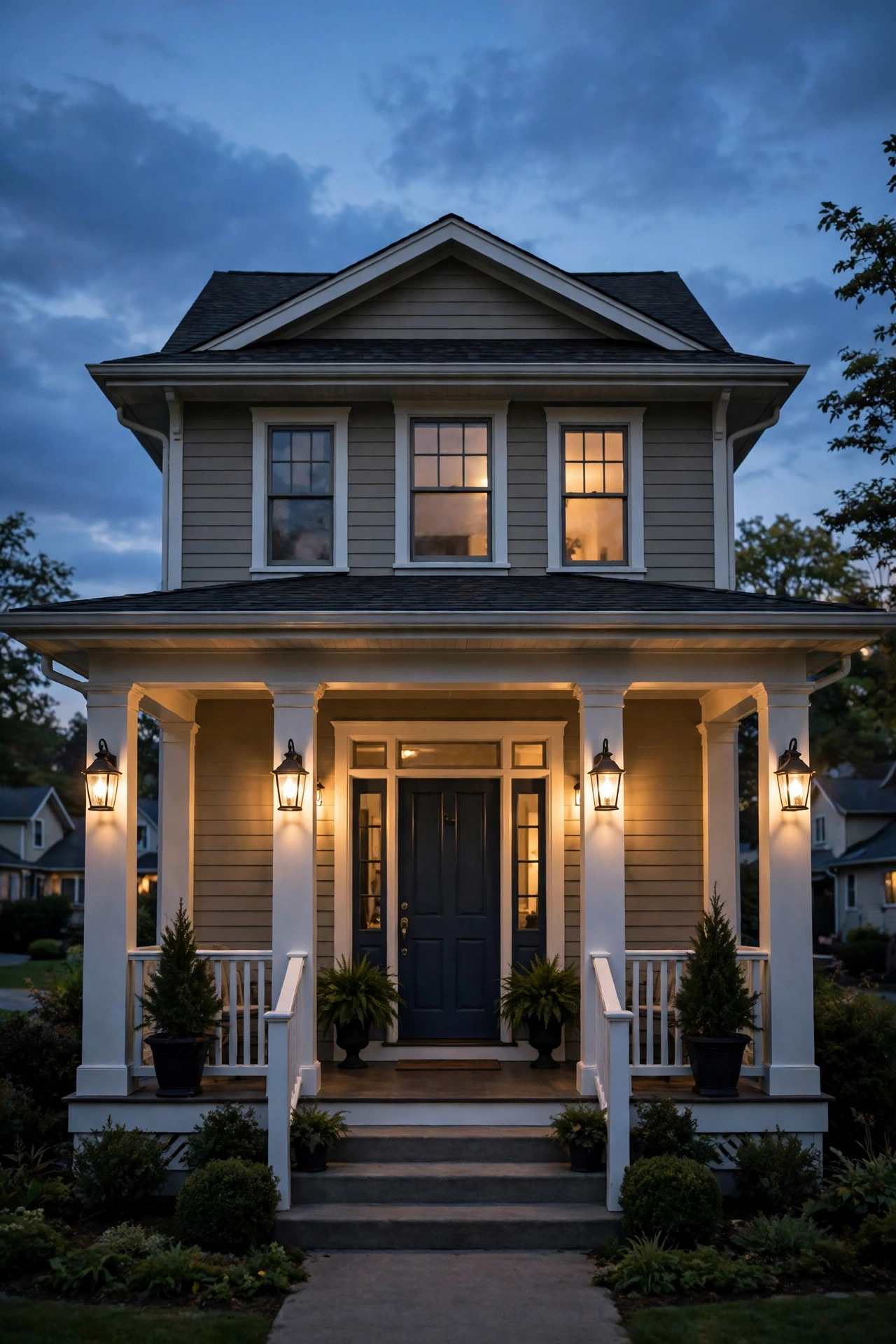
Here's a design principle disguised as an idea: whatever fixture you choose, repeat it identically on every column. Matching sconces, matching wraps, matching caps — the repetition is what the eye reads as architecture. A porch with three different lights on three columns looks like a yard sale; the same light three times looks like a magazine.
Measure once and template everything: same mounting height (mark it with painter's tape on every column before drilling anything), same bulb, same color temperature. Bulbs matter more than people think — two "warm white" bulbs from different makers can differ enough to notice, so buy all your bulbs from the same pack and keep spares from that same pack.
This is also why I always buy fixtures in one order with one extra. Styles get discontinued, finishes change slightly between production runs, and the lone replacement fixture that almost matches will bother you every evening. Symmetry is the cheapest design upgrade there is: it costs nothing extra, it just takes the discipline to commit to one good choice and repeat it.
Suggested budget range: $80 – $250.
12. String a Fairy-Light Curtain Between Two Columns
For a porch with two columns flanking a wide opening — or a corner porch with a long bay — a curtain of fairy lights strung between the columns creates a glowing backdrop that turns the whole porch into an evening room. Run a discreet tension wire or cup hooks along the beam, then hang vertical strands of copper-wire fairy lights every 4 to 6 inches.
Copper-wire strands are nearly invisible by day, which is the magic trick: the porch looks normal at noon and enchanted at eight. Solar-powered strands work if the panel can sit in sun at the porch edge; plug-in strands on a timer are brighter and more reliable, and honestly the route I'd choose for a primary entry.
Keep the curtain on the street-facing bay only, and leave the bay by the door clear so nobody's walking through a veil of lights with groceries. A gentle caution: this is a lot of sparkle, so balance it by keeping every other light on the porch warm and simple. Done with restraint — yes, a light curtain can be restrained — it's the most romantic look on this list.
Suggested budget range: $20 – $60.

13. Use Smart Bulbs in Column Fixtures for Holiday Color
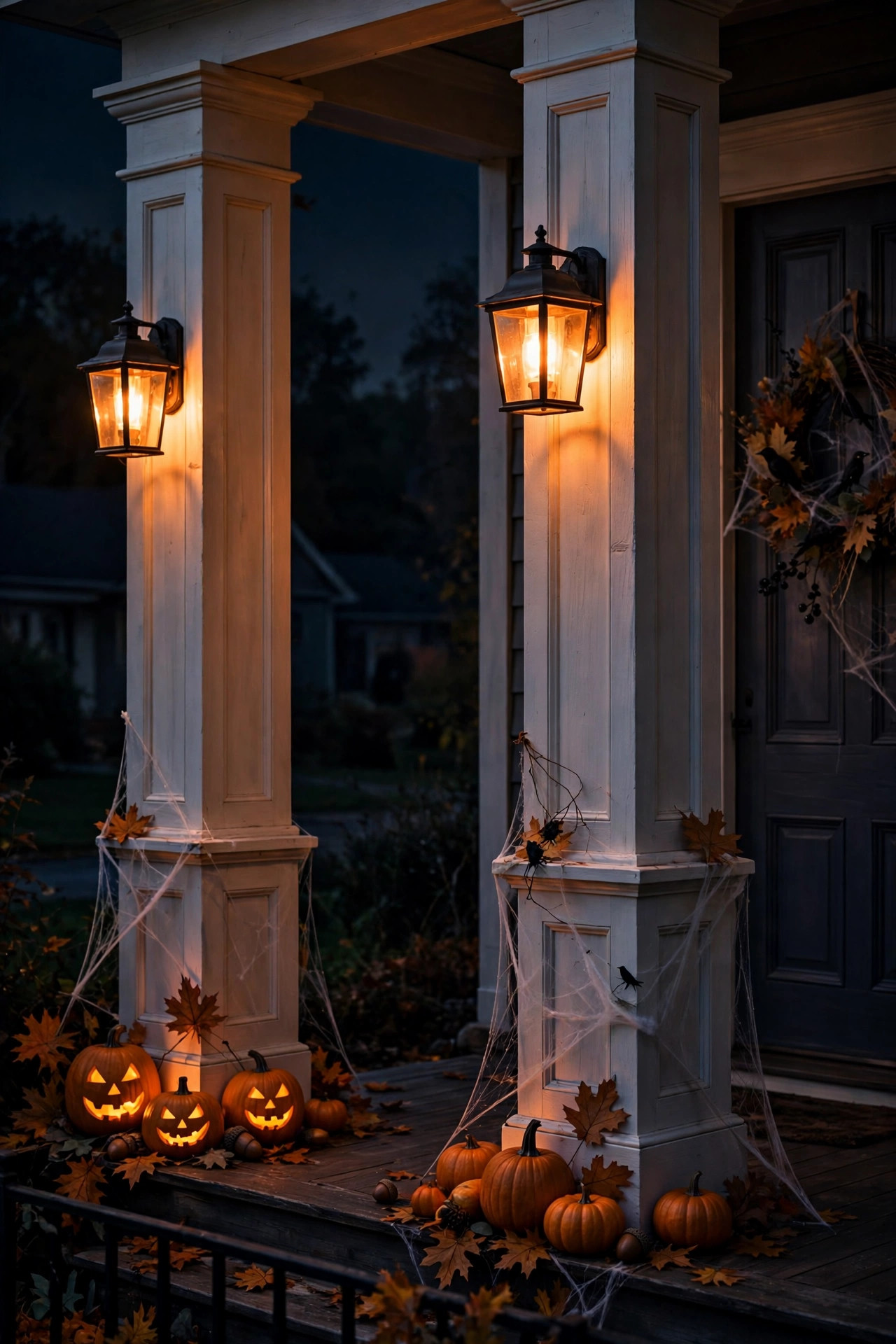
Your column fixtures are perfectly placed to do double duty as holiday lighting — if the bulbs are smart. Swap the standard bulbs in your column sconces or lanterns for smart LED bulbs, keep them at a classic warm 2700K ninety percent of the year, and let them turn amber for Halloween, red and green (tastefully, at low saturation) for December, or red-white-and-blue for the Fourth of July.
The discipline is in the defaults: set a schedule so they return to warm white every morning after a holiday run, or by January your porch is still glowing green and the neighbors are talking. Group both column bulbs in the app so they always change together — one green column and one warm column is a look nobody wants.
Smart bulbs in enclosed fixtures must be rated for enclosed use, and Wi-Fi reach is the usual failure point; if your signal is weak out there, a smart plug running plain bulbs on a schedule gets you half the magic for a third of the price. It's a small upgrade that makes old fixtures feel new every season.
Suggested budget range: $25 – $90.
14. Choose Flicker-Flame Bulbs for a Gas-Lantern Look
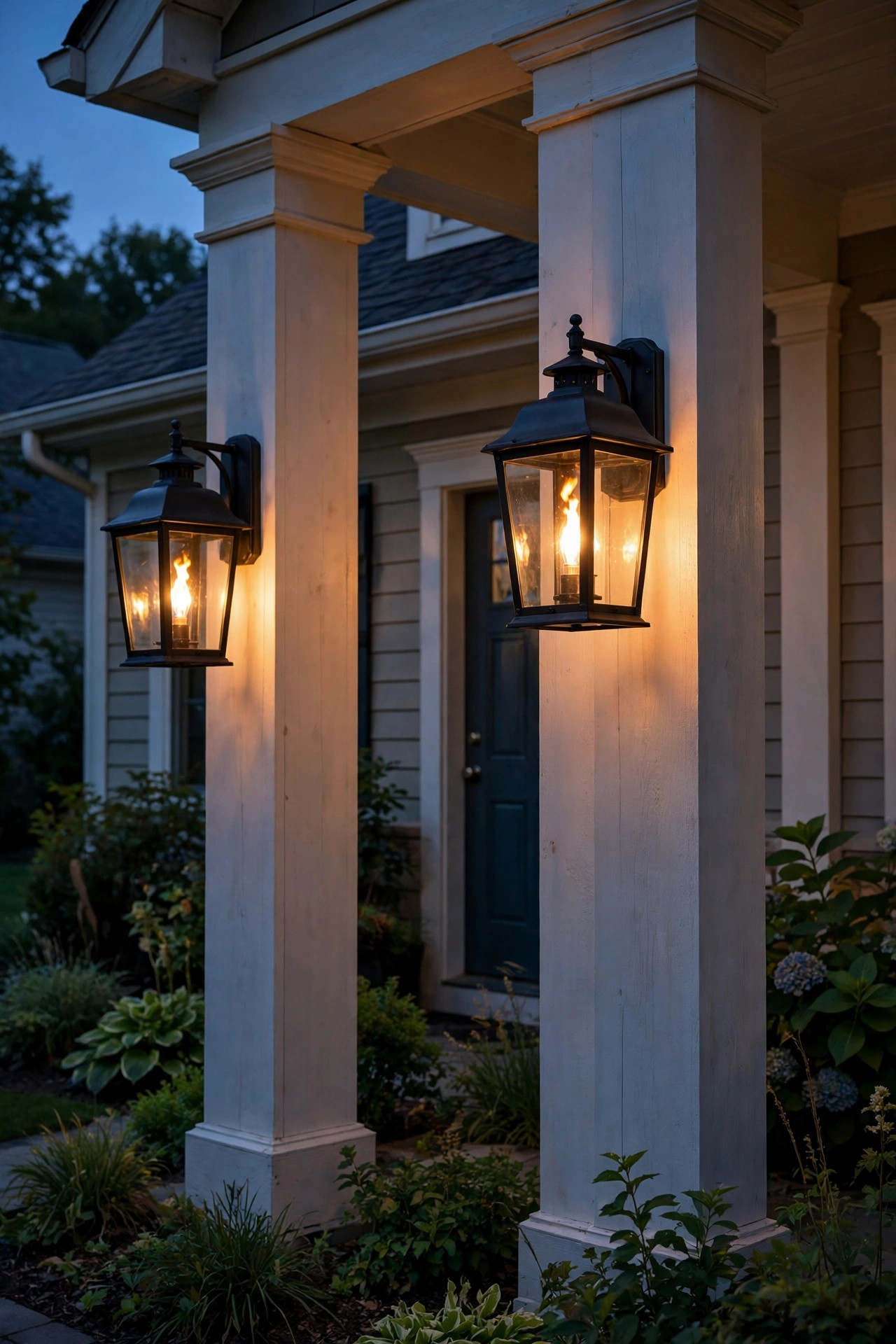
If you love the romance of old gas lanterns but not the gas line, flicker-flame LED bulbs are the closest shortcut I've found. Installed in a clear-glass lantern on each column, the bulb's animated flame effect dances convincingly — especially from the street, especially at dusk. Mount them flame-up in a hanging or wall lantern, since most models read best in their intended orientation.
Pair the flame bulbs with a lantern that has some scale: a 14- to 18-inch carriage-style lantern gives the flame room to register, while a tiny fixture just looks like a bulb having a problem. Keep the rest of the porch lighting steady and warm; the movement should be a single accent, not a competition.
Be realistic about light output — these are mood bulbs, roughly a 25-watt equivalent of usable light, so your lock and steps still need a real light source nearby. In my experience this is the highest compliment-per-dollar swap you can make to existing column fixtures: one bulb change per column, no tools beyond a step stool, and the porch suddenly has a story.
Suggested budget range: $20 – $60.
15. Light the Column Bases With Recessed Step Lights
Here's a trick borrowed from deck design: small recessed step lights installed in the porch floor or the bottom trim of each column, aimed outward. They trace a low line of light at the base of every column, marking the porch edge for guests and giving the columns a subtle "floating" outline against the dark.
Low-voltage LED step lights (about 1 to 3 watts each) wire into the same landscape transformer as path lights, and the porch-floor versions install in a 2- to 3-inch hole with a simple bracket. On a wood porch, position them 4 to 6 inches out from the column base so the little beam grazes the floorboards instead of disappearing under the post.
This layer is pure wayfinding and polish — it won't light a face or a keyhole, and it isn't meant to. What it does beautifully is connect your column lighting to your walkway lighting so the whole approach, from sidewalk to door, reads as one designed system. It's also mercifully subtle for light-sensitive neighbors, since every lumen points down or across the floor.
Suggested budget range: $60 – $170.

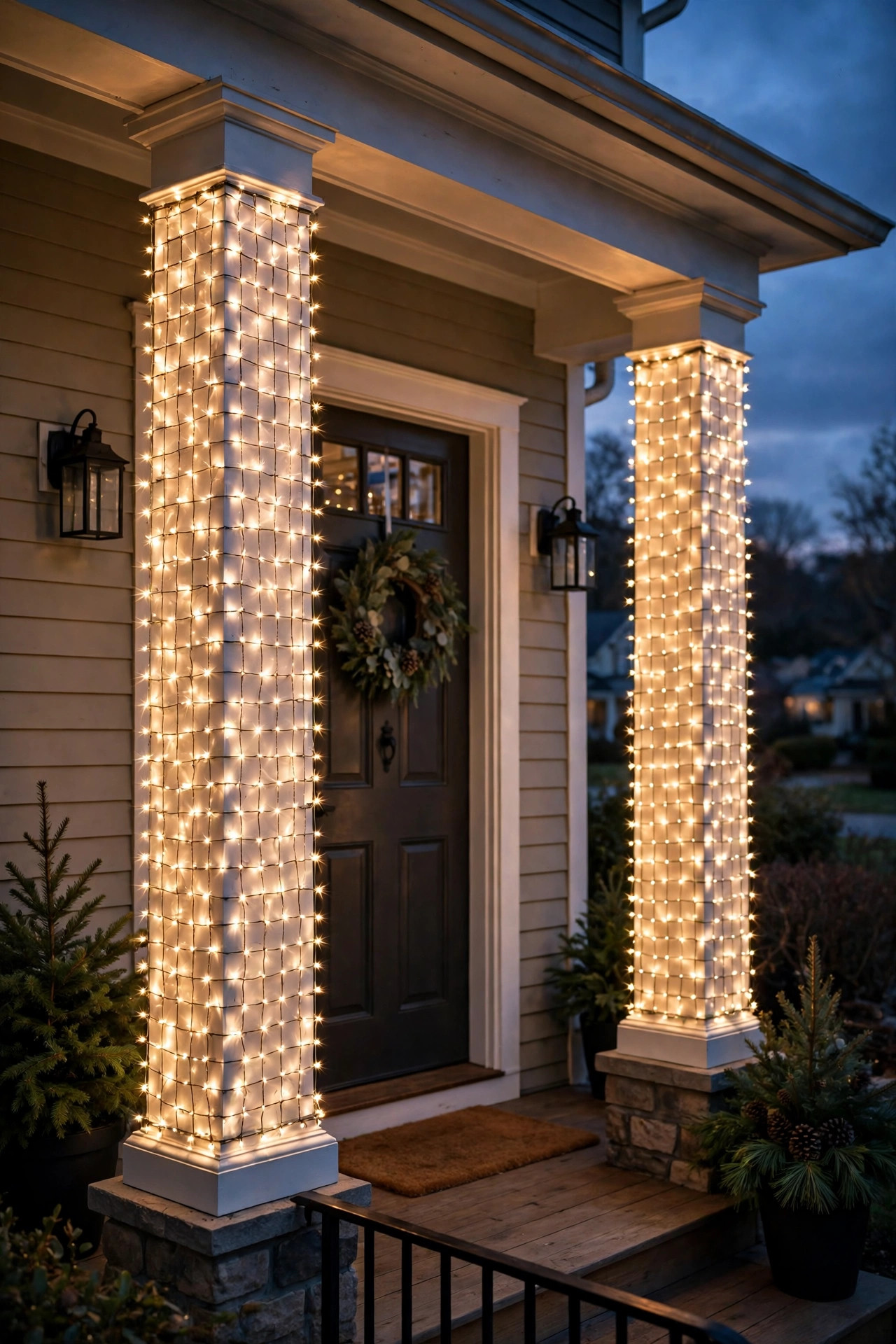
16. Wrap Columns in Twinkle Net Lights for the Holidays
When December arrives and the spiral-wrap strands start sliding around, net lights are the tidy person's answer. A net of LED lights drapes around a column in one motion and stays put — no winding, no spacing math, no lopsided spirals. Wrap one net per column, overlap the edges at the back, and secure the top and bottom with removable hooks.
Standard nets run about 4 by 6 feet, which wraps an 8-foot column of average girth with a little overlap to spare; measure your column's circumference first — chunky brick columns eat more net than slim wood posts. Warm white twinkle (the kind where random bulbs gently pulse) looks expensive; steady-burn looks clean. Pick one style for all columns and commit — mixed twinkle patterns fight each other.
Because nets hug the column, keep them LED-only and check that no netting presses against a hot fixture surface. After the season, they fold flat and store in almost no space. Of all the holiday porch column lighting ideas, this is the one I'd hand to a first-timer: five minutes a column, zero skill required, and the result looks like you hired it done.
Suggested budget range: $30 – $85.
17. Combine Uplight and Downlight for a Layered Frame
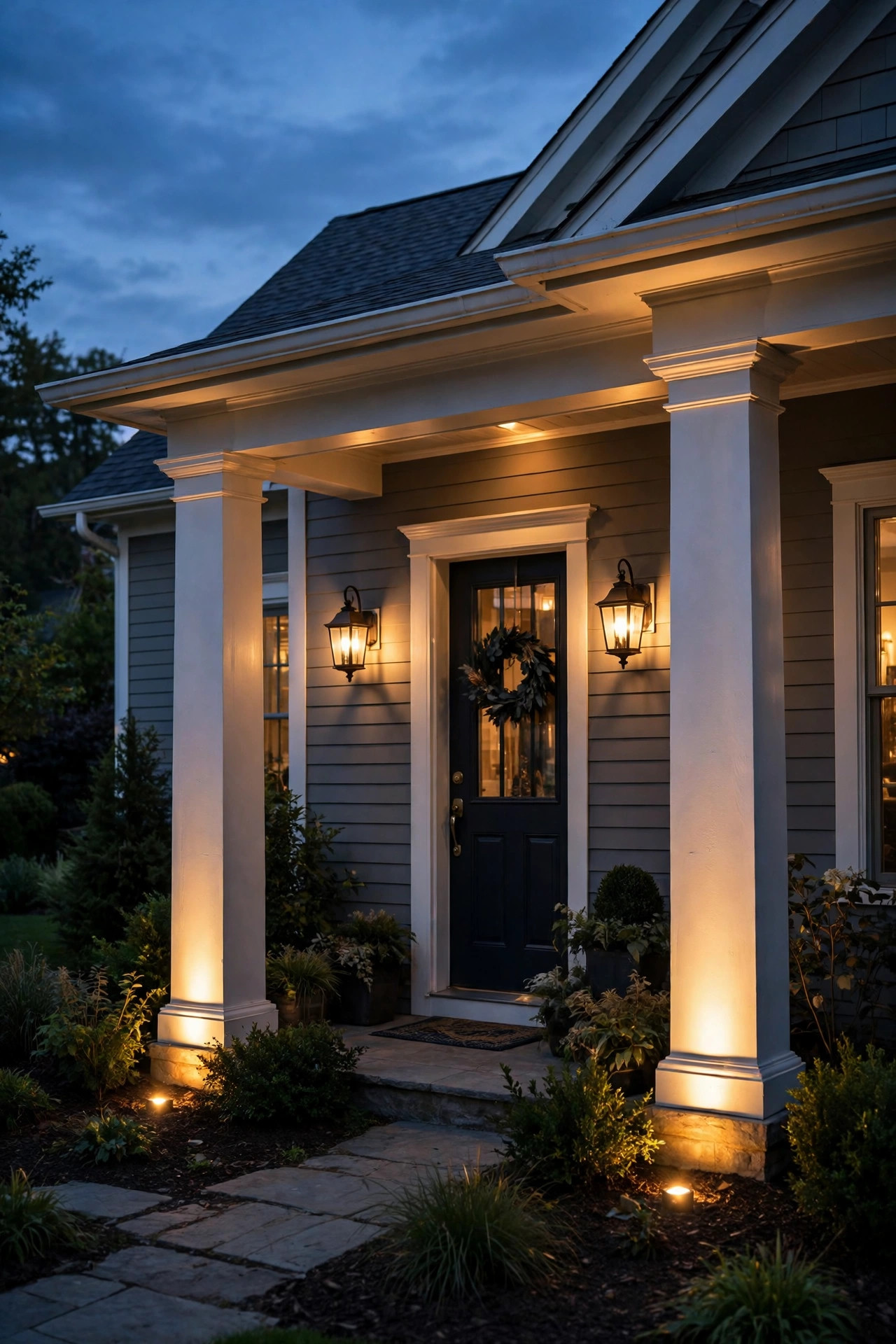
After seventeen ideas, here's how I'd actually spend the money: combine two. An uplight grazing up each column from the planting bed, plus one soft source at eye level — a sconce, a hanging lantern, a flame bulb — gives you the full layered frame that makes an entry feel finished. Neither light is bright; together they're greater than the sum, because the eye reads height, texture, and welcome all at once.
Keep both layers at 2700K and put them on separate controls if you can: uplights on the landscape timer, eye-level lights on the porch switch or a smart schedule. That way the architecture can glow until midnight while the porch goes dark when you do.
Budget-wise this is the splurge of the list, but it's also the combination every professional porch photo is secretly using. Start with the uplights if you must choose; they change the house's face the most for the least money. Add the eye-level layer next season. That's genuinely how my own porch came together — one layer a year, each one making the last look better.
Suggested budget range: $100 – $300.
Frequently Asked Questions
How high should porch column lights be mounted?
For sconces and lanterns on the column face, center the fixture about 5½ to 6 feet above the porch floor — roughly eye level for a standing adult. Post-cap lights sit at whatever height your column top is, and uplights belong at the base, angled up. Mark it with tape on every column and check from the street before drilling; identical heights across all columns matter more than the exact number.
Should porch column lights be warm or cool white?
Warm, almost always — 2700K is my default for porches, and 3000K is as cool as I'd ever go. Warm light flatters wood, brick, skin, and paint colors, and matches the glow spilling from your windows. Cool white (4000K and up) tends to look harsh and commercial on a front porch. Whatever you pick, use the same color temperature in every bulb on the porch; mismatched temperatures are the most common reason a porch lighting scheme looks "off" without anyone knowing why.
Can I light porch columns without wiring or an electrician?
Yes — several ideas on this list need no wiring at all. Solar post-cap lights sit on square column tops, battery lanterns on hooks run for a season on a timer, string lights and net lights plug into an ordinary outdoor outlet or run on battery packs, and fairy-light curtains come in solar versions. The tradeoff is brightness and reliability: no-wire options are accents, not primary light. Most porches pair no-wire column accents with one wired fixture by the door for real visibility.
How much does it cost to light porch columns?
It scales with how permanent you go. Plug-in and battery ideas — string-light wraps, net lights, flameless lanterns — run about $20 to $120 for a typical two-column porch. A low-voltage uplight setup lands around $40 to $120 per column including a share of the transformer. Fully wired sconces or soffit downlights are the investment tier at roughly $60 to $350 per column, plus electrician time if new cable is needed. My honest advice: start with one $50 layer, live with it a month, then add the next.
Conclusion
Great porch column lighting ideas all come back to one principle: light the frame, and the picture — your door, your porch, your home — looks better. You don't need all seventeen. One repeated fixture, one warm color temperature, one layer you love will carry the whole entry. Browse our other lighting ideas whenever you're ready for layer two; the porch swing at dusk is waiting.
For more inspiration, work through our front porch lighting ideas for the rest of the porch, pair your columns with the entries in our outdoor entryway lighting ideas, and see how the columns play with the house style in our farmhouse porch lighting roundup.