The first time one of my path lights went dark, I did what most people do: I unscrewed the little bulb, drove to the hardware store, held it up to the shelf, and guessed. The guess was wrong — twice. The bulb that finally fit had a code name I'd never heard of, two pins spaced just a hair differently from the one I'd bought first. That afternoon taught me something I wish I'd known sooner: understanding landscape lighting bulb types matters far more than the fixture you screw them into. The fixture is just a pretty metal hat. The bulb decides the brightness, the beam shape, the color, and honestly half the magic of how your yard looks at night. This guide translates the alphabet soup — MR16, G4, PAR36, plus a few cousins — into plain English. By the end, you'll know how to read any bulb code, identify what's already in your fixtures, choose the right beam and brightness, and swap in LEDs without a single wasted trip to the store.
The Short Answer
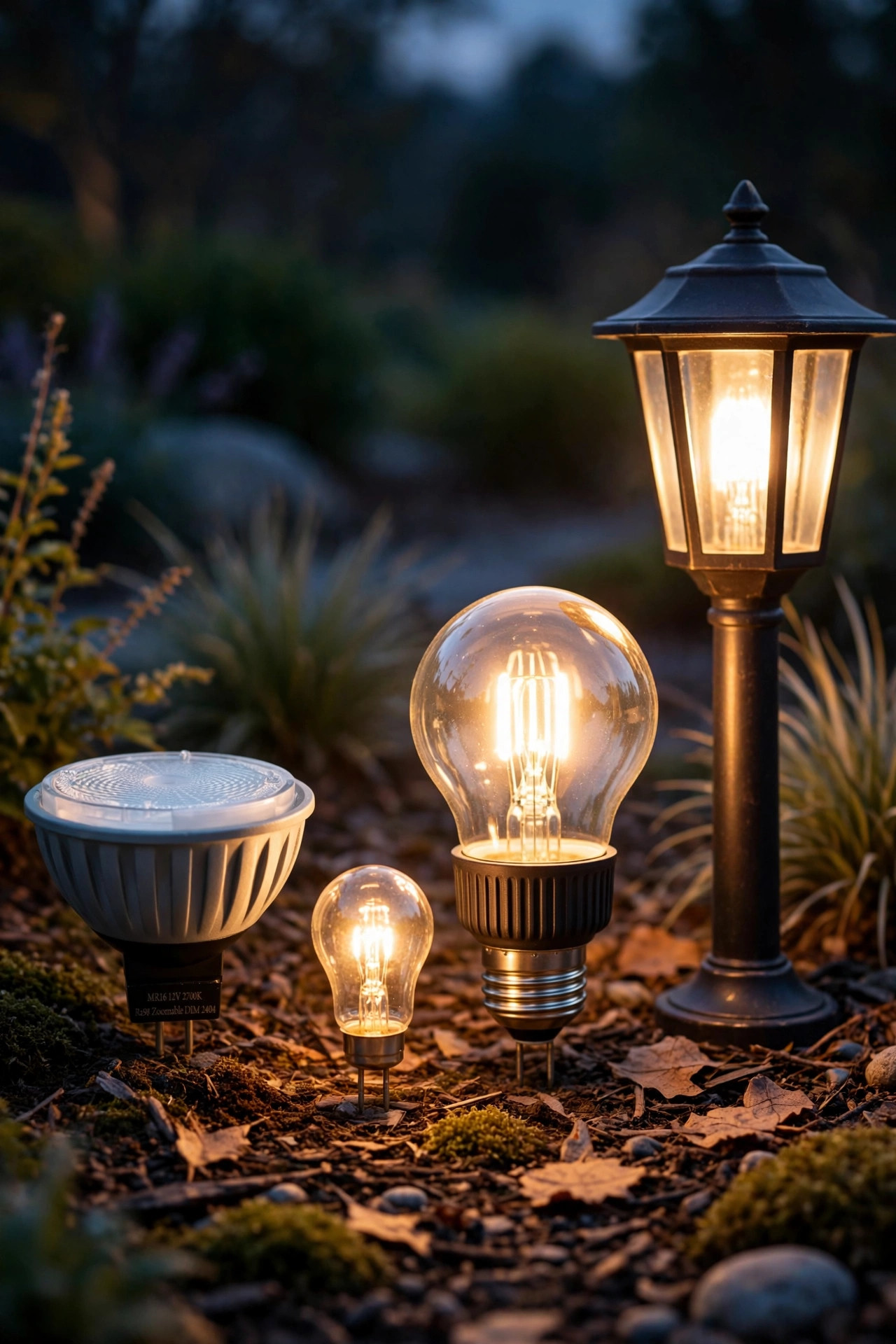
Almost every low-voltage landscape system runs on three bulb families. MR16 bulbs are the 2-inch spotlight bulbs with two pins, found in spotlights and well lights. G4 bi-pins are the tiny capsule bulbs hiding inside most path, area and deck lights. PAR36 bulbs are the big 4.5-inch sealed floods used for trees and wide washes. Buy LED versions in 2700–3000K, match the base exactly, pick your beam angle on purpose, and each type costs roughly $5–$18 a bulb in 2026. That's the whole game — the rest of this guide just makes it easy.
Why the Bulb Matters More Than the Fixture
Here's the mindset shift that saves people real money: fixtures are hardware, but bulbs are the light itself. Two identical spotlights can paint completely different pictures depending on the bulb inside — one throws a tight pencil of light up a narrow column, the other spills a soft cone across a whole garden bed. The fixture housing rarely wears out; heavy brass and aluminum bodies can last decades in the ground. Bulbs, though, are consumables. Halogens burn out in a year or two of nightly use, and even good LEDs eventually dim or get swapped when you redecorate the lighting design.
That means the bulb choice follows you. It's the part you'll replace, upgrade and experiment with for as long as you own the system. Getting fluent in bulb types also protects your transformer math: every bulb you add draws watts, and knowing that an LED MR16 sips 5 watts where its halogen ancestor drank 35 changes how many lights your system can carry. In my experience, once homeowners understand their bulbs, the rest of landscape lighting — spacing, layering, even design — suddenly gets much less mysterious. Every decision that follows quietly depends on it: where lights can go, how far apart they sit, how many a single run can carry. The bulb is the smallest part of the system, but it sets the limits for everything else.
How to Read a Bulb Code: What the Letters and Numbers Mean
Bulb names look like license plates, but they're actually a tidy little code once someone explains it. The letters describe the bulb's shape or base style. The number describes its size, almost always in eighths of an inch for the reflector families. An MR16 is a Multifaceted Reflector, 16 eighths of an inch across — that's 2 inches. A PAR36 is a Parabolic Aluminized Reflector, 36 eighths — 4.5 inches across. The G in G4 stands for a glass bi-pin base, and the 4 is the distance between its two pins in millimeters.
Once you see the pattern, the whole shelf decodes itself. MR11 is just a smaller MR16 at 1-3/8 inches. A G5.3 base has pins 5.3 millimeters apart — which is exactly the base an MR16 sits on, and exactly why the two get confused. PAR bulbs share their sizing logic with indoor floodlights, so a PAR36 is a much bigger cousin of the PAR20s and PAR30s you might know from recessed cans.
My honest advice? Never buy from memory or from a blurry phone photo. The codes are printed or stamped on every bulb, and thirty seconds of reading beats a second trip to the store every single time.
MR16: The Spotlight Workhorse of Landscape Lighting
If your yard has spotlights aimed at trees, columns or the front of the house, you almost certainly own MR16s. This 2-inch reflector bulb is the industry workhorse: it pushes in on a two-pin GU5.3 base, locks into a socket inside the fixture, and focuses its light through that faceted mirror surface into a controlled beam. Halogen versions commonly ran 20, 35 or 50 watts. LED replacements do the same job on about 3 to 7 watts, producing roughly 250 to 600 lumens.
The MR16's real talent is beam control. The same bulb family comes in narrow spots around 10–15 degrees for grazing up a tall palm or flagpole, medium floods near 36 degrees for most trees and shrubs, and wide floods of 60 degrees for washing a wall. Swapping beam angles — not fixtures — is how designers fine-tune a scene, and it's a five-minute job per light.
One caution from experience: MR16 fixtures vary in depth, and some LED versions are slightly longer than the halogen originals. Check that the lens or gasket still seats after a swap. A bulb that fits the socket but props the cover open will invite water in, and water is the one thing these little bulbs can't forgive.

G4 Bi-Pin: The Tiny Bulb Hiding in Your Path Lights
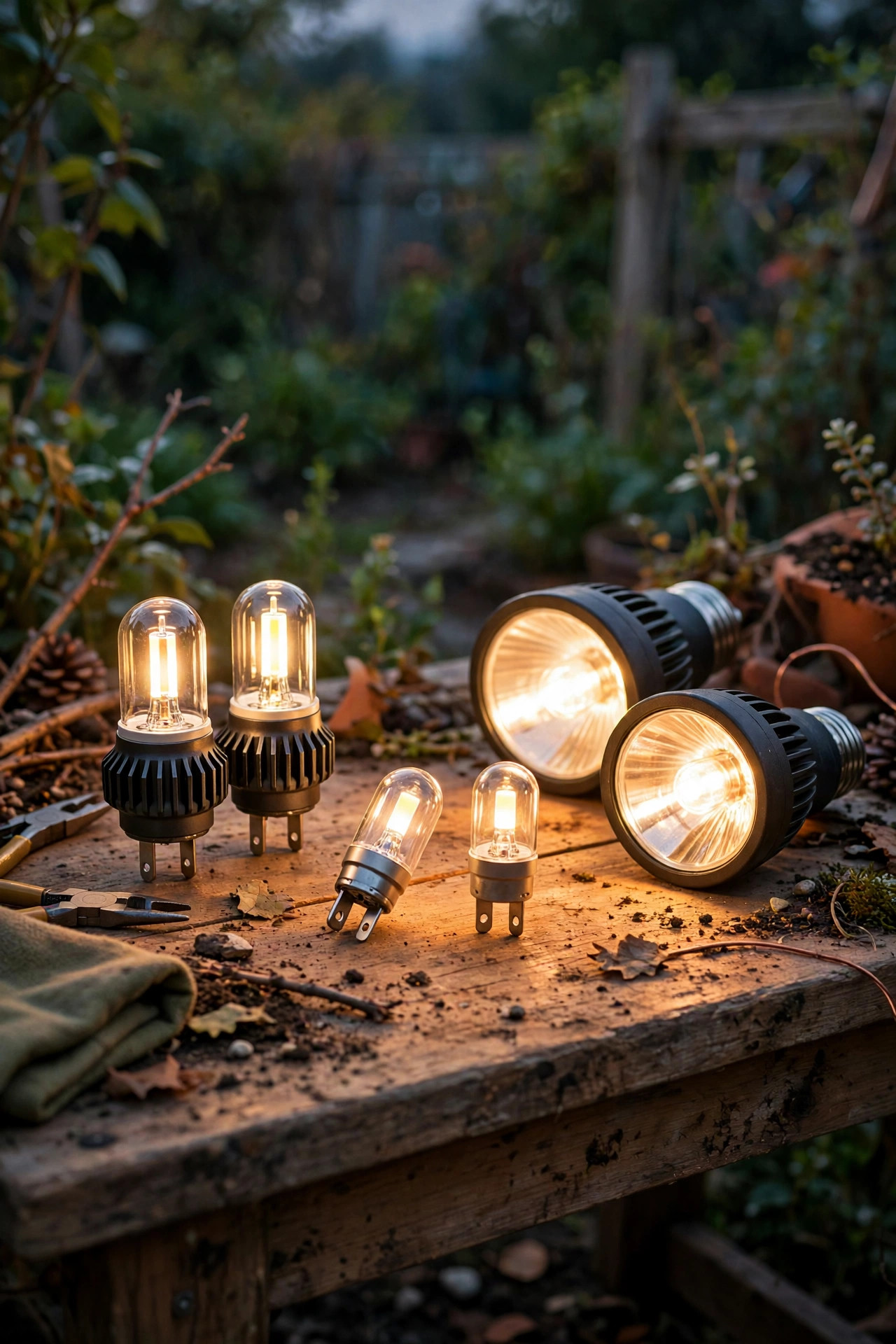
Open up almost any path light, area light, step light or deck light and you'll find a G4: a tiny capsule, barely half an inch long, with two thin pins sticking straight out of its base, spaced 4 millimeters apart. Halogen G4s usually ran 10 or 20 watts and gave off a lovely sparkle — along with enough heat to matter. LED replacements take a few friendly shapes: little flat "wafer" or "disc" bulbs that throw light sideways, corn-cob styles studded with diodes, and simple capsule shapes that mimic the original.
That sideways throw matters. Path lights work by bouncing light down and out through a hat or shade, so an LED G4 that only shines forward can leave the fixture looking dim and patchy even at the right wattage. Look for omnidirectional discs or wafers rated around 100 to 300 lumens, drawing 1 to 3 watts. It replaces the 10 or 20-watt halogen one-for-one in brightness.
Heat is the G4's other quirk. These bulbs live in small, enclosed fixtures where air barely moves. Cheap LEDs cook themselves in that little oven and fade within a season. In my experience it's worth paying a dollar or two more per bulb for versions rated for enclosed fixtures — the path lights along my front walk are on year four with theirs, and they still match the new ones I added last spring.
PAR36: The Big Bulb for Trees, Washes and Wide Floods
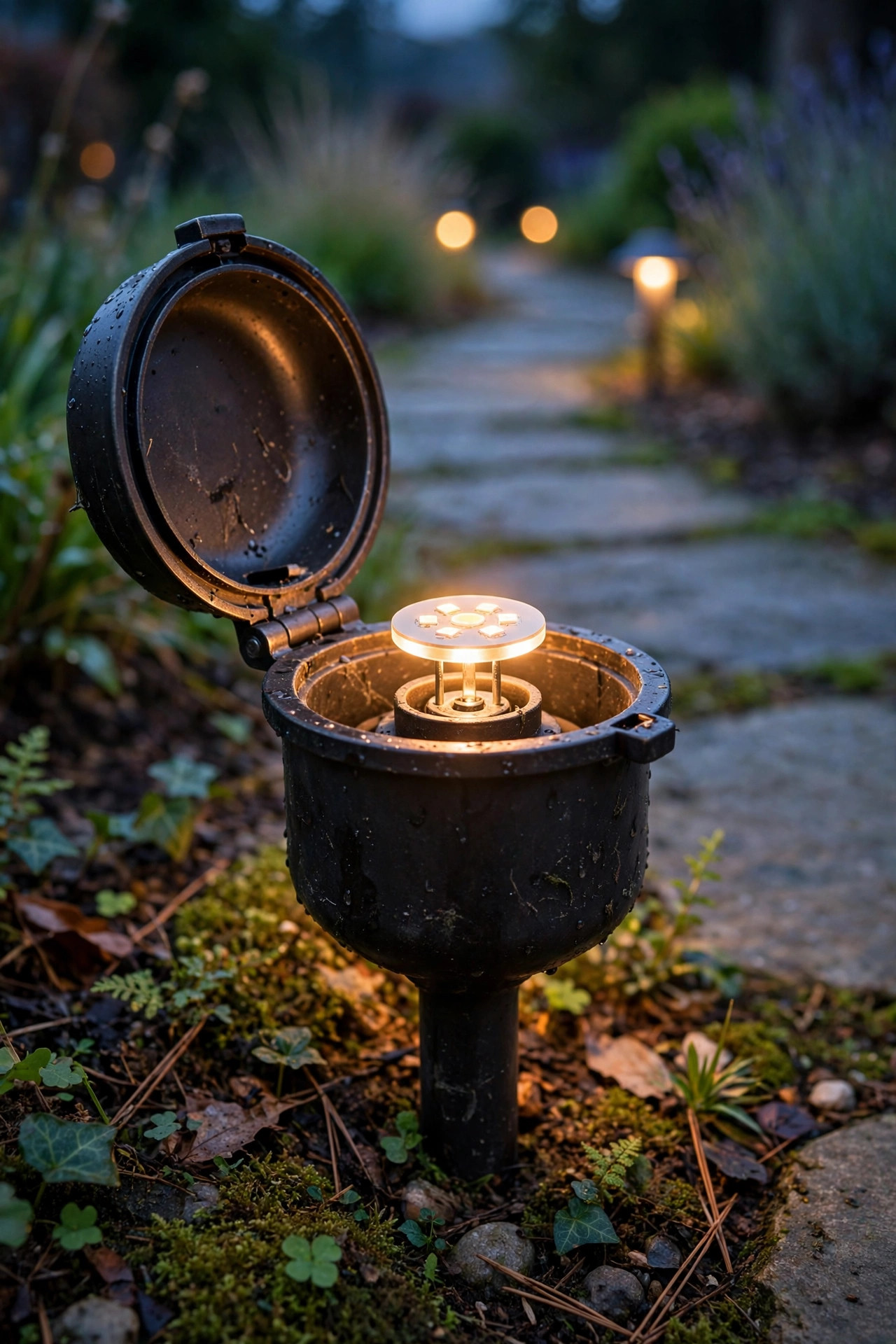
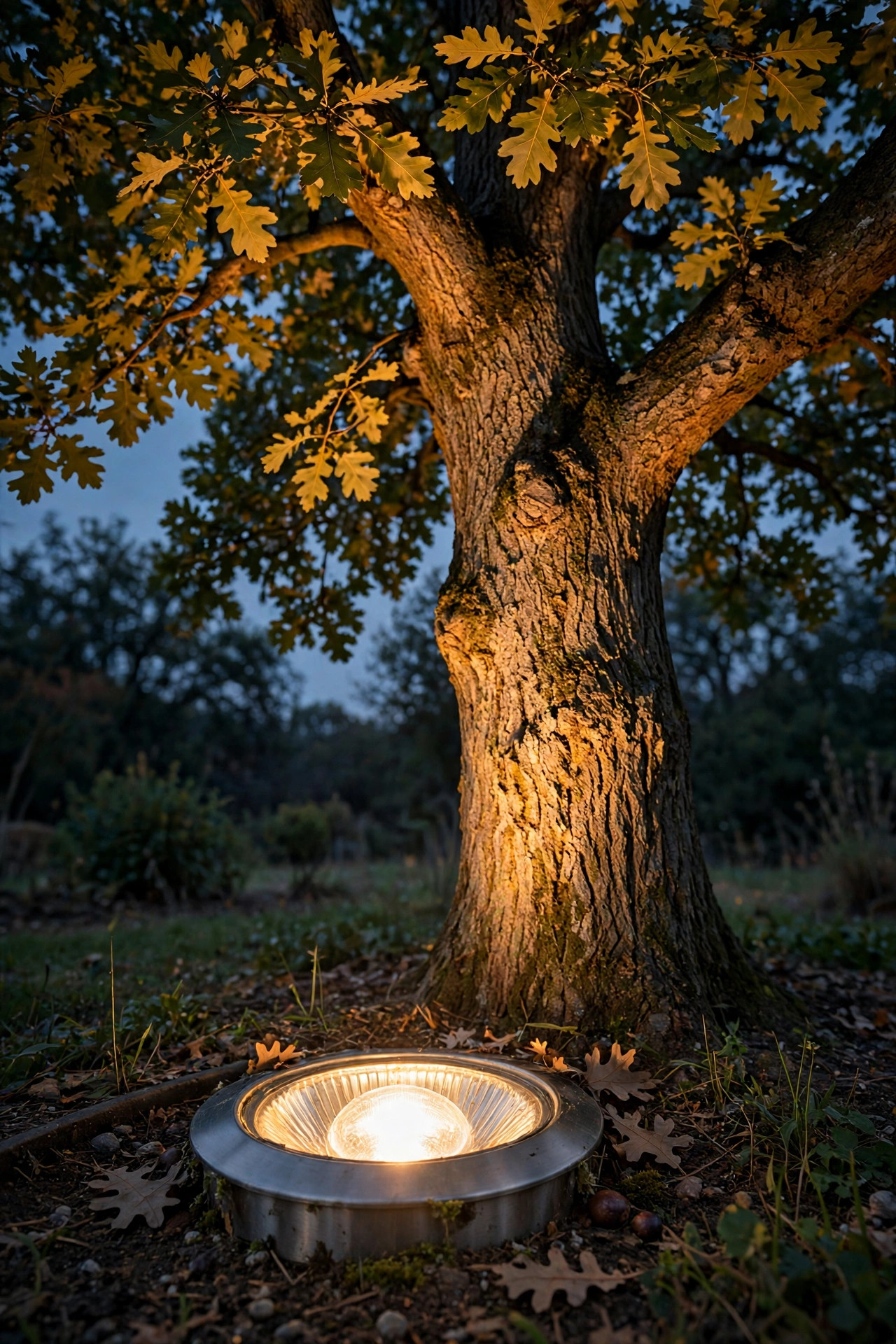
The PAR36 is the heavyweight of the low-voltage world — a chunky 4.5-inch sealed-beam bulb that looks like a small car headlight, because it basically is one. Instead of pins, it connects with screw terminals or spade lugs on the back, and it lives in well lights, in-ground fixtures and larger flood housings. When a designer needs to throw serious light a long way — up a mature oak, across a wide facade, down from a high branch in a moonlighting setup — the PAR36 is usually what's doing the work.
Halogen PAR36s commonly drew 35 or 50 watts. LED versions deliver roughly 500 to 1,000 lumens on about 6 to 12 watts, in beams from a tight 10-degree spot to a broad 60-degree flood. Because these bulbs sit buried in wells or aimed from a distance, that extra punch genuinely matters; a small bulb simply can't push light 25 feet up into a canopy.
The trade-offs are size and cost. PAR36 fixtures are bigger, the bulbs run $12–$18 in LED form, and the sealed-beam design means you replace the whole unit — reflector, lens and all — when it dies. That's also its quiet advantage: every replacement brings a fresh, clear lens, so PAR36 fixtures tend to look crisp for decades while smaller fixtures fog and yellow around aging bulbs.
The Rest of the Family: MR11, Wedge Bases and Integrated LEDs
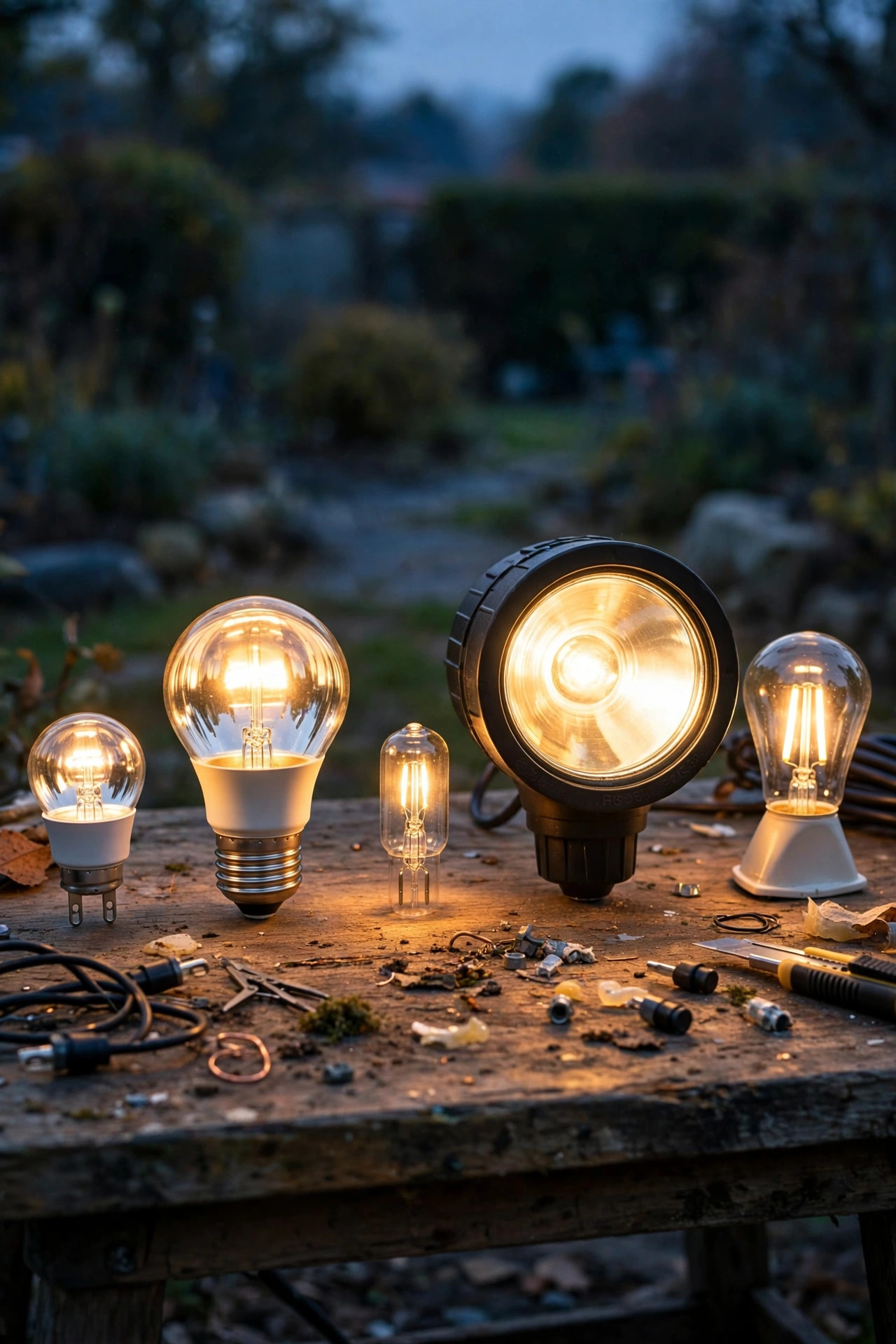
Three more types round out what you'll meet in the wild. The MR11 is the MR16's little sibling — same two-pin idea on a smaller GU4 base, about 1-3/8 inches wide, common in compact deck, step and miniature accent fixtures. LED versions draw 1 to 3 watts. Treat it exactly like an MR16, just confirm the base before ordering, because GU4 and GU5.3 pins look identical until the bulb won't seat.
Wedge-base bulbs (you'll see codes like T10 or 921) push into a slotted plastic socket instead of pins. They turn up in older path lights and some specialty fixtures. LED wedge replacements exist and work fine, but the installed base is shrinking — if you're rebuilding a tired fixture anyway, a G4 socket is the more future-proof home.
Then there's the type with no bulb at all: integrated LED fixtures, where the diode is built permanently into the fixture. There's nothing to code-shop, which is their charm, but when the light dies you replace the whole fixture. My rule of thumb: choose replaceable-bulb fixtures anywhere you'd ever want to change beam angle or brightness later — which, honestly, is most places — and enjoy integrated fixtures for their slim shapes in steps and rails where space is tight.
Landscape Lighting Bulb Types Compared Side by Side
Here's the whole family on one page. Keep this table in mind at the store and the codes stop being intimidating — you're really just matching a base, then choosing a beam.
| Bulb type | Base / connection | Found in | Halogen watts | LED watts | Typical LED lumens | Bulb cost (2026) |
|---|---|---|---|---|---|---|
| MR16 | GU5.3 two-pin | Spotlights, well lights, uplights | 20–50W | 3–7W | 250–600 | $5–$10 |
| G4 bi-pin | Two pins, 4mm apart | Path, area, step and deck lights | 10–20W | 1–3W | 100–300 | $3–$7 |
| PAR36 | Screw terminals / spades | Well lights, big floods, tree lights | 35–50W | 6–12W | 500–1,000 | $12–$18 |
| MR11 | GU4 two-pin | Mini accent, deck and step fixtures | 10–20W | 1–3W | 100–250 | $4–$8 |
| Wedge (T10/921) | Push-in wedge | Older path lights, specialty fixtures | 11–18W | 1–3W | 100–280 | $3–$6 |
Two patterns jump out. First, LED wattage lands at roughly a seventh to a tenth of the halogen it replaces, which is why conversions free up so much transformer capacity. Second, price tracks size and power, not quality tier — even the biggest bulb on this list costs less than a pizza. Bulbs are the cheapest design tool in your whole system, so experimenting with a different beam or brightness is a genuinely low-risk pleasure.
Beam Angle: The Spec That Actually Shapes Your Light
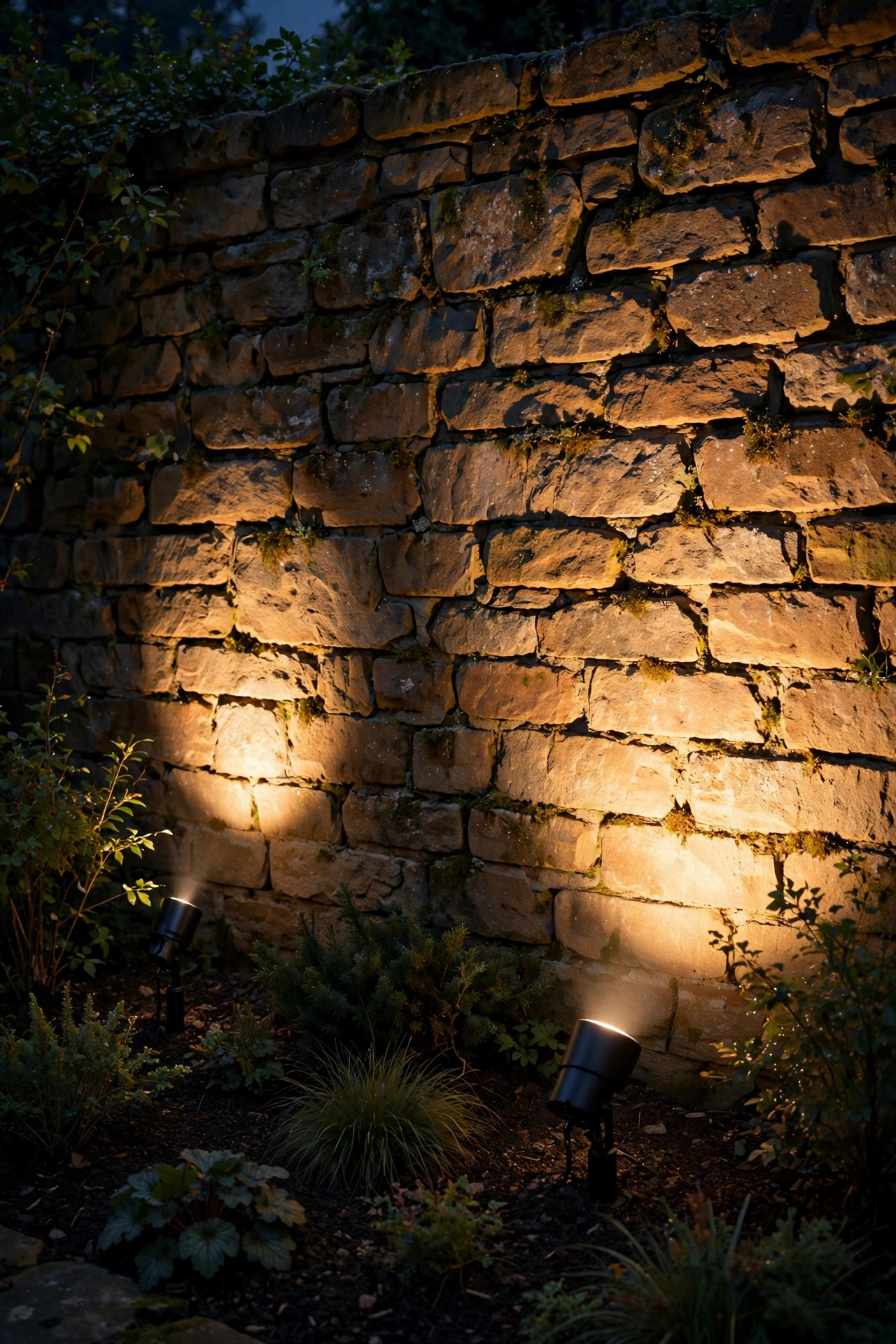
Two bulbs can share a base, a wattage and a lumen rating and still light your yard completely differently — the difference is beam angle, the width of the cone the bulb throws. Spot bulbs concentrate their light into 10–15 degrees, which is what you want for a flagpole, a narrow column, or grazing up a tall, skinny tree. A 24–36 degree flood is the all-purpose middle: most trees, shrubs and architectural features live happily here. Wide floods at 60 degrees and beyond wash walls, spread across garden beds and soften the light from well fixtures.
Here's the math that makes it click: brightness on the ground isn't just about lumens, it's about how concentrated they are. A 400-lumen spot at 15 degrees looks dramatically brighter on its target than a 400-lumen flood spread over 60 degrees, because all that light lands in a small circle. This is why swapping a bulb's beam angle so often fixes a scene that "just looks wrong" — the fixture was fine, the brightness was fine, the cone was simply the wrong shape for the job.
When in doubt, I start with a 36-degree flood for feature lighting and a wide, soft throw for anything near a path. You can always tighten a beam later; a too-narrow spot is the one that leaves harsh, theatrical hotspots nobody enjoys walking through.
Brightness: Shop by Lumens, Not Watts
Watts used to be a decent brightness shorthand because every bulb technology burned power the same way. LEDs broke that completely. A 5-watt LED MR16 can outshine a 35-watt halogen, so comparing watts now compares electricity bills, not light. Lumens are the honest number: they measure the actual light a bulb produces, and they're printed on every package.
As a working guide, path and step lights are happy at 100–300 lumens per fixture — enough to see the ground without glare. Feature spotlights on trees and architecture usually want 300–600. Big PAR36 work higher up runs 500–1,000. More is not better: an overpowered path light blinds you on the very walk it's meant to make safe, and your dark-adapted eyes never recover between fixtures.
If you'd like the deeper math on matching brightness to the job, my outdoor lighting lumens and watts guide walks through room-by-room — well, yard-by-yard — targets for every fixture type. Here, just remember the habit: when you replace a bulb, match lumens to the old bulb's job, not watts to the old bulb's label. The transformer math gets easier as a bonus, since lower LED loads mean longer, happier cable runs. And because LEDs sip so little power, the bulb you choose today leaves headroom in the system for the extra lights you'll inevitably want to add next year.
Color Temperature: Keeping Every Bulb the Same Warm White
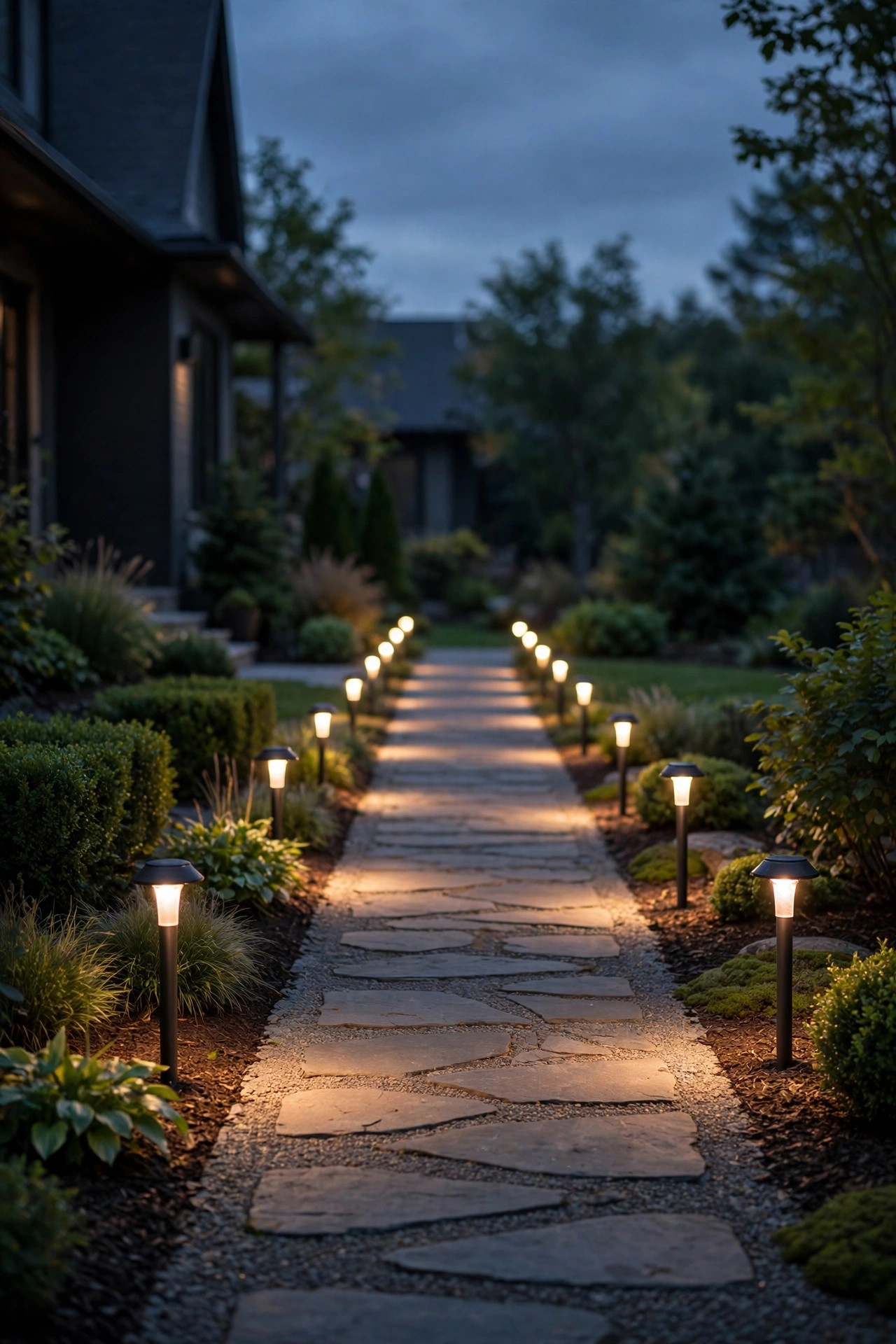
Color temperature, measured in kelvins, is the fastest way to make a yard look either professionally designed or accidentally mismatched. Most of us want the candlelit warmth of 2700K — the same glow as a classic incandescent. 3000K is a touch crisper and works nicely on pale stone, white houses and modern architecture. Drift past 4000K and outdoor light starts to read blue and commercial, like a parking lot that wandered into your garden.
The practical trap isn't choosing the temperature — it's mixing them by accident. A 2700K path light beside a 3000K spotlight looks fine in isolation, but where their beams overlap the color seam shows, and once you see it you can't unsee it. When you replace bulbs one at a time over the years, write the kelvin rating on your spares list and buy the same number every time. Bulb type conversions are the sneaky moment: an LED G4 at 2700K beside an older LED MR16 at 3000K will quietly clash for years.
There's a fuller walkthrough in my outdoor light color temperature guide if you want help picking between 2700K and 3000K for your home's materials. My own yard is all 2700K, and honestly? Consistency beats perfection — matching bulbs in a slightly-off warmth look far better than a patchwork of individually "perfect" ones.

Halogen vs LED: What Changes With Each Bulb Type
Every bulb type in this guide exists in both halogen and LED form, and converting is mostly painless — but each family has its own little gotcha. MR16 LEDs are the happiest swap: they run cool, last 25,000 hours or more, and come in every beam angle. Just mind the fixture-depth note from earlier. G4 LEDs need the enclosed-fixture rating I mentioned, because path-light housings trap heat. PAR36 LEDs are the priciest per bulb but pay back fastest, since the halogens they replace were your system's biggest drinkers.
The system-level effect is dramatic. A twelve-light halogen setup might pull 350 watts; the same yard on LEDs often runs under 70. That freed capacity means one transformer can grow, cable runs stop suffering dim end-of-run lights, and the electric bill drops to pocket change. If you want the full savings picture, my breakdown of what LED outdoor lighting actually saves runs the numbers year by year.
One honest warning: the cheapest no-name LEDs sometimes flicker on older transformers or render colors flat and grey. Look for a CRI of 90 or higher when you can — it keeps brick, foliage and skin tones looking rich — and buy one test bulb before committing to a yard-wide swap. One bulb is a cheap experiment; twenty is a commitment.
How to Identify the Bulb You Already Have
Replacing a bulb starts with a two-minute autopsy, and it's worth doing properly once. First, turn the system off at the transformer and let any halogen cool — they run genuinely hot. Open the fixture and ease the bulb out: MR16s and MR11s pull straight from their pin sockets, G4s pull straight out too, and PAR36s need their two back terminals unscrewed or unclipped.
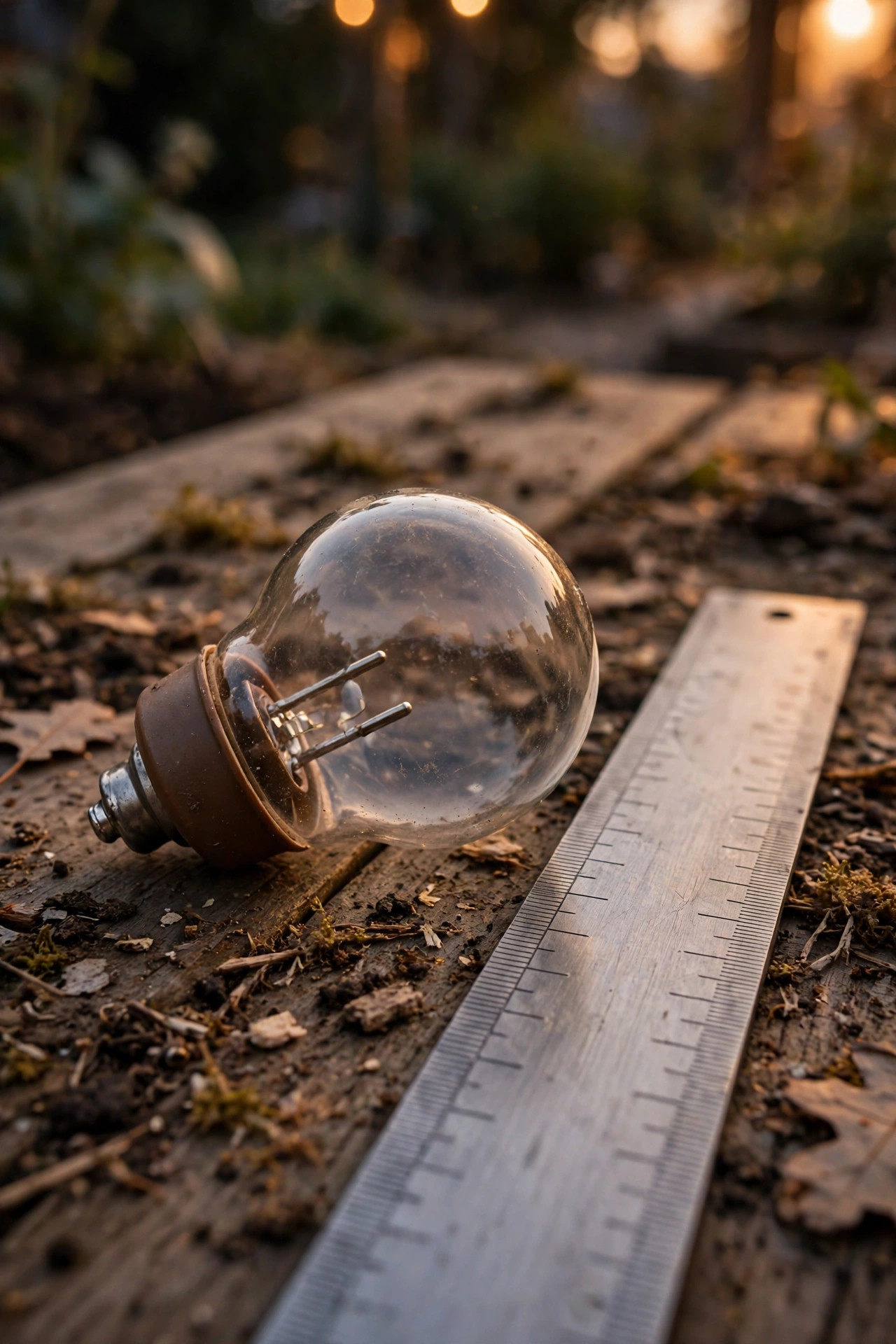
Now read the bulb. The type code is printed on the rim, the glass or the base — MR16, G4, PAR36 — along with watts and volts. If the printing has cooked off, measure instead: the face diameter in eighths of an inch gives you reflector bulbs (2 inches = MR16, 4.5 inches = PAR36), and a ruler across the pins gives you bi-pins (4mm = G4, 5.3mm = GU5.3). Take a photo of the bulb beside the ruler and bring it to the store or compare it online.
Finally, write down what you found — bulb type, beam angle if it's marked (look for degrees or words like "spot" and "flood"), kelvin rating, and which fixture it came from. That one note, kept in a drawer or your phone, turns every future replacement into a thirty-second errand instead of an archaeology project.
What the Main Landscape Lighting Bulb Types Cost in 2026
Bulbs are refreshingly cheap as home projects go. In 2026, a single LED MR16 runs about $5–$10, with multi-packs of four or six trimming that toward $4 a bulb. LED G4s are the bargains of the family at $3–$7 each, usually sold in packs of six or ten — handy, since path lights travel in herds. PAR36 LEDs sit at the top at $12–$18 each, and MR11s and wedge LEDs land around $3–$8.
A full LED conversion of a typical twelve-fixture yard usually totals $60–$150 in bulbs — MR16s and G4s doing most of the work — and replaces a halogen set that would have burned through several $4–$6 replacements each over the same years. Running costs shrink just as kindly: that converted yard at roughly 70 watts for five hours a night costs on the order of $15 a year in electricity, versus $60 or more feeding halogens.
Where does money actually leak? Buying twice — the wrong base first, or bargain LEDs that fade in a season and get replaced anyway. Spending a dollar more per bulb for enclosed ratings, 90+ CRI and a stated 25,000-hour life is the cheapest insurance in this whole hobby. Keep two spares of each type you own and a dead bulb never darkens a weekend again.
5 Mistakes That Ruin the Effect
Every mistake on this list has cost me — or a neighbor I've rescued mid-project — a second purchase and a second Saturday. The good news is they're all the same species of error: buying fast instead of buying informed. Once you've seen them named, you'll spot them coming.
1. Buying by watts instead of lumens. A "5-watt LED" tells you nothing about brightness; two 5-watt bulbs can differ by 200 lumens. Match the lumen output to the job.
2. Guessing the base. GU5.3 and GU4 pins look like twins. So do G4 and its wider cousins. Thirty seconds with the old bulb in hand beats a return trip every time.
3. Mixing color temperatures. One 4000K bulb in a 2700K yard glares like a wrong note. Buy the same kelvin for every replacement, and note it on your spares list.
4. Ignoring beam angle. A spot bulb in a path-adjacent wash fixture creates a blinding hotspot; a flood on a flagpole spills light into the street. The beam is the design.
5. Sealing in cheap G4s. Unrated budget LEDs in enclosed path lights cook, yellow and die young. The enclosed-fixture rating exists precisely for those little ovens — pay for it.
Notice the pattern? Not one of these mistakes is about taste or budget. They're all cured by the same two-minute habit from the identification section earlier in this guide: pull the old bulb, read it, measure it, write it down. Do that, and the store shelf stops being a guessing game forever.
Keeping Spares: A Simple Bulb Maintenance Routine
Bulb maintenance is blessedly light once your system is all LED. Twice a year — I do it on the same weekends I swap the porch decor for the season — walk the yard after dark and simply look. Note any fixture that's dimmer, warmer or cooler than its neighbors, which usually means an aging bulb or a corroding socket rather than anything serious. Wiggle-test gently: a bulb that flickers when touched has a tired connection, and cleaning the pins or socket contacts with the power off often revives it.
Keep a small spares box based on your identification list: two MR16s in your usual beam angle, a few G4s, one PAR36 if you run them. Store them dry, keep the note with the kelvin ratings in the same box, and replacements become a five-minute evening stroll instead of a dark corner of the yard for weeks. I write the purchase date on the box too, so the oldest spares rotate into service first.
That dark-corner procrastination is the real enemy, honestly. One dead path light becomes the spot where guests trip and the design balance quietly unravels. With the right spare in a drawer, there's simply no excuse left — and your yard keeps the layered, intentional glow you built it for, all year long.

Frequently Asked Questions
Can I put an LED bulb in a fixture that came with halogen?
Yes, in almost every case. Low-voltage LED replacements are made for the same sockets — MR16, G4, PAR36 and the rest — and they run far cooler than the halogens they replace. Just match the base exactly, stay at 12 volts, and choose enclosed-fixture-rated LEDs for small sealed housings like path lights. Your transformer will thank you too, since the total load drops dramatically.
How do I know if my bulb is an MR16 or an MR11?
Measure the face. An MR16 is 2 inches across; an MR11 is about 1-3/8 inches. The bases differ too — the MR16 sits on a GU5.3 base and the MR11 on the smaller GU4 — but the diameter check is the fastest tell, and it's printed right in the name: the number is the width in eighths of an inch.
Why does my new LED bulb flicker or glow faintly when off?
Usually it's a compatibility quirk rather than a bad bulb. Very old magnetic transformers can under-load with efficient LEDs, and some photocells leak a trickle of current that an LED — unlike a halogen — can turn into a faint glow. Try the bulb in another fixture first; if it behaves there, the fix is a different bulb model or an updated transformer, not the wiring.
How long do LED landscape bulbs actually last outdoors?
Rated life is typically 25,000 to 40,000 hours, which at five hours a night works out to well over a decade. Real life outdoors depends on heat and moisture: quality bulbs in vented fixtures usually do approach those numbers, while bargain bulbs in sealed path lights may fade in two or three seasons. The rating on the box assumes kind conditions — buy for the fixture the bulb will actually live in.
Conclusion
MR16, G4 and PAR36 stop being intimidating the moment you can decode them: the letters name the shape and base, the number gives the size, and everything else — lumens for brightness, degrees for beam, kelvins for warmth — is a choice you get to make on purpose. Mastering landscape lighting bulb types turns replacements into a five-minute job, conversions into a genuine upgrade, and your whole system into something you understand rather than tolerate. Start with one fixture, identify its bulb properly, and let that small win carry you around the yard. And when you're ready for fresh ideas to point all those well-chosen bulbs at, browse the lighting guides and ideas here — your yard after dark is about to become your favorite room in the house.