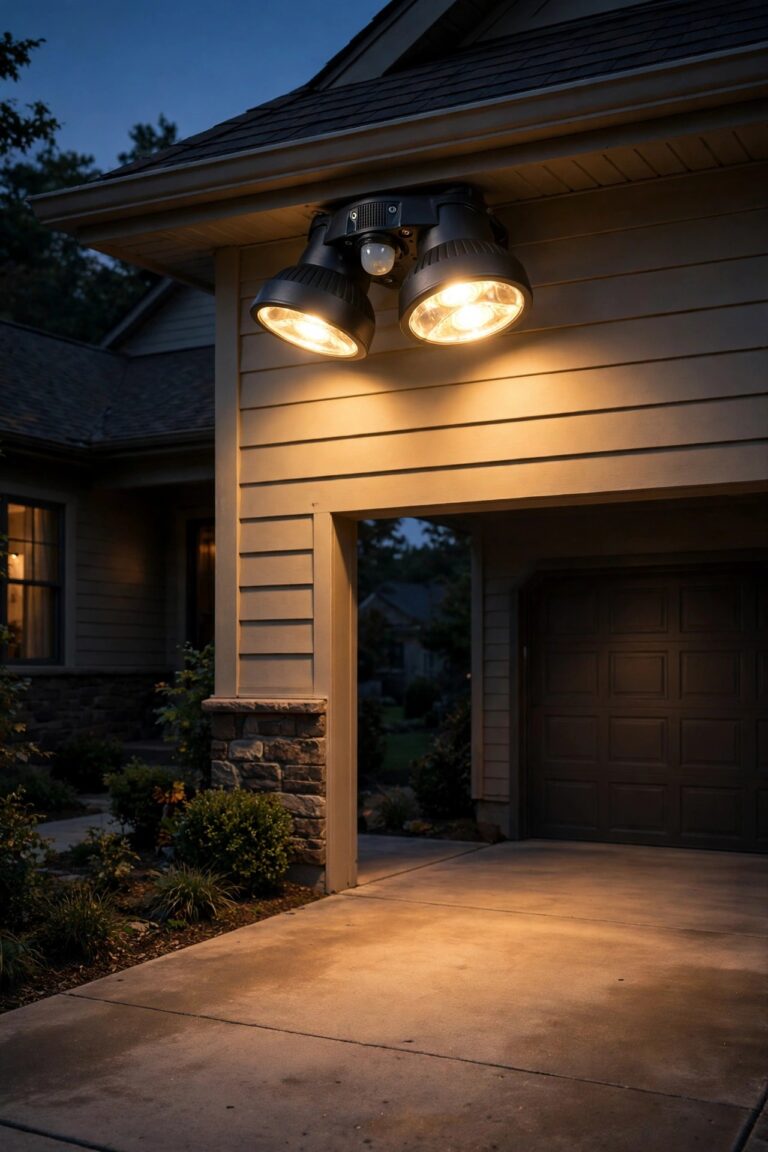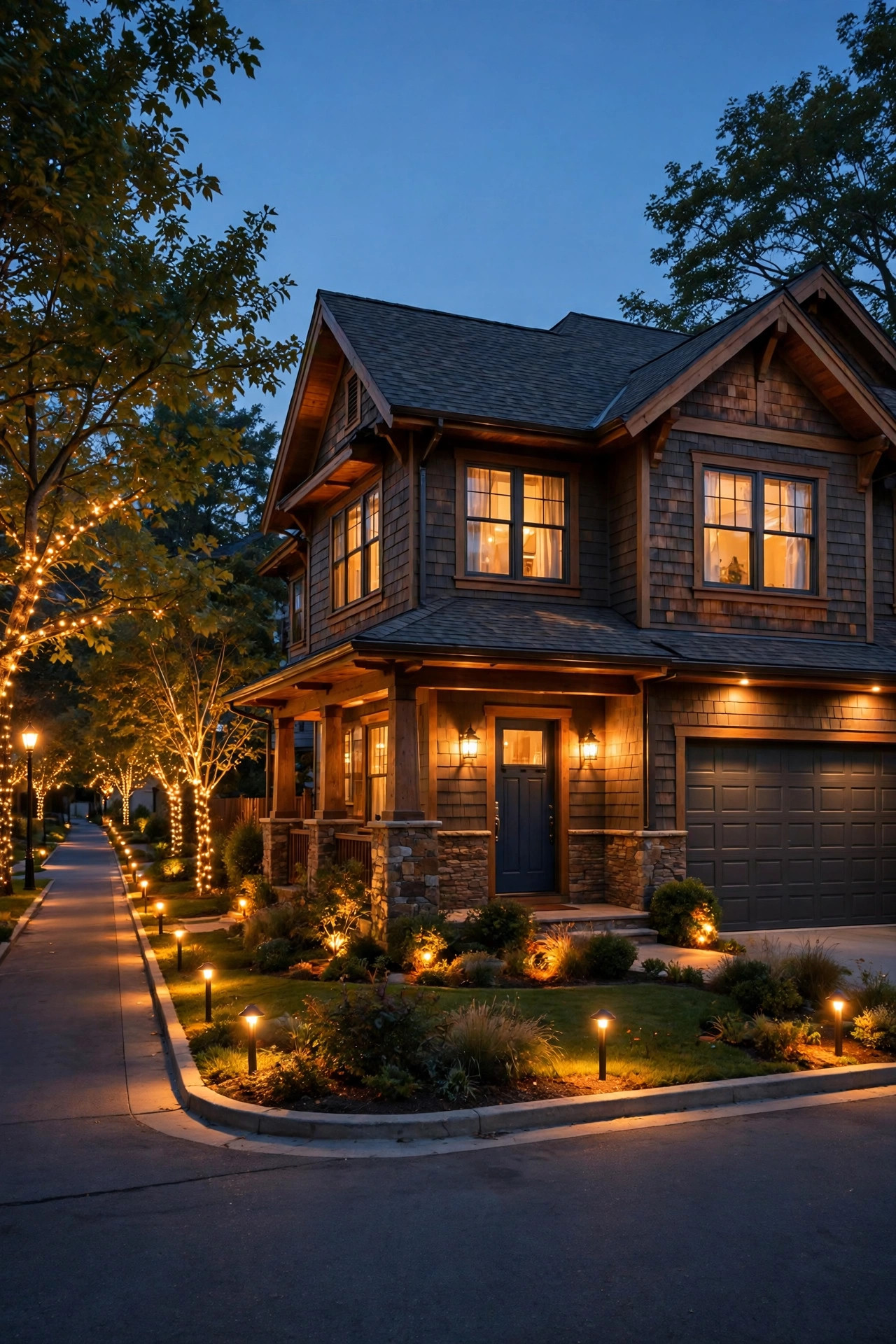
A corner lot is a gift and a challenge at the same time. You get double the curb appeal, double the garden space, and a home that presents itself to the whole neighborhood — but you also get double the frontage to light, and a side yard that most homes get to keep private suddenly sits on full display. After helping two neighbors on my own street work through their corner lots, I've landed on one guiding principle: treat the two streets as one composition, not two separate projects. Layering is everything. A soft wash of ambient light, a few well-aimed accent lights on your best features, and clear task lighting along both walkways will make the whole property feel intentional instead of patchy. The corner lot lighting ideas below walk you through exactly that, frontage by frontage and feature by feature, with honest budget ranges attached to every single one so you can plan a corner that glows from every angle.
1. Anchor the Corner With an Uplighted Specimen Tree
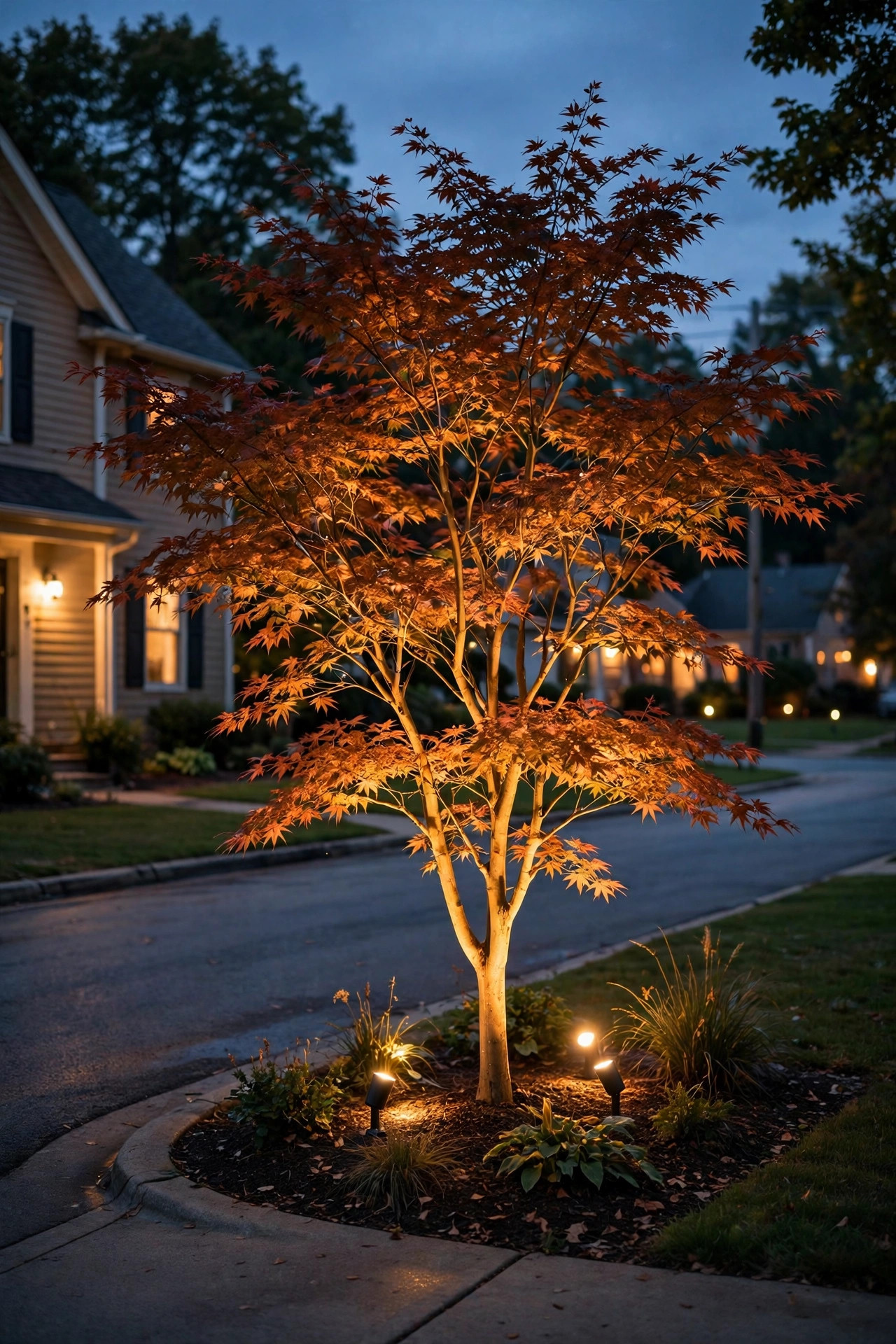
Every corner lot has one natural focal point: the tree, shrub, or ornamental planting sitting near the corner point itself. Uplighting it gives both streets a shared "moment" and stops the corner from reading as empty leftover space. I use one or two low-voltage LED spotlights, 5 to 7 watts each, staked 12 to 18 inches from the trunk and aimed up into the canopy at roughly a 30-degree angle. For a small ornamental tree, a single 35-degree beam is plenty; for a wide oak or maple, two fixtures crossed from different sides fill the canopy without hot spots. Choose warm white, 2700K to 3000K, so the foliage looks golden rather than ghostly. Keep fixtures a few inches above mulch level so leaves don't bury them by July, and re-aim once a year as the tree grows. This one move does more for a corner lot than any other single fixture — drivers literally slow down for a beautifully lit tree on a corner.
Suggested budget range: $60 – $180.
2. Line Both Walkways With Staggered Path Lights
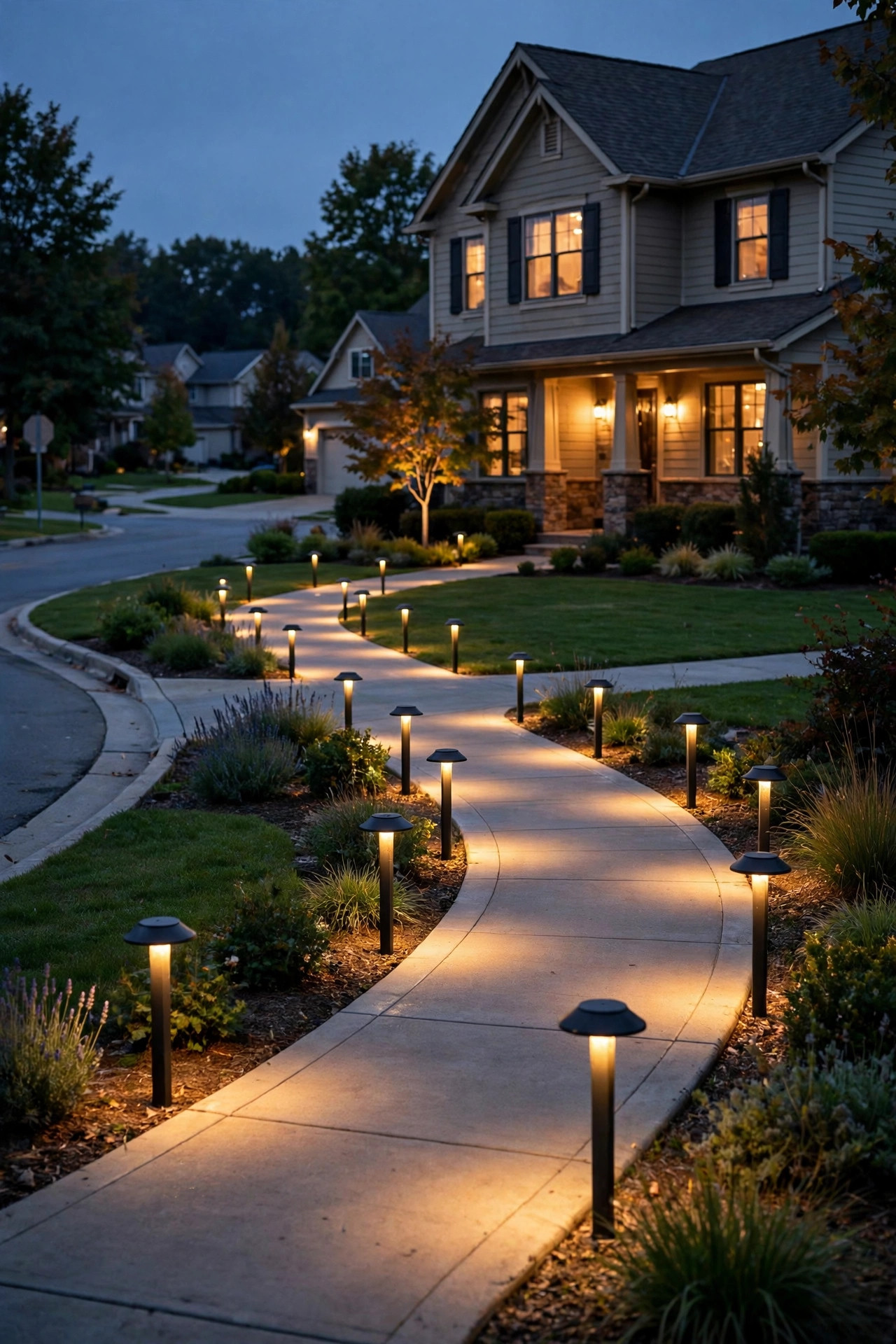
Most corner homes have a walkway on the main street, and many have a second path — to a side gate, a driveway pad, or a garden entrance — on the cross street. Lighting only one leaves the other frontage looking forgotten after dark. My rule is simple: use the same fixture style on both paths so the house reads as one home from either direction, and stagger the lights on alternating sides of each path rather than marching them down one edge. Spacing of 6 to 8 feet apart is plenty for low-voltage LED path lights in the 100–200 lumen range; closer than that creates the dreaded runway effect. Pools of light should just kiss each other, not overlap into a continuous stripe. On the side-street path, which usually gets less foot traffic, you can stretch spacing to 8 or 9 feet and save a fixture or two. Matching fixtures, matching color temperature, two welcoming paths — that's the backbone of the whole corner plan.
Suggested budget range: $150 – $400.
3. Set a Lantern Post Light Right at the Corner Point
If there's one classic corner lot lighting idea I recommend again and again, it's a single lantern-style post light near the corner point of the property, set back a few feet from the sidewalk intersection. It marks your lot the way a lighthouse marks a harbor — softly, warmly, unmistakably. Choose a post around 5 to 6 feet tall so the light sits just above eye level for pedestrians, with a frosted or seeded glass diffuser so nobody stares into a bare bulb. A wet-location rated fixture with an LED filament-style bulb around 800 lumens gives you that gaslight charm without the gaslight maintenance. Check your local setback rules before you dig; most towns want fixtures at least 2 to 3 feet inside the property line, and corner lots sometimes have sight-triangle rules near intersections so drivers can see around the turn. Keep the planting bed around it low for the same reason. It becomes the signature of the whole street corner.
Suggested budget range: $180 – $450.

4. Repeat Your Porch Sconces So They Read From Both Streets
Your front porch usually faces one street, which means the cross-street side gets whatever light spills over — usually none. The fix is to echo your entry lighting around the corner of the house. If your porch has a pair of sconces flanking the door, add one matching sconce on the side wall of the porch or the adjacent corner of the house, mounted at the same height, about 66 to 72 inches from the floor to the center of the fixture. Same finish, same bulb temperature, same brightness family. Now the entry "moment" wraps the corner, and the house looks finished from both approaches instead of lit on one side and dark on the other. If your porch wraps partway around the corner — lucky you — a third fixture at the bend makes the whole veranda glow evenly. I always recommend wiring these on the same switch or smart control as the porch pair so the whole entry scene turns on together at dusk and nobody has to remember a second switch.
Suggested budget range: $90 – $300.

5. Try Moonlighting From the Tallest Tree for a Soft Wash Over Everything
Moonlighting is the most forgiving technique on a corner lot, because one well-placed fixture can wash a huge area — including parts of both frontages — in soft, shadow-dappled light that never looks harsh to passing drivers. Mount a shielded downlight fixture 20 to 30 feet up in your tallest tree, aimed down through the branches. The leaves break the beam into natural patterns, exactly the way real moonlight behaves. Use a cool-neutral bulb here if you like the moonlit effect, though honestly? I still lean warm white, around 3000K, so it blends with the rest of the landscape lighting instead of fighting it. Hire an arborist or a lighting pro for the install if heights make you nervous — the fixture goes up once and a quality LED lasts for years. Run the wire down the back side of the trunk, away from both streets, and leave a service loop of extra cable at the base so the tree can grow without strangling the line.
Suggested budget range: $250 – $600.
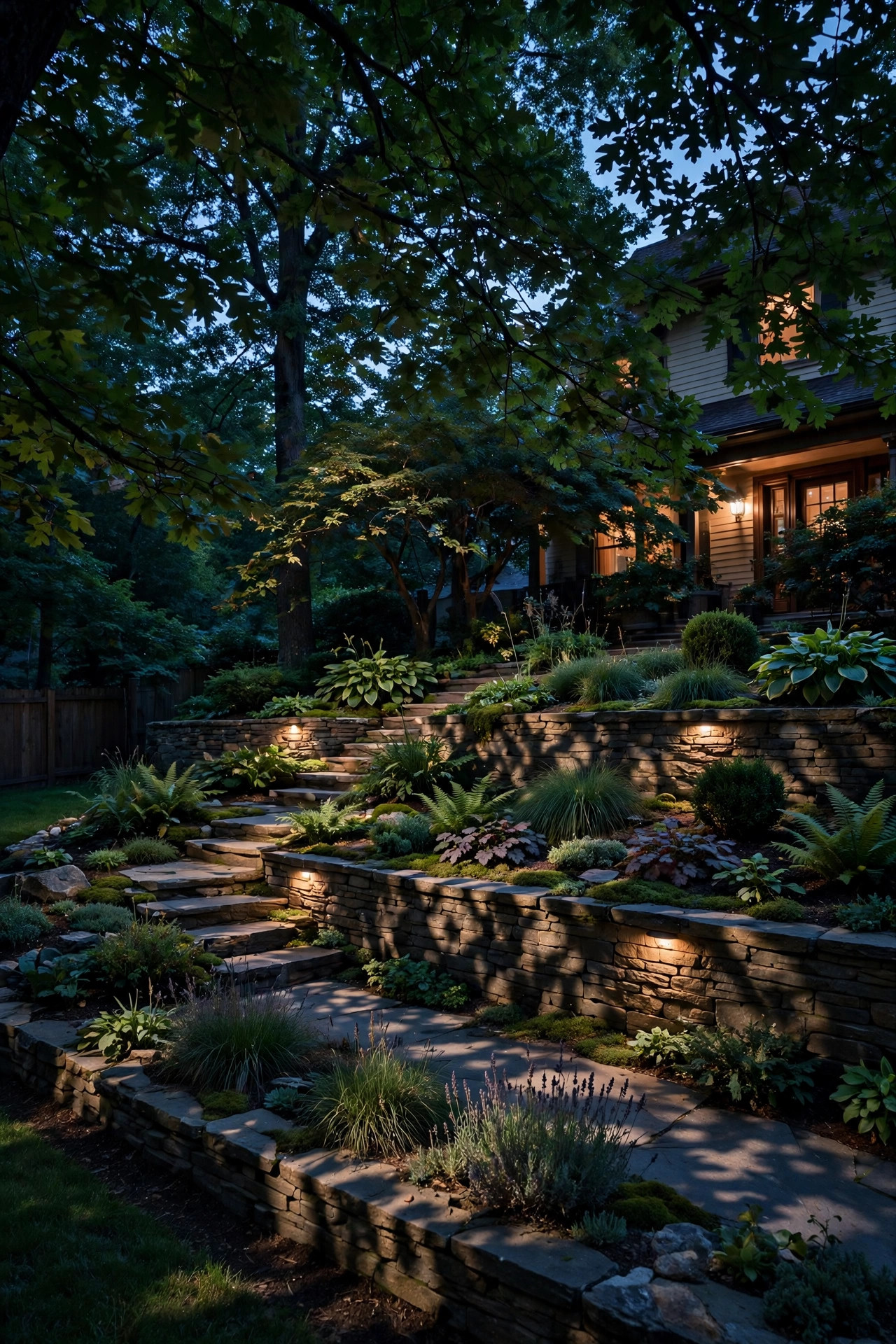
6. Run Low Bollards Along the Side-Street Frontage
The side street is where corner lots usually give up — a long, plain stretch of lawn and fence that goes black at sunset. A row of low bollard lights, 18 to 30 inches tall, transforms it into a deliberate design line. Space them 8 to 10 feet apart along the sidewalk edge, set back about 18 inches from the pavement so mower decks and snow shovels miss them. Bollards throw light downward and outward in a controlled pool, which keeps glare out of drivers' eyes — important on a street where headlights are already sweeping the corner. Choose fixtures with louvered or shielded tops rather than exposed globes. Five to seven bollards usually cover a typical side frontage, and because each one is low wattage, the whole row barely sips power. If bollards feel too modern for your home, short lantern-style path fixtures give the same rhythm with a softer look; the spacing rules stay exactly the same either way. More placement ideas live in my guide to driveway bollard lights — the same fixtures shine here.
Suggested budget range: $200 – $550.

7. Graze the House Corner Itself With an Architectural Uplight
Here's a trick I borrowed from commercial buildings: place one narrow-beam uplight at the base of the house's street-facing corner and let it graze straight up the siding or brick. That single vertical line of light ties the two frontages together architecturally — it literally draws the eye to the hinge point of the house. A 10- to 15-degree beam works best; anything wider just floods the wall and washes out the effect. On brick or stone, the grazing angle exaggerates every bit of texture, which looks expensive even when it isn't. On smooth siding, keep the fixture 6 to 8 inches out from the wall so the beam opens up slightly and doesn't leave a harsh stripe. This is also a lovely way to highlight a corner quoin, a chimney shoulder, or stacked-stone veneer if your home has one. One fixture, one cable run, and suddenly the architecture is doing the decorating for you on both streets.
Suggested budget range: $50 – $140.

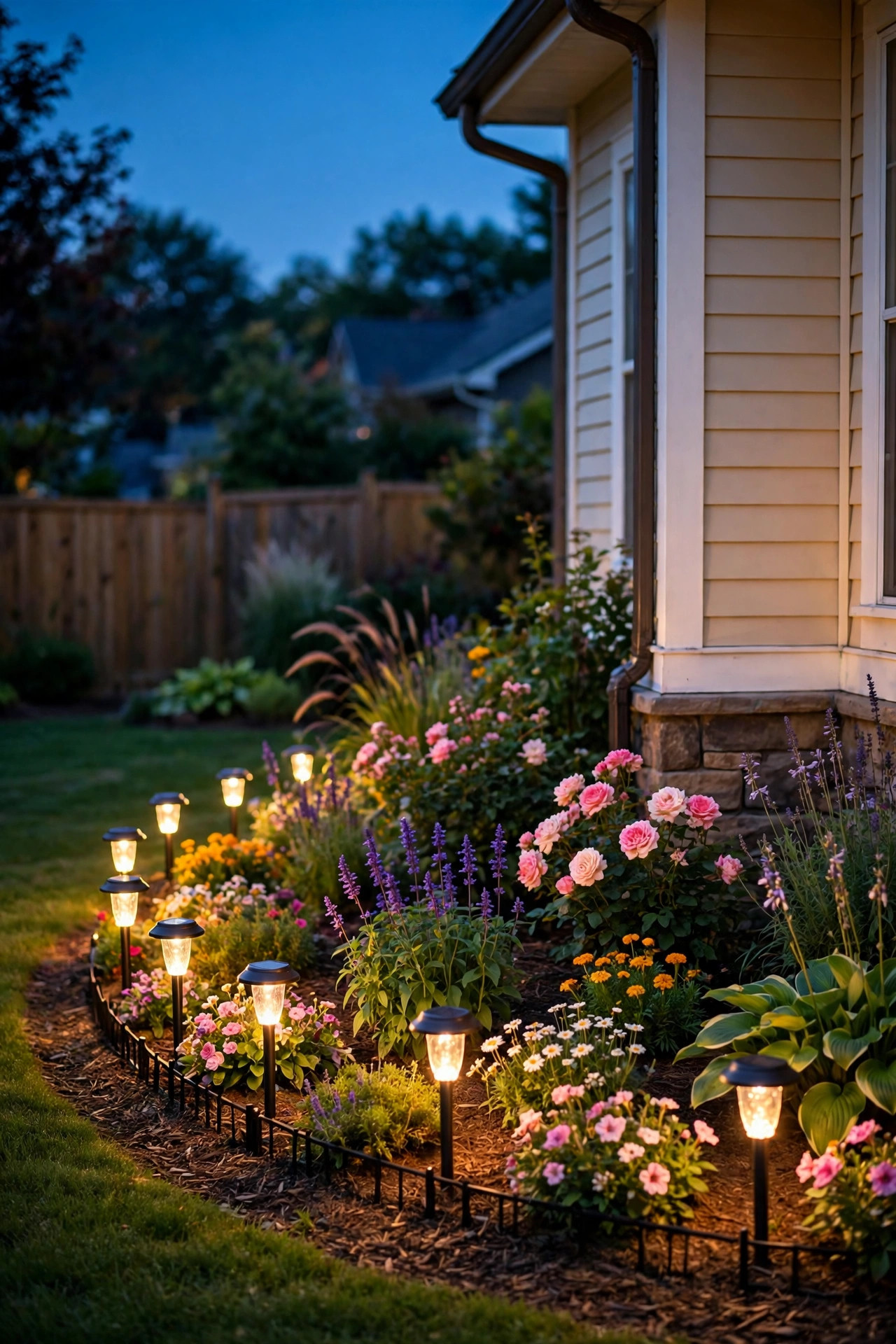
8. Edge the Corner Flower Beds With Solar Stake Lights
The beds that wrap the corner point work hard all day — they're what both streets actually look at — and they deserve a little sparkle after dark without a wiring project. Solar stake lights are perfect here: no trench, no transformer, and you can rearrange them every time you replant. The honest truth about solar is that quality varies wildly, so buy fewer, better fixtures with replaceable batteries and real glass or metal housings instead of a bulk box of plastic. Look for warm-white output; the bluish cheap ones will fight everything else in your yard. Space them 3 to 4 feet apart along the bed's front edge, pushed in so the panel faces the sunniest sky — on a corner bed that's usually easy, since two open frontages mean great sun exposure all day. Expect them to glow 6 to 8 hours on a good charge, a little less in deep winter. They're accent light, not safety light, and that's exactly the job here.
Suggested budget range: $40 – $120.
9. String Café Lights Along the Side Fence for a Lived-In Glow
A corner lot's side fence is public-facing whether you like it or not, so you might as well make it charming. A run of outdoor string lights along the fence line — the side facing your yard, glowing above it — gives the whole property a warm, inhabited halo that both streets can see. Use commercial-grade, wet-location rated strands with shatterproof LED bulbs, and support them with a guide wire or fence hooks every 8 to 10 feet so they don't sag into sad swags by August. Keep bulbs at least a few feet from anything flammable and use LED only, never incandescent, near wood fencing and plantings. If the fence borders your patio or side garden, this doubles as your entertaining light. Hang them about 7 to 8 feet high so the glow spills over the fence top without blinding the neighbors across the side street. On a timer set to switch off around 11 p.m., they're neighborly as well as pretty — a balance I care about on a corner, where your light reaches twice as many bedroom windows.
Suggested budget range: $60 – $200.

10. Spotlight One Garden Feature Where the Two Streets Meet
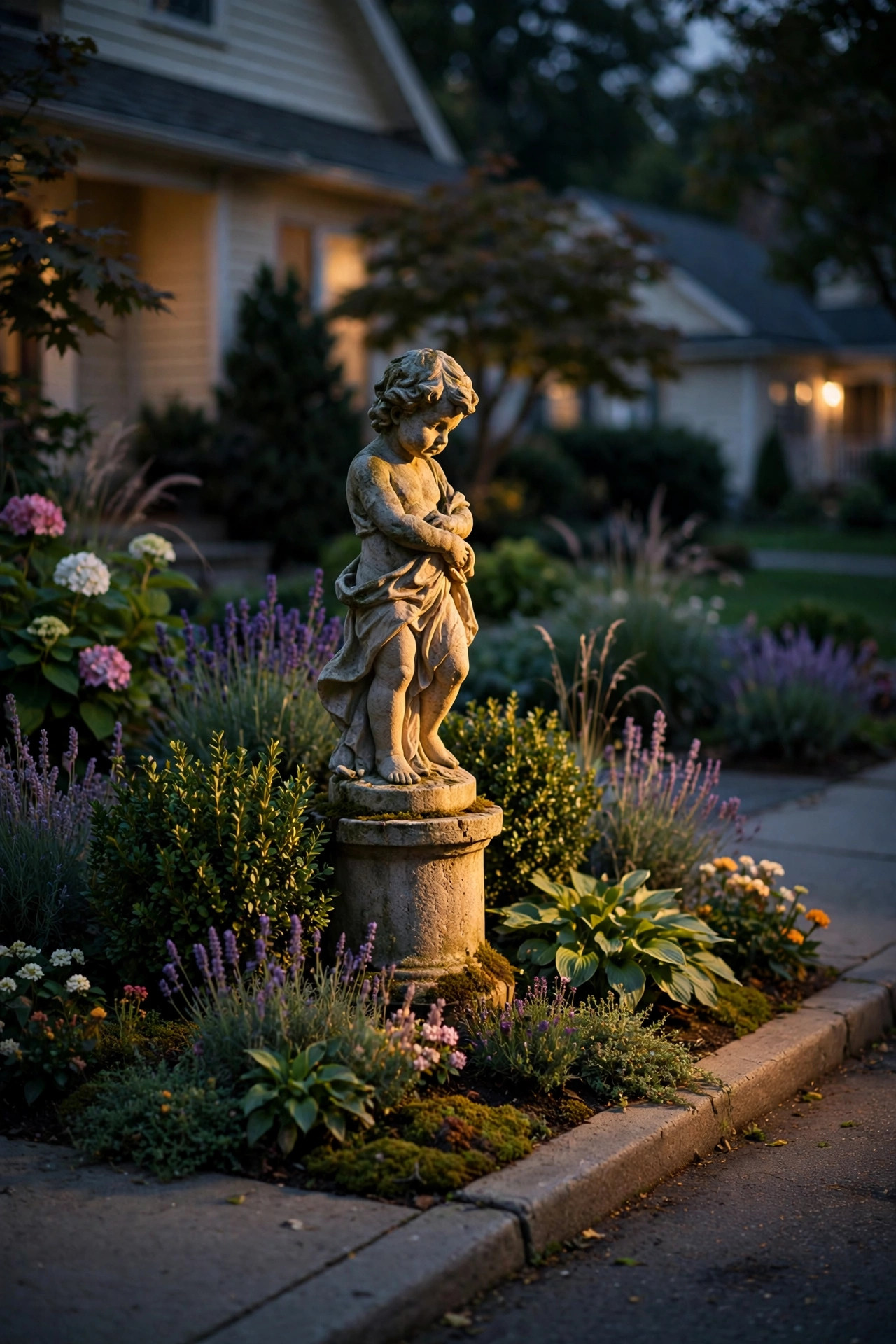
Right at the corner, give passersby one deliberate thing to admire: a birdbath, a small statue, a sculptural Japanese maple, a boulder grouping, or a seasonal urn planting. One accent spotlight, aimed from the side so the feature models itself with light and shadow, turns that spot into the neighborhood's favorite view. Front-lighting flattens everything, so angle the fixture 30 to 45 degrees off to one side, and keep it to 3 to 5 watts — a whisper of light reads as more elegant than a blast. If your feature is seasonal, like an urn you replant, choose a fixture on a short stake you can re-aim in minutes. This is also the natural home for a small solar spotlight if the corner is far from your transformer, since one accent light doesn't justify a long cable run. Think of it as the exclamation point at the end of your corner: everything else is the sentence, this is the part people remember.
Suggested budget range: $35 – $110.
11. Mark the Driveway Apron Where It Meets the Second Street
Many corner homes take their driveway off the side street, which means guests approach your house from the "back" of your lighting plan. Two or three flush in-ground marker lights, or a pair of short fixtures flanking the apron where driveway meets street, fix that instantly and help everyone — you included — judge the turn-in after dark. Keep markers outside the tire path; set into the lawn edge or the apron's concrete border, not in the driving surface unless they're true drive-over rated pavers. A driver swinging wide onto dark grass or clipping a sprinkler head is exactly what this prevents. Match the color temperature to your path lights so the approach feels continuous, and if your driveway lights are on a motion sensor, let these join that circuit — a gentle brighten as a car approaches is both welcoming and practical. This is unglamorous lighting, I know, but it's the idea your guests will thank you for on every rainy night visit.
Suggested budget range: $80 – $260.

12. Wash a Retaining Wall or Corner Slope With Recessed Lights
Corner lots often come with a slope, a terraced edge, or a low retaining wall holding back the higher side of the lot — and at night that whole structure disappears, which looks unfinished and can be a genuine trip hazard where the sidewalk climbs. Recessed hardscape lights tucked under the wall cap, spaced 3 to 4 feet apart, wash the wall face with a soft downward glow and define the grade change beautifully. If your wall is still in the planning stage, have the electrician rough in conduit before the capstones go on; retrofitting is possible with surface-mount strip fixtures under the cap lip, but it's fiddlier. On a plain slope with no wall, a few well lights aimed across — never straight up the hill into drivers' eyes — will model the planting beds instead. Either way, you're turning the lot's trickiest terrain into one of its prettiest night features, and making the public sidewalk edge safer for everyone who walks it.
Suggested budget range: $150 – $420.

13. Make Your House Numbers Readable From Both Streets
Here's the most practical of all corner lot lighting ideas, and the one delivery drivers will bless you for: illuminated house numbers that can be read from both streets. A corner home effectively has two "fronts," and an address that only faces the quieter street guarantees missed packages and confused guests circling the block. Options range from a backlit modern number plaque near the door, to solar numbers staked at the corner bed, to a small spotlight aimed at traditional numbers mounted on the corner-facing wall. Whatever you choose, aim for digits at least 4 inches tall — most fire codes ask for that anyway — with strong contrast against the wall behind them. Keep the light warm and modest; you're lighting information, not advertising. I like a dusk-to-dawn photocell fixture here so the address is simply always findable, no timer math required. Test it the way a stranger would: drive past at night at normal speed, from both directions, and see if you can read the numbers without slowing to a crawl.
Suggested budget range: $30 – $150.

14. Light the Corner Hedge or Privacy Planting From Within
If you've planted a hedge, a row of arborvitae, or ornamental grasses along the corner to soften the exposure — and most corner-lot owners eventually do — a little light inside that planting makes it glow like a lantern instead of sitting there as a black mass. Two or three small uplights placed inside the hedge line, aimed up through the foliage, give depth and a gentle sense of enclosure without any visible fixture from the street. Fairy lights woven loosely through a hedge work too, especially in winter when the branches are bare and the sparkle reads from both streets. Keep wattage low and the effect subtle; you're frosting, not floodlighting. This also quietly improves security, since a softly lit planting line leaves no deep shadow right against the house. One caution from experience: check the planting twice a season and trim anything growing directly over a fixture lens, because shrubs will swallow a small uplight faster than you'd believe.
Suggested budget range: $45 – $160.

15. Put Both Frontages on One Smart Schedule
The final idea isn't a fixture at all — it's the control that makes a two-frontage plan effortless. Corner homes fail at lighting when one street gets lit and the other depends on someone remembering a second switch. So put everything on one system: a low-voltage transformer with an astronomical timer that tracks sunset for you, or smart plugs and a photocell, all set to bring both frontages up together at dusk. I like a gentle two-stage evening — full welcome brightness until about 10 or 11 p.m., then a dimmed overnight level with just the corner lantern, path lights, and house numbers staying on for safety. That schedule keeps the glow neighborly, trims the power bill, and means the house simply always looks cared for, from both streets, every single night of the year. If layering is the philosophy, automation is what makes you actually stick to it — my full approach is in this guide to layered landscape lighting.
Suggested budget range: $70 – $300.

Frequently Asked Questions
How many lights does a corner lot actually need?
Fewer than you fear. Most corner lots look complete with 12 to 20 fixtures total: path lights for both walkways, two or three accents for the corner tree and one feature, entry sconces, and one specialty item like the corner lantern post. Start with the walkways and the corner anchor, live with it a week, then add accents. Layered and modest beats bright and busy every time.
What color temperature works best when two streets are watching?
Warm white, 2700K to 3000K, everywhere. It flatters brick, siding, and foliage, and it looks residential rather than commercial. The single most common corner-lot mistake I see is mixing temperatures — warm path lights with one bluish flood — which reads as an accident from both streets. Pick one temperature per fixture family and commit.
Is solar or low-voltage better for a corner lot?
Low-voltage wired lighting wins for the backbone — walkways, accents, the corner anchor — because it's brighter, consistent, and runs on one timer. Solar earns its place at the far corner bed and for house numbers, where trenching a cable is a hassle. Most of the corner lots I admire use both, each where it's strongest.
Will lighting two frontages annoy the neighbors or break any rules?
Not if you keep fixtures shielded, aimed into your own yard, and on a timer that dims late at night. Avoid bare bulbs facing the street and anything aimed across the road. Some towns and HOAs have light-trespass or sight-triangle rules for corner lots specifically, so a quick check of local code before placing the corner post light is worth five minutes.
Conclusion
Great corner lot lighting ideas all come back to one principle: one home, one composition, two glowing frontages. Anchor the corner, repeat your fixtures and your color temperature on both streets, layer path, accent, and ambient light, and let a timer hold the whole thing together. Do that, and your corner stops being the lot with twice the work and becomes the one the whole neighborhood slows down for. If you're weighing what the investment returns at resale time, this breakdown of outdoor lighting curb appeal value is a helpful next read — and do browse the rest of the site for more front yard, porch, and landscape lighting ideas to round out your plan.