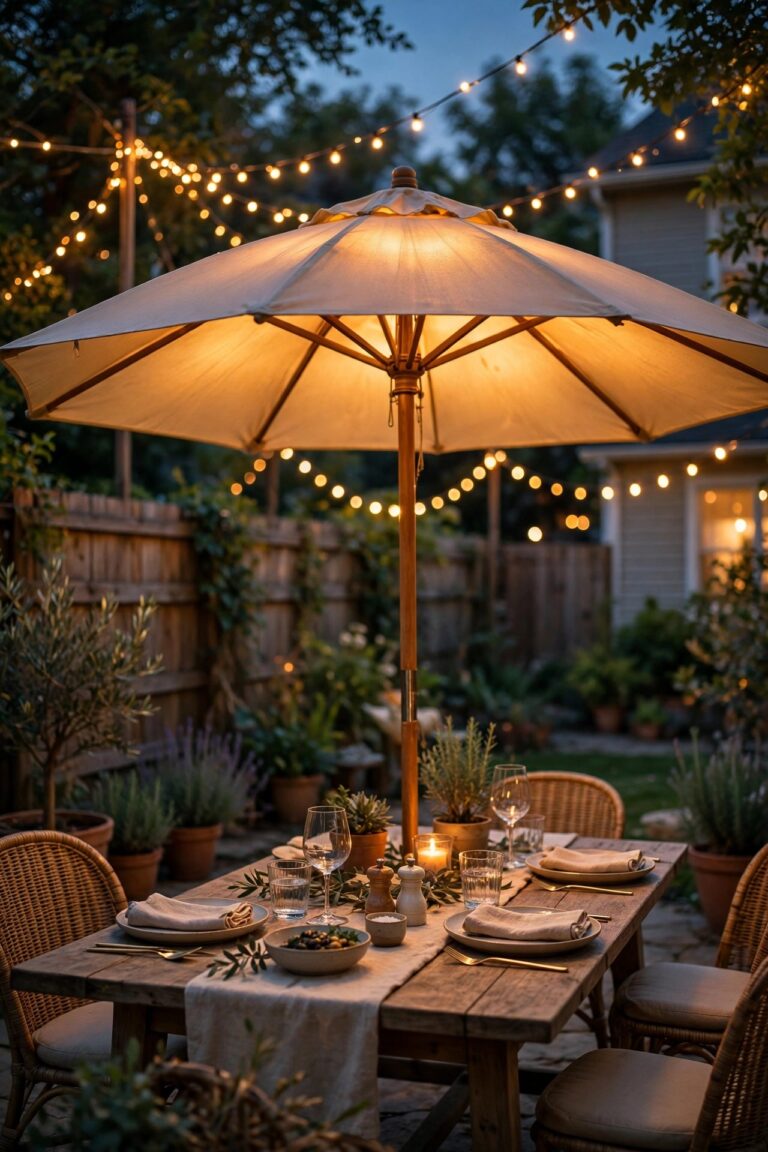
The first time I stood in a friend's half-acre backyard at dusk, I understood the problem instantly: one bright patio light, forty feet of darkness, and a lawn that swallowed every bulb she tried. If that sounds familiar, these large backyard lighting ideas are for you. The secret is not buying more lights — it's layering. In a big yard, I light in zones: a tall layer from trees and poles, a middle layer along fences and beds, and a low layer on paths and steps. Each zone is dim on its own, but together they make the whole space feel finished instead of spotty. In this list I've gathered 21 ways to scale up, from moonlighting in a mature oak to pole-mounted string light grids that cover a real lawn. Every idea includes the spacing, heights, and wattage notes I've learned the hard way, plus honest budget ranges. Pick three or four, mix your heights, and even the biggest yard starts to feel like a room.
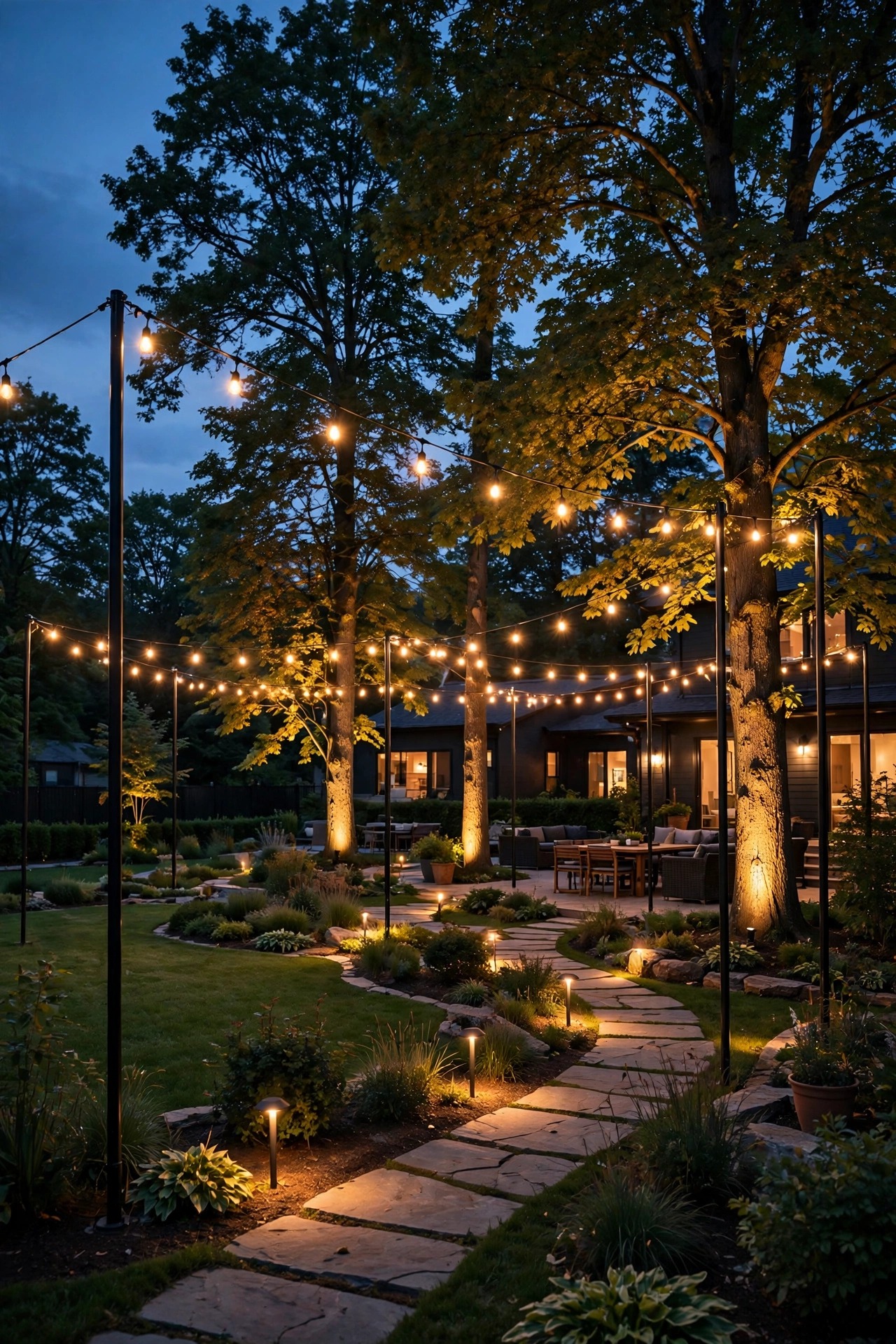
1. Start With Zones: The Plan Behind Large Backyard Lighting Ideas That Work
Before you buy a single fixture, stand at your back door and divide the yard into three or four zones: the entertaining zone near the house, the middle lawn, the far corners, and the routes between them. In my experience, most "my yard feels dark" complaints are really "my far zones have no plan" complaints. Sketch it on paper and assign each zone a job — gathering, playing, gardening, or just visual depth — then light to the job. This is exactly the approach I recommend in my guide to planning landscape lighting zones, and it matters even more at scale, because a half-acre can take 40 to 60 fixtures without blinking. Run each zone on its own transformer tap or smart circuit so you can run the patio zone bright for dinner and keep the far tree line on a soft 30 percent glow. Zoning also protects your budget: you can finish zone one this spring and add the back corners next year without redoing anything. Trust me, a drawn plan beats a trunk full of impulse-buy fixtures every single time.
Suggested budget range: $25 – $75.

2. Tall Poles for String Lights That Actually Cover a Lawn
String lights fail in big yards when they're strung low between two trees and only cover a patio-sized patch. The fix is height and span. I use 9- to 10-foot string light poles — purpose-made steel poles with hooks, set in ground sleeves or heavy planters — placed 15 to 20 feet apart around the lawn's edge. From that height, commercial-grade strands with bulbs every 24 inches throw a wide, even canopy over real square footage. My full method is in my roundup of string light pole ideas, but the big-yard version is simple: four poles make a rectangle of light roughly 20 by 30 feet, and six poles stretch it to cover most suburban lawns. Always run a galvanized guide cable between poles and clip the strand to it; at these spans the cord alone will stretch and sag unevenly by midsummer. Choose LED filament bulbs at 2700K, keep the lowest sag point above 7 feet 6 inches, and put the whole grid on a dimmer — full brightness for parties, half for quiet evenings.
Suggested budget range: $180 – $420.

3. Moonlighting From Your Tallest Trees
Moonlighting is the single most effective trick I know for a big yard, because one fixture 25 to 30 feet up in a mature tree washes an enormous circle of lawn in soft, dappled light. A shielded downlight with a wide 60-degree beam, mounted on a main branch and aimed straight down, mimics full-moon light filtering through leaves — honestly, guests always assume it's real moonlight. I cover the technique in depth in my moonlighting trees guide, but the essentials are: use a cool-neutral 4000K for a moonlit feel or warm 3000K if you prefer golden, keep the fixture's glare shield on so you never see the bulb itself, and run the wire up the back of the trunk with slack loops for growth. One moonlight covers roughly a 30-foot diameter pool of usable light, so two trees can carry an entire back lawn. Because the source is high and soft, it never creates the harsh shadows or neighbor-annoying glare of a floodlight. Hire an arborist for the climb if heights aren't your thing — it's worth it.
Suggested budget range: $250 – $600.
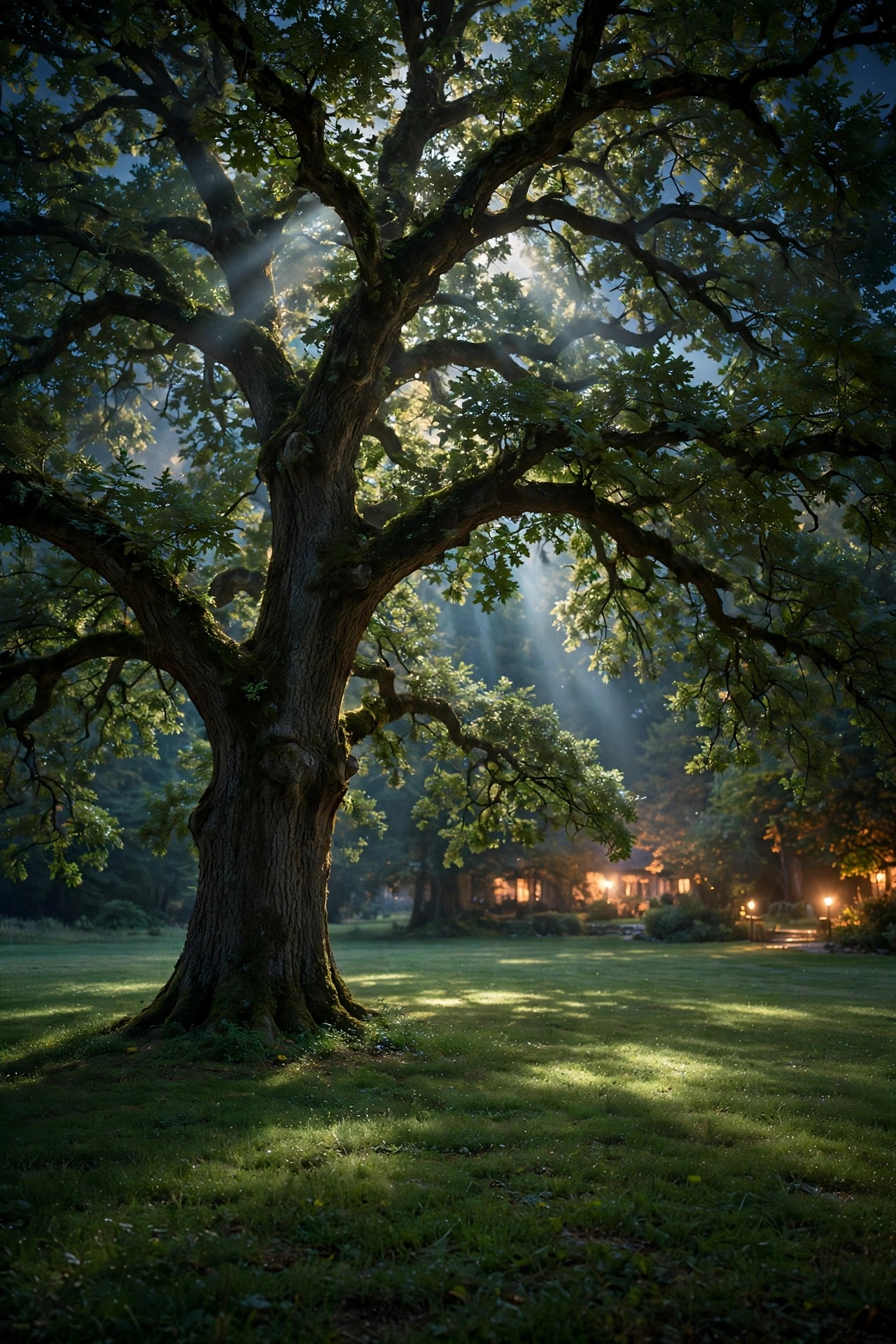
4. Uplight the Big Specimen Trees as Living Landmarks
Every large yard has one or two hero trees, and uplighting them gives the whole space a destination for the eye. Instead of one spotlight at the trunk, I use two or three well lights or bullet fixtures per big tree, placed 12 to 18 inches out from the trunk line and angled up into the canopy from different sides. For a tree with a 30-foot spread, fixtures in the 7- to 10-watt LED range (roughly 500 to 800 lumens each) give that full, cathedral glow without blowing out the top branches. Cross the beams slightly so the foliage lights evenly rather than in hot stripes. Brass or copper fixtures disappear into mulch beds and age gracefully, and in-ground well lights are mower-proof, which matters when a big lawn gets cut weekly. Keep fixtures off the root flare and check aim after the first month — settling soil tilts them. Uplighting the hero trees is also what makes all the smaller ideas in this list look intentional: the canopy becomes the ceiling of your outdoor room, and the yard reads as "designed" from the back door.
Suggested budget range: $150 – $450.

5. Wash the Perimeter Fence So the Yard Has Edges
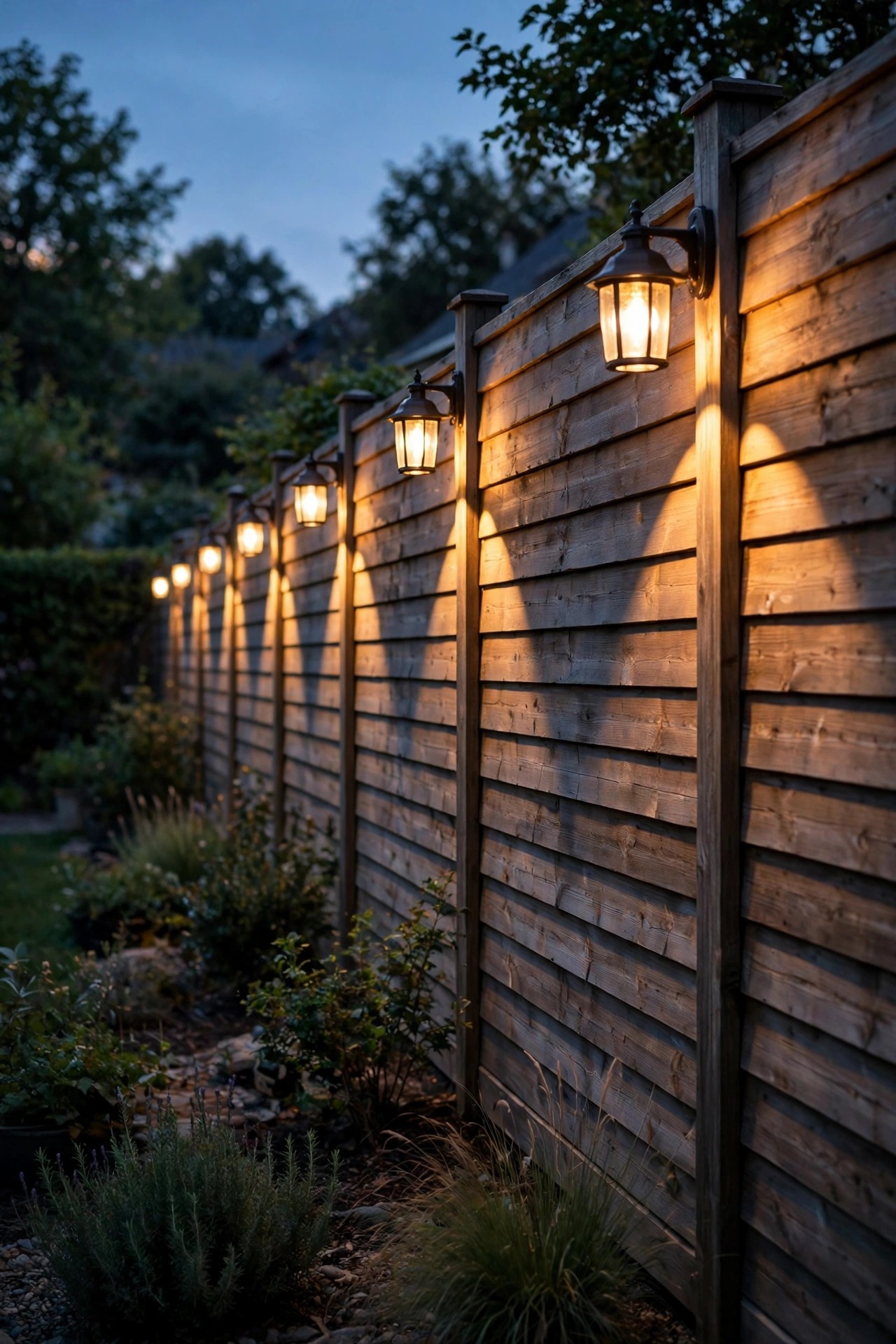
A big yard at night feels unfinished when it fades into black at the property line. A gentle wash along the fence fixes that instantly. I mount small downlights or eave-style fixtures on fence posts every 10 to 12 feet, aimed down at a 45-degree angle so each one paints a soft scallop of light on the fence boards and a pool on the ground below. The overlapping scallops read as one continuous ribbon of light that tells your eye exactly where the yard ends — it's the difference between "dark field" and "garden room." Solar post-cap lights can do a lighter version of this with zero wiring, and for a 100-foot fence line they're genuinely practical. If you go low-voltage, this whole run usually fits on one cable home-run with fixtures in the 2- to 4-watt range. Keep the color temperature matched at 2700K all the way around; mixed temperatures along one fence line look like a mistake, because they are. This is also a kind security layer: a defined, softly lit perimeter leaves no inviting dark corners.
Suggested budget range: $120 – $380.
6. A Real Path Light Grid for Long Garden Routes
In a large yard, paths aren't short connectors — they're 40-, 60-, even 100-foot journeys to the garden, the shed, or the back gate, and two lonely path lights won't cut it. I space fixtures 8 to 10 feet apart, alternating sides of the path, so the pools of light just touch and your eye follows a dotted rhythm across the yard. Choose fixtures 18 to 24 inches tall with shielded, downward light; taller mushroom styles throw light too far sideways and glare when you're walking toward them. For runs this long, voltage drop is the enemy everyone forgets: use 12-gauge cable, keep runs under 100 feet per home-run, and tap the transformer in the middle of the run when you can. LED modules in the 200- to 300-lumen range are plenty — the goal is guidance, not runway lighting. Solar stakes only work here if the path gets six-plus hours of direct sun, which shaded garden routes rarely do. Done right, the path grid becomes the connective tissue that makes every other zone in the yard feel reachable after dark.
Suggested budget range: $200 – $550.

7. Lamp Posts as Anchors in the Middle of Nowhere
The middle of a big lawn is where lighting plans go to die — there's nothing to mount to and nothing to plug into. A lamp post solves both problems by bringing its own structure. I place a single 8- to 10-foot post light at a lawn's visual center or at a path crossing, and it instantly becomes a landmark that organizes everything around it. Modern LED post tops in the 800- to 1,200-lumen range light a useful 15-foot radius without glare, especially in fixtures with frosted or downward-directed optics. Run the cable in an 18-inch-deep trench from the nearest zone circuit — shallow trenches are how cables get sliced by aerators, ask me how I know. Solar lamp posts have improved enormously and work for decorative glow, but for a post that's meant to anchor a seating area or mark a crossing, wired wins on brightness and reliability. Style-wise, match the post to your house fixtures so it looks original to the property. One well-placed post does more for a sprawling yard than six random stake lights ever will.
Suggested budget range: $220 – $500.

8. Layer Three Heights: How Large Backyard Lighting Ideas Come Together
If I could only teach one principle from this whole list, it's this: big spaces need light at three heights or they look flat and patchy. High layer first — moonlights in trees, string light poles, eave downlights, roughly 9 to 30 feet up. Middle layer second — fence washes, lamp posts, pergola fixtures, uplights catching shrubs and fence lines, from about 3 to 8 feet. Low layer last — path lights, step lights, well lights under 18 inches. When I walk a yard that "has plenty of lights but still looks wrong," nine times out of ten everything is at knee height, so the ground glows and the space above it is a void. Spreading your budget across heights feels counterintuitive — fewer path lights, more tree work — but the payoff is enormous. A practical ratio for a large yard: about 30 percent of fixtures high, 40 percent mid, 30 percent low. And keep brightness modest at each level; layers are supposed to whisper together, not compete. Stand at the back door after each addition and check the balance from the house, because that's the view you live with.
Suggested budget range: $300 – $900.
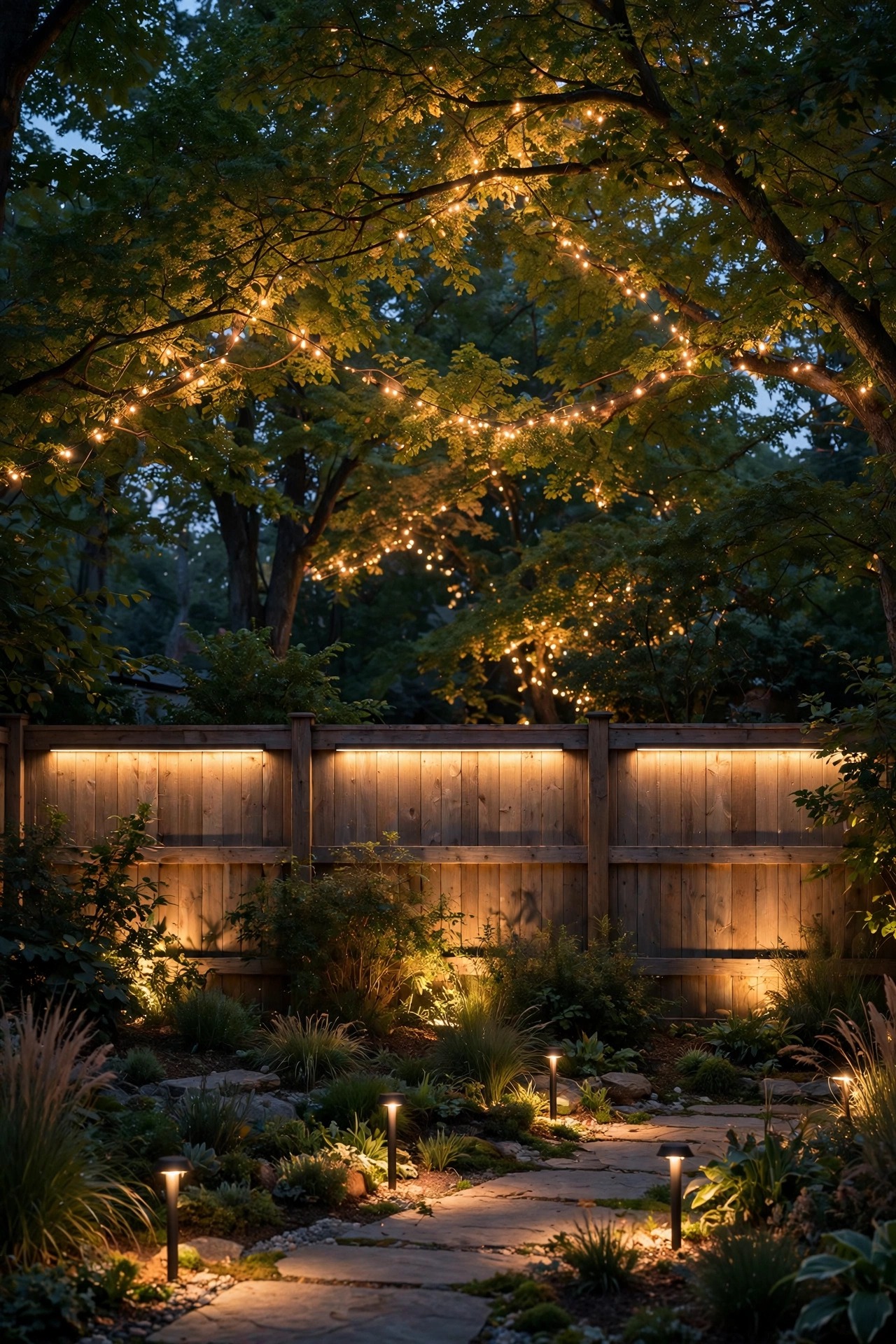
9. Give the Fire Pit Its Own Low, Warm Zone
A fire pit at the far end of a big yard should feel like a destination, not an afterthought you stumble toward in the dark. I circle the seating area with low light only: fixtures under bench seats, small well lights at the circle's edge aimed outward, or lanterns hung from short shepherd's hooks between chairs. Keep everything at or below seated eye level — about 24 inches — so nothing competes with the flames or glares across the circle. The fire itself provides the main light; your fixtures are just there to define edges, mark the step down from lawn to patio stone, and keep the trip back to the house safe. Flame-effect LED tiki torches around the outer edge are a lovely bridge between the lit yard and the pit zone, and solar versions mean no cable trench across the lawn. Color temperature matters here more than anywhere: 2200K to 2700K keeps the mood firelight-warm. Add one dim path light run back toward the house and guests will find their way without anyone flipping on a harsh porch light.
Suggested budget range: $90 – $300.
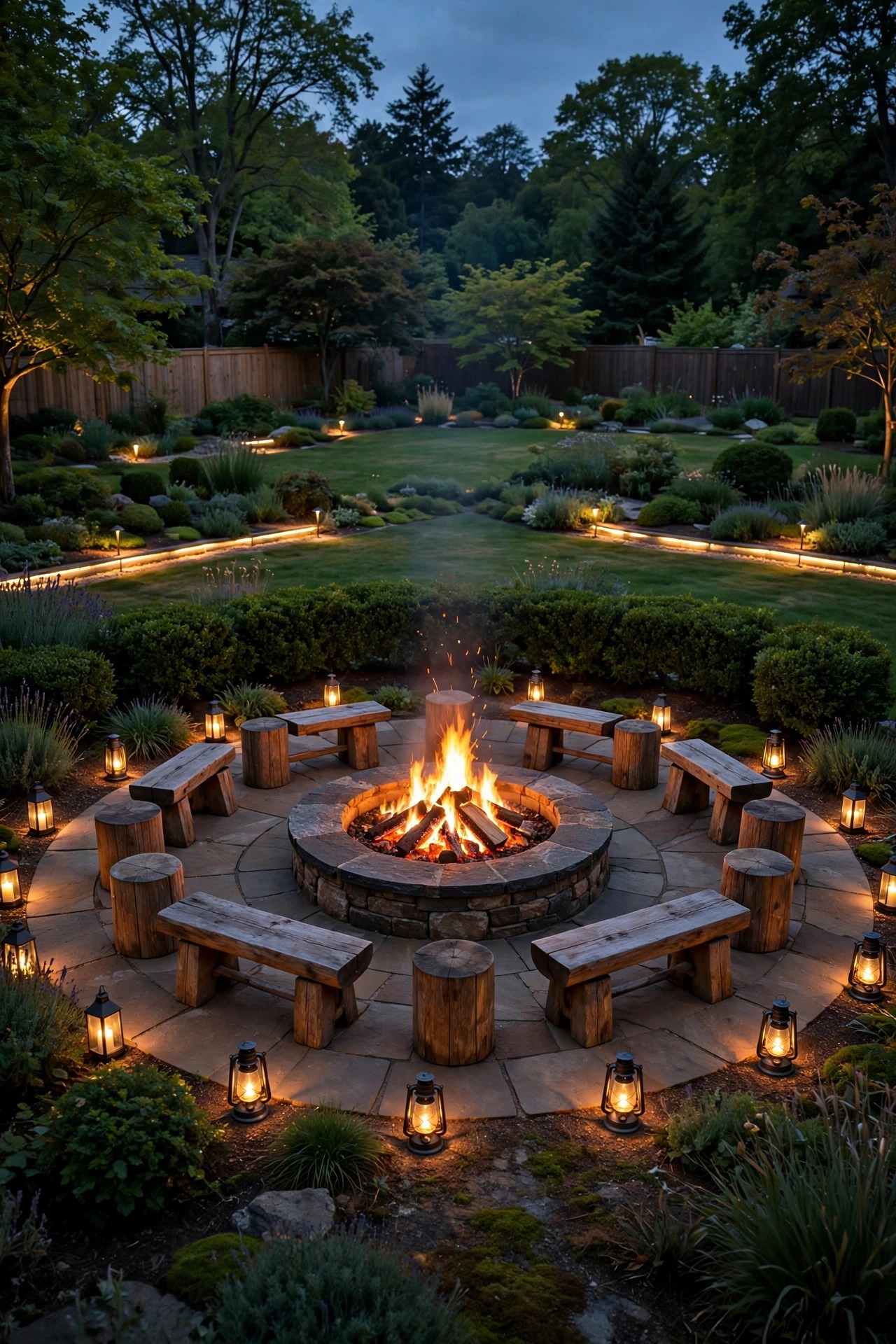
10. Turn a Pergola or Pavilion Into a Lit Destination
In a large yard, a pergola, pavilion, or even a simple shade sail on poles creates the "far room" that pulls people out into the space — but only if it's lit like a room. I combine three sources: recessed or strip downlights in the beams for general light, a pair of outdoor-rated pendants or a chandelier over the table for focus, and small uplights at the posts so the structure itself glows against the night. Dimmers are non-negotiable; dining under a pergola wants about half the brightness of the cooking area. If the structure sits 50-plus feet from the house, budget for the cable run or place a small dedicated transformer nearby on its own GFCI-protected circuit. Weatherproofing is where people cut corners and regret it: every fixture needs a wet-location rating, and connections belong in gel-filled waterproof connectors, never bare wire nuts underground. Add a ceiling fan with a light kit if the structure allows — moving air plus dimmable light makes a far pergola feel like the best seat in the house, and in a big yard that's exactly the point.
Suggested budget range: $350 – $950.

11. Light the Pond or Pool Surround, Not the Water Alone
Water features are natural focal points in a big yard, but underwater lights alone leave the surrounding deck and planting in darkness, which looks odd and is a genuine trip hazard. I layer it: two or three submersible or in-grade fixtures to make the water itself shimmer, uplights on any specimen planting or rockwork at the water's edge, and a low circle of shielded fixtures around the deck or stone surround so the footing is clear. For pools, keep deck lighting low and warm — bright white floods bouncing off water are blinding and ruin every other zone nearby. Always use fixtures rated for the exact job: submersible-rated in the water, wet-location around it, and everything on a GFCI-protected circuit, full stop. Solar floating lights are a fun, zero-install accent for ponds and look magical drifting, but treat them as jewelry, not lighting. Timers help here too — I run water feature zones until midnight, then let the yard's overnight layer take over at low glow. The reflection doubling every light is the cheapest drama in landscape lighting; use it.
Suggested budget range: $200 – $700.

12. Shielded Wide-Beam Floods for Play Lawns and Games
Here's the practical side of large backyard lighting ideas nobody puts on mood boards: sometimes the kids want to play soccer until dark, and the lawn needs real, usable light. The trick is doing it without turning your yard into a stadium or blinding the neighbors. I mount two wide-beam LED floods — 120-degree beam, 3,000 to 5,000 lumens each — high on the house eaves or on 15- to 20-foot poles at the lawn's corners, aimed down at 30 to 45 degrees so the light lands on grass, not in windows. Full-cutoff shielded fixtures keep the spill where it belongs, and warm-white 3000K looks far less harsh than daylight bulbs while still showing the ball clearly. Put the play zone on its own switch or smart circuit so it only runs during games, not all evening. Motion-activated is wrong for this job; a simple timer or app control is right. When the game zone is off, your soft layers take back the yard. Honestly, this one addition is what finally made our big yard usable for the whole family after 7 p.m.
Suggested budget range: $180 – $650.

13. Border the Garden Beds So the Planting Reads at Night
In a large yard, garden beds are wide and deep, and a single row of lights along the front edge flattens them. I light beds in two rows: a front row of low path-style fixtures 12 to 18 inches from the edging, spaced about 6 feet apart, and a back row of small spotlights tucked behind mid-height shrubs, aimed up and out to catch the tall plants and fence behind them. This front-back pairing gives the bed visible depth after dark, so a 6-foot-deep perennial border looks layered instead of like a lit sidewalk. Adjustable bullet fixtures in the 3- to 5-watt range are perfect for the back row because you can re-aim as plants grow — and you will, every season. Keep front fixtures shielded so light stays in the bed, not in the eyes of anyone on the lawn. Mulch color matters more than people think: dark mulch absorbs light, so bump fixture brightness slightly or tighten spacing in dark-mulched beds. Beds are also the cheapest place to experiment with color; a pair of warm amber accents among the whites adds richness without kitsch.
Suggested budget range: $160 – $480.
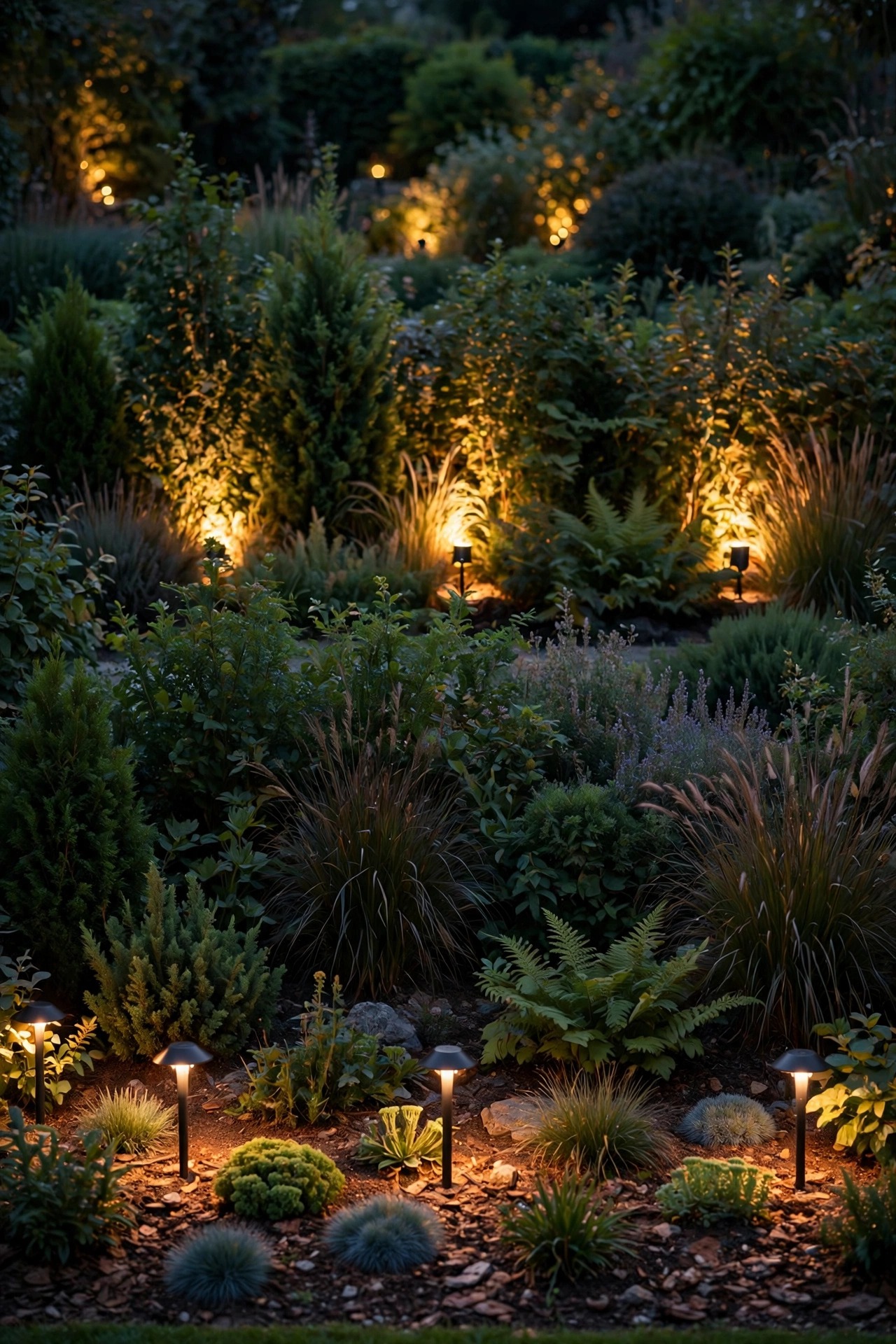
14. Solar Stake Fields for the Far Corners With No Power
Every big yard has them: the far corners where trenching cable feels ridiculous. That's solar's home turf. Modern solar stakes with separate, larger panels have changed what "solar" can do — a cluster of five to eight fixtures, each with its panel angled at the sun and staked in an open patch, can wash a corner garden, a compost area's path, or the base of a far tree line in genuinely useful light. Grouping is the key move: a single solar stake looks lost in a large yard, but a deliberate field of them reads as design. Check the lumen ratings honestly — you want 50 to 100 lumens per stake for visible effect, not the 5-lumen bargain-bin glow — and expect premium stakes in the $15 to $35 range each. Replaceable batteries extend their life for years; sealed units are landfill in two seasons. In northern winters, runtime shrinks, so treat solar zones as accents that can fade early without ruining the yard's main layers. For zero-trench, zero-electrician coverage of distant corners, nothing else comes close on effort.
Suggested budget range: $120 – $350.
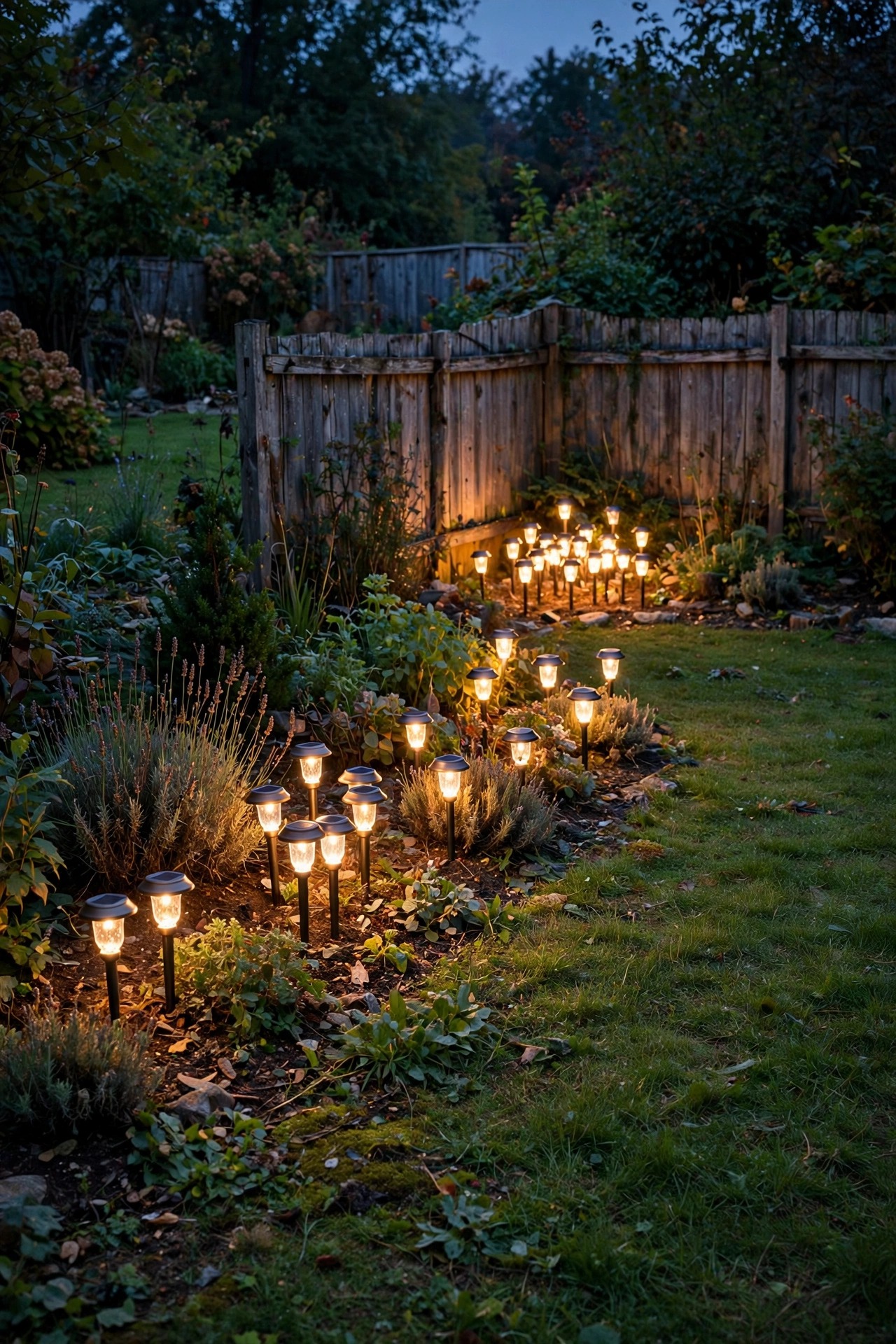
15. Zigzag String Lights Over the Dining Terrace
The dining terrace anchors the near zone of a large yard, and a zigzag string light pattern is my favorite way to roof it. Anchor strands on the house wall and on two terrace poles, then run them back and forth in a W with passes 3 to 4 feet apart — because the strands cross the space so often, the light over the table is even, with no dark seats. Keep the lowest sag at least 7 feet 6 inches above the floor, and use a galvanized guide cable for any run over 20 feet so the cord isn't carrying the tension. In a big-yard layout, I deliberately make the terrace canopy denser and brighter than the lawn's pole grid from idea 2, so the terrace reads as the yard's "main room" and the lawn canopy feels like its softer extension. Warm 2700K LED filament bulbs, a dimmer at the door, and a timer as backup — that's the whole recipe. Dinner guests will linger, and honestly, that lingering is the entire reason we light these yards in the first place.
Suggested budget range: $90 – $260.
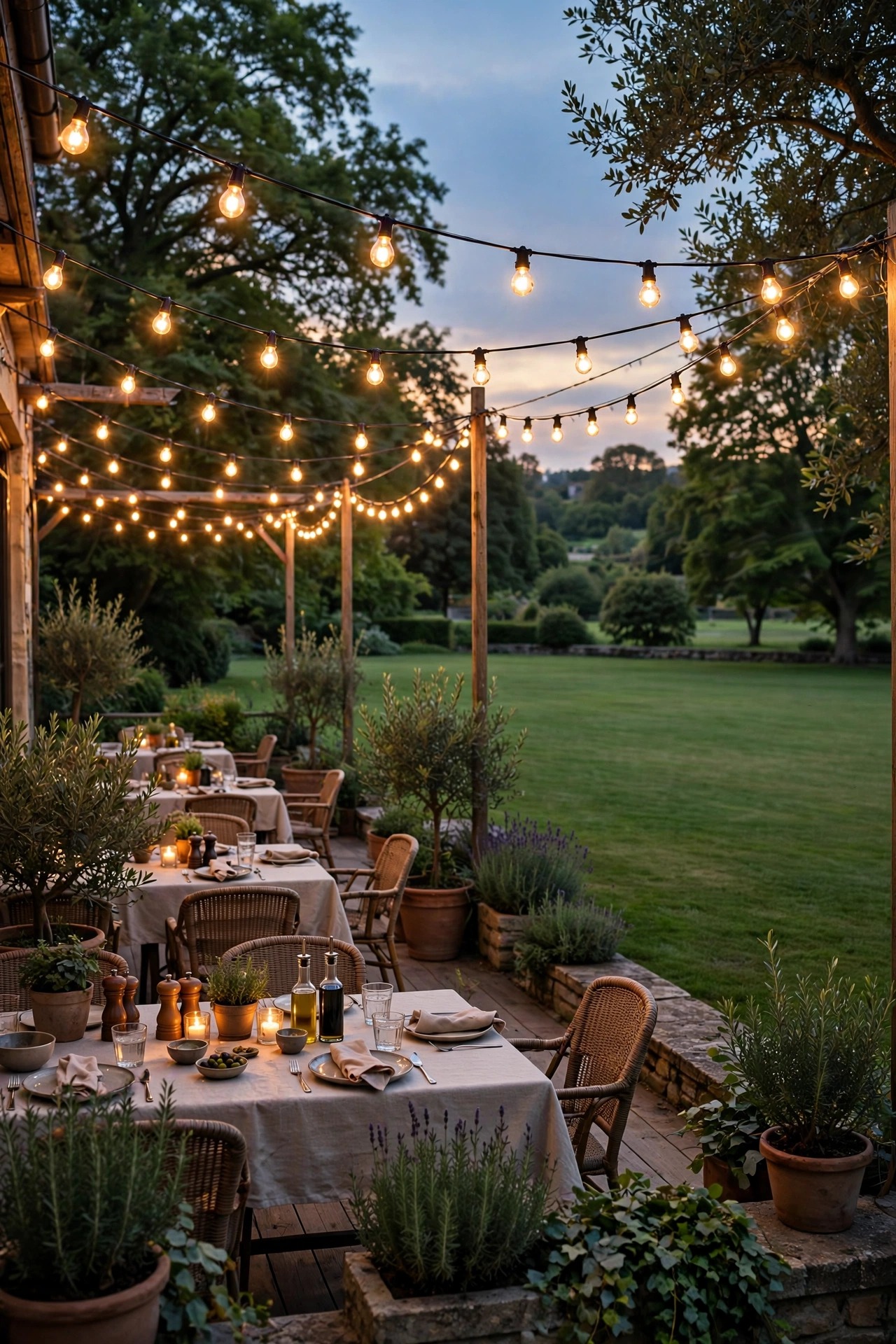
16. Downlight the Yard From the House Eaves
Your house is the tallest structure you own, and its eaves and second-story walls are free lighting platforms for the near half of a big yard. I install soffit downlights or discreet surface-mount fixtures under the eaves every 8 to 10 feet, angled slightly outward, to wash the patio, the planting against the foundation, and the first 20 feet of lawn in a soft, even sheet. Because the light comes from above and behind anyone sitting outside, it never glares into the seating area — the same principle as good porch lighting, scaled up. Put eave lights on the same dimmer zone as the terrace so the whole house-edge layer adjusts together. This is line-voltage work for most homes, so it belongs in the "hire an electrician" column unless you're confident and permitted; budget accordingly and have them add a switched outlet at the eave while they're up there — future holiday-you will be grateful. Eave downlighting also closes the security gap between house and yard better than a single motion flood, because the whole foundation line is gently, constantly lit.
Suggested budget range: $300 – $900.

17. Bollards to Edge the Lawn and Mark Level Changes
Bollards are the grown-up version of path lights, and large yards are where they shine — literally marking the long edges of lawn, the turn of a path, or the two steps down to a lower terrace that guests always miss. At 24 to 36 inches tall, a bollard throws a wider, more useful pool of light than a small stake, and its solid form looks intentional in daylight too. I space them 10 to 12 feet apart along lawn edges and always place one at any grade change, step, or path intersection. Choose louvered or shielded designs that push light down and out rather than into eyes, in the 300- to 500-lumen range. Commercial-style bollards cost more per fixture, but you need fewer of them than stakes, and they survive mower bumps and soccer balls that flatten cheaper lights. In-ground or concrete-set mounting is worth the effort in soft soil. A line of bollards marching down a long lawn edge gives a big yard the kind of structure that makes visitors say the place looks like a resort — I've heard it twice, and both times bollards did the heavy lifting.
Suggested budget range: $280 – $800.

18. Pair Task and Ambient Light in the Outdoor Kitchen
An outdoor kitchen at the far end of a big patio fails at night if it only has party lighting: you can't see the grill thermometer by string light alone. I split it into two circuits. Task layer: focused downlights under the counter overhang or a pergola beam directly over the grill and prep surface, in the 500- to 800-lumen range per fixture, neutral 3500K to 4000K so meat colors read true. Ambient layer: the terrace's warm 2700K strings, pendants, and candle-style accents on a separate dimmer for everything around the cooking. Keeping the temperatures on separate circuits is what makes both work — mixed together in one fixture type, food looks grey and the mood goes office-y. Add a small step light at any counter-side grade change and under-counter strip lighting for the storage side; cooks trip carrying trays, full stop. Weatherproof everything to wet-location standard and keep fixtures at least the code-required distance from open flame. When the task lights switch off after cooking, the kitchen melts back into the party glow seamlessly.
Suggested budget range: $250 – $750.

19. Wrap Several Trees, Not Just One, for Depth
One wrapped tree is a Christmas photo. Three or four wrapped trees scattered across a large yard are depth itself. I wrap trunks and the first few main branches with warm-white fairy lights — copper-wire strands wound snugly every 4 to 6 inches — on trees at different distances from the house: one near the terrace, one mid-lawn, one at the far corner. The repetition creates a visual rhythm that pulls your eye through the whole space, and the yard instantly feels three times deeper. Outdoor-rated plug-in strands hold up far better than battery versions at this scale; run slim outdoor extension cords along mulch lines and cover the plugs with weatherproof in-use boxes. Keep the wrap density consistent tree to tree or it looks like you ran out of lights, because you did. On timers, wrapped trees become the yard's nighttime skeleton — the layer that stays on latest at my house, honestly, because it looks good from every window. Remove or at least loosen wraps each spring to protect bark, and re-wrap in fall as part of your seasonal routine. Cheap, forgiving, and the highest compliments-per-dollar of anything on this list.
Suggested budget range: $60 – $220.

20. Put It All on Smart Zones and Timers
The bigger the yard, the more lighting it has — and the less of it you will ever walk around switching. Automation is what turns 50 fixtures from a chore into a backdrop. My setup: a transformer or smart controller with at least three zones, programmed to fade up at sunset (astronomical timers adjust themselves all year), run the entertaining layers at full until 11 p.m., then drop to a soft overnight layer of path lights and tree wraps until dawn. Smart plugs and app-controlled low-voltage controllers in the $30 to $120 range handle most of this now, and scene presets — "dinner," "party," "play lawn," "overnight" — mean one tap instead of a checklist. This is where large backyard lighting ideas either become a lifestyle or a guilt pile, honestly. Choose photocell-plus-timer control over pure clock timers so cloudy early dusks don't leave you dark. And label every zone in the app with the name you'd shout across the yard — "far trees," not "Output 3" — future you, standing in the rain with a phone, sends thanks.
Suggested budget range: $60 – $300.

21. Finish With a Moon Garden Corner That Glows on Its Own
My favorite finishing move in a big yard costs almost nothing in light: plant one corner for the night. A moon garden — white and silver plants like white roses, dusty miller, lamb's ear, white hydrangea, and pale ornamental grasses — reflects so much ambient light that it seems to glow by itself. Tuck it into a corner that's visible from the house and the terrace, then add just two low spotlights aimed into the planting from the sides, never straight on. The pale foliage catches your existing layers — tree wraps, a nearby lamp post, even porch light — and amplifies them, so this corner needs barely any dedicated wattage. A light gravel or pale stone mulch underneath doubles the effect. It's also the most forgiving spot in the yard for solar accents, since the plants do most of the visual work. Guests always drift toward the glowing corner without knowing why, and in winter the pale grasses and a single uplight still give you structure when the beds are bare. Every big yard has one underused corner; this is how it becomes the favorite.
Suggested budget range: $75 – $300.

Frequently Asked Questions
How many lights do I need for a large backyard?
For most large yards (a quarter acre and up), plan on 40 to 60 fixtures spread across zones rather than one bright cluster. Start with the paths, the main entertaining area, two or three hero trees, and the far corners — then live with it a few weeks before adding more. It's far easier to add fixtures to a wired system later than to undo an over-lit yard, and layering in stages keeps the budget sane.
Which color temperature looks best in a big yard?
Warm white, 2700K to 3000K, for nearly everything — it flatters skin, wood, and foliage and keeps the mood residential. I make two exceptions: moonlighting can go slightly cooler at 3000K to 4000K for a true moonlit feel, and outdoor kitchen task lights read food colors better around 3500K. Whatever you choose, keep one temperature per zone so the yard doesn't look patchy.
Is solar or low-voltage better for covering a really big area?
Low-voltage wired lighting wins for your main layers: it's brighter, consistent on cloudy weeks, and one transformer can run dozens of fixtures for pennies a night. Solar shines in the far corners where trenching cable isn't worth it, and for accents like floating pond lights. My honest rule: wire the structure of the design, solar the sprinkles.
How much does it cost to light a large backyard?
A solid DIY low-voltage setup for a large yard typically runs $1,500 to $4,000 in fixtures, cable, and transformers, phased over a season or two. Professional design and installation for the same space usually lands between $5,000 and $12,000 depending on fixture count and how much tree work is involved. Running costs are minor — a full LED system often draws less power than one old halogen floodlight.
Conclusion
A big yard doesn't need more light — it needs light in the right places, at the right heights, on the right schedule. Start with zones, anchor the space with trees, poles, and a lit destination or two, then let paths and beds connect it all. That's the whole philosophy behind these large backyard lighting ideas, and it scales from a deep suburban lot to a genuine acre. Pick your first three projects, stand at the back door at dusk, and adjust like a painter. And when you're ready to refine the details, browse the rest of my lighting guides here on the site — your yard's best evenings are still ahead of it.