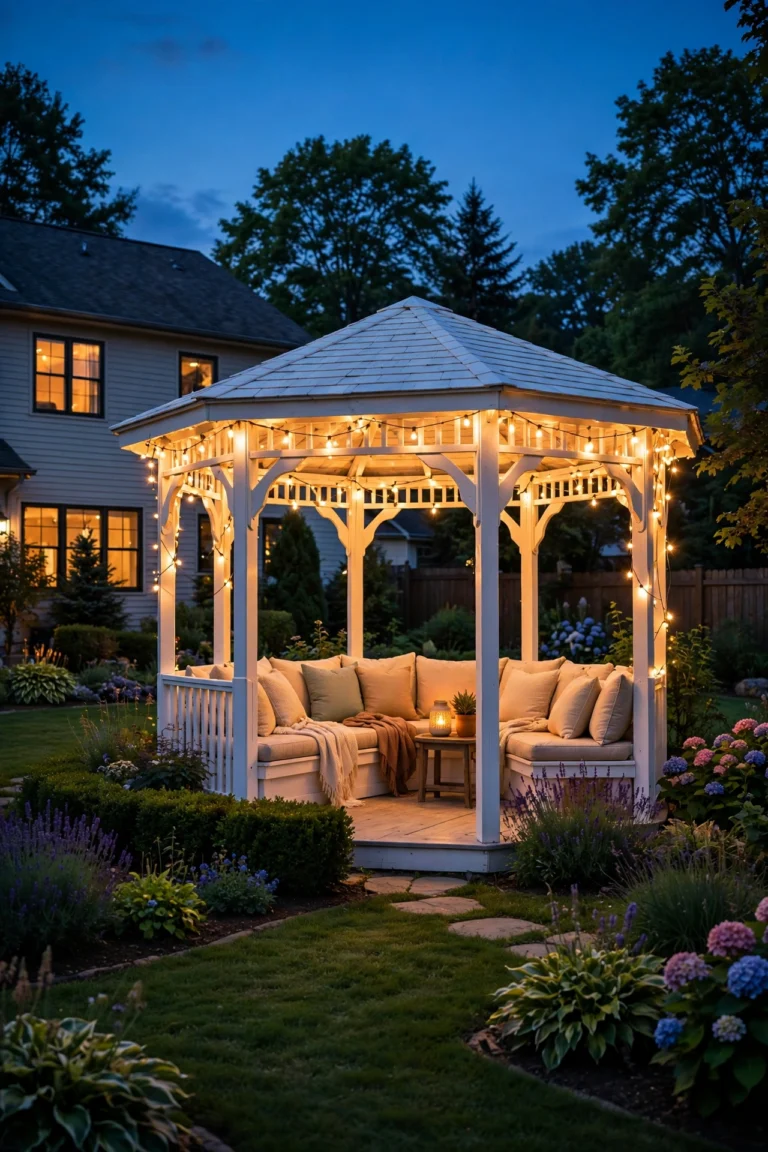
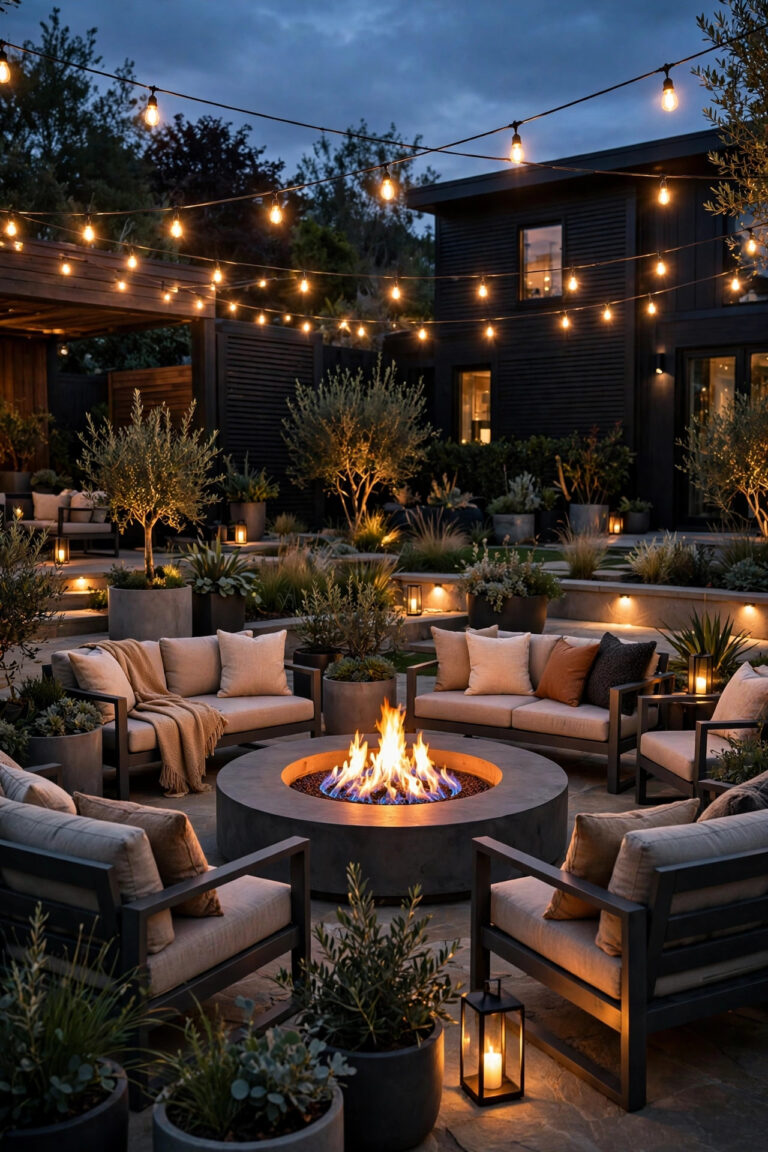
Here's the dilemma every composite deck owner knows: you spent serious money on boards that will never rot, warp or need staining — and now every lighting guide tells you to drill holes in them. Most recessed deck lights require coring a 1-inch hole through the board, and many manufacturers will not cover a board that has been cut, drilled or fastened wrong. So when friends ask me for composite deck lighting ideas, I skip the drill entirely. After years of decorating low-maintenance decks, I have a whole toolbox of slip-on, clip-on, stick-on and stake-in tricks that light a deck beautifully without touching a single board. As always, I build the glow in layers: something on the posts, something along the rails and steps for safety, and something soft at table level. Every one of these 21 ideas removes in minutes if you ever change your mind — and not one of them puts your warranty at risk.

1. Solar Post Cap Lights — the Easiest Composite Deck Lighting Ideas to Add
If you do only one thing from this list, make it this. Solar post cap lights simply slip over the top of your railing posts the same way the plain caps do — no drilling, no wiring, no holes anywhere near a deck board. Measure your posts first: most composite rail systems use 4×4, 5×5 or 6×6 sleeves, and caps are sold in exact sizes, so match the inside dimension, not the outside. A firm friction fit is usually enough, but on windy decks I add a pea-sized dab of clear exterior silicone to the inside lip of the cap. That touches the post sleeve, never a board, and pops off cleanly with a putty knife. Look for caps in the 2700K to 3000K warm-white range so the light flatters the brown and gray tones in composite boards, and expect 10 to 30 lumens each — accent level, not task light. I light every post on smaller decks and every other post on long runs. Wipe the little solar panels with a damp cloth once a month; pollen film is the number-one reason these quietly go dim by midsummer.
Suggested budget range: $60 – $180.

2. Clip-On Railing Lights That Clamp in Seconds
Clip-on railing lights are the workhorses of my no-drill kit. A spring clamp or adjustable jaw grabs the top rail or the underside of the handrail, points the light downward, and washes the deck boards in a soft pool that shows off the wood-grain texture composite is famous for. Most jaws adjust to grip rails from about 1½ to 3 inches thick, and the better models have a rubber pad inside the clamp so there is not even a scuff mark when you remove them. I space these every 3 to 4 feet along the main railing and closer on the side where we walk after dark. Choose solar versions for zero maintenance beyond cleaning the panel, or battery versions if your railing sits in shade — those run a full season on a set of AA batteries in my experience. Aim the heads slightly inward so the beam lands on the deck instead of glaring out into the yard. When guests come, I shift two of them over the grill zone in seconds. Try doing that with a recessed fixture.
Suggested budget range: $35 – $90.
3. LED Strip Lights Tucked Under the Top Rail
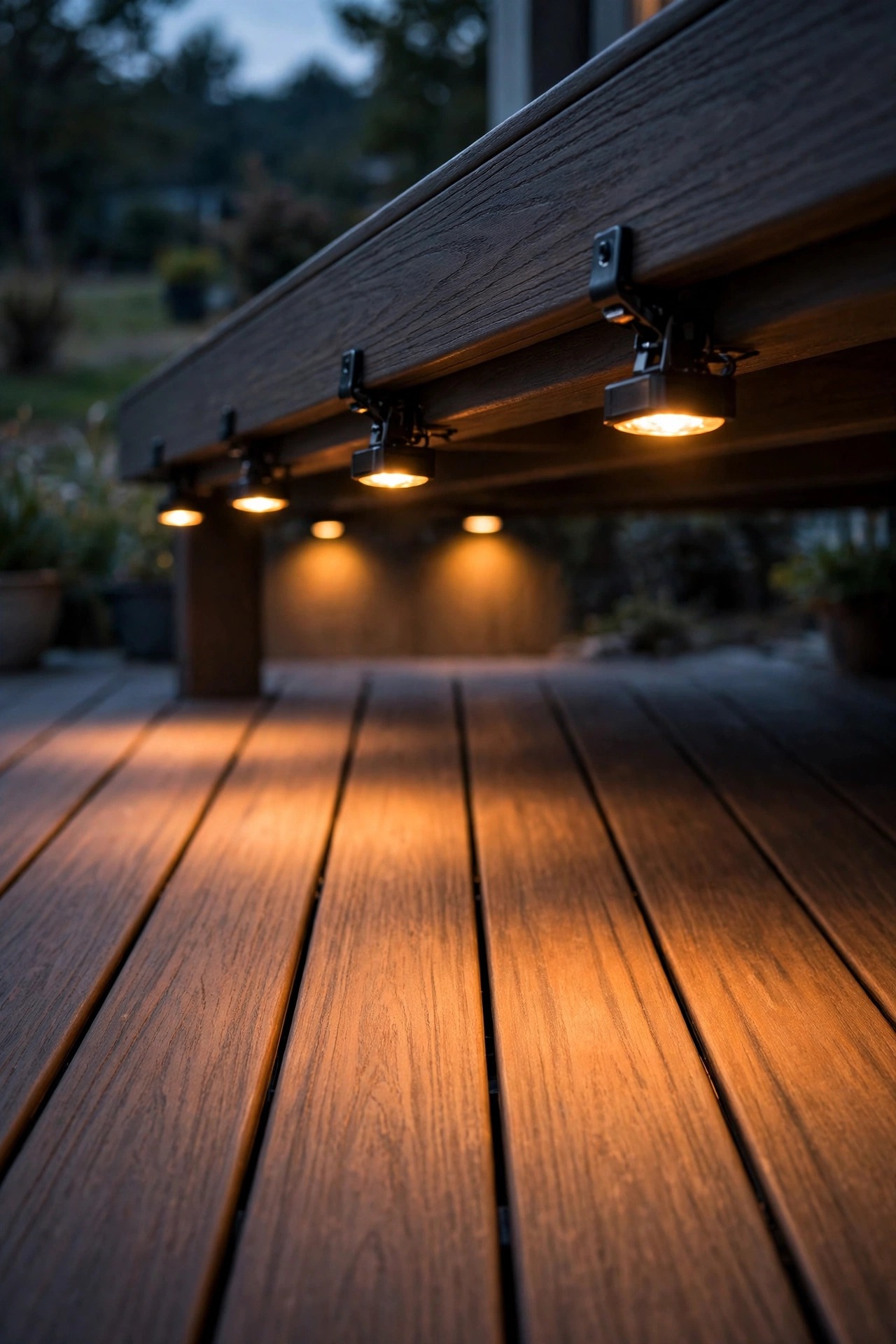
For that high-end, hotel-deck look with zero visible fixtures, stick an outdoor LED strip underneath the top rail where it glows down across the balusters. The no-damage trick is an adhesive-backed aluminum channel: the tape bonds to the underside of the rail — never a walking surface — and a frosted diffuser cover snaps over the strip so you see one smooth ribbon of light instead of dotted diodes. Use IP65-rated tape at minimum, 2700K to 3000K, and low-voltage 24-volt runs for decks longer than 16 feet so the far end stays as bright as the start. My full method for channels, connectors and dimmers is in my guide to under-rail LED strip lighting, and it applies to composite rails exactly the same way. A remote dimmer takes it from find-your-drink dim to bright enough for a card game. If you ever remove it, gentle heat from a hair dryer loosens the adhesive without a trace. Honestly, this single layer does more for evening atmosphere than anything else on this page.
Suggested budget range: $45 – $130.

4. Solar Step Lights With Peel-and-Stick Mounting
Steps are where a pretty deck becomes a safe one after dark, and luckily they are easy to light without a drill. Modern solar step lights ship with heavy-duty outdoor mounting pads that bond to the vertical riser or the stringer face — vertical surfaces, not the tread boards you walk on. Peel, stick, press for 30 seconds, done. Clean the spot with rubbing alcohol first and the pads hold through summer storms; I have had a set on my own stairs for three seasons. Put one light per step on narrow stairs, every other step on wide ones, always at the same height so the rhythm reads as intentional. Dusk-to-dawn models give a constant low glow, while motion-activated versions flare up as you approach, which saves the battery on cloudy weeks. My deck stair light ideas cover placement patterns in more depth if you have winders or a landing. Warm 3000K light shows the edge contrast best. This is the idea I push hardest on anyone with grandparents or grandkids visiting after sunset.
Suggested budget range: $30 – $85.

5. String Lights Hung From Posts, Hooks and Clamps
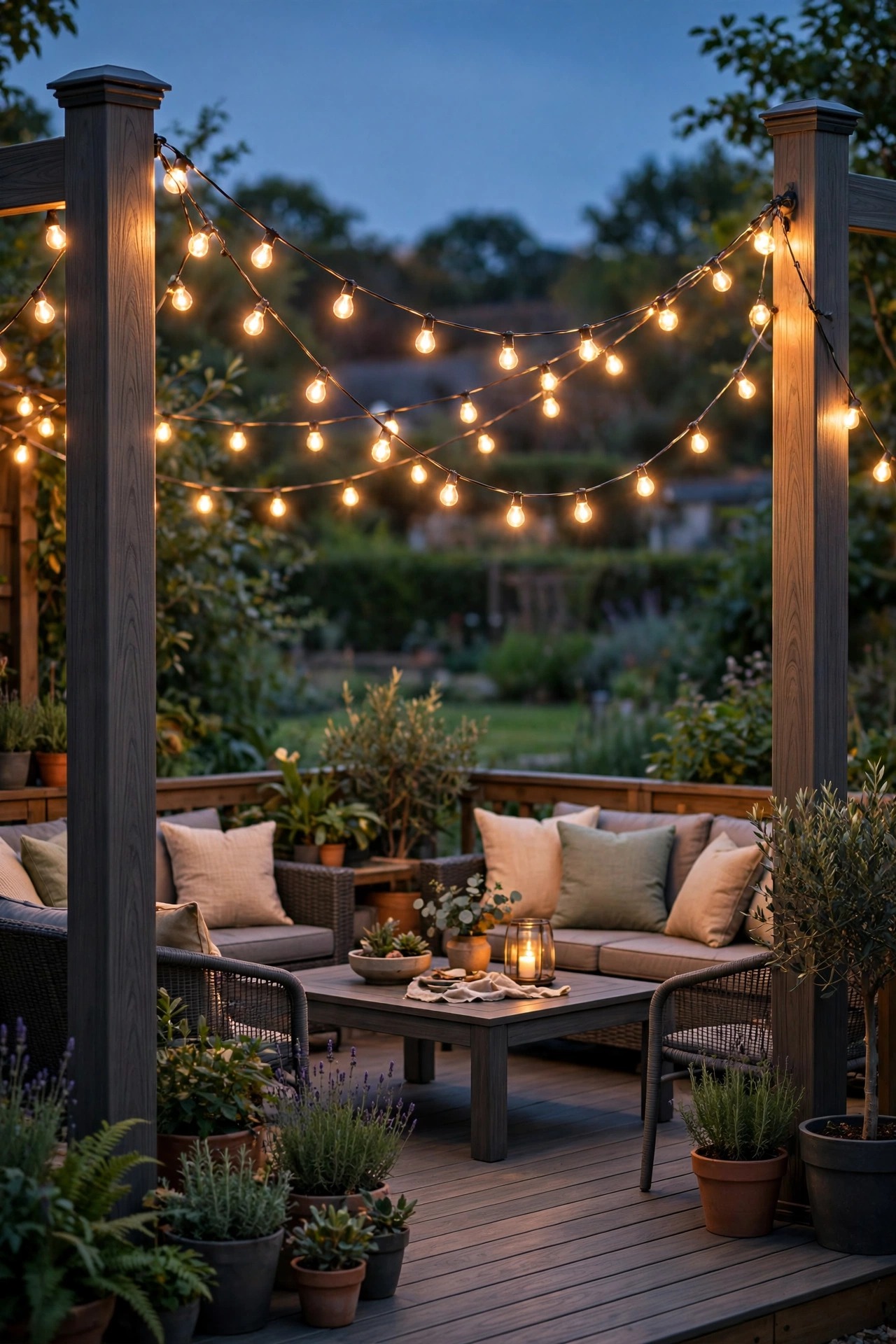
Nothing says stay-awhile like string lights overhead, and a composite deck gives you plenty of anchor points that are not deck boards: railing posts, pergola beams, the house siding, even a pair of freestanding poles set in heavy planters at the corners. Screw hooks go into posts and house framing — structures, not boards. If you want a truly zero-hole setup, use clamp hooks that grip the railing and tension the strand between them. Keep the lowest point of each swag at least 7 feet above the deck so nobody ducks, and run a thin guide wire for spans over 15 feet so the weight never sags onto the strand's own cord. Choose commercial-grade stringers with shatterproof LED filament bulbs in warm white; they sip power, stay cool, and shrug off a dropped strand. Two 48-foot strands cover most 12-by-16 decks in parallel rows. On an outdoor smart plug with a dusk timer, the whole ceiling of light fades on by itself every evening, and your boards remain exactly as the manufacturer delivered them.
Suggested budget range: $40 – $110.
6. Rope Lights Along the Fascia With Snap-On Clips
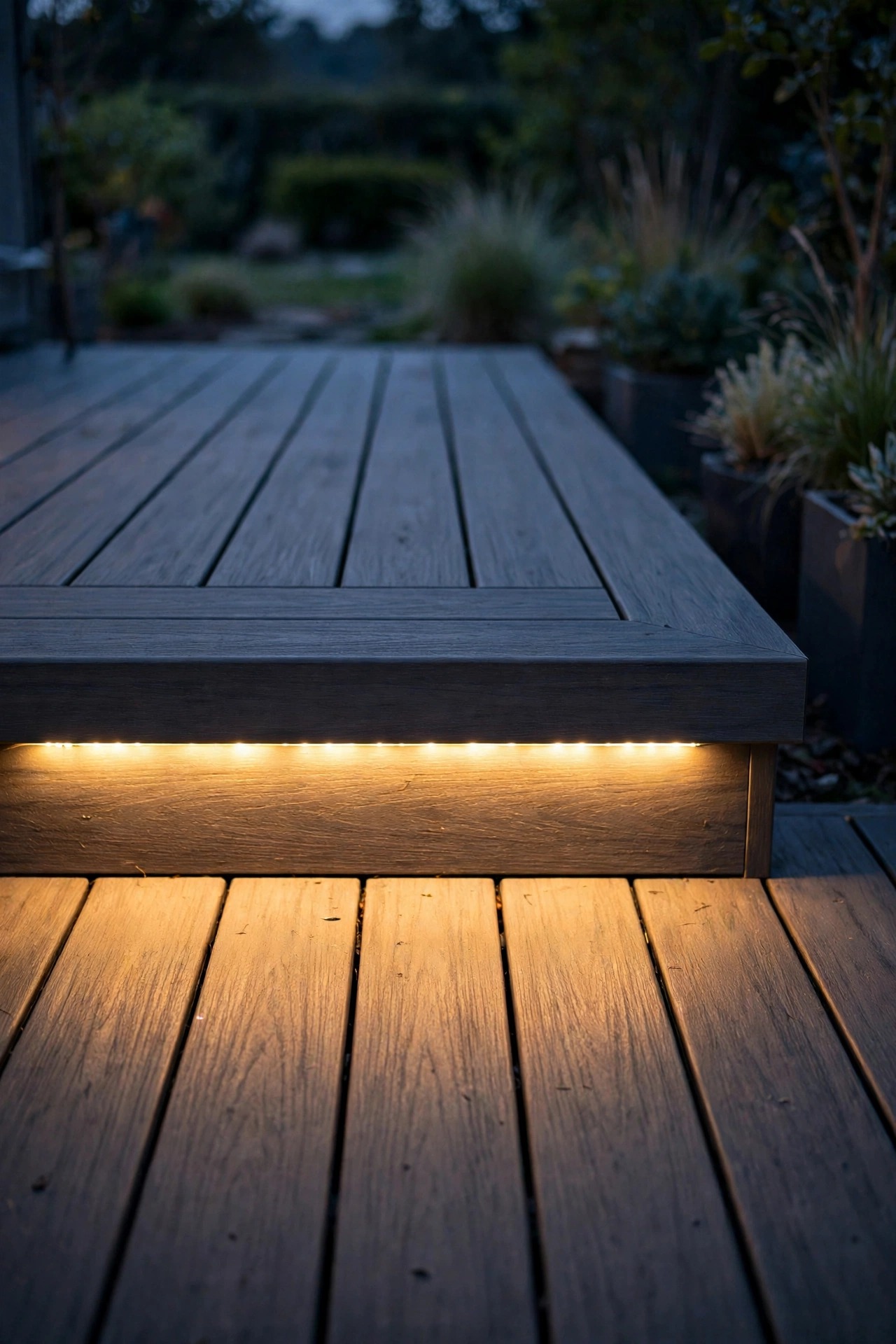
The fascia — that vertical trim board along the deck's outer edge — is fair game for clips, and outlining it with rope light gives your deck a floating, finished outline you can see from across the yard. Clear mounting clips snap into a channel or grip the fascia's bottom edge every 12 to 18 inches, holding the rope snug against the vertical face. Because everything attaches to the edge trim and hangs below deck level, nothing touches the walking surface at all. I like warm-white LED rope rated for outdoor use, cut to length at its marked points, with the power cord dropped discreetly at a corner post down to a GFCI outlet. Steady-on reads modern; a gentle chase setting is fun for parties. From the street, the deck looks like it hovers on a ribbon of light, and from above, the rope is invisible — all you see is the glow edging each board line. Add an inexpensive plug-in timer so it runs dusk to 11 p.m. and you will never think about it again until a neighbor compliments it.
Suggested budget range: $35 – $95.

7. Solar Spotlights Staked in the Yard, Aimed at the Deck
Sometimes the smartest place for deck light is not on the deck at all. Solar spotlights staked into the planting beds around your deck can wash the stair fronts, graze up the skirting and silhouette the railing without a single attachment point. Push the stake in 12 to 24 inches out from the deck edge and aim the adjustable head at a shallow angle; grazing light across composite skirting and stair risers creates lovely shadow and depth. Solar spotlights now reach 200 to 600 lumens, so two or three genuinely light a seating zone when combined with softer layers. Position one to backlight a planter at the deck corner and one to rake across the steps, and keep one spare aimed at the grill from the garden side. Choose models with a detachable panel you can angle toward the sun while the head aims at the deck — that flexibility matters under trees. Rain is a non-issue with IP66 housings, and when fall comes, you pull them up in a minute and store them in a tote.
Suggested budget range: $30 – $80.

8. Battery Puck Lights With a Remote, Stuck Wherever You Need Them
Battery puck lights are my secret weapon for the dark corners no other fixture reaches: under a built-in bench lip, inside the shadow of an outdoor kitchen counter, beneath the top step overhang. Each puck sticks up with an adhesive disc — applied to the underside of furniture or structure, never to a board surface — and a single remote dims, brightens and sets timers for the whole group. Modern LED pucks run 100 hours or more per battery set at medium brightness, and tap-on versions work fine if you skip the remote. Keep them in sheltered spots, since most are IP44 and dislike direct rain. I use warm-white pucks under the bench on our deck's reading corner; the glow spills onto the boards like lamplight and makes the whole nook feel like an outdoor room. Three pucks light a bench, two light a serving counter, and one under the railing by the gate makes the latch findable at midnight. When a battery finally fades mid-season, you swap it in ten seconds with zero tools.
Suggested budget range: $20 – $60.
9. Solar Rail-Hugger Accent Lights That Hook Over the Rail
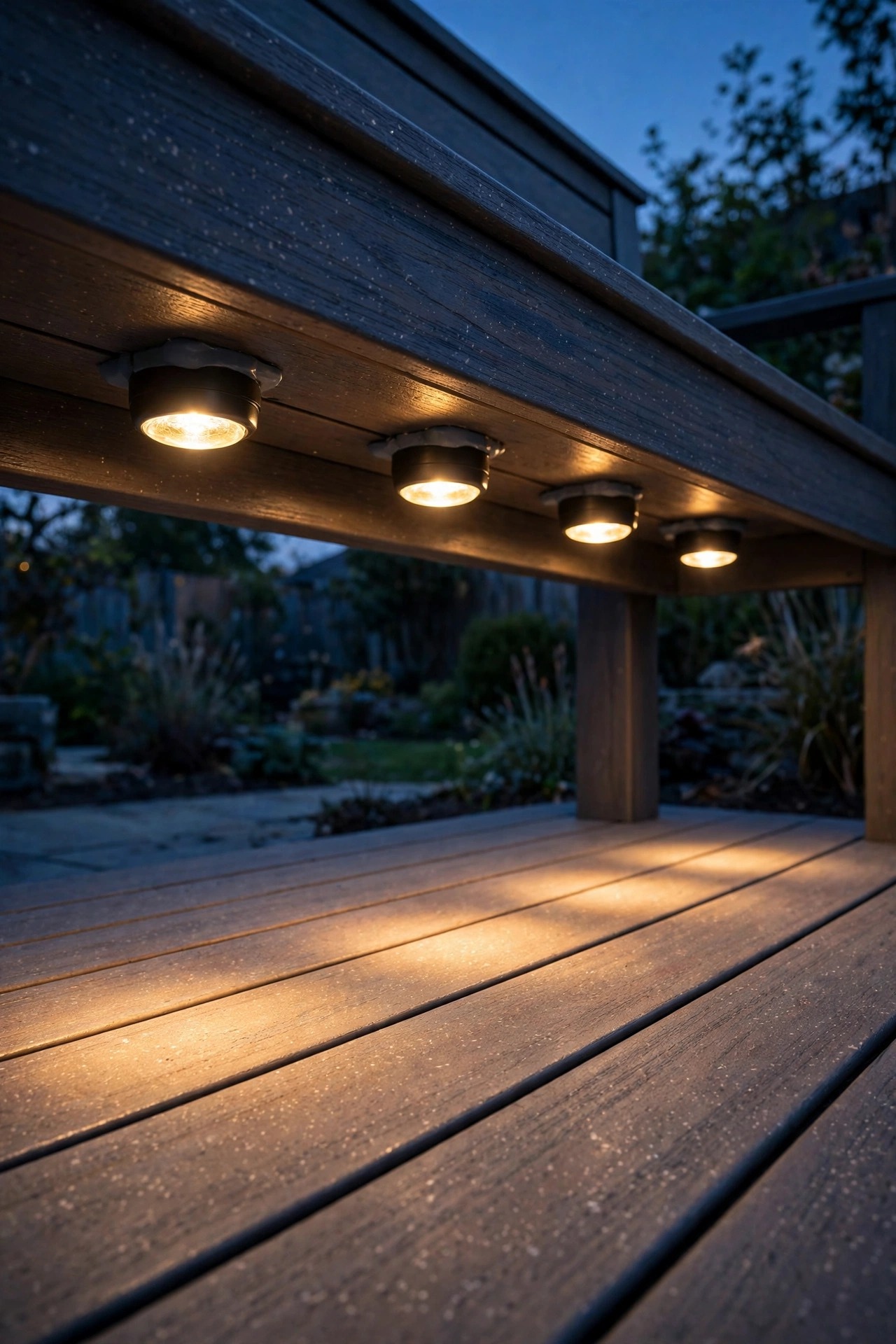
Rail-hugger lights are shaped like an upside-down L or a wide hook: the short leg drops over the outside of your top rail, the long leg hangs down the inside face, and the whole fixture stays put by gravity and a snug fit. No screws, no pads, no clamps — you simply hang them like ornaments. Inside the hanging face sits a downward LED that pools light onto the deck boards beside the railing, exactly where people step off furniture and navigate with drinks in hand. I space them every 4 to 6 feet and skip the stretches behind tall planters. Because they hang rather than attach, you can gather them up before a storm, rearrange them for a party, or move every one to the sunny side of the house for a midwinter recharge. Look for versions sized to common rail widths — a too-loose hugger rattles in the wind, which is the only complaint I ever hear. Solar panels sit on the top face, so give them a quick wipe when you water the planters.
Suggested budget range: $40 – $100.

10. Clamp-On Post Spotlights for the Grill and Games
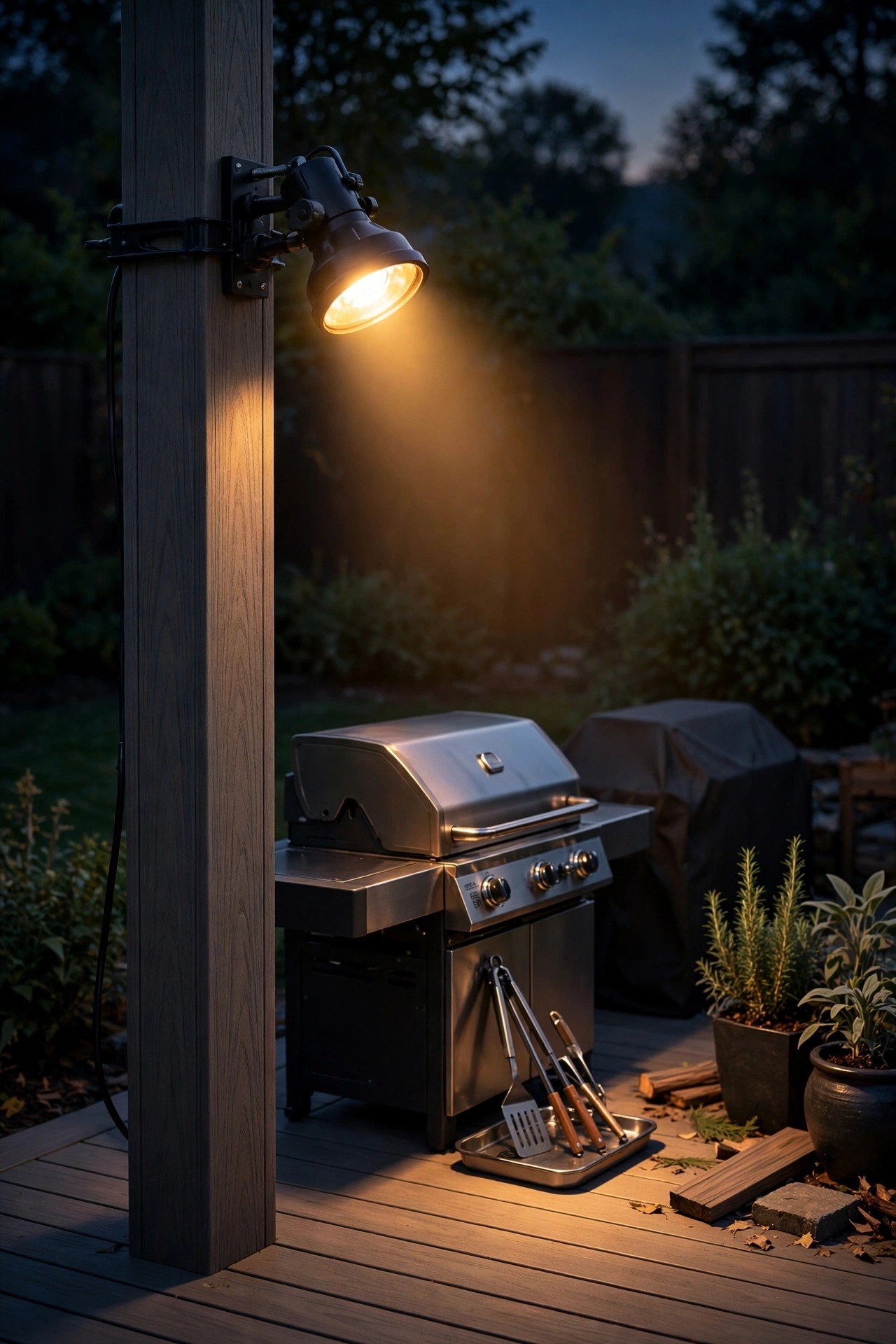
Every deck has one job that needs real light: reading the grill thermometer, dealing cards, finding the cornhole bags. A clamp-on spotlight with a C-clamp or heavy spring jaw bites onto any railing post — structure, not boards — and aims a focused beam exactly where the work is, then comes off when the party ends. Battery models with a separate solar panel on a short cable are my favorite, because you park the panel on top of the post in full sun while the head works in the shade below. Look for 300 lumens or more, an adjustable gooseneck or tilting head, and a warm-to-neutral 3000K to 4000K temperature so food looks appetizing, not amber. One clamped at the top of the stairs doubles as a motion light for late arrivals if you choose a sensor model. I keep two in the deck box all season. Zero install, zero holes, and they earn their keep every single weekend from May through October.
Suggested budget range: $25 – $75.
11. Freestanding Solar Lanterns — the Most Portable Composite Deck Lighting Ideas
When people ask which composite deck lighting ideas I use most at my own house, the honest answer is lanterns. A freestanding solar lantern needs no attachment whatsoever: set it on the deck, hang it from a shepherd's hook at the corner, group three on the wide step by the door. Tall lantern frames with a solar panel in the lid charge all day and glow from dusk, and the flameless-candle inserts give you that flicker without wax on your boards or an open flame near the railing. I cluster them at three heights — floor, bench, table — because uneven heights are what make a deck feel styled rather than equipped. Metal frames in matte black or oil-rubbed bronze disappear against composite railings; woven rattan shades suit the boho decks. Move a pair to flank the cooler for a party, line the steps when guests leave after dark, then set them back. They are also the one idea here that works identically on a patio, a balcony or a dock, so they never become wasted money if you move.
Suggested budget range: $30 – $120.

12. Magnetic Lights for Metal Railing Systems
Here is a trick most people never think of: if your composite deck has an aluminum or steel railing — and a huge share of modern composite rail kits are powder-coated aluminum — a fridge magnet will stick to it, which means magnetic LED light bars snap on anywhere along the rails and posts. These slim rechargeable bars park under the top rail to wash the boards, cling to a post at eye level for a conversation glow, or ride on the stair rail as a motion-sensing guide light. USB charging means no battery drawer, and most run 8 to 20 hours per charge depending on brightness. Test your railing with any magnet before ordering; if it slides off, your rails are vinyl or composite through and through, and you should use the clip-on ideas instead. For metal-rail owners, though, this is the cleanest system I know: reposition in a second, pull them indoors for a fast charge, and there is not so much as a sticky pad left behind.
Suggested budget range: $25 – $70.

13. Motion-Sensor Solar Lights Strapped to the Posts
Security and welcome-home light does not need screws either. Many solar motion lights now ship with slotted backs designed for straps, and a UV-stable hook-and-loop strap or a wide zip tie cinched around a railing post holds them rock-solid with nothing penetrating anything. Mount them 6 to 7 feet up on the posts flanking your stairs, the gate and the path to the trash bins — the routes you actually walk at night. Output has jumped in recent years: 800 to 1,500 lumens with a wide 120-degree sensor is common, and adjustable sensitivity keeps the neighbor's cat from triggering a light show. I set mine to dim-glow at dusk, full brightness on motion, because a faint constant layer makes the deck feel occupied while the burst does the real work. For the post by the grill, choose a model with an always-on mode for cooking nights. Straps weather-check once a year is the only maintenance on my list.
Suggested budget range: $35 – $90.

14. Hanging Pendants and Lanterns From the Pergola or a Branch
Look up: the best no-drill light on a deck often hangs from something that is not the deck at all. Battery and solar pendant lights come with hooks and loops sized to drape over a pergola beam, a gazebo frame or a sturdy tree branch overhanging the corner of the deck. Over a dining table, hang the shade so the bulb sits about 30 to 36 inches above the tabletop — low enough to feel intimate, high enough to see faces and pass the potato salad. Rattan and woven shades throw gorgeous patterned light; simple metal farmhouse shades focus a brighter pool for games. Because nothing fastens to the deck, the boards stay pristine, and the fixture stores indoors over winter in about a minute. Weight matters: keep pendants under about 3 pounds on branches, and use a rated outdoor hook on beams. I run one pendant over the table plus two small hanging lanterns on the pergola corners, all on matching warm 2700K inserts, and dinner guests always ask who wired it. Nobody did.
Suggested budget range: $45 – $140.

15. Snap-In Baluster Lights for a Dotted Line of Glow
Between every pair of balusters there is a slot just waiting to hold light. Baluster lights are small wedge or clip fixtures sized to snap onto a spindle or wedge into the channel where balusters meet the rails, and a slim low-voltage cable daisy-chains them together, hidden in the shadow line under the bottom rail with adhesive cable clips. The result is a dotted rhythm of soft pools along the whole railing — subtle, architectural, and low enough never to glare. Because the clips bite the balusters and rails rather than the floor, your boards stay completely untouched. Solar baluster lights exist too, each with its own tiny panel, though wired low-voltage sets look more even on long runs. I suggest one light every third or fourth baluster; filling every slot reads busy and doubles the cost. This is the layer guests photograph, because at dusk the railing seems to sparkle at ankle height while the deck surface stays calm. It pairs beautifully with plain post caps on the corners for a finished frame.
Suggested budget range: $60 – $150.

16. Flameless Candle Clusters in Hurricane Lanterns
For pure atmosphere at table height, nothing beats a cluster of flameless candles — and on a composite deck they are also the practical choice, because real candle wax drips stain boards and open flames near dry leaves make me nervous. Group three LED candles of different heights inside a glass hurricane on the table, another pair on the steps, one big one inside a floor lantern by the door. The good ones flicker with a warm 2700K amber that is nearly indistinguishable from wax at conversational distance, and built-in 5-hour timers mean they light themselves at dusk every evening without you lifting a finger. Battery life runs to hundreds of hours, and remote sets let you switch a whole cluster from the kitchen door. Keep the look layered: candles are the sparkle, never the only layer, so pair them with any rail or post idea from this list for depth. At season's end they come indoors and become mantel decor. Zero wax, zero flame, zero marks on the boards.
Suggested budget range: $20 – $65.

17. Solar Path Lights Around the Deck Perimeter
Light the approach and you light the deck. A circle of solar path lights staked into the mulch or lawn at the base of the deck washes the skirting, finds the first step for guests arriving from the yard, and makes the whole structure read as a destination instead of a dark shape. Staking into soil touches nothing on the deck at all, which makes this the most warranty-proof idea on the page. Choose lights 12 to 18 inches tall with a defined downward beam rather than a glowing orb — you want pools on the ground and the bottom step, not glare at eye level. Space them 4 to 6 feet apart and always place one exactly at the foot of the stairs and one at the gate. Warm 3000K blends with the layers above. After a storm I walk the circle and straighten two stakes; that is the entire maintenance routine. If your beds are shaded, pick models with remote panels on short leads that you can lay in a sunny patch behind the shrubs.
Suggested budget range: $30 – $90.

18. Adhesive Light Bars Under Built-In Benches
Built-in benches are standard on composite decks, and the underside of the seat is a perfect hiding place for light that never touches a walking board. An adhesive LED bar or a short strip in a channel sticks to the bench's front underside — the furniture structure — and throws a toe-kick glow across the boards below, so the bench appears to float. It also lights the floor where people set down drinks and bags, which prevents more stubbed toes than any step light I own. Battery bars with motion sensors are ideal here: they wake as you approach the bench and sleep when the party moves on. For a wired feel without wiring, choose USB-rechargeable bars and swap them indoors monthly. Run one bar per bench section, centered, and keep the color at 2700K so it melts into the evening. This same trick works under the lip of a deck-side planter box or a serving ledge. Every host who has sat on my bench at night asks about this one, and the honest answer is: it is just a stick-on bar.
Suggested budget range: $25 – $80.
19. Clip-On Umbrella Lights for the Dining Corner
If your deck table has a market umbrella, its pole is a light fixture waiting to happen. Umbrella lights are donut-shaped discs that open, wrap the pole and click shut at whatever height you like — most hold 24 to 32 LEDs in a circle that shines down on the table and up into the canopy for a tent-like glow. Three brightness levels cover cards, dinner and a soft nightcap setting, and battery sets last weeks of evenings. It takes ten seconds to install and exactly nothing is screwed, glued or drilled. In my experience this is the single best light-per-dollar on any deck, composite or otherwise, because the table is where everyone actually sits. Pair it with dim surroundings — a couple of lanterns, the post caps — and the umbrella becomes a little room of light. When the umbrella comes down for winter, the disc stores in a drawer. Measure your pole diameter before ordering; most fit the standard 1 to 1.5 inch range.
Suggested budget range: $15 – $45.

20. Tiki Torches and Fire Bowls at the Deck Edge
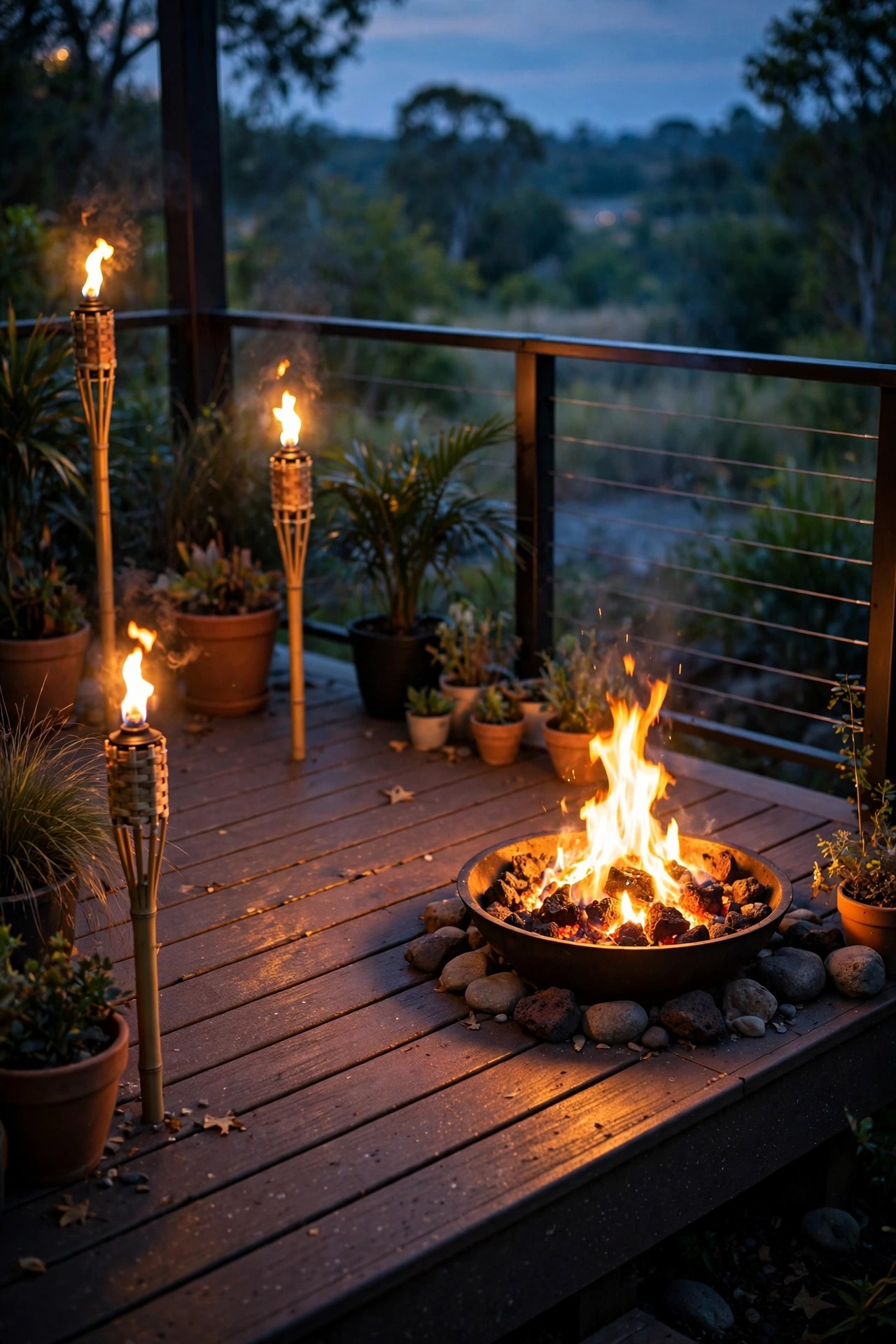
Real flame still wins for drama, and freestanding pieces keep it safe on composite. Tabletop fire bowls and torch stands sit on the deck rather than in it — set any open-flame bowl on a stone or metal heat mat, keep it at least 3 feet from railings and furniture, and never leave it unattended. The flicker animates the whole deck in a way LEDs imitate but never quite match, and a bowl at each end of the seating zone frames the space beautifully. If flame near the boards makes you cautious — a fair instinct — solar tiki torches with realistic flicker LEDs stake into the beds flanking the deck or stand in weighted bases at the corners, no fuel and no heat at all. I use the solar flames most weeknights and save the real fire bowl for Saturday guests. Either way, nothing attaches to the deck; the pieces lift away for cleaning day and the boards underneath look brand new.
Suggested budget range: $40 – $130.
21. Color-Changing Solar Lights for Party Mode
Finish the system with a layer that changes its personality: color-changing solar lights. Modern versions — bulbs for your stringers, cap lights, stake lights and even strip controllers — shift from everyday warm white to saturated color by remote or app, so the deck runs tasteful 2700K on Tuesday and full team colors on game day. Because every format here is solar, clip-on or adhesive, the fun costs your boards nothing. My advice is restraint: pick one layer to carry color, usually the string lights or the perimeter stakes, and keep the steps and rails warm white so the deck still looks like a home rather than a carnival. A slow color-fade scene behind the seating while faces stay in warm light photographs beautifully. Syncing two or three zones to one remote keeps it simple. This is the idea the grandkids request by name, and honestly, on the Fourth of July with the grill going, I am right there requesting it with them.
Suggested budget range: $40 – $120.

Frequently Asked Questions
Will drilling into composite decking really void my warranty?
It can. Most composite manufacturers exclude damage caused by improper fasteners, and coring a hole for a recessed light counts as altering the board — claims for that board are commonly denied. Rules vary by brand and product line, so check your warranty paperwork, but the safe play is simple: light the posts, rails, furniture and surroundings, and leave the boards exactly as installed. Everything in this article does exactly that.
Are solar lights bright enough to light a whole composite deck?
For atmosphere and safe walking, yes — layered solar caps, rail lights and step lights together cover a deck comfortably. For task work like grilling or reading, add one stronger piece: a clamp-on spotlight or a battery pendant. Solar brightness keeps improving, but layering three gentle sources always looks better than one harsh one, whatever the power source.
Will adhesive pads and clips damage the boards when I remove them?
No, when you use them the way this article suggests — on vertical or underside surfaces like risers, rail undersides, fascia and bench fronts rather than the walking surface. Outdoor mounting pads release cleanly with gentle heat and a slow peel, and clips and clamps leave nothing behind at all. Avoid sticking anything to the top of a deck board, where foot traffic grinds grit into the finish.
What color temperature looks best on composite decking?
Warm white, 2700K to 3000K, flatters both brown wood-tone and gray composite boards and keeps skin tones looking healthy in photos. Cooler 4000K-plus light makes gray boards look blue and clinical. Whatever you choose, keep every layer in the same range — mixed temperatures are the fastest way to make a deck look accidental instead of designed.
Conclusion
A composite deck is a decades-long investment, and it deserves light that treats it gently. Post caps that slip on, rails that glow from clip-ons and strips, steps lit by peel-and-stick solar, and lanterns that move wherever the evening goes — these composite deck lighting ideas prove you never needed the drill at all. Start with the steps and post caps for safety and structure, then add one atmosphere layer at a time until dusk becomes your favorite hour out there. When you are ready to plan the rest of the yard to match, browse my wider deck lighting ideas for layouts and layering plans that work with everything you have just installed.